Category Archives: Publishing

#amwriting: Morality and Conscience

Severus_Snape memeSeveral years ago, I posted on a writer’s responsibility in regard to portraying morality in his/her work. I think some of those ideas are worth rehashing.

Much of what I discussed back then still stands: When we write a tale that involves human beings, it is likely morality will enter into it at some point.

What is our responsibility as authors, when it comes to telling our tales?  Do we sugar-coat it and pretend our heroes have no flaws, or do we portray them, warts and all?

For myself, I gravitate to tales written with guts and substance. Works like L. E. Modesitt Jr.’s Scion of Cyador, where the hero is a man who struggles with ambition and the desire to have it all. He is a dutiful son, devoted lover, and loyal soldier, gifted with great ability that he must keep secret. He is also a cold-blooded murderer with an unspoken agenda, a man completely devoted to salvaging what he perceives as all that is good and beautiful in his world regardless of the cost. What (or who) does Lorn have to sacrifice in the end to achieve his ambition? And what toll does it take on him in the end?

I said this in my post three years ago, and I still say it: give me the Flawed Hero over the Bland Prince any day.

HTB Stamp copyIn my book,  Huw, The Bard, I describe a murder, committed in cold blood.  I take you from what is the worst moment in Huw’s life, and follow him as he journeys to a place and an act which, if you had asked him two months prior, he would have sworn he was not capable of committing. This terrible deed is not the lowest point in his tale.  It is, however, the beginning of his journey into manhood.

Does my writing the story of this reprehensible act mean I personally advocate revenge murders?  Absolutely not.  But I have lived for 62 years, and my view of morality is that of a person with some experience of life. Personally I believe  no human being has the right to take another’s life, or do harm to anyone for any reason.

Still, I write stories about people who might have existed, and who have their own views of morality. When writing, my characters stories don’t always follow the outline I had in mind for them. They sometimes go in directions I never planned for them to go, which throws my whole story-arc into disarray until I figure out how this new development fits.

In my first completed novel, I never intended for my main character and a companion to fall in love. They did though, and that took the story in a direction that was a surprise to me–and I think was one of my favorite side-plots.

In each story I write, I try to get into the characters’ heads, to understand why they make the sometimes terrible choices that change their lives so profoundly.

Some flawed heroes’ stories end well, and some don’t–those whose ends are less than happily are the tragic heroes.

hamartia definitionPepperdine University’s website says this about the tragic hero:

“Tragic Flaw (Hamartia): the tragic hero must “fall” due to some flaw in his own personality. The most common tragic flaw is hubris (excessive pride). One who tries to attain too much possesses hubris.” 

I believe authors have a responsibility to tell the best story they are able to tell, even if they are only writing for their own consumption.

This means sometimes I stretch the bounds of accepted morality, and make every effort to do it, not for the shock value, but because the story demands it.

I write stories for entertainment, yes. But more than that, I want the tale to remain with the reader after they have finished it. If I am somehow able to tap into the emotions of the moment, and bring the reader into the story, I have achieved my goal.

GRRM MemeMy life is a constant journey to the land of knowledge. I seek understanding, and sometimes I think I have a grasp on it…but not quite. More lessons await.

I am learning the skills of story-telling.  More than anything I want my work to  stand up and measure well beside the works of my literary heroes such as Tad Williams, Marion Zimmer Bradley, and George Saunders, great authors who describe terrible moments and conflicts of morality with such grace and understanding.

This may happen, or it may not, but I won’t stop trying because with every tale I write, I grow as a writer.

I read the words penned by those who have attained mastery of this skill, I am awed, and fired with the knowledge it can be done.

2 Comments

Filed under Publishing, Uncategorized, writer, writing

#amwriting: King Arthur: where history and fantasy merge

473px-Boys_King_Arthur_-_N._C._Wyeth_-_p214 Public Domain via WikimediaA few years ago I was challenged to write an Arthurian tale with a steampunk twist. I accepted the task, but immediately wished I hadn’t.

The first question I asked myself was: Where do Arthurian and steampunk connect well enough to make a story? The answer was–they don’t. I felt that block we all feel when the story will not reveal itself.

But, sitting on my back porch and letting my mind wander, I found myself wondering what Galahad and Gawain would have really been like. The people those characters were based on were men of the 5th or 6th century, ordinary men, and despite the heroic legends, they were made of flesh and blood.

And what if somehow Galahad got separated from Gawain through a door in time? How would Galahad get back to Gawain?  What if he was marooned in Edwardian England, with Merlin – can you say steampunk?

The title of that tale is Galahad HawkeThe original working title was I, Galahad. For every story, the title is a moot point for me, because any title I give it at the beginning will likely be changed when I rewrite it anyway.

The main character is Galahad Du Lac, son of Lancelot Du Lac, illegitimate, some have said, but is he really? If he is, it implies the fifth century was a lot less concerned about the proprieties than we give them credit for. His line of work–nobleman and hero. Thus, he goes on quests to find strange and magical objects such as Holy Grail.

The story was told from Galahad’s point of view. I opened the story just after the Grail was found.

What is the original story of Galahad that is bandied about most often?

Nowadays Galahad is a minor knight, but he figures prominently in Sir Thomas Malory’s 1485 work, Le Morte d’Arthura reworking of traditional tales that were hundreds of years old in his day.

480px-Schmalz_galahadTraditionally, Galahad finds the grail and immediately goes to heaven, raptured as a virgin – but was he? I mean raptured OR a virgin?  If he was not raptured, what could have happened to make medieval chroniclers think he was?

And why was this notion of a virgin knight and being taken to heaven before death so important to the medieval chroniclers that they would write it as though it was true history?

Well, they were writing some 300 to 400 years after the supposed event, during the final decades of the Crusades. Religion and belief in the Christian truths espoused by the Church was in the very air the people of the time breathed. All things of this world were bound up and explained in ways relating to the Christian traditions of the day.

Literature in those days was filled with religious allegories, the most popular of which were the virginity and holiness of the Saints–especially those Saints deemed holy enough to be raptured. These people did not have to experience death, but instead were raised while still alive to heaven where they spent eternity in Gods presence.

Death was to be feared–a constant companion, and if possible, one to be avoided.

The concept of a knight pure enough in God’s sight to be raised to heaven was a popular centerpiece of medieval tales.

According to the fount of all knowledge, Wikipedia: “Medieval literature is a broad subject…the literature of this time was composed of religious writings as well as secular works. Just as in modern literature, it is a complex and rich field of study, from the utterly sacred to the exuberantly profane, touching all points in-between.”

SO, lets talk about Geoffrey of Monmouth. He was a Welsh cleric whose work was the foundation for the development of British historiography and the popularity of tales of King Arthur. He is best known for his chronicle Historia Regum Britanniae (“History of the Kings of Britain”), which was wildly popular in its day and was uncritically accepted as true history well into the 16th century. It has been translated into various other languages from its original Latin, but is now considered historically unreliable.

220px-Sir_Galahad_(Watts)The High Middle Ages were a golden period for historical writing in England, but the craft of history was not an academic subject taught in school. It was something enjoyed by well-educated men of learning who were all men of the Church, but  was not subjected to the process of verification and research that we attempt to apply to academic subjects today. The gathering of historical tales was a hobby for educated men who had the time, social position, and the talents to pursue it.

As a result, the histories from this period are highly questionable–but are quite entertaining and are great fantasy reads. I always think that if J.R.R. Tolkien had been writing history in a monastery during the 7th and 8th century, The Lord of the Rings would have the same place in our historical narrative that the Arthurian Cycle has now, and Aragorn would have been the king who united all of Britain.

Galahad_grail_detailKnowing that history and fantasy merges in the Middle Ages, I approached my story by asking these questions:

  1. What does Galahad have to say about his story?
  2. How does he end up separated from Gawain
  3. How does he end up in Merlin’s company
  4. Why are they unable to get back to Gawain? What is the reason the magic no longer works?
  5. What do they do to resolve the situation?
  6. How does the tale end – does Galahad get Gawain back or is he permanently adrift in time? I wrote it two ways and picked the one that moved me the most.

This short-story appears in the novella, Tales From the Dreamtime.  However–for the last few days, the idea of what happened next has been percolating in my mind. I think Galahad may have another tale in his future.

6 Comments

Filed under Fantasy, Literature, Publishing, writing

#amwriting: 3 steps for keeping the story straight

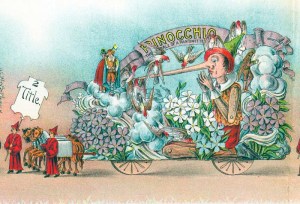
1916 Momus Pinocchio via Wikimedia CommonsEvery liar knows it’s difficult to keep a story straight–the story keeps evolving and soon it’s out of control.  However, writers, those spinners of awesome lies on paper, must devise ways to avoid this little problem.

Some people use a program called Scrivener which is not too expensive, but which seems to have a tricky learning curve. I downloaded the free version but couldn’t make heads or tails of it and found it quite frustrating. Nevertheless, I understand that it works well for many people, and to them I say, “Good for you.”

For myself, I don’t want a fancy word-processing program. I just use MS Office, because I have been using the programs that come with that software since 1993, and I’ve been able to adapt to each upgrade they have made. It’s affordable, so I use Word to write and edit in, and occasionally use Excel  to make small charts that are my style guides for each  novel or tale I write, and also for every book I edit.

Helpful tip #1: Create a style sheet for every work-in-progress. Whether it is a handwritten list or spreadsheet–keep track of what you named people, places, and things.

Bleakbourne Style Sheet

By creating a visual guide that I can print out or  keep minimized until I need it, I will not inadvertently contradict myself later on in the tale. This particular chart is the style-sheet for a serial I am writing for Edgewise Words Inn, a small online blogzine.

Lets consider Lord Tenneriff, the name of a minor character. Because I noted it on the style sheet and gave a small explanation when I first used it, I will always remember that Lord Tenneriff was spelled with two ‘n’s and two ‘f’s, and with no ‘e’ at the end of it.  The heading of the sheet is like this:

Character Name       Word 1st appears      Other names       Meaning?

            Jason Tenneriff              chapter 1                                                      a local lord

                                                         chapter 2                   Bleakbourne             a village

By listing out the names of every character no matter how minor, even the horses, I will not have a continuity problem by the time I hit chapter 14 of this series. For my editing clients, I also list all magic spells, every god, demon or dwarf that comes into the tale. Anything that is named goes onto that style sheet exactly the way it was first mentioned, the chapter it was first mentioned in, and the brief description of what it means.

Every author has a different way of visualizing these things, and this is what works for me.

Helpful tip #2: Map it out:

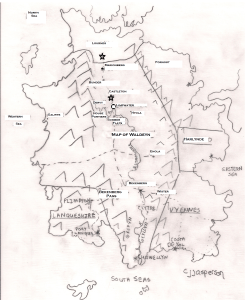
Map of WaldeynSo how do you visualize your country and the world you are creating? I have discussed this before–I draw maps.

They start out like this, all blotchy and hand-drawn, with whiteout covering the changes. After a while of refining them they end up looking more like real maps.

Its a gradual process, and the actual shapes and where the places are will evolve throughout writing the tale, but it will remain basically that way.

Many authors will use locales they are familiar with for their fantasy maps, just changing the names of major cities.  This is a good way to do it, because your world is already well defined for you, and Northwesterners know that Portland, Oregon is about 170 miles south of Seattle, Washington.  You are safe using currently existing terrain.

map of Waldeyn 2015 with lettering cooper black copyBut safe isn’t exactly my thing, so I had to invent both the world of Waldeyn (Huw the Bard), and the World of Neveyah (Tower of Bones). This is what the hand-drawn map of Waldeyn from above has evolved into————>

Helpful Tip #3: Version control:

When we first begin to write seriously we learn how critical it is to have proper naming of our files to ensure version control.  The most recent file will usually be the best edited unless you have accidentally saved an earlier version over it. ALWAYS use a separate file for each version, and ALWAYS use consistent file labeling practices to avoid this tragedy!

Use good file labeling practices, even if you have a fancy program that handles structuring your manuscript.

As an editor, I am particularly careful how I name the files of my clients.

  1. I use a specific sort of naming system. It will ALWAYS be Book_ AuthorName_script.doc .
    This is the main file folder for this book and this author!
  2.  The file folder will contain everything that pertains to this author and his work. There will be at least two folders in this file, and can have up to six. Version control is critical, so proper naming of the files is absolutely essential. If he should ever lose his files, I will have the most recent version on hand.
  3. The raw manuscript in its entirety is saved in this file, and I will name it:
  •  Book_ AuthorName_rawscript.doc

There will be 2 files for every step of the process this manuscript goes through with me: One file will be from the author’s desk to me, and the other will be from my desk to the author.  I will break the raw ms down into chapters, and label each chapter in that file consecutively:

  • Book title_Ch1_ author initials_cjj_edit_rnd1.doc

This tells me that this is Book A, chapter 1, by Author SoAndSo, and was edit round one of that ms.

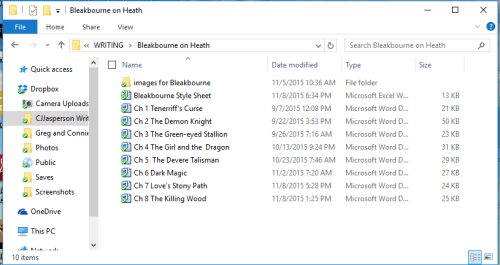
For my own work I label the files uniformly, like this: The main folder will be labeled with the working title, such as Bleakbourne on Heath. Inside the main folder will be the style sheet, and any images that will be used, including maps if needed.

Version Control 1

These three tips, creating a style guide, drawing a map, and labeling your files so you have good version control will help you navigate the shoals of the authoring business. You will always know who you are talking about, where you are, and you will be working in the most recent version of your work.

3 Comments

Filed under Publishing, writer, writing

#amwriting: avoiding #nanowrimo pitfall number 1


NaNo-2015-ML-Badge-Large-SquareOne thing we authors often do is forget to use contractions in dialogue. If you ever plan on publishing that manuscript, DON’T FALL INTO THAT TRAP!

In some ways, this habit is fostered by participating in NaNoWriMo, National Novel Writing Month. The goal is to write a 50,000 word novel in 30 days. Word count is king, and new authors are sometimes advised not to use contractions to get the all-important word count of 1667 words per day.

I don’t recommend that to the Wrimos in my region because I want their manuscripts to be worth reading, and crawling through a manuscript and inserting contractions in the second and third draft are daunting tasks, even with a sharp-eyed editor helping to spot them.

Dialogue that is too formal is awkward and unnatural to the reader.

“I shall not be attending the party. I have a previous engagement to go whale-watching.”

That’s a whole lot of awkward.

long_live_dead_languages_latin_poster-r90bf04eb9e534fd48a8e4149dadac2aa_vhzd_8byvr_512

………………Long Live Dead Languages……………

While I might say something like that in a joking fashion to my sister or to a friend, in reality (and if I was writing dialogue) I would use contractions. I would also use what I personally think of as common phrasing. Fact–unless I work hard to change it, my written dialogue sounds like a Pacific Northwesterner, because that is who I am.

“Sorry, I can’t go to the party. I’m going whale-watching that day.”

When it comes to dialogue, your characters need to speak in expected ways. Remember, the reader’s eye is the “ear” through which they hear the dialogue. Nothing should stop the eye from moving on to the next sentence.

Feel free to break the rules of grammar if your character shows a blatant disregard for what’s correct. If on the first draft he wants to say, “I seen that movie last week. It were rubbish,” let him, at least on your first draft. You can tone it down on the second draft.  This is a way to show you, the author, the description of your characters. On the second draft, have him say, “I seen it last week–it was rubbish.” It still gets the point across, but doesn’t stop the reader’s eye.

However, in regard to a main character, or a prominent secondary character, it’s usually best to avoid trying to convey accent by altering spelling. It’s difficult and tiresome to read an author’s attempt to convey a cockney or an Irish accent, so use colloquialisms and speech patterns instead.

Having said that, there are times when a slight accent is appropriate. If the character is making a MINOR appearance, using an accent and colloquialisms will give the reader feeling that they know that character, without resorting to an info dump.

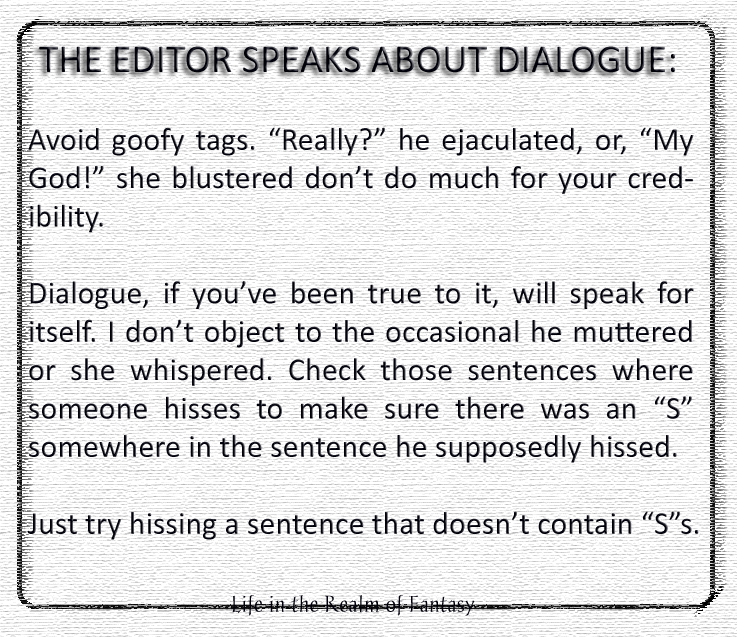
DialogueFancy synonyms for ‘said’ are usually unnecessary and distracting. And remember, people do not smile, snort or smirk dialogue. In fact, it is often best to do away with dialogue tags altogether, once you have established who is speaking though the visual cues

Sometimes, instead of using dialogue tags, miss a few “beats.” In script-writing, beats are little bits of physical action inserted into dialogue: John put the book down and looked out the window. Sarah turned and walked to the door. Used sparingly, they serve to punctuate the dialogue, to give the scene movement, and to maintain a strong mental picture in the absence of description. They are often best placed where there is a natural break in the dialogue, as they allow the reader to experience the same pause as the characters.

crest-bda7b7a6e1b57bb9fb8ce9772b8faafbBeats are an effective tool and are essential to good dialogue, but don’t overdo it. If your characters are fluttering their eyelashes, gazing into the distance or opening their laptops between every second line of conversation, the scene becomes about the action and not the dialogue, and the impact is diluted or lost entirely.

And finally, don’t get too creative with dialogue tags. Stick to ‘John said.’  Unless you absolutely need a John screamed or a Elizabeth uttered or a Joan retorted (which you pretty much never do) just say it and let the reader’s imagination do the rest.


9 Comments

Filed under Publishing, Uncategorized, writing

#amwriting: creating religion within the context of the tale

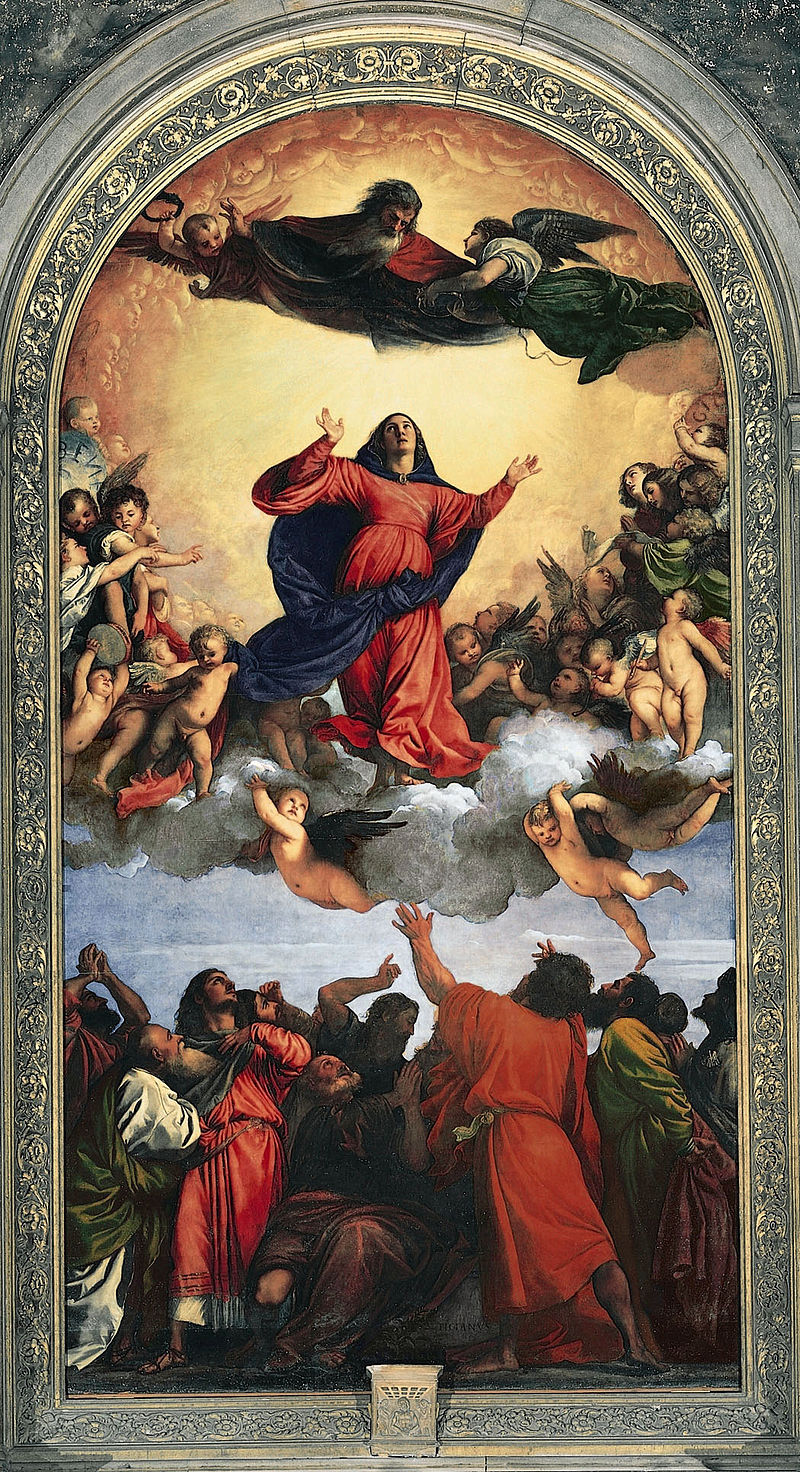
Assunta, by Titian, 1516-1518, via Wikimedia Commons

Assunta, by Titian, 1516-1518, via Wikimedia Commons

One thing we fantasy authors must occasionally deal with is developing religions within the context of the tale.

Most of what we will discuss here won’t actually make it into the written pages of your tale, but if you don’t have a good understanding of what you are writing about, you will inadvertently introduce discrepancies into your tale.

First, ask yourself “why does this religion matter?”  If it doesn’t matter, it doesn’t belong in your tale.

However, when you have a heavenly power-struggle, you have some intriguing opportunities for mayhem.

Are there many gods and goddesses? What is their relationship with each other and how does it play into your story?

If you choose to create a religion as a key plot point, here are some questions to ask:

  1. How central to the life of the protagonist or antagonist is religion? Is the protagonist a member of the priestly class, perhaps a priestess or priest of a particular god or goddess?
  2. What does the protagonist gain from following this deity?
  3. How jealous is this deity?
  4. What is the protagonist/antagonist willing to do for their faith? Will they die for their deity or is it a more abstract religion?
  5. The priesthood—who can join?
  6. Can only the nobility rise in the priesthood, or can anyone with the ability to learn gain power within the organization?
  7. How do the nobility and the priestly class get along? Do they have a good accord or are they jostling for power?
  8. And within that religious organization, who has the most power?
  9. What does that person do with their power?

How important is your religion politically? In Rome, the church was central to their government, in some cases having more power than the ruling nobility. During the Middle Ages, Rome slowly fell under the political control of the Papacy, which had settled in the city since the 1st century AD. In the 8th century, Rome became the capital of the Papal States, which lasted until 1870.

You don’t have to re-invent the wheel here–history is full of great ideas to draw upon.

A_Glass_of_Wine_with_Caesar_Borgia_-_John_Collier

Painting by John Collier, “A glass of wine with Caesar Borgia” via Wikimedia Commons

Consider the Borgias–Wikipedia, the fount of all knowledge says this about them: Especially during the reign of Alexander VI, they were suspected of many crimes, including adultery, incest, simony, theft, bribery, and murder (especially murder by arsenic poisoning). Because of their grasping for power, they made enemies of the Medici, the Sforza, and the Dominican friar Savonarola, among others. They were also patrons of the arts who contributed to the Renaissance.

See? Even George R.R. Martin knows that the renaissance offers great opportunity for good plot twists in your fantasy project.

Now let’s examine the political environments of the medieval city-states of Venice, Milan, Florence, Genoa, Pisa, Siena, Lucca, and CremonaRodney Stark, an American sociologist of religion, proposes that the city-state was a ‘marriage of responsive government, Christianity, and the birth of capitalism’ as we know it. He argues that these states were mostly republics, unlike the great European monarchies of France and Spain, where absolute power was vested in rulers who could and did stifle commerce.

It has been suggested (in Wikipedia, the fount of all knowledge) that by keeping both direct Church control and imperial power at arm’s length, the independent city republics of medieval Italy prospered because their commerce was based on early capitalist principles. The church was still involved in their daily lives, but this slight, deliberate separation of church and state ultimately created the societal conditions that brought about the artistic and intellectual flowering of the renaissance.

And for you, the author, understanding the commerce and economics of your fantasy society is extremely important, so that inconsistencies don’t get introduced. The reader won’t care, and doesn’t want the background info, but you need to know it.

If your protagonists are poor, why are they poor? Is poverty widespread, or is it only the one family? Where is all the money–is it in the hands of the church or is it in the hands of the middle-class? If it’s in the hands of the church–you’ve a good plot-point to work with.

Thus if religion of some sort is an integral part of your work, you as the author must have a good knowledge of what the influence of that institution is, the structure of the priesthood, the power they wield in society at large, how (or if) they control the economy, and how this organization is viewed by the ordinary citizen.

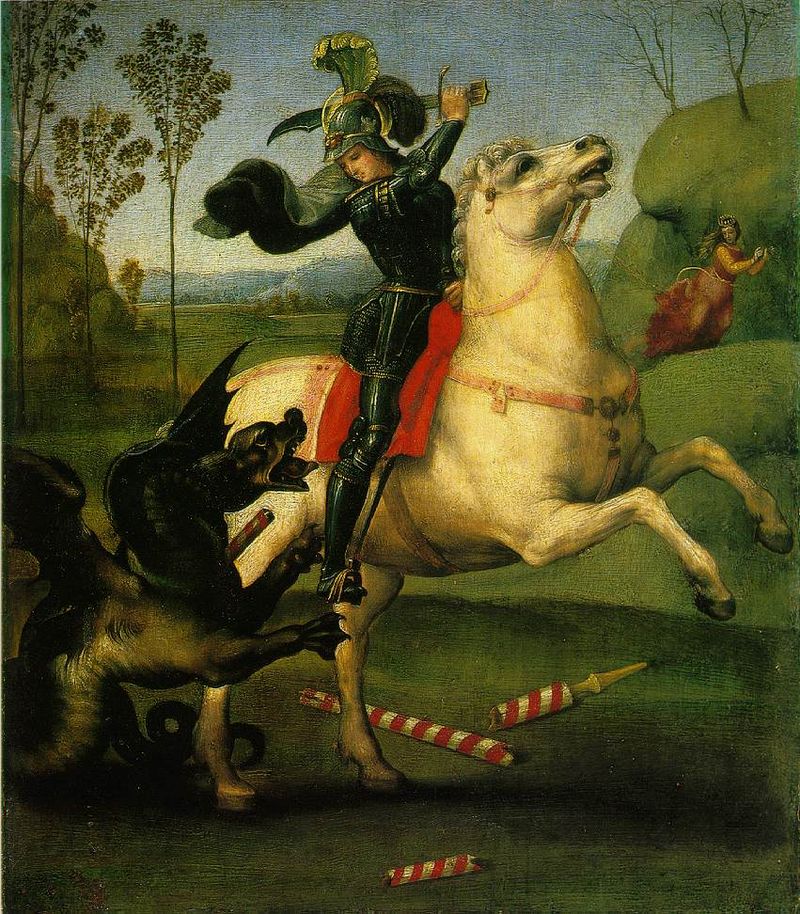
St. George and the Dragon, Raphael via Wikimedia Commons

St. George and the Dragon, Raphael via Wikimedia Commons

Many authors avoid this altogether, by having only a vague mention of religion, simply mentioning a connection with a particular deity as the reason for the ability to use and control magic.

Others make religion and opposing religions the foundation of their works. How you handle religion in your manuscript is up to you, but if you make it a central part of your tale, I suggest you create a document in which you establish the basics of your religion(s) clearly. Update it as the rules evolve, which they certainly will do over the first two drafts of your novel. During your writing process, refer back to this document regularly.

The reader doesn’t care about those details, and will put the book down if they are included. But if you don’t know what you are writing about, can’t remember what you wrote three chapter ago, and contradict yourself too often, your reader will lose the ability to suspend his disbelief.

Keeping the reader immersed in the tale, forgetting that it is only a fiction is the primary goal every author wants to achieve.

2 Comments

Filed under Fantasy, Publishing, Uncategorized, writing

#amwriting: getting the word out

Old Restored booksYou have finished your book. It has been professionally edited and proofed. You hired an expensive cover designer to make the perfect cover that is both professional and eye-catching. You’ve done all the important things at Amazon and Goodreads, making author pages at both places.

You made a professional Facebook page, you are blogging once a week, you’ve joined twitter and use TweetDeck or Hootsuite to schedule tweets, and check it every day and sometimes retweet interesting things for other folks you are following. You’ve even joined Pinterest and  Instagram.

This all good, but even so, after the first rush, sales have dwindled off, and now you are at a loss of what to do to increase the visibility of your work.

Some folks join mutual promotion groups on Facebook. I have found them to be more aggravating than helpful as I get spammed by the same two authors daily–they are nice people, but they have no sense of how irritating that is. People on Facebook lose interest when they see the same books all the time.

Also, I have found the “99 cent boost groups” to be not as beneficial in the long-run as they promote themselves to be.

I’ve not figured out the magic key to gaining traction rapidly, but I do know that my Goodreads ad pays off in terms of sales, as when I receive more clicks on the ad, I sell more of those books.

Writing short stories and publishing my work gets my name out there, and each time I publish a chapter of the Bleakbourne on Heath series, on Edgewise Words Inn, I see a jump in sales. From what I can see, the only way to get your author name out there is to publish your work.

Shaun Allan has had great success getting his name out via WattPad, as has Paul Coelho. Yes, you are giving your work away, but it introduces YOUR work to potential readers who will buy your other work–and these two authors’ sales are excellent.

Asking other authors to promote your work is not really a good idea, because they have their own work to promote, and your agenda doesn’t always mesh with theirs.

If you have been out in the indie world for any length of time, you may have observed this scenario: Author A, charming and talented Facebook friend, asks Author B to be a part of their personal fan-club, working to get Author A more recognition. Author B does not have time for that–he is trying to get his own name out there. The author who was ‘recruited’  is shocked, and saddened that a friend has so little understanding and such a lack of respect for his work that she would expect that of him, but he doesn’t want to be unfriendly and thinks “well, maybe it’s only this once.”

But it’s not only the once. It’s a never-ending stream of “push my book, push my book.”

When he realizes he is being used as her personal assistant and free publicity agent, he refuses, as he feels that she has no respect for him as an author. She has a temperamental fit and unfriends him. He warns his other friends to beware of that author. While her rudeness may have been unintentional, it was a bit of an eye-opener to those who know her casually, a clue about her true character.

I’ve seen that scenario unfold several times–sometimes talented people are supremely egotistical and only associate with others if they will gain something from that association. Once they have achieved what they wanted, they have no further use for their ‘friend’ and quickly move on to more important pastures.

I try to stay away from toxic professional relationships, and believe me, the opportunities for that are plentiful in many author groups. When I like another author’s work, I would love to see that author succeed. If we are friends and they need a signal boost for a new book or an event, I will gladly tweet and perhaps mention what I like about their work on my blog. I will even mention that they are having an event, and will be signing books.

But I will not be their private publicity agent.

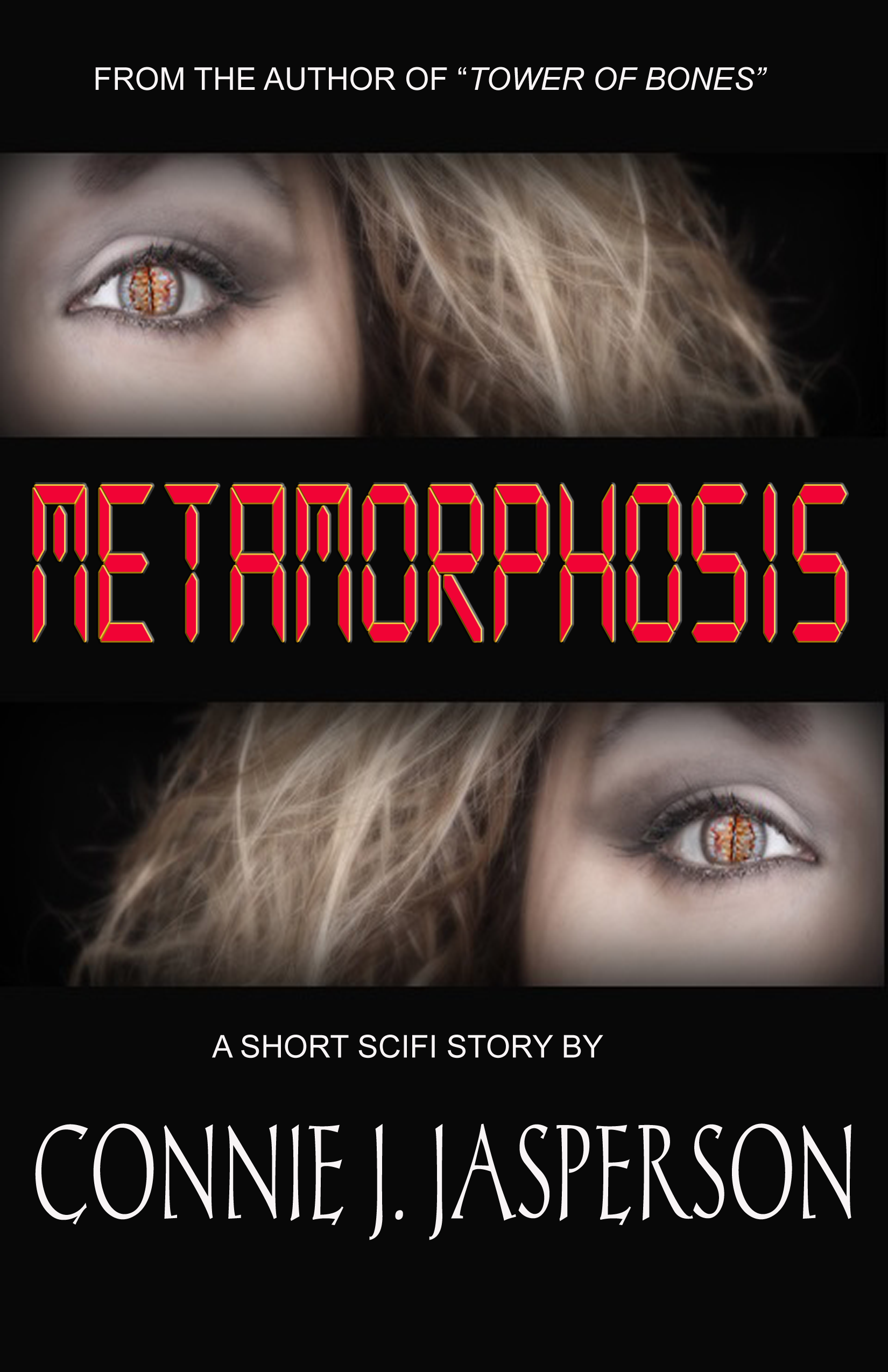
MetaMorphosis cover for WattPad copySo even though you desperately want to increase your visibility and sales, you have to be careful how you go about it. For indies, this is the sort of thing that has to flow two ways–Author A must support Author B as much as he/she expects Author B to support him/her.  Boosting the signal is a real bonus, and if a friend does this for you it should be reciprocated.

So do yourself a favor: post short stories on WattPad, and keep submitting to magazines and anthologies. Success is rarely an overnight thing–it is the culmination of the long hours and efforts you put into it.

Read METAMORPHOSIS on WattPad.

4 Comments

Filed under Publishing, Uncategorized, writing

#MindWandering: The Power of Downtime

Veneto,_Bartolomeo_-_Lucrezia_Borgia_(alleged),_detail_of_portraitDaydreaming…wasting time…selfish indulgence, or fountain of creativity?

WebMD says, quote:  “Daydreaming is looked upon negatively because it represents ‘non-doing’ in a society that emphasizes productivity,” says John McGrail, a clinical hypnotherapist in Los Angeles. “We are under constant pressure to do, achieve, produce, succeed.”

Wikipedia, the fount of all knowledge, describes Daydreaming as “a short-term detachment from one’s immediate surroundings, during which a person’s contact with reality is blurred and partially substituted by a visionary fantasy, especially one of happy, pleasant thoughts, hopes or ambitions, imagined as coming to pass, and experienced while awake.”

Apparently we daydream less as we get older. I wonder, is this nature, or nurture?

What really happens when we allow ourselves to just sit and think about nothing in particular? What happens on a neurological level when we let our minds off the leash, to run free and unencumbered?

One interesting fact is that apparently, if we daydream about the past, we tend to forget what we were doing before the daydream started. This happens to me all the time.

But most people don’t ponder the past. “Daydreaming is often about anticipating the future, especially in a fantasy context,” noted Peter Delaney, a psychologist at the University of North Carolina, Greensboro, in the July 3, 2013 issue of National Geographic.

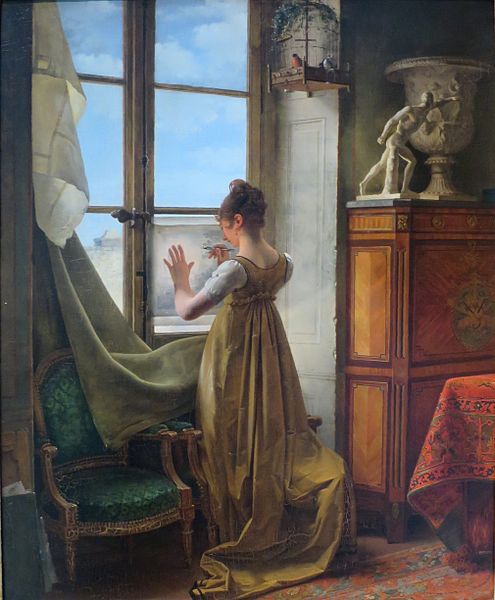
'A_Girl_Copying_a_Drawing'_by_Martin_Drolling,_Pushkin_Museum PD 100 via wikimedia commonsAnd according to the Daily Mail, Prof. Moshe Bar, of the Gonda (Goldschmied) Multidisciplinary Brain Research Center, said, “Over the last 15 or 20 years, scientists have shown that – unlike the localized neural activity associated with specific tasks – mind wandering involves the activation of a gigantic default network involving many parts of the brain.”

Also, I have just learned that daydreaming turns off parts of your brain. It’s true–our brain has an analytic part that helps us make reasoned decisions, and an empathetic part that allows us to relate to others. Researchers have discovered that when you are daydreaming, your mind naturally cycles through the different modes of thinking, analytic and empathetic. Apparently, during this time the analytic and empathetic parts of your brain tend to turn each other off.

Another intriguing thing I have only just found out is that the physiology of the brain itself, and not the “mind” controls our daydreams. Anthony Jack, a cognitive scientist at Case Western Reserve University in Ohio says, “How we daydream and think depends on the brain’s structure. …(That) structure is constantly changing in small ways—as we learn new things the connections between nerve cells change.” (Read “Beyond the Brain” in National Geographic magazine.)

We have long known that creative people are often guilty of daydreaming, but researchers have shown that daydreaming makes you more creative.

“Many times the ‘dialogue’ that occurs when the daydreaming mind cycles through different parts of the brain accesses information that was dormant or out of reach,” notes Eugenio M. Rothe, a psychiatrist at Florida International University. “Likewise, the daydreaming mind may make an association between bits of information that the person had never considered in that particular way.”

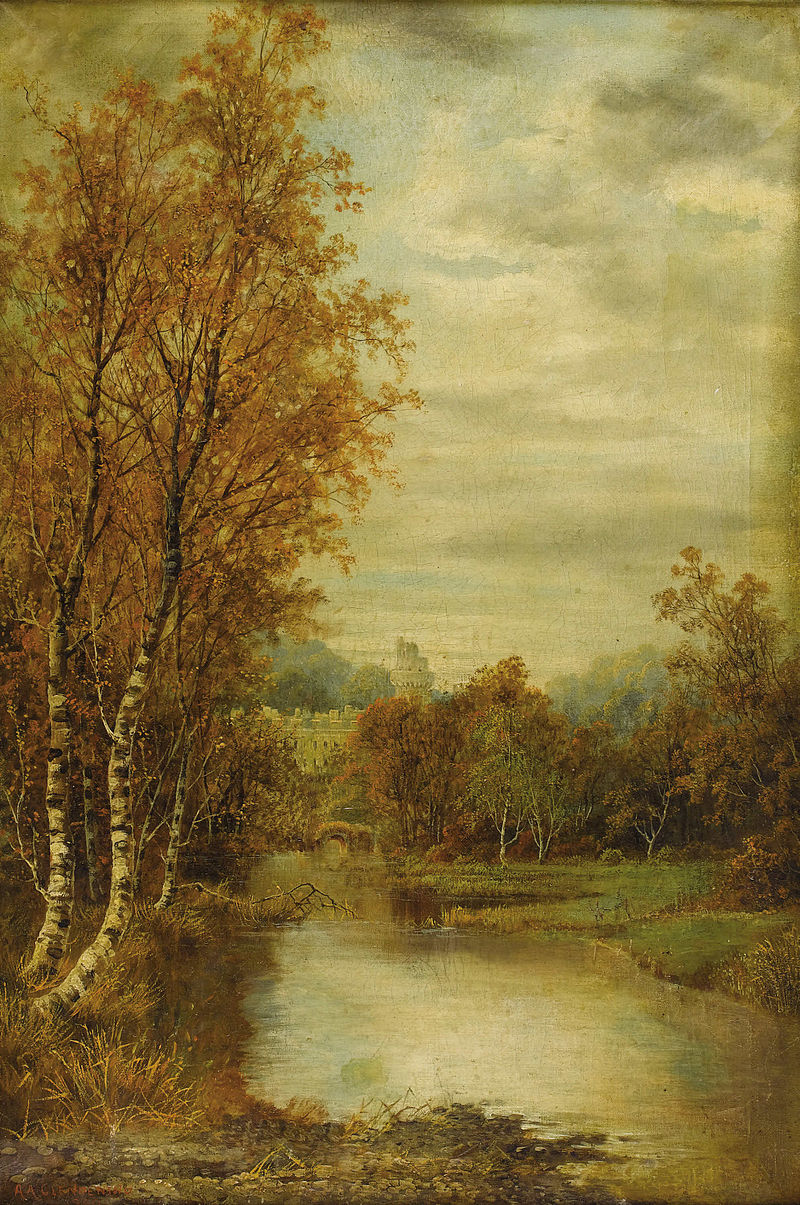
Autumn_Landscape_With_Pond_And_Castle_Tower-Alfred_Glendening-1869According to a study published in the Proceedings of the National Academy of Sciences, a wandering mind can impart a distinct cognitive advantage.

This means that daydreaming is actually good for you. It boosts the brain, making our thought process more effective. Apparently letting the mind wander allows a kind of ‘default neural network’ to engage when our brain is at wakeful rest, as in meditation, rather than actively focused on the outside world. When we daydream, our brain is freed up to process tasks more effectively.

This is good to know, because as an author I spend an astounding amount of time daydreaming, and I would hate to be simply wasting time!

(This post was first published September 15, 2015 on Edgewise Words Inn)

9 Comments

Filed under Publishing, Uncategorized, writer

#amwriting: Theme: chaos or stability

Fall of Angels L E Modesitt JrA common theme in fantasy is the juxtaposition of chaos and stability, or order. Good versus evil is a trope of the genre, and  evil is usually portrayed by taking one or the other of these concepts to an extreme.

Author L.E. Modesitt Jr. has taken the theme of chaos and order and built his Magic of Recluce series around the comparison and contrasts of the two, with each side being given the protagonists’ POV in different books as the series progresses. He has been able to really explore the way each side’s magic is expressed, and the moral and ethical values that each side holds dear.

Both sides consider themselves morally superior, and both sides are wary of those who walk that gray path in the middle, which allows Modesitt real opportunities to put his protagonists through the wringer.

Trumps_of_doomThe late Roger Zelazney’s brilliant Chronicles of Amber series also details the distinctions between Chaos and Order, and moral and ethical challenges of those who travel from reality to reality through the shadows, with each shadow growing more radical depending on the distance from Castle Amber (which represents Order).

In several of his works, elements of each are combined freely and interchangeably. Jack of Shadows and Changeling, for example, revolve around the tensions between the two worlds of magic and technology, or order and chaos.

But what is chaos, and what is order ?

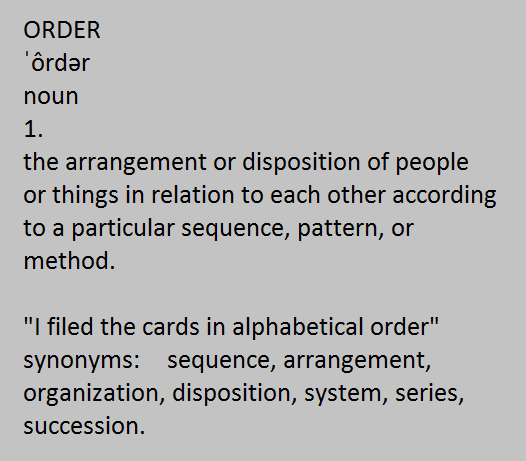
Google defines Chaos as

Chaos definition

Google also defines Order as:

order definition

Either side of the coin, when taken to an extreme, can be truly evil.

Consider chaos, or AnarchyWhen a culture descends into anarchy, you have an absence of government and absolute freedom of the individual. While this frequently begins as an attempt to allow for individual freedoms without state interference, history shows that what follows is the emergence of a violent culture that is beyond the reach of law.  There is no law and no one capable of enforcing it. The strongest, most violent thugs rise to the top and frequently war with each other, while the common person is caught in the middle. Followers of each warlord are rewarded with the spoils of conquest, which are often goods taken from the common citizen who must somehow survive under that tyranny.

war and peaceNow let’s look at order: totalitarianism, or total order can also be a form of tyranny: everything is static and nothing changes. There is centralized control by an autocratic authority, combined with the political concept that the citizen should be totally subject to an absolute state authority. No divergence from the norm can be tolerated, and good, obedient citizens are rewarded, while deviants who are seen to be free-thinkers, intellectuals, and artists are persecuted and imprisoned, or killed.

Anarchy=instability and a breakdown of society. Totalitarianism=lack of growth and stagnation of society. For most people’s comfort, a good society allows for both law and creativity.

In extreme types of societies, power is everything, and drawing negative attention to yourself is dangerous. Thus chaos-based societies are usually represented in literature as having an underlying order that holds them together, and order-based societies are often represented as requiring the ability to grow and change, but within certain parameters.

The theme of order and chaos can really power a story-line, and the way you perceive them will not be the way another author sees them. L.E. Modesitt, Jr. and Roger Zelazney couldn’t be more different in the way they portrayed these concepts.

If you haven’t read Zelazney’s works, I highly recommend them.

Comments Off on #amwriting: Theme: chaos or stability

Filed under Fantasy, Publishing, Uncategorized, writing

Yay! Its #friday

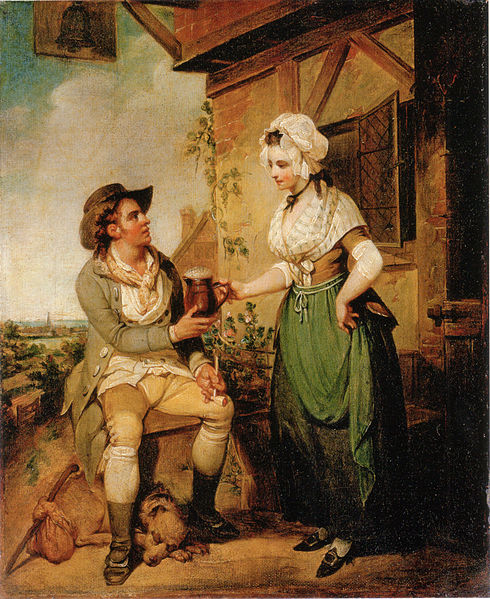
The Alehouse Door, by Henry Singleton via Wikimedia Commons

The Alehouse Door, by Henry Singleton via Wikimedia Commons

I wrote a lot of short stories last summer, which is good, because in short stories you have to be sparing with words.

This need for economy has really helped with my personal writing bugaboo, giving too much background info. When you are writing to a specific word limit, you have to choose your words carefully.

This means the only background that can remain in the tale is the minimum background that the reader must know for the tale to make any sense.

Some of what I wrote was a serial, for Edgewise Words Inn, a series of tales set in the village of Bleakbourne, on the Heath river. Bleakbourne is an unusual town, being the crossroads for the fae and mortal worlds. Many strange things happen there, and Leryn is the young bard who records it all.

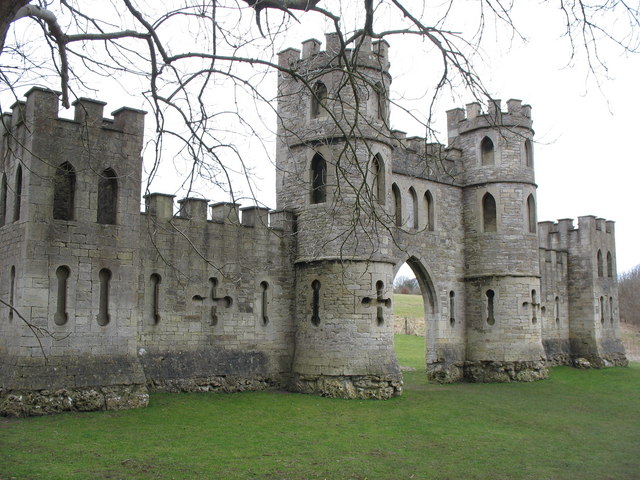
Ralph_Allens_Castle_-_geograph.org.uk_-_1762356Two installments have been posted, and several more are set to post as autumn progresses.

If you are curious, the link to chapter one is here: Bleakbourne on Heath: Tenneriff’s Curse and the link to chapter two, the Demon Knight is here.

That tale was inspired by a photo of a Castle Folly I saw on Pinterest. I love Pinterest, but I get most of my inspiration and ideas from Wikimedia Commons, just randomly searching the classical art there.

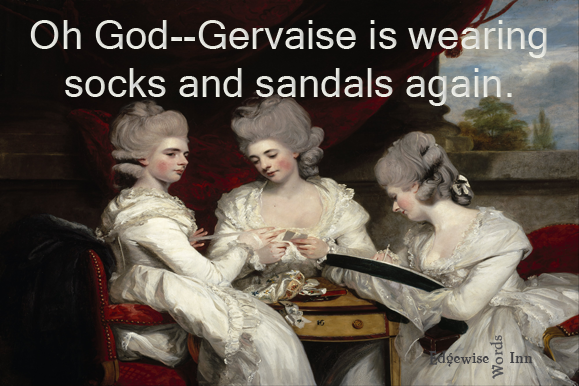
Socks and Sandals MemeI also find that lots and lots of time just sort of dissolves as I am doing that–perusing  the great art of the masters is as much of a time-eater as Facebook, but without the memes.

However, the temptation to turn them into memes is sometimes overwhelming. I look at them, and wonder what was going through their minds at the time the painter caught them. Probably it was “Please make him paint faster,” but you know I can just leave it at that.

Sometimes it’s hard to contain myself when these wonderful images give me so much food for thought.


If you happen to be at out and about Saturday the  10th of October, in the Renton area south of Seattle, stop in at the AFK E&E, and visit my friends who will be signing books and having a great time in general. They will be Reading in the Dark, and the event will run from 2:00pm to 9:00pm in the back left of the restaurant.

  • AFK Elixers & Eatery
  • 3750 E Valley Rd.
  • Renton, WA 98057

You will find these great authors: A.J. Downey, Jeffrey Cook, Lee French, Sechin Tower, Tina Shelton, and Shannon L. Reagan and several more. I can’t wait to see what they are offering us!

Comments Off on Yay! Its #friday

Filed under Humor, Publishing, Uncategorized, writing