Category Archives: Self Publishing

#amwriting: verbs, gerunds, and infinitives

Hamlet Poster Benedict CumberbatchA dear friend and I have been discussing gerunds. “Gerund” is a term (from our roots in Latin grammar) for a verb form that functions as a noun. Gerunds are nouns formed from verbs and they describe actions.

The gerund in English is usually identified by the addition of the three letters “ing” added at the end of an infinitive. For example:

  • “to be” is changed to “being”
  • “to eat” is changed to “eating”

So what is an infinitive? Basically, an infinitive verb is a verb with the word “to” in front of it:

  • to be
  • to have
  • to hold
  • to walk
  • to dream
  • to sleep

Without the word “to,” each of the above words is just a base verb. They are finite, limited. They are the action, end of story. When you add the word “to” in front of the action it is no longer finite—it becomes unlimited, or infinite: an infinitive. This lack of boundaries creates a passive voice when telling a story, and for some narratives it is appropriate.

However, we want our work to have an active voice if we are writing modern genre fiction, so we must do our best to avoid the overuse of infinitives.

When we first begin sharing our work in writers’ groups, we are shown instances of where the use of infinitives creates a passive narrative, separating the reader from the action. We choose to combat that by eliminating as many instances of these words as we can, and in some places, changing them into a more active form: the gerund.

A side bit of trivia: in modern speech, expressions such as “can’t stand,” “couldn’t help,” and “it’s no use” are frequently followed by gerunds:

  • I can’t stand running in place.
  • It’s no use harping at me; I won’t change my mind.

Traditionally, the gerund has four forms: two for the active voice and two for the passive. Consider the word “love,” a word that can either be a thing (a noun) or an action (a verb). For this exercise we are looking at the verb form:
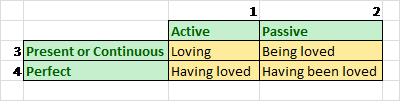
gerunds

You will note that one form is referred to as “Perfect” and you are wondering how this relates to our gerund. The word perfect literally means “made complete” or “completely done.” Thus, the three perfect tenses in English are the three verb tenses which show action already completed.

  • Present Perfect: I have seen it. (This is done. Finished. End of story).
  • Past Perfect: I had seen it. (It happened in the past. It’s done, so get over it.)
  • Future Perfect: I will have seen it. (Okay, it’s not done yet, but when it is, I will be the one to report that it is finished).

Consequently, having loved indicates that the act of loving is completed.

I mentioned that we sometimes avoid using a passive voice, by changing infinitives to gerunds.  But when should we NOT use a gerund? This just came up in my own work, prompting this bit of research:

One of my personal first-draft sins is the infamous “subject-less gerund-participial clause that is left hanging in space without an understood subject (this is known as the dangling participle). It happens to me most often when I begin a sentence with a gerund:

Being desperately poor, chocolate was scarce, as was milk.

In MY mind, as the writer, the word “being” in the above sentence relates to my character’s poverty. But a reader might stop and say “Huh? What?” To clarify that, I should say, The family was desperately poor. Chocolate was scarce, as was milk.”

GerundsThis tendency to inadvertently create confusion is why I try not to start a sentence with a gerund, unless it is the only way to express that thought and can be done in a clear, unambiguous fashion.

Also, we should not use gerunds with infinitives (to be, to do, etc.) UNLESS the word “to” is being used as a preposition. Remember this quick trick: if you can put the pronoun “it” after the word “to” and form a meaningful sentence, then the word “to” in that instance is a preposition.

For example:

  • to look forward to (it)
  • to be accustomed to (it)
  • to get around to (it)
  • to be used to (it)

It is important to recognize that the word “to” is a preposition in these cases because it must be followed by a gerund. It is not part of the infinitive form of the verb. (Prepositions may be defined as any word or group of words that relates a noun or a pronoun to another word in the sentence.)

An excellent page on this subject can be found at the University of Victoria’s ELC Study Zone: Gerunds. A quote from this page regarding gerunds and prepositions:

“But… only gerunds can be the object of a preposition.

“We are talking about writing in English.” (end quote)

I graduated from high school, but my formal education was somewhat lacking in this area. Either I was staring out the window when the teachers were talking about proper use of gerunds, or it wasn’t a subject we discussed–I don’t know. But somehow I didn’t pick up on it then.

Forty years on, I’ve formed certain writing habits and often use gerunds incorrectly in my first, second and even third drafts, which leads to confusing prose. The words made perfect sense when I wrote them, and I can’t catch them all when I am making revisions.

This is why a sharp beta reader and a good line-editor are lifesavers.

5 Comments

Filed under Self Publishing, writing

#amwriting: The second draft: effective revisions

My Writing LifeI am in the process of making revisions on Valley of Sorrows, the third book in the Tower of Bones trilogy. I’ve had trouble with this manuscript, not because I fell out of love with it, but because so many great characters have emerged that I lost the thread of the story.

Because I knew I had lost my way, I sent it to a friend, Dave Cantrell, who has done a structural edit and given me the pointers I need to get this back on track.

What happened to derail VOS is this: I lost track of the original story arc.

This is not an uncommon problem–writers tell me all the time how new and intriguing characters pop up and take their tale in a different direction.

Sometime this works out well. Other times, not so much. I have floundered for two years on this novel.

What Dave did at my request was far more intensive than a beta-read. He really went deep, looking at it from the standpoint of a reader and an editor, and asking himself what worked, what didn’t, and analyzing why.

So right now I am taking each chapter on an individual basis and looking at Dave’s comments. Every comment is designed to let me know why a particular plot point did or didn’t work, and where it became confusing. He was able to see where I lost the overall story arc and his comments give me a road-map to guide my efforts in building tension and ending this series with a strong finish.

I’ve said before that making revisions is not editing. Revising the first draft is a necessary part of the process that will get you to the editing stage.

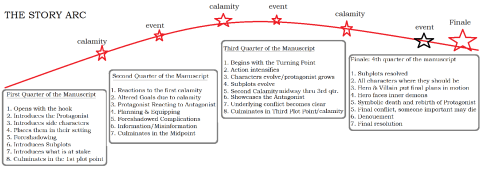
Most authors understand that there is an arc to the overall novel–the Story Arc  which  consists of :

  1. Exposition, where we introduce our characters and their situation.
  2. Rising Action, where we introduce complications for the protagonist
  3. Climax, the high point of the action, the turning point of the narrative
  4. Falling Action, the regrouping and unfolding of events that will lead to the conclusion
  5. Resolution, in which the problems encountered by the protagonist are resolved, providing closure for the reader.

The Story Arc

As I said, most of us understand this arc, but we can easily lose track of it when we are in the throes of writing our first draft.

At the 2014 PNWA Conference, in his seminar on the arc of the scene, author Scott Driscoll explained how the main difference in the arc of the scene vs the overall arc of the novel is this: the end of the scene is the platform from which your next scene launches.

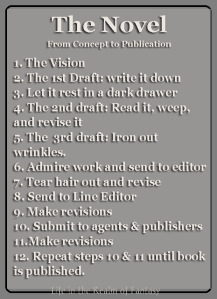
The Novel Meme LIRFSo as I am revising I am keeping in mind:

  1. Each chapter is a scene.
  2. These scenes have an arc to them: action and reaction.
  3. These arcs of action and reaction begin at point A and end at point B.
  4. Each launching point will land on a slightly higher point of the story arc.

I had lost the plot of this novel, so first I had to remind myself just what the series was about:

  1. This series deals with Edwin’s story.
  2. He is separated from his wife and child because of his task on behalf of the Goddess Aeos.
  3. Completion of his task takes us to the 3rd plot point of the novel
  4. Hunting  the acolyte of Tauron and the final battle in Aeoven resolves the story
  5. No conversation can happen unless it advances the plot of this story. EVERYTHING that does not pertain to this story can be cut, saved, and used later.

I have a goal of finishing this by the end of February. When I submit this to my editors, there will be more revisions–that is a given. But because of the work Dave has done, it won’t be the arduous rewrite it would have been.

8 Comments

Filed under Self Publishing, writing

#amwriting: Who are you? 4 steps toward building your brand

Who are youI have written a great many reviews for Best in Fantasy over the past two years. For each post on that site, I always try to include links to the author’s website. If I am unable to locate a website for them, I link it to their Amazon Author Page, or their Goodreads Author Page.

I can’t tell you how frustrating it is when I am unable to find a website to link to their review. It’s even worse when I find that their author page at Amazon is a blank canvas, and they haven’t bothered with Goodreads. I want to promote their work, but they are making it impossible.

Goodreads and Amazon offer you a central place to put both your author name and links to your work– where a prospective reader can locate it all in once place. If you do nothing else, you need to take advantage of that.

First: Lets start with your author bio–after all, each and every professional site you will want to connect with will want your official bio. For your own website you can go into as much detail as you want, but for most other sites you will want to keep it short, keep it simple, and make it intriguing. This is author Alison DeLuca’s short bio::

Hunted Heart by Alison DeLucaAlison DeLuca is the author of several steampunk and urban fantasy books.  She was born in Arizona and has also lived in Pennsylvania, Illinois, Mexico, Ireland, and Spain. Currently she wrestles words and laundry in New Jersey.

In real life Alison is an author, an editor, a founding member of Myrddin Publishing Group, a teacher, the mother of  a pre-teen, the wife of a rocket scientist, chef–but her bio focuses on her writing.

This is author Shaun Allan’s bio:

Dark Places Front Large (1)Shaun Allan is the creator of many prize winning short stories and poems. A writer of multiple genres, including horror, humour and children’s fiction, Shaun goes where the Muse takes him – even if that is kicking and screaming. Shaun lives with his one partner, two daughters, three cats and four fish!  Oh, and a dog.

Shaun also has a job, a family, a business, and a private life–but his bio focuses on his writing. Take a cue from these two authors and keep it simple, a little fun, and keep it short. Focus on your writing.

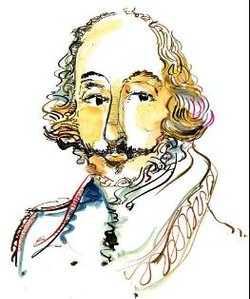
Wm Shakespeare author central portraitSecond: You will want to select an author photo to go with that bio. Choose one you like, and stick with it. You only have to update it every five years or so, if that often. Some authors never update it. This is William Shakespeare’s author photo on Amazon. He can get away with a cartoon, because, as a true renaissance man, he was never photographed.

(Medieval humor).

Third:  If you are a published author, create an Amazon Author Page. Log into Amazon’s Author Central. The following instructions are quoted from Amazon’s Author Central help page:

  1. Go to https://authorcentral.amazon.com/ and click Join Now.
  2. Set up your Author Central account if you haven’t already done so.
  3. In Author Central, click the Profile tab. You’ll see sections for adding or changing your biography, photos, videos, speaking or other events, and blog feeds.
  4. Click the add or edit link next to a section. Instructions appear, along with space to add information.

If you don’t add information to a section, that section does not appear on the Author Page. Sections are always available in Author Central so you can add or change the information later. By doing this, all your books will show up in one place, and you will have ONE link to showcase ALL your work, and it includes buy buttons.

Fourth: Create a Goodreads Author Page using the same bio and photo you used at Amazon. The following instructions are quoted from the Goodreads Author Program help page:

  1. If you are already a Goodreads member, make sure you are signed in. If not, sign up for an account.
  2. Search for yourself and click on your published author name. The author name is listed below the title of your book in the search results. If you are a writer but have not yet published a book, you may want to check out the writing section of your profile where you can post your writing for others to read and review.
  3. Clicking on your name takes you to your basic author profile page. This page has your name at the top and “author profile” to the right of your name. This page is part of our database of books and authors and is separate from your member profile page (which lists your bookshelves and friends).
  4. Scroll down to the bottom of the page. Click “Is this you?” to send a request to join the Author Program. Please give us a few days to process your request. You will receive email confirmation when we successfully upgrade your user account to an author account. Joining the program merges your author page with your member page. The email will also contain further instructions for managing your author profile.
CJJ_profile_pic_2013

Connie Jasperson 2013

I have two bios-one long and one short. They focus on my writing life.  You need both long and short, because some sites will ask for more and some will ask for less. The following is my expanded bio:

Connie J. Jasperson lives in Olympia, Washington.  A vegan, she and her husband share five children, a love of good food and great music. She is active in local writing groups, an editor for Myrddin Publishing Group, and is a writing coach. She is an active member of the both the Northwest Independent Writers Association and Pacific Northwest Writers Association, and is a founding member of Myrddin Publishing Group.  Music and food dominate her waking moments. When not writing or blogging she can be found with her Kindle, reading avidly. You can find her blogging on her writing life at: https://conniejjasperson.wordpress.com.

For my short bio, I use this: Connie J. Jasperson lives in Olympia, Washington.  A vegan, she and her husband share five children, a love of good food and great music. When not writing or blogging she can be found with her Kindle, reading avidly.

We have to make it convenient for our prospective readers to find our work. Remember,  your author name is your brand and your bio is your calling card. Your author photo, your bio, and your Goodreads and Amazon profiles are what will show up when your author name is googled, but only if you put them out there.

Getting your name out there is your job, whether you are an indie or traditionally published. Also, YOU must make sure your bio, author photo are updated more than once every five years.

These are small ways for you to connect with your readers, they take very little time, and unlike a blog, you only have to do them once and then just update them once in a while.

4 Comments

Filed under Publishing, Self Publishing, writing

#amwriting fantasy: creating the landscape

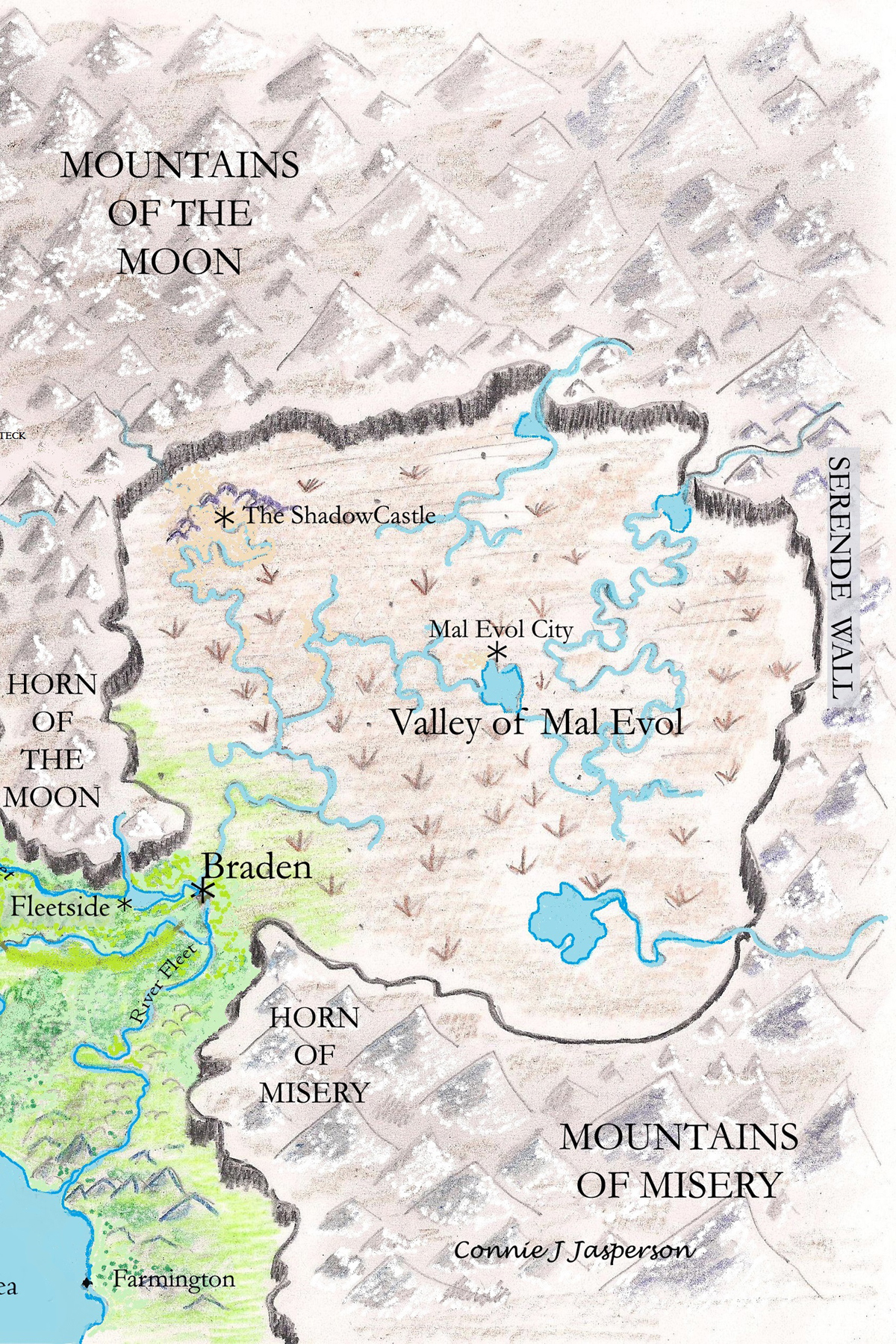
Map of Mal Evol, color full size, no roadsWhen I am reading a fantasy, I can get completely immersed, if the author has been kind enough to use a mix of familiar earthly landscapes to create his world.  Readers do need to have a small bit of “the known” to hang their imaginations on.

In my book, Tower of Bones, I write about a landscape that has been devastated, first by war, and secondly by the slow, deliberate poisoning of the environment.  The God, Tauron, seeks to change Neveyah into a copy of his own desert world of Serende.  At the time of our story, the immense crater Valley of Mal Evol is a wasteland of thorn-bushes and scorpions.  Few people live there, and those who do are slaves to the Legions of D’Mal, the minotaur soldiers of the Bull God.

The World of Neveyah is actually the state of Washington, in all its bipolar glory, but “on steroids.”

The God Tauron carved the Valley of Mal Evol out of the mountains when he imprisoned his brother. That created the landscape that was not unlike that of Eastern Washington, some of which was carved by a disaster. Before the disaster, this land was likely similar to the area around Spokane and toward Colville, prairies with large forests of lodgepole pines.

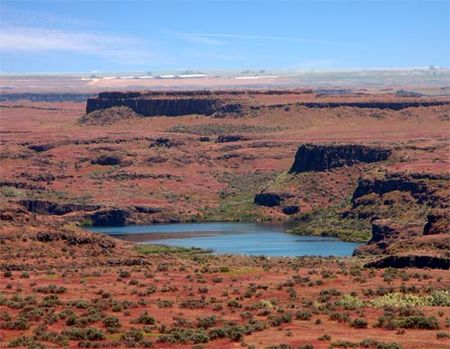
Drumheller Channels, Washington State

Channeled Scablands, Washington State

The Channeled Scablands are a relatively barren and soil-free landscape on the eastern side of the  state of Washington near Grand Coulee Dam, and Dry Falls. It’s an area that was scoured by floods unleashed when a large glacial lake drained at the end of the last ice age. I took this landscape and magnified it, making it the place where two vastly different worlds touch.

I live 60 miles due north of Mt. St. Helens, an active stratovolcano that has erupted several times in my lifetime. As a teenager in the fall of 1970, 10 years before the eruption, my earth-science class visited the lava-tubes that were popular tourist destinations in those days.  The volcano was considered to be of no threat to anyone, practically dead, really.

Mt. St. Helens from Spirit Lake prior to 1980

Mt. St. Helens from Spirit Lake prior to 1980 via ABC news

As this photo shows, it had a beautiful shape to it, like Mt. Fuji, and was featured on calendars and postcards for its beauty and majesty.  The verdant forests were tall and thick, mostly Douglas Fir and Western Red Cedar.  Spirit Lake, at its base, was a playground for summer vacationers.  My family spent many summer holidays at the campgrounds and the lodge there.
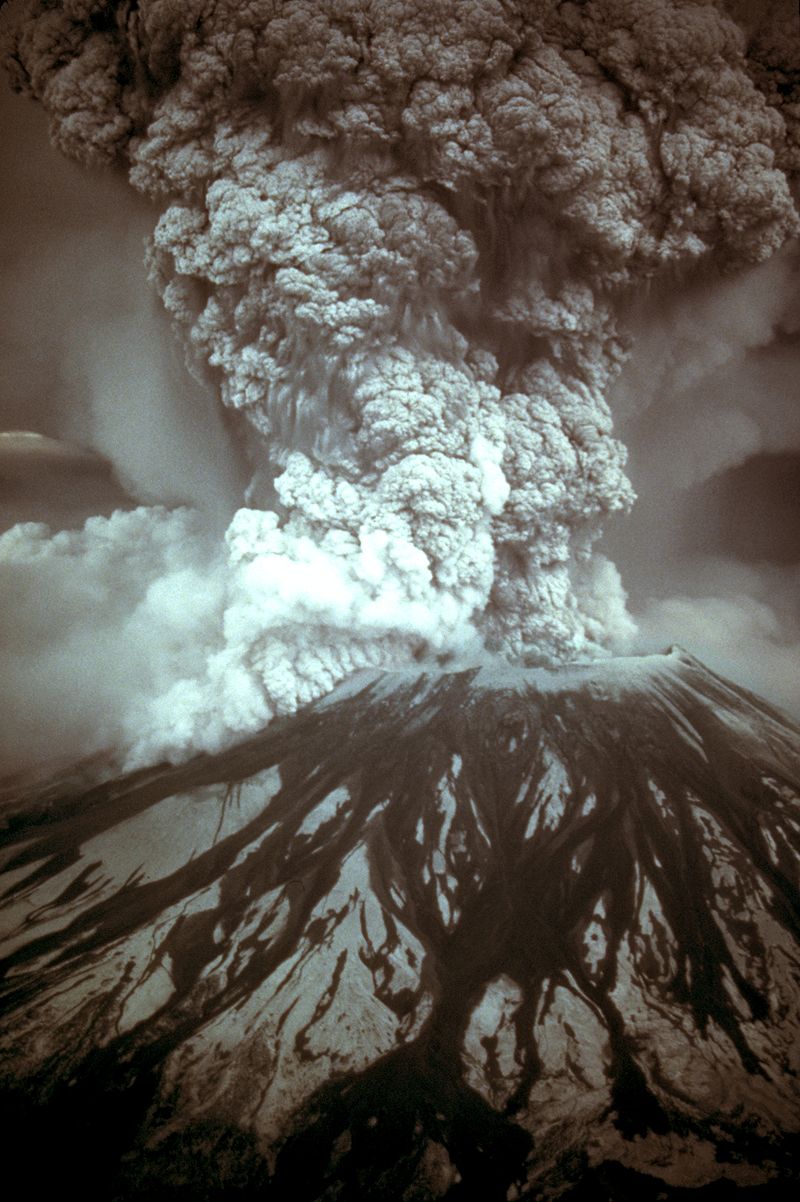
PD United States Geological Survey, via Wikipedia

PD United States Geological Survey, via Wikipedia

All that changed overnight on May 18th, 1980, when the mountain erupted.  We could see the ash column quite clearly from the lake in the Bald Hills of Thurston County, where we were fishing that morning, and we knew something really bad had happened at the mountain. Entire forests were blown down and buried under volcanic ash. Spirit Lake was both destroyed and reborn in a different form.

The destruction of the ecology is one of the underlying themes of the World of Neveyah series.

But the miraculous way the land around Mt. St. Helens has rebounded in the last 35 years is also working its way into my World of Neveyah–Tauron’s spell is broken, and the land will recover.  The devastation of Mal Evol looks permanent, and is terrible to those who know what it once was like, but they have hope that it will recover.

In the World of Neveyah series, I created the Mountains of the Moon, out of which the valley of Mal Evol was torn. I understood how mountains can rise high into the sky, blocking the rising or setting sun. Also, I used the climate of the Scablands here in Washington–the climate is typified by large seasonal temperature differences, with excruciatingly hot  summers and severely cold winters, and that is how I made Mal Evol. Remember, dealing with weather offers great opportunity for mayhem in the narrative.

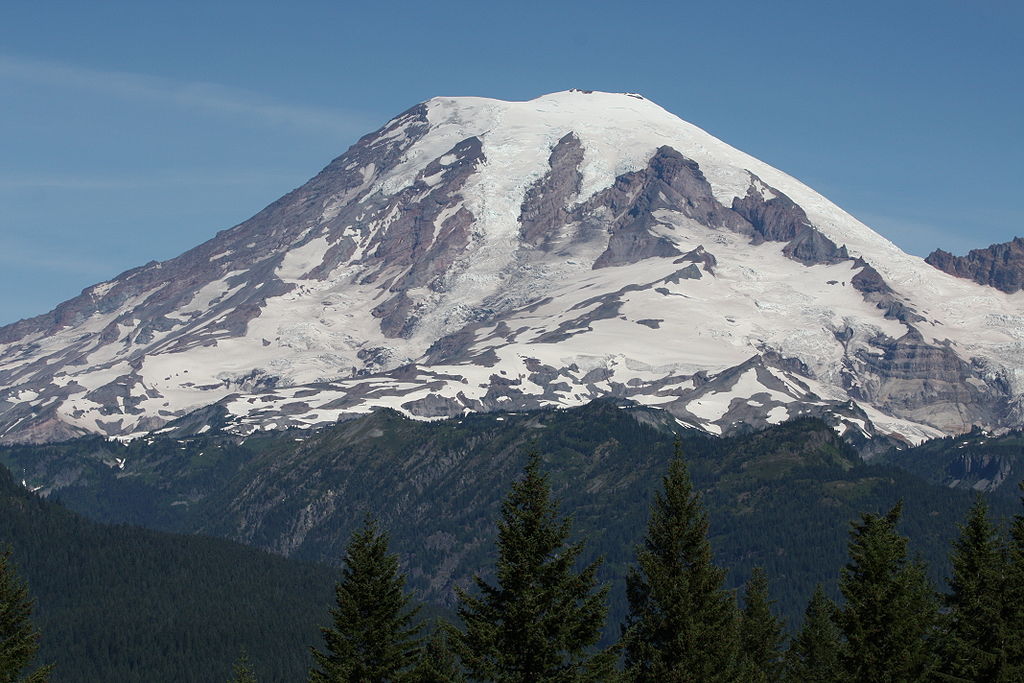
I live on the heavily forested western side of the state, 50 miles west of 14,411 ft tall  Mount Rainier, beneath the Nisqually Glacier. That sight dominates my front-yard skyline on a clear day. The valley I live in was carved by glaciers and eruptions from this amazing pile of rock, ice, and fire. I took this idea, but I made my mountains taller and badder than the Himalayas on a bad Mt. Everest day.

Mount Rainier, Nisqually Glacier, ©2010 Walter Siegmund Via Wikipedia

Mount Rainier, Nisqually Glacier, © 2010 Walter Siegmund Via Wikipedia

We here in our bipolar State of Washington are able to see how the landscape can radically change if you just drive west east (thank you Scott Driscoll!) on I-90 for four hours.

Because  of my good fortune of living in the shadow of two large volcanoes, and between two high mountain ranges, the Olympic Mountains and the Cascade Range,  I have the opportunity to experience a wide diversity of ecologies in one day, going from saltwater to mountain range, to desert.

You may find your inspiration elsewhere. It could be in anything from architecture to ornamental gardens, to cornfields or sage brush.

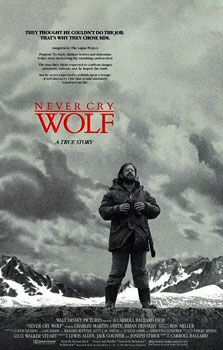
Never_Cry_Wolf_PosterWhile the window of our own experience is an amazing place to find our inspiration for our fantasy environments, the internet is a valuable tool. Google Earth is a wonderful resource for viewing a real-time image of an area you need to see to understand.

Google Earth is as much of a squirrel as Facebook is, in that I got very little done when researching with it–I’m sure it was all research. Really.

Consider going to the movies–it’s amazing what great scenery you will find in an old movie. One thing I don’t have access to experience in person is wild caribou–for that reason much of my mental imagery for how wild herd animals of North America behave and the environment in which they live comes from a great movie, called Never Cry Wolf. The cinematography and the actual scenery is incredible, and the mood of the land is captured in one of the better films of the twentieth century.

The root ideas are what you hang the fabrication on, just a frame for the canvas you will paint with your words. It’s your world, but if it is to feel solid to the reader, there must be some small familiarity for them to have that  “Oh, I know this place” moment.

4 Comments

Filed under Fantasy, History, Mt St Helens, Self Publishing, writing

Elements of the story: making effective revisions

puppy happy dance via pinterestThere is no feeling of accomplishment like that of having completed a novel, or a shorter piece. Once that final sentence is written, there is that happy-dance moment, where we are shouting and the world is singing.

Following that, we have the urge to immediately look the finished manuscript over and see where some revisions could be made.

I know it’s tempting, but don’t do it. We need to gain some distance from our work in order to see it more clearly, so put it aside. If you work on something else for a couple of weeks, or even a month or two, you will gain a better perspective on what you just finished, and your revisions will bring out the best in your work.

But when we do get back to it, where do we start?

Stephen King said it so eloquently in his book, On Writing: “I got a scribbled comment that changed the way I rewrote my fiction once and forever. Jotted below the machine-generated signature of the editor was this note: ‘Not bad, but PUFFY. You need to revise for length. Formula: 2nd Draft = 1st Draft – 10%. Good luck.’ — Stephen King, On Writing, 2000

This means we must cut the fluff.  If your 1st draft is 100,000 words, try to cut 10,000 words out of it, making it 90,000. The following is a list of things to consider:

  1. Dialogue pitfalls: Search for clichés. Speaking as a reader, do a global search for the word alabaster. If you have used it to describe a woman’s skin, get rid of it, and find a different way to describe her. It’s an overused word that has become cliché. Find different ways to say what you want, unless you have a character who uses clichés–if so, he’d better have a good reason. Even then, don’t go overboard. Click here for a looooong list of common clichés: ProWriting Aid.
  2. Try to make your sentences do without these words: very, that, just, so, and literally. There will be places where they are the only words that will work, and you will use them in that instance. Usually just cutting them out of the sentence and adding nothing makes the sentence stronger. Fluffy, over-blown prose weakens the narrative.
  3. Flowery prose, even in a medieval setting, is off-putting to a reader. Do a global search (Cntrl F) for two letters: ly. This will bring up all the adjectives  (oops adverbs, thank you David Cantrell) because they end in ly. Look at each instance and if it is possible, get rid of them. Often the sentence is stronger without that extraneous word. Find a way to show the idea without flowery prose. This is where you grow as a writer–you give visual clues that enhance the story.
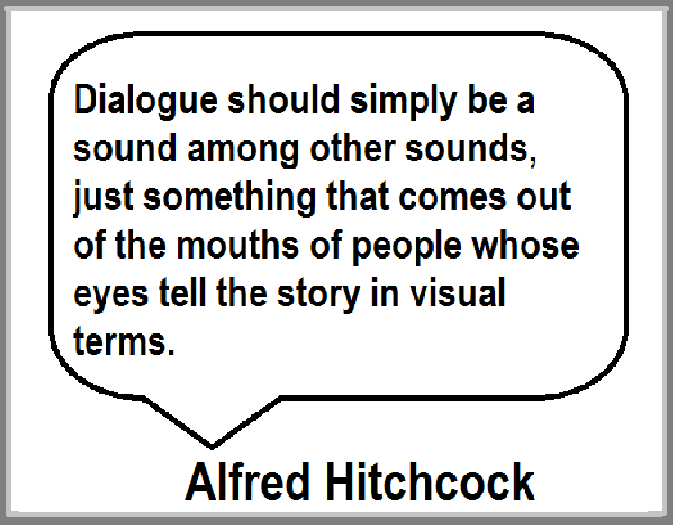
  4. Alfred Hitchcock quote re dialogueExamine the ms for conversations that are opportunities for info dumps. Info is good, but don’t dump it–dole it out as needed, and only when needed.
  5. Are people long-winded, and ranting on and on, with nary a pause for breath?  Decide what is really important in what they are saying and cut everything else.  Conversation in literature must have a purpose, or it is as boring as hell. Cut those marathon speeches down to where they sound like normal people talking, not like orators.
  6. Conversation must pertain to and advance the story. Small talk and verbal tics are obnoxious, and should be avoided at all cost. DO NOT have your characters preface sentences with “Hmmm…” and DO NOT have them use the name of the person they are speaking to, unless there are more than two characters in the scene. You can avoid things like “Well, Bill, it was like this…” just by having the speaker turn to Bill, and say it.

And now for my pet peeve: People do not smile, snort, or smirk dialogue. I mean really: “That’s a lovely dress,” snorted Clara. (eeew. )  Stick to simple dialogue tags, such as said and replied. In fact, it is often best to do away with speech tags (attributions) altogether for a few exchanges every now and then, if:  A. you have only 2 speakers, and B. you have clearly established who is speaking. You can also show who is speaking in other ways:

  1. Miss a few beats. Beats are little bits of physical action inserted into dialogue: John fell quiet and stared out the window. Halee turned and walked out the door. Used sparingly, these pauses serve to punctuate the dialogue, to give the scene movement, and to maintain a strong mental picture in the absence of description. They’re best placed where there is a natural break in the dialogue, because they allow the reader to experience the same pause as the characters.
  2. Don’t over do the action within the conversation. If your characters are rattling pans, slicing apples or staring out the window between every line of dialogue, the scene becomes about the action and not the dialogue, and the impact of the conversation can be lost entirely.

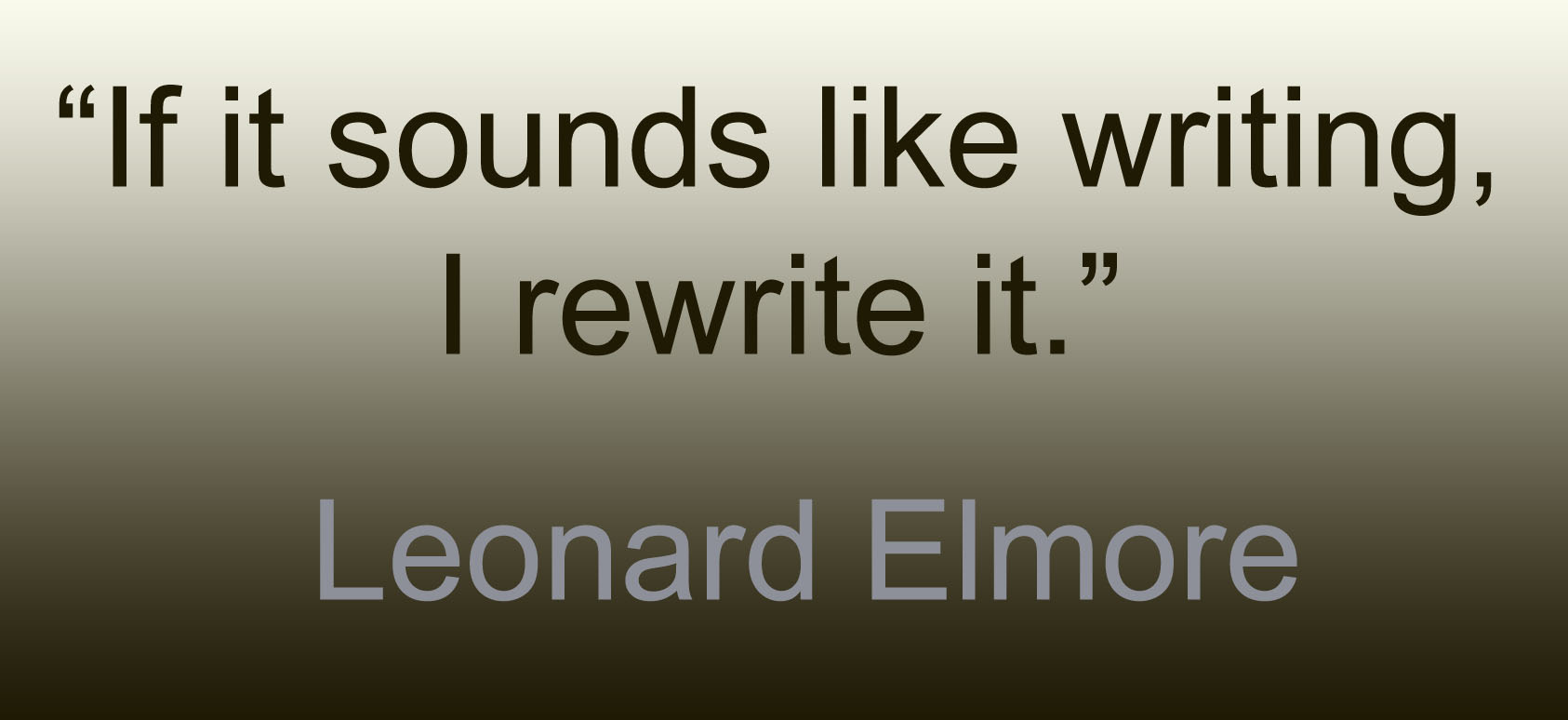
leonard elmore quoteIn our first draft we are trying to make our point, and we inadvertently repeat ourselves. A good way to find where you are repeating yourself is to read a chapter from the bottom up, one paragraph at a time. My editors frequently  tell me, “You said it once, that’s enough.”

In my own work, I hear repetitions and other things I need to cut, if I read it aloud to someone else. I think that’s because when another person is listening, we are more aware of how a given passage sounds.

Also, consider not including a prologue. About half of the readers see the word “prologue” and assume it will be a boring info dump, so they skip it.

This begs the question, “Why go to the trouble of writing it if they aren’t going to read it?” If you must have a prologue, consider calling it Chapter 1– and make it clear that is occurring twenty years before the present day (or whatever). Make it immediately exciting, make it a true first chapter. And don’t do an excerpt from a Holy Book as your prologue. I did that once, and it flew like an iron kite. So I moved my Holy Book to the appendices, and if a reader is interested, they can read it there.

These are just a few things to look for when you begin revisions. And just so you know, revisions are not editing, they are rewriting. If you are “editing” your own manuscript, you have a fool for a client. There is no such thing as self-editing–the best you can do is make revisions and admire your work. You may do very well at that–some people do.

You must make revisions before you hire an editor. Then, ask other authors who they might recommend as an editor and see if you can work well with that person. Your editor will likely point some things out that you didn’t see, but that a reader will. At that point, you will make revisions again. But the results will be so worth it!

5 Comments

Filed under Humor, Self Publishing, Uncategorized, writing

Crafting the narrative: the potty-mouthed vicar

Portrait of Vsevolod Mikhailovich Garshin by Ilya Repin

Portrait of Vsevolod Mikhailovich Garshin by Ilya Repin PD|100 via Wikimedia Commons

Look at poor Vsevolod Mikhailovich Garshin. The artist immortalized him at the unfortunate moment he realized he was faced with a gazillion hours of searching for overused words in his manuscript–and all of them in Russian.

Heh heh.

I wrote a post on this subject three years ago, but it’s time to  dust it off and play with it again. Overused words can be fun if done right:

Mark Twain said, “Substitute “damn” every time you’re inclined to write “very”; your editor will delete it and the writing will be just as it should be.”

Well now, we could have some fun with that!

Think of how often some beginning authors use the word very in their work:

“We are doing very well, thank you,” replied the vicar. “The weather is very nice, and the food  is very good.” 

Let’s do as Twain suggests and see what happens:

“We are doing damn well, thank you,” replied the vicar. “The weather is damn nice and the food is damn good.”

That was fun. The word ‘damn’ leaps out at you, because you don’t really expect it. I personally enjoyed replacing ‘very’ with ‘damn.’  But, hilarious though it is to give the vicar potty-mouth, in reality it’s unnecessary. Simply eliminating ‘very’ and not replacing it with anything goes a long way toward improving it:

“We are doing well, thank you,” replied the vicar. “The weather is nice and the food is good.”

Some times we repeat certain words and phrases for emphasis. This article is not about using repetition when crafting narrative. Instead, we are thinking about words that are overused, and which we can often do without.

In our rough drafts we overuse certain words because we are flying along and they are easy–they say what we want and we can keep on moving.

But in the second draft, we must look for them. Let take the word ‘very.’

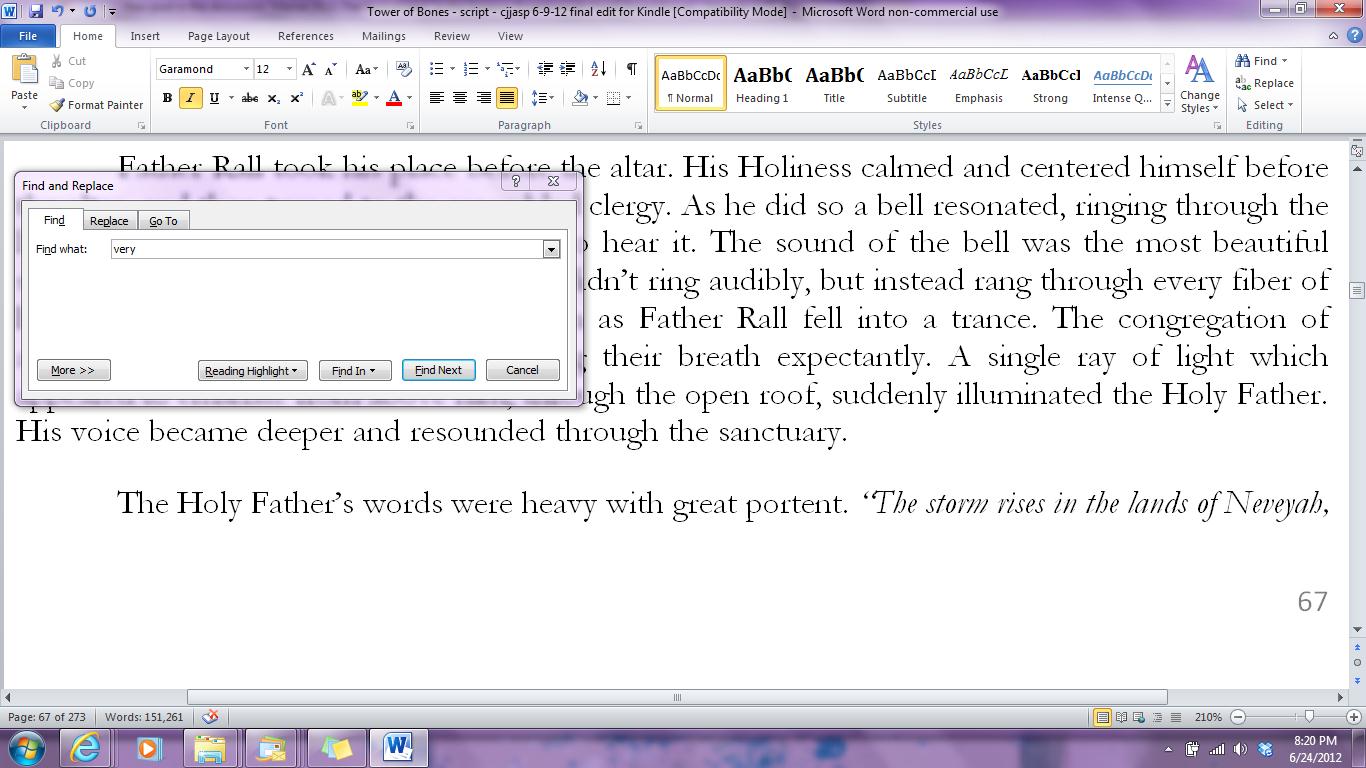
Once you are finished with your first draft, do what is called a global search – in Microsoft WORD you click on the ‘Home’ tab, and at the far right hand side click on ‘Find,’ OR press the ‘Ctrl’ key and the ‘F’ key at the same time.  This will open the ‘find and replace’ menu:

find graphics

In the ‘find and replace menu, type the word ‘very’ and click on ‘find next’.  The word ‘very’ will be highlighted in blue, and you can delete it.  I don’t recommend doing ‘replace all’ with any overused modifier, because you will create more problems than you can imagine!  Look at each individual instance of the word, and either delete it or change it to a stronger word.

Deleting them or changing to a stronger word will help you grow as writer.  You will begin to think about your sentences and stretch your vocabulary.

Next do the same with ‘that’ and ‘had.’ These are words  we all use too freely in our first draft, and until an editor pointed it out to me, I had no idea how they weakened my work. They are good words, used infrequently and only when another won’t do the job.

Here is a list of words that can appear with great frequency in your rough drafts, some of which are considered ‘tired.’ Some of these words can be made into contractions to eliminate wordiness. Some can be cut altogether, and some will need to stay. However, some of these words are ‘telling’ words, and we want to avoid that wherever possible. Look at each instance and make that decision.

  • about
  • am
  • are
  • bad
  • beautiful
  • big
  • could
  • did
  • fine
  • good
  • great
  • had
  • has
  • have
  • is
  • look
  • looked
  • nice
  • quite
  • seems
  • so
  • some
  • that
  • then
  • think
  • very
  • was
  • well
  • went

We all use these to excess in our rough draft, because we are laying the roadbed of the superhighway that is our book. The words we spew at this point are the framework we are going to build the true story around, the story that was in our heads, but that the rough draft doesn’t do justice to.

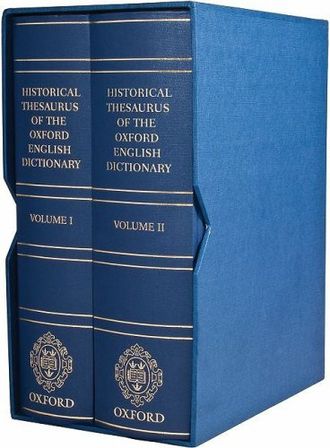
Historical_ThesaurusThis is where our thesaurus comes in handy. We need to express the thoughts our overused words evoke, but we don’t want to repeat them over and over. When a word seems to be cropping up with great frequency, try using the global search option. It will tell you how many instances of the word appears in your manuscript, and you might be surprised.

Highlight the word and right-click on it. A pop-up menu will appear. From that menu, choose ‘synonyms.’ Click on that, and a list of words with similar meanings will appear. If you need more than can be found in that list, click on ‘Thesaurus’ (at the bottom of the list) or google the word and add ‘synonyms’ to your search.

Consider my recent experience with gaped–a beta reader pointed out that I had my characters gaping at each other far too regularly. I had to go through it and have them stare, exchange glances, or simply look away. In several instances, I cut that sentence because it wasn’t really needed.

It can be difficult to see the words you have overused when it is your own work. But you can run your ms through a free, online  program like Word Count Tools and that will give you a heads up on how many times you have used each word.

2 Comments

Filed under Books, Literature, Publishing, Self Publishing, Uncategorized, writer, writing

But what about poetry?

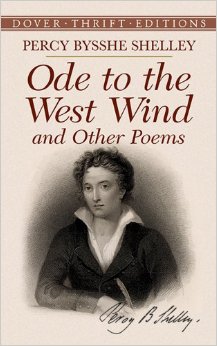
ode to the west wind-shelleyI love poetry because I love the many ways words can be manipulated on a blank page. To me, poetry is something beautiful and visually simple, a thing that looks like it should be uncomplicated. But nothing could be farther from the truth.

I guarrantee you, this post will not scratch the surface of why poetry is so much more than naughty limericks (which I do know a great many of and which are quite hilarious).

Bad poetry can be written by anyone, but writing great poetry takes a certain genius–I don’t consider myself a poet, although I do sometimes feel compelled to attempt poetry.

Poetry doesn’t always rhyme and it frequently involves complicated aesthetics that are both auditory and visual. This is because the reader may not always be reading the poem aloud, and so the visual art of the piece comes into play.

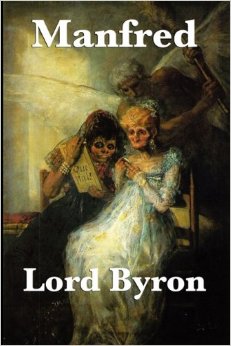
Sometimes, poetry is long, epic in actuality. Consider Manfred, by George Gordon, Lord Byron (From Wikipedia, the font of all knowledge): Manfred: A dramatic poem is a poem written in 1816–1817 by Lord Byron. It contains supernatural elements, in keeping with the popularity of the ghost story in England at the time. It is a typical example of a Romantic closet drama. (end quoted text)

Byron himself referred to his works as “closet dramas,” since they were intended more for the theater of the mind than the actual theater.

manfred-lord byronExcerpt from Act III, scene I of Manfred

There is a calm upon me–
Inexplicable stillness! which till now
Did not belong to what I knew of life.
If that I did not know philosophy
To be of all our vanities the motliest, 10
The merest word that ever fool’d the ear
From out the schoolman’s jargon, I should deem
The golden secret, the sought ‘Kalon,’ found,
And seated in my soul. It will not last,
But it is well to have known it, though but once.

And a “theater of the mind” is what Byron’s work sparks in me.

Words are bent and shaped by poets to evoke meanings, bent and formed into precise shapes. We novelists and writers’ of short fiction have the luxury of creating a long narrative. In poetry, space is intentionally limited by the author, forcing the the poet to write within narrow constraints. Thus, allegory, allusion, and indirection are common motifs in poetry.

Traditional forms have precise constraints: Sonnets are fourteen lines, following a set rhyme scheme and logical structure. Sonnets use iambic pentameter, which is characterized by the familiar “da dum da dum da dum da dum da dum” cadence of five sets of syllables.

Even in free verse, one must pay attention to the meter, the basic rhythmic structure  of a piece, the rhythm and cadence of the syllables. A clear example of this can be found in Walt Whitman’s poems, where he repeats certain phrases and uses commas to create both a rhythm and structure.

I love the poem,  When Lilacs Last in the Dooryard Bloom’d, written in free verse in 206 lines. Whitman used many of the literary techniques associated with the pastoral elegy. He composed it during the summer of 1865, a period of profound national mourning. The country was reeling in the aftermath of the assassination of President Abraham Lincoln, that occurred on April 14, 1865.

Despite the poem being an elegy to the fallen president, Whitman neither mentions Lincoln by name nor does he mention the circumstances of his death. Instead, Whitman used allegory–symbolic imagery:  the lilacs, a falling star in the western sky which was the planet Venus, and a shy bird, the hermit thrush. It is most definitely an elegy because he employed what scholars consider the traditional progression of the pastoral elegy: moving from grief toward an acceptance and knowledge of death.

It is is a beautiful poem, and is one I often return to. Lines 18-22 of Whitman’s leaves of grass-whitman When Lilacs Last in the Dooryard Bloom’d:

In the swamp in secluded recesses,
A shy and hidden bird is warbling a song.

Solitary the thrush
The hermit withdrawn to himself, avoiding the settlements,
Sings by himself a song.

And how has poetry evolved into the 21st century? For one unique direction of evolution check out the works of Seattle poet, Bill Carty on Pinwheel

For more famous contemporary poets, check out 31 Contemporary Poets You Need to Read.

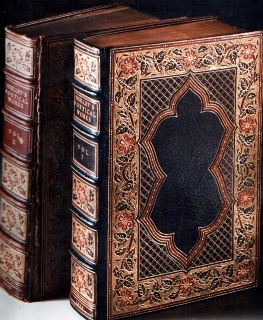
I have always been a fan of the classic masters: Dickinson, Browning, the Brontë sisters, Byron, Shelley, Frost, Whitman. Wordsworth, and my beloved Yeats, among many.  I was raised in a home with their works proudly displayed on the bookshelves in the living-room, massive tooled-leather volumes from Grolier, smelling of romance and ideas.

I didn’t always understand the works of the great poets, and I still don’t–but I love them.

I leave you with a rhyming poem, The Song of the old Mother by William Butler Yeats:

I rise in the dawn, and I kneel and blow
Till the seed of the fire flicker and glow;
And then I must scrub and bake and sweep
Till stars are beginning to blink and peep;
And the young lie long and dream in their bed
Of the matching of ribbons for bosom and head,
And their days go over in idleness,
And they sigh if the wind but lift a tress:
While I must work because I am old,
And the seed of the fire gets feeble and cold.

4 Comments

Filed under Books, Fantasy, History, Literature, Publishing, Self Publishing, Uncategorized, writer, writing

How to format your manuscript for submission

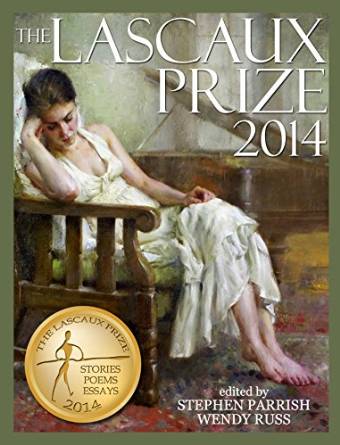
lasceax prizeThis post is a follow-up to the previous post on why indies need to write short stories. That article sparked some questions that I will answer to the best of my ability. All of this information was gleaned by searching the internet when I first wanted to know why my manuscripts were so regularly rejected.

First of all, a properly formatted manuscript shows that the author did her research and knows what the editor wants. That will help your ms make it past the first hurdle.

You will find that each publisher, magazine, or contest website will have a page or section called “Submission Guidelines.” That page is your friend, because within the words on that page will be the rules specific to that particular publication or contest:

  1. length of submissions in word count (Do not exceed or fudge this. Stay within their parameters.)
  2. how they want you to format your work for their best use.
  3. where to submit the work
  4. what dates submission will be open
  5. if it is a contest, fees will be listed there

If you are building a back-log of of short-fiction there are some short-cuts you can take to enable you to have submission-ready work that requires minimal adjustment to fit  various requirements. This is because most publishers use what is considered the industry standard, Shunn Manuscript Format. William Shunn didn’t invent this, but he made this knowledge available to all would-be authors via the internet.

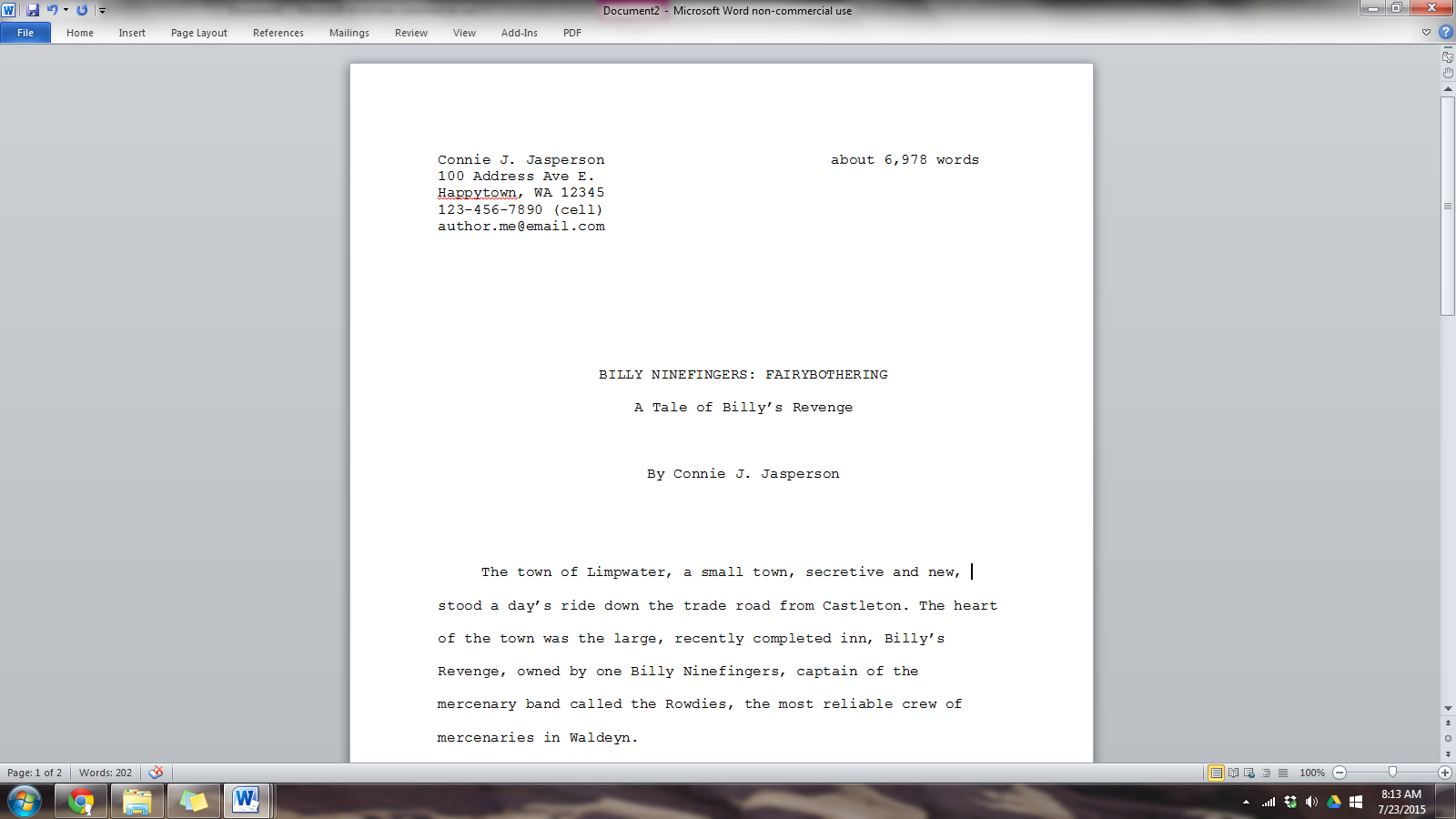
First, if you are submitting this to a publisher that publishes hard-copy your manuscript should look typed, not typeset. If you are composing your manuscript on a computer, don’t succumb to the temptation to use fancy fonts. For hard-copy publishers use a Courier font. Every word processor and printer comes with Courier, so you have no excuse for not using it.

Use a 12-point Courier. This means it prints out at a pitch of ten characters per inch. Don’t use a 10- point Courier, which prints out at a pitch of twelve characters per inch. That is far too small and editors who have to read a lot of manuscripts won’t want to struggle to read yours and it will be summarily rejected.

On a side note, something I have learned through this publishing life is that in printing, point size refers to the height of the characters in a font; pitch refers to the width. This is critical knowledge, because the font that the publisher wants the ms submitted in is the only one that will make it past the first editor’s inbox.

If you are submitting this to a publisher that is publishing in an electronic format, they may require 12-point Times New Roman font. Times New Roman is easier on the eyes, when viewed on a monitor. As an editor I prefer submissions in Times New Roman, as I rarely work from hard copy.

The preferred font will be clearly stated in their submission guidelines.

IF YOU INTEND TO FORMAT YOUR MS FOR HARD-COPY SUBMISSION TO AN OLD-SCHOOL PUBLISHER:

  1. Set the margins for your document at 3cm (1 inch) on all four sides.
  2. Align to the left hand side only; the right hand side should remain jagged. (THIS IS CRITICAL)
  3. Use twelve point Courier in black type only. Times New Roman or Arial fonts may also be acceptable—check the submission guidelines of the magazine or anthology.
  4. Lines should be double spaced with no extra spaces between paragraphs. (THIS IS CRITICAL)
  5. Single space between sentences after periods. (this is also critical)
  6. Indent new paragraphs and each new section of dialogue, with the exception of a scene break paragraph.
  7. Indicate scene breaks by inserting a blank line and centering the hash sign (#) in the center of that line.
  8. Center a hash sign # one double-spaced blank line down at the end of the manuscript. Or simply write The End. This assures the reader that no pages are accidentally missing.
  9. Use underline for italicized words if you are using Courier font. If you are using Times New Roman you can use proper italics. (Again, check the submission guidelines)
  10. William Shunn says, “You should place a header in the upper-right corner of every page of your manuscript except the first. This header will consist of: the surname used in your byline, one important word from the title of your story, and the current page number. Do not place the header in the upper-left corner, because the typesetter will often have your manuscript clipped in that corner as he or she transcribes it and will not be able to see what the current page number is.” (end quoted text)

Your first page should include:

  1. The name of the work.
  2. The approximate word count, some will want it only to the nearest hundred.
  3. In the upper left, your contact details formatted in the same font and size as the manuscript font.

prnt scrn Fairybothering 1

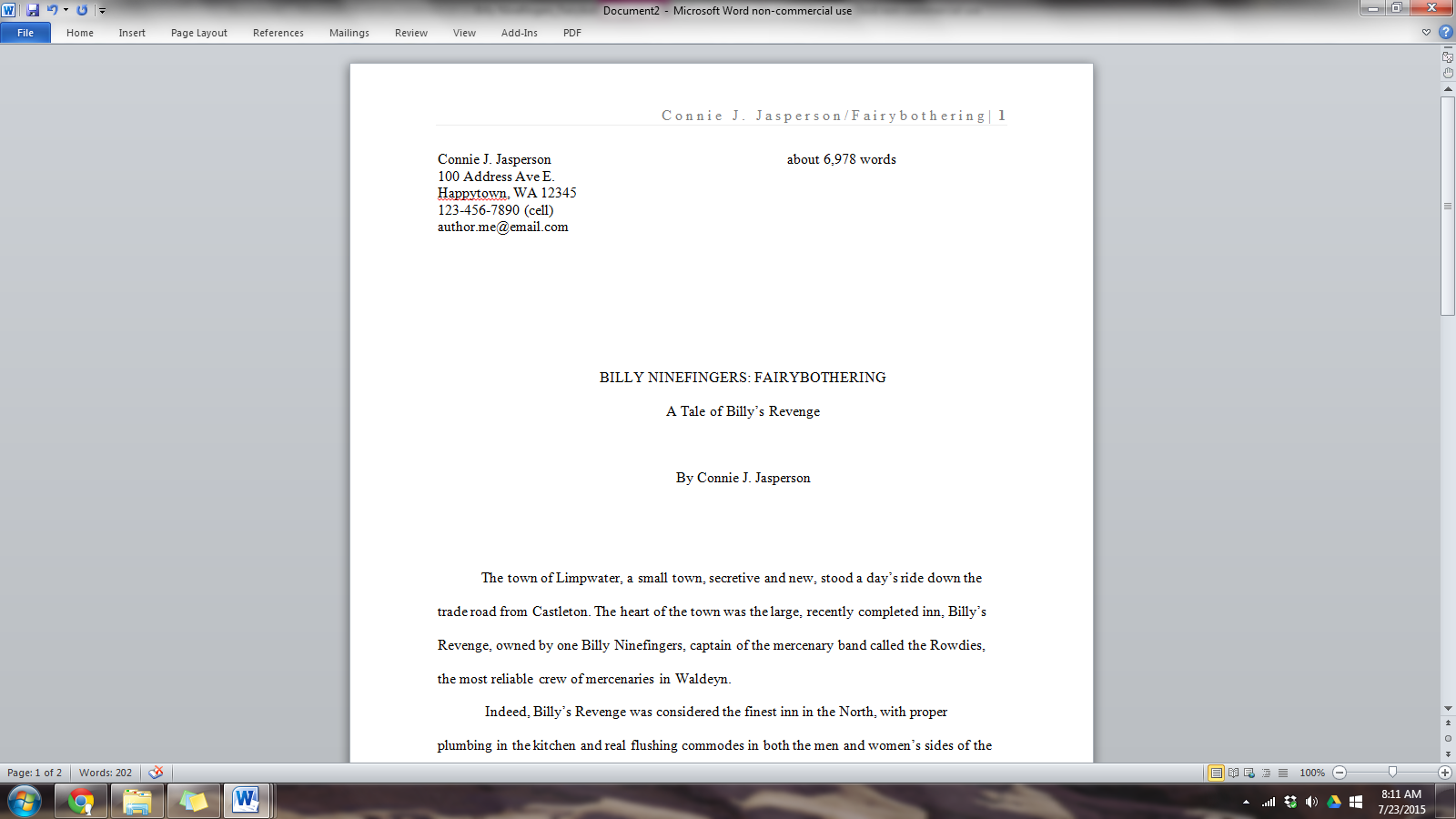
MANY contests and e-magazines want your manuscript formatted in a similar fashion, but may require a different font. Some will want the header on all pages, and some will want your full author name in the header:

prnt scrn Fairybothering 2

TO Format your header in MS WORD:

  1. Go to the Insert Tab and click on: page numbers>top of page
  2. From the drop down menu select plain number three (the upper right hand corner)
  3. Type your name and title just before the number
  4. Click on the body of your document and the header/page number is set, and will appear to gray out.

TO Format your ms so the page numbers start on page two: click on this link to go to this page at MS Office Help if you are using WORD 2007 or 2010. Later versions also have help pages there. The process is a little more involved, and I don’t want to fill this post up with that, so use the resource offered by Microsoft–that is how I learned. Most hard-copy manuscripts must be formatted this way, so learning how to do this is critical.

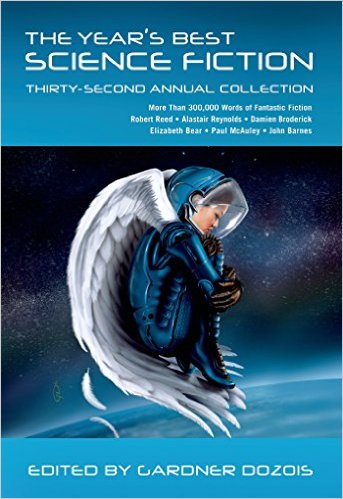
anthology sci fiWhen you submit your work to an anthology or contest, if your work is accepted you will receive a contract. That contract will have the terms of payment, conditions of use, and all the pertinent information you, as the author, will need to know. Most are simple, and don’t require a law degree to understand. If you receive a complicated contract, seek a literary agent or attorney for advice.

Also be aware that ALL contests  and magazines will want original work that has never been published before. Many anthologies, will too, unless they are promotional anthologies put out by publications showcasing the most popular stories they printed during the previous year. Often these collections are the editors’ favorites.

Most contracts will state that you can reuse or republish the work 3 months or 90 days after the date of their publication. When you do so, you must include on the copyright page a caveat stating that it was originally published in their anthology or magazine, and what issue/year.

1 Comment

Filed under Publishing, Self Publishing, writer, writing

Reading for pleasure vs reading for editing

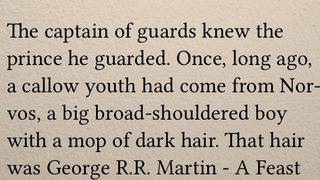
George R.R.Martin formatting issue 1 via book blog page views, margaret ebyI haven’t been able to read as much lately as I normally do–my editing and writing time has seriously cut into my reading time. In fact, I haven’t written a book review in over a month. I do miss the long hours I used to spend reading, but lately I am lucky to read two or three pages before fall asleep. Thus I have been reading poetry and short fiction.

This is not because the books I intend to read are boring–they aren’t! It’s just that when I am editing for a client, I can’t disengage my mind from that mindset. This means I have a terrible time reading for pleasure. When I am in editing mode I notice things a casual reader might not, and I can’t just enjoy the book. And I am not talking indies here–I am talking books published by the Big 5 traditional publishers.

Sometimes the errors and flaws are hilarious though.

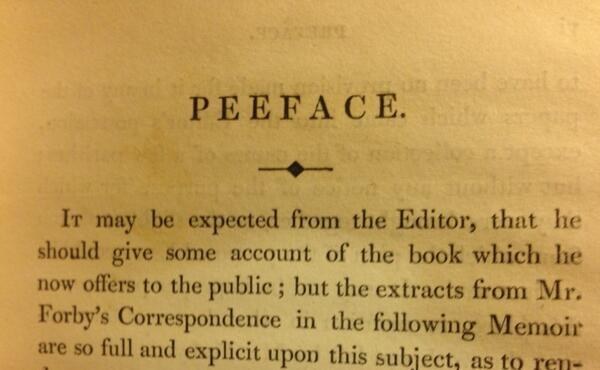
Marked_Wicked_bibleThe thing is, errors do creep into even the most carefully examined texts and manuscripts. Usually, no one dies over it, however, in the case of the infamous Wicked Bible, the publishers paid a hefty price: Robert Barker and Martin Lucas, the royal printers in London,  were called to the Star Chamber and fined £300 (£43,586 as of 2015) and deprived of their printing license. The Star Chamber, which held court from the late 15th century to the mid-17th century,  was a branch of the English court of law and was established to ensure the fair enforcement of laws against socially and politically prominent people so powerful that ordinary courts would likely hesitate to convict them of their crimes.

SpelMistk14 Image credit- Jazarah! Hubspot_com 14 worst marketing errorsTypos and editing mistakes are pretty much taken for granted when left in mass-market paperbacks by the Big 5 Publishers, but woe to the indie who neglects to notice a repeated ‘and’ or any other editing error.

Indies are held to a far more rigid code by most readers than the traditional publishers are because the internet is rife with disparaging rhetoric pointing the finger at indies. And while the Big 5 traditional publishers are just as guilty of rushing-to-publish crap, the truth is, many new self-published authors haven’t yet gotten the hang of the publishing business, and often their books are rife with things they will later wish they hadn’t rushed-to-publish.

enhanced-buzz-20953-1398618489-5 courtesy reddit dot comHaving learned my own lessons the hard way, besides working closely with a professional editor, I now have a reliable group of friends who comb my completed manuscripts for errors and gross cut-and-paste errors, and we can only hope we have caught them all. When you are an indie, it takes a village to help you get your book fit for the public to read.

Anyway–my editor’s hat is firmly on my head these days, and that means I can’t enjoy casual reading for a while more. That’s not to say I don’t enjoy my clients’ books–I love them. I’ve made it clear that I only accept work I feel a strong attachment to, but editing is a different mindset from casual reading, and I can’t just fall out of it at the end of the day. Yes, this greatly slows my own writing, because I am stupidly self-editing instead of just letting the words flow. When I am editing I am looking for all varieties of mistakes–not just structural, grammatical, and obvious punctuation errors. I am also looking for things that will interfere with formatting the final ms for upload to Kindle or Smashwords and I hope I find them all for my client, but it makes writing my own work difficult.

George R.R.Martin bormatting issue 4 via book blog page views, margaret ebyAs an editor I do my best. But, nothing is ever sure, and I won’t see the ms after I send her the final suggested corrections. Mistakes can be made right up to the last minute while she is making those adjustments, so someone else will have to proof-read her work. The indie author has the responsibility for the final eye on his/her work. So when my client has finished her revisions, she will have her posse check the ms over for the slings and arrows of publishing fate.

I will be finished with my current editing project soon, and I plan to take a break from editing for a short while, when that happens. Then I will let my mindset slide back into the joy-of-reading mode.

I really do love to read–getting lost in a great book is the best thing I can think of, as comforting as a cute kitty purring, or my sister’s homemade chocolate truffles. I look forward to resting my editorial mind and over-indulging in the work of my many favorite authors.


7 Comments

Filed under Books, Humor, Publishing, Self Publishing, Uncategorized, writer, writing

When inspiration fails…

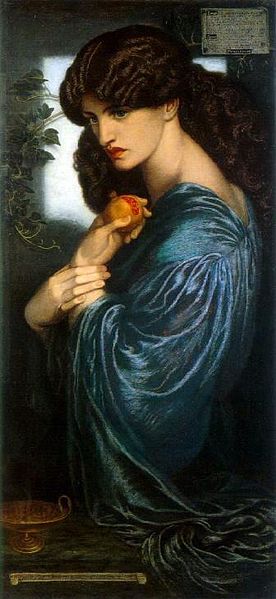
276px-Dante_Gabriel_Rossetti_-_ProserpineThere are days when I just can’t come up with a new idea. The creative juices are flowing, but they’re moving  more like unimaginative sludge. I don’t see these moments as writer’s block—the ideas are lying dormant. They just don’t want to bloom quite yet.

This is when I clean the house. For some reason, inspiration always strikes when I am doing some mindless task, and though you wouldn’t know it from my office, I work better when the house is in order. If that hasn’t jarred an idea loose, I put on some Loreena McKennitt or Blackmore’s Night and go out to the internet and search for ideas, by looking at fantasy images from Canstock or Dreamstime.

Sometimes I just peruse the old masters from the renaissance era out on Wikimedia Commons, like Dante’s Persephone.

Then there are times when I have a cornucopia of ideas. They can’t all be used, there are so many of them. I try to write them down for use later, and that helps when I have a temporary dry spell.

That is, they help unless I forget to make full notes about the whole idea—random notes like “Give the dog a biscuit” are just a bit too ambiguous to be really helpful. Know what dog would have been helpful–however that random note did inspire me to give Billy Ninefingers a hilarious sidekick, a dog named Bisket.

Sometimes I get going on a tale and all of a sudden my enthusiasm just sort of faints somewhere along the line and I don’t know why. It turns out that idea really wasn’t a novel—it was a short story and it just wanted to be done and over with.  Short stories are wonderful exercises for writing longer pieces. If you can, you should try to build up a backlog of short pieces under 7000 words in length, because you never know when a call for short stories will come along and you might have the chance to be published in an anthology.

Old Restored booksAlso, writing short fiction helps you get the hang of using a story arc in smaller increments, to help the layers of your longer pieces.

Sometimes I get stuck in the middle, and don’t know what is going to happen next. That is really frustrating, but I just set is aside to come back to it later. Other times I get a little bit of a jump-start by talking to members of my writing group.

But there are times the piece just has to be shelved for a while.  That’s okay, because when I pull it out, I will say, “Hey! This is awesome—I love this story.” I never fail to find that spark when I run across a tale I forgot I had half-written.

I never get bored with my characters, but I sometimes get bored with the drivel I write for them to do. That is why sometimes walking away from a stalled story for a short while is a good idea. At that point I am beating a dead horse and it’s a waste of time. Later I will see the manuscript through new eyes and a better way to get my heroes to the final battle will strike.

When I am stuck on a paragraph that I just can’t get right, I email a writing buddy and run it past them. We bounce it back and forth until it conveys the idea I think it needs to–or I throw it out.

I’m always happy to talk with them when they are stuck, so it all balances out.

GrandmasNoBakeCookiesMy point is that we all suffer from occasional lapses of the creative muse. I never let lack of inspiration for one project stop me from pushing forward—I just find something that does interest me and do that for a while until I have my fire back.

Sometimes I just have to make cookies for a while. Chocolate no-bakes...yummy….

4 Comments

Filed under Adventure, Battles, blogging, Books, Fantasy, Humor, Literature, Publishing, Self Publishing, Uncategorized, writer, writing