Category Archives: Uncategorized

#amwriting: keeping short stories short, when all your stories want to be long

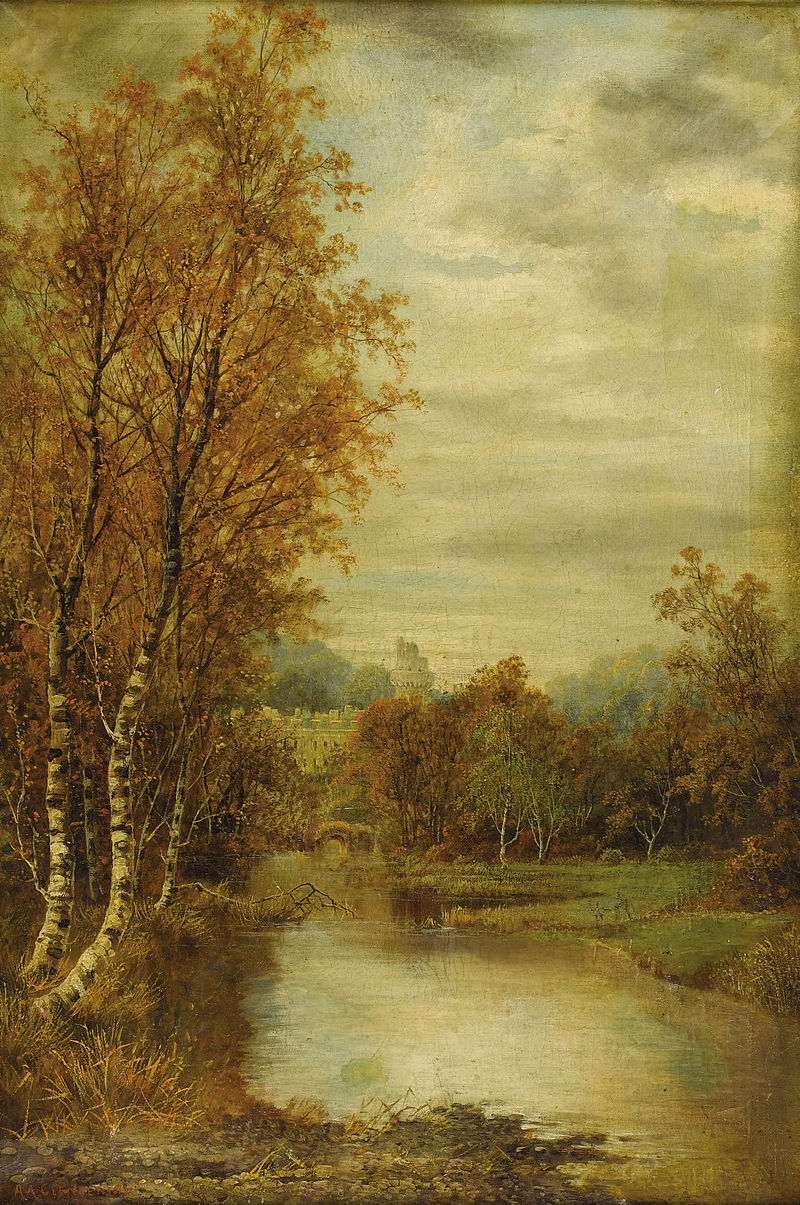
Autumn Landscape With Pond And Castle Tower-Alfred Glendening-1869

Autumn Landscape With Pond And Castle Tower-Alfred Glendening-1869

Over the summer I posted several times about why we need to write short stories, and each time I’ve talked about writing them to build stock for submissions to magazines, anthologies, or to enter into contests. Today, I want to talk about the art of keeping a story short.

First, decide what length you want to write to–if you have no specific contest in mind, 2000 to 4000 is a good length that will fit into most submission guidelines.

For those of you who have trouble writing short works for contests and anthologies with rigid word-count limits, this is where mapping your story becomes really important.

Let’s say you want to write a story that can be no longer than 2,000 words. You know what the story is, but when you sit down and begin writing, it’s like there is way too much story for only 2,000 words. You need to map it out.

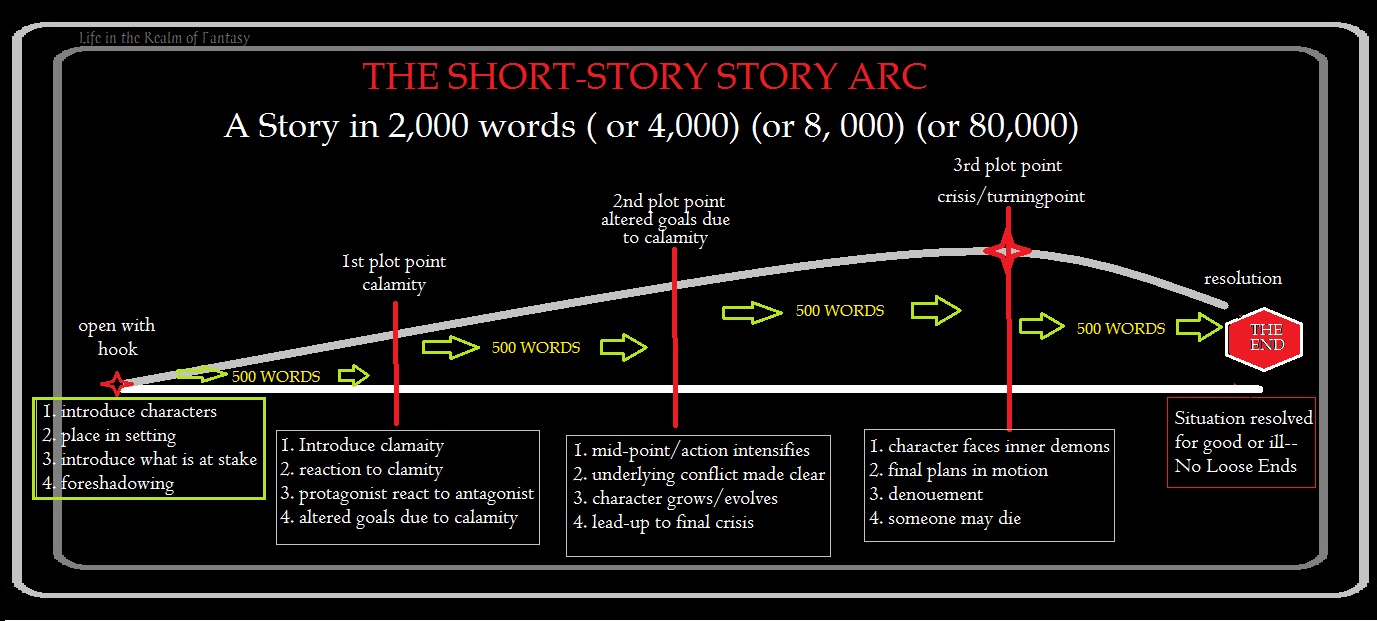
Short-stories are just like novels, in that they have an arc, and you can make it work for you.  By looking at it from the perspective of the story arc, you can see what you have to accomplish, and how many words you have to accomplish it in.

short story arc

Every word in a 2000 word story is critical and has a specific task–that of advancing the the plot. To that end, in a story of only 2,000 words:

  1. No subplots are introduced
  2. Minimal background is introduced
  3. The number of characters must be limited to 2 or 3 at most
  4. Every sentence must propel the story to to the conclusion

Lets say you are writing a fantasy, titled, A  Song Gone Wrong. Because he was a bit too specific when a putting a local warlord’s fling with another man’s wife into a song, our protagonist  is now a wanted man. Divide your story this way:

Act 1: the beginning: You have 500 words to show these plot points

  1. setting: the village of Imaginary Junction,
  2. the weather is unseasonably cold
  3. In an alley, a bard, Sebastian, is  hiding from the
  4. Soldiers of the lord he has inadvertently humiliated

Act 2: First plot point: You have 500 words to tell how

  1. the soldiers surround and capture Sebastian
  2. he is hauled before the angry lord and
  3. thrown into prison, sentenced to hang at dawn, but now you are at:

Act 3.: Mid-point: You have 500 Words to explain how

  1. Sebastian meets a dwarf, Noli, also sentenced to die
  2. Noli is on the verge of managing an escape, but needs help with one last thing
  3. Noli and Sebastian manage to complete the escape route
  4. but the guard seems suspicious, hanging around their cell door, hampering their escape

Act 4: Resolution–you have 500 words to show how

  1. The smart guard finally is relieved by a less wary guard, which
  2. allows Sebastian and Noli to squeeze through the escape route
  3. They are spotted at the last minute, but Noli’s friends are waiting, and
  4. they are whisked to a dwarf safe-house, leading to Sebastian’s next short-story adventure

Once you have parsed out what needs to be said by what point, and in how many words, you can then get to the nitty-gritty of turning that far-fetched tale of woe into a good short-story.

You will see that in order to keep to the strict limit of words, you will have to choose your words carefully. You will have to find words that really convey what you want to say, concisely in one or two sentences. Sebastian can’t give Noli a recap  of his troubles in your hearing–all that will have to be off-stage. On-screen conversations are critical–they will convey the personalities and the minimal backstory of the piece.

After a few times of creating short stories this way, you won’t need to think about it. When you know the length a given tale has to be, you can mentally divide it into acts and just write for fun.

2 Comments

Filed under Publishing, Uncategorized, writer, writing

Elements of the story: showing the mood

My Writing LifeMost of us, if you are reading this blog, are writers who love to read for pleasure. We each enjoy different sorts of books, but all our favorite reading has one thing in common: the story, whether fictional or true, moves us in some deeper way, making us think about it long after the final page has been read.

In order for the reader to be moved by a story, his imagination must have been completely engaged in the work. Thus, the writer must perform a tightly controlled balancing act, walking the fine line between giving too much description and not enough.

As writers we are constantly admonished to show, not tell. This can be taken to extreme, and the result is a boring, unimaginative walk-though of a character’s most minute expressions. For example:

Gordon’s brow furrowed, and his eyes narrowed. His eyebrows nearly met in the middle. His lips turned down at the corners. He screamed, “You bloody idiot.”

Well, duh. Pick one, and let the reader imagine the rest.

Gordon appeared angry.

That doesn’t do it either. That is simply telling the reader Gordon was upset, rather than showing it. Perhaps Gordon’s face darkened and his voice was harsh. Or, Gordon’s eyes narrowed. “You bloody idiot!” 

If your character is angry, please don’t have them hiss their dialogue. People do not snort, hiss, or spit dialogue, no matter how angry they are unless they are a snake or a camel.

The writing world has several good handbooks on showing emotions, and these two are  in my library:

It’s good if you have bought a book on this subject and are using it to help show what is going on in  your character’s minds rather than telling it. But use some common sense. If there are fifteen ways to show dejection, please don’t use them all to describe one moment. Simply have your character sit slumped, or refuse to engage the others.

Readers don’t want to be told in minute detail what to imagine. They will put your boring book down and walk away with only one regret–that they bought it in the first place.

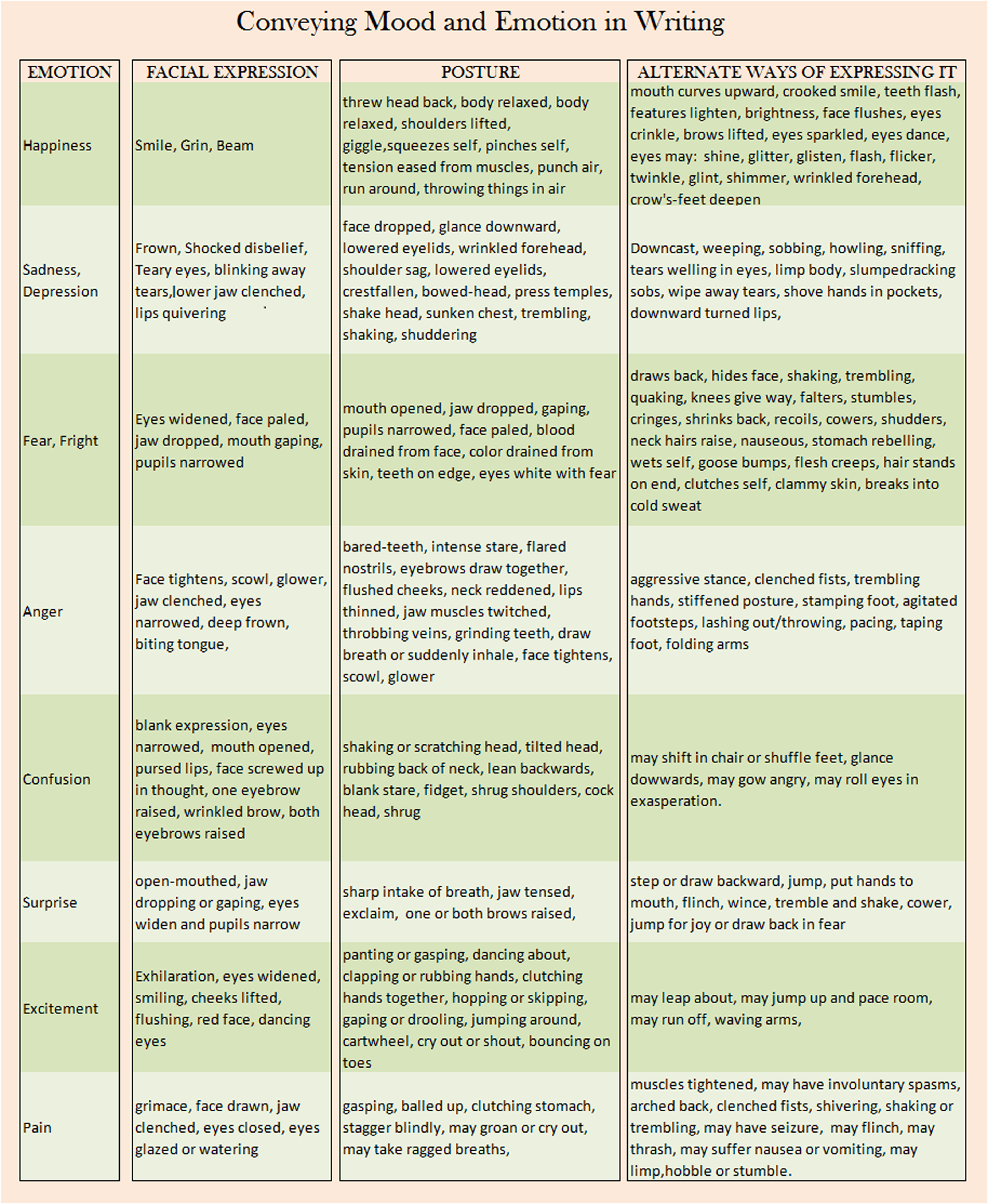
I’ve put together a little cheat sheet for showing emotions. Be sparing–show just enough to keep your readers engaged and the story moving along. If you provide a good framework and allow the reader’s imagination to do the rest, you will engage the reader. That, my friends, is priceless.

Cheat sheet for showing emotion and mood

Cheat sheet for showing emotion and mood

5 Comments

Filed under Humor, Publishing, Uncategorized, writing

Labor Day

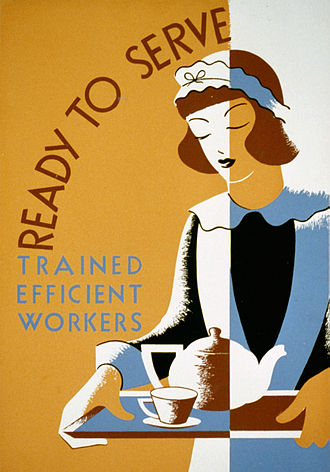
Stylized drawing of a maid on a Works Progress Administration poster via Wikipedia

WPA poster via Wikipedia

Over the course of my life I have worked in a wide variety of jobs.

1970s-80s – a field hand for a multi-national Christmas tree company, photo lab tech, waitress in a bakery and also a deli

1980s-90s – a hotel maid, a dark-room technician, a bookkeeper, and an office manager

2000-13 – a bookkeeper, tax-preparer, data entry

None of my work was glamorous but I always found something to enjoy in each job, and by going to work I was able to pay my bills, which I did enjoy. Sometimes, especially during the Reagan years and into the 90s, wages were low and jobs were scarce. I held two and three part-time jobs just to keep the roof over my children’s heads and food on their table.

During the late 70s and early 80s I worked for the J. Hofert Company (Christmas trees) and absolutely loved the work. It was outdoors, paid $3.25 an hour and it was seasonal, but I was able to work a lot of overtime, as field hands were as hard to get then as they are now.

English: First World War The Home Front: Women workers at the British Oil Cake Co.

English: First World War The Home Front: Women workers at the British Oil Cake Co.

As I said, none of my work was glamorous but I worked with great people, many of whom are still my close friends. My favorite job was as a hotel maid at a large hotel in Olympia–the work was hard, but I enjoyed it for 12 years. For most of the 1990s it was my weekend job that I kept along with my bookkeeping job, because the hotel was a union shop.

I worked every weekend and every holiday and yes it was not easy, but it was what it was. My kids were good and supportive and knew I was doing my best.

In 1993 things were easier. As a bookkeeper/office manager I made $7.50 an hour (two dollars over minimum at the time) and worked less than 30 hours a week with no benefits whatsoever. As a hotel housekeeper in a union shop I made $8.50 (three dollars over minimum) and worked about 20 hours a week, giving me enough from the two jobs to live on and provide for my children.

No matter what other job I had, I kept my weekend job at the hotel, because when other jobs went away, I always had that one to fall back on. Because of the union, we who did the dirty work earned a little more than others in that line of work, and had a few benefits, such as health insurance and a 401k. We would have had nothing more than minimum wage without the union.

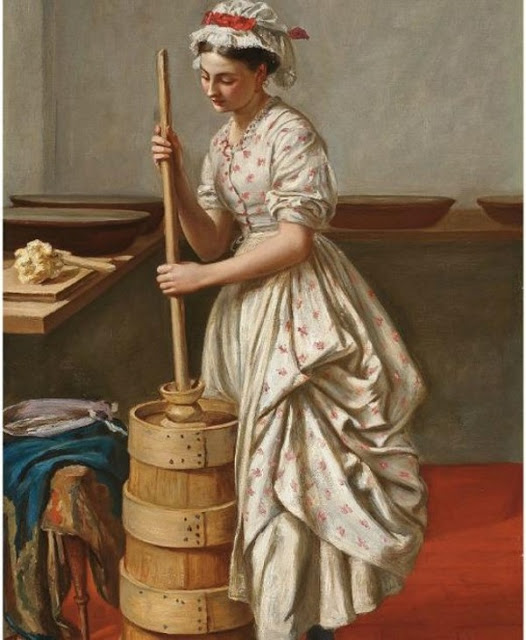
The butter churnNot every union is good, and not every union is reasonable. But while I don’t agree with everything every union does and stands for, I do feel gratitude that I and my family was protected by a good, reasonable organization during those years that were such a struggle for me. Every worker deserves that his/her employer treats them with respect and a fair wage in return for their labor.

I write books now, and the world is a different place in many ways. Even so, someone must do the dirty jobs, the work that no one else wants. I have nothing but respect for those who work long hard hours in all areas of the service industry, struggling to support their families. Look around you, and see the people who make your life easier, by being there every day doing their job.

Every one of them is a person just like you, a living, caring human being with hopes, ambitions, triumphs and tragedies. Every one of them has a story and a reason to be where they are, doing the task they have been given.

Say a little thank you to all those who take your unintentional abuse when you are stressed out and “don’t have time to wait,” or are upset by things you have no control over and need to vent at someone who can’t or won’t fight back. Give a little thanks to those who do the dirty work and enable you to live a little easier.

'The Munitions Girls' oil painting, England, 1918 Alexander Stanhope Forbes

‘The Munitions Girls’ oil painting, England, 1918 Alexander Stanhope Forbes


4 Comments

Filed under Uncategorized

Elements of the story: making effective revisions

puppy happy dance via pinterestThere is no feeling of accomplishment like that of having completed a novel, or a shorter piece. Once that final sentence is written, there is that happy-dance moment, where we are shouting and the world is singing.

Following that, we have the urge to immediately look the finished manuscript over and see where some revisions could be made.

I know it’s tempting, but don’t do it. We need to gain some distance from our work in order to see it more clearly, so put it aside. If you work on something else for a couple of weeks, or even a month or two, you will gain a better perspective on what you just finished, and your revisions will bring out the best in your work.

But when we do get back to it, where do we start?

Stephen King said it so eloquently in his book, On Writing: “I got a scribbled comment that changed the way I rewrote my fiction once and forever. Jotted below the machine-generated signature of the editor was this note: ‘Not bad, but PUFFY. You need to revise for length. Formula: 2nd Draft = 1st Draft – 10%. Good luck.’ — Stephen King, On Writing, 2000

This means we must cut the fluff.  If your 1st draft is 100,000 words, try to cut 10,000 words out of it, making it 90,000. The following is a list of things to consider:

  1. Dialogue pitfalls: Search for clichés. Speaking as a reader, do a global search for the word alabaster. If you have used it to describe a woman’s skin, get rid of it, and find a different way to describe her. It’s an overused word that has become cliché. Find different ways to say what you want, unless you have a character who uses clichés–if so, he’d better have a good reason. Even then, don’t go overboard. Click here for a looooong list of common clichés: ProWriting Aid.
  2. Try to make your sentences do without these words: very, that, just, so, and literally. There will be places where they are the only words that will work, and you will use them in that instance. Usually just cutting them out of the sentence and adding nothing makes the sentence stronger. Fluffy, over-blown prose weakens the narrative.
  3. Flowery prose, even in a medieval setting, is off-putting to a reader. Do a global search (Cntrl F) for two letters: ly. This will bring up all the adjectives  (oops adverbs, thank you David Cantrell) because they end in ly. Look at each instance and if it is possible, get rid of them. Often the sentence is stronger without that extraneous word. Find a way to show the idea without flowery prose. This is where you grow as a writer–you give visual clues that enhance the story.
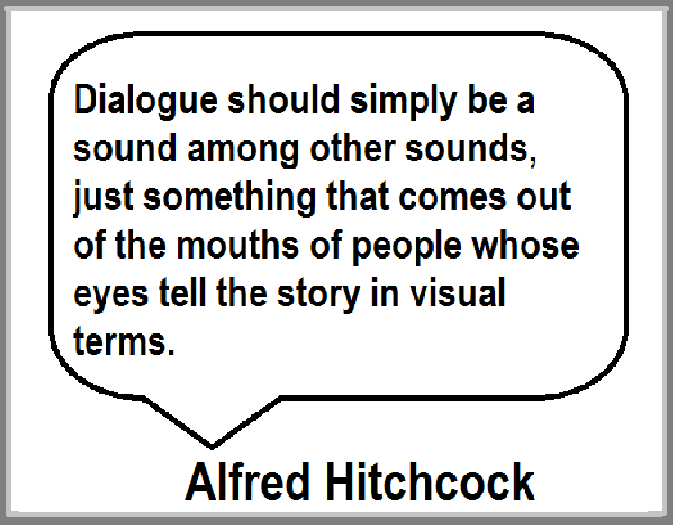
  4. Alfred Hitchcock quote re dialogueExamine the ms for conversations that are opportunities for info dumps. Info is good, but don’t dump it–dole it out as needed, and only when needed.
  5. Are people long-winded, and ranting on and on, with nary a pause for breath?  Decide what is really important in what they are saying and cut everything else.  Conversation in literature must have a purpose, or it is as boring as hell. Cut those marathon speeches down to where they sound like normal people talking, not like orators.
  6. Conversation must pertain to and advance the story. Small talk and verbal tics are obnoxious, and should be avoided at all cost. DO NOT have your characters preface sentences with “Hmmm…” and DO NOT have them use the name of the person they are speaking to, unless there are more than two characters in the scene. You can avoid things like “Well, Bill, it was like this…” just by having the speaker turn to Bill, and say it.

And now for my pet peeve: People do not smile, snort, or smirk dialogue. I mean really: “That’s a lovely dress,” snorted Clara. (eeew. )  Stick to simple dialogue tags, such as said and replied. In fact, it is often best to do away with speech tags (attributions) altogether for a few exchanges every now and then, if:  A. you have only 2 speakers, and B. you have clearly established who is speaking. You can also show who is speaking in other ways:

  1. Miss a few beats. Beats are little bits of physical action inserted into dialogue: John fell quiet and stared out the window. Halee turned and walked out the door. Used sparingly, these pauses serve to punctuate the dialogue, to give the scene movement, and to maintain a strong mental picture in the absence of description. They’re best placed where there is a natural break in the dialogue, because they allow the reader to experience the same pause as the characters.
  2. Don’t over do the action within the conversation. If your characters are rattling pans, slicing apples or staring out the window between every line of dialogue, the scene becomes about the action and not the dialogue, and the impact of the conversation can be lost entirely.

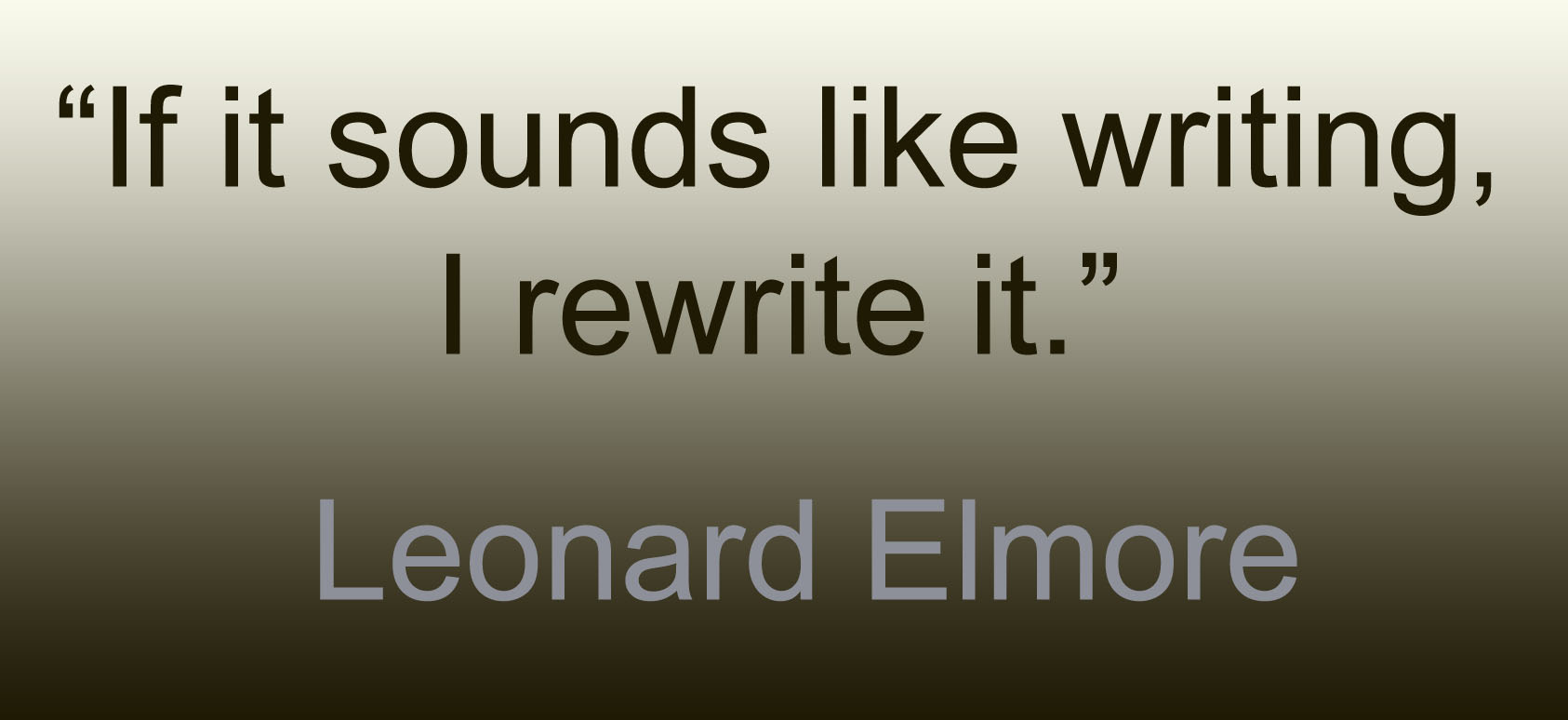
leonard elmore quoteIn our first draft we are trying to make our point, and we inadvertently repeat ourselves. A good way to find where you are repeating yourself is to read a chapter from the bottom up, one paragraph at a time. My editors frequently  tell me, “You said it once, that’s enough.”

In my own work, I hear repetitions and other things I need to cut, if I read it aloud to someone else. I think that’s because when another person is listening, we are more aware of how a given passage sounds.

Also, consider not including a prologue. About half of the readers see the word “prologue” and assume it will be a boring info dump, so they skip it.

This begs the question, “Why go to the trouble of writing it if they aren’t going to read it?” If you must have a prologue, consider calling it Chapter 1– and make it clear that is occurring twenty years before the present day (or whatever). Make it immediately exciting, make it a true first chapter. And don’t do an excerpt from a Holy Book as your prologue. I did that once, and it flew like an iron kite. So I moved my Holy Book to the appendices, and if a reader is interested, they can read it there.

These are just a few things to look for when you begin revisions. And just so you know, revisions are not editing, they are rewriting. If you are “editing” your own manuscript, you have a fool for a client. There is no such thing as self-editing–the best you can do is make revisions and admire your work. You may do very well at that–some people do.

You must make revisions before you hire an editor. Then, ask other authors who they might recommend as an editor and see if you can work well with that person. Your editor will likely point some things out that you didn’t see, but that a reader will. At that point, you will make revisions again. But the results will be so worth it!

5 Comments

Filed under Humor, Self Publishing, Uncategorized, writing

Mapping the Story

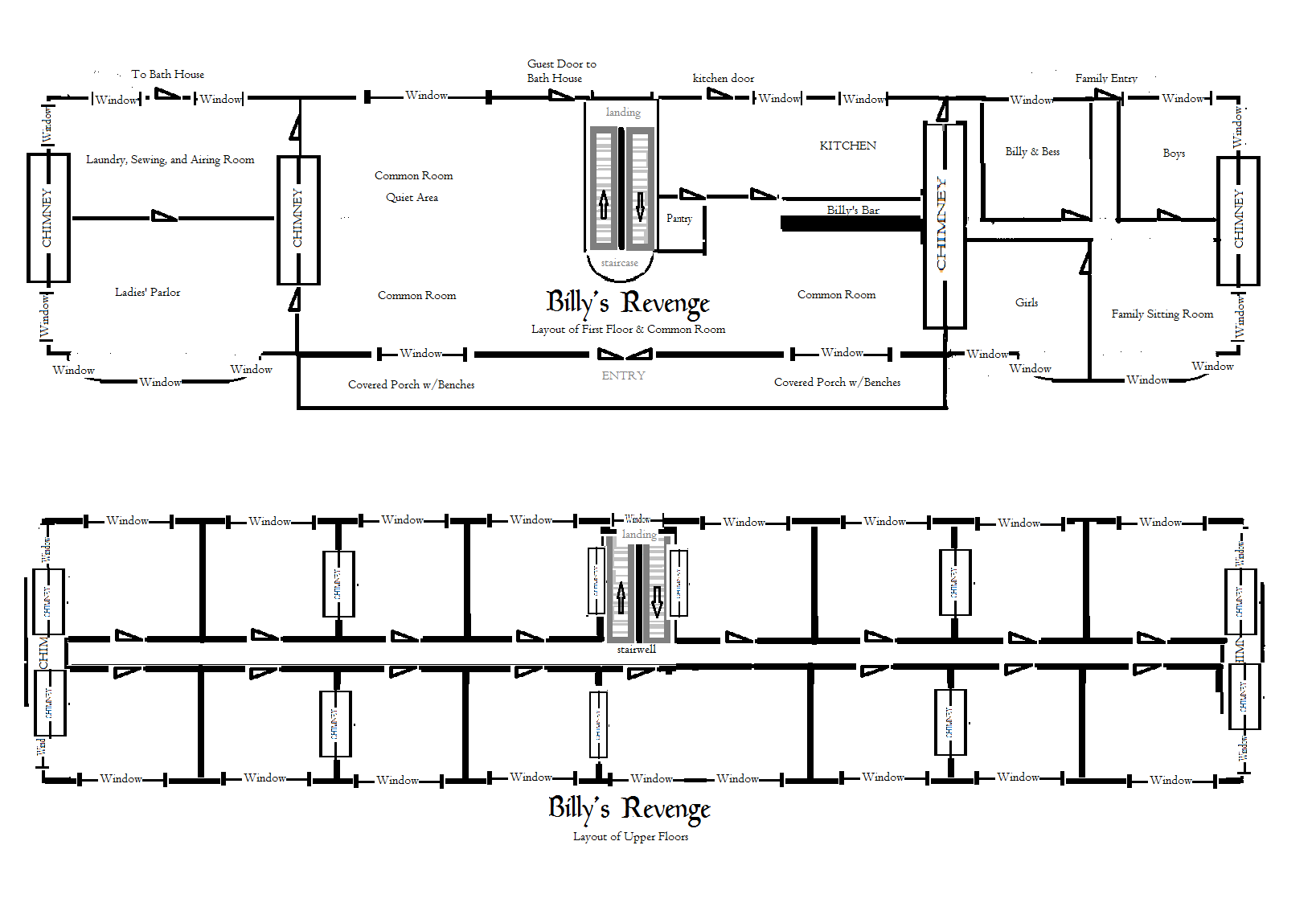
Billy's Revenge Floor plan ground floor

Billy’s Revenge © Connie Jasperson 2015

I was worried I wouldn’t have a blog post for today. The power was out most of Saturday due to a large storm here, and there have been times when that  lasts three days here.  When that happens I have no way to post my blog, although I hear you can post them from cell phones if you know the magic words.

I’ll just say that if I have to key my blog on a cell phone, it will take 5 years to get it ready for posting.  I am the world’s slowest text-message-er. Of course, if you have predictive texting set up, and make good use of auto-fill, you could have some real fun, and do it quickly! But that was another blog post.

After the power outage, my printer/scanner was not speaking to my computer, so I couldn’t print or scan. I did behave, no temper tantrums here. My IT man, (a.k.a. my beloved, long-suffering husband with the patience of a saint) took the time to rectify that situation. I was at the limits of my endurance with that thing.

So, because our power was out, I worked on a pencil sketch of a new map for an upcoming novel, Billy’s Revenge. On Sunday, I digitalized it. It isn’t complete, and is out of proportion in some places but when it is finished, it will tell me everything I need to know about Limpwater.

Map of Limpwater copy

Map of Limpwater, © Connie Jasperson 2015

I always have some sort of map to work with, even if it’s just scribbled, when I am writing in a world of my invention, and they all start out as pencil sketches. Eventually, they become the digital versions you see in my books.

That book will consist of 1 novel and 4 short stories that all revolve around the inn known as Billy’s Revenge. Huw the Bard returns, as does Julian Lackland. Billy Ninefingers has a few misadventures that threaten his career, mess with his chances  to convince Dame Bess to marry him, and set him on a path he never thought he would find himself traveling.

In the opening short story, we meet Eddie, Billy’s father, and see the origins of the Rowdies. Eddie’s story sets the stage for Billy’s trouble with Bastard John. Several short stories that were cut from The Last Good Knight will be included at the end of Billy’s novel, as they don’t pertain to Julian Lackland as much as they do the entire group of Rowdies, Billy Ninefingers included, and they are fun stories.

BNF sign

BR Pub Sign © Connie Jasperson

I’ve had the sign that will hang over the porch in front of Billy’s inn ready for quite a while–hanging it is going to be the trick.

When the power went out, I had Photoshop open and was working on the cover for Valley of Sorrows. But while I know how the graphics will be and I am happy with their layout, I’m not really happy with the art I have located so far, but it’s still early days. I will keep searching, which I enjoy doing.

Anyway Saturday  was not as productive as it could have been.

And Sunday was a busy, catch-up day. Fortunately, it rained off and on all day, so I was able to finish a lot of what I needed to get done.  Today will be as crazy as any Monday ever is, and I will simply have to make time for revisions.  All I need is an hour here and there. I am close to having it ready for editing. I will have Valley of Sorrows published in the spring of 2016, if all continues to go well.

4 Comments

Filed under Books, Publishing, Uncategorized, writer, writing

But what if they don’t like what I #amwriting

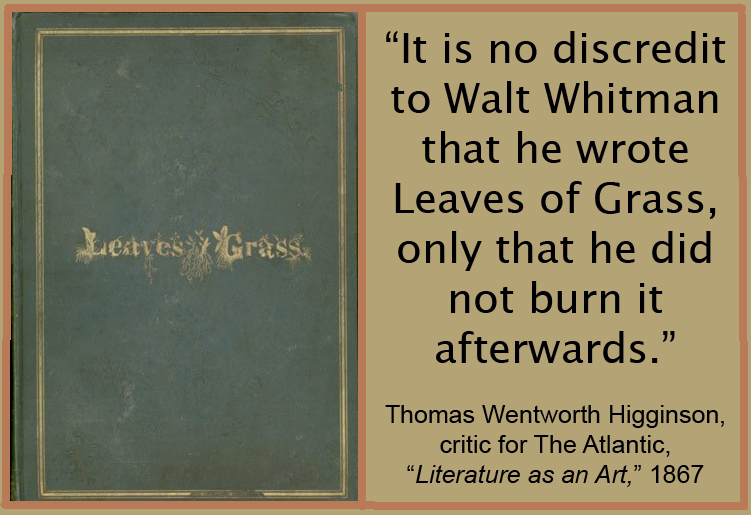
leaves of grass memeI’m just going to come out and say it–sometimes people don’t like what I write.

I know!  Who knew?

But it’s true, and I’ve the reviews to prove it. However, for every person who dislikes my work for one reason or another, someone else loves it, and they are the reader I am writing for.

If you focus your attention on reviews, good or bad, you risk losing your enjoyment of the craft. Writing is an extremely personal thing, and when a novel is completed we offer it to the public, who then airs their opinion on the quality (or lack thereof) of the fruit of our  labors. We are proud of our work when it is well received, and we are proud of it when it is ignored or disparaged.

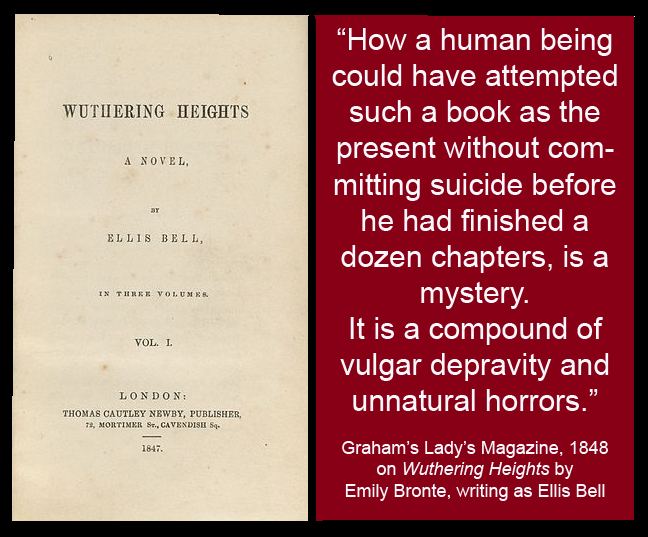
Wuthering_Heights,_1847I rarely look at my reviews because I have to concentrate on what I am currently writing, not on what I’ve already done. Every now and then a friend will post a good review by another reviewer on my personal Facebook page and I appreciate that sort of thoughtfulness.

But honestly, I don’t talk a lot about reviews on my personal page, good or bad. This is because I think my friends and family know what my job is and how selling my product works. I already bore them enough as it is with all my going here and there to hawk my books BS.

The minute we publish, whether through the traditional route or by going indie, we are putting ourselves and the thing we cherished most in the hands of the reading public.

At that point you must walk away from it emotionally.

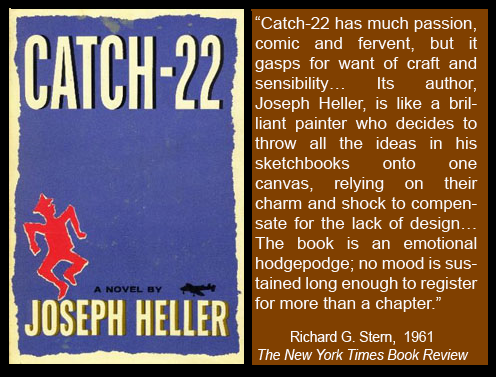
Catch22But while I do like having reviews, I want a variety of them. This shows the potential buyer that more people than just my friends are reading my books.  A mix of good and bad reviews is good because even the bad ones go a long way toward establishing credibility in the reading community. The reviews and numbers of stars will level out and in the end, the more reviews you have, the better for your book.

Most readers are smart. I don’t know about other people, but want to judge a book or product for myself, rather than be told what to think by a reviewer.  This is because most reviews on Amazon are not very enlightening, and alternatively, reviews bought in advance by publishers don’t impress me, good or bad.

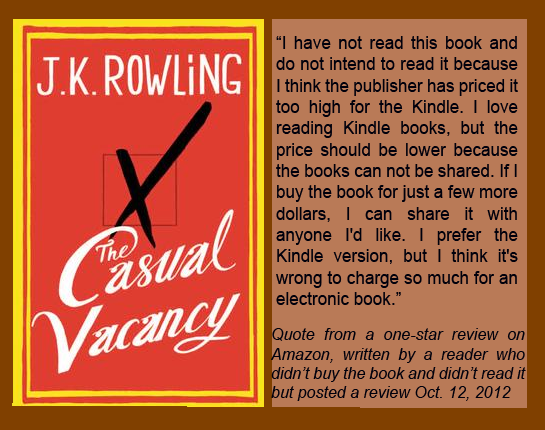
The_Casual_VacancyI make my own mind up when I read the book for myself. I enjoyed The Casual Vacancy by J.K. Rowling, even though a kajillion people couldn’t wait to take her down a notch. Read my review of that book here.

You won’t write anything worth reading if you only do it with the intention of getting glorious reviews. Write because you have something to say, and write what YOU want to read. Never publish anything less than your best work and ignore the reviews, good and bad.

Some of the best books ever written have received the worst reviews. Your book could be one of them, so don’t look at bad reviews as a measure of your worth as a writer. Ignore them and just keep on writing. You are writing because you love it and that is what you do.

Everything else is just fluff.

5 Comments

Filed under Literature, Publishing, Uncategorized, writer, writing

My #beachreads: Tenth of December & The Husband’s Secret

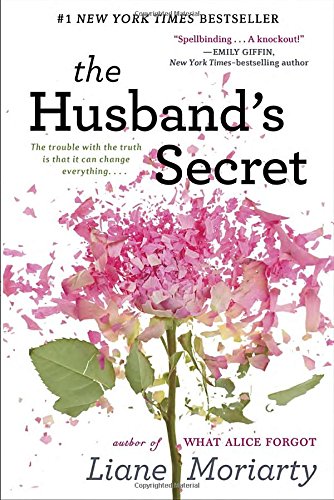
For my vacation reading this year I had a bit of a split personality book-wise. I had packed George Saunders’ book of short-stories, Tenth of December, and while we were in Cannon Beach, my oldest daughter, Leah, and I went to the local book stores. She found a book by an Australian writer, Liane Moriarty, called The Husband’s Secret.

She liked it so much I had to make a Kindle purchase.

The two books are radically different. Tenth of December is literary science fiction. The Husband’s Secret is contemporary fiction. Both books are about the human condition, and both books are character driven.

Although they are widely different, they are windows into the human soul, and both authors had me thinking about their work long after I finished them. These reviews are now up on Goodreads ,  so my work there is done.
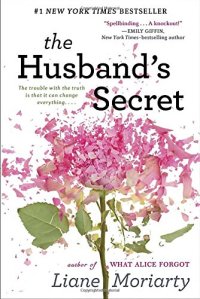
the husbands secretFirst up is The Husband’s Secret, by Liane Moriarty. Released in 2013 by Berkley, and Penguin in the US, this book is currently a #1 bestseller at Amazon, and Moriarty is listed in the top 100 authors there.

First the Blurb:

At the heart of The Husband’s Secret is a letter that’s not meant to be read

My darling Cecilia, if you’re reading this, then I’ve died. . .

Imagine that your husband wrote you a letter, to be opened after his death. Imagine, too, that the letter contains his deepest, darkest secret—something with the potential to destroy not just the life you built together, but the lives of others as well. Imagine, then, that you stumble across that letter while your husband is still very much alive. . . .

Cecilia Fitzpatrick has achieved it all—she’s an incredibly successful businesswoman, a pillar of her small community, and a devoted wife and mother. Her life is as orderly and spotless as her home. But that letter is about to change everything, and not just for her: Rachel and Tess barely know Cecilia—or each other—but they too are about to feel the earth-shattering repercussions of her husband’s secret.

My review: This book is about loss and grief in Sydney, Australia–but it could easily have been set in Seattle or London and it would still feel true. These women are people you feel you know, and while they are not always likable, they are always true to who they are.

Several characters in the book have secrets they hold on to that they eventually reveal. The concepts of guilt and betrayal loom large in this tale, driving it to the shocking conclusion. Ethics and morality shift and bend under the stress, and three good women do things they consider heinous, and each finds herself justifying her actions.

The Berlin Wall is referred to throughout the novel as Cecelia’s daughter, Esther, works on her school project. And in fact, we learn that Cecilia met John-Paul on the day the Wall finally came down. The Wall is symbolic of many things in this tale, as Tess also has a connection to it.

Rachel is pinched and afraid to love anyone but her grandson. Her son is devastated by the loss of his sister and hurt by his mother’s distance. No matter how he tries, he can’t get close to her.

These are complicated women, faced with an unbearable situation. Their actions and the final resolution is completely true to their characters. This is a slow-moving tale action-wise, but it literally tears through the emotional gamut. I give The Husband’s Secret four and half stars.

>>><<<
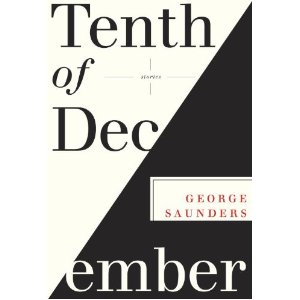
Tenth_of_DecemberNow we come to Tenth of December, by George Saunders, a book of short-stories, also first published as a book in 2013. I reviewed this book as an Audible book before, so you may have a feeling of déjà vu here!

First, the blurb:

In the taut opener, “Victory Lap,” a boy witnesses the attempted abduction of the girl next door and is faced with a harrowing choice: Does he ignore what he sees, or override years of smothering advice from his parents and act? In “Home,” a combat-damaged soldier moves back in with his mother and struggles to reconcile the world he left with the one to which he has returned. And in the title story, a stunning meditation on imagination, memory, and loss, a middle-aged cancer patient walks into the woods to commit suicide, only to encounter a troubled young boy who, over the course of a fateful morning, gives the dying man a final chance to recall who he really is. A hapless, deluded owner of an antiques store; two mothers struggling to do the right thing; a teenage girl whose idealism is challenged by a brutal brush with reality; a man tormented by a series of pharmaceutical experiments that force him to lust, to love, to kill—the unforgettable characters that populate the pages of Tenth of December are vividly and lovingly infused with Saunders’s signature blend of exuberant prose, deep humanity, and stylistic innovation.

Writing brilliantly and profoundly about class, sex, love, loss, work, despair, and war, Saunders cuts to the core of the contemporary experience. These stories take on the big questions and explore the fault lines of our own morality, delving into the questions of what makes us good and what makes us human.

Unsettling, insightful, and hilarious, the stories in Tenth of December—through their manic energy, their focus on what is redeemable in human beings, and their generosity of spirit—not only entertain and delight; they fulfill Chekhov’s dictum that art should “prepare us for tenderness.”

My Review:

Wow! For once, a book that has a blurb that really tells the truth. Saunders has the ability to get inside each of his characters’ heads, showing them sharply as unique individuals. They aren’t always nice, and certainly not always moral as I see morality, but Saunders portrays them with such vivid strokes that you feel as if you understand their reasoning.

For me, the most powerful tale in this collection of stunning tales was “Escape from Spiderhead.” This sci-fi tale has an almost Vonnegut-like flavor. It is a stark journey into the depths to which we humans are capable of sinking in the pursuit of knowledge for the sake of knowledge. Where does punishment end and inhumanity begin? This story lays bare concepts regarding our view of crime and punishment that are difficult, but which are important to consider. The scenario is exaggerated, as it is set in a future world, but it exposes the callous view society has in regard to criminals and what punishment they might deserve.

This was not my first trip through this book–the first time was as an Audible book, narrated by Saunders himself. He reads his work with passion and life–I loved hearing him read these tales. But reading them for myself was also a treat–I savored the written word the way he laid it down. I love authors who bend and twist words and phrases into works of art and that is what Saunders does.

>>><<<

While I was on vacation, I enjoyed two wonderful books written by authors who couldn’t be more different in their approaches to writing. They both write in ways far different from my own approach. Both authors have given me ideas for my own work, in the way they approached certain technical aspects of the craft.

Yes, I was on vacation, but I can’t just leave writing behind–you know me better than that. In between grandkids and the family, I managed short bursts of work on two short-stories and continued revisions on the third book in the Tower of Bones series. Bless my hubby–he tolerates and encourages my obsession with this writing life.

3 Comments

Filed under Books, Literature, Uncategorized, writer, writing

R & R for the soul

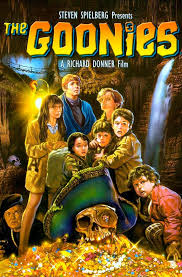
the goonies posterAs of this week I am on vacation. Yay for the burning heat or foggy chill of the Oregon Coast! As always we are in Cannon Beach, where the weather is random and as many of our large family as can make it come to kick off our shoes and play in the surf. This year several great-grandchildren I have never met are visiting from the east coast.

We are engineers and designers as well as artists and musicians–we will build a monument to sandcastles!

Or hang out at grandma’s condo and assemble a jigsaw-puzzle if it should suddenly turn cold and rainy.

Or we’ll watch TV on my son-in-law’s portable outdoor theater, which I find intriguing–I rarely watch TV at home. But we have to watch The Goonies, since we are in Cannon Beach–it’s a family tradition and a rule.

Tenth_of_DecemberFor reading material, I have my kindle loaded with Tenth of December by George Saunders. I listened to the Audible book, and I was so impressed with Saunders’ narration that I have to read it with my own eyes. Yep–this will be an awesome, relaxing reading-for-pleasure kind of vacation.

By virtue of past experience with Cannon Beach cuisine, I know I can eat in several cafes that offer vegan/vegetarian options–they are good, but limited.

But we always rent a condo, and I am doing most of my own cooking, as no one really gets that vegans eat vegetables–go figure! (oh god, a vegan–what will I cook?) I am the queen of barbecue tofu sliders, and all food homemade, not just vegan.

We always stay down by Ecola, and love that end of the beach. Watching the grand-kids and great-grand-kids play in the sun and surf is awesome. Making vegan smores is a total treat. The others are not vegan but I use vegan chocolate and if I can’t find any Dandies, I just won’t eat the marshmallows. The simplicity of sitting around the fire at night listening to my kids talk about their work, their ambitions, and their parenting lives inspires a sense of pride in me that is hard to explain.

The little ones are building memories that will bind them closer together, cousins with a common history of one particular place they went, a week-long family party, and a summer that seemed endless.

Amaranthus and Savvy at the needles by haystack rock cannon beach 2012Kite-flying is my big down-time hobby. I keep it simple, and have found through experience that flying a kite in the fog is not always as easy as it sounds. In many ways writing is a lot like flying a kite–it takes a little effort, but wow, once you’re aloft it’s mesmerizing.

I always return completely revitalized, and ready to get back into publishing and writing. Who knows what amazing revelations regarding my work will have occurred to me while I am enjoying the views and salt-sea air that Ursula K. Le Guin frequently enjoys?

Le Guin’s work was one of the many that inspired me to think I might be able to write–her way of telling a story was so compelling I couldn’t get enough of it. The first book of hers that I read,  A Wizard of Earthsea is set in the fictional archipelago of Earthsea. I loved how she painted that world with words, and brought it to life in my mind. And it was just my cup of tea–the story follows the education of a young mage named Ged who joins a school of wizardry—and is my favorite fantasy book of all time. She knows how to write great prose, and how to keep it moving so that even picky-wannabe-critics forget they are reading great prose.

Now, if only some of that  gift for word-bending will rub off on me while I am building sandcastles and flying kites in her old stomping grounds!

2 Comments

Filed under Humor, Uncategorized, writer, writing

Essays–the vegan discusses Bacon and other meaty reads

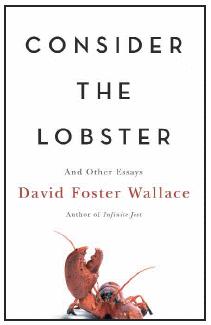
consider the lobsterWe have talked a lot about fiction and writing novels as well as short stories. You might think that outside of journalism and blogging there isn’t much left for an author. But there is another area of writing that we’ve all heard of but don’t often think about. They are Essays.

Essays are not just that bane of every school child’s existence–essays are where some of the best works of western literature can be found.

We shall go to the fount of all knowledge, Wikipedia, and ask the holy guru “what is an essay”: “Essays have been defined as “prose composition with a focused subject of discussion” or a “long, systematic discourse”.

Well–that was distinctly un-enlightening.

In her introduction to The Best American Essays 1988, Annie Dillard claims that “The essay can do everything a poem can do, and everything a short story can do—everything but fake it.”

The word essay also means to attempt–and why this meaning is important will emerge later.

But let’s take a look at essays, starting with Sir Francis Bacon, renaissance author, courtier, and father of deductive reasoning. The life and works of this English essayist and statesman had a major impact in his day and still resonate in modern literature. Essayes: Religious Meditations. Places of Perswasion and Disswasion. Seene and Allowed (1597) was his first published book.

The 1999 edition of The Oxford Dictionary of Quotations includes  91 quotations from the Essays. No one gets that many quotes unless his work has struck a chord with centuries of readers.

  • “Knowledge itself is power.”
  • “Riches are a good handmaid, but the worst mistress”

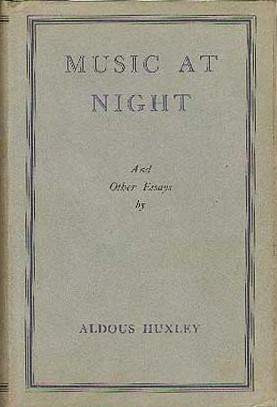
MusicAtNightAldous Huxley‘s book Jesting Pilate, an Intellectual Holiday had as its epigraph, “What is Truth? said jesting Pilate; and would not stay for an answer” quoted from Bacon’s essay “Of Truth”.  Huxley himself was a brilliant essayist and, according to Wikipedia, he defined essays in this way: “essays belong to a literary species whose extreme variability can be studied most effectively within a three-poled frame of reference”. These three poles (or worlds in which the essay may exist) are:

  • The personal and the autobiographical: The essayists that feel most comfortable in this pole “write fragments of reflective autobiography and look at the world through the keyhole of anecdote and description”.
  • The objective, the factual, and the concrete-particular: The essayists that write from this pole “do not speak directly of themselves, but turn their attention outward to some literary or scientific or political theme. Their art consists on setting forth, passing judgement upon, and drawing general conclusions from the relevant data”.
  • The abstract-universal: In this pole “we find those essayists who do their work in the world of high abstractions”, who are never personal and who seldom mention the particular facts of experience. (end quote)

Essays offer an author the opportunity to use prose to expound ideas and values. Michel de Montaigne (1533–1592) was the first author to describe his work as essays–by which he meant attempts. He used the term to characterize these short pieces as “attempts” to put his thoughts into writing. Montaigne’s essays grew out of his work that was then known as “commonplacing”:  published books that were essentially scrapbooks filled with items of every kind: medical recipes, quotes, letters, poems, tables of weights and measures, proverbs, prayers, legal formulas. Think of them as mini-encyclopedias.

Sir Francis Bacon and Aldous Huxley are two men whose works shaped modern literature and they did it though essays.

I highly recommend reading essays as a way to expand your imagination. Essays offer us ideas, philosophical, sociological, and ask us to examine our values.  This examination of the world through the eyes of essayists offers us many insights which will make their way into our own work in ways both seen and unseen, such as Huxley’s reference of Bacon’s work.

Some contemporary essayists I have read and who left an impression on me (some good, some bad) are:

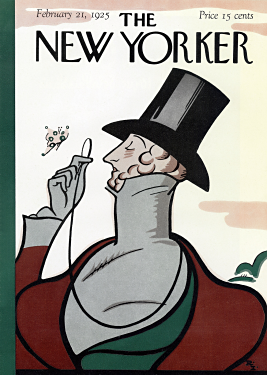
Original_New_Yorker_coverJohn McPhee, The Search for Marvin Gardens published in the September 9, 1972 issue of The New Yorker

Norman Mailer, Advertisements for Myself (published by G.P. Putnam’s Sons in 1959)

David Foster Wallace, “Consider the Lobster” (originally appeared in Gourmet, 2004)

George Saunders, “The Braindead MegaPhone” (Essays by George Saunders) (published by Riverhead, 2007)

Norman Mailer was definitely not my cup of tea, but he might be yours. Great writing is not always comfortable, but it always challenges your view of the world. I still didn’t like it.

Essays most frequently appear in magazines, so that is where to look for awesome contemporary work by today’s best-known authors of mainstream fiction–and much of it is sitting around in waiting-rooms the world over. If you fly Alaska Airlines (as I usually always do) take a look at that magazine they provide you with. You will find essays by authors like Scott Driscoll.

Essays are also frequently referred to as “Creative Non-Fiction” which sounds like an oxymoron–after all, when we are growing up “creative truthing” was called “lying.”  Get creative with your ideas and philosophies–put them in an essay.

Comments Off on Essays–the vegan discusses Bacon and other meaty reads

Filed under Humor, Literature, Publishing, Uncategorized, writer, writing

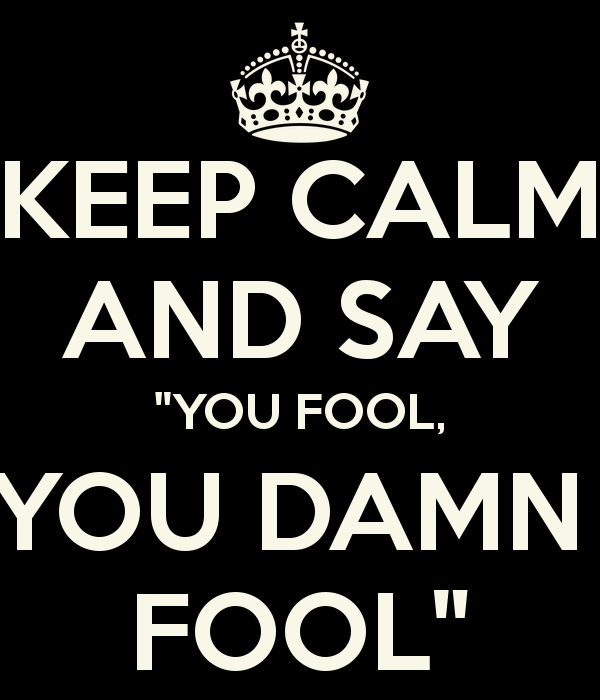
Is it damn fool, damnfool, or damned fool?

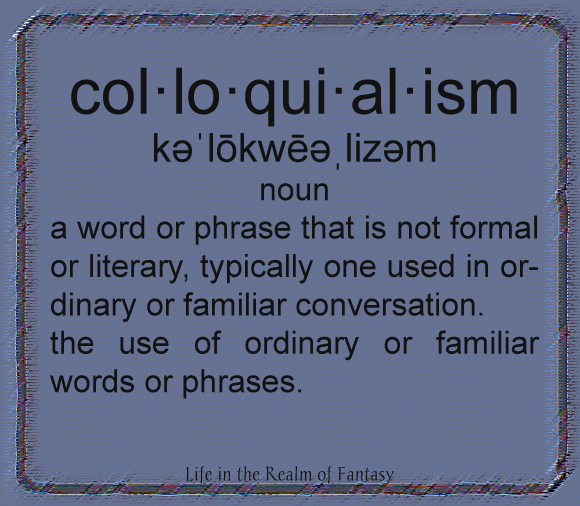
colloquialism memeOne of the more interesting things about being an editor is the amazing amount of time you spend stopping what you are doing and doing a little research. This is especially true if you are editing a piece that has a lot of colloquialisms in it.

Fortunately, some colloquialisms have made it into the Webster’s Dictionary, and the rest are out there on the internet somewhere.

Let’s consider the question of if we mean damn fool, damnfool, or damned fool:

According to the Urban Dictionary

  • A person who is extremely foolish. Their actions are not only irresponsible to themselves, but can possibly be harmful towards others.
  • If a guy tries and talk you out of using a condom, he is a damn fool. (You can’t make this stuff up–you have to go to the internet for it.)
  • Did you see that damned fool? He was swerving all over the road. (end quoted text)
And just for fun, lets see what Wiktionary has to say:
  • damn fool (adjective)
  • damnfool 
  1. (informal) Contemptibly foolish. (end quoted text)
He was a damned fool.

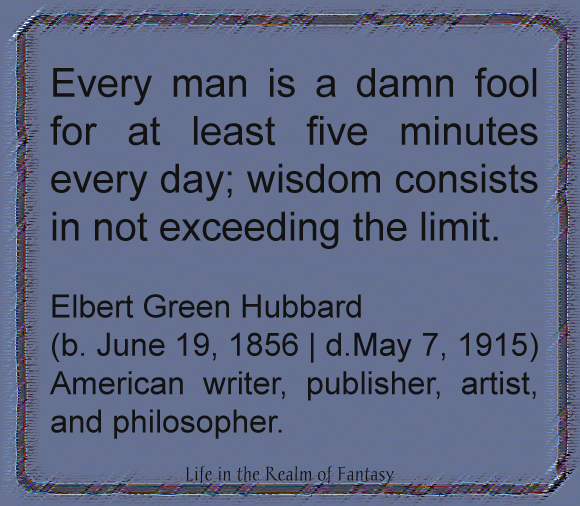
Ellbert Hubbard memeHow I see it:

  1. He was a damned fool. (I just cursed him to hell.)
  2. He was a damn fool. (He was contemptibly foolish)
  3. He did a damnfool thing. (He was contemptibly foolish and I will curse him to hell.)
Now this can be tricky if you are unsure which of these damnfool things the author meant, so this is where I insert a comment asking the author what kind of a damned fool she is writing about.
.
What other fun little “OMG I have to stop and look this up” things do I play with when I should be working?
  • I love looking up Pagan rituals, or indigenous peoples’ religious rituals.
  • I love anything to do with history, and exact dates.
  • Ooh! Ooh! Let me look it up on a map!
Yep–looking things up is part and parcel of the fun. I’m just not as keen on looking up where to properly place commas–the rules make my head hurt.
 .
So let’s talk commas and where to stick ’em, or better yet, where NOT to stick ’em. I found a wonderful website that has a handy-dandy list of comma don’ts phrased in simple language that did not make my eyes go numb: The Proper Care & Feeding of Commas
 .
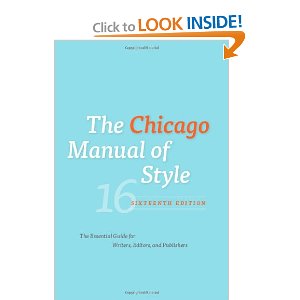
chicago manual of styleImproperly installed commas can wreak havoc in a paragraph. This is because they are punctuation: “…the act or practice of inserting standardized marks or signs in written matter to clarify the meaning (of a sentence.)” (quoted from Google)
.
Commas are there to separate clauses and to make sentences understandable. Consistently used according to the accepted rules, commas make it so that every English-speaking reader understands what you have written. We don’t put them in to indicate to the reader where we pause or take a breatheveryone pauses and breathes differently and what makes sense to you will not make sense to someone else.
.
These are the same rules for everyone, which make our work understandable in Brisbane, Houston, London, Hong Kong or Seattle. But the rules in the Chicago Manual of Style (my go-to manual) are often ambiguously phrased and are hard to remember. SO, when checking on simple points, I love this website for a quick list of comma dos: Your Dictionary: Comma Rules
 .
Dialect and local sayings play a huge part in contemporary work–sometimes I get a piece that was written by a UK author.  Perhaps it is an Urban Fantasy and it will have all sorts of words I have never heard of: again, I go to Your Dictionary: Common UK Expressions. This  is also a problem with American dialects and local slangs–the internet is my friend! Texas-talk is “a whole nuther thang” and sometimes more difficult to follow than Cockney EnglishHowdy Get Rowdy
 .
It is an editor’s job to do a certain amount of research whenever a question arises in the manuscript to ensure his comments will help the author clarify ambiguous and hard-to-understand areas. Having fun surfing the internet looking up obscure and interesting facts is just one of the perks!
.
keep-calm-and-say-you-fool-you-damn-fool

2 Comments

Filed under Books, Fantasy, Humor, Literature, Publishing, Uncategorized, writer, writing