Category Archives: writer

10 Things to Do—Part 1, The First 5 Speedbumps

shakespeare-word-cloud

There are things that happen in the natural course of writing the first draft that make it painful for people to read. DO NOT SHOW IT TO YOUR ADORING FANS JUST YET. This really is NOT the time to ask for feedback unless you want to be lied to. They will look at you with a possum-in-the-headlights smile, and say “Wow…this is really…nice.”

What they really are thinking is, “Holy s**t. This disjointed, hokey mess sucks.” That friend will poke needles in their eyes before they read another piece of your work again.

Just sayin’.

But even though the first draft is always stinkaroo, don’t try to edit as you write because it interferes with your creative processes and blocks the flow of ideas. While you’re writing the first draft these bloopers should be allowed to just fall where they may, because you just need to get the ideas down.  You will reshape them in the 2nd draft. So, today I’m posting the first half of a two-part series on 10 Things to Do in the second draft of your manuscript.

Before you do anything, just put it to one side. Forget about it for a while.

A month or so later, after you have gained a different perspective is when you begin to look for these problems.  Fine tuning and rephrasing will settle most of them, and a good flamethrower will take care of the rest!

First we will look at:

800px-Singapore_Road_Signs_-_Temporary_Sign_-_Detour.svg1. The Info Dump (my personal failing)

Often new authors feel they need to dump a lot of back story at a novel’s beginning before readers will understand the main story. I did this in my first novel, and I have regretted it ever since! It seems like logical thinking: “Before you get this, you need to know this.” But the problem was, I gave the info dump in the first five pages.  Those are the pages that acquisition editors look at and decide whether or not to continue reading the submission. For those of us planning to go the indie route, those pages are also the pages the prospective buyer sees in the “look inside” option on Amazon dot com.

While back story is important for character and plot building, too much outright “telling” freezes the real-time story in its tracks. And for modern genre fiction, beginnings must be active—they need to move.

Here is the opening paragraph of my next novel in the Tower of Bones series, Mountains of the Moon. It is a prequel to the first two novels, and this is the way it currently reads in its second draft stage. It may be changed once the editor gets her hands on it, but right now this is how it stands with the info dump removed:

Wynn Farmer discovered his old boots had holes worn in the soles when he heard the soft, squishing sound, perfectly in sync with every step he took. If he’d known he would be dropped into some strange world when he left the house, he might have planned ahead a little better and slipped some new cardboard into his boots, just until he could get them resoled. Now he trudged along a faint path through a dark, eerie prairie with wet feet, shivering in the cold, misty rain and completely lost.

In the second draft we alter the original words we wrote, subtly slipping little details into the narrative while showing the real-time story, and doing it in such a way that it is part of the action and the dialogue, fading into the background.  The reader will understand what you are showing them without feeling bludgeoned by it.
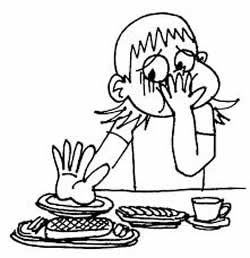
 

nausea42. Telling Instead of Showing in Prose (heh, heh–my own personal failing)

In the rush of the first draft, of getting all our thoughts about the storyline down, sometime our minds go faster than we can write. We use a kind of ‘mental shorthand’ and write things such as:

Erving was furious.

Martha was discouraged.

These are really just notes telling us what direction this tale is supposed to go. Modern readers don’t want to be told how the characters felt—they want to see. When you come across this in a novel, it is clear the author has published a first draft.

Thus, when you come across this in your first draft, now is the time to follow those road signs and expand on the scene a little. Instead of telling the reader that Martha was furious, you will show this emotion.

Martha stamped her foot, and clenched her fists.

Erving’s body shook with rage, and his face went white.

Show the reader the emotions. It adds word count, but you will also be taking word count away in other places in the manuscript as you go along.
 

cover_art_Billy_39_s_Revenge3. Using Dialogue to Tell, Not Show (oh yeah–my personal failing)

“I’m simply not going to do it,” Vivian hissed. (Reader: “What, is she a snake?”)

“Why, oh why, did I ever trust her?” Greg said dejectedly. (Reader: “Aw, that’s sad. Boring!”) (Closes book.)

Please, OH please, avoid attaching adverbs ending in “ly” to speech tags. They are the devil!

If you want to convey an attitude in dialogue, the words themselves should communicate it.  Greg’s words already communicate dejection. If you need more, add a line of action:

In low tones, Vivian said, “You couldn’t pay me enough to do that.” She turned and walked away.

Greg threw up his hands. “Why did I trust her?”

This gives readers the opportunity to see for themselves the scene you painted with words.


4. A Lack of Contractions in Dialogue (Wait–this is my personal failing too!  What’s going on here?)

“Arrabelle, I do not want you to leave me!”

This is one of the worst NaNoWriMo manuscript flaws BECAUSE when we are in the midst of November, we are desperate for word count. “Don’t use contractions” is one of the prime directives of Chris Baty’s  “No Plot? No Problem” and if word-count is all you are in the game for, then fine.  However, IF you ever intend to publish your work you should use contractions in dialogue. Depending on the type of story you are writing, you may want to use them elsewhere, if that is the style of your work.

This problem may also be a throwback to those days in your high school English class, when teachers deducted points for the use of contractions in term papers. But contractions are effective at conveying realistic speech.

You want dialogue to sound natural? Use contractions.
 

Dialogue Tags © cjjasp 20145. Too Many Speech Tags in Dialogue (Hey–I have that problem too! What the heck…?)

“Jake, are you okay?”  Vaia wailed.

 “Of course I’m all right,” Jake groaned. “What a silly question.”

 “But your arm,” Vaia said. “I thought maybe you…well, the way you’re holding it…I guess I thought—”

 “You thought I’d injured it,” Jake said.

 “Well…yes,” Vaia said.

Especially when only two characters are talking, readers should be able to keep track of speaker ID with ease. In those situations, speech tags are rarely, if ever, needed. In fact, doing away with tags entirely, unless they are absolutely necessary, is frequently suggested to be a great strategy, although I don’t go that far. Instead of using a speech tag, insert a burst of action before or after a line of dialogue that identifies the speaker and lends opportunities to deepen character chemistry, conflict, and emotions.

Vaia felt something trickling down her cheek. She wiped it, and her hand came away with blood. Jake was pale, and held his arm at a strange angle. “Jake, are you okay?”

 “Of course I’m all right. I’m always all right.”

 She reached toward his shoulder, toward the torn shirt—but something held her back. “But your arm. I thought maybe ….”

 “I’m hurt, but I think it’s fine. You thought maybe I had broken it.” He willed her to admit that she cared.

 The intensity of his gaze forced her to look away. “Well…. I did think that. Can you still fight?” 

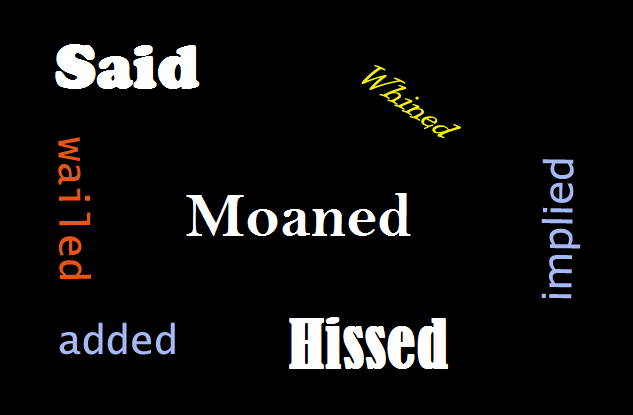
Trade in empty speech tags for emotion-infused writing that can do so much more. HOWEVER—Remember that the reader needs to have clear direction as to who is speaking to whom, otherwise you will lose the reader. And I do recommend you don’t get too creative with them.  Said, replied–those are usually all that is required. If you throw in hissed, or moaned, once in a great while for specific circumstances, fine, but not too much please. It’s too distracting for me as a reader.  I close that book and move on to the next when the  characters do too much hissing and moaning. Just sayin’.

This covers the first 5 things to look for in your second draft. Items 6 through 10 will be covered on Wednesday!


1 Comment

Filed under Adventure, Battles, Books, Fantasy, Humor, Literature, Publishing, Uncategorized, writer, writing

Timber Rose, by J.L. Oakley – official launch

Timber RoseToday is the launch of J.L. Oakley’s ‘Timber Rose.’ As a third-generation, life-long resident of the Pacific Northwest, I am proud of our rich history. I know it’s not fantasy, but I am a multidimensional reader and I’ve been looking forward to this book all year. I loved her first book, ‘Tree Soldier.’ 

Oakley will be officially launching  ‘Timber Rose’ at Village Books in Fairhaven, in Bellingham Washington today at  4:00 P.M.  If you are a Northwest resident and can make the drive to Bellingham, by all means do so.

Here is the Blurb on the back of the book:

1907. Women climbing mountains in skirts. Loggers fighting for the eight hour day. The forests and mountains of the North Cascades are alive with  progress, but not everyone is on board. Caroline Symington comes from a prominent family in Portland, Oregon. Much to her family’s dismay, she’s more interested in hiking outdoors and exploring the freedoms of a 1907’s New Woman than fancy parties and money. She plans to marry on her own terms, not her parents. When she falls in love with Bob Alford, an enterprising working-class man who loves the outdoors as much as she, little does she know how sorely her theories will be tested. Betrayed by her jealous sister, Caroline elopes, a decision that causes her father to disown her. The young couple moves to a rugged village in the North Cascade Mountains where Caroline begins a new life as the wife of a forest ranger. Though she loves her life in the mountains as a wife and mother, her isolation and the loss of her family is a challenge. As she searches for meaning among nature, she’s ushered along by a group of like-minded women and a mysterious, mountain man with a tragic past.

‘Timber Rose’ has already received a fine review from Barbara Lloyd McMichael of the Bellingham Herald. Published on April 3, 2014, you can read McMichael’s review of Timber Rose here:  Prequel taps early 20th century for drama.

tree soldierI’ve known and admired J.L. Oakley for several years, having ‘met’ her in the virtual universe in 2011, when we both entered the  ABNA (Amazon Breakthrough Novel Awards) contest that year. This year she entered her book, Tree Soldier, and has made it to the second round of the contest.
Janet is also an active member of the Pacific Northwest Writers Association, of which I am also a member. She has been a presenter as several PNWA conventions, and is a well-known historian here in the Pacific Northwest.
.
And if you are curious to know more about her, here is Janet’s official bio:


About the writer:

Janet Oakley is an award winning author of memoir essays and novels. Her work appears in various magazines, anthologies, and other media including the Cup of Comfort series and Historylink, the on-line encyclopedia of Washington State history.  She writes social studies curricula for schools and historical organizations, demonstrates 19thcentury folkways, and was for many years the curator of education at a small county museum in La Conner, WA.  Her historical novels, The Tree Soldier set in 1930s Pacific NW and The Jossing Affair set in WW II Norway were PNWA Literary Contest finalists.  Tree Soldier went on to win the 2013 EPIC ebook award for historical fiction and grand prize for Chanticleer Book Reviews Lit Contest.

She writes both non-fiction and fiction, applying her research skills to both types of writing.  In 2006 she was the manager of a History Channel grant, researching old court cases in early Washington Territory.

She especially enjoys the hunt in old newspapers, court cases, and other delights in archives around the country.  The history of the Pacific Northwest is rich and not as well known in the rest of the country beyond Lewis and Clark’s passage through, yet crucial happenings took place here that influenced the formation of United State of America.  In December 2012, an article on a  19th century bark that was a part of the coastal trade between Puget’s Sound and San Francisco was published the prestigious Sea Chest.

>>><<<

This wraps up my post for today, but if you have a chance, get to Village Books in Bellingham and meet Janet, a.k.a. J.L. Oakley.

fort-nistqually-talk-june-6-2012

Comments Off on Timber Rose, by J.L. Oakley – official launch

Filed under Books, History, Literature, Mt St Helens, Publishing, Uncategorized, writer, writing

Meet Author Connie J. Jasperson

I’ve had a lovely time meeting this man (ape.)

edit: Okay – At first I keyed in “Mating”.

That did not happen.

But the man behind the ape is a wonderful person, and I did enjoy MEETING him!

*See me walk out to the car with both feet in my mouth*

Chris The Story Reading Ape's avatarChris The Story Reading Ape's Blog

Profile Pc 9-7-2013 jpegConnie J. Jasperson lives and writes in Olympia, Washington. A vegan, she and her husband share five children, eleven grandchildren and a love of good food and great music. She is active in local writing groups, and is the Olympia area municipal liaison for NaNoWriMo. Music and food dominate her waking moments and when not writing or blogging she can be found with her Kindle, reading avidly. An avid gamer and obsessive fan of the Final Fantasy RPG Empire, Connie began writing short stories and fairy tales for her children, and progressed to writing the storylines for an RPG computer game. The game was never put into production, but the story launched a series of books, the Tower of Bones series. Writing, reading and gaming takes all her free time not spent living la vida loca with her grandkids.

You can find her blogging on her writing life at: Life…

View original post 408 more words

3 Comments

Filed under Books, Fantasy, Humor, Literature, Uncategorized, writer, writing

Strapping the Monkey to the Typewriter and Selling His Work

0000-9780857863782At times, creativity seems to fail. We’ve become bored with the work we’re doing and need some new thing to spark that creative genius lurking deep within our coffee-addled brains (or wine-soaked, as the case may be.) An infinite number of monkeys strapped to IBM Selectrics, industriously typing out Shakespeare could do better.

For myself, the way to beat this is to write something, anything–even if it doesn’t pertain to my major work in progress. The best part of being an indie is that you can write in whatever direction the mood takes you.

And that is how Huw the Bard  came about. I was supposed to be working on Forbidden Road, but I had become bogged down. NaNoWriMo came along and Huw grabbed me by the imagination and away we went.  This jump-started my mind on the other book too, so I wrote on both books for the next year. Forbidden Road was finished, edited and published in 2013

Now Huw the Bard has been published and I am working on Valley of Sorrows. In the meantime I have to find ways to publicize my work, and since we just acquired a hefty car payment, it must be affordable. (As in CHEAP.)

google plus iconIn other posts I have discussed the importance of getting Twitter, LinkedIn, Goodreads, Pinterest, Facebook and Google+ profiles created. You must also have your Author Central profile put together on Amazon and one for Smashwords, Barnes and Noble and any other major online place you sell your works.

Today, I want to say that Facebook is fun, and a great place for a free launch party. We had a great time with that, and I do think it helped sell books.  But you need a sustainable place to put your work, and Facebook is no longer that great a venue for selling books.  I’ve had better luck through blogging, if the truth be told.  My good friends helped get Huw the Bard off the ground with their blogs and tweets.

Also, Facebook won’t allow your posts to be seen by many people unless you pay them. They call it ‘Boosting’ the post. I have done that on occasion, and  for 30.00 I sold 3 books.  That is a terrible return on investment.

tsra-button-01I was directed by Aura Burrows, who writes the hit series, “The Cold” on www.BigWorldNework.com, to an interesting and free website run by a friend of hers. It is called The Story Reading Ape Blog and I have gone to the “contact me” page and followed the instructions. It is free, and Chris is awesome as a person–he is very sincere about helping indies get their work seen. I will keep you posted as to how that goes for me, and if you want to try it yourself, please feel free to click the link and go for it.

There are many venues–blog hops,  paid ads on Goodreads and Google–all of which I will be doing over the next year. Paid ads are tricky–the ones I can afford are not that big or prominent so perhaps they aren’t a good investment. However, there are many affordable indie book websites who will sell you ad space for $30.00 to $50.00 a whack–a sum that is doable for me if I give up Starbucks for my craft.

So now begins my real push to get my work out there–to make it visible so readers will see it and want to know what it’s about.  I have to push Tales From the Dreamtime as well as Huw the Bard, because I have that wonderful narrator, Craig Allen, depending on me to sell our audio-book! I’m selling a few books here and there, but I’ll be posting about which venues were most successful as the year progresses.

The real trick will be to get the work out in the public eye without spamming and alienating my friends.


5 Comments

Filed under Books, Epilepsy, Fantasy, Literature, Publishing, Uncategorized, writer, writing

Karaoke Noveling

science of relationships dot comGoodness knows I have read my share of badly written books over the last three years. There is no way to describe the agony of seeing a perfectly good novel devoured by excessive descriptions and overblown characters whose moves and emotions are described to the last detail.

So I don’t.

children of the elementi ceri clarkInstead I focus on the really awesome books I have enjoyed, many of twhich will never be best sellers because they are just one drop in an ocean of books.  But that too will change, I think.

Right now, there is this sort of Karaoke Culture going in regard to writing genre-novels. It’s an “anything you can do, I can do better” sort of philosophy, and while it’s not necessarily terrible, it’s flooding the market with less than stellar works by people who really only have one book in them, and not a great one at that.  At some point, this flood of indies will peak and then level out and those who are in it for the long haul will gain better visibility.

George R.R.Martin formatting issue 1 via book blog page views, margaret ebyIn actuality, every indie author is a Karaoke Star–at first we begin as amateurs who dream big, standing up in front of a crowd and putting our talents (or lack thereof) on the line.  We find out that the more you drink, the better we sound, and when you applaud our efforts, it only encourages us.

Young Woman Sitting Looking at Laptop ScreenSome of us become so encouraged, we quit our day jobs and go pro–to our families’ shock and horror.

Regardless of how badly written a book is, the author had passion for it, and just like the guy who mutilated “Billie Jean” with all his drunken heart in the Karaoke Bar the other night, the author did their best against huge odds.

I have some hard-earned advice for new authors, those of you who want to leave the ranks of the Karaoke novelists. If you are really serious about your work,  get your work professionally edited. Yes, it will cost you, but that experience will enable you to put a book out there that you can be proud of, one that will stand up to any put out by the big publishers.

George R.R.Martin formatting issue 2 via book blog page views, margaret ebyYou might wonder what prompted this little rant–I have just spent the week looking through five reasonably priced, beautifully covered indie books–only to discover they were poorly formatted, rife with newbie errors–beginning the book with a big info dump (been there done that)–thick, lush descriptions of “creamy blue eyes” (pardon, must barf now)–and threads to nowhere, obviously intended to entice the reader to get the sequel, which is now on my “No way in hell” list.  My response? “If you went to the trouble to find expensive art for the cover, you could have had the freaking mess professionally edited. Don’t tell me your friends edited it for you, because the way it looks now, your best chums aren’t doing you any favors.”

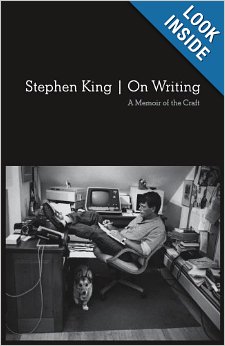
on writing

Indies–aren’t you glad I only review the books I like? I don’t want to be known for being a bitch, which is what I feel like when I read some of these travesties.  You see–I have been there.  I started out that way and I didn’t get it either. But experience is a real teacher, and more than anything, I love this craft, and want to be the best I can be at it, whether I sell a book or not.

Thus, after grousing and yelling for two days this week, I decided to reread an old favorite, and will be blogging on my review blog about a book that was published in 1997. I have read it twice, and each time I am swept away by it. Tomorrow, I will be talking about it on Best in Fantasy. My posts go up by 8:00 in the morning US west coast Pacific time. If you are curious as to what book I am talking about, stop by tomorrow!

EDIT:

Review of “Fall of Angels” by L.E. Modesitt Jr.

8 Comments

Filed under Adventure, Books, Fantasy, Humor, Literature, Publishing, Romance, Uncategorized, writer, writing

The Wayward Plot

Eternal_clockIf you happen to be a character in a fantasy tale maps are awesome indicators of what direction you should probably point your horse, whenever you are off on a nice vacation in Hell.  However, the wise hero also carries a calendar,  and perhaps a pocket watch, since even the most absurd quests have a finite date of completion.

I’m not sure what would have happened if Frodo and Sam hadn’t arrived at the volcano in time to scorch Sauron’s plans, so to speak–and what if Gollum had not gotten the memo? Who would have leapt into the lava?

images“…After you, Samwise, old buddy, old friend….”

“…Ah….no Mr. Frodo…. Please, you go first….”

SO, even though maps and calendars as created by frail, elderly  authors are  NOT finite, and nothing is exact or engraved in stone, the wise author uses both when constructing the tale.  Sure in the end you don’t use exact dates, nor do you use exact miles–if you do, you won’t get it right and your editor will pick it to bits.

Remember, in fantasy, time  and distance are mushy, but it really helps to have some idea of when all the important bits are supposed to come together.

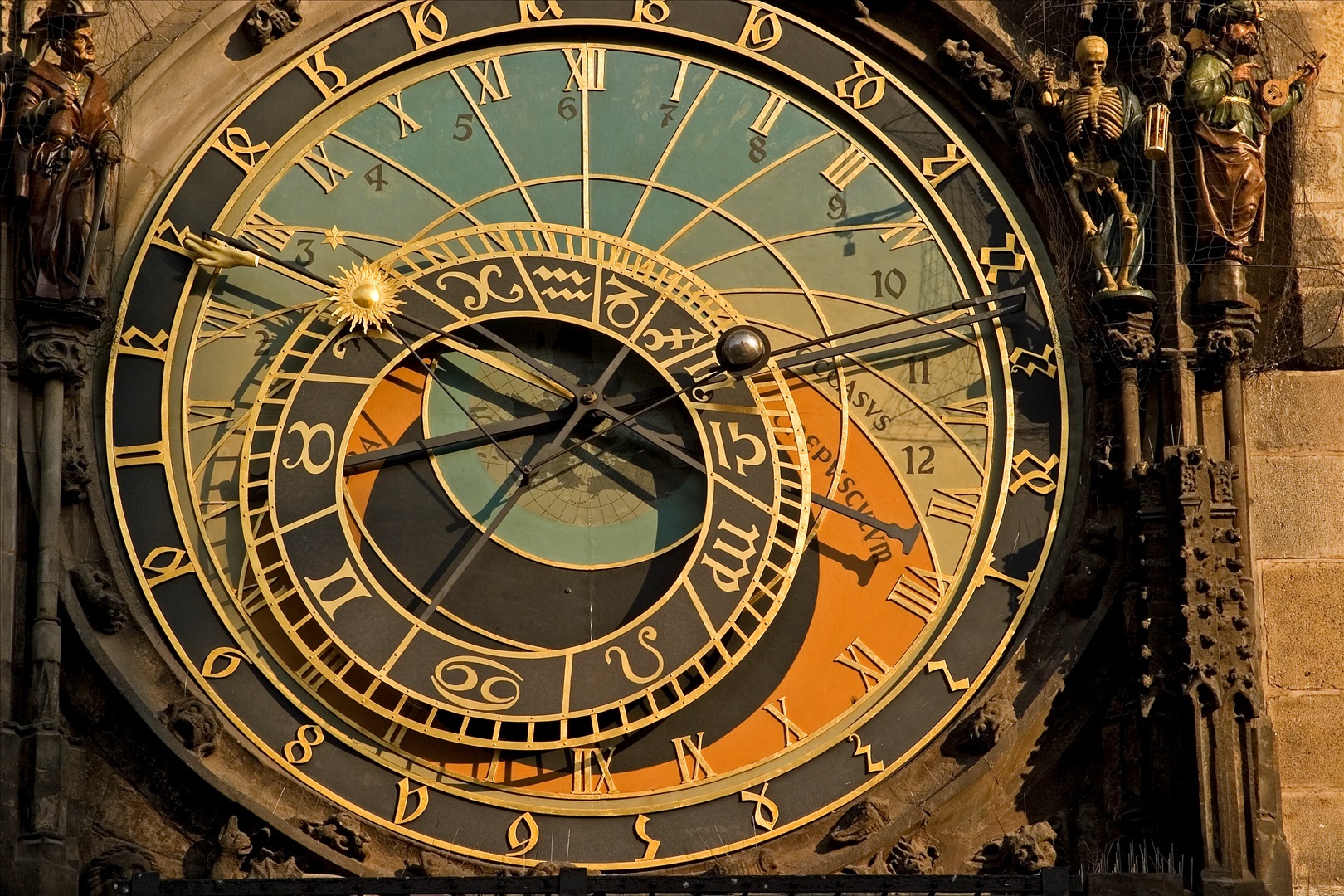
Prague-Astronomical_clock-Clock-Old_Town_Prague-Prague_Astronomical_Clock-originalEven in this modern world of the GPS and Atomic Clocks, each individual traveler arrives at their destination at a different time and by a different route. Take my family: My husband and I will have the family dinner scheduled for 1:00 on the given holiday, but family members will arrive at varying times up to 3:00, all from the same general area of the north, and all of them funneled down I-5.

So when you are constructing your story, the calendar helps keep you on track, so that an event that takes 2 months for the main character also takes that length of time for the supporting characters.

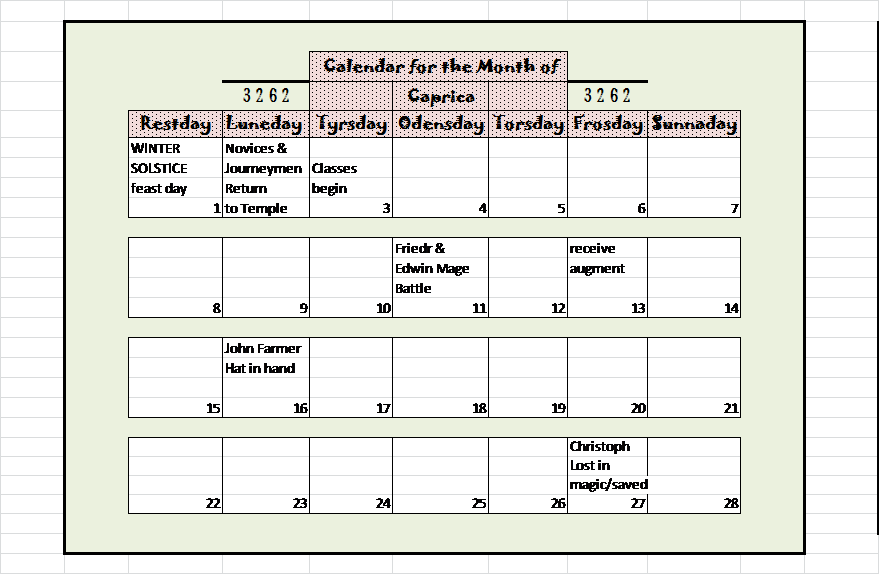
Calendar Capricas 3262 NeveyahFor my books set in Neveyah, I invented a 13 month lunar calendar, and labeled the months with names drawn from astrology. I named the days of the week using norse gods (don’t ask me why–it was years ago, and I was writing the basic outline of TOWER OF BONES  as the walk-though for an old-school RPG that never got built.) Since the book was not originally graphed out as a book, there are flaws inherent in this that I am dealing with to this day!

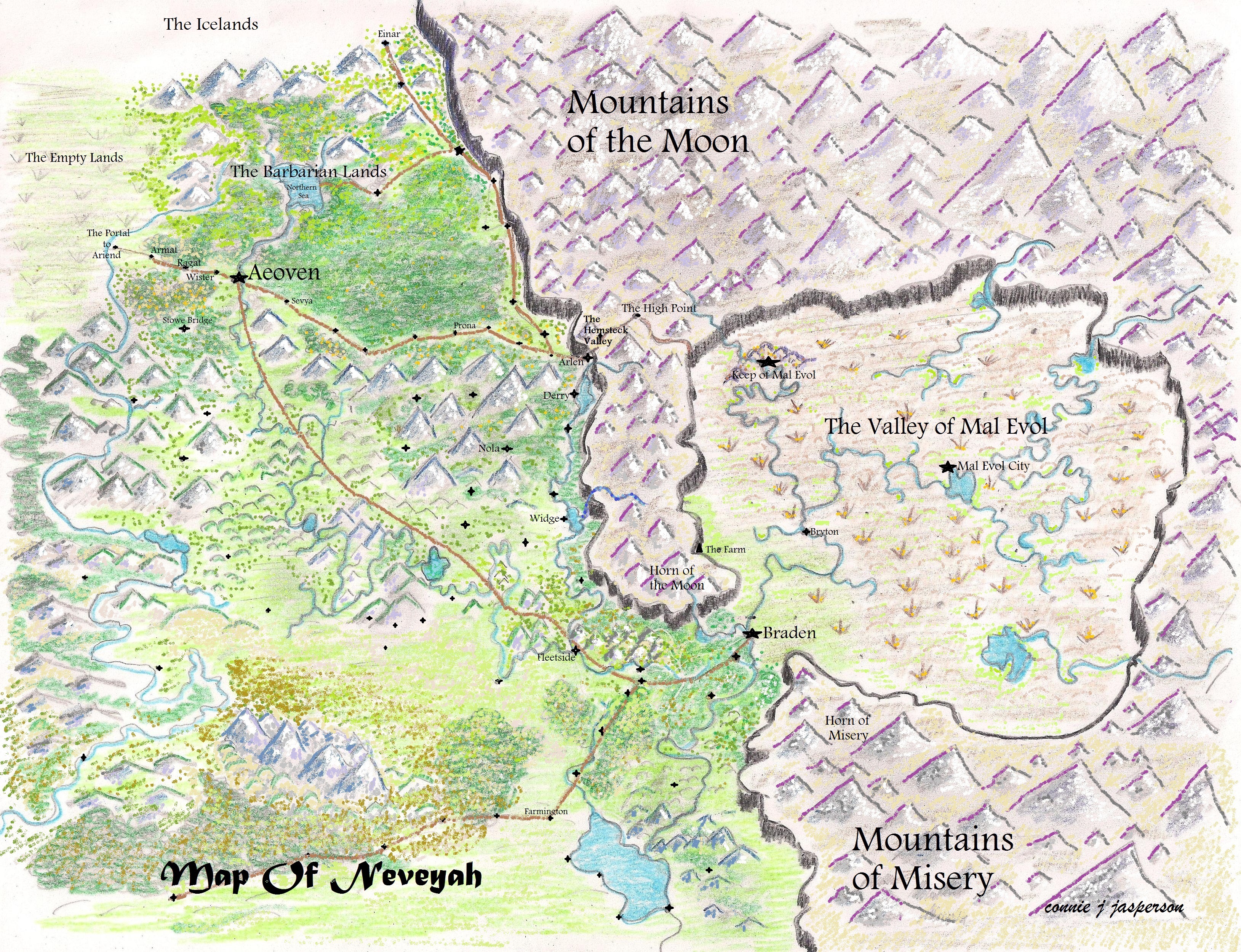
map of Neveyah relief 3-4-2013 001But those flaws are creating some awesome plot opportunities in Valley of Sorrows, the final book in the TOWER OF BONES series.  I just have to make sure I use the calendar to mesh events in the first half of the book with the events in FORBIDDEN ROAD, because John Farmer and Garran Andressson absolutely must be in Braden when Edwin, Friedr, and Zan arrive.

The second half of the book is pretty much structured, but the first half is giving me fits.  As Alison DeLuca, author of the steampunk Crown Phoenix Series frequently says, it’s like birthing a cement hippo.  Still, it is beginning to come together.

3 Comments

Filed under Adventure, Books, Fantasy, Literature, Uncategorized, writer

Wringing inspiration from a stone

Wrong-Way-Traffic-Sign-K-101-1Writing is sometimes a bit of a struggle. Some days you just have to force it, and if you get a thousand words, you’ve scored! It isn’t that I have lost my fire for this tale–on the contrary–I love these characters and their story incredibly.  I’m just at a spot where I am not sure how to proceed.

I’m building up to an important moment in the tale. I know what has to happen. I know who must be there and what they will do–I just can’t set the scene in my head. Gradually, one conversation at a time, it is taking shape.

When I see it in my head it is one thing.  When I see it on the screen, it’s another. Pulling this out of my head is worse than cleaning the refrigerator.

It’s amazing, the stuff that you find.

800px-Singapore_Road_Signs_-_Temporary_Sign_-_Detour.svgSo–I’ve come up with a plan.  I made the plan so that I would have something to do when I was not writing what I was trying to write. Making plans is really a good diversionary tactic for when you are avoiding doing something that you should be doing.

Like writing.

traffic-sign-reflective-10683So I work on business until my head hurts. Then I write a little. Then I do some things around the house but not too much–I don’t want my husband to think I’ve turned into a domestic diva or something. And then I write a little more.

Then I blog.

Then I write a little.  Then I read, which is a lot more fun than any of the above.

Then I get my behind back in the chair and force myself to write, even though I know whatever falls out of my head won’t remain in the book in this incarnation. It will be filtered through me, the betas and then the editors, so the point is to just get that idea out there onto the paper.

6a0120a85dcdae970b0120a86d6130970b-piWhy is it so stinking hard?.

It’s like having to work on Saturday, and hoping that when you get home your spouse or the kids will have done the dishes.

You know the house will be trashed, and the darlings will be starving despite the mountain of cereal bowls in the sink–and you know it will be your job to rush around like a freak solving the problem.

But when it’s done, and the first draft of your manuscript is finished, it’s so worth the effort.

3 Comments

Filed under Adventure, Battles, Books, Fantasy, Humor, Literature, Uncategorized, writer, writing

Spanking L. E. Modesitt Jr.

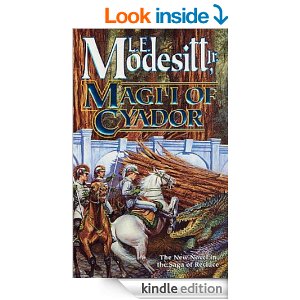
magii of cyadorI’m just going to say at the outset, I love L. E. Modesitt Jr. and his work.  But my very FAVORITE series of books has a huge failing–the MAPS SUCK!  In Fall of Angels,  The Chaos Balance, Magii of Cyador and Scion of Cyador, and all of which take place BEFORE the world of Recluce is dramatically altered, the main characters are traveling all over the continent to places that DON’T EXIST on the maps provided in the front of the books! (I’d add another exclamation point or two, but it would look like I’m hyperventilating.) (Gasp.)

798px-Diego-homem-black-sea-ancient-map-1559However, I do understand how such a thing happens.  Being an indie, I am responsible for providing some sort of mappy-thing in the front of my own books and that is where it actually gets a bit dicey.

The thing is–maps, unless they are drawn by satellite GPS, are inherently WRONG in regard to actual distances and such. All they can do is provide a general idea of where the cartographer thought things were.

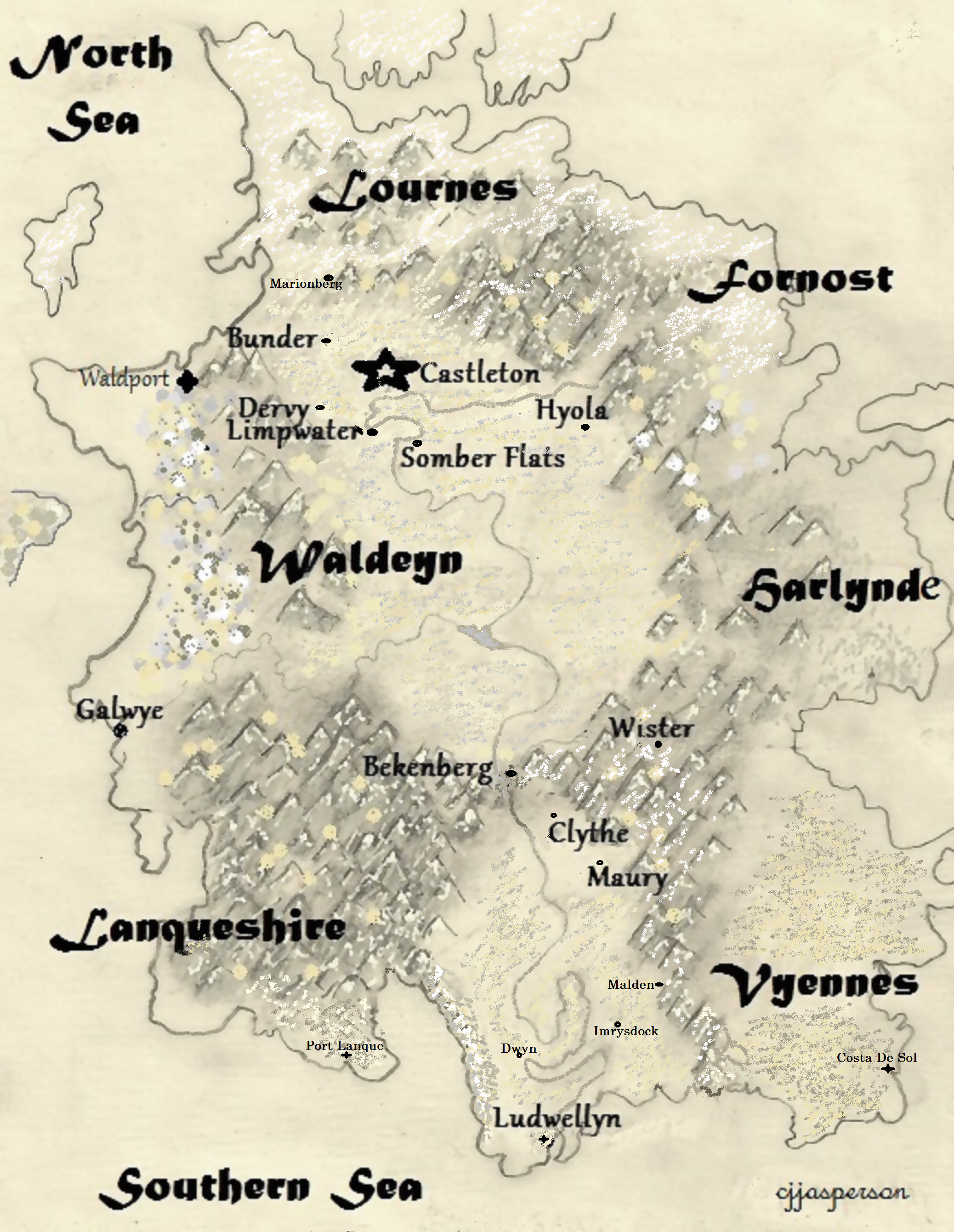
map of Waldeyn 2014As a tool, I draw my own maps, when I am writing the tale so I will have some idea of where the heck they are going, but I am not a cartographer. All maps drawn by me are only a picture of where one town might lay in relationship to another, a general idea of things.

Being an avid map checker, it frustrates me when there is no way to see what the author is talking about when he takes his characters from one place to another. I’m not asking for accuracy here, just a general scribble on the back of a napkin would be awesome–some indication of the direction and the lay of the land, such as mountains, forests and harbors.

BUT FOR THE LOVE OF TOLSTOY DON’T PUT MAPS IN THE FRONT OF THE BOOK THAT HAVE NO RELATIONSHIP TO THE TALE.

Cyador's HeirsL.E. Modesitt Jr. has a new Cyador book coming out in May, Cyador’s Heirs,  and I have already preordered it. I can hardly wait–it’s almost like waiting for Harry Potter!  Oh, mighty publishing giant who prints these wondrous creations PLEASE — make the bloody maps pertain to the actual book! Don’t make me stop this car!

2 Comments

Filed under Adventure, Battles, Fantasy, Humor, Literature, Publishing, writer, writing

Hyphen help us–

hyphenated wordsYou thought hell was getting that manuscript written and ready for submission. You thought the rest was going to be easy.

Oh, no, my friend.

True hell is discovered in the editing process of your manuscript. This is when you realize that (among other failings) your knowledge of  how hyphenated words really work is somewhat lacking.

Oh sure, everyone agrees that a compound word is a combination of two or more words that function as a single unit of meaning. Most of us even know that there are two types of compounds: those written as single words, with no hyphenation and which are called “closed compounds”– such as the word “bedspread,”  AND  the “hyphenated compounds,” such as “jack-in-the-box” and “self-worth.”

But there is a third group, and they are the bane of my life–those mysterious, ephemeral denizens of the deepest corner of writer’s hell, called open compounds. These seemingly innocent instruments of torture are written as separate words–the nouns “school bus” and “decision making,” for example.

But how do I tell if  it’s one word, two words or a hyphenated word?  

1. Do not use a hyphen unless it serves a purpose. If a compound adjective cannot be misread or, as with many psychological terms, its meaning is established, a hyphen is not necessary.

For example:

covert learning techniques, health care reform, day treatment program, sex role differences, grade point average

2. Do use one in a temporary compound that is used as an adjective before a nounuse a hyphen if the term can be misread or if the term expresses a single thought:

For example:

“the children resided in two parent homes” means that two homes served as residences, whereas if the children resided in “two-parent homes,” they each would live in a household headed by two parents.  In that case, a properly placed hyphen helps the reader understand the intended meaning.

IMG7663. We also use hyphens for compound words that fall into these catagories:

a. the base word is capitalized: pro-African

b. numbers: post-1910, twenty-two

c. an abbreviation: pre-ABNA manuscript

d. more than one word: non-achievement-oriented students

d. All “self-” compounds whether they are adjectives or nouns such as self-report, self-esteem,  self-paced.

4. We hyphenate words that could be misunderstood when there are diverse meanings if they’re unhyphenated:

re-pair (to pair again) as opposed to repair (to mend)

re-form  (to form again) as opposed to reform (to improve)

5. We hyphenate words in which the prefix ends and the base word begins with the same vowel:

metaanalysis, antiintellectual

But really, unless you are a technical writer, how often are we going to use these terms? Hence, the confusion when we DO use them.

Getting it write online dot com says, “One way to decide if a hyphen is necessary is to see if the phrase might be ambiguous without it. For example, “large-print paper” might be unclear written as “large print paper” because the reader might combine “print” and “paper” as a single idea rather than combining “large” and “print.” Another such example is “English-language learners.” Without the hyphen, a reader might think we are talking about English people who are learning any language rather than people who are learners of the English language.”

Write most words formed with prefixes and suffixes as one word with NO hyphen.

Prefixes: Afterglow, extracurricular, multiphase, socioeconomic

Sufixes: Arachnophobia, wavelike, angiogram

dictionaryxHooray for Merriam-Webster! One can also look the word up in an online dictionary, to see the various different ways it can be combined. Just go to:

http://www.merriam-webster.com

Now the real point of all this is that no matter how much I know when I am editing for another author, I always manage to screw up my own work amazingly well–it’s like my finger has a twitch that absolutely MUST add a hyphen! (Or a semi-colon, but that’s another post.)

Curses on the hyphen!

6 Comments

Filed under Books, Fantasy, Humor, Literature, Publishing, Uncategorized, writer, writing

Words as Swords

shakespeare-word-cloudGrammar is such a pain. We all speak naturally in a dialect that is indicative of where we live, and there are certain peculiarities that will emerge in our scribbles.

*doh*

I was raised by a set of parents who adored words.  Long words, short words, rhyming words– my siblings and I learned words at a young age and we know how to use them and in what context.

Of course, many of the words I was taught were unique to my family, apparently, but words were important and they were celebrated.

the_last_good_knight_cover-createspace.jpgPeriodically Dad would “lose his words” and what came out of his mouth at that point we were not to repeat….

I have this wealth of words in my head, and yet when I get to cruising on a tale, I inadvertently use the same words rather frequently, as if my head is stuck in a rut.

Words have power. Words can build nations and words can tear them down. “When, in the course of human events, it becomes necessary for one people to dissolve the political bands which have connected them with another, and to assume among the powers of the earth the separate and equal station to which the laws of nature and of nature’s God entitle them, a decent respect to the opinions of mankind requires that they should declare the causes which impel them to the separation.”

51VAA93NY4LWilliam Shakespeare adored words too, and is credited with inventing over 1700 of the words we use today. He did this by changing nouns into verbs, and connecting words together that had never been used before. Some of these words include ‘bedroom’ and ‘courtship.’

Words can win a persons love, and words can destroy a relationship forever. “Where love is great, the littlest doubts are fear….”

To have the chance to wallow in words all day long, and get paid for it is more than amazing, it is what I always dreamed of. I live for words, to write them, to read them — to play with them. I get to quote Shakespeare! “Cry ‘havoc,’ and let slip the dogs of war….”

Long words, short words, life is built around words.

“Without the which we are pictures, or mere beasts…..”

2 Comments

Filed under Battles, Books, Fantasy, Humor, knights, Literature, Uncategorized, writer, writing