Category Archives: writer

#amwriting and #amrevising: weeding the garden of words

Free-range pansies by cjjaspersonWhen I write a novel, I always end up with a lot of back story. These are details that are important for me to know, but not meant for the actual novel. It’s more a way for me to mentally talk my way through the first draft.

I think of my manuscript as a garden of words, and by the time the novel is complete, it will have been weeded, dug up, and replanted many times.

Every author has their own style, their own way of getting the story down on paper. My style is not the usual way, but it works for me.

The way I do a first draft is this: First, I put together an outline listing all the characters and plot points.  Second, I write the ending and then write the scenes for the large events and turning points. Once those are in place, I start at the beginning and write the story in a linear form, connecting the large events and finally meeting up with the end.

Along the way, my story evolves. A lot of fluff gets added in because I need to sort the story out in my head and writing it down is the way I do that. This fluff is all written in a passive, telling voice, and is part of my road map for creating the first draft–it was put down in that fashion so I would remember it later when I came back to rewrite the scene and turn it into an action sequence or cut it entirely.

I’ll give you an example of a telling sequence from Julian Lackland’s story, which is set in Waldeyn, Huw the Bard’s world. It was written down in this way so I would have a mental picture:

“In Port Lanque, the harbor itself was accessible only by one broad cobbled street, Quay Street, snaking down the steep cliffs to the piers. This wide boulevard ran through the center of town, twisting and turning in a sharp descent down to the piers, and had been kept in good repair by the pirates as it was the only way to move carts and drays down to the ships for off-loading loot. At the very top of Quay Street, in the worst part of town, an immense, rundown palace loomed. Now less than a filthy slum, it was once the home of generations of kings.”

Little or none of that passage will make it into the final manuscript because it doesn’t advance the plot. It was originally written to set the scene in MY mind. But I didn’t throw it away–I kept it in my file of outtakes along with some useful conversations further down the page that may come in handy in a different story:

“You’re wearing a dress, madam, not a crown. How can I be sure you’re the real king?” King Harry eyed the pirate. “You could be any old thief claiming to know how to sail a ship. I happen to like this ship, and I’m not disposed to give her away to some random old man in a dress.”  

That above passage is why I say you shouldn’t be married to your prose. I love the scene and the conversation, and the action that follows, but the plot thread it is part of does not advance Julian Lackland’s story. However, I intend to turn it into a short story set in Waldeyn.

By the time I finish a manuscript, I will have written the beginning three different ways, some names will have changed, and relationships will have evolved. But the major plot points and the ending will usually be the same as I had originally envisioned.  I say ‘usually’ because that was not the case for Valley of Sorrows. I ended up completely rewriting the end of that manuscript.
prnt screen 1 never delete cut passagesI can’t say it often enough: never delete any passage that you have cut from your manuscript. Save it in a separate file labeled ‘outtakes,’ because you may need that information later, or you may be able to turn that work into a short story.

A lot of authors use Scrivener for this, and it seems to work for them. I find it simpler to just copy and paste the work into a new file and save it in my outtakes for that particular novel. That way it’s out there in my dropbox or google drive and available no matter where I go or what happens to my computer.

Short stories are the bread-and-butter of many authors. You get paid a small sum for them, and your author name is published in one more place. The small story you toss out there could attract new fans to your other work.

Our work starts out full of passion and promise. Like a garden, it can grow wildly out of control. When you can’t see the flowers for the weeds, the garden must be cut back and pruned. The wild weed-words must be pulled in order for the reader to enjoy the real story.

Sometimes those weeds produce beautiful flowers when you get them into a different garden.

2 Comments

Filed under Self Publishing, writer, writing

#amreading: the genesis of an author

Nymphenburg, View From the Seaside painting by Joseph Wenglein 1883

Nymphenburg, View From the Seaside painting by Joseph Wenglein 1883

I find the process of creativity as experienced by others intriguing, and am always curious about how they became authors.

My own journey to this place in my life was pretty tame. But some people  become authors via more adventurous, alternative paths.

This notion is explored in Elizabeth McKenzie’s frank, autobiographical post published on January 26, 2016, for LitHub.

Max Ernst, The Elephant Celebes 1921, Tate, London via WikipediaAppropriately titled “Surrealism and Decomposition. Or How I Wrote My Novel,”  McKenzie takes us on a journey through both her personal quest for enlightenment and creativity and the authors whose works colored her writing life. The quote that hooked me into reading this piece: “I read Rimbaud and Breton and Lautreamont and started according my dreams the respect I felt towards art. I wanted to have visions, I wanted, as Rimbaud put it, to take part in the systematic disordering of the senses.”

Her honest account of her sometimes psychedelic journey through alternate forms of consciousness and literary greatness is quite intriguing and took me back to my college days when many of my friends also chose that path for enlightenment.

Psychedelics were never an option for me, although in that way I was the odd one in my circle. The notion of them frightened me. Life in the early 1970s was surreal enough in its cold reality. My form of mind-expansion came in books.

The authors whose works influenced me as a young adult might surprise those who know me.

In my twenties, sci-fi and fantasy books were expensive and hard to get. The libraries stocked a few, but not as many as I required, as fast as I read.

When I was young, my parents were prolific readers and were members of both Doubleday Book Club and Science Fiction Book Club. They also purchased two to four paperbacks a week at the drugstore and subscribed to Analog and several other magazines.

samuel pepys diaryThere was always something new and wonderful to read around our house, and most of it was speculative fiction, although we had the entire 54 volume leather-bound set of the Great Books of the Western World, and our father insisted we attempt to read and discuss what we could.

Some were mostly understandable, such as William Shakespeare and Samuel Pepys.

Plato, not so much, and yet his work did influence me.

At the age of 14 I didn’t understand Pepys, but I read him, and while we were bass fishing on a Saturday morning, Dad would talk about the differences between life and morality in Pepys’ London and our life in suburban America in 1969. His thought was that I should learn about the 17th century and the Great Fire in London from an eye witness, just as I had learned about the war in the Pacific from John F. Kennedy‘s autobiographical novel,  PT 109.

But Pepys’ London of 1666 was so different from the ‘Mod’ subculture of the London of 1966 (and the Beatles) that I was familiar with thanks to Life magazine. To me, it was almost like speculative fiction. In many ways it was more difficult  for me to believe in historical London than Tolkien’s Middle-Earth.

When I married and left home, I still read every sci-fi or fantasy novel that came out in paperback, budgeting for books the way others of my acquaintance budgeted for beer. I read the classics for my irregular college classes, and learned to love Chaucer and James Joyce. For a variety of reasons I never earned a college degree, but I’ve never stopped reading and researching great literature.

But reading for entertainment was still my “drug.” I jonesed for new books by the great ones, Anne McCaffrey, Jack Chalker, and Roger Zelazny, reading and rereading them until they were shreds held together with duct tape.

As a married student attending college in Bellingham Washington, purchasing books for pleasure became a luxury. I found a secondhand bookstore where I could get a brown paper shopping bag full of novels in too poor a condition to sell on their shelves for $2.00 a bag if you had a bag of books to trade in.

As a college drop-out I went through a bag of books every week, and within a year, I had read every book they had.

Devils Cub Georgette HeyerThus, out of desperation, I discovered a whole new (to me) genre: regency romances written by Georgette Heyer, and other romance writers of that generation. Those books, along with beat up copies of bestsellers by Jack Kerouac, James Michener, and Jacqueline Susann began to show up in the pile beside my bed.

So at least some of my literary influences can be traced back to dragons, booze, morality, and England’s romantic Regency—lived vicariously through these authors’ eyes.

Always when the budget permitted, I returned to Tolkien, Zelazny, McCaffrey, Asimov, Bradbury, and as time passed, Piers Anthony, David Eddings, Tad Williams, L.E. Modesitt Jr., and Robert Jordan to name only a few.

And there were so many, many others whose works I enjoyed. By the 1990s, the genres of fantasy and sci-fi were growing authors like a field grows weeds, and I loved it.

All of the books I read as a child and young adult have influenced my writing. They still inspire me.

Nowadays I rarely am able to read more than a chapter or two before falling asleep. My Kindle is full of books, and I haven’t got the time to read them because I have to write my own story. Having the luxury to spend a day wallowing in a book is a treat to be treasured.

Old booksBut it is because of the uncountable authors whose works I have been privileged to read that I was inspired to think that my own scribblings might be worth pursuing.

Writing has always been necessary to me, as natural as breathing. In the beginning, my writing was unformed and was a reflection of whoever I was reading at the moment. As I matured and gained confidence, I found my own ideas and stories, and they took over my life.

Once that happened, I became a keyboard-wielding writing junkie.

Some days I write well, and others not so much, but every day I write something.

And every day I find myself looking for the new book that will rock my universe, a new “drug” to satisfy my craving, even if I know I won’t have time to read it.

I’m addicted to dreams and the people who write about them. Reading is my form of mind expanding inspiration. Without the authors whose books formed my world, I would never have dared to write.

Life would be so boring.

2 Comments

Filed under Publishing, writer, writing

#amwriting: Commas: Morsels of madness or necessary evils?

commaNothing gets certain people jacked up more than misplaced commas. Why this rabid hysteria? Personally, I have no energy to waste, so I’m selective about my frenzies.

But commacentric grammarians do raise a few salient points. Commas and the rules for their use exist for a reason, and if we want the reading public to understand our work, we need to follow them.

I am a decent structural editor, but I don’t claim to have any special knowledge about commas.

However, I do know a couple of things:

  1. Never insert commas “where you take a breath” because everyone breathes differently.
  2. Do not insert commas where you think it should pause, because every reader sees the narrative differently.

Commas are the rules of the road for writing. They are the universally acknowledged pausing and joining symbol. Readers expect to find their pauses between clauses and commas are sometimes the signifiers of those pauses.

One rule I had to unlearn the first time I sent my work to a professional line editor:

  1. Do not place a comma before ‘because’ unless the information that follows is necessary to the sentence.

What? That’s not what I was taught in school!

The Chicago Manual Online gives this example (and I quote):

He didn’t run, because he was afraid.

He didn’t run because he was afraid.

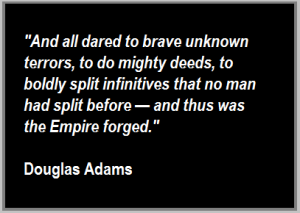
Douglas Adams quote, split infinitivesIn the first sentence, “because he was afraid” isn’t necessary. The main thing is that he didn’t run, and the reason is incidental. The second sentence, which omits the comma, is unclear. It might mean that he ran, but fear was not the reason he did so.

Mignon Fogarty, the Grammar Girl, explains this well. “You don’t automatically put a comma before the word because, but sometimes you need a comma there to make sure your meaning is clear.”

We do use commas to set off introductory clauses:

  1. In the first sentence, “because he was afraid” isn’t necessary.

I italicized the introductory clause in the above sentence to show that it is not a stand-alone sentence. This clause introduces the clause that follows it, and its meaning is dependent on that following clause.

Another thing I had to unlearn:

  1. Do not automatically place a comma before the conjunction ‘and.’

Compound sentences combine two separate ideas (clauses) into one compact package. A comma should be placed before a conjunction only if it is at the beginning of an independent clause. So use the comma before the conjunction (and, but, or) if the clauses are actually standalone sentences. If one of them is not a standalone sentence, it is a dependent clause, and you do not add the comma.

Take these two sentences: She is a great basketball player. She prefers swimming.

  1. If we combine them this way we add a comma: She is a great basketball player, but she prefers swimming.
  2. If we combine them this way, we don’t: She is a great basketball player but prefers swimming.

I hear you saying, “Now wait a minute! Mrs. Downing very clearly taught us to use commas to join clauses, and she was right.”

I’m sorry, but Mrs. Downing probably  explained that. It just didn’t stick in your memory.

Two complete ideas can be joined with ‘and.’ Did I just contradict myself?

Sort of.

Think of it like a list: if there are only two things (or ideas) in a list, they do not need to be separated by a comma. If there are more than two ideas, the comma should be used to separate them, with a comma preceding the word ‘and’ before the final item/idea.

Dogs, cats, rabbits, and birds.

Oh YES, we DO use serial commas to prevent confusion! You’ve all seen the meme:

serial commas meme, martha stewartOn a personal level, I do love cooking, my pets, and my family. (But not in the same pot.) They’re happy that I use serial commas.

One of my favorite personal failings is the notorious comma splice. Apparently it’s bad form to join two independent clauses with a simple comma. This error is called a comma splice.

I have it on good authority that a comma splice will not cause a tear in the space-time continuum. But since this breach of humanity occasionally sends commacentrics into a frothing frenzy, we will use the conjunction and give these poor wretches a break.

From Wikipedia, the fount of all knowledge: “A comma splice is the use of a comma to join two independent clauses. For example: It is nearly half past five, we cannot reach town before dark. Although acceptable in some languages and compulsory in others (e.g., Bulgarian or French), comma splices are usually considered style errors in English.”

chicago manual of styleCommas and their proper use can drive you crazy when you are trying to get your work in order. And quite frankly, the rules are a little confusing.

Consistency is critical. UK usage can vary from US usage in some ways. Find a style guide that you can understand and consult it. Once you have a guide you can work with, use those suggestions consistently in all your work.

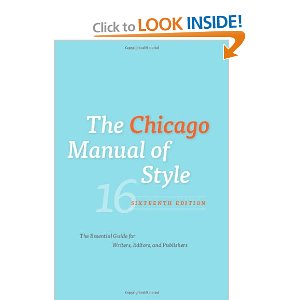
I use the Chicago Manual of Style for my work because I am a US citizen, and for creative writing, this is the most comprehensive manual and is what publishers and editors use. If you are strapped for cash, you can often buy secondhand copies of this manual through Amazon.

Commas can easily get out of control for me because I have a tendency to hit the comma key whenever I pause in my thinking when I am in the first draft phase. At that point, I am more concerned with just getting the words down than I am form and style.

However, proper form and style must come into play when we get into the later drafts. Using established protocols for punctuation is important if you want your readers to understand what you meant when you wrote that amazing piece of literature.

14 Comments

Filed under writer, writing

#amwriting: the end: separation anxiety

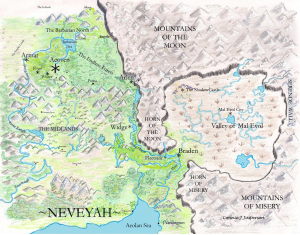
Map of Neveyah, for RizAeroNothing is more difficult (in my opinion) than finishing a novel that has been stalled for three years. My current work in progress has been through three different incarnations.

Two other books have been published during this time because  I couldn’t find a satisfying way to end this chapter in the history of Neveyah.  Perhaps it is a case of separation anxiety, but for one reason or another, it has never gotten to the true finish line.

My current focus is on finishing the final draft of this novel and getting it submitted to my editor. This book must wind up the Tower of Bones series, and it has to finish BIG.

While I am doing this, I confess I feel the same mix of feelings as I did when my youngest child left home–a sense of loss combined with pride and the thought that freedom looms.

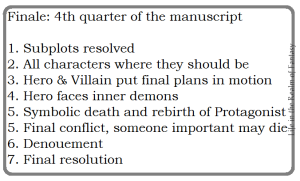
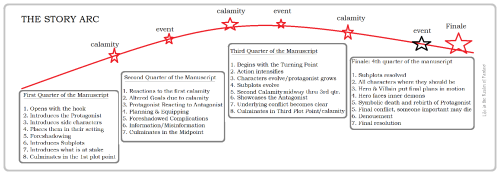
4th qtr of MSSo let’s talk about the all-important fourth quarter of the story arc.

At this point in the story arc, the final plans are in motion. We’ve met the enemy part 1 and survived the encounter. We’ve suffered a terrible setback. Now we’ve regrouped.

In the third quarter, major events have unfolded that point to the conclusion. Based on my structural editor’s suggestions, I  inserted new scenes into the existing narrative that drive the action to the final conflict. Those are all finished and are where they should be.

  1. At the outset of the 4th quarter, all my subplots are resolved and the final focus is on the Dark God’s move.
  2. The Dark God’s final pawn in this game must be exposed to the reader.
  3. The enemy’s plan and their true nature must be shown.
  4. Someone who was previously safe is now in peril. Their fate hangs on a thread and the outcome is unclear.
  5. The heroes must face the fact that their efforts to preserve their homeland has forced the enemy’s hand in a way they never expected
  6. The resolution for these characters is final, no loose threads can be left at the end of this book, as it completes the trilogy.

My work right now revolves around taking the new material and blending it into the existing story. Foreshadowing must be inserted and some otherwise great passages will be cut. This is because anything that does not drive the plot to this end is a side quest, and there can be no more of those.

This means one whole storyline that took six months to write will be cut, but it’s not a waste. There will be more opportunities for writing in this world, and that storyline could become a novella. These are great characters and the villains are as intriguing as the heroes.

As I said at  the beginning of this post, I am seeing this novel coming together at long last, and I am loath to let go of it. But I am excited to see it coming to this conclusion and feel good about it, despite having to shed some of the work that took so long to write.

The events have been detailed. Making sure this story flows seamlessly is time-consuming but it’s my obsession, so poring over the manuscript is what I am doing when I could be playing games. (Hear that Aveyond Stargazer?)

The Story Arc copy

4 Comments

Filed under Publishing, writer, writing

#amwriting: Version Control

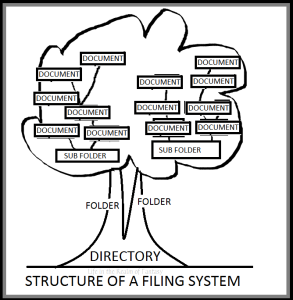
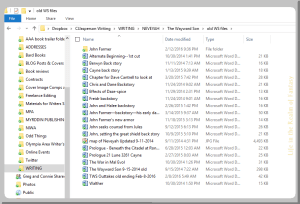
tree_of_filing_LIRFYou would be amazed at how many authors I meet who don’t know how to properly save files, and who regularly lose or save over important documents.

Naming files consistently is a skill most people never had a reason to learn. Because they’ve never had more than a few personal files to manage, they have no concept of how easily something that should have been simple can veer out of control.

Fortunately, I worked as a bookkeeper and office manager for many years. I was responsible for naming and saving my employers’ files in a consistent and manageable way.

Now that I am writing full time I generate a lot of different work, that I want to submit to different places, so I have a large number of files within my writing folder.

This is where good system of version control comes in handy.

“Version control” is a system that records changes to a file or set of files over time so that you can recall specific versions later. The worst thing that can happen is when you accidentally save an old file over the top of your new file, or delete the file entirely.

First of all, you need to save regularly. I use a file hosting service called Dropbox. I have a lot of images on file, so I pay for an expanded version, but they do have a free version that offers you as much storage as a thumb drive. I like using a file hosting service because it can’t be lost or misplaced, and is always accessible. I work out of those files, so they are automatically saved and are where I want them when I close out.

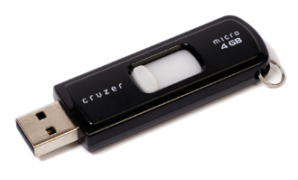
330px-SanDisk_Cruzer_MicroBut you can use any storage system–Google Drive, Amazon S3 Storage (if your files are so large you require a server farm), or a standard portable USB flash drive. What I want to discuss today is naming your files so they are consistent and easy to identify.

You can make many different configurations for your filing system. Your decision as to what works best for you should ultimately be based on what you’re filing, how many files you have and how many sub-categories (sub folders) your system needs to be broken down into. The important thing is to use a consistent system of for naming your files.

Detailed below is the system I use for saving my writing files.

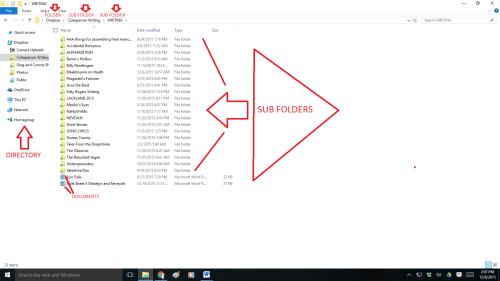
A filing system is quite simple, rather like a tree from the ground up. For most documents, my system  is a standard office-type system that consists of:

DIRECTORY> FOLDERS> SUB-FOLDERS> DOCUMENTS

version_control_3

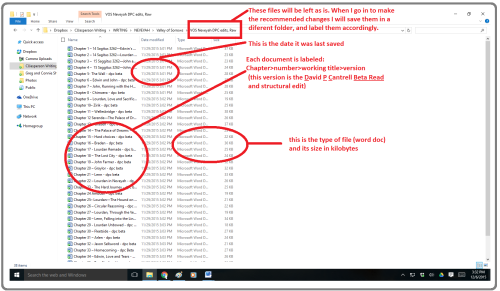
In the second draft my goal is to condense my fluffy, fat prose to something readable. I will copy and save each individual chapter to a separate new document, and I will give them a specific name. Yes, I am separating each chapter out of the whole ms, but we will not lose their order because we have a reliable system for naming files and will ALWAYS use it!

First of all, be sure to save it as an actual Word DOCUMENT and not a Template.  If you save it as a template, you will keep getting a warning the document is read only and it won’t let you save it. Libraries are the screen that opens when you click “Save As” and are where you go to manage your documents, music, pictures, and other files. You can browse your files the same way you would in a folder, or you can view your files arranged by properties like date, type, and author.  These pictures, above and below, are of Windows Explorer libraries.

I will do each chapter one at a time, saving them and closing them out. Any time I am confused as to what chapter I am supposed to be on, I look at the library of files to see what I have already saved, and go the next chapter.

The main file folder for each book or project I am working on is labeled with the initials of its title, in this case, VOS for Valley of Sorrows. As I save each chapter, they will automatically sort themselves into the proper order as long as I name them this way.

version_control_4


Name your files consistently, and save each version in a separate separate folder within the master folder.

version_control_5

You, as an author, will create many versions of your manuscript. YOU MUST manage your versions with meticulous care, or you will lose files, have to rewrite sections you just wrote (and which were brilliant) or any number of horrible, irritating situations will arise.

These tragedies are not caused by your word processing program, so don’t blame Bill Gates.  They are caused either by you not knowing how to prevent them from happening, or inattentiveness when saving files.

But now you know how to avoid version control disasters.

7 Comments

Filed under Publishing, writer, writing

#Flashfic: Metamorphosis

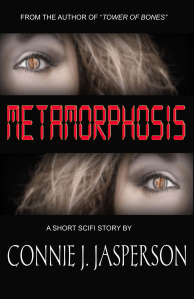
MetaMorphosis cover for WattPad copyYrena Rozhenko ran, not knowing if she was headed into something worse.  It didn’t matter—the transformation had begun and she couldn’t seem to halt it. One way or the other she had to get away from Benton.

The sounds of distant pursuit penetrated to her newly-altered hearing, spurring her on.

She took to the foliage. The shade and mottled light of the strange underbrush eased the pain in her eyes, dimming the glare. She raised her hand to her face, wondering why it felt so bruised. Hard nobs had begun to form above her eyebrows, turning them in ridges. Her heart nearly stopped when she saw the scales forming on her hands and long, deadly-looking talons where neatly manicured fingernails once had been.

What’s happening to me? We ate nothing and drank no water from this world. We touched nothing ungloved. Could it be the air?

Their mission was over. In the UFA records, they would be officially listed as MIA, something that happened frequently on first exploration missions. Benton had murdered Jackson. Jenner was either dead or in hiding, and she…she was changing into some…thing.

Was she going to die next? Benton’s fear and loathing of anything different made him…the only word she could think of was evil.

Why had he not begun to change? The answer came from all around her, from the forest. I was waiting for you. He is not worthy.

She heard Benton softly call her name, a sing-song taunt. “Rozhenko…come out, come out, wherever you are….”

What could she do? With those talons on her hands she wouldn’t be able to return to the ship, even if she could make it to the lander. Besides, she couldn’t leave without knowing if Jenner was alive, and if he was, she wouldn’t leave him behind.

And even if she made to the ship, what then? She knew the change was happening to her on a genetic level, as if this planet had claimed her. Something told her it was irreversible.

Gods, her back ached.  Her shoulder blades, her tailbone were like points of…gah! Whatever. She had to ignore it and get deeper into the brush.

Jackson had begun to change the first night. By dawn he’d transitioned into something…else.

The others had discussed his condition, deciding to take him back to Lodestar Station where the medical team was, despite it being a ten-day journey and meaning the end of their mission. They would have to declare Sirius C a class N Biohazard planet, meaning the established ecology was too dangerous for human settlement.

Benton had been the lone holdout, shouting they had to destroy Jackson before he destroyed them. “He’s a killer. Look at those claws—he’s not human anymore!”

When Yrena and Jenner shouted him down, he had walked up behind Jackson and shot him in cold blood, with no further conversation or discussion, murdering the man who’d been their commander with no qualm or shame.

He’d been proud that he’d done so and now claimed Jackson’s position as expedition leader.

Jenner had begun to change right after Benton murdered their commander, but he’d vanished while Yrena was in the shuttle sending the message detailing the hazard and Benton’s mutiny.

Yrena feared that Benton had killed Jenner while she was busy, but if he had, the body was nowhere to be found.

Benton had shown his true colors. He’d always bragged that he had what it took to rise to the top. He was a capable enough navigator and a solid geologist, but he’d never understood finesse or compassion. How he’d been put on their team in the first place, she didn’t know, but he’d been nothing but a sour pain in the…ass.

She suppressed a groan. Even her ass ached. She was afraid to reach back there and see why.

Some new instinct told her to get off the ground, that safety was in the tree-tops. Yrena’s new talons made excellent assists for rapid tree climbing. Perched high in the canopy and hidden by the triangular, golden leaves, she watched as Benton combed the forest floor, not even thinking to look up.

She had burst out of her shipsuit, which was now nothing but shreds. Carefully she balled it up and hid it in the hollow of the tree. She could nest there if she had to.

What was she thinking? She had to get back to…what was that? A glint of gold caught her eye. A gold-mottled form was perched on a branch near her, one sharp-taloned finger held to his scaly lips for silence. Relief swept through her—Jenner had completed the transformation.

She was not alone.

Benton passed under their tree. Yrena clung tightly to the trunk, remaining perfectly still. She needed a few more hours to complete the transformation, but if he looked up, she would never know what she was transforming into, never again know love or laughter or….

A flash of golden wings…Benton’s sudden strangled cry….

Yrena looked down and saw Benton’s bloody form lying in several pieces.

Jenner flew back up to perch beside her.  She let go of the trunk and went to sit beside him, their arms going around each other.

They had been colleagues but she’d not really known him well. He was all she had now.

The setting sun cast a ray that glanced off the abandoned shuttle. Above the forest, stars began to come out and a tiny star passed overhead. Once it had been a research vessel, but now it was an abandoned hulk ending its days as a small star in a new sky.


Metamorphosis © Connie J. Jasperson 2015  All Rights Reserved

Metamorphosis was first published July 10, 2015 on Edgewise Words Inn under the title “Transfiguration”

It was republished on Oct. 18, 2015 on WattPad under the title “Metamorphosis”

Comments Off on #Flashfic: Metamorphosis

Filed under Literature, Publishing, Uncategorized, writer, writing

#amwriting: consider the weather

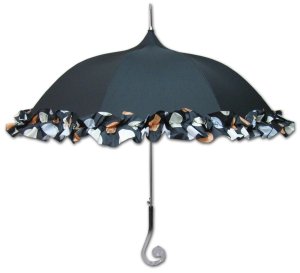
81UuqzVF-1L._SL1500_Something about the  wind-driven rain-bullets here in our part of the world can be death on umbrellas, even expensive ones. Even the cutest umbrellas frequently end up in street-corner trash-bins, ending their days as the tattered and broken relics of impulse purchases.

Despite the carnage, I feel compelled to keep buying umbrellas, feeling sure the next purchase will be the one–the true umbrella for all seasons, able to withstand 40 mph winds and sideways rain.  So far, the decidedly unromantic golf umbrella is the bumbershoot I carry.

But while golfers look fine carrying them, I long for beauty. I just know that my desire to have some cheery vestige of spring in the form of a floral print over my head will somehow work out and I will manage to remain both dry and stylish.

And this brings me to my point: You may not realize it but weather is a huge factor in your characters’ ability to go from point A to point B. For those of us who are writing fantasy, our characters are likely to be riding horses or walking. Weather will be a large part of what impedes them, or enables them to travel faster than they had planned.

Traveling on foot in the dark during a heavy storm is extremely difficult. Prior to the advent of the automobile, people didn’t travel during storms unless some terrible reason forced them to.

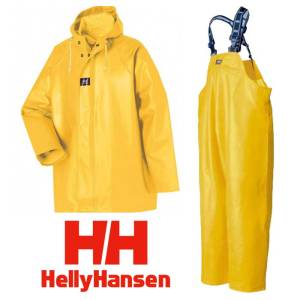
helly hansen raingear comboWeather is something I understand. In the 1980s, newly divorced and unqualified for any well-paying job, I worked for a Christmas tree grower. In the summer, we started work at 5:30 am so we could be finished and out of the field by 2:30, during the hottest part of the day.

I’ve never been a fan of using too much sunscreen—it’s greasy and full of things I can’t pronounce, it gets in your food, and I’m not so sure eating it is good for you. So, in those days I wore light, long-sleeved shirts to keep the sun off me, and wide-brimmed hats that kept the sun off my face. That is old-school, low-tech farm garb, and is how I still roll when it comes to dealing with the sun.

But when November arrived, we field hands were still working outside. With the advent of a Northwest Winter, we wore layers, 2 pairs of wool socks, barn-boots, and raingear. Good old Helly Hansen—his fine product kept me dry and warm while I worked to bring Christmas trees into every home. But, working outside in the cold and rain requires a certain amount of preparation, or you can become hypothermic, and unable to function.

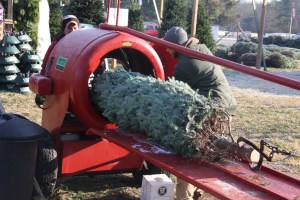
Howey Christmas Tree Baler

Howey Christmas Tree Baler via Flicker

Every year, when cutting-and-baling season started we would have a new crop of people who had never worked out of doors, and who didn’t understand the sense of investing in long-johns and raingear. The company offered decent gear (boots, gloves, and raingear) at reasonable prices, but many would not  spend the money, refusing to believe that it was a war the weather would win.

So I discovered that if you were going to work outdoors year-round, you needed better quality gear than the company offered. In 1982, the best gear available was: LL Bean thermal underwear, and Helly Hansen foul-weather gear, and the mail-order catalogue was the place to get it.

My point with this is that if your novel’s setting is a low-tech society, weather affects what your characters can do. It affects the speed with which they can travel great distances, and it affects how they dress. It affects their horses, and that is a serious point to consider.

Medieval society had ways of dealing with the weather when they had to be out in it, and the internet is your friend. In medieval times, people of England, Wales, and Ireland didn’t have to deal with extreme temperatures the people of Northern Europe experienced in the 17th and 18th centuries, as it was a warmer time. However, they did get some occasional snow and cold in the winter, and at times they suffered heat waves during the summer.

How did they protect themselves against the weather? Here are several good websites for research:

Sarah Woodbury, Romance and Fantasy in the Middle Ages

Medieval Gloves, etc.

Castles and Manor Houses

In a cold, wet winter, a simple shawl won’t cut it. Layers are critical, and the materials they would use are simple and readily available—linen, and wool.

414-2-blue-robed-santa-claus-christmas-vintage-postcardIn a lower-tech society fur-trapping is a common way of earning money, but only the wealthier classes, merchants and nobility, can afford to buy those furs.

The average medieval agrarian society will have access to fleeces, though, especially if they are a Northern European type of society. Also, in the more urban centers of a low-tech society, the average person’s winter garments, hooded cloaks and gloves, and even bedding would be made of thick wool, layered and felted.

Wool has been a winter mainstay since humans first began making cloth. Some garments will be made of heavy canvas, or oil-cloth. Oilcloth, close-woven cotton canvas  or linen cloth with a coating of boiled linseed oil,  was a product available from the late middle ages on.

Clothing and cold weather gear will make their appearance in relatively few sentences in your novel, but a little research on your part regarding what technology might be plausible in your society will lend a sense of realism to your work.

2 Comments

Filed under Publishing, Uncategorized, writer, writing

#amwriting: Morality and Conscience

Severus_Snape memeSeveral years ago, I posted on a writer’s responsibility in regard to portraying morality in his/her work. I think some of those ideas are worth rehashing.

Much of what I discussed back then still stands: When we write a tale that involves human beings, it is likely morality will enter into it at some point.

What is our responsibility as authors, when it comes to telling our tales?  Do we sugar-coat it and pretend our heroes have no flaws, or do we portray them, warts and all?

For myself, I gravitate to tales written with guts and substance. Works like L. E. Modesitt Jr.’s Scion of Cyador, where the hero is a man who struggles with ambition and the desire to have it all. He is a dutiful son, devoted lover, and loyal soldier, gifted with great ability that he must keep secret. He is also a cold-blooded murderer with an unspoken agenda, a man completely devoted to salvaging what he perceives as all that is good and beautiful in his world regardless of the cost. What (or who) does Lorn have to sacrifice in the end to achieve his ambition? And what toll does it take on him in the end?

I said this in my post three years ago, and I still say it: give me the Flawed Hero over the Bland Prince any day.

HTB Stamp copyIn my book,  Huw, The Bard, I describe a murder, committed in cold blood.  I take you from what is the worst moment in Huw’s life, and follow him as he journeys to a place and an act which, if you had asked him two months prior, he would have sworn he was not capable of committing. This terrible deed is not the lowest point in his tale.  It is, however, the beginning of his journey into manhood.

Does my writing the story of this reprehensible act mean I personally advocate revenge murders?  Absolutely not.  But I have lived for 62 years, and my view of morality is that of a person with some experience of life. Personally I believe  no human being has the right to take another’s life, or do harm to anyone for any reason.

Still, I write stories about people who might have existed, and who have their own views of morality. When writing, my characters stories don’t always follow the outline I had in mind for them. They sometimes go in directions I never planned for them to go, which throws my whole story-arc into disarray until I figure out how this new development fits.

In my first completed novel, I never intended for my main character and a companion to fall in love. They did though, and that took the story in a direction that was a surprise to me–and I think was one of my favorite side-plots.

In each story I write, I try to get into the characters’ heads, to understand why they make the sometimes terrible choices that change their lives so profoundly.

Some flawed heroes’ stories end well, and some don’t–those whose ends are less than happily are the tragic heroes.

hamartia definitionPepperdine University’s website says this about the tragic hero:

“Tragic Flaw (Hamartia): the tragic hero must “fall” due to some flaw in his own personality. The most common tragic flaw is hubris (excessive pride). One who tries to attain too much possesses hubris.” 

I believe authors have a responsibility to tell the best story they are able to tell, even if they are only writing for their own consumption.

This means sometimes I stretch the bounds of accepted morality, and make every effort to do it, not for the shock value, but because the story demands it.

I write stories for entertainment, yes. But more than that, I want the tale to remain with the reader after they have finished it. If I am somehow able to tap into the emotions of the moment, and bring the reader into the story, I have achieved my goal.

GRRM MemeMy life is a constant journey to the land of knowledge. I seek understanding, and sometimes I think I have a grasp on it…but not quite. More lessons await.

I am learning the skills of story-telling.  More than anything I want my work to  stand up and measure well beside the works of my literary heroes such as Tad Williams, Marion Zimmer Bradley, and George Saunders, great authors who describe terrible moments and conflicts of morality with such grace and understanding.

This may happen, or it may not, but I won’t stop trying because with every tale I write, I grow as a writer.

I read the words penned by those who have attained mastery of this skill, I am awed, and fired with the knowledge it can be done.

2 Comments

Filed under Publishing, Uncategorized, writer, writing

#amwriting: 3 steps for keeping the story straight

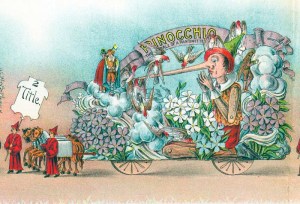
1916 Momus Pinocchio via Wikimedia CommonsEvery liar knows it’s difficult to keep a story straight–the story keeps evolving and soon it’s out of control.  However, writers, those spinners of awesome lies on paper, must devise ways to avoid this little problem.

Some people use a program called Scrivener which is not too expensive, but which seems to have a tricky learning curve. I downloaded the free version but couldn’t make heads or tails of it and found it quite frustrating. Nevertheless, I understand that it works well for many people, and to them I say, “Good for you.”

For myself, I don’t want a fancy word-processing program. I just use MS Office, because I have been using the programs that come with that software since 1993, and I’ve been able to adapt to each upgrade they have made. It’s affordable, so I use Word to write and edit in, and occasionally use Excel  to make small charts that are my style guides for each  novel or tale I write, and also for every book I edit.

Helpful tip #1: Create a style sheet for every work-in-progress. Whether it is a handwritten list or spreadsheet–keep track of what you named people, places, and things.

Bleakbourne Style Sheet

By creating a visual guide that I can print out or  keep minimized until I need it, I will not inadvertently contradict myself later on in the tale. This particular chart is the style-sheet for a serial I am writing for Edgewise Words Inn, a small online blogzine.

Lets consider Lord Tenneriff, the name of a minor character. Because I noted it on the style sheet and gave a small explanation when I first used it, I will always remember that Lord Tenneriff was spelled with two ‘n’s and two ‘f’s, and with no ‘e’ at the end of it.  The heading of the sheet is like this:

Character Name       Word 1st appears      Other names       Meaning?

            Jason Tenneriff              chapter 1                                                      a local lord

                                                         chapter 2                   Bleakbourne             a village

By listing out the names of every character no matter how minor, even the horses, I will not have a continuity problem by the time I hit chapter 14 of this series. For my editing clients, I also list all magic spells, every god, demon or dwarf that comes into the tale. Anything that is named goes onto that style sheet exactly the way it was first mentioned, the chapter it was first mentioned in, and the brief description of what it means.

Every author has a different way of visualizing these things, and this is what works for me.

Helpful tip #2: Map it out:

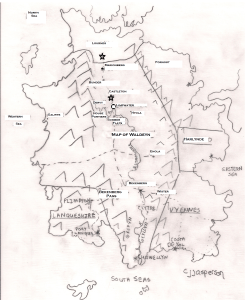
Map of WaldeynSo how do you visualize your country and the world you are creating? I have discussed this before–I draw maps.

They start out like this, all blotchy and hand-drawn, with whiteout covering the changes. After a while of refining them they end up looking more like real maps.

Its a gradual process, and the actual shapes and where the places are will evolve throughout writing the tale, but it will remain basically that way.

Many authors will use locales they are familiar with for their fantasy maps, just changing the names of major cities.  This is a good way to do it, because your world is already well defined for you, and Northwesterners know that Portland, Oregon is about 170 miles south of Seattle, Washington.  You are safe using currently existing terrain.

map of Waldeyn 2015 with lettering cooper black copyBut safe isn’t exactly my thing, so I had to invent both the world of Waldeyn (Huw the Bard), and the World of Neveyah (Tower of Bones). This is what the hand-drawn map of Waldeyn from above has evolved into————>

Helpful Tip #3: Version control:

When we first begin to write seriously we learn how critical it is to have proper naming of our files to ensure version control.  The most recent file will usually be the best edited unless you have accidentally saved an earlier version over it. ALWAYS use a separate file for each version, and ALWAYS use consistent file labeling practices to avoid this tragedy!

Use good file labeling practices, even if you have a fancy program that handles structuring your manuscript.

As an editor, I am particularly careful how I name the files of my clients.

  1. I use a specific sort of naming system. It will ALWAYS be Book_ AuthorName_script.doc .
    This is the main file folder for this book and this author!
  2.  The file folder will contain everything that pertains to this author and his work. There will be at least two folders in this file, and can have up to six. Version control is critical, so proper naming of the files is absolutely essential. If he should ever lose his files, I will have the most recent version on hand.
  3. The raw manuscript in its entirety is saved in this file, and I will name it:
  •  Book_ AuthorName_rawscript.doc

There will be 2 files for every step of the process this manuscript goes through with me: One file will be from the author’s desk to me, and the other will be from my desk to the author.  I will break the raw ms down into chapters, and label each chapter in that file consecutively:

  • Book title_Ch1_ author initials_cjj_edit_rnd1.doc

This tells me that this is Book A, chapter 1, by Author SoAndSo, and was edit round one of that ms.

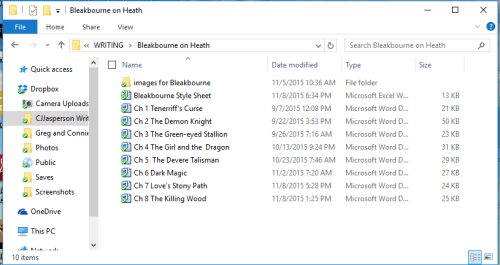
For my own work I label the files uniformly, like this: The main folder will be labeled with the working title, such as Bleakbourne on Heath. Inside the main folder will be the style sheet, and any images that will be used, including maps if needed.

Version Control 1

These three tips, creating a style guide, drawing a map, and labeling your files so you have good version control will help you navigate the shoals of the authoring business. You will always know who you are talking about, where you are, and you will be working in the most recent version of your work.

3 Comments

Filed under Publishing, writer, writing

#MindWandering: The Power of Downtime

Veneto,_Bartolomeo_-_Lucrezia_Borgia_(alleged),_detail_of_portraitDaydreaming…wasting time…selfish indulgence, or fountain of creativity?

WebMD says, quote:  “Daydreaming is looked upon negatively because it represents ‘non-doing’ in a society that emphasizes productivity,” says John McGrail, a clinical hypnotherapist in Los Angeles. “We are under constant pressure to do, achieve, produce, succeed.”

Wikipedia, the fount of all knowledge, describes Daydreaming as “a short-term detachment from one’s immediate surroundings, during which a person’s contact with reality is blurred and partially substituted by a visionary fantasy, especially one of happy, pleasant thoughts, hopes or ambitions, imagined as coming to pass, and experienced while awake.”

Apparently we daydream less as we get older. I wonder, is this nature, or nurture?

What really happens when we allow ourselves to just sit and think about nothing in particular? What happens on a neurological level when we let our minds off the leash, to run free and unencumbered?

One interesting fact is that apparently, if we daydream about the past, we tend to forget what we were doing before the daydream started. This happens to me all the time.

But most people don’t ponder the past. “Daydreaming is often about anticipating the future, especially in a fantasy context,” noted Peter Delaney, a psychologist at the University of North Carolina, Greensboro, in the July 3, 2013 issue of National Geographic.

'A_Girl_Copying_a_Drawing'_by_Martin_Drolling,_Pushkin_Museum PD 100 via wikimedia commonsAnd according to the Daily Mail, Prof. Moshe Bar, of the Gonda (Goldschmied) Multidisciplinary Brain Research Center, said, “Over the last 15 or 20 years, scientists have shown that – unlike the localized neural activity associated with specific tasks – mind wandering involves the activation of a gigantic default network involving many parts of the brain.”

Also, I have just learned that daydreaming turns off parts of your brain. It’s true–our brain has an analytic part that helps us make reasoned decisions, and an empathetic part that allows us to relate to others. Researchers have discovered that when you are daydreaming, your mind naturally cycles through the different modes of thinking, analytic and empathetic. Apparently, during this time the analytic and empathetic parts of your brain tend to turn each other off.

Another intriguing thing I have only just found out is that the physiology of the brain itself, and not the “mind” controls our daydreams. Anthony Jack, a cognitive scientist at Case Western Reserve University in Ohio says, “How we daydream and think depends on the brain’s structure. …(That) structure is constantly changing in small ways—as we learn new things the connections between nerve cells change.” (Read “Beyond the Brain” in National Geographic magazine.)

We have long known that creative people are often guilty of daydreaming, but researchers have shown that daydreaming makes you more creative.

“Many times the ‘dialogue’ that occurs when the daydreaming mind cycles through different parts of the brain accesses information that was dormant or out of reach,” notes Eugenio M. Rothe, a psychiatrist at Florida International University. “Likewise, the daydreaming mind may make an association between bits of information that the person had never considered in that particular way.”

Autumn_Landscape_With_Pond_And_Castle_Tower-Alfred_Glendening-1869According to a study published in the Proceedings of the National Academy of Sciences, a wandering mind can impart a distinct cognitive advantage.

This means that daydreaming is actually good for you. It boosts the brain, making our thought process more effective. Apparently letting the mind wander allows a kind of ‘default neural network’ to engage when our brain is at wakeful rest, as in meditation, rather than actively focused on the outside world. When we daydream, our brain is freed up to process tasks more effectively.

This is good to know, because as an author I spend an astounding amount of time daydreaming, and I would hate to be simply wasting time!

(This post was first published September 15, 2015 on Edgewise Words Inn)

9 Comments

Filed under Publishing, Uncategorized, writer