Category Archives: writing

What reference guide is right for what I #amwriting?

The_Chicago_Manual_of_Style_16th_editionNovember is a difficult month for me because I have a specific goal to accomplish, and I’ve set the bar high. It’s National Novel Writing Month and I have many activities involved with that. I need to add writing time to my already packed schedule, attempting to rebuild my stockpile of short fiction and essays, and am letting everything else fall by the way to do it. Trader Joe and the Microwave are providing my husband with hot meals because I have been known to forget to cook.

For my NaNoWriMo project this year I am writing a variety of short pieces, some technical essays on writing craft, some essays on life and travel, and some short fiction. I am writing for three different markets and we will get to why that distinction is important a little further on.

I’m on the road a lot, and have limited time to get my wordcount. Sometimes I get two or three pages of writing done in the 20 or 30 minutes before I have to leave the house for an appointment. There is something about the pressure of knowing I will have to quit at a certain time that forces me to be more productive than I would ordinarily be.

Why is this? When I am pressed for time I use every second to get those ideas out of my head. I don’t have the luxury of stopping to research grammar and questions of style on the good, old, time-wasting internet. Instead I refer to hardcopy reference manuals, unless I absolutely must go out to the internet to research something.

Some references have to be in hardcopy, such as The Chicago Manual of Style, which is the most comprehensive style guide geared for writers of essays, fiction, and nonfiction. Strunk and White’s Elements of Style is an acceptable beginner style guide, but the information there must be looked at with a critical eye as it is presented in an arbitrary, arrogant fashion and sometimes runs contrary to commonly accepted practice.

Instead I always recommend The Chicago Manual of Style to authors who are writing fiction they someday hope to publish, and who want to know about sentence construction. The researchers at CMOS realize that English is a living changing language, and when generally accepted practices within the publishing industry evolve, they evolve too.

Writing is not a one-size-fits-all kind of occupation. There is no one style guide that will fit every purpose. Each essay and book may be meant for a different reader, and each should be written with the style that meets the expectations of the intended readers.

The Chicago Manual of Style is written specifically for writers, editors and publishers and is the publishing industry standard. All the editors at the major publishing houses own and refer back to this book when they have questions.

micosoft-manual-of-styleWhat is the best style guide for writing technical user manuals?

Are you writing for a newspaper? AP style was developed for expediency in the newspaper industry and is not suitable for novels or for business correspondence, no matter how strenuously journalism majors try to push it forward. If you are using AP style you are writing for the newspaper, not for literature. These are two widely different mediums with radically different requirements.

For business correspondence, you want to use the Gregg Reference Manual.

If you develop a passion for the words and ways in which we bend them, as I have done, you could soon find your bookshelf bowing under the weight of your reference books.

Some of my best ideas have come about under a time crunch.  Normally when I am writing on a stream-of-consciousness level, I can key about fifty words a minute, which I know is paltry compared to today’s authors who grew up keying their homework rather than writing it in cursive.

ozford-american-writers-thesaurusI do admit that just because I can key those words does not mean they will all make sense, or be worth reading. That is why we are driven to look at what we just wrote the day after we wrote it. Did it say what I meant? How many times did I use the word “sword” in that particular paragraph and where am I going to find six different alternatives for such a unique weapon? Sword? Blade? Steel? After all, an epee is not a claymore, nor is it a saber. Any reader with a small amount of knowledge will know that, so I have to be careful what synonyms I use. My characters swing a claymore-style of sword which is rarely referred to as “steel.” In literature, that term is more commonly used for epees and rapiers.

It’s a jungle in my head sometimes, and my ancient  student edition of Roget’s Thesaurus is no longer my friend. But neither is the modern, online version cutting it. I need more synonyms. Lots, and lots more! Thus I have the Oxford American Writers’ Thesaurus on my desk and I refer to it regularly. It saves time to use the hardcopy book rather than the internet because I am not so easily distracted and led down the bunny trail of “Wow! I never knew that!”

All in all, I like the way being forced to produce words in a short time helps me lay down a rough draft. But I admit, I do look forward to the end of November, when I can look back on my accomplishments and go back to my normal writing routine of wasting time on the internet researching important things like the life cycle of sand dollars. Who knew those little creatures were so intriguing?

2 Comments

Filed under writing

#amwriting: #nanowrimo momentum

2016-placeholder-book-cover-smallWe’re on Day 2 of NaNo 2016. I’ve written two short stories totaling 11,605 words, 80% of them misspelled, but I won’t worry about that until January. I admit I was hoping to have written four, but I’m still on track to make 50 short stories and flash fictions by the end of November.

Some people are already behind, but all is not lost.  Get caught up now and go forward by adding a few extra words every day.

Habitual behavior, or ‘daily routine’ goes unnoticed because we don’t engage in self-analysis when undertaking routine tasks. Thus, writing daily is easier once it becomes a behavioral habit.

Consider smoking.

Smoking is a behavioral habit as much as it is a physical addiction. Smokers trying to quit always tell me they don’t know what to do with their hands. When they first started smoking they trained themselves to do “the cigarette ritual,” shaking the cigarette out of the pack, lighting it, holding it, and exhaling the smoke with their own style each time they went outside.  They did this ritual every time they lit up their cigarette, and now their hands have “nothing to do.”

If breaking certain habits is difficult, creating new, more positive habits is also tough. Behavioral patterns we repeat become imprinted in our neuro-pathways, so repetition of positive behaviors is necessary to make the behavior automatic. Wikipedia, the Fount of all Knowledge, says this:

“As the habit is forming, it can be analysed in three parts: the cue, the behavior, and the reward. The cue is the thing that causes the habit to come about, the trigger of the habitual behavior. This could be anything that one’s mind associates with that habit and one will automatically let a habit come to the surface. The behavior is the actual habit that one exhibits, and the reward, a positive feeling, therefore continues the “habit loop”.[13] A habit may initially be triggered by a goal, but over time that goal becomes less necessary and the habit becomes more automatic.”

In his November 3rd, 2013 blog post for Creative Writing Guild, Rob Blair says:

“Studies on habit formation have found that extra willpower is almost never sufficient for getting a new habit to stick. What does seem to work is an intervention that looks like this:

  • Write out the details of what you want the new habit to be. (In your case, it’s going to be writing 1,667 words per day.)

  • Plan the details of how and where you will be engaging in the new habit. Be as concrete as you can be.

  • Plan a “trigger” for when you will start doing the new habit. How will you know it’s time to start writing? This can be a specific time, but I’ve found it’s better to choose a point in your normal daily routine where you can insert the new habit. (e.g., “After pouring coffee but before changing out of my PJs.)

  • Write a list of the pitfalls, detailing what’s most likely to go wrong. What’s prevented you from writing in the past? Did you get busy? Did you sleep in? Did you “feel uncreative”? Be honest with yourself, and get your normal traps and tribulations on the page.

  • Write a response plan for each pitfall. This can be something complex, but research has found that even simple response plans (e.g., “I’ll remind myself this is writing time and I can sleep in come December”) are astoundingly effective. (end quoted material.)

I like what Rob has to say about doing a small intervention to short-circuit self-defeating habits, but remember such effort only works if you are honestly committed to the project. He also offers a great deal of other useful advice in that article, so I highly recommend you read his post in its entirety.

But what I really believe is that you will succeed in developing the habit when you write something you are really fired up about. When you are passionate about a story, the words will flow. Find that moment in your daily routine when you can insert a new habit, put pen to paper and begin writing!

The best thing about stream-of-consciousness writing is you don’t take the time to over-think things. You write it as you think it, and the word count grows as if by magic.

I’m using this time to write short stories, but just as if I were writing a nano-novel, I will be done writing at the end of November. I will take a break from this project until January and then, over the course of the next year I will be pulling these rough drafts out of the 2016 NaNoWriMo file and polishing them up.  That is when I will worry about what is wrong with these little stories, and implement plot adjustments. Right now, I am just writing it as I think it, warts and all.


Reference Sources:

6 Steps for Nailing the First Week of NaNoWriMo, published November 3, 2013, on http://www.creativewritingguild.com · by Rob Blair

Wikipedia contributors, “Habit,” Wikipedia, The Free Encyclopedia, https://en.wikipedia.org/w/index.php?title=Habit&oldid=747213739 (accessed November 1, 2016).

2 Comments

Filed under NaNoWriMo, writing

#amwriting: #NaNoWriMo Jump Start

NANO CrestIf you are doing NaNoWriMo this year, you’re quite busy right now and don’t have time to read a long post. So, here are a few quick tips and resources to help get your novel off the ground:

Tips:

  • Never delete, do not self-edit as you go. Don’t waste time re-reading your work. You can do all that in December when you go back to look at what you have written.
  • Make a list of all the names and words you invent as you go and update it each time you create anew one, so the spellings don’t evolve as the story does.
  • Write 1670 words every day – 3 more than is required (to account for differences in how your word processing program and NaNoWriMo’s official word counter validates wordcount – you don’t want to come up short at the end! This has happened and is quite frustrating.

If you are writing a story set in our real world and your characters will be traveling, walking a particular city, or visiting landmarks, bookmark google maps for that area and refer back to it regularly to make sure you are writing it correctly.

If you are writing about a fantasy world and your characters will be traveling, quickly sketch a rough map and refer back to it to make sure the Town names and places remain the same. Update it as new places are added. This is all you need:

sample-of-rough-sketched-map

If you are writing fantasy involving magic or supernatural skills, briefly draw up a list of rules for who can do what with each skill. Remember:

  • Magic with no rules is both impossible and creates a story with no tension. No one wants to read a story where the characters have nothing to struggle against.
  • Each character should have limits to their abilities. Because they are not individually all-powerful, they will need to interact and work with each other and with the protagonist. They will have to do this whether they like each other or not if they want to win the final battle or achieve their goal. That will provide openings for some great interactions.
  • This gives you ample opportunity to introduce tension into the story. Remember, each time you make parameters and frameworks for your magic you make opportunities for conflict within your fantasy world, and conflict is what drives the plot.

Resources to Bookmark:

Three websites a beginner should go to if they want instant answers in plain English:

Most importantly – enjoy writing that novel. This is time spent creating an amazing story only you can tell, so above all, enjoy this experience.

4 Comments

Filed under NaNoWriMo, writing

#amwriting: circumstance, objective, and the story arc

Book- onstruction-sign copyIf you intend to write a novel, especially a fantasy novel, a little pre-planning and at least a smidge of an outline is really beneficial.

Consider the beginning: At the outset of any good story, we find our protagonist, and see him/her in their normal surroundings. An event occurs (the inciting incident) and the hero is thrown out of his comfort zone and into the Situation, which is the core idea of your plot.

This is the circumstance in which your protagonist finds himself at the beginning of the story. Some things for you consider before you you begin writing:

  • How will the story start?
  • What is the hero’s personal condition (strength, health) at the beginning?
  • How will that condition be changed, for better or worse, by the hero himself or by the antagonistic force?
  • What could possibly entice him out of his comfort zone?

Now we come to the core of your story: Objective. Without this, there is no story.

In every class I’ve taken on plot development, the instructors have emphasized that a protagonist has no reason to exist unless he/she has a compelling objective. If your main character doesn’t want something badly enough to do just about anything to achieve it over the next couple hundred pages, then he doesn’t deserve to have a story told about him.

That harsh edict is true because everything you will write from the moment of the inciting incident to the last page will detail that quest. Your protagonist must desire nothing more than to achieve that objective. Every scene and conversation will push the protagonist closer to either achieving that goal or failing, so if you make it a deeply personal quest, the reader will become as invested in it as you are.

In the book, Tower of Bones, Edwin wants to free Marya from captivity in Mal Evol. It’s a mission that begins as a somewhat noble desire to help his friends free a healer he has never met, but along the way he realizes she is the girl he has been dreaming about for several years. Once he realizes that, it becomes personal, and he becomes driven. That is when it becomes a real story.

When writing fantasy, you need a broad outline of your intended story arc, and you really need to know how it will end. If you try to “pants” it, you might end up with a mushy plot that wanders all over the place and a story that may not be commercially viable.

  • What will be your inciting incident?
  • What is the goal/objective?
  • At the beginning of the story, what could the hero possibly want to cause him to risk everything to acquire it?
  • How badly does he want it and why?
  • Who is the antagonist?
  • What moral (or immoral) choice is the protagonist going to have to make in his attempt to gain that objective?
  • What happens at the first pinch point?
  • In what condition do we find the group at the midpoint?
  • Why does the antagonist have the upper hand? What happens at the turning point to change everything for the worse?
  • At the ¾ point, your protagonist should have gathered his resources and companions and should be ready to face the antagonist. How will you choreograph that meeting?

These are just a few things to think about when you are planning to write a fantasy novel, because so much goes into world building and creating magic systems that it is easy to get involved in large info dumps and bunny trails to nowhere.

Some people are able to visualize a story in its entirety and can write a coherent first draft without even a minimal outline.

I am not one of those people, nor are the majority of writers. An outline will tell you what you need to have happen next to arrive at the end of the book in a reasonable number of words: 100,000 to 125,000 for a first epic fantasy novel. You don’t have to go into detail, but if you give yourself a rough outline, you will know how many words you have to accomplish each task within the story line.

The Story Arc

You want to have a smoothly functioning story arc, so you don’t become desperate and resort to killing off characters just to stir things up.  That doesn’t really help, because you run out of characters, and people don’t like it when you kill off someone they liked.

Besides, you might need that character later.

2 Comments

Filed under Fantasy, Literature, writing

#NaNoWriMo2016: The Ghosts of NaNoWriMos Past

NaNoWriMo-General-FlyerYou’ve had this idea rolling around your head for a while now for a book you’d like to read, and you keep wishing your favorite author would write it. In my experience, you’re going to have to write it yourself, or it will never happen. This is because your favorite author can only write so fast, or, as in the case of several of my most respected authors, they might be dead. Dead authors rarely publish new books, unless they are ghost writers. (heh heh.) From what I can see, most authors don’t live beyond 100 years of age, so there you go–if you want that book, you’re going to have to write it yourself.

My first NaNoWriMo novel, written in 2010, began with the idea of writing a book Fritz Lieber might write if he were still alive (and if he had consumed several hallucinogenic mushrooms). You see, I had just finished re-reading my collection of Fritz Lieber tales, and I had Fafhrd and the Gray Mouser on the brain. These two characters are scoundrels, living in a decadent world where a lack of scruples a requirement for survival.

What I actually produced had no resemblance to Fafhrd and the Gray Mouser, and was nothing like anything Fritz would have written, but within the uneven plot and frequently overblown dialogue it had the bones of a good story.

My addiction to NaNoWriMo began innocently, as all good addictions do: A young writer in the Philippines whom I had met through a gaming website mentioned he was going to do this writing challenge. It was a worldwide thing where hundreds of thousands of people actually began writing a novel on November 1 with the intention of having it finished by November 30.  The catch was, you couldn’t start until 12:01 am on November 1st,  it had to be at least 50,000 words long, but it could longer than that if you needed it to be. And, you had to have it validated by 11:59 PM on November 30th to win the coveted winners goodies.

My friend challenged me to enter, and not sure I would really be able to do this crazy thing, I did. He said all I had to do was write 1,667 words a day, which I felt I could do. I figured the worst that could happen was that I would fail to get the word count. In the past, fear of failure had never stopped me from making my life more complicated, so of course I went out to the national website and signed up. I chose the handle dragon_fangirl.

At 6:30 a.m. on November 1, 2010, I looked at my laptop and had no idea what to do. Then it came to me: Just write the first line:

There was a cabin in the woods.

Well, that wasn’t exactly literary brilliance, but it wasn’t too terrible, and it gave my idea little more form. I just began telling the story as it fell out of my mind. To my surprise, I discovered my word count averaged 2,500 to 3,000 words a day. By day fifteen I knew I would have no trouble getting the 50,000, and by November 21 I had attained the winning number of words.

At the 68,000 word point, I had completed my rollicking tale of snark and medieval derring-do. Of course, it was completely unpublishable, but I didn’t know that until later.

What I did know, was that I had written a complete novel, and told a story that I would have wanted to read. Three years later I realized all it needed was rewriting, editing, revising, rewriting, and putting in a drawer, never to be seen again.

However, out of the wreckage of that book came the story of Huw the Bard. You never know what characters you will need later, so killing them when you get stuck for a plot point is not really wise.

One rule they tell you at NaNoWriMo is never delete, and don’t self-edit as you go along. This is all strictly stream-of-consciousness, write it the way you think it. That was hard for me, but I did get into the swing of things eventually.

When I was out lurking on the various threads on the national website, I discovered a contingent of writers who were not trying to write a book that could be published. For them, this was a game they wanted to win at any cost, and their goal was to see how high their word count could get.

One suggestion from them for increasing your word count was to use no contractions.

Let’s be clear: I do NOT recommend this. If you ever want to publish your manuscript, you will have a lot of work ahead of you to make it readable if you do that.

My rules for NaNoWriMo:

  1. Write at least 1,670 words every day (three more than is required) This takes me about 2 hours – I’m not fast at this.
  2. Write every day, no matter if you have an idea worth writing about or not. Do it even if you have to get up at 4:00 am to find the time and don’t let anything derail you. If you are stuck, write about how your day went and how you are feeling about things that are happening in your life, or write that grocery list. Just write, and think about where you want to take your real story. Write about what you would like to see happen in that story.
  3. Check in on the national threads and your regional thread to keep in contact with other writers.
  4. Attend a write-in if your region is having any, or join a virtual write-in at NaNoWriMo on Facebook. This will keep you enthused about your project.
  5. Delete nothing. Passages you want to delete later can be highlighted, and the font turned to red or blue, so you can easily separate them out later.
  6. Remember, not every story is a novel. If your story comes to an end, draw a line at the bottom of the page and start a new story, in the same manuscript. You can always separate the stories later, and that way you won’t lose your word count.
  7. Validate your word count every day.

These are the novels I have written during the month of November since 2010:

  • 2010 Billy’s Revenge (published 2011 as the Last Good Knight, has since been unpublished and will remain that way)
  • 2011 The Bard’s Tale, which was published in 2013 as Huw The Bard.
  • 2012 Neveyah 3, which was published in July 2016 as The Wayward Son.
  • 2013 Valley of Shadows, which was published May of 2016 as Valley of Sorrows.
  • 2014 The Seventh Space, still under construction, may not be a novel after all.
  • 2015 November Tales – 42 short stories, totaling 107,000 words. Included in this mess were ten truly awful poems, along with chapters 7 thru 11 of Bleakbourne on Heath, an ongoing serial, published 2015-2016. That serial is now past the mid-point and will end in the spring of 2017.
  • 2016 November Tales 2016 – 30 Days of Madness and Pot Pies – nothing written yet, but I will hit the keyboard at 12:01 a.m. on November 1st, and begin churning out as many short stories, flash-fictions, drabbles, poems, and chapters of Bleakbourne as my feeble fingers are able to do.

crest-bda7b7a6e1b57bb9fb8ce9772b8faafbIf you should choose to enter this highly addictive, adrenaline rush of a contest, go to www.nanowrimo.org and sign up! Pick your name, get your author profile started, and look up dragon_fangirl (that’s me). Add me as your writing buddy and I will be part of your writing posse, cheering you on when you need a morale boost.

9 Comments

Filed under NaNoWriMo, writing

#FlashFictionFriday: The Drunken Sasquatch

I used to shoot pool down at the Drunken Sasquatch, the local watering-hole over on 15th  frequented by those of us who travel in…different…circles.

But not anymore.  I’m no longer welcome there, and it’s not my fault. I warned Alfredo that I don’t handle certain substances well.

But no, he just had to see if I was truthin’ when I said that…which I was.

But how is it only my responsibility?

When a person says they can’t handle a certain substance, don’t sneak it into their glass. I spit it out as soon as I recognized the tongue-tingling zing, but it was too late—I’d swallowed some.

So now I’m liable for a table and several chairs, the burn marks on the floor, and Sylvia Wannamaker’s new coat.

That’s okay, I do have a bit of gold stashed. But the embarrassment—to say nothing of being no longer allowed to play in November’s pool tournament—

I may not get over that anytime soon.

I’m just going to say it once.

If a dragon tells you he can’t handle carbonated beverages, believe him.796px-Louis_Ducros_(circle)_Pifferari_in_einer_römischen_Taverne


The Unfairness of Life © Connie J Jasperson 2016, All Rights Reserved

Originally published on Life in the Realm of Fantasy Oct.9, 2015 under the title, The Unfairness of Life

Comments Off on #FlashFictionFriday: The Drunken Sasquatch

Filed under writing

#amwriting: when writing becomes work

The Rainy Day, Gustave Caillebotte

Winter is approaching, here in the great Northwest.  It’s still warm now, but soon we will enjoy endless days of rainy grey darkness interspersed with brief moments of frozen hysteria. Yes, we who live in the rural parts of the Northwest dread those clear, cold nights when, just before dawn, the temperature hovers at 28 degrees Fahrenheit, and a fine glaze of ice encases the county roads, keeping things interesting.

In my part of the Northwest, the months of November through March are famous for the phenomenon known as Black Ice. The drive to the freeway is a white-knuckle experience: tightly controlled panic interspersed with moments of sheer terror. But I rarely have to drive in it, so it’s mostly my husband who gets the adrenaline rush of having survived yet another commute.

The dark days are sometimes depressing. I force myself to write, because to go a day without writing is to let the demons win. And even though I am not as inspired as I wish I was at this moment, I am getting the nuts and bolts out of the way, doing work that needs to be done, but isn’t that fun.

  • Plotting
  • Developing the theme.
  • Getting to know the characters.
  • Building the world.
  • Designing the magic system.

My boots sit damply near the door, and the umbrella rests near them. Soon the retention-pond in the front yard will be full, and puddles will dot the landscape.  I will walk the neighborhood, swathed in fleece and Gortex, dry and warm in the midst of side-ways rain storms, but not because I want to.  I will do it because its “good for me.”

I will walk and consider my work in progress. Am I remaining faithful to my theme? How can I show the disintegration of a relationship without resorting to the same arguments and spats that are the cliché tropes of badly crafted romance novels? I decide that what I need to do is continue crafting the allegories, and build the layers of tension.

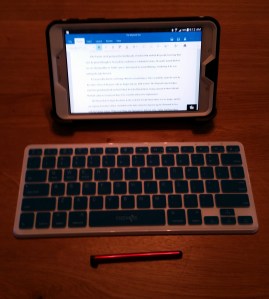
And once I have brainstormed my block into submission, I will stop in at the diner, order a coffee, and pull out my android tablet. I will write for an hour putting those thoughts together. It will be a productive hour, just because I have walked in the fresh air, and changed my writing environment.

Everyone suffers from stalled creativity. For me, the only solution is to force my way through it. Once I have a hole punched through the wall, new ideas crystallize and I am fired with the knowledge of what has to be done next.

3 Comments

Filed under writing

#amwriting: using allegory to underscore theme

the Matrix PosterGreat novels, like great movies, are built of many layers. Theme is what the story is about on a deeper level than what is seen on the surface. It’s the big meaning, and often it’s a moral. Love, honor, family, redemption, and revenge are all common, underlying themes.

Allegory is an essential tool of the author who wants to convey important ideas with the least amount of words. One of my works-in-progress is a contemporary novel. I need to convey a Gothic atmosphere in this piece and yet maintain the setting and time-frame of a novel set squarely in the  21st century. The way I am doing this is through the use of allegory. With symbolism in mind, I try to approach writing a scene as it would be portrayed in a movie. Each conversation is an event and must advance the story.

Consider this scene from one of my favorite movies of all time, The Matrix. The films of The Matrix trilogy pit man against machine in a clearly drawn battle, but they also reveal that the humans are more machine-like than they think, and that the machines possess human qualities as well. These are the obvious themes, but there are several underlying concepts going at the same time.

The movies in this series are famous for the action, and rightfully so.  But great choreographed martial arts sequences can’t convey the concepts the authors needed to express. The advancement of the plot hinges on dialogue. Dialogue drives the action and connects the fundamental ideas of the story through the intentional use of allegory. The authors never lost the way, because every aspect of that script is steeped in symbolism that directly points to the overall theme(s).

Quotes from the matrix


The conversation concerns a drug deal, but the overarching idea of the blurred line between humans and machines is never lost.

The key words are in the first line, written on Neo’s computer:

  1. The Matrix has you,
  2. the third line,follow the white rabbit,
  3. and in that very last line, telling Neo to unplug.

The obvious plot of The Matrix series of films details a questioning of what reality is and portrays Neo as the potential savior of the world, which has been enslaved by a virtual reality program. Dig slightly deeper, and you see that it is about escaping that program, at which point the audience sees that a larger theme is in play: fate vs. free will.

Even before that larger concept is made clear, the conversations that happen in the course of the film all advance that theme, even the minor interactions, from the first conversation to the last.

The storytelling in The Matrix movies is a brilliant example of employing heavy allegory in both the setting and conversations to drive home the motifs of man, machine, fate, and free will.

The themes are represented with heavy symbolism in the names of the characters, the words used in conversations, and even the androgynous clothes they wear. Everything on the set or mentioned in conversation underscores those themes, including the lighting. Inside The Matrix the world is bathed in a green light, as if through a green-tinted lens. In the real world, the lighting is harsher, unfiltered.

In the movie, everything that appears or is said onscreen is symbolic and supports one of the underlying concepts. When Morpheus later asks Neo to choose between a red pill and a blue pill, he essentially offers the choice between fate and free will.

Neo chooses the red pill—real life—and learns that free will can be unpleasant. Cypher regrets choosing the red pill and ultimately chooses to return to the Matrix.

The creators of the movie even used the lighting as an allegory showing that Neo’s world is filtered through something else: The Matrix.

The arc of the story is driven by

  1. who has the information,
  2. when they learned it, (and when the audience learns it)
  3. what they did on learning that information.

In our own work, if we don’t keep the arc of the story moving toward the final conclusion with each scene, we will lose our reader. To that end, we disseminate information in small increments, with the reader learning what she must know at the same time our protagonist does. Using symbolism and allegory is a way to get the most information out there in the least amount of words, but it requires intention on the part of the author. Words, phrases, and setting must be chosen and the narrative’s prose must be crafted.

Crafted prose does not mean flowery prose. If you reexamine the above excerpt from The Matrix, you see lean dialogue, spare and to the point. It is in the symbolism of the setting, their names, their attire, and the authors’ choice of words that we get the most information. When Neo answers the door and is invited to the party, he at first declines. But then he notices that Du Jour, the woman with Choi, bears a tattoo of a white rabbit. He remembers seeing the words: follow the white rabbit, on his computer. Curious and slightly fearful of what it all means, he changes his mind and goes to the party, setting a sequence of events in motion.

We build the overall arc of the story from scenes, each of which is a small arc, in the same way a gothic cathedral is constructed of many arches that all build toward the top.  The underlying arches strengthen the overall construction. Without arches, the cathedral wouldn’t remain standing for very long.

Theme is a thread that winds through the story and supports the plot. Using allegory and symbolism in the environment to subtly underscore your themes allows you to show more without resorting to info dumps.

Picture conversations, clothing, settings, and wider environments as if they were scenes in a movie, and consider how you can use allegory to support your story arc. When we are immersed in reading it, we don’t notice the heavy symbolism on a conscious level, but on closer examination it is all there, making the imaginary real, solid and concrete.

By using allegory and conversations to create many layers, we can build memorable stories that will stand out in the reader’s mind.

1 Comment

Filed under writing

#amwriting: trust your readers

Stardust, Neil GaimanSome hard-core fantasy qualifies as literary fiction because of the way in which the story is delivered. Because of the style in which they’re written, these books appeal to a broader fan base than work pigeonholed into either the “genre fantasy category” or the “literary fiction category.”

Neil Gaiman’s Stardust qualifies as a novel that is a “literary fantasy.” This is because it is a fairy tale told with beautiful prose in an unhurried fashion.

Among the burgeoning population of authors who are just learning the craft, opinions regarding style and voice run high and loud.

According to those critique groups armed with a little dangerous knowledge, in the very first sentence of chapter one, Gaiman commits the most heinous crime an author can: he tells the story with leisurely, poetic prose.

Quote: There once was a young man who wished to gain his heart’s desire. 

OMG!  He did he really write “There once was” in a genre fantasy novel?  Passive Voice! Passive Voice!

Well, guess what? Neil Gaiman knows what he is doing when he sits down to tell a story, and his rabid fans and best-selling novels are a testament to that.

Those megalomaniacal gurus armed with tattered copies of Strunk and White, limited talent of their own, and who believe themselves the fount of writerly knowledge really lose their minds over what he does after that first sentence:

  1. He sets the scene: In a style reminiscent of traditional fairy-tales, he explains how our hero, Tristam, lives in the village of Wall. It’s a tiny town about a night’s drive from London. A giant wall stands next to the town, giving the place its name.
  2. He goes on to explain that there’s only one spot to pass through this huge grey rock wall, and it’s always guarded by two villagers at a time, and they are vigilant at their task.
  3. Gaiman comments that this guarding of the gap is peculiar because all one can see through the break in the wall is meadows and trees. It looks as if nothing frightening or strange could be happening there, and yet no one is allowed to go through the break in the wall.
  4. Only then does he bring us to the point: Once every nine years, always on May Day, a unique, traveling fair comes to the meadow. That is the only day the guards ever take a break from their posts on the gap in the wall.

I can hear the group’s de facto emperor pontificating now. What was Gaiman thinking, starting a fantasy novel with a TELLING, PASSIVE sentence followed by an info dump? Why, everyone knows real authors only use active prose and never, ever, offer information up front.

To that breathless expert, I say “not true, my less-than-widely-read friend.” Lean prose can be leisurely and poetic, and still pack a punch. That is what true writing is all about, conveying a story in a style that is crafted and has a voice that is uniquely that of the author.

In Stardust, each character is given a certain amount of importance, and even minor players are clearly drawn. The circumstances and events gradually pick up speed, and in the end, the reader is left pondering what might have happened after the final words on the last page.

stardust_promo_posterIf you saw the movie that is loosely based on the book, you might be surprised at how different the book is from the movie. There are no cross-dressing sky pirates in the book, although Robert De Niro was awesome in that role in the movie. The movie is excellent but bears little resemblance to the book, and, like The Hobbit movie, should be looked at as a different entity entirely.

Neil Gaiman trusts his readers. That is something we all need to do. Sometimes a story needs to emerge slowly and be told with beautiful, immersive prose, and we need to trust that our readers will enjoy it if we craft it well.

There is room in the bookstore for books with a less urgent story to tell as well as those that ambush the reader and beat them bloody with non-stop action.

When we write, we are writing because we have a story to tell. (Yes, I said tell.) To that end, every word must count, every idea must be conveyed with meaningful words, and sometimes you can just have a little fun with it.

In the opening lines of Gaiman’s Stardust, nothing unimportant is mentioned although the prose meanders in a literary way. Yes, he takes the long way, but the attitudes, mores, and personalities of Tristam’s village are conveyed with humor, and the journey is the best part of this fairy tale. He never devolves into florid, overblown purple prose, yet it has a poetic feel.

True authors are driven to learn the craft of writing, and it is a quest that can take a lifetime. It is a journey that involves more than just reading “How to Write This or That Aspect of a Novel” manuals. Those are important, but they only offer up a part of the picture.

You must read widely, and outside your favorite genre. When you come across authors whose work shocks, rocks, and shakes you, study how they crafted the sentences that moved you.

Let their works show you how to use words to form the moods and emotions that drive the plot.

Learn from the masters how to show the true character of a protagonist, or the smell of an alley by the wharves, painting pictures with words.

Read widely, and then apply what you’ve learned to your own work.

6 Comments

Filed under Fantasy, Literature, writing

#amwriting: November is National Novel Writing Month #NaNoWriMo2016

nanowrimo-2016-kick-it-in-gear-desktop

Dragon_Fangirl’s home-made nanowrimo-2016 “kick-it-in-gear “desktop

Every year starting on November 1st several million people sit down and attempt to write a 50,000-word novel in 30 days, most while holding down jobs and raising kids.

Four years running, 2010 – 2014, I used the month of November to lay down the rough draft of an intended novel. I made an outline in October and drew maps and such so that on November 1st I could hit the ground running. Most of the time, once I have that foundation down, I can write off the cuff, and that is how three of my books came into existence.

However, last year I already had two novels in the final stages and one simmering on the back burner.  What I lacked was short stories. I had the brilliant idea to write a short story collection, because I knew I had to build my backlog of submittable work. As a result, and despite having a viral plague during the entire month of November, I wrote 42 short stories for a total of 105,000 words.

That’s not counting the blog posts I also wrote. NaNoWroMo 2015 was a prolific year despite the plague!

For many participants, the challenge of sitting down and using the “seat of your pants” style of creative writing is what draws them to sign up.

On November 1, participants begin working towards the goal of writing a 50,000-word novel by 11:59 PM on November 30.

In 2011, the year I wrote Huw the Bard, I spewed the basic rough draft in the most unlinear way possible.  I had the plot outline and followed it, sort of.  With that as my guide, no matter how off track I found poor Huw (pronounced Hew), I still managed to get him to the end I had originally envisioned.

The next year, my novel didn’t go quite as smoothly, and I had a few hiccups.

But that novel was really only a writing exercise for me, just to see if I could write in that particular genre and I fell out of love with it. Since it didn’t have a grip on my heart, and by November 15th I had written 50,000 words of a story I hated, I began a different story.

I kept the work I had already done, as that book was as done as it was ever going to get. But I’m not silly – I had no intention of wasting that word count, so at the bottom of the last page, I began a new novel, which eventually became The Wayward Son, and was just published last month. At the end of that November, I had written 115,000 words total and had 2 completely different novels to show for my efforts.

2016-placeholder-book-cover

2016-placeholder-book-cover

This year my book has the working title of November Tales 2016: 30 days of Madness and Pot Pies by Dragon_Fangirl: The literary ranting of an author on the edge.

Once again I am embarking on a binge of writing short stories and essays.

Many authors are unwilling to commit to NaNoWriMo because it takes discipline to write 1667 words a day.

Also, they fear having to recoup any perceived losses should they find themselves in the middle of NaNoWriMo when they suddenly realize they’ve gone terribly astray. Or they fear writers’ block.

It happens. Not to me usually, because I know the secret: If you can’t write on the subject you intended, write about what you are experiencing and what interests you at that moment. Yes, it’s not that fabulous fantasy novel you began but are stuck on, and no epic dragons will be in it. (Unless you are Stephen Swartz. His real life has epic dragons. And bunnies.)

The key here is you will be writing, and that is what is important.

Rule 1 of NaNoWriMo: write.

Rule 2: Write 1667 words every day.

Rule 3: Every time you rewrite the scene with a slightly different outcome, it counts toward your word count. Don’t delete – just change the font color to red in that section, and begin rewriting the scene the way it SHOULD have been written in the first place, using the usual black font.

In December, cut the offending scene out of the ms, paste it into a separate document and save it in a ‘Background File’ in the same folder as the main manuscript. By doing that, you don’t lose prose you may need later.

During National Novel Writing Month, every word in my manuscript over and above 50,000 counts toward my region’s total word count. So if that means I have a lo-o-o-o-ong, multicolored manuscript for a few weeks, so be it.

For me, if I don’t begin to make those changes when I first realize they need to be done, I might forget until Dave Cantrell, my first reader and structural genius, points it out. (I daily thank God for Dave, and am grateful the internet connects to California.) (♥)

As one of the Municipal Liaisons for the Olympia Washington Region, I am required to attend most of the write-ins, which happen at different coffee shops or libraries. I handle the daylight hours, as I don’t drive after dark. It does eat into my day, which is why my husband thinks of it as National Pot-Pie Month. But I do get a lot of stream-of-consciousness writing done at these events and I have made life-long friends among the writing community of Olympia and the surrounding area.

If you want to sign up for this year’s month of madness and mayhem, get on the internet and go to:

www.nanowrimo.org

Sign up, pick a NaNo name – mine is Dragon_Fangirl, and you are in business. Look me up and make me one of your writing buddies. Spend the rest of October organizing what you think you will need to begin you story on November first. Then, on the first day of November you begin writing. If you apply yourself, and write (AT the minimum) 1667 words every day, on the 30th of November you should have a novel…or something.

nanowrimo-yodaIn reality, if you set aside one or two hours a day, and pound out the words as fast as you can during that time, you will get your word count. Never delete, and do not self-edit as you go along. Just spew words, misspelled and awkward as they may be. They all count, misspelled or not, and it is the discipline of writing that we are working on here, not the nuts and bolts of good manuscript.

Revising and correcting gross mistakes will come in the second draft, when you have time to look at it with a critical eye. What you are doing now is getting the ideas down.

Never discard your work no matter how much your first reader says it stinks. Even if what you wrote is the worst drivel she ever read, some of it will be worth saving and reusing later.

Spending a month immersed in stream-of-consciousness writing is not a waste of time. You will definitely have something to show for your efforts, and you will have developed the most import skill a writer must have: self-discipline.

4 Comments

Filed under NaNoWriMo, writing