Category Archives: writing

#FlashFictionFriday: Edna’s Garden

Fairies Looking Through A Gothic Arch John Anster Fitzgerald

Fairies Looking Through A Gothic Arch, John Anster Fitzgerald

This morning I noticed there were fairies in the back garden.

I was a little surprised. At first, I thought they were a side effect of my medication. But hallucinations were not listed on any of the labels, which, by the way, I had to read with the magnifier. I decided they weren’t, and several hours later they were still there.

At first, I couldn’t see them well, and wasn’t sure if they were bugs or birds, but no…when I looked closer with my magnifier, I could see they were definitely fairies.

It seems odd to me, to think that after all these years of wishing for a fairytale ending in my life, I should finally have a garden full of fairies. But life is what it is, and sometimes the things you want elude you until you no longer need them.

When I had lunch, they had progressed to building a rather large bower in the yew hedge. I was glad to see that because it meant they were staying, and they’re a lot more interesting to watch than birds.

They ignored me as they went about their business, rather like the rest of the world, probably just seeing a really old lady, nothing to worry or fret about. I was concerned that Rufus would pester them, but they didn’t interest him. He is the laziest cat, but he does sometimes work up the energy to bother the birds.

I thought about sharing the information with Violet, as they’re something she would enjoy, but she worries about me too much. If I were to call her up and say, “Violet, guess what! Fairies are nesting in the back yard,” she would say, “That’s nice, Edna. Have you a unicorn now too? Perhaps you should stop driving.” She would immediately call my daughter.

That would be bad.

Violet should talk…she’s as bad off as me or worse. But I think we’re doing quite well, for a couple of old crackpots. Funny how ninety-two doesn’t feel as old when you’re wearing that birthday hat as it seemed when we were young and whining about turning sixty-two.

So now I have a garden full of fairies. I wonder if they eat the same sort of things the birds like? Maybe I should get some of that fancy wild-bird food with all the sunflower seeds. And I should probably fill the birdbath.

Then I’ll give Violet a call and invite her over for coffee on the back porch, just to see if she notices anything out of the ordinary. If she does, I’ll pretend like I don’t see them.

She’s always moaning about how nothing exciting ever happens in this town, so this should be good for a laugh.


“Edna’s Garden” © 2016 Connie J. Jasperson, All Rights Reserved

Click here to read part 2

3 Comments

Filed under #FlashFictionFriday, Fantasy, Literature, writing

#amwriting: using foreign languages in your dialogue

Long Live Dead Languages

At my Tuesday morning therapy writing group, a friend was telling me about a post she had seen in an online writers’ forum. The question ran something like this:

Questioner: “I have a main character in a fantasy novel who speaks no English. She speaks several other languages, though. Should I put the translations for her dialogue in italics or in parentheses?”

My friend gave the answer I would have: The answer to BOTH options is NO!!!

Translations should not be necessary at all. Never give a large amount of dialogue to a character who doesn’t speak the native language the book is written in. We don’t put the reader through that kind of torture, wading through a language they don’t understand, and then giving them the translation in italics. (Or large chunks of whatever in parentheses.)

We all laughed, but afterward, I was still thinking about this issue. The author whose post had begun this was writing a fantasy novel, and there are certain conventions readers expect authors to adhere to in this genre. When writing genre fantasy it’s a generally accepted practice that thoughts are set off with italics, not parentheses (aka Virginia Woolf), and so brackets have no place in the fantasy narrative.

Let me be clear on this: too many brackets clutter up the narrative just as much as large blocks of italics. In fantasy, the use of the em dash or ellipses fills the function of setting portions of the narrative off for emphasis.

Italics, parentheses, and foreign dialogue are like cayenne—a little goes a long way.

If you are writing a character who speaks a foreign  language, consider how they are commonly portrayed in novels that are traditionally published. Take any spy novel with a plot that takes place in both Mexico and the US. It has American characters, including the protagonist, who is a CIA agent and is fluent in both Spanish and English, and it features a large cast of Mexican citizens who may or may not be bilingual.

Because the book is intended for an English-speaking audience, when the Spanish-speaking characters are talking to each other in their native tongue the dialogue is still in English. At times, a few, commonly recognized words in español may be sprinkled in to lend the flavor of Spanish.

You must clearly establish that the characters are speaking their native language, Spanish, in the narrative. This is particularly important if you have a character who switches between languages or in certain situations where Spanish is the only language spoken.

I happen to read and understand some Spanish, and it is a language spoken by many US citizens, but our readers in the US are, for the most part, English-centric.

It’s all right to include an occasional foreign word or phrase, as long as it is done in such a way that the reader who most likely does not speak that language is not completely thrown out of the book.

yoda gibberish memeNow, why would I say this? Because I find it  irritating as hell (sorry for the editor speak) to stop reading, and hunt down translations.

It is hard enough when authors like Alexander Chee  put large amounts of words in French with no translation. Chee is from Canada and is writing for Canadians. His main character is Canadian, and French is one of his two national languages. For that reason, his mingling of French and English is acceptable, as his work is clearly understood by his intended audience.

My next thought when I was told about this particular virtual exchange was, does the writer speak the languages she is writing, or is she getting her Russian (or Spanish or German) from Google Translate? If that is the case, this author has a hot mess on her hands.

Original sentence in English: “It appears as if my dog may have fleas.”

Google translation in French: “Il semble que si mon chien peut avoir des puces.”

Re-run that French phrase through Google translator: “It seems as if my dog can have fleas.”

MSClipArt MP900390083.JPG RF PDNote the slight change in the translation—one word, “may” or “can”—these words are not always interchangeable, as they don’t mean the same thing in English—so that slight switching out of the word “can” for “may” changes the meaning of the sentence. The first sentence with “may” suggests it is possible the dog has fleas. The second translation with “can” gives the dog permission to have fleas.

These are two entirely different concepts.

English originally developed from a set of Anglo-Frisian or North Sea Germanic dialects originally spoken by Germanic tribes traditionally known as the Angles, Saxons, and Jutes.

Therefore, modern English is an offshoot of Frisian, as is Dutch. But even though we share the same roots, we have widely different syntax as our English is heavily influenced by Latin, thanks to the Roman Conquest of Britain after it was settled by the Frisians. In linguistics, syntax is the set of rules, principles, and processes that govern the structure of sentences in a given language, specifically word order.

How do you know that the Google translator understands syntax? The answer is: it doesn’t.

Your character from Amsterdam has bent a spoke on his bicycle wheel. He speaks Dutch. Filtered through the translator, it goes like this:

Dutch: “Oh nee. Ik heb een gebogen sprak op mijn fietswiel. Hoe kan ik het vast?”

English translation: “Oh no. I spoke bent on my bicycle wheel. How can I fix it?”

Note the misplaced words: In English, this implies he was speaking while bent over his bicycle wheel.

If you do use the occasional foreign word or phrase, it’s no big deal as long as it is used appropriately and in a context that will be understandable. It lends a certain realism, when done with a deft and sparing hand.

Just remember, forcing your reader to stop reading and check too many translations is suicide, especially for an indie. Never give your reader a reason to put the book down!

5 Comments

Filed under writing

#amwriting: The Superhero

The_IncrediblesI just spent the weekend on grandma duty with a 3-yr old grandson. We did a lot of fun things, but when we needed some quiet time we watched The Incredibles…over and over….

It’s a great movie…honest…but now I know the dialogue by heart.

Superheroes are huge in our pop culture. I love them, and everyone loves them. So what is it that makes a story involving a superhero intriguing? First of all, this type of tale is speculative fiction. It is based on the power of “what if….”

When you open a book of speculative fiction, you will often find yourself reading a morality tale, a “there but for the grace of God” tale that keeps you thinking long after you have finished the book.

The main characters are usually flawed heroes, imperfect people who come through in the end, and win the day. Nowhere is the concept of the flawed hero more clearly drawn than in the sci-fi sub-genre of Superheroes. It is a branch of science fiction that has become a sub-culture.

Traditionally, science fiction involves the accurate portrayal of science as we know it, including the cutting edge of theoretic science. For the fans of this genre, plausible science is critical, along with a strong morality tale set in a futuristic setting.

“Superhero” stories take “what if” science speculation to an extreme: they tend to be a mix of known and as-yet-unknown science extrapolated out to the nth degree and heavily padded with uber-dramatic plots.

The spider bite that gave Peter Parker his powers. Amazing Fantasy #15, art by Steve Ditko.

The spider bite that gave Peter Parker his powers. Amazing Fantasy #15, art by Steve Ditko.

Mad science has free reign, threatening the citizens of a frequently unnamed metropolis. Sometimes, ordinary people are caught up in these experiments and granted super powers. Think about Spiderman: he is the victim of an experiment gone wrong. A bite from a radioactive spider triggers mutations in the teen-aged Peter Parker’s body, granting him superpowers.

The early series revolves around his maturing through teen-aged angst to married adulthood, while dealing with his super powers. He is one of the few working-class superheroes–he has no fortress of solitude from which he works, but he does live with his elderly aunt and attends high-school.

Sometimes their gifts are used for good (our superheroes) but more frequently the powers take away their “humanity” turning them evil (enter the supervillain).

It is the imbalance of evil super-ness to good that creates the never-ending string of villains for the superhero to battle.

Other superheroes have super technology.  Consider Batman: he possesses no superhuman powers. However, he has mastered the martial arts, developed espionage techniques, and understands everything from physics to forensics. What he lacks in super powers he makes up for in super-science.

Superheroes all have an exceptionally rigid, highly moral code of honor. They are eager to risk their lives in the service of humanity and expect no payment.

Batman by Jim Lee (2002) via WikipediaThey often work alone. The catch phrase “it’s complicated” completely defines the flawed superhero. Again, let’s look at Batman: he is dark, brooding. He is a man obsessed with the murder of his parents and is consumed with avenging them, taking to the streets to hunt down super-criminals. He is possessed of the money to enable him to fight evil with incredible technology, and he spends it like water.

All superheroes must have a fundamental motivation, a reason for their obsession. In many cases, it’s a sense of responsibility and guilt for a traumatic incident witnessed in their childhood.

Tales involving Superheroes are usually set in modern cities, and have a strong science theme, although the science is frequently fantasy-based. Magic is rarely used in western superhero stories, although Japan has a long tradition of combining science and magic in its manga (comic books).

Most superheroes and the supervillains they battle operate from a secret base or headquarters. These bases are usually equipped with state-of-the-art, highly advanced, and/or alien technologies. No amount of money is spared when it comes to designing a superhero’s (or villain’s) fortress. Let’s examine the Batcave: Batman’s secret headquarters, command center, and safe house. The cave’s beating heart is a supercomputer whose specs are on par with any of those used by our government. It’s capable of global surveillance and also connects to a massive information network including, but outside of, our usual internet.

Naturally, a computer of that size stores vast amounts of information, both on Batman’s foes and his allies. He even has satellite link-ups that allow easy access to his information network anywhere around the globe. No matter where he is, he is connected. Of course, the systems are highly protected against unauthorized access, and any attempt to breach their security is immediately made known to Batman.

dragons in piecesAs an added bonus, while the superhero is often dark and brooding, the evil he battles is outrageously megalomaniacal. The supervillain’s ego is as large as his fortress, and so is his disdain for humanity in general.

Be aware, the science in these stories is “squishy,” and requires the reader to set aside their inner skeptic. For this reason, the superhero is a sub-genre all its own.

There is a lot of room for imagination when writing about a superhero. Lean prose is required, and an almost comic-book style of plot. A plot should have all the elements of a thriller, with a certain amount of mad science thrown in. When done right, the superhero book can be quite a fun read.

For an excellent example of books in this genre, check out Lee French’s novel, Dragons in Pieces. It’s as perfect an example of work written in this sub-genre as I have read outside of a comic book. It has great characters who are complicated and slightly flawed, plenty of mad science, loads of evil henchmen, and an epic plot.

3 Comments

Filed under Adventure, Fantasy, writing

#amwriting: know your style: hypocrisy in the industry

a writer's styleIn writing, style is far more than simply choosing to wear high-heeled shoes with jeans. Style is a multilayered representation of your voice and your knowledge of the craft of writing.

An author’s style affects the overall readability of his/her finished product. Good readability is achieved by:

  1. Understanding: Keeping to generally accepted grammatical practices. Purchasing and using a style guide when questions arise regarding a creative writing project
  2. Rebellion: if the author chooses to break the accepted rules, he/she does so in a consistent manner.
  3. Wordcraft: The way the author phrases things, and the words he/she chooses, combined with his/her knowledge of the language and accepted usage. Invented word combinations, such as wordcraft (word+craft) and the context in which they are placed.

Simply having a unique style does not make your work fun to read.

Ulysses cover 3Let’s take a look at James Joyce, the man I think of as the king of great one-liners. If you look up great lines quoted from modern classic literature, you will find excerpts from his novel Ulysses represented more often than many other authors.

Yet, while the average reader has heard and often used quotes from Joyce’s work, most people have not read it. They may have picked it up, but then put it down, wondering what all the critics loved so much about it.

The mind of the literary critic is as inscrutable as that of an ex-spouse: hard to understand but easy to run afoul of. I personally learned to love Joyce’s work when I was in a class, taking it apart sentence-by-sentence. Prior to that, I couldn’t understand it, despite the fact it was written in modern, 20th century English.

What makes Joyce’s work difficult for the average reader is his style: he was Irish and had the Irishman’s innate love of words and how they could be twisted, and often wrote using what we call stream-of-consciousness. In doing so, Joyce regularly, but consistently, broke the rules of grammar.

Consistency and context are absolutely critical when an author chooses to write outside the accepted rules of grammatical style. If you just don’t feel like enclosing your dialogue within dialogue tags, it is your choice. Simply tell your editor that is your decision, and she/he will make sure you have consistently omitted them throughout the manuscript.

Queen of the Night alexander cheeYou may, however, have written a book that is difficult for the average person to read, as Alexander Chee has in his brilliant novel The Queen of the Night. While his writing is sheer beauty, this particular style choice is a mystery to me. It makes the book difficult to get into, because you’re reading along, and suddenly you realize you’re reading dialogue, and you have to stop, go back, and reread it.

It is incomprehensible to me why an editor for a large publisher would accept a manuscript that is as annoying as that one flaw makes this otherwise amazing book. It is also proof that large publishers (Houghton Mifflin Harcourt in this case) are just as guilty as indies when it comes to making strange decisions that can negatively affect sales. They may have done this to elevate it to a “status” read,  a must-buy literary name-dropper for those who wish to appear fashionably cultured. If so, it’s a disservice to a work that is brilliant despite a flaw that would be fatal if it were to appear in an Indie author’s work.

Chee’s editor did one thing correct, however: the lack of closed quotes is consistent throughout the book, and so one can sort of get into the narrative—at least until the dialogue starts up again. This blemish is why I will only recommend the audiobook to readers who are easily discouraged.

Your style choices are critical. They convey your ideas to the reader, and if you make poor choices, you may lose a reader.

James Joyce and Alexander Chee made style choices in their writing that an Indie could never get away with. The world holds Indies to a higher standard, so the choice to omit something as vital as quotation marks would result in instant finger-pointing and mockery of the Indie publishing industry as a whole.

What you choose to write and how you write it is like a fingerprint. It will change and mature as you grow in your craft, but will always be recognizably yours. As you are developing your style, remember: we want to challenge our readers, but not so much that they put our work down out of frustration. Most of us who are Indies can’t rely on our names to sell our books.

9 Comments

Filed under Publishing, writing

#amwriting: genitives and possessives: when good apostrophes go bad

they're their there cupEvery now and then I’m reading along and I’m jarred out of the book by the improper use of an apostrophe. Yeah I know, that seems pretty minor, but think about it: apostrophes denote possession (and I’m not talking demonic here).

Things to remember:

  1. Who’s is the contraction of “who is” or, less commonly, “who has.”
  2. Whose is the possessive of “who” or, somewhat controversially, “which.”
  3. Their(s) is the possessive of “they.” (They’re proud to own it, it’s theirs, and it’s not there.)
  4. Its is the possessive of “it,” and “it’s” is a contraction of it is.

Quote from grammar-quizzes.com:

“Whose replaces a genitive personal or inanimate noun in a relative clause. While some people may object to the usage of whose with an inanimate noun, grammarians approve of it and cite its usage by highly esteemed writers.” (end quoted text)

What does that slightly complicated explanation really mean?

Let’s look at some definitions:

Genitive: The genitive case is the grammatically correct term predominantly used for showing possession. Nowadays words falling into that category are more frequently referred to as possessive, which is simpler. With nouns, it is usually created by adding an apostrophe followed by an “s”: ’s to the word or by preceding it with the word: of.

  • John’s blue eyes.
  • The rim of the cup.
  • It is the cat’s possession, a possession of the cat, or a possession owned by the cat. (Universal fact: cats own everything.)

However, the genitive case is not always about possession and, for this reason, the word genitive won’t completely fall out of favor in the English language. Grammar-Monster.com says:

  • Dan’s bike (No one would argue this is the genitive case and the possessive case. It is the bike of Dan. It is about possession.)
  • Children’s songs (This is not about possession. It’s about songs for children. For this reason, some argue this is the genitive case and not the possessive case.)
  • Constable’s paintings (This is not about possession. It’s about paintings by Constable. Some would argue this is the genitive case and not the possessive case.) (end quoted text)

Grammar-Monster also says:

“Possessive adjectives and possessive personal pronouns are also forms of the genitive case.” Examples:

  • our carpet (our – a genitive form of we)
  • Can I use yours? (yours – a genitive form of you) (end quoted text)

Remember:

When referring to living beings, whose denotes possession and who’s is a contraction that refers to existence: who is.

So now we have some idea of “whose” versus “who’s.” But what about “It?”

Dealing with possession by the inanimate—we don’t need an exorcist, although a good maid service could probably help. But in this case, we are referencing something owned by  the inanimate:

  • The texture of the wall —it’s rough. (It is rough.)
  • I scratched myself on its surface. (The wall’s surface.)

Its…it’s…which is what and when to use it?

The trouble here can be found in the apostrophe. In probably 99% of English words an apostrophe indicates possession, but once in a while, it indicates a contraction.

  1. It’s is the contraction of “it is” and sometimes “it has.”
  2. Its denotes possession: It owns it.

it's and whose

Contractions (e.g., let’s, don’t, couldn’t, it’s, she’s) have a bad reputation in educational and formal writing. Many argue that they have no place at all in formal writing. If you are writing a thesis, you should observe your publisher’s or instructor’s requirements.


However, in writing fiction, avoiding contractions makes your writing appear stilted and hyper-formal. If you are serious about the craft, you will learn the exceptions to the rules when it comes to apostrophes, and not accidentally mingle possessives in with your contractions.


5 Comments

Filed under Self Publishing, writing

#flashfictionfriday: The Iron Dragon

Earl Aeddan ap Rhydderch turned his gaze from the mist to the strange iron road that emerged from it, and then to where the road entered the cave. “Tell me again what happened.”

The peasant who had guided the earl and his men said, “The mist, the iron road, and the cave appeared yesterday, sir. We saw the beast entering its lair, and a fearful thing it is, too. No one dares to enter, but the monster can be heard in there. It’s a most dreadful dragon—we found the carcass of a large wolf that had been torn to shreds, trampled until it was nigh unrecognizable.”

The man’s companion said, “Everyone knows wolves are Satan’s hounds. It must have angered its hellish master. We found it lying cast to one side of the Devil’s Road.”

Aeddan looked back to the iron road, seeing where it emerged from the mist. He walked to the low-hanging fog bank, seeing that the road vanished just after it entered the mist, leaving no marks upon the soil. He turned and strode back to the peasants. “I agree it’s the work of the Devil, but why does the Lord of Hell require an iron road that leads nowhere?”

A faint grumbling sounded beneath Aeddan’s feet. “A light! Look to the mist!” shouted one of his men.

Turning, Aeddan saw a white glow forming in the fog, as if a large lamp approached from a great distance. “That’s no ordinary lantern. Mount up!” Moving quickly, he leaped into his saddle and turned his steed to face the demon. He freed his lance from its holster and settled it in the arret attached to his breastplate under his right arm. His fingers fumbled as he struggled to fasten the grapper, but at last it held firm. The peasants, knowing they were no match for whatever approached, had run for shelter up the hill.

The light deep within the fog grew and strengthened, as did the rumbling noise.  The light waxed brilliant and the earth shuddered as if beneath the pounding of a thousand hooves. Smoke filled the night air, reeking of the sulfurous Abyss, combined with a howling as cacophonous as the shrieks of all the damned in Hell.

What emerged from the mist was impossible—an Iron Dragon of immense height and girth.

“Courage men! For God and King Gruffydd!” His bowels had turned to water, but Aeddan and his men stood firm in the face of the demon, sure that death would be their reward.

Dragon-Linda_BlackWin24_Jansson

Dragon, Linda Jansson PD/CC via Wikimedia Commons

The fiery light emanating from the burning maw lit the night, and the ground shook as the beast roared and raced ever closer. As the beast sped toward him, a burning wind blowing straight out of Hell knocked Aeddan and his horse to the side of the Devils Road, and using that opportunity, the Iron Dragon thundered past him, heading into its lair.

Stunned, Aeddan scrambled to his feet, staring as the length of the beast passed him by, the body taller than a house and long, like an unimaginably giant, demonic centipede. The length of the beast was incomprehensible, lit  by the fire within and glowing with row upon row of openings. The faces of the damned, souls who’d been consumed by the ravening beast peered out as they flashed by. Sparks flew from its many hooves.

Terrified his men would be crushed by the immense creature he shouted for them to back off, his voice drowned by the din.

Abruptly it was gone, vanished inside its lair. In the sudden, deafening silence, Aeddan wondered how such a thing could possibly have fit into the cave. Yet it had done so, and other than the stench of its passing, there was no sign of it.

He remounted and settled his lance in the holster beside his stirrup, then turned to his men. “Rouse the village. We must seal it’s lair with stone and mortar. We may not be able to kill it, but at least, we can stop it from marauding and decimating the countryside.”

>>><<<

Mist shrouded the small valley just outside of the village of Pencader. Engine Driver Owen Pendergrass looked at his pocketwatch and opened the logbook, noting the time and that they had just departed Pencader. He said to the fireman, Colin Jones, “We should be approaching the tunnel, though it’s hard to tell in this mist. We’re making good time despite the fog. We’ll be in Carmarthen on schedule.”

“Sir! Look just ahead! What…?” Colin pointed ahead.

A group of mounted men dressed like medieval knights, complete with lances lowered as if prepared to joust, appeared out of the mist, attempting to block their path. “God in heaven—what next!” Blowing the whistle to scare them off the tracks, Owen pulled the brake cord but there was no way the train could stop soon enough. In no time at all, the train was upon the knights, scattering them and blowing past. Owen looked out the window, to see if they’d survived but they were gone as if they’d never been.

“Vanished,” said Colin. “Like the ghosts when we passed through here yesterday.”

Hiding his trembling hands, Owen shook his head. “It was a close call, but no harm was done. We’ll not be mentioning this to the authorities, eh? Not after the way our report was received yesterday. It’s a haunted valley, but it’ll do us no good to mention it to anyone important.”

Colin agreed, and turned back to fueling his fire, shoveling coal as if he could work the fear out of his mind.

The connecting door opened and Harrison, the chief steward, entered. Pendergrass told him the same thing, and the old man agreed. “We got in enough trouble at the yard yesterday for mentioning the ghosts. I’ll go soothe the passengers.”

“Tell them it was just the mist and the dark playing tricks on their eyes.” Owen shook his head and glanced out the window, seeing they had emerged from the tunnel into a clear, cold evening and would soon be at the next stop, the village of Llanpumpsaint. “Playing tricks indeed.”


“The Iron Dragon” © 2016 Connie J. Jasperson, All Rights Reserved

For more stories involving what may or may not be dragons, check out today’s post by Chuck Wendig–he has posted a writing challenge and over the next two weeks the links to many great stories will be filling the comment section:

Terrible Minds/Chuck Wendig: Flash Fiction Challenge: the Dragon

6 Comments

Filed under #FlashFictionFriday, Dragons, writing

#amwriting: too many words

My Writing LifeI have been accused of using too many words to say what I mean—and my critics were right. For the last four years, I have been on a quest to learn how to convey a story and keep my reader involved. I’ve had some successes and also failures. The successes keep me going, and every failure inspires me to figure out what went wrong.

Most of the time it was my love of playing with words that derailed my story. Today’s example is a passage from an early work of mine. I will be rewriting this book over the course of the next few years, once the three books I am currently working on are published.

When I rewrite this book, I will eliminate the verbosity. I won’t change the basic story, only pare down the wordiness. This book was written for my first NaNoWriMo and was completely unplanned. I had no idea of what I was going to write until 12:01 a.m. on Nov. 1st, when I began writing it. In the back of my mind lurked Fritz Lieber’s great character, Fafhrd, although he’s not represented in this tale. Yet, Fafhrd and the Grey Mouser influenced this tale.

It still shocks me that over the course of 21 days, a 92,000 word story about a group of mercenaries in a medieval Alternate Earth emerged from my subconscious mind.

The original manuscript is a great example of everything that is both wrong and right about a  stream-of-consciousness first draft.

  1. Positive: It has a great, original plot,
  2. Positive: It has wonderful characters,
  3. Positive: It (surprisingly to me) has a basically good story arc.
  4. Positive: It ends well.
  5. Negative: I led off with an info dump.
  6. Negative: I used no contractions (Doh!)
  7. Negative: I made way too free with my adverbs and modifiers. This fluffed up the word-count by about 15,000 unnecessary words.
  8. Doubly negative: I used hokey phrasing, because I was trying to write well.
  9. Negative: Oh, and another info dump was inserted toward the end.

The example:

“I’ve brought along something so that we shall not have to boil the water to drink it,” ventured Lackland as he uncorked a bottle of wine. “Chicken Mickey was right about the trots you know, but I will never tell him that; the old thing enjoys mothering us so. It would take away the joy of nagging us to death if he thought we were able to care for ourselves.”

What? We shall not? From what hell hath this beast arisen? Still, once the hokey crap is pared away, something worth reading can be found.

SO, let’s take that unwieldy, 70-word behemoth of a paragraph apart and trim it down.

“I brought something so we won’t have to boil water to drink.” Lackland uncorked a bottle of wine. “Mick was right about the trots you know, but I’ll never tell him. It would take away the joy of nagging us to death.”

_72982736_vikings courtesy of BBCI trimmed it from 70 words to 42, and made it stronger without changing the meaning or intention. I changed the way Lackland refers to an absent friend, Chicken Mickey, the Rowdies’ supply-master. By this point in the ms, there is no need to use his full mercenary nickname every time he’s mentioned. Everyone knows Mick’s nickname and why he has it (he retired from the Rowdies to be a chicken farmer for a while, but that didn’t work out) so going with the short version of his given name, “Mick,” immediately helps that paragraph.

In the process, I axed one of my favorite sentences: “The old thing enjoys mothering us so.” It’s redundant as the sentiment is expressed in the sentence that follows, which also shows Mick’s character despite his absence.

Also of great benefit is the cutting away of unneeded words: along, to drink, ventured, as—these are words that can “go without saying” in the context of that paragraph. The reader understands they are there as silent partners: unwritten but understood. At this point, I feel that no dialogue tag is needed because Lackland has an action to perform, showing both who speaks and setting the scene.

Using contractions makes dialogue more natural. Some people would go even further than I did, and make “It would” a contraction. I don’t like the way “It’d” looks or sounds so I won’t do that—and that is part of what I think of as my voice. It is a deliberate usage choice, one that I prefer.

When I wrote the first draft of this manuscript, I was at a different stage in my writing development than I am at now. I had never been involved with a writing group, and I had never studied the mechanics of writing. The rudimentary skills I had were developed from trying to copy the styles of my favorite authors, but I had a limited understanding of the mechanics of writing fantasy fiction. The only writing I had done was for myself and my children, although I had done a lot of that.

While I had a standard high-school education and some college and had done a bit of writing in the course of my work, I realized I was woefully uneducated about the craft of writing. I made it my business to get an education, via the internet. It’s free and available to anyone who wants to learn. You just have to want to learn.

I began attending seminars, and writer’s conventions. I scavenged garage sales for books on the craft of writing and I joined local writing groups. I found other writers and made life-long friends, learning a great deal from them.

Nowadays, I have my own voice and my own style. I write far leaner prose in my first draft than I did in those days, and the editing process is not nearly such an ordeal as it was the first time I had one of my manuscripts edited professionally. I continue trying to learn the craft, updating my education constantly.

leonard elmore quoteChoose your words carefully, so they express what you want to say clearly, and in as few words as is possible, while still conveying the atmosphere and mood.

  1. Nothing can be included that does not advance the plot.
  2. There can be no idle conversations “just to show they’re human”: conversations must advance the story.
  3. We don’t need a chapter detailing the history behind the core conflict. Let that emerge as needed.
  4. Never use three words when one suffices.
  5. If you’re in love with a passage you wrote because it’s “great writing,” it probably should be cut.
  6. Ax all redundancies. It only has to be said once, unless the character has forgotten it, and that “forgetting” is a core part of the plot.
  7. Adverbs are important. They need to to be chosen carefully and used sparingly.
  8. If you occasionally love to wax poetic, go ahead and write poetry—just not in the middle of your political thriller. You have permission to love action-oriented genre fiction written with lean, mean prose, and still appreciate (and write) poetry.

What I didn’t know when I first began this journey is this: deleting the excess verbiage will add up to large gains, reducing the overall length of the book, increasing readability and (hopefully) the reader’s enjoyment.

9 Comments

Filed under Publishing, writing

#amwriting: Verbs: when to use “if I was” and “if I were”

epiphanyMost of my ideas for blog posts arise during work, or in conversation with other writers. Usually, these revolve around concepts I have a basic understanding of but haven’t really given a lot of thought to. Writing about them helps to clarify and cement them in my mind.

Every now and then a grammar topic comes up that I’ve never really thought about. If it’s a subject I am not really clear on, I will research it, and then try to distill my discoveries into bite sized chunks.

We writers often operate by instinctively using the knowledge we gained in school. Often, as in my case, that knowledge is a bit tarnished and worse for the wear.  Today’s topic is one fabulous instance of that very thing.

Last Tuesday, we were standing around the virtual watercooler at the virtual offices of Myrddin Publishing. We have authors and editors on three continents, so we use a virtual office. A grammar question arose, and this is how the conversation went:

Shaun Allan (UK) said: Grammar question, please. ‘As if it were’ or ‘as if it was’ ?

Ross Kitson (UK) said: Would it depend upon the subject of it? If it were an individual then I’d say “was” whereas if ‘it’ were an event then I’d say ‘were.’ Might be best to ask a non-Northerner.

Connie Jasperson (me) (US) said: Ross Kitson is correct (in my opinion).

Stephen Swartz (US) said: were.

Gary Hoover  (US) said: A HUGE issue with most people is the subjunctive tense. Anything that is not actual but could be is subjunctive (as your phrase indicates). “If I were a carpenter.” Is correct because the singer isn’t actually a carpenter. “I was a carpenter” is correct if he actually was. (Gary inserted the link to Wikipedia’s article on “English Subjunctive”)

Alison DeLuca (US) said: I’m a subjunctive slore! ‘Were’ all the way.

It turns out this conversation revolved around the “Past Subjunctive Tense.” Gary, Stephen, and Alison had it right.

As a result of this conversation, I did a little more digging, wanting to know more about this oddly named construct. It just so happens that on Saturday morning, Stephen Swartz and I both happened (at the same time) upon an excellent blog post by the Grammar Girl, Mignon Fogarty.

When you go out to Wikipedia the whole subjunctive verb thing looks quite complicated, but it doesn’t have to be. The subjunctive (in the English language) is used to form sentences that do not describe known objective facts. For the purposes of this post, we are only looking at Past Subjunctive definitionSubjunctives: the verbs was and were.

But first, what does “subjunctive” mean?:

Dictionary.com defines “Subjunctive.” as:

adjective

1.(in English and certain other languages) noting or pertaining to a mood or mode of the verb that may be used for subjective, doubtful, hypothetical, or grammatically subordinate statements or questions, as the mood of ‘be’ in ‘if this be treason.’

Compare imperative (def 3), indicative (def 2).

noun

2.the subjunctive mood or mode.

3.a verb in the subjunctive mood or form.

First, let’s consider what Past Subjunctive Tense covers: how to use the words ‘was’ and ‘were.’

Which is correct?

  • I wish I were a penguin. I would fly through the water.
  • I wish I was a penguin. I would fly through the water.

If I am only  only wishing I were a penguin, were is correct. If I actually could be a penguin, was would be correct and I would have to rewrite my sentence, by deleting ‘I wish’ and changing ‘would’ to ‘could.’

The Grammar Girl goes farther. She says: Believe it or not, verbs have moods just like you do. Yes, before the Internet and before emoticons, somebody already thought it was important to communicate moods. So, like many other languages, English has verbs with moods ranging from commanding to questioning and beyond. The mood of the verb “to be” when you use the phrase “I were” is called the subjunctive mood, and you use it for times when you’re talking about something that isn’t true or you’re being wishful.

I love that clue—that verbs can be wishful.

fiddler onthe roof soundtrackThe Grammar Girl gives us a great example: Think of the song “If I Were a Rich Man,” from Fiddler on the Roof. When Tevye sings “If I were a rich man,” he is fantasizing about all the things he would do if he were rich. He’s not rich, he’s just imagining, so “If I were” is the correct statement. This time you’ve got a different clue at the beginning of the line: the word “if.”

However, there are times when we use the verb ‘was’ even though the subject of the sentence has not yet happened, or may not happen at all. Grammar Girl says:  But “if” and “could” and similar words don’t always mean you need to use “I were.” For example, when you are supposing about something that might be true, you use the verb “was.”

Past subjunctive verb forms express a hypothetical condition in present, past, or future time:

  • Don’t complain about the food. What if I was a chef?
  • I wish I were reincarnated. What if I was a penguin?

If it’s only wishful thinking, we use “were.” If it might be true but we don’t know or it hasn’t happened, we use “was.”

So now, thanks to a bunch of editors hanging around the water cooler and the miracle of the internet, we know how and when to use our moody, past subjunctive verbs.

If you are a grammar junkie (as I am becoming) I highly recommend you check out Mignon Fogarty’s Grammar Girl blog, or pick up her books.

4 Comments

Filed under writing

#flashfictionfriday: Dreams and Shadow Truths

Neil Gaiman Sandman quote memeTales, dreams, shadow-truths…the fabric of the multiverse. One universe touches upon another, and the dreamer dreams. The faerie queen leads her court though the forest and one more mortal falls in love.

Books are evidence that once upon a time a mortal slept, and dreamt. Within the pages of dusty, leather-bound books lies proof that the philosophers’ stone exists in the realm of imagination spinning words of straw into gold, and bequeathing immortality to those who possess it.

The multiverse is yours for the taking if you believe, and are unafraid to dream.

Open a book, and  step into a realm unknown.


“Dreams and Shadow Truths”  by Connie J. Jasperson © 2015 was first published on Aug. 10, 2015 on  Edgewise Words Inn

2 Comments

Filed under #FlashFictionFriday, writing

#amwriting: The Garden Path

Plum Trees in Blossom, Pissaro 1894 via Wikimedia Commons

Plum Trees in Blossom, Pissaro 1894 via Wikimedia Commons

Today we are looking at the second of two creatively named structural errors that can introduce ambiguity to our work. On Monday we looked closely at “squinting modifiers” and today we are walking the “garden path sentence.”

Most of us are aware that many times a sentence is made stronger by the elimination of relative pronouns, such as that, which, and whom. Often, these words are understood and are therefore unneeded.

However, overzealous new authors recovering from a severe ego-bruising at the hands of a writing group sometimes get a little crazy and slash every instance of the “offending word” from their narrative. Such a knee-jerk reaction is ridiculous and can create the “garden-path sentence.”

Spring Hedges in Bauerngarten, Heinrich Vogeler 1913 via Wikimedia Commons

Spring Hedges in Bauerngarten, Heinrich Vogeler 1913 via Wikimedia Commons

From Wikipedia, the fount of all knowledge:

“A garden path sentence, such as “The old man the boat,” is a grammatically correct sentence that starts in such a way that a reader’s most likely interpretation will be incorrect; the reader is lured into a parse that turns out to be a dead end or unintended.

“Garden path” refers to the saying “to be led down the garden path,” meaning to be deceived, tricked, or seduced.

After reading, the sentence seems ungrammatical and makes almost no sense, requiring rereading to fully understand its meaning after careful parsing.”

pac-man jpgIn this case, confusion arises because we read like Pac-Man eats: one word at a time, as fast as we can, following the line. We attempt to understand sentences as we are reading them. The “garden-path sentence” begins by taking you toward a particular destination, but midway through it takes a turn for the bizarre.

Disambiguation memeThere are two types of garden path sentences.  The first is “locally ambiguous,” meaning that it can be cleared up with minimal changes to the sentence. Many times the addition of a word or punctuation will resolve the issue:

  • “The raft floated down the river sank.”
  • “The raft that floated down the river sank.”
  •  “We told the man the dog bit a medic could help him.”
  • “We told the man whom the dog bit that a medic could help him.”

Wikipedia offers the sentence: “The old train the young fight.”

  • When you add a comma it reads: “The old train, the young fight.” The addition of the comma makes sense of the words.
  • One could also argue that the sentence means “The old train the young to fight.

ambiguityThe other type of garden path sentence is “globally ambiguous” because when it is taken out of context the meaning is still unclear no matter how many times you reread it . It requires a complete rewording.

A sentence should always be understandable. Context is extremely important to the meaning of an ambiguously phrased sentence. What happens to a sentence when you take it out of context? It has to stand alone, and still make sense.

Again, Wikipedia offers an example of confusion: “The cat was found by the shed by the gardener.”  This sentence is open to several interpretations. Perhaps the cat was by the shed, or the shed was by the gardener, or both the cat and the gardener were next to the shed. When this sentence is isolated from its paragraph and taken out of context, the meaning is unclear.

Consider a more active phrasing and reword the sentence to say “The gardener found the cat near the shed.”

The way to resolve the garden-path sentence is to

  • Insert a relative pronoun (such as “that”) for clarity.
  • Insert proper punctuation for clarity.
  • Reword the sentence to make the meaning clear.
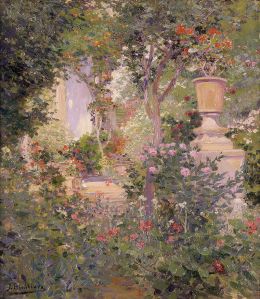
 The Garden of the Author, by José Benlliure Gil via Wikimedia Commons


The Garden of the Author, by José Benlliure Gil via Wikimedia Commons

Readers want to read without bumps and hiccups. Anytime they have to stop and reread something you risk losing them. Sentences that are ambiguous stop the eye.

We never want to introduce haziness into our work, and because we wrote it, we sometimes don’t see that it is confusing. If you have asked a beta reader to read a section of your work, and he flags a portion as being unclear, don’t just look at it and wonder why he can’t understand what seems so clear to you.

You must “parse” it. Tear that passage down to its component parts and find out what it is that the reader doesn’t understand. When you take the offending sentences out of their context, you can see if they will stand on their own. If they don’t, a simple rewording may be all that is needed.

6 Comments

Filed under Romance, writer, writing