National Novel Writing Month is not only about writing novels. This is a month solely dedicated to the act of writing. Even if you have no intention of “doing” NaNoWriMo, it can’t hurt to think about what you might like to write.
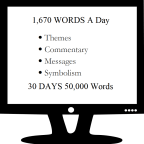
November’s Goal
First, we must decide on a project. Once we know what we’re writing, we can begin laying the groundwork.
Many people know they want to write something but don’t know what. The words live within us, but how do we free them? First, we have to find out what those words want to be.
Some ideas are:
Novel
- What genre?
- What is the central theme?
- Who are the characters, their gender, their culture?
- Will you “pants it” through the plot or create an outline?
Poetry collection
- What genre? Free verse? Or do you prefer traditionally structured poetry? Odes, Haikus, Elegies, Sonnets, Dramatic Poetry, or Narrative Poetry? In my misspent youth, I was a musician and wrote lyrics for a heavy metal band, so I tend to write lyric poetry. I have a friend who writes sci-fi poetry.
- What is the central theme of this collection? (The central theme in my poetry is the landscape that shaped me, i.e., the lake where I grew up, the river emerging from the south end of it, and the hills rising above it.)
- Will these be random poems expressing the thoughts of the moment?
- Will these poems be planned to express certain ideals and beliefs?
 Short story collection
- What genre? Or will it be a mix of genres?
- What is the central theme that gives shape to this collection?
- Will you have a recurring character binding the collection together?
- Will a different protagonist be featured in each?
- Will the stories be set in one town or in many?
- Will you “pants it” or write little outlines? I work both ways when it comes to short stories.
You’ve noticed that I’m repeating myself—but trust me, a fiction project is easier to create if you know what genre you are writing for and can see the central theme that will bind it together.
Memoir
- Have you read any memoirs? Do you know how the plots of successful memoirs are constructed?
- Your actual memories or a fictionalized account?
- Dare to name names or not?
Family history
- Are you just curious, or are you searching for an identity, trying to find a past to know who you are and where your family comes from?
- Research from a site such as ancestry.com or gleaned from family bibles, letters, and other collected papers? A combination of both?
- Photographs?
- Will you include interviews with older family members who may remember something about your family’s history?
Academic Papers
- Will this be the basis for a thesis, or is it an independent study?
- Will it become the basis for a textbook?
- Will you be required to conform to a specific format for disseminating the arc of information? (Structural editing.)
- Will you need to use a specific Academic Style Guide for grammar and mechanics? If so, where can you acquire it?
As we go toward November, we will delve further into plotting a novel or short story. We’ll also talk about structuring literary collections (short stories or poetry) so a reader will stay involved and finish the book.
Now is a good time to declare your intention to participate, if you are so inclined. But navigating the website at www.nanowrimo.org can be confusing. Take the opportunity to explore it ahead of time and get to know all the many tricks for using it. You’ll be more comfortable when November arrives.
Perhaps you haven’t been a participant for several years and are considering joining again. You’ll find the new website is quite different from the old site. Many features we used and loved in the past are no longer available. However, the new site includes many features you will enjoy. The following screenshots will help you find your way around the website:
First, go to www.nanowrimo.org. This is how the landing page looks:

Next, create a profile. You don’t have to get fancy unless you are bored and feeling creative. On your profile page, click the “Announce New Project” button. Open this to declare your project.
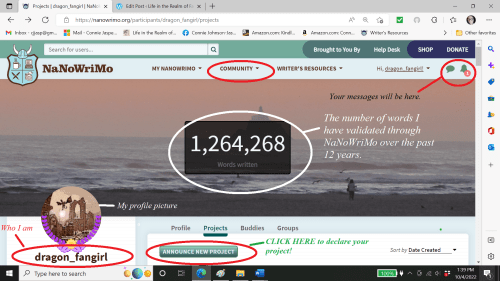
dragon_fangirl’s profile page at http://www.nanowrimo.org
- Give your project a name if you have one. I don’t have a working title yet, so I’m going with 30 Days of Madness and Pot Pies, my all-purpose NaNo title, when I have no idea what to call my project.
- Pick the genre you intend to write in.
- Write a few paragraphs about your intended project if you know what you plan to write. If you have nothing yet, don’t worry about it.
You can play around with your personal page a little to get used to it. I use my NaNoWriMo avatar and name as my Discord name and avatar. This is because I only use Discord for NaNoWriMo and two other large writers’ organizations. (Later in this series, we’ll discuss Discord and how numerous regions rely on it for word sprints and virtual write-ins.)
While creating your profile, write a short bio. With that done, you’re good to go. If you’re feeling really creative, add a header and make a placeholder book cover—have fun and go wild.
 Next, check out the community tabs. The tabs will be across the top if you are in full screen. If you have the screen minimized, the button for the dropdown menu will be in the upper right corner and will look like the blue/green and black square to the left of this paragraph.
When the button is clicked, the menu will be on the right-hand side instead of across the top.
Your regional page will look different from ours because every region has a different idea of how they present themselves. It will be there in the Community tab. Also, don’t forget to check out the national forums, which can be found on the Community tab.
You may find the information you need in one of the many forums available.
 By the time November arrives, I hope that those who want to “do NaNoWriMo” will have the tools they need and the confidence to get it done.
Many people don’t choose to participate in something that intensive but still want to write. November is dark and gloomy here in the Pacific Northwest–a good month to begin a casual writing project, but often, people don’t know how to get started.
If that is you, my goal will be to get you closer to identifying what you want to write and helping you begin that project.
Whether you participate in NaNoWriMo or not, I hope to help you take that nebulous idea and turn it into written words.
 As we progress into November, we will make that prep work into a coherent book.
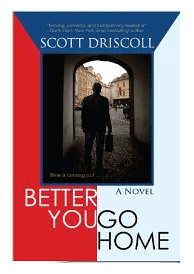 Three-Part Point of View Seminar was offered by
 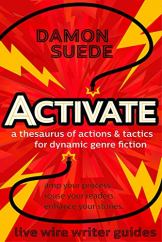 Damon Suede, on the other hand, is fireworks. If you aren’t prepared for it, the amount of information he delivers can be overwhelming. His handouts are thorough and closely follow the content of his classes, which is essential for me as I have trouble learning without visual aids.
 Unfortunately (for them) on that survey, there was a box where we could write detailed opinions about the catering. I’m a writer, so I took advantage of that opportunity.
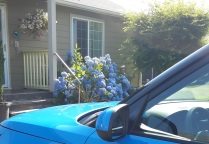 So, for the two final weeks of November and the first two weeks of December, we will be firing up the Starship Hydrangea (our hydrangea-blue Kia Soul) and driving 30 miles a day to and from the clinic. This will happen four out of five days a week, barring snow.
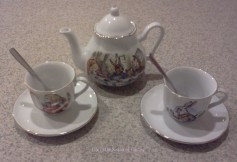 I have no problem getting the first draft done with the aid of a pot of hot, black tea and a simple outline to keep me on track. All that’s required is for me to sit down for an hour or two each morning and write a minimum of 1667 words per day.
 The real work begins after November. After writing most of a first draft, many people will realize they enjoy writing. Like me, they’ll be inspired to learn more about the craft. They discover that writing isn’t about getting a particular number of words written by a specific date, although that goal was a catalyst, the thing that got them moving.
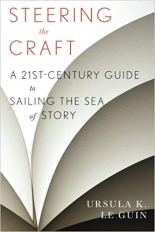 A good way to educate yourself is to attend seminars. By meeting and talking with other authors in various stages of their careers and learning from the pros, we develop the skills needed to write stories a reader will enjoy.
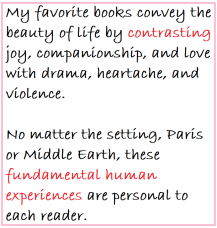 I aspire to write like my heroes, authors who create characters who come alive. While I’m in that world, I see the people and their stories as sharply as the author intends.
 Polarity gives the important elements strength. It provides texture but often goes unnoticed while it influences a reader’s perception.
 I use the
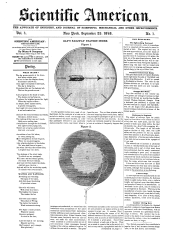
  Let’s have a look at how the Big 5 Publishers of literature did last year. You will note that the top players have changed since my last Big 5 article. Some of the big fish have been absorbed by the even bigger fish since we last looked at them.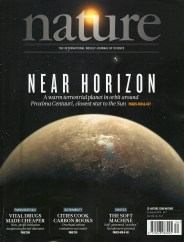
 For indies, our most reliable royalties have always come from digital sales, although we do sell some print books. But the best route to gaining loyal readers has been book fairs, conventions, and signings at bookstores.
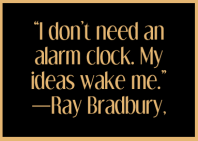
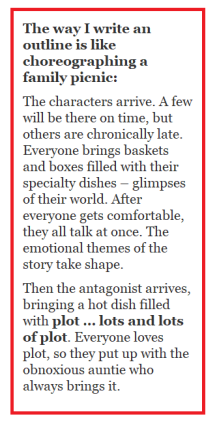 I am a planner, but I’m also a pantser. I’m just writing to a loose outline. All I need is a little free time in advance of November to let my mind wander.
 Next, I ask the creative universe who the protagonist is. I create a brief personnel file, less than 100 words. It’s a paragraph with all the essential background information. Sometimes it takes a while to know what a character’s void is (a deep emotional wound), but it will emerge. I note the verbs, adjectives, and nouns the character embodies, as those give me all the necessary information.
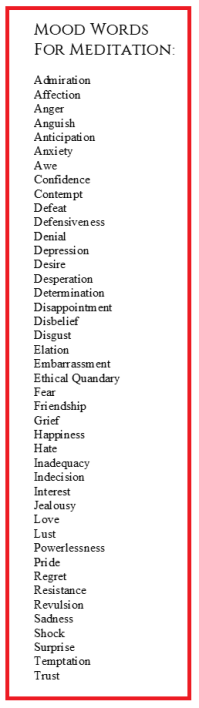 Meditating on mood words often precipitates a flash of brilliance that has nothing to do with anything. What if …
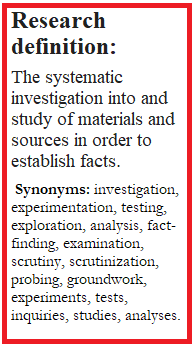 I just finished reading a sci-fi book set ten years from now, in 2032. It was a free Kindle book, but I felt overcharged.
 Never once did the super-heroic and uber-capable protagonist fear for her life no matter what ridiculously dangerous situation popped up.
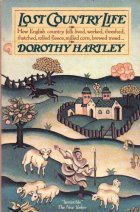 Take a look around in your local secondhand bookstore. A brilliant source of information on low-tech agricultural life and culture came in the form of a book I found at a second-hand bookstore in Olympia in the mid-to-late-1980s. It was called
 ![Fairy of Eagle Nebula By NASA [Public domain], via Wikimedia Commons](https://conniejjasperson.com/wp-content/uploads/2017/10/fairy-of-eagle-nebula-by-nasa-public-domain-via-wikimedia-commons.png?w=500)
 The second master class was on the how of creativity. Those of you who follow my blog know how the subject of creativity fascinates me. If you haven’t read any of Jeff Wheeler’s work, here is the link to my 2013 review of his first book, the
 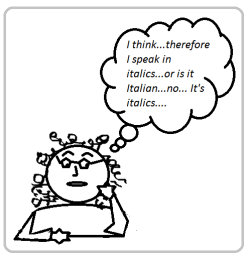 First, Lindsay pointed out that thinking is an action scene, as are conversations. He asked what a character does while thinking. He pointed out that Humphrey Bogart had a way of tugging on his ear when thinking, a habit that carried over into his movies. A side character with a certain amount of screen time but isn’t the POV character can be shown as real when they have a small personal habit that appears from time to time.
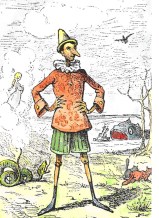 When a character’s facial expressions take over the scene, they become cartoonish, two-dimensional displays of emotion with no substance. A landslide of microscopic showing can make your characters seem melodramatic. All that physical drama doesn’t show a character’s emotions. What is going on inside their heads?
 And this brings me to the core of this post. During NaNoWriMo, when I write new words as quickly as possible, I lean too heavily on the external, relying on a lot of smiling and shrugging. Conversations are action scenes, but too much “face time” is too much.
 In some circles, 40,000 words is a novel, but in fantasy, it is less than half a book.
 A detailed history of everyone’s background isn’t required. As a reader, all we need is a brief mention of historical information in conversation and delivered only when the protagonist needs to know it.