The supermassive black hole known as Sagittarius A Star gives the spiral shape to our galaxy and keeps it together. Gravity is the force ensuring that “what goes into a black hole, stays in the black hole.”
 All around us, gravity works in hidden ways. Gravity on a small scale keeps everything securely stuck to the surface of Planet Earth.
Except in my flying dreams. But I digress.
In writing, punctuation serves the same function as gravity, keeping paragraphs and sentences from flying apart, shaping prose. The physics that constrain the chaos of words and word clusters are the laws of grammar and punctuation. They are the quantum mechanics of writing.
What is spoken must be easily distinguished from the ordinary narrative. Therefore, punctuation is for the reader’s benefit. While we can take some liberties with grammar and dialect when writing conversations, following the established rules of punctuation is essential.
We want readers to be able to forget the punctuation and just enjoy the story. They only notice bizarre punctuations, such as:
All, hands on deck”. Said the captain.
“What do we do with the drunken sailor? Blurted the First Mate!
“Put him in the scuppers at the lee rail. With the captain’s teddy bear,” replied the bosun
So, they put him in the scuppers, and all hands were finally on deck. Some were prone, but all were there until a rogue wave washed drunk dave and the soggy bear away.
I’m sure you noticed the problems when reading the above example. I have several times been asked to edit work with problems of that magnitude. I respectfully declined the job. No editor has the time to teach a writer how to write.
The one place where the fundamental laws of grammar are allowed to deviate from the norm is in conversation. But even conversations have quantum laws we must follow.
I didn’t make these rules – readers make the rules because their ability to suspend disbelief is the universe we are writing to.
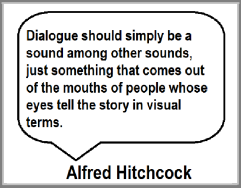 Creating memorable characters is the goal of all authors. After all, who would read a book with bland and uninteresting dialogue? Dialogue is where most information is given to the characters and the reader. However, when we are just beginning to write, many of us are confused about how to punctuate conversations. It’s not that complicated. Here are four rules to remember:
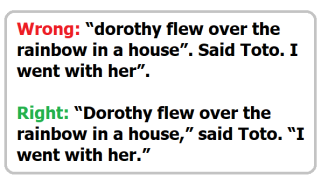
Rule 1: Surround everything that is spoken with quotation marks. “I’m here,” Loretta said.
Begin and end the dialogue with “double quotes.” These are called closed quotes. All punctuation goes inside the quotation marks. This is a universal, cast-iron rule that we must follow.
Rule 2: When quoting someone else as part of a conversation, you should set the quoted speech apart with single quotes (apostrophes, inverted commas) and keep it inside the closed quotes.
You can do this in two ways:
- George said, “When I asked her, Tammy replied, ‘I can’t go.’ But I’m sure she was lying.”
- George said, “When I asked, Tammy replied, ‘I can’t go.'”
Note that in the second sentence, 3 apostrophes are placed after the period (full stop): 1 apostrophe and 1 double (closed) quote mark. This is in keeping with the rule that all punctuation goes inside the quotation marks in dialogue.
Indirect dialogue is a recapping of a conversation.
- When asked, George said Tammy couldn’t go.
We don’t use quotes in indirect dialogue. Also, in the above sentence, the word that is implied between said and Tammy.
Rule 3: Commas—Do not place a period between the closed quotes and the dialogue tag. Use a comma because when the speech tag follows the spoken words, they are one sentence consisting of clauses separated by a comma: “I’m here,” she said.
- When leading with a speech tag, the commas are placed after the tag and are not inside the quotation marks: She said, “I’m here.”
- Dialogue that is split with the speech tag is all one sentence: “The flowers are lovely,” she said, “but they make my eyes water.” Note that the first word in the second half of the sentence is not capitalized.
Rule 4: When a speaker’s monologue must be broken into two paragraphs, lead off each with quotation marks but only put the closed quote at the end of the final paragraph. A wall of dialogue can be daunting in a story but sometimes happens in essays and when quoting speeches.
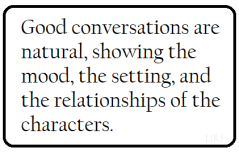
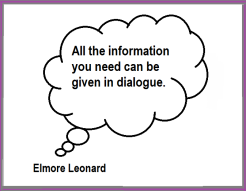 When you envision your characters in conversation, you must think about what the word natural means. People don’t only use their words to communicate. Bodies and faces tell us a great deal about a person’s mood and what they feel.
Actions (also called beats) serve to punctuate the dialogue, give the scene movement, and maintain a strong mental picture in the absence of description.
George turned away, his expression cold. “She can’t go.”
These small actions can show a character’s mood and are often best placed where there is a natural break in the dialogue. They’re an effective tool and are essential to good conversations, but don’t rely entirely on them.
Just remember, certain facial actions are physically impossible to do while speaking. In life, they happen just before or after the words are spoken.
Try smiling and speaking at the same time. Or, try snorting the words out—it isn’t a pretty picture. Snorting=air goes in through the nose. Speaking=air goes out through the mouth.
They can be done at the same time—but it’s ugly.
Write those actions this way:
“Oh, she would say that.” Jane snorted.
“I love roses.” Tammy smiled. “But they make my eyes water.”
We do need speech tags of some sort. Nothing is worse than trying to figure out which character said what. I suggest using simple dialogue tags, like said or replied. Getting too creative with speech tags can cause the reader to stop reading out of disgust.
Even worse is when the action upstages the dialogue. The dialogue can fade into the background, obscured by the visual noise of the characters’ movements and facial expressions.
 For this reason, we don’t want to inject an excess of flushing, smirking, eye-rolling, or shrugging into the story. Those actions have a specific use in conveying the mood, but anything used too frequently becomes a crutch.
We must be creative, but speech tags must be unobtrusive. Achieving this balance is the hardest part of being an author.
To summarize, grammar and punctuation serve the same purpose as gravity, giving shape to the story and forming it into a familiar, identifiable structure.
Conversations, both spoken and internal, light up and illuminate the individual parts of the story, bringing the immensity of the overall story arc down to a personal level.
Good conversations and mental dialogues bring characters to life and turn them into our closest friends. The laws of grammar sometimes break down when our characters are speaking naturally.
But on the quantum level, punctuation is hard at work, holding the written universe together.
 First up is the particle. In grammar, a particle is a word with a specific purpose that depends on the words around it. It is a function word that is always associated with another word or phrase to impart meaning.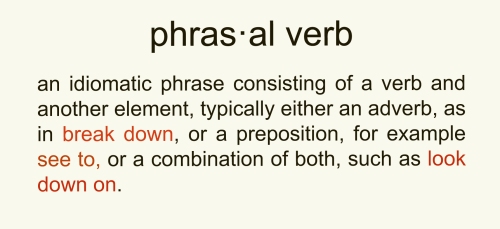
 Today’s readers have no patience with Tolkien’s style of paragraph-long compound sentences composed of clause after clause divided by conjunctions, commas, and semicolons.
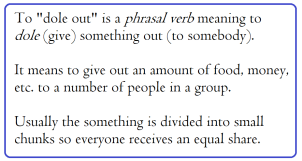
 I try to limit idioms and phrasal verbs to speech, and then only to that of one character. When used in conversation, they sound natural, but even there, I go lightly. I want to show a specific character’s personality but don’t want my prose to feel cliché and overdone.
 Artist:
  We are emotional creatures. When we are just starting on this path, getting an unbiased critique for something you think is the best thing you ever wrote can feel unfair.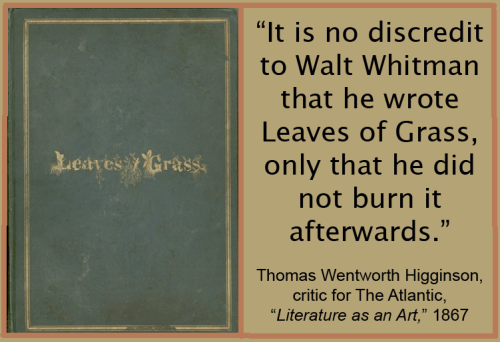
 I could have embarrassed myself and responded childishly, but that would have been foolish and self-defeating. When I really thought about it, I realized that particular plot twist had been done many times before. I thanked him for his time because I had learned something valuable from that experience.
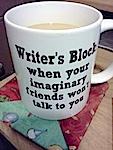 Treat all your professional contacts with courtesy, no matter how angry you are. Allow yourself some time to cool off. Don’t have a tantrum and immediately respond with an angst-riddled rant.
 Leah and Tom have no spare bedrooms until the remodel is done. So, we stayed at the Snohomish Inn, two blocks away. It’s an older place but clean.
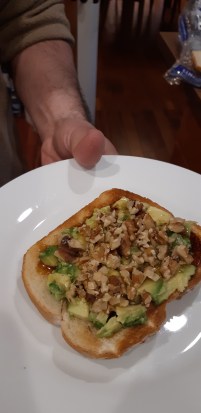 Sunday morning began with the best avocado toast I’ve ever had. Everyone who knows me has heard how much I love that particular dish. Tom’s version is incredibly simple: a good bread, toasted and topped with mashed avocado, chopped walnuts sprinkled over the top, and a teensy drizzle of honey. It sounds odd, but wow. That was a divine, filling breakfast. The picture I took doesn’t do it justice.
 And as a final twist to the craziness–we were finally getting ready for sleep in our hotel room, both of us tired but feeling good about our day. All our toiletries were in a small, dark zipper-bag.
 When you are pantsing it (writing-by-the-seat-of-your-pants), themes are like your drunk uncle. They hang out at the local pub until closing time and then weave their way home through dark alleys. Sometimes, as you are leaving for work in the morning, you find them under the neighbor’s shrubs. Other times they make it home.
 I often sit on my back porch and just let my thoughts roam, thinking about nothing in particular. Usually, I will end up considering the character’s quest or dilemma. I ask myself what the root cause of the issue is—if it is a crime, why is crime rampant? Is it a societal problem, such as poverty or war? If the core dilemma is unrequited love, what are the roadblocks to a resolution?
 These layers offer us an incredible amount of subliminal information about that surreal world and what is going on in reality, what the Matrix truly is.
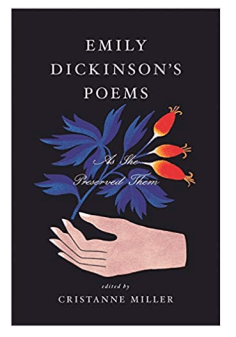
 Poets understand how central a theme is to the story. A poet takes the theme and builds the words around it. Emily Dickinson’s poems featured the themes of spirituality, love of nature, and death, which is why she appealed so strongly to me during my angsty young-adult life.
 But that would be wrong. Poets write words that range far more widely than their physical surroundings. Some poets are constrained by unrewarding jobs, others may be “on the spectrum,” as they now say, and still others are constrained by physical limitations.
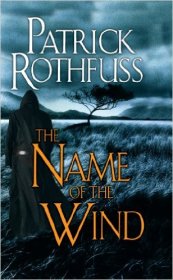 Fantasy author
  Even today, her humor shines with sharp-edged wit delivered without condescension. Her most memorable protagonists rise above the trivialities of life that absorb the sillier characters.
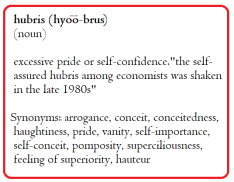 Pride is a powerful theme because it is the downfall of many characters in all literature, not just Jane Austen’s work.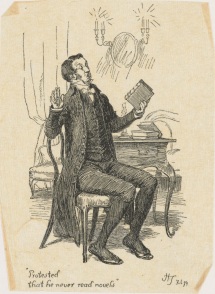
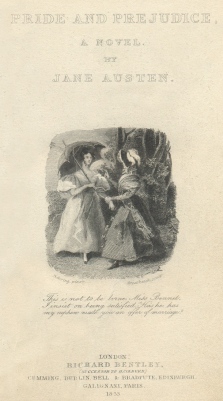 Clearly, Mrs. Dashwood feels that ensuring her sisters-in-law are not impoverished would make her only son less rich. Less appealing to other affluent families.
 Many of James’s books feature one common theme—lust.
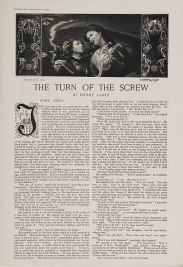 Henry James is famous for his novels and short stories laying bare the deepest motives and manipulations of the society he knew. However, he wrote one of the most famous novellas ever published,
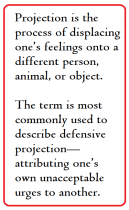 Projection
 Why is this so? Let’s look at an example.
 So how is social class different from economic class? In some parts of the world, they are the same. In others, social class is inherited, and economic class is acquired.
 For instance, I grew up in a financially stable lower-middle-class family. But I never buy pre-distressed furniture, no matter how much the designers on TV love it. This is because, by the time my youngest child left home, all my hand-me-down furniture was distressed. I like my furniture to reflect my life—un-distressed.