Category Archives: writing

#FineArtFriday: Road from Market by Thomas Gainsborough ca. 1768 (revisited)


Title: Road from Market by Thomas Gainsborough  (1727–1788)

Date: between 1767 and 1768

Medium: oil on canvas

Dimensions: Height: 1,213 mm (47.75 ″); Width: 1,702 mm (67 ″

What I love about this painting:

Thomas Gainsborough is one of Great Britain’s most famous portrait artists. His best-known painting is the “Blue Boy.”  But while portraits may have paid his bills (handsomely), Thomas Gainsborough loved painting landscapes and did so whenever he was able.

This painting shows us a road, and while it looks to our modern eyes to be nothing more than a dirt track fading into the forest, it was typical of the main roads one had to travel in both Great Britain and America. They were dirt tracks, barely passable at certain times. Traveling these roads while riding in a carriage was both dangerous and arduous.

Four people are depicted in this painting, three men and a woman. All but one of the farmers is seated sideways on the horses. This tells us that side-saddle was a common way for all people to ride at the time of the American Revolution, not just women.

Gainsborough did manage to romanticize the bucolic countryside in this pleasant, homey painting.

His horses are heroic, the peasants look well-fed, and even the cattle look prosperous. The fields just beyond the trees are lush and green.

Thomas Gainsborough is credited, along with Richard Wilson, as one of the originators of the 18th-century British landscape school. Gainsborough was a founding member of the Royal Academy of Arts.


Credits and Attributions:

Wikimedia Commons contributors, “File:Thomas Gainsborough – Road from Market – Google Art Project.jpg,” Wikimedia Commons, the free media repository, https://commons.wikimedia.org/w/index.php?title=File:Thomas_Gainsborough_-_Road_from_Market_-_Google_Art_Project.jpg&oldid=354218025 (accessed October 11, 2019).

6 Comments

Filed under writing

Creating Characters vs. Defamation of Character #amwriting

Real-life has moments that are far stranger than anything I could dream up. I’m not alone in this—everyone has a story. That story will have moments that are difficult to hear and others that are amazing.

DangerWriting fiction allows me to put reality into more palatable chunks. It’s easier to cope with that way.

One of the ways I design my worlds is by drawing on the real world to help develop the unreal. Reshaping and reusing the scenery and terrain around you are habits of good world-building.

However, crafting characters is different. We shouldn’t use the real names and exact situations of people we are acquainted with for any reason. Don’t thinly disguise your hated boss or neighbor with a different name because they could recognize themselves and sue you.

This was made clear by the late Betty MacDonald’s situation. Her first published book was picked up by J.B. Lippincott. The Egg and I is a fictionalized account of Betty’s life as a chicken farmer. It was set in Chimacum, a small community in rural Washington State.

Many members of my family were from that area of Puget Sound and still lived there during the post-WWII years, the time frame in which Betty’s book was set.

A wide disparity in education and social services existed between urban and rural communities at that time. Only a basic education was available to most families of loggers, brush pickers, and small farmers in Washington.

Thanks to the US government’s efforts, the indigenous people were in dire straits. Traditionally, Puget Sound tribes were mainly hunter/gatherers and now suffered extreme deprivation. They had lost access to their traditional hunting and fishing territories. They were losing the culture that had been their foundation for untold thousands of years.

Betty MacDonald’s book was a success in that era and moral climate, selling well over a million copies and spinning off several movie adaptations.

The Egg and I fell into disfavor in the 1970s because cultural awareness had changed the way we view indigenous people. Critics now saw a lack of understanding and cliched treatment of our local Native people in the book.

This post isn’t intended to address or pass judgment on a 1940’s treatment of cultural issues. These are things we avoid in our modern connected society, but which people took for granted in 1946 when the book was written. Instead, we need to focus on the moral and financial repercussions of writing fictional characters too close to life.

Betty’s book motivated several lawsuits against her and her publisher for defamation of character.

From Wikipedia:

Post-publication lawsuits

Following the success of the book and film, lawsuits were filed by members of the Chimacum community. They claimed that characters in The Egg and I had been based on them, and that they had been identified in their community as the real-life versions of those characters, subjecting them to ridicule and humiliation. The family of Albert and Susanna Bishop claimed they had been negatively portrayed as the Kettles. Their oldest son Edward and his wife Ilah Bishop filed the first lawsuit, which was settled out of court for an undisclosed amount.

The second lawsuit was filed against MacDonald, publisher J. B. Lippincott Company, and The Bon Marché (a Seattle department store which had promoted and distributed the book) for total damages of $975,000, as sought by nine other members of the Bishop family ($100,000 each) and Raymond H. Johnson ($75,000), who claimed he had been portrayed as the Indian “Crowbar.” The case was heard before a jury in Judge William J. Willkins’ (who was also one of the presiding judges at the Nuremberg Trials) courtroom in King County Superior Court beginning February 6, 1951. MacDonald testified that the characters in her book were composite sketches of various people she had met. The defense produced evidence that the Bishop family had actually been trying to profit from the fame the book and movie had brought them, including testimony that son Walter Bishop had had his father Albert appear onstage at his Belfair, Washington, dance hall with chickens under his arm, introducing him as “Pa Kettle.” On February 10, 1951, the jury decided in favor of the defendants. [1]

stoplightWe all draw inspiration from real life, whether consciously or not. However, if we are writing fiction, we must never detail people we are acquainted with, even if we change their names.

If you become a success, some people may see that as their ticket to a little extra money at your expense. This, despite the disclaimer we put on the copyright page:

This is a work of fiction. Names, characters, places, and incidents are products of the author’s imagination or are used fictitiously and are not to be construed as real. Any resemblance to actual events, locales, organizations, or persons, living or deceased, is entirely coincidental.

However, we can and will draw impressions from the people around us.

A common “coffee shop” game is a good way to develop characters for your stories and won’t get you sued. Now that the pandemic is winding down, many coffee shops offer indoor seating once again. Pick a place that is new to you and have your pen and notepad or laptop at the ready. Watch your fellow patrons. Observe their behavior, their speech habits, and their unconscious mannerisms. You can build an entire fantasy life for them.

Each character sketch is the kernel that can be the start of a short story or even a novel–and all of it is fiction.

My Coffee Cup © cjjasp 2013The best thing is that you don’t actually know a thing about them other than they like a Double Tall Hazelnut Latte. Peoples’ conversations are unguarded in coffee shops, openly talking about what moves them or holds them back. They are lovers or haters, quiet or loud, and most importantly, anonymous.

The moods and mannerisms, idiosyncrasies, and habitual quirks that you see can give rise to a character you can use without risking your financial security and your reputation. People-watching is a necessary habit for the author to develop.


Credits and Attributions:

[1] Wikipedia contributors, “The Egg and I,” Wikipedia, The Free Encyclopedia, https://en.wikipedia.org/w/index.php?title=The_Egg_and_I&oldid=1050662692 (accessed February 8, 2022).

13 Comments

Filed under writing

Food, culture, and what your characters eat #amwriting

I write books set in fantasy environments. An important part of worldbuilding includes the appropriate food for your level of technology.

feeding your fictional charactersSeveral years ago, I read a fantasy book where the author clearly spent many hours on the food of her fantasy world and the various animals. She gave each kind of fruit, bird, or herd beast a different, usually unpronounceable, name in the language of her fantasy culture.

The clumsy way she inserted the information into the narrative ruined what could have been a great book for me.

The book started out well, and I really liked the characters. It was a portal story, and the group had been dropped into a strange world. One of the local farmhands agreed to be their guide.

However, every time the protagonists halted their journey, they pulled some random fruit with a gobbledygook name out of the bag and waxed poetic about it. As they passed each field or forest, their guide would stop and explain the various fruits, herbs, and creatures in nearly scientific detail.

As a reader, I think Tolkien got the food right when he created the Hobbit and the world of Middle Earth. Food is an essential component of a culture but should be only briefly mentioned. Whether commonplace or exotic, it should be similar enough to known earthly foods to create an atmosphere a reader can easily visualize.

Plow_medievalAs many of you know, I have been vegan since 2012. However, during the 1980s, my second ex-husband and I raised sheep. Most of the meat we served in our home was raised on his family’s communal farm. Our chickens and rabbits roamed their yard and had good lives, and our family’s herd of twenty sheep was managed using simple, old-style farming methods.

We were self-employed in the photography industry and were able to rotate whose turn it was to spend a week caring for the animals. Fortunately, my sister-in-law’s husband was Palestinian. He ensured our sheep were raised and butchered according to halal dietary laws.

I could write a book about those five years, but no one would believe it.

I grew up fishing with my father and have a first-person understanding of what it takes to put meat, fish, or fowl on the table when a supermarket is not an option.

Take my word for this: getting a chicken from the coop to the table is time-consuming, messy, and stinks. We had as many vegetarian meals as we did those featuring meat of some kind.

Village_scene_with_well_(Josse_de_Momper,_Jan_Brueghel_II)

Village Scene with Well, Josse de Momper and Jan Brueghel II PD|100 via Wikimedia Commons.

That experience taught me many things. As far as food goes, in a medieval setting, meat, fish, and fowl won’t be served every day in the average person’s home.

Yes, it is a real job to slaughter and prepare it for the table, but other, more subtle factors come into play, things that affect the logic of your plot.

In the Middle Ages, the wool a sheep could produce in its lifetime was of far more value than the meat you might get by slaughtering it. For that reason, lamb was rarely served. The only sheep that made it to the table were usually rams culled from the herd.

Chickens were no different because you lose the many meals her eggs would have provided once a chicken is dead. Young roosters, however, were culled before they got to the contentious stage and were usually the featured meat in any stew that might be on a Sunday menu. Only one rooster was kept for breeding purposes and if he was too ill-tempered, he went into the stew pot and a young rooster with better manners took his place.

Cattle and goats were also more valuable alive. Cows were integral to a family’s wealth as they were milk producers and sometimes worked as draft animals. Only one bull would be kept intact for breeding purposes in a small herd. The others would be neutered, made into oxen and draft animals that pulled plows, pulled wagons, and did all the work that heavy farm machinery does today.

In medieval times, it was a felony for commoners in Britain to hunt for game on many estates. Poachers were considered thieves and faced hash penalties, horrific by our standards if they were caught.

However, most people were allowed to fish as long as they didn’t take salmon, so fish was on the menu more often than fowl, sheep, or cattle. Eels were a menu staple.

Pieter_Bruegel_the_Elder_-_Peasant_Wedding_-_Google_Art_Project_2

Pieter Bruegel the Elder – Peasant Wedding (1526/1530–1569) via Wikimedia Commons

Therefore, eels, eggs, dried beans and peas, grains, and vegetables were easy and figured most prominently on the menu. Pies of all sorts were the fast-food of the era, often sold by vendors on the street side or in bakeries.

Wheat was rare and expensive. For that reason, the grains most often found in a peasant’s home were barley, oats, and most importantly, rye.

Common vegetables in medieval European gardens were leeks, garlic, onions, turnips, rutabagas, cabbages, carrots, peas, beans, cauliflower, squashes, gourds, melons, parsnips, aubergines (eggplants)—the list goes on and on. And fruits?

Wikipedia says:

Fruit was popular and could be served fresh, dried, or preserved, and was a common ingredient in many cooked dishes. Since sugar and honey were both expensive, it was common to include many types of fruit in dishes that called for sweeteners of some sort. The fruits of choice in the south were lemons, citrons, bitter oranges (the sweet type was not introduced until several hundred years later), pomegranates, quinces, and grapes. Farther north, apples, pears, plums, and wild strawberries were more common. Figs and dates were eaten all over Europe but remained rather expensive imports in the north. [1]

For the most part, my characters eat a medieval/agrarian diet. In medieval times, peasants ate more vegetables, grains, fruits, and nuts than the nobility. The primary source of protein would be eggs and cheese, and fish. Herbal teas, ale, ciders, and mead were also staples of the commoner’s diet because drinking fresh, unboiled water was unhealthy. Medieval brews were more of a meal than today’s beers.

In my world of Waldeyn, the setting for Billy Ninefingers, when food is mentioned, it’s likely to be oat or bean porridge, soup or fish stew, ale or cider, or bread and cheese.

Billy is captain of a mercenary company and an innkeeper, and for most of his story, he does the cooking. I keep the food simple and don’t make too big a deal out of it. The conversations that happen while he is trying to feed the Rowdies are more important than the food. The food is the backdrop.

avacado dinner saladKnowing what to feed your people keeps you from introducing jarring components into your narrative. In Mountains of the Moon, set in the world of Neveyah, my people have a melding of familiar New World ingredients for their diet and do a lot of foraging. For a good list of what this diet might entail, go to this link: Indigenous cuisine of the Americas. You will be amazed at the variety of common foods that originated in the Americas.

When it comes to writing about meals, I feel it’s best to concentrate on the conversations. The food should be part of the scenery, a subtle part of worldbuilding. The conversations that occur around food are the places where new information can be exchanged, things we need to know to move the story forward.


CREDITS AND ATTRIBUTIONS:

[1] Wikipedia contributors, “Medieval cuisine,” Wikipedia, The Free Encyclopedia, https://en.wikipedia.org/w/index.php?title=Medieval_cuisine&oldid=896980025 (accessed Feb 06, 2022).

The Medieval Plow (Moldboard Plow) PD|100, File:Plow medieval.jpg – Wikipedia (accessed Feb 06, 2022).

Pieter Bruegel the Elder – Peasant Wedding (1526/1530–1569) PD|100 via Wikimedia Commons.

Village Scene with Well, Josse de Momper and Jan Brueghel II PD|100 via Wikimedia Commons.

4 Comments

Filed under writing

#FineArtFriday: Saint Cecilia (revisited) by Edward Burne-Jones

Saint Cecilia, by Edward Burne-Jones

Date: circa 1900

Medium: Stained and painted glass

Dimensions: Height: 213.5 cm (84 in); Width: 75.5 cm (29.7 in) frame: Height: 235 cm (92.5 in); Width: 88.7 cm (34.9 in); Depth: 4 cm (1.5 in)

Collection: Princeton University Art Museum

About this image:

Today we are revisiting an image of a masterpiece in glass: Saint Cecilia, by Edward Burne-Jones. She is the patroness of musicians, and her feast day is traditionally celebrated on November 22. The above image is my favorite rendering of her, as it is so vividly colored.

One of the most beautiful forms of art is stained glass, and the many works of Sir Edward Burne-Jones are without peer.

I may have said before that I’m not a fan of some of the art produced by the Pre-Raphaelite Brotherhood. I understand the heroic and dramatic stories they attempted to tell. Unfortunately, the more hyper-romanticized, physically impossible contortions in which they sometimes posed their heroes and heroines don’t engage my imagination in a good way.

Burne-Jones, however, ranks high on my list of favorite artists because (in my untutored opinion) his best medium was stained glass. The concept and execution of Burne-Jones’s artistic visions in glass are stunning. Vivid, intense colors, romantic subjects – his windows are glorious and seem illuminated even when not backlit by the sun.

About Saint Cecilia, From Wikimedia Commons:

One of nearly thirty versions of a window designed by Burne-Jones and executed by the company founded by William Morris (1834–1896), Saint Cecilia is a product of the Arts and Crafts movement they initiated. Friends at Oxford, Morris and Burne-Jones became disciples of John Ruskin and the Pre-Raphaelite movement and put into practice his vision for the renewal of art. They sought to counter the effects of the machine age by reviving medieval crafts, abolishing distinctions between fine and decorative arts, and beautifying objects of everyday life. Morris wrote on the philosophy of art and founded a company to execute textiles, wallpaper, and other objects, while Burne-Jones, in addition to painting and sculpting, studied with the Pre-Raphaelite painter Dante Gabriel Rossetti and designed murals, tapestries, and stained glass for Morris’s company.

The Gothic Revival style in architecture created a market for stained glass, especially in the 1870s, when Burne-Jones was a particularly prolific designer of windows. The first Saint Cecilia window, at Christ Church, Oxford (1875), shows the influence of the early Renaissance art he had seen in central Italy, most recently in 1871. The flat, abstracted, linear style and the wilting pose of the impossibly tall, graceful woman make reference to the work of Botticelli (Florentine, ca. 1445–1510), while the tapestry-like screen of pomegranate trees and fruits and the richly patterned brocade fabric recall the latest Gothic phase of Italian art, about 1400.

Saint Cecilia, an early Christian Roman virgin martyr, became the patron saint of music and was portrayed with an organ — here, a portable organ of the fifteenth century. Although water organs existed in the ancient world, pipe organs date from the fourteenth century, so we must assume Cecilia is singing the praises of God in heaven, not during her earthly life. In the window at Christ Church, she is flanked by lancet windows with music-making angels; scenes from the life of a fellow martyr saint, Valerian, and her own martyrdom are shown below. In Chicago, a Saint Cecilia window was included in the stained glass of the Second Presbyterian Church (1904); there, the fabric behind the saint is blue, and the tree bears lemons, demonstrating the permutations that could occur among these windows.

About the artist, from Wikipedia:

Sir Edward Coley Burne-Jones, 1st Baronet ARA (28 August 1833 – 17 June 1898) was an English artist and designer closely associated with the later phase of the Pre-Raphaelite movement, who worked closely with William Morris on a wide range of decorative arts as a founding partner in Morris, Marshall, Faulkner & Co. Burne-Jones was closely involved in the rejuvenation of the tradition of stained glass art in Britain.


Credits and Attributions:

Saint Cecilia, Edward Burne-Jones [Public domain], Stained and painted glasss, ca. 1900

Wikipedia contributors, “Edward Burne-Jones,” Wikipedia, The Free Encyclopedia, https://en.wikipedia.org/w/index.php?title=Edward_Burne-Jones&oldid=868174553 (accessed November 16, 2018).

Wikimedia Commons contributors, “File:Burne-Jones, Sir Edward, Saint Cecilia, ca. 1900.jpg,” Wikimedia Commons, the free media repository, https://commons.wikimedia.org/w/index.php?title=File:Burne-Jones,_Sir_Edward,_Saint_Cecilia,_ca._1900.jpg&oldid=303427881 (accessed November 16, 2018).

2 Comments

Filed under #FineArtFriday, writing

Agency and Consequences #amwriting

In my previous post, Agency and Character Development, I briefly mentioned the importance of consequences. It is a word with many uses and connotations.

WritingCraftSeriesAgencyLIRF01302022Let’s look at both the meanings and synonyms for the word consequences.

Consequence (noun)

[kon-seh-kwens]

consequences (plural noun)

[1] The result or effect of an action or condition.

“Many programmers were laid off from work as a consequence of the failing economy.”

Synonyms:

Result, upshot, outcome, sequel, effect, reaction, repercussion, reverberations, ramification, end, end result, conclusion, termination, culmination.

[2] Importance or relevance.

“That’s of no consequence.”

Synonyms:

Importance, import, significance, account, moment, momentousness, substance, note, mark, prominence, value, weightiness, weight, concern, interest, gravity, seriousness.

[3] Social distinction. (Slightly dated usage. Its synonyms are more commonly used.)

“Adelaide Brown was a woman of consequence.”

Synonyms:

Fame, distinction, eminence, preeminence, prominence, repute, reputation, prestige, acclaim, celebrity, note, notability, mark, standing, stature, account, glory, illustriousness.

For today’s post, let’s consider agency and the importance of choice. How will the results of their decisions affect our characters’ lives? After all, a story isn’t interesting without a few self-inflicted complications.

Once again, we will go to J.R.R. Tolkien and look at Bilbo’s choices and his path to becoming the eccentric eleventy-one-year-old hobbit who vanishes (literally), leaving everything, including the One Ring, to Frodo.

ConsequencesLIRF07122020In the morning, after the unexpected (and unwanted) guests leave, he has two choices, to stay in the safety of Bag End, or hare off on a journey into the unknown. He chooses to run after the dwarves, and so begins the real story—how a respectable hobbit became a burglar and became a hero in the process.

The consequences of his decision will shape his entire life afterward. Where he was once a staid country squire, having inherited a comfortable income and existence, he is now expected to steal an important treasure from a dragon. At the outset, that particular job doesn’t seem real. He is beset by problems, one of which is his general unfitness for the task. He’s always been well-fed, never had to exert himself much, and suddenly, his opinions carry no weight.

Bilbo’s hidden sense of adventure emerges early when the company encounters a group of trolls. He is supposed to be a thief, so he is sent to investigate a strange fire in a forest. Reluctantly, he agrees. Upon reaching the blaze, he observes that it is a cookfire for a group of trolls.

Bilbo has reached a fork in the path of life. He must make a choice: the smart thing would be to turn around at that point and warn the dwarves. However, his ego feels the need to do something to prove his worth. “He was very much alarmed as well as disgusted; he wished himself a hundred miles away—yet somehow he could not go straight back to Thorin and Company empty-handed.” [1] Bilbo feels the need to impress the Dwarves and makes decisions he comes to regret.

In the process of nearly getting everyone eaten and having to be rescued by Gandalf, he discovers several historically important weapons. One of them is Sting, a blade that fits Bilbo perfectly as a sword.

At first, Sting has no name, a long knife that the hobbit Bilbo Baggins discovers in the cave of trolls. Gandalf and the dwarf Thorin also find their respective swords, Glamdring and Orcrist.

Although it is only a dagger, its length corresponds to a short sword for a creature the size of the hobbit. It turns out that, like the swords of Gandalf and Thorin, this dagger was forged by the elves of Gondolin in the First Age and possesses a magical property—it shines with a blue glow when orcs are close.

the hobbitThe blade does not acquire its name until later in the adventure, after Bilbo, lost in the forest of Mirkwood, uses it to kill a giant spider and rescue the Dwarves. This is when Bilbo’s decisions become more thoughtful, and his courageous side begins to emerge.

Decisions and consequences shape Bilbo’s character and force his growth. His experiences and bad choices along the way have consequences that shape how he thinks. As the Dwarves continue to get into trouble, he makes plans for their rescue and considers what may or may not go wrong before implementing them. He doesn’t know it, but he thinks like a warrior instead of a staid country squire.

Consequences force the character arc. Sometimes the decisions our characters make as we are writing them surprise us. But if those decisions make the story too easy, they should be discarded.

We, as their creator, must take over, cut or rewrite those scenes, and force the story back on track.


Credits and Attributions:

[1] Quote from The Hobbit, or There and Back Again, by J.R.R. Tolkien, published 1937 by George Allen & Unwin, Ltd.

6 Comments

Filed under writing

Agency and Character Development #amwriting

Now that we are well into the new year, many of us are finally getting back to work on novels we began for NaNoWriMo or work we had on hold for the holidays.

WritingCraftSeriesAgencyLIRF01302022This is an excellent time to look at the freedom we give our characters to act and react within the story. I have mentioned many times that I am a plotter. However, when I am in the process of writing the first draft of a novel, the characters sometimes take over. The plot veers far from what I had intended when I began writing it.

West_End_Fair_Gilbert_PA_Demolition_DerbyThis happens because my work is character-driven, and sometimes, they’re like demolition derby drivers.

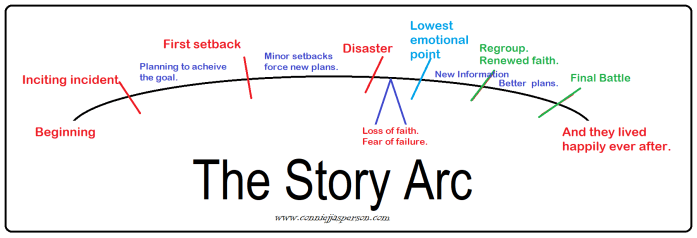
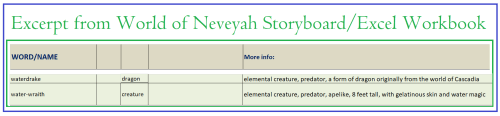
When a significant change happens, I have to adjust events to match the timeline. Adjusting my outlines is a simple process because I create them in Excel. I can delete and move events as needed to ensure my story arc doesn’t flatten.

Other people use whiteboards and sticky notes, and still others use Scrivener—a program my style of thinking doesn’t mesh with.

I tried Scrivener but grew too frustrated, so I returned to my good old Excel spreadsheet program. Google Sheets works well too, and it’s free.

Usually, the ultimate ending never changes no matter what the characters do. However, the path to that place can go quite far afield from what was initially intended.

I try to keep the plot moving so that it flows naturally. The characters must still act and speak individually, the way that I envision them. I want their uniqueness to remain central to the story, even if their motives and actions evolve from what I first planned.

PinocchioThis is called giving your characters “agency.” Agency is an integral aspect of the craft of writing. It means that you allow your characters to make decisions that don’t necessarily follow the original plot outline. This gives them a chance to become real, the way Pinocchio wanted to be a real boy and not a puppet.

Many times, the way to avoid predictability in a plot is to introduce a sense of danger early, a response to an unavoidable, looming threat. Every character has a different personality and should respond to each event differently. The freedom you allow the protagonist and antagonist to steer the events is crucial for them to emerge as real to the reader.

In literary terms, “agency” is the ability of a character to surprise the author, and therefore, the reader. If you plan their every response when you are writing them, it can feel canned and boring. The most exciting moments I’ve had as an author are when my characters surprise me and take over the story.

Sometimes my characters make their own choices. Other times, they go along as I, their creator, have planned for them. Ultimately, they do what I intend for them, but they always do it their own way and with their own style.

Plotting, for me, means setting out an arc of events for a story that I hope to write. I do this in list form in a new Excel workbook. My outline workbook will contain several spreadsheets. On page one, I create the characters and give them personality traits. On page two, I list the order of events that I think will form the arc of the story.

When my characters begin evolving, new events are added. My plot outline must continually evolve with them so that I don’t lose control of the arc and go off on a side quest to nowhere. The evolution of the outline happens once I begin writing because that is when I get to really know my characters. Only when the writing commences can they make choices and say things that surprise me.

That is when they have agency.

When I first consider writing a new novel, I get the idea out of my head by creating a plot outline. For me, introducing the threat and warning signs of inescapable danger early in the story arc limits my habit of writing too much backstory. Their history can happen off-screen, in a file marked Backstory. That way, I get to know my characters, but no one is going about “life as normal” in the narrative. Readers aren’t looking for ordinary—they have enough of that in real life.

Each character will be left with several consequential choices to make in every situation that arises along the timeline. I consider the personality and allow the characters’ reactions to fit who they are.

Author-thoughtsNo matter how they respond, they will be placed in situations where they have no choice but to go forward. After all, I am their creator, the deity of their universe. I have an outline that predestines them to specific fates, and nothing they can do will stop that train.

The consequences my characters face for their choices affect the atmosphere and mood of the story as it emerges. Think about it—if there are no consequences for bad decisions a character might make, everyone goes home unscathed. So why bother writing at all?

So, while I am an outliner and plotter, I also fly-by-the-seat-of-my-pants to a certain extent. I love it when my characters take over and drive the story.


Credits and Attributions:

Lowenburg at the English Wikipedia, CC BY-SA 3.0 <http://creativecommons.org/licenses/by-sa/3.0/&gt;, via Wikimedia Commons

Pinocchio by Enrico Mazzanti (1852-1910), Public domain, via Wikimedia Commons

12 Comments

Filed under writing

Codewords and Mental Shorthand #amwriting

Many of us are in the revision process, working on the novels we wrote during November’s NaNoWriMo. These novels are disjointed and uneven, but they contain the essence of what can be a great book—with a lot of work.

depthPart1revisionsLIRF05252021On November 1st, when we began setting the first words on the blank page, our minds formed images, scenes we attempted to describe. In his book, The Language Instinct, Steven Pinker notes that we are not born with language, so we are NOT engineered to think in words alone. We also think in images.

For each author, certain words become a kind of mental shorthand, code words used with frequency in the first draft because they are efficient. Code words are small packets of letters that contain a world of images and meaning for us. These words help us get the story down more quickly when we are in the grip of creativity. Code words are a speedy way to convey a wide range of information.

Because we use them, we can get the first draft of a story written from beginning to end before we lose the fire for it.

I have mentioned before that one codeword I sometimes find in my first draft prose is the word “got.” It’s a word that my family used and is ingrained in my subconsciousness as a tool word.

It is a tool word because it serves numerous purposes and conveys many images with only three letters. “Got” is on my global search list of codewords. The words in the list are signals to me, indications that a scene needs to be reworded to express my true intent.

Got can signify understanding or comprehension, as in “she got it.” Some other instances where I might use “got” as a code word for my second draft:

  • He got the dog into the car. (put, placed)
  • He got the mail. (acquired)
  • He got (became) In an instance like this, an entire scene must be written, one I didn’t take the time to write during the rush of NaNoWriMo.

Codewords are the author’s multi-tool—a compact tool that combines several individual functions in a single unit. One little word, one small packet of letters serves many purposes and conveys a myriad of mental images.

Every author thinks differently, so your codewords will be different from mine. One way to find your secret codewords is to have the Read Aloud tool read each section. I find most of my inadvertent crutch words that way. When you hear them read aloud, they really stand out.

ozford-american-writers-thesaurusOnce you find them, you need to go to the thesaurus to find alternatives that better express your intent.

A first draft codeword high up my personal list is “felt.” Let’s go to Merriam-Webster’s Online Thesaurus:

  • Synonyms:
    • endured
    • experienced
    • knew
    • saw
    • suffered
    • tasted
    • underwent,
    • witnessed
  • Words Related to felt:
    • regarded
    • viewed
    • accepted
    • depended
    • trusted
    • assumed
    • presumed
    • presupposed
    • surmised

We all overuse certain words without realizing it. That is where revisions come in and is where writing takes effort. You’ll discover that some words have very few synonyms that work.

When you discover one of your first draft codewords, go to the thesaurus, find all the synonyms you can, and list them in a document for easy access. If it is a word like smile or shrug, you have your work cut out, but consider making a small list of visuals.

Consider the word “smile.” It’s a common code word, a five-letter packet of visualization. We can use it to show happiness, but also it can suggest so many other moods and unspoken emotions.

Synonyms for the word smile are few and usually don’t show what I mean. When I find that word, it sometimes requires a complete revisualization of the scene. What am I really trying to convey with the word smile? I look for a different way to express my intention, which can be frustrating.

Facial expressions are only one of the many ways to display happiness, anger, spite, and other emotions. We shouldn’t rely only on a character’s face to show their moods.

Yes, their eyebrows raise or draw together, foreheads crease, and eyes sometimes twinkle. However, posture conveys a great deal. Shoulders sometimes slump, and hands often tremble. Sometimes characters refuse to look at the person they are speaking with.

Sometimes the brief image of a smile is the best expression to convey your intention.

Nothing is more off-putting than reading a story where a person’s facial expressions take center stage. As a reader, I’m more concerned with what is happening inside the characters than about the melodramatic outward display.

Think about the body language an onlooker would see if a character were angry.

  • Crossed arms.
  • A stiff posture.
  • Narrowed eyes.

A little list of those mood indicators can keep you from losing your momentum and will readily give you the words you need to show all the vivid imagery you see in your mind.

emotion-thesaurus-et-alIf you don’t have it already, a book you might want to invest in is The Emotion Thesaurus by Angela Ackerman and Becca Puglisi. Some of the visuals they list aren’t my cup of tea, but they know how to show what people are thinking.

The revision process is sometimes the most challenging aspect of writing because we are also looking at scene composition and framing (which was covered in my previous post). It takes time to revisualize each scene when we are also looking for codewords and rewriting entire paragraphs.

But codewords don’t always need changing—sometimes, a smile is a smile, and that is okay.

8 Comments

Filed under writing

Composition and Scene Framing #amwriting

Composition is defined as the way the elements inside a frame are exhibited to the viewer – the layout of a picture. In the second draft of a novel or story, you must consider what to show and how to arrange the visuals to achieve the best effect. The environment (world) against which the events and actions are shown is the frame that enhances the scene.

scene framingEach chapter is comprised of one or more scenes. These scenes have an arc to them: action and reaction. These arcs of action and reaction begin at point A and end at point B. Each launching point will land on a slightly higher point of the story arc.

Each scene occurs within the framework of the environment, which must be shaped to emphasize the emotion of the narrative. This is called scene framing.

Our written narrative is the camera through which the scene is viewed.

We want the characters’ interactions to convey the most emotional impact. Also, we want to keep the wordiness to a minimum. We supplement our descriptions by using the environment to highlight the characters’ moods and darken or lighten the atmosphere.

When you target the focus of the scenery to frame the action, you draw attention to the subtext you want to convey, beneath and around the ruminations and conversations.

Today’s example is taken from Anne McCaffrey’s 1988 novel, Dragonsdawn. The Dragonriders of Pern series is recognized as science fiction because of its knowledge of the nature of the star Rukbat and its planetary system. Many elements in the earlier books are primarily fantasy in origin as they deal with dragons and telepathy.

However, the early novels also detail the gradual rediscovery of lost technology, the revelation of their forgotten history. Dragonsdawn reinforces the science fiction nature of the series by explaining the science behind McCaffrey’s dragons and why they were genetically engineered to be what they are.

The story follows several POV characters, giving us a comprehensive view of the colony’s successes and failures. For the first ten years, the planet Pern seems a paradise to its new colonists, who are seeking to return to a less technologically centered, agrarian-based way of life. They believe Pern is the place where they can leave their recent wars and troubles behind.

A decade after arriving on the planet, however, a new threat appears. It is a deadly, unstoppable spore that periodically rains from the skies in the form of a silvery Thread that mindlessly devours every carbon-based thing it touches.

TDragonsdawn_coverhe scenes we are looking at today have two distinct environments to frame them: first the planet and then the abandoned colony ship, Yokohama. These scenes are filled with emotion, high stakes, and rising dread for the sure and inevitable tragedy that we hope will be averted. Not all the drama is in Sallah Telgar’s direct interaction with Avril Bitra. The environment heightens the drama, the sense of impending doom.

Before the advent of Thread, Avril disappeared, gathering resources and intending to leave the planet with as much treasure as she can carry. She has been pretty much forgotten by the others but has an agenda and refuses to be thwarted.

In the first scene of this chapter, we see Sallah on her way to work, leaving her children at the daycare. We zoom out and see Kenjo, the pilot, putting the last of the precious fuel into the only working shuttle, the Mariposa. This shuttle has been refitted for one last science expedition: to discover the source of the Deadly threads that rain down upon the planet periodically and to retrieve a sample. If this mission fails, there will be no other.

The camera moves out, and we see Sallah as she observes a woman she recognizes as Avril Bitra slipping through the abandoned shuttles on the landing grid. The view widens again as we see Avril following the pilot, Kenjo, who vanishes. We then see her entering the Mariposa alone.

Sallah makes a spur-of-the-moment decision to follow her, to see what Avril is up to.

Here is where the sparse visual mentions of the environment become crucial as they emphasize the stark reality of Sallah’s situation. Sallah enters the shuttle just as the airlock door closes, catching and crushing her heel. She manages to pull it out so that she isn’t trapped, but she is severely injured. Later, the dark, abandoned interior of the Yokohama reinforces Sallah’s gut-wrenching realization that her five children will grow up without a mother.

Subtext is the hidden story, the hints and allegations, the secret reasoning. It’s the images we see of the environment and how it affects the atmosphere. Subtext is the content that supports the dialogue and gives purpose to the personal events.

Scene framing is the way we stage the people and visual objects. What furnishings, sounds, and odors are the visual necessities for that scene?

Whatever you mention of the environment focuses the reader’s attention when the characters enter the frame and affects the reader’s interpretation of a scene. In this chapter of Dragonsdawn, we see the junk and scrap on the grid and the decaying shuttles. Two shuttles have been dismantled and parted out and used to keep the few cargo sleds they have converted to Thread-fighting gunships in working order. One shuttle remains in usable condition.

Sensory details are important, showing how the environment affects or is affected by the characters. Conversely, not mentioning the scenery during a conversation brings the camera in for a closeup, focusing solely on the speaker or thinker.

A balance must be struck in how your characters are framed in each scene. We flow from wide-angle, seeing Salla floating in freefall, blood pooling in her boot. The camera moves in to closer up, showing Avril’s rage at the fact that she can’t control the course of the Mariposa, which is programmed to dock at the Yokohama.

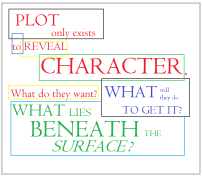
Plot-exists-to-reveal-characterWe see Avril taunting Sallah for her matronly body and move out again to see Avril tying a cord to Sallah’s crushed foot and forcing her to make the navigational calculations for Avril’s escape. We move close up and hear the interaction, Sallah pretending to do as Avril asks but really setting her enemy’s doom in action. The camera moves to the wide view again, and we hear the interaction with her frantic husband on the ground. We are caught up in her determination to seize this only chance, using her dying breaths to get the information about the thread spores to the scientists on the ground.

Atmospheric Mood: Ask yourself why you have placed those things in that scene. Why are they important, and what are you conveying to the reader with that visual composition? What subliminal elements does the environment contain that clue the reader into the deeper emotions in that scene? What subtext will carry over from this scene to the next?

Scene framing is the way you compose the scene. How you use the setting to place your characters supports and reinforces the subtext of the conversations and events and is what makes a scene feel powerful.

6 Comments

Filed under writing

#FineArtFriday: Fishermen at Sea by J. M. W. Turner 1796

Joseph_Mallord_William_Turner_-_Fishermen_at_Sea_-_Google_Art_ProjectArtist: J. M. W. Turner (1775–1851)

Title: Fishermen at Sea

Genre: marine art

Depicted place: The Needles, off the Isle of Wight

Date: 1796

Medium: oil on canvas

Dimensions: Height: 914 mm (35.98 in); Width: 1,222 mm (48.11 in)

What I love about this painting:

I love seascapes, in all their many forms. This particular painting is dark in many ways beyond the obvious. It is a night scene, and it tells us a story of the dangers that fishermen face. Fish don’t care about the weather and some fish can only be caught at night.

If you must go out in the stormy dark, sometimes the catch is death.

We see an event unfolding by moonlight, observed by three seagulls sailing on the wind. Two boats, one a small vessel and the other a larger boat, tossing upon the rough sea, both with their sails furled. This tells us they fear being driven onto the rocks known as the Needles.

A line has been cast toward the larger boat, but no one is tending it. Nearly all the art scholars say it is a fishing line, but it seems rather stout for a fishing line, and there is only one line in the water although two ships are braving the storm. Waves threaten to wash everything overboard on both boats.

I’m a storyteller; to my imagination this scene looks less like a fishing expedition and more like a rescue, as if the rope has been cast toward the other vessel to bring it close.

This is the beauty of great art. It inspires the imagination to think beyond the obvious, to look outside the accepted view and to find new ways of looking at things.

The warm glow of lantern in the stern of the smaller boat casts little light and is the only warmth in this scene. The moon has emerged from behind the clouds and illuminates the action.

Whether this is merely a rough night of fishing or a rescue at sea, this a powerful moment of fear and bravery.

About this painting via Wikipedia:

Fishermen at Sea, sometimes known as the Cholmeley Sea Piece, is an early oil painting by English artist J. M. W. Turner. It was exhibited at the Royal Academy in 1796 and has been owned by the Tate Gallery since 1972. The painting measures 36 by 48.125 inches (91.44 cm × 122.24 cm). It was the first painting by Turner to be exhibited at the Royal Academy. It was praised by contemporary critics and founded Turner’s reputation, as both an oil painter and a painter of maritime scenes. Art historian Andrew Wilton has commented that the image: “Is a summary of all that had been said about the sea by the artists of the 18th century.”

The painting depicts a moonlit view of fishermen on rough seas near the Needles, of the Isle of Wight. It juxtaposes the fragility of human life, represented by the small boat with its flickering lamp, and the sublime power of nature, represented by the dark clouded sky, the wide sea, and the threatening rocks in the background. The cold light of the Moon at night contrasts with the warmer glow of the fishermen’s lantern. [1]

About the Artist, via Wikipedia:

Joseph Mallord William Turner RA (23 April 1775 – 19 December 1851), known in his time as William Turner,[a] was an English Romantic painter, printmaker and watercolourist. He is known for his expressive colourisations, imaginative landscapes and turbulent, often violent marine paintings. He left behind more than 550 oil paintings, 2,000 watercolours, and 30,000 works on paper. He was championed by the leading English art critic John Ruskin from 1840, and is today regarded as having elevated landscape painting to an eminence rivalling history painting.

Turner was born in Maiden Lane, Covent Garden, London, to a modest lower-middle-class family. He lived in London all his life, retaining his Cockney accent and assiduously avoiding the trappings of success and fame. A child prodigy, Turner studied at the Royal Academy of Arts from 1789, enrolling when he was 14, and exhibited his first work there at 15. During this period, he also served as an architectural draftsman. He earned a steady income from commissions and sales, which due to his troubled, contrary nature, were often begrudgingly accepted. He opened his own gallery in 1804 and became professor of perspective at the academy in 1807, where he lectured until 1828. He travelled to Europe from 1802, typically returning with voluminous sketchbooks.

Intensely private, eccentric and reclusive, Turner was a controversial figure throughout his career. He did not marry, but fathered two daughters, Eveline (1801–1874) and Georgiana (1811–1843), by his housekeeper Sarah Danby. He became more pessimistic and morose as he got older, especially after the death of his father, after which his outlook deteriorated, his gallery fell into disrepair and neglect, and his art intensified. In 1841, Turner rowed a boat into the Thames so he could not be counted as present at any property in that year’s census. He lived in squalor and poor health from 1845, and died in London in 1851 aged 76. Turner is buried in Saint Paul’s Cathedral, London. [2]


Credits and Attributions:

Fishermen at Sea, J. M. W. Turner, Public domain, via Wikimedia Commons

[1] Wikipedia contributors, “Fishermen at Sea,” Wikipedia, The Free Encyclopedia, https://en.wikipedia.org/w/index.php?title=Fishermen_at_Sea&oldid=1000617338 (accessed January 21, 2022).

[2] Wikipedia contributors, “J. M. W. Turner,” Wikipedia, The Free Encyclopedia, https://en.wikipedia.org/w/index.php?title=J._M._W._Turner&oldid=1062349164 (accessed January 21, 2022).

2 Comments

Filed under #FineArtFriday, writing

The Business Side of the Business, part 2: Inventory #writerlife

The pandemic will end someday. Whether you are traditionally published or indie, if you intend to make personal appearances at local bookstores, fairs, or conventions, you will have an inventory of books on hand to manage and account for at the end of the year. This can be quite a headache if you have more than one or two books to cart around with you.

Its a BusinessBut more importantly, even if you are traditionally published, you pay for the books you sell at shows. 

The good businessperson has a spreadsheet of some sort to account for this side of the business, as it will be part of your annual business tax report. An excellent method for assembling the information you will generate for your tax report is discussed the previous post, The Business Sequence for Writers. Ellen King Rice has given us a great framework for keeping our business records straight.

There is only one more skill to have, and this is only for those who intend to sell books in person. A wise author understands that good records ensure a successful business and sets up the bookkeeping system before they go to book fairs. They have a list of the stock on hand, what books are on reorder, the day they were ordered, and how long it takes for them to ship. Also, you should keep an account of your cost for each book, both for tax purposes and insurance purposes, if the stock of books is lost or damaged in a house fire or flood.

You can do this on notebook paper with a pencil, a ruler, and a calculator. However, a green or yellow ledger book with eight to twelve columns is already set up for you to begin using.

I began working as a bookkeeper in 1982, using the industry-standard tools of the trade for the time. We noted each transaction with a red or black pencil in a green or yellow ledger book of varying sizes (2 to 32 columns). Then, we used rulers or yardsticks to ensure that we tracked a particular item on the correct line across all the columns. The handiest electronic device on my desk was the calculator with a printout tape.

The tools for this method of accounting are still available in the stationery section of any store and are quite affordable.

I use Excel for all my accounting purposes, but no matter how you create your spreadsheet, each title you have on hand to take to book fairs or shows has several costs associated with it. What follows are several screenshots of a simple way to organize a spreadsheet:

Picture1

The first column contains the heading Titles: under that heading, list each book you take to shows by the title. We will use Huw the Bard as our example book.

On the same line as the title, working to the right in column 2, write unit cost. This is the price you pay for each copy you must take to a show and varies from title to title by the length of the book and the trim size. On the same line as the book’s title, write the cost you pay KDP or Ingram Sparks or your publisher for that book: $4.69

Column 3 is the current stock-on-hand at the end of the taxing quarter: Quantity in stock: 19

Column 4 is the sum of column three times column two: Inventory value: $89.11. That is what you would have to pay to replace those books. It is also what some Departments of Revenue may tax you on at the end of the year if the value of that stock is over a certain limit, say $5,000.00. My stock on hand never exceeds that limit.

This is why retail stores have end-of-the-year sales. They need to offload their inventory to keep their taxes low.

Column 5 is the retail price. This is what the book sells for at bookstores: $12.99. You set your retail price to cover the cost of replacing the book, with some revenue to cover table and vendor fees at shows and conventions, and still allow for a small profit.

Column 6 is the special show price (if you discount your books at shows): $12.00.

Column 7 is the retail value of your stock on hand. It is the sum of column 3 times column 6: $228.00.

Did you have to collect sales tax from your customers? When you apply for your business license, you will receive a pamphlet with all the taxing jurisdictions in your licensing area and their tax rates. These range between .08 and .11 here in Thurston County. Washington State has no income tax, so all our state’s revenues come from businesses and sales taxes collected at the time of purchase. Make a note of the city or county where the books were sold, as you may be required to forward the taxes collected to the Department of Revenue. If you are smart, you will make another page with these columns:

Picture2

At the bottom of the page for both spreadsheets, total each column. That will give you the stock expenses for all your titles. There will be no scrambling at the end of the quarter for Business and Occupation taxes if you live in a state like Washington State or at the end of the year if you live elsewhere. Be smart and set the money collected as sales tax aside because it is not yours and shouldn’t be considered part of your income.

That way, you will have it at the end of the year if you only do a few shows a year like me, or quarterly if you are out there doing shows and signings every week.

The bookkeeping side of your business should take less than an hour after each show. If you have kept your spreadsheets updated, filling out annual business tax forms for your state and federal agencies will go quickly. You will have all the numbers you need to back up your reports if you are audited.

Also (and this is important), you will know the exact number of books you have on hand in each title. You will know when it’s time to reorder more stock. There is a two-to-three-week lag in printing and shipping time, so ordering books in advance is critical. You don’t want to waste money on stock you have plenty of, but you need to have a supply of your better sellers.

My personal spreadsheet is a little more detailed and is saved in the cloud as are all my business and other records. It looks like this:

Dummy_Inventory_Spreadsheet

Something we rarely consider is the random natural disaster, but we must be prepared. If something should happen to your stock of books due to theft, fire, or flood, you will be able to claim your business loss. Many authors are more prolific than I am. I have only 12 titles, including several anthologies that my work was published in. For most of us, replacing the stock of 1 to 30 titles is an expense that is difficult to carve out of the family budget unless we have sold enough to cover that cost.

Theft is rare, as people are usually quite decent at conventions and trade shows. I’ve only had one book stolen from a table at a show in all these years—a $15.00 (show cost) loss (or $6.80 my cost).

While it disturbed me on one level, I was a bit honored that someone wanted my book that badly. The experience left me confused as to how I was supposed to feel. But on the good side, it was nice to know that shoplifters are readers too!

10 Comments

Filed under writing