Category Archives: writing

5 things I’ve learned #amwriting

I’ve been writing for all of my adult life, but for most of it, not professionally. For the majority of my writing life, I was new, untutored in the craft, writing words that shouldn’t have been shown to anyone. I didn’t have the information I needed to make my work readable and didn’t know how to get it.

I felt embarrassed for even thinking that I could be an author.

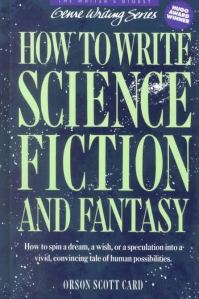
One day in 1990, I stumbled upon a book that was offered in the Science Fiction Book Club catalog: How to Write Science Fiction and Fantasy by Orson Scott Card. The day that book arrived in my mailbox changed my life. It was possible for me to become a writer, and one of my favorite authors was going to tell me how to do it.

In the years since that book, I have amassed a library of books on the craft. Some are brilliant, some not so much, but I always learn something from them. However, personal experience is a great teacher, and I’ve learned many things by trial and error.

So here in no particular order are five things I would like to pass on to you:

Make a style-sheet as you go, a glossary of words and spellings unique to your story, and be sure to list names especially. I use an Excel spreadsheet, but use anything you like, and that will help you stay consistent in your spellings.

Develop a good system for naming your files and save regularly. Save each version of your manuscript with a different name so you can go back and retrieve bits you may need later. I use a system like this:

Heavens_Altar_V5.docx

That stands for Heaven’s Altar version five, and I work out of Word, so the extension is automatically a docx.

Find a local group of writers to meet with and talk about the craft. Critique groups are great, but they are only one small part of the picture. Authors need to network with other authors because we need to discuss the craft with someone who doesn’t look at you with glazed eyes. I gained my extended author network for by joining The Pacific Northwest Writers Association and going to their conferences. This is how we educate ourselves. I also gained a local support group through attending Write Ins for NaNoWriMo.

Don’t even consider signing with any slick-talking publisher that contacts you out of the blue, saying they want your work if you haven’t submitted your work to them. How can they possibly want work they haven’t seen?

Make use of SFWA’s Writer Beware site. These predators want your work all right—and want to sell you publishing services you can do for yourself. You won’t benefit from the publisher’s “services,” but they will benefit from your desperation to be published. They will publish your work unedited, and your payment is the glory of having it published, as you will never see any royalties. They will expect you to market their product and offer you all manner of for-payment services that are dubious at best. Worst of all, you will have signed away the rights to your work for nothing.

Even though you are writing that novel, write short stories. Short stories are a training ground, a way to hone your developing skills. They’re also the best way to get your name out there. My advice is to build a backlog of work in lengths from 2000 to 5000 words ready to submit to magazines, anthologies, and contests. All those fabulous scenes and vignettes that roll though your head can be made into short pieces. Get the Submittable App and see who is asking for what sort of work, and start submitting.

These are five things that I wish I had known in 2010 but didn’t.

7 Comments

Filed under writing

The End #NaNoWriMo2018

Today is the final day of that annual writing rumble, NaNoWriMo. Many writers have passed the hurdle and already collected their winners’ goodies. They have ordered their winner’s T-shirt and are embarking on revisions.

Many other writers are scrambling to get that final thousand words written, the words that will reach the golden ring of 50,000 words before midnight tonight.

Others have decided that they are never going to finish, it’s a waste of time, and they’ll never do this again.

But they will.

They will come back in a year or two with a plan and they will beat those inner demons that block our creative mind and keep us from succeeding.

This year, I have so far written over 90,000 words. I’ve expanded my novel some, written many short stories and vignettes. I’ve written poems that made me happy,  and also chugged out a great many words that will never see the light of day.

But buried deep within the rubbish are some good words, words that are useful and make me happy.

I’ve been participating in NaNoWriMo since 2010. This annual burst of word-spewing has forced me to become disciplined. It makes me do what is for me the most difficult thing—I have to ignore my inner editor to get my wordcount. By November 30th, the little voice that slows my productivity down and squashes my creativity is numb and has accepted that no one is listening.

For that reason alone, I will most likely always “do” NaNoWriMo, even when I am no longer able to be a Municipal Liaison.

I love the rush, the thrill of having written something for myself, something that I alone will see and enjoy. But more than that, I love knowing that some of what I have written is good and is worthy of submission.

Perhaps one or more of these short stories will be accepted by a contest or magazine. Perhaps one of these little jewels will see the light of day and make a reader happy too.

9 Comments

Filed under writing

Sculpting the second draft #amwriting

The end of NaNoWriMo approaches. Many novels have been written, and many are still incomplete. And when we do finally write the last words, we will get that happy-dance feeling, that moment where the world is singing.

Following that burst of joy, we have the urge to immediately share it. I know it’s tempting, but don’t do it.

We need to gain some distance from our work to see it more clearly, so put it aside. If you work on something else for a couple of weeks, or even a month or two, you will gain a better perspective on what you just finished, and your revisions will bring out the best in your work.

Writers tell me all the time how new and intriguing characters pop up and take their tale in a different direction. Sometime this works out well. Other times, not so much. I floundered for years on my first novel, only to have it never be published.

So, when we do get back to our manuscript, where do we start so we can avoid the failed novel syndrome? I didn’t know the first thing about how to write a novel, which is clear when you look at that old ms.  I didn’t know that we are like sculptors. The first draft is not the finished product–it really is our block of clay.

I know—you see a complete novel, but trust me, others won’t see what you do in it, just yet. When a sculptor sees a block of clay, she also sees what it can become. She begins scraping the layers away, and that is what we must do.

We scrape the layers away scene by scene. As you revise, keep in mind:

  1. Each chapter is made up of scenes. It might be one scene or several strung together.
  2. These scenes have an arc to them: action and reaction.
  3. These arcs of action and reaction begin at point A and end at point B.
  4. Each launching point will land on a slightly higher point of the story arc.
  5. Strung together, these scenes form the entire story arc, with a beginning, middle and end.

If somewhere near the middle you discover that you have lost the overall plot of your novel, remind yourself what the original idea was. This happens to me for several reasons.

First, it can happen because I deviate from the outline, and while my new idea is better, it lacks something. I can

  • Go back to the original idea and rewrite it so that it conforms to that outline.
  • Try to figure out why the plot has failed.

More often, I have to ask myself, did the original quest turn out to be a MacGuffin?

Every story has a quest of some sort. It can be a personal quest for enlightenment or a quest for the Holy Grail. No matter what, the characters want something, and that thing must be sharply defined.

Alfred Hitchcock popularized the name “MacGuffin” in the 1930s. The MacGuffin’s importance to the plot is not the object or goal itself, but rather the effect it has on the characters and their motivations. Many times, it is inserted into the narrative with little or no explanation, as the sole purpose of the MacGuffin is to move the plot forward.

The Maltese Falcon is a classic example of a MacGuffin. The object of the quest might not be the purported “Maltese Falcon” after all, despite the obvious quest to acquire it and the lengths the characters must go to in the process. The true core of the story is the internal journey of both Sam Spade and Brigid O’Shaunessy, two people brought together by the quest, and whose lives are changed by it.

If the quest has become a MacGuffin, the effect that searching for it has on the characters must be clearly shown. The true quest is not for the object. It is for power, love, money, or personal growth and must be given more prominence.

As we are peeling back the layers of our rough draft, what symbolism have we subconsciously inserted into the story that we can work with? Once we identify the symbolic aspect of the plot, we must amplify it. Symbolism is a powerful tool and is part of the subtext that pushes the story forward. In my opinion, one of the most masterful uses of symbolism happens in the film, The Matrix.

In one of my favorite scenes, when Neo answers the door and is invited to the party, he at first declines. But then he notices that Du Jour, the woman with Choi, bears a tattoo of a white rabbit. He remembers seeing the words: follow the white rabbit, on his computer.

Curious and slightly fearful of what it all means, he changes his mind and goes to the party, setting a sequence of events in motion. The white rabbit tattoo is a symbol, an allegorical reference to Alice in Wonderland, a subliminal clue that things are not what they seem.

What is the deeper story? With each pass through our manuscript, we are sharpening the final product, scraping away from this part and adding over here, rewording and redefining as we go.

Ultimately, we will have exposed the core of our original vision, revealed the parts we couldn’t articulate at first. Some things only become clearer to us as we dig deeper.

This is why, while many people can write, not just anyone can write well. It takes patience and time to cut away the fat and bring out the true story that needs to be told. It also takes practice. Digging the deeper story out doesn’t happen overnight.

A first draft is our block of clay, and after much effort, the final draft is our finished sculpture.


Credits and Attributions:

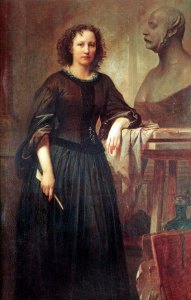
Portrait of German-American sculptor Elisabeth Ney with a bust of King George V of Hanover, 1860, by Friedrich Kaulbach. PD|100. Wikimedia Commons contributors, “File:Elisabeth Ney by Friedrich Kaulbach.jpg,” Wikimedia Commons, the free media repository, https://commons.wikimedia.org/w/index.php?title=File:Elisabeth_Ney_by_Friedrich_Kaulbach.jpg&oldid=286953027 (accessed November 27, 2018).

5 Comments

Filed under writing

Subtext and first person point-of-view #amwriting

Third-person omniscient has been my usual mode to write in, but I’m not limited to it. When we write in third-person omniscient mode, the story is told from an outside, overarching point of view. The narrator sees and knows everything that happens within the world of the story, including what each of the characters is thinking and feeling.

This works because the narrator hold much of the information back from the reader, doling it out as the protagonists need it.

But what if we want to create a sense of intimacy, of being in the character’s head? And what if we don’t want the reader to know everything that is going on until the last minute?

This is where the literary devices of point-of-view and subtext come into play. It’s fairly easy to keep the reader guessing what is going on in either narrative mode if you make good use of subtext.

The first-person point of view is fairly common and is told from one protagonist’s personal point of view. It employs “I-me-my-mine” in the protagonist’s speech, allowing the reader or audience to see the primary character’s opinions, thoughts, and feelings.

A limited first person point of view is stream of consciousness. This is a narrative mode told from a first-person perspective, replicating the thought processes as well as the actions and spoken words of the protagonist. In real life we can’t be all-seeing and all-knowing—witnesses are notoriously unreliable. First-person point-of-view employs the unreliable narrator which I like when the author understands how to make the subtext work.

Disbelief paralyzes me, but then my emotions coalesce into one thought—Ricky…of course.

Through the use of interior monologues, we show the inner desires and motivations of the protagonists. We also offer the reader the incomplete thoughts they express to themselves but conceal from the other characters. So, we see the POV character’s rambling thoughts, as well as witness their conversations and actions.

How do we fit subtext into our narrative if we’re using a limited first person point of view? “Subtext” is the hidden story, the hints and allegations, and secret motives of the entire cast. Subtext is the content that supports the dialogue and gives private purpose to the events each character experiences.

We don’t want to just lay it all out for the reader in the first paragraphs. Just as in all other narrative modes, in limited first person point of view we have several ways available to reveal the subtext, the hidden motives and desires of our characters.

The Double Entendre: a word or phrase open to two interpretations, one of which is usually risqué or indecent. “My, those are some plump loaves you have rising there, ma’am.” This can be too in-your-face for many readers if the author is heavy-handed. Many classic Noir detective novels of the 1930s through the 1960s employed the double entendre to convey ideas and intentions that the censors wouldn’t have allowed to be published.

Sarcasm: the use of irony to mock or convey contempt. “I didn’t attend the funeral, but I sent a nice letter saying I approved of it.—Mark Twain. I sometimes use sarcasm as a way to show subtle aggression and tension. Also sarcasm, especially that which is self-directed, can highlight the dark humor of a bad situation.

Lying: The main character may be guilty of habitually telling falsehoods. “Sorry, I’m late. Traffic was a bitch.” If the first page shows the character oversleeping, this lie is a clue that the character is not always truthful. In a first person narrative, the reader should consider that what he tells us may be a lie too.

We can also employ the use of allegory, words, and images that can be interpreted to reveal a hidden meaning, typically a moral or political one. Animal Farm, written by George Orwell, is an allegory that uses animals on a farm to describe the overthrow of the last Russian Tsar, Nicholas II, and the Communist Revolution of Russia before WW I.

Symbolism: using an object or a word to represent an abstract idea. An action, person, place, word, or object can all have a symbolic meaning. Literary Devices.net gives us these examples:

  • The dove is a symbol of peace.

  • A red rose, or the color red, stands for love or romance.

  • Black is a symbol that represents evil or death.

  • A ladder may stand as a symbol for a connection between heaven and earth.

  • A broken mirror may symbolize separation.

Writing is as much about rewriting as it is writing new words. Sometimes I have a story that I think might have potential, but I can’t decide if the plot should continue down the bunny trail it’s on or not. I will share it with my writing buddies to see what they think about the premise.

Usually, I get good feedback that helps me steer the narrative in the right direction when I am embarking on the second draft. I consider all feedback good, even when the first readers of a scene or short story don’t “get” what I am trying to convey. The readers don’t see what I mean, so their comments aren’t directly helpful as they have missed the point of the story entirely.

What that kind of feedback tells me is this: the scene or a story must be completely rewritten because the subtext failed to do its job. My protagonist’s intentions must be made clearer to the reader.

That struggle to express my ideas clearly is just part of the process.


Credits and Attributions:

LiteraryDevices Editors. “Symbolism” LiteraryDevices.net. 2013. http://literarydevices.net/symbolism/  (accessed November 24, 2018).

Quill Pen, PD|by author, BWCNY at English Wikipedia.

Comments Off on Subtext and first person point-of-view #amwriting

Filed under writing

#FineArtFriday: Hunter in Winter Wood, George Henry Durrie

Hunter in Winter Wood, by George Henry Durrie 1860 is one of my favorite images of 19th century Americana. The snow on the bare trees and rocky outcroppings gives the impression of weight, yet it is only a light dusting. The way the light shines golden on the snow—this is how a snowy winter looked in the woods surrounding the rural lake where I grew up. The grandeur of the view shows the 19th century vision of a wide, boundless country. Anything is possible in a country where the land and resources are as limitless as shown in this painting.

Hunter in Winter Wood was painted near the end of Durrie’s life. His most famous works were made into prints by Currier and Ives after his death at the age of 43.

About the Artist, quoted from the National Gallery of Art:

Born in New Haven in 1820, the son of a Connecticut stationer, George Henry Durrie remained in that city virtually his entire life. Married to a choirmaster’s daughter, Sarah Perkins, in 1841, he immersed himself in the quiet pursuits of family and church. While he never achieved the fame of the most renowned nineteenth century American landscape painters, he appears to have had a fulfilling, productive career. His letters show that he never felt the need to move beyond his community, although he once briefly took a studio in New York and exhibited there regularly at the National Academy of Design.

Almost all of his compositions are relatively small in scale, few exceeding 18 x 24 inches, and his views are quiet and intimate. He knew and admired the works of Thomas Cole, and may have tried to emulate certain aspects of Cole’s style, yet he eschewed the Hudson River School’s compositional complexity and expansiveness. Because his paintings combined extensive genre elements with landscape they had a story-telling content that made them pleasant, accessible images to the average viewer.

The lithographic firm of Currier & Ives successfully reproduced ten of Durrie’s scenes and these, in turn, became popular calendar illustrations in the twentieth century. As a result, Durrie’s depictions of rural life in the mid-nineteenth century are now among the most familiar images in all of American art. As Martha Hutson has noted, however, these printed pictures do not convey the keen sensitivity to and understanding of conditions of atmosphere and light that are so pronounced in Durrie’s paintings.

From Wikipedia:

In his teens the self-taught artist painted portraits in the New Haven area. In 1839 he received artistic instruction from Nathaniel Jocelyn, a local engraver and portrait painter. After 1842 he settled in New Haven, but made painting trips to New Jersey, New York, and Virginia. Around 1850, he began painting genre scenes of rural life, as well as the winter landscapes that became popular when Currier and Ives published them as lithographs. Four prints were published between 1860 and the artist’s death in New Haven in 1863; six additional prints were issued posthumously. The painter Jeanette Shepperd Harrison Loop studied with him.


Credits and Attributions:

Hunter in Winter Wood, by George Henry Durrie 1860 [Public Domain] via Wikimedia Commons

Wikipedia contributors, “George Henry Durrie,” Wikipedia, The Free Encyclopedia, https://en.wikipedia.org/w/index.php?title=George_Henry_Durrie&oldid=861433469 (accessed November 23, 2018).

National Gallery of Art contributors, “George Henry Durrie,” biography, © 2018 National Gallery of Art, https://www.nga.gov/collection/artist-info.6397.html

Comments Off on #FineArtFriday: Hunter in Winter Wood, George Henry Durrie

Filed under #FineArtFriday, writing

Existence and Past Subjunctives revisited #amwriting

Because we are deep in depths of NaNoWriMo and it is Thanksgiving week, I am neck deep in cooking and writing. So, today I’m serving a post from last year—a little treatise on existence and verb forms. Enjoy!


Grammarians are philosophers. You can find us in darkened chat rooms. We argue about existence, to be or not to be, and postulate theories that are subjective, doubtful, and often hypothetical.

Or, at least, the words and rules to describe existence can be murky.

We call them Subjunctive Verbs.

When you go out to Wikipedia, the whole subjunctive verb thing looks quite complicated, but it doesn’t have to be. The subjunctive (in the English language) is used to form sentences that do not describe known objective facts. So today, we are once again looking at Past Subjunctives: the verbs was and were.

But first, what does “subjunctive” mean?

Dictionary.com defines “Subjunctive.” as:

adjective

1.(in English and certain other languages) noting or pertaining to a mood or mode of the verb that may be used for subjective, doubtful, hypothetical, or grammatically subordinate statements or questions, as the mood of ‘be’ in ‘if this be treason.’

2.the subjunctive mood or mode.

3.a verb in the subjunctive mood or form.

First, let’s consider existence and what Past Subjunctive Tense covers: how to use the words ‘was’ and ‘were,’ which are forms of the verb ‘be.’

Which is correct?

  • I wish I were a penguin. I would fly through the water.
  • I wish I was a penguin. I would fly through the water.

If I only wish I were a penguin, were is correct. If I could actually be a penguin, was would be correct and I would have to rewrite my sentence, by changing ‘would’ to ‘could.’

The Grammar Girl goes farther. She says: Believe it or not, verbs have moods just like you do. Yes, before the Internet and before emoticons, somebody already thought it was important to communicate moods. So, like many other languages, English has verbs with moods ranging from commanding to questioning and beyond. The mood of the verb “to be” when you use the phrase “I were” is called the subjunctive mood, and you use it for times when you’re talking about something that isn’t true or you’re being wishful.

I love that clue—that verbs can be wishful.

The Grammar Girl gives us a great example: Think of the song “If I Were a Rich Man,” from Fiddler on the Roof. When Tevye sings “If I were a rich man,” he is fantasizing about all the things he would do if he were rich. He’s not rich, he’s just imagining, so “If I were” is the correct statement. This time you’ve got a different clue at the beginning of the line: the word “if.”

English tends to favor fewer subjunctives than some other languages. So why are some grammarians ranting about irrealis mood and were?

(And what the hell does that mean?)

The irrealis mood is an older, nineteenth century label for a verb mood. Simply stated, it means that language can express fact (what is real) and can indicate fallacy (what is unreal). It was identified by the linguist, Roman Jakobson.

English has a formula for expressing the unreal: the irrealis mood, but that label is no longer as well-known as its modern label: the past subjunctive verb form. This verb form expresses a hypothetical condition in present, past, or future time:

Steven Pinker, in his extremely convoluted book on language and usage, The Sense of Style, discusses the word, irrealis. He offers several complicated explanations but eventually gets to the point, and I will boil it down here:

There are times when we use a form of the verb ‘was’ even though the subject of the sentence has not yet happened or may not happen at all:  the past subjunctive verb form. It is unreal and may remain that way. “If I were.”

Let’s go back to the song from Fiddler on the Roof, If I were a rich man. As I am a woman and intent on remaining so, I will never be a rich man. As I am an author and intent on remaining so, I will never be rich. So, for me, that song title contains two impossibilities. “If I were” is the correct subjunctive mood.

When you are supposing about something that might be true, you use a form of the verb “was” and don’t sweat it.

If it’s likely real: Was (possibly is) I heard he was training his dog to fetch.

If it’s likely unreal: Were (possibly isn’t) If I were a penguin, I wouldn’t need to rent a tuxedo.

We are still talking existence here. Remember from above? The past subjunctive verb forms express a hypothetical condition which may exist in present, past, or future time:

  • Don’t complain about the food. What if I was a chef?
  • I wish I were
  • If this be treason…
  • To be or not to be

What if you are writing a technical manual, a dissertation, or an email to a client or coworker? Despite the ill-conceived efforts of many critique groups and Microsoft Word to erase all forms of ‘to be’ from the English language and replace it with ‘is,’ you have a right to use the subjunctive verb form if you choose to do so. Write with your own sense of style.

When your intent is formal, subjunctives may abound, often in the form of commonly used phrases:

  • Be that as it may,
  • So be it,
  • Suffice it to say,
  • Come what may,

Steven Pinker has a point that is important to this blogpost: Subjunctives are hard to spot. Forms of “to be” can be found in subordinate clauses where something is mandated or required:

  • I demand the prisoner be fed the same as anyone else.

A verb like “see” also has a subjunctive form when something is mandated or required:

  • It’s essential that I see your report before you send it.

In ordinary writing, we rarely need to use subjunctives in clauses with mandates except perhaps to show a formal conversation.

Subjunctives are small verbs of existence but used correctly they have a large influence on your writing voice.

And, thanks to Steven Pinker, we now know that if someone drops the word “irrealis” on you at a critique group, it’s a hint that they are fond of obscure, nineteenth century words. Surprise them by telling them the past subjunctive verb form is your friend, and you enjoy using it appropriately.


Credits and Attributions:

Existence and Past Subjunctives by Connie J. Jasperson, © 2017 first appeard here on Life in the Realm of Fantasy on November20, 2017.

Subjunctive Verbs, by Mignon Fogarty, http://www.quickanddirtytips.com/education/grammar/subjunctive-verbs, Copyright © 2017 Macmillan Holdings, LLC. Quick & Dirty Tips™

Wikipedia contributors, “English subjunctive,” Wikipedia, The Free Encyclopedia,  https://en.wikipedia.org/w/index.php?title=English_subjunctive&oldid=807313887 (accessed November 19, 2017).

11 Comments

Filed under writing

#FineArtFriday: Saint Cecilia, by Edward Burne-Jones

Saint Cecilia is the patroness of musicians, and her feast day is traditionally celebrated on November 22. The above image is my favorite rendering of her, as it is so vividly colored.

One of the most beautiful forms of art is stained glass, and the many works of Sir Edward Burne-Jones has inspired and influenced my own art.

While I have no patience with some of the more hyper-romanticized, physically impossible art produced by the Pre-Raphaelite Brotherhood, the  concept and execution of Burne-Jones’s artistic visions in glass is without peer. Vivid, intense colors, romantic subjects – each of his windows tells a story. They are glorious, and seem illuminated even when not back-lit by the sun.

About Saint Cecilia, From Wikimedia Commons:

One of nearly thirty versions of a window designed by Burne-Jones and executed by the company founded by William Morris (1834–1896), Saint Cecilia is a product of the Arts and Crafts movement they initiated. Friends at Oxford, Morris and Burne-Jones became disciples of John Ruskin and the Pre-Raphaelite movement and put into practice his vision for the renewal of art. They sought to counter the effects of the machine age by reviving medieval crafts, abolishing distinctions between fine and decorative arts, and beautifying objects of everyday life. Morris wrote on the philosophy of art and founded a company to execute textiles, wallpaper, and other objects, while Burne-Jones, in addition to painting and sculpting, studied with the Pre-Raphaelite painter Dante Gabriel Rossetti and designed murals, tapestries, and stained glass for Morris’s company.

The Gothic Revival style in architecture created a market for stained glass, especially in the 1870s, when Burne-Jones was a particularly prolific designer of windows. The first Saint Cecilia window, at Christ Church, Oxford (1875), shows the influence of the early Renaissance art he had seen in central Italy, most recently in 1871. The flat, abstracted, linear style and the wilting pose of the impossibly tall, graceful woman make reference to the work of Botticelli (Florentine, ca. 1445–1510), while the tapestry-like screen of pomegranate trees and fruits and the richly patterned brocade fabric recall the latest Gothic phase of Italian art, about 1400.

Saint Cecilia, an early Christian Roman virgin martyr, became the patron saint of music and was portrayed with an organ — here, a portable organ of the fifteenth century. Although water organs existed in the ancient world, pipe organs date from the fourteenth century, so we must assume Cecilia is singing the praises of God in heaven, not during her earthly life. In the window at Christ Church, she is flanked by lancet windows with music-making angels; scenes from the life of a fellow martyr saint, Valerian, and her own martyrdom are shown below. In Chicago, a Saint Cecilia window was included in the stained glass of the Second Presbyterian Church (1904); there, the fabric behind the saint is blue, and the tree bears lemons, demonstrating the permutations that could occur among these windows.

About the artist, from Wikipedia:

Sir Edward Coley Burne-Jones, 1st Baronet ARA (28 August 1833 – 17 June 1898) was an English artist and designer closely associated with the later phase of the Pre-Raphaelite movement, who worked closely with William Morris on a wide range of decorative arts as a founding partner in Morris, Marshall, Faulkner & Co. Burne-Jones was closely involved in the rejuvenation of the tradition of stained glass art in Britain.


Credits and Attributions:

Saint Cecilia, Edward Burne-Jones [Public domain], Stained and painted glasss, ca. 1900

Wikipedia contributors, “Edward Burne-Jones,” Wikipedia, The Free Encyclopedia, https://en.wikipedia.org/w/index.php?title=Edward_Burne-Jones&oldid=868174553 (accessed November 16, 2018).

Wikimedia Commons contributors, “File:Burne-Jones, Sir Edward, Saint Cecilia, ca. 1900.jpg,” Wikimedia Commons, the free media repository, https://commons.wikimedia.org/w/index.php?title=File:Burne-Jones,_Sir_Edward,_Saint_Cecilia,_ca._1900.jpg&oldid=303427881 (accessed November 16, 2018).

3 Comments

Filed under writing

Slang, Colloquialisms, and Clichés #amwriting

Words are awesome. I love obscure, weird words. J.K. Rowling used the word ‘snogging’ in her Harry Potter series, to describe couples who were engaged in prolonged kissing, or as we sometimes say where I come from,  ‘canoodling.’

Another good word is ‘kerfuffle,’  a Briticism for a  noisy disturbance or commotion. That word has become more common in American conversation over the last few years.

Words are how authors convey the imaginary world to the reader. Artistry comes into play in the way the author assembles their chosen words into sentences and paragraphs. In reading those words, the reader finds themselves in a new reality, a mental picture painted by the author.

English is a mash-up language. It is old Latin glued to an evolving language with completely different roots, Frisian, with a bunch of words and usages invented by William Shakespeare added in.

Thanks to the human drive to explore new worlds, English, the mish-mash language, went to America where it absorbed many words from the various languages it encountered among the people already living there.

English also went to Australia where the same thing happened. Each of the many dialects of English contains wonderful, wild words that are unique to their local population.

Colloquialisms are fun, informal things, but truthfully, they are much like clichés. Unless we are writing a contemporary piece where words unique to a particular culture are part of the world building, we shouldn’t rely on them to tell the story.

Sometimes, we find ourselves using words that are what I think of as subtle clichés. They are subtle because they feel so natural sitting in that sentence. Consider “damn fool.”

It was a common thing adults would say about a particularly reckless or impulsive neighbor when I was growing up. But would I write it into a narrative? Maybe, if using that cliché showed the personality of a minor character whose only onscreen time was shown in that brief conversation.

The problem comes with word evolution, and how common phrases evolve differently from place to place, and sometimes even in the same town.

That was a damn fool thing. This was how I would hear that phrase as a child.

So, if that is a concept that we are trying to convey, how do we say it? If you listen carefully, people say it just a bit differently depending on where they are from. Some say it with two words, some make it one, and others give damn an “ed” ending as if the suffix adds a sense of finality.

Do we spell it damn fool, damnfool, or damned fool?

According to the Urban Dictionary

damned fool

  • A person who is extremely foolish. Their actions are not only irresponsible to themselves but can possibly be harmful towards others.
  • If a guy tries to talk you out of using a condom, he is a damn fool. (You can’t make this stuff up–you have to go to the internet for it.)
  • Did you see that damned fool? He was swerving all over the road.(end quoted text)

And just for fun, let’s see what Wiktionary has to say:

  • damn fool (adjective)
  • damnfool 
  1. (informal) Contemptibly (end quoted text)

He was a damned fool.

How I see it:

  1. He was a damned fool. (I just cursed him to hell.)
  2. He was a damn fool. (He was contemptibly foolish)
  3. He did a damnfool thing. (He was contemptibly foolish, and I will curse him to hell.)

If you absolutely must use that colloquialism, write it the way that seems right to you, and it will be fine.

But when you look at the meanings of the various clichés we use in our daily speech, you can see there are better ways to say what you mean without making your work feel dated.

He was contemptibly foolish would be a good choice, as it isn’t a cliché and it says what you mean.

If we want our work to be meaningful to more than just the reader of today, we must use words that won’t lose their relevance, or fall out of fashion as within a decade. Did I hear you say, “Groovy?” Far out.

We want to write well, and we don’t want our prose to be stale or boring, but we also don’t want it to be annoyingly full of jargon.

Consider The Great Gatsby, by F. Scott Fitzgerald. The slang his characters use in their casual conversation is specific to the nineteen twenties of America, and while it was well understood in that time, using those words in that context has fallen out of favor. This makes understanding that novel difficult for the modern reader, yet the prose of the narrative outside the conversations is truly beautiful.  Some words used in conversation that have lost their relevance today:

  • Mop (indicates a handkerchief)
  • Niffy (great, wonderful)
  • Noodle Juice (tea – a weak drink for weak people)
  • Quilt (indicated a drink meant to warm someone up)

Having the characters use slang stamps a novel with a date, setting it squarely in a known period.

For that reason, I feel it’s best to avoid slang and clichés even though finding the right words to convey those thoughts can be a struggle. When I am reading a new book, originality wins over hackneyed prose any day.

16 Comments

Filed under writing

The Functions of the Scene revisited #amwriting

We are at mid-month for NaNoWriMo, and I am not writing my novel. Instead, I am trying to write short stories, but my mind won’t cooperate. I keep waking up with new scenes filling my head, scenes that demand to be written for all my works in progress.

Scenes are what I want to talk about today, but I just discovered that I wrote a perfectly good post on them last year and can’t think of anything to add to it. So, we may as well revisit last year’s post on The Functions of the Scene. I hope you find it useful as your writing journey continues.

Keep writing, update your word count every day if you are participating in NaNoWriMo, and happy writing to you, whether you participate in that merry month of madness or not!


A great story consists of a beginning, a middle and an end, and is made of scenes. We have action, emotion, ups and downs, a plot all sewn together by the thread that is the theme. But the entire structure of the novel is built scene-by-scene, connected by transitions.

Scenes may consist of conversations, or they may be action sequences, but put them together in the right order, link them with a plot featuring a good protagonist and a worthy antagonist, they combine to form a story.

I perceive the scene as a small area of focus within a larger story with an arc of its own, small arcs holding up a larger arc: the chapter. So, scenes are the building blocks of the story. Strong scenes make for a memorable novel, and we all strive to make each scene as important as we can. Therefore, no scene can be wasted. Each scene must have a function, or the story fails to hold the reader’s interest.

Some things a scene can show:

  • Information
  • Confrontation
  • Revelation
  • Negotiation
  • Decision
  • Capitulation
  • Catalyst
  • Contemplation/Reflection
  • Turning Point
  • Resolution
  • Myriad deep emotions

Make one or more of these functions the core of the scene, and you will have a compelling story.

Let’s examine a watershed scene that occurs in the Fellowship of the Ring, book one of J.R.R. Tolkien’s Lord of the Ring series: The Council of Elrond. The scene is set in Rivendell, Elrond’s remote mountain citadel.

Each of those characters attending the Council has arrived there on separate errands, and each has different hopes for what will ultimately come from the meeting. Despite their different agendas, each is ultimately concerned with the Ring and protecting the people of Middle-earth from the depredations of Sauron, if he were to regain possession of it. This scene serves several functions:

Information/Revelation: The Council of Elrond serves the purpose of conveying information to both the protagonists and the reader. It is a conversation scene, driven by the fact that each person in the meeting has knowledge the others need. Conversations are an excellent way to deploy needed information. Remember, plot points are driven by the characters who have the critical knowledge.

The fact that some characters are working with limited information is what creates the tension. At the Council of Elrond, many things are discussed, and the full story of the One Ring is explained, with each character offering a new piece of the puzzle. The reader and the characters receive the information at the same time at this point in the novel.

Confrontation: Action/confrontation, conversation, reaction. A scene that is all action can be confusing if it has no context. A properly placed confrontational conversation (an argument/dispute) gives the reader the context needed to understand the reason for the action.

At the Council of Elrond, long simmering racial tensions between Gimli the Dwarf and Legolas the Elf surface. Each is possessed of a confrontational nature, and it isn’t clear whether they will be able to work together or not.

Other conflicts are explored, and heated exchanges occur between Aragorn and Boromir.

Negotiation: What concessions will have to be made to achieve the final goal? These concessions must be negotiated. Tom Bombadil is at first mentioned as one who could safely take the ring to Mordor as it has no power over him. Gandalf feels he would simply lose the ring, or give it away because Tom lives in a reality of his own and doesn’t see the conflict with Sauron as a problem. Bilbo volunteers, but he is too old and frail. Others offer, but none are accepted as good candidates for the job of ring-bearer for one reason or another. Each reason offered for why these characters are found to be less than satisfactory by Gandalf and Elrond deploys a small bit of information the reader needs.

Turning Point: After much discussion, many revelations, and bitter arguments, Frodo declares that he will go to Mordor and dispose of the ring, giving up his chance to live his remaining life in the comfort and safety of Rivendell. Sam emerges from his hiding place and demands to be allowed to accompany Frodo. This is the turning point of the story.

(The movie portrays this scene differently, with Pip and Merry hiding in the shadows. Also, in the book, the decision as to who will accompany Frodo, other than Sam, is not made for several days, while the movie shortens it to the one day.)

So, within the arc of the story are smaller arcs, arcs of conflict and reflection, each created by scenes. The arc of the scene is like any other: it begins, rises to a peak, and ebbs, ending on a slightly higher point of the overall story arc than when it began, leading to the brief transition scene.

Transitions can be as simple as a change of setting, one character leaving the room for a breath of air. They can be hard transitions, the scene ends and with it, so does that chapter. Within a chapter, conversations can serve as good transitions that propel the story forward to the next scene, offering a chance to absorb what just happened. If using a conversation as a transition, it’s important you don’t have your characters engage in idle chit-chat. In literary terms, a good conversation is about something we didn’t know and builds toward something we are only beginning to understand.

That is true of every aspect of a scene—it must reveal something and push the story forward toward something.

With each scene we are also pushing the character arc, raising the stakes a little. Our protagonist grows and is shaped by receiving needed information through action and conversation, followed by reaction and regrouping. This allows the reader to experience the story as the protagonist does, and then to reflect and absorb the information gained before moving on to the next scene.

All the arcs together form a cathedral-like structure: the novel. By creating small arcs in the form of scenes, we offer the reader the chance to experience the rise and fall of tension, the life-breath of the novel.


Credits and Attributions:

The Functions of the Scene, ©2017 by Connie J. Jasperson, first appeared here on Life in the Realm of Fantasy on November 22, 2017.

The Fellowship of the Ring by J.R.R. Tolkien, Houghton Mifflin Harcourt; Reissue edition (February 15, 2012) Fair Use.

3 Comments

Filed under NaNoWriMo, writing

#FineArtFriday: Tavern of the Crescent Moon by Jan Miense Molenaer

The  sign hanging in front of  the Tavern of the Crescent Moon shows it was a wayside inn catering to the traveling public and some locals.  Molenaer’s inn seems to have been a friendly place where the food was most important. A piper is playing, and people are singing. Others are hanging out the windows and watching from a balcony, enjoying the music.

The patrons are a mixed group but look like happy middle-class people, who seem fairly prosperous. What I love about this painting is the fact that the patrons are sitting outdoors. The inside of most taverns and wayside inns were dark, smoky places. Patrons must have moved outdoors as soon as the weather allowed. The day this painting was composed, weather was fine, although one well-dressed man (perhaps a merchant?) has his foot resting on a foot-warmer, which was a luxury item in that time period.

Whole families are there, out for an evening of music and enjoyment. They are breaking and sharing fresh-baked bread. Other than the man whose best friend is the dog, no one has overindulged in drink—over all, the happy group looks as if they came to the tavern solely for the company and the music.

About the Artist: From the National Gallery Website:

Jan Miense Molenaer was born in Haarlem and lived there or in nearby Heemstede. In 1634 he was listed as member of the Guild of St. Luke in Haarlem. In 1636 he married the painter Judith Leyster. Both Molenaer and Leyster may have been pupils of Frans Hals and were certainly influenced by both his style and subject matter. Dirck Hals’ influence was also very important for him, for it inspired Molenaer to paint merry company scenes.

Jan Miense Molenaer was a more prolific artist than his wife, Judith Leyster, who worked on similar subjects. Motherhood and running a household most likely cut into Judith’s time for artistic endeavors.  Molenaer  and Leyster had five children, only two of whom survived to adulthood.


Sources and Attributions:

Quote from biography of Jan Miense Molenaer, The National Gallery Website, https://www.nationalgallery.org.uk/artists/jan-miense-molenaer The National Gallery, Trafalgar Square, London, WC2N 5DN (accessed November 9, 2018)

Wikimedia Commons contributors, “File:Jan Miense Molenaer 003.jpg,” Wikimedia Commons, the free media repository, https://commons.wikimedia.org/w/index.php?title=File:Jan_Miense_Molenaer_003.jpg&oldid=302686494 (accessed November 9, 2018).

Wikipedia contributors, “Judith Leyster,” Wikipedia, The Free Encyclopedia, https://en.wikipedia.org/w/index.php?title=Judith_Leyster&oldid=820769951 (accessed November 9, 2018).

Comments Off on #FineArtFriday: Tavern of the Crescent Moon by Jan Miense Molenaer

Filed under writing