Category Archives: writing

Validation vs. Candor #amwriting

When I first began this writing gig, I wanted to share my work with everyone, kind of like a proud parent showing off their exceptional child. It never occurred to me that it wasn’t really ready for prime time, as they say.

The worst part was when people would point out flaws—it felt like knives cutting out my heart.

I was seeking validation that my work was good – and therefore I was good – not an honest opinion that it had promise but needed work.

Then, something occurred that showed me that my expectations were skewed: my first experience with a real editor.

That ordeal was when I truly saw my work through unbiased eyes.

My manuscript came back to me looking like a sea of red. Even though I had gone over it several times, my manuscript was rife with lazy writing habits.

  • Dropped and missing words.
  • Closed quotes sometimes missing at the beginning or end of dialogue.
  • Erratic spelling of made-up words
  • Random capitalization of made-up words
  • Lack of knowledge of grammar
  • Repetition of crutch words
  • Repetition of ideas
  • Too many descriptors
  • Too many quantifiers
  • Too much background
  • Awkward phrasing
  • Passive phrasing
  • Too many hyphenated words
  • Relying on clichés rather than creativity
  • Using too many words to say simple things
  • Using “thoughts” to dump info
  • Using dreams to dump info
  • Using flashbacks to dump info

The list of writing “wrongs” that were so carefully instilled into that manuscript went on…and on….

When I got that manuscript back, my initial gut reaction was outrage. Naively, I had expected a few comments about commas or something.

On the heels of outrage came depression. When I really looked at the first chapter, I discovered that I was a hopeless, no-talent hack. How could I have missed so many stupid mistakes? I must be the worst, the most ignorant fool out there.

After I survived the self-pity stage, I pulled up my socks, put my big girl pants on, and made it my business to make the revisions as my editor had suggested.

We grow as writers, not from mindless, sycophantic validation of our personal worthiness, but from mindful, honest critiques of our work.

My passion for writing craft evolved out of a desire to make my next book better. And with each book, I have gained in craft, and I have learned to love the experience of having an editor who is looking out for me and doing her best to make sure my work is enjoyable.

If you are new in the craft and you blithely hand your work to an experienced reader, don’t be shocked if they point out things you don’t want to hear.

This is where you must make a choice. You can write just for yourself, which is perfectly fine, and many people fall into that category. Or, you can purchase books on writing craft, attend seminars, and learn everything you can about how to make your talent readable.

Many people are not comfortable in groups, preferring a one-on-one discussion of strengths and weaknesses. If you want to know what the weaknesses are in your manuscript, but don’t want to be involved in a writing group, hire an editor. Learn to love the process of making revisions. She/he will do their best to help you realize your vision of what that novel can be.

If what you are really seeking is validation that you are worthy, don’t show that manuscript to anyone. Instead, volunteer in your community and through helping others, you will find the validation you seek.

18 Comments

Filed under writing

World building: what was, what is, and what may be #amwriting

All novels are set in one of three time periods: the past, the present, or the future.

Readers are much smarter than we are, so knowing what you write about is critical no matter what the level of technology. Even when setting a novel in the present day, the actual technology available is an unknown quantity to most of us.

However, targeted research can shed some light on what was once possible, what is possible, and what will one day be possible. Here are some of my go-to sources of information:

The Past:

My best source of information on low-tech agrarian life and culture comes from a book I found at a second-hand book store in Olympia in the mid- to late-1980s. Lost Country Life by Dorothy Hartley is still available as a second-hand book and can be found on Amazon. This book was meticulously researched and illustrated by a historian who knew the people she was writing about.

What I find absolutely charming is the way the author used excerpts from medieval rhymes and literature to put their lives into context, forming a picture of how we really lived before the industrial revolution. In fact, many rural communities were still living this kind of life in the early twentieth century. The author knew and interviewed farmers whose lives had been spent working the fields and raising animals the old way.

Best of all, even though the book makes no apologies for being a textbook, Hartley’s prose is so enjoyable I found myself reading it with the sort of enjoyment one gets from a novel.

I also get a lot of information on how people lived from Wikimedia Commons.  There, under the heading  Category: Painters from the Northern Netherlands (before 1830) you will find the brilliant works of the Dutch Masters, artists living in what is now The Netherlands. In the course of their work these painters created accurate records of the everyday life of the common people, how they dressed, and what was important to them.

The Present:

You can Google just about anything. Fads, fashion, phone tech, current robotics tech, automobile tech—it’s all out there. If you need to know how many bodies you can fit into the trunk of a Mini Cooper, don’t guess. Look it up and write with authority. (The answer is NONE—Mini Coopers have no trunk.)

Available on the internet today:

TED Talks are a wonderful resource for information on current and cutting edge technology.

ZDNet Innovation is an excellent source of current tech and future tech that may become current in 25 years.

Tech Times is also a great source of ideas.

If you want to know what interests the people in the many different layers of our society, go to the magazine rack at your grocery store or the local Barnes & Noble and look at the many publications that are available to the reading public. You can find everything from culinary to survivalist, to organic gardening—if people are interested in it, there is a magazine for it.

Know what your community is interested in, and your setting will have depth.

The Future:

We can only extrapolate how societies will look in the future by taking what we know is possible today and mixing it with a heavy dose of what we wish were possible.

But many business people and scientists have incredible imaginations, and their life’s work is making the future knowable, and a reality.

SPACEX

NASA

Digital Trends

If you write sci fi, you must read sci fi as that is where the ideas are. Much of what was considered highly futuristic in the classic science fiction is now current tech—ion drive, space stations—these are our reality but were only a dream when science fiction was in its infancy. Think about it: your Star Trek communicator is never far from your side.

Do the right research, target it to your needs, and don’t allow yourself to be sidetracked by the amazing bunny trails that lead you away from actually writing.

Above all, enjoy the act of creating a world that a reader will want to live in, whether it is set in the past, the present, or the future.


Credits and Attributions:

Lost Country Life, by Dorothy Hartley, © 1981 by Pantheon, cover illustrated by Beatrice Fassell, fair use.

3 Comments

Filed under writing

#FineArtFriday: The Biennale of Art in Venice: jewels in an elaborate setting, by Rhonda Truesdale

The following post was written by my sister-in-law, Rhonda Truesdale. She is a world traveler, art lover, and an all-round amazing woman. This past summer we toured many art and glass museums in Cannon Beach, Oregon, and she confessed she had written an article on the Biennale of Art in Venice which she attended in 2017. I convinced her to send me her article for my Fine Art Friday series, and she was kind enough to do so. She also sent many pictures, which I have included here. Seeing the Glasstress Exhibition through her eyes has been a wonderful experience. Enjoy!


The Biennale of Art in Venice: jewels in an elaborate setting

By Rhonda Truesdale

May 2017

I was fortunate enough to preview the Biennale of Art in Venice this year. I specifically covered the Glasstress exhibit. Communing with the city, my colleagues, other reporters and artists gave me a taste for the rest of the exhibits, and I hope to see more when the Biennale of Art returns in two years.

The Venetian setting for the Biennale of Art lends an extra dimension to the art. While each piece of art is an intended focus, the surroundings can’t be ignored. The juxtaposition was at times jarring: the old with the new; the flashy with the staid; the timeless with the fleeting; or the unquestionably lovely with the bizarrely intriguing. It also creates facets in the jewels. The combination of colors and styles enhances the art in sometimes unexpected ways. Would the jewels be as stunning in a different setting? For me, they are forever tied, inextricably linked.

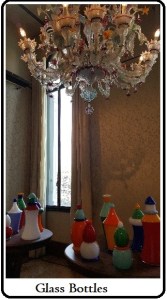
The main event that I covered was the Glasstress exhibit displayed in the Palazzo Cavalli-Franchetti. The Palazzo is the 19th century home of the Istituto Veneto di Scienze, Lettere ed Arti. This Venetian Gothic work of architectural art has soaring painted ceilings, beautifully sculpted plaster, stunning chandeliers, elaborate columns and breathtaking panels of wood and marble. In contrast, another display in Glasstress is in a glass foundry on Murano, which is dark, smoky and utilitarian.

The Biennale introduced Glasstress in 2009, in which Adriano Berengo melded contemporary art with glass. Over the years, it has expanded its cadre of artists from painters and sculptors to include architects, designers, fashion designers and musicians, including Pharrell Williams. Most of the contributors aren’t glass artists, as Glasstress focuses on the concepts and artistic collaboration more than on the medium. Glasstress is a collateral event at the Biennale of Art, traveling around the world when not in Venice. Host cities include Stockholm, Beirut, London, New York, and, most recently, Boca Raton, Florida.

These unusual collaborations have resulted in a singularly unique set of artistic creations. Reflecting the medium, they are shiny, bright and either transparent or reflective. Depicted thematic creations evoke emotions across the spectrum from exquisite to repulsive, including a fair amount of bemusement. As introduced by Philippe de Montebello, former Director of the Metropolitan Museum of Art in New York at the opening of their show, “For hundreds of years, glass has been viewed as by some as simply a decorative or functional medium. Glasstress New York on view at the Museum of Arts and Design, shatters those notions. Here you will see dynamic new glass works from both established and emerging artists, architects and designers from around the world.”

The next few pages highlight examples of the art in the Palazzo.

The influence of fashion design is unmistakable in the glass dresses.

The glass picture boxes are fascinating in their detail and engineering, as they are each composed of many layers of glass, each of which is a standalone picture that contributes to the whole landscape.

The beauty of the room and the chandelier complement the artist’s work.


From eels, to a woman in a mirror only visible from the side, a fallen bird and a jumble of intertwined images in a hanging sculpture, each piece is unique. Separated body parts add a gruesome touch, and what appears to be solid glass turns out to be individual filaments on closer inspection.

Collaborators in the Palazzo Glasstress exhibit include Tony Cragg, Erwin Wurm, Thomas Shuette, Monica Bonvicini, Jan Fabre, Shirazeh Houshiary, Vik Muniz, Ai Weiwei, Paul McCarthy, Abdulnasser Gharem, Laure Provost, Ugo Rondinone, Sarah Sze, and many other new and established artists.

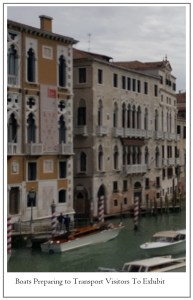
After touring the Palazzo, visitors were invited to the Berengo Exhibition Space on Murano for a separate, related Glasstress exhibit. Above is a view of the Palazzo and a boat preparing to transport visitors to the exhibit. Here again, the overall experience of boating to Murano and entering a glass factory enhances the enjoyment of the displayed art.

The Murano glass factory exhibit, titled “The Unplayed Notes Factory”, is a solo exhibition by Loris Greaud and curated by Nicolas Bourriaud as a special project of Glasstress 2017. The factory has been closed for 60 years, and is brought back to life in this exhibit. According to the Glasstress brochure, “the former glass furnace will be secretly revived and will play host to a whole new trade: an unofficial production line which is thought to conceal the mysterious vitrification of ‘hourglass’ sand, with an almost alchemical ambition to crystallize time…”

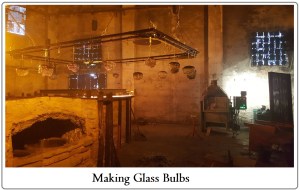
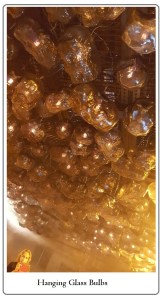
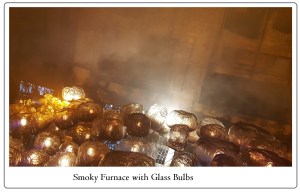
The interior of the factory is dark and smoky, punctuated by bright lights from high windows and the fire in the furnaces. The play of the lights, glass bubbles, smoke and furnace is mesmerizing. Each bubble encloses a light, and the bubbles intermittently light up in sections or across the entire sculpture. In a happy circumstance, a dinner hosted in the factory the previous night left large silver tables set up the length of the room. The line of tables mirrored the glass bubbles, fires and sunlight from the windows for even more dramatic photographs.

Here are images from the Murano glass factory exhibit.

The glass “notes” are created, and …

… hung from the ceiling.

The notes twinkle in front of the smoky furnaces, and …

… are mirrored in the tables.

Pictures:

So, in the final estimation, is it the jewel or the setting that makes the piece? For the Biennale of Art in Venice, it has to be both. While the glass artistry is spectacular, Venice’s history, architecture and unique feel makes this exhibit a special experience.


Thank you, Rhonda, for your wonderful photos and vivid impressions of this amazing, once in a lifetime opportunity to see such an exhibition of glass art.

Next Friday, Rhonda’s colleague and fellow traveler, Colleen Getz, has agreed to give us her impressions of “Tomorrow is another Day,” an exhibit by Mark Bradford, an American artist, that was featured at the 2017 Biennale in Venice.


Rhonda Truesdale, in her own words:

I began supporting online writing as a director for the non-profit organization ChixLIT, which published an ezine for and by girls. The organization and ezines were founded in 2010 by my good friend, Maria Laso Elders, who also wrote a children’s novel, “Otherwise Known as Possum”, which was published February 28, 2017. I created the ChixLit and ChixLittle magazine websites at http://www.chixlit.org and http://www.chixlittle.org and helped with content and site maintenance until 2013, when the site was redesigned. Following Maria’s death in 2015, the ezines were moved to http://www.chixlit.tumbler.com.

So what makes me an art blogger? I love art, travel, and writing; however, my writing is more typically in the realm of technical and sales articles for information technology. I joined the art blog world when I was invited to attend the press preview event in Venice for the 2017 Biennale of Art in May 2017 and wrote a guest article for gallery.spb. The gallery.spb is a contemporary arts journal based in St. Petersburg, Russia, which has been published for over 10 years and is transitioning online. This invitation gave me the opportunity to combine my 3 passions, and the resulting article describing the Glasstress exhibit at Biennale in Venice is scheduled to appear in the online version of gallery.spb.


Credits and Attributions:

The Biennale of Art in Venice: jewels in an elaborate setting, by Rhonda Truesdale © 2018 Rhonda Truesdale, All Rights Reserved. Printed by Permission

All images used in this article are ©2018 by Rhonda Truesdale, and are intended solely to illustrate this post. Used by permission.

Comments Off on #FineArtFriday: The Biennale of Art in Venice: jewels in an elaborate setting, by Rhonda Truesdale

Filed under #FineArtFriday, writing

Thoughts on the Advent of Autumn #amwriting

I’ve mentioned before that I love the changing of the seasons. Here in the Pacific Northwest, the colors of our native big-leaf maples and alders are beginning to paint the landscape in shades of yellow and gold, dotted with pops of red sumac and scarlet vine-maples.

In the higher hills of the lowlands and up in the Cascades, the gold of our native larches is astonishing to those who’ve never seen a deciduous conifer. It can seem like an entire forest has died. But they’re only getting ready to sleep through the winter, the way bears, maples, and cottonwoods do.

I’ve always been awed by the majesty of the autumn forest here in my part of the world.

The sky is also changing. The days are growing shorter and the rains of the monsoon months approach. The long dry spell has ended, and rain has returned to us.

In November, the gray overcast skies linger unending, eternal. My friends and I wonder if the sun will ever shine again. But just as I am feeling desperately sorry for myself, the clouds will part to reveal a patch of blue so beautiful my eyes hurt. I have to dig out my sunglasses to shield my weak, Northwesterner’s eyes from the radiance of the great yellow orb.

We who have grown up in the long dark winters have little tolerance for such brilliance. But we’re always ready to discuss our never-ending quest for cheap sunglasses. We adore those accessories that are so much more than a fashion statement.

As my previous posts have said, these are the writing weeks, the mad dash to finish the first draft of my work in progress, and my preparations for NaNoWriMo. Stockpiling staple groceries, perusing my recipe file for crock-pot meals—comfort food is on my mind at this time of year.

After all, food was love in the family I grew up in, and our favorite comfort foods make the winter seem warmer. The time we spend at the table sharing the evening meal is inviolable—no TV, just quiet music and conversation. This is our time to reconnect, to rebuild the ties of love and family that bind us.

Autumn’s glory will linger for a brief few weeks. The rainy season will come, turning unraked leaves to sodden, moldy messes waiting for the winds of November to send them flying from yard to yard. I will watch from my front room window and admire the leafy ballet.

Once the leaves are gone, evening and morning will still bring color, but it will be the sky that has the dominant role. At that time of year, the sun, low on the southern horizon, reflects on the clouds, turning them every shade of pink, gold, red, purple, and even a gray so dark it’s black.

Sporadically juxtaposed against that riot of cloud-color will be patches of poignant blue. It’s a color that makes my heart ache for spring, makes me yearn for sunshine and warmth.

I have prepared the back porch for winter, abandoned my favorite thinking place. The cushions are put away and the chairs are pulled to the center where they will stay dry except in the heaviest wind-driven rains.

Since spring is a full six months away, and the weather is fairly nice today, I will uncover a chair and sit on the back porch and write about a world where the sun is shining, and birds are singing.


Credits and Attributions:

Wikimedia Commons contributors, “File:Thomas Worthington Whittredge – Woods of Ashokan.jpg,” Wikimedia Commons, the free media repository, https://commons.wikimedia.org/w/index.php?title=File:Thomas_Worthington_Whittredge_-_Woods_of_Ashokan.jpg&oldid=296638658 (accessed September 13, 2018).

8 Comments

Filed under writing

Creating Societies #amwriting

I write in many different worlds with widely varying levels of technology and forms of government. When I first began writing, I was woefully ignorant about many things, but I knew it was important to create a solid feeling of reality in any fantasy world. My first efforts were less than good, but as time went on and I read the works of other authors, and played certain, world-heavy video games, I learned how important creating a sense of depth is in world building.

We all know the importance of giving depth to the physical setting of your story. The environment must be absolutely clear in your mind. But the society your characters inhabit is just as important as his physical world–how they live in that environment a key component of world building.

You achieve depth in a society by creating layers. What those layers are is listed below, but key is in how you apply the layers. The society must be there in YOUR mind, rock solid and with no apologies. The reader doesn’t need to know the details or the history, only that it is.

The World of Neveyah was originally invented as the setting for an anime-based platform-style RPG (Role Playing Game) that was never built. We intended to create a Final Fantasy style world and game, but the tech crash happened, and the game didn’t materialize.

However, I had retained the rights to my maps, my characters, and my story line—which eventually became the Tower of Bones series. Mountains of the Moon is the original story that the series grew out of, although it was the fourth book to be completed and published.

In a large console/computer RPG, world-building is critical. When you look at the great games that are considered classics, you find one commonality: Whether the classic game is a Platform game, ‎a Beat ’em up game, ‎a Shooter game, ‎a Stealth game, or an MMO game—they all have memorable worlds and deep, involving story lines.

What I originally did for the game was to write the story of the community my protagonist grew up in, a word-picture of that world and how the environment shaped their society. I made a list of questions about the society and the answers formed the picture of Wynn’s world and his place in it.

With that done, I set it aside, to use as reference material when I need to know how a particular character would react in a given situation. This is the method I still use today when I create a new world.

I have posted the following lists before, so if you have already seen them, thank you for stopping by!

Society is always composed of many layers and classes. How is your society divided? Who has the wealth? are there

  • Nobility?
  • A servant class?
  • A merchant class
  • A large middle class?
  • Who makes up the poorest class?
  • Who has the power, men, women—or is it a society based on mutual respect?

Do they have a written language? This is really important if you are setting your people in a medieval world or in a really low-tech society because it determines how knowledge is passed on. Low-tech generally equals an oral tradition.

  • How are people educated?
  • Who is allowed to learn to read and write?
  • How are bards, storytellers and other disseminators of knowledge looked upon?
  • How is monetary wealth calculated?
  • Do they use coins? What is their monetary system? If you are inventing it, keep it simple. (I generally use gold, divided into tens: 10 coppers=a silver/ 10 silvers=a gold)

Ethics and Values: What constitutes morality?

  • Is marriage required?
  • How are women treated?
  • How are men treated?
  • How are same-sex relationships viewed?
  • How are unmarried sexual relationships seen in the eyes of society?
  • How important is human life? How is murder punished?
  • How are treachery, hypocrisy, envy, and avarice looked upon?
  • What about drunkenness?
  • How important is the truth?
  • What constitutes immorality?
  • How important is it to be seen as honest and trustworthy?

Religion and the Gods: How important is religion in this tale? If it is central, ask yourself: Is there one god/goddess or many? If the worship of a deity is a key part of your tale, you must design the entire theology. You must know the rituals and know how their deity holds their hearts. You must know how that deity considers his/her worshipers.

  • What sort of political power does the priestly class wield?
  • What is the internal hierarchy of the priesthood?
  • Who has the power?
  • Is this religion a benevolent entity or all-powerful, demanding, harsh?
  • How does the priesthood interact with the community?
  • Who can join the priesthood?
  • Do people want to join the priesthood or do they fear it?
  • How is the priesthood trained?

Level of Technology: What tools and amenities do this society have available to them? What about transport?

  • Hunter/Gatherers?
  • Agrarian/farming
  • Greco-Roman metallurgy and technology?
  • Medieval metallurgy and technology?
  • Pre-industrial revolution or late Victorian?
  • modern day?
  • Or do they have a magic-based technology?
  • How do we get around and how do we transport goods? On foot, by horse & wagon, by train, or by space shuttle?

Government: There will be a government somewhere, even if it is just the local warlord. Someone is always in charge because it’s easier for the rest of us that way:

  • Is it a monarchy, theocracy, or a democratic form of government?
  • How does the government fund itself?
  • How are taxes levied?
  • Is it a feudal society?
  • Is it a clan-based society?
  • How does the government use and share the available wealth?
  • How is the government viewed by the citizens?

Crime and the Legal System: What constitutes criminal behavior and how are criminals treated?

Foreign Relations: Does your country coexist well with its neighbors?

  • If not, why? What causes the tension?

Waging War: This is another area where we have to ask what their level of technology is. It is critical for you as the author to understand what sort of weapons your characters will bring to the front, and also what the enemy will be packing. Do the research and choose weaponry that fits your established level of technology.

  • What kind of weaponry will they use?
  • How are they trained?
  • Who goes to battle? Men, women, or both?
  • How does social status affect your ability to gain rank in the military?

This is by no means a comprehensive list, just a jumping off point. Considering this little list of ideas always leads to my realizing other large concepts that combine to make up a civilization. You are welcome to use this roster to form your own inventory of ideas about society.

Know your world, know the society, and write with authority.

Give the reader just enough detail to show the world as one that is real and solid, but don’t devolve into dumps about how that world came to be. You, as the author, are the only one who needs to know those details.


Credits and Attributions

Wikimedia Commons contributors, “File:Milano Duomo 1856.jpg,” Wikimedia Commons, the free media repository, https://commons.wikimedia.org/w/index.php?title=File:Milano_Duomo_1856.jpg&oldid=146639100 (accessed September 23, 2018).

6 Comments

Filed under writing

#FineArtFriday: Chihuly Garden and Glass, Dale Chihuly

A few years ago I toured the Bridge of Glass in Tacoma, Washington. The bridge itself is a work of art, with two wonderful  green crystal towers designed by Dale Chihuly in a shape reminiscent of fan coral, and the 80-foot Venetian Wall, a length of illuminated cases displaying gorgeous art-deco glass work. It was beautiful, especially after dark when the footbridge is lit, glowing in the dark.

I was so impressed with the imagination of it all, I sought out another of his exhibits: The Chihuly Garden of Glass in Seattle, Washington. The incredible forms of the sculptures and deep, rich colors evoked an immense, otherworldly garden as might be seen in dreams. The following images were taken with my old flip phone in 2013–but they remain two of my favorite images. The riot of color and shape that Mr. Chihuly and the artists in his workshop create from sand and fire never fails to impress me!

The above exhibit was the artist’s rendering of what the shore of a pond or lake here in the Pacific Northwest would be like, and I wondered where the glass frogs and fish were that must come out after the museum closes, to play among the reeds and lily pads.

The next image was from an exhibit that made me think of a scene from beneath Puget Sound, perhaps an Octopus’s Garden. (Cue the Beatles!) 

The artistic vision of Dale Chihuly and the craft shown by the artists employed in his studio provides a wonderful little escape from reality when summer ends and the winter doldrums begin to set in–Seattle is only a two-hour drive from my house. There will be no gloom in Mudville if the Rainy City can be viewed from a garden of glass.


Credits and Attributions:

Art Glass by Dale Chihuly. Author’s own photos, intended to illustrate the essay on the work of Dale Chihuly. Garden of Glass Photo 1 & Garden of Glass Photo 2 © Connie J. Jasperson 2013-2018.

4 Comments

Filed under writing

The derailed plot #amwriting

You’re a pantser, not a plotter–you like to wing it when you write, just let the ideas flow freely. This can be liberating, but sometimes in the course of writing the first draft, we realize our manuscript has gone way off track and is no longer fun to write.

At this point, we must go back and find the point where the story stops working. We cut everything back to there and make an outline to build some structure into the manuscript.

Let’s say we are working on a manuscript titled “Dog Days of Summer.” We wrote most of it during November and are sixty thousand words in, but we aren’t even a third of the way to the finish. When we look back, the first twenty thousand words are exactly what we wanted the story to be. But at that point we became a little desperate to get our daily word count, and now we don’t know what to do or how to bring the story to its intended conclusion.

When this happens to me, I stop floundering and (literally) cut my losses. It needs to be cut back to the place where it dissolved into chaos. This is good – it’s called rewriting. Nearly every published novel has entire sections that had to be rewritten at least once before it got to the editing stage.

Much of what you cut out can be recycled, reshaped, and reused, so never just delete weeks of work.

  1. Save everything you cut to a new document, labeled, and dated: “OutTakes_DDoS_rewrite1_09-19-2018.” (Out Takes, Dog Days of Summer, rewrite 1, 09-19-2018)

Now, you must consider what will be the most logical way to get the plot back on track.

Sit down with a notebook (or in my case a spreadsheet) and make a list of what events must happen between the place where the plot was derailed and the end—a list of chapters with each the keywords for each scene noted:

15 Aeddie sick – Mendric can’t repair his heart-take him to Hemsteck 
16 Three days into the journey Elgar and Raj battle Thunder lizard
17 Star stone falls outside Waterston
18 Aeddie sick, nearly dies, Mendric nearly burns out gift keeping him alive
19 South of Kyran, water wraith
20 North of Kyran, mob attack
21 Nola – inn
22 Maldon, highwaymen, and William

You can go even farther and color code your scenes to show who the POV characters are, as was noted in my previous post, Author Simon Wood on Plotting.

What is the core conflict? Make a large note to remind yourself of what the central conflict is so that you won’t go off track again.

Pay close attention to the story arc. Make a “blueprint” of the intended story arc, an outline.

  1. Where does the inciting incident occur?
  2. Where does the first pinch point occur?
  3. What is happening at the midpoint? Are the events of the middle section fraught with uncertainty but still moving the protagonist toward their goal? If not, cut them and insert events that propel the story forward.
  4. Where does the third plot point occur?

What does each character desire? List each character and make a note of what they want at the beginning, what stands in their way at the middle, and what they get at the end.

  1. At the outset, what do the characters want?
  2. What are they willing to sacrifice to get it?
  3. How are their attempts to achieve it frustrated?
  4. Do they get it in the end, or do their desires evolve away from that goal as the story progresses?

Everything you write from the point of the inciting incident to the last page will detail that quest for the unobtainable something. At the outset, your protagonist must desire nothing more than to achieve that objective. Use whatever you can of the material you cut, and write new prose where you must.

By the end of the book, the internal growth of the characters may have caused them to change their personal goals, but something big and important must be achieved in the final chapters.

Where are they going? If they are traveling in a created world, draw a simple map for your own reference. Otherwise, use an atlas or Google Earth to keep your story on track.

Don’t be afraid to rewrite what isn’t working. Save everything you cut, because I guarantee you will want to reuse some of that prose later, at a place where it makes more sense. Not having to reinvent those useful sections will greatly speed things up, which is why I urge you to save them with a file name that clearly labels them.

Finally, don’t feel that, just because you wrote a wonderful section, it has to stay in the manuscript. If the story is stronger without that great scene, cut it. Use it as fodder for a short story or novella set in that world.

5 Comments

Filed under writing

Author Simon Wood on Plotting #amwriting

In my post, Theme and the Short Story, I discussed how, as part of my pre-NaNoWriMo exercise regimen, I create small outlines of the short stories I intend to write. Using an outline is also how I write novels.

  • First, I divide my story arc into quarters, so the important events are in place at the right time. When I try to “pants” it, I sometimes end up with a mushy plot that wanders all over the place and a story that may not be commercially viable.

  • What length am I writing to? Knowing the word count in advance will help you keep on track.
  • What will be the inciting incident? How does it relate to the theme?
  • What is the goal/objective? How does it relate to the theme?
  • At the beginning of the story, what could the hero possibly want to cause him to risk everything to acquire it?
  • How badly does he want it and why?
  • Who is the antagonist? What does he want and why?
  • What moral (or immoral) choice is the protagonist going to have to make in his attempt to gain that objective?
  • What happens at the first pinch point?
  • In what condition do we find the group at the midpoint?
  • Why does the antagonist have the upper hand? What happens at the turning point to change everything for the worse?

For novels, I make a larger outline, offering myself a more in-depth exploration of the intended story, and I discussed that process here: Jumpstart #NaNoWriMo2017, the Storyboard.

I do it this way because I can’t keep all the many threads on track if I don’t have some sort of a road map to follow. The outline is my literary GPS device.

Recently, at the Southwest Washington Writer’s Conference, I attended a two-part seminar on plotting, given by Simon Wood, author of such USA Today bestsellers as The One that Got Away.

Simon’s outline goes even deeper than mine. His outline is simple and linear, and color-coded to each character. Numbered from 1 to 80 (or however many scenes you have) each scene is listed with a sentence or two describing what happens at that point, something like Jack meets the dealer at the drop point. Argument ensues.

The sentences are small road maps from which he develops the entire scene. Each line is colored red, yellow, or green depending on whose point of view the scene is being shown from. Green is the protagonist’s point of view.

His outline doesn’t go into so much detail that the story is already written, but it ensures the plot goes in the intended direction with good pacing. Pacing is the reason why I outline—my earlier work was inconsistent.

What struck me in Simon’s seminar was the idea of color-coding each POV—when you have large stories encompassing the points-of-view for three or more characters, all it takes is a glance at your first-draft list of scenes to see if there is an imbalance in who’s talking.

Simon began this style of plotting in 1998, long before Scrivener. Some of you will say you use Scrivener for this, and to you, I say bravo! I find that program isn’t intuitive, is less than user-friendly, and is extremely annoying to try to learn. So, I have it, sitting in my computer taking up valuable real estate on my hard drive, going unused and unloved.

Simon writes thrillers, and I write fantasy, but we both create our outlines in Excel. However, this could easily be done in any word-processing or spread-sheet program (such as Google docs/sheets) or in Word, simply by changing the color of your fonts. You can even do this on colored post-it notes, as some authors do. For visual people who are not Scrivener savvy, being able to use the cut-and-paste function to move scenes around to where they are most effective is critical.

Simon was kind enough to answer a few questions via email about his process.

CJJ: First of all, what do you consider a scene? Is it a chapter or a portion of a chapter?

SW: A scene isn’t a chapter necessarily.  It may be made up of  2-3 scenes.  It depends on how the scenes connect.  Say the chapter was “Robbing a bank.”  To me that would be broken into three scenes: Getting into the bank, Getting into the vault, Getting the money out.  An over simplified answer but I hope it illustrates the point.

CJJ: How do you decide if a character is important enough to warrant a voice and becoming a viewpoint character?

SW: I just assess whether a particular character has valuable insight to share.  If a supporting character’s POV gives additional context to the relationship on how the protagonist and antagonist are behaving then their POV is valuable. Essentially a POV character has to add something to the story.

CJJ: How long are your scenes in terms of word count? For purposes of NaNoWriMo, 1,667 words a day is needed to reach 50,000 words by November 30th and some will plan to write a chapter a day.

SW: Usually my scenes are 1500 words.

CJJ: In your own experience, during the process of getting a novel to the final draft, how many times will the direction of the story and the outline change from the original?

SW: It all depends on how well I did my original outline or how well I had conceived the idea.  Sometimes it’s changed several times.  Others it’s pretty much stayed true to the original.  Usually a couple of times at least.

Thank you, Simon, for sharing your insights with us. For all who are curious about his process, Simon offers several wonderful seminars on writing craft, the links to which are at the bottom of this post. Do yourself a favor and sign up for one!

In the end, we as authors must each find our own best way to free the story from our creative minds. For some of you, a program like Scrivener might fill the bill, but for me, a simple outline to begin with, the willingness to change course when the intended storyline isn’t working, and sheer stubbornness are what it takes to get a book out.

You must give your plot structure. In other words, use an outline to create a good story arc at the outset, but within the structure of your outline, allow your characters to surprise you. We know that the way to avoid obviousness in a plot is to introduce a big threat. How our characters react to that threat should be unpredictable because they have agency.

When we give our characters agency, threats take away the option of going about life as normal and leave characters with several choices, all of which are consequential, the final one of which should be made in a stressful situation. I intentionally used the word consequential relating to the choices your characters must make. If there are no consequences for the bad decisions a character might make, what is the story about?

Simon’s idea of color-coding the scenes in the outline is a great addition to my writers’ toolbox. Being able to see at a glance if my story is imbalanced away from the protagonist’s thread will be a good way for me to avoid having to scrap a few months’ work to get a novel back on the right path.


About Simon Wood:

USA TODAY bestselling author, Simon Wood is a California transplant from England. He’s a former competitive racecar driver, a licensed pilot, an endurance cyclist, an animal rescuer and an occasional PI. He shares his world with his American wife, Julie. Their lives are dominated by a longhaired dachshund and six cats. He’s the Anthony Award winning author of The One That Got Away, Accidents Waiting to Happen, Paying the Piper, Terminated, Deceptive Practices and the Aidy Westlake series. His latest book is SAVING GRACE. He also writes horror under the pen name of Simon Janus. Curious people can learn more at http://www.simonwood.net.

Website: Simon Wood’s Web Hideout

Check out Simon’s workshops here: Simon Wood’s Workshops

Follow Simon on Twitter: https://twitter.com/simonwoodwrites

10 Comments

Filed under writing

#FineArtFriday: The Emerald Pool, Worthington Whittredge

About this image:

“The Emerald Pool” is also titled “Woods of Ashokan” and is a gloriously composed representation of an Autumn afternoon in the quiet woods. Sunlight is the core element here, in the way it filters through the leaves and touches branch and trunk, and then reflects from the pool.

The trees look very much like those that would have existed in parts of the woods near the house I grew up in, places where the evergreens had been cut and maples, alder, and ash could grow. Sun filters through the leaves which have turned colors but still remain on the trees. A few small firs struggle to grow in the deciduous forest, but one day those firs will cast a wide, dark shadow and the sunlit glade will be no more.

A pheasant (I think?) poses for his portrait, bringing the center focus of the painting to the calm pool beneath the log he stands on. The pool is masterfully shown, its waters rippling as if touched by a slight breeze, reflecting the scene above.

>>><<<

ABOUT THE ARTIST (From Wikipedia): Thomas Worthington Whittredge (May 22, 1820 – February 25, 1910) was an American artist of the Hudson River School. Whittredge was a highly regarded artist of his time, and was friends with several leading Hudson River School artists including Albert Bierstadt and Sanford Robinson Gifford. He traveled widely and excelled at landscape painting, many examples of which are now in major museums. He served as president of the National Academy of Design from 1874 to 1875 and was a member of the selection committees for the 1876 PhiladelphiaCentennial Exposition and the 1878 Paris Exposition, both important venues for artists of the day.

Artist:  Worthington Whittredge  (1820–1910)

Title:   The Emerald Pool

Date    1868

Medium          oil on canvas

Dimensions     Height: 144.8 cm (57 in); Width: 102.9 cm (40.5 in)

Current location: Chrysler Museum of Art


Credits and Attributions

Wikipedia contributors, “Worthington Whittredge,” Wikipedia, The Free Encyclopedia, https://en.wikipedia.org/w/index.php?title=Worthington_Whittredge&oldid=857357141 (accessed September 13, 2018).

Wikimedia Commons contributors, “File:Thomas Worthington Whittredge – Woods of Ashokan.jpg,” Wikimedia Commons, the free media repository, https://commons.wikimedia.org/w/index.php?title=File:Thomas_Worthington_Whittredge_-_Woods_of_Ashokan.jpg&oldid=296638658 (accessed September 13, 2018).

2 Comments

Filed under writing

Titling that book, or wringing blood from a stone #amwriting

A great book title can sell a book or short story to the reader:

We all start out with a working title—after all, we have to label our files somehow. But how do we come up with a catchy title for that finished product? It’s an issue we all face.

First of all, write the book and don’t obsess about the title until you are at the stage where something must be put in place on the cover. During the writing of the book the perfect title might come to you, so don’t sweat it.

What is the book’s genre? Go to the bookstore (or online to Amazon) and look at books in that genre to see how other authors are naming them. This will also give you an idea of how the cover should look if you are an indie. You will know what to ask of your cover designer.

Your friends and your writing group are good resources for brainstorming titles, so get them involved. Your writing group will know what the book is about, so their ideas will be valuable. If they haven’t been able to help and you are in the editing stage, ask your editor for some ideas.

I have two books titled after the main character’s name, Huw the Bard and Billy Ninefingers. This works because their names are unique. Other authors have done this too:

Are there any scenes that depict watershed moments in the protagonist’s life, places that are turning points? Settings that represent the theme can be great titles.

What is the central plot point?

If your story is dark, you might want to emphasize that theme by going the mysterious route.

Giving your work an official title is sometimes difficult, and it’s hard to find good titles that aren’t already famous. In the US, book titles aren’t copyrighted so there may be multiple books out there with the title you want to use—take my advice and research your prospective title thoroughly.

I once was at a book signing event with my epic fantasy book, Mountains of the Moon (World of Neveyah), seated opposite an author selling a travel book, Mountains of the Moon, detailing his journeys in Africa. We laughed and helped sell each other’s books—because he was a good sport, the identical names worked to our advantage at that show, and we sold more books than we would have. But knowing what I do now, I would definitely give my book a different name–I had no idea such a place existed here in this world.

The right title is a subliminal lure enticing the reader into opening the book or clicking on the “look inside” option.

In 1989, I bought a book by Tad Williams: The Dragonbone Chair. That title hooked me, and the book itself lived up to its promise so well that I patiently waited two years between books for Mr. Williams to finish each installment in the series.

In my case, good titles are as much of a hook as an intriguing cover design.

Comments Off on Titling that book, or wringing blood from a stone #amwriting

Filed under writing