Category Archives: writing

The Narrative Essay #amwriting

Today we are continuing the subject of crafting short fiction. In December I wrote a post on essays I have read and why we should write them. While this post expands on that subject, we’re digging deeper today, going into the mechanics of writing a specific type of essay. For Indie authors who wish to earn actual money from their writing, the narrative essay appeals to a wide audience and is sometimes more salable. Narrative essays are often anecdotal and not necessarily completely true.

They may detail an experience or event, and how it shaped the author on a personal level. However, we must keep in mind, the first-person narrator is frequently unreliable. This purely human tendency to embellish or slightly twist the truth is what makes the narrative essay an engrossing tale.

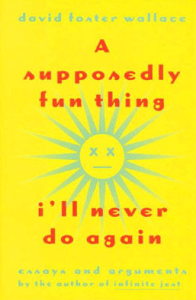
One of my favorite narrative essays is 1994’s Ticket to the Fair, (now titled “Getting Away from Already Being Pretty Much Away from It All“) by the late David Foster Wallace, and published in Harpers. Told in the first person, it is a humorous, yet eye-opening story of a “foreign” (east coast) journalist’s assignment to cover the 1993 Iowa State Fair.

Sandra Allen describes this essay as, Laugh-out-loud hilarious and almost ridiculous in its level of detail, it explores the author’s fractured identity, the Midwest versus the East Coast, and the American experience at large.

At the outset, Wallace states he was born several hours drive from the fair, but had never attended it. A city boy, he has no knowledge of farms, farm culture, or animals, and hasn’t really thought about the fair beyond the fact that in the course of covering the fair for Harpers, he is getting his first official press pass. After high school and college, he had left the Midwest for the East Coast and never looked back.

Wikipedia summarizes Ticket to the Fair this way: Wallace’s experiences and opinions on the 1993 Illinois State Fair, ranging from a report on competitive baton twirling to speculation on how the Illinois State Fair is representative of Midwestern culture and its subsets. Rather than take the easy, dismissive route, Wallace focuses on the joy this seminal midwestern experience brings those involved.

Writing thought provoking content is the prime purpose of an essay. Because the essay is the vehicle for conveying our ideas in a palatable form, writing narrative essays require us to think, not just about the content, but also about the structure. You must include:

  • an introduction
  • a plot
  • one or more characters (can be the narrator)
  • a setting
  • a climax
  • a summary/ending

Writing with intentional prose is critical. A good essay has been put into an entertaining form that expresses far more than mere opinion. Narrative essays may center around larger concepts, but they present ideas in such a way the reader feels connected to the story. Good essays offer a personal view of the world, the places we go, and the people we meet along the way. (Names changed to cover your backside legally, of course.)

Literary magazines want well-written essays with fresh ideas about wide-ranging topics, and some will pay well for first publication rights. Therefore, it is essential you pay strict attention to grammar and editing, and never send out anything that is not your best work. After you have finished the piece, set it aside for a week or two. Then come back to it with a fresh eye and check the manuscript for:

  • Spelling—misspelled words, autocorrect errors, and homophones (words that sound the same but are spelled differently). These words are insidious because they are real words and don’t immediately stand out as being out of place.
  • Repeated words and cut-and-paste errors. These are sneaky and dreadfully difficult to spot. Spell-checker won’t always find them. To you the author, they make sense because you see what you intended to see. For the reader, they appear as unusually garbled sentences.
  • Missing punctuation and closed quotes. These things happen to the best of us.
  • Digits/Numbers: Miskeyed numbers are difficult to spot when they are wrong unless they are spelled out.
  • Dropped and missing words.

Don’t be afraid to write with a wide vocabulary. Never use jargon or technical terms only people in certain professions would know unless it is a piece geared for publication serving that segment of readers.

Above all, be intentional and active with your prose, and be a little bold. I enjoy reading David Foster Wallace and George Saunders because they are adventurous in their work.

A list of publications that are accepting narrative essays can be found here: NewPages.Com

And on that note, we must be realistic. Not everything you write will resonate with everyone you submit it to.  Put two people in a room, hand them the most thrilling thing you’ve ever read, and you’ll get two different opinions, and they probably won’t agree with you.

Don’t be discouraged by rejection. Rejection happens far more frequently than acceptance, so don’t let fear of rejection keep you from writing pieces you’re emotionally invested in.

This is where you have the chance to cross the invisible line between amateur and professional. Always take the high ground—if an editor has sent you a detailed rejection, respond with a simple “thank you for your time.” If it’s a form letter rejection, don’t reply.

And when you receive that email of acceptance—celebrate! There is no better feeling than knowing someone you respect liked your work enough to publish it.


Credits and Attributions:

Harpers, Ticket to the Fair by David Foster Wallace, pdf  https://harpers.org/wp-content/uploads/HarpersMagazine-1994-07-0001729.pdf

17 Personal Essays That Will Change Your Life by Sandra Allen for Buzz Feed, August 2013

Wikipedia contributors, “A Supposedly Fun Thing I’ll Never Do Again,” Wikipedia, The Free Encyclopedia, https://en.wikipedia.org/w/index.php?title=A_Supposedly_Fun_Thing_I%27ll_Never_Do_Again&oldid=815132504 (accessed January 9, 2018).
10 Comments

Filed under writing

How writing drabbles develops mad skills #amwriting

Some of the best work I’ve ever read was in the form of extremely short stories. Authors grow in the craft and gain different perspectives when they write short stories and essays. With each short piece that you write, you increase your ability to tell a story with minimal exposition.

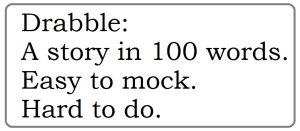
This is especially true if you write the occasional drabble—a whole story in 100 words or less. These practice shorts serve several purposes:

Writing such short fiction forces the author to develop economy of words. You have a finite number of words to tell what happened, so only the most crucial of information will fit within that space.

  1. You have a limited amount of space so your narrative will be limited to one or two characters only.
  2. There is no room for anything that does not advance the plot or affect the outcome of the story.
  3. The internet is rife with contests for drabbles, some offering cash prizes.
  4. Building a backlog of short stories gives you ready-made characters and a premade setting to draw on when you need a longer story to submit to a contest.

Writing a 100-word story takes less time than writing a 3,000-word story, but all writing is a time commitment. When writing a drabble, you can expect to spend an hour or more getting it to fit within the 100 word constraint.

To write a drabble, we need the same basic components as we do for a longer story:

  1. A setting
  2. One or more characters
  3. A conflict
  4. A resolution.

First, we need a prompt, a jumping off point. We have 100 words to write a scene that tells the entire story of a moment in the life of a character. Some contests give whole sentences for prompts, others offer one word, and still others no prompt at all.

A prompt is a word or visual image that kick starts the story in your head. The prompt for the following story is sunset.

In my previous post on writing short stories, I showed how I break short stories into acts. A drabble works the same way–we can break this down into its component parts and make the story arc work for us. We have about 25 words to open the story and set the scene, about 50 – 60 for the heart of the story, and 10 – 25 words to conclude it.

We sat on the beach near the fire, two old people bundled against the cold Oregon sunset. Friends we’d never met fished the surf.

Wind whipped my hair, gray and uncut, tore it from its inept braid. The August wind was chill inside my hood, but I remained, pleased to be with you, and pleased to be on that beach.

Mist rose with the tide, closed in and enfolded us, blotting out the falling stars.

Laughing at our folly, we dragged our weary selves back to our digs, rented, but with everything this old girl needed—love, laughter, and you.

The above drabble is a 100-word romance, with a beginning, a middle, and an end. The beginning places our protagonist on the beach with someone for whom she cares deeply.

The conflict in this tale? The mist and wind make it too cold for our protagonist to stay on the beach and gaze at the stars. A hard, cold wind and heavy mist are typical of the Washington and Oregon Coast in August, two things you wouldn’t think could coexist, but there, they do.

The resolution? A cozy evening indoors.

Drabbles are incredibly useful. They contain the ideas and thoughts that can easily become longer works. The above drabble, written in 2015, combined with a photograph I took while vacationing in Oregon with my husband in 2016, was the inspiration for what became a longer poem: Oregon Sunset, which you can read here.

Good drabbles are the distilled essences of novels. They contain everything the reader needs to know about that moment and fills them with curiosity to learn what happened next.

When you have a flash of brilliance, a shining moment of what if, write it in the form of a drabble. Save it in a file for later use as a springboard to write a longer work, or for submission to a drabble contest in its proto form. Spending an hour getting that idea and emotion down so you won’t forget it is a small gift you give yourself, as an author.

Whether you choose to submit a drabble to a contest or hang on to it doesn’t matter. Either way, the act of writing a drabble hones your skills, and you will have captured the emotion and ambiance of the brilliant idea.

That is what true writing is about.

26 Comments

Filed under writing

#FineArtFriday: Home, Sweet Home by Winslow Homer

Home, Sweet Home is one of the most famous paintings of the American Civil War, depicting a moment in time, painted by Winslow Homer. On opposite shores of the Rappahannock River, opposing armies are caught up in an awareness of brotherhood, as music becomes the medium that lays bare the humanity of the soldiers on both sides.

Winslow Homer was best known for his landscapes featuring the many moods of the ocean, but he also painted many iconic images of that turbulent time before, during, and after the American Civil War. His art captures a sense of familiarity, a feeling that the viewer knows these people and their stories intimately.

Wikipedia says, “Harper’s (magazine) sent Homer to the front lines of the American Civil War (1861–1865), where he sketched battle scenes and camp life, the quiet moments as well as the chaotic ones. His initial sketches were of the camp, commanders, and army of the famous Union officer, Major General George B. McClellan, at the banks of the Potomac River in October 1861.

“Although the drawings did not get much attention at the time, they mark Homer’s expanding skills from illustrator to painter. Like with his urban scenes, Homer also illustrated women during wartime, and showed the effects of the war on the home front. The war work was dangerous and exhausting. Back at his studio, Homer would regain his strength and re-focus his artistic vision. He set to work on a series of war-related paintings based on his sketches, among them Sharpshooter on Picket Duty (1862), Home, Sweet Home (1863), and Prisoners from the Front (1866). He exhibited paintings of these subjects every year at the National Academy of Design from 1863 to 1866. Home, Sweet Home was shown at the National Academy to particular critical acclaim; it was quickly sold and the artist was consequently elected an Associate Academician, then a full Academician in 1865.[10]”

The story behind the painting, Home, Sweet Home, is told poignantly in the autobiography, Reminiscences of a Private, by Frank Mixson, who served in the Confederate Army.

“The Yankee band would play the popular airs of theirs amid much yelling and cheering; our bands would do the same with the same result. Towards the wind-up the Yankee band struck up “Yankee Doodle.” Cheers were immense. When they stopped our band struck up “Dixie,” and everything went wild. When they finished this, both bands, with one accord and simultaneously, struck up “Home, Sweet Home.” There was not a sound from anywhere until the tune was finished and it then seemed as if everybody had gone crazy. I never saw anything to compare with it. Both sides were cheering, jumping up and throwing up hats and doing everything which tended to show enthusiasm. This lasted for at least a half hour. I do believe that had we not had the river between us that the two armies would have gone together and settled the war right there and then.”

Quote from: Reminiscences of a Private, by Frank Mixson (1910)


Sources and Attributions:

Wikipedia contributors, “Winslow Homer,” Wikipedia, The Free Encyclopedia, https://en.wikipedia.org/w/index.php?title=Winslow_Homer&oldid=817253575 (accessed January 4, 2018).

Home, Sweet Home: “Had we not had the river between us,” posted by Marek,  https://civilwarfolkmusic.com/2013/12/15/1862-home-sweet-home/ accessed 04 January 2018.

Reminiscences of a Private, by Frank Mixson (published 1910 by Columbia, S.C., The State Company)

Home, Sweet Home (oil on canvas) by Winslow Homer – circa 1863 | Winslow Homer [Public domain], via Wikimedia Commons, accessed 04 January 2018.

6 Comments

Filed under #FineArtFriday, writing

Crafting the very short story #amwriting

During the month of January I will be exploring the many aspects of the craft of writing short, salable works. I periodically discuss the importance writing to build stock for submissions to magazines, anthologies, or contests. However, many authors have difficulty keeping a story short, and there is an art to it.

Some authors are naturally skilled at this, so if you are one of those lucky people, this may be of no interest to you, but thank you for stopping by!

So, now we get down to business. First up is the short story, works that are 2,000 to around 7,000 words in length.

First, decide what length you want to write to—if you have no specific contest in mind, 2000 to 4000 is a good all purpose length that will fit into most submission guidelines. For those of you who have trouble writing short works for contests and anthologies with rigid word-count limits, this is where taking the time to do a little storyboarding becomes critical.

Let’s say you want to write a story that can be no longer than 2,000 words. You know what the story is, but when you sit down and begin writing, you think you have too much story for only 2,000 words. You need to map it out.

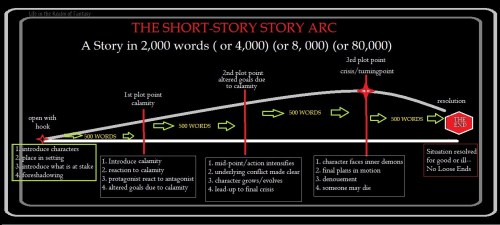
Short-stories are just like novels, in that they have an arc, and you can make it work for you.  By looking at it from the perspective of the story arc, you can see what you must accomplish, and how many words you must accomplish it in.

Every word in a 2,000-word story is critical and has a specific taskthat of advancing the plot. To that end, in a story of only 2,000 words:

  1. No subplots are introduced
  2. Minimal background is introduced
  3. The number of characters must be limited to 2 or 3 at most
  4. Every sentence must propel the story to the conclusion

For the purposes of this post, suppose we need to write a short story for submission to a fantasy anthology.

This method works for stories written in any genre and for essays, so the underlying method is not “fantasy” specific. I have used the following example before when talking about the (very short) short story, and I use it in my seminar on the subject.

First, we will carefully read the publisher’s guidelines, so we don’t waste our time writing something that won’t be accepted.

  • We discover that the guidelines stress that the wordcount limit is a strict 2,000 words, and longer submissions will not be considered.
  • The theme of this anthology is Truth and Consequences, and the theme must be strongly represented throughout the story.

Our submission will be titled A Song Gone Wrong.

The inciting incident happens off screen. We’re saving precious words by opening with our main character already in trouble, and everything the reader needs to know will be conveyed in the opening scene.

The Plot: Because he was a bit too specific when a putting a local warlord’s fling with another man’s wife into a song, our protagonist is now a wanted man in danger of being hung for treason.

Divide your story this way:

Act 1: the beginning: You have 500 words to show

  1. setting: the village of Imaginary Junction,
  2. general atmosphere: the weather is unseasonably cold
  3. introduce the protagonist and show him in his situation: In an alley, a bard, Sebastian, is  hiding
  4. introduce the antagonist(s): Soldiers of the lord he has inadvertently humiliated are searching for Sebastian.

Act 2: First plot point: You have 500 words to tell how

  1. the soldiers surround and capture Sebastian
  2. he is hauled before the angry lord and
  3. thrown into prison, sentenced to hang at dawn, but now you are at:

Act 3.: Mid-point: You have 500 Words to explain how

  1. Sebastian meets a dwarf, Noli, also sentenced to die.
  2. Noli is on the verge of managing an escape but needs help with one last thing.
  3. Noli and Sebastian manage to complete the escape route,
  4. but the guard seems suspicious, hanging around their cell door, hampering their escape

Act 4: Resolution–you have 500 words to show how

  1. The smart guard finally is relieved by a less wary guard, which allows
  2. Sebastian and Noli to squeeze through the escape route.
  3. They are spotted at the last minute, but Noli’s friends are waiting, and
  4. They are whisked to a dwarf safe-house, leaving Sebastian free to embark on his next short-story adventure

Once you have parsed out what needs to be said by what point, and in how many words, you can then get to the nitty-gritty of turning that far-fetched tale of woe into a good short-story.

You will see that to keep to the strict limit of words and still convey your story, you must choose your words carefully.

  • Use a wide vocabulary to show mood, setting, and reactions. You are an author, so you must craft the prose. It is your job to find words that best convey what you want to say, concisely in one or two sentences.
  • Sebastian can’t give Noli a recap of his troubles onscreen—all that will have to be off-stage.
  • Conversations are critical—they are the vehicle through which you convey the personalities and the minimal backstory of the piece.

You can quickly plot and write a story of any length this way, just by

  • Dividing the specified word count into four acts
  • Keeping the theme of the story in the forefront
  • Make use of your thesaurus. Put your large vocabulary to work by using words that say what you mean with the least amount of “helper” words (adjectives and adverbs).

After a few times of creating short stories using this method, you won’t need to think about it. Once you know the length a given tale has to be, you can mentally divide it into acts and just write for fun.

18 Comments

Filed under writing

#Drabble “Ted”

Today is the first day of 2018! An area of writing that I really enjoy is called The Drabble. Writing such short fiction forces the author to develop economy of words. We will be exploring Drabbles and the craft of writing short fiction more closely here on Life in the Realm of Fantasy during the month of January.

A Drabble is an extremely short story, usually no more than 100 words, although some contests will allow as much as 300 words.

My first Drabble was this one, penned in 2013, and it remains one of my favorite short pieces.


TED

Edna stirred her coffee and looked out the window toward the shed.

“Did you feed the chickens?” Marion always asked, despite knowing Edna had.

Edna tore her gaze from the shed. “Of course.” Her eyes turned back to the small building. “We won’t be able to keep him in there much longer. He’s growing too big. We should have a barn built for him.”

“Ted was always a greedy boy.” Marion sipped her coffee. “I warned him he behaved like a beast, and now look.”

A rumbling bellow shook the shed. A long green tail snaked out of the door.


“Ted,” by Connie J. Jasperson ©2013 – 2018

Garden Shed, Australia, By Rod Waddington from Kergunyah, Australia (Garden Shed, Australia) [CC BY-SA 2.0 (https://creativecommons.org/licenses/by-sa/2.0) ], via Wikimedia Commons

Comments Off on #Drabble “Ted”

Filed under #FineArtFriday, #FlashFictionFriday, writing

Goodbye 2017 #amcelebrating

Christmas Day has gone, taking with it the snow that lent our small valley transitory beauty. It left behind the memory of cozy warmth, of a table laden with comfort food, and old friends sharing a holiday meal.

The old year is nearly over, and while it has been a difficult year in many ways for my family, I have far more blessings than I can count.

My New Year’s Eve wish for you is: May you never lack for good food, warmth, and the companionship of witty people. May you always have books to read, and may happiness regularly cross your path.

9 Comments

Filed under #FineArtFriday, writing

#NewYears Advice from Grandma #amwriting

A new year is approaching, and as the resident grandma, I feel compelled to let you know that you are loved and worthy of the good things in life.

Every now and then I come across an author who is devastated by a lack of reviews, or sales, and is desperate to move into the “big kid’s pool.” I was that kid, once.

First, let me say that I read because I am an escape artist. I want to be completely immersed in a world elsewhere, anywhere that is not this world. I write because my favorite authors are unable to turn out a book a week, which would be what I require to satisfy my reading habit. So, I write the stories I want to read.

But I am a ‘niche’ reader. I love Tolkien, and his epic style, and Tad Williams with his lush story development. I adore Neil Gaiman and his meandering prose. I liked Robert Jordan’s side quests and multiple story lines.

I also adore George Saunders, and Patrick Rothfuss, and Erin Morgenstern.

This means my work doesn’t resonate with everyone.

I know! I was shocked to discover this too!

When I was first published in 2011, I would read my hard-earned reviews and be alternately elated or depressed. It came to a point where I couldn’t write because I was so concerned about what readers who also review would say, and that overwhelming concern stifled my ability to tell my stories.

I had allowed my damaged ego to become a vampire, sucking the joy from my creativity.

My own grandmother was right—listening to your ego is always a mistake. Your best bet is to put a gag on it and lock it in a closet.

Nowadays I don’t read my reviews, good or bad. I ignore them because they either feed my despair and lack of self-worth or they artificially inflate my ego. These mental conditions can’t coexist with my true desire to just write what I want to read. I have embraced the fact that I am writing the stories I want to read, and this means I can’t care about writing in commercially viable genres.

What I do have to care about is writing to the best of my ability, writing the story that makes me happy, and learning as much about the craft of writing that I am able.

My work is weird, it’s odd, it’s “out there.” My early books each have flaws I wouldn’t repeat if I were writing them now, but despite the flaws inherent in these early novels, they have life and passion and characters who are real to me, and I still love those stories. My growth as an author has been gradual, but the growth is clear in my more recent work.

We all have this desire to have the work we have so lovingly written and struggled to produce be accepted, and be as beloved by the world as we think it should be. We all want to write award-winning bestsellers.

But that star-struck need to be loved by millions of readers is just noise, wind in your ears distracting you from your real task. Ask yourself, “Am I an author writing a story I am passionate about, or am I calculatedly producing a marketable product?”

When I noticed my books were not easy to market, I asked myself that question. I had to also ask, “If I am pouring time and energy into creating a marketable product, who is going to market it?” The answer was “No one.” I certainly don’t have time to become a marketer if I am creating the product, nor do I have the funds to hire a marketing firm.

My point is this: if I must be strapped to the millstone, grinding away on a book I don’t love, why would I even do it? I retired from that sort of work in 2007, and believe me, working in a data entry pool gives the word “boring” new meaning.

I have no problem pegging out a short story to fit the theme and parameters of a contest or an anthology. In fact, I enjoy doing so, and try to write at least one a month. But an entire novel written to fit someone else’s idea of what my ‘genre’ should be?

No.

Ask yourself, “Do I write because I am passionate about a story? Or do I want to mindlessly enter data to fit some formulaic template readers will chew up and forget as soon as they’ve swallowed it?” Decide what you want to be known for, and pursue that goal.

I am an author. I have accepted that my head occasionally makes noise that steals my creativity. For the last few years, I have chosen to ignore the voices and immerse myself in my chosen craft, and I do this for a purely selfish reason: I want to tell my own stories.

I don’t care if my novels are acceptable to the general reading public or not. I am proud to be a niche reader and proud to be writing the niche stories I want to read, stories that don’t fit into the boxes that genre-Nazis would like to enforce on all authors.

This supremely selfish aspect of my personality keeps me going, keeps me pouring my heart, my life into something others likely won’t see, and if they do chance upon it, they may not find it to their taste.

The fact is, I am writing novels and doing the best I can to turn out a good book. This is all I care about, and I am proud of what I do, whether my work resonates with a broad spectrum of readers or not. I love what I write, and a niche group of readers seems to enjoy it, women more often than men.

That makes sense to me, as I am a woman, and this is what I want to read. While I’d like to have the world love my work, ultimately my own enjoyment is all that matters.

And that is the wisdom this old lady would like to impart to you: Write because you have a passion for a story, learn all you can about the craft, and develop your own voice.

Don’t listen to the voices on the wind, because they will suck the joy out of you. Listen to the still voice in your heart, and write something you will want to read.

I’m a reviewer as well as a reader, but don’t write your novel for me. Write it for yourself, and enjoy the ride. Chances are, I will see the good in your work and the good will more than outweigh the flaws.

3 Comments

Filed under writing

Thoughts on “A Christmas Carol” by Charles Dickens #MerryChristmas

Thoughts on “A Christmas Carol” was first published here on Life in the Realm of Fantasy, Dec. 15, 2014 under the title, A Christmas Carol–what I’ve learned from Charles Dickens. Because I adore the works of Charles Dickens, and especially love A Christmas Carol, I reprint this article every year during the week before Christmas. It has become my little Christmas card to you and to the world.


Charles Dickens was a master at creating marvelous hooks and using heavy foreshadowing. Let’s take the first line of my favorite Christmas story of all time, A Christmas Carol. I love each and every version of it, will watch any movie version I can get my hands on:

“Marley was dead, to begin with. There is no doubt whatever about that. The register of his burial was signed by the clergyman, the clerk, the undertaker, and the chief mourner. Scrooge signed it. And Scrooge’s name was good upon ‘Change for anything he chose to put his hand to. Old Marley was as dead as a doornail.”

I hear a great deal of argument about how modern 21st century genre-fiction is nothing but sixty-second soundbites and bursts of action jammed together in dumbed-down prose.  I hate to say this, but that has been true of popular fiction for centuries–and if you look at this tale, you will see what I mean. The popular prose, at the time it was written, was more descriptive and leisurely than we enjoy nowadays, but even so, the popular tales leaped straight to the action.

In that first paragraph, Dickens tosses out the bait, sinking the hook, and landing the fish (the reader) by foreshadowing the first plot point of the story–the visitation by Marley’s ghost. We want to know why Marley’s definite state of decay was so important that the conversation between you the reader, and Dickens, the author, was launched with that topic.

He picks it up and does it again several pages later, with the little scene involving the door-knocker:

“Now, it is a fact, that there was nothing at all particular about the knocker on the door, except that it was very large.  It is also a fact, that Scrooge had seen it, night and morning, during his whole residence in that place; also that Scrooge had as little of what is called fancy about him as any man in the city of London, even including — which is a bold word — the corporation, aldermen, and livery.  Let it also be borne in mind that Scrooge had not bestowed one thought on Marley, since his last mention of his seven years’ dead partner that afternoon.  And then let any man explain to me, if he can, how it happened that Scrooge, having his key in the lock of the door, saw in the knocker, without its undergoing any intermediate process of change — not a knocker, but Marley’s face. 

“Marley’s face.  It was not in impenetrable shadow as the other objects in the yard were, but had a dismal light about it, like a bad lobster in a dark cellar.  It was not angry or ferocious, but looked at Scrooge as Marley used to look: with ghostly spectacles turned up on its ghostly forehead.  The hair was curiously stirred, as if by breath or hot air; and, though the eyes were wide open, they were perfectly motionless.  That, and its livid colour, made it horrible; but its horror seemed to be in spite of the face and beyond its control, rather than a part or its own expression.

“As Scrooge looked fixedly at this phenomenon, it was a knocker again.”

You must admit, it’s a huge thing for a man of as limited an imagination as Scrooge was known to have, to suddenly see his dead friend staring back at him.

This is also the second foreshadowing of the events that will follow and makes the reader want to know what will happen next.

At this point, we’ve followed Scrooge through several scenes introducing the subplots. We have met the man who, at this point, is named only as ‘the clerk’ in the original manuscript, but whom we will later know to be Bob Cratchit, and we’ve met Scrooge’s nephew, Fred. These two subplots are critical, as our man Scrooge’s redemption revolves around the ultimate resolution of these disparate mini-stories—he must witness the joy and love in Cratchit’s family, who are suffering but happy despite the grinding poverty for which Scrooge bears responsibility.

We see that his nephew, Fred, though orphaned is well enough off in his own right, but craves a relationship with his uncle with no thought or care of what he might gain from it financially.

All the characters are in place. We’ve seen the city, cold and dark, with danger lurking in the shadows. We’ve observed the way Scrooge interacts with everyone around him, strangers and acquaintances alike.

Now we come to the first plot point–Marley’s visitation. This is where the set-up ends, and the story takes off.

Dickens raises the tension. The bells begin ringing for no apparent reason and “The cellar-door flew open with a booming sound, and then he heard the noise much louder, on the floors below; then coming up the stairs; then coming straight towards his door.

Scrooge, of course, is dismayed and tries to deny the strange happenings. He desperately clings to his view of reality.

“It’s humbug still!” said Scrooge.  “I won’t believe it.”

However, he can’t deny this phenomenon forever and refusing to recognize it won’t make it go away.

“Though he looked the phantom through and through, and saw it standing before him; though he felt the chilling influence of its death-cold eyes; and marked the very texture of the folded kerchief bound about its head and chin, which wrapper he had not observed before: he was still incredulous, and fought against his senses.

“How now!” said Scrooge, caustic and cold as ever. “What do you want with me?”

This is the turning point, the place where Ebenezer Scrooge is faced with a situation in which he will either succeed or fail and what will happen to him, the reader can’t guess. A deep sense of mystery now surrounds this miserly old man–what could possibly be so important about him that a man he cared so little for in life would go to such trouble as to return from the grave to save him?

In 1843 Charles Dickens showed us how to write a compelling tale that would last for generations. We start with the hook, use foreshadowing, introduce the subplots that ultimately support the structure of the tale, and arrive at the first plot point–these are the things that make up the first quarter of this timeless tale. Get these properly in line, and your story will intrigue the reader, involving them to the point they don’t want to set the book down.


Credits and Attributions:

Passages quoted from  A Christmas Carol. In Prose. Being a Ghost Story of Christmas, by Charles Dickens, With Illustrations by John Leech. London: Chapman & Hall, 1843. First edition. PD|100

Marley’s Ghost, and Scrooge’s third visitor. These images are two of four hand-coloured etchings included in the first edition. There were also four black and white engravings. Date1843. PD|100. John Leech [Public domain], via Wikimedia Commons

Merry Christmas to you and to your loved ones from me, and my favorite author, Charles Dickens!

2 Comments

Filed under writing

Essays #amwriting

One area of writing that we’ve all heard of, but don’t often think about, are Essays. However, if we want to be published, writing and submitting essays is an opportunity the unknown author should exploit.

Essays are not just that bane of every school child’s existence—essays are where some of the best works of western literature can be found. Essays are short, magazine-length or blog post length articles. They are non-fiction and are frequently opinion pieces, but sometimes they are brief memoirs of a singular experience. Essays are pieces we have all read and which have moved us in some way, for good or ill.


In her introduction to The Best American Essays 1988, Annie Dillard claims that “The essay can do everything a poem can do, and everything a short story can do—everything but fake it.”

The word essay also means to attempt—and why this meaning is important will emerge later.

But let’s look at essays, starting with Sir Francis Bacon, renaissance author, courtier, and the father of deductive reasoning. The life and works of this English essayist and statesman had a major impact in his day and still resonate in modern literature. Essayes: Religious Meditations. Places of Perswasion and Disswasion. Seene and Allowed (1597) was his first published book.

The 1999 edition of The Oxford Dictionary of Quotations includes  91 quotations from the Essays. No author is quoted so many times unless their work has struck a chord with centuries of readers.

  • “Knowledge itself is power.”
  • “Riches are a good handmaid, but the worst mistress.”

Aldous Huxley‘s book Jesting Pilate, an Intellectual Holiday had as its epigraph, “What is Truth? said jesting Pilate; and would not stay for an answer.” These lines were quoted from Bacon’s essay “Of Truth.”  Huxley himself was a brilliant essayist, and according to Wikipedia, he defined essays in this way: “essays belong to a literary species whose extreme variability can be studied most effectively within a three-poled frame of reference.” These three poles (or worlds in which the essay may exist) are:

  • The personal and the autobiographical: The essayists that feel most comfortable in this pole “write fragments of reflective autobiography and look at the world through the keyhole of anecdote and description.”
  • The objective, the factual, and the concrete-particular: The essayists that write from this pole “do not speak directly of themselves, but turn their attention outward to some literary or scientific or political theme. Their art consists of setting forth, passing judgement upon, and drawing general conclusions from the relevant data.”
  • The abstract-universal: In this pole “we find those essayists who do their work in the world of high abstractions,” who are never personal and who seldom mention the particular facts of experience. (end quote)

Essays offer an author the opportunity to use prose to expound ideas and values. Michel de Montaigne (1533–1592) was the first author to describe his work as essays—by which he meant attempts. He used the term to characterize these short pieces as “attempts” to put his thoughts into writing. Montaigne’s essays grew out of his work that was then known as “commonplacing.” These were published books that were essentially scrapbooks filled with items of every kind: medical recipes, quotes, letters, poems, tables of weights and measures, proverbs, prayers, legal formulas. Think of them as mini-encyclopedias.

Sir Francis Bacon and Aldous Huxley are two men whose works shaped modern literature, and they did it though essays.

I highly recommend reading essays to expand your imagination. Essays offer us ideas, philosophical, sociological, and ask us to examine our values.  This examination of the world through the eyes of essayists offers us many insights which will make their way into our own work in ways both seen and unseen, such as Huxley’s reference of Bacon’s work.

Some contemporary essayists I have read and who left an impression on me (some good, some bad) are:

John McPhee, The Search for Marvin Gardens published in the September 9, 1972 issue of The New Yorker

Norman Mailer, Advertisements for Myself (published by G.P. Putnam’s Sons in 1959)

David Foster Wallace, “Consider the Lobster” (originally appeared in Gourmet, 2004)

George Saunders, “The Braindead MegaPhone” (Essays by George Saunders) (published by Riverhead, 2007)

Norman Mailer was not my cup of tea, but he might be yours. Great writing is not always comfortable, but it always challenges your view of the world. I didn’t like Mailer’s voice or style.

Essays most frequently appear in magazines, so that is where to look for awesome contemporary work by today’s best-known authors of mainstream fiction—and much of it is sitting around in waiting-rooms the world over. If you fly Alaska Airlines (as I usually always do) take a look at that magazine they provide you with. You will find essays by authors like Scott Driscoll.

Essays are also frequently referred to as “Creative Non-Fiction” which sounds like an oxymoron—after all, “creative truthing” is “lying.” Nowadays “creative truthing” is business as usual from Washington D.C., but politics aside, get creative with your ideas and philosophies—put them in an essay.

Several prestigious literary magazines are open for submissions, a mix of well-known and little-known or new magazines that welcome creative non-fiction: memoirs, personal essays, lyrical essays, and more. Go to the website, Authors Publish, and there you will find a list of publications seeking submission.

You can also find a long list of open calls at Submittable. I trust and use this app to find open calls and to track where my own submissions are in the process.


Credits and Attributions:

Wikipedia contributors, “Essay,” Wikipedia, The Free Encyclopedia, https://en.wikipedia.org/w/index.php?title=Essay&oldid=815813680 (accessed December 18, 2017).

Wikipedia contributors, “Essays (Francis Bacon),” Wikipedia, The Free Encyclopedia, https://en.wikipedia.org/w/index.php?title=Essays_(Francis_Bacon)&oldid=811671029 (accessed December 18, 2017).

Essays–the vegan discusses Bacon and other meaty reads, ©2015, by Connie J. Jasperson  https://conniejjasperson.com/2015/08/10/essays-the-vegan…ther-meaty-reads/

2 Comments

Filed under writing

#FineArtFriday: Winter Scene in New Haven, Connecticut, by George Henry Durrie

I frequently find myself perusing the vaults at Wikimedia Commons, looking for clues about how people lived in times past. Winter Scene in New Haven, Connecticut, by George Henry Durrie is an intriguing window into the winter of 1858, a surprisingly intimate view of life in America just before the Civil War.

Durrie had a modest reputation during his lifetime, an indie struggling unsuccessfully to market his works. After his death, the American printmaking firm, Currier and Ives, ensured his works were kept in the public eye.

The grandeur of the sky is reminiscent of Constable’s work, and the painting, overall, is both bold and comforting. Under a large sky, we find a small farm. It’s a simple pastoral scene, a moment painted during a winter long passed into memory. It’s pleasant, almost boring scene in its common hominess. When you look at the larger picture, you may ask, “How is this intimate? The landscape and the sky provide the drama, while the people are completely overshadowed by the scenery.”

But there is another, deeper story, one that is overshadowed by the majestic landscape and threatening winter skies, and Durrie included these people for a reason.

In Connecticut in 1858 things were not as simple and bucolic as the wide view of this image portrays.

Quote from Matthew Warshauer in his article for Connecticut History:

The state descended into chaos at the start of the war, splitting into warring Republican and Democratic factions that sometimes faced off violently.  Before the Southern states even seceded, the two parties faced off in the 1860 gubernatorial election, a contest that would decide the level of the state’s involvement once the war began.

Artists, then and now, frequently deal in allegory and misdirection. Then, as now, they were pressured to portray an acceptable vision life as it should be. They had to sell their work to live, so they did do that, but they still painted what they saw, inserting the truth into each painting. The story that Durrie hid within this painting can be found by examining the painting in detail. I have enlarged the important section for you.

A sled, drawn by a single horse and driven by a woman, has pulled up beside the gate. A man has emerged and is talking to her. In the doorway of the farmhouse, a woman and girl stand, watching the scene at the gate.

We can imagine that some drama exists in their relationships, beginning with the way the man is standing there, not inviting the woman in. She obviously doesn’t expect to be invited in by him but has come anyway.

The man speaks to the traveler, but his gaze is not focused on the woman who has traveled through the snow, bringing a large sack filled with… what? Presents? Food-gifts? Instead, he looks away, focusing on the fencepost. Is the visitor an unwelcome mother-in-law, or is she, perhaps, a travelling merchant and he is negotiating with her?

Did she purchase something? Perhaps they’re merely chatting and he just happens to be looking away.

The sky can be a clue to the deeper story, too. Dark clouds take up fully half of the scene, dwarfing the homestead. Storms threaten the peace and prosperity of this farm, and barren trees flourish. It’s 1858 and the country is divided politically and ideologically, and the threat of a civil war looms.

The final subliminal clue is in the title: Winter Scene in New Haven, Connecticut. The artist names the picture after the larger community, a town that doesn’t appear at all in the painting, instead of offering the farm’s name. Thus, the scene. the approaching storm threatening the peaceful farm, is an allegory depicting the mood of the larger community.

Does this small detail hidden in the larger picture depict a travelling merchant, a customer, or a disliked mother-in-law bringing gifts despite her son-in-law’s aversion? Or is there something deeper here? Nothing breaks up families or divides communities as surely as strongly held opposing opinions, and we were deeply divided in those turbulent times.

The story is there, and the world in which it is set is all prepared for you. George Henry Durrie painted it, and if you are looking for a deep story that echoes our modern political state of affairs, here it is.

Or, it could simply be a passing stranger, asking for directions on a winter’s day.

When you examine the art of the past closely and look for allegories, you may find a large story hidden within the the image.  It’s up to you to interpret it and then write it.


Credits and Attributions:

Wikimedia Commons contributors, “File:George Henry Durrie – Winter Scene in New Haven, Connecticut – Google Art Project.jpg,” Wikimedia Commons, the free media repository, https://commons.wikimedia.org/w/index.php?title=File:George_Henry_Durrie_-_Winter_Scene_in_New_Haven,_Connecticut_-_Google_Art_Project.jpg&oldid=249454341  (accessed December 14, 2017).

The Complicated Realities of Connecticut and the Civil War, by Matthew Warshauer, Ph.D., Professor of History at Central Connecticut State University. Copyright © Connecticut Humanities. Licensed under a Creative Commons Attribution Non-Commercial Share Alike 3.0 License. (accessed December 14, 2017)

5 Comments

Filed under #FineArtFriday, writing