#amwriting: the truth about #NaNoWriMo

NaNoWriMo-General-FlyerEvery author knows that writing is about so much more than merely laying words down on a page.   Most people with a minimal education can do that, and can even whack out a creditable paragraph or two. However, sustaining the momentum and carrying that vision through an entire story is quite another thing.

Over the years, I’ve seen disparaging articles where people have expressed their scorn and disdain of authors who participate in Nation Novel Writing Month, mocking the notion of a “competition.”

But these naysayers are overlooking one important point: to write a novel one must begin a novel and then complete it.

If it takes a special month of writing and a group frenzy to get some people fired up about an idea they’ve had rolling around in their heads, who am I to complain?  I am a reader as much as I am an author, and I say the more, the merrier!

Take a look at some of the most well-known “NaNo Novels” of all time:

  1. Water for Elephants, by Sara Gruen. On the best-seller lists for over a year, turned into a movie starring Reese Witherspoon and Robert Pattinson, started as a NaNo novel.
  2. The Night Circus, by Erin Morgenstern. What eventually became The Night Circus began life in 2004, seven years before it was finally published, started as a NaNo novel.
  3. Wool, by Hugh Howey. Howey’s dystopian sci-fi novel is one of those credited with putting self-publishing on the map, started as a NaNo novel.

I’m not bothered by the “poo-poo on the contest” noise. Whatever gets a writer fired up and writing is fine by me, and we are all the better for the experience.

The real thing that causes angst among the elite is the notion that anyone with an idea can sit down and write the bare bones of a book in 30 days. Being an author is not being in a private club anymore, and it secretly bothers some of the stodgier “real” authors that a person of any background, religion, or ethnicity can dare to write meaningful or entertaining work, even people with minimal education.

Fear and Loathing, we call that. It’s irrational, but then no one ever accused authors of being rational! There will always be a need for more authors and more books, as once a book has been read, the dedicated reader wants a new book. It is the law of supply and demand, and publishing is a business.

The fact is, most people who begin a novel in November do not reach their goal of 50,000 words and never finish those novels. They do not have the discipline to sit down every day and dedicate a portion of their time to this project.

A great number of Nano Authors discover that doing NaNoWriMo is just like doing karaoke. They love to read, and they want to write the next Gone with the Wind, but their work reads like a tone-deaf drunk sounds when singing Wind Beneath my Wings.  They are not talented writers. But so what? The cream always rises to the top, my grandma used to say.

Because of NaNoWriMo, many truly talented people are now embarking on learning a craft, committing their time and resources to educating themselves about how to write a novel that others will want to read. Several years down the road, who knows what wonderful works of fiction will have emerged from this year’s madness?

NANO CrestI only know that I am always looking for a good book, and so I will be first in line, hoping to be blown away by a fresh, new work of art. This is why I volunteer as a Municipal Liaison for NaNoWriMo. Every year we have new, young writers, with fresh, amazing ideas. But we also have many new older people who are writing their first novel, embarking on a dream they always had but never thought they could do.

Most who begin their novel this year will never write again. But every year a few writers  in each age group continue on after the month of madness is over. When I talk to them and hear how fired up and passionate they are, I am proud to have been a part of their writing life. They see the goal, and and are filled with the desire to finish what they started.

They have embarked on the quest to learn how to write well.

2 Comments

Filed under NaNoWriMo, writing

#flashfictionfriday: Scrofulous Mudd (reprise)

Scrofulous Mudd was first published here in May of 2016. The story itself was prompted by the first line. Once I had that, the rest of the story followed. 


Scrofulous Mudd was a dirty old man.

By that I mean he was an elderly man who sorted through the leavings in ancient privies and wrote highly boring papers detailing the history of what he uncovered. He kept himself moderately clean, and took baths every Saturday unless an additional effort was required, such as for his mother’s funeral.

I suppose his fascination with filth began with his elegantly disease-ridden name. His was a difficult delivery, and when the elderly volunteer came around asking about the new baby’s name, Maude Mudd was still a little out of it. A scholar of Roman Literature, what she had actually said was “Rogellus.”

The volunteer, a retired nurse of infectious diseases, had misunderstood her mumbled words. Thus, Scrofulous, or Scroffy, as he was known at school, was given a name difficult to live up to.

Young Scroffy never knew his father, nor was any father named on his birth certificate. He assumed his had been a virgin birth, as his mother had never said otherwise and to his knowledge she never had gentlemen callers.

In truth, Maude’s single night of passion with the Professor of Antiquities had occurred after both had consumed far too much sherry at a faculty mixer at the at the beginning of fall semester. Hung-over, embarrassed, and terribly disappointed by sex in general, she immediately accepted the offer of a research position at a University far, far away, in Scotland to be exact.

It wasn’t until several months later that she realized she had a little Mudd in the oven. Things were different in those days, and rather than lose her position at the University for being morally unfit, she padded her chest, making herself appear to be merely stout. She hired a live-in housekeeper and continued with her work until the day of his delivery, which occurred just at the beginning of summer break. When the next term began, a much slimmer Professor Maude Mudd returned to school as if nothing had happened.

via wikimedia commons

Nanny MacDuff cared for young Scroffy as much as she was able, which was not a lot, as she had a pinched heart, but she did do her best by him. Many times Scroffy and his pram were left parked outside the post office, forgotten until Nanny arrived home and suddenly wondered where the washing powder she had tucked in his carriage was.

However, she saw to it he was as clean and well-fed as any other child. Both the infant Scroffy and Maude Mudd’s house were vigorously scrubbed daily, and both shone like polished chrome.

Never having been a maternal woman, Maude felt she had fulfilled her parental obligation, by hiring a nanny. While she did occasionally ask after his health in a general sort of way and whether he was doing well in school, she rarely had any reason to communicate with him.

As a small child, the books in his mother’s library fascinated him, but that room was strictly off limits. Nanny explained that little boys had dirty fingers, and so he should never touch the ancient, irreplaceable tomes. However, he often stood just outside the door, peering in, wondering what mysteries lay concealed within those pages.

Scroffy spent his childhood at boarding school. He did well in primary school and was a good student during his secondary years. It was there he discovered history could be uncovered by digging through the garbage left behind by our ancestors, and it was a science called Archaeology.

Perhaps it was his lifetime of rigorously enforced cleanliness at the hands of Nanny and the various Matrons, or perhaps it was the only rebellion he could think of, but dirt, and what it concealed, attracted him.

He was rarely invited home for holidays, and thus, Maude had nearly forgotten about her son when she was surprised to receive a letter from him thanking her for his education. He also explained he would be taking his newly earned Doctorate in Archaeology to London, and hoped she would understand.

In London, he indulged his passion for filth, digging up medieval midden heaps and privies, sifting the soil, and exclaiming over dubious treasures. Unlike his fellow scientists, he didn’t mind the filthy conditions, and relished a good, big find, feeling as if the night-soil of generations past somehow filled in the blank, far-too-clean slate of his childhood. He also began acquiring his own library of rare books, and manuscripts of historical significance, all of them shining a little light on the dark, dirty realities of medieval life.

It was said by his peers that Scrofulous Mudd knew more about the dark ages than the people who’d actually lived through those times. Had he been told that to his face, he would have agreed.

Forty years passed, during which time Maude Mudd rarely gave any thought to her absent son, although he thought of her at times. At first, he’d hoped for a letter or card, or an invitation to Christmas dinner but eventually gave up believing there was any connection there.

He had a brief, cordial conversation with his mother at Nanny’s funeral. Maude was heartbroken at Nanny’s loss, and terribly concerned she would never find a cleaner with as much respect for the many irreplaceable manuscripts in her library as Nanny had embodied. Scroffy had agreed it would be difficult. On the train back to London, he comforted himself with the thought his old nanny was in floor-polishing heaven.

He was a congenial, if obsessed, guest at faculty dinner parties, and was always willing to talk about his work. The more fastidious guests suspected he was invited as much for shock value as anything else. Conversations would stutter into pained silence when he began describing how the layers of earth and ancient human waste concealed the shards of history, things tossed into the privy or accidentally lost.

The arrival of the main course would inspire the observation that usually he found evidence of what people in various strata of society dined on, in their petrified dung. Then he would casually mention he didn’t watch the telly, as he spent his evenings with his microscope, puzzling over samples.

Time passed, the world changed, and having been born and raised in a life of academia, Scroffy evolved with it. He rose to a high post at his university. He had a team of several young women and men who were as intrigued by the waste and garbage of the past as he was. The BBC made several documentaries on what his work digging up medieval privies had unearthed, and how our ancestors had really lived.

When Scrofulous was sixty-five, he received a letter from Maude’s solicitor informing him of his mother’s passing. He had inherited the house and her library, which, as a child, he was never allowed to touch.

After the funeral, he walked through Maude’s house, looking into rooms that seemed so large when he was a child.

Walking through each room, he saw his mother had found another cleaning person as deeply offended by dust and dirt as Nanny MacDuff. Every room smelled of furniture polish and gleamed in the light shed by windows so clean he had to look twice to see they were there.

The ancient tomes that were his mother’s closest companions seemed as much a mystery to him as she had been.

Old Restored booksA book lay on Maude’s desk, with an envelope sticking out of the top as if marking a place. A pair of clean, white, cotton gloves lay beside it. He opened the book, seeing it was a first edition of a famous treatise on an archaeological dig in Mesopotamia. It was a book which he also had in his collection, albeit his was a later edition. Then he saw the envelope was addressed to him, from his mother.

“I never really knew you, as my work precluded everything else. Nevertheless, I have always been pleased you were successful in your career. But whatever you do, wear gloves when you handle the pages of these books.”

Scroffy reflected that even in death Maude cared more for her books than her son. Yet, the scientist in him realized she must have left something behind for him to dig up about his own history, and he intended to discover it.

He looked down at the book in which he had found the note. The author had been one of his professors, a solitary man obsessed with antiquities, and who only came to life when discussing some of his more obscure finds. He’d learned a great deal from him, finding a kindred spirit when it came to unearthing the past.

He wondered why Maude had chosen that book, when she had been a scholar of Roman literature, and inherently unable to discuss anything else. He sat down suddenly, his knees giving way under the realization she had chosen the only way she knew to tell him something important, something she had withheld from him for all those years.

Nanny’s words came back to him, about little boys having dirty fingers. He was aware of how little had changed, that he was in actuality a dirty old man, due in part to his advanced age, but mostly to his profession. Accordingly, he drew on the white gloves and opened his mother’s desk. He pored through his mother’s papers, physician’s instructions, tax returns, payroll receipts–being who she was, Maude had been unable to dispose of any. She had kept everything, but had filed them as neatly as she had kept her library. He searched and sorted until he came to the year prior to his birth.

The light had begun to fade when he refiled his mothers papers as neatly she had originally, and shut the drawer. For a long while, he sat in his late mother’s study, staring into the gloom, thinking.

Having met both his mother and his father, and found them to be exceptionally solitary people, he concluded that his existence could only be explained as a miracle. And while, as a boy, he’d often wished for a less arduous name to explain to new acquaintances, he was terribly glad his mother hadn’t named him after his father.

If ‘Scrofulous Mudd’ had been the cause of the occasional fist fight at school, he suspected Hamza Pigg Jr. wouldn’t have been any easier.


Scrofulous Mudd © Connie J. Jasperson 2016, All Rights Reserved

Comments Off on #flashfictionfriday: Scrofulous Mudd (reprise)

Filed under #FlashFictionFriday

#amwriting: The strong novella vs. a weak novel

via buzzfeed

Sometimes we find that our work-in-progress is not really a novel after all. We get to the finish point, and that place might be only at the 40,000-word mark (or less).

In some circles, 40,000 words is a novel, but in fantasy, it is less than half a book. A short novel that has been read to shreds is far better than a long, boring book ending its days as a doorstop.

I recommend not trying to stretch the length if you have nothing of value to add to the tale. It’s better to be known for having written a strong novella than a weak novel. So, now at the end of the rough draft, your book must become a novella.

In the second draft, you will weed out many words and cut the unnecessary repetitions. The manuscript is going to both expand and contract, but when the final ms is complete, it may be only 35,000 words. But why do I think this?

I have experienced this very thing. Sometimes, when I was just finishing the rough draft, I discovered that besides the four chapters that had to go since they don’t belong there anymore, 3 more chapters were mostly background, rambling to get my personal mindset into the story. That sort of background doesn’t need to be in the finished product, other than a brief mention in conversation. Often, when I go in and remove large chunks of exposition, I’m able to condense those chapters into one passage or scene that actually moves the story forward.

Another thing to watch for when you are in the second draft, are areas where you may have repeated yourself, with a slightly different phrasing. These are hard for the author to pick out, but they can be found. Decide which phrasing you like the best, and go with that.

Also in the rough draft, we use a lot of words we can cut or find alternatives for, words and phrases that weaken our narrative:

  • There was
  • To be

We change these words to more active phrasing, and sometimes we gain a few words in the process.

In conversations especially, it’s good to use contractions. ‘Was not’ becomes ‘wasn’t,’ ‘has not becomes hasn’t,’ etc.

It’s amazing how many times we can simply cut some words out, and find the prose is stronger without them. Many times they need no replacement.

Sometimes we use what I think of as “crutch” words. You can really lower your word-count when you look at each instance and see if you can get rid of these words. These are overused words that fall out of our heads along with the good stuff as we are sailing along:

  • so,
  • very,
  • that,
  • just,
  • literally
  • very

The fact is, you must be willing to be ruthless. Yes, you may well have spent three days or even weeks writing a chapter you are about to cut. But now that you see it in the context of the overall story arc, you realize it is bogging things down, and NO–Sometimes there is no fixing it. Just because we wrote something does not mean we have to keep it in the story.

But do save it in a separate file, as you may be able to use it later. I always have a file folder labeled “Outtakes.” Many times those cut pieces become the core of a new story.

I strongly feel that no matter how much you like the prose you have just written for a given chapter, if the chapter or passage does not advance the story, it must go.

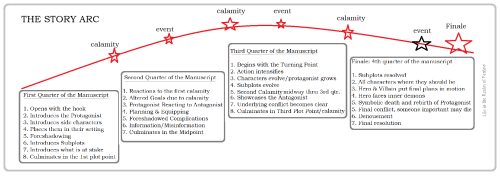
Pay close attention to the story arc. Large chunks of exposition flatten it, pushing the plot point back, and the reader may give up. Once you have your rough draft complete, measure the tale against the blueprint of the story arc.

  • Where does the inciting incident occur?
  • Where does the first pinch point occur?
  • What is happening at midpoint? Are the events of the middle section moving the protagonist toward their goal?
  • Where does the third plot point occur?

short story arc

It’s not important to have written a novel. Whether you write short stories or 700-page doorstops, you are an author.  It is, however, extremely important to have written well. A powerful, well-written novella can be a reading experience that shakes the literary world:

  1. A Christmas Carol, by Charles Dickens
  2. Breakfast at Tiffany’s, by Truman Capote
  3. Candide, by Voltaire
  4. Three Blind Mice, by Agatha Christie
  5. The Strange Case of Dr. Jekyll and Mr. Hyde, by Robert Louis Stevenson
  6. The Time Machine, by H.G, Wells
  7. Of Mice and Men, by John Steinbeck
  8. The Old Man and the Sea, by Ernest Hemingway
  9. Animal Farm, by George Orwell
  10. The Turn of the Screw, by Henry James

8 Comments

Filed under writing

#amwriting: Midpoint in the Character Driven Novel

LOTR advance poster 2Some novels are character-driven, others are event-driven.

ALL novels follow an arc.  For my personal reading pleasure, I prefer literary fantasy, which has a character-driven plot. Events happen, often in a fantasy setting, but the growth of the characters is the central theme, and the events are just the means to enable that growth.

You may have built a great world, created a plausible magic system or, conversely, you may have created an alien world with plausible technologies based on advanced scientific concepts. You may have all sorts of adventures and hiccups for your protagonist to deal with. All that detail may be perfect, but without great, compelling characters, setting and action is not reason enough for a reader to stick with your story.

Despite your amazing setting and the originality of your plot, if you skimp on character development, readers won’t care about your protagonist. You must give them a reason to stick with it.

In a character driven novel, the midpoint is the place where the already-high emotions really intensify, and the action does too. From this point on, the forces driving the plot are a train on a downhill run, picking up speed. There is no  turning back now. The characters continue to be put to the test, and the subplots kick into gear.

Of course, plotting and pacing of your entire story arc is critical, but it is especially so from midpoint to the third plot point.

As you approach midpoint of the story arc, the personal growth for the protagonist and his/her friends begins to drive the plot. These are the events that tear the hero down, break him emotionally and physically so that in the final fourth of the book he can be rebuilt, stronger, and ready to face the villain on equal terms.

How does the protagonist react to the events? What emotions drive him/her to continue toward the goal?

In a character -driven novel, this is the place where the protagonists suffer a loss of faith or have a crisis of conscience. It may be a time when the main character believes they have done something unfair or morally wrong, and they have to learn to live with it.

What personal revelations come out about the protagonist, or conversely what does he discover about himself?

This part of the novel is often difficult to write because the protagonist has been put through a personal death of sorts–his world has been destroyed or shaken to the foundations. You as the author are emotionally invested in the tale and are being put through the wringer as you lay it down on the paper.

What has happened? Remember, the protagonist has suffered a terrible personal loss or setback. Perhaps she no longer has faith in herself or the people she once looked up to.

  • How is she emotionally destroyed by the events?
  • How was her own personal weakness responsible for this turn of events?
  • How does this cause the protagonist to question everything she ever believed in?
  • What makes her pull herself together and just keep on going?
  • How is she different after this personal death and rebirth event

LOTR advance posterThe truth underlying the conflict now emerges. Also, the villain’s weaknesses become apparent. The hero must somehow overcome her own personal crisis and exploit her opponent’s flaws. It’s your task to convey the hard decisions she must make, and show that she truly does have the courage to do the job. The villain has had his/her day in the sun, and they could possibly win.

This low point is a crucial part of the hero’s journey, the place during which she is taken down to her component parts emotionally, and rebuilds herself to be more than she ever believed she could be.

At this point in the novel, if you have done it right, your reader will be sweating bullets, praying that Frodo and Sam can just hold it together long enough to make it to Mt. Doom.

2 Comments

Filed under writing

#flashfictionfriday: The Cat, the Jeweler, and the Thief (reprise)

The Cat, the Jeweler, and the Thief was  written during November 2015 and first published here in May of 2016. It is one of my favorites because it has possibilities. Another story could be in Scuttle’s future! Anyway, as it is once again November and I am madly writing new fiction, I offer you this little morsel of merriment:


Barliman gazed at the statue of the cat, and then out the polished window, not seeing the passersby. His eyes turned back to the stylishly dressed thief who stood before him. “It’s a nice enough  statue, well-made. What makes it worth the amount you are asking?”

Scuttle smiled. “It’s more than merely well-made. It’s brilliant. Look at it—have you ever seen such detail rendered in marble?” Thin, with a face slightly resembling that of a pleasant, well-favored weasel, he kept his desperation tightly tamped beneath a business-like demeanor.

Scuttle’s lady, Mari, was so ill that an ordinary herb doctor wouldn’t do. Their landlady believed she had contracted river fever and insisted only a healer from the Church could resolve it. But the Church never healed the poor; only the wealthy could afford a Church Healer. For that reason, Scuttle had to have those coins. He put on his most persuasive voice. “This is a miracle of art, created in marble. The hand of a master freed this cat from the stone.”

“I agree it’s beautiful, but I doubt you came by it honestly. I will be limited in who I can resell it to. Who made it? If I can at least tell a prospective purchaser whose hand created it, I will understand its value, and be better able to get a fair price for it.”

Scuttle snorted. “A fair price…usury has no concept of ‘fair.’ But all right, I’ll tell you who I believe to have made it. Benevolio.” Raising his hand, he forestalled Barliman’s comment. “I have no proof, and there is no maker’s mark on it anywhere.” Picking up the statue he held it to the light, turning it to reveal the remarkable craftsmanship. “Look at the face. Each hair, each whisker, every feature is there in the most minute detail, as if a cat had turned to stone as it sat there. Even soles of the paws which can’t be seen unless one picks the statue up–only Benevolio himself could have created such a masterpiece.”

Silence reigned in the shop as Barliman digested that comment. He pulled his magnifier from his pocket and examined the life-sized statue inch by inch. Scuttle had expected he would, and occupied himself with calculating the value of the objects displayed in the shop. Silver tea services, gold-handled cutlery, delicate jewelry set with precious stones—all rested on dark velvet in glass cases, gleaming in the light cast by wide diamond-paned windows. The fact they were on display meant those items had been purchased from more reputable sources.

The thief had come to Barliman because the jeweler sometimes supplied the wealthier class with things they could acquire nowhere else. Scuttle was a “discreet thief,” a man who ordinarily only stole on commission. However, the cat had been liberated from the house of a prosperous merchant newly in town, something he had only done because of Mari’s illness. The fact he was there in person to sell the statue indicated to the jeweler that this had been a private matter, making Scuttle’s bargaining position perilous. The jeweler was his only resort–no one else would have given him a copper for the statue, much less what he needed.

What Mari needed.

Barliman set the cat back down on the counter. He replaced the magnifier in the pocket of his vest. “With no maker’s mark, I can’t guarantee authenticity. That will substantially lower the price I can get for it. Therefore, I can’t give six golds coins. Three is my offer–consider, it please. It comes to three months wages for an ordinary man.”

“Five would be less than fair for a statue of this quality, and you would still make an absurd profit. If you can’t offer five, I must withdraw it.” Scuttle had no idea what he would do if Barliman refused. He didn’t dare take the time to go all the way to Westerberg. Three days there and back—Mari would be dead before he returned.

Barliman pursed his lips, deliberating. “Five golds, then.”

Though he felt like dancing, Scuttle comported himself with dignity as the coins were handed over. Barliman placed the cat statue beneath the counter and bowing, the thief departed the shop.

>>><<<

As the door closed behind the thief, the curtain behind the jeweler whisked open. Cardinal Valente stood framed in the doorway. “Good.” The Cardinal’s acidic tones fell like lead in the shop. “Here is your five golds, plus fifteen more for your trouble.”

Barliman handed Valente the heavy, marble statue. “Whose hand created this cat?” he asked. “Even Benevolio could never have done such fine work.”

Instead of answering, the Cardinal set the statue on the counter. “Observe.” He muttered some incomprehensible words, passing his hands over the cat.

Fantasy Desk With Books And Scrolls © Unholyvault | Dreamstime.com

To Barliman’s surprise, the statue stretched and yawned, then stood up and jumped down. Twining about the Cardinal’s ankles, the cat purred.

“God’s hand created this cat. A spell turned it to stone, and I placed it in the home of my concubine. Then I allowed rumors of its existence to come to Scuttle’s ears.”

Barliman could not conceal his dismay. “Why? Was it to trap him? He has…skills. He’s useful, and not only to me. Imprisoning him would be bad for my business.”

“He is indeed useful. However, a personal matter  interfered with my thief’s ability to gain an artifact I must have. He needs coins to resolve the issue but he is not a man to ask for charity, and I am not known for my generosity. Hence, I devised a way for him to help himself.” The Cardinal laughed, a grating sound. “By the day after tomorrow at the latest, my thief will resume the important task I have set before him, and soon I will have my artifact.” A sly smirk lit his bony features. “And now I know what matters most in the world to my thief, and where to lay my hands on it if I should ever need a bargaining chip. That knowledge alone was worth twenty golds. Never forget this: knowledge is power, Barliman. It’s good to be the one with the knowledge.”


The Cat, the Jeweler, and the Thief © Connie J. Jasperson 2016 All Rights Reserved

4 Comments

Filed under writing

#amwriting: choosing an effective writing group

MSClipArt MP900390083.JPG RF PD

As it is November, and I am attending a lot of write-ins with people just beginning their writing careers, I am frequently asked if I am a member of a writing group. I am, but it is not a traditonal group, by any means. We are all published authors and are more of an author-support beta-reading group. But what the new author is asking, is how to find a group that will be a good fit for them. To answer that question, I am revisiting a post from March of 2015, originally titled “Critique groups vs beta reading groups.”


Every writer needs honest, constructive feedback in order to grow in their craft. Many will join critique or beta reading groups. These groups come in all sorts and sizes, some specializing in general fiction and some in genres like mystery, science fiction, fantasy, or romance.

Most communities have clusters of authors—after all, nowadays everyone either is an author or has a couple in the family . In your community you will find groups for beginners, or some that cater to more advanced crowds. I guarantee there will be one to fit your needs.

We’ve all heard the horror stories regarding critique groups, and perhaps even experienced one. Making a poor choice in writing groups can be devastating—it can undermine a budding author’s confidence and destroy a person’s joy in the craft. The seas are rough out there but many writing groups are really good, supportive gatherings of authors who stay for years and welcome new authors into their group with open arms.

Other groups can be cliquish, unwelcoming, and daunting to new arrivals. Authors just beginning to explore this necessary part of the craft will not come back to one of these groups if they were given the cold-shoulder the first time.

I suggest that you sit in on a group in your area. Do not offer your work on the first time, but do take notes, paying special attention to these points:

  1. Do they treat the submitted work with respect, or do they nitpick it to shreds?
  2. Do they allow discussion of a critiqued work or is the author supposed to sit there and silently take the punishment?

hazing-definitionIf the latter is the case, that group is engaged in a subtle form of hazing, more than in critiquing. Thank them for allowing you to sit in, and walk away from them.

There is a difference in types of writing groups, too. Some are traditional critique groups, people who usually read a few pages aloud at their sessions and discuss it in detail in a round-table fashion. This sort of focus can be just right for some authors, especially those in the final stages of making their manuscript submission-ready.

Because traditional critique groups focus only on 3 or 4 pages at a time, they lack the context to be able to discern if your protagonist has developed sufficiently along his character arc by the first 1/4 of the tale. However, they can tell you if you have made editing errors, and discuss small points of technique within those few pages, which you can then apply to the overall manuscript.

This is an important aspect of the process, but is not always the kind of input an author is seeking.

The one flaw these sorts of groups have is they don’t have the ability to properly critique the larger picture—pacing, overall story arc, worldbuilding, character development, and on, and on–because these things can only be judged in larger context. So if, like me, that is the sort of input you are looking for, my advice is to find a beta reading group.

Critique groups cannot do what beta readers can.

But how do you select a group? Before you join a writing group, you have the right to know what that group focuses on.

A beta reading group will focus on these questions:

  1. Where did my chapter bog down?
  2. What did they think about my characters?
  3. Where did they get confused and what did they have to read twice?
  4. Did it become unbelievable or too convenient at any point?
  5. What do they think will happen to the characters now?

Then after you have sat in on one of their sessions and observed how they treat each others’ work, ask yourself, “What kind of vibes did I get from this group of people? Will I benefit from sharing my work with this group? Did the comments they made to each other sound helpful?” Hopefully, the answer to those questions will be a resounding “yes.”

If the answer is anything other than a resounding “yes,” run now. Run far, far away.

Red Flags to Watch For:

There are common negatives to watch out for in all writing groups: If you have stumbled into a group where the most visible member is a self-important, read-all-the-books-on-writing-so-I-know-it-all kind of a person, don’t bother joining or you’ll be subjected to many accounts of how their writing group in Minnesota was so much better than this pathetic group.

Another author you might watch out for is the ubiquitous Famous-Author-Name-Dropper, a person who must be important because she has been to a great many seminars and conventions with these famous people, and hung out in the bar with one of them once. If it turns out she is in your prospective group, it may not be the group you are looking for. Sometimes they are the same person, sometime not, but either one of these wannabe-famous authors are poison—in their eyes the group only exists to admire them, and they will casually cut your work to shreds, dismissing it as merely amateur in the face of their “professional” experience.

When you are considering joining a group, ask the leader/chairperson these questions:

  1. If the group is a beta reading group focused on first drafts, what do they consider a first draft? Do you have to hire an editor and have it thoroughly edited before you submit it to this group? I say this because a fully edited manuscript is not a first draft, and that group would be a waste of your time.
  2. Will you receive insights into your manuscript on points you hadn’t considered, or will the focus of the discussion centered on minor editing issues that you are already aware of?
  3. Ask the leader to define for you the specific areas that readers will be looking at:
  1. Character development,
  2. pacing the arc of the scene,
  3. pacing the arc of the conversation,
  4. worldbuilding,

So let’s say you have found a group who seems to a good bunch of people, and yes, they read and write in your genre. You trust them enough to submit your first piece to the group. After the session is over, ask yourself:

  1. Do I still feel positive about my work or do I feel like my work was treated as being less than important?
  2. Did I gain anything from the experience that would advance the plot or did I just hear a rehash of arm-chair editing from a wannabe guru?

that which does not kill meThe answers to these questions have to be that you feel good about your work, that you saw through their eyes the weaknesses, and that they can be fixed.

New authors join writing groups feeling a great deal of trepidation, filled with uncertainty and fear. They fear being belittled and told their work is crap, and sometimes that happens. At the end of the day, you have to feel as if you have gained something from the experience.

Hopefully you will be as fortunate as I have been, and find a group of beta readers you can mesh with, people who will support and nurture you in the same way that you will them.


This post was first published March 2, 2015, under the title “Critique groups vs beta reading groups” by Connie J. Jasperson

7 Comments

Filed under writing

What reference guide is right for what I #amwriting?

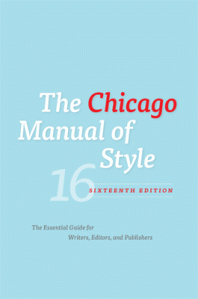
The_Chicago_Manual_of_Style_16th_editionNovember is a difficult month for me because I have a specific goal to accomplish, and I’ve set the bar high. It’s National Novel Writing Month and I have many activities involved with that. I need to add writing time to my already packed schedule, attempting to rebuild my stockpile of short fiction and essays, and am letting everything else fall by the way to do it. Trader Joe and the Microwave are providing my husband with hot meals because I have been known to forget to cook.

For my NaNoWriMo project this year I am writing a variety of short pieces, some technical essays on writing craft, some essays on life and travel, and some short fiction. I am writing for three different markets and we will get to why that distinction is important a little further on.

I’m on the road a lot, and have limited time to get my wordcount. Sometimes I get two or three pages of writing done in the 20 or 30 minutes before I have to leave the house for an appointment. There is something about the pressure of knowing I will have to quit at a certain time that forces me to be more productive than I would ordinarily be.

Why is this? When I am pressed for time I use every second to get those ideas out of my head. I don’t have the luxury of stopping to research grammar and questions of style on the good, old, time-wasting internet. Instead I refer to hardcopy reference manuals, unless I absolutely must go out to the internet to research something.

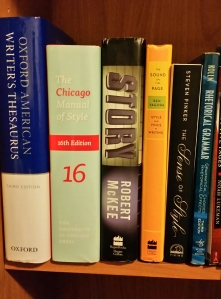
Some references have to be in hardcopy, such as The Chicago Manual of Style, which is the most comprehensive style guide geared for writers of essays, fiction, and nonfiction. Strunk and White’s Elements of Style is an acceptable beginner style guide, but the information there must be looked at with a critical eye as it is presented in an arbitrary, arrogant fashion and sometimes runs contrary to commonly accepted practice.

Instead I always recommend The Chicago Manual of Style to authors who are writing fiction they someday hope to publish, and who want to know about sentence construction. The researchers at CMOS realize that English is a living changing language, and when generally accepted practices within the publishing industry evolve, they evolve too.

Writing is not a one-size-fits-all kind of occupation. There is no one style guide that will fit every purpose. Each essay and book may be meant for a different reader, and each should be written with the style that meets the expectations of the intended readers.

The Chicago Manual of Style is written specifically for writers, editors and publishers and is the publishing industry standard. All the editors at the major publishing houses own and refer back to this book when they have questions.

micosoft-manual-of-styleWhat is the best style guide for writing technical user manuals?

Are you writing for a newspaper? AP style was developed for expediency in the newspaper industry and is not suitable for novels or for business correspondence, no matter how strenuously journalism majors try to push it forward. If you are using AP style you are writing for the newspaper, not for literature. These are two widely different mediums with radically different requirements.

For business correspondence, you want to use the Gregg Reference Manual.

If you develop a passion for the words and ways in which we bend them, as I have done, you could soon find your bookshelf bowing under the weight of your reference books.

Some of my best ideas have come about under a time crunch.  Normally when I am writing on a stream-of-consciousness level, I can key about fifty words a minute, which I know is paltry compared to today’s authors who grew up keying their homework rather than writing it in cursive.

ozford-american-writers-thesaurusI do admit that just because I can key those words does not mean they will all make sense, or be worth reading. That is why we are driven to look at what we just wrote the day after we wrote it. Did it say what I meant? How many times did I use the word “sword” in that particular paragraph and where am I going to find six different alternatives for such a unique weapon? Sword? Blade? Steel? After all, an epee is not a claymore, nor is it a saber. Any reader with a small amount of knowledge will know that, so I have to be careful what synonyms I use. My characters swing a claymore-style of sword which is rarely referred to as “steel.” In literature, that term is more commonly used for epees and rapiers.

It’s a jungle in my head sometimes, and my ancient  student edition of Roget’s Thesaurus is no longer my friend. But neither is the modern, online version cutting it. I need more synonyms. Lots, and lots more! Thus I have the Oxford American Writers’ Thesaurus on my desk and I refer to it regularly. It saves time to use the hardcopy book rather than the internet because I am not so easily distracted and led down the bunny trail of “Wow! I never knew that!”

All in all, I like the way being forced to produce words in a short time helps me lay down a rough draft. But I admit, I do look forward to the end of November, when I can look back on my accomplishments and go back to my normal writing routine of wasting time on the internet researching important things like the life cycle of sand dollars. Who knew those little creatures were so intriguing?

2 Comments

Filed under writing

#flashfictionfriday: The Iron Dragon

Because it’s November, and National Novel Writing Month is in full swing, I am reposting a story I posted in April of 2016. This story was actually written during NaNoWriMo 2015. If you’re curious as to my word count, feel free to click on the image to the upper right, the one that says NaNoWriMo Participant. In the meantime, enjoy  The Iron Dragon.

Leaf_Decoration 1_clip_art_small


Earl Aeddan ap Rhydderch turned his gaze from the mist to the strange iron road that emerged from it, and then to where the road entered the cave. “Tell me again what happened.”

The peasant who had guided the earl and his men said, “The mist, the iron road, and the cave appeared yesterday, sir. We saw the beast entering its lair, and a fearful thing it is, too. No one dares approach it, but the monster can be heard in there. It’s a most dreadful dragon — we found the carcass of a large wolf that had been torn to shreds, trampled until it was nigh unrecognizable.”

The man’s companion said, “Everyone knows wolves are Satan’s hounds. It must have angered its hellish master. We found it lying cast to one side of the Devil’s Road.”

Aeddan looked back to the iron road, seeing where it emerged from the mist. He walked to the low-hanging fog bank, seeing that the road vanished just after it entered the mist, leaving no marks upon the soil. He turned and strode back to the peasants. “I agree it’s the work of the Devil, but why does the Lord of Hell require an iron road that leads nowhere?”

A faint grumbling sounded beneath Aeddan’s feet. “A light! Look to the mist!” shouted one of his men.

Turning, Aeddan saw a white glow forming in the fog as if a large lamp approached from a great distance. “That’s no ordinary lantern. Mount up!” Moving quickly, he leaped into his saddle and turned his steed to face the demon. He freed his lance from its holster and settled it in the arret attached to his breastplate under his right arm. His fingers fumbled as he struggled to fasten the grapper, but at last it held firm. The peasants, knowing they were no match for whatever approached, had run for shelter up the hill.

The light deep within the fog grew and strengthened, as did the rumbling noise.  It waxed brilliant, and the earth shuddered as if beneath the pounding of a thousand hooves. Smoke filled the night air, reeking of the sulfurous Abyss, combined with a howling as cacophonous as the shrieks of all the damned in Hell.

Dragon-Linda_BlackWin24_JanssonWhat emerged from the mist was impossible — an Iron Dragon of immense height and girth.

“Courage men! For God and King Gruffydd!” His bowels had turned to water, but Aeddan and his men stood firm in the face of the demon, sure that death would be their reward.

The fiery light emanating from the burning maw lit the night, and the ground shook as the beast roared and raced ever closer. As the beast sped toward him, a burning wind blowing straight out of Hell knocked Aeddan and his horse to the side of the Devils Road and using that opportunity, the Iron Dragon thundered past him, heading into its lair.

Stunned, Aeddan scrambled to his feet, staring as the length of the beast passed him by, the body taller than a house and long, like an unimaginably giant, demonic centipede. The length of the beast was incomprehensible, lit by the fire within and glowing with row upon row of openings. The faces of the damned, souls who’d been consumed by the ravening beast peered out as they flashed by. Sparks flew from its many hooves.

Terrified his men would be crushed by the immense creature he shouted for them to back off, his voice drowned by the din.

Abruptly it was gone, vanished inside its lair. In the sudden, deafening silence, Aeddan wondered how such a thing could possibly have fit into the cave. Yet it had done so, and other than the stench of its passing, there was no sign of it.

He remounted and settled his lance in the holster beside his stirrup, then turned to his men. “Rouse the village. We must seal its lair with stone and mortar. We may not be able to kill it, but at least, we can stop it from marauding and decimating the countryside.”

>>><<<

Mist shrouded the small valley just outside of the village of Pencader. Engine Driver Owen Pendergrass looked at his pocket watch and opened the logbook, noting the time and that they had just departed Pencader Station. He said to the fireman, Colin Jones, “We should be approaching the tunnel, though it’s hard to tell in this mist. We’re making good time despite the fog. We’ll be in Carmarthen on schedule.”

“Sir! Look just ahead! What…?” Colin pointed ahead.

A group of mounted men dressed as medieval knights, complete with lances lowered as if prepared to joust, appeared out of the mist, attempting to block their path. “God in heaven — what next!” Blowing the whistle to scare them off the tracks, Owen pulled the brake cord, but there was no way the train could stop soon enough. In no time at all, the train was upon the knights, scattering them and blowing past. Owen looked out the window, to see if they’d survived, but they were gone as if they’d never been.

“Vanished,” said Colin. “Like the ghosts when we passed through here yesterday.”

Hiding his trembling hands, Owen shook his head. “It was a close call, but no harm was done. We’ll not be mentioning this to the authorities, eh? Not after the way our report was received yesterday. It’s a haunted valley, but it’ll do us no good to mention it to anyone important.”

Colin agreed and turned back to fueling his fire, shoveling coal as if he could work the fear out of his mind.

The connecting door opened and Harrison, the chief steward, entered. Pendergrass told him the same thing, and the old man agreed. “We got in enough trouble at the yard yesterday for mentioning the ghosts. I’ll go soothe the passengers.”

“Tell them it was just the mist and the dark playing tricks on their eyes.” Owen shook his head and glanced out the window, seeing they had emerged from the tunnel into a clear, cold evening and would soon be at the next stop, the village of Llanpumpsaint. “Playing tricks indeed.”


“The Iron Dragon” © 2016 Connie J. Jasperson, All Rights Reserved

(first published Apr. 1, 2016 on Life in the Realm of Fantasy)

Art: Dragon By Linda BlackWin24 Jansson [Public Domain], via Wikimedia Commons

1 Comment

Filed under #FlashFictionFriday, Dragons, Fantasy, Literature

#amwriting: #nanowrimo momentum

2016-placeholder-book-cover-smallWe’re on Day 2 of NaNo 2016. I’ve written two short stories totaling 11,605 words, 80% of them misspelled, but I won’t worry about that until January. I admit I was hoping to have written four, but I’m still on track to make 50 short stories and flash fictions by the end of November.

Some people are already behind, but all is not lost.  Get caught up now and go forward by adding a few extra words every day.

Habitual behavior, or ‘daily routine’ goes unnoticed because we don’t engage in self-analysis when undertaking routine tasks. Thus, writing daily is easier once it becomes a behavioral habit.

Consider smoking.

Smoking is a behavioral habit as much as it is a physical addiction. Smokers trying to quit always tell me they don’t know what to do with their hands. When they first started smoking they trained themselves to do “the cigarette ritual,” shaking the cigarette out of the pack, lighting it, holding it, and exhaling the smoke with their own style each time they went outside.  They did this ritual every time they lit up their cigarette, and now their hands have “nothing to do.”

If breaking certain habits is difficult, creating new, more positive habits is also tough. Behavioral patterns we repeat become imprinted in our neuro-pathways, so repetition of positive behaviors is necessary to make the behavior automatic. Wikipedia, the Fount of all Knowledge, says this:

“As the habit is forming, it can be analysed in three parts: the cue, the behavior, and the reward. The cue is the thing that causes the habit to come about, the trigger of the habitual behavior. This could be anything that one’s mind associates with that habit and one will automatically let a habit come to the surface. The behavior is the actual habit that one exhibits, and the reward, a positive feeling, therefore continues the “habit loop”.[13] A habit may initially be triggered by a goal, but over time that goal becomes less necessary and the habit becomes more automatic.”

In his November 3rd, 2013 blog post for Creative Writing Guild, Rob Blair says:

“Studies on habit formation have found that extra willpower is almost never sufficient for getting a new habit to stick. What does seem to work is an intervention that looks like this:

  • Write out the details of what you want the new habit to be. (In your case, it’s going to be writing 1,667 words per day.)

  • Plan the details of how and where you will be engaging in the new habit. Be as concrete as you can be.

  • Plan a “trigger” for when you will start doing the new habit. How will you know it’s time to start writing? This can be a specific time, but I’ve found it’s better to choose a point in your normal daily routine where you can insert the new habit. (e.g., “After pouring coffee but before changing out of my PJs.)

  • Write a list of the pitfalls, detailing what’s most likely to go wrong. What’s prevented you from writing in the past? Did you get busy? Did you sleep in? Did you “feel uncreative”? Be honest with yourself, and get your normal traps and tribulations on the page.

  • Write a response plan for each pitfall. This can be something complex, but research has found that even simple response plans (e.g., “I’ll remind myself this is writing time and I can sleep in come December”) are astoundingly effective. (end quoted material.)

I like what Rob has to say about doing a small intervention to short-circuit self-defeating habits, but remember such effort only works if you are honestly committed to the project. He also offers a great deal of other useful advice in that article, so I highly recommend you read his post in its entirety.

But what I really believe is that you will succeed in developing the habit when you write something you are really fired up about. When you are passionate about a story, the words will flow. Find that moment in your daily routine when you can insert a new habit, put pen to paper and begin writing!

The best thing about stream-of-consciousness writing is you don’t take the time to over-think things. You write it as you think it, and the word count grows as if by magic.

I’m using this time to write short stories, but just as if I were writing a nano-novel, I will be done writing at the end of November. I will take a break from this project until January and then, over the course of the next year I will be pulling these rough drafts out of the 2016 NaNoWriMo file and polishing them up.  That is when I will worry about what is wrong with these little stories, and implement plot adjustments. Right now, I am just writing it as I think it, warts and all.


Reference Sources:

6 Steps for Nailing the First Week of NaNoWriMo, published November 3, 2013, on http://www.creativewritingguild.com · by Rob Blair

Wikipedia contributors, “Habit,” Wikipedia, The Free Encyclopedia, https://en.wikipedia.org/w/index.php?title=Habit&oldid=747213739 (accessed November 1, 2016).

2 Comments

Filed under NaNoWriMo, writing

#amwriting: #NaNoWriMo Jump Start

NANO CrestIf you are doing NaNoWriMo this year, you’re quite busy right now and don’t have time to read a long post. So, here are a few quick tips and resources to help get your novel off the ground:

Tips:

  • Never delete, do not self-edit as you go. Don’t waste time re-reading your work. You can do all that in December when you go back to look at what you have written.
  • Make a list of all the names and words you invent as you go and update it each time you create anew one, so the spellings don’t evolve as the story does.
  • Write 1670 words every day – 3 more than is required (to account for differences in how your word processing program and NaNoWriMo’s official word counter validates wordcount – you don’t want to come up short at the end! This has happened and is quite frustrating.

If you are writing a story set in our real world and your characters will be traveling, walking a particular city, or visiting landmarks, bookmark google maps for that area and refer back to it regularly to make sure you are writing it correctly.

If you are writing about a fantasy world and your characters will be traveling, quickly sketch a rough map and refer back to it to make sure the Town names and places remain the same. Update it as new places are added. This is all you need:

sample-of-rough-sketched-map

If you are writing fantasy involving magic or supernatural skills, briefly draw up a list of rules for who can do what with each skill. Remember:

  • Magic with no rules is both impossible and creates a story with no tension. No one wants to read a story where the characters have nothing to struggle against.
  • Each character should have limits to their abilities. Because they are not individually all-powerful, they will need to interact and work with each other and with the protagonist. They will have to do this whether they like each other or not if they want to win the final battle or achieve their goal. That will provide openings for some great interactions.
  • This gives you ample opportunity to introduce tension into the story. Remember, each time you make parameters and frameworks for your magic you make opportunities for conflict within your fantasy world, and conflict is what drives the plot.

Resources to Bookmark:

Three websites a beginner should go to if they want instant answers in plain English:

Most importantly – enjoy writing that novel. This is time spent creating an amazing story only you can tell, so above all, enjoy this experience.

4 Comments

Filed under NaNoWriMo, writing