#amwriting: The Query Letter

My Writing LifeEvery author, indie or traditionally published, comes to a point in their career where they must craft a query letter. For many, avoiding having to do that is one of the reasons they went indie in the first place.

Most editors and publishers want a 1 page, 300-word description of your novel. They want the hook and the essence of that novel in 2 paragraphs, and they want to get a feel for who you are. Both aspects of this 1-page extravaganza must intrigue them. Every editor and agent has a website detailing the way they want queries submitted. In general, they want letters/emails that follow a certain pattern, and that basic format is readily available via the internet.

The www.NYBookEditors.com website has this to say about query letters: “You must walk a very fine line between selling your manuscript without coming across like the parent who knows his kid is the best player on the bench.”

That, my friends, is more complicated than it sounds. Of course, we are firm believers that what we wrote IS the best player on the bench. I’ve always known that about my children and my books!

Anyway, back to the query letter. I’ve attended several seminars on the subject and written many of them. I’ve had good results and also bad results with mine. The best place I have found with a simple description of what your query letter should look like is at the NY Book Editors website.

In essence, what they tell you is this:

  1. Format your letter this way:
  • Your address at the top of the page, right justified.
  • The agent’s address, this time left justified.
  1. Use a personalized greeting where you acknowledge the agent or editor by name.
  2. Keep the body of your query letter to three to five paragraphs.

The 1st paragraph is where you introduce yourself. If you have a connection with the agent or editor you are approaching, say you met at a convention or seminar, or you are a fan of one the authors they represent, mention that. Briefly.

If you have no previous connection, NY Editors suggest you get down to business right away with your attempt to sell your book. Their point of view on this is that you only have a few paragraphs to sell your book, so make those words count.

In the 1st paragraph are the 3 most important things to include:

  1. Title
  2. Genre
  3. Word count

The 2nd paragraph must give a brief description of the work—showcase the plot, and show why you think it is a good fit for this agent/editor. Do this in one paragraph, and don’t give it the hard sell.

The 3rd paragraph should be a quick bio of you, your published works, and whatever awards you have acquired. If samples of your work are available on your website, say so.

This is most important: don’t forget to double-check your letter for typos and spelling errors. We all make them and we don’t want them to be our legacy.

As I have said, my luck with queries has been uneven. I think query letters are like ice cream—you just have to cross your fingers and hope your query arrives on a day when the person in question is in the mood for a story exactly like what you are selling.

Query letter image

2 Comments

Filed under Publishing, writing

#amwriting: holding indies to a higher standard

Hamlet Poster Benedict CumberbatchI haven’t been able to read as much lately as I normally do and I miss it. However, time spent editing for clients and then trying to write has seriously cut into my ability to read. When I am editing for a client, I can’t disengage my mind from that mindset, which means I have a terrible time reading for pleasure. In fact, I haven’t written a book review in months. Lately, I am lucky to read two or three pages before falling out of the book. Thus I have been reading poetry and resorting to audio books.

When I am in an editing mindset, I notice things a casual reader might not, and I can’t just enjoy the book. And I am not talking indies here—I mean books published by the Big 5 traditional publishers. I keep finding things they could have phrased more actively, or should possibly have cut. These are things an average reader will never notice, and are examples of why authors must have a thick skin.

Typos and editing mistakes are pretty much taken for granted when left in mass-market paperbacks by the Big 5 Publishers, but woe to the indie who neglects to notice a repeated ‘and’ or any other editing error. Also, the Big 5 publishers are allowed to take questionable chances with “style,” such as Alexander Chee did when writing The Queen of the Night, allowing lazy habits we indies could never get away with.

I was unable to actually read the book, as it must have been too tiring for him to use closed quotations to indicate dialogue. The reader has no idea someone is speaking until they’re halfway through a conversation, and have to re-read it. I loved what I could read of it, so I had to resort to the audio book, which was the only way I could get through it.

As an editor, it’s incomprehensible to me why an editor for a large publisher would accept a manuscript that is as annoying as that one flaw makes this otherwise remarkable book.

It is also proof that large publishers (Houghton Mifflin Harcourt in this case) are just as guilty as indies when it comes to making strange decisions that can negatively affect sales. They may have done this to elevate it to a “status” read, a must-buy literary name-dropper for those who wish to appear fashionably cultured. If so, it’s a disservice to work that is brilliant despite a flaw that would be fatal if it were to appear in an Indie author’s work.

However, though we can’t take avant garde chances with style, indies DO get to take chances with content, writing and publishing stories that traditionally published authors most likely wouldn’t be allowed to do. If a book might not sell, it won’t be published by a large publisher, because that is what they are in the business to do. However, once an indie has a best seller with a plot the Big 5 would deem sure to fail, traditional publishers will leap on it and the market will soon be glutted. (Can you say Fifty Shades of Grey?)

George R.R.Martin bormatting issue 1 via book blog page views, margaret ebySometimes the errors and flaws in the work sold by the traditional publishing houses are hilarious, as we saw in the first Kindle edition of George R.R.Martin’s A Feast For Crows. That was a formatting error, not an error on Martin’s part, so some poor intern probably got raked over the coals for it, as the book had to be pulled, reformatted, and republished as quickly as possible.

The thing is, errors do creep into even the most carefully examined texts and manuscripts. Usually, no one dies from it, but sometimes there are consequences, as in the case of the infamous Wicked Bible. The publishers paid a hefty price: Robert Barker and Martin Lucas, the royal printers in London, were fined £300 (£43,586 as of 2015) and deprived of their printing license.

Indies are held to a far more rigid code by most readers than the traditional publishers are because the internet is rife with disparaging rhetoric pointing the finger at us. And while the Big 5 traditional publishers are just as guilty of rushing-to-publish unreadable crap, the truth is, many new self-published authors haven’t yet gotten the hang of the publishing business, and often their books are rife with things they will later wish they hadn’t been so eager to publish.

Having learned my own lessons the hard way, I have made changes in how I review my own work. Besides working closely with a professional editor, I now have a solid group of friends who comb my completed manuscripts for errors and gross cut-and-paste errors. We can only hope we have caught them all. When you are an indie, it takes a village to help you get your book fit for the public to read.

Anyway—my editor’s hat is firmly on my head these days, and that means I can’t enjoy casual reading for a while more. This mindset slows my own writing output to nearly nothing because I am stupidly self-editing instead of just letting the words flow.

When I am editing I am looking for all varieties of mistakes–not just structural, grammatical, and glaring punctuation errors. I am also looking for things that will interfere with formatting the final manuscript for upload to Kindle or Smashwords, and I hope I find them all for my client, but it makes writing my own work challenging.

joyce corrections on his msAs an editor, I do my best. But, nothing is ever sure, and I won’t see the manuscript after I send my client the final suggested corrections. Mistakes can be made right up to the last minute while the client is making those adjustments, so someone else will have to proof-read her work.

Remember, you, as the author, have the responsibility for the final eye on your manuscript. So when my client has finished making revisions, she will have her posse check the manuscript over for the slings and arrows of publishing fate.

I will be done with my current editing project soon, and I plan to take a break from editing for a short while when that happens. Then I will let my mindset slide back into the joy-of-reading mode. I look forward to resting my editorial mind and over-indulging in the work of my many favorite authors.

5 Comments

Filed under Self Publishing, Uncategorized, writing

#flashfictionfriday: Beyond Ecola’s Door

Heaven lies beyond the hills, beside the Tillamook Head.

At Ecola’s door, where the river finds the sea,

Where east meets west and seabirds nest, my feet are often led.


Gray waves pound the stony cliffs, stout and standing tall

Rock is strong and water soft,  yet crumbling ‘neath the waves.

Winter’s wrath of wind and surge slowly grinds them small.


And out to sea a lighthouse stands beyond the Tillamook Head

No keepers shelter ‘neath her lamp, Tilly stands alone,

Guarded by the white-winged birds, and ashes of the dead.


Black rock rises from the waves, beyond Ecola’s door

I long to be at river’s edge, where Ecola meets the sea

And soon and soon, I’ll walk the sand, along the wild shore.

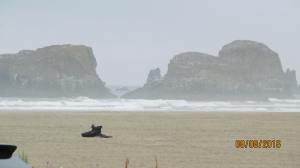
horses on the beach, Cannon Beach, Oregon by C.J. Jasperson 8-13-2014


Beyond Ecola’s Door, © Connie J. Jasperson 2016

4 Comments

Filed under #FlashFictionFriday, Politics, Uncategorized

#amgaming: Review of Stargazer, by Amaranth/John Wizard

Stargazer screen shot 3I spend a certain amount of time playing computer games, especially when I am trying to avoid doing any serious writing. And just like the books I read when dodging work, I love to talk about whatever game I’m playing. Today I am reviewing Stargazer, which was published in 2015.

I love old-school, indie-built, computer Japanese-style RPGs, and Stargazer, created by John Wizard in association with Amaranth, is one of the best games I’ve played in years. I’ve played it through four times over the last year, setting Aura’s magic up differently each time, and have not run across any glitches or bugs. Yay for that!!!

Magic no longer exists in the world, but Zach, stargazer and dreamer, doesn’t really believe that. The game begins when a meteor falls from the sky, and Zach goes to investigate it. He manages to avoid the Chancellor’s goons and discovers a girl who is suffering from amnesia. She thinks her name is Aura. There is an instant attraction there, and Zach is smitten. Their adventures begin, and they meet Scarbeck (a detective) Thyme (a healer) Grayson (a noble, but scary, knight), Kala, (has magic and rides a Firewing bird) and Amelia Mae (a 14-year-old genius).

Their romance is sweet, but not without stumbling blocks. There is no doubt how Zach and Aura feel about each other, but as for Thyme and Grayson…it’s a rocky road to the altar. And, in true Amaranth fashion, unless all the right criteria are met throughout the game, you won’t gain attraction points, and there will be no weddings.

The story line is a good fantasy story with a great quest, and the dialogue is hilarious, rife with snark and sarcasm.The art and graphics are excellent, colorful and highly detailed. Each setting is fun to roam around in. If I have any complaint, it’s the amount of walking back and forth over the same ground that one has to do to complete the many tasks, but that’s a minor irritation–the story keeps it interesting.

Stargazer screen shot 2The dungeons are difficult but not impossible, and the puzzles are challenging. The creatures are fun, and some are hard to beat, but you do gain strength, so nothing is impossible. You do have to be careful with the gold in order to get the best armor and weapons, as there are no goodie caves or secret weapons/armor stashes, although you can gain some good armor and weaponry in treasure chests.

Shybeard’s ship and Mala (the Firewing Bird) are delightfully hokey in an enlarged SNES Super Mario kind of way. Hawkeye is the lone graphic that is pretty much indecipherable.

The final battle is fun, and if you have met all the right criteria and gained enough attraction points for the two marriageable couples, you will get two weddings at the end. Or not, but either way, it’s a great game.

This is a terrific way to spend 25 or so hours, as there are over 200 puzzles and side quests to complete, all of which advance the story.

Amaranth and John Wizard are my 2 favorite indie RPG game makers, and they have lately collaborated with each other on several other games. Built using RPG Maker, their games are reminiscent of the old Enix/Square Soft games, for the Super Nintendo with strong story lines and fun side quests. They are as much fun as The Legend of Zelda, or Chrono Trigger or any early Final Fantasy game ever was.

Stargazer screen shotStargazer is available from John Wizard, or Aldorlea, or on SteamThis game is not for sale on the Aveyond.com website, which is what Google queries for Amaranthia redirect to. Amaranth has undergone some serious changes over the last year and their website is no longer the fun place it was, although gamers and indie game creators can still meet and discuss gaming and game creation in some limited forums.

I am not sure what to make of that—even though the John Wizard site redirects Stargazer questions to Aveyond, there are no forums there to discuss Stargazer, and the game does not appear on their website.

Regardless of that mystery, I give Stargazer 5 full stars, with no reservations whatsoever—I love this game.

2 Comments

Filed under Final Fantasy, Game Reviews, Games

#independenceday: celebrating diversity

800px-John_C._Dollman_-_The_immigrants'_ship_-_Google_Art_ProjectToday, July 4, 2016, is celebrated as Independence Day, here in the US. Yet, though my family left their homes in dear old Mother England, we still feel that bond, that familial connection.

My father’s side of the family came to America from Herne Hill, Canterbury, England in 1630, sailing on the Winthrop Fleet, and ended up in Massachusetts.

My mother’s side came from Laugharne, Carmarthenshire, Wales right around the same time, and ended up in Virginia. Somehow, fortunes were made and lost, generations passed, and my grandparents ended up in Olympia, Washington.

Hó-ra-tó-a,_a_BraveWhen you look back far enough, every person in this country is an immigrant. The Native American tribes and First Nations peoples came first, across the waters and across the land bridges. This was their land for thousands of years. But we who claim European, African, and Asian ancestry are all recent immigrants. We are only here because our parents and grandparents found a place where they could raise their family in relative safety, and forced their way in. Some were brought here against their will, but stayed, hoping to find a better life. It wasn’t easy, and those times were difficult.

We are decent people, trying to live good lives. Individually, we don’t see ourselves as exclusionary or cruel. We believe in the greater good, and because we do, change will come. The face of America will evolve.

800px-4th_of_July_(2008)_fireworks_over_Seattle_(3)Immigrants have always come to America and always will, and they will be a part of what makes this nation a good place to live. We will find common ground because this is a small planet in a large universe, and right now, we have nowhere else to go. Change and growth are never easy, and there are always some who would hold back, fearing the unknown.

Today America celebrates its independence from Great Britain. Today we celebrate our diversity.

6 Comments

Filed under writing

#amblogging: trying to get the word out.


windows dialogue box 6 dude are you sureIt’s hard to gain readers when you first begin to blog. The reason we write is so people can read our work, and if we have a limited audience, we feel a little defeated in our efforts to gain readers.

Because we want to gain readers, it’s necessary to use every platform available to get the word out and WordPress offers us many opportunities to do just that. On the dropdown menu to the left of your Blog title, under the words “My Sites,” click the dropdown menu.

In that menu, scroll down to “sharing” and click on it. that will take you to the “Sharing Settings” page. Click on the button that says “Publicize Settings.”

That will open a list of what I think of as blog warehouses, places that collect blogs and offer them to their regular readers. You want to activate as many of them as you can.

My blog automatically post to Path, Stumble Upon, Tumblr, Google+, Networked Blogs, Facebook, and Twitter, and each one of those venues has increased my readership.

I don’t normally post on Saturdays, but I am trying a new (to me) thing called Bloglovin, hence the html in the first paragraph of this post–they want you to put their code in a new post. As my blog automatically posts in a variety of different places, I figured it would confuse people if I posted a blog that just had their code in it, so I am bringing you all along on this journey!

Bloglovin is not in the WP publicize menu yet, so you have to go out to their website and try to follow their instructions, which I am doing at this moment. I will keep you all posted on how that goes, and we will see whether my readership increases or not!

.
Edit: Okay–the html at the top of the post didn’t work, because: WordPress. SO what I did was, I downloaded their logo, got the link to my Bloglovin Page, and linked that to the logo image. Now, when a person clicks on that logo, they will go directly to my page there, where the follow button is right at the top.

We will see how this works!

Comments Off on #amblogging: trying to get the word out.

Filed under blogging

#amreading: Night Watchman Express by Alison DeLuca

Alison DeLuca HeadshotOne of my dear friends is author Alison DeLuca, who is the main driving force behind Myrddin Publishing.  Alison is the idea woman, and has the follow-though needed to successfully run the equivalent of a small publishing house these days.

Alison is a superwoman. Not only does she guide 25 authors through the wild west of indie publishing, she is the mother of an active pre-teen, a working author and blogger, and is one of the finest editors I know.

My husband and I share 5 children, and so we have “a passel” of grandkids, as my grandma would have said. While I generally write books more geared for adult readers, Alison has written a young adult Steampunk collection of books, the Crown Phoenix series.

She has written several other novels, and numerous short stories more geared for mature readers, and if there is one thing I can say about Alison, everything she writes is classy and well-crafted.

I am always looking for good, challenging books for my grandkids to read, ones that will keep their interest and stretch their minds, so I was thrilled when I met Alison and discovered her young adult work.

night watchman expressThe first book of hers that I ever read was the Night Watchman’s Express. I loved this book. The story never stops moving until the last page. Miriam, an unhappy young girl is orphaned when her wealthy industrialist father dies. With no other family, her father’s business partners, the Marchpanes, become her guardians. The Marchpanes immediately move into Miriam’s house, and take over her father’s rooms. (Mrs. Marchpane is deliciously evil.) They make their attempt to gain full control of Miriam’s money and her father’s company.

Gradually, Miriam begins to find common ground with the Marchpane’s son and their other young ‘guest’ when a nanny, who is both wise and skilled in certain magics, is hired. Mana is a woman who is of a race of people, who are considered to be second-class citizens, and contrary to the Marchpane’s hopes, she turns out to be exactly what both Miriam and the two boys needed.

There is a reluctant camaraderie that develops between Miriam and the two boys. The three of them do a certain amount of exploring the grounds of the estate, and discover a strange machine that her father has constructed. Another interesting thread is also Miriam’s strange emotional attachment to her father’s typewriter-like machine, which she has claimed for her own since his death, and keeps hidden in her room.

This book was so good for a rainy-weekend read that I read it twice. And guess what? It’s currently a free download for your Kindle, but if you are into paper, it also available in that format for $12.99.

This month, Alison is participating in The #BigBookGiveaway, which starts today, July 1st. For avid book lovers, this is an awesome deal! Sponsored by Girl Who Reads, two boxes of books donated by multiple authors and publishers will be given away through Rafflecopter, and the link to enter that contest is here: #BigBookGiveAway via RafflecopterJust click on that link and it will take you to the contest page, and you too could end up with a large box of books to while away your summer with, and Alison DeLuca’s Night Watchman Express is only one of them.

Christmas O'clock 2013Girl Who Reads is a great resource for avid readers like me, as it’s a website where you can find balanced book reviews, many of them indie books. Books are being offered in this giveaway by many wonderful authors, several with larger publishers, such as Penguin Books and Random House. Alison is also including a copy of Myrddin Publishings children’s’ anthology, Christmas O’Clock.

I did pen one of the stories in that collection, a little thing called A Christmas Tail.  I loved writing that tale—I was in a Toad Hall mood apparently, and Ratsy’s adventures with his friends are reminiscent of that wonderful series of tales.

Alison is one of the easiest people to work with I’ve ever known. We began this publishing adventure in the summer of 2012 as refugees from a bad publishing situation, and while it was rocky in the beginning, we have never regretted our decision to go indie. Our publishing cooperative began with a great group of authors who were all as committed to the indie way as we are, and every year we have gained new authors who bring new ideas and new fire to our collective. Alison is the glue that binds us together.

You can find Alison and more of her work here:

Facebook: http://www.facebook.com/alison.deluca.author

OR http://on.fb.me/TNWEfb

Twitter – http://twitter.com/ – !/AlisonDeLuca

Google + http://bit.ly/ADGoogle

Amazon Author Central:  http://amzn.to/ADeLucaAuthorCentral

Pinterest: http://pinterest.com/alisondeluca/

4 Comments

Filed under Books, Fantasy, Literature, Self Publishing, writer, writing

#amblogging: why authors should blog, take 3: the vegan

avacado dinner salad

my favorite avocado dinner salad

One of the things I love most about writing is this blog. I have made so many friends though this little place on the internet. Blogging offers me the opportunity to riff for several hundred words on any subject I’m interested in, without interruption. Of course, I’m usually only interested in writing-craft, but this is where I come to discuss it.

Nothing improves your writing chops more than writing every day. Deadlines can be daunting but say what you will about not being able to write under pressure—I think that is when I do my best work.

And, today I don’t feel like talking about writing. I want to discuss food! As many know, I am vegan, but my descent into veganism was (sadly) not motivated by any high moral prohibition against animal cruelty. There is a certain amount of that, but it was always there in the the way I purchased food for my family. During the 1980s, much of our meat we raised ourselves, cage free, free range chickens, and sheep raised in traditional farming methods.

However, I have developed an auto-immune variety of arthritis that is triggered by meat and dairy–all forms of it. Whenever I go off my diet (and cheese is the big draw) I pay the price. So, I stay on my vegan diet and I feel good.

I have discovered a wonderful resource for amazing, healthy, vegan food: the internet.

I know! It’s not just for Facebook and online gaming.

There is information out there, and it’s all in blogs. One of the best sites for me is called The Minimalist Baker. Today the main picture on their site is a gorgeous image of peppers stuffed with cauliflower rice. That image is eye candy. I will definitely be making some form of this recipe.

Oh my gosh! That website, and the recipes Dana and John have put together are just amazing. I use more of their recipes as the basis of my own cooking than from any other website or book.

Changing your diet is difficult, because you have to change your habits. Sometimes you have to change the flavors you love, and learn to like new ones.

And if you are just starting out and can’t afford to buy cookbooks, the internet offers an incredible wealth of free information, and much of it in the form of blogs by people like me.

I love to eat as much as I love to read, and I could easily talk for hours on either subject. If you are passionate about a particular subject, a blog is a great place to talk about it. It brings together people with similar interests, and for a writer, blogging is crucial, as it gets your name out there. Blogging shows people you can write well, and blogging regularly forces you to be creative.

If you want to know more about getting your own blog up and running, see my post of December 14, 2015, Blogging is Writing TooThis post talks about how to use the new default system here at WordPress so that you can insert pictures and make a nice looking post.

  • Keep it down to about 1000 words more or less.
  • Use the spellchecker tool to look for obvious errors.
  • Write in draft form and don’t publish it right away–come back and read it over again, and make corrections.
  • If you use information found elsewhere, quote it and credit the author
  • Use images that are either public domain, or that you have the right to use
  • Put links to other informative sites in the text
chocolate chip cookies, vegan

chocolate chip cookies, vegan and yummy

Rule number one: be consistent. I began by blogging once a week on a now defunct site—but my actual posts were more often made only once or twice a month. I dreaded it and didn’t want to do it. My blog stats were in the tank because I wasn’t applying myself to it.

It’s a commitment, and authors are procrastinators, but we can write to deadlines when we have to, and it’s good for us.  Now I am writing three posts a week on this blog, and at least one post a week for each of several other venues. I spend Sundays putting my blog posts together, which I couldn’t do if I was still raising children, but you only need to blog once a week to keep your content fresh. Writing this post took me about 45 minutes, so that is a small time commitment.

But just like a healthy diet and a walk in the fresh air, a change of writing scenery is good for you.

6 Comments

Filed under blogging, writing

#amwriting: evoking a sense of place

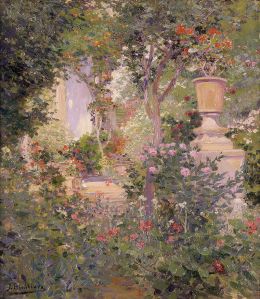
800px-El_jardí_de_l'autor,_Josep_Benlliure_Gil,_Museu_de_Belles_Arts_de_València

The Garden of the Author, by José Benlliure Gil via Wikimedia Commons

Summer has officially arrived here in the Pacific Northwest. This is a time when I can take my notepad out on the back porch, enjoying the garden and, to a certain extent, people watching. I love my back yard and my porch, feeling as if the heart of my home is there.

My work involves creating worlds and making them real to the reader. All the worlds I write about are a composite woven of my personal experiences and places that I love.

My town is a tiny place, slightly more than a village, and less than a city. Historically it is a mining town. Three things kept my town alive during hard times: the sandstone quarry, the coal mines, and timber. Now it’s a bedroom community for Olympia, the capital city of the State of Washington.

I’ve been here since 2005, and although I love my small house and garden, I don’t really fit into this community, which is probably my fault. Most of my writing groups are in Olympia, and my favorite places are in that city too. But I have a “soul-home,” which is comprised of the places that had the most profound meaning to me in my life. My soul-home is made up of three places that I have lived, which have all had a profound effect on me.

One part of that soul-home is Seattle. I lived there until I was 10, and went to West Woodland Elementary School.Our house was in Ballard, an urban community of fishermen who spent most of their time fishing in Alaska, and who were first-generation Norwegians. Everyone, including my family, was Lutheran, which was a cultural thing as well as religious. In the late 1950s to the early 1960s, Ballard was a small town within the big city, and the kids in my neighborhood were close-knit.

Seattle and the greater Puget Sound area is one component of my soul home, mainly because of the many immigrants whose cultures made it what it is today. The Pacific Northwest and Seattle, in particular, is a fusion of Asian, Norwegian, Native American, and hardy sons and daughters of the pioneers who came from all over the world seeking a better life. We are a unique mix and happy to be so.

In Seattle, music takes on a life of its own, and the world listens. Wikipedia has a page that lists all the famous musicians who came out of Seattle, and it’s pretty impressive. You can check it out here.

Music, art, and literature are celebrated in Seattle, and the influence the city has on Pacific Northwest culture is felt all up and down the Puget Sound region. I was fired to write my own books by reading the works of local area authors like Frank Herbert, Greg Bear, J.A. Jance, Terry Brooks and so many, many more Northwest authors. The Puget Sound region is a breeding ground for creativity, and Seattle is where it comes together.

Amaranthus and Savvy at the needles by haystack rock cannon beach 2012

But I am also a product of many summers spent in Cannon Beach, Oregon. I love that place so much that it is another piece of my soul-home. Terry Brooks and Ursula K. LeGuin are also fans of the North Oregon Coast, as are many famous musicians and actors. Something about it calls to the wilder side of me, and it seeps into my work.

But the primary portion of my soul-home came into my life when I was ten, and my family moved to Olympia, to a home on Black Lake. We moved from a nice, large, two-story home in a middle-class neighborhood to a tiny, rundown, ranch-style vacation house miles from civilization. It was cold and damp in the winter, and cool and pleasant in the summer. The house was barely livable, but the property was what my parents moved there for: the 350 feet of waterfront and the sandy beach, with forested land going back 5 acres to the county road. Dad was a WWII vet, and fishing was his greatest hobby.

The first thing I saw the day we moved there wasn’t the lake, although it was impressive. It was the Black Hills that dominated my view—black and forested with cedars, firs and hemlock, and rising high over the other side of the lake, they dominated the front windows. The many moods of the lake were out there for us all to see every minute of every day. You knew what going to happen by the direction the wind was coming from.

I hated it. I was torn from everything I knew, thrust into a world where I had no friends, and didn’t know my way around. Nevertheless, after the first, terribly difficult months of adjustment, I grew to love my Black Lake home, relishing the rural privacy and the deep connection to nature we formed, without our knowing it. When I left home, I carried a piece of it in my heart, and it will always be with me. My contemporary literary fiction is usually set there, with the bits and pieces I loved so much about that home forming a memory that shines, and I am able to give that place to my readers.

Just as my world, and the place I think of as my home was created by many generations of immigrants and pioneers filled with hope and the dream of a better life, so are most other cities and cultural centers.

The sense of place you instill into your work is the sure knowledge of where it is and what it represents to the protagonist. If you are crafting a world that doesn’t exist, as I have done with most of my work, you must make it real. Take some of what you love about your home, your town, and your culture, and write it into your work.

The knowledge of place is created in the reader’s mind by subtle cues, small descriptions, minor mentions over multiple scenes. A few words, little references to the background setting give the reader a framework upon which his imagination will build the rest.

Terry Brooks’ world of Shannara is real in his mind, because he lives there, just as Neveyah is real to me for the same reason. Both worlds have evolved from the reality and landscape we live in and love so much, yet they are radically different, both from each other and from the Pacific Northwest. They are composites of our imaginations, made real by our experiences.

Haystack_rock_monochromeWhen you write a novel or an essay, whether it’s fiction or non-fiction, the setting is how you create the sense of place, and must be a creation of many layers:

  • Place: where the protagonist lives, whether in the city, a village, a wandering life with no fixed address, or a farm in the countryside
  • Landscape/Terrain: mountainous, forested, high desert, seaside
  • Culture: in many stories, broad hints of what passes for political systems, the influence of religion, and the amount of respect accorded by society to music and art.

None of these layers will be overtly discussed or described at length in your work unless it is part of what creates the tension and drives the plot. But you, as the author, must know and understand these components as if they were your soul-home. That knowledge will come across in your work via small cues, and your readers will have a firm picture of the world in which your work is set.

4 Comments

Filed under writing

#flashfictionfriday: Hope in the Desert of Plenty

Sunset_in_Dubai_desert_12I dreamed of a green oasis, and woke this evening, feeling disoriented at the normality of our desert home. A little voice in my head kept saying this is wrong, this is not how it’s supposed to be. The voice was mistaken because this is how it is, and what it is.

Grandfather frequently moans that it wasn’t always this way, blaming this and that technology we can no longer use, but it doesn’t matter. Yes, I remember those days, and maybe it’s not supposed to be, but it’s life, and we live with it.

At sunset, I went out to work in the garden and found the wind had blown the muslin sun shield off the dandelions. I replaced it, but don’t know if they were harmed by the direct sunlight. The wind usually rises later in the day, so perhaps they weren’t exposed to too much. I don’t know what will happen if they don’t make it.  I do have plenty of the leaves dried and have saved every seed, but fresh greens are essential, and dandelions are the faithful greens that produce all year round and keep us alive no matter what happens to the other vegetables.

Other plants frequently fail when the temperature reaches the high 120s. With luck, we’ll get one more crop of beans harvested before the rains.

The Himalaya blackberries are covered with small berries and with constant care they might survive the drought. The berries are a staple, lending sweetness to our food and blackberry wine makes life pleasant. They’re also attractive to the wasps that pollinate our crops, so we desperately need them.

But it’s been a hard, hot year, and even the Scotch broom, which we’ve come to depend on for everything from fuel, to building materials and fibers for cloth, is struggling. Hopefully, I’ll have enough water to keep the plantation alive. My fog traps have grown steadily less productive, as they do every year at the peak of the heat, but we’re not going thirsty yet.

Water is an issue, but when is it not? It’s always darkest before the dawn, someone once said. I like to think of it as “driest before the monsoon.” November is coming, and the downpour will begin, those brief weeks of dangerous weather and devastation, fearfully clinging to hope we won’t be washed away in the floods.

But this year, if we make it through the winds, it will be a blessing and not a catastrophe. Yes, it’s too much water all at once, but we’ve adapted. Where we once lived on the ground, we have raised our shacks on tall stilts. Our dandelion, blackberry, and broom plantations are situated on high, raised platforms, with muslin sun filters, as are our goat pens. I know, it seems odd when for eight months out of the year there is no water for many miles, but we’re safe from the wildcats and feral dogs, and they can’t get to our goats. The wild rabbits can’t destroy our farms.

Our village of twenty families has survived when the others failed because we learned how to shield our crops from the both the broiling sun and the punishing downpour with sturdy awnings. This year, the moment the rain stops, we’ll be more than an island of shacks on stilts in a shallow sea. This year we will become an oasis.

Every year until now, we’ve struggled to save that water, as within a month the sea becomes large puddles and within another month we’re left with scant barrels of water and our fog traps to get us by for the rest of the year.

This year we’re prepared for the monsoon, and will be able to save the runoff in a cistern. It’s impossible to labor outside during the day, but we spent our chilly nights building it, covering it with soil to insulate it from the heat, so it resembles a small, perfect hill. We lined the interior with fired ceramic tiles, and made sure every roof is pitched and has gutters to channel the water into it. This last year there was no rest for the wicked, as they say, but it will be worth it. Next year we won’t have to choose between thirst and watering the livestock and plants.

Grandfather is filled with doom and gloom, but not me. Next year will be a year of lush gardens, of cool, sweet blackberry wine at sunrise when the work-night has ended. Next year all our babies may survive.

Next year.

Comments Off on #flashfictionfriday: Hope in the Desert of Plenty

Filed under #FlashFictionFriday