#amwriting: the point of no return

Epic Fails memeIn life we often find ourselves boxed into a corner, frantically dealing with things we could have avoided if only we had paid attention and not ignored the metaphoric “turn back now” signs.

Imagine a road trip where you are sent off on a detour in a city you’re unfamiliar with. Imagine what would happen if some of the signs were missing, detour signs telling you the correct way to go, and also a one-way street warning sign.

At some point before you realized the signs had been removed, there was a place you could have turned back. Unaware of the danger, you passed that stopping point by and turned left when you should have turned right, and found yourself driving into oncoming traffic on a one-way street.

That safe place where you could have turned around before you entered the danger zone was the point of no return for your adventure. Fortunately, in our hypothetical road-trip no one was harmed, although you were honked at and verbally abused by the people who were endangered by your wrong turn. You made it safely out danger, but you’ll never take a detour again without fearing the worst.

In literature what is the point of no return? Scott Driscoll, on his blog, says, “This event or act represents the point of maximum risk and exposure for the main character (and precedes the crisis moment and climax).”

Epic fantasy, which is what the novels in my Tower of Bones series are, generally features a plot driven by a chain of events, small points of no return, each one progressively forcing the protagonist and his/her companions to their meeting with destiny. These scenes of action form arcs that rise to the Third Plot Point: the event that is either an actual death or a symbolic death, but which forces the hero/heroine to be greater than they believed they could be.

For me, in a gripping story, the struggle may have been fraught with hardship, but the actual point of no return is the event that forces the ultimate showdown and face-to-face confrontation with the enemy.

What if you aren’t writing epic fantasy? This series of “arcs of action” driving the plot comes into play in every novel to some degree—the protagonists are in danger  of losing everything because they didn’t recognize the warning signs, and they are pushed to the final confrontation whether they are ready for it or not.

During the build-up to the point of no return, you must develop your characters’ strengths.  Identify the protagonist’s goals early on, and clarify why he/she must struggle to achieve them.

  • How does the hero react to being thwarted in his efforts?
  • How does the villain currently control the situation?
  • How does the hero react to pressure from the villain?
  • How does the struggle deepen the relationships between the hero and his cohorts/romantic interest?
  • What complications (for the hero) arise from a lack of information regarding the conflict, and how will he/she acquire that necessary information?

800px-Singapore_Road_Signs_-_Temporary_Sign_-_Detour.svgCalamity and struggle create opportunities for your character to grow, so it is your task to litter your protagonist’s path with obstacles that stretch his/her abilities and which are believable. Each time he/she overcomes a hair-raising obstruction, the reader is rewarded with a feeling of satisfaction.

It doesn’t matter what genre you are writing in: you could be writing romances, thrillers, paranormal fantasy, or contemporary women’s lit—for all fiction, obstacles in the protagonist’s path make for satisfying conclusions. I say this because the books I love to read the most are crafted in such a way that we get to know the characters, see them in their environment, and …uh ohh…. Calamity happens, thrusting the hero down the road to divorce court, or trying to head off a nuclear melt-down. Sometimes our hero finds himself walking to Naglimund, or to the Misty Mountains with nothing but the clothes on his back.

Calamity is the fertile ground from which adventure springs, and most calamities are preceded by a point of no return. Identify this plot point, and make it subtly clear to the reader, even if only in hindsight.

8 Comments

Filed under writing

#amwriting: point of view

Xpogo_RioA young author recently asked me, “What is head-hopping and why has my writing group accused me of doing it?” Headhopping occurs when an author switches point-of-view characters within a single scene, and happens most frequently when using a Third-Person Omniscient narrative, in which the thoughts of every character are open to the reader.

It’s difficult to know whose opinions are most important when all your characters are speaking in your head as you are writing. They clamor and speak over the top of each other, making a din like my family at any holiday dinner. But you must force them to take turns speaking, and make a real break between the scenes where the speaker changes, or each rapid shift of perspective will throw the reader out of the story. But what is Point of View other than the thoughts of one or two characters?

Point of view is a common literary term which some authors are a little unclear on. Remember, books, stories and literature in general, are a window through which readers look at the world. The way they see through that window, is though the eyes of the narrator: the point of view.

Writers direct their readers’ attention to the details, opinions, or emotions they want to emphasize by manipulating the point of view of the story, writing the narrative in one of three different ways: first-person, second-person, or third-person.

First-person point of view is fairly common, and is told from one protagonist’s personal point of view. It employs “I-me-my-mine” in the protagonist’s speech, allowing the reader or audience to see the primary character’s opinions, thoughts, and feelings. Remember, it is told from the view and knowledge of the narrator, and not of other characters. You ,as the author, must remember that no one has complete knowledge of anything. Thus, your protagonist cannot be all-seeing and all-knowing. The reader will find out the information as the protagonist does, which can be engrossing.

So I know I am right not to settle, but it doesn’t make me feel better as my friends pair off and I stay home on Friday night with a bottle of wine and make myself an extravagant meal and tell myself, This is perfect, as if I’m the one dating me. ~~ Gone Girl, by Gillian Flynn

Second-person point of view, in which the author uses “you” and “your,” is rarely found in a novel or short story. It is, however, commonly used in guide books, self-help books, do-it-yourself manuals, interactive fiction, role-playing games, gamebooks such as the Choose Your Own Adventure series, musical lyrics, advertisements.

For an author attempting to use it in fiction, it’s tricky to get right, so it doesn’t come off like a walkthrough for an RPG and for this reason, authors rarely speak directly to the reader in this way. However, it can work well, if the author is smart and really understands what they are writing. Successful use of Second Person POV can be found in: Jay McInerney’s Bright Lights, Big City (1984)

“You are not the kind of guy who would be at a place like this at this time of the morning. But here you are, and you cannot say that the terrain is entirely unfamiliar, although the details are fuzzy.”

Third-person point of view provides the greatest flexibility to the author and thus is the most commonly used narrative mode in literature. In the third-person narrative mode, each and every character is referred to by the narrator as “he,” “she,” “it,” or “they.” Third-person point of view is that of an outsider looking at the action, an invisible third person describing the events.

  1. The writer may choose third-person omniscient, in which the thoughts of every character are open to the reader, or third-person limited, in which the reader enters only one character’s mind, either throughout the entire work or in a specific section.
  2. Third-person limited differs from first-person because while we see the thoughts and opinions of a single character, the author’s voice, not the character’s voice, is what you hear in the descriptive passages.
  3. The Flâneur (idler, lounger, loiterer.) This is traditionally a form of third person POV, but I like to think of it almost as a fourth POV. Many of you have heard of it as third-person objective or third-person dramatic.

James Wood, author and literary critic, discusses this in the New Yorker (Books section Feb 28, 2011) in his review of Teju Cole’s Open City. Wood writes: …we also need a flâneur to see interesting things in the city, and to notice them well, and (Teju) Cole’s narrator has an acute, and sympathetic, eye. Sometimes he is witty and paradoxical, in a way that recalls Roland Barthes. Watching a park full of children: “The creak-creak of the swings was a signal, I thought, there to remind the children that they were having fun; if there were no creak, they would be confused.”

The flâneur is a voice that observes and comments but without actually becoming a character, a witness to the events. There is a downside to using the flâneur as your vehicle to convey your narrative:

  • He is not reliable—he has his own personality, offering subtle judgments and unconscious opinions on the behavior of the characters. Therefore, just as in a first-person narrative, the reader cannot be sure he is telling the unbiased truth.
  • The narrator  tells the story without describing any of the character’s thoughts, opinions, or feelings; so the reader can only guess at character motivations, and must assume the objective observer truly is objective and has told the truth in that regard.
  • It separates the reader from the intimacy of the action and slows the pace down.

Authors know what every character they are writing is thinking, and sometimes feel compelled to write from every character’s viewpoint. First we’re in Joe’s head, and then we are in Mary’s–rather like watching a tennis match. It’s critical that we don’t jump from head to head within a scene, as that will knock the reader out of the narrative and we don’t want that.

Joe’s experience can be explored and Mary’s can too, but make a solid break, or begin new chapter before you switch to Mary’s viewpoint. If a different character has something to say that is important to the narrative, I give them a separate chapter, even if it is a short one. That way my readers are not too confused about who is making the observations.

Remember, we avoid head-hopping and mental whiplash by not changing characters and point of view mid-scene.

10 Comments

Filed under writing

#flashfictionfriday: October Sky

Louis_Français-CrépusculeIt had been the coldest October I could remember. Rafts of ice floated up and down the lake, blown by the winds, breaking up and re-forming as if dancing a ballet. The leaves had been off the trees since the end of September, almost as if they couldn’t fall fast enough.

It was in the last, quiet hour before sunset when the real beauty of my rustic lake home was revealed to me. The sun drifted its way behind the hills as the wind died off to nothing. The lake became a mirror reflecting the pink-blue-purple-gold of the sky and the deep green of the evergreen forested hills. It was a green so deep that it appeared to be black.

I would sit at my frozen picnic table with a steaming mug of coffee warming my hands, watching the snow geese and the western grebes. Only the voices of the loons and the geese pierced the blanket of peace I had wrapped about myself.

When the colors had faded, and I could no longer feel my fingers, I would go back into the house and stoke up the fire, still in the thrall of the lake’s spell. Then, only when I had absorbed the tranquility of my lake, would I pick up a brush and enter my world of canvas and color.

On the first morning I saw the naked trees stark against the incredible sky, I knew I had to somehow capture the power. Attempt followed attempt and soon my house was littered with the “almosts.” The bones of the trees were right, but the essence of the sky was missing. Each night I worked longer and more feverishly until one day I realized that I had to back off and gain some perspective.

And so it was that in the small hours before dawn one morning I put away the brushes and paints, and covered the canvasses, frustrated by my inability to capture the essence of the lake and the sky that was mirrored in it. Exhausted, I fell into my bed drained and unable to concentrate, yet sleep escaped me. My mind was filled with the loons and the trees and their sky.

At last, knowing it was futile to try to sleep I rose and made myself tea. Wrapping a blanket about myself I walked out to my small sitting room to watch the trees greeting the pale dawn. The warmth and fragrance of the steaming cup of tea made me feel rested as my bed never had, and the familiarity of the ritual soothed away my frustrations.

The serenity of the moment deepened, a sense of sacredness pervaded the garden. Willingly, I gave myself to the experience, allowing the essence of the moment to seep into my soul.

The air felt strange, alive and crystalline, and the trees beckoned to me. I could feel them calling me to come out and greet the sun with them, and bemused, I answered their call. Stepping outside, still wrapped in my blanket, I walked through the frozen grass, until I was in the orchard among the trees on the shore of the lake.

Looking west to the black-forested hills, I held my breath, overcome by the feeling of anticipation that infused me. Something told me I stood on the verge of an event, vast and unfathomable, though what it could be I couldn’t imagine.

Gradually I realized that the ground was vibrating, and had been for a while, shaking as if a giant walked nearby. As I became aware of the vibrations beneath my feet, a deep rumbling began to penetrate my reverie, shattering the peace. The unfamiliar thunders grew louder with every moment, and the birds fell silent as if waiting to see what approached.

Huddling nervously in my blanket, my eyes were drawn to the north and there, emerging from the mist I saw machines—great, huge, monstrous machines I had no words to describe. They came slowly and relentlessly down the middle of my lake. The waters rolled and boiled around them as they passed me by, paying me less attention than they did the trees. The ice floes broke and tipped crazily, riding the waves that danced about the giant treads.

The line of machines continued south, grinding through the swamp, going I knew not where and coming from where I could not imagine. As they came, the waters grew, and waves began splashing at my feet and then my knees. At last, realizing that I was in trouble, I turned and raced for the higher ground and the safety of my house.

Still the waters rose, following me, and still the machines came rolling down from the north.

I closed the door and stood to gaze out the window at the rising waters and the monstrous machines that continued their unrelenting journey south. The waters rose, and my house began swaying, creaking and groaning under the water’s assault.

I fell to my knees praying to the God I didn’t believe in, but he wasn’t listening.  My house shook and rocked, and lifted with the rising water, turning slowly as if to say goodbye to the lake and the hills to the west. Dishes and furniture careened off paintings and walls—my life in small objects passing before my eyes. I looked, disbelieving, through the shattered windows and saw the inconceivable sky spinning around like a child’s top spins.

I covered my head, and screamed my prayer, but the only answer I received was the sure and profound sound of breaking glass and furniture shattering.  At last, when I believed it would never stop, the floor I clung to gave a great lurch and the noise of destruction stuttered into silence, a silence every bit as loud as the din had been.

Throwing back my blanket, determined to get out of the wreckage while I could, I saw the last of the machines going south into the broken swamp. The trail they blazed through the marshland was a great scar that would never heal, and I wept at the sight of it.

I surveyed the damage to my home with stunned eyes. My house was now perched all askew upon a slight rise that had been perhaps fifty feet behind it before. Everything I had ever owned was now in full view of anyone who might choose to make a leisurely visit to my remote home. Every item of clothing, every bit of dish, smashed or whole, everything dangled from the branches of the broken trees, displayed everywhere.

Despite the carnage, the sky hung pink-blue-purple-golden and unchanged while the naked trees made lewd gestures with my most personal of possessions. The ridiculousness of the situation penetrated my shock, and I began laughing, and falling to my knees I laughed until I couldn’t breathe. Eventually, my laughter became sobs, and I howled until I was spent.

The silence was too much, making me intensely aware of my frail mortality. Stepping through the rubble, I gathered my canvasses, paints, and brushes. Miraculously my easel was untouched, and so I did the only thing I could think of.

I painted the pathetic wreck of my house reflected in the perfection of the lake and the hills.

I painted the obscene trees against the incredible sky as they proudly displayed the debris of my life.

And then I painted those awesome machines as they paraded past me, not realizing that I was there and not caring.

When I was done, three paintings leaned against my ruined fireplace. Exhausted, I found my bed and righted it. Crawling into it I finally fell asleep, resting dreamlessly.

When my eyes opened, I was disoriented. I awoke in my bedroom and looking around, I could see no signs of the previous day’s events. In disbelief, I went to the kitchen and found all my kitsch and accumulated knick-knacks still to be there, whole and in their tasteless entirety. There were no broken dishes, no broken furniture.

Awed and amazed at the power of the dream I had just experienced I set about preparing my breakfast. “Idiot,” I muttered, still feeling rather giddy. I wondered what my sister would say when I called to tell her about it.

Making a cup of coffee, I went to sit by the window in the sitting room.

As I passed the fireplace I froze. Three pictures leaned against the uninjured hearth.

One was of obscene trees decorated with my personal possessions, silhouetted against an incredible sky. In the second picture, my sad house perched askew on the hill, broken and sad, framed by the astounding sunset.

And the third picture was a terrifying image of gigantic, grotesque machines tearing up my lake, plowing through the swamp with the waters roiling wildly about the monstrous treads, beneath the sky that had eluded my skills until that night.

Even I had to admit that the power of the paintings was overwhelming.


October Sky © Connie J. Jasperson 2016 All Rights Reserved

Written circa 1992 and originally published On Wattpad, December 2012

Republished on Edgewise Words Inn, April 2015

8 Comments

Filed under #FlashFictionFriday, writing

#amwriting: the struggle is the story

A point that was raised on another blog I follow is something many authors struggle with: devising the complicating events that raise levels of risk for the protagonist, and also for the antagonist. A compelling story evolves when the antagonist is strong, but not omnipotent. The protagonist must also be stronger than she thought she was, but still not omnipotent.

Small hindrances must occur between the larger events, frustrating the journey. These things delay the protagonist, and sometimes send them down the wrong path, but as each is overcome the reader feels a small sense of satisfaction. Following the protagonist as he/she is negotiating these detours is what makes the story captivating, in my opinion.

If you have a story of any length, short or long, you can’t have people sitting around idly chit-chatting. Conversations must have a purpose, and be designed to advance the plot. Information emerges that the protagonist (or antagonist) must know. The reader discovers this at the same time as the characters.

Better You Go Home Scott DriscollIn the literary novel Better You Go Home by Scott Driscoll, Chico Lenoch, a Seattle attorney, is desperately ill and needs a family member to donate a kidney. None of his family members here locally are suitable donors. He has always wondered about his family in the Czech Republic, which his father won’t discuss, and has recently discovered he has a half-sister still living there. He journeys there to find his sister, and in the process, he unearths the secrets his father and mother left behind. As each terrible secret is revealed, hindrances arise. Danger, political fallout, personal vendettas, and a growing concern for his sister conspire with Chico’s failing health to keep him from achieving his goal.

If the path had been easy, Chico’s story would have been an exploration of a man with a problem, but not real exciting. Because of the roadblocks, it’s a taut thriller, and his journey comes to an unexpected and electrifying conclusion.

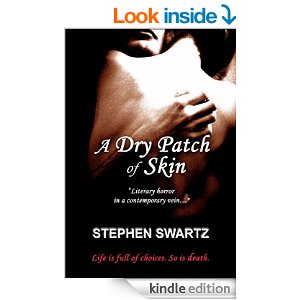
TA patch of Dry Skin, Stephen Swartzhis notion of making the path difficult is explored well in  Stephen Swartz’s literary fantasy, A Dry Patch of Skin. The story opens in Croatia but moves to Oklahoma. This tale is a fantasy in the sense it’s an exploration of vampirism, but is literary and gripping in its plausibility. Two of my favorite lines of all time are in the opening chapters of this novel:

Mirrors are such odd devices, and whoever invented them should have been killed. They purport to show us the true state of affairs and yet everything is distorted.

The protagonist, a man of Hungarian descent, named Stefan Székely, has a disturbing genetic skin condition and embarks on a quest to find a cure, desperate to somehow salvage his relationship with Penny. He has a job as a phlebotomist, which allows him to conceal his ailment, but eventually he is unable to hide it. Many roadblocks arise, interfering with Stefan’s success, forcing him to seek a cure in Budapest, but even that trip is fraught with frustrations. Because of those hindrances, the tension builds toward the end, making for a gripping read. The novel ends in an unexpected fashion and is one that stayed with me for a long time after.

Both these novels detail a seemingly ordinary thing—a person dealing with a life-threatening illness, both seeking a cure that seems like it should be easy but which becomes virtually impossible. In both novels, the roadblocks and detours along the journey create compelling narratives I found impossible to put down.

e.m. forster plot memeBoth are set in a contemporary setting, and both have surprising endings that could only have been arrived at because of the roadblocks and hindrances placed in the paths of the protagonists.

This is why we can’t make it easy for our characters. The struggle is the story.

2 Comments

Filed under writer, writing

#amwriting: Desires and Objectives

LOTR advance poster 2When we sit down to write a story of any length, whether a novel or flash fiction, we often begin with an idea for a plot, the possibilities of great characters, and little more. To make those two things into a compelling story, we must discover what the protagonist desires most, and find out what she/he is willing to risk to achieve it.

Objectives+Risk=Story

In The Lord of the Rings, by J.R.R. Tolkien, Frodo is just an ordinary young hobbit, with no particular ambitions. On the same day as his older cousin Bilbo’s “eleventy-eleventh” (111th) birthday, Frodo (Bilbo’s heir) celebrates his thirty-third birthday.

At the lavish double-birthday party, Bilbo departs from the Shire for what he calls “a permanent holiday.” He does so by using the magic ring (that he had found on the journey detailed in The Hobbit) to disappear. He is aided in that by Gandalf with a flash and puff of smoke, leading many in the Shire to believe Bilbo has gone mad.

He leaves Frodo his remaining belongings, including his home, Bag End, and after some heavy-handed persuasion by the wizard Gandalf, he also leaves the Ring. Gandalf departs on his own business, warning Frodo to keep the Ring secret. Seventeen years or so pass, and then Gandalf returns to inform Frodo of the truth about Bilbo’s ring. It is the One Ring of Sauron the Dark Lord, and is evil. It forges a connection between the wearer and Sauron, and whoever bears it will be slowly corrupted, eventually becoming a Ringwraith.

LOTR advance posterFrom the moment of learning the truth about the Ring, Frodo’s goal is clear to the reader: he must get rid of the ring. In Rivendell, he learns the only way to do so is to carry it into the depths of Mordor and cast the ring into the fires of Mt. Doom.

Frodo wants to achieve this goal badly enough to walk into an active volcano and certain death to accomplish this.

At no point in the narrative is the objective unclear. The path is blocked many times, and each of the characters is tested by the evil ring, some beyond their ability to resist it.

The objective creates the tension, which drives the plot forward.

But what about a book where the goal is not so clear? Let’s talk about Ulysses, by James Joyce.

Ulysses chronicles the wandering appointments and encounters of Leopold Bloom in Dublin, taking place over the course of an ordinary day, 16 June 1904. Ulysses is the Latinized name of Odysseus, the hero of Homer’s Odyssey. Joyce established a series of parallels between the epic poem and his novel. This book has one of the best opening lines of all time:

Stately, plump Buck Mulligan came from the stairhead, bearing a bowl of lather on which a mirror and a razor lay crossed.

Ulysses cover 3Structurally, there are strong correlations between the characters and experiences of Leopold Bloom with Odysseus, Molly Bloom with Odysseus’ long-suffering wife, Penelope, and Stephen Dedalus with Odysseus’s son, Telemachus. It is set in early twentieth century Dublin with the events and political tempests of of the time. Themes of antisemitism and the impact of Ireland’s rocky relationship with Britain as a it was felt in those days are the underlying pins of this novel. It is highly allusive and filled with allegories.

There is no obvious quest, although many minor quests are completed in the course of living through the day. The book opens with Stephen Dedalus, the first protagonist, having breakfast with Buck Mulligan, who is perhaps a friend, or maybe a rival. It’s James Joyce, so it’s complicated. Stephen shares his opinions about religion, especially as they relate to the recent death of his mother, with Buck Mulligan, who manages to offend him. They make plans to go drinking later that evening.  Stephen is not Leopold’s biological son as Telemachus is Odysseus’, but he fulfils that role.

What does Leopold desire? In Episode 4, the narrative shifts abruptly. The time is again 8 am, but the action has moved across the city and to the second protagonist of the book, Leopold Bloom, a part-Jewish advertising canvasser. He and his wife have a daughter, Milly Bloom, who, at the age of 15, has left home to study photography.  As the day unfolds, Bloom’s thoughts turn to the affair between his wife, Molly, and her manager.

He also thinks about the death of their infant son, Rudy Bloom, who died at the age of 11 days. The absence of a son is what leads him to form an attachment to Stephen, for whom he goes out of his way in the book’s latter episodes. He rescues him from a brothel, walks him back to his own home, and even offers him a place there to study and work.

Finally, we come to Molly. The significant difference between Molly and Odysseus’ wife, Penelope, is that while Penelope is eternally faithful, Molly is not. Molly is having an affair with Hugh ‘Blazes’ Boylan after ten years of her celibacy within the marriage.  In Dublin, Molly is an opera singer of some renown. Molly wants to be loved.

Ulysses_(1967_film_dvd_cover)The final chapter of Ulysses, often called “Molly Bloom’s Soliloquy,” is a long, un-punctuated stream-of-consciousness passage, which is arguably the most difficult passage to read and/or follow in the Western canon. (The body of books, music and art that scholars generally accept as the most important and influential in shaping Western culture.)

At the end of the day Molly allows Leopold into her bed, and worries about his health. She reminisces about their first meeting, and about when she knew she was in love with him. This long-winded monologue is comprised of some 20,000 words of her thoughts as she lies in bed next to Bloom, who is unaware of her internal rambling.

In The Lord of the Rings, we have a clear and obvious quest, straightforward and seemingly impossible. In Ulysses, we have a group of people who all want something, but just as in real life, what that may be is not as clear as we would like it. But there is an objective: they just want to get through the day and in the end, they each want to love and be loved, and perhaps be part of a family.

Once we know what our protagonist wants and what he/she is willing to risk to achieve it, we have our plot. Personally, I like a certain amount of literary prose, but I prefer reading books that are a little more straight-forward than Ulysses. That’s why Tolkien’s work spoke to me when I was still in grade school.

How we dress it up is up to us—and, while I admit James Joyce’s rambling is too daunting for me to read for pleasure, I am a confirmed fan of his magnificent one-liners.

History is a nightmare from which I am trying to awake.

Ulysses, Episode 2

4 Comments

Filed under Books, writing

#FlashFictionFriday:Happy Hour at the Drunken Sasquatch

796px-Louis_Ducros_(circle)_Pifferari_in_einer_römischen_TaverneI’m always at the Drunken Sasquatch for Happy Hour, as I have nowhere else to be. But Harry Wolfe was a family man with a problem, and he looked distinctly out of place there among the regulars. I had told him I thought the perfect person to resolve it would be in at about four, and sure enough, there she was.

He set his root-beer on the table. “Everyone knows Grandma is no one to mess with! Sure, my stepdad was a big, bad wolf. I won’t argue that he received a kind of back-handed justice. And who is sitting there proudly wearing his hide?” Harry gazed at the elderly woman seated at the bar. “Not my stepdad, that’s for sure.”

The elderly woman in the ratty fur coat turned to see what all the noise was about. We smiled and waved at Grandma.

“See how innocent she looks?  She could be any old barfly. But that’s no ordinary old drunk.” I tried to impress on him how perfect she was for his problem. “That’s Grandma, and she’s the one for the job.”

Harry capitulated. “Um… okay, but no violence. They’re terrible tenants, but they’re college kids, right?”

“So are you going to ask her?”

Harry’s eyes showed the whites, as he mastered his panic. “No! She’s…could you ask her?” The werewolf was actually shaking in his boots.

“Okay,” I said. “I’ll do it.” Very few things intimidate a dragon. I took my orange juice to the bar and found a stool next to the lady in question.

“Mrs. Johnson?” I asked.

“Who wants to know?”

“Dan Dragonsworthy. My friend has a rental property, occupied by some tenants who’re trashing it…he was wondering if you were still in the vigilante business.”

“You mean that nice young man doesn’t want to dirty his paws with such matters.” She met my gaze. “Sure, but it will cost him. I don’t work for free.”

I brought Harry over and introduced him. They got down to the nitty-gritty, and a price was arranged. Grandma fixed Harry with her steely gaze. “Tell me everything you know about these tenants.”

“Well, they’re pigs.”

“We know that. What do they look like?”

“They’re pigs, Yorkshire pigs, to be exact, and seemed so charming and British. They’re foreign exchange students and had good references, but now I’m assuming they were forged.”

“What exactly have they done to your property?” Grandma tried to look comforting. It scared the willies out of me. As I said, very few things scare a dragon, but that look on this old lady was one of them.

Harry said, “Every Saturday night they have these huge parties with hundreds of people and live bands. Loud punk music all night long. My phone is always ringing off the hook, with the other tenants’ complaining.”

“Over on Walnut Street?” Grandma asked, and Harry nodded. “Yeah,” she said. “Those are some great parties.” Grandma thought for moment. “I hate to evict my friends, but business is business, and a girl’s gotta make a living.”

She fished around in her handbag, setting things on the bar: old Kleenexes, mints, a pearl-handled Colt forty-five, her cell phone, a hacksaw, her checkbook, a crescent wrench, a dog-eared address book… and so on… and so on. Finally, she came to a small stack of business cards, with a rubber band wrapping them. Pulling one card from the bundle, she handed it to Harry. “Send the legal paperwork to me at this address here, along with half the fee. I’ll collect the other half when the job is done, Tuesday at the latest. Just make sure a large dumpster is delivered to the curb in front of the place Monday morning.” She turned, tossing everything back into her bag and addressed herself to her gin and tonic. It was a dismissal Harry and I both could recognize.

As we sat down at our table, Harry said, “I don’t like doing things this way, but I can’t have my property destroyed. She’s definitely the one for the job. I hate to have to play the Grandma card, but those pigs have got to go. I just hope she doesn’t harm them.”

Looking at the little old lady seated at the bar, I had to agree. “When you have a tough job, you can always count on Grandma. It may not be pretty, but she gets results.”

Harry shivered.


Happy Hour at the Drunken Sasquatch © 2016 Connie J. Jasperson, All Rights Reserved

6 Comments

Filed under #FlashFictionFriday

#amwriting: don’t gut your novel

Excalibur London_Film_Museum_ via Wikipedia

This post has nothing to do with swords, but I felt one should be pictured, so here is Excalibur.

I have another novel in the editing process, one with many sections written before I embarked on my quest to discover how to write. I am now culling many unnecessary words and awkward phrases from the older sections.

If you’re a regular reader of my blog, you know the word “that” is like a keyboard tic for me. I use it a lot in my personal speech, and it falls into my work with a little too much regularity. I thought I had them pretty well under control, but one doesn’t see one’s own work with eyes of the disinterested reader.

Because of this, my editor and I are now combing each section for words I can eliminate and still retain the flow of the narrative.

Yes, I know I claim to be an editor. But I am first and foremost a writer, so I do have an editor because an unbiased eye is critical to producing a good, tight, manuscript.

When it comes to eliminating the word “that,” it’s crucial you look at each instance of how it is used.  Sometimes, “that” is the only word for a given situation. If a particular idea can’t be conveyed any other way, for the love of Tolstoy, use it. Don’t gut your prose just because some online guru tells you ‘that’ is the devil. If you remove every instance of “that” you’ll end up with a mess on your hands.

And just so you know, “that” and “which” are not interchangeable so you can’t just change every instance of “that” to “which.”

“That” is a pronoun used to identify a specific person or thing observed by the speaker, a determiner, an adverb, and a conjunction.

  1. “That’s his dog on the curb.” (Identifier)
  2. “Look at that red car.” (Determiner)
  3. “I wouldn’t go that far.” (Adverb)
  4. “She claimed that she was married.” (Conjunction)

In the case of number 4, the sentence would be stronger without it. Most of the time, prose is made stronger when the word “that” is simply cut and not replaced with anything. I say most, but not all of the time. Use common sense and if a beta reader runs amok in your manuscript telling you ax “this and that,” examine each instance of what has their undies in a twist and try to see why they are pointing it out.

There are cases where only “that” will suffice. When do we use the word “that?” We use it when we have something called a ‘Restrictive Clause’:

Quote from Grammar Girl, “A restrictive clause is just part of a sentence that you can’t get rid of because it specifically restricts some other part of the sentence.”  She goes on to give a specific example of a restrictive clause: “Gems that sparkle often elicit forgiveness.”  See?  Not just any gems elicit forgiveness in this sentence. Only gems that sparkle bring about clemency. In this sentence, forgiveness is restricted to one kind of gem.

“Which” is a pronoun asking for information. It specifies one or more people (or things) from a particular set, and it is also a determiner:

  1. “Which are the best diapers for newborns?” (Pronoun)
  2. “I’m looking at a house which is for sale on Black Lake.” (Determiner)

Go lightly with “which” and “that” but use them when they are required.

keep clam and proofreadThe same common sense approach goes for “very.” I seldom need to use it, but I do when it’s required. However, some people employ it too frequently, and it’s rarely needed in the context they  place it, fluffing up the word count. As with every word, there are times when it’s the only one that will convey an idea crucial to your story.

Mark Twain had a perfect comment regarding overusing “very.”

“Substitute ‘damn’ every time you’re inclined to write ‘very;’ your editor will delete it and the writing will be just as it should be.”

I’d love to be that editor.

6 Comments

Filed under writing

#amwriting: homonyms and honorifics

MSClipArt MP900390083.JPG RF PDAn editor once told me, “If you’re going to use grammar improperly, at least have the decency to misuse it consistently.” Since that day, I have made every effort to do so.

However, as a reader, I like to see that the author and editor both had a good grasp of the basics, and if a book is written with too many inconsistencies it ‘s hard to get involved in it.

We are all guilty of typos, homonym misuse, and the occasional comma splice. We sometimes are inconsistent with the words “sir” and “Son.” We make every effort to have our work read by editors and proofreaders, and still, invariably, some glaring blot of darkness sneaks through because certain aspects of the English language are as difficult to wrangle as a van full of toddlers on coca-cola.

One thing I’ve regularly noticed people have trouble with is the proper use of terms of endearment, such as “Sir,” or “Dad,” and “Mom.” The rules are basically simple to remember:

For people who are related, if you are saying it directly to them in place of their name, capitalize it.

  • “I love you, Son.”

If you are mentioning them in conversation, don’t capitalize it.

  • “My son is wonderful.”

Terms of endearment can also be relatively impersonal, denoting a friendship, or can even be slightly patronizing. If the speaker is not related to the person in question, do not capitalize it.

  • “I wouldn’t do that, son.”

Then there is the issue of the word “sir.” It is an honorific. Quoted from the Chicago Manual of Style section 8.32:

Honorific titles and respectful forms of address are capitalized in any context with several exceptions:

  • sir

  • ma’am

  • my lord

  • my lady

Where king/queen, Lord, or Sir is used as part of someone’s name, it is always capitalized, as are these honorifics:

  • King Olav, and Lucille, the Queen of Darkness
  • Lord John Davies; Lady Mary Shelton
  • Sir William Neville

Where king/queen is employed in the context of a general reference it is lowercased:

  • “Hello,” said the king.

But should one capitalize the word “sir” when it’s used in dialogue? Which of the following would be correct? “Yes sir.” OR “Yes Sir.”

If the reply is to a respected person in general, it is written with no capital, as it’s not a formal name. But you do need a comma just you would with a formal name:

“Yes, sir.”

“Yes, George.”

For a more in-depth exploration of that subject see my post of March 14, 2016: son and sir: to capitalize or not?

When writing dialogue: if your speaking character is in the military and the person he/she is addressing has a military rank above them, and is speaking in their military capacity you must capitalize it. The exception to this is if a younger person of lesser rank is talking to an older person of higher rank in an informal setting. At that point, the younger person is simply speaking respectfully to an older person, and “sir” does not need to be capitalized.

Remember, English is a strange and mysterious language, and is one even which even native-born speakers rarely master. While it has rules, it has many exceptions to those standards, so it is easy to be confused. Your word-processing program’s spell checker won’t notice these things because they aren’t misspelled.

to lie means to restHomophones: Words that share the same pronunciation, regardless of how they are spelled and Homonyms: Words that sound alike, but have different meanings:

  • there, they’re, their
  • to, too, two

It’s also good to recognize homographs (words that share the same spelling) that have different pronunciations and meanings. These words include:

  • desert (to abandon) and desert (arid region)
  • tear (to rip) and tear (a drop of moisture formed in the eye)
  • row (to argue or an argument) and row (as in to row a boat or a row of seats—two words which are also a pair of homophones)
  • bark (the sound of a dog) and bark (the skin of a tree)

Capitonyms are words that share the same spelling but have different meanings when capitalized. They may or may not have different pronunciations. Such words include:

  • polish (make shiny) and Polish (from Poland)
  • march (walk or advance) and March (the third month of the year in the Gregorian calendar)

chicago manual of styleNegotiating the shoals of English grammar can be tricky, and it’s easy to get a fortune tied up in reference books. However, if you are on a tight budget, these two good references will help immensely with gaining some mastery of it:

I always recommend these two as they are the most comprehensive examples of their kind, and good, lightly used volumes are sometimes available second hand through Amazon.

Strunk and White’s Elements of Style is an excellent reference book if the Chicago Manual of Style is too daunting for you, as it’s not nearly as detailed and does hit the high points, and old copies are always available in second-hand bookstores.

Comments Off on #amwriting: homonyms and honorifics

Filed under writing

#flashfictionfriday: Short Poetry: I Have Seen the Stars

Admiring the Galaxy |CCA 4.0 ESO/A. Fitzsimmons

Admiring the Galaxy |CCA 4.0 ESO/A. Fitzsimmons


I have seen the stars hung bright

Across the inky dark of night

Such beauty there displayed for me

I scarce can know their mystery.


Heaven’s vault with diamonds flung

Summer’s sky with beauty hung

Bursting forth, the joy in me

Humbled by the majesty.


I have Seen the Stars © Connie J. Jasperson 2016

5 Comments

Filed under #FlashFictionFriday, Poetry

#amwriting: the rough draft

My Writing LifeI have begun a new novel set in Neveyah. It is the “how it all began” novel and takes place at the beginning of their recorded history. It’s been rolling around my head, and bits of this story are alluded to at various points all through the Tower of Bones series and also Mountains of the Moon.

The protagonist of this story is mentioned regularly in the Tower of Bones series as a character featured in children’s books. He’s portrayed as a kind of superhero, doing many impossible things.

But as always, there was a real man and real events at the core of the mythology.

I am taking the mythical man and giving him his place in history as the founder of the City of Aeoven, the College of Warcraft and Magic, and the first leader of the Temple of Aeos. I had the basic story drawn up back in 2009 when I began devising the world of Neveyah—three lines mentioning their childhood heroes.

The events that launch Aelfrid down the path of the mythic hero are all laid out. Now I must connect the dots and bring him to life.  If the story grows too large, it will be published as a two volume set, but my intention is to keep it to the same length as Valley of Sorrows.

As an indie, I must pay CreateSpace up front for my stock whenever I go to book fairs or signing events, so keeping my costs down is critical. CreateSpace costs are dependent on the length of the book, so if I have to pay $6.99 for each book, it limits  how much stock I can afford to keep on hand. I don’t want to run short of books, so I try to keep my costs to below  $5.00 per book. This also makes donating them to libraries and shelters affordable.

Even though Tower of Bones was published first, the rough draft of Mountains of the Moon was actually written first. In early 2009 I had been asked to write an epic fantasy story-line for a Final Fantasy-style anime-based RPG that was never built. For that reason, the world building was super-heavy.

Before I even had a story, I had to spend months

  • devising history and mythology
  • designing all the many environments where the story would take place
  • drawing maps
  • designing the creatures the characters do battle with
  • I also had to design the rules for magic, including its limitations

Having all these things so well-drawn and documented has been a bonus, as I can just write the story. The setting is clear in my head, laid out in a style sheet for that world, and the terrain is detailed on maps.

The north in the time of AelfridI have learned from the mistakes of others. Unlike the Saga of Recluce series, my maps for the early days detail the world as it was then, so there is no struggling to guess where the major towns are. (See my post, of  March 10, 2014, Spanking L.E. Modesitt Jr.)

I would definitely do two things differently, if I were to create that world today: the calendar, and the names of the days. I wouldn’t go with a 13-month lunar calendar, and I wouldn’t name the days after Norse gods.

But the calendar is canon now, and just as in real life, you must work with what you have. So, right now I am nearing the first plot point, where the first calamity occurs. Since this is the rough draft, everything to this point is really sketchy—a lot of “he said,” and “he went,” just to get the ideas down and everything in place.

These “telling and not showing” places are road marks, to guide me when I sit down to write the true first draft. My synopsis was about 3000 words. This rough draft will top out at about 55,000 words, and the first draft of the novel itself will be around 90,000 to 100,000 words.

398px-Heroes journey by Christopher Vogler

Hero’s Journey, by Christopher Vogler, via Wikipedia

What I am doing at this point is setting the scene, introducing and developing the characters, and finding the reasons why they are who they are as people. I have a grip on my mentor’s character, and also the side characters.

I know my protagonist fairly well, although what initially motivates him is still a bit of a mystery. His personality and what he has to do are clear, but I haven’t yet discovered what lies within him that pushes him to achieve this thing. That is part of the journey for me.

For this book, I know exactly who my villain is, and how he came to be that person. He is new to me, but his motivation is clear and easy to imagine. I feel a real connection to him.

Altogether, if everything goes according to plan, writing this book will take about a year for me to get it to the final draft and into the editing process.

3 Comments

Filed under writing