#amwriting: tips for writing clear dialogue

gibberish quoteDialogue can be tricky. Often, in our rush to get the ideas on paper, we have left off quotes, misplaced punctuation, and written interrupted dialogue with inconsistency.

While a certain amount of literary license in dialogue can enrich our work, our dialogue may be too rich with run-on sentences, and not in a good way.

Also, while everyone has read books that inspire them to become writers, some authors never learned how to write the kind of dialogue they envision. They don’t understand the fundamentals and don’t realize how their lack of understanding ruins their work.

Always begin what is actually spoken (dialogue) with a capitalized word, no matter where in the sentence it begins.

  • Mary glanced over her shoulder and said, “I’m sorry. I can’t go with you.” 

However, interrupted dialogue, when it resumes, is not capped, although the rules of punctuation and quotation marks still apply.

  • “I’m sorry to tell you,” said Mary, “but I can’t go with you.”

Direct dialogue is someone speaking to you or someone else and requires quotation marks.

  • “I’m sorry. I can’t go with you,” said Mary.

I’m a US author, so I used double quotes, also called closed quotes. The UK usage is different and often uses apostrophes, or what they call inverted commas. Either way, be consistent and make sure ALL punctuation goes inside the quote marks.

Yes, I did say All punctuation. How does one set off a quote from someone else within dialogue? Set it apart with single quotes (apostrophes, inverted commas) and keep it inside the closed quotes.

George said, “When I asked her, Mary replied ‘I can’t go.’ But I’m sure she was lying.”

George said, “When I asked, Mary replied ‘I can’t go.'” Note there are 3 apostrophes there: 1 apostrophe and 1 double (closed) quote mark. This is in keeping with the rule that all punctuation in dialogue goes inside the quotation marks.

Indirect dialogue is a recapping of dialogue that someone previously spoke.

  • When asked, George said Mary couldn’t go.

Note there are no quotes used in indirect dialogue. Also in this sentence, the word that is implied between said and Mary.

Dialogue tags, or attributions, can come before the dialogue, especially if you want the dialogue tag to be noticed. To make them less noticeable put them in the middle or at the end of sentences. In my own work, I want the dialogue and not the attribution to stand out. However, when more than two people are involved in a conversation, I move the dialogue tags further to the front so the reader isn’t left wondering who is speaking.
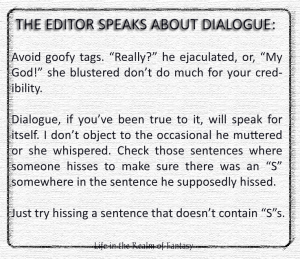
DialogueI’ve mentioned before that I prefer simple attributions such as said, replied, and answered because they are not as likely to stop the reader’s eye. People don’t snort, smirk, smile, or frown dialogue as it is physically impossible. They can say it with a smile, but the smile is a facial expression and does not speak.

Avoid verbal tics like “hmmm…” and “ahhh…” as they just take up space and add fluff to your narrative. When people in real life preface all of their sentences with drawn-out ahs and hmms it can be aggravating to listen to them. Consider how irritating it would be to read it.

Sometimes we have two ideas in a sentence that we think are one, and we connect them with commas.  But closer examination shows they are not.

  • “Hello, sir, we bathed your dog,” she said.

The above dialogue contains a run-on sentence, despite its shortness. We may actually speak it in this fashion, words run together, but for a reader, punctuation clarifies ideas.

The dialogue contains two separate ideas. “Hello, sir,” is an acknowledgment and a greeting. “We bathed your dog,” indicates an action was taken in regard to his dog. It should be:

  • “Hello, sir. We bathed your dog,” she said.
  • When we write our conversation using proper punctuation, it looks natural, and the reader will hear it the way it was intended.

When it’s done right, dialogue is, in my opinion, the best part of the story. It’s where we discover who the characters are, and how the larger events affect them. Conversations show the world as the protagonist sees it. We can take some style and voice liberties with dialogue, and indeed, we should, but adhering to industry standard rules of punctuation ensures your reader can remain immersed in the story, and forget they are reading.

And THAT is what we all hope for.

21 Comments

Filed under Literature, writer, writing

#amwriting: Our shifting language

English is the third most widely spoken native language in the world (behind Mandarin Chinese and Spanish). It is the first language of four countries and is spoken by more than 400 million people, with five major dialects and distinct accents:

  • Countries where English is spoken natively by the majority of the populationBritish English
  • North American English
  • Australian English
  • New Zealand English
  • South African English

An American girl from a rural corner of the US can understand a girl from New Zealand fairly well, and after they adjust to the differences in their accents, they can chat freely.

Many other countries use English as their official language. According to Google, fifteen more countries have their own native language, but use English as an “Official Language and the Language of Instruction in Higher Education”:

Anguilla Ireland, Northern Singapore
Antigua and Barbuda Ireland, Republic of Solomon Islands
Australia Jamaica South Africa
Bahamas Kenya Swaziland
Barbados Lesotho Tanzania


According to Wikipedia, the Fount of All Knowledge: “Estimates that include second language speakers vary greatly, from 470 million to more than 1 billion. David Crystal calculates that non-native speakers as of 2003 outnumbered native speakers by a ratio of 3 to 1. When combining native and non-native speakers, English is the most widely spoken language worldwide.”

All English speaking people can communicate through writing, and while they might not be able to understand each other well in person, they can easily communicate via the written word.

In medieval times, the lingua franca was Latin. Lingua Franca means a language that is adopted as a common language between speakers whose native languages are different. An historical example of how people can communicate using a lingua franca in writing and still be unable to understand each other when speaking it: Richard the Lionhearted spoke langue d’oïl, a French dialect, and lenga d’òc, a Romance language, and his wife, Berengaria of Navarre, spoke Navarro-Aragonese, a Spanish dialect.

During the political negotiations arranging their marriage, Richard and Berengaria communicated via letters composed and written in Latin, as neither one spoke the other’s native language. However, when they met, even though they were both speaking Latin, their accents made it nearly impossible for them to understand each other until they became used to the other’s pronunciations.

That bit of historical trivia brings us back to the modern day lingua franca: English. With so many people speaking it, new usages come into play and spread through the speaking community, and the language shifts. Sometimes it shifts more rapidly than I can keep up with.

This blending and shifting of the common usage demonstrate what happened to Latin. Latin is frequently referred to as a dead language, but it is not. Latin is actively spoken in the modern Romance languages. (Romance referring to Roman, not love.)

The five most widely spoken Romance languages by number of native speakers are:

  • Spanish (410 million)
  • Portuguese (216 million)
  • French (75 million)
  • Italian (60 million)
  • Romanian (25 million)

Latin also appears in and strongly influences our Germanic, Frisian-based English, through our Norman ancestry—after all, our great Norman kings and queens spoke Medieval French: langues d’oïl, which itself was a mingling of Gallic and Roman based languages.

The Normans came to Britain speaking French, and their children remained, speaking a blend of Anglo-Saxon-French: Old English.

270px-Rosetta_StoneAll spoken language evolves. Only languages whose sole known records are actually engraved in stone, such as Egyptian Hieroglyphics and Ancient Sumerian, are unchanging.

English is continually evolving in more than just the obvious way of snappy catch-phrases and new technology. It is evolving in its formal usage

Consider the word whilst. As conjunctions go, the words whilst and while are technically interchangeable in meaning, but whilst has become less common in standard American English. If whilst appears in an American genre fiction book, it’s an eye-stopper, awkward and old-fashioned, more suited to classical poems and literary prose. Therefore, an American author may not use whilst, but a British author might.

Yet, despite its having fallen out of fashion in the US, we all understand the word whilst when we see it written and when we hear it.

At some point, everything we write in our modern language will be as unintelligible to those who speak the future modern English as Geoffrey Chaucer’s work is to the contemporary eye and ear today:

chaucer modern translate wife of bath meme

It is clear that the eye of the translator and his perception can greatly influence the modern translation of the work. I disagree with the use of the word “Ruled” in the second line, as the intent of “Were” in this case is clearly “was.” In the common usage of the day, “were” was interchangeable with “was.” Had I been in the same program as the above translator, we would have argued over this point.

I’d have translated it as:

Experience, though no authority,

Was in this world  enough for me

To speak of the woe that is marriage.

For, Lordings, since I was twelve years of age,

Thanks be to God eternally alive!

Husbands at the church door, I have had five.

We can only see the works of our great literary giants through the lens of time, filtered through our own wishes and interpretations. And this is how our greatest works, those which do survive into the next millennium, will be seen and interpreted.

Title page of Geoffrey Chaucer’s Canterbury Tales in the hand of his personal scribe Adam Pinkhurst, c. 1400Perhaps our published work will remain a part of the public record as it is today, and be available for students of “classic” literature to interpret. Or perhaps our works will be forgotten, lodged in the dusty vaults of Bowkers, only rarely resurfacing, having been ironically relegated to the dark corners of scholastic research on obscure texts in forgotten languages.

Soon-to-be forgotten or not, I am writing for today, and writing for a contemporary reader. My usages will evolve over the life of my writing career–I ‘ve already seen this evolution at work. That is the process of growth, and it’s clear how my early works differ from my more recent work.

Growth and change drives and forms the new canon of 21st century world literature. We are all a part of its birth, whether we are readers or authors. Readers choose the works they buy and those works are written by people who chose to record the thoughts, values, and misdeeds of their contemporary society in story form.

I am so blessed to be both a reader and an author.

3 Comments

Filed under Literature, writing

#amreading: The Well at World’s End, William Morris

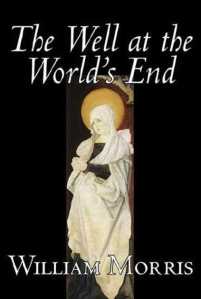
TheWellattheWorldsEnd423x630First published in 1896, and now in the public domain, The Well at World’s End by William Morris has inspired countless great fantasy authors. J.R.R. Tolkien and C.S. Lewis were students at Oxford when they became devotees of Morris’s work, to name just two. I first read this book in college (back in the dark ages) when Ballantine released it as a two-volume set. The original Ballantine covers are below, at the end of this post.

This fairly unknown literary treasure is available for free, as a download for your Kindle or any other reading device. I got my Kindle version through the Gutenberg Project on Google–and it reminded me of what my true roots as a reader of fantasy are. Give me the beautiful prose, the side-quests to nowhere, and wrap them in an illusion of magic, and I’m yours forever.

First, The Blurb:

The rich, interwoven tapestry of William Morris’s four-volume epic, “The Well at the World’s End”, is brought together in a handsome edition featuring the tale of Ralph of Upmeads. Literally and figuratively, this story is the wellspring that gave rise to both C.S. Lewis’ “Chronicles of Narnia”, and J.R.R. Tolkien’s “The Hobbit” and “Lord of the Rings”. Many elements of the story will be familiar to those who love these and other modern narratives of fantasy and adventure, set in a mythical world.

Ralph of Upmeads is the fourth and youngest son of the king of a small monarchy, and the only one forbidden of his elder brothers from going in search of his fortune. He runs away, but not before his godmother gives him a necklace with a bead on it, which unerringly directs his destiny to seek out the legendary and titular well at the end of the earth. Along the way, he encounters friends and foes in an ever-changing landscape of rolling hills and barren wood, towering mountains and meandering rivers. Through them all pass roads down which many heroes since have sojourned; united in fellowship, or alone on solitary quests.

Great and splendorous cities await, and in between, thriving towns, tiny villages, and protective farms at the edge of vast wildernesses. The further our intrepid wayfarer gets from home, the more he misses the simple pleasures of his hearth, table, and bed. Many have followed in his footsteps since, both character and reader alike.

Its language is that of another age, but its archetypical settings and denizens are the timeless stuff of once and future legend.

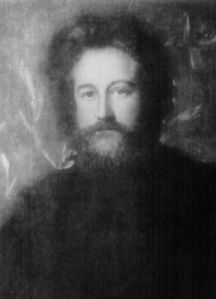
William_Morris_-_Project_Gutenberg_eText_13619

Portrait of William Morris by George Frederic Watts, 1870

My Review:

William Morris wrote beautifully crafted poems. The prose in this narrative is both medieval and sumptuous. He was born in 1834 and died in 1896. He was an important figure in the emergence of socialism in Britain, founding the Socialist League in 1884, but breaking with that organization over goals and methods by the end of the decade. Famous as a designer of textiles and wallpaper prints that made the Arts and Crafts style famous, Morris devoted much of the rest of his life to the Kelmscott Press, which he founded in 1891. Kelmscott was devoted to the publishing of limited-edition, illuminated-style print books. The 1896 Kelmscott edition of the Works of Geoffrey Chaucer is considered a masterpiece of book design.

The Well at World’s End is a real departure for the literature of the Victorian era, in that the morality is indicative of the free-thinking bohemian lifestyle of the famous and infamous artists of the day. William Morris was a member of the Pre-Raphaelite Brotherhood and was a man who enjoyed an unconventional lifestyle in the company of like-minded people, with few permanent ties, all of them celebrating musical, artistic, and literary pursuits.

Using language with elements of the medieval tales written by Chaucer and Chrétien de Troyes, who were his models, Morris tells the story of Ralph of Upmeads, the fourth and youngest son of a minor king. The king is wise and his kingdom prosperous, but nevertheless his four sons are not content. The three older brothers set out, with their father’s blessing. Ralph is still young, and his father wishes him to remain at his side.

Not happy with his lot, Ralph departs without his father’s blessing. He yearns to find knightly adventure and is encouraged by a lady, Dame Katharine, to seek the Well at the World’s End, a magic well which will confer a near-immortality and strengthened destiny on those who drink from it. The Dame is childless, and sees Ralph as a son; she gives him a necklace of blue and green stones with a small box of gold tied on to it, telling him to let no man take it from him, as it will be his salvation. She also gives him money for his journey.

The well lies at the edge of the sea beyond a wall of mountains called “The Wall of the World” by those on the near side of them but “The Wall of Strife” by the more peaceful and egalitarian people who live on the seaward side.

Ralph meets a mysterious Lady of the Dry Tree, the Lady of Abundance who has drunk from the well, and they become lovers. Together and separately, they face many foes and dangers including brigands, slave traders, unscrupulous rulers and treacherous fellow travelers. The lady is murdered, leaving Ralph bereft. Later, Ralph meets another lady, Ursula, and with her help and the aid of the Sage of Sweveham, an ancient hermit who has also drunk of the well, Ralph eventually attains the Well, after many more adventures.

Because the main character, Ralph, and a nameless lady become lovers with no thought of marriage, the novel was not well known in its time, until twenty years after Morris’s death when it was discovered by free-thinking university students, to the dismay of their strait-laced parents.

The underlying story is strong, with many twists and turns. The relationship between the Ralph and the Lady of Abundance is well portrayed, as is the jealousy of her former lover, the death of her husband, and the way she is either loved or feared by everyone around her driving the plot forward. She is a woman of mystery, alternately cruel and kind, one minute the Lady of the Dry Tree, and the next, the Lady of Abundance.

Ralph’s story really begins after her death and the intertwined threads of fate and magic are compelling. The characters Ursula and the Sage of Sweveham are both deep and well-drawn.

I freely confess that in the same way as the works of William Shakespeare are hard for a modern reader to translate, the language of William Morris’s work is difficult to follow. A quote will show you what I mean: “But Ralph gave forth a great wail of woe, and ran forward and knelt by the Lady, who lay all huddled up face down upon the grass, and he lifted her up and laid her gently on her back. The blood was flowing fast from a great wound in her breast, and he tore off a piece of his shirt to staunch it, but she without knowledge of him breathed forth her last breath ere he could touch the hurt, and he still knelt by her, staring on her as if he knew not what was toward.”

When you read it aloud, it rolls off the tongue with beauty and grace and is somehow easier to understand.

I was always intrigued by the works of the medieval and renaissance authors whose works I had to work to translate into modern English. Once translated, reading it was like opening a time capsule. It was a window into a lost world of romance and mystery.

The Well at the Worlds End is a foundational work in the canon of modern fantasy literature. All the great works of the twentieth century have some roots in this novel. The hard-core devotee of true fantasy literature will not be intimidated by the archaic prose. A wealth of tales lies within this volume, all of which come together in the end.

The_Well_at_the_Worlds_End_1-2


Parts of this review were originally published  on 31-Jan-2014 on Best in Fantasy

5 Comments

Filed under Books, Fairies, Fantasy

#amwriting: wrangling that, which, and semicolons

em dash memeSemicolons are misused morsels of punctuation. Some authors believe they are extra-long pauses: half-way between a comma and a (full stop)period. These bits of typographical madness litter their work.

Semicolons  are NOT extra-firm pauses. Em dashes or (if you are British) hyphens serve that function. Semicolons have a different place in the universe. For this post, we are going to look at semicolons as joiners.

The proper use of a semicolon is to join two short sentences that are directly related to each other, turning them into a compound sentence.

No one enjoys reading a choppy narrative. Too many short sentences can be distracting and hard to get into. The way we smooth the narrative is to join short sentences into longer, compound sentences. But frequently, that creates run-on sentences. (I am the queen of those.)

  1. Short and choppy: I’d love some ice-cream. We should go to the Dairy Queen.
  2. Compound sentence: I’d love some ice-cream; we should go to the Dairy Queen.

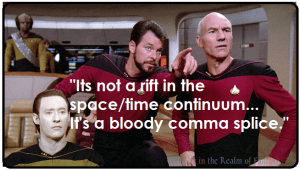
Comma Splice MemeYou do not join independent clauses with commas as that creates a rift in the space/time continuum: the Dreaded Comma Splice.

  1. WRONG: It’s nearly half past five, we can’t reach town before dark.
  2. BETTER: It’s nearly half past five; we can’t reach town before dark.

The two clauses that are joined together with a semicolon should relate to each other. The above sentences work because the lateness of the day means they might have to travel after dark.

  1. WRONG: We should go to the Dairy Queen; it’s nearly half past five.
  2. BETTER: We should go to the Dairy Queen. It’s nearly half past five.

If time is actually the issue in the above sentence, and you absolutely MUST use a semicolon or you will explode, say, “The Dairy Queen is about to close; it’s nearly half past five.”

I generally try to find alternatives to semicolons, but I don’t dislike them, as some editors do. I think they are too easily abused and misused, so I encourage myself and my authors to think outside the semicolon.

Another sticky area for the some authors are the words ‘that’ and ‘which.’ They are often difficult for new authors to get the hang of. They are not interchangeable, and overuse of the word ‘that’ cannot be cured by using ‘which’ instead.

‘That’ is a pronoun:

  1. Used to identify a specific person or thing observed by the speaker.

“That’s his dog on the curb.”

  1. Referring to a specific thing previously mentioned, known, or understood.

“That’s a good idea.”

‘That’ is also a determiner:

  1. Used to identify a specific person or thing observed or heard by the speaker.

“Look at that house fire.”

  1. Referring to a specific thing previously mentioned, known, or understood.

“He lived in Tacoma at that time.”

‘That’ is also an adverb

  1. Indicating to such a degree; so.

“I wouldn’t go that far.”

And ‘that’ is a conjunction:

  1. Introducing a subordinate clause expressing a statement or hypothesis.

“She claimed that she was married.”

‘That’ can also be a literary conjunction expressing a wish or regret:

“Oh, that I had known this before.”

<><>

‘Which’ is a pronoun:

  1. asking for information specifying one or more people or things from a definite set.

“Which are the best diapers for newborns?”

‘Which’ is a determiner:

  1. used referring to something previously mentioned when introducing a clause giving further information.

“A house on Black Lake, which is for sale.”

Some people will rather forcefully say you must never use the word ‘that,’ but those people are clearly unaware of the larger grammatical picture—do not listen to them.

Sigh.

So, when do we use the word ‘that’ in an appropriate and defensible fashion?  After all, too many ‘that’s’ make the prose boring and forgettable.

So does Grammar Girl, (Mignon Fogarty) on her awesome website for writers with questions. This website is an invaluable resource for folks like me, with some education, but no memory of what we were actually taught.

that which does not kill meThere are instances where only ‘that’ will suffice. When do we use the word that?

We use it when we have something called a ‘Restrictive Clause’:

Quote from Grammar Girl, “A restrictive clause is just part of a sentence that you can’t get rid of because it specifically restricts some other part of the sentence.”  She goes on to give a specific example of a restrictive clause: “Gems that sparkle often elicit forgiveness.”  See?  Not just any gems elicit forgiveness in this sentence. Only gems that sparkle bring about clemency. In this sentences, forgiveness is restricted to one kind of gem.

So, now we know about restrictive clauses, but what about nonrestrictive clauses? Again we turn to the Grammar Girl and she says, “A nonrestrictive clause is something that can be left off without changing the meaning of the sentence. You can think of a nonrestrictive clause as simply additional information.”

Again the Grammar Girl gives the example, “Diamonds, which are expensive, often elicit forgiveness.”  The word ‘which’ isn’t really necessary, as the meaning of the sentence would not be changed if you left it out. “Diamonds are expensive, but often elicit forgiveness.”

stop don't click replace allOften the sentence is better without the words ‘that’ or ‘which,’ but each instance must be examined individually, to ensure you are making the best choice.

This is yet another time when making a global search for these words is a good idea. (And never choose ‘replace all’.) On an individual basis, decide which word is the correct word, ‘that’ or ‘which’ and then decide whether to delete it or keep it. If the sentence makes good sense without it, lose it.

4 Comments

Filed under Self Publishing, writing

#amwriting: Couriers, Pigeons, and Excalibur

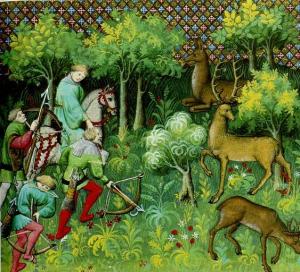
Medieval_forest wikimedia commons PD 100 yrs

Russian Forest in medieval France (1405-1410) Gaston Phoebus

I have a great deal of interest in Medieval history because I have ancestors who lived then. I’m not bragging–everyone who is alive today is here because one or two ancestors survived the Dark Ages long enough to leave behind a child who did the same.

Life was perilous, even if you grew up in a fairly sheltered environment. No one was exempt from disease–even kings regularly died young from plagues and injuries. Regardless of their personal safety, medieval kings were forced to go to war in person. They did this for several reasons.

  1. The only way for the monarch to know what was actually happening on the battlefront was to be there
  2. It was expected that a monarch should understand the art of warfare and be proficient as a warrior. He was responsible for winning or losing the battle.

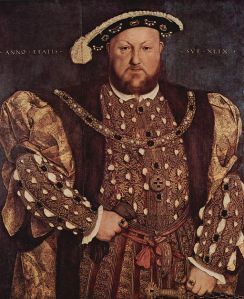
Portrait of Henry VIII (1491-1547) by Hans HolbeinDuring the Dark Ages, official news was delivered by a royal messenger and read aloud in church or in the market.

Messengers were a permanent fixture on the royal payroll. They were dedicated and well-paid to travel the kingdom continuously, carrying the king’s word. In medieval England, kings did not stay in London. Instead, they traveled all over their lands and the noble families were required to feed and house them at great expense. Their gypsy-like existence kept the messengers busy.

Wars were expensive. Henry VIII’s habit of medieval couch-surfing at the country homes of his noble courtiers was a great way for an impoverished king and his entourage to live well and cheaply, conserving the cash to pay for the troops. But it also meant that an organized and efficient messenger service was required to ensure that correspondence to and from the king: royal letters, grants, patents, and such, arrived at their intended destinations.

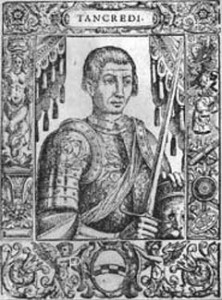
Tancred, Count of Lecce, King of Sicily via Wikimedia

Tancred, Count of Lecce, King of Sicily via Wikimedia

In the year 1190, when my direct maternal ancestor, Tancred, King of Sicily, faced Richard I of England, he was limited to what information a messenger could convey. Thus, their battles were fought in person and so were their negotiations.

These were not native Italians–the original Tancred of Hauteville (980 – 1041) was an 11th-century Norman and a minor baron of Normandy about whom little is known, other than eight of his twelve sons joined the crusades and became kings of southern Italy in the process.

So his illegitimate great-grandson, King Tancred, and King Richard the Lionhearted were Norman kings, squabbling over what was left of the Holy Land and the Mediterranean at the end of the crusades. However, Tancred was born and raised there so he was a third generation Sicilian, being the out-of-wedlock son of Roger III, the Norman duke of Apulia and Emma of Lecce, who was married to Ruggero III de Hauteville.

Quote from Wikipedia: “In 1190 Richard I of England arrived in Sicily at the head of a large crusading army on its way to the Holy Land. Richard immediately demanded the release of his sister, William II’s wife Joan, imprisoned by Tancred in 1189, along with every penny of her dowry and dower. He also insisted that Tancred fulfill the financial commitments made by William II to the crusade. When Tancred balked at these demands, Richard seized a monastery and the castle of La Bagnara.” (end quoted text)

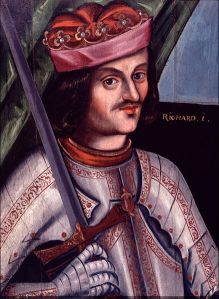
Richard I Google Art Project via Wikimedia

Richard I Google Art Project via Wikimedia

Richard was joined in Sicily by the French crusading army, led by his soon-to-be-former friend,  King Philip II of France. The presence of two foreign armies highly aggravated the local citizens who, rightfully, demanded the foreigners leave their island.

Ever the good guest, King Richard responded by attacking Messina, which he captured on 4 October 1190. Once the city had been looted and burned, Richard established his base there and decided to stay the winter—after all, winters in Sicily are a bit more pleasant than those in Normandy.

But what’s a little looting and pillaging among friends? According to Wikipedia:

“Richard remained at Messina until March 1191, when Tancred finally agreed to a treaty. According to the treaty’s main terms:

  • Joan was to be released, receiving her dower along with the dowry.
  • Richard and Philip recognized Tancred as King of Sicily and vowed to keep the peace between all three of their kingdoms.
  • Richard officially proclaimed his nephew Arthur of Brittany as his heir presumptive, and Tancred promised to marry one of his daughters to Arthur when he came of age (Arthur was four years old at the time).
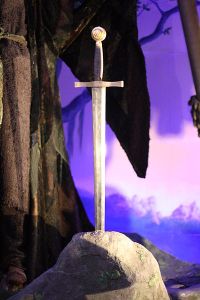
Excalibur London_Film_Museum_ via Wikipedia

Excalibur London Film Museum via Wikipedia

After signing the treaty, Richard and Philip finally left Sicily for the Holy Land. It is rumored that before he left, Richard gave Tancred a sword he claimed was Excalibur in order to secure their friendship.”

Yes, you read this correctly. King Richard the Lionhearted gave my many-times great grandfather Excalibur, the legendary sword of mythical King Arthur.

I doubt Richard the Lionhearted would really give away a sword that was supposed to prove his lineage back to the Pendragon if he actually believed it was truly Arthur’s. However, it is a documented fact that he did indeed give this sword of historical significance to Tancred.

I suspect that Tancred believed it was the true sword of King Arthur as much as I do, but in the interest of peace, he most likely smiled and thanked his departing guest. Whatever he did with it, it was never seen again. When he came to reclaim his island after Tancred’s death, Henry IV, king of the Holy Roman Empire, pillaged Tancred’s treasury and the sword was not there.

But what, you ask, does my illegitimate many-times-great grandfather’s possession of the possibly faux Excalibur have to do with communication?

Tancred and Richard both had to be there in Sicily in person and had to communicate through messengers to arrange all this swapping of women and dowries and swords of dubious origin.

Good long-distance communication has always been seen as critical to good governing. Wars were won and lost based on the information those kings and generals received. During the Middle Ages, postal systems were invented, became corrupt, and fell into disuse all over Europe. This recurred at different times up through the eighteenth century.

In 1505, Emperor Maximilian I established one of the more stable postal systems, but it was not a thing the peasant class could avail themselves of. An illiterate peasant could hire a scribe, but then they would also have to scrape up more coins to get the note sent to its destination. It was better to pay a neighbor to carry the news to wherever it had to go.

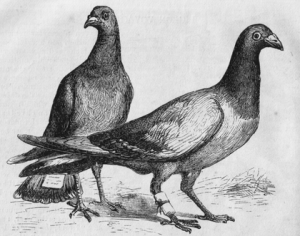
420px-Pigeon_Messengers_(Harper's_Engraving)There was a faster method of getting a letter home. Long before the Middle Ages and during them, homing pigeons were used to carry messages. Rock pigeons have the ability that taken far from their nest, they’re able to find their way home. This due to a particularly developed sense of orientation. Messages were then tied around the legs of the pigeon, which was freed and could reach its original nest.

This is of limited usefulness because pigeons will only go back to the one place that they have identified as their home. Pigeon mail can only work when the sender has a specific recipient in mind and has possession of that receiver’s pigeons.

So how did they  do this? The sender had to hand-carry the pigeons with them. Once released, the pigeons would fly back home with the note. Correspondents could not send a pigeon anywhere but the one place the birds considered their home.

If you are an author writing in an era other than the modern times, be diligent and do the research before you write about things that are outside your personal experience. Readers may have knowledge that you don’t and they will definitely not be shy about letting you know where you’ve gone wrong.

Much of my work is set in medieval environments, and so I can’t have my characters getting instantaneous information from afar without divine intervention. If my characters need to communicate over long distances, I have to consider the length of time it would take even a fast messenger to travel over roads we would consider impassable, but which were the medieval equivalent of I-5.

This kind of information is available via the internet.  Researching my subject online is how I discovered that regular mail delivery is a relatively modern invention. Perusing Ancestry.com is how I discovered the medieval Norman/Sicilian roots of my mother’s family, the (Fitz)Rogers family.

4 Comments

Filed under Battles, History, Humor, Literature, writing

#CoverReveal: Working the Table, by Lee French and Jeffrey Cook

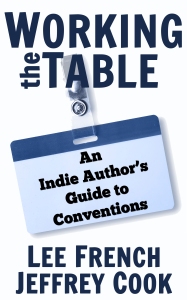
IndieGuideCoverAs you know, I am a strong proponent of the indie movement in publishing. Indies have a hard road when it comes to getting their work noticed.

A useful new book for indie authors is due out on March 19, 2016: Working the Table–An Indie Author’s Guide to Conventions. Well-travelled authors Lee French and Jeffrey Cook have put together this comprehensive how-to manual based on their own experiences.

The Blurb:

Because books won’t sell themselves.

In these times when it’s easy to self-publish but hard to get noticed, conventions offer a solid, feasible option for the independent author to start on a path to financial sustainability. But becoming a professional denizen of the dealer’s room has its challenges. In Working the Table, two veteran indie authors spill their secrets to help you not only survive, but thrive in the book-event environment.

I have shared a table with both Jeff and Lee, and they really do know what they are doing. They really love the convention atmosphere and they are building a solid fanbase with their personal appearances. I look forward to seeing what their secrets are.
–

Lee1Lee French lives in Olympia, WA, and is the author of several fantasy and science fiction books, most notably the Maze Beset Trilogy, The Greatest Sin series (co-authored with Erik Kort), and assorted tales in her fantasy setting, Ilauris. She’s an avid gamer and active member of the Myth-Weavers online RPG community, where she’s known for creative squirrel deployment. In addition to spending time there, she also trains year-round for the one-week of glorious madness that is RAGBRAI, has a nice flower garden with one dragon and absolutely no lawn gnomes, and tries in vain every year to grow vegetables that don’t get devoured by neighborhood wildlife.

She is an active member of the Northwest Independent Writer’s Association and serves as the Municipal Liaison for the Olympia region of NaNoWriMo. Her appearances to date include GenCon, WorldCon, Norwescon, and several other Pacific Northwest sci-fi and fantasy conventions. You can find Lee’s books here: Lee French’s author page on amazon.com.

Jeff1Jeffrey Cook lives in Maple Valley, Washington, with his wife and three large dogs. He was born in Boulder, Colorado, but has lived all over the United States. He’s the author of the Dawn of Steam trilogy of alternate-history/emergent Steampunk epistolary novels, the YA urban fantasy series The Fair Folk Chronicles, and the YA Sci-fi thriller Mina Cortez: From Bouquets to Bullets. He’s a founding contributing author of Writerpunk Press and has also contributed to a number of role-playing game books for Deep7 Press out of Seattle. When not reading, researching, or writing, Jeffrey enjoys role-playing games and watching football.
 –
You can find Jeff’s books here at: Jeffrey Cook’s author page on amazon.com.
 –
Lee and Jeff will have a lot of good advice and information to offer in this book–they spent the entire summer on the road last year, and do at least 2 conventions a month during the off-season! I don’t have that kind of enthusiasm for living out of a suitcase, but they are making it work.

2 Comments

Filed under Self Publishing, writer

#amwriting and #amrevising: weeding the garden of words

Free-range pansies by cjjaspersonWhen I write a novel, I always end up with a lot of back story. These are details that are important for me to know, but not meant for the actual novel. It’s more a way for me to mentally talk my way through the first draft.

I think of my manuscript as a garden of words, and by the time the novel is complete, it will have been weeded, dug up, and replanted many times.

Every author has their own style, their own way of getting the story down on paper. My style is not the usual way, but it works for me.

The way I do a first draft is this: First, I put together an outline listing all the characters and plot points.  Second, I write the ending and then write the scenes for the large events and turning points. Once those are in place, I start at the beginning and write the story in a linear form, connecting the large events and finally meeting up with the end.

Along the way, my story evolves. A lot of fluff gets added in because I need to sort the story out in my head and writing it down is the way I do that. This fluff is all written in a passive, telling voice, and is part of my road map for creating the first draft–it was put down in that fashion so I would remember it later when I came back to rewrite the scene and turn it into an action sequence or cut it entirely.

I’ll give you an example of a telling sequence from Julian Lackland’s story, which is set in Waldeyn, Huw the Bard’s world. It was written down in this way so I would have a mental picture:

“In Port Lanque, the harbor itself was accessible only by one broad cobbled street, Quay Street, snaking down the steep cliffs to the piers. This wide boulevard ran through the center of town, twisting and turning in a sharp descent down to the piers, and had been kept in good repair by the pirates as it was the only way to move carts and drays down to the ships for off-loading loot. At the very top of Quay Street, in the worst part of town, an immense, rundown palace loomed. Now less than a filthy slum, it was once the home of generations of kings.”

Little or none of that passage will make it into the final manuscript because it doesn’t advance the plot. It was originally written to set the scene in MY mind. But I didn’t throw it away–I kept it in my file of outtakes along with some useful conversations further down the page that may come in handy in a different story:

“You’re wearing a dress, madam, not a crown. How can I be sure you’re the real king?” King Harry eyed the pirate. “You could be any old thief claiming to know how to sail a ship. I happen to like this ship, and I’m not disposed to give her away to some random old man in a dress.”  

That above passage is why I say you shouldn’t be married to your prose. I love the scene and the conversation, and the action that follows, but the plot thread it is part of does not advance Julian Lackland’s story. However, I intend to turn it into a short story set in Waldeyn.

By the time I finish a manuscript, I will have written the beginning three different ways, some names will have changed, and relationships will have evolved. But the major plot points and the ending will usually be the same as I had originally envisioned.  I say ‘usually’ because that was not the case for Valley of Sorrows. I ended up completely rewriting the end of that manuscript.

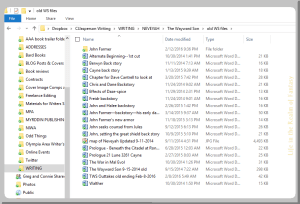
prnt screen 1 never delete cut passagesI can’t say it often enough: never delete any passage that you have cut from your manuscript. Save it in a separate file labeled ‘outtakes,’ because you may need that information later, or you may be able to turn that work into a short story.

A lot of authors use Scrivener for this, and it seems to work for them. I find it simpler to just copy and paste the work into a new file and save it in my outtakes for that particular novel. That way it’s out there in my dropbox or google drive and available no matter where I go or what happens to my computer.

Short stories are the bread-and-butter of many authors. You get paid a small sum for them, and your author name is published in one more place. The small story you toss out there could attract new fans to your other work.

Our work starts out full of passion and promise. Like a garden, it can grow wildly out of control. When you can’t see the flowers for the weeds, the garden must be cut back and pruned. The wild weed-words must be pulled in order for the reader to enjoy the real story.

Sometimes those weeds produce beautiful flowers when you get them into a different garden.

2 Comments

Filed under Self Publishing, writer, writing

#amwriting: drawing on personal experience

Map of Mal Evol, color full size, no roadsWith Valley of Sorrows on the editor’s desk, I can finish revising my other book based in the world of Neveyah. This is a stand-alone novel, The Wayward Son, which will be published late in 2016 after Valley of Sorrows comes out. It tells the story of John Farmer, Edwin’s father, and takes place concurrently with Forbidden Road. This book was far easier to write than many others, as it explores combat-related post-traumatic stress disorder (PTSD), a condition I am all too familiar with, as a bystander.

John’s story opens with an incident that changes his life. Twenty-five years later, John must return to Aeoven and face the past, and somehow learn to live with himself.

We writers all use our knowledge of the world around us to draw on when we are creating a scene or a character, even if we are not aware of having done so. I have deliberately drawn on observations made during my childhood and young adult years to create John’s gut-reactions and to show how his life was colored by his experiences.

My father was a veteran of WWII, and a man who’d intended to make the military his career. The loss of his left leg changed his career path. He became a draftsman and made a very good living. Other than being inconvenienced by having only one leg, everything went on normally.

On the surface, anyway.

US Army Signal Corps photo of SCR-299 radio set in operation 1942, US Army Signal Corps

US Army Signal Corps photo of SCR-299 radio set in operation 1942, US Army Signal Corps

The injury that had cost my father his leg was not combat-related, although it occurred while he was on active duty.  But  the most devasting things that impacted him had happened long before he met his fate in El Paso, TX in 1946.

Dad joined the army in 1938. He rose to staff sergeant in charge of a radio unit. During his time in the military, he had marched across Europe carrying his SCR-300, a portable radio transceiver used by US Signal Corps in World War II. One thing he was always willing to discuss was how his backpack-mounted unit was a large two-way radio, and it was called a “walkie-talkie.”

Later in the war, he was in charge of something called an SCR299. This was a large mobile radio station.  The Signal Corp and men like my father provided long-range communications between permanent bases and the battlefront.

Dad was always just behind the actual battlefront, always passing through the aftermath. He never discussed it, but the enemy knew how important these communications outfits were, so they must have been important targets. I do know he’d lost several close companions, men who were there one minute and gone in a pile of wreckage the next.

Drafting Table, courtesy Wikimedia Commons {PD GNU Free}

Drafting Table, courtesy Wikimedia Commons {PD GNU Free}

My dad and my uncles never really got over the war, and they all suffered from survivor’s guilt to a certain degree. They came home and settled back into society, and began building the American Dream. When he was sober, all Dad ever really said about the war was that the good guys had won. When he’d been drinking, he might say more, but not much.

Dad was an avid gardener, a musician, a brewer, and a winemaker. He was passionate about his interests, a renaissance man who insisted we read (and discuss) all manner of books from the classics to comic books, be athletic, and learn to play a musical instrument.

But Dad was also a volatile man who drank too much every weekend and partied as hard as he worked. We all knew how to mix drinks and serve canapés by the time we left home, as we were Dad’s bartenders whenever there was a party. That may be why I have always been more of a non-drinker.

90px-US_Army_WWII_SSGT.svgAs my dad grew older his lifestyle began to catch up with him. He grew erratic and his once hilariously cynical wit became less funny and more bitter. Good Dad lost the battle to Bad Dad. We never knew just what would trigger a tirade, and we developed coping mechanisms.

When I look back, I can see that some of his most outrageous tantrums were actually panic attacks. When he was in the grip of one of those, all bets were off–your best choice was to just walk away and let him rave until he was done. His health suffered–he developed type-II diabetes and never got it under control. He was forced to retire early from his job at the age of 59 because of his health, but he had two good pensions, one from the military, and one from the State of Washington.

San-felipe-baja-california-2000 via WikipediaAfter he retired,  he and mom, along with Aunt Lillian and Uncle Wes, who’d been in Germany and North Africa during WWII, began wintering in San Felipe, Baja, Mexico for most of the year.  Dad was happier there. He loved the sun and people of Mexico. Even so he lost many lifelong friends who loved him but couldn’t stand him when he was drinking. He had destroyed his marriage–Mom hung on out of old-school Lutheran stubbornness.

Dad died at the age of sixty-six from complications of penicillin-resistant osteomyelitis (the cause of the loss of his leg 34 years prior), diabetes, and alcoholism. In his last years, he wanted to be happy, but he couldn’t, and his confusion and instability was a black pall that darkened every day for those of us around him.

WWII US Soldiers Marching, image courtesy www.berkeley.edu

WWII US Soldiers Marching, image courtesy http://www.berkeley.edu

As a child I saw how my uncles were also affected by war–Uncle Don came home from the Battle of the Bulge with a metal plate in his head, Uncle Dean spent the war on a destroyer in the Pacific theater. Uncle Billy died in Korea, and Uncle Bobby came home from Korea a changed, angry man. They all experienced the trauma and flashbacks differently, but the lives of everyone who loved them was affected in negative ways.

There was no help for them. They were told to suck it up and be men about it, no matter what it was. To a certain extent, the US government is still dropping the ball when it comes to caring for our combat veterans, whose many documented mental illnesses stem directly from their war experiences.

Using this unfortunate personal knowledge of how witnessing events in war can affect a soldier for decades after the war has ended, I created John’s story. His story and those of his companions were written in my head long before I ever began writing Tower of Bones. I wrote John’s story for my father, my uncles, my older brother and for all the young soldiers, men and women who’ve seen combat and who must somehow reintegrate into society.

5 Comments

Filed under writing

#FlashFictionFriday: Laundry Day Blues

Politics and fashion may come and go, but laundry is eternal. I originally wrote this poem in 1996 as a bit of joke-on-me, when I was living in Olympia and working two jobs, one of which was 2-hour commute every day. I had no washing machine. My children and I decided that the $20.00 every two weeks I had budgeted for the laundromat would be better spent on a movie matinee or making a day trip to picnic by the ocean.

Thus, laundry was done in my bathtub and hung on lines to dry. My neighbors thought I was nuts.

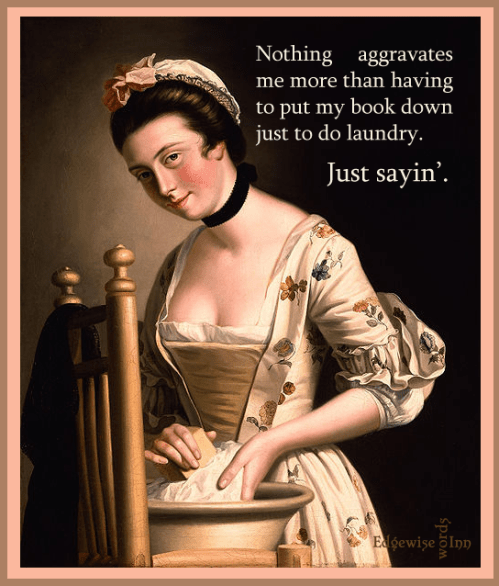
Nowadays I have that miracle of modern technology, the washing machine, and still, I resent being taken from my book just to sort, wash, fold, and put away clothes.

vi edgewise words inn, the laundry meme

LAUNDRY DAY BLUES

I’d love to claim I’m reading

the best book of the year.

I’d love to swear I’ve read it

but laundry day is here.

clothespin tiny

My book rests by the sofa

tempting and serene.

But I’ve a pile of laundry

to somehow sort and clean.

clothespin tiny

The cover art is lovely

with elves and all their kin.

It’s by my favorite author–

would reading be a sin?

clothespin tiny

Alas for me it would be

for socks don’t wash themselves.

When the task is finished.

I’ll run off with my elves.


Laundry Day Blues © Connie J. Jasperson 2016

2 Comments

Filed under #FlashFictionFriday, Fantasy, Humor

#amwriting: World building: Society, and Magic

Today we will examine society and magic, two disparate concepts with one thing in common: both require a solid framework to imagine the story around. In other words, you have to understand them well.

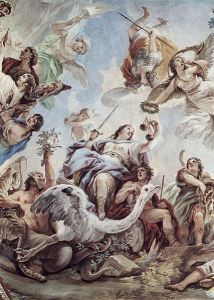
Luca Giordano, Frescoes in the gallery of the Palazzo Medici-Riccardi in Florence, Scene - Justizia ca 1584

Luca Giordano, Frescoes in the gallery of the Palazzo Medici-Riccardi

First let’s discuss religion and society: Who are the movers and shakers?

In all societies, there is a hierarchy of power. Someone is at the top and someone else is at the bottom.

As I create the political power-structure, I find that the opportunities for creating tension within the story also grow. I keep a list of those ideas so that when I run short on creativity I have a bit in the bank, so to speak.

When you are building a world that only exists on paper, you have a microcosm of space in which you can convey the social, religious, and political climate of your story.  You show this in small ways, with casual mentions in conversation when it becomes pertinent, and not through info dumps.

However, in order to convey that information logically and without contradictions, you must have an idea of how things work.

  • Who has the power and privilege in that society, and who is the underclass?
  • How is your society divided? Who has the wealth?
  • Who has the power? Men, women—or is it a society based on mutual respect? Is one race more entitled than another?
  • Who wants power, and what lengths are they willing to go to gain it?
  • What place does religion have in this society? Is it central to the governance of the society, or is it a peripheral, perhaps nonexistent thing?
  • What passes for morality? Is sex before marriage taboo? What constitutes murder and how is it viewed? Remember, you only need to worry about the moral dilemmas that come into your story.
  • If a character goes against society’s unwritten or moral laws what are the consequences?

This creates atmosphere. This is knowledge the characters have but the reader does not. There is no need to have an introductory chapter describing the laws and moral codes of the religious order of Grok, or the political climate of West Berlin in 1961. The way you convey this is to show how these larger societal influences affect your character and his/her ability to resolve their situation.

Consider this story: a woman is separated from her husband by the Berlin Wall.  Every day, on her way to her job, she rides her bicycle past the wall, knowing that on the other side, less than a block away, is her husband. Yet the couple is divided by an impassable barrier. How the wall affects her is shown in her everyday life. In this story, the history of how the wall came into existence isn’t as important as how its presence destroys her family. The wall represents the ideology of those who rule in her divided city, so the reader comes to know the politics of both East and West Berlin by her experiences in trying to cross that barrier.

And now for the magic:

If magic is central to your story, it is critical that you have finite rules for limiting how magic works. If you make your characters too clever, readers won’t be able to relate to their story. 

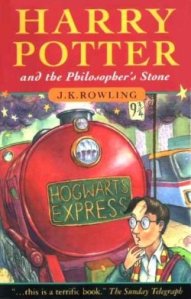
Harry_Potter_and_the_Philosopher's_Stone_Book_CoverWhen magic is part and parcel of a story, rules and limitations create the tension that moves the plot forward. J.K. Rowling’s Harry Potter series is an excellent example of this. No one character has all the power. The two most powerful wizards, Dumbledore and Voldemort, are evenly matched, but neither one is all-powerful. Both wizards want something from Harry. Harry has to work hard to gain his the full use of his abilities.

Harry’s struggle is the story.

  • Who has the magic, and what social power does this give them?
  • What are the limitations of his/her powers?

Each time you make parameters and frameworks for your magic you make opportunities for conflict within your fantasy world. Conflict is what drives the plot.

What challenge does your character have to overcome in regard to his magic?

  • Is he unable to fully use his own abilities?
  • If that is so, why is he hampered in that way?
  • How does that inability affect his companions and how do they feel about it?
  • Are they hampered in anyway themselves?
  • What has to happen before your hero can fully realize his abilities?

Without rules, there would be no conflict, no reason for the hero to struggle, and no story to tell.

Merlin, by Douglas Baulch, Via Wikimedia Commons

Merlin, by Douglas Baulch, Via Wikimedia Commons

I have three worlds with three radically different systems of magic. My serial, Bleakbourne on Heath, is set in a parallel earth that is one shadow away from this one. Bleakbourne, situated on the Heath River, is where the fey and the mortal worlds meet. Leryn, my main character, has many adventures with people who have certain parallels with our history and who are drawn from Arthurian legend, but who are given my own particular twist.

I had to sit down and write out the rules for Merlin’s magic. In Bleakbourne’s world, wizards are born with the latent ability to wield magic, but it is considered a science, and craftsmanship is valued above all else. Skill is what gives a sorcerer power. Certain rituals must be observed.

  • Spells work two ways, and the second way always reverses the first way—this is called symmetry.
  • The words used in spells are of the old, dead, Romani language. Unwords are syllables that have a null meaning and are often inserted for symmetry.
  • All the Romani words with more than one meaning must be chosen carefully because they can be either too short or too long for symmetry. Too long a word will not work at all as you can lengthen, but not shorten them. The sorcerer must choose a shorter word, which requires him/her to insert an extra, closing unword, or the two spells wouldn’t be symmetrical. There are four unwords to choose from, but only three chances to get the spell right

In the Bleakbourne series, the use (and abuse) of magic is the underlying theme.

In creating both social and magic systems, you are creating a hidden framework that will support and advance your plot. Within your magic system, there can be an occasional exception to a rule, but there has to be a damned good reason for it, and it must be clear to the reader why that exception is acceptable.

The only time the reader needs to know these systems exist is when these institutions affect the characters and their actions. Dole this information out in conversations or in other subtle ways and it will become a natural part of the environment rather than an info dump.

1 Comment

Filed under Fantasy, Publishing, writing