#amwriting: world building: maps and the mythology of history

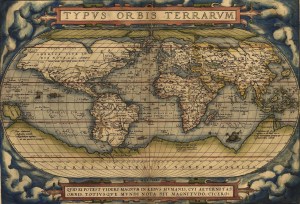
The world Ortelius' Typus Orbis Terrarum, first published 1564

The world Ortelius’ Typus Orbis Terrarum, first published 1564

After years of work on the author’s part, regardless of whether the book is an encyclopedia, a contemporary thriller, a historical fiction, or even a travelogue with photographs, the world that the book details remains untouchable by our human hands. This is because that world only exists between those pages and in the mind’s eye.

The fundamental laws of physics bar us from going back and viewing or experiencing the reality of a historical event as a participant. We can, however, read about it, paint images of it, or make a film depicting what we believe happened during the event. This is where world building comes in.

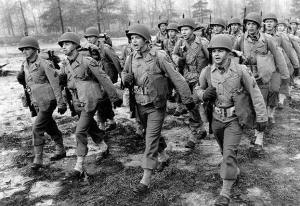
WWII US Soldiers Marching, image courtesy www.berkeley.edu

WWII US Soldiers Marching, image courtesy http://www.berkeley.edu

But wait, you say. I’m not writing fantasy. I’m writing a story about France, in 1945. I don’t have to build that world–it actually exists.

I’m sorry–the world of France in 1945 is long gone. It no longer exists, except as a memory.

Let’s assume you are writing a historical accounting of the Battle of the Bulge. But, even though it may explore a soldier’s true experiences through newsreels, the pages of his diary, and  the interview you had with him, in reality, the world of this book exists only in three places:

  • it flows from the author’s mind
  • to the pages of the book
  • into the reader’s mind through the written word

Because we can only view history through the stained glass of time, we must accept that it assumes a mythical quality when we attempt to record it. Even a documentary movie that shows events filmed by the news camera may not be portrayed exactly as it was truly experienced. The facts are filtered through the photographer’s eye and the historian’s pen.

Your mind is the medium through which the idea for a novel or story is filtered and words are how it is made real. The key to making both fiction and non-fiction real for the reader is subtle but crucial: worldbuilding. It is worldbuilding that makes a stark accounting of incidents and conversations seem real to the person reading the book.

To build a world out of ideas and words, the author must know it well:

  • Create a stylesheet to avoid contradictions in your work. This is covered in my post, Stylesheets.
  • If your work is set in a contemporary setting, make use of Google Earth. This allows you to see a recent image of the place for yourself, even if you can’t afford to travel there.
  • Go to the internet and find maps of the place in the time your are writing about. If you are writing genre fantasy or speculative fiction of any sort, create a hand-drawn map for your own reference. We will discuss this below.
  • Research/or Create and these systems if they pertain to your work: Political, Social, Religious, and Magic. (We will discuss how to do this simply in my next post.)

If you are writing fantasy you need to know what the world looks like.

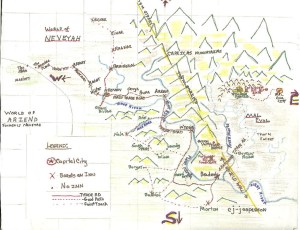
Original Map of Neveyah from 2008 ©cjjasp

Original Map of Neveyah from 2008 ©cjjasp

I love maps. My own maps start out in a rudimentary form, scribbled in pencil on graph paper, just as a way to keep my work straight. They begin looking like the one to the left of this paragraph, and evolve as the first draft of the story evolves.

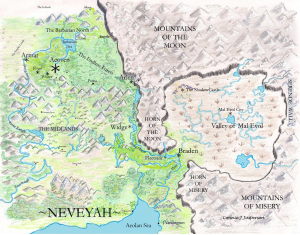
Towns get renamed. They get moved to more logical places. Whole mountain ranges are moved, and forests and savannas appear where they are supposed to be. Over the course of writing the first draft, my world becomes real and the pencil sketch  map will become the digital art you see below.

In my books, people are going hither and yon with great abandon, and if I am not really on top of it, the names of towns will evolve over the course of the novel–Maudy will become Maury (this actually happened) and distances will become too mushy even for me. The map is my indispensable tool for keeping my story straight.

Map of Neveyah, for RizAero

Map of Neveyah 2015 ©cjjasp

When your characters are traveling great distances, they may pass through villages on their way, and if these places figure in the events of the book, they should be noted on the map. This prevents you from:

  • accidentally naming a second village the same name later in the manuscript
  • misspelling the town’s name later in the narrative
  • forgetting where the characters were in chapter four

Perhaps certain things will impede your characters. If they are pertinent to the story, you will want to note their location of on your map so that you don’t contradict yourself if your party must return the way they came:

  • Rivers
  • swamps
  • mountains
  • hills
  • towns
  • forests
  • oceans

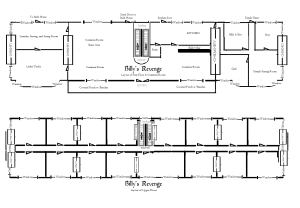
Billy's Revenge Floor plan ground floorIf your work is in sci-fi, consider making a rudimentary star-chart, if space-travel is a part of your tale. For Sci-fi, you might want to know:

  • the name of the star or stars if the system is binary/trinary
  • number of planets, their names and positions
  • which planet the story takes place on
  • moons and asteroid belts that may be relevant to the tale
  • map of the area on the planet your story takes place or
  • map of space station/ship if the story takes place in space

In the narrative, if you are writing fantasy, I suggest you keep the actual distances mushy because some readers will  nitpick the details, no matter how accurate you are. Yes, you wrote it, but they don’t see it the way you do. This is because their perception of a league may be three miles while yours might be one and a half. Despite the fact that a league has no finite length and is whatever the author decides it is, some readers feel their opinion is of such worth that they will never back down. They will become so annoyed by this that they will give your book a three-star review, simply because they disagree with the length of time your character took to travel a certain distance. 

From Wikipedia, the fount of all knowledge: “A league is a unit of length (or, in various regions, area). It was long common in Europe and Latin America, but it is no longer an official unit in any nation. The word originally meant the distance a person could walk in an hour.[1] Since the Middle Ages, many values have been specified in several countries.”

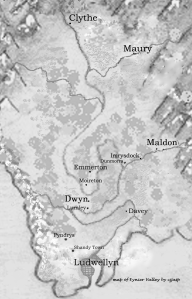
Map of Eynier Valley for 'Huw the Bard, ' ©cjjasp 2014

Map of Eynier Valley for ‘Huw the Bard, ‘ ©cjjasp 2014

Therefore, a league is what you say it is, within some loose parameters. I go with the distance you can walk in an hour, but you have to take into consideration the terrain.

Huw the Bard takes two months to travel between Ludwellyn and Clythe. In his story, Huw Owyn is walking through fields, woods, and along a several winding rivers for the first half of  his journey. He has to backtrack as frequently as he goes forward in order to sneak around those who would kill him. It’s only safe for him to walk on the main road once he makes it to Maury, weeks after fleeing Ludwellyn.

It is a stretch of road that he could have done in two weeks if he had been able to stay on the main road, and if he hadn’t had to do so much backtracking. But that inability to make progress creates opportunities for tension.

Readers love to see maps in the front of books, but you don’t have to put yours there if you don’t like your own handiwork. This map can be only for your purposes, so you will know in a concrete way where every town and village is in relation to your story.

Fantasy readers like maps. If you choose not to include your map in the finished product, consider hiring an artist to make your map from your notes. Because I am an artist, my pencil-drawn map always evolves into artwork for the book.

Every book, fiction or non-fiction, takes an idea, translates it into words, and dares the reader to believe it. It is our job as authors to take what is intangible and make it seem real to the reader who is experiencing the world and a moment in history through our writing.

11 Comments

Filed under Fantasy, writing

St Albans – stained glass and medieval paint

I have enjoyed this journey through the history and architecture of St. Albans so much! I can’t thank Sue Vincent enough for sharing it with us, through both her camera and her eye for the poetry in things. What I’ve learned from observing her as she experiences this place, is that writers must see the world through the eye of the artist.

3 Comments

Filed under Adventure, writing

The Lake Isle of Innisfree, by W.B. Yeats

Skagit River Mist/PFly CC-BY-SA-2.0

THE LAKE ISLE OF INNISFREE

W.B. Yeats

I will arise and go now, and go to Innisfree,

And a small cabin build there, of clay and wattles made;

Nine bean-rows will I have there, a hive for the honey-bee,

And live alone in the bee-loud glade.


And I shall have some peace there, for peace comes dropping slow,

Dropping from the veils of the morning to where the cricket sings;

There midnight’s all a glimmer, and noon a purple glow,

And evening full of the linnet’s wings.


I will arise and go now, for always night and day

I hear lake water lapping with low sounds by the shore;

While I stand on the roadway, or on the pavements grey,

I hear it in the deep heart’s core.


William Butler Yeats (1865-1939), Nobel Prize winning Irish dramatist, author and poet.

The poetry of WB Yeats occupies a large place in my heart and is one of my favorite sources of inspiration.  In his early years, Yeat’s was not afraid to write of faeries and mystical things that fired my childish imagination. Later, as he grew as both a writer and as a person, he also wrote wonderful works that were more firmly rooted in reality. The Lake Isle of Innisfree was published in 1890.

3 Comments

Filed under #FlashFictionFriday, Fantasy, Poetry

St Albans – “Count the stars…”

Sue Vincent continues St. Albans, this time though the abbey itself. Seen through the eye of the photographer and the soul of the poet, we find ourselves in a holy place, where architecture meets the divine.

3 Comments

Filed under Adventure, History, mythology

#amwriting: the author’s voice

The sense of style steven pinkerAnyone who is a member of a writing group is regularly beaten over the head with certain basically good, but occasionally clichéd, rules. Improperly applied, this mindless interpretation of proper grammatic style can inhibit an author’s growth.

These rules are fundamentally sound, but cannot be rigidly applied across the board to every sentence, just “because it says so in Strunk and White.” I rely on the Chicago Manual of Style, but I also understand common sense.

English is a living language. As such it is in a continual state of evolution and phrasing that made sense one-hundred years ago may not work well in today’s English.

We may be writing a period piece, but we are writing it for modern readers.

You can split an infinitive: it is acceptable to boldly go where you will.

You can begin a sentence with a conjunction if you so choose. And no one will die if you do.

Stephen Pinker discusses many rules in his controversial book, The Sense of Style, and finds that some of them no longer make sense.

For example, Pinker points out that “The prohibition against clause-final prepositions is considered a superstition even by the language mavens, and it persists only among know-it-alls who have never opened a dictionary or style manual to check.” 

He notes that rigidly following “the rules” would have you doing silly things like turning “What are you looking at?” into “At what are you looking?”  I don’t know about you, but for me the first example is preferable.

In the example, the word at is a preposition, and placing it after looking makes it a clause-final preposition.  Such a construct is technically a no-no, but I suggest you break that rule.

Stardust, Neil GaimanWe are constantly told that we need to make our verbs active, rather than relying on passive constructions, and for the most part, this is true. But Pinker reminds us that “The passive is a voice and not a tense.” There are times when the use of passive phrasing is appropriate.

Consider the difference between ‘the cat scratched the child’ and ‘the child was scratched by the cat.’  The second sentence is written in the passive voice, and in this context the active voice is the one I would choose because it is simpler and less fluffy.

Pinker agrees with me that there are contexts in which the passive is preferable. Quote from The Sense of Style: “Linguistic research has shown that the passive construction has a number of indispensable functions because of the way it engages a reader’s attention and memory.”

And in writing, context is everything. 

For most genre work, editors push for active voice, but truthfully, mainstream fiction and literary fiction can use the passive voice and still sell boatloads of books. Some of the most beautiful prose out there in genre fantasy mixes passive voice in with the active, and when done right  it is immersive.

name of the wind -patrick rothfussPatrick Rothfuss’s Name of the Wind is one example, and Neil Gaiman’s Stardust is another.

These books are best sellers because both Rothfuss and Gaiman understand how to craft prose that mingles passive and active phrasings, drawing us into their work. They choose when to use passive phrasing, and apply it appropriately so the narrative is a seamless blend of properly constructed sentences chosen to reflect their distinct voices.

The modern prohibition against passive phrasing exists for a reason: improperly and excessively used, the passive voice can weaken your narrative.

Knowledge of grammar and sentence construction is critical if you are an author: Sloppy grammar habits show that your work is badly crafted.

Your voice is the way you habitually phrase things despite your vast knowledge of how grammar is correctly used. Take a look at the great authors: Raymond Chandler, Ernest Hemingway, F.Scott Fitzgerald, and James Joyce: these authors each had such a distinctive voice that when you read a passage of their work, you knew immediately who you were reading.

They ALL broke the rules in their work and were famous for doing so.

Raymond chandler quote split infinitivesHowever, they understood the rules they were breaking and broke them deliberately and selectively in the crafting of their narrative.

Imagine a story set in an expensive restaurant. This story revolves around a marriage that is disintegrating. The couple, Jack and Diane, dine in silence. The food is important, but only because of what it represents. How do you convey this?

The steak was well-prepared and melted in Jack’s mouth. Nevertheless, Diane wielded her knife like a surgeon, cutting her meat into tiny, uniform chunks, chewing each bite slowly before swallowing. Jack imagined her carving his heart similarly, chewing it carefully and then spitting it out.

800px-Night_Sky_Stars_Trees_Quote“The steak was well-prepared and melted in Jack’s mouth” is written with a passive voice, and that is okay. The important thing is Jack’s observation of Diane and her mad knife skills. You don’t need to say “The chef had prepared the steak perfectly.” Unless he is having an affair with Jack or Diane, the chef who prepared the tender steak is not important and doesn’t need to be mentioned.

Steven Pinker has some words of wisdom for would-be editors: “It’s very easy to overstate rules. And if you don’t explain what the basis is behind the rule, you’re going to botch the statement of the rule—and give bad advice.”

Knowing what the rule is and why it exists allows you to choose to break it if that is your desire.

Writing style is a combination of so many things. It is how you speak through your pen or keyboard. Craft your prose with an eye to what is important to your story, and say it with your voice. With that said, your voice should not be so distinct and loud that it makes your prose obnoxious. A good editor will understand the difference and guide you away from bad writing, helping you find your voice in such a way that your work will be a joy to read.

8 Comments

Filed under Fantasy, Publishing, writing

#amwriting: stylesheets

IBM_SelectricWriting a fictional novel is really the same as telling a whopping lie that you believe in with all your heart and keeping it straight for 80,000 words or more.

Everyone knows how lies evolve in the telling. That tendency to elaborate and embellish is the eventual downfall of even the most believable of liars.

What the writer has going for them that the average liar doesn’t is paper. We write the falsehood down on paper the way we pretend it happened. Once the fabrication is complete we have the luxury to go back and forth over it, making sure we haven’t contradicted ourselves, and then we dare the reader to believe it.

I posted a blog to this effect on November 9, 2015: 3 steps for keeping the story straight. One step that I discussed is what editors refer to as the “stylesheet.”

Bleakbourne Style SheetWhen a manuscript comes across their desk, editors and publishers create a list of names, places, created words, and other things that may be repeated and that pertain only to that manuscript. This is called a stylesheet.

The stylesheet can take several forms, but it is only a visual guide to print out or  keep minimized until it’s needed. I copy and past every new word or name the first time they appear in the manuscript, and if I am conscientious, I’ll be less likely to inadvertently contradict myself later on in the tale.

Many people use a program call Scrivener for this and they are happy with it, but I found it didn’t mesh well with the way MY mind works, so I went back to my one-page list and hand scribbled map.

Regardless of how you create your stylesheet, I suggest you include these elements:

  • Word/Name
  • Page it first appears
  • Meaning

Stylesheet_example_LIRF_cjjasp

This is especially crucial for fantasy authors because we invent entire worlds, creating names for people, places, and creatures.

Take my own work-in-progress: it is the final volume of the Tower of Bones trilogy, and has people with names that can be spelled several ways, and when I am in the throes of writing the first draft I fling them out any old way.

Thus, a character named Linette on page one can become Lynette by page six. Kalen can become Kalin. Place names become mushy, and any word that is important or invented can evolve over the course of a manuscript.

Now I am in the final stages of making the manuscript submission-ready. I have completed a global search for every possible variant of the words on my list, and replaced the incorrect instances with the version I like best.

Valley of Mal Evol ©Connie J. Jasperson 2016Place names evolve too, so maps are essential tools when you are building a world. Places written on a map tend to be ‘engraved in stone’ so to speak. Readers will wonder where the town of Maudy is when the only town on the map at the front of the book that comes close to that name is listed as Maury.

To prevent that from happening, double check what you have written on the map, and then do a global search for every possible variant.

Just because you invented the world doesn’t mean you know it like the back of your hand. That world is constantly evolving in your mind. I have been writing in the world of Neveyah since 2009, and still I find that I frequently contradict myself, which is why the stylesheet is so important.

11 Comments

Filed under Fantasy, Publishing, writing

St Albans… ‘render unto Caesar’

Photographer and author, Sue Vincent, takes us on a journey through British history via the architecture of St. Albans. It is in this village where the real influence of the Romans can still be seen. Roman and Victorian building styles collide and create something uniquely British.

5 Comments

Filed under Adventure

#FridayFiction: Meriko’s Eyes

Meriko's Eyes © cjjasp 2016

Meriko pressed against the wall, hiding ever deeper in the shadows.  One never knew what lurked in the streets of the city anymore. Since the change, things had been difficult. According to the internet, society was crumbling.

Of course, the web had always declared that.

The darkness in the alley emphasized the scarcity of electricity even though the grid was back up. Meriko’s own scant ration of wattage was reserved for her computer—her lifeline, her source of income and her only reliable link to the life she once had.

She knew things were still bad but had no idea how widespread the problems were. She hadn’t witnessed any violence outside her windows in weeks, but still, emails from her fellow employees at GiantSoft were rife with rumors of murder and worse, and now she went out only when she had no other choice. She wasn’t completely out of touch—she still had interactions with friends through emails and social media. Even if they never saw each other, the network of workers did have a kind of camaraderie.

It was just…she had found a solitary existence more difficult to endure than she had initially believed it would be.

Normally, she had everything delivered to her: food, clothing, everything. She never had to leave home.  However, her self-imposed solitude had at last driven her out of her flat; loneliness and the handsome face of a young man viewed from her window.

She emerged into the alley behind her building. The cool, damp air held a musty scent of mold and garbage mingled with other even less desirable odors, but she didn’t notice them, her senses open to other, worse things. Fortunately she didn’t sense the evil miasma of nightwalkers in the area. Nevertheless, she cleared her mind of any thoughts that might draw attention to her and quickly crossed the alley to the Double Joy restaurant, melting into the shadows. After a moment’s indecision, she entered the café through the backdoor.

Boldly walking as if she had simply been to the restroom, she sat on the only empty stool at the counter and ordered yaki-soba and bubble tea, adding a tip as she paid the bill.  Sipping her drink, she waited for her meal. Even if nothing came of her plan, it was good to be around real people, hearing real voices instead of virtual conversations through the social interface.

She had a flat full of cat statues to keep her company, but they only underscored her isolation, their marble features forever perfect and unchanging.

Meriko could barely tolerate the aromas of the restaurant, the scents of food mingled with the odors of others like her, people so desperate to escape their solitary lives that they would brave the shadowed streets just to dine in a sweltering café with strangers.

“How can you see with those dark glasses, girlie?” said the drunk next to her, with a leer.  The smell of stale beer made her ill, and reflexively, she leaned away from him.

“Oh, you know,” she said noncommittally. “It’s the fashion, so….”

“Hey there! Don’t be bothering the other customers,” the man behind the counter warned the drunk. “If you bother her again, you’re out of here.”

“I’m behaving, don’t worry,” the drunk mumbled, and after a few moments, he staggered out the front door into the night. As he left, fresh air came in, but it was quickly cut off by the slamming of the door.

“I hate drunks,” the man behind the counter said.  “They can eat elsewhere. I don’t need their money.” He busied himself with cleaning the counter and the soda machine.

Meriko pushed her food around the plate and stared through the service window at the young cook in the back.  He was why she came here, despite the danger in doing so.

Tonight she had come in close to closing time, and soon she was the only customer there. So she had timed it right.

She’d watched him come and go every night since he had started working there, observing him from the window of her flat.  The restaurant was just across the alley from her building, so much of her view was taken up by the alley and the back of this restaurant.

“May I have a box to take my leftovers home in?” The man behind the counter brought her a box. “Have a nice evening,” she said, as she walked out the front door.  She was so lonely.  Maybe tonight she would find a friend.  Other people had companions in their lives. Maybe this was the night for Meriko.

***

Ten minutes after closing the restaurant, the cook, a young man named Kai, walked down the dark city street to his bus stop. Usually he was the only one there, but tonight a girl was there, and a to-go box from his restaurant sat on the bench beside her.  He was sure she’d been in the café earlier. He’d seen her carrying the box as she left.

He’d noticed her because she was wearing dark glasses.

“Hello,” he said cheerfully. “Did I see you tonight in my restaurant? Well, it’s not mine, but I work there.”  His smile was unforced and honest, elevating his face from handsome to beautiful.

“Yes,” she said, smiling. “I go there often, but tonight I was later than usual. They were almost closed.”

“I only work the late shift, so that’s why I haven’t seen you before,” he said as he sat on the bench and checked his phone to see the time.  “My name is Kai.  What’s yours?”

“Meriko,” she answered, feeling happy for the first time in weeks.  He was so handsome!

They sat talking for five or so minutes.  Finally he asked, “Why do you wear dark glasses in the night? You wore them inside our restaurant.  I heard you tell the drunk that it was the fashion, but…well, maybe I am not up on the current trends or something.”

“Ah…it’s a genetic condition. My eyes are extremely sensitive to the light,” she told him. “Do you have any hobbies?” she asked, trying to distract him.

“Oh, so it’s painful to go without them,” he said, as if he understood. “So are you a vampire or something?” he joked. “That would be a hoot, me hanging out with a vampire.”

“No.” She laughed. “I’m not a vampire! I am just a girl, just a regular girl. Hobbies…I like collecting old Pokémon cards from before the change. Do you collect anything?”

“So let me see your eyes then, Meriko, who is just a regular girl,” he said, leaning forward to take the sunglasses off her.

“No! Don’t do that,” she said. But it was too late.

Meriko looked at the statue of the handsome young man sitting on a bus bench, holding a pair of dark sunglasses.  The lights of the approaching bus turned the corner as it made its way to her stop, but Meriko had already fled into the darkness, crying.

“Why do they always want to see my eyes?  Why can’t they ever just want to talk?”  Still sobbing, she crept through the shadows to her home.

Statues.  Meriko’s life was full of statues.


Meriko’s Eyes © 2016 Connie J. Jasperson, all rights reserved

Meriko’s Eyes was first published on WattPad in January 2013 as Fortune’s Fool. It was republished in March 2015 by Edgewise Words Inn, under the title Meriko’s Eyes.

8 Comments

Filed under Fantasy, writing

#amreading: the genesis of an author

Nymphenburg, View From the Seaside painting by Joseph Wenglein 1883

Nymphenburg, View From the Seaside painting by Joseph Wenglein 1883

I find the process of creativity as experienced by others intriguing, and am always curious about how they became authors.

My own journey to this place in my life was pretty tame. But some people  become authors via more adventurous, alternative paths.

This notion is explored in Elizabeth McKenzie’s frank, autobiographical post published on January 26, 2016, for LitHub.

Max Ernst, The Elephant Celebes 1921, Tate, London via WikipediaAppropriately titled “Surrealism and Decomposition. Or How I Wrote My Novel,”  McKenzie takes us on a journey through both her personal quest for enlightenment and creativity and the authors whose works colored her writing life. The quote that hooked me into reading this piece: “I read Rimbaud and Breton and Lautreamont and started according my dreams the respect I felt towards art. I wanted to have visions, I wanted, as Rimbaud put it, to take part in the systematic disordering of the senses.”

Her honest account of her sometimes psychedelic journey through alternate forms of consciousness and literary greatness is quite intriguing and took me back to my college days when many of my friends also chose that path for enlightenment.

Psychedelics were never an option for me, although in that way I was the odd one in my circle. The notion of them frightened me. Life in the early 1970s was surreal enough in its cold reality. My form of mind-expansion came in books.

The authors whose works influenced me as a young adult might surprise those who know me.

In my twenties, sci-fi and fantasy books were expensive and hard to get. The libraries stocked a few, but not as many as I required, as fast as I read.

When I was young, my parents were prolific readers and were members of both Doubleday Book Club and Science Fiction Book Club. They also purchased two to four paperbacks a week at the drugstore and subscribed to Analog and several other magazines.

samuel pepys diaryThere was always something new and wonderful to read around our house, and most of it was speculative fiction, although we had the entire 54 volume leather-bound set of the Great Books of the Western World, and our father insisted we attempt to read and discuss what we could.

Some were mostly understandable, such as William Shakespeare and Samuel Pepys.

Plato, not so much, and yet his work did influence me.

At the age of 14 I didn’t understand Pepys, but I read him, and while we were bass fishing on a Saturday morning, Dad would talk about the differences between life and morality in Pepys’ London and our life in suburban America in 1969. His thought was that I should learn about the 17th century and the Great Fire in London from an eye witness, just as I had learned about the war in the Pacific from John F. Kennedy‘s autobiographical novel,  PT 109.

But Pepys’ London of 1666 was so different from the ‘Mod’ subculture of the London of 1966 (and the Beatles) that I was familiar with thanks to Life magazine. To me, it was almost like speculative fiction. In many ways it was more difficult  for me to believe in historical London than Tolkien’s Middle-Earth.

When I married and left home, I still read every sci-fi or fantasy novel that came out in paperback, budgeting for books the way others of my acquaintance budgeted for beer. I read the classics for my irregular college classes, and learned to love Chaucer and James Joyce. For a variety of reasons I never earned a college degree, but I’ve never stopped reading and researching great literature.

But reading for entertainment was still my “drug.” I jonesed for new books by the great ones, Anne McCaffrey, Jack Chalker, and Roger Zelazny, reading and rereading them until they were shreds held together with duct tape.

As a married student attending college in Bellingham Washington, purchasing books for pleasure became a luxury. I found a secondhand bookstore where I could get a brown paper shopping bag full of novels in too poor a condition to sell on their shelves for $2.00 a bag if you had a bag of books to trade in.

As a college drop-out I went through a bag of books every week, and within a year, I had read every book they had.

Devils Cub Georgette HeyerThus, out of desperation, I discovered a whole new (to me) genre: regency romances written by Georgette Heyer, and other romance writers of that generation. Those books, along with beat up copies of bestsellers by Jack Kerouac, James Michener, and Jacqueline Susann began to show up in the pile beside my bed.

So at least some of my literary influences can be traced back to dragons, booze, morality, and England’s romantic Regency—lived vicariously through these authors’ eyes.

Always when the budget permitted, I returned to Tolkien, Zelazny, McCaffrey, Asimov, Bradbury, and as time passed, Piers Anthony, David Eddings, Tad Williams, L.E. Modesitt Jr., and Robert Jordan to name only a few.

And there were so many, many others whose works I enjoyed. By the 1990s, the genres of fantasy and sci-fi were growing authors like a field grows weeds, and I loved it.

All of the books I read as a child and young adult have influenced my writing. They still inspire me.

Nowadays I rarely am able to read more than a chapter or two before falling asleep. My Kindle is full of books, and I haven’t got the time to read them because I have to write my own story. Having the luxury to spend a day wallowing in a book is a treat to be treasured.

Old booksBut it is because of the uncountable authors whose works I have been privileged to read that I was inspired to think that my own scribblings might be worth pursuing.

Writing has always been necessary to me, as natural as breathing. In the beginning, my writing was unformed and was a reflection of whoever I was reading at the moment. As I matured and gained confidence, I found my own ideas and stories, and they took over my life.

Once that happened, I became a keyboard-wielding writing junkie.

Some days I write well, and others not so much, but every day I write something.

And every day I find myself looking for the new book that will rock my universe, a new “drug” to satisfy my craving, even if I know I won’t have time to read it.

I’m addicted to dreams and the people who write about them. Reading is my form of mind expanding inspiration. Without the authors whose books formed my world, I would never have dared to write.

Life would be so boring.

2 Comments

Filed under Publishing, writer, writing

#amwriting: Commas: Morsels of madness or necessary evils?

commaNothing gets certain people jacked up more than misplaced commas. Why this rabid hysteria? Personally, I have no energy to waste, so I’m selective about my frenzies.

But commacentric grammarians do raise a few salient points. Commas and the rules for their use exist for a reason, and if we want the reading public to understand our work, we need to follow them.

I am a decent structural editor, but I don’t claim to have any special knowledge about commas.

However, I do know a couple of things:

  1. Never insert commas “where you take a breath” because everyone breathes differently.
  2. Do not insert commas where you think it should pause, because every reader sees the narrative differently.

Commas are the rules of the road for writing. They are the universally acknowledged pausing and joining symbol. Readers expect to find their pauses between clauses and commas are sometimes the signifiers of those pauses.

One rule I had to unlearn the first time I sent my work to a professional line editor:

  1. Do not place a comma before ‘because’ unless the information that follows is necessary to the sentence.

What? That’s not what I was taught in school!

The Chicago Manual Online gives this example (and I quote):

He didn’t run, because he was afraid.

He didn’t run because he was afraid.

Douglas Adams quote, split infinitivesIn the first sentence, “because he was afraid” isn’t necessary. The main thing is that he didn’t run, and the reason is incidental. The second sentence, which omits the comma, is unclear. It might mean that he ran, but fear was not the reason he did so.

Mignon Fogarty, the Grammar Girl, explains this well. “You don’t automatically put a comma before the word because, but sometimes you need a comma there to make sure your meaning is clear.”

We do use commas to set off introductory clauses:

  1. In the first sentence, “because he was afraid” isn’t necessary.

I italicized the introductory clause in the above sentence to show that it is not a stand-alone sentence. This clause introduces the clause that follows it, and its meaning is dependent on that following clause.

Another thing I had to unlearn:

  1. Do not automatically place a comma before the conjunction ‘and.’

Compound sentences combine two separate ideas (clauses) into one compact package. A comma should be placed before a conjunction only if it is at the beginning of an independent clause. So use the comma before the conjunction (and, but, or) if the clauses are actually standalone sentences. If one of them is not a standalone sentence, it is a dependent clause, and you do not add the comma.

Take these two sentences: She is a great basketball player. She prefers swimming.

  1. If we combine them this way we add a comma: She is a great basketball player, but she prefers swimming.
  2. If we combine them this way, we don’t: She is a great basketball player but prefers swimming.

I hear you saying, “Now wait a minute! Mrs. Downing very clearly taught us to use commas to join clauses, and she was right.”

I’m sorry, but Mrs. Downing probably  explained that. It just didn’t stick in your memory.

Two complete ideas can be joined with ‘and.’ Did I just contradict myself?

Sort of.

Think of it like a list: if there are only two things (or ideas) in a list, they do not need to be separated by a comma. If there are more than two ideas, the comma should be used to separate them, with a comma preceding the word ‘and’ before the final item/idea.

Dogs, cats, rabbits, and birds.

Oh YES, we DO use serial commas to prevent confusion! You’ve all seen the meme:

serial commas meme, martha stewartOn a personal level, I do love cooking, my pets, and my family. (But not in the same pot.) They’re happy that I use serial commas.

One of my favorite personal failings is the notorious comma splice. Apparently it’s bad form to join two independent clauses with a simple comma. This error is called a comma splice.

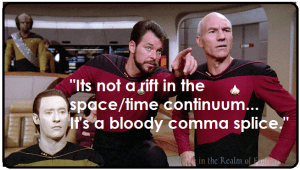
I have it on good authority that a comma splice will not cause a tear in the space-time continuum. But since this breach of humanity occasionally sends commacentrics into a frothing frenzy, we will use the conjunction and give these poor wretches a break.

From Wikipedia, the fount of all knowledge: “A comma splice is the use of a comma to join two independent clauses. For example: It is nearly half past five, we cannot reach town before dark. Although acceptable in some languages and compulsory in others (e.g., Bulgarian or French), comma splices are usually considered style errors in English.”

chicago manual of styleCommas and their proper use can drive you crazy when you are trying to get your work in order. And quite frankly, the rules are a little confusing.

Consistency is critical. UK usage can vary from US usage in some ways. Find a style guide that you can understand and consult it. Once you have a guide you can work with, use those suggestions consistently in all your work.

I use the Chicago Manual of Style for my work because I am a US citizen, and for creative writing, this is the most comprehensive manual and is what publishers and editors use. If you are strapped for cash, you can often buy secondhand copies of this manual through Amazon.

Commas can easily get out of control for me because I have a tendency to hit the comma key whenever I pause in my thinking when I am in the first draft phase. At that point, I am more concerned with just getting the words down than I am form and style.

However, proper form and style must come into play when we get into the later drafts. Using established protocols for punctuation is important if you want your readers to understand what you meant when you wrote that amazing piece of literature.

14 Comments

Filed under writer, writing