Vegans #GiveThanks too: The Famdamily Feast

1024px-Pieter_Bruegel_the_Elder_-_The_Peasant_Dance_-_1526-1530 to 1569I make no secret that I am vegan. It confuses my friends, and my family tolerates it. They worry what to feed me. I always say, “Vegetables.”

I like food that is
– made with Non GMO ingredients
– 100% meat and dairy free (vegan) made from ingredients with words I understand and can pronounce.

I don’t really care for the traditional vegan staple, the Tofurkey roast, although many vegans do enjoy that particular product. I LOVE Tofurkey brand’s tempeh products, and use them all the time.  I even like their 100% meat free hot dogs.
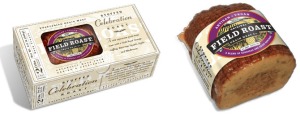
Field Roast celebrations roastI prefer Field Roast products, when it comes to getting my protein in a vegetable form. Thus, while I am roasting an actual organic, free-range turkey for my sadly carnivorous family, I will also make myself a Field Roast brand Celebration roast, with a cranberry glaze.

All of the traditional side dishes will be there but they will have no animal product in them–and there will be no  lack of Thanksgiving flavor at my table!

I will make the traditional sweet-potatoes, using Dandies vegan marshmallows.

There will be chips and salsa and guacamole, and  tea-bread and  chocolate chip cookies. No one but me will know they are vegan, because there are many great recipes that don’t require butter or eggs.

I will make mashed potatoes, using Earth Balance margarine (100% vegan, has no lactose in it) and almond milk:

  • 5 to 6 potatoes, peeled and chopped
  • 2 cloves garlic, peeled
  • 2 Tbsp vegan margarine optional
  • 1 cup Almond milk, warmed (rice milk if allergic to nuts)
  • Salt and pepper to taste

My mashed potatoes will pass the taste test–Courtney, the pickiest eater ever, will love them.

I will make Balsamic Roasted Vegetables with this glaze:

1/3 cup vegetable broth
1/4 cup extra-virgin olive oil
1/4 cup balsamic vinegar
2 tablespoons maple syrup
2 teaspoons Dijon mustard
1 teaspoon lemon juice
Kosher salt and freshly ground black pepper
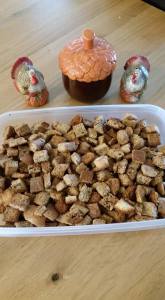
homemade croutons image © connie jasperson

homemade croutons

I will also make a tasty Vegan Stuffing, using croutons made from homemade bread: Made like garlic bread, cubed, and seasoned with my own poultry seasoning. Baked at 350 for 25 minutes, stir half way through.

  • 10 cups 1/2 inch bread cubes from 1 lb firm wh wheat or other sandwich bread
  • 2 Tbsp + 1 Tbsp olive oil
  • 1 Tbsp minced fresh garlic (2 – 3 cloves)
  • 1 cup finely chopped onion
  • 1 1/2 cups finely chopped celery
  • 1 cup dried cranberries
  • 1/2 cup minced fresh parsley
  • 1+1/2 tsp dried rubbed sage leaf
  • 1 tsp dried thyme leaf
  • Optional: 1/2 tsp salt
  • 1/2 tsp black pepper
  • 2 – 3 cups vegetable stock OR 3 c. water + veggie BetterThanBoullion to taste

Preheat oven to 400 degrees. Oil a large shallow casserole dish

  1. Toast bread cubes in a large baking sheet in the oven until golden brown. Set aside in a large bowl
  2. Turn oven down to 350 degrees F
  3. Heat 2 Tbsp olive oil in a large skillet on medium heat. Sauté onions, garlic, and celery until soft
  4. Using a rubber spatula, transfer the veggie mixture to the bowl of bread crumbs
  5. Add parsley, sage, thyme, optional salt, and pepper
  6. Optional: Drizzle 1 Tbsp olive oil into the mixture
  7. Stir until until everything is well mixed
  8. Add 2 cups vegetable stock, and stir until it is absorbed. Add more stock as needed so that the mixture is moist and clumping together, but not soggy
  9. Bake in a covered shallow casserole or baking dish for 25 minutes
  10. Optional: Uncover and bake another 15 minutes to form a crusty top
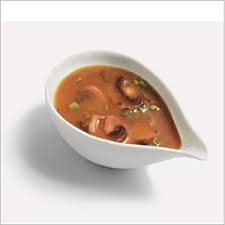
onion and mushroom gravy

picture via google images

But the best part will be the ONION AND MUSHROOM GRAVY

  • 3/4 cup white or button mushrooms, chopped
  • 1 small yellow or white onion, minced
  • 1/4 cup vegan margarine
  • 2 1/2 cups vegetable broth
  • 2 tbsp soy sauce
  • 1/4 cup flour
  • 1 tbsp poultry seasoning (or 1/2 tsp each of sage, thyme and marjoram)
  • salt and pepper to taste
  1. In a large skillet, melt the vegan margarine and add onion and mushrooms. Sauté for just a minute or two over high heat.
  2. Reduce heat to medium and add vegetable broth and soy sauce. Slowly add flour, stirring well to combine and prevent lumps from forming. Bring to a simmer or a low boil, then reduce heat.
  3. Add poultry seasoning, salt and pepper, stirring consistently. Allow to cook for 8-10 minutes, stirring regularly, until gravy thickens.

And–there will be pumpkin pie and cherry pie, with coconut whipped cream, all made with all-vegetable ingredients.

Vegan pumpkin pie–for the recipe, click here: Food Network Vegan Pumpkin Pie
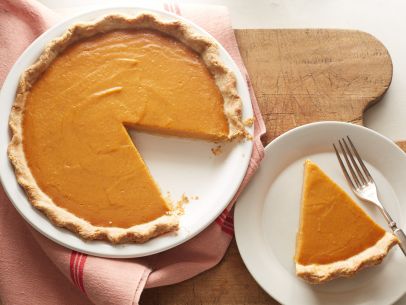
Food Network Vegan Pumpkin Pie
Food Network Vegan Pumpkin Pie
7 Comments

Filed under Humor, Publishing, Uncategorized, writing

#amwriting: creating lean but descriptive prose

wordsSome work is written so starkly it may as well be a phone-book. This tells me that author X has really taken to heart the much-bandied, amateurish idea of no adverbs and adjectives, ever.

That concept is flawed.

It is true that when we carve away unneeded modifiers, we move from telling the story to showing it, which is the goal of every author. But the key here is the word ‘unneeded.’

Some modification of your verbs and nouns is necessary, or you have a ‘Dick and Jane” novel.

See Jane. See Jane run.

Even if the concept for the plot has some merit, a stark, completely bare-bones approach won’t make it worth reading. The idea behind the novel might intrigue me, and I could be curious as to where the author is going with the idea.  But despite being curious, if I don’t enjoy reading the narrative I won’t finish it.

gibberish-american businesses onlineWe all know fluffed-up prose (A.K.A. ‘purple’ prose) is daunting and hides the action, but don’t let a knee-jerk reaction to a bad beta-read by an armchair critic make you go the route of completely eliminating modifiers and descriptors. A well-written narrative is sparing with descriptors and modifiers, this is true—but modifiers and descriptors do exist within every good narrative and are there for a reason.

Sometimes a thought requires a little description: An old man carries his groceries home in a snowstorm, fearing he will slip and fall. This idea could be told several ways, and here are two, off the top of my head, one less wordy than the other. Both use modifiers and descriptors:

Snow fell softly. Holding a bag of groceries, he gazed at the stairs leading from the walk to the front door, fearing a layer of ice lurked beneath the pristine whiteness.

He gazed at the icy stairs leading from the un-shoveled walk to the front door, his bag of groceries growing heavier.

There is a reason that descriptors and modifiers exist in the English language. They add flavor, spicing up a flat wall of words.  Just like salt in the soup, too much is too much and too little is not enough.  We are looking for that happy medium where the prose flows in such a way that the reader forgets they are reading and lives the story.

I read a lot of work that begins with a great concept, but has no substance. If only the author had been had been brave enough to tell a good story these novels could have been great. Instead I was given a laundry list of characters acting and reacting to events with no passion or emotion.

It could have meant something to me as a reader, but it didn’t.

Good prose requires choosing words that convey your ideas in the least amount of space. Modifiers and descriptors do that for us, but need to be chosen carefully, and used only when nothing else will do.

i read because memeIf you are writing a novel you want the reader to live your story and react to the ideas and emotions that you are conveying instead of stumbling over limpid pools of velvet blue eyes or falling flatly into skeletal accounts of boredom. It’s our task to find the middle ground that exists between purple prose and lack of soul.

We want to get the reader immersed in the story, and make them forget the real world for a short time. As a reader, I love it when that happens.

7 Comments

Filed under Publishing, Uncategorized, writing

#Flashfic: Metamorphosis

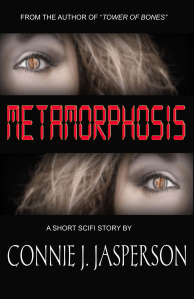
MetaMorphosis cover for WattPad copyYrena Rozhenko ran, not knowing if she was headed into something worse.  It didn’t matter—the transformation had begun and she couldn’t seem to halt it. One way or the other she had to get away from Benton.

The sounds of distant pursuit penetrated to her newly-altered hearing, spurring her on.

She took to the foliage. The shade and mottled light of the strange underbrush eased the pain in her eyes, dimming the glare. She raised her hand to her face, wondering why it felt so bruised. Hard nobs had begun to form above her eyebrows, turning them in ridges. Her heart nearly stopped when she saw the scales forming on her hands and long, deadly-looking talons where neatly manicured fingernails once had been.

What’s happening to me? We ate nothing and drank no water from this world. We touched nothing ungloved. Could it be the air?

Their mission was over. In the UFA records, they would be officially listed as MIA, something that happened frequently on first exploration missions. Benton had murdered Jackson. Jenner was either dead or in hiding, and she…she was changing into some…thing.

Was she going to die next? Benton’s fear and loathing of anything different made him…the only word she could think of was evil.

Why had he not begun to change? The answer came from all around her, from the forest. I was waiting for you. He is not worthy.

She heard Benton softly call her name, a sing-song taunt. “Rozhenko…come out, come out, wherever you are….”

What could she do? With those talons on her hands she wouldn’t be able to return to the ship, even if she could make it to the lander. Besides, she couldn’t leave without knowing if Jenner was alive, and if he was, she wouldn’t leave him behind.

And even if she made to the ship, what then? She knew the change was happening to her on a genetic level, as if this planet had claimed her. Something told her it was irreversible.

Gods, her back ached.  Her shoulder blades, her tailbone were like points of…gah! Whatever. She had to ignore it and get deeper into the brush.

Jackson had begun to change the first night. By dawn he’d transitioned into something…else.

The others had discussed his condition, deciding to take him back to Lodestar Station where the medical team was, despite it being a ten-day journey and meaning the end of their mission. They would have to declare Sirius C a class N Biohazard planet, meaning the established ecology was too dangerous for human settlement.

Benton had been the lone holdout, shouting they had to destroy Jackson before he destroyed them. “He’s a killer. Look at those claws—he’s not human anymore!”

When Yrena and Jenner shouted him down, he had walked up behind Jackson and shot him in cold blood, with no further conversation or discussion, murdering the man who’d been their commander with no qualm or shame.

He’d been proud that he’d done so and now claimed Jackson’s position as expedition leader.

Jenner had begun to change right after Benton murdered their commander, but he’d vanished while Yrena was in the shuttle sending the message detailing the hazard and Benton’s mutiny.

Yrena feared that Benton had killed Jenner while she was busy, but if he had, the body was nowhere to be found.

Benton had shown his true colors. He’d always bragged that he had what it took to rise to the top. He was a capable enough navigator and a solid geologist, but he’d never understood finesse or compassion. How he’d been put on their team in the first place, she didn’t know, but he’d been nothing but a sour pain in the…ass.

She suppressed a groan. Even her ass ached. She was afraid to reach back there and see why.

Some new instinct told her to get off the ground, that safety was in the tree-tops. Yrena’s new talons made excellent assists for rapid tree climbing. Perched high in the canopy and hidden by the triangular, golden leaves, she watched as Benton combed the forest floor, not even thinking to look up.

She had burst out of her shipsuit, which was now nothing but shreds. Carefully she balled it up and hid it in the hollow of the tree. She could nest there if she had to.

What was she thinking? She had to get back to…what was that? A glint of gold caught her eye. A gold-mottled form was perched on a branch near her, one sharp-taloned finger held to his scaly lips for silence. Relief swept through her—Jenner had completed the transformation.

She was not alone.

Benton passed under their tree. Yrena clung tightly to the trunk, remaining perfectly still. She needed a few more hours to complete the transformation, but if he looked up, she would never know what she was transforming into, never again know love or laughter or….

A flash of golden wings…Benton’s sudden strangled cry….

Yrena looked down and saw Benton’s bloody form lying in several pieces.

Jenner flew back up to perch beside her.  She let go of the trunk and went to sit beside him, their arms going around each other.

They had been colleagues but she’d not really known him well. He was all she had now.

The setting sun cast a ray that glanced off the abandoned shuttle. Above the forest, stars began to come out and a tiny star passed overhead. Once it had been a research vessel, but now it was an abandoned hulk ending its days as a small star in a new sky.


Metamorphosis © Connie J. Jasperson 2015  All Rights Reserved

Metamorphosis was first published July 10, 2015 on Edgewise Words Inn under the title “Transfiguration”

It was republished on Oct. 18, 2015 on WattPad under the title “Metamorphosis”

Comments Off on #Flashfic: Metamorphosis

Filed under Literature, Publishing, Uncategorized, writer, writing

#amwriting: consider the weather

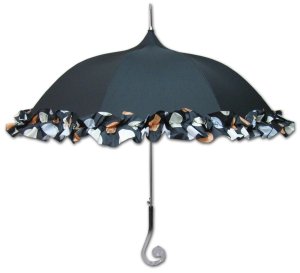
81UuqzVF-1L._SL1500_Something about the  wind-driven rain-bullets here in our part of the world can be death on umbrellas, even expensive ones. Even the cutest umbrellas frequently end up in street-corner trash-bins, ending their days as the tattered and broken relics of impulse purchases.

Despite the carnage, I feel compelled to keep buying umbrellas, feeling sure the next purchase will be the one–the true umbrella for all seasons, able to withstand 40 mph winds and sideways rain.  So far, the decidedly unromantic golf umbrella is the bumbershoot I carry.

But while golfers look fine carrying them, I long for beauty. I just know that my desire to have some cheery vestige of spring in the form of a floral print over my head will somehow work out and I will manage to remain both dry and stylish.

And this brings me to my point: You may not realize it but weather is a huge factor in your characters’ ability to go from point A to point B. For those of us who are writing fantasy, our characters are likely to be riding horses or walking. Weather will be a large part of what impedes them, or enables them to travel faster than they had planned.

Traveling on foot in the dark during a heavy storm is extremely difficult. Prior to the advent of the automobile, people didn’t travel during storms unless some terrible reason forced them to.

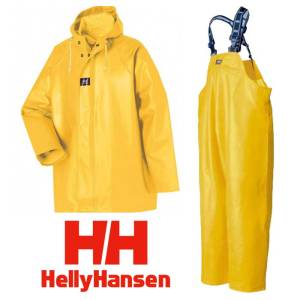
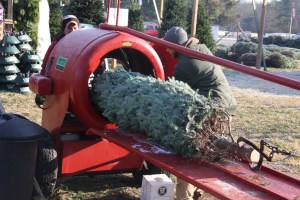
helly hansen raingear comboWeather is something I understand. In the 1980s, newly divorced and unqualified for any well-paying job, I worked for a Christmas tree grower. In the summer, we started work at 5:30 am so we could be finished and out of the field by 2:30, during the hottest part of the day.

I’ve never been a fan of using too much sunscreen—it’s greasy and full of things I can’t pronounce, it gets in your food, and I’m not so sure eating it is good for you. So, in those days I wore light, long-sleeved shirts to keep the sun off me, and wide-brimmed hats that kept the sun off my face. That is old-school, low-tech farm garb, and is how I still roll when it comes to dealing with the sun.

But when November arrived, we field hands were still working outside. With the advent of a Northwest Winter, we wore layers, 2 pairs of wool socks, barn-boots, and raingear. Good old Helly Hansen—his fine product kept me dry and warm while I worked to bring Christmas trees into every home. But, working outside in the cold and rain requires a certain amount of preparation, or you can become hypothermic, and unable to function.

Howey Christmas Tree Baler

Howey Christmas Tree Baler via Flicker

Every year, when cutting-and-baling season started we would have a new crop of people who had never worked out of doors, and who didn’t understand the sense of investing in long-johns and raingear. The company offered decent gear (boots, gloves, and raingear) at reasonable prices, but many would not  spend the money, refusing to believe that it was a war the weather would win.

So I discovered that if you were going to work outdoors year-round, you needed better quality gear than the company offered. In 1982, the best gear available was: LL Bean thermal underwear, and Helly Hansen foul-weather gear, and the mail-order catalogue was the place to get it.

My point with this is that if your novel’s setting is a low-tech society, weather affects what your characters can do. It affects the speed with which they can travel great distances, and it affects how they dress. It affects their horses, and that is a serious point to consider.

Medieval society had ways of dealing with the weather when they had to be out in it, and the internet is your friend. In medieval times, people of England, Wales, and Ireland didn’t have to deal with extreme temperatures the people of Northern Europe experienced in the 17th and 18th centuries, as it was a warmer time. However, they did get some occasional snow and cold in the winter, and at times they suffered heat waves during the summer.

How did they protect themselves against the weather? Here are several good websites for research:

Sarah Woodbury, Romance and Fantasy in the Middle Ages

Medieval Gloves, etc.

Castles and Manor Houses

In a cold, wet winter, a simple shawl won’t cut it. Layers are critical, and the materials they would use are simple and readily available—linen, and wool.

414-2-blue-robed-santa-claus-christmas-vintage-postcardIn a lower-tech society fur-trapping is a common way of earning money, but only the wealthier classes, merchants and nobility, can afford to buy those furs.

The average medieval agrarian society will have access to fleeces, though, especially if they are a Northern European type of society. Also, in the more urban centers of a low-tech society, the average person’s winter garments, hooded cloaks and gloves, and even bedding would be made of thick wool, layered and felted.

Wool has been a winter mainstay since humans first began making cloth. Some garments will be made of heavy canvas, or oil-cloth. Oilcloth, close-woven cotton canvas  or linen cloth with a coating of boiled linseed oil,  was a product available from the late middle ages on.

Clothing and cold weather gear will make their appearance in relatively few sentences in your novel, but a little research on your part regarding what technology might be plausible in your society will lend a sense of realism to your work.

2 Comments

Filed under Publishing, Uncategorized, writer, writing

#amwriting: Morality and Conscience

Severus_Snape memeSeveral years ago, I posted on a writer’s responsibility in regard to portraying morality in his/her work. I think some of those ideas are worth rehashing.

Much of what I discussed back then still stands: When we write a tale that involves human beings, it is likely morality will enter into it at some point.

What is our responsibility as authors, when it comes to telling our tales?  Do we sugar-coat it and pretend our heroes have no flaws, or do we portray them, warts and all?

For myself, I gravitate to tales written with guts and substance. Works like L. E. Modesitt Jr.’s Scion of Cyador, where the hero is a man who struggles with ambition and the desire to have it all. He is a dutiful son, devoted lover, and loyal soldier, gifted with great ability that he must keep secret. He is also a cold-blooded murderer with an unspoken agenda, a man completely devoted to salvaging what he perceives as all that is good and beautiful in his world regardless of the cost. What (or who) does Lorn have to sacrifice in the end to achieve his ambition? And what toll does it take on him in the end?

I said this in my post three years ago, and I still say it: give me the Flawed Hero over the Bland Prince any day.

HTB Stamp copyIn my book,  Huw, The Bard, I describe a murder, committed in cold blood.  I take you from what is the worst moment in Huw’s life, and follow him as he journeys to a place and an act which, if you had asked him two months prior, he would have sworn he was not capable of committing. This terrible deed is not the lowest point in his tale.  It is, however, the beginning of his journey into manhood.

Does my writing the story of this reprehensible act mean I personally advocate revenge murders?  Absolutely not.  But I have lived for 62 years, and my view of morality is that of a person with some experience of life. Personally I believe  no human being has the right to take another’s life, or do harm to anyone for any reason.

Still, I write stories about people who might have existed, and who have their own views of morality. When writing, my characters stories don’t always follow the outline I had in mind for them. They sometimes go in directions I never planned for them to go, which throws my whole story-arc into disarray until I figure out how this new development fits.

In my first completed novel, I never intended for my main character and a companion to fall in love. They did though, and that took the story in a direction that was a surprise to me–and I think was one of my favorite side-plots.

In each story I write, I try to get into the characters’ heads, to understand why they make the sometimes terrible choices that change their lives so profoundly.

Some flawed heroes’ stories end well, and some don’t–those whose ends are less than happily are the tragic heroes.

hamartia definitionPepperdine University’s website says this about the tragic hero:

“Tragic Flaw (Hamartia): the tragic hero must “fall” due to some flaw in his own personality. The most common tragic flaw is hubris (excessive pride). One who tries to attain too much possesses hubris.” 

I believe authors have a responsibility to tell the best story they are able to tell, even if they are only writing for their own consumption.

This means sometimes I stretch the bounds of accepted morality, and make every effort to do it, not for the shock value, but because the story demands it.

I write stories for entertainment, yes. But more than that, I want the tale to remain with the reader after they have finished it. If I am somehow able to tap into the emotions of the moment, and bring the reader into the story, I have achieved my goal.

GRRM MemeMy life is a constant journey to the land of knowledge. I seek understanding, and sometimes I think I have a grasp on it…but not quite. More lessons await.

I am learning the skills of story-telling.  More than anything I want my work to  stand up and measure well beside the works of my literary heroes such as Tad Williams, Marion Zimmer Bradley, and George Saunders, great authors who describe terrible moments and conflicts of morality with such grace and understanding.

This may happen, or it may not, but I won’t stop trying because with every tale I write, I grow as a writer.

I read the words penned by those who have attained mastery of this skill, I am awed, and fired with the knowledge it can be done.

2 Comments

Filed under Publishing, Uncategorized, writer, writing

#FlashficFriday: Silence and Love #FreeVerse

Paul Cornoyer Winter twilight along Central Park

Silence and Love

There was a time when we talked,

A time when words connected us the way kisses join lovers.

You mind amazed me as much as your body did

And I knew them both better than I knew my own.

You still amaze me but years have wedged silence between us.

Not the stony silence of anger or hurt—thank god, not that.


It is the silence of comfortableness,

The soundless speech of two old people

who sometimes read each other’s minds.

The quiet sharing of a back porch in the summer.

Side-by-side on a second-hand settee with a blue cushion,

You reach for my hand, and I am swept away.


Now when we speak, it is a more cerebral sharing,

Mind to mind, heart to heart,

Two old people still in love, but with little to say.

Did we say it all in the young wild days?

Did we spend our words the way we spent our kisses?

If so, then many more remain, waiting to pass between us.


No. We were learning each other, discovering truths

and facing our self-deceptions.

Now it is a calm sharing.

I still know your mind and your body

and love them better than my own.

I still love it when you hold my hand.


And when we speak it means something.

And when we kiss it means something.

And when we hold hands in the silence

Of an evening on a back porch,

Side-by-side on a second-hand settee with a blue cushion,

It means everything.


“Silence and Love” © Connie J. Jasperson 2015, All Rights Reserved

6 Comments

Filed under Literature, Uncategorized, writing

#amwriting: King Arthur: where history and fantasy merge

473px-Boys_King_Arthur_-_N._C._Wyeth_-_p214 Public Domain via WikimediaA few years ago I was challenged to write an Arthurian tale with a steampunk twist. I accepted the task, but immediately wished I hadn’t.

The first question I asked myself was: Where do Arthurian and steampunk connect well enough to make a story? The answer was–they don’t. I felt that block we all feel when the story will not reveal itself.

But, sitting on my back porch and letting my mind wander, I found myself wondering what Galahad and Gawain would have really been like. The people those characters were based on were men of the 5th or 6th century, ordinary men, and despite the heroic legends, they were made of flesh and blood.

And what if somehow Galahad got separated from Gawain through a door in time? How would Galahad get back to Gawain?  What if he was marooned in Edwardian England, with Merlin – can you say steampunk?

The title of that tale is Galahad HawkeThe original working title was I, Galahad. For every story, the title is a moot point for me, because any title I give it at the beginning will likely be changed when I rewrite it anyway.

The main character is Galahad Du Lac, son of Lancelot Du Lac, illegitimate, some have said, but is he really? If he is, it implies the fifth century was a lot less concerned about the proprieties than we give them credit for. His line of work–nobleman and hero. Thus, he goes on quests to find strange and magical objects such as Holy Grail.

The story was told from Galahad’s point of view. I opened the story just after the Grail was found.

What is the original story of Galahad that is bandied about most often?

Nowadays Galahad is a minor knight, but he figures prominently in Sir Thomas Malory’s 1485 work, Le Morte d’Arthura reworking of traditional tales that were hundreds of years old in his day.

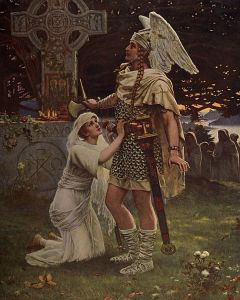
480px-Schmalz_galahadTraditionally, Galahad finds the grail and immediately goes to heaven, raptured as a virgin – but was he? I mean raptured OR a virgin?  If he was not raptured, what could have happened to make medieval chroniclers think he was?

And why was this notion of a virgin knight and being taken to heaven before death so important to the medieval chroniclers that they would write it as though it was true history?

Well, they were writing some 300 to 400 years after the supposed event, during the final decades of the Crusades. Religion and belief in the Christian truths espoused by the Church was in the very air the people of the time breathed. All things of this world were bound up and explained in ways relating to the Christian traditions of the day.

Literature in those days was filled with religious allegories, the most popular of which were the virginity and holiness of the Saints–especially those Saints deemed holy enough to be raptured. These people did not have to experience death, but instead were raised while still alive to heaven where they spent eternity in Gods presence.

Death was to be feared–a constant companion, and if possible, one to be avoided.

The concept of a knight pure enough in God’s sight to be raised to heaven was a popular centerpiece of medieval tales.

According to the fount of all knowledge, Wikipedia: “Medieval literature is a broad subject…the literature of this time was composed of religious writings as well as secular works. Just as in modern literature, it is a complex and rich field of study, from the utterly sacred to the exuberantly profane, touching all points in-between.”

SO, lets talk about Geoffrey of Monmouth. He was a Welsh cleric whose work was the foundation for the development of British historiography and the popularity of tales of King Arthur. He is best known for his chronicle Historia Regum Britanniae (“History of the Kings of Britain”), which was wildly popular in its day and was uncritically accepted as true history well into the 16th century. It has been translated into various other languages from its original Latin, but is now considered historically unreliable.

220px-Sir_Galahad_(Watts)The High Middle Ages were a golden period for historical writing in England, but the craft of history was not an academic subject taught in school. It was something enjoyed by well-educated men of learning who were all men of the Church, but  was not subjected to the process of verification and research that we attempt to apply to academic subjects today. The gathering of historical tales was a hobby for educated men who had the time, social position, and the talents to pursue it.

As a result, the histories from this period are highly questionable–but are quite entertaining and are great fantasy reads. I always think that if J.R.R. Tolkien had been writing history in a monastery during the 7th and 8th century, The Lord of the Rings would have the same place in our historical narrative that the Arthurian Cycle has now, and Aragorn would have been the king who united all of Britain.

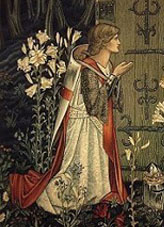
Galahad_grail_detailKnowing that history and fantasy merges in the Middle Ages, I approached my story by asking these questions:

  1. What does Galahad have to say about his story?
  2. How does he end up separated from Gawain
  3. How does he end up in Merlin’s company
  4. Why are they unable to get back to Gawain? What is the reason the magic no longer works?
  5. What do they do to resolve the situation?
  6. How does the tale end – does Galahad get Gawain back or is he permanently adrift in time? I wrote it two ways and picked the one that moved me the most.

This short-story appears in the novella, Tales From the Dreamtime.  However–for the last few days, the idea of what happened next has been percolating in my mind. I think Galahad may have another tale in his future.

6 Comments

Filed under Fantasy, Literature, Publishing, writing

#amwriting: 3 steps for keeping the story straight

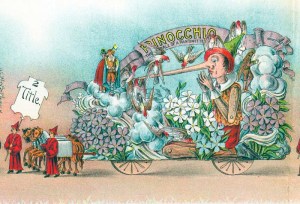
1916 Momus Pinocchio via Wikimedia CommonsEvery liar knows it’s difficult to keep a story straight–the story keeps evolving and soon it’s out of control.  However, writers, those spinners of awesome lies on paper, must devise ways to avoid this little problem.

Some people use a program called Scrivener which is not too expensive, but which seems to have a tricky learning curve. I downloaded the free version but couldn’t make heads or tails of it and found it quite frustrating. Nevertheless, I understand that it works well for many people, and to them I say, “Good for you.”

For myself, I don’t want a fancy word-processing program. I just use MS Office, because I have been using the programs that come with that software since 1993, and I’ve been able to adapt to each upgrade they have made. It’s affordable, so I use Word to write and edit in, and occasionally use Excel  to make small charts that are my style guides for each  novel or tale I write, and also for every book I edit.

Helpful tip #1: Create a style sheet for every work-in-progress. Whether it is a handwritten list or spreadsheet–keep track of what you named people, places, and things.

Bleakbourne Style Sheet

By creating a visual guide that I can print out or  keep minimized until I need it, I will not inadvertently contradict myself later on in the tale. This particular chart is the style-sheet for a serial I am writing for Edgewise Words Inn, a small online blogzine.

Lets consider Lord Tenneriff, the name of a minor character. Because I noted it on the style sheet and gave a small explanation when I first used it, I will always remember that Lord Tenneriff was spelled with two ‘n’s and two ‘f’s, and with no ‘e’ at the end of it.  The heading of the sheet is like this:

Character Name       Word 1st appears      Other names       Meaning?

            Jason Tenneriff              chapter 1                                                      a local lord

                                                         chapter 2                   Bleakbourne             a village

By listing out the names of every character no matter how minor, even the horses, I will not have a continuity problem by the time I hit chapter 14 of this series. For my editing clients, I also list all magic spells, every god, demon or dwarf that comes into the tale. Anything that is named goes onto that style sheet exactly the way it was first mentioned, the chapter it was first mentioned in, and the brief description of what it means.

Every author has a different way of visualizing these things, and this is what works for me.

Helpful tip #2: Map it out:

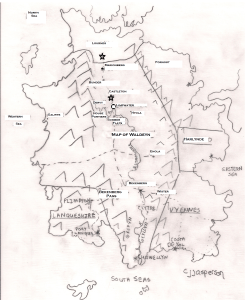
Map of WaldeynSo how do you visualize your country and the world you are creating? I have discussed this before–I draw maps.

They start out like this, all blotchy and hand-drawn, with whiteout covering the changes. After a while of refining them they end up looking more like real maps.

Its a gradual process, and the actual shapes and where the places are will evolve throughout writing the tale, but it will remain basically that way.

Many authors will use locales they are familiar with for their fantasy maps, just changing the names of major cities.  This is a good way to do it, because your world is already well defined for you, and Northwesterners know that Portland, Oregon is about 170 miles south of Seattle, Washington.  You are safe using currently existing terrain.

map of Waldeyn 2015 with lettering cooper black copyBut safe isn’t exactly my thing, so I had to invent both the world of Waldeyn (Huw the Bard), and the World of Neveyah (Tower of Bones). This is what the hand-drawn map of Waldeyn from above has evolved into————>

Helpful Tip #3: Version control:

When we first begin to write seriously we learn how critical it is to have proper naming of our files to ensure version control.  The most recent file will usually be the best edited unless you have accidentally saved an earlier version over it. ALWAYS use a separate file for each version, and ALWAYS use consistent file labeling practices to avoid this tragedy!

Use good file labeling practices, even if you have a fancy program that handles structuring your manuscript.

As an editor, I am particularly careful how I name the files of my clients.

  1. I use a specific sort of naming system. It will ALWAYS be Book_ AuthorName_script.doc .
    This is the main file folder for this book and this author!
  2.  The file folder will contain everything that pertains to this author and his work. There will be at least two folders in this file, and can have up to six. Version control is critical, so proper naming of the files is absolutely essential. If he should ever lose his files, I will have the most recent version on hand.
  3. The raw manuscript in its entirety is saved in this file, and I will name it:
  •  Book_ AuthorName_rawscript.doc

There will be 2 files for every step of the process this manuscript goes through with me: One file will be from the author’s desk to me, and the other will be from my desk to the author.  I will break the raw ms down into chapters, and label each chapter in that file consecutively:

  • Book title_Ch1_ author initials_cjj_edit_rnd1.doc

This tells me that this is Book A, chapter 1, by Author SoAndSo, and was edit round one of that ms.

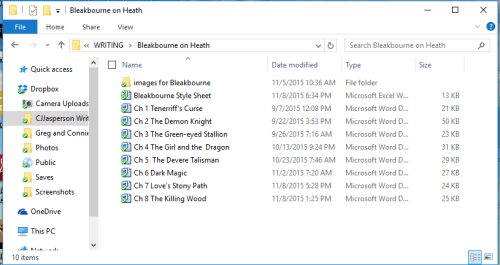
For my own work I label the files uniformly, like this: The main folder will be labeled with the working title, such as Bleakbourne on Heath. Inside the main folder will be the style sheet, and any images that will be used, including maps if needed.

Version Control 1

These three tips, creating a style guide, drawing a map, and labeling your files so you have good version control will help you navigate the shoals of the authoring business. You will always know who you are talking about, where you are, and you will be working in the most recent version of your work.

3 Comments

Filed under Publishing, writer, writing

#FlashficFriday: The Edit

The village clerk , painting by Albert Anke 1874

The Edit 

Desperate hours, pen in hand,

Inspiration shifts like sand.

Ruthless, crafting perfect prose,

Revelation’s tendril grows.

Sifting, sorting, choosing—nay–

Some must go, but you shall stay.


The Edit, © Connie J. Jasperson, All Rights Reserved

1 Comment

Filed under Humor, Uncategorized, writing

#amwriting: avoiding #nanowrimo pitfall number 1


NaNo-2015-ML-Badge-Large-SquareOne thing we authors often do is forget to use contractions in dialogue. If you ever plan on publishing that manuscript, DON’T FALL INTO THAT TRAP!

In some ways, this habit is fostered by participating in NaNoWriMo, National Novel Writing Month. The goal is to write a 50,000 word novel in 30 days. Word count is king, and new authors are sometimes advised not to use contractions to get the all-important word count of 1667 words per day.

I don’t recommend that to the Wrimos in my region because I want their manuscripts to be worth reading, and crawling through a manuscript and inserting contractions in the second and third draft are daunting tasks, even with a sharp-eyed editor helping to spot them.

Dialogue that is too formal is awkward and unnatural to the reader.

“I shall not be attending the party. I have a previous engagement to go whale-watching.”

That’s a whole lot of awkward.

long_live_dead_languages_latin_poster-r90bf04eb9e534fd48a8e4149dadac2aa_vhzd_8byvr_512

………………Long Live Dead Languages……………

While I might say something like that in a joking fashion to my sister or to a friend, in reality (and if I was writing dialogue) I would use contractions. I would also use what I personally think of as common phrasing. Fact–unless I work hard to change it, my written dialogue sounds like a Pacific Northwesterner, because that is who I am.

“Sorry, I can’t go to the party. I’m going whale-watching that day.”

When it comes to dialogue, your characters need to speak in expected ways. Remember, the reader’s eye is the “ear” through which they hear the dialogue. Nothing should stop the eye from moving on to the next sentence.

Feel free to break the rules of grammar if your character shows a blatant disregard for what’s correct. If on the first draft he wants to say, “I seen that movie last week. It were rubbish,” let him, at least on your first draft. You can tone it down on the second draft.  This is a way to show you, the author, the description of your characters. On the second draft, have him say, “I seen it last week–it was rubbish.” It still gets the point across, but doesn’t stop the reader’s eye.

However, in regard to a main character, or a prominent secondary character, it’s usually best to avoid trying to convey accent by altering spelling. It’s difficult and tiresome to read an author’s attempt to convey a cockney or an Irish accent, so use colloquialisms and speech patterns instead.

Having said that, there are times when a slight accent is appropriate. If the character is making a MINOR appearance, using an accent and colloquialisms will give the reader feeling that they know that character, without resorting to an info dump.

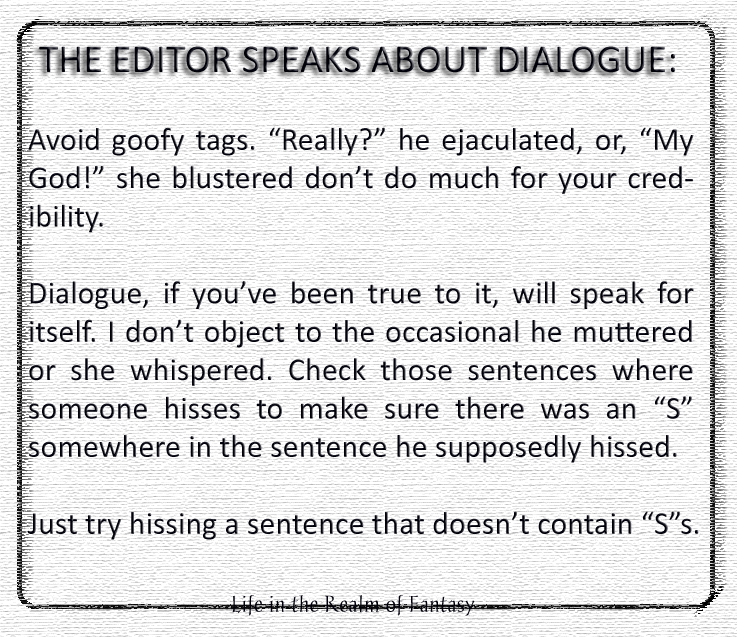
DialogueFancy synonyms for ‘said’ are usually unnecessary and distracting. And remember, people do not smile, snort or smirk dialogue. In fact, it is often best to do away with dialogue tags altogether, once you have established who is speaking though the visual cues

Sometimes, instead of using dialogue tags, miss a few “beats.” In script-writing, beats are little bits of physical action inserted into dialogue: John put the book down and looked out the window. Sarah turned and walked to the door. Used sparingly, they serve to punctuate the dialogue, to give the scene movement, and to maintain a strong mental picture in the absence of description. They are often best placed where there is a natural break in the dialogue, as they allow the reader to experience the same pause as the characters.

crest-bda7b7a6e1b57bb9fb8ce9772b8faafbBeats are an effective tool and are essential to good dialogue, but don’t overdo it. If your characters are fluttering their eyelashes, gazing into the distance or opening their laptops between every second line of conversation, the scene becomes about the action and not the dialogue, and the impact is diluted or lost entirely.

And finally, don’t get too creative with dialogue tags. Stick to ‘John said.’  Unless you absolutely need a John screamed or a Elizabeth uttered or a Joan retorted (which you pretty much never do) just say it and let the reader’s imagination do the rest.


9 Comments

Filed under Publishing, Uncategorized, writing