#amwriting: keeping short stories short, when all your stories want to be long

Autumn Landscape With Pond And Castle Tower-Alfred Glendening-1869

Autumn Landscape With Pond And Castle Tower-Alfred Glendening-1869

Over the summer I posted several times about why we need to write short stories, and each time I’ve talked about writing them to build stock for submissions to magazines, anthologies, or to enter into contests. Today, I want to talk about the art of keeping a story short.

First, decide what length you want to write to–if you have no specific contest in mind, 2000 to 4000 is a good length that will fit into most submission guidelines.

For those of you who have trouble writing short works for contests and anthologies with rigid word-count limits, this is where mapping your story becomes really important.

Let’s say you want to write a story that can be no longer than 2,000 words. You know what the story is, but when you sit down and begin writing, it’s like there is way too much story for only 2,000 words. You need to map it out.

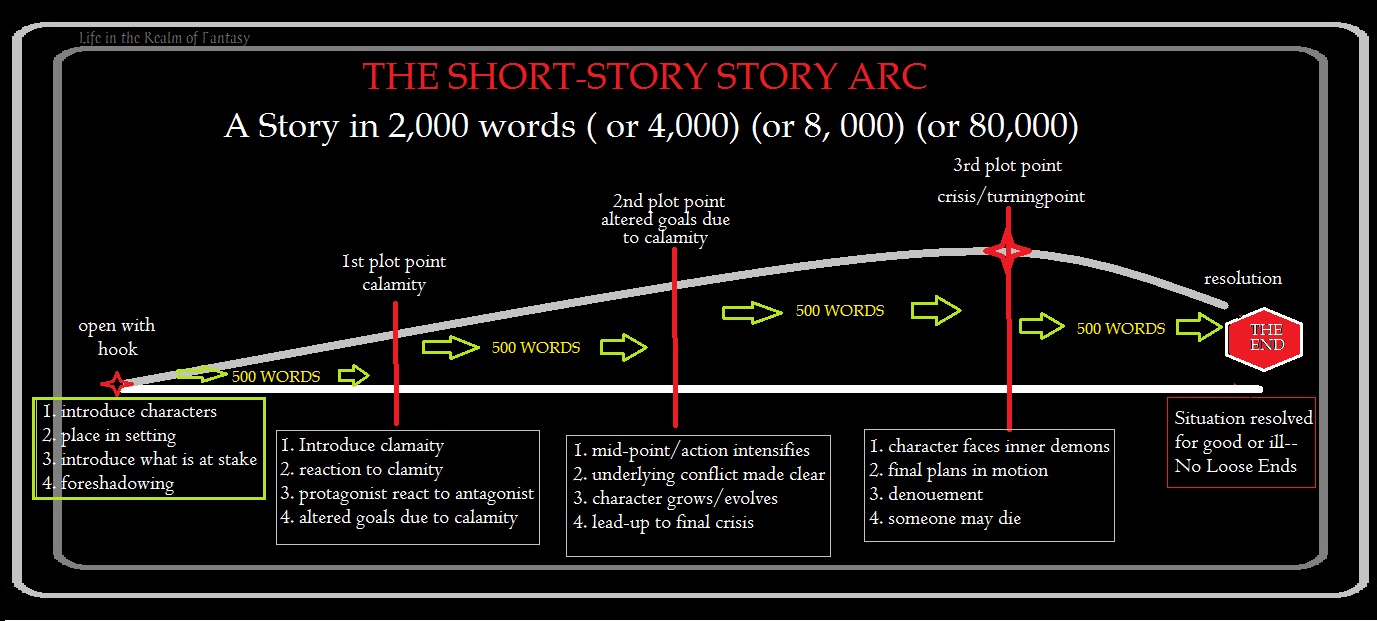
Short-stories are just like novels, in that they have an arc, and you can make it work for you.  By looking at it from the perspective of the story arc, you can see what you have to accomplish, and how many words you have to accomplish it in.

short story arc

Every word in a 2000 word story is critical and has a specific task–that of advancing the the plot. To that end, in a story of only 2,000 words:

  1. No subplots are introduced
  2. Minimal background is introduced
  3. The number of characters must be limited to 2 or 3 at most
  4. Every sentence must propel the story to to the conclusion

Lets say you are writing a fantasy, titled, A  Song Gone Wrong. Because he was a bit too specific when a putting a local warlord’s fling with another man’s wife into a song, our protagonist  is now a wanted man. Divide your story this way:

Act 1: the beginning: You have 500 words to show these plot points

  1. setting: the village of Imaginary Junction,
  2. the weather is unseasonably cold
  3. In an alley, a bard, Sebastian, is  hiding from the
  4. Soldiers of the lord he has inadvertently humiliated

Act 2: First plot point: You have 500 words to tell how

  1. the soldiers surround and capture Sebastian
  2. he is hauled before the angry lord and
  3. thrown into prison, sentenced to hang at dawn, but now you are at:

Act 3.: Mid-point: You have 500 Words to explain how

  1. Sebastian meets a dwarf, Noli, also sentenced to die
  2. Noli is on the verge of managing an escape, but needs help with one last thing
  3. Noli and Sebastian manage to complete the escape route
  4. but the guard seems suspicious, hanging around their cell door, hampering their escape

Act 4: Resolution–you have 500 words to show how

  1. The smart guard finally is relieved by a less wary guard, which
  2. allows Sebastian and Noli to squeeze through the escape route
  3. They are spotted at the last minute, but Noli’s friends are waiting, and
  4. they are whisked to a dwarf safe-house, leading to Sebastian’s next short-story adventure

Once you have parsed out what needs to be said by what point, and in how many words, you can then get to the nitty-gritty of turning that far-fetched tale of woe into a good short-story.

You will see that in order to keep to the strict limit of words, you will have to choose your words carefully. You will have to find words that really convey what you want to say, concisely in one or two sentences. Sebastian can’t give Noli a recap  of his troubles in your hearing–all that will have to be off-stage. On-screen conversations are critical–they will convey the personalities and the minimal backstory of the piece.

After a few times of creating short stories this way, you won’t need to think about it. When you know the length a given tale has to be, you can mentally divide it into acts and just write for fun.

2 Comments

Filed under Publishing, Uncategorized, writer, writing

Elements of the story: when the novel is not a novel after all

Book- onstruction-sign copy

In the rough draft, the goal is to get the work out of your head, and the concepts onto the page. To that end, I advise you to just write, and try not to self-edit as you go, because you may lose your train of thought.

If we let ourselves drop into the zone, in the first draft we are in story-teller-mode, which is where our best work happens. Yes, our prose is uneven and may contain things we wish had been written by someone else, but all we were doing was getting the idea down:

Thus it was that On departing Billy’s Revenge on this particular job, Lackland and Mags had kept the conversation cordial and polite, but little of substance passed between them. Oh, They joked and laughed, and said all the things that as they would say to with any Rowdy that they were on a job working with, but it felt all wrong. Still, Even so, Lackland did not press for anything more from Lady Mags, although he was full of questions and desperate for answers. 

It’s okay write crap when you are just getting it on to paper. You have to get the basic ideas down before you can craft them into a proper novel or short-story. (That drivel was from the rough draft of my 2010 nanowrimo manuscript. I can get rid of at least 24 words in that paragraph, and although I did replace several words, losing the fluff made it stronger.)

Remember, the rough draft–the first draft–is the proto-story, the just-born infant that is the child of your creativity. You do the shaping when you come back to it in the second draft. Some will stay, and some will go.

This weekend I discovered that one of my works in progress is not really a novel after all.

It was at 85,000 words, but it has occurred to me that it is a novella, because in the first half of the book, 4 chapters don’t advance the protagonist’s story. When I am done weeding it out, the ms may only top out at about 50,000 words.  In some circles that is a novel, but in fantasy, it is half a book.

Still, I’m not going to try to force it to be any longer than it is, because I have nothing of value to add to the tale. I would much rather be known for having written a strong novella than a weak novel. So, now at the end of the rough draft, this book must become a novella.

Those four cut chapters total about 16,000 words. Add to that the words that will be weeded out in the second draft and I would say its going to lose a lot more weight–perhaps another 8,000 to 10,000 words. But why do I think this? Because I am just finishing the rough draft and I have realized several things:

  1. __Hell's Handbasket__400 1Besides the four chapters that must go since they don’t belong there anymore, 3 more chapters are mostly background that doesn’t need to be in the finished product. When I went in and removed large chunks of exposition I was able to condense those 3 chapters into 1 that actually moved the story forward.
  2. Add to that the fact that in the rough draft we will always have a lot of words we can cut (or find alternatives for), words and phrases that weaken our narrative:
  • There was
  • To be

I will also make some contractions, ‘was not’ becomes ‘wasn’t,’ ‘has not becomes hasn’t,’ etc.

It’s amazing how many times we can simply cut some words out, and find the prose is stronger without them. Many times they need no replacement.

Sometimes we use what I think of as “crutch” words. You can really lower your word-count when you look at each instance and see if you can get rid of these words. These are overused words that fall out of our heads along with the good stuff as we are sailing along:

  • so,
  • very,
  • that,
  • just,
  • so,
  • literally
  • very

But back to one of my current works-in-progress: why am I cutting an 85,000 word MS down to 50,000 or so words?

800px-Singapore_Road_Signs_-_Temporary_Sign_-_Detour.svgA lot of what I have written is good work, but as I said, several long passages don’t advance my protagonist’s tale. They pertain to a different character’s story set in that world–so they were a rabbit-trail to nowhere in the context of this tale. However, those passages will come in handy later if I choose to write that character’s story, so I am saving them in file labeled “Out Takes.”

The fact is, you must be willing to be ruthless. Yes, you may well have spent three days or even weeks writing that chapter. But now that you are seeing it in the context of the overall story arc, you realize it is bogging things down, and NO–Sometimes there is no fixing it. Just because we wrote it does not mean we have to keep it.

In genre fiction, no matter how much you like the prose you have just written for a given chapter, if the chapter does not advance the story, it must go. The story arc must not be derailed, and sometimes amputation is the only cure.

The Story Arc copy

3 Comments

Filed under Publishing, writer, writing

Elements of the story: Crafting magic systems

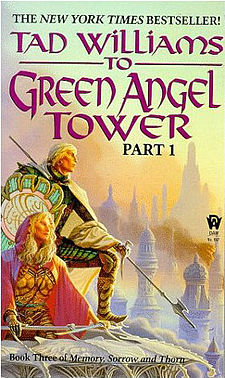
Green_Angel_Tower_P1I am thrilled that Tad Williams is writing another series of books set in Osten Ard. Tad is an author who  absolutely understands the craft of writing fantasy. He knows what makes epic fantasy EPIC. There is just the slightest hint of the rebellious indie in his work, which makes it a little wild. But more than that, Tad understand how important it is to make the limitations and roadblocks forced on the protagonists power the narrative.

If you love epic fantasy and have not read his powerful trilogy, Memory, Sorrow, and Thorn–you should.

In Tad’s work, magic systems feel natural, organic and are not all powerful. I love epic fantasy books where the magic systems have been as well thought out as the political systems, and the characters are limited in what they can do with them.

I despise books where the hero/heroine can do anything, and be as awesome as she/he needs to be, all because he/she has a special power. No need to worry about planning that mission, because our hero can read minds and predict the future–he knows exactly how to thwart Evil Badguy. Several boring scenes later, an opportunity for something interesting turns up, but no! The author has blessed his favorite supercharacter with (cue the fanfare) amazing magic powers that have no explanation, and apparently no limits.

If you are writing fantasy, consider this–Infinite abilities instills infinite boredom in me as a reader.

Let’s talk about magic. Who has magic? What kind of magic–healing or offensive or both? What are the rules for using that magic and why do those rules exist? Magic is an intriguing tool in fantasy, but it should only be used if certain conditions have been met:

  1. if the number of people who can use it is limited
  2. if the ways in which it can be used are limited
  3. if not every mage can use every kind of magic
  4. if there are strict, inviolable rules regarding what each magic can do and the conditions under which it will work.
  5. if there are some conditions under which the magic will not work
  6. if the learning curve is steep and sometimes lethal

Even if it does not come into the story, you should decide who is in charge of teaching the magic, how that wisdom is dispensed, and who will be allowed to gain that knowledge.

  1. is the prospective mage born with the ability to use magic or
  2. is it spell-based, and any reasonably intelligent person can learn it if they can find a teacher?

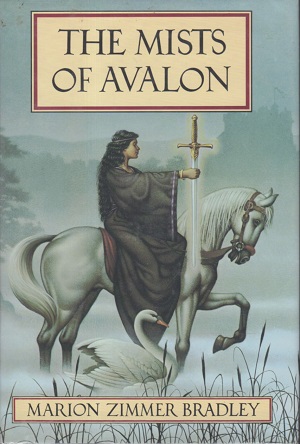
Mists_of_Avalon-1st_edMagic and the ability to wield it usually denotes power. That means the enemy must be their equal or perhaps their better. So if they are not from the same school, you now have two systems to design. You must create the ‘rules of magic.’  Take the time to write them out, and don’t break the laws, without having a damned good explanation for why that particular breaking of the rules is possible.

Limits make for better, more creative characters. In the Mists of Avalon, Marion Zimmer Bradley made the magic a natural outcome of religion, something only a few characters had access to, and they paid a great price each time they used it.

Lets pretend we have a mage, Gerald—we’ll make him a lowly journeyman mage, just allowed out of magic school on his own. Events beyond his control occur, and only he can rid the world of Stinky Sam. Sam is a very powerful, very naughty wizard, who will crush young, untried Gerald with no effort whatsoever.

Let’s say Gerald has a few skills at the beginning: he can draw water out of the air for drinking, and maybe he can use the elements of fire and lightning as weapons. Can he also use magic to heal people?  Can he heal himself?  What are the rules governing these abilities and how do these rules affect the progress of the story?  When it comes to magic, limitations open up many possibilities for plot development.

For this to be a good story, our bad guy, Stinky Sam, must be a master in whatever area Gerald has chosen–and he should have a few skills and abilities Gerald might never learn.

the night circus by erin morgensternThis means Gerald must work hard to overcome the obstacles set in his path by Stinky Sam.  With the successful completion of difficult tasks, and overcoming great hardships, Gerald will learn what he needs to know about his magic/gifts, and acquire the ability to counter Stinky Sam’s best efforts in the final showdown, although it will be difficult.

In great fantasy, evil is very strong, and has great magic–but there are rules.  The evil one might be a bully and he may have some awesome skills, but he’s not omnipotent, or there would be no story. All magic systems have limits, which means he has a weakness. With the discovery of the antagonist’s limitations, your character has the opportunity to grow and develop to his fullest potential in process of finding and exploiting it.

2 Comments

Filed under Fantasy, Publishing, writer, writing

Elements of the story: showing the mood

My Writing LifeMost of us, if you are reading this blog, are writers who love to read for pleasure. We each enjoy different sorts of books, but all our favorite reading has one thing in common: the story, whether fictional or true, moves us in some deeper way, making us think about it long after the final page has been read.

In order for the reader to be moved by a story, his imagination must have been completely engaged in the work. Thus, the writer must perform a tightly controlled balancing act, walking the fine line between giving too much description and not enough.

As writers we are constantly admonished to show, not tell. This can be taken to extreme, and the result is a boring, unimaginative walk-though of a character’s most minute expressions. For example:

Gordon’s brow furrowed, and his eyes narrowed. His eyebrows nearly met in the middle. His lips turned down at the corners. He screamed, “You bloody idiot.”

Well, duh. Pick one, and let the reader imagine the rest.

Gordon appeared angry.

That doesn’t do it either. That is simply telling the reader Gordon was upset, rather than showing it. Perhaps Gordon’s face darkened and his voice was harsh. Or, Gordon’s eyes narrowed. “You bloody idiot!” 

If your character is angry, please don’t have them hiss their dialogue. People do not snort, hiss, or spit dialogue, no matter how angry they are unless they are a snake or a camel.

The writing world has several good handbooks on showing emotions, and these two are  in my library:

It’s good if you have bought a book on this subject and are using it to help show what is going on in  your character’s minds rather than telling it. But use some common sense. If there are fifteen ways to show dejection, please don’t use them all to describe one moment. Simply have your character sit slumped, or refuse to engage the others.

Readers don’t want to be told in minute detail what to imagine. They will put your boring book down and walk away with only one regret–that they bought it in the first place.

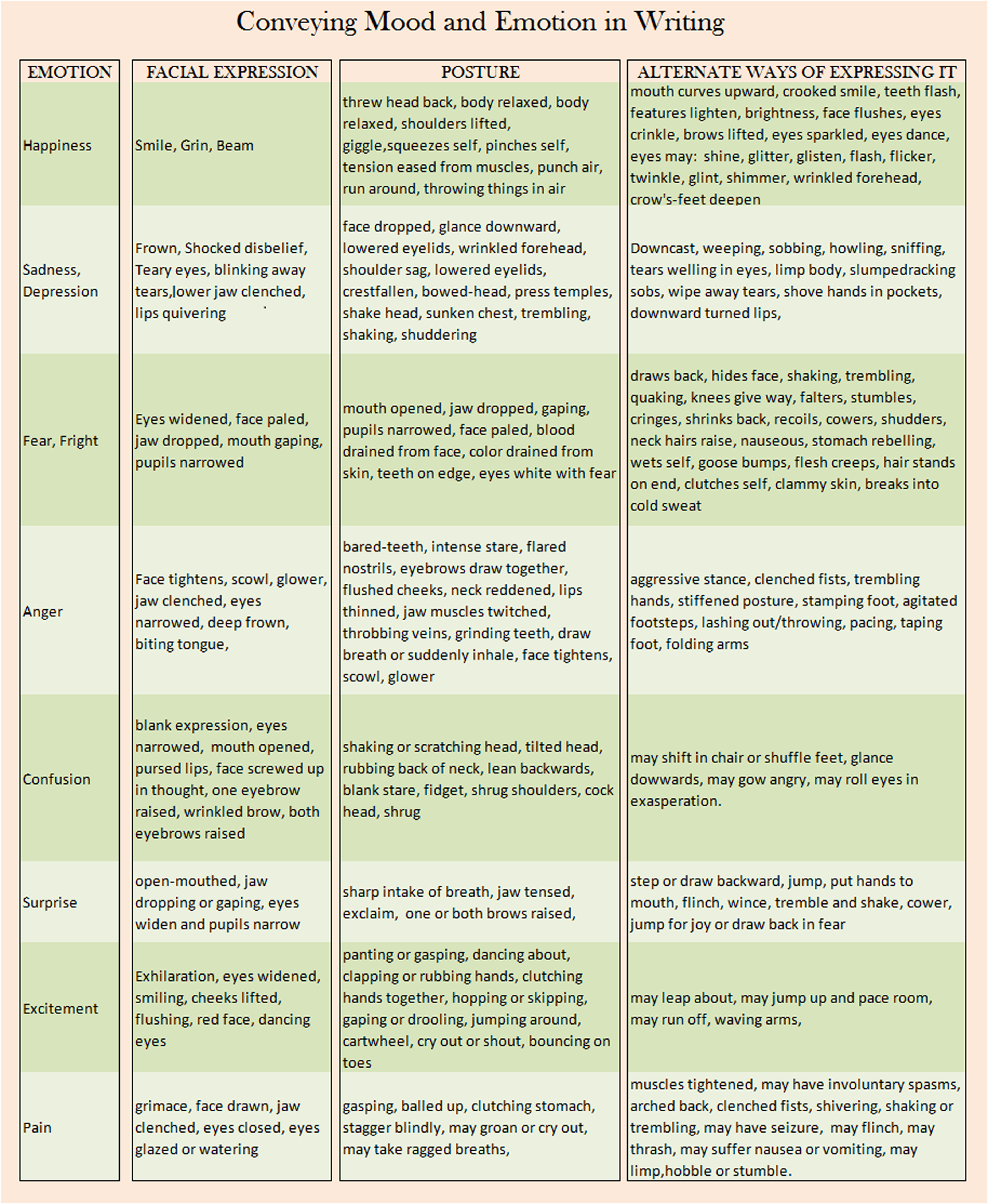
I’ve put together a little cheat sheet for showing emotions. Be sparing–show just enough to keep your readers engaged and the story moving along. If you provide a good framework and allow the reader’s imagination to do the rest, you will engage the reader. That, my friends, is priceless.

Cheat sheet for showing emotion and mood

Cheat sheet for showing emotion and mood

5 Comments

Filed under Humor, Publishing, Uncategorized, writing

Labor Day

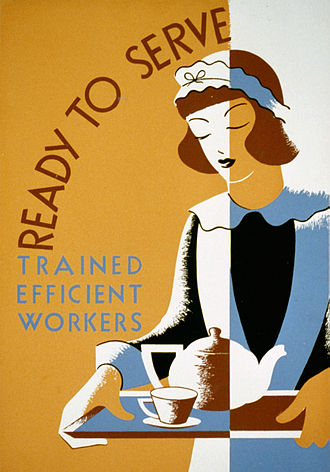
Stylized drawing of a maid on a Works Progress Administration poster via Wikipedia

WPA poster via Wikipedia

Over the course of my life I have worked in a wide variety of jobs.

1970s-80s – a field hand for a multi-national Christmas tree company, photo lab tech, waitress in a bakery and also a deli

1980s-90s – a hotel maid, a dark-room technician, a bookkeeper, and an office manager

2000-13 – a bookkeeper, tax-preparer, data entry

None of my work was glamorous but I always found something to enjoy in each job, and by going to work I was able to pay my bills, which I did enjoy. Sometimes, especially during the Reagan years and into the 90s, wages were low and jobs were scarce. I held two and three part-time jobs just to keep the roof over my children’s heads and food on their table.

During the late 70s and early 80s I worked for the J. Hofert Company (Christmas trees) and absolutely loved the work. It was outdoors, paid $3.25 an hour and it was seasonal, but I was able to work a lot of overtime, as field hands were as hard to get then as they are now.

English: First World War The Home Front: Women workers at the British Oil Cake Co.

English: First World War The Home Front: Women workers at the British Oil Cake Co.

As I said, none of my work was glamorous but I worked with great people, many of whom are still my close friends. My favorite job was as a hotel maid at a large hotel in Olympia–the work was hard, but I enjoyed it for 12 years. For most of the 1990s it was my weekend job that I kept along with my bookkeeping job, because the hotel was a union shop.

I worked every weekend and every holiday and yes it was not easy, but it was what it was. My kids were good and supportive and knew I was doing my best.

In 1993 things were easier. As a bookkeeper/office manager I made $7.50 an hour (two dollars over minimum at the time) and worked less than 30 hours a week with no benefits whatsoever. As a hotel housekeeper in a union shop I made $8.50 (three dollars over minimum) and worked about 20 hours a week, giving me enough from the two jobs to live on and provide for my children.

No matter what other job I had, I kept my weekend job at the hotel, because when other jobs went away, I always had that one to fall back on. Because of the union, we who did the dirty work earned a little more than others in that line of work, and had a few benefits, such as health insurance and a 401k. We would have had nothing more than minimum wage without the union.

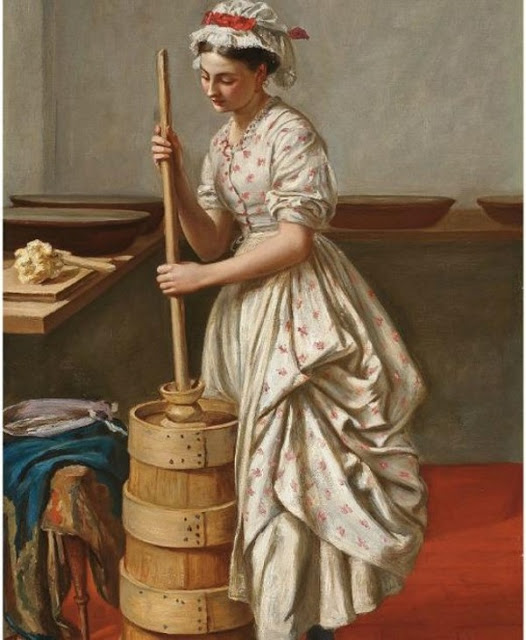
The butter churnNot every union is good, and not every union is reasonable. But while I don’t agree with everything every union does and stands for, I do feel gratitude that I and my family was protected by a good, reasonable organization during those years that were such a struggle for me. Every worker deserves that his/her employer treats them with respect and a fair wage in return for their labor.

I write books now, and the world is a different place in many ways. Even so, someone must do the dirty jobs, the work that no one else wants. I have nothing but respect for those who work long hard hours in all areas of the service industry, struggling to support their families. Look around you, and see the people who make your life easier, by being there every day doing their job.

Every one of them is a person just like you, a living, caring human being with hopes, ambitions, triumphs and tragedies. Every one of them has a story and a reason to be where they are, doing the task they have been given.

Say a little thank you to all those who take your unintentional abuse when you are stressed out and “don’t have time to wait,” or are upset by things you have no control over and need to vent at someone who can’t or won’t fight back. Give a little thanks to those who do the dirty work and enable you to live a little easier.

'The Munitions Girls' oil painting, England, 1918 Alexander Stanhope Forbes

‘The Munitions Girls’ oil painting, England, 1918 Alexander Stanhope Forbes


4 Comments

Filed under Uncategorized

Marilyn Rucker, Nick’s, and September

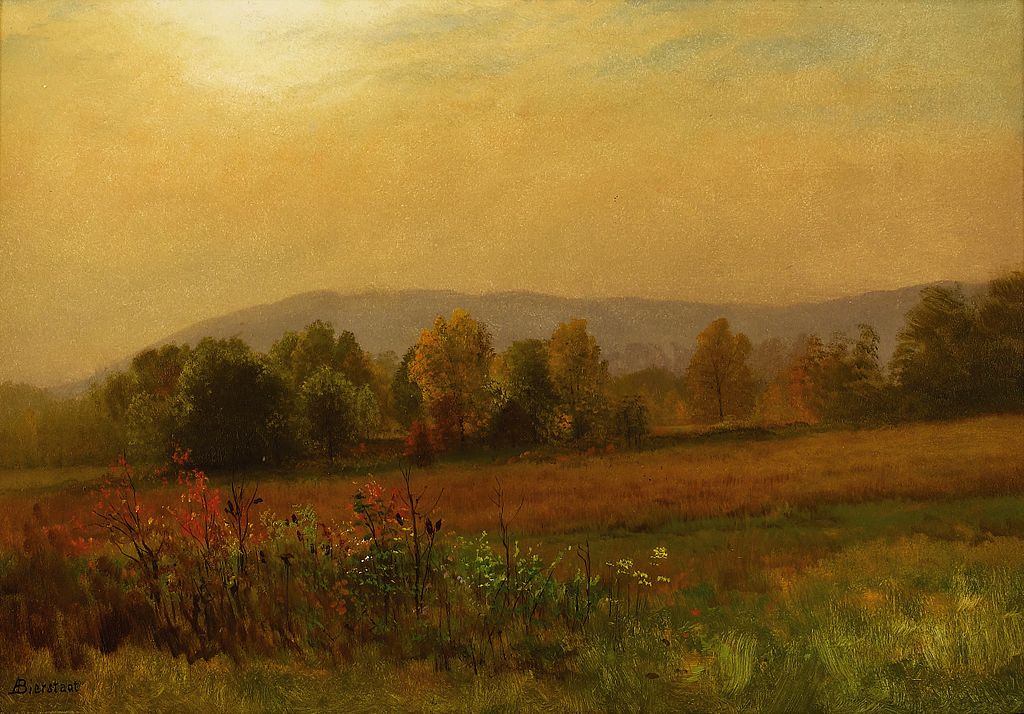
Albert Bierstadt - Autumn Landscape PD|100 via Wikimedia Commons

Albert Bierstadt – Autumn Landscape PD|100 via Wikimedia Commons

September is the month that always sneaks up too fast. This year we had a long drought, with 80 and 90 degree weather (that is 26.7  and 32.2 degrees Celsius)  and well above from the first of May through most of August.

Then, just about the time we took our vacation to Cannon Beach, the weather turned cold, and a little rain finally began to fall. Over the last week it has been cold and rainy here, so much so that I have had to wear socks in the house, and long-sleeved jammies for work. (!!!) And the rain–in the last two weeks we have had more than in the prior four months.

The unwatered lawns are turning green again in our less-than-affluent suburban neighborhood–it’s likely to be a bad year for hay up here in the Northwest.

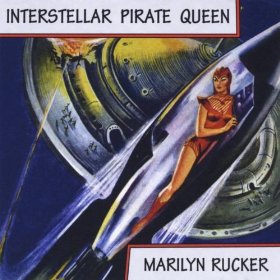
Interstellar Pirate QueenLast evening my dear old hubby and I met in Bellevue with well-known musician and author, Marilyn Rucker, who is up from Texas to perform at Tumbleweed Music Festival in Richland, Washington.  Marilyn wrote Sax and the Suburb, a hilarious and entertaining band-geek murder mystery. Marilyn is an awesome performer, and her music has been featured on King of Queens, and many other television shows. She plays with both The Studebakers and the Hootchcakes Band, but is performing solo in Richland.

If you love hilarious, witty music, give her solo album, Interstellar Pirate Queen a spin. It’s full of wry wit and fabulous, entertaining music to write to.

But we did have an amazing dinner at a place we had never been to, as we are rarely in Bellevue, and we discovered this little jewel in the culinary crown of the Puget Sound region by accident. The place is called Nicks Greek and Italian Cuisine, and all I can say is “Ooh, baby.”

And Nick himself is quite the character with his lovely accent and genuine, welcoming way.

My hiatus from contract editing is over, and I am back at work once again. Writing has to assume the secondary position in my pantheon of tasks. I have a wonderful fantasy novel by Carlie M.A. Cullen currently in my editing pile. I’m also editing an anthology for my publisher, Myrddin Publishing. The work I have received for this anthology so far is outstanding–Myrddin has some fine authors under its banner.

I will take another break from editing in November, as that is NaNoWriMo month.

This year I plan to use that as my opportunity to write a 2000 to 4000 word short-story every day until I have my 50,000 words, and then I will wing it, until November has ended. I am currently building my list of prompts.

Autumn Landscape With Pond And Castle Tower-Alfred Glendening-1869

Autumn Landscape With Pond And Castle Tower-Alfred Glendening-1869

September is the month I enjoy the least. It represents the end of fun, the last hurrah of the summer. It means playtime is over and work begins in earnest. I hope the weather will turn nice again for a week or so, to give us those final few days of sunshine and 75 degrees (23.3)–that is the perfect, ideal summer day, the kind of day we were denied this year because of the unusual, San Diego-style heat.

I want to sit on my back porch with my kindle and enjoy the last bits of sunshine before the monsoons close in. I want to sit there, watching the birds and planning my next writing adventure, and I will, if only the rain would relax for a week or so, and allow me that little pleasure.

My wish for this winter is that it snows prodigiously in the mountains where it belongs, and rains frequently here in the lowlands. Then, promptly on July 5th as is expected, may our allotted six weeks of summer begin anew with temperatures in the low 80s. Please, may we have a “normal” year, if normal can be measured in our ever-changing world.

1 Comment

Filed under Fantasy, Humor, writing

Elements of the story: making effective revisions

puppy happy dance via pinterestThere is no feeling of accomplishment like that of having completed a novel, or a shorter piece. Once that final sentence is written, there is that happy-dance moment, where we are shouting and the world is singing.

Following that, we have the urge to immediately look the finished manuscript over and see where some revisions could be made.

I know it’s tempting, but don’t do it. We need to gain some distance from our work in order to see it more clearly, so put it aside. If you work on something else for a couple of weeks, or even a month or two, you will gain a better perspective on what you just finished, and your revisions will bring out the best in your work.

But when we do get back to it, where do we start?

Stephen King said it so eloquently in his book, On Writing: “I got a scribbled comment that changed the way I rewrote my fiction once and forever. Jotted below the machine-generated signature of the editor was this note: ‘Not bad, but PUFFY. You need to revise for length. Formula: 2nd Draft = 1st Draft – 10%. Good luck.’ — Stephen King, On Writing, 2000

This means we must cut the fluff.  If your 1st draft is 100,000 words, try to cut 10,000 words out of it, making it 90,000. The following is a list of things to consider:

  1. Dialogue pitfalls: Search for clichés. Speaking as a reader, do a global search for the word alabaster. If you have used it to describe a woman’s skin, get rid of it, and find a different way to describe her. It’s an overused word that has become cliché. Find different ways to say what you want, unless you have a character who uses clichés–if so, he’d better have a good reason. Even then, don’t go overboard. Click here for a looooong list of common clichés: ProWriting Aid.
  2. Try to make your sentences do without these words: very, that, just, so, and literally. There will be places where they are the only words that will work, and you will use them in that instance. Usually just cutting them out of the sentence and adding nothing makes the sentence stronger. Fluffy, over-blown prose weakens the narrative.
  3. Flowery prose, even in a medieval setting, is off-putting to a reader. Do a global search (Cntrl F) for two letters: ly. This will bring up all the adjectives  (oops adverbs, thank you David Cantrell) because they end in ly. Look at each instance and if it is possible, get rid of them. Often the sentence is stronger without that extraneous word. Find a way to show the idea without flowery prose. This is where you grow as a writer–you give visual clues that enhance the story.
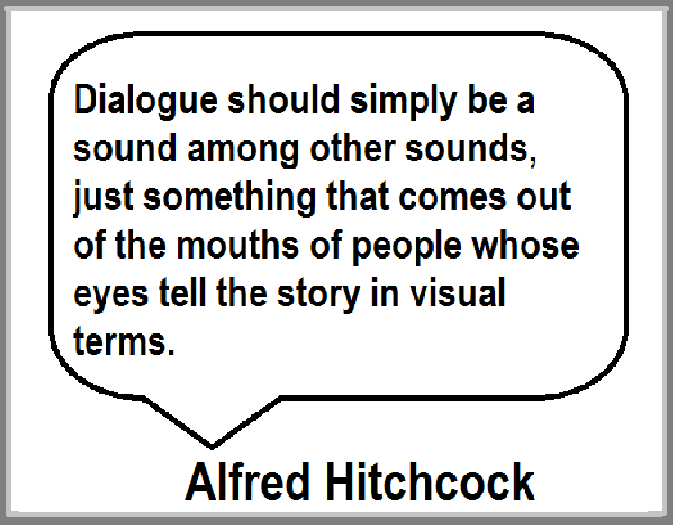
  4. Alfred Hitchcock quote re dialogueExamine the ms for conversations that are opportunities for info dumps. Info is good, but don’t dump it–dole it out as needed, and only when needed.
  5. Are people long-winded, and ranting on and on, with nary a pause for breath?  Decide what is really important in what they are saying and cut everything else.  Conversation in literature must have a purpose, or it is as boring as hell. Cut those marathon speeches down to where they sound like normal people talking, not like orators.
  6. Conversation must pertain to and advance the story. Small talk and verbal tics are obnoxious, and should be avoided at all cost. DO NOT have your characters preface sentences with “Hmmm…” and DO NOT have them use the name of the person they are speaking to, unless there are more than two characters in the scene. You can avoid things like “Well, Bill, it was like this…” just by having the speaker turn to Bill, and say it.

And now for my pet peeve: People do not smile, snort, or smirk dialogue. I mean really: “That’s a lovely dress,” snorted Clara. (eeew. )  Stick to simple dialogue tags, such as said and replied. In fact, it is often best to do away with speech tags (attributions) altogether for a few exchanges every now and then, if:  A. you have only 2 speakers, and B. you have clearly established who is speaking. You can also show who is speaking in other ways:

  1. Miss a few beats. Beats are little bits of physical action inserted into dialogue: John fell quiet and stared out the window. Halee turned and walked out the door. Used sparingly, these pauses serve to punctuate the dialogue, to give the scene movement, and to maintain a strong mental picture in the absence of description. They’re best placed where there is a natural break in the dialogue, because they allow the reader to experience the same pause as the characters.
  2. Don’t over do the action within the conversation. If your characters are rattling pans, slicing apples or staring out the window between every line of dialogue, the scene becomes about the action and not the dialogue, and the impact of the conversation can be lost entirely.

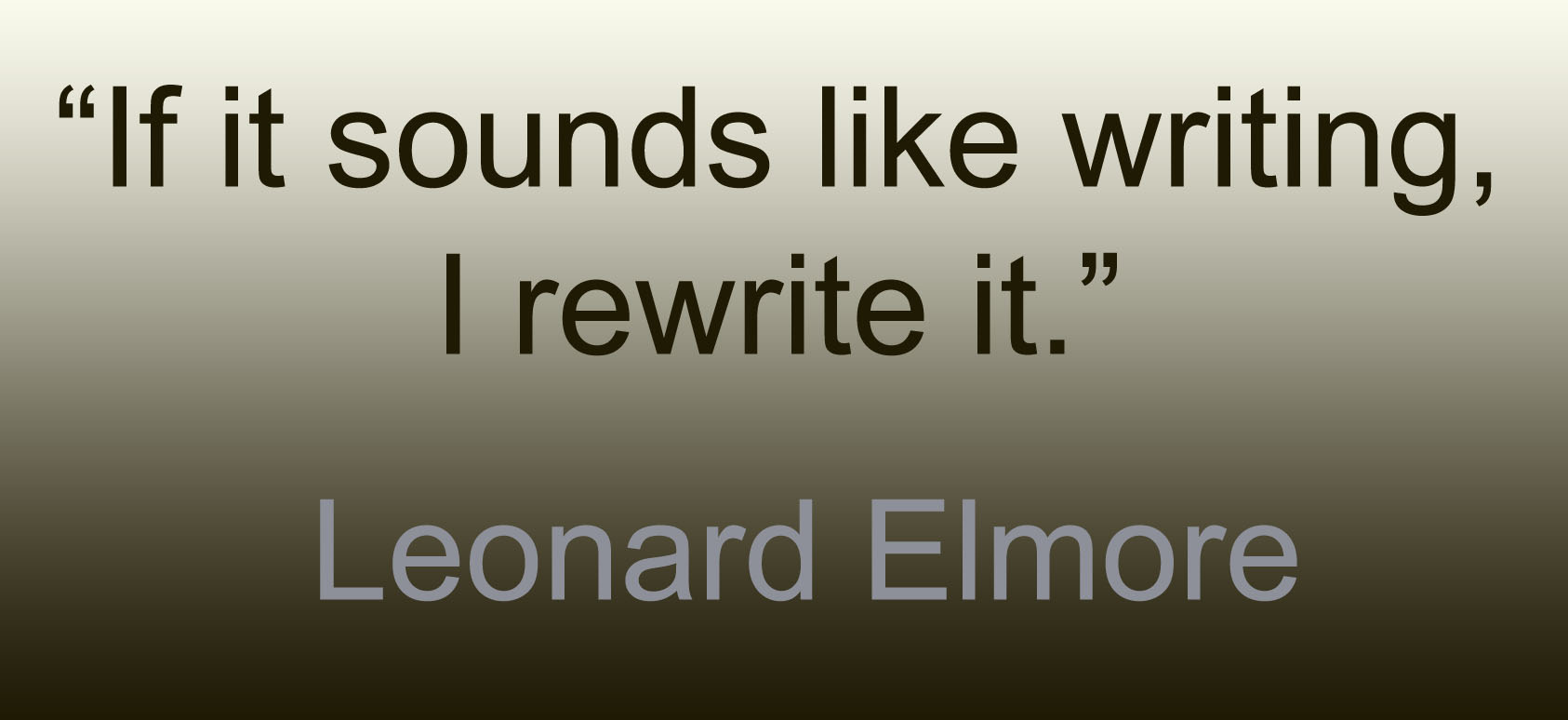
leonard elmore quoteIn our first draft we are trying to make our point, and we inadvertently repeat ourselves. A good way to find where you are repeating yourself is to read a chapter from the bottom up, one paragraph at a time. My editors frequently  tell me, “You said it once, that’s enough.”

In my own work, I hear repetitions and other things I need to cut, if I read it aloud to someone else. I think that’s because when another person is listening, we are more aware of how a given passage sounds.

Also, consider not including a prologue. About half of the readers see the word “prologue” and assume it will be a boring info dump, so they skip it.

This begs the question, “Why go to the trouble of writing it if they aren’t going to read it?” If you must have a prologue, consider calling it Chapter 1– and make it clear that is occurring twenty years before the present day (or whatever). Make it immediately exciting, make it a true first chapter. And don’t do an excerpt from a Holy Book as your prologue. I did that once, and it flew like an iron kite. So I moved my Holy Book to the appendices, and if a reader is interested, they can read it there.

These are just a few things to look for when you begin revisions. And just so you know, revisions are not editing, they are rewriting. If you are “editing” your own manuscript, you have a fool for a client. There is no such thing as self-editing–the best you can do is make revisions and admire your work. You may do very well at that–some people do.

You must make revisions before you hire an editor. Then, ask other authors who they might recommend as an editor and see if you can work well with that person. Your editor will likely point some things out that you didn’t see, but that a reader will. At that point, you will make revisions again. But the results will be so worth it!

5 Comments

Filed under Humor, Self Publishing, Uncategorized, writing

Mapping the Story

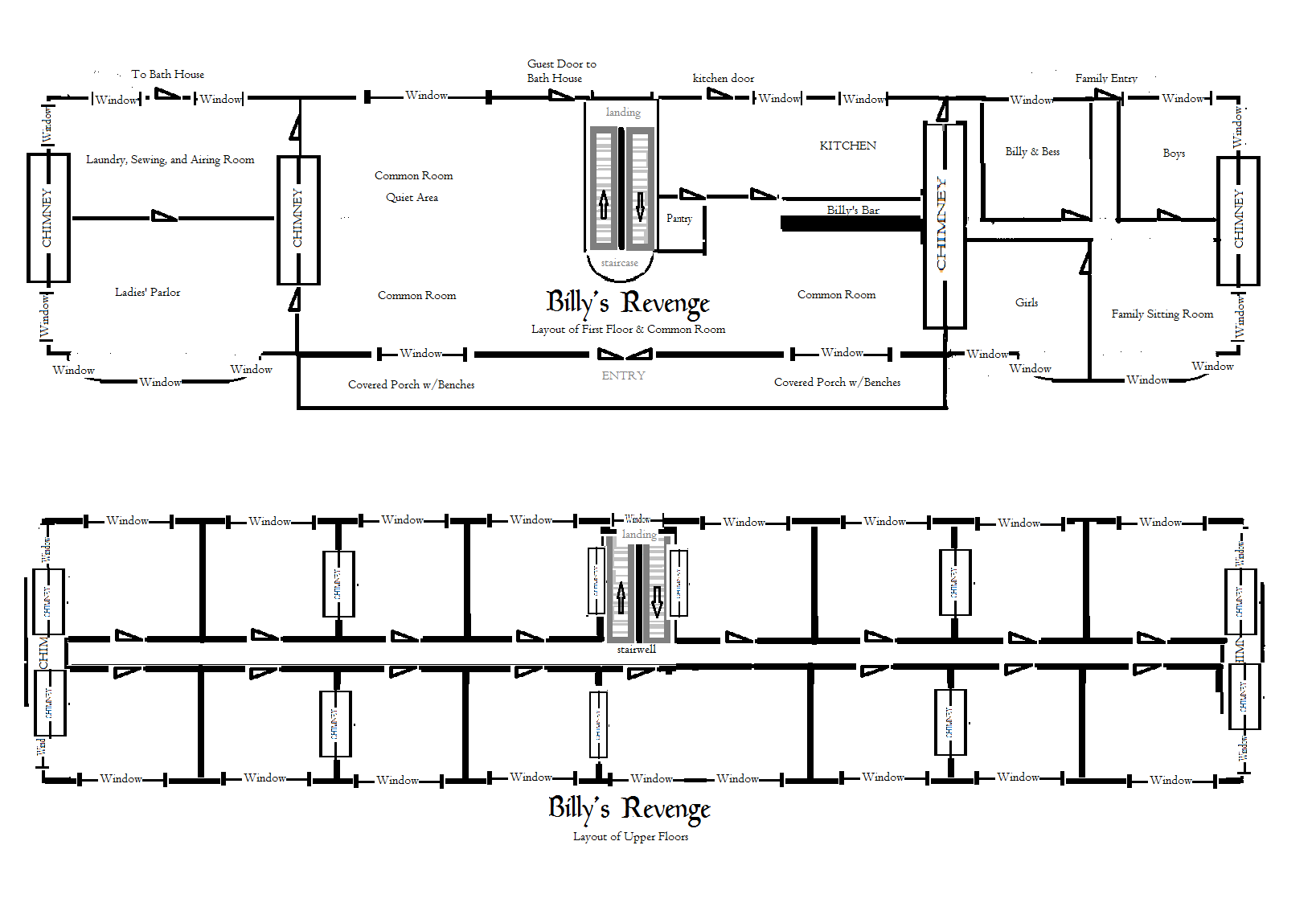
Billy's Revenge Floor plan ground floor

Billy’s Revenge © Connie Jasperson 2015

I was worried I wouldn’t have a blog post for today. The power was out most of Saturday due to a large storm here, and there have been times when that  lasts three days here.  When that happens I have no way to post my blog, although I hear you can post them from cell phones if you know the magic words.

I’ll just say that if I have to key my blog on a cell phone, it will take 5 years to get it ready for posting.  I am the world’s slowest text-message-er. Of course, if you have predictive texting set up, and make good use of auto-fill, you could have some real fun, and do it quickly! But that was another blog post.

After the power outage, my printer/scanner was not speaking to my computer, so I couldn’t print or scan. I did behave, no temper tantrums here. My IT man, (a.k.a. my beloved, long-suffering husband with the patience of a saint) took the time to rectify that situation. I was at the limits of my endurance with that thing.

So, because our power was out, I worked on a pencil sketch of a new map for an upcoming novel, Billy’s Revenge. On Sunday, I digitalized it. It isn’t complete, and is out of proportion in some places but when it is finished, it will tell me everything I need to know about Limpwater.

Map of Limpwater copy

Map of Limpwater, © Connie Jasperson 2015

I always have some sort of map to work with, even if it’s just scribbled, when I am writing in a world of my invention, and they all start out as pencil sketches. Eventually, they become the digital versions you see in my books.

That book will consist of 1 novel and 4 short stories that all revolve around the inn known as Billy’s Revenge. Huw the Bard returns, as does Julian Lackland. Billy Ninefingers has a few misadventures that threaten his career, mess with his chances  to convince Dame Bess to marry him, and set him on a path he never thought he would find himself traveling.

In the opening short story, we meet Eddie, Billy’s father, and see the origins of the Rowdies. Eddie’s story sets the stage for Billy’s trouble with Bastard John. Several short stories that were cut from The Last Good Knight will be included at the end of Billy’s novel, as they don’t pertain to Julian Lackland as much as they do the entire group of Rowdies, Billy Ninefingers included, and they are fun stories.

BNF sign

BR Pub Sign © Connie Jasperson

I’ve had the sign that will hang over the porch in front of Billy’s inn ready for quite a while–hanging it is going to be the trick.

When the power went out, I had Photoshop open and was working on the cover for Valley of Sorrows. But while I know how the graphics will be and I am happy with their layout, I’m not really happy with the art I have located so far, but it’s still early days. I will keep searching, which I enjoy doing.

Anyway Saturday  was not as productive as it could have been.

And Sunday was a busy, catch-up day. Fortunately, it rained off and on all day, so I was able to finish a lot of what I needed to get done.  Today will be as crazy as any Monday ever is, and I will simply have to make time for revisions.  All I need is an hour here and there. I am close to having it ready for editing. I will have Valley of Sorrows published in the spring of 2016, if all continues to go well.

4 Comments

Filed under Books, Publishing, Uncategorized, writer, writing

5 Books: Society’s Mirror

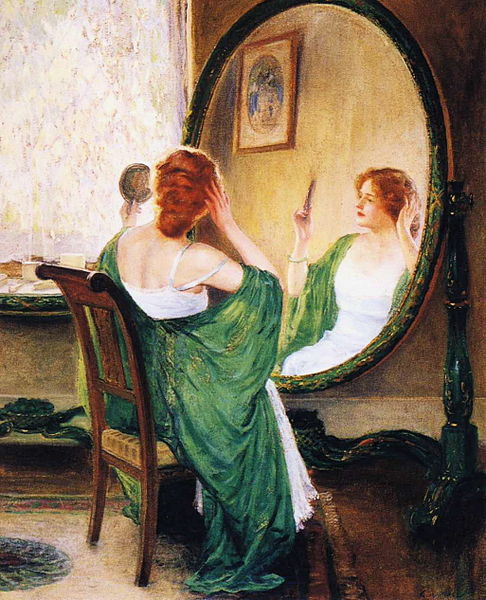
The Green Mirror, by Guy Rose PD|80 via Wikimedia Commons

The Green Mirror, by Guy Rose PD|80 via Wikimedia Commons

Most authors do not sit down and say “I am going to write a novel and this will be the message.” However, as we progress in writing a given work, certain social themes that are important to us at that moment will emerge.

Most of the time social themes will emerge as a natural outgrowth of the creative process. That particular story may have begun as a a “what if” moment, which, during the process of writing, becomes a powerful story.

We don’t sit down to write with a particular moral or political agenda in mind, but our own values will come out in who the characters we create are, how they perceive their world, and in the society we create as the backdrop for them.

Some of the most gripping works of modern literature occurred when an author was particularly moved by a situation presented by the society in which he lived:
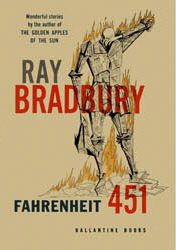
Fahrenheit_451_1st_ed_coverFahrenheit 451 is a dystopian novel by Ray Bradbury published in 1953, the year I was born. It is regarded as one of his best works. The novel presents a future American society where books are outlawed and any that are found are confiscated and burned. The title refers to the temperature that Bradbury believed was the ignition point of paper.

Besides having an incredible cast of characters set in compelling situations, the novel discusses and exposes the role of book burning in suppressing dissenting ideas. In a 1956 radio interview, Bradbury stated that he wrote Fahrenheit 451 because of his concerns at the time (during the McCarthy era) about the threat of book burning in the United States.

Fahrenheit 451 remains a classic, because the societal pressures and fringe threats that inspired Bradbury to write this novel still exist, perhaps even more so than during the McCarthy era.
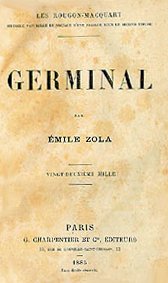
Germinal_first_edition_coverGerminal  (1885) is the thirteenth novel in Émile Zola‘s twenty-volume series Les Rougon-Macquart. (From Wikipedia:) Often considered Zola’s masterpiece and one of the most significant novels in the French tradition, this novel is an uncompromisingly harsh and realistic story of a coal miners’ strike in northern France in the 1860s. It has been published and translated in over one hundred countries and has additionally inspired five film adaptations and two television productions.

Germinal is a brutal depiction of the poverty and wretchedness of a mining community in northern France under the second empire. At the center of the novel is Etienne Lantier, a handsome 21 year-old mechanic, intelligent but with little education and a dangerous predisposition to murderous, alcoholic rage. Germinal tells the parallel story of Etienne’s refusal to accept what he appears destined to become, and of the miners’ difficult decision to strike in order to fight for a better standard of life.

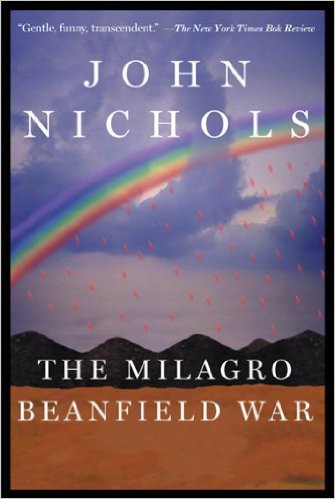
milagro beanfield warThe Milagro Beanfield War, 1974, is the first book in John Nichols New Mexico Trilogy. The book opens when Joe Mondragon, a feisty hustler with a talent for trouble, slammed his battered pickup to a stop, tugged on his gumboots, and marched into the arid patch of ground. Carefully (and also illegally), he tapped into the main irrigation channel. And so began-though few knew it at the time-the Milagro beanfield war.

But like everything else in the dirt-poor town of Milagro, it would be a patchwork war, fought more by tactical retreats than by battlefield victories. Gradually, the small farmers and sheep-men begin to rally to Joe’s beanfield as the symbol of their lost rights and their lost lands. And downstate in the capital, the Anglo water barons and power brokers huddle in urgent conference, intent on destroying that symbol before it destroys their multi-million-dollar land-development schemes. The tale of Milagro’s rising is wildly comic and lovingly tender, a vivid portrayal of a town that, half-stumbling and partly prodded, gropes its way toward its own stubborn salvation.

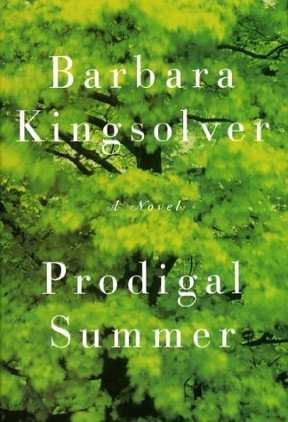
ProdigalSummerProdigal Summer (2000) is the fifth novel by American author, Barbara Kingsolver. It is a hymn to wildness that celebrates the prodigal spirit of human nature, and of nature itself. It weaves together three stories of human love within a larger tapestry of lives amid the mountains and farms of southern Appalachia. Over the course of one humid summer, this novel’s intriguing protagonists face disparate predicaments but find connections to one another and to the flora and fauna with which they necessarily share a place.

The narrative follows Deanna, a solitary woman working as a park ranger, Lusa, a widowed farmwife at odds with her late husband’s tight-knit family, and Garnett, an old man who dreams of restoring the lineage of the extinct American Chestnut tree.

Kingsolver’s extensive education in biology is on display in this book, laden with ecological concepts and biological facts. Her writing also exhibits her knowledge of rural Virginia, where she grew up.

The_Idiot_(book_cover)The Idiotfirst published serially in The Russian Messenger between 1868 and 1869. is a novel written by Fyodor Dostoyevsky. (From Wikipedia:) The 26-year-old Prince Lev Nikolayevich Myshkin returns to Russia after spending several years at a Swiss sanatorium. Scorned by the society of Saint Petersburg for his trusting nature and naiveté, he finds himself at the center of a struggle between a beautiful kept woman and a virtuous and pretty young girl, both of whom win his affection. Unfortunately, Myshkin’s very goodness precipitates disaster, leaving the impression that, in a world obsessed with money, power, and sexual conquest, a sanatorium may be the only place for a saint.

Elizabeth Dalton wrote that in The Idiot, more than in any other of Dostoevsky’s works, we are shown the actual experience itself of one mind wrestling with the various tensions of life – rather than simply dwelling on intellectual speculation, as we see in Crime and Punishment and Notes from Underground.

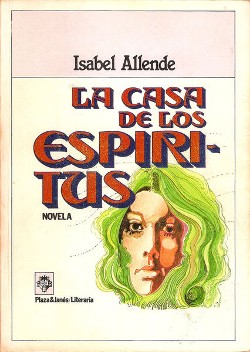
HouseofthesprirtsThe House of the Spirits (Spanish: La casa de los espíritus, 1982) is the debut novel of Isabel Allende. In one of the most important and beloved Latin American works of the twentieth century, Isabel Allende weaves a luminous tapestry of three generations of the Trueba family, revealing both triumphs and tragedies. Here is patriarch Esteban, whose wild desires and political machinations are tempered only by his love for his ethereal wife, Clara, a woman touched by an otherworldly hand. Their daughter, Blanca, whose forbidden love for a man Esteban has deemed unworthy infuriates her father, yet will produce his greatest joy: his granddaughter Alba, a beautiful, ambitious girl who will lead the family and their country into a revolutionary future.

The House of the Spirits is an enthralling saga that spans decades and lives, twining the personal and the political into an epic novel of love, magic, and fate.

>>><<<

These stories are powerful because of the characters that were created when that “what if” moment occurred, and because of the societal pressure under which their stories unfold. They are considered among  the greatest works in modern literature, and all of them are gripping, moving works of fiction, heavily laced with the social reality of the authors’ times.

All of these books are considered masterpieces, and each one struck a chord one way or another with me, although I confess, although each made a large impression on me, I have not reread most of them in recent years.

All of these books are available at your local library, or very reasonably priced at Amazon.com.

2 Comments

Filed under Books, Literature, Publishing, writer, writing

The clock, groceries, and a new thesaurus

Jetsonslogo640x480At times the world seems to be conspiring against me.  I have to drop what I’m doing, load up the van, and head up to town for something as mundane as groceries. Food should order itself, deliver itself, and put itself away.

But no. Where is my android butler and why is he not doing the shopping? Just like the flying car I was promised when I was child, my android butler is in the Jetsons‘ style garage of my imagination.

But sometimes I get two or three pages of writing done in the 20 or 30 minutes before I have to leave the house for an appointment. There is something about the pressure of knowing I will have to quit at a certain time that forces me to be more productive than I would ordinarily be.

Why is this? When I am pressed for time I use every second to get those ideas out of my head. I don’t stop and research on the good, old, time-wasting internet, and I don’t worry about whether or not I am overusing a word in the narrative. This is a rough draft–all of that can be ironed out when I have more leisure–the next day usually.

clockSome of my best ideas have come about under a time crunch.  Normally when I am writing on a stream-of-consciousness level, I can key about fifty words a minute–paltry compared to today’s young-uns who grew up keying their homework rather than writing it in cursive.

I do admit that just because I can key those words does not mean they will all make sense, or be worth reading. But that again is why we are driven to look at what we just wrote the day after we wrote it–did it say what I meant? How many times did I use the word “noose” in that particular chapter and where am I going to find six different alternatives for such a unique word?

Apricot poodle puppy portrait. Isolated on a white background (studio shoot), via Google Images

A little rephrasing here, cutting there, and voila! It looks like a poodle!

It’s a jungle in my head sometimes, and my ancient  student edition of Roget’s Thesaurus is my friend. But neither the old student version of the thesaurus from 40 years ago, nor the modern, online version is cutting it for me right now.

I need more synonyms. Lots, and lots more!

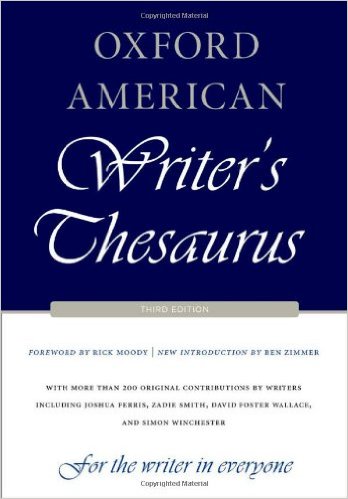
I have just now invested in a bigger, better, hardcover thesaurus. Thus I now have the Oxford American Writers’ Thesaurus winging it’s way to my doorstep. I expect the drone to drop it on Saturday.

ozford american writers thesaurusSome references have to be in hard-copy–such as The Chicago Manual of Style, which is the most comprehensive style guide geared for writers of essays, fiction, and nonfiction. Strunk and White’s Elements of Style is a good beginner style guide, but I found it hard to navigate and couldn’t always find what I wanted. The Chicago Manual of Style is written specifically for writers, editors and publishers and is the industry standard.

Just as a side note–if you are using AP style you are writing for the newspaper, not for literature–two widely different styles with radically different requirements. AP style was developed for expediency in the newspaper industry and is not suitable for novels or for business correspondence. For business, you want to use the Gregg Reference Manual.

Eternal_clock

Eternal Clock, Robbert van der Steeg CC|2.0 via Wikimedia Commons

All in all, I like the way being forced to produce words in a short time helps me lay down a rough draft. But being short on time is big pain when I am trying to revise and iron out stubborn, repetitive wrinkles in a narrative.

Summer is nearly over, and with that comes the long, dark days of the northern winter. I won’t be going as many places (I hope). But with the advent of September I will be spending longer hours editing for clients. My personal productivity will drop in regard to my own work, but I will still find time to write.

And I will also find time to revise. I am nearly at the end of two books written for the World of Neveyah series. Valley of Sorrows will wind up the Tower of Bones series–it is completed and is in revisions. The Wayward Son is nearly complete. While The Wayward Son is not actually a part of the Tower of Bones series, much of it does run concurrently with Forbidden Road, as it is the story of John Farmer’s redemption.

Today will be busy–groceries can wait until tomorrow. Today I am working as hard as I can, trying to get Valley of Sorrows ready to be edited, so that the ToB series will be complete, and also to get John’s story out there too.

2 Comments

Filed under Books, Humor, Literature, Publishing, writer, writing