
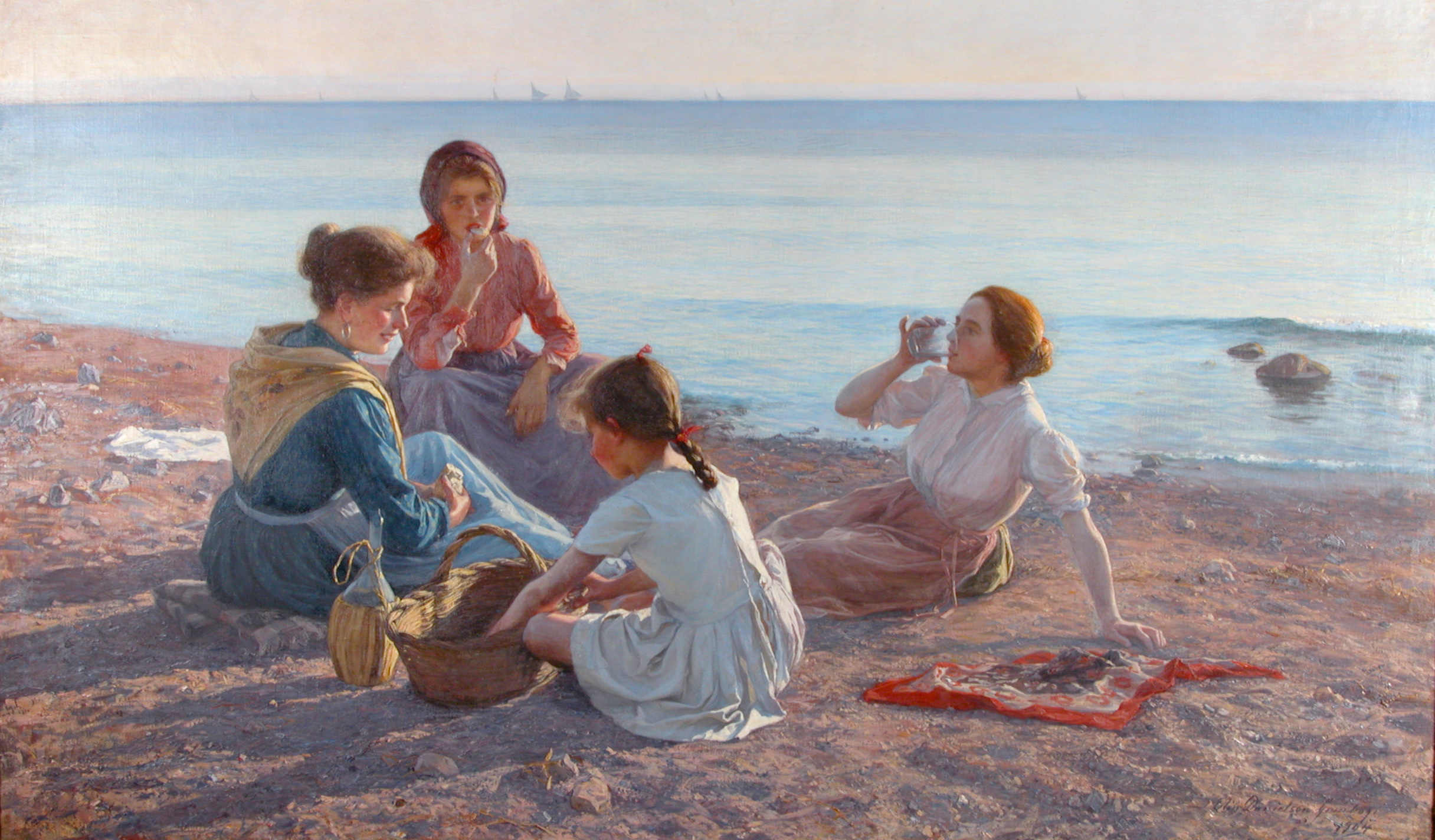
 Artist: Elin Danielson-Gambogi (1861–1919)
Title: By the Sea – The Snack (La Merenda)
Date: 1904
Medium: oil on canvas
Dimensions: height: 102 cm (40.1 in)
Collection: K. H. Renlund art collection
What I love about this painting:
Elin Danielson-Gambogi gives us a perfect afternoon for an afternoon picnic by the sea with friends. An afternoon beside the surf and the company of friends—it doesn’t get any better.
The good years just prior to the outbreak of WWI seem golden in many ways. Women’s work was never done but they have the luxury of a little leisure time, and they are enjoying it. Two women have removed their headscarves as if they don’t care if they get a little sun-browned. The cast-off squares of cloth lie on the rocky beach as if blown by the wind.
The girl is very likely the artist’s niece, as she and her mother figure prominently in many of Elin’s paintings. I like to think she is pleased to have been included in the picnic, proud to be serving the snacks.
There is a pleasant warmth to this image, the peace of a Goldilocks day, that rare summer’s afternoon that is just right.
About the Artist, via Wikipedia:
Elin Kleopatra Danielson-Gambogi (3 September 1861 – 31 December 1919) was a Finnish painter best known for her realist works and portraits. Danielson-Gambogi was part of the first generation of Finnish women artists who received professional education in art, the so-called “painter sisters’ generation”. The group also included Helene Schjerfbeck (1862–1946), Helena Westermarck (1857-1938), and Maria Wiik (1853-1928).
In 1883 Danielson received a grant and moved to Paris. While there, she took lessons at the Académie Colarossi under Gustave Courtois and painted in Brittany during the summertime. A few years later she returned to Finland and lived with her relatives in Noormarkku and Pori. In 1888 she opened an atelier in Noormarkku. During the 1880s and 1890s she worked as a teacher in several art schools around Finland. She also attended the artists’ colony Önningeby in Ålands.
In 1895, she received a scholarship and traveled to Florence, Italy. A year later she moved to the village of Antignano in Livorno where she met an Italian painter 13 years younger than herself, Raffaello Gambogi (1874–1943). They began working together and got married on February 27, 1898. They held exhibitions in Paris, Florence (where she was awarded an art prize by the city) and Milan, and in many Finnish cities, and their paintings were also included in the 1900 World’s Fair in Paris, where she again won bronze medal. She also got to second place in the 1901 national portrait painting competition organized by the Finnish state. In 1899, King Umberto purchased a painting from her. That same year, she participated in the Venice Biennale.
Their marriage was strained when Raffaello had an affair with Danielson’s Finnish friend Dora Wahlroos. While the affair quickly ended, it had a lasting impact on the Gambogis’ marriage. She moved to Finland for a while but returned to Antignano in 1903. Because of World War I, her connection to her homeland was cut, and by the time she died, of pneumonia, at Antignano in 1919, she had been mostly forgotten in Finland.
Because of her choice of rare subject matters that often even caused some offence, Danielson is now seen as one of the central artists of the Golden Age of Finnish Art. Danielson-Gambogi was included in the 2018 exhibit Women in Paris 1850-1900. [1]
Credits and Attributions:
IMAGE: Wikimedia Commons contributors, “File:Elin Danielson-Gambogi – La Merenda (1904).jpg,” Wikimedia Commons, https://commons.wikimedia.org/w/index.php?title=File:Elin_Danielson-Gambogi_-_La_Merenda_(1904).jpg&oldid=848460780 (accessed June 20, 2024).
[1] Wikipedia contributors, “Elin Danielson-Gambogi,” Wikipedia, The Free Encyclopedia, https://en.wikipedia.org/w/index.php?title=Elin_Danielson-Gambogi&oldid=1203975014 (accessed June 20, 2024).
 Intelligent creatures communicate in their own languages with each other, sounds that we humans interpret as random and meaningless or simply mating calls. But scientists are discovering their vocalizations must have meanings beyond attracting a mate, words that are understood by others of their kind. This is evident in the way they form herds and packs and flocks, societies with rules and hierarchies.
 We humans are tribal. We prefer living within an overarching power structure (a society) because someone has to be the leader. We call that power structure a government.
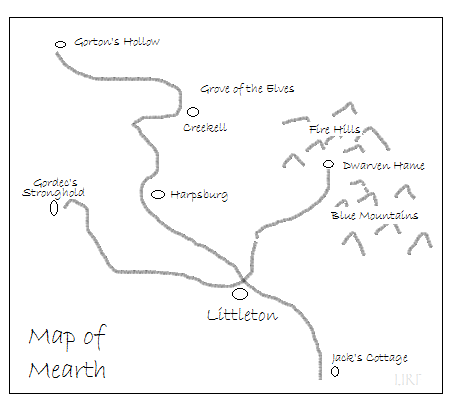 Worldbuilding requires us to ask questions of the story we are writing. I go somewhere quiet and consider the world my characters will inhabit. I have a list of points to consider when creating a society, and you’re welcome to copy and paste it to a page you can print out. Jot the answers down and refer back to them if the plot raises one of these questions.
 Power in the hands of only a few people offers many opportunities for mayhem. Zealous followers may inadvertently create a situation where the populace believes their ruler has been anointed by the Supreme Deity. Even better, they may become the God-Emperor/Empress.
 Artist: August Fischer (1854–1921)
  Talking about the craft of writing is soothing, something with solid rules. When everything else is chaos, writing is there, offering safety and escape.
 First, is this character someone the reader should remember? Even if they offer information the protagonist and reader must know, it doesn’t necessarily mean they must be named. Walk-through characters provide clues to help our protagonist complete their quest, but we never see them again. They can show us something about the protagonist and give hints about their personality or past—but when they are gone, they are forgotten.
 Novelists can learn a lot from screenwriters about writing good, concise scenes. An excellent book on crafting scenes is
  I took this absurdity to an extreme in
  One final thing to consider is this: how will that name be pronounced when read aloud? You may not think this matters, but it does. Audiobooks are becoming more popular than ever. You want to write it so a narrator can easily read that name aloud.
 Despite my experience of reading fantasy books aloud to my children, it didn’t occur to me that the names were unpronounceable as they were written. We ironed that out, but that hiccup taught me to spell names the way they’re pronounced whenever possible.
 Artist: Anna Ancher (1859–1935)
 Use common sense and if a beta reader runs amok in your manuscript telling you to remove “this and that,” examine each instance of what has their undies in a twist and try to see why they are pointing it out.
 Many writers have beta readers look at their work before it is submitted. I would also suggest hiring a freelance editor. Besides having a person pointing out where you need to insert or delete a comma, hiring a freelance editor is a good way to discover many other things you don’t want to include in your manuscript, things you are unaware are in there:
 Freelance editors will point out these all things. We don’t like it when certain flaws in our work are pointed out, but we are better off knowing what needs addressing. When an editor guides you away from detrimental writing habits, they aren’t trying to change your voice. They’ve seen something good in your work, and they’re pointing out places where you can tighten it up and grow as a writer.
 Artist: John Singer Sargent (1856–1925)
 In creative writing, the apostrophe is a small morsel of punctuation that, on the surface, seems simple. However, certain common applications can be confusing, so as we get to those I will try to be as concise and clear as possible.


 The different meanings of seldom-used sound-alike words can become blurred among people who have little time to read. They don’t see how a word is written, so they speak it the way they hear it. This is how wrong usage becomes part of everyday English.
 Insure: We insure our home and auto. In other words, we arrange for compensation in the event of damage or loss of property or the injury to (or the death of) someone. We arrange for compensation should the family breadwinner die (life insurance). Also, we arrange to pay in advance for medical care we may need in the future (health insurance).
 I have a lot of words to choose from, and


 Life in the Realm of Fantasy
