
Every story is different and requires us to use a unique narrative time. Narrative tense conveys information about time. It relates the time of an event (when) to another time (present, past, or future). So, the narrative tense we choose when writing a particular story indicates its location in time.
 In my previous post, we talked about narrative point of view. POV is the perspective, the personal or impersonal “lens” through which we communicate our stories. It is the mode we choose for conveying a particular story.
The narrative tense we gravitate to is also a component of our voice.
We shape our stories by combining narrative time with two closely related aspects:
- Narrative point of view.
- Our narrative voice (we’ll explore this more later).
The way that narrative tense affects a reader’s perception of the characters is subtle, an undercurrent that goes unnoticed after the first few paragraphs. It shapes the reader’s view of events on a subliminal level.
- “I eat.”
- “I am eating.”
- “I have eaten.”
- “I have been eating.”
The above sentences are all in the present tense. They contain the present-tense form of a verb: eat, am, and have.
Yet, they are different because each conveys slightly different information, a different point of view about how the act of eating pertains to the present moment.
Revisions are a mess for me because I “think aloud” when writing the first draft. Passive phrasing finds its way into the prose.
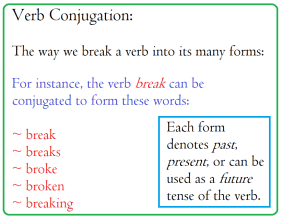 When I begin my second draft, those weak verb forms function as traffic signals. They were a form of mental shorthand that helped me write the story before I lost my train of thought. But in the rewrite, weak verbs are code words that tell me what the scene should be rewritten to show.
I’ve used these examples before. Each sentence says the same thing, but we get a different story when we change the narrative tense, point of view, and verb choice.
- Henry was hot and thirsty. (Third-person omniscient, past tense, passive phrasing.)
- Henry trudged forward, his lips dry and cracked, yearning for a drop of water. (Third-person omniscient, past tense, active phrasing.)
- I struggle toward the oasis with dry, cracked lips and a parched tongue. (First-person present tense, Active phrasing.)
- You stagger toward the oasis, dizzy with thirst. (Second-person, present tense, active phrasing.)
This is a moment in time for these thirsty characters, and the way we show it to our readers is meaningful in how they perceive the scene.
Sometimes, the only way I can get into a character’s head is to write in the first-person present tense. This is because the narrative time I am trying to convey is the now of that story. (This happens to me most often when writing short stories.)
Every story is unique; some work best in the past tense, while others must be set in the present.
WARNING: When we write a story using an unfamiliar narrative mode, watch for drifting verb tense and wandering narrative point of view.
Drifting verb tense and wandering POV are insidious. Either or both can occur if you habitually write using one mode but switch to another. For this reason, I am vigilant when I begin writing in the first-person present tense, but later discover it isn’t working for me. If I were to switch to close third person past tense, each verb must be changed to match the new narrative mode and time.
But changing an entire draft to a different narrative mode isn’t the only danger zone:
- Time and modes will drift sometimes for no reason other than you were writing as quickly as you could. For this reason, when you begin revisions, it’s crucial to look at your verb forms to ensure your narrative time doesn’t inadvertently drift between past and present.
So, where does voice come into it? An author’s voice is their habit, their fingerprint, a recognizable “sound” in the way a story is communicated.
 The way we habitually phrase sentences, how we construct paragraphs, the words we choose, and the narrative mode and time we prefer to write in is our voice. It includes the themes we instinctively write into our work and the ideals we subconsciously hold dear.
So, our voice (or style) is formed by our deeply held beliefs and attitudes. We may or may not consciously intend to do it. Regardless of intent, our convictions emerge in our writing, leitmotifs that shape character and plot arcs.
As we grow in writing craft and our values and beliefs evolve, that growth is reflected in our voice. We get better at conveying what we intend to say, and our style of writing reflects it.
A fun writing exercise is to write a 100-word short story in a narrative mode that you dislike. Think of it as a little palate cleanser.
Then, rewrite it in that same mode but using a different narrative tense. You might see a wide array of possibilities that a new narrative mode and tense bring to a scene.
 If we move to a different window, the view changes. Some views are better than others.
 Books like
  Last week, I mentioned head–hopping, a disconcerting literary no-no that occurs when an author switches point-of-view characters within a single scene. I’ve noticed it happens more frequently in third-person omniscient narratives because it’s a mode in which the thoughts of every character are open to the reader.
 I find that when I can’t get a handle on a particular character’s personality, I open a new document and have them tell me their story in the first person.
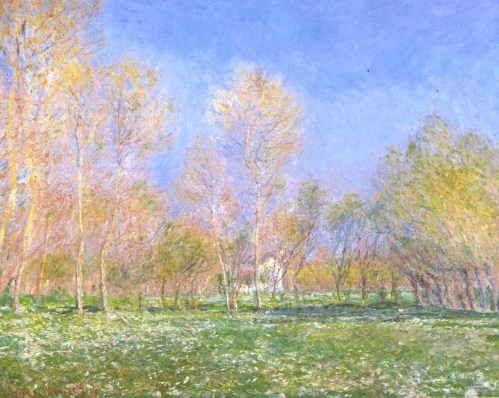 Artist: Claude Monet (1840–1926)
 But how do we recognize when a moment of action has true dramatic potential? We try to inject action and emotion into our scenes, but some dramatic events don’t advance the story.
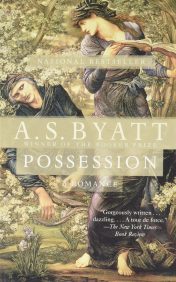 Recognizing where the real drama begins is tricky. Let’s have a look at the novel
 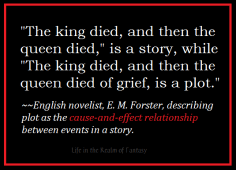 I admire the audacity of having Michell, a protagonist who considers his professional reputation as his most prized possession, commit such a catastrophic action as stealing those original letters. It proves there is potential for drama in the least likely places.
 I’m not a Romance writer, but I do write about relationships. Readers expecting a standard romance would be disappointed in my work which is solidly fantasy. The people in my tales fall in love, and while they don’t always have a happily ever after, most do. The other aspect that would disappoint a Romance reader is the shortage of smut.
 In his book
 When a beta reader tells me the relationship seems forced, I go back to the basics and make an outline of how that relationship should progress from page one through each chapter. I make a detailed note of what their status should be at the end. This gives me jumping-off points so that I don’t suffer from brain freeze when trying to show the scenes.
 I think our characters have to be a little clueless about Romance, even if they are older. They need to doubt, need to worry. They need to fear they don’t have a chance, either to complete their quest or to find love.
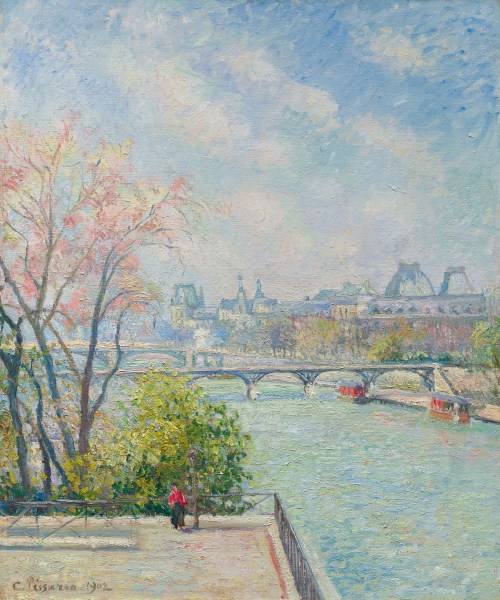 Artist: Camille Pissarro (1830–1903)
 But the scenes themselves are pictures within the larger picture of the story arc. Think of the story arc as a blank wall. We place the scenes on that blank wall in the order we want them, but without transition scenes, these moments in time appear random, as if they don’t go together.
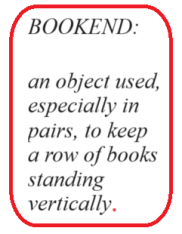 Our bookend scenes are not empty words. They should reveal something and push us toward something unknown. They lay the groundwork for what comes next.
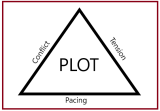 One of my favorite authors sometimes has chapters of only five or six hundred words, keeping each character thread separate and flowing well. A hard scene break with a new chapter is my preferred way to end a nice, satisfying fade-to-black.
 The second draft is where the real work begins. I set the first draft aside for several weeks and then go back to it. I look at my outline to make sure the events fall in the proper order. At that point, I can see how to write the transitions to ensure each scene flows naturally into the next.
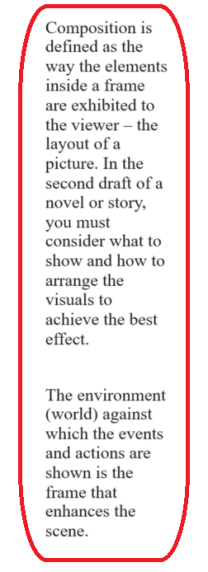
 In a novel or story, each scene occurs within the framework of the environment.
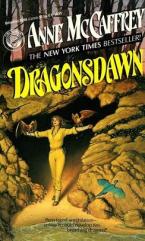
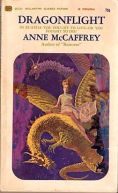 The Dragonriders of Pern series is considered science fiction because McCaffrey made clear at the outset that the star (Rukbat) and its planetary system had been colonized two millennia before, and the protagonists were their descendants.
 The scenes we are looking at today have two distinct environments to frame them. In both settings, the surroundings do the dramatic heavy lifting. This chapter is filled with emotion, high stakes, and rising dread for the sure and inevitable tragedy that we hope will be averted.
 Sallah enters the shuttle just as the airlock door closes, catching and crushing her heel. She manages to pull it out so that she isn’t trapped, but she is severely injured.
 This is an incredibly emotional scene: we are caught up in her determination to seize this only chance, using her last breaths to get the information about the thread spores to the scientists on the ground.


 Life in the Realm of Fantasy
