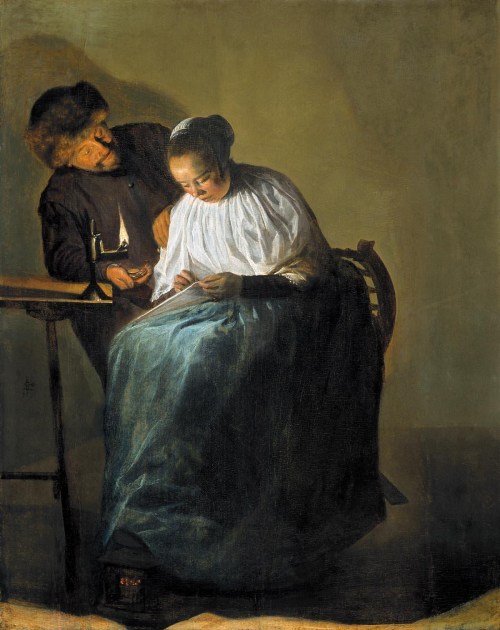
#FineArtFriday: The Proposition by Judith Leyster 1631 (revisited)

What I love about this painting is how honest Judith Leyster is when detailing the realities of life in her time and in her city. Here, a young woman is pressured to enter into a relationship with a man she has no interest in. He clearly feels he has the right to compel her to sell her virtue, and she clearly ignores him. It is as if she refuses to notice him.

Male artists of the time, Leyster’s husband, Jan Meinse Molenaer included, rarely painted genre pictures of young women other than in taverns or other low-life situations. Commissioned portraits of noble and merchant class women they painted in great abundance, but simple, modest women of good virtue?

Rarely. They had to sell paintings to feed their families, and then as today, virtue did not sell all that well.

Leyster, on the other hand, had the talent and (because she was a woman) the freedom to paint whatever she wanted. After all, as long as she managed the house, made sure food was served, and raised the children, she could paint whatever moved her.

The artistic talent of women has been so disregarded historically that, despite her signature, her paintings and her talent were attributed (after her death) to her husband and to Franz Hals.

About the Painting (Via Wikipedia):

“The Proposition” is a genre painting of 1631 by Judith Leyster, now in the Mauritshuis in The Hague, who title it “Man offering money to a young woman.” It depicts a woman, sewing by candlelight, as a man leans over her, touching her right shoulder with his left hand. He is offering her coins in his right hand, but she is apparently ignoring the offer and concentrating intently upon her sewing.

The man wears dark clothing, and the dark tones, as well as his shadow cast behind him and across his face from the angle of the candlelight, give him a looming appearance. In contrast, the woman is lit fully in the face by the candlelight and wears a white blouse.

It is an early work by Leyster, who was only 22 years old in 1631.

Also, From Wikipedia:

(The painting’s) most distinctive feature is how different it is to other contemporary Dutch and Flemish “sexual proposition” paintings, many falling into the Merry company genre. The convention for the genre, a common one at the time, was for the characters to be bawdy, and clearly both interested in sex, for money. The dress would be provocative, the facial expressions suggestive, and sometimes there would be a third figure of an older woman acting as a procuress. Indeed, in The Procuress by Dirck van Baburen, an example of the genre, that is exactly the case.

In contrast, in The Proposition the woman is depicted not as a whore but as an ordinary housewife, engaged in a simple everyday domestic chore. She isn’t dressed provocatively. She does not display her bosom (but rather her blouse covers her all of the way to her neck). No ankles are visible. She displays no interest in sex or even in the man at all.

Contemporary Dutch literature stated the sort of activity in which she is engaged to be the proper behaviour for virtuous women in idle moments. Kirstin Olsen observed that male art critics “so completely missed the point” that the woman is, in contrast to other works, not welcoming the man’s proposition that they mistakenly named the painting The Tempting Offer.

The foot warmer, whose glowing coals are visible beneath the hem of the woman’s skirt, was a pictorial code of the time, and represented the woman’s marital status. A foot warmer wholly under the skirt indicated a married woman who was unavailable, as it does in The Proposition. A foot warmer projecting halfway out from under the skirt with the woman’s foot visible on it indicated one who might be receptive to a male suitor. And, a foot warmer that is not under the woman at all, and empty of coals, indicated a single woman. This code can also be seen in Vermeer’s The Milkmaid and Dou’s The Young Mother.

About the Artist:

Judith Jans Leyster (also Leijster) (c. July 28, 1609[1]– February 10, 1660) was a Dutch Golden Age painter. She painted genre works, portraits, and still lifes. Her entire oeuvre was attributed to Frans Hals or to her husband, Jan Miense Molenaer, until 1893 when Hofstede de Groot first attributed seven paintings to her, six of which are signed with her distinctive monogram ‘JL*’. Misattribution of her works to Molenaer may have been because after her death many of her paintings were inventoried as “the wife of Molenaer”, not as Judith Leyster.

She signed her works with a monogram of her initials “JL” with a star attached: JL* This was a play on words; “Leister” meant “Lead star” in Dutch and was for Dutch mariners of the time the common name for the North Star. The Leistar was the name of her father’s brewery in Haarlem.

(Only occasionally did she sign her works with her full name.)

She specialized in portrait-like genre scenes of, typically, one to three figures, who generally exude good cheer, and are shown against a plain background. Many are children; others men with drink. Leyster was particularly innovative in her domestic genre scenes. These are quiet scenes of women at home, often with candle- or lamplight, particularly from a woman’s point of view


Sources and Attributions:

Wikipedia contributors, “The Proposition (painting),” Wikipedia, The Free Encyclopedia, https://en.wikipedia.org/w/index.php?title=The_Proposition_(painting)&oldid=851982429 (accessed February 1, 2019).

Wikipedia contributors, “Judith Leyster,” Wikipedia, The Free Encyclopedia, https://en.wikipedia.org/w/index.php?title=Judith_Leyster&oldid=820769951(accessed February 1, 2019).
2 Comments

Filed under #FineArtFriday

Exploring Theme part 2: Jane Austen #amwriting

Born in 1775, Jane Austen is remembered today for her six novels, the most famous of which is Pride and Prejudice. Austen touched on familiar themes throughout her work, including romance, youth, wealth, and poverty.

plot is the frame upon which the themes of a story are supportedEven today, her humor shines with sharp-edged wit delivered without condescension. Her most memorable protagonists rise above the trivialities of life that absorb the sillier characters.
Via Wikipedia:

With the publication of Sense and Sensibility (1811), Pride and Prejudice (1813), Mansfield Park (1814), and Emma (1816), in her lifetime she achieved modest success and, as the books were published anonymously, little fame. She wrote two other novels, Northanger Abbey and Persuasion, both published posthumously in 1818, and began another, eventually titled Sanditon, but died before its completion. She also left behind three volumes of juvenile writings in manuscript, the short epistolary novel Lady Susan, and another unfinished novel, The Watsons. [1]

Austen’s work delved deep into the issues women faced, which were not discussed in polite company, and she did it while navigating the shark-infested waters of her society. Her central themes were:

Financial insecurity: The need for a gentlewoman to marry well for financial security rather than love.

Patriarchy: The sure assumption that men know best and the societal value of a man’s opinion as opposed to a woman’s opinion.

Women as property: The value of youth; a young woman is more desirable than an older woman, no matter how intelligent and thoughtful.

Hubris: Pride – and the humbling of pride.

The six published novels deal with social class, gender and society’s expectations, and morality.

What is right, moral, and proper? This theme of honorable morality winds through all her work.

And the other major theme, one opposing honorable morality, is pride. Pride loves power. It is listed as one of the world’s seven deadly sins because pride can become so powerful that it creates its own morality, crushing humility.

hubrisPride is a powerful theme because it is the downfall of many characters in all literature, not just Jane Austen’s work.
These two themes, pride and morality, power Austen’s satire, give weight to her humor and support the triumphs and tragedies of her characters. Austen saw pride as a form of hubris.

Jane Austen’s novels have inspired many debates. Some claim they are politically conservative, and others argue they are progressive. Those who see conservatism in her novels claim her heroines support the existing social structure by doing their duty and sacrificing their personal desires.

Those who see progressive tendencies in her work argue that she is skeptical of the patriarchal right to rule, evidenced by her ironic tone.

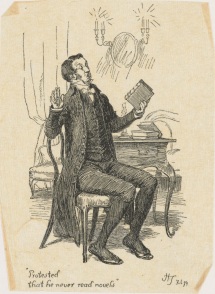
Houghton_Typ_805.94.8320_-_Pride_and_Prejudice,_1894,_Hugh_Thomson_-_Protested

Illustration by Hugh Thomson representing Mr. Collins, protesting that he never reads novels

Austen understood the political issues surrounding the gentry. As a member of that society, she was able to pose questions relating to money and property, framing them in such a way they were entertaining while being thought-provoking. Her satire exposed the patriarchy, the arbitrary inequality of inheritance laws, and the perilous economic position of women. In an era when few career choices were available for women, the social system enforced a lifetime of servitude, either as a wife, possibly a teacher/governess, or as a servant.

Throughout Austen’s work, there is a tension between the prerogatives of society and the desires of the individual. Austen is often considered one of the originators of the modern, interiorized novel character.

How did she achieve this?

Again, Wikipedia tells us:

Austen is most renowned for her development of free indirect speech, a technique pioneered by 18th-century novelists Henry Fielding and Frances Burney. In free indirect speech, the thoughts and speech of the characters mix with the voice of the narrator. Austen uses it to provide summaries of conversations or to compress, dramatically or ironically, a character’s speech and thoughts. In Sense and Sensibility, Austen experiments extensively for the first time with this technique. For example,

Mrs. John Dashwood did not at all approve of what her husband intended to do for his sisters. To take three thousand pounds from the fortune of their dear little boy, would be impoverishing him to the most dreadful degree. She begged him to think again on the subject. How could he answer it to himself to rob his child, and his only child too, of so large a sum?

[…] However, Page writes that “for Jane Austen … the supreme virtue of free indirect speech … [is] that it offers the possibility of achieving something of the vividness of speech without the appearance for a moment of a total silencing of the authorial voice.” [2]

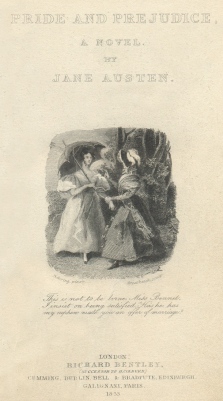
Pickering_-_Greatbatch_-_Jane_Austen_-_Pride_and_Prejudice_-_This_is_not_to_be_borne,_Miss_BennetClearly, Mrs. Dashwood feels that ensuring her sisters-in-law are not impoverished would make her only son less rich. Less appealing to other affluent families.
So, Jane Austen used her characters’ thoughts and their spoken conversations to subtly weave her themes of pride, the human tendency for greed, and social inequity throughout the narratives of her novels.

I’ve said this before, but it bears repeating: when your writing mind has temporarily lost its momentum, and you are stretching the boundaries of common sense, it’s time to stop and consider the central themes.

I find it helps to remind myself that theme is one of the elements that drives a plot.


Credits and Attributions:

[1] Wikipedia contributors, “Jane Austen,” Wikipedia, The Free Encyclopedia, https://en.wikipedia.org/w/index.php?title=Jane_Austen&oldid=1073632619 (accessed March 15, 2022).

[2] Wikipedia contributors, “Styles and themes of Jane Austen,” Wikipedia, The Free Encyclopedia, https://en.wikipedia.org/w/index.php?title=Styles_and_themes_of_Jane_Austen&oldid=1063968945 (accessed March 15, 2022).

Media: Wikimedia Commons contributors, “File:Houghton Typ 805.94.8320 – Pride and Prejudice, 1894, Hugh Thomson – Protested.jpg,” Wikimedia Commons, the free media repository, https://commons.wikimedia.org/w/index.php?title=File:Houghton_Typ_805.94.8320_-_Pride_and_Prejudice,_1894,_Hugh_Thomson_-_Protested.jpg&oldid=351956491 (accessed March 15, 2022).

Media: Wikimedia Commons contributors, “File:Pickering – Greatbatch – Jane Austen – Pride and Prejudice – This is not to be borne, Miss Bennet.jpg,” Wikimedia Commons, the free media repository, https://commons.wikimedia.org/w/index.php?title=File:Pickering_-_Greatbatch_-_Jane_Austen_-_Pride_and_Prejudice_-_This_is_not_to_be_borne,_Miss_Bennet.jpg&oldid=351959807 (accessed March 15, 2022).

6 Comments

Filed under writing

Exploring Theme part 1: Henry James #amwriting

A late 19th– early 20th-century writer whom many have heard of but never read, Henry James, has a great deal to tell us about using a story’s themes to create memorable characters. You may be familiar with some of his works, such as The Turn of the Screw and The Golden Bowl. His novels are still being made into movies and adapted as plays.

2WritingCraft_themeMany of James’s books feature one common theme—lust.
Lust for sex. Lust for money. Lust for control.

Lust for power.

The Golden Bowl is the story of deception, manipulation, lust for money, and lust for control. Many of James’s novels feature people in his contemporary world going through their lives. But he takes his characters down to their fundamental emotional components, peels back the veneer of civilization, and exposes their motives for you, the reader.

James understood the potential of a strong theme. He threaded his themes through every conversation and scene as if the theme was background music, an orchestra playing a musical score. Like a Roger Williams film score, James’s themes subtly, insidiously, propel the plot, reinforce emotions, and support the dramas as they are played out. This is why his novels are still considered among the most powerful works of modern fiction.

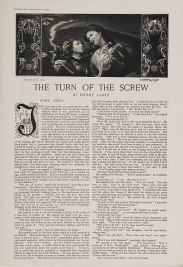
512px-The-Turn-of-the-Screw-Collier's-1AHenry James is famous for his novels and short stories laying bare the deepest motives and manipulations of the society he knew. However, he wrote one of the most famous novellas ever published, The Turn of the Screw.
On the surface, The Turn of the Screw is different from his other forays into Victorian society, a Gothic horror story. The four main themes are the corruption of the innocent, the destructiveness of heroism, the struggle between good and evil, the difference between reality and fantasy. A fifth theme is the perception of ghosts. Are the ghosts real or the projection of the governess’s madness?

However, there are several subthemes interwoven into the fabric of the narrative.

Secrecy.

Deception.

The lust for control.

Obsession

Via Wikipedia:

The Turn of the Screw is an 1898 horror novella by Henry James which first appeared in serial format in Collier’s Weekly (January 27 – April 16, 1898). In October 1898, it was collected in The Two Magics, published by Macmillan in New York City and Heinemann in London. The novella follows a governess who, caring for two children at a remote estate, becomes convinced that the grounds are haunted. The Turn of the Screw is considered a work of both Gothic and horror fiction.

On Christmas Eve, an unnamed narrator and some of their friends are gathered around a fire. One of them, Douglas, reads a manuscript written by his sister’s late governess. The manuscript tells the story of her hiring by a man who has become responsible for his young niece and nephew following the deaths of their parents. He lives mainly in London but also has a country house in Bly, Essex. The boy, Miles, is attending a boarding school, while his younger sister, Flora, is living in Bly, where she is cared for by Mrs. Grose, the housekeeper. Flora’s uncle, the governess’s new employer, is uninterested in raising the children and gives her full charge, explicitly stating that she is not to bother him with communications of any sort. The governess travels to Bly and begins her duties.

Miles returns from school for the summer just after a letter arrives from the headmaster, stating that he has been expelled. Miles never speaks of the matter, and the governess is hesitant to raise the issue. She fears there is some horrible secret behind the boy’s expulsion, but is too charmed by him to want to press the issue. Soon after, around the grounds of the estate, the governess begins to see the figures of a man and woman whom she does not recognize. The figures come and go at will without being seen or challenged by other members of the household, and they seem to the governess to be supernatural. She learns from Mrs. Grose that the governess’s predecessor, Miss Jessel, and another employee, Peter Quint, had had a close relationship. Before their deaths, Jessel and Quint spent much of their time with Flora and Miles, and the governess becomes convinced that the two children are aware of the ghosts’ presence. [1]

Lust for control—whether real or imagined, the ghosts refuse to move on, refuse to relinquish control of the children.

All these themes are woven around the delicate subject of the governess’s unhealthy romantic attachment to the boy.

Many theories abound regarding the governess and the ghosts:

Inquiries Journal says:

projection definitionProjection may explain what role the ghosts play in “Turn of the Screw,” but it does not explain why the governess feels she needs to use projection as a defense. The governess appears to be experiencing an inner battle that is affecting her perception of reality. She has fallen in love with a boy much younger than herself. Society sees this pedophilic behavior as corrupting the child. The governess’s conscience tells her that she must reform her ways. Her id tells her that she is right in pursuing what she desires. In “The Turn of the Screw,” the governess is using an unconscious means of defense, projection, to protect herself from her superego, while continuing to hold onto her sexual desires. [2]

James leaves several loose ends still hanging when we reach the final page of the novella. This asks the reader to reach their own conclusions about how these themes affect the characters as they go forward in their lives. Regardless of whether the ghosts are real or imagined, the story takes us on a dark journey.

What I take home from Henry James’s intense focus on his themes and the inner workings of his characters is this: find a strong theme and use it to underscore and support our characters’ motives.

Our characters are people. People are a mix of good and bad at the same time. Some lean more to good, others to bad. Either way, they act with good, logical intentions, believe themselves unselfish, and desperately want what they think they deserve.

Most importantly, they lie to themselves about their own motives and obscure the truth behind other, more palatable truths.

I always think that inserting a whiff of human frailty into a character makes them more interesting, more relatable.


Credits and Attributions:

[1] Wikipedia contributors, “The Turn of the Screw,” Wikipedia, The Free Encyclopedia, https://en.wikipedia.org/w/index.php?title=The_Turn_of_the_Screw&oldid=1073476225  (accessed March 13, 2022).

[2] Literary Analysis: Turn of the Screw – Inquiries Journal www.inquiriesjournal.com/articles/65/literary-analysis-turn-of-the-screw  © 2022 Inquiries Journal/Student Pulse LLC. All rights reserved. ISSN: 2153-5760. (Accessed March 13, 2022).

4 Comments

Filed under writing

#FineArtFriday: Two Paintings by H. A. Brendekilde

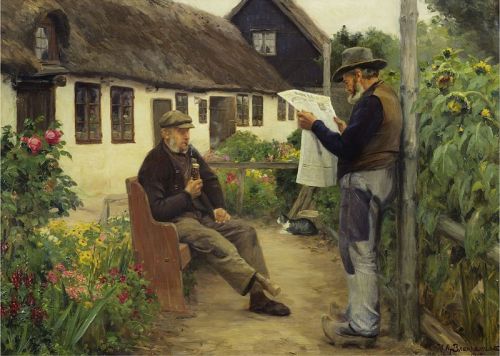
H. A. Brendekilde is one of my favorite artists. There is a story in the above painting. I particularly like the details—the patched trousers of the gardener, the mud on his clogs, the other man’s wooden leg—juxtaposed against the lush spring garden and prosperous village life of Denmark in 1912. Their hands and clothes indicate they have stopped work to read the newspaper. Both men seem stunned. Are they perhaps reading of the death of King Frederick VIII, who died on 14 May 1912? Whatever they are reading, the cat remains undisturbed by the news.

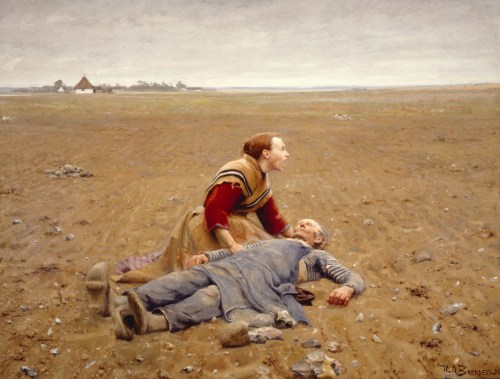
H. A. Brendekilde was a forerunner of the social realist style, embraced by Diego Rivera. His early work often depicted the daily lives of the rural working class. One of his most famous paintings, “Worn Out” (1889) shows an elderly man lying fallen on his back in the plowed field. He has collapsed while picking stones, preparing a field for planting. The stones he had gathered have scattered across the ground, and one of his clogs has fallen off his foot.

Has he worked himself to death? Will he recover? His entire world is this rocky barren field.  A story is in this stark painting.


About the Artist via Wikipedia (be patient–this was written by a non-native English-speaker. We should all speak a foreign language so well!)

[1] Hans Andersen Brendekilde (7 April 1857 – 30 March 1942) was a Danish painter.

Brendekilde’s influence was great not only on society, but also on his many friends among painters and potters. Among the painters especially on L.A. Ring. During their young and poor years they were sharing room and studio in Copenhagen for periods. They painted similar themes, both had the family name Andersen and they were therefore often confused with one another.[1] So in 1884 they changed their family names Andersen to the names of their native villages instead, Brendekilde and Ring. Brendekilde was always in a good mood, was deeply committed to paint life in the small villages, and furthermore was an ardent socialist. Ring was of a more depressive disposition and Brendekilde encouraged him to continue painting and join exhibitions. Brendekilde also introduced Ring to Lars Ebbesen, who had a farm “Petersminde” in “Raagelund” close to Odense. In 1883, Ring was living in extreme poverty in Copenhagen, but the introduction to Lars Ebbesen meant that he could live and paint without worrying about the cost of rent and food for long periods. Both Brendekilde and Ring remained lifelong friends with farm owner Ebbesen.[2] Several of Brendekilde’s paintings became very famous and won medals e.g. at the World Expositions in Paris 1889, in Chicago 1893 and at the “Jahresausstellung” im Glaspalast in München 1891. He also inspired painters like his friends Julius PaulsenPeder MønstedHans SmidthPaul FischerSøren Lund [da] and H. P. Carlsen.

Brendekilde was the first painter bringing the arts and crafts movement to Denmark when from about 1884 he designed and made integrated frames around his paintings, the frames being part of the paintings and their story. Some frames were symbolistic and others more ornamental.

Many of his paintings are obviously related to those by Anna and Michael AncherP.S. Krøyer and the Swedish painters Carl Larsson and Anders Zorn. All of these displayed their paintings at the international exhibitions in Copenhagen 1888, Paris 1889, Munich 1891 and Chicago 1893. [1]


Credits and Attributions:

[1] Wikipedia contributors, “H. A. Brendekilde,” Wikipedia, The Free Encyclopedia, https://en.wikipedia.org/w/index.php?title=H._A._Brendekilde&oldid=1019433991 (accessed March 11, 2022). Translated from Dutch.

While reading the newspaper news by H. A. Brendekilde 1912 [Public domain], via Wikimedia Commons

Worn Out by H. A. Brendekilde [Public domain], via Wikimedia Commons

4 Comments

Filed under #FineArtFriday

World-Building: Dressing the Set #amwriting

In any environment, fictional or real, the following is true: no matter how costly and rich or poor and rundown, personal belongings in a scene are only necessary for what they say about the people who own them.

WritingCraftWorldbuildingWhy is this so? Let’s look at an example.

Consider the protagonist in a scene set in a kitchen.

I cross to sit at the table. In front of me are a laptop, a cup of tea, a notepad, and a pen. The white page of the notepad stares back at me, accusing, as if to say, “Write, you fool.”

But words elude me.

As a reader, what do you see?

You see the word kitchen and assume it is furnished with everything you think should be there. You assume there is a sink, a stove, a refrigerator…and so on. Instantly, it becomes a room you can understand. Yet only the tea, the table, the notepad, and the pen are mentioned. The code word, the one that triggers the mental picture, is kitchen.

If we mention how the dark, heavy furniture lends an atmosphere of gloom to the room, that’s all the description we need to offer. The reader sees the laptop, notepad, and pen, along with a cup of tea against a version of dark and heavy dining furniture. The style of furniture will be something the reader is familiar with.

We don’t need to explain any further.

Possessions that are mentioned give the reader clues about many things. Some things will show economic class and background, but all should hint at the owner’s personality. Are they neat or untidy? Fond of some sort of art? Are there a lot of books? Maybe they are fond of music.

Perhaps they are a person who cares about style, or maybe they don’t. Their possessions reflect their personal tastes.

desaturated alice Tea setSo how is social class different from economic class? In some parts of the world, they are the same. In others, social class is inherited, and economic class is acquired.

When we meet them away from their environment, people’s social class can be hard to nail down just by looking at them. Behavior and manners are one clue, showing the standards and values a person was raised with, irrespective of their financial standing. You’d have to see their family and early lives to know their social class, if class matters to the story.

Most people from impoverished backgrounds are raised with good manners—politeness and respect are personal qualities everyone appreciates. People working in blue-collar jobs are curious about science and the world around them. They might love their work, but they may also value education and go out of their way to educate themselves. They might love all things NASA and look for science shows featuring space exploration.

 Many rich families lose their money and social standing over the course of generations. Who they once were no longer means anything. Who they are is all that counts.

Many children who start life in poverty grow up to own expensive clothes and cars, earning them through hard work. So, if you mention a brand name with “cool” status, such as Rolex or iPhone, you are only scraping the surface of the person. You have to go a little deeper, look into their personal values.

Consider the table in our fictional kitchen. Is it a beautiful antique? Maybe it’s a high-quality table from a high-end furniture store. Could it be a secondhand table with mismatched chairs? Or is it a modern-looking matched set from the chain store that sells overpriced furniture on contract and advertises huge discounts on TV, the used-car-salesmen of the furniture world?

We have a good-quality but overpriced matched set in my real-life dining room. What can I say? We are suckers for flashy advertising.

How do we use furnishings to show personality, wealth, background, or class?

People from impoverished backgrounds may value nice things and take care of them because they understand how difficult it can be to acquire replacements. They purchase items as much for durability as for style.

Our personal background formed the first two decades of our lives, but that is all. Once we leave home, that is behind us. Over the next forty to eighty years, life shapes us, forms our likes and dislikes. 

IMG_1206For instance, I grew up in a financially stable lower-middle-class family. But I never buy pre-distressed furniture, no matter how much the designers on TV love it. This is because, by the time my youngest child left home, all my hand-me-down furniture was distressed. I like my furniture to reflect my life—un-distressed.

The way a person dresses and sets out their possessions in their environment can be shown briefly. Clothing, even uniforms, can show personality, and objects can foreshadow things.

The following scene takes place on a starship. The crew is on a scientific mission:

Ensign Kyle Stone left his rooms and walked to Ensign Price’s door on the opposite end of the passage. He pressed the bell, and after a moment, the door slid open. He said, “I might be a bit early. Sorry.” “Kyle” was a name he’d like to lose. “Stone” was what he answered to.

“No problem.” Emma stood there, her uniform perfectly neat, as fresh as if they hadn’t just spent the morning wrangling with a broken levitor. “I’m not quite finished adding this morning’s notes to the brief, so if you don’t mind, I’ll get that done. Have a seat.” She turned and went to the little alcove that served as a study in all the quarters.

Stone sat and looked around, absently wondering how Emma had managed to make the same kind of utilitarian rooms all the unmarried personnel occupied feel so personal, so—lived in. The furnishings were exactly the same as his, built into the floor so you couldn’t rearrange things. Certainly, his quarters looked as personal as a hotel, with only his dirty laundry to show for his existence.

Yet Emma’s quarters had a feeling of permanence. Maybe it was the plants she had set in various places. He noticed a carved wooden box on a shelf above the entertainment console. Beside the box was a framed picture. She never mentioned family, never discussed her personal life. He was about to look more closely at it when she returned.

 Emma said, “I uploaded it to Lieutenant Arrans, so we’re all set. Did you manage to find the schematic?”

Glad she hadn’t caught him snooping in her personal space, Stone said, “I did, and uploaded them. But I still doubt it’s what we need.”

Still talking, they left Emma’s quarters, heading to the small conference room.

What does the box signify? Who is in the picture? What did Stone’s observation of Emma’s tidy uniform and her plants tell you about her? How do these things relate to the larger story?

2016-08-12 21.26.16

Sunset at Tillamook Head, Copyright 2016 Connie J. Jasperson

In a sci-fi story, just as in a contemporary or fantasy story, the way we use observations and visuals says a lot about our characters, things we don’t have to write out in detail.

Use these visual observations to your advantage.

Your assignment is this:

Invent two characters and write a short scene set in any room, any genre. Be selective in the visual items you mention and only mention the things the protagonist finds important.

Readers will extrapolate information from those items, clues that will build an entire picture in their imaginations, populating the space with many things you won’t have to mention.

14 Comments

Filed under writing

The Farmer’s Market, Volcanic Tofu, and Revisions #amwriting #writerlife

We had an exceptionally wet January here in my area of the Pacific Northwest. Usually, we get 8.19 inches (208 mm) of rain in January. But this year, we received 10.78 inches (273.8 mm) of precipitation. Some days, it just bucketed down.

MyWritingLife2021February here in my little town was dryer than usual, far less rainy than in other parts of the Northwest. We have seen the sun much more than usual over the last two weeks, which doesn’t bode well for the summer. I can’t help but think of the horrible heat we had last June. We don’t like it when it gets up to 110 degrees Fahrenheit (43.3 Celsius). It’s literally hell when you realize most people here don’t have air conditioning in their homes. Up through the 1980s, we never needed it, as summers rarely topped 80 degrees (26.6).

But it’s still early March, and Saturday morning was cool and sunny, and a perfect day to go to the Farmers Market in Olympia. The local farms and greenhouses had a good selection of early organic vegetables. It was crowded with folks like us, masked and keeping a respectful distance, but all of us were hoping for good bargains.

512px-Igelstachelbart,_Hericium_erinaceusEdible mushrooms of all sorts abounded. One I hadn’t seen before, the lion’s mane mushroom, was the central feature in the displays of the two local craft fungi growers. It was interesting to look at, but … no.

Not on my plate, please.

However, local wines, hothouse veggies, winter apples, baked goods, carved boxes, silk scarves and hand-dipped candles abounded—the market was full of intriguing things .

Best of all, the musician on stage in the food court was really talented, a brilliant songwriter and guitarist. Great music, and a sunny day–what could top it?

Lunch.

So, we went to our favorite teriyaki restaurant, where I ordered my usual favorite dish, the spicy tofu bowl.

They must have a new cook. I can take a certain amount of culinary heat, and the dish I have grown to love over the last ten years can be tongue-tingling and a bit lip-burning.

But, on a scale of one to five, with one being bland and five the hottest, what I received was at least a ten on the volcanic pepper index.

I couldn’t eat it. But we had fun anyway. Now that I know a different cook is working there, I’ll order the teriyaki tofu bowl next time.

Apples 8-25-2013On the writing front, last week was quite productive. I received the final chapters back for my blended novel from my editor and am now going over the manuscript one last time. This is a merging of the stories of two characters and the events of one overarching plot arc. It’s the parallel stories of two battle mages, a father and son, told from their unique generational viewpoints.

It’s not working as separate books, and in the final book of that series, the protagonists join forces to work together anyway. Since being an indie means I can do whatever I think will improve my product, I decided to put their concurrent stories into one book, telling the story with no repetition of ground already covered.

When deciding whose point of view should be primary in each chapter, I chose the character with the most interesting angle on the action. For the first half, it’s more from John’s point of view, but Edwin’s story kicks into gear in the middle, and they join forces at the end, preparing for the final book. It’s epic fantasy, so it’s big and sweeping, but still less than half the length of a Robert Jordan or Tad Williams book.

The whole series is getting a facelift. I’m always learning, always trying to improve myself and my work. So, when something doesn’t work, I’m not ashamed of admitting I was wrong and changing it up.

Author-thoughtsThis merger of two novels into one involved cutting a number of chapters out of each and layering the stories so that the timeline moves forward at the right pace and doesn’t repeat what we already know.

I think that with my editor’s sharp eye pointing out the rough spots, we’ve achieved a smooth narrative, but time will tell. I will have the book professionally formatted for paperback, as I just don’t have the patience for that anymore.

So, that’s how I’m spending my spring afternoons, re-editing old works, and putting the final polish on Bleakbourne on Heath, the novel that began life as a weekly serial for a now-defunct website.

It has an actual ending now. Once the final chapters have been run by my writing group, I will publish it as a standalone novel.

Writing and publishing a chapter a week seemed so easy back in 2016 when I had the idea.

It’s not.

Oh, how foolish I was to commit to that! Writing the words is one thing. Words I had in abundance. But I had to edit them, revise them, and proofread them–which left me no time for writing anything else.

I couldn’t keep churning chapters out that pace, and then I didn’t know how to end the thing. So, I ended it with a wedding and left several threads dangling.

This last November, my writing group came through, helping me brainstorm it. With their help and the impetus of NaNoWriMo, I managed to pull off a credible ending.

So far this year, I’ve submitted a short story to the Masters Review short fiction contest. I did this hoping to at least get a critique of some sort. I don’t expect much as fantasy never does well in that particular contest, no matter how deep the themes and ideas presented. They say they want fiction in all genres, but really, they lean more toward literary fiction. The reason I took such a perilous plunge was to get a critique of that story by people who hadn’t read parts of it before, and who don’t know me.

magicAlso, I submitted my 2020 NaNoWriMo novel to PNWA’s literary contest in the category of fantasy and science fiction. All entrants will receive two critiques from that contest, which is why I sent my work in. The readers are people who read fantasy for pleasure. They have never seen my work, and my name isn’t attached to the manuscript. So, their insights will be unbiased, with no need to sugarcoat them.
And finally, on Friday, I had an epiphany. It occurred to me that I’ve been approaching one of my stalled works-in-progress from the wrong angle. This is a story that begs to be told from the first-person point of view. Once I did that, the words flowed.

The way I structure my writing day is to write new words in the morning and make revisions on other works in the afternoon. I don’t stagnate that way, and I feel like I’m making progress.

So, that’s the news from Casa del Jasperson. Fresh veggies, sunshine, and a lot of progress in the writing department.

I hope your winter has gone as well as mine.


Credits and Attributions:

Media:  Lion’s Mane Mushroom, Lebrac, CC BY-SA 3.0 <https://creativecommons.org/licenses/by-sa/3.0&gt;, via Wikimedia Commons.

Wikimedia Commons contributors, “File:Igelstachelbart, Hericium erinaceus.jpg,” Wikimedia Commons, the free media repository,  https://commons.wikimedia.org/w/index.php?title=File:Igelstachelbart,_Hericium_erinaceus.jpg&oldid=490095032 (accessed March 6, 2022).

3 Comments

Filed under writing

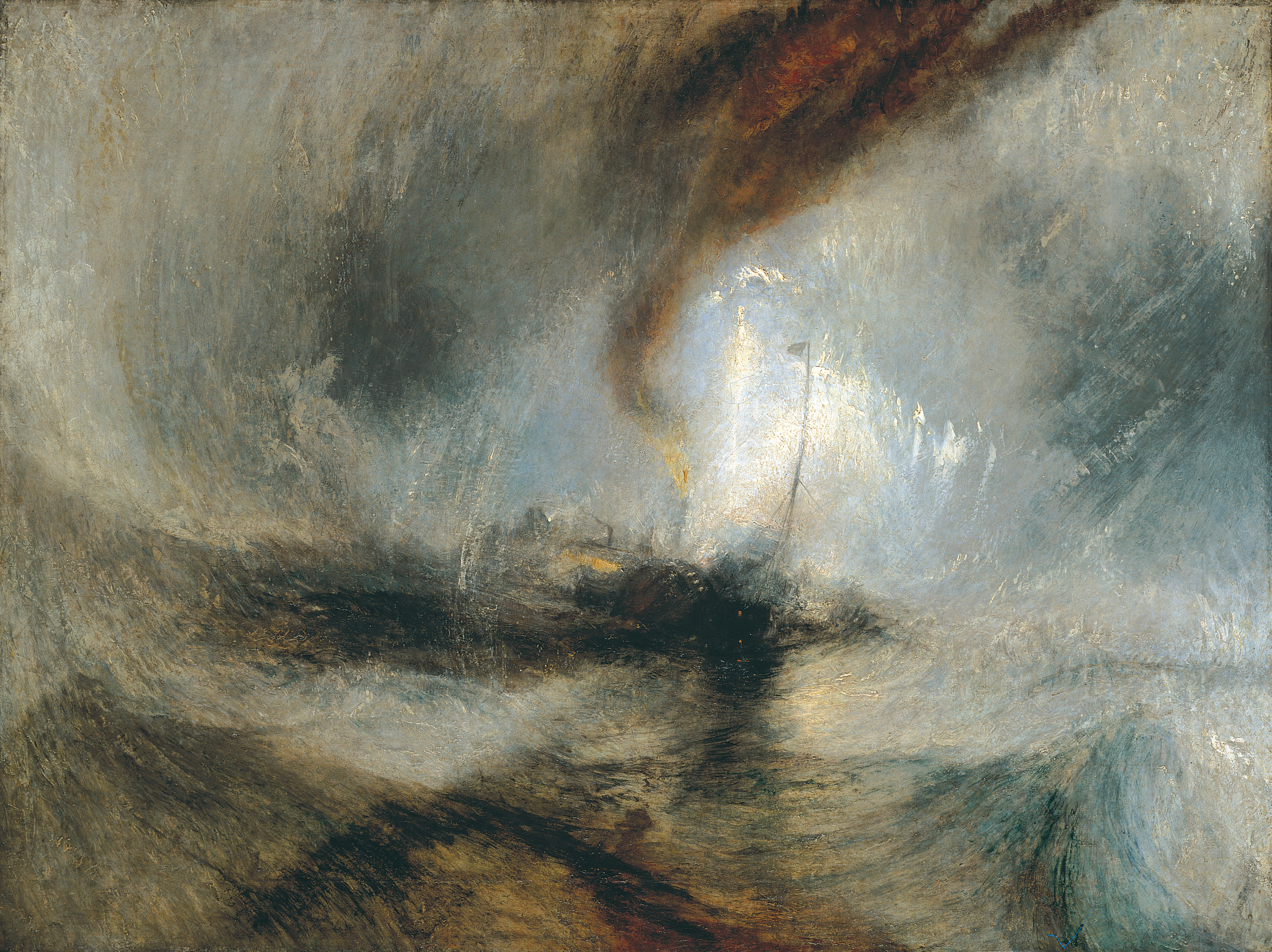
#FineArtFriday: Snow Storm: Steam-Boat off a Harbour’s Mouth J.M.W. Turner 1842

J.M.W. Turner

Title: Snow Storm: Steam-Boat off a Harbour’s Mouth

Artist: J. M. W. Turner

Year: 1842

Medium: oil on canvas

Dimensions: 91 cm × 122 cm (36 in × 48 in)

Location: Tate, London, Great Britain

About this Picture, Via Wikipedia:

The painting depicts a paddle steamer caught in a snow storm. This marine painting is showing a Romantic era’s painter’s depiction of a snowstorm on water at its best, fully developing the bold, daring Romantic fantasy of Turner. Turner was unrivaled in depicting the natural world unmastered by mankind and exploring the effects of the elements and the battle of the forces of the nature. Turner worked first as a watercolorist, and he started to work much later with oils. He later applied the techniques he learned in watercolour onto oil paintings.

It is typical of the late style of Turner. Turner’s tints and shades of colours are painted in different layers of colour, the brushstrokes adding texture to the painting. The colours are monochromatic, only a few shades of grey, green and brown are present, having the same tone of colours. The silvery pale light that surrounds the boat creates a focal point, drawing the viewer into the painting. The smoke from the steamboat spreads out over the sky, creating abstract shapes of the same quality like the waves.

An inscription on the painting relates that The Author was in this Storm on the Night the “Ariel” left Harwich. Turner later recounted a story about the background of the painting:

“I did not paint it to be understood, but I wished to show what such a scene was like; I got the sailors to lash me to the mast to observe it; I was lashed for four hours, and I did not expect to escape, but I felt bound to record it if I did.”

He was 67 years old at the time. Some later commentators doubt the literal truth of this account. Other critics accept Turner’s account, and one wrote, “He empathized completely with the dynamic form of sovereign nature.”  This inscription allows us to better understand the scene represented and the confusion of elements.

Turner had investigated the interactions between nature and the new technology of steamboats in at least five paintings in the previous decade. Throughout his career, Turner engaged with issues of urbanism, industry, railroads and steam power. [1]

About the Artist, Via Wikipedia:

Joseph Mallord William Turner RA (23 April 1775 – 19 December 1851), known in his time as William Turner, was an English Romantic painter, printmaker and watercolourist. He is known for his expressive colourisations, imaginative landscapes and turbulent, often violent marine paintings. He left behind more than 550 oil paintings, 2,000 watercolours, and 30,000 works on paper. He was championed by the leading English art critic John Ruskin from 1840, and is today regarded as having elevated landscape painting to an eminence rivalling history painting.

Turner was born in Maiden Lane, Covent Garden, London, to a modest lower-middle-class family. He lived in London all his life, retaining his Cockney accent and assiduously avoiding the trappings of success and fame. A child prodigy, Turner studied at the Royal Academy of Arts from 1789, enrolling when he was 14, and exhibited his first work there at 15. During this period, he also served as an architectural draftsman. He earned a steady income from commissions and sales, which due to his troubled, contrary nature, were often begrudgingly accepted. He opened his own gallery in 1804 and became professor of perspective at the academy in 1807, where he lectured until 1828. He travelled to Europe from 1802, typically returning with voluminous sketchbooks.

Intensely private, eccentric and reclusive, Turner was a controversial figure throughout his career. He did not marry, but fathered two daughters, Eveline (1801–1874) and Georgiana (1811–1843), by his housekeeper Sarah Danby. He became more pessimistic and morose as he got older, especially after the death of his father, when his outlook deteriorated, his gallery fell into disrepair and neglect, and his art intensified. In 1841, Turner rowed a boat into the Thames so he could not be counted as present at any property in that year’s census. He lived in squalor and poor health from 1845, and died in London in 1851 aged 76. Turner is buried in Saint Paul’s Cathedral, London. [2]


Credits and Attributions:

[1] Wikipedia contributors, “Snow Storm: Steam-Boat off a Harbour’s Mouth,” Wikipedia, The Free Encyclopedia, https://en.wikipedia.org/w/index.php?title=Snow_Storm:_Steam-Boat_off_a_Harbour%27s_Mouth&oldid=1000619190 (accessed March 3, 2022).

[2] Wikipedia contributors, “J. M. W. Turner,” Wikipedia, The Free Encyclopedia, https://en.wikipedia.org/w/index.php?title=J._M._W._Turner&oldid=1075008053 (accessed March 3, 2022).

Wikimedia Commons contributors, “File:Joseph Mallord William Turner – Snow Storm – Steam-Boat off a Harbour’s Mouth – WGA23178.jpg,” Wikimedia Commons, the free media repository, https://commons.wikimedia.org/w/index.php?title=File:Joseph_Mallord_William_Turner_-_Snow_Storm_-_Steam-Boat_off_a_Harbour%27s_Mouth_-_WGA23178.jpg&oldid=618892271 (accessed March 3, 2022).

2 Comments

Filed under #FineArtFriday, writing

Editing part 2, What Submissions Editors Want

In the publishing world, there are several different kinds of editors: line editors, structural editors, submissions editors, and so on. Each does a specific job within the industry. When you look at the annual salaries, you can see that none of these jobs pay well, so it’s clear that, while they like to eat and pay the mortgage as much as any other person, editors in all areas of publishing work in the industry because they love a good story.

toolsToday we are discussing a particular kind of editor: the submissions editor. When I first began this journey, I didn’t understand how specifically you have to tailor your submissions for literary magazines, contests, and anthologies. Each publication has a specific market of readers, and their editors look for new works their target market will buy.

I’m just going to lay it out there for you: it’s not worth a publisher’s time to teach you how to be a writer. You have to learn that on your own.

So, if magazine editors aren’t going to edit your work, what does the editor for that publisher do? Magazine editors look for and bring new and marketable stories to the reading public.

Marketable is the keyword. If your submission doesn’t fit what that magazine’s readers expect, the editor will reject it.

War_and_Peace_Franklin_Library_By_Leo_Tolstoy_First_Edition_1981The quality of your work isn’t the problem, and you have selected a publication that features work in your chosen genre. But your subgenre may not match what the readers of that publication want to see. After all, both spaghetti Bolognese and bruschetta are created out of ingredients made from wheat and tomatoes, but the finished meals are vastly different.
A person who craves spaghetti Bolognese won’t be satisfied with an offering of bruschetta despite the fact they both feature wheat and tomatoes. The genre may be Italian, and they feature the same ingredients. But the delivery method is a subgenre that may not appeal to every diner.

Editors for contests and large publishers of books do the same—they find and bring work they enjoy to the public in specific genres. If your story makes it through the publisher’s door and into the first part of their process, their editor may ask you for minor revisions, small things you may have missed when self-editing.

But they won’t offer you technical advice.

This is because they shouldn’t have to. Before submitting your work to an agent or submissions editor, you must have the technical skill down.

For the indie author, magazines, contests, and anthologies are the most logical places for getting their names out to the reading world. You must ensure you have a clean manuscript that is marketable to the readers of the publication you are courting. You may need to have someone in your writing group proofread it before submitting it.

Professionals do the required work and don’t think twice about it—self-editing and proofreading are just part of the job.

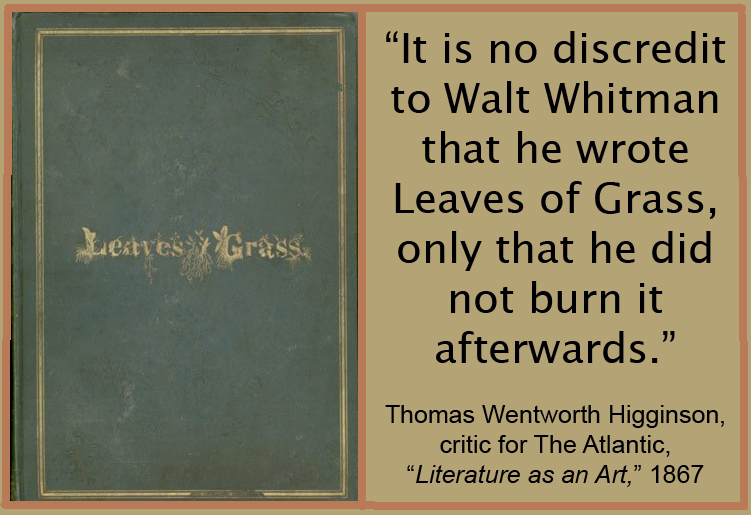
leaves of grass memeSome hobbyists expect special consideration and are offended when they don’t get it. Egos are rampant in this business, but in reality, no one gets to be treated like a princess.

Prominent publications have wide readerships. The more people who read and enjoy a short piece by you, the more potential readers you have for your novels. These people likely read books, and guess what? They might look for your novels when shopping for books at Amazon, Barnes & Noble, and other digital booksellers.

When you have a great story that you believe in, you must find the venue that publishes your sort of work. Know your genre. If you write fantasy, google magazines featuring fantasy and sci-fi. A good place to start would be the website Worlds Without End, an author resource site listing magazines that publish fantasy and science fiction.

Not all publications will be accepting new work, but some will. Be warned—finding magazines with open calls for submissions is a lot of work.

Anthologies with open calls might be more plentiful, but you have to know how to find them. Make connections through the many writers’ forums on Facebook and other social media platforms.

If you haven’t any short work ready for submission but would like to write something, do some research before setting pen to paper. Buy magazines, read them, and write to those standards. 

For those of us who can’t afford to buy magazines, you can go to websites like Literary Hub and read excellent pieces culled from various literary magazines for free. This will give you an idea of what you want to achieve in a story and where you might considJackie Onassis memeer sending your work.

Go to the publisher’s website, find out their submission guidelines, and FOLLOW THEM. (Yes, they apply to EVERYONE, no matter how famous, even you.) If you skip this step, you can wait up to a year to hear that your manuscript has been rejected, and they most likely won’t tell you why.

Formatting your manuscript is crucial. When the editor of a contest, publication, or anthology opens the call for submissions, they will get hundreds of entries, perhaps thousands. Their editors will have no time to deal with badly formatted manuscripts when a call goes out.

Editors are only one person, and they want to read every submission. Publishers have specific, standardized formatting they want you to use, and these guidelines are clearly posted on their websites.

Time is always of the essence in the publishing world. Publication dates are set well in advance and must be adhered to. Unfortunately, some great stories won’t even be read out of all the entries they receive. This is because the author didn’t format the manuscript in the way the submission rules stated.

Expediency kicks in. If the first page shows the manuscript is not formatted to industry standards, the editor will reject it and move on to the next submission.

A few simple formatting rules are universal to most publications. You should ensure the font is Times New Roman .12 or Courier .12 font and the body of the manuscript is aligned left.

  1. 1 in. margins
  2. Double-spaced
  3. 1 space after each sentence (NOT 2 as we dinosaurs were taught in typing class)
  4. Each page is numbered in the upper right-hand corner
  5. Has formatted indented paragraphs (DO NOT USE THE TAB TO INDENT!)
  6. The header contains the title and author’s penname
  7. The first page includes the author’s legal name, mailing address, and phone or email contact information in the upper left-hand corner

UrsulaKLeGuinQuotePlease, if you consider yourself a professional, format your submissions properly. You want to stand out but getting fancy with your final manuscript is not the way to do that—you will be rejected out of hand if you don’t make this effort.

Below are the links to two posts (with screenshots) detailing how to make your manuscript submission-ready:

Formatting Your Paragraphs

Formatting Short Stories for Submission

You have to keep trying, keep improving as an author, and keep believing in yourself and in your work. Most importantly, you must never give up.

6 Comments

Filed under writing

How the Process of Editing Works part 1 #amwriting

Editing is a process where the editor goes over the manuscript line by line, pointing out areas that need attention. These might be awkward phrasings, grammatical errors, missing quote marks, or numerous other things that make the manuscript less readable.

toolsMost editors will ask to see the first twenty pages of your manuscript before they agree to accept the job. Sometimes, significant issues will need to be addressed. If so, an editor will probably refuse to accept your manuscript. However, they will tell you why and give you pointers on how to resolve the problems.

This is because freelance editors book projects in advance and can’t take on manuscripts that will bog them down for months.

During the editing process, some editors will generate a word-frequency report. Also, a style sheet will be developed for usages and unique spellings that may pertain to your manuscript. Check your email regularly because most editors will want to verify the spelling of names, invented words, and common words that may differ from standard usages to create that style sheet.

Be prepared—the editor will ask questions regularly as they come up. You must respond promptly to enable the editor to meet your agreed-upon deadline.

Conversely, most editors respond to your questions as soon as they receive your email. If your editor doesn’t respond in a timely fashion, you need to find out why. On rare occasions, you may need to find a different editor.

to err is human to edit divineFor new and beginning authors, it may take an editor more than one trip through a manuscript to straighten out all the kinks. This may be a three-step process involving you making the first round of revisions and/or explanations, sending them back to the editor, who will make final round of suggestions. At that point, the editor is done. You have the choice to either accept or reject those suggestions in your final manuscript.
In academic writing, editing involves looking at each sentence carefully and ensuring that it’s well designed and serves its purpose. In scholastic editing, every instance of grammatical dysfunction must be resolved.

A client’s future depends on the quality of their finished dissertation as much as it does the content. Their work will be measured by the standards of their department head and the academic world in general.

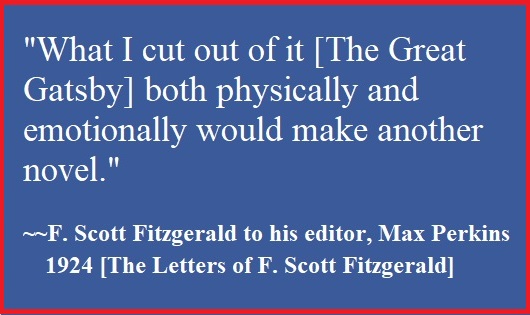
f scott fitzgerald quoteFor creative writing, editing is a stage of the writing process. A writer and editor work together to improve a draft by correcting punctuation and making words and sentences clearer, more precise. Weak sentences are made stronger, info dumps are weeded out, and important ideas are clarified. At the same time, strict attention is paid to the overall story arc.
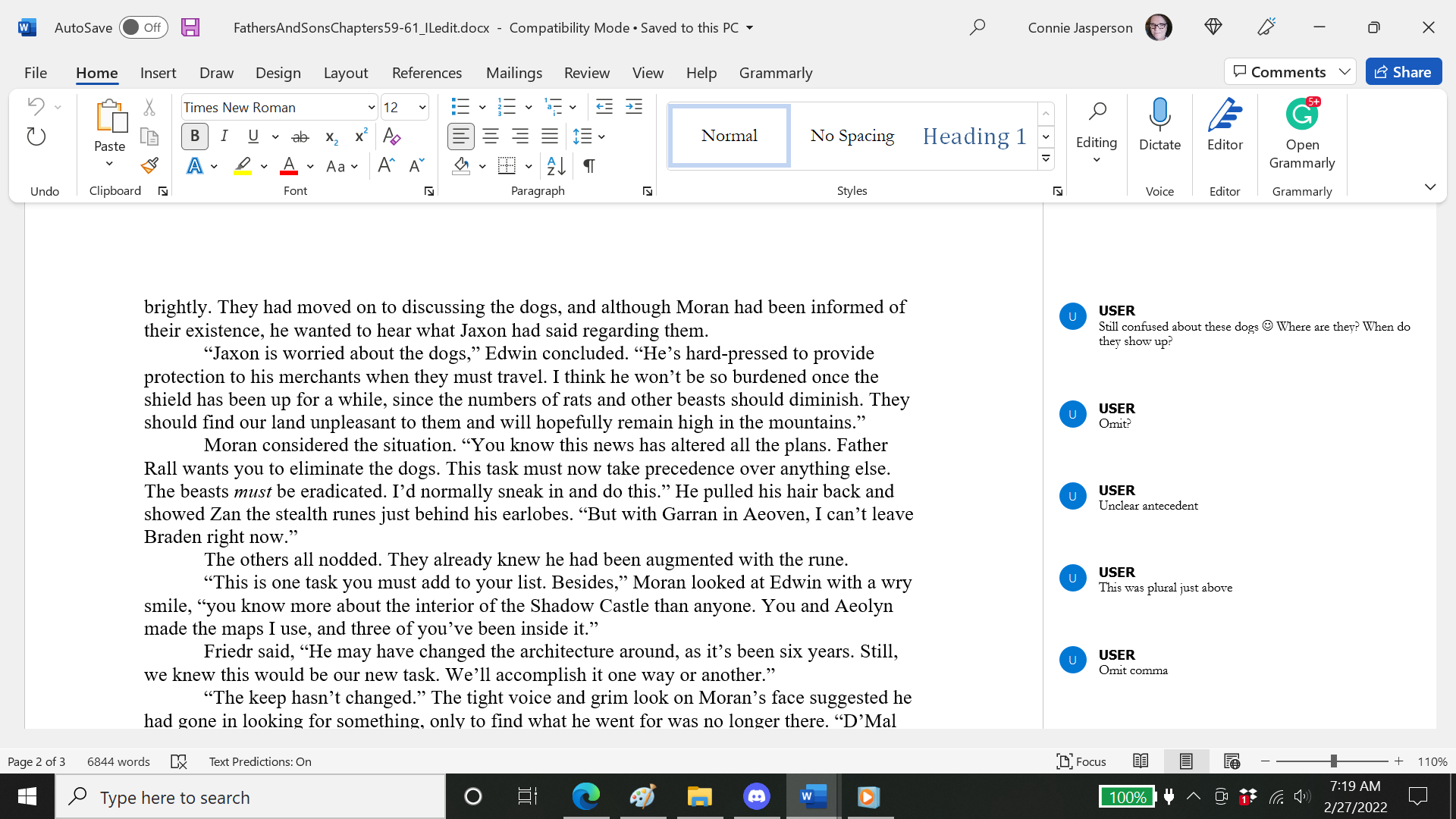
The editor is not the author. Editors can only suggest revisions, but ultimately all changes must be approved and implemented by the author.

Some editors return your manuscript with suggestions for revisions noted in the reviewing pane on the right-hand side of the document. You click on each comment, then choose to make that change or not, and then delete the comment.

This is the least confusing way for new authors, but it takes more time for the editor to work their way through the manuscript. This is how a manuscript with comments in the reviewing pane might look:

Track Changes 3 comments in sidebarEditors who have been in the business for a long time find it much faster to use the markup function and insert inline changes. A new author or someone unfamiliar with how word-processing programs work might find it confusing and difficult to understand.
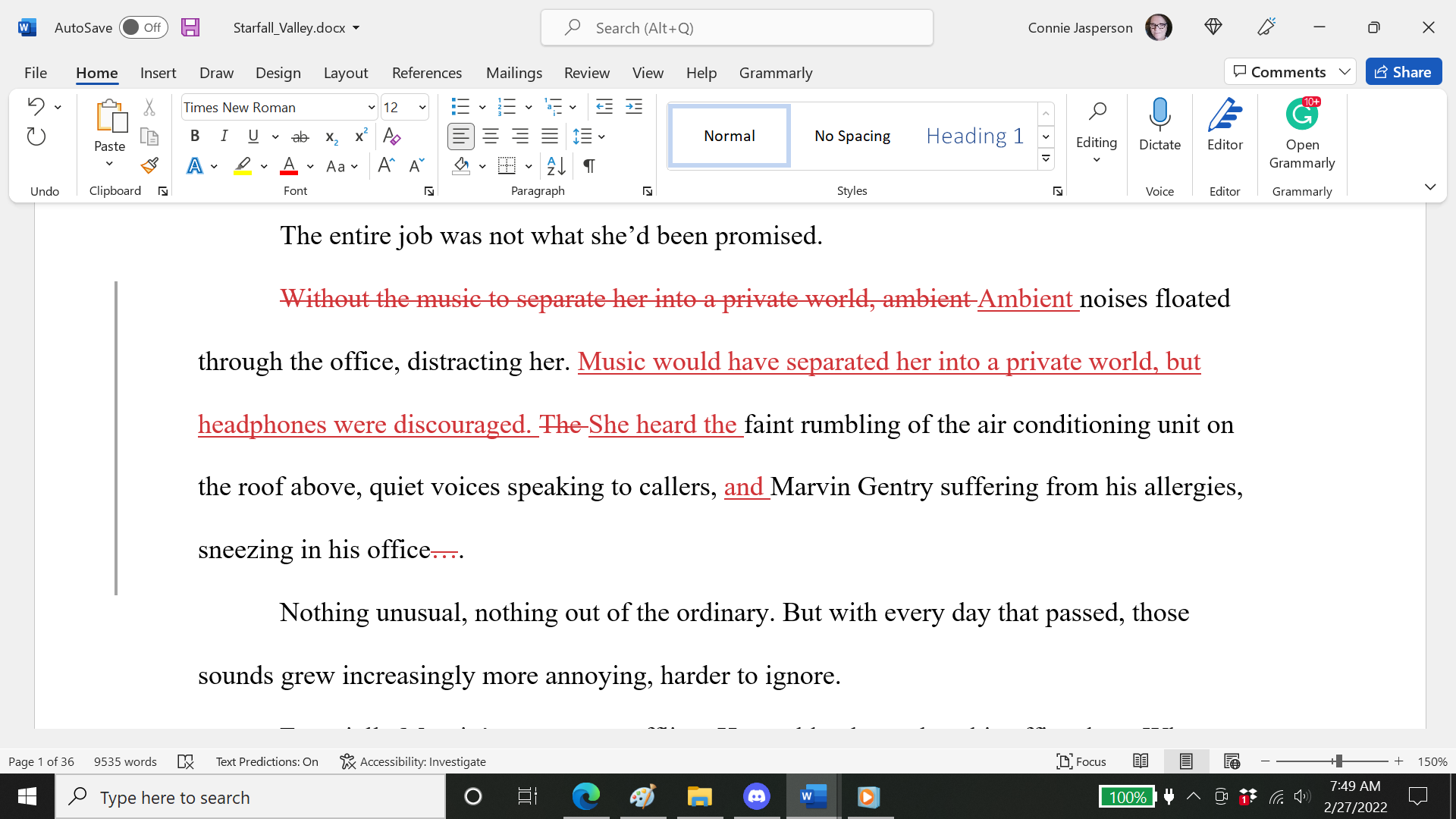
Track Changes 4 inserted revisionsInserting the changes and using Tracking cuts the time an editor spends on a manuscript. Writing comments takes time, and suggestions may not always be clear to the client.
Tracked changes are only SUGGESTED changes. To become permanent, they must be accepted. You may disagree with some of the tracked changes and choose to reject them. Below are the instructions for accepting and rejecting comments, followed by instructions for deleting comments made in the comment column.

If an editor has to insert many changes, they can become distracting to the author. Many editors use both inserted changes and comments when that is the case.

Word has several ways to customize how tracked changes appear:

  • Simple Markup: This shows the final version without inline markups. Red or black markers will appear in the left margin to indicate where a change has been made.
  • All Markup: This shows the final version with inline
  • No Markup: This shows the final version and hides all markups.
  • Original: This shows the original version before changes and hides all markups.

Places where an editor inserts a suggested change will be shown in a red font and have a line beneath them. Deleted items will be in red and have a line through them.

To accept or reject changes:

  1. Select the change you want to accept or reject.
  2. From the Review tab, click the Accept or Reject
  3. The markup will disappear, and MSWord will automatically jump to the next change. You can continue accepting or rejecting each change until you have reviewed all of them.
  4. Click the Track Changes command to turn off Track Changes when you’re finished. Just click on it, and the gray will return to the same shade as the rest of the ribbon.
  5. To accept all changes at once, click the Accept drop-down arrow, then select Accept All.
  6. If you no longer want to track your changes, you can choose to Accept All and Stop Tracking.

How to Remove comments

If your document has comments, they won’t be removed from the comment column when you accept or reject tracked changes. You’ll have to delete them separately.

  1. On the Review tab, in the Comments section, click Next to select a comment.
  2. On the Review tab, click Delete.

To delete all comments at once, click the arrow below the word Delete, and then click Delete All Comments in Document.

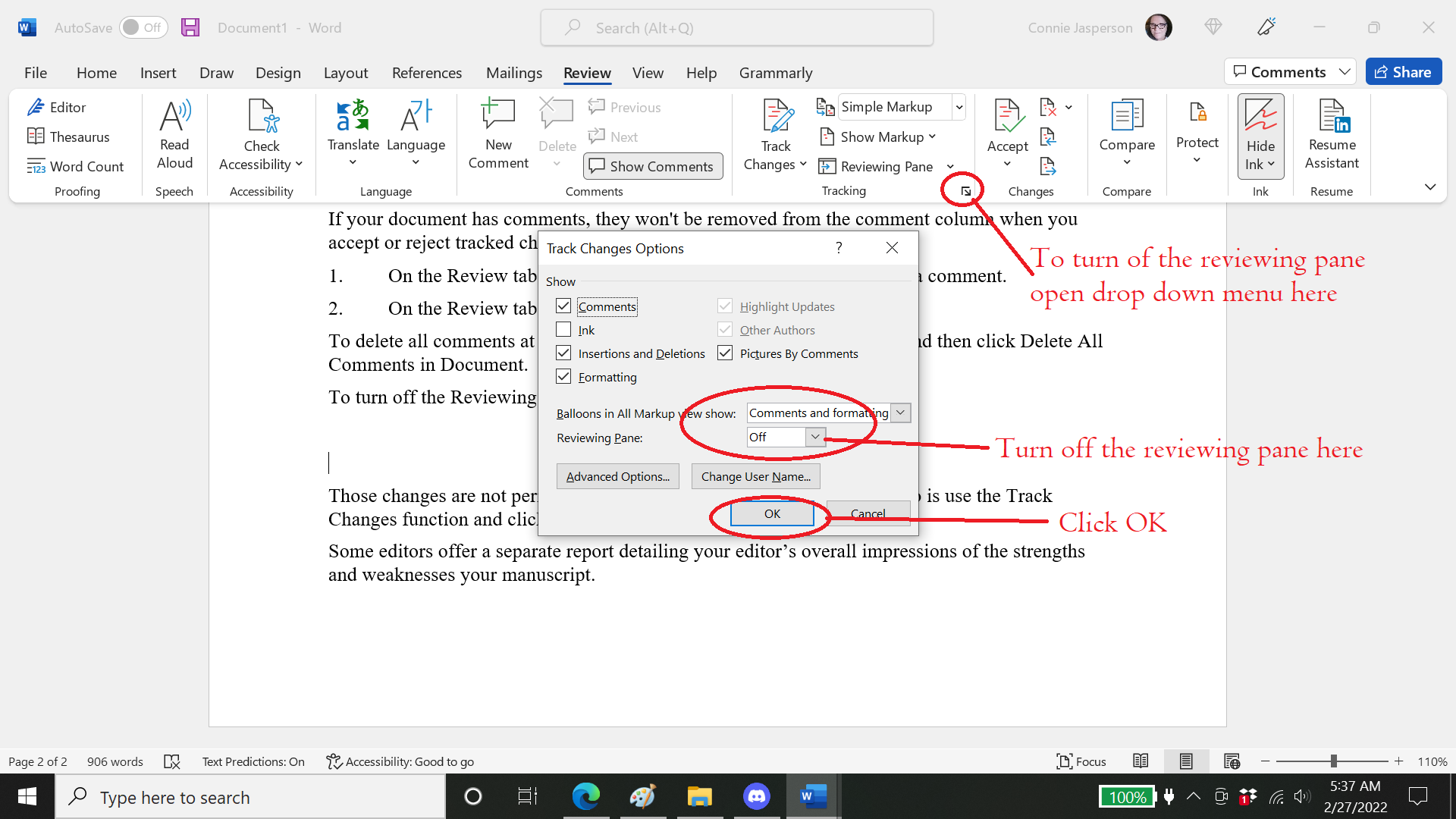
To turn off the Reviewing Pane:

Track Changes 2

Those changes are not permanent or engraved in stone. All you have to do is use the Track Changes function and click accept or reject for each change.

Some editors offer a separate report detailing their overall impressions of your manuscript’s strengths and weaknesses. Others will want to talk via the phone or Zoom.

Hiring a freelance editor is well worth the cost if you can afford it. You will learn many things about the craft of writing as you look at their suggestions.

ok to write garbage quote c j cherryhHowever, many authors don’t have the money to hire an editor. If that is the case, you may have a friend in your writing group who has some experience editing, and they will often help you at no cost. Your writing group is a well of inspiration, support, and wisdom, and they are invested in your book. They want you to succeed and most will gladly trade services.
Each editor is different and has their own style and approach to the task. But no matter how they approach the task of editing, all editors are readers who love what they do.

Editors want to help you make your manuscript as clean as possible because they love books. Next up, we will talk about what editors for publications look for when they are acquiring new work.

9 Comments

Filed under writing

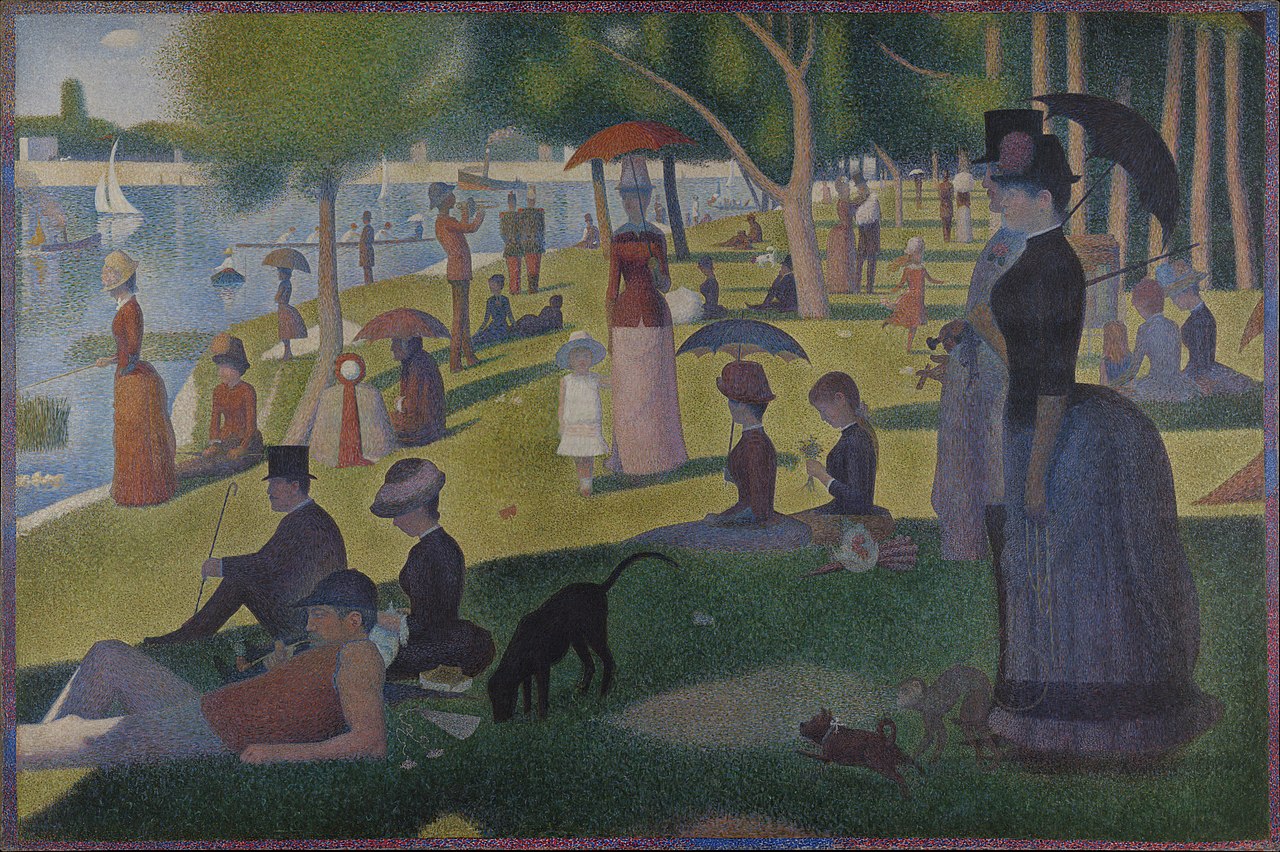
#FineArtFriday: A Sunday on La Grande Jatte by Georges Seurat circa 1884 (revisited)

A Sunday Afternoon on the Island of La Grande Jatte by Georges Seurat (1884–1886) is a landmark painting. Art historians agree that with this image, Seurat changed the direction of modern art and began the era of Neo-impressionism. It is one of the most recognizable of late 19th-century paintings.

About this painting from Wikipedia: In summer 1884, Seurat began work on A Sunday Afternoon on the Island of La Grande Jatte.

The painting shows members of each of the social classes participating in various park activities. The tiny juxtaposed dots of multi-colored paint allow the viewer’s eye to blend colors optically, rather than having the colors physically blended on the canvas. It took Seurat two years to complete this 10-foot-wide (3.0 m) painting, much of which he spent in the park sketching in preparation for the work (there are about 60 studies). It is now in the permanent collection of the Art Institute of Chicago.

What I love about this painting is the preciseness of each component. This painting proudly declares it is not “real”—it is instead an impression of a moment in time, a summer day spent on the River Seine. It is both sharply delineated and dreamlike. That is a neat trick.

Seurat used individual dots of only primary colors (Red, green, yellow, blue) but the way he places them, they seem muted and blended into shades of rose and purple, and even pale pink. I’m captivated by a technicality – obsessed by the way the primary colors of each dot are juxtaposed with other primary colors, tricking the eye into believing it sees light and dark, and all shades between.

About the Artist, via Wikipedia: (Seurat) is noted for his innovative use of drawing media and for devising the painting techniques known as chromoluminarism and pointillism. Seurat’s artistic personality was compounded of qualities which are usually supposed to be opposed and incompatible: on the one hand, his extreme and delicate sensibility; on the other, a passion for logical abstraction and an almost mathematical precision of mind.

This technique is one I hadn’t given much thought to until I ran across a postcard with an image of Seurat’s painting on it. Other notable artists who explored this method were Paul Signac and Vincent van Gogh.

For me, studying these images of masterpieces for the Friday posts on art teaches me how to be creative with my words. Artists both push the limits of their color palettes and yet force external constraints on themselves to create images that fool the eye.

Authors must do the same with how we shape our words to show ideas and form stories.

About the Pointillist technique of painting, from Wikipedia: If red, blue, and green light (the additive primaries) are mixed, the result is something close to white light. Painting is inherently subtractive, but Pointillist colors often seem brighter than typical mixed subtractive colors. This may be partly because subtractive mixing of the pigments is avoided, and partly because some of the white canvas may be showing between the applied dots.

The painting technique used for Pointillist color mixing is at the expense of the traditional brushwork used to delineate texture.

The majority of Pointillism is done in oil paint. Anything may be used in its place, but oils are preferred for their thickness and tendency not to run or bleed.


Sources and Attributions:

Wikimedia Commons contributors, “File:Georges Seurat – A Sunday on La Grande Jatte — 1884 – Google Art Project.jpg,” Wikimedia Commons, the free media repository, https://commons.wikimedia.org/w/index.php?title=File:Georges_Seurat_-_A_Sunday_on_La_Grande_Jatte_–_1884_-_Google_Art_Project.jpg&oldid=90112845 (accessed January 10, 2019).

Wikipedia contributors, “A Sunday Afternoon on the Island of La Grande Jatte,” Wikipedia, The Free Encyclopedia,https://en.wikipedia.org/w/index.php?title=A_Sunday_Afternoon_on_the_Island_of_La_Grande_Jatte&oldid=875941354 (accessed January 10, 2019).

Wikipedia contributors, “Georges Seurat,” Wikipedia, The Free Encyclopedia, https://en.wikipedia.org/w/index.php?title=Georges_Seurat&oldid=877532379 (accessed January 10, 2019).

Wikipedia contributors, “Pointillism,” Wikipedia, The Free Encyclopedia, https://en.wikipedia.org/w/index.php?title=Pointillism&oldid=874469961(accessed January 10, 2019).

1 Comment

Filed under writing