
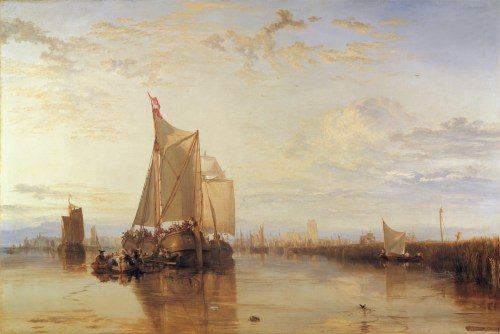
Artist: J. M. W. Turner (1775–1851)
Title: Dort or Dordrecht: The Dort packet-boat from Rotterdam becalmed
Genre: marine art
Date: 1818
Medium: oil on canvas
Dimensions: Height: 157.5 cm (62 in); Width: 233.7 cm (92 in)
Collection: Yale Center for British Art
What I love about this painting:
The colors show us a windless evening in summer or fall, a time of day when the smoke from factories and chimneys lingers and turns the sky brown and gold, reflected on the waters.
This is a glimpse into the history of how we once moved goods and mail across long distances. Some packet boats were medium-sized ships, able to navigate shallow rivers and canals. Others were ocean-going vessels. Some were steam driven, but the one we see in this painting is an early ship, powered by the wind.
The wind has failed, and so the crew is being ferried off the ship via a smaller row-boat.
About this painting via Wikipedia:
The Dort, or Dort or Dordrecht: The Dort packet-boat from Rotterdam becalmed is an 1818 painting by J. M. W. Turner, based on drawings made by him in mid-September 1817. It shows a view of the harbour of Dordrecht. It is the finest example of the influence of Dutch marine painting on Turner’s work.
It was exhibited at the Royal Academy in 1818, where it was described by The Morning Chronicle as “one of the most magnificent pictures ever exhibited, and does honour to the age”. In 1832, John Constable wrote of the picture, “I remember most of Turner’s early works; amongst them one of singular intricacy and beauty; it was a canal with numerous boats making thousands of beautiful shapes, and I think the most complete work of a genius I ever saw”.
It was purchased by Walter Fawkes for 500 guineas at the request of his son, and hung in the drawing room at Farnley Hall until it was bought by Paul Mellon in 1966. It was then donated to the Yale Center for British Art upon the founding of the centre. [1]
About the Artist, via Wikipedia:
Joseph Mallard William Turner was born in Maiden Lane, Covent Garden, London, to a modest lower-middle-class family. He lived in London all his life, retaining his Cockney accent and assiduously avoiding the trappings of success and fame. A child prodigy, Turner studied at the Royal Academy of Arts from 1789, enrolling when he was 14, and exhibited his first work there at 15. During this period, he also served as an architectural draftsman. He earned a steady income from commissions and sales, which due to his troubled, contrary nature, were often begrudgingly accepted. He opened his own gallery in 1804 and became professor of perspective at the academy in 1807, where he lectured until 1828. He travelled to Europe from 1802, typically returning with voluminous sketchbooks.
Intensely private, eccentric and reclusive, Turner was a controversial figure throughout his career. He did not marry, but fathered two daughters, Eveline (1801–1874) and Georgiana (1811–1843), by his housekeeper Sarah Danby. He became more pessimistic and morose as he got older, especially after the death of his father, after which his outlook deteriorated, his gallery fell into disrepair and neglect, and his art intensified. In 1841, Turner rowed a boat into the Thames so he could not be counted as present at any property in that year’s census. He lived in squalor and poor health from 1845, and died in London in 1851 aged 76. Turner is buried in Saint Paul’s Cathedral, London. [2]
Credits and Attributions:
Wikimedia Commons contributors, “File:DortorDordrecht.jpg,” Wikimedia Commons, the free media repository, https://commons.wikimedia.org/w/index.php?title=File:DortorDordrecht.jpg&oldid=554289467 (accessed October 28, 2021).
[1] Wikipedia contributors, “Dort or Dordrecht: The Dort packet-boat from Rotterdam becalmed,” Wikipedia, The Free Encyclopedia, https://en.wikipedia.org/w/index.php?title=Dort_or_Dordrecht:_The_Dort_packet-boat_from_Rotterdam_becalmed&oldid=1000618596 (accessed October 28, 2021).
[2] Wikipedia contributors, “J. M. W. Turner,” Wikipedia, The Free Encyclopedia, https://en.wikipedia.org/w/index.php?title=J._M._W._Turner&oldid=1050867512 (accessed October 28, 2021).
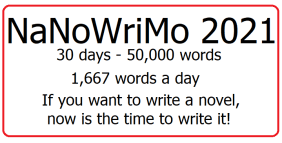
 NaNoWriMo is a personal challenge, a month that is solely dedicated to the act of writing a novel. It is a speed-run with daily goals to meet.
 As always, there is a downside to this intense month of stream-of-consciousness writing. Just because you can sit in front of a computer and spew words does not mean you can write a novel that others want to read.
 Some new authors seek out books about writing craft and attend seminars. They will join writing groups and develop the skills needed to take a story and make it a novel with a proper beginning, a great middle, and an incredible end.
 This is time-consuming, and you will feel as if you need a personal assistant to handle these things. I know several authors who rely on the services of
  So, what do we need to have in place during the next seven days before the big event?
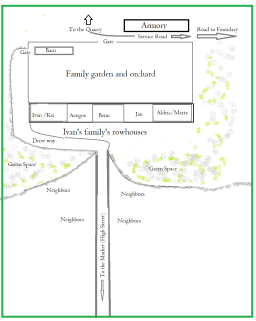 Environment: Ivan and Kai live in Weiland, Tribe Weila’s riverport and mining center. Ivan’s extended family has five rowhouses at the upper end of High Street. It’s a steep but easy walk to the market for his grandfather, who lives next door and watches the children while Ivan and Kai work. I drew a little map for my notes, so I know the layout of where everything is in regard to their home and businesses. It could change, but I have something to start with.
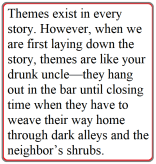 A common theme in fantasy is the juxtaposition of chaos and stability (or order). This subtheme will feature strongly in my novel. Good vs. evil is a
 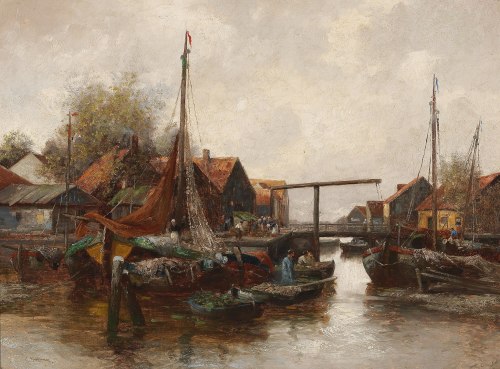 Artist: Adolf Kaufmann (1848–1916)
 Writing is easier once it becomes a daily
  We have this perception that taking time for creativity is selfish, and that will be your biggest hurdle. Trust me, it is not asking too much of your family for you to have some time every day that is sacred and dedicated to writing.
 Write for five minutes here and ten minutes there all day long if that is all you can do. Every word counts toward your finished manuscript. I took my lunch to work and wrote during my lunch half-hour whenever possible. I also wrote on the bus when I didn’t own a car.
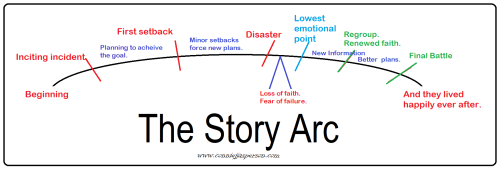
 Remember, what you are writing is a rough draft, so your story arc will be bumpy and uneven. It doesn’t have to be perfect, so don’t worry about making it so. The goal of NaNoWriMo is to get that first draft written in thirty days. So, every time you have fifteen minutes to spare, sit down and write as much as you can in that short length of time. Spew your story as fast as you can in those moments before you are pulled away. With six or seven short bursts of writing, you can really rack up the word count.
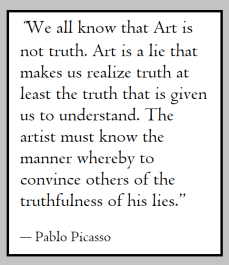 Often the work that is inspired by a visual prompt has nothing to do with the image. But it has everything to do with the nature of storytelling. The ability to explain the world through stories and allegory emerges strongly in some people. Many are naturally able to form and express a story, and others find the subliminal prompting of an image will be the spark that lights their creativity.
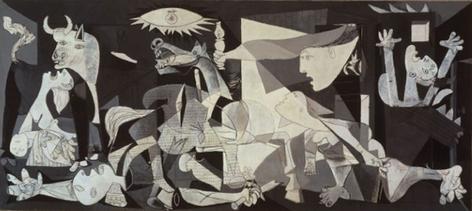 Picasso’s choice to use black and white to tell that story is brilliant. Newsreels of the day were black and white, which influenced his decision. This piece is powerful because of the emotion the artist painted into the image.
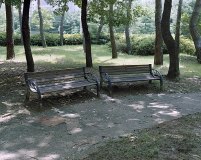 nspiration can be found in the image of an unoccupied park bench in winter. The gray weather, the barren scenery, the loneliness of the empty bench could be the seeds from which a novel grows. Who is that bench waiting for? Who has just left it? Is the story light or dark?
 Artist: Anna Ancher (1859–1935)
 Once there, create a profile. You don’t have to get fancy unless you are bored and uber-creative.
 You can play around with your personal page a little to get used to it. I use my NaNoWriMo avatar and name as my Discord name and avatar. This is because I only use Discord for NaNoWriMo and one other large organization of writers. (Next week, we’ll talk about Discord and why NaNoWriMo HQ wants us to use it for word sprints and virtual write-ins.)
 Next, check out the community tabs. If you are in full screen, the tabs will be across the top. If you have the screen minimized, the button for the dropdown menu will be in the upper right corner and will look like the blue/green and black square to the right of this paragraph.
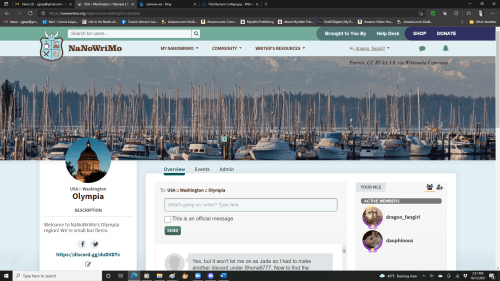 You may find the information you need in one of the many forums listed here.
 Make a master file folder that is just for your writing. I write professionally, so my files are in a master file labeled Writing.
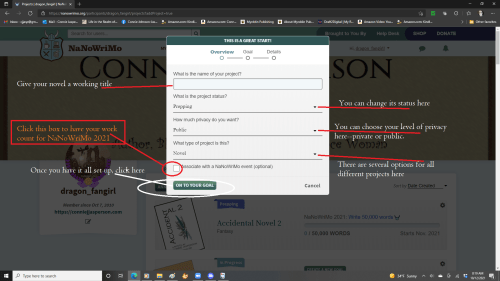
 Give your document a label that is simple and descriptive. My NaNoWriMo manuscript will be labeled: Accidental_Novel_2.
 Still, we can come together and support each other’s writing via the miracle of the internet. My region is finalizing a schedule for “Writer Support” meet-ups via Zoom – little gab sessions that will connect us and keep us fired up.
 But sometimes, when writing the first draft, we realize our manuscript has gone way off track and is no longer fun to write. That is where the storyboard and my loose outline become important.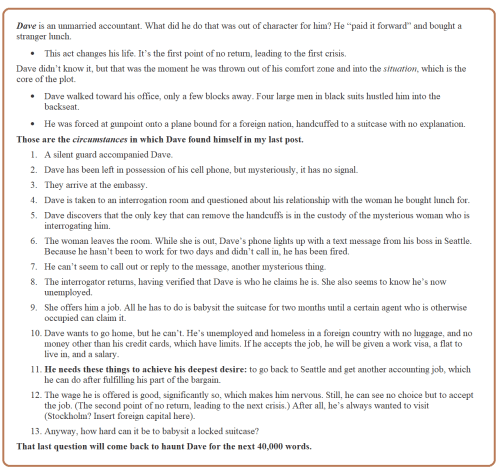
 Every novel is different, has a different genesis, and emerges from the author’s mind with its own personality.


 Life in the Realm of Fantasy
_-_WGA24677.jpg&oldid=268076769)