#FineArtFriday: Romantic Winter Landscape with Ice Skaters by a Castle, by Albert Bredow (reprise)

I love the dreamscape quality of this painting – it’s practically a Christmas card. Peasants, ordinary people living in the shadow of the ruined castle, freely enjoying the day. To look at this picture is to see a fairy tale that wants to be told. Who are these people and why do they live there? What is their connection to the ruined castle? And what is their connection to each other?

The trees, the ice, the snow–the detail is all there, even the warmth of the peasant’s hut. It’s a comforting picture, a moment of contentment.

About the Artist:

Little is known of Albert Bredow’s life. Born Apr 23, 1828 in Germany, and died May 5, 1899 in Moscow, he was well known as a landscape painter, lithographer and stage designer.

From this painting, which is dated near the end of his life, we know he was a romantic, fond of fantasy and fairy tales.

His birthplace in Germany and where he first studied art and set design are unknown. Records do show that he lived and worked in Riga as a stage designer from around 1852 and then in Tallinn. In 1856 he went to Moscow at the invitation of the Directorate of the Imperial Theater. He worked from 1856 to 1862 as a set designer for the Moscow Theater and from 1862 to 1871 the Petersburg Theater.

He is known for his ethereal landscape paintings, which may have been a hobby he pursued more intently later in life since he was actively employed in the theater during his working years. His style of landscape painting must have produced some amazing backdrops for the sets he designed.

In 1863, illustrations of his stage sets for Glinka’s opera “A Life for the Tsar” were considered worthy enough to be published as an album. In 1868 he began his studies at the Petersburg Imperial Art Academy. At the Academy’s art exhibitions, he exhibited his landscapes from Germany and Russia.

The designs of Albert Bredow’s stage sets are in the collection of the Moscow Bachruschin Theater Museum.


Credits and Attributions

Wikimedia Commons contributors, “File:Albert Bredow – Romantic Winter Landscape with Ice Skaters by a Castle.jpg,” Wikimedia Commons, the free media repository, https://commons.wikimedia.org/w/index.php?title=File:Albert_Bredow_-_Romantic_Winter_Landscape_with_Ice_Skaters_by_a_Castle.jpg&oldid=282656583 (accessed December 7, 2018).

Comments Off on #FineArtFriday: Romantic Winter Landscape with Ice Skaters by a Castle, by Albert Bredow (reprise)

Filed under #FineArtFriday

Research and Development #amwriting

I love learning how other authors work. I recently watched a 2015 podcast, Adam Savage Interviews ‘The Martian’ Author Andy Weir – The Talking Room. This is a fabulous interview, where Andy explains his intense research for the bestseller, The Martian, and his writing process.

The MArtian Andy WeirAndy Weir is genuinely a nice person and is the best example of an inadvertent teacher that I’ve ever seen. This interview is a brilliant seminar on how to research and plot a book. He writes hard sci-fi with a heart, but the principles of creation are the same for any genre.

If you haven’t read The Martian, I have to say it is my favorite sci-fi novel of all time. DO PLEASE watch that interview—his method of writing and researching is genius.

Targeted research is crucial if you want your fiction to be plausible. Identify what you want to know, use the internet, ask an expert, and create a searchable file or database of information that backs up your assertions.

Once you establish the technological era you are writing in, you know what you need to research and how theoretical your narrative may need to be.

Here are some of my go-to sources of information. I’ve published this list before, but here it is again:

If you seek information about low-tech societies (the past):

My best source of information on low-tech agricultural (farm) life and culture comes from a book I found at a second-hand book store in Olympia in the mid-to-late-1980s. Lost Country Life by Dorothy Hartley is still available as a second-hand book and can be found on Amazon. This textbook was meticulously researched and illustrated by a historian who personally knew the people she wrote about.

I also discover a lot of information on how people once lived from the art found at Wikimedia Commons. Under the heading  Category: Painters from the Northern Netherlands (before 1830), you will find the brilliant works of the Dutch Masters, artists living in what is now The Netherlands.

These painters created accurate records of ordinary people going about everyday life. Their genre art depicts how they dressed and what was important to them in their daily lives.

Looking things up on the internet can suck up an enormous amount of your writing time. Do yourself a favor and bookmark your resources, so all you have to do is click on a link to get the information you want. Then you can quickly get back to writing.

Resources to bookmark in general:

www.Thesaurus.Com (What’s another word that means the same as this but isn’t repetitive?)

Oxford Dictionary (What does this word mean? Am I using it correctly?)

Wikipedia (The font of all knowledge. I did not know that.)

oxford_dictionaryTED Talks are a fantastic resource for information on current and cutting-edge technology.

ZDNet Innovation is an excellent source of existing tech and future tech that may become current in 25 years.

Tech Times is also a great source of ideas.

Nerds on Earth is a source of valuable information about swords and how they were used historically.

If you are writing a contemporary novel, you need to know what interests the people in the many different layers of our society. Go to the magazine rack at your grocery store or the local Big Name Bookstore and peruse the many publications available to the reading public. You can find everything from mushroom hunting, to culinary, to survivalist, to organic gardening. If people are interested in it, there is a magazine for it. An incredible amount of information can be found in these publications.

We all agree that while the early pioneers of science fiction got so much of our modern reality right, they also got it wrong. So, we can only extrapolate how societies will look in the future by taking what we know is possible today and mixing it with a heavy dose of what we wish for.

SpaceX

NASA

Digital Trends

If you write sci-fi, you must read sci-fi as that is where the ideas are. Much of what was considered highly futuristic in the era of classic science fiction is today’s current tech.

Ion drives and space stations are our reality but were only a dream when science fiction was in its infancy.

Think about it: your Star Trek communicator is never far from your side, and your teenagers won’t put theirs down long enough to eat dinner.

sample-of-rough-sketched-mapMAPS: If you are writing a story set in our real world, your characters will be traveling in places that exist in reality. You want to write the landmarks of a particular city as they should be, so bookmark google maps for that city. Even if you live there, make sure you write it correctly because readers will let you know where you have gone wrong.

GOOGLE EARTH is your friend, so use it!

If you are writing about a fantasy world, quickly sketch a rough map. Refer to it to ensure the town names and places remain the same from the first page to the last. Update it as new locations are added.

Please, make sure your literary murders are done in a way that doesn’t fly in the face of logic. Do the research on poisons, knife wounds, and consider all the possible reasons why that particular murder wouldn’t work in reality. Then write a murder that does work.

Talk to police, talk to doctors, talk to lawyers–many are willing to help you with your quest for accuracy about their professions. Also, you can Google just about anything. Fads, fashion, phone tech, current robotics tech, automobile tech—it’s all out there.

We may be writers of fiction, but we are also disseminators of information and dreams. It’s a big responsibility!

Do the proper research, target it to your needs, and don’t allow yourself to be sidetracked by the many bunny trails that lead you away from actually writing.


2 Comments

Filed under writing

About foreshadowing #amwriting

Today marks the halfway point for NaNoWriMo 2021. Many writers are working on the first draft of a new manuscript. Others are revising last year’s novel and rearranging the story’s events and writing new scenes.

NaNoWriMoMemeForeshadowing is integral to a well-plotted story.

Those of us who have been working from an outline may have included some in the planning stage. For authors who wing it, this happens on a subconscious level, but it does happen.

But what is foreshadowing? It is the subtle warning that all is not what it seems, a few clues embedded in the first quarter of the story to subliminally alert the reader that things may not go well for the protagonist. We include small warning signs of future events, bait, if you will, to lure the reader and keep them reading.

In the first draft, we commit certain sins of craftsmanship, road signs for us to examine in the second draft:

  1. Clumsy foreshadowing, baldly stating what is going to happen later.
  2. Neglecting to foreshadow so that events arrive out of nowhere.

Recognizing those signals can be a challenge, but that is where writing craft comes into play.

When a possibility is briefly, almost offhandedly mentioned, but almost immediately overlooked or ignored by the protagonists, that is a form of foreshadowing.

Some readers will miss the suggested possibility just as the unsuspecting characters do. Other readers will guess what is going on.

If the narrative is well-written, readers will stick with it as they will want to see how it plays out.

We are subtle with foreshadowing because we want readers to feel surprised when all the pieces fall into place. We want to reward the reader with a moment when they can say, “I should have seen that coming.”

Now is an opportune time to hone our foreshadowing skills. This helps avoid using the clumsy Deus Ex Machina (pronounced: Day-us ex Mah-kee-nah) (God from the Machine) as a way to miraculously resolve an issue.

  • A Deus Ex Machina occurs when, toward the end of the narrative, an author inserts a new event, character, ability, or otherwise resolves a seemingly insoluble problem in a sudden, unexpected way.
  • Foreshadowing also helps us avoid the opposite ungainly device, the Diabolus Ex Machina (Demon from the machine). This is the bad guy’s counterpart.

When an author suddenly realizes the evil his character faces isn’t evil enough, we may see the sudden introduction of an unexpected new event, character, ability, or weapon. The intent is to ensure things suddenly get much worse for the protagonists, but it falls flat.

As a reader, I hate it when a character suddenly gets a new skill or knowledge without explanation. When this happens, it’s usually explained away as a Chekhov’s Skill.

A casual mention early on of the characters using or training that skill will resolve the situation. Without briefly foreshadowing that ability, the reader will assume the character doesn’t have it.

This is when the narrative becomes unbelievable.

Literature and the expectations of the reader are like everything else. Tastes evolve and change over the centuries.

In genre fiction today, a prologue may not be a place for foreshadowing. This is because modern readers don’t have the patience to wade through large chunks of exposition dumped in the first pages of a novel.

DickseeRomeoandJulietI often refer to the way that Shakespeare used both exposition and foreshadowing. In his works, more significant events are foreshadowed through the smaller events that precede them.

Let’s look at Romeo and Juliet and the scene where Benvolio tries to talk Romeo out of his infatuation with Rosaline.

“Take thou some new infection to thy eye,

And the rank poison of the old will die.” 

In other words, “Bro, the minute you see a different girl, you’ll forget this one.”

Benvolio’s advice proves correct because as soon as Romeo lays eyes on Juliet, he forgets his obsession with Rosaline and is fixated on his mortal enemy’s daughter.

And again, later, when Benvolio brings the news that Mercutio is dead, Romeo says,

“This day’s black fate on more days doth depend; 

This but begins the woe, others must end.”

Romeo predicts that Mercutio’s death is only the beginning, that disaster looms for everyone. He feels as if he is racing toward an unknown future.

William_Shakespeare_-_First_Folio_1623In that moment, we see that Romeo is deeply aware that he has reached a point of no return.

He will fight Tybalt to avenge Mercutio because his society requires it. Therefore, he must duel but is fully aware that killing Tybalt won’t resolve anything. Instead, the murder will only perpetuate the problem.

Romeo has seen the foreshadowing and knows he is no longer in control of his fate.

Inserting slight hints of what is to come into your narrative gives the protagonists an indication of where to go next.

It tantalizes a reader and keeps them turning the page, and that is our goal.


Credits and Attributions

Romeo and Juliet, by Frank Bernard Dicksee, 1884 Public domain, via Wikimedia Commons

First Folio of William Shakespeare’s Plays, 1623 by William Shakespeare, Public domain, via Wikimedia Commons

Comments Off on About foreshadowing #amwriting

Filed under writing

#FineArtFriday: The Emerald Pool, Worthington Whittredge, 1868 reprise

About this image:

“The Emerald Pool” is also titled “Woods of Ashokan” and is a gloriously composed representation of an Autumn afternoon in the quiet woods. Sunlight is the core element here, in the way it filters through the leaves and touches branch and trunk, and then reflects from the pool.

The trees look very much like those that would have existed in parts of the woods near the house I grew up in, places where the evergreens had been cut and maples, alder, and ash could grow. Sun filters through the leaves which have turned colors but still remain on the trees. A few small firs struggle to grow in the deciduous forest, but one day those firs will cast a wide, dark shadow and the sunlit glade will be no more.

A pheasant (I think?) poses for his portrait, bringing the center focus of the painting to the calm pool beneath the log he stands on. The pool is masterfully shown, its waters rippling as if touched by a slight breeze, reflecting the scene above.

>>><<<

ABOUT THE ARTIST (From Wikipedia): Thomas Worthington Whittredge (May 22, 1820 – February 25, 1910) was an American artist of the Hudson River School. Whittredge was a highly regarded artist of his time, and was friends with several leading Hudson River School artists including Albert Bierstadt and Sanford Robinson Gifford. He traveled widely and excelled at landscape painting, many examples of which are now in major museums. He served as president of the National Academy of Design from 1874 to 1875 and was a member of the selection committees for the 1876 PhiladelphiaCentennial Exposition and the 1878 Paris Exposition, both important venues for artists of the day.

Artist:  Worthington Whittredge  (1820–1910)

Title:   The Emerald Pool

Date    1868

Medium          oil on canvas

Dimensions     Height: 144.8 cm (57 in); Width: 102.9 cm (40.5 in)

Current location: Chrysler Museum of Art


Credits and Attributions

This is the reprint of a post that first appeared here on Life in the Realm of Fantasy September 14, 2018.

Wikipedia contributors, “Worthington Whittredge,” Wikipedia, The Free Encyclopedia, https://en.wikipedia.org/w/index.php?title=Worthington_Whittredge&oldid=857357141 (accessed September 13, 2018).

Wikimedia Commons contributors, “File:Thomas Worthington Whittredge – Woods of Ashokan.jpg,” Wikimedia Commons, the free media repository, https://commons.wikimedia.org/w/index.php?title=File:Thomas_Worthington_Whittredge_-_Woods_of_Ashokan.jpg&oldid=296638658 (accessed September 13, 2018).

4 Comments

Filed under writing

Mood and atmosphere #amwriting

I refuse to self-edit my first drafts, especially during NaNoWriMo, so the prose in my current work is less than stellar. Because I am inventing the story as I write it, the early drafts for all my work are littered with ‘ly’ words and other telling words.

MyWritingLife2021Once the first draft is a complete novel, I will step away from it for a few weeks and work on other projects. Then when I come back to it, I use the global search (find option) to look for each instance of ‘ly’ words and rewrite those sentences to make them active.

Active prose injects impact into the narrative, but the first draft is littered with telling instead of showing, because I am telling myself the story.

I’ve said many times that words are the colors we use to show entire worlds. I am always looking for ways to use words for better impact.

Every idea for a novel comes to me with an idea for the overall mood, and that mood can be described with a word. Sometimes though, that word is difficult to identify.

I make use of the thesaurus. This is where you will find words to describe mood and atmosphere, along with synonyms and antonyms, words with the opposite meaning.

I make a new storyboard for every story I write. Once I know what the story I intend to write is, I go out and look for the words that will help jar my imagination, words that convey the mood and atmosphere that I want to instill in my work.

I include the list of mood words in the storyboard file so that I have them on hand.

It speeds up the writing process if I have a supply of descriptors to draw on to build my world without having to stop and look things up. It also helps me avoid crutch-words.

For the cash strapped author, the Merriam-Webster online thesaurus is your best friend. https://www.merriam-webster.com/thesaurus

You will find many words, some of which are uncommon. Do yourself a favor and choose words that most readers with an average education won’t have to stop and look up.

For example, if you are writing something with a Gothic mood, your inspiration word could be ominous. It is an adjective that conveys the impression that something bad or unpleasant is going to happen. The word ominous brings other dark thoughts to mind.

ozford-american-writers-thesaurusSynonyms for ominous that we could use: baleful, dire, direful, foreboding, ill, ill-boding, inauspicious, menacing, portentous, sinister, threatening.

Related words to subtly reinforce the mood: black, bleak, cheerless, chill, cloudy, cold, comfortless, dark, darkening, depressing, depressive, desolate, dim, disconsolate, dismal, drear, dreary, forlorn, funereal, gloomy, glum, godforsaken, gray/grey, lonely, lonesome, miserable, morbid, morose, murky, plutonian, saturnine, sepulchral, somber/sombre, sullen, sunless, threatening, wretched.

Other related words: discouraging, disheartening, hopeless, unfavorable, unpromising, unpropitious, ill-fated, ill-starred, star-crossed, troubled, unfortunate, unlucky, evil, malign, malignant.

Antonyms for ominous, opposites I can use to provide contrast, so the overall mood and atmosphere is made more explicit: unthreatening.

Near Antonyms for ominous: auspicious, benign, bright, encouraging, favorable, golden, heartening, hopeful, promising, propitious, prosperous.

Toward the end of my work, I want things to feel hopeful. So, we might want to research the word auspicious the same way we did ominous.

Auspicious: having qualities that inspire hope or pointing toward a happy outcome.

Synonyms for auspicious: bright, encouraging, fair, golden, heartening, hopeful, likely, optimistic, promising, propitious, rose-colored, roseate, rosy, upbeat.

Words related to auspicious: cheering, comforting, reassuring, soothing, assured, confident, decisive, doubtless, positive, sure, unhesitating, favorable, good.

Antonyms for auspicious: bleak, dark, depressing, desperate, discouraging, disheartening, dismal, downbeat, dreary, gloomy, hopeless, inauspicious, pessimistic, unencouraging, unlikely, unpromising.

Near Antonyms for auspicious: cheerless, comfortless, doubtful, dubious, uncertain, grim, negative, unfavorable, funereal, glum, gray/grey, miserable, wretched.

But you can do the same for any word that conveys mood:

Humorous, mysterious—you see what I mean. The overall mood-word you choose for your work will have many synonyms and antonyms and you can use them to your advantage.

WordItOut-word-cloud-4074543If you are writing any kind of genre work, the best way to use your descriptors is to find the word that conveys the atmosphere you want with the most force. That word will help you visualize the scene and enable your ability to spew the story.

I refuse to self-edit my first drafts, so my prose in my first drafts is sometimes a mess. Because I am thinking out loud as I write them, the early drafts for all my work are littered with ‘ly’ words.

In the first draft the most crucial thing is to get the idea down without self-editing. For this reason, we don’t publish our first drafts!

If you are like me in your first drafts, cleaning up the ‘ly’ words could take a while, especially in a large manuscript. However, that won’t be a problem unless you write that novel all the way to an end.


Credits and Attributions:

“Ominous.” Merriam-Webster.com Thesaurus, Merriam-Webster, https://www.merriam-webster.com/thesaurus/ominous. Accessed 23 Jan. 2021.

“Auspicious.” Merriam-Webster.com Thesaurus, Merriam-Webster, https://www.merriam-webster.com/thesaurus/auspicious. Accessed 23 Jan. 2021.

5 Comments

Filed under writing

The Character Arc #amwriting

The Discord channel for my region is a hub of activity these days. Our writers are a week into NaNoWriMo now and discovering aspects of their characters that they didn’t plan or expect.

Plot-exists-to-reveal-characterThe emergence of these traits is exciting, fueling the passion they have for their stories.

Over the next year, my own characters will be more fully formed, as they aren’t really who I envision them to be just yet. Even my protagonist is a bit hazy, as he is now five years older than he was in book 1. He now has children, and parenthood changes everything for most people.

You can’t just drop everything and hare off on some death-defying quest.

But he’s going to have to do just that.

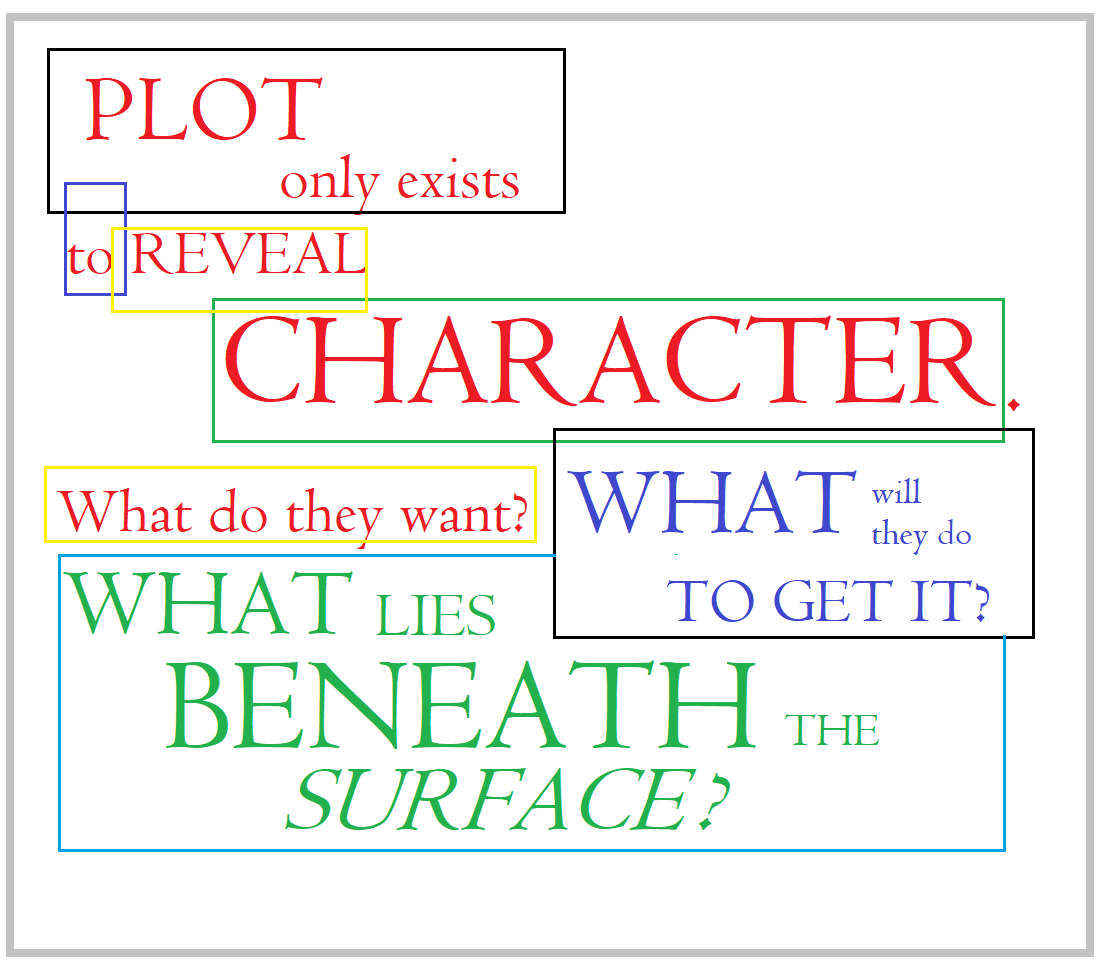
At this point, I’m just trying to get the story written while it’s fresh in my mind. As I progress, the characters will all experience an arc of growth and change. After all, the characters are the story, and the events of the piece exist only to force growth upon them.

How people are changed by their experiences is what makes the story compelling. One of my favorite examples of this can be found in the book The Hobbit by J.R.R. Tolkien.

Bilbo Baggins is Tolkien’s protagonist. His story begins in a middle-class place of comfort, with few things to trouble him. He lives in his family’s home, a comfortable, well-kept place.

Bilbo has inherited a modest private income and has no need to work, so he devotes his time to writing and entertaining his close friends.

This is our hero in his comfort zone. He could have lived to the end of his days going along as he was and would have told you he was happy. But underneath it all, Bilbo is a little bored with his existence. Nevertheless, he’s a sensible, well-bred hobbit and refuses to admit to it.

If Gandalf had chosen a different hobbit that fateful day, Bilbo would never have developed any further as a person. He was stagnating and didn’t know it.

However, one sunny day, he’s just enjoying himself on the bench beside his front door, when along comes “the inciting incident”—Gandalf, a mysterious character who plays multiple roles within the Lord of the Rings story arc.

In his first guise, Gandalf has the archetypal role of Herald. He is the bringer of change and unwanted dinner guests.

I like the way that Bilbo is shown here. He resents the intrusion, but politeness forces him to become an unwilling host to a company of strangers. Bilbo also dislikes being made aware of how bored he is with his comfortable existence.

We all fear what we don’t know, and Bilbo fears going into the unknown with the dwarves despite Gandalf’s insistence. Also, he’s not too keen on being labeled an ‘expert burglar,’ as he’s never burgled anything in his life and has no idea how to go about such a thing.

However, at the last minute, Bilbo realizes that if he doesn’t go now, he will always wonder what would have happened if he had.

the hobbitBilbo’s sudden irrational decision to accept the task of Burglar sets him on a path that becomes a personal pilgrimage, a search for the courage he always possessed but had never needed.

Fear of stagnation has overcome Bilbo’s fear of the unknown.

This begins the journey and events that shape Bilbo’s character arc. By the end of the novel, he has recognized and embraced his nature’s romantic, fanciful, and adventurous aspects. In the process, he discovers that he is competent and capable of bravery, winning respect by applying his wits and common sense to every problem.

Events in themselves don’t change us. We are changed by what we learn as human beings, by experiencing how incidents and occurrences affect our emotions and challenge our values.

Each person grows and develops in a way that is distinctively them. Some people become hardened, world-weary. Others become more compassionate, forgiving.

A character arc should encompass several events that precipitate personal growth. Three common experiences that change a person are:

  • Profound Grief
  • Failure
  • Success against great odds

What the incentive for change will be is up to you and depends on the story you are telling.

The character arcIn one of my current works in progress, my protagonist is a soldier of the Bull God’s world of Serende, an enemy sworn to conquer the goddess’s world of Neveyah. He undergoes a religious conversion, and his story takes him on a physical and spiritual journey.

Whether we are writing fantasy, literary fiction, comedy, sci-fi, or romance for NaNoWriMo this year, our characters must be changed by their experiences.

How they are changed will be up to you because it is your story.

The works that we consider classics are those in which the events are the sparks that ignite personal growth for the reader as well as the protagonist. Those novels stay with us, and we find ourselves thinking about them long after reading the last page and closing the book.


Credits and Attributions:

Dustcover of the first edition of The Hobbit, taken from a design by the author, J.R.R. Tolkien.

Comments Off on The Character Arc #amwriting

Filed under writing

#FineArtFriday: Rhetoricians at a Window by Jan Steen ca. 1666 (reprise)

Artist: Jan Steen  (1625/1626–1679)

Title: Rhetoricians at a Window

Genre: genre art

Date: c. 1661-66

Medium: oil on canvas

English: Oil on canvas

Dimensions: Height: 759.46 mm (29.90 in); Width: 586.23 mm (23.07 in)

Collection: Philadelphia Museum of Art

What I love about this painting:

This is one of my all time favorite paintings. It has inspired some the characters who pass through my stories, people my protagonists meet along the way. These jolly rogues have such vivid personalities that the viewer immediately feels a kinship to them.

The reading of a poem or play was clearly the opportunity for the performers to have a good time. From the drinker in the shadows of the background, to the grapevines growing around the window, Steen tells us that wine and rhetoric are clearly entwined.

I love the inclusion of both “the critic” who leans his head on his hand and listens analytically, and the man behind him, who is clearly “a little over the limit,” and supports himself by grasping the window frame and heartily agreeing with some point.

The reader is clearly enjoying himself, as are the others.

About the Artist (Via Wikipedia):

Jan Havickszoon Steen (c. 1626 – buried 3 February 1679) was a Dutch Golden Age painter, one of the leading genre painters of the 17th century. His works are known for their psychological insight, sense of humour and abundance of colour.

Daily life was Jan Steen’s main pictorial theme. Many of the genre scenes he portrayed, as in The Feast of Saint Nicholas, are lively to the point of chaos and lustfulness, even so much that “a Jan Steen household”, meaning a messy scene, became a Dutch proverb (een huishouden van Jan Steen). Subtle hints in his paintings seem to suggest that Steen meant to warn the viewer rather than invite him to copy this behaviour. Many of Steen’s paintings bear references to old Dutch proverbs or literature. He often used members of his family as models, and painted quite a few self-portraits in which he showed no tendency of vanity.

Steen did not shy from other themes: he painted historical, mythological and religious scenes, portraits, still lifes and natural scenes. His portraits of children are famous. He is also well known for his mastery of light and attention to detail, most notably in Persian rugs and other textiles.

Steen was prolific, producing about 800 paintings, of which roughly 350 survive. His work was valued much by contemporaries and as a result he was reasonably well paid for his work. He did not have many students—only Richard Brakenburgh is recorded—but his work proved a source of inspiration for many painters. [2]

About this painting, Via Wikipedia:

Chambers of rhetoric (Dutch: rederijkerskamers) were dramatic societies in the Low Countries. Their members were called Rederijkers (singular Rederijker), from the French word ‘rhétoricien’, and during the 15th and 16th centuries were mainly interested in dramas and lyrics. These societies were closely connected with local civic leaders and their public plays were a form of early public relations for the city. [1]

In 1945, Sturla Gudlaugsson, a specialist in Dutch seventeenth-century painting and iconography and Director of the Netherlands Institute for Art History and the Mauritshuis in The Hague, wrote The Comedians in the work of Jan Steen and his Contemporaries, which revealed that a major influence on Jan Steen’s work was the guild of the Rhetoricians or Rederijkers and their theatrical endeavors.

It is often suggested that Jan Steen’s paintings are a realistic portrayal of Dutch 17th-century life. However, not everything he did was a purely realistic representation of his day-to-day environment. Many of his scenes contain idyllic and bucolic fantasies and a declamatory emphasis redolent of theater.

Jan Steen’s connection to theater is easily verifiable through his connection to the Rederijkers. There are two kinds of evidence for this connection. First, Jan Steen Steen’s uncle belonged to the Rhetoricians in Leiden, where Steen was born and lived a substantial part of his life. Second, Jan Steen portrayed many scenes from the lives of the Rederijkers, an example being the painting Rhetoricians at a Window of 1658–65. The piece is currently held in the Philadelphia Museum of Art which was established in February 1876. The humanity, humor and optimism of the figures suggest that Jan Steen knew these men well and wanted to portray them positively.

With his lavish and moralising style, it is logical that Steen would employ the stratagems from theater for his purposes. There is conclusive evidence that the characters in Steen’s paintings are predominantly theatrical characters and not ones from reality. [2]


Credits and Attributions:

This post first appeared here on Life in the Realm of Fantasy  in September of 2020.

[1] Wikipedia contributors, “Jan Steen,” Wikipedia, The Free Encyclopedia, https://en.wikipedia.org/w/index.php?title=Jan_Steen&oldid=950709901 (accessed September 10, 2020).

[2] Wikipedia contributors, “Chamber of rhetoric,” Wikipedia, The Free Encyclopedia, https://en.wikipedia.org/w/index.php?title=Chamber_of_rhetoric&oldid=975283829 (accessed September 10, 2020).

Wikimedia Commons contributors, “File:Jan Steen, Dutch (active Leiden, Haarlem, and The Hague) – Rhetoricians at a Window – Google Art Project.jpg,” Wikimedia Commons, the free media repository, https://commons.wikimedia.org/w/index.php?title=File:Jan_Steen,_Dutch_(active_Leiden,_Haarlem,_and_The_Hague)_-_Rhetoricians_at_a_Window_-_Google_Art_Project.jpg&oldid=355150081 (accessed September 10, 2020).

2 Comments

Filed under #FineArtFriday

Autumn, Industry News, and Week 1 of NaNoWriMo 2021 #amwriting

The terrible heat wave we Northwesterners suffered in June has given us one of the most colorful autumns we have had in many years. All last week, even the native trees were colorful. Usually, our native maples are relatively dull as compared to the non-native ornamentals.

MyWritingLife2021My euonymus alata compacta, AKA Burning Bush, was glorious this year. That is a non-native shrub, but wow! The hedge really brightened up the yard.

Our magnolia tree even bore two fruits this year, which it never has done before. We planted the tiny sprouts in containers, hoping maybe they would grow. Who knows, we might end up with two more trees.

In industry news, Publishers Weekly reports that with most categories posting increases, sales at the 1,158 publishers that report results to the Association of American Publishers’ StatShot program rose 6.9% in July over July 2020.

They also said that Amazon’s growth has slowed to 15% in the third quarter of 2021. At the same time, Hachette Book Group’s third-quarter sales dropped by 9%. I find that interesting, as it says that with the pandemic easing, people are making less time for reading. Amazon sells far more than books, while HBG’s focus is on printing and selling paper books.

I ran across an older article in the HuffPost yesterday that still has merit: Traditional Journalism is Dying: Why the Publishing Industry Must Adapt to Survive | HuffPost Impact.

Apparently, short attention spans are still affecting that side of the industry. If people don’t have the patience to read a short article—

euonymous burning bushWhere was I? Oh, yes. Today (Wednesday) is the third day of NaNoWriMo2021. I am managing to get all the clerical work for my region done and keep a path cleared through my home. Monitoring the Discord channel for my region has been a bit distracting. However, I still have the time to get a respectable amount of work done on my new book.

At the time of this writing, the plumbing is still a problem on the homefront, but that is closer to being worked on. More on that debacle later when I have at least an answer and an estimated cost.

This year having an outline has been a real bonus. With my home in plumbing hell, having the outline for reference keeps me focused on the story.

Today, my goal is to finish fleshing out the Antagonist’s backstory. When that is finished, I will move on to the inciting incident.

My novel is not a book at this stage, and it won’t be until sometime in January. But I hope to have the entire story arc written and ready to flesh out by the 30th of this month.

I learned early on that even with an outline, this first draft is my “thinking draft.” It will be a combination of backstory and brilliance. In January, the weeding will begin. Hopefully, I will be in the editing stage by next November, just as I am now with last year’s NaNoWriMo novel.

So that is the news from the Command Corner at Casa Del Jasperson. Happy writing!

2 Comments

Filed under writing

What I #amwriting

Today is the opening day of National Novel Writing Month, and the clock is ticking. I plan to write the scenes detailing the incidents as presented in my outline and then link them together into a narrative. Today I am writing a first encounter scene.

NaNoWriMo-WriterBadge-555-2x-1This method involves hopping around in the story arc, but it works for me. I have a master file already with the storyboard in it. Today, I began writing each scene as a short story, labeling the file with a title like FoR_pub_scene_at_Linniston (Fires of Redemption, pub scene at Linniston). The title tells me where this scene will fit in the story arc. Everything will go into the master file in my writing folder and be saved to Dropbox. I’m starting with this one, as it introduces everyone.

Each scene will be around 1,000 words long, so I will shoot for two scenes a day. And truthfully, these scenes are really chapters, but I can’t think that far ahead at this point.

Once I have all of the major plot points written, I will stitch them into a proto manuscript and begin writing transitions and joining scenes. That is when the real work begins and should happen in about week three of November.

Everyone has a particular way of getting the story out of their heads. I used to write more linearly, starting at page one and writing forward as the story unfolds. But there are times when I can’t sustain that intensity of focus over a 70,000-word manuscript. My brain is like a toddler on jellybeans and Coca Cola.

spaghetti boilerThis will be one of the more challenging years for me, as life is throwing roadblocks in my path. A water pipe has broken beneath our master bedroom closet, and two weeks on, we are still waiting for a plumber. In the meantime, we have no hot water, but we do have cold still flowing, so we aren’t hurting too badly. I make hot water with the spaghetti boiler on my stove and feel glad we aren’t hauling it here from the creek.

In the meantime, all the clothes we own are in the living room, draped over the furniture, waiting to return to their closet.

Speaking of clothes, going to the laundromat was a shock—one washer costs $5.50 to run. On the positive side, it washed the amount of clothes I would do in three loads here at home.

But I was 50 cents short of having enough quarters, because I rarely use cash for anything.

However, you can pay via the QR code … just by entering your information into an impossible-to-decipher-on-your-phone website. Demons designed this particular website to enable us mortals to finance doing our laundry. After much struggle, a seriously frustrated hubby, and the aid of a fellow sufferer, we managed to wash our clothes.

be happy 3That was a week ago. We’ve been waiting for the plumber for two weeks, but a light is on the horizon. Hope looms, and an appointment for tomorrow has finally been confirmed.

One only hopes the resolution will be moderately un-invasive, as a radical deconstruction of my bedroom would be … unpleasant.

So, that is the news from Casa del Jasperson. Writing is going well, providing a perfect escape from plumbing problems. My happiness quotient is full to bursting despite the hiccups in life, and you can’t ask for more than that.

4 Comments

Filed under writing

#FineArtFriday: Dort or Dordrecht: The Dort packet-boat from Rotterdam becalmed by J. M. W. Turner 1818

B1977.14.77

Artist: J. M. W. Turner (1775–1851)

Title: Dort or Dordrecht: The Dort packet-boat from Rotterdam becalmed

Genre: marine art

Date: 1818

Medium: oil on canvas

Dimensions: Height: 157.5 cm (62 in); Width: 233.7 cm (92 in)

Collection: Yale Center for British Art

What I love about this painting:

The colors show us a windless evening in summer or fall, a time of day when the smoke from factories and chimneys lingers and turns the sky brown and gold, reflected on the waters.

This is a glimpse into the history of how we once moved goods and mail across long distances. Some packet boats were medium-sized ships, able to navigate shallow rivers and canals. Others were ocean-going vessels. Some were steam driven, but the one we see in this painting is an early ship, powered by the wind.

The wind has failed, and so the crew is being ferried off the ship via a smaller row-boat.

About this painting via Wikipedia:

The Dort, or Dort or Dordrecht: The Dort packet-boat from Rotterdam becalmed is an 1818 painting by J. M. W. Turner, based on drawings made by him in mid-September 1817.  It shows a view of the harbour of Dordrecht. It is the finest example of the influence of Dutch marine painting on Turner’s work.

It was exhibited at the Royal Academy in 1818, where it was described by The Morning Chronicle as “one of the most magnificent pictures ever exhibited, and does honour to the age”. In 1832, John Constable wrote of the picture, “I remember most of Turner’s early works; amongst them one of singular intricacy and beauty; it was a canal with numerous boats making thousands of beautiful shapes, and I think the most complete work of a genius I ever saw”.

It was purchased by Walter Fawkes for 500 guineas at the request of his son, and hung in the drawing room at Farnley Hall until it was bought by Paul Mellon in 1966. It was then donated to the Yale Center for British Art upon the founding of the centre. [1]

About the Artist, via Wikipedia:

Joseph Mallard William Turner was born in Maiden Lane, Covent Garden, London, to a modest lower-middle-class family. He lived in London all his life, retaining his Cockney accent and assiduously avoiding the trappings of success and fame. A child prodigy, Turner studied at the Royal Academy of Arts from 1789, enrolling when he was 14, and exhibited his first work there at 15. During this period, he also served as an architectural draftsman. He earned a steady income from commissions and sales, which due to his troubled, contrary nature, were often begrudgingly accepted. He opened his own gallery in 1804 and became professor of perspective at the academy in 1807, where he lectured until 1828. He travelled to Europe from 1802, typically returning with voluminous sketchbooks.

Intensely private, eccentric and reclusive, Turner was a controversial figure throughout his career. He did not marry, but fathered two daughters, Eveline (1801–1874) and Georgiana (1811–1843), by his housekeeper Sarah Danby. He became more pessimistic and morose as he got older, especially after the death of his father, after which his outlook deteriorated, his gallery fell into disrepair and neglect, and his art intensified. In 1841, Turner rowed a boat into the Thames so he could not be counted as present at any property in that year’s census. He lived in squalor and poor health from 1845, and died in London in 1851 aged 76. Turner is buried in Saint Paul’s Cathedral, London. [2]


Credits and Attributions:

Wikimedia Commons contributors, “File:DortorDordrecht.jpg,” Wikimedia Commons, the free media repository, https://commons.wikimedia.org/w/index.php?title=File:DortorDordrecht.jpg&oldid=554289467 (accessed October 28, 2021).

[1] Wikipedia contributors, “Dort or Dordrecht: The Dort packet-boat from Rotterdam becalmed,” Wikipedia, The Free Encyclopedia, https://en.wikipedia.org/w/index.php?title=Dort_or_Dordrecht:_The_Dort_packet-boat_from_Rotterdam_becalmed&oldid=1000618596 (accessed October 28, 2021).

[2] Wikipedia contributors, “J. M. W. Turner,” Wikipedia, The Free Encyclopedia, https://en.wikipedia.org/w/index.php?title=J._M._W._Turner&oldid=1050867512 (accessed October 28, 2021).

Comments Off on #FineArtFriday: Dort or Dordrecht: The Dort packet-boat from Rotterdam becalmed by J. M. W. Turner 1818

Filed under #FineArtFriday, writing