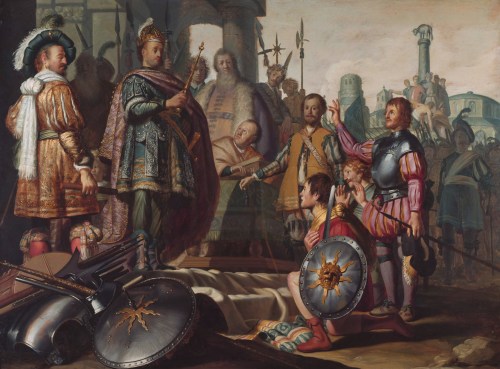
#FineArtFriday: History Painting, Titus (with self portrait of Rembrandt) by Rembrandt Harmenszoon van Rijn 1626

History Painting, Titus (with self portrait of Rembrandt) by Rembrandt Harmenszoon van Rijn 1626

  • Artist: Rembrandt  (1606–1669) Rembrandt Harmenszoon van Rijn
  • Title: Historical Scene.
  • Inscriptions: Monogram and date bottom right: RH 16[2]6
  • Object type: painting
  • Genre: history painting
  • Depicted people: Titus
  • Date: 1626
  • Medium: oil on oak panel
  • Dimensions: Height: 89.8 cm (35.3 in); Width: 121 cm (47.6 in)
  • Collection:   Museum De Lakenhal

What I love about this Painting:

This is one of Rembrandt’s earliest history paintings. The young artist went all out to compose and execute this painting. He scoured the city for props, and found old armor and weapons. Then he dressed the players richly in the finest garments of his own day, so as to befit a beloved and respected emperor.

Wikipedia says: Rembrandt’s portraits of his contemporaries, self-portraits, and illustrations of scenes from the Bible are regarded as his greatest creative triumphs. His self-portraits form a unique and intimate biography, in which the artist surveyed himself without vanity and with the utmost sincerity.

The level of detail in the weaponry and richly worked garments is remarkable, as are the faces and features of each of the players. Emperor Titus is portrayed as slightly larger than life, noble, wise, and kind.

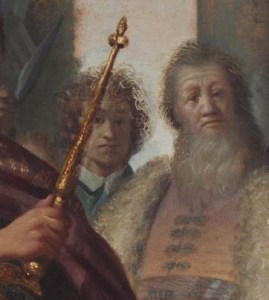
In the background, hidden by the scepter, we find Rembrandt himself, the witness who happened to come upon the scene and is looking on with wonder. Of the witnesses, he alone is shown dressed in the unadorned muted gray woolen clothing of a common man.

We know Rembrandt was well educated in history, and admired the Emperor Titus greatly, as he named his only surviving son after him.

About the Roman Emperor Titus, the Subject of this Painting (via Wikipedia):

Vespasian died of an infection on 23 June 79 AD, and was immediately succeeded by his son Titus. As Pharaoh of Egypt, Titus adopted the titulary Autokrator Titos Kaisaros Hununefer Benermerut (“Emperor Titus Caesar, the perfect and popular youth”). Because of his many (alleged) vices, many Romans feared that he would be another Nero. Against these expectations, however, Titus proved to be an effective Emperor and was well loved by the population, who praised him highly when they found that he possessed the greatest virtues instead of vices.

One of his first acts as Emperor was to order a halt to trials based on treason charges, which had long plagued the principate. The law of treason, or law of majestas, was originally intended to prosecute those who had corruptly “impaired the people and majesty of Rome” by any revolutionary action. Under Augustus, however, this custom had been revived and applied to cover slander and libel as well. This led to numerous trials and executions under TiberiusCaligula, and Nero, and the formation of networks of informers (Delators), which terrorized Rome’s political system for decades.

Titus put an end to this practice, against himself or anyone else, declaring:

“It is impossible for me to be insulted or abused in any way. For I do naught that deserves censure, and I care not for what is reported falsely. As for the emperors who are dead and gone, they will avenge themselves in case anyone does them a wrong, if in very truth they are demigods and possess any power.”

Consequently, no senators were put to death during his reign; he thus kept to his promise that he would assume the office of Pontifex Maximus “for the purpose of keeping his hands unstained.” The informants were publicly punished and banished from the city. Titus further prevented abuses by making it unlawful for a person to be tried under different laws for the same offense.  Finally, when Berenice returned to Rome, he sent her away.

As Emperor he became known for his generosity, and Suetonius states that upon realizing he had brought no benefit to anyone during a whole day, Titus remarked, “Friends, I have lost a day.”


Credits and Attributions:

History Painting, Titus (with self portrait of Rembrandt) by Rembrandt Harmenszoon van Rijn 1626

Wikipedia contributors, “Titus,” Wikipedia, The Free Encyclopedia,  https://en.wikipedia.org/w/index.php?title=Titus&oldid=950453618 (accessed April 24, 2020).

Wikimedia Commons contributors, “File:Rembrandt Historical Painting 1626 (Detail, with self-portrait).jpg,” Wikimedia Commons, the free media repository, https://commons.wikimedia.org/w/index.php?title=File:Rembrandt_Historical_Painting_1626_(Detail,_with_self-portrait).jpg&oldid=369318658 (accessed April 24, 2020).

2 Comments

Filed under #FineArtFriday

Guest Post: My Approach to Marketing: Flirting for Fun and Profit by Thomas Gondolfi

Book signings and in-person sales events are where most indies make their money. Today’s post is on a subject we indies all want to know more about–marketing our work in person. My good friend, publisher and author Thomas Gondolfi, is quite successful at it, and has kindly offered to share his knowledge as part of the 6-week NIWA Blog tour. Without further commentary, here is Thomas Gondolfi and post #4.


Let me ask you a question. Answer truthfully as the answer is only to yourself. How many times a day are you the center of good attention? My guess, based on some solid data, is that even if you have a focused partner, a loving child, or an exceptional parent, your answer is going to be fairly low. If you don’t have one of those, the number approaches nil. Along comes a vendor who is eager to engage with you as his only focus. He isn’t pushing his product on you. He is genuinely interesting in finding out how you are different! Isn’t that appealing? This is the essence of my F2F marketing strategies.

The essence of flirting is the wholehearted, one-to-one focus that one person can give to another if they are sincere. No, it’s not about trying to get a date. No, it’s not plastered on as a veneer until you can have what you want. No, it’s not about hawking your books at them.

I know you have a preconceived notion of what flirting is. I’ll tell you that you are almost certainly wrong. I have many more credits than those required to have a minor in psychology (but my school didn’t offer one). I’ve done some of my own studies in this area. I find that the meanings given by the professional wordsmiths are wrong. What I’ve learned as a definition: Flirting – To give attention to one or more persons and / or their interests in a wholehearted way.

Sincerity is the key. You must want to engage and find out what is interesting about that person, otherwise you are fighting a losing war. Flirting is of its own, valuable. People have skills they are dying to share with someone who is open to listen and share. You may learn how to knit a yarmulke, garble an herb, or even fly a sailplane. Also, it can, and does, lead to friendships. I can immediately bring to mind three strong friendships, and innumerable lesser ones, that have developed over my years of vending books because of flirting. And if the two above aren’t enough, that level of absorption can also lead to new plots, characters, and skills to use in future writing.

So let’s pull back to our customers and how to flirt. I use the mnemonic HAMER to describe the steps – Hook, Absorb, Mutual Interest, Expand, and Release.

Hook is nothing more than what we do when writing the first few pages of our book/story. We have to grab the attention of the reader in the best possible way. I do this by using hints from the person themselves, usually clothing, hairstyle, tattoos and the like. The hook should have a question attached or the potential customer may just give you a high five and move on.

Absorb means now listening to what the person has to say. No, I mean really listen. It isn’t easy. Don’t think about what books you will sell them, your spouse, the sports tournament, your quilting project. Make them the focus of your entire attention.

Now take the information you got in Absorb and find something that you can share as Mutual Interest. I believe it is axiomatic that if you are interested, you can’t be feigning interest.

Once you have chosen that Mutual Interest you need to Expand upon it and share back. Offer something in your own experience about the topic. Inquire about their experience or expertise in an area. Something to continue the conversation and make them aware that you are paying attention. But keep your response to about half of the time that they have talked to you in the Absorb step. Remember you want them to be the center of attention, not you. Now let them talk again. Do three or four Absorb-Mutual Interest-Expand steps before you get to the most important step of all.

Release is even more important than the Hook itself. Many salesmen do the above steps and will never let the coin in the customer’s purse escape and hold on like a leech. The Release is the key to soft selling. You are telling the person that they are more important than pawning you wares on them (and you would be right). To do this, you find and give a reason to let the person go, such as “I know you have to make that afternoon panel on genre blending,” “I think you friend just went around the corner,” or “I don’t want to keep you from your shopping.”

This is the key moment. If there is any chance at all of making a sale, the customer will look down and ask YOU about what you have available. Often your interest will get people who might be on the fence about your wares to buy because you made them feel good about themselves.

Whether they purchased something or not, you have just successfully completed a flirt. I talk more in-depth about this technique in my book of the same title “Flirting for Fun and Profit”  but I’ve summed up the basics here.

Your sales totals will increase. BUT even if you don’t make a sale, you’ve made a connection with another person. It is a win all around.


Founding TANSTAAFL Press in 2012, Thomas Gondolfi is the author (and book parent) of the Toy Wars series, the CorpGov Chronicles, and Wayward School along with numerous other writing and editing credits which can be found on www.tanstaaflpress.com. He is a father of three (real children), consummate gamer, and loving husband. Tom also claims to be a Renaissance man and certified flirt.

Raised as a military brat, he spent twenty years of his life moving to a new place every few years giving him a unique perspective on life and people.

Working as an engineer in high tech for over thirty years, Tom has also worked as a cook, motel manager, most phases of home construction, volunteer firefighter, and the personal caregiver to a quadriplegic.


3 Comments

Filed under writing

Writing Contemporary Fiction in a Time of Uncertainty #amwriting

The pandemic, combined with the political uncertainty of our time, has left many authors feeling unable to write. In an online group, an author who writes YA contemporary/near-future sci-fi novels said that looking at his keyboard made him feel like a deer staring into the headlights of an oncoming car.

This subject also came up at our last writing group meeting via Google Chat. A good friend who is an integral part of my writing posse is suffering from this crippling inertia.

The block these authors are experiencing is caused by the extreme uncertainty of our times and the constant barrage of bad and often conflicting news. No one knows what the near future holds, so writing something that will be affected either by the next election or how the pandemic progresses is a difficult proposition.

For some people, writing anything right now is impossible.

To write contemporary or near-future sci-fi, one must be able to predict a multiplicity of futures and decide which is most likely to occur. This is an iffy thing even in less turbulent times.

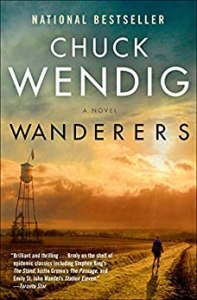
Chuck Wendig managed to nail how our society might react to a true global pandemic with The Wanderers, A Novel. Just as in the novel, we have deniers and blame-casters who categorically refuse to accept scientific evidence. We are blessed with fools aplenty.

Isaac Asimov in The Naked Sun, George Orwell in Nineteen Eighty-Four: A Novel, Ray Bradbury in Fahrenheit 451—these were the forward-thinkers of their time. These authors were able to extrapolate a possible future from reading about current events in the newspapers and watching the evening news on TV or radio.

These novels don’t describe a perfect example of how things are, but they contain glimpses of our modern life. In The Naked Sun, we find people who communicate almost exclusively via an internet of sorts and rarely meet in person.

In Nineteen Eighty-Four: A Novel, we see the effects of mass surveillance and the brutal regimentation of all aspects of behavior within a society. Dangerous thoughts are illegal, and the Thoughtpol (thought police) spy on everyone to detect and eliminate those whose independent thinking questions the powers-that-be.

In Fahrenheit 451, we are asked to consider a society in which books have been ruthlessly condensed to accommodate short attention spans. Minority groups protest the controversial, outdated content they believe exists in literature. However, comic books and pornography remains, as these feed the mainstream population’s desire for mindless entertainment. At the outset of the story, it is illegal to own a book.

These are novels that raise questions and ask us to take a hard look at ourselves.

These authors were conscious of how people react to given events, how the herd mentality takes over, and how mobs function. They also paid attention to the cutting edge science and theories of the day.

We denizens of the 21st century spend a lot of time on the internet, communicating via social media. Our phones and computers are under constant surveillance by our governments as part of the war on terrorism, and Google Earth knows where we are and what we are doing.

And finally, in many homes, reading takes a distant second place to television when it comes to family entertainment.

This raises the question, does our society shape sci-fi, or does sci-fi shape us? We tease about our cell phones and e-book readers being Star Trek devices. But all jokes aside, cell phones and electronic books and notebooks are integral parts of our culture that were described by Gene Roddenberry as part of his 1966 sci-fi televisions series.

So, while the early speculative fiction authors weren’t seers or clairvoyants, they took the information that was available to them and wrote stories that intuited a multitude of possible future timelines fairly accurately, some aspects of which closely resemble our 21st-century society.

This time of uncertainty will pass. We may never go back to standing next to strangers in a line at the grocery store, but we will create a new normal. We will find security in whatever form that new normal takes once we get used to the routine.

In real life, the good guys never win completely, but neither do the bad guys. One may have the upper hand for a while, but the pendulum swings two ways.

Pandemics are horrible, but they do eventually pass, and we will recover as a society.

This sense of powerlessness will pass.

You who write contemporary and near-future fiction and who are momentarily unable to put pen to paper will regain your creative muse, and words will flow. You will once again write insightful stories, delving deeply into what it means to be human. You will show us what a beautiful, interconnected world we live in, and how fragile each link in the web of life is.

The words will come, and you will write them.


Credits and Attributions

Eye on Flat Panel Monitor, Image by © Royalty-Free/Corbis

Dog Using Laptop Computer CC0 1.0 Universal (CC0 1.0)

2 Comments

Filed under writing

Why Authors Should Blog #amwriting

We authors, whether indie or traditionally published, are responsible for building our own brand. I have found most of this aspect of my career to be difficult. However, I have managed to succeed at one of the foundations of building my brand–I have a working author website and blog.

When I began, I used the free sites offered by both WordPress and Blogger, so cost should not hold anyone back. And the dashboards of both platforms are easy to learn with a little trial and error. If I can learn them, anyone can.

I often hear writers complain that they don’t update their author blog regularly because they have nothing to say. I disagree—they’re writers for heaven’s sake. Writers can wax poetic out the ends of their fingers, ranting for hours on the oddest subjects.

The trick is rambling on for 500 words or so and sticking to a schedule of sorts. Writers like to rant, but deadlines cause us to go into procrastination mode.

Still, although many will claim they aren’t able to write under pressure, that is when I do my best work.

NaNoWriMo has proven to me that nothing improves your writing chops more than writing every day.

Blogging offers me a mix of self-imposed goals and gives me the chance to riff on my favorite subject—the craft of writing. Much of what I have learned as a writer over the past decade has come about through researching topics for this blog.

I wasn’t always a confirmed blogger. In 2011, I signed up for a free Blogger (Google’s platform) website, taking that plunge only because my former publisher forced me to. He swore it would help get my name out there and give me a regular platform for my opinions.

The posts I wrote for that first attempt at blogging were pathetic attempts to write about current affairs and politics as a journalist, which is something that has never interested me. I was lucky if I managed to post one piece a month and had no readers or followers.

I soon realized I could not write on the subjects my publisher wanted and quit altogether.

After talking to some friends who were successful in marketing their work, it occurred to me there was one subject I could talk about for hours on end:

Books.

I went back to that old site and scrapped the awkward, unloved posts. I changed the site’s name and shifted to writing about something I loved—books. I wrote one book review post a week for the next five years.

While I haven’t had a lot of time lately to keep it updated, the site is the home of Best in Fantasy, my book review blog.

I hate to say this because we parted ways rather messily: despite my resistance, my former publisher was right about the importance of having an author’s website and writing the occasional blog post.

During the time I was first writing for Best in Fantasy, I began to realize that I was marketing everyone else’s work, but no one was promoting mine.

I needed a place to showcase my work.

That’s how this site came into existence.

It wasn’t until I stopped trying to fit into the mold someone else had designed for me that I discovered how much I love writing, and blogging is writing in its purest form.

You really are writing on the wing.

I write my posts, proofread them, and schedule them to publish on regular specific days.

That in itself is an adventure, opening you up to all sorts of embarrassing literary moments. As many of you know, despite my best efforts, my work sometimes posts “warts and all.”

Writing for this site has made me a thinking author, as well as a pantser, and has proven that I can write to a deadline. I can write using the “stream of consciousness” method, or I can write several days in advance by putting together a quick outline about whatever aspect of the craft occupies my thoughts at the time.

Usually, I do the research, and the post begins to write itself.

I’ve made many friends through blogging, people all over the world who I may never meet in person, but who I am fond of, nevertheless. This place, Life in the Realm of Fantasy, is where I develop seminars on the craft of writing. I find that talking about my obsession helps me organize my thoughts.

Blogging is only successful if you are passionate about what you are discussing. Usually, I talk about writing craft because I’m an obsessive nerd, but sometimes real life gets in the way of creativity.

When I need to, I talk about the difficulties of traveling while vegan. I’ve written about the challenges of having two children with epilepsy, the dysfunctionality of growing up with a father suffering battle-related PTSD and many other aspects of just trying to live a happy life in the real world.

Having a blog on your website and updating it at least twice a month is a way to connect with your readers on a human level. Fans will enjoy hearing what your writing goals are. They want to know where you will be signing books.

Also, they love to hear about the books you are reading.

Readers enjoy seeing little off-the-cuff pieces once in a while. Articles of less than 1000 words are fun to write and often find their way into your other work, as they are a great way to brainstorm ideas.

To my knowledge, I have never been plagiarized. I have a notice clearly in the sidebar on my website that the content is copyrighted. I also make sure all quoted material is credited to the original authors with links back to their websites.

So:

  • Keep it down to about 500 – 1000 words more or less.
  • Use the spellchecker tool to look for glaring errors.
  • Write in draft form and don’t publish it right away–come back and read it over again, and make corrections.
  • If you use information that you found elsewhere, quote it and credit the author
  • Use images that are either public domain or that you have the legal right to use
  • Put links to other informative sites in the text

Be Consistent.

Life in the Realm of Fantasy has evolved over the years because I have changed and matured as an author.

If you are wondering how to get started, please check out my post, Creating your Author Blog.  There, you can find detailed, step by step instructions for getting a free website, and getting started on either WordPress or Blogger. I use both platforms, and they are not too hard once you learn the ropes.

In the meantime, stay safe. One last thought: if you are finding writing difficult because of stress we all feel via the pandemic, riffing on a completely random subject might rest your mind and free your creativity. Give it a shot, and let us all know how it goes!

3 Comments

Filed under writing

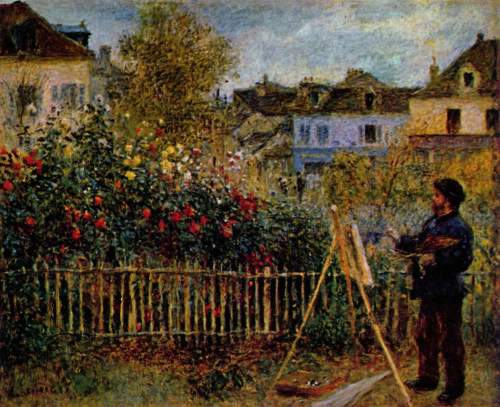
#FineArtFriday: Monet Painting in His Garden by Pierre-Auguste Renoir 1873

Monet Painting in His Garden by Pierre-Auguste Renoir

Date: 1873

Medium: oil on canvas

Dimensions : Height: 46 cm (18.1 in); Width: 60 cm (23.6 in)

Collection: Wadsworth Atheneum Museum of Art

What I love about this painting:

Renoir shows us that Claude Monet’s garden is lush and a little wild, like the man who owns it. Yet, although he is the subject of this painting, Monet is completely focused on his work. The colors are vivid, which inspires me since my own garden is only now shaking off the depredations of winter. I would love to spend time in this riotous garden.

Renoir visited his good friend many times during the years Monet lived at Argenteuil, a village on the right bank of the Seine river near Paris. In 1873, Monet purchased a small boat equipped to be used as a floating studio, which must have been a draw for Renoir and his friends.

About the artist (via Wikipedia):

In 1862, Auguste Renoir began studying art under Charles Gleyre in Paris. There he met Alfred SisleyFrédéric Bazille, and Claude Monet.  At times, during the 1860s, he did not have enough money to buy paint. Renoir had his first success at the Salon of 1868 with his painting Lise with a Parasol (1867), which depicted Lise Tréhot, his lover at the time. Although Renoir first started exhibiting paintings at the Paris Salon in 1864, recognition was slow in coming, partly as a result of the turmoil of the Franco-Prussian War.

Renoir was inspired by the style and subject matter of previous modern painters Camille Pissarro and Edouard Manet. After a series of rejections by the Salon juries, he joined forces with Monet, Sisley, Pissarro, and several other artists to mount the first Impressionist exhibition in April 1874, in which Renoir displayed six paintings. Although the critical response to the exhibition was largely unfavorable, Renoir’s work was comparatively well received.  That same year, two of his works were shown with Durand-Ruel in London. 


Credits and Attributions:

Monet Painting in His Garden by Pierre-Auguste Renoir / Public domain

Wikipedia contributors, “Pierre-Auguste Renoir,” Wikipedia, The Free Encyclopedia, https://en.wikipedia.org/w/index.php?title=Pierre-Auguste_Renoir&oldid=949963500 (accessed April 17, 2020).

Wikimedia Commons contributors, “File:Renoir-Monet painting.png,” Wikimedia Commons, the free media repository, https://commons.wikimedia.org/w/index.php?title=File:Renoir-Monet_painting.png&oldid=338421916 (accessed April 17, 2020).

Comments Off on #FineArtFriday: Monet Painting in His Garden by Pierre-Auguste Renoir 1873

Filed under #FineArtFriday

Guest Post: Writing Essentials: Organizing Your Plot by Suzanne Hagelin

This is the third in a six-week blog tour series for the Northwest Independent Writer’s Association. You can catch up with them at https://www.niwawriters.com/

Today’s guest post is by Indie author Suzanne Hagelin. Suzanne is a USA Today best-selling author of science fiction. I’ve enjoyed her work and look forward to hearing what she has to say!

What could be more delightful than a great story told well? Homer continues to gain “Iliad” fans after thousands of years and Shakespeare retains his reputation as a master playwright. How did they assemble the parts to create a satisfying whole? Is it possible to find a common denominator for all the successful plots out there? The approaches to building a story are so numerous and versatile that it could be daunting to pull out a basic principle that works for all, but this might be a good starting place.

A good plot cooperates with the way human minds process information.

The key to processing and digesting information is organizing it in a way our brains can use. Reading books is no exception. A simple narrative with few characters can get away with a scattered tossing of events and ideas, but the more complex a story becomes, the more essential it is to have a well-organized plot.

When we organize a plot, we’re creating a pattern of events, forming the basic structure of the story. The author’s success in weaving them together depends on how the pieces are coordinated. Ideally, authors lay out their stories in ways that make sense and don’t require too much guessing or backtracking on the part of the reader.

Chronology

Reality happens in order—at least as far as we know in this branch of the multiverse—but we experience reality in complex ways because of how we process information; reviewing memories, comparing facts, dealing with trauma, struggling with questions. Our minds are existing in the present, and branch into the past and future as well, as we evaluate our lives. This is why we can enjoy stories told out of sequence and why breaking up the chronology of a plot can work.

In fact, it can be masterfully done.

“Memento” is a film about a man who can’t form permanent memories because of a traumatic incident that included the death of his wife. By showing only what he experiences and moving backwards, the movie captures what it’s like to be this man and shows us at the same time what is actually happening. It’s intense, tragic, and disturbing. The author set up the pattern very carefully so that, even as scenes were moving in reverse in time, our understanding of who the characters were and what was happening progressed in a logical way forward, building solidly. The viewer’s experience was sequential, like walking backwards in the snow, watching the ground so you can set each foot in the print you left on your way there, only seeing one at a time.

Most stories are told sequentially with occasional visits to the past.

Ways to organize the chronology of your plot

By characters

Take each of your main characters and jot down the flow of the story from their point of view. Let their motivations and personalities clarify gaps or redirect the plot. For example, “Joe” wouldn’t just be sitting there for seven chapters while “Mary” is battling a monster. Of course, you don’t have to write what Joe is doing, but you should know.

Once you’ve got each character’s thread, look at how they cross and interact. You may find some plot peaks and valleys this way.

By timeline

Take the space of time your story covers and place events on it. The most logical approach is to tell the story in the order it happened, within reason. You wouldn’t interrupt a scene to throw in what was happening at the same time somewhere else unless it were essential to tie the two events together immediately. You may want to interlace chapters that deal with different segments in order to preserve the forward momentum of the plot.

If you aren’t telling your story in the order it happened, why not? Memories and flashbacks happen within the mind. Whose mind are you connecting it to? It could be a specific character or the reader, as if they had found a historical resource to draw from.

Ask questions like:

  • Is there a good reason why this isn’t happening in chronological order?
  • Who is linked to this and how will I maintain the continuity of the plot?
  • Would putting this section back into the timeline make more sense or improve the plot?
  • Does this help the reader to know what I (the author) know or does it confuse them?

One of my novels was really suffering until I did this. I laid the scenes out on a timeline and realized how I had been botching it by neglecting the importance of chronology. Reorganizing the flow helped me regain momentum not only in the story progression but in my writing.

By key points

There are specific landmarks you need to get to, pivotal events in your book that are essential. Identifying those and placing them in strategic places will help you decide what should happen between them. I may not have decided how to accomplish this, but I know that about halfway through the book, that character has to be in this situation. Anchoring these might change the structure of your plot somewhat but that’s good. Now you know where you’re going.

The reader will sense that direction even if they don’t know where you’re taking them.

Composition

When composers craft a symphony, writing musical notes in patterns, choosing instruments and how they blend together, they are weaving a story with sound. The conductor interprets the notes, expanding or contracting tempos, creating highs and lows, excitement or calm, making it individual. The musicians follow the conductor’s instructions, but each one has their own level of skill, talent, and nuances of style.

Stories are compositions, like music. When authors sketch out a storyline, adding characters, locations, sequences of events, and dialog, they are composing a story with words. The style of writing fleshes it out, like a conductor, and determines the impact the plot will have.

Consider your book from a musical standpoint. Where are your crescendos and decrescendos? Are there long, legato passages and short staccato ones? Have you built a rhythm and pace that conveys emotion? This approach can identify long dull patches or consistently tense ones that never have peaks or valleys.

When you’re sitting down to organize your plot, there are several things to look at. You want to consider:

  • The structure of the timeline in the story, what happens when
  • The flow of how you tell the story, which isn’t necessarily the same
  • Where your characters are at each point in that flow

This is helpful because:

  • You can identify transitions and make sure you handle them the way you want.
  • You can make a note of where support characters come in and how much the reader needs to know about them that hasn’t happened on the pages.
  • You can get a feel for the tempo of the book, where it’s dragging or when it’s rushing at a steady clip for too long, and choose places to add pauses or excitement, as the case may be.

Tools for organization

My favorite tool for organizing plots is Excel. I can track as many things as I wish through the plot because there’s always room for another row or column. Sometimes it’s basically an outline. Sometimes it’s a lot more.

There are times, though, where I can’t get what I need on a computer no matter how many sheets I have open or how big the screen is. I need something that can be moved around or scribbled on or torn up with bare hands. Then I turn to 3 x 5 index cards, sticky notes, torn pieces of paper. Laying it all out and sometimes marking it with colored codes, I can solve problems that can’t be tackled any other way. I can see at once where everyone is, everything that’s happening.

This rescued that book I mentioned, spreading it out made me realize I had approached the flow all wrong. The how and when of the story had to change completely. Fortunately, it didn’t mean a lot of rewrites, but it did alter the pace drastically. Chapters I had written that had a good tempo acquired more of a rushed feel, but since the plot as a whole wasn’t working before, the gain was worth the cost.

Talking about the plot out loud can be handy as well. Listing the sequence of events may reveal a hole. Talking about character motives may indicate scenes I left out. Maybe something I thought was great actually sounds dumb when I say it aloud.

Scene flow

Organizing your plot extends into the details and can be an asset to writing individual scenes.

Once a scene has been written, I always go back and look at the flow. I have a tendency to jumble my ideas together, associating them in ways that aren’t sequential—especially when I’m comfortable with them and already blazing ahead in my mind to what comes next. A painting can do that. It can present all the pieces of its image together and let you choose how you examine it. One person may prefer to consider the colors first, and another looks for faces, but authors are only giving a piece at a time and if we aren’t careful, we can lose the reader before the picture is complete.

This sounds obvious, but sometimes I have to remind myself that the reader is reading sequentially.

Present ideas in order

The woman enters the room and sees the wild animal before pulling out her weapon with a shriek. She doesn’t scream first, shoot, and then enter the room. This seems obvious, and the example is kind of simplistic, but the truth is I usually have to go back and make sure I’m not doing this.

“Shrieking and pulling out her Glock, the woman blasted the creature repeatedly as she entered the room where the beast had broken in through a window.”

Reorganizing the progression makes it easier to follow.

“Entering the room, the woman shrieked at the sight of the beast, covered in glass from a broken window, and within seconds had pulled out her Glock and unloaded over twelve plugs into its bulk.”

This isn’t beautiful writing, but it’s easier to follow when the sequence makes sense.

Organize the flow of action, then identify and fill in missing pieces.

Final thoughts

The reader has no idea about our story until we present it to them. They can’t see what we can see or know the characters like we know them. If we want them to enjoy the process of entering into this world so they can experience the adventure we’ve prepared, we need to assemble the parts in an easily absorbed way.

A story that sweeps you up into its grasp and carries you off into the sunset doesn’t happen by accident.

Someone laid a well-crafted snare.


Thank you for this highly detailed post, Suzanne! 

Her first post in this series was “Writing Essentials: Organizing Your Mind”. You can read the second installment in this series here, “Writing Essentials: Organizing Your Time”, and the fourth post will be on William Cook’s Blog next week.

Graphic made with photos by NASA Hubble and Christophe Ferron on Unsplash


USA Today bestselling author of hard science fiction, Suzanne Hagelin, lives in the Seattle area where she runs a small press, Varida P&R, and teaches language on the side.

Her Books. The Silvarian Trilogy Book 1, “Body Suit” is available for 99c in April only and the audiobook is Downpour’s current Editor’s Pick at $4.95. Book 2 “Nebulus” just released on audio, and Book 3, “The Denser Plane” is in the writing stage. The Severance begins with “Cascade” and will be followed by “Eclipse”.

LINKS—Suzannehagelin.com, Suzanne’s Blog, Newsletter, Twitter, FaceBook, Medium


10 Comments

Filed under writing

How to be a good Beta Reader #amwriting

Beta Reading is the first reading of a manuscript by someone other than the author. One hopes the reader is a person who reads and enjoys the genre that the book represents.

I am fortunate in that I have excellent friends who are willing to do this for me, and their suggestions are both kind and spot on.

This first reading by an unbiased eye is meant to give the author a general view of the overall strengths and weaknesses of their story. This phase of the process should be done before you submit the manuscript to an editor.

In my work, the suggestions offered by the beta reader (first reader) guide and speed the process of revisions, so that my editor can focus on doing her job without being distracted by significant issues that should have been caught early on.

If you agree to read a raw manuscript for another author, you must keep in mind that it has NOT been edited. The author is not asking you to edit the manuscript.

This manuscript is the  child of the author’s soul. Be sure to make positive comments along the way and never be chastising or accusatory. Always phrase your suggestions in a non-threatening manner

What are the larger issues that must be addressed before the fine-tuning can begin? If you are beta reading an unedited manuscript, these are the more significant issues you should look at:

How does it open? Did the opening hook you? As you read on, is there an arc to each scene that keeps you turning the page? Make notes of any places that are confusing.

Setting: Does the setting feel real? Did the author create a sense of time, mood, and atmosphere? Is the setting an important part of the story?

Characters: Is the point of view character (protagonist) clear? Did you understand what the character was feeling?  Were the characters likable? Did you identify with and care about the characters? Was there a variety of character types, or did they all seem the same? Were their emotions and motivations clear and relatable?

Dialogue: Did the dialogue and internal narratives advance the plot? Did they illuminate the tension, conflict, and suspense? Were the conversations and thoughts distinct to each character, or did they all sound the same?

Pacing: How did the momentum feel? Where did the plot bog down and get boring? Do the characters face a struggle worth writing about, and if so, did the pacing keep you engaged?

Does the ending surprise and satisfy you? What do you think might happen next?

Grammar and Mechanics: At this point, you can comment on whether or not the author has a basic understanding of grammar and industry practices that suit their genre.

Be gentle—if they lack knowledge, suggest they get a style guide such as the Chicago Guide to Grammar, Usage, and Punctuation, or if you feel up to it, offer to help them learn a few basics.

I know how difficult it is to share your just-completed novel with anyone. My friends offer comments that help me turn my vision of what the story could be into a reality.

For that reason, being the first reader for their work is a privilege I don’t take lightly.

4 Comments

Filed under writing

You Asked for Feedback. How to Handle it #amwriting

Let’s pretend that you have just joined a professional writers’ group. After attending a few meetings, you ask a member for feedback about your book or short story.

Be prepared for it to come back with some critical observations.

We are full of expectations that all readers will enjoy our just finished work and tell us how stellar it is.

That daydream quickly dissolves into hard reality when we get our first assessment back, and it isn’t what we thought we would hear.

Perhaps the reader noticed those massive info dumps, long paragraphs we thought were so important to the why and wherefore of things.

Worse, perhaps they were familiar with horses (or medicine, or police procedure). Maybe they told us that we have it all wrong, that we need to do more research and then rewrite what we thought was the perfect novel.

Our unrealistic belief that our work is perfect as it falls from our mind is a failing that we must overcome if we want to engage readers.

Some of us don’t know how to react when a beta reader points out the flaws in our work. For some authors, even mild comments feel like their work has been torn to shreds.

When I shared my first novel with the sister of a friend, I received feedback that was the opposite of what I expected. It hurt, but I managed to take her comments like a grownup and learn from the experience.

As a teenager, I was a hockey player and a speed skater. In that competitive environment, I learned how skill and growth can only come through education, practice, and effort. Education comes when you seek advice and follow it.

I had to suck it up and use her suggestions to improve my work.

A good, honest critique can hurt if you are only expecting to hear about the brilliance of your work. Even if it is worded kindly, criticism can make you feel like you have failed.

Not understanding how to correct our bad writing habits is the core of why we feel so hurt.

Experiencing failure and moving on is the path to growth. Critiques hurt in those days, but looking back, I can clearly see why it was not acceptable in the state it was in.

I had no idea what a finished manuscript should look like, nor did I understand how to get it to look that way.

I didn’t understand how to write to a particular theme.

I didn’t understand how to punctuate written dialogue.

I resented being told I used clichés.

I disliked being told my prose was passive. But I couldn’t understand what they meant when they said to write active prose.

Worst of all, I didn’t know where to begin or who to turn to for answers. 

There was only one way to resolve this problem. I had to find a way to educate myself.

I joined an online organization for new and beginning writers, Critters Writers Workshop. There I saw discussions about books that would help me get to my goal. I had bought a few books on the craft which was why my work wasn’t completely abysmal.

Armed with better information, I sought out books on the craft of writing that were tailored to my needs. I am still buying books on the craft today. I will never stop learning and improving.

The feedback we receive from first drafts isn’t always what we wanted to hear, so I rarely offer a beta reader anything that isn’t as clean as I can make it.

Even so, they always find flaws. When we get the feedback we asked for, we need to be strong, stay calm, and understand that the reader has gone to some trouble for you.

Something to consider—if the reader is an author, they may be involved with the same forums in all the many social platforms you are, so have a care what you say online. Please, don’t go into a rant about that reader to your friends on your favorite writers’ forums.

If you respond publicly in an unprofessional way, the innocent bystanders will remember you and won’t be inclined to work with you either.

In this new world of social media, we should all be aware that how we interact online with others is public information and is visible to the world.

Don’t ask a fellow member of a professional writers’ forum to read your work unless you want advice that is honest.

Even if they don’t “get” your work, they spent their precious time reading it, taking time from their own writing.

Maybe you don’t know any writers to ask. Perhaps you only have family and friends to go to for input. Before you do, take the time to consider the people you know and who have a large influence in your life.

Some people, even people you love respect, are not cut out to be beta readers. Perhaps they are not cut out to be readers at all.

Some people are like my Aunt Jo was. She found fault with everything, shot from the hip, and her blunt comments took no prisoners. She took pride in “just being honest,” declaring that she was doing you a favor.

For that reason, as an adult I never asked her opinion of anything. If you offer your work to a person like Aunt Jo, don’t expect praise.

Writer’s groups and forums are made of humans, and none of us are perfect. Any group may have an Aunt Jo among the members. If you have offered your work to a person like her and then discovered she had nothing good to say, don’t feel guilty for not asking them to read for you again.

Let the manuscript rest for a day or two. Then, look at their comments with a fresh eye and try to see why they made them. There may be a kernel of truth hidden in the barbs that you need to look at.

Conversely, they may simply not like your style or genre, and that dislike impedes their ability to give a good critique. You must learn to accept human frailty in your fellow writers and not hold it against them.

Negative feedback is a necessary part of growth. This is where you have the chance to cross the invisible line between amateur and professional.

Never be less than gracious to a person who reads and critiques your work when you communicate with them.

Sit back and cool down.

Consider the areas they find problematic and find ways to revise and resolve those problems.

Above all, keep writing.

6 Comments

Filed under writing

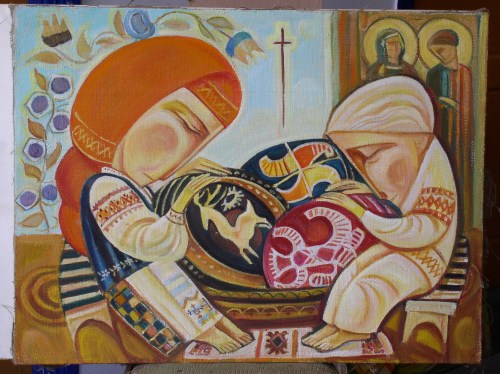
#FineArtFriday: Painting Easter Eggs, by Mykhaylo Chornyi

Today’s image is one that I posted in 2019 on Good Friday – the Friday before Easter. For me, this painting is like an Easter-card from friends far away.

This image is painted in  the Ukrainian Neo-Folk style. The artist, Mykhaylo Chornyi, lives and paints in the Ukraine. Many European ethnic groups have traditions for using the wax-resist method (psyanky) for inscribing designs on eggs.

From Wikipedia:

pysanka (Ukrainianписанка, plural: писанки) is a Slavic egg , decorated with traditional folk designs using a wax-resist method. The word pysanka comes from the verb pysaty, “to write” or “to inscribe”, as the designs are not painted on, but written (inscribed) with beeswax.

I’m captivated by the colors, the life in this amazing depiction of that most popular of Easter activities. It was painted in 2000, and to me, while it is highly stylized, it is passionate. Every time I look at this photograph of the painting, I see something new, some small detail that enchants me and draws me deeper into it. I feel like it’s an Easter gift from the artist to me.

Coloring eggs is a common activity this time of year, but these artists don’t simply dye their eggs in pastel shades the way most children here in the US do. These painters are intent, creating brilliant works of art on the most delicate of canvasses—the eggshell.

There is something reverent about the painters as they go about their work. The religious themes in the background are so much a part of the overall scene they are nearly subliminal, yet they are not hidden in any way. Who are the eggs intended as gifts for?

About the Artist, Via Wikipedia:

Mykhaylo Nikiforovich Chornyi (Ukrainian: Михайло Никифорович Чорний; Russian: Михаил Никифорович Чёрный; November 26, 1933) is a Ukrainian Realist, Neo-Primitivist) painter and graphic artist. Chornyi is described as “the founder of Ukrainian Neo-Folk Style”. A member of Ukrainian National Artists’ Union since 1968. People’s Artist of Ukraine (2003).


Credits and Attributions:

Painting Easter Eggs by Mykhaylo Chornyi first posted here on 19 APR 2019. https://conniejjasperson.com/2019/04/19/fineartfriday-painting-easter-eggs-by-mykhaylo-chornyi/

Painting Easter Egg, by Mykhaylo Chornyi (Black milly [CC BY-SA 3.0 (https://creativecommons.org/licenses/by-sa/3.0)] )

Wikimedia Commons contributors, “File:Painting Easter Eggs.jpg,” Wikimedia Commons, the free media repository, https://commons.wikimedia.org/w/index.php?title=File:Painting_Easter_Eggs.jpg&oldid=185923430 (accessed April 19, 2019).

Wikipedia contributors, “Mykhaylo Chornyi,” Wikipedia, The Free Encyclopedia, https://en.wikipedia.org/w/index.php?title=Mykhaylo_Chornyi&oldid=838782944 (accessed April 19, 2019).

Lubap Creator:Luba Petrusha [CC BY-SA 3.0 (https://creativecommons.org/licenses/by-sa/3.0)%5D

Wikipedia contributors, “Pysanka,” Wikipedia, The Free Encyclopedia, https://en.wikipedia.org/w/index.php?title=Pysanka&oldid=893148353 (accessed April 19, 2019).

2 Comments

Filed under #FineArtFriday, writing

William J. Cook, Advice for New Writers #writetip

This is the second in a six-week blog tour series for the Northwest Independent Writers Association. You can catch up with them at https://www.niwawriters.com/

Today’s guest post is by Indie author William Cook. William writes mysteries, set in my part of the world, the Pacific Northwest. I’ve enjoyed his work in the anthologies we have both been featured in and look forward to hearing what he has to say!

~~~~

Let me begin by saying I still consider myself a new writer, even though I have several books under my belt. Although I’ve “written” all my life, I only got serious about producing books when I retired in 2011. I hope I’ve continued to improve my craft since then, but only my readers can judge that. What follows are only my opinions, and I’m sure if you polled all our NIWA members, you’d find a hundred more.

Number One: Please don’t quit your day job. Truth be told, most of us are only meagerly supplementing our incomes, not debuting on the world stage of #1 Bestsellers. Although some of us have been quite successful, there are very few, if any, Andy Weirs among us. The fortune and fame that showered The Martian are akin to winning the lottery or being struck by lightning—it happens, but the odds against it can be astronomical.

So why do we write? We write because we have to—it has to come out of us. We write for the sheer joy of seeing our creations on paper and on a digital screen. If we make a few bucks, that’s frosting on the cake. Knowing we have family and friends who read our work and like it is reward enough. No, we never stop trying to be successful—taking courses in marketing, scheduling book signings at local bookstores and conferences, begging reviews from readers and local media outlets, doing whatever we can to improve our craft—but we also accept that we are very likely not the next John Grisham or Dean Koontz.

Number Two: Should you try to get an agent or should you publish independently? This is a complicated question. I have never had an agent, so I can only repeat what I have heard from others who have.

Potentially, getting an agent can give your book wider exposure. Your agent gets you a publishing company, and you have the support of that company behind you, hopefully helping you with advertising, book tours, media outlets, etc. On the down side, you may lose a lot of control over your book—content as well as cover. I spoke with one author who told me her company insisted she change one of her characters or they wouldn’t publish her novel. Another said her company just sat on her book and did no promotion at all. Of course, there are other situations where the agent is perfect for the job, establishes a trusting relationship with the writer, and both go on to be very successful together over the course of several books.

Bottom line: decide at the outset whether you want to try to get a literary agent BEFORE you go ahead and publish independently. Once you’ve published independently, it’s much harder to get an agent for that same book, or for a book that comes later in a series. It’s the proverbial Catch-22: your prospective agent will ask, “If your book is successful published independently, why do you want me? If it’s not successful, why should I take the risk?”

Anyway, an excellent resource is https://querytracker.net/ Two essential books are How Can I Find a Literary Agent and Step by Step Pitches and Proposals, both by Chip MacGregor with Holly Lorincz. Also, a better way to land an agent than sending out proposals cold, is to buy face-to-face time with an agent at a literary conference. The biggest one in Oregon, the Willamette Writers Conference, will be in Portland in August (depending, of course, on the pestilence situation at the time).

So far, I have opted to publish independently. Although there are many independent platforms out there, such as IngramSpark, Draft2Digital, Bookbaby, Smashwords, and Kobo, I’m a bit of a dinosaur and have done all mine through Kindle Direct Publishing. That means I can only sell my books on Amazon, and that most bookstores don’t want my paperbacks because Amazon has no return policy for them. Some stores will do it on consignment, and I am fortunate to have a local store that is very kind to independent writers.

What I like about being an indie author is the freedom it gives me. I control everything—content, cover, timing of release, the works. The only deadlines I have to meet are my own. Self-publishing has introduced me to a thriving community of authors who have been extraordinarily helpful. In short, it’s fun!

Number Three: Should you look to see what’s trending and write to that? My answer? Please don’t pimp your writing. Write your own story, not the one you think other people may want to read because it’s currently fashionable. If you don’t write from your heart, you probably won’t survive the dark periods when you’re afraid the Muse has abandoned you and you’re only a hack who shouldn’t have started writing in the first place. (Yes, those days will come.)

Number Four: Should you write every day on a regular schedule? Writing is not “one-size-fits-all.” If you can write every day, that’s wonderful. I know there are many writers of great discipline (and success!) who write four to six hours every day, like clock-work. Hats off and more power to them. But I have a rich life away from my computer, and I can’t. For some people, writing is like fishing. The old adage, “Any time you can get away is a good time to fish,” can be applied to writing as well. Any time you can squeeze in an hour or two is a good time to write.

But you may ask, “What if I get stuck? What if the dreaded Writer’s Block hits me like COVID-19?” Then make a covenant with yourself: you will write one sentence every day—good, bad, or indifferent, however long it takes. If more comes out of you, fine, but your commitment is for one sentence only.

Number Five: Join writing groups. Like good parenting, good writing takes a village. At the very least, join a critique group. This should be small enough (maximum 5 people?) to afford each writer plenty of time to strut their stuff and get the honest feedback he or she deserves. Some groups email their pages in advance, while others bring printed copies for everyone to the group. By all means, read your work out loud. That’s the quickest way to spot the awkward sentence, the overly stiff dialogue, the plot hole you’ve missed. Other groups are available as well. In Oregon, Willamette Writers has local branches throughout the State. In Salem, Writers Yesterday, Today, and Tomorrow (WYTT) meets weekly. NIWA is a Facebook group that has been enormously helpful to me.

Number Six: Beware the perils of self-editing! I will write more about this in a future blog, but for now, always be aware that your brain operates like the autocorrect function on your phone. It will fill in the missing word, remove the repeated word, fix the misspelling. Make sure other eyes get to look at your work before you publish it.

Number Seven: The necessity of marketing. Ah, the dreaded M-word. I have found that marketing is an entirely different skill-set from writing. And I’m not very good at it—yet. When your book gets published on Amazon, it will be the proverbial needle in a haystack, lost among the millions of volumes already there. Good advertising makes it stand out. Unless you can afford to pay someone to do it for you, you’re going to have to learn how to advertise on Amazon, Facebook, Instagram. But you can take it a little at a time. Get that book written first!

So there’s my two cents. I hope I haven’t been too negative. The truth is, holding that book in your hands, whether it’s your first or your fifth, is a thrill like no other. Go for it!


Thank you for those excellent words of wisdom, William!

If you want to read other posts in this series by this author, go to https://authorwilliamcook.com/blog/   “Reading to Impact Your Writing (And Can Watching Movies be a Business Expense?)”

Watch for the next post in the series by this author:

https://lecatts.wordpress.com/   “My Approach to the Writing Process”

About William J. Cook:

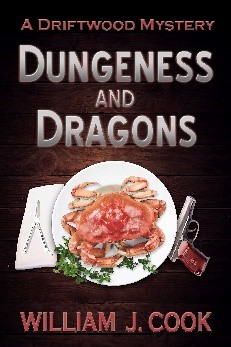
William Cook moved to the Pacific Northwest from the East Coast in 1989, and worked for a total of 37 years as a mental health therapist until his retirement in 2011. He splits his time between writing, babysitting for his 15 grandchildren, and sneaking off to mid-week matinees (when theaters are open!). The Kindle edition of his latest book, Dungeness and Dragons: A Driftwood Mystery, is available now for pre-order and will be published on April 24. Find all his books at:

https://authorwilliamcook.com/

Comments Off on William J. Cook, Advice for New Writers #writetip

Filed under writing