Tag Archives: #amwriting

The Writer’s Holiday

This week we are in Cannon Beach, Oregon, for our annual family pilgrimage. It is the place where sand and sea meet grandchildren and dogs. This year, no toddlers, but one of the older grandchildren is here with his friend.
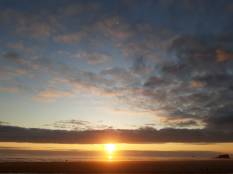
Sunset_Cannon_Beach_05_August_2019We booked in January, so we got our favorite condo on the beach. Some years we don’t get it, but we always have fun. My sister-in-law and her husband are in a small house a bit further toward the other end of town. The daughter with the teenagers is staying in the neighboring town of Seaside, which is more oriented to teenagers and caters to their idea of fun.

Cannon Beach is a pleasant village, with flowers in every public place, gardens that are maintained by the city. It’s an attractive tourist town, easily walkable, and with a free transit system.

There is a brewery, several coffee roasters, numerous art galleries, and bookstores. On the main street we find a fabulous wine shop, my all-time favorite bakery, and an old-fashioned candy factory that is to die for.

Most important of all, on the corner near our condo is the grandchildren’s favorite toy store of all time, Geppetto’s. No one can walk past it without stopping in. (Shh – don’t tell anyone, but I’m getting the youngest ones their Christmas presents today.) This store has the most amazing variety of board games and puzzles.

Our condo is in the thick of things, so pizza night is easy to arrange, and a great pub is just around the corner.

We usually stay at the north end of town in the same area every year. I have a full kitchen, essential for the vegan on the road, and can walk out my door to where Ecola Creek enters the sea. The creek is wide here at the estuary but so shallow we can wade across.
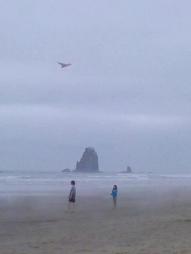
Amaranthus and Savvy at the needles by haystack rock cannon beach 2012

The best part of this condo is the lovely gas fireplace for when the teenagers come in dripping seawater and sand, with blue lips and chilled to the bone.

They never listen to Grandma. “Come in before you get hypothermia!”

Just sayin’.

The view from our condo is one that never fails to soothe me. Tillamook Head is just off to the north. A mile out to sea, resting atop a sea stack of basalt, the notorious Tillamook Rock Lighthouse, nicknamed “Terrible Tilly,” has had a long history of strife and tragedy. Although long closed to the public, she still stands today, battered and bruised. Her continued existence is a testament to the quality of construction, as she is much stouter than the rock she was built upon.

About Terrible Tilly, from Wikipedia:

Tillamook Rock Lighthouse Cannon Beach Aughust 2014In September 1879, a third survey was ordered, this time headed by John Trewavas, whose experience included the Wolf Rock lighthouse in England. Trewavas was overtaken by large swells and was swept into the sea while attempting a landing, and his body was never recovered. His replacement, Charles A. Ballantyne, had a difficult assignment recruiting workers due to the widespread negative reaction to Trewavas’ death, and a general desire by the public to end the project. Ballantyne was eventually able to secure a group of quarrymen who knew nothing of the tragedy, and was able to resume work on the rock. Transportation to and from the rock involved the use of a derrick line attached with a breeches buoy, and in May 1880, they were able to completely blast the top of the rock to allow the construction of the lighthouse’s foundation.

On October 21, 1934, the original lens was destroyed by a large storm that also leveled parts of the tower railing and greatly damaged the landing platform. Winds had reached 109 miles per hour (175 km/h), launching boulders and debris into the tower, damaging the lantern room and destroying the lens. The derrick and phone lines were destroyed as well. After the storm subsided, communication with the lighthouse was severed until keeper Henry Jenkins built a makeshift radio from the damaged foghorn and telephone to alert officials.

The lighthouse was decommissioned in 1957 and replaced with a whistle buoy, having become the most expensive U.S. lighthouse to operate. During the next twenty years, the lighthouse changed ownership several times; in 1980 a group of realtors purchased the lighthouse and created the Eternity at Sea Columbarium, which opened in June of that year. After interring about 30 urns, the columbarium‘s license was revoked in 1999 by the Oregon Mortuary and Cemetery Board and was rejected upon reapplication in 2005.

Access to the lighthouse is severely limited, with a helicopter landing the only practical way to access the rock, and it is off-limits even to the owners during the seabird nesting season. The structure was listed on the National Register of Historic Places in 1981 and is part of the Oregon Islands National Wildlife Refuge. [1]

I spend a lot of time on the porch, looking out to sea at Terrible Tilly. The view is soothing, although the Northern Pacific waters are wild and untamed.

The lighthouse that I think of as a friend stubbornly clings to life, providing a home for seabirds. I watch it, sitting in solitude and letting my mind go free, and then I write.
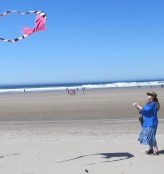
KiteFlying2018When I feel need to clear my mind, I go to the water’s edge and fly my kite. While I do that, my husband roams the beach, watching the seabirds nesting on the God-rock of Cannon Beach, Haystack Rock.

I will admit, we overindulge in treats reserved only for holidays. On days when we have no grandchildren, we visit our favorite restaurants and pubs. Often we go to a play at the community theater.

Each year, when we return home, my thoughts are clearer for having come to this place of wildness and beauty. I feel invigorated for having spent a week in the company of our loved ones.

Winters on this coast are notoriously awful, as witness the battering of Terrible Tilly, but August is peaceful, with mists rising at dawn, sun all afternoon, and stars falling over the vast ocean.

Every year, the moment we arrive back in our inland valley, I long for this place, my spiritual home. In the days and months to come, this week will shine in my memories, a sliver of paradise outside of the pandemic, a quiet time of rest and rejuvenation.


Credits and Attributions:

[1] Wikipedia contributors, “Tillamook Rock Light,” Wikipedia, The Free Encyclopedia, https://en.wikipedia.org/w/index.php?title=Tillamook_Rock_Light&oldid=1026355176 (accessed August 14, 2021).

All images used in this post are the author’s own work and are copyrighted.
3 Comments

Filed under writing

Character Development: Narrative Time

Last week, we discussed how the descriptive narrative of a story is comprised of three aspects:

Narrative point of view is the perspective, a personal or impersonal “lens” through which a story is communicated.

Narrative time is the grammatical placement of the story’s time frame in the past or the present, i.e., present tense (we go) or past tense (we went).

Narrative voice is how a story is communicated. It is the author’s fingerprint.

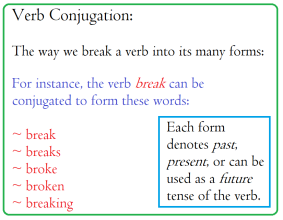
verb-conjugationToday we’re discussing how narrative time, or what we call tense, affects a reader’s perception of character development. In grammartense is a category that expresses time reference. Tenses are usually shown by how we use the forms of verbs, particularly in their conjugation patterns. The main tenses found in most languages include the pastpresent, and future.
The way that narrative tense affects a reader’s perception of characters is subtle, an undercurrent that goes unnoticed after the first few paragraphs. It shapes the reader’s view of events, but on a subliminal level.

Every story is different and requires us to use a unique narrative time.

Tense conveys information about time. It relates the time of an event (when) to another time (now or then). The tense you choose indicates the event’s location in time.

Consider the following sentences: “I eat,” “I am eating,” “I have eaten,” and “I have been eating.”

All are in the present tense, indicated by the present-tense verb of each sentence (eatam, and have).

Yet, they are different because each conveys unique information or points of view about how the action pertains to the present.

We often “think aloud” in writing the first draft. We insert many passive phrasings into the raw narrative, words that I think of as traffic signals. These words are a shorthand that helped us get the story down when we were writing the raw first draft, a guide that now shows us how we intend the narrative to go.

Subjunctives are insidious. The subjunctive (in the English language) is used to form sentences that do not describe known objective facts. In other words, subjunctives describe unknown intangible possibilities.

Maeve Maddox, in her article The Many Forms of the Verb To Be, says:

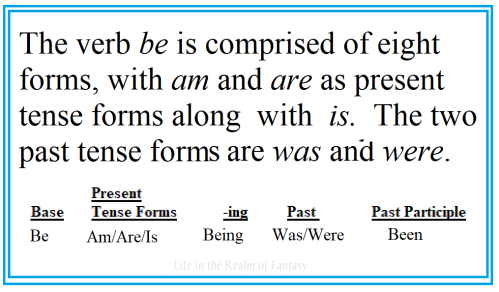
Of all Modern English verbs, to be has the most forms: am, are, is, was, were, be, being, been. In addition, the helping verb will is used to form a future tense with be (e.g. I will be with you in a minute.)

The forms are so different in appearance that they don’t seem to belong to the same verb. The fact is, they don’t. Oh, they do now, but they came from three different roots and merged in the Old English verbs beon and wesan.

William Shakespeare said it best in Hamlet: “To be or not to be… that is the question.”

Should he exist, or should he not exist—for the deeply depressed Dane, suicide or not suicide is the question. In his soliloquy, Hamlet contemplates death and suicide. He regrets the pain and unfairness of life but ultimately acknowledges that the alternative might be worse.

Subjunctives are small verbs of existence, but just like adverbs, they are telling words. These words fall into our narrative in the first draft because they are signals for the rewrite.

Be_Eight_Forms_LIRF05122019In the rewrite, we look for the code words that tell us the direction in which we want the narrative to go.
We look at each instance and rewrite the paragraph to show the event rather than tell about it.

If we write a sentence that says a character was hot and thirsty, we leave nothing to the reader’s imagination. The reader is on the outside, looking in.

When we take that experience of thirst and make it immediate, no matter what narrative tense we are writing in, it changes everything.

Which sentence feels stronger, more pressing?

  • They were hot and thirsty.
  • They trudged on with dry, cracked lips, yearning for a drop of water.
  • I walk toward the oasis with dry, cracked lips and parched tongue.

The way we show the perception of time for these thirsty characters is the same – the narrative is in the past tense in the first two cases and the present in the third.

Each sentence says the same thing, but we get a different story when we change the narrative tense, point of view, and verb choice.

“Were” is a verb, but it is subjunctive and is perceived as a weak word, where “trudged” conveys power. The narrative time in which the story is set (past or present tense), verb choice, and expansion of the imagery – these combine to change how we see the characters at that moment.

No matter what narrative tense you choose for your story, using strong verbs to describe their actions and emotions will reinforce the reader’s connection to the characters.

For my short story, View from the Bottom of a Lake, the narrative tense that worked best was a past tense, close third person.

Peggy Jayne smiled. Beneath the green-glittering gaze, her toothsome smile flayed her daughter, leaving Sarah breathless, panicking and longing for her lake.

Who are youSometimes the only way you can get into a character’s head is to write them in the first-person present tense, which happened to me with Thorn Girl. I struggled with her story for nearly six months until a member of my writing group suggested changing the narrative tense and point of view.
Once I did that, the story fell out of my head the way I had envisioned but couldn’t articulate, and I wrote it in one evening.

My first instinct is to shake my head and back away.

But I don’t. Long ago, my Lady told me that in every life, a time will come when you arrive at a precipice. You must either leap the chasm or fall to your death.

I stand at that place now.

In traditional first-person POV, the protagonist is the narrator. We must keep in mind that no one ever has complete knowledge of anything, so the first-person narrator cannot be omnipotent.

powerwordsWordCloudLIRF06192021Every story is unique, and some work best in the past tense, while others need to be in the present. When we begin writing a story using a narrative time that is unfamiliar to us, we may have trouble with drifting tense and wandering narrative points of view.
This happens most frequently if you habitually write using one mode, say the third-person past tense, but switch to the first-person present tense.

For this reason, when you begin revisions, it’s crucial to look for your verb forms to make sure your narrative time doesn’t inadvertently drift.


PREVIOUS POSTS IN THIS SERIES:

Storyboarding character development 

Character Development: Motivation drives the story 

Character Development: Emotions

Character Development: Showing Emotions

Character Development: Managing the Large Cast of Characters

Character Development: Point of View

This post: Character Development: Narrative Time


Credits and Attributions:

Maeve Maddox, The Many Forms of the Verb To Be, Copyright © 2007 – 2021 Daily Writing Tips. All Right Reserved

Quote from View from the Bottom of a Lake, © 2020 Connie J. Jasperson. Story first appeared in the anthology Escape, published by the Northwest Independent Writers Association and edited by Lee French.

Quote from Thorn Girl, © 2019 Connie J. Jasperson. Story first appeared in the anthology Swords, Sorcery, and Self-rescuing Damsels, edited by Lee French and Sara Craft.

14 Comments

Filed under writing

Character Development: Point of View. Who is Telling the Story?

The descriptive narrative of a story is comprised of three aspects:

Narrative point of view is the perspective, a personal or impersonal “lens” through which a story is communicated.

Narrative time is the grammatical placement of the story’s time frame in the past or the present, i.e., present tense (we go) or past tense (we went).

Narrative voice is the way in which a story is communicated. How it is written is the author’s fingerprint.

WritingCraftSeries_narrative modeToday, we’re focusing on the narrative point of view, discussing who can tell the story most effectively, a protagonist, a sidekick, or an unseen witness.
The words objective narrator and omniscient narrator (in modern literary terminology) are reserved for non-participant voices: the 3rd Person narrator. We can use this mode in several ways for our descriptive passages.

The 3rd person omniscient narrative mode refers to a narrating voice that is not one of the participants. This narrator views and understands the thoughts and actions of all the characters involved in the story. This is an external godlike view.

David remembered Selina’s instructions, but things had changed. With no other option, he turned and dropped the gun into the nearest dumpster.

The third-person point of view provides the greatest flexibility and thus is the most commonly used narrative mode in literature. In the third-person narrative mode, every character is referred to by the narrator as “he,” “she,” “it,” “they,” or other gender terms that best serve the story.

The writer may choose third-person omniscient, in which every character’s thoughts are open to the reader, or third-person limited, in which the reader enters only one character’s mind, either throughout the entire work or in a specific section.

Third-person limited differs from first-person because while we see the thoughts and opinions of a single character, the author’s voice, not the character’s voice, is what you hear in the descriptive passages.

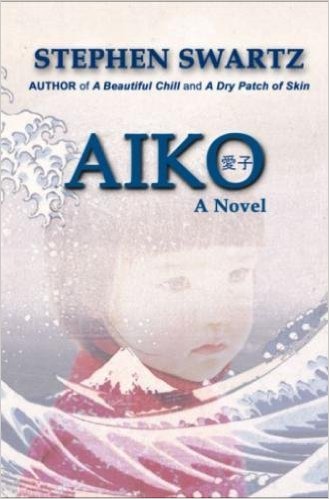
aikoSome third-person omniscient modes are also classifiable as “third-person subjective,” modes that switch between the thoughts, feelings, etc. of all the characters.
This mode is also referred to as close 3rd person. At its narrowest and most personal, the story reads as though the viewpoint character were narrating it. Because it is always told in the third person, this is an omniscient mode.

This mode is comparable to the first-person in that it allows an in-depth revelation of the protagonist’s personality but always uses third-person grammar.

Some writers will shift perspective from one viewpoint character to another. I don’t care for that but occasionally find myself falling into it. I then have to stop and make hard scene breaks because it’s easy to fall into head-hopping, which is a serious no-no.

Head-hopping occurs when an author switches point-of-view characters within a single scene. It happens most commonly when using a third-person omniscient narrative, because each character’s thoughts are open to the reader.

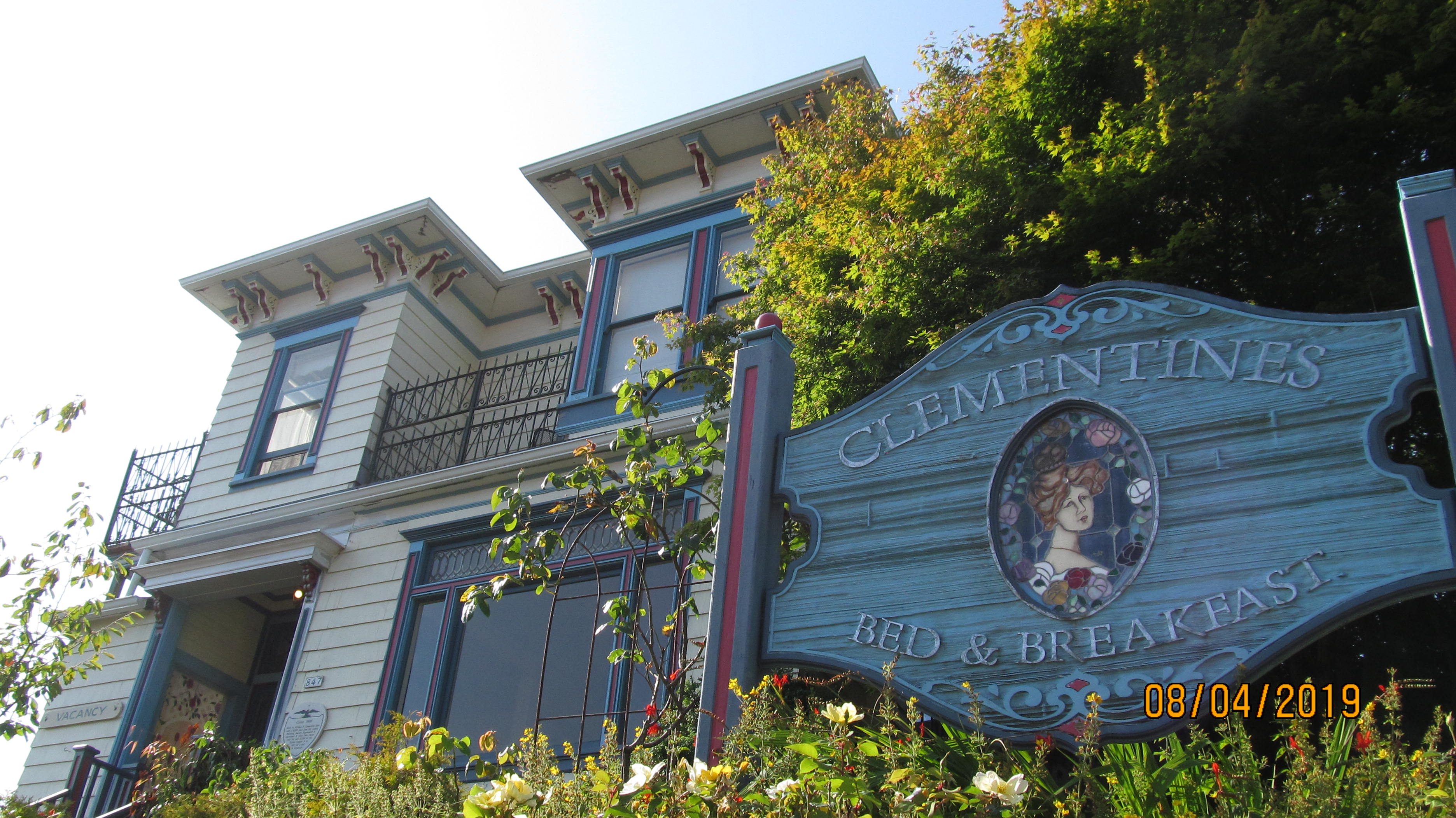
To wind up this overview of the third-person narrative mode, we have the Flâneur (idler, lounger, loiterer.) This is traditionally a form of third-person point of view, but I like to think of it almost as a fourth POV. Many of you have heard of it as third-person objective or third-person dramatic.

Clementines_Bed_and_BreakfastThe flâneur is the nameless external observer, the interested bystander who reports what they see and overhear about a particular person’s story. They garner their information from the sidewalk, window, garden, or any public place where they commonly observe the protagonists. They are an unreliable narrator, as their biases color their observations. In many of the most famous novels told by the flâneur, the reader comes to care about the unnamed narrator because their prejudices and commentary about the protagonists are endearing.
On Saturday mornings, at seven o’clock, Wilson always passed my gate as he walked to the corner bakery. He bought a box of maple bars, which he carefully held with both hands as he returned. I imagined he served them to his wife with coffee, his one thoughtful deed for the week.

Sometimes, the story works best when it’s told by the characters central to the story’s main action. Other times it is best told by the witnesses. So now we come to the two terms, reliable narrator and unreliable narrator, that describe participant narrator/observers.

The first-person point of view is common and is told from one protagonist’s personal point of view. It employs “I-me-my-mine” in the protagonist’s speech, allowing the reader or audience to see the primary character’s opinions, thoughts, and feelings.

Many authors employ the first-person point of view to convey intimacy when they want to tell a story through the protagonist’s eyes. With the first-person point of view, a story is revealed through the thoughts and actions of the protagonist within their own story.

The waves carried me, and I fell upon the shore, a drowning man, clutching at the stones with a desperation I had never before known.

Second-person point of view, in which the author uses “you” and “your,” is rarely found in a novel or short story. However, it can be an effective mode when done right.

You enter the room, unsure if you’re dreaming. Yet, here you are, in the tangible reality of devastation, stumbling over the wreckage of your life.

IndieGuideCoverSecond-person point of view is commonly used in guidebooks and self-help books. It’s also common for do-it-yourself manuals, interactive fiction, role-playing games, gamebooks such as the Choose Your Own Adventure series, musical lyrics, and advertisements.
Some stories seem to demand a first-person narrator, while others are too large and require an omniscient narrator.

Your homework for the week, should you choose to try it: Experiment with point-of-view. Write a scene from one of your works in progress using all the different narrative modes discussed. How does the way you see your story change with each change of point-of-view?


Previous Posts in this Series:

Storyboarding character development 

Character Development: Motivation drives the story 

Character Development: Emotions

Character Development: Showing Emotions

Character Development: Managing the Large Cast of Characters

This Post: Character Development: Point of View

7 Comments

Filed under writing

Character Development: Managing the Large Cast of Characters

This has been a productive summer for me. My sister, who kindly gives all my manuscripts a final reading and critique before I send them off to be line edited, is now reading the novel I accidentally began last November. I have inadvertently started a second book featuring these characters, which, only a week ago, I had no intention of writing.

WritingCraftSeries_character-arcI had no intention of writing book one either, but there it is. These characters won’t let go of me, so now I’m storyboarding a new plot.
But enough about that.

Today, we’re continuing our discussion of characters and characterization. Ordinarily, I keep the ensemble narrow, limiting point of view to only one, two, or three characters at most. I keep the supporting cast limited to four or five, as that’s all I personally can keep separate and unique.

Also, I keep my stylesheet/storyboard updated whenever a large change occurs, such as a character’s name being a duplicate. Any number of evolutionary occurrences can happen in the first draft, and for the sake of continuity, the stylesheet is how I keep track of them.

What if your plot is in a setting where the events affect a large group of characters, all of whom must interact with each other? How do you keep the threads straight and generate sympathy for each of them?

First, writers absolutely must acquire and read novels written by best-selling authors and dissect their work. That’s the only way to discover what works for you as a reader and what doesn’t. You also discover what the public is buying in that genre.

I write fantasy novels, but my published short stories are a mix of sci-fi, fantasy, and contemporary women’s fiction. I read in all genres.

What I really want as a reader is a damn good story, and I don’t care about the genre.

Give me a novel that rings my bells and rattles my world. After that first reading, I will sit down and dissect that book line by line, trying to see what hooked me. I may have bought the book for the blurb and the cover, but it was the characters who sucked me into their world.

So, let’s talk about books with large casts of characters. How does one keep them separate, prevent the reader from becoming confused, and ensure the plot rolls forward at a good pace?

Nine_Perfect_Strangers_Liane_MoriartySeveral years ago, I read Nine Perfect Strangers by Australian author Liane Moriarty, and I talked about it on this blog. The book details the experiences of nine people booked into an exclusive Australian health spa and three staff members.

Moriarty’s characters are immediately engaging. They sucked me into their world in the opening pages. I couldn’t set the book down, as I wanted to know everyone’s dark secrets. I was hooked; I had to know what led each person to book themselves into that very unusual health spa.

By the time I reached the truly startling conclusion, I looked forward to the informational epilogues just because I didn’t want to let go of the characters.

Moriarty introduces us to the cast by opening with Yao and his experience as an EMT and introducing us to Masha as she suffers a heart attack.

Ten years later, the story picks up when nine people meet at an exceedingly remote health spa. The brochure advertising it promises to change their guests’ lives, guaranteeing a complete transformation in only ten days.

All the reviews are glowing, but none explain how such a change will be accomplished. Each guest arrives with secrets and personal reasons for wanting to be remade into something better than what they believe they are. Several chapters in, Masha is revealed as the benevolent antagonist, and Yao has become her disciple.

Structurally, the novel is a bit jerky, and the ending is a series of infodumps.

But it works.

Liane Moriarty’s characters are captivating because, at the outset, she establishes each as an individual in physical appearance, personality, history, and endows them with a mystery.

Each character is a “fish out of water.” They are thrust immediately into an unknown and possibly dangerous environment.

I had no trouble following who was who. Every character has an unmistakable surface persona, an outward personality that is different from the others, and their names are unique.

Soon after meeting them, we see glimpses of weaknesses and fears, the sorrows and guilts that drive them.

The nine guests have each signed contracts prior to arriving at the wilderness spa. When it becomes clear that the rules they have agreed to obey are iron-clad and strictly enforced, each guest becomes angry and afraid.

Yet, they are willing to continue because of what they hope to gain on a personal level.

All the characters’ stories combine and connect to make a larger, powerful story of personal transformation.

So, what did I learn from reading that novel?

Neil_Gaiman_QuoteI had a reaffirmation of sorts; the reassurance that no writer can follow every writing group rule and no book that does would be worth reading.
Info-dump-epilogues often follow Moriarty’s endings, but only an experienced writer or another editor would notice (as I did) or care.

This little bunny-trail habit is a trait I’ve observed in all Moriarty’s books. The lingering epilogue is her fingerprint, a style of storytelling that is immediately recognizable as hers. In some ways, the imperfections of her structure add to the flavor.

To keep our imaginary people unique, it’s crucial to reveal snippets of their character arcs with each scene. Then we must blend those secrets into the evolving plot. Moriarty is a master at this.

Her narratives are smooth and easily readable, and for me, the lingering backstory dump at the end of her novels isn’t a deal-breaker.

Plot-exists-to-reveal-characterEvery successful writer has habits that are technical wrongs, habits that don’t fly when offered to a critique group. Yet, these patterns persist in their work over their career because they are part of that author’s creative process.
I love discovering how and where a successful author commits a large technical no-no but doesn’t derail the story. It reinforces my belief that good writing and great characterization require developing a voice and style.

Most readers read for fun and are forgiving of the flaws that we who write and edit for other writers notice. Good prose, compelling storylines, and strong character arcs engage the reader and overcome most writing wrongs.


Previous posts in this series:

Storyboarding character development 

Character Development: Motivation drives the story 

Character Development: Emotions

Character Development: Showing Emotions

This post: Character Development: Managing the Large Cast of Characters

Next up: Character Development: Point of View

11 Comments

Filed under writing

Character Development: Showing Emotions

Most authors who have been in writing groups for any length of time become adept at writing emotions on a surface level. We bandage our wounded egos and work at showing our characters’ inner demons. We spend hours writing and rewriting, forcing words into facial expressions.

depth-of-characterHappiness, anger, spite – all the emotions get a description. Eyebrows raise or draw together; foreheads crease and eyes twinkle; shoulders slump and hands tremble. Lips turn up, lips curve down, and eyes spark – and so on and so on.
Using facial expressions as dialogue tags can work when done sparingly and combined with a conversation.

But that solution can easily become a crutch that keeps us from delving deeper into our characters.

Also, it’s aggravating when it becomes repetitive.

And this brings me to the core of this post. In the early drafts of my most recent work in progress, I struggled to give my characters balanced personalities. During NaNoWriMo, when I was writing new words as quickly as I could, I leaned too heavily on the external, with a LOT of smiling and shrugging.

Those facial expressions were code words for the second draft, places where more work would be required to flesh out the scene.

Nothing is more ordinary than a story where a person’s facial expressions take center stage, hollow displays of emotion with no substance. Lips stretch into smiles, but the musculature of the face is only a small part of the signals that reveal the character’s interior emotions.

Then, there are the stories where the author leans too heavily on the internal. Creased foreheads are replaced with stomach-churning, gut-wrenching shock, or wide-eyed trembling of hands.

And don’t forget the recurring moments of weak-kneed nausea.

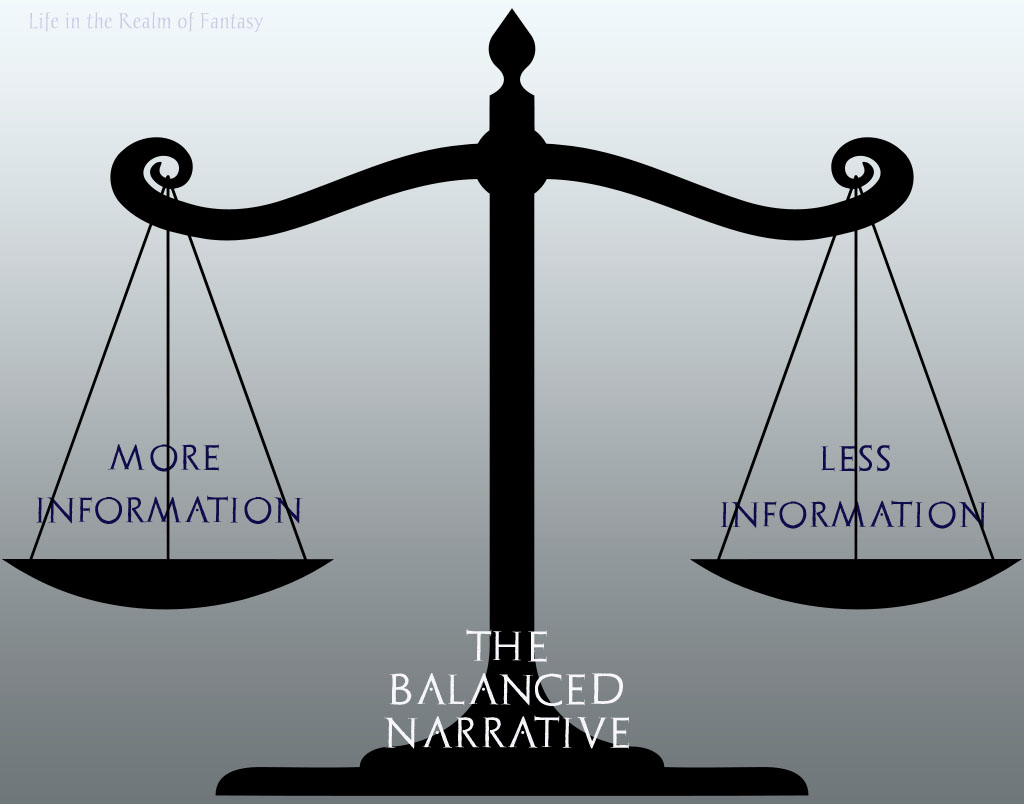
the balanced narrativeFor me, the most challenging part of writing the final draft of any novel is balancing the visual indicators of emotion with the more profound, internal clues.
It takes effort to write a narrative so that we aren’t telling the reader what to experience. We allow the reader to infer what to feel (remember we are still in the inferential layer of the Word-Pond). We must make the emotion feel as if it is the reader’s idea.

If you haven’t seen this before, here is my list of surface emotions:

  • Admiration
  • Affection
  • Anger
  • Anguish
  • Anticipation
  • Anxiety
  • Awe
  • Confidence
  • Contempt
  • Defeat
  • Defensiveness
  • Denial
  • Depression
  • Desire
  • Desperation
  • Determination
  • Disappointment
  • Disbelief
  • Disgust
  • Elation
  • Embarrassment
  • Ethical Quandary
  • Fear
  • Friendship
  • Grief
  • Happiness
  • Hate
  • Inadequacy
  • Indecision
  • Interest
  • Jealousy
  • Love
  • Lust
  • Powerlessness
  • Pride
  • Regret
  • Resistance
  • Revulsion
  • Sadness
  • Shock
  • Surprise
  • Temptation
  • Trust
  • Unease
  • Weakness

These are emotions you can show with either a facial expression or a physical reaction, combined with internal dialogue or conversations.

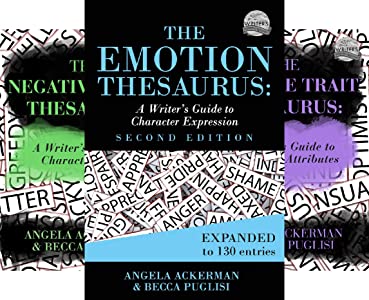
emotion-thesaurus-et-alI have mentioned The Emotion Thesaurus by Angela Ackerman and Becca Puglisi. Sometimes all we need is a hint of how to show what a character is feeling, someone to point the way when we’re suffering from a blank mind.

Just don’t go overboard when describing emotions, as it can turn into mawkishness, maudlin caricatures of emotions, and over-the-top melodrama.

Readers form mental visions of the scenes you describe, and you don’t want them to find your protagonist’s reactions repulsive.

A few subtle physical hints and some internal dialogue laced into the narrative show a rounded character, one who is not mentally unhinged.

Each of us experiences emotional highs and lows in our daily lives. We have deep-rooted, personal reasons for our emotions.  Our characters must have credible reasons, too. A flash of memory or a sensory prompt can inspire emotions that a reader can empathize with.

Why does a blind alley or a vacant lot make a character nervous?

Why does a grandmother hoard food?

Why does the sight of daisies make an old woman smile?

Writing genuine emotions requires practice and thought. Motivation is the foundation of emotion in a narrative. If a character’s eyes light up at the sight of daisies, WHY does she react with that emotion?

Emotions that are undermotivated have no base for existence, no foundation. They lack credibility and leave us, the reader, feeling as if the story is shallow, a lot of noise about nothing.

Timing and pacing are essential. Let’s say the sight of a river sparks a memory.

The emotion hits, and the character processes it, experiencing a physical reaction.

If something sparks a memory that advances the plot or explains something about the character, simply mention it in passing. That way, you avoid dumping backstory, and the reader can extrapolate the needed information.

ozford-american-writers-thesaurusOpen the thesaurus and find words that carry visual impact in your narrative, and you won’t have to resort to a great deal of description.
Weak word choices separate the reader from the experience of the narrative, dulling the emotional impact of what could be a highly charged scene.

Balancing the internal and external reactions our characters experience is necessary. Otherwise, all we have is a bunch of drama queens on a quest for sanity instead of heroes looking to rid the world of evil.

The books I love are written with bold, strong words and phrasing. The emotional lives of their characters are real and immediate to me. Those are the kind of characters that have depth and are memorable.

Homework assignment: A good exercise for writing deep emotions is to create scenes involving characters you currently have no use for.

  1. My Coffee Cup © cjjasp 2013The setting is a coffee shop.
  2. You must create two to four characters.
  3. One of them is hiding a gun.
  4. One of them is angry.
  5. Give them conversations and mental dialogue and practice using their body language instead of dialogue tags.

Mixing body language into paragraphs in place of dialogue tags to show who is speaking serves several purposes:

  • It describes what they are thinking and feeling in fewer words.
  • It keeps the “he said, they said” problem down to a dull roar.

Again, common sense is required, or the scene becomes nothing but words followed by grimaces, foot shuffling, and paper rattling.

Remember, just as in all the many other skills necessary to the craft of writing a balanced narrative, practice is required.

PREVIOUS POSTS IN THIS SERIES:

Storyboarding character development 

Character Development: Motivation drives the story 

Character Development: Emotions

14 Comments

Filed under writing

Storyboarding character development #amwriting

Every year, I participate in NaNoWriMo (National Novel Writing Month). This happens in November and is thirty days of dedicated writing. Authors with an idea for a novel sit down and daily write at least 1,667 words of a first draft.

depth-of-characterThis month of concentrated writing time is meant to help authors get the entire story down while the inspiration and ideas are flowing. At the end of the thirty days, you should have a novel-length story, hopefully with a complete story arc (beginning, middle, and end).

To succeed at completing a project with such an ambitious goal, you should spend some time planning your novel. To that end, I create a stylesheet for each project, a place to storyboard all my ideas.

I have mentioned before that I use a spreadsheet program to outline my projects, but you can use a notebook or anything that works for you. You can do this by drawing columns on paper by hand or using post-it notes on a whiteboard or the wall.

Some people use a dedicated writer’s program like Scrivener.

Everyone thinks differently, so there is no perfect way to create that fits everyone. I just happen to like working with Excel or Google Sheets.

I make this effort when the idea is first in my head. If I become lost or find myself floundering in the writing process, I can remind myself of the original concept of the story. The stylesheet is where I brainstorm ideas.

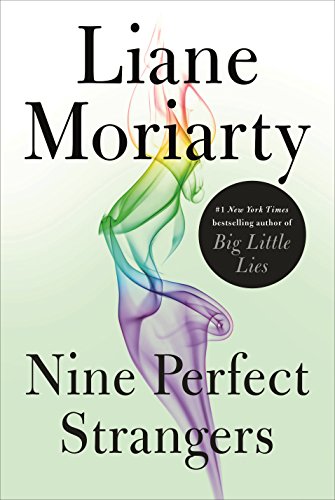
New authors spend a lot of time plotting the events of a novel, but sometimes neglect to flesh out their characters. Attention must be given to character development. The characters are the story, and the circumstances of the piece exist only to force growth upon them.

The character arcFirst, we want to get to know who we’re writing about.

Who are these people, and why should I care about them? I have a fairly good idea of how my characters look. However, that image can drift as the first draft evolves, and brown eyes are suddenly green (yes, this did happen in one of my current works in progress).

But don’t get too detailed. Readers have their own image of beauty, so don’t force your idea of loveliness on them. General description and the reactions of other characters should convey how they look.

Once I know the basic plot, I make a page in my workbook with a bio of each character, a personnel file. Sometimes I include images of RPG characters or actors who most physically resemble them and who could play them well.

Professor Reina Jacobs

  • Physical description: 5’8′, perceived-time age 55, real-time age 168. Works out daily. Has brown eyes, iron-gray hair worn in a short cut, not military short, but for ease of keeping it neat. Is a cyborg—left leg is a grafted prosthesis.
  • Personality: Competitive, highly organized, ambitious, impatient, highly focused.
  • Occupation:  Colonel, Retired. Experienced 33 years as a Warbird Pilot in the Mirandan Space Corps. Forced into early retirement from the Corps due to prosthetic leg. Leading researcher in the field of biosomes – breeding and adapting plants able to thrive in alien environments. Not too keen on promoting plants that require radical adaptations, but a strong proponent of plants that can easily adapt without destroying the ecosystem. 
  • Hobbies:  hopping up an anti-grav speedster in her garage. Loves flying low and too fast over dangerous ground.

Colonel Brandon Ladeaux, Ret.:

  • Physical Description: Dark hair turning gray, brown eyes, 6’2, works out daily. Lean and muscular. Perceived-time age 57, real-time age 198.
  • Personality: competitive, organized, slightly laid-back approach to life.
  • Occupation: Shuttle pilot. Experienced 40 years as a Warbird Pilot in the Mirandan Space Corps.
  • Hobbies: cooking, hanging around watching Reina work on her speedster. Also enjoys flying low and too fast over dangerous ground.

The personnel file is laid out this way:

Column A: Character Names. I list the important characters by name and the point where they enter the story.

Column B: About: What their role is, a note about that person or place, a brief description of who and what they are.

Column C: The Problem: What is the core conflict?

Column D: What do they want? What does each character desire?

Column E: What will they do to get it? How far will they go to achieve their desire?

storyboard_LIRF_10_31_17Names say a lot about characters. If you give a character a name that begins with a hard consonant, the reader will subconsciously see them as stronger than one whose name begins with a soft sound. It’s a little thing but is something to consider when trying to convey personalities.

Also, I’ve said this before, but with the growing popularity of audiobooks, my suggestion is to write names that are easy to pronounce. I learned that lesson when I was having a novella of three short stories, Tales from the Dreamtime, made into an audiobook. My reader was brilliant, and worked with my difficult fantasy names, but since that experience, I only write names my readers can easily pronounce.

A great story evolves when the antagonist and protagonist are powerful but not omnipotent. Both the antagonist and protagonist must have character arcs that show personal growth or inability to grow. For the antagonist to be realistic, this must be clearly shown, so they also get a personnel file.

When you begin writing the first chapters, the characters aren’t fully formed. They will evolve as a result of the experiences you write for them. Note these changes in your personnel file so that descriptions remain consistent.

I like stories featuring characters who are human. They make mistakes, cause themselves more trouble because they are untried and don’t know what they are doing.

The evolution of each character’s personal arc should parallel the events that form the story arc.

How do they handle setbacks? How do they handle success? How do they see their future when we meet them on page one? Has their view of the future changed by the time we arrive at the final page?

The characters must be changed by the events they experience. How you show their emotional state is critical because emotions engage readers. If you want your readers to feel the crisis, your characters must feel it and show their reactions to the reader.

emotion-thesaurus-et-alIf you need ideas for showing a variety of emotions, I highly recommend the Writers Helping Writers Series of textbooks written by Angela Ackerman and Becca Puglisi.

But do us all a favor—show it briefly and move on. Don’t swamp us with detailed shoulder sagging, lips turning down, and face dropping all in one sentence.

We must contrast the relative security of the characters’ lives as they were in the opening paragraphs with the hazards of where they are now. Each person experiences uncertainty, fear, anger, and sense of loss differently. Those differences make them unique characters.

In a good story, bad things have happened, and the protagonists have to get creative and work hard to acquire or accomplish their desired goals.

How they overcome their doubts and make themselves stronger is what makes each character interesting. That internal and emotional journey is the real story.

The events, mighty as they may be, are only the catalysts of personal growth. Next in this series, Character development: Motivations.


14 Comments

Filed under writing

Worldbuilding part 4: Designing the Parameters of Science and Magic #amwriting

Personal power and how we confer it is the layer of worldbuilding where writers of science and writers of magic come together.

  • WritingCraftWorldbuildingScienceVSMagicMagic and the ability to wield it confers power. Magical creatures, elves, mythical races, mythological gods and demigods – these are some of the many natural and supernatural components of fantasy.
  • Science and superior technology also confer power. Science fiction embraces current physics and theoretically possible technology, taking them into the near or distant future.

Speculative fiction is comprised of two overarching genres: science fiction and fantasy. The choice to make the technology of science or the technology of magic the primary source of power in your story determines which side of the coin lands up. The way you choose to go determines the sub-genre.

A novel set firmly in the technology of the past with no magic is not mainstream sci-fi. If it falls in late Victorian or early Edwardian times and uses the technology available in that era in advanced ways, it could be a branch of sci-fi called Steampunk.

If it takes place in an earlier era and contains magic, magical creatures, or advanced technology, it is an Alternate World fantasy (magic) or sci-fi (tech). If it has no magic or advanced technology, it could be a different genre altogether: historical fiction.

Science fiction has strict parameters established by its readers. The wise author will pay attention to those limits if they want their work to resonate with that audience.

I have said this before, but I feel the need to repeat it. Science is not magic, and it should not feel to a reader as if it were. It is logical, rooted in the realm of both factual and theoretical physics.

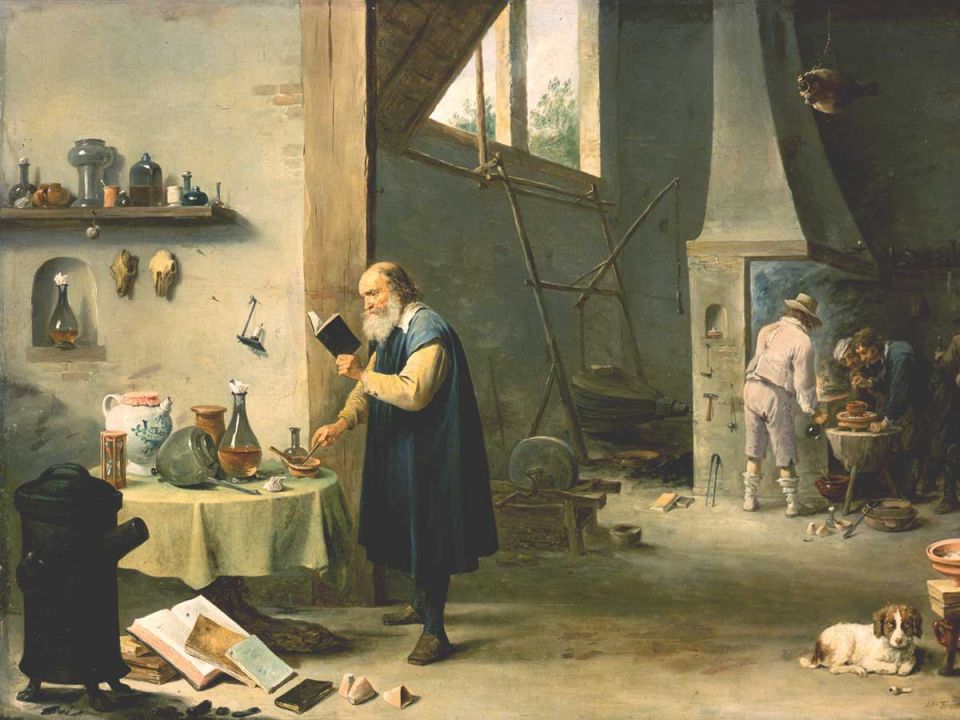
David_Teniers_the_Younger_-_The_AlchemistAuthors of sci-fi must do the research and understand the scientific method. This path of testing and evaluation objectively explains nature and the world around us in a reproducible way. The physics of our current technology, everything from toasters and cellphones to microwave ovens and spaceships has been created using scientific discoveries by people who understand the scientific method.  
Skepticism and peer review are fundamental parts of the process.

An important thing for authors to understand is who their readers are. Those who read and write hard science fiction are often employed in various fields of science, technology, or education in some capacity.

They know the difference between physics and fantasy.

The same goes for those who read fantasy: they are often employed in fields that require critical thinking.

Often, readers of both genres are avid gamers. Gamers learn to develop skillsets within strict parameters to advance in the game. Thus, logic and limitations define how much enjoyment they get from a gaming or reading experience.

I read a great many books in all genres. If I have one complaint, it is that many authors indulge in mushy science or magic. They make it up as they go, which is what we all do, but they don’t bother to cover their tracks.

When they get to the editing stage, they don’t go back and look for the contradictions in their magic or science, the places where a reader can no longer suspend their disbelief.

Magic is also a science and should be held to the same standard as physics. Having magic conveys power in the same way that having superior technology does.

If magic is a tool that your characters rely on, it must be believable. I write fantasy, so the science of magic is an underlying, invisible layer that is part of my worldbuilding process.

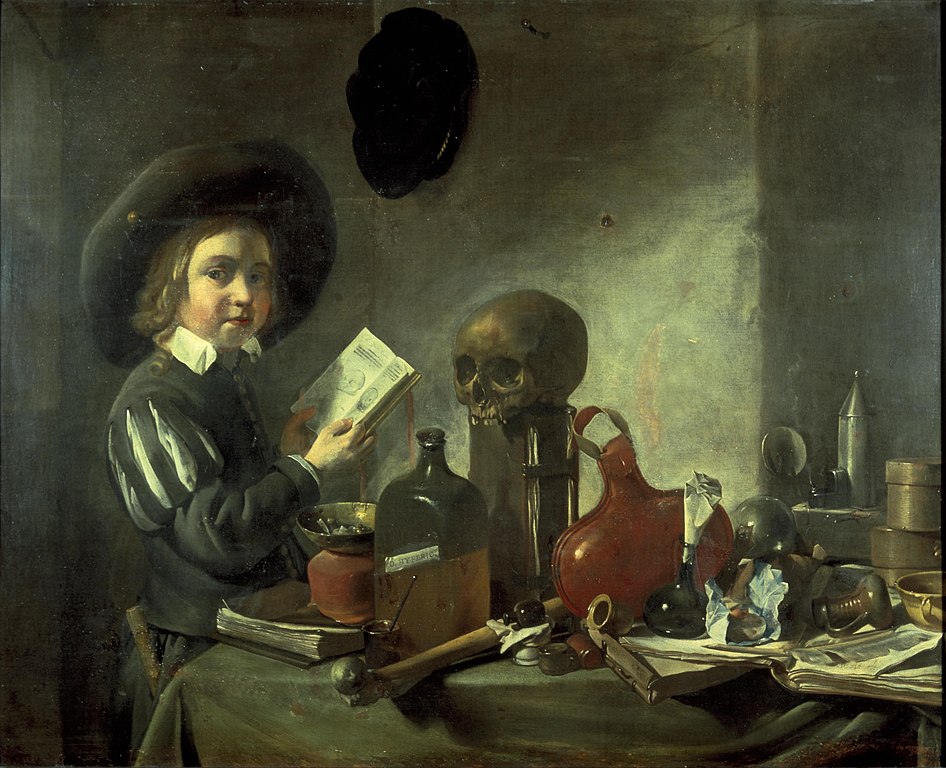
915px-An_alchemist_in_his_laboratory._Oil_painting_by_a_follower_o_Wellcome_V0017631The following is my list of places where the rules of believable magic and technology converge in genre fiction:
  1. The number of people who can use either magic or technology should be limited.
  2. The ways that characters can use magic or technology should be limited.
  3. Characters with those abilities or equipment should be limited to one or two kinds of magic/technology. Only specific mages/technicians can make use of all forms of magic/technology.
  4. There must be strict, inviolable rules regarding what each kind of magic/technology can do.
  5. The author must clearly define the conditions under which this magic/technology will work.
  6. There must be some conditions under which the magic/technology will not work.
  7. There must be limits to the damage magic/technology can do as a weapon or the healing it can perform.
  8. The wielder of this magic/technology might pay a physical/emotional price for using it.
  9. The wielder of this magic/technology should pay a physical/emotional price for abusing it.
  10. The learning curve for magic should be steep and sometimes lethal.

For the narrative to have a realistic conflict, the enemy must have access to equal or better science/magic.

Often in the case of magic, the protagonist and their enemy are not from the same “school.” When this is the case, the author has two systems and sets of rules to design for that story.

The same goes for technology. One group may have found a way to exploit physics that places the other group at a disadvantage. This disparity is where the tension comes into the story.

We authors must create the rules of magic or the limits of science for both the protagonist and antagonist. We must do it in the first stages of the writing process. If you have been creating your stylesheet, take the time to include a page defining the laws of physics/magic that pertain to your universe.

It will only require fifteen minutes to half an hour to brainstorm and create a system that satisfies the above ten requirements. This way, you will be sure the logic of your magic/technology has no hidden flaws.

When you take the time to research science technologies or create magic systems, you create a hidden framework that will support and advance your plot. Limits force us to be creative, to find alternative ways to resolve problems.

There can be an occasional exception to a rule within either science or magic, but it must be clear to the reader why that exception is acceptable.

There must be an obvious, rational explanation for that exception.

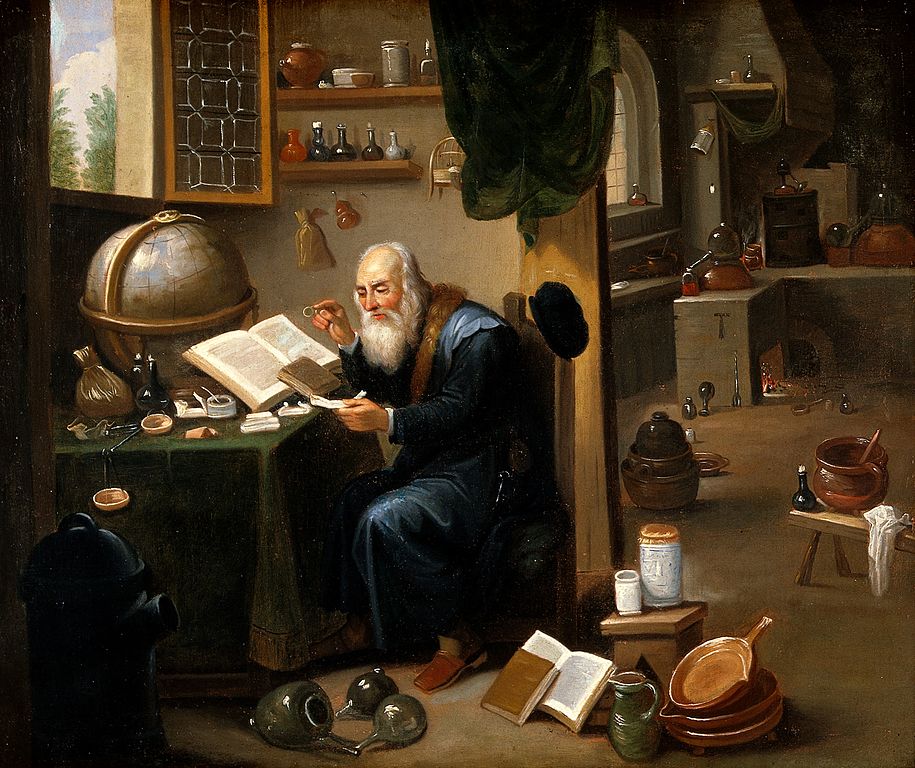
An_Alchemist_attributed_to_Joost_van_Atteveld_Centraal_Museum_20801Science or magic is only an underpinning of the plot. They are foundational components of the backstory. 
The only time the reader needs to know these systems exist is at the moment it affects the characters and their actions. When Gandalf casts a spell, or Sulu fires his phaser, the reader knows the characters have these abilities/technologies.

The best background information comes out only when that knowledge affects the story. It emerges naturally in actions, conversations, or as visual components of the setting.

By not baldly dropping the history or science/magic on the reader in paragraph form, the knowledge becomes a normal part of the environment rather than an info dump.


The previous posts in this series can be found here:

Designing the Story (includes creating a stylesheet)

Worldbuilding Part1: Climate

Worldbuilding Part 2: Maps, Place-names, and Consistency

Worldbuilding Part 3: Designing the Parameters of Science and Magic

This Post: Worldbuilding Part 4: Creating the Visual World


Credits and Attributions:

Wikimedia Commons contributors, “File:David Teniers the Younger – The Alchemist.jpg,” Wikimedia Commons, the free media repository, https://commons.wikimedia.org/w/index.php?title=File:David_Teniers_the_Younger_-_The_Alchemist.jpg&oldid=528972179 (accessed July 18, 2021).

Wikimedia Commons contributors, “File:An Alchemist attributed to Joost van Atteveld Centraal Museum 20801.jpg,” Wikimedia Commons, the free media repository, https://commons.wikimedia.org/w/index.php?title=File:An_Alchemist_attributed_to_Joost_van_Atteveld_Centraal_Museum_20801.jpg&oldid=531124885 (accessed July 18, 2021).

Wikimedia Commons contributors, “File:An alchemist in his laboratory. Oil painting by a follower o Wellcome V0017631.jpg,” Wikimedia Commons, the free media repository, https://commons.wikimedia.org/w/index.php?title=File:An_alchemist_in_his_laboratory._Oil_painting_by_a_follower_o_Wellcome_V0017631.jpg&oldid=303482875 (accessed July 18, 2021).

5 Comments

Filed under writing

Worldbuilding Part 3: Creating the Visual World #amwriting

One of the most valuable tools an author can have to aid them in worldbuilding is the stylesheet. It costs nothing to create but is a warehouse of information about your work-in-progress. If you’re smart, it contains a glossary of created words, names, a list of sites where you got your research, and myriad notes that relate to that novel.

The post on creating this essential tool is here: Designing the Story (includes developing a stylesheet).

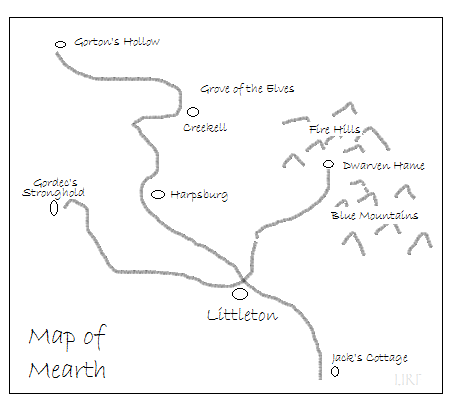
WritingCraftWorldbuildingIf you are writing a contemporary novel or historical work set in our real world, this is where you keep maps and maybe a link to Google Earth.
The original plot and characters of Mountains of the Moon began life as a storyline for an anime-based RPG that never went into production.

I had created the maps for the game, so I knew the topography was as much an antagonist as was the ultimate threat posed by the minions of the Bull God. I had to first build and then destroy the ecology for the game because the dangerous environment and creatures capable of elemental magic are a core plot point in the story, a threat with which the protagonist must learn to coexist.

The world of Neveyah, where Mountains of the Moon is set, is an alien environment. Yet it’s familiar, based on the world I live in, the Pacific Northwest. The plants and geography are directly pulled from the forested hills of Southern Puget Sound and Western Washington State.

The foods they have available to them are primarily those available in the pre-Columbian Americas, although chickens and sheep aren’t native to this continent. I also invented plants that served as medicines and were helpful as tools or dyes.

In 2010, I wrote the proto novel of what later became Julian Lackland as my first NaNoWriMo project. I drew on the landscape around me to create the world of Waldeyn, where the Billy’s Revenge series is set. I used familiar landscape and flora, but in this case, I invented creatures born of magic. These are beasts whose predations limit travel and the ability of technology to advance beyond the waterwheel. The quest for indoor plumbing is a thorn in the side of my favorite innkeeper, Billy Ninefingers.

How do you fit the visual world into a narrative without dumping it on the reader? I try to use the scenery to show the mood and atmosphere.

Ivan drew his cloak around himself, listening to the soft rattling of branches moving with the breeze. The occasional calls of night birds went on around him, as if he weren’t full of doubt and indistinct fears, as if he didn’t exist to them. Leaves fell, brown and harvest-dry, drifting, spiraling down to the forest floor.

For a moment, he caught the faint, disgusting scent of a water-wraith and drew his blade in case he had to rouse the others.

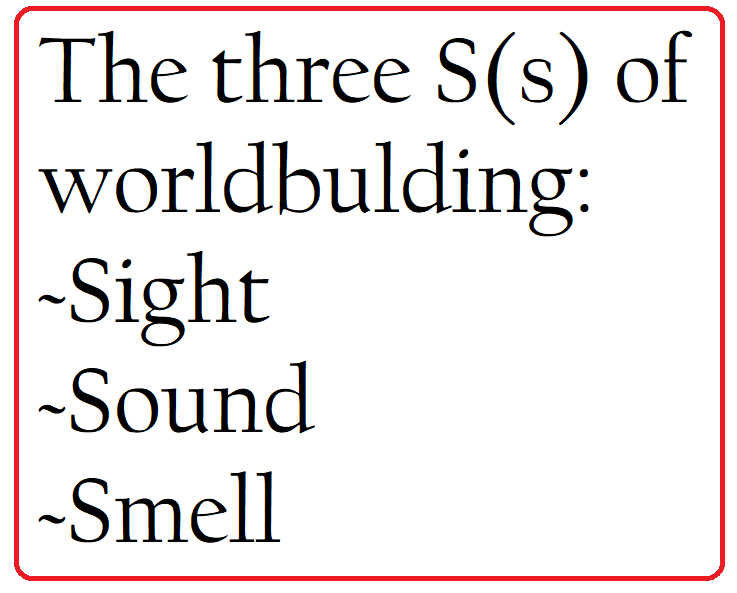
3-Ss-of-worldbuilding-LIRF07182021The “three S’s” of worldbuilding are critical: sights, sounds, and smells. Those sensory elements create what we know of the world. Taste rarely comes into it, except when showing an odor.
Inside the lair, the caustic atmosphere burned her eyes and throat. “Shallow breaths,” she reminded herself. The nest was huge, but Sofia climbed in and quickly grabbed the egg, slipping it inside her shirt, next to her skin. She switched the round rock into its place, positioning it as the egg had been.

 Silently, she ran back to the entrance, slipping from boulder to boulder until she disappeared into the shrubbery. Once hidden in the thick undergrowth, she breathed deeply, but the metallic aftertaste of the bitter air lingered.

In my part of the world, Douglas fir and western red cedar are the most common tree species. They both can reach up to 80 – 100 meters with a trunk up to 3 meters across. Western hemlock is shorter, only 60 meters, but has a larger trunk, up to 4 meters wide. Once a familiar tree, it became less common as old-growth forests were cut down and replaced with plantations of fast-growing Douglas fir.

Modern forest management has developed an understanding of the interdependence of diverse forest species, so a more natural approach to managed forestry has evolved.

These are the native forest trees I see in the world around me, along with big-leaf maples, alders, cottonwood, and ash. This is the world I visualize when I set a story in a forest.

What makes up your written world? How does your environment affect the way your characters live?

Darkness had fallen, but the alley’s gritty pavement still radiated a low heat. Wanda raised her eyes to see the new moon high in the black velvet sky, the distant stars obscured by the glow of neon signs and halogen streetlamps.

The odors behind the Flamingo Bar and Grill offered a pungent counterpoint to the aromas of burgers and barbecue emanating from inside. Above the back door, the weak bulb flickered but remained on, illuminating the litter.

Just a few more minutes and Bill would emerge. She knelt beside the dumpster, the gun pointed, cocked, and ready.

You might believe you can’t picture a place you haven’t been. Why?

Open your eyes and look around.

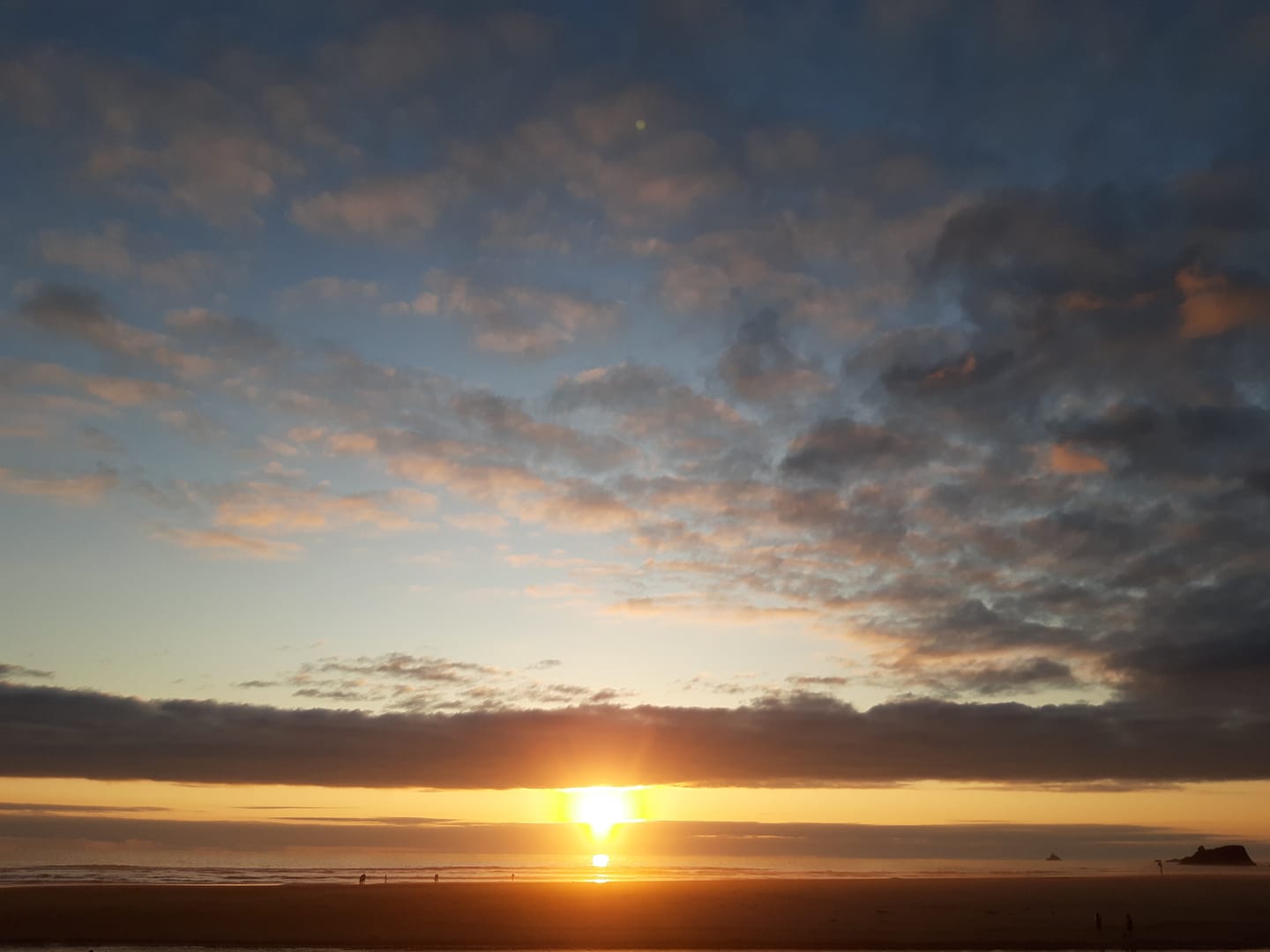
Sunset_Cannon_Beach_05_August_2019At this moment, inside your room and outside your door, you have all the elements you need to create an alien or alternate world.

These elements might exist before your eyes, or they live in your memory. Use what you know.

Reshape your environment, reuse it, and make it your fictional world.


The previous posts in this series can be found here:

Designing the Story (includes creating a stylesheet)

Worldbuilding Part1: Climate

Worldbuilding Part 2: Maps, Place-names, and Consistency

This Post: Worldbuilding Part 3: Creating the Visual World

Up Next: Worldbuilding Part 4: Designing the Parameters of Science and Magic


Credits and Attributions:

Sunset by Connie J. Jasperson © 2019, All Rights Reserved.

7 Comments

Filed under writing

World-building part one: climate #amwriting

Hello from a small town near beautiful Olympia, Washington. June was a strange month, climate-wise. We usually have the same climate as those of you in Wales or England.

MyWritingLife2021BOn June 27th, within the space of days, we went from temperatures well below average, low to mid-60s, and pouring rain to suffering from temperatures well above 100 degrees—108 at my house, 111 at my sister’s house 10 miles away. We use Fahrenheit in the US, but for you in the UK and Europe, we topped out at around 44 degrees Celsius. For more on the week from H**l, see this article in the Seattle Times.
Now we’re back to temperatures that are slightly above normal, getting up to the mid to upper 80s, and we feel like that’s a cool breeze.

Air conditioning isn’t as commonly built into homes here as in other parts of the US. Those of us who have the occasional A/C window unit are the lucky ones. This is because, until recent years, summers here never really began until July 5th or so, with low clouds and drizzle for much of June, and they never became unbearably warm.

When the sun did arrive, temperatures, for most of the time we have kept records, ran into the high 70s or rarely, low to mid-80s. We are said to have a generally mild climate, and while that is changing, we hope it will remain mostly temperate.

When the heatwave hit, our free-standing A/C unit saved us, but when the outside temperature reached 108, the temperature in our back hallway was still 89 degrees.

Until this year, that seemed uncomfortably warm.

Now we’re grateful for a day that doesn’t end with us prostrate.

So, let’s look at the weather as a factor in world-building.

What follows is a plan to help you lay the groundwork for the world in which your novel is set. First, what sort of world is your life set in? When you look out the window, what do you see?

I always think that if an author can inject enough reality into a fantasy or sci-fi setting, the world will feel solid when I read it.

The weather can be shown in small, subtle ways. Usually, authors use the weather as background to give a sense of place to our characters’ interactions and the events they precipitate.

The path was slippery and required scaling the cliff in some places. By the time they arrived at the clifftop, the sky had begun to clear, and the low fog was dissipating. Patches of blue peeked from behind the gray clouds, and the wind had picked up.

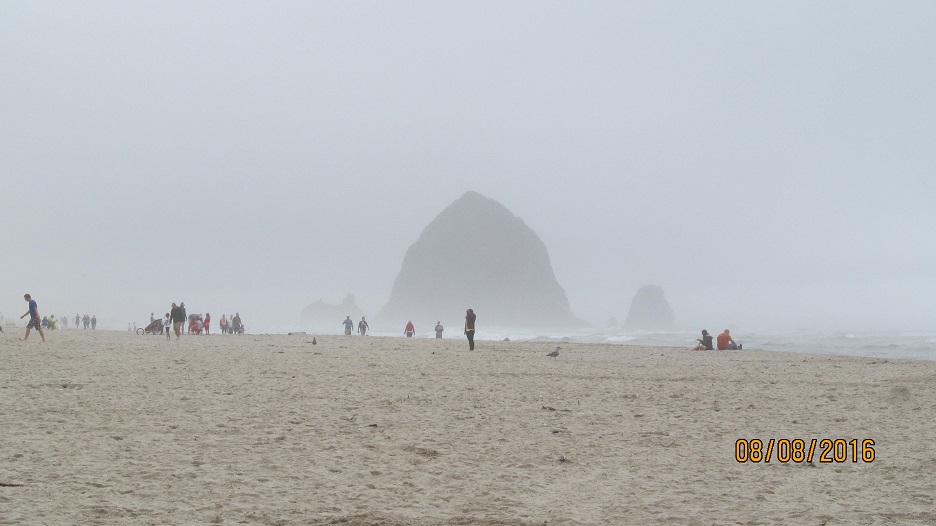
Haystack_Rock_in_the_fog_©2016_Connie_J_Jasperson_LIRF07112021

Haystack Rock in the Fog

Other times, weather becomes the star of the story. Tornados, hurricanes, bizarre heatwaves—these weather events can be the villain our heroes must overcome.

Once you have decided your overall climate, do some research on how the weather affects agriculture and animal husbandry.

The best way to make the fantasy world real is to visualize the scene clearly and place yourself there. Blend what you know about the natural world into it. Write out all the details that will never make it into your story, things you as the author must have set in your mind.

Now we get to the tactile parts of the setting:

How does the weather make the characters feel? Is it too warm, too wet, or is it pleasant? If your novel’s setting is a low-tech civilization, the weather will have a different kind of effect on your characters than one set in a modern society.

Parker observed the beach from his balcony. Far down at the north end of the cove, Leo and Claire walked beside the surf, with Leo’s gestures emphasizing his words. Claire was hunched against the sharp breeze in her hooded sweatshirt and agitated. It was clear her agent had told her something she didn’t want to hear.

In any era, the weather affects the speed with which your characters can travel great distances and how they dress. Bad weather always has a detrimental effect on transportation, a serious point to consider.

For example, when the heatwave was just beginning, when it was still only building, we made a trip 80 miles north to visit two of our daughters. We stayed the night in Snohomish, then stopped in Bothell to have lunch with our second oldest son. We left our last stop in Bellevue at 3 pm to head home.

sample-of-rough-sketched-mapThe journey from our youngest daughter’s house to our home 60 miles south of there took 3 ½ hours, a trip that should take an hour. Unfortunately, traffic had ground to a halt in many places. At times, we would speed along at 5 miles an hour, sometimes as fast as ten. Many drivers couldn’t handle the 94-degree heat of that day, and their short tempers combined with several stalled vehicles made for a miserable journey down I5.
But enough about the wretched climate and the effects of global warming on my life. Our next post will talk about location, and why I make simple maps for every fantasy world in which my work is set.


Credits and Attributions:

Haystack Rock in the Fog, © 2016-2021 Connie J. Jasperson, All Rights Reserved.

Map of Mearth, © 2015-2021 Connie J. Jasperson, All Rights Reserved.


9 Comments

Filed under writing

Fundamentals of Writing: Depth part 1 – identifying the weaknesses #amwriting

You have finished your first draft, successfully taken your characters from the opening pages through several disasters, and given them a smashing conclusion. You wrote “the end,” so now you’re finished! Time to upload it to Amazon and wait for the accolades to roll in.

depthPart1revisionsLIRF05252021STOP! If you value your reputation, you won’t rush to publish that mess just yet.
In my previous post, I outlined the stages of book construction using a traditional phased method of project management.

  1. The Concept. Make a note of that brilliant idea. Write it down, so you don’t forget it.
  2. The Planning Phase is where I create an outline. Some people don’t need this step, but I do.
  3. The Construction Phasewrite the first draft from beginning to the end.
  4. Monitoring and Controlling—For writers, this is actually a continuation of step three, a part of the construction phase. This is where you build quality into your product. If you are an outliner, this phase might go smoothly.
    • Create a style sheet as you go. See my post on style sheets here: Self-editing: Ensuring Consistency.
    • Find beta readers among your writing group and heed their concerns in the rewrites.
    • Take the manuscript through as many drafts as you must to have the novel you envisioned.
    • Employ a good line editor to ensure consistency in the quality of your product.
    • Find reliable proofreaders. (Your writing group is an invaluable resource.)
  5. Completion or Closing.

As you can see, when you write “the end” at the bottom of the last page, you have only completed the development and initial construction phase of this project.

800px-Singapore_Road_Signs_-_Temporary_Sign_-_Detour.svgNow you must set it aside, as you must gain a little distance from it to see it with a clear eye. This is where I seek an outside opinion on the strengths and weaknesses of my proto-novel. I am fortunate to have a local writing group of highly talented published authors. I also trade services with several editors. When the first draft of my manuscript is finished, I send it to a reader. While they are reading it, I work on something completely different.

You must ask your reader to look for and point out weaknesses. You need to know where you’ve over-explained, what needs to be expanded upon, and if the story has a satisfying conclusion. At this point, your manuscript needs line editing, but the first reader must understand that you aren’t at that stage yet. Beta readers must be able to look beyond those flaws and see the story as a whole.

Authors are thin-skinned. We are full of expectations that all readers will enjoy it and tell us how stellar it is. You must be prepared for your manuscript to come back with some critical observations. I have felt the sting and burn of honest criticism and was utterly crushed.

I had to put on my big-girl undies and grow up.

The real work begins when we get the first reader’s assessment back, and it isn’t what we thought we would hear.

If you had a conscientious reader, they noticed those massive info dumps. You know the ones, the long paragraphs of backstory we write to explain things.

Hopefully, your reader is familiar with your genre and knows about features such as horses, medicine, or police procedures. If so, they may tell you that more research is required.

Sometimes, the feedback we get means that we now have to completely rethink what we thought was the perfect novel.

Book- onstruction-sign copyAt this point, an amateur decides the beta reader missed the point and chooses to ignore their comments. Our unrealistic belief that our work is perfect as it falls from our minds is a failing that we must overcome if we want to engage readers.
When you have received your manuscript back with the reader’s comments, it’s time to begin the second draft. This is the area of construction where we straighten out confusing passages and make positive changes by adding or cutting scenes. We begin to add depth to our novel.

In my current manuscript, several areas were identified that needed attention.

First, my reader liked the overall story and found the characters engaging. However, she felt I hadn’t explored their relationships well enough to show their growing attraction. The eventual pairing seems to come out of nowhere. That relationship lacked depth.

Also, she pointed out where I had missed an excellent opportunity to inject real tension into the midpoint crisis. She also felt a lack of tension in the final pages.

In other words, the story lacks depth and tension at this point in its development. The work isn’t done; it’s only just begun.

This is where the intelligent author puts her reader’s observations to work. I took Alison’s comments to heart and considered the midpoint crisis. A solution presented itself, turning the story on its head. By doing that, an opportunity to make the final confrontation more perilous presented itself.

I added two chapters and trimmed back three. I slightly changed how the characters interact initially, making their mutual attraction a sub-thread that gradually grows from the moment when Character Two enters the story.

This novel tells the origin of an artifact that will be a strong thread in this series, but it is more focused on the internal battles we fight as part of the human condition. Each of us experiences emotional highs and lows in our daily lives. I must bring forward a specific layer of depth, the deep-rooted, personal reason for the emotions I want to portray.

Reactions must have a cause, something to react to. Depth can be instilled by adding a few well-chosen words, a sentence or two to show a flash of memory, a sensory prompt that a reader can empathize with.

But I'm not superstitious, LIRFIn my current work, the thoughts and motives of the characters are critical to the midpoint event and subsequent crisis of faith. Yes, who these people are, and their place in the story at the point where we meet them is crucial to the plot.

But the plot is only the surface. Below the surface, lending substance to the narrative, lies the layer of inference and implication. This layer conveys a sense of solidness, of complexity.

This layer must be handled deftly because you want the reader to feel like they have earned the information they are gaining. Yet, you must leave enough clues lying around that they can understand what you are implying. Readers can only extrapolate knowledge from information the author has offered them.

Depth is a vast word, considering that it consists of only five letters. Depth is complexity, intensity, and profoundness. These qualities are shown when each character’s sub-story is built upon who these characters think they are.

On Monday, we will take a closer look at some ways to build depth into the interactions of our characters.

2 Comments

Filed under writing