
We are still working on creating the characters for our NaNoWriMo 2021 novels. Our plan is to have everything in place on November 1st to begin writing with all the prep work done. We intend to have the first draft of our novel written from beginning to end on November 30th.
 When we commence writing on the 1st of November, we will know what has to happen at each point along the story arc, but we will have the freedom to “pants it” between each plot point. “Pantsing” is writer slang for “flying by the seat of your pants.” Hopefully, we will be able to write 1,667 words every day and meet our goal of a finished novel or 50,000 words at midnight on the 30th.
We are still working on our storyboard, and today we are fleshing out the sidekicks and other characters. To see how I do a storyboard, check out this post: #NaNoPrep: part 1: What’s the Story? | Life in the Realm of Fantasy .
My main character, Ivan, has a complicated life. He is a husband and father, a master armorsmith, and a shaman. A fire-mage, he is a Sword of Aeos, dedicated to serving the people of Neveyah. He is secretly a Hunter of rogue-mages and mindbenders (empathically gifted healers who have gone rogue.)
Lee French, my co-municipal liaison here in the Olympia Region, suggests you identify what your main character wants. She says, “Everybody has goals, and so does your MC. They want things. Some goals are big and world-shaking. Other goals are small and personal. Some goals are easy and quick to achieve, others take months or years, or a 20-book series.
“For your MC, define at least three goals your character has at the start of the story, either knowingly or not. Big, small, easy, or hard, they need or want something, and that’s what will get your story rolling.”
These are some examples of goals that Lee suggests:
- Survive
- Make a friend
- Find love
- Kill the bad guy
- Escape a bad situation, like prison or an abusive relationship
- Find food and/or water
- Steal something specific
- Admit they have an addiction problem
- Take Thing X to Location Y
- Learn a specific skill
- Get a job
- Earn respect from Person A
- Acquire $Z
- Rescue or protect Person B
- Save the world
Any of the above goals can be the main driving force of a story, or they can be secondary goals that help determine how your MC pursues the primary objective (s).
My main character, Ivan, wants to eliminate the rogue-mage, save the people of Tribe Anendale, and get home to his children.
With Ivan’s goals identified, I move on to the others with a part in this story. I will add a little information to my storyboard every day as I think about it.
Who are Ivan’s side characters? As this is a book two, Ivan’s support group is established.
Kai is an earth-mage and a master mason, Ivan’s life-partner. Kai is tall, has brown hair, green eyes. He and Ivan’s father, an earth-mage named Aengus, have a quarry on the outskirts of Weiland. Aengus usually manages large building projects for the tribe, such as canals or fortifications, and Kai runs the quarry and builds the occasional home for community members as needed. They have four children. Ivan’s obligations as a shaman limit his free time, but he and Kai share parenting and homemaking duties.
The rest of Ivan’s family lives in the same row of five rowhouses, joined by a long porch. The family consists of his brother Aldric whose wife Marta is a water-mage and their three children. In the center house is their maternal grandfather, Benn, who cares for the children while the others work. Also living in their row of houses are his father, Aengus, and Jan, a master-smith and Ivan’s business partner (Aldric’s father-in-law). All but Benn are involved with hunting rogue-mages and mindbenders.
Nolin is the high elder of Anendale. He is tall, has dark skin, black curly hair, and dark brown eyes. He wants Ivan’s group to eliminate the rogue-mage and root out the dark god’s disciples.
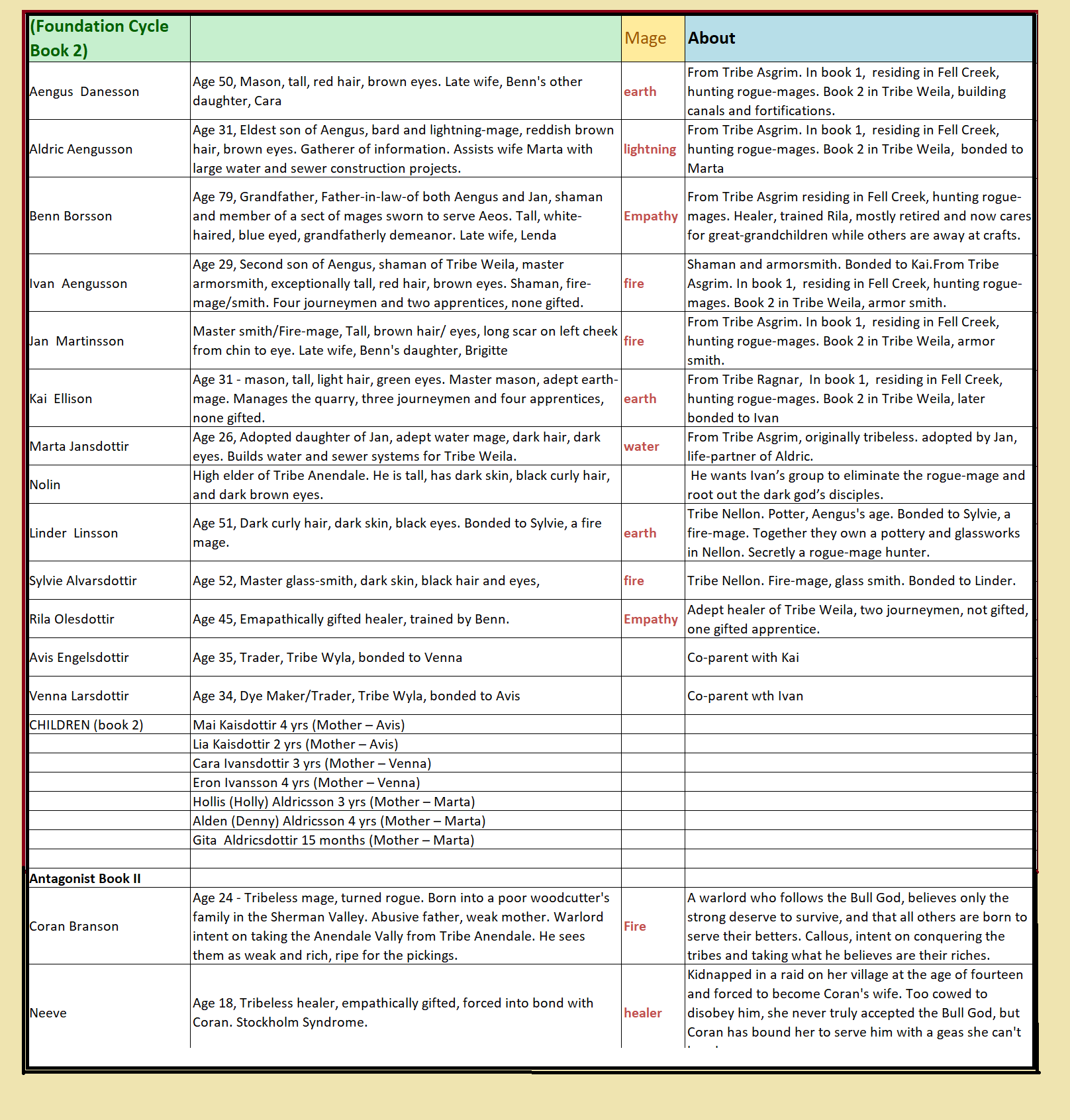 Every side character has hopes and wants something, so that will be noted.
But what of my antagonist? I’m plotting book two, so a new antagonist is required.
Coran Branson: Tribeless fire-mage, turned rogue. Follows Tauron the Bull God. Born into a poor woodcutter’s family in the Sherman Valley. Abusive father, weak mother. Warlord intent on carving his empire. He considers the tribes weak and rich, ripe for the pickings. Sees himself as an all-conquering emperor on a holy mission of pillage and plunder, a Genghis Khan but with fire magic.
Neeve: Tribeless healer, empathically gifted. Kidnapped in a raid on her village at the age of fourteen and forced to become Coran’s wife. Too cowed to disobey him, she never truly accepted the Bull God, but Coran has bound her to serve him with a geas she can’t break. Think Stockholm Syndrome.
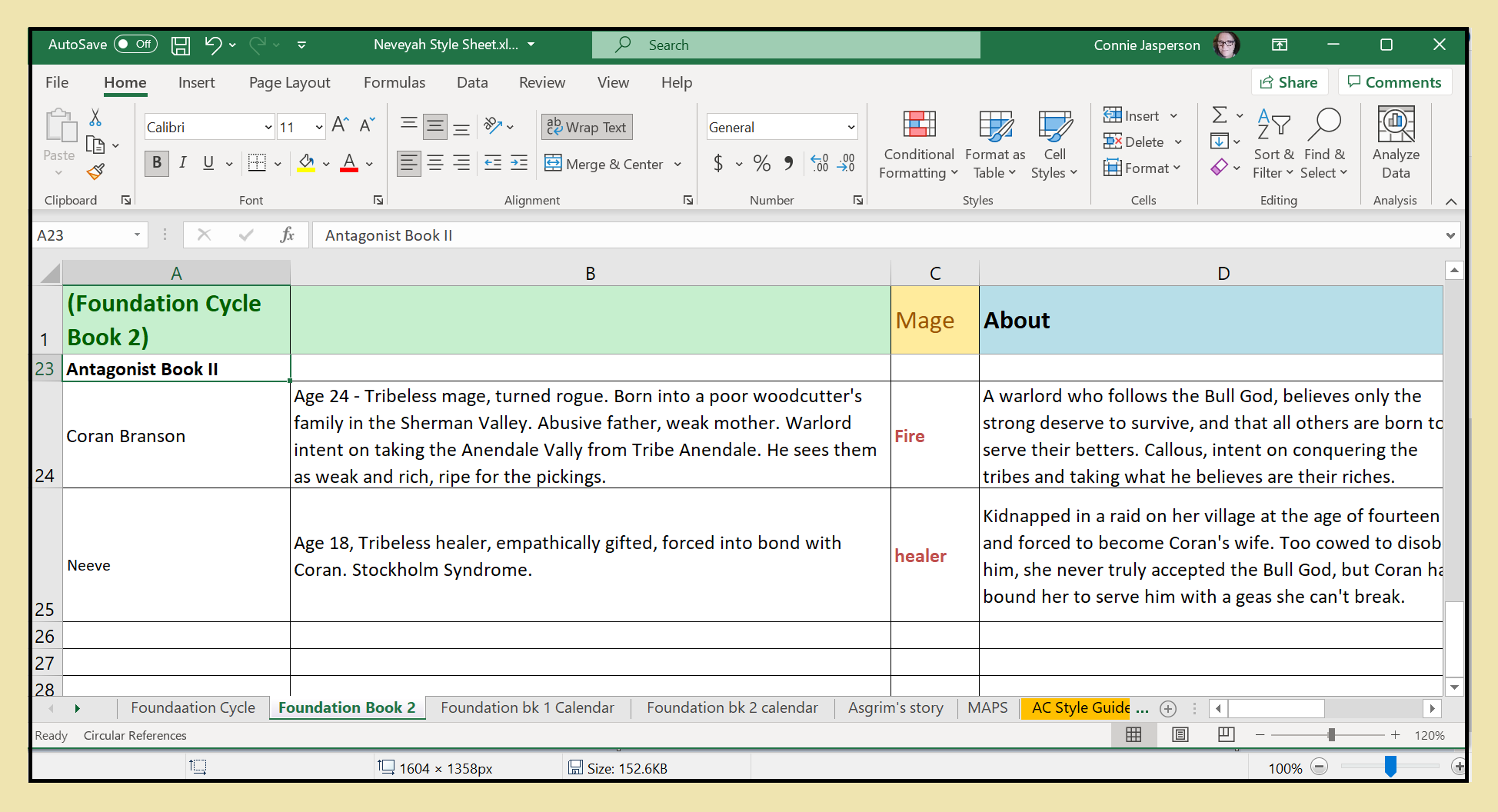 My antagonist will have trusted captains, who will carry out his orders. I just haven’t met them yet, and probably won’t until I begin plotting the antagonist’s arc of the story.
If you see something in your storyboard that no longer fits, don’t be afraid to modify it. While we are in the planning stage is a perfect time to do so.
I work back and forth, make changes, and adjust things as I go. That way, I’m not wasting writing time in November.
Now that we have a cast of characters, we will go back to looking at the world they inhabit and their place in that setting.
As Lee French regularly tells me, the process of planning involves making changes now, so we’re not making them while writing or in revision.
The #NaNoPrep series so far:
#NaNoPrep: part 1: What’s the Story?
#NaNoPrep, Setting: Creating the Big Picture
#NaNoPrep, Building Characters
 Race: This is a post-apocalypse world. When the survivors were preparing to leave the catacombs, they divided into 50 tribes and blended the various races and ethnicities as evenly as possible to widen the gene pool. Everyone is of mixed-race heritage, regardless of outward coloring and appearance.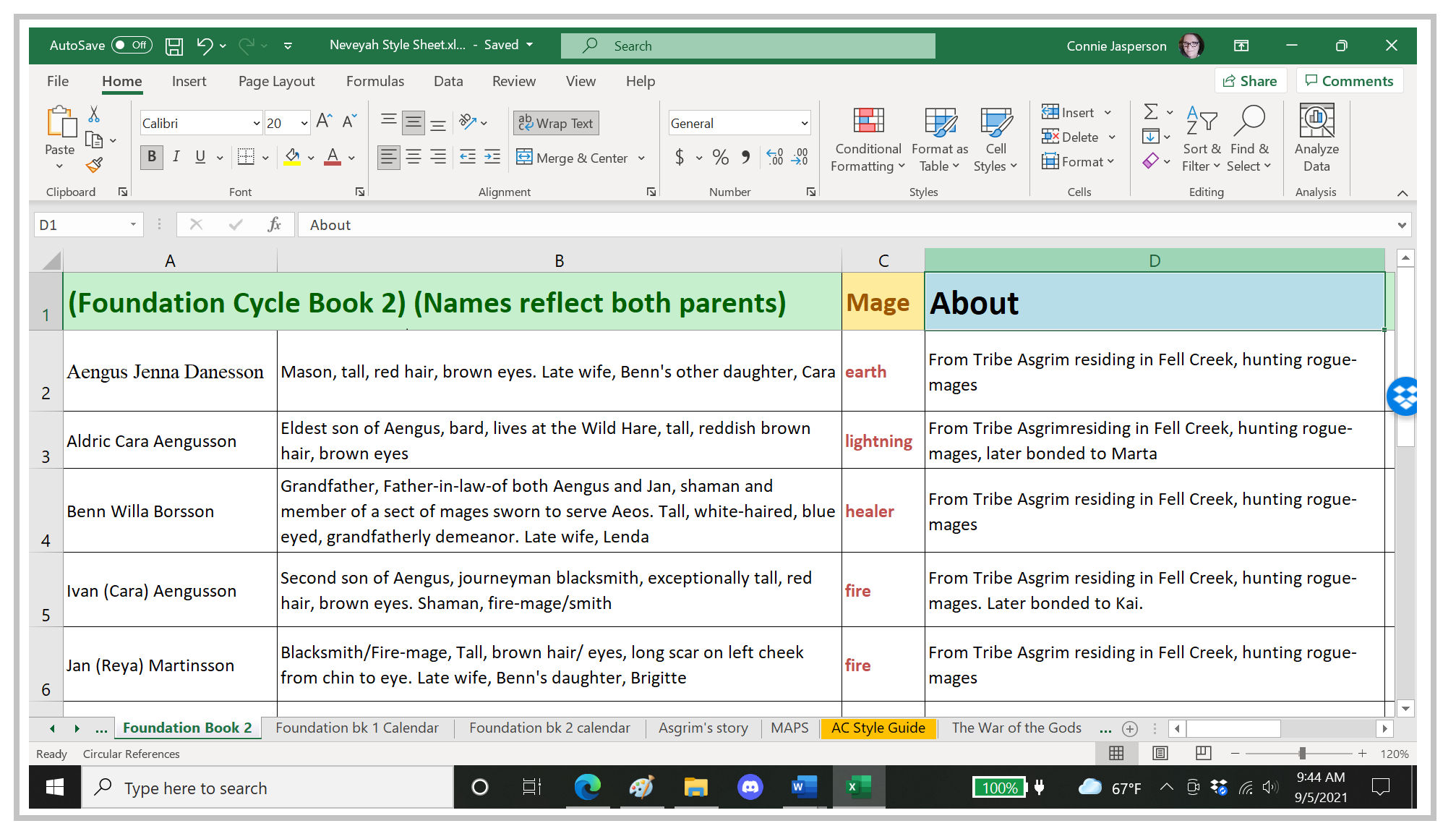
 Next up, we will look closer at our characters and see who their companions are. Some of Ivan’s companions are already established as they were featured in last year’s NaNoWriMo novel. Others are new, and I need to understand who they are and how they fit into Ivan’s story.
 I had no intention of writing book one either, but there it is. These characters won’t let go of me, so now I’m storyboarding a new plot.
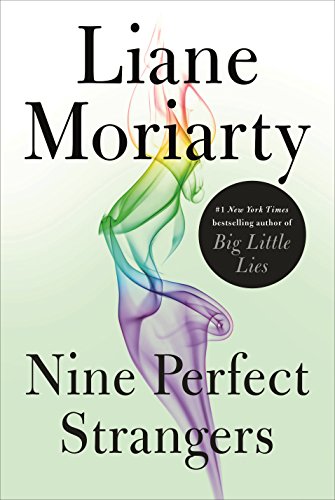 Several years ago, I read “
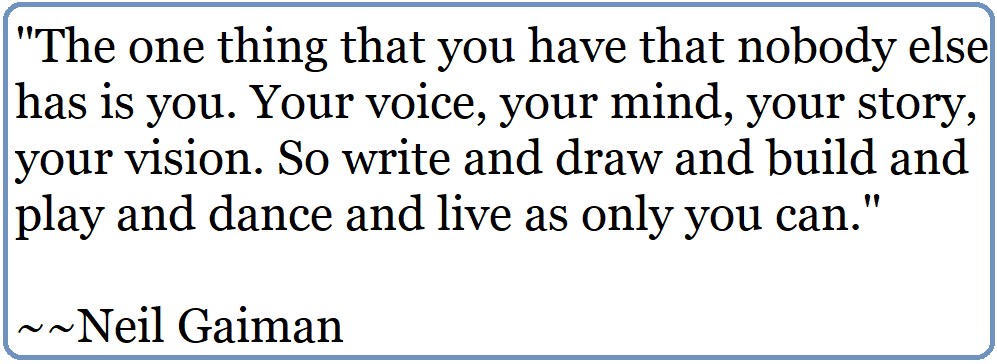 I had a reaffirmation of sorts; the reassurance that no writer can follow every writing group rule and no book that does would be worth reading.
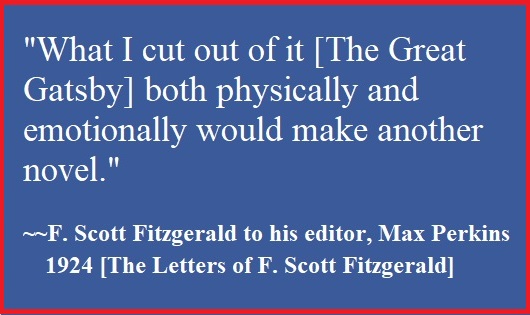
 Every successful writer has habits that are technical wrongs, habits that don’t fly when offered to a critique group. Yet, these patterns persist in their work over their career because they are part of that author’s creative process.
 This month of concentrated writing time is meant to help authors get the entire story down while the inspiration and ideas are flowing. At the end of the thirty days, you should have a novel-length story, hopefully with a complete story arc (beginning, middle, and end).
 First, we want to get to know who we’re writing about.
 Names say a lot about characters. If you give a character a name that begins with a hard consonant, the reader will subconsciously see them as stronger than one whose name begins with a soft sound. It’s a little thing but is something to consider when trying to convey personalities.
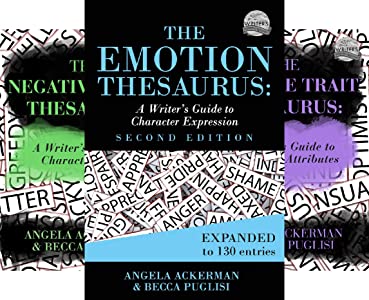 If you need ideas for showing a variety of emotions, I highly recommend the
  Kellan is a complicated character who believes he is the hero. His story begins as a member of the protagonist’s inner circle and ends tragically.
 In other stories, there is the nebulous antagonist—the faceless giant of corporate greed, characterized by one or two representatives, who may be portrayed as caricatures. In some
  This is an important distinction. Credible villains become evil for sympathetic reasons. They care intensely, obsessively about something, or someone. It is our job to make those deeply held justifications the driving force behind their story.
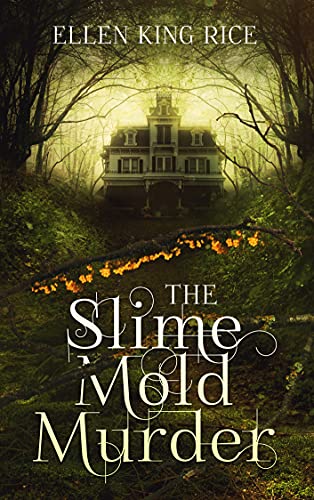 One of the best ways to learn about the craft of writing is to talk with other authors. We all have different ways of creating our work, so hearing how another author works always gives me new ideas.
 EKR: Mitchell and Mark are a gay couple, but I didn’t want to write them as caricatures. I spent a great deal of time trying out descriptions to come up with two men who are individuals in their own right but collectively a pair who would rattle the conservative county commissioner.
 CJJ:
CJJ: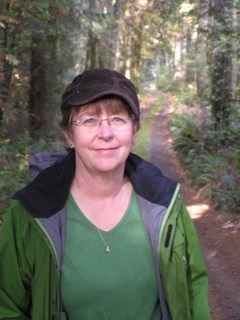
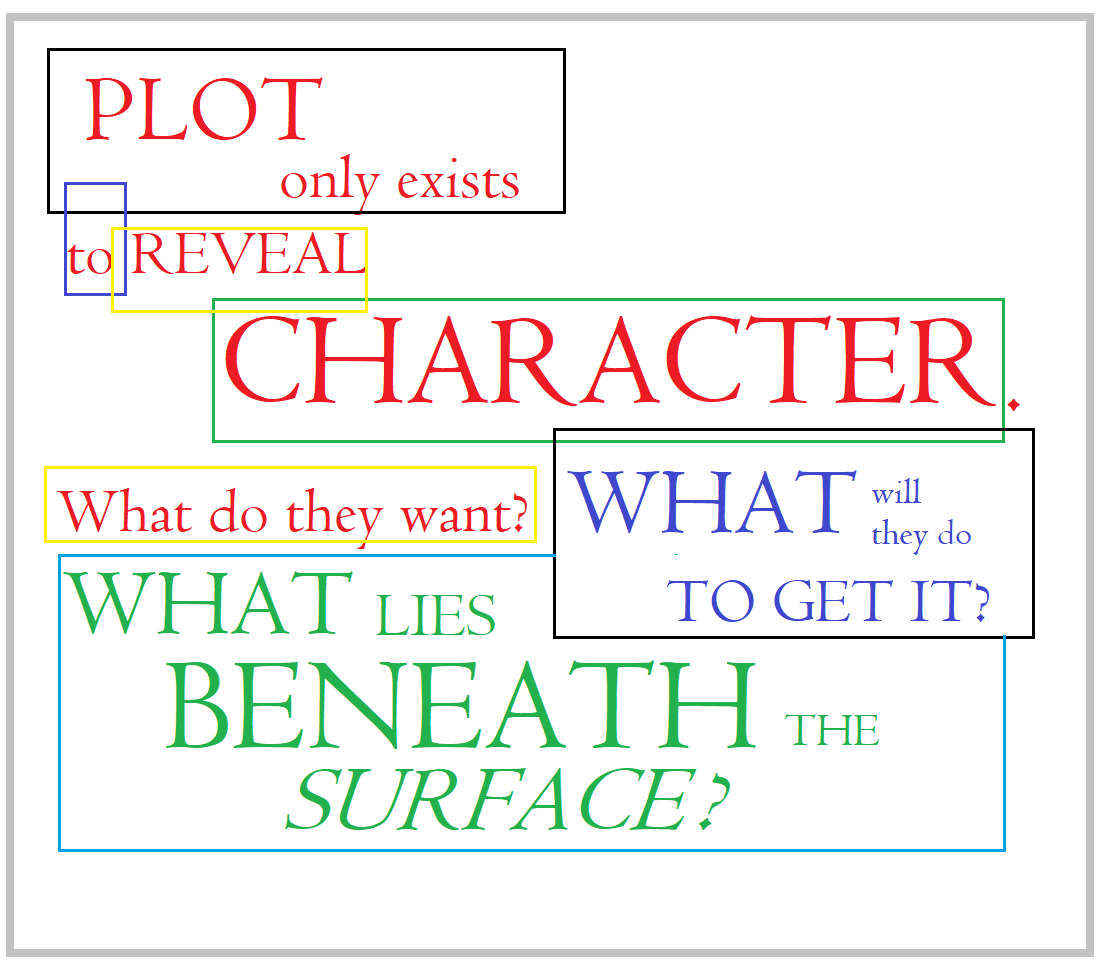
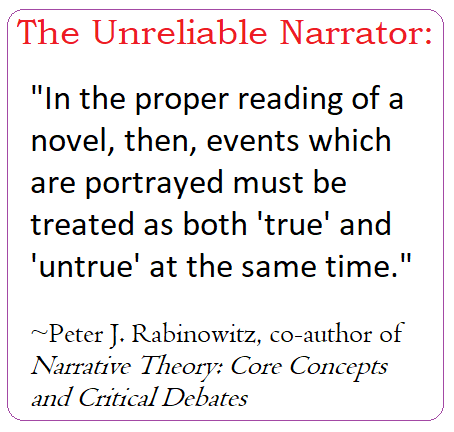 They might think one thing about themselves, but this verb is the truth.
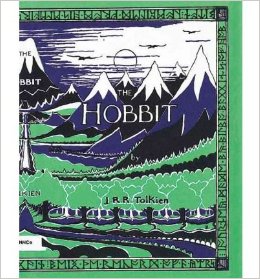 Bilbo resents both the intrusion and being made aware of how bored he is. Secretly, he fears going into the unknown and resists Gandalf’s insistence that he must go with the dwarves. However, at the last minute, Bilbo realizes that if he doesn’t go now, he will always wonder what would have happened if he had.
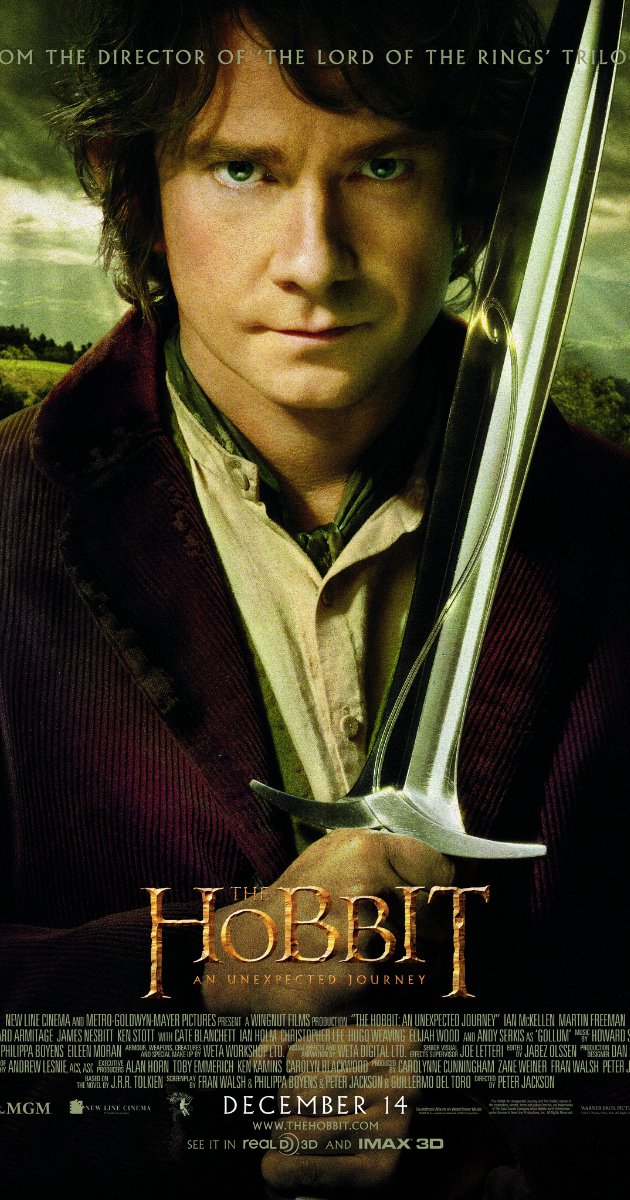 Over the next year, Bilbo experiences many things. Where once he was a little xenophobic and slightly disdainful of anything not of The Shire, he discovers that other cultures are as valuable as his, meeting people of different races whom he comes to love and trust. He experiences the loss of friends and gains compassion. By the time Bilbo returns to the Shire, he is a different person than he was when he ran out his front door without even a handkerchief.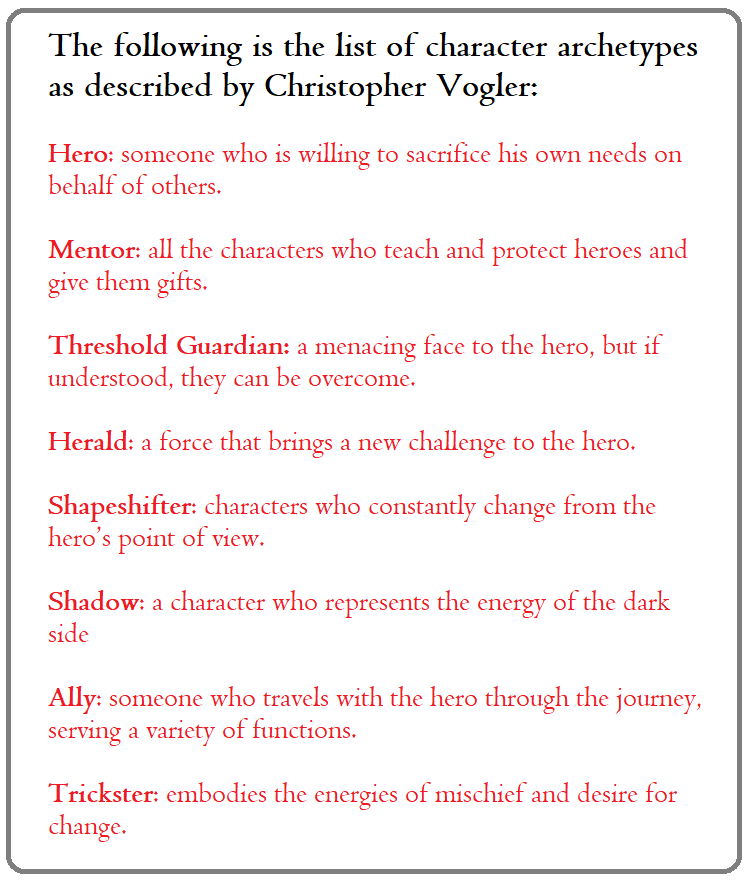
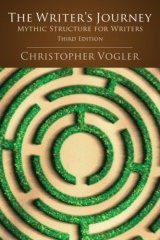 The Writer’s Journey, Mythic Structure for Writers,
 One thing I do recommend is that you keep the number of allies limited. Too many named characters can lead to confusion in the reader.
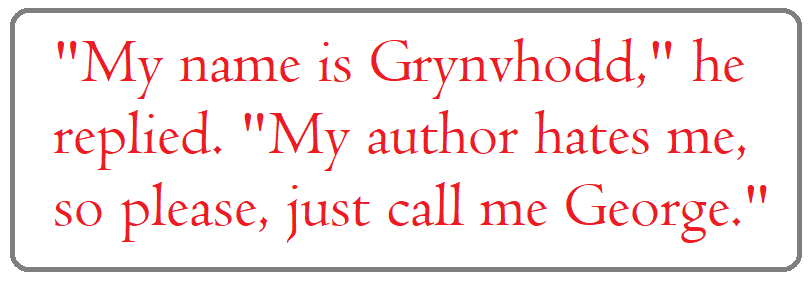 How easy is it to read, and how will that name be pronounced when it is read aloud?
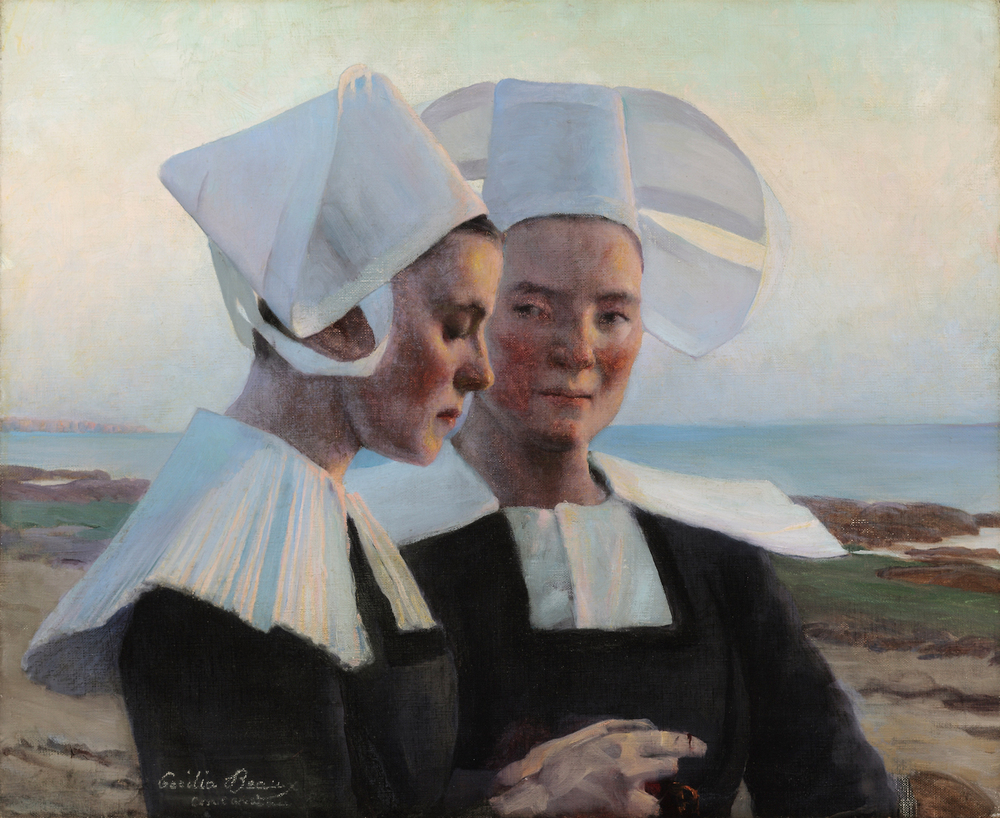 In real life, everyone has emotions and thoughts they conceal from others. Perhaps they are angry and afraid, or jealous, or any number of emotions we are embarrassed to acknowledge. Maybe they hope to gain something on a personal level—if so, what? Small hints revealing those unspoken motives are crucial to raising the tension in the narrative.
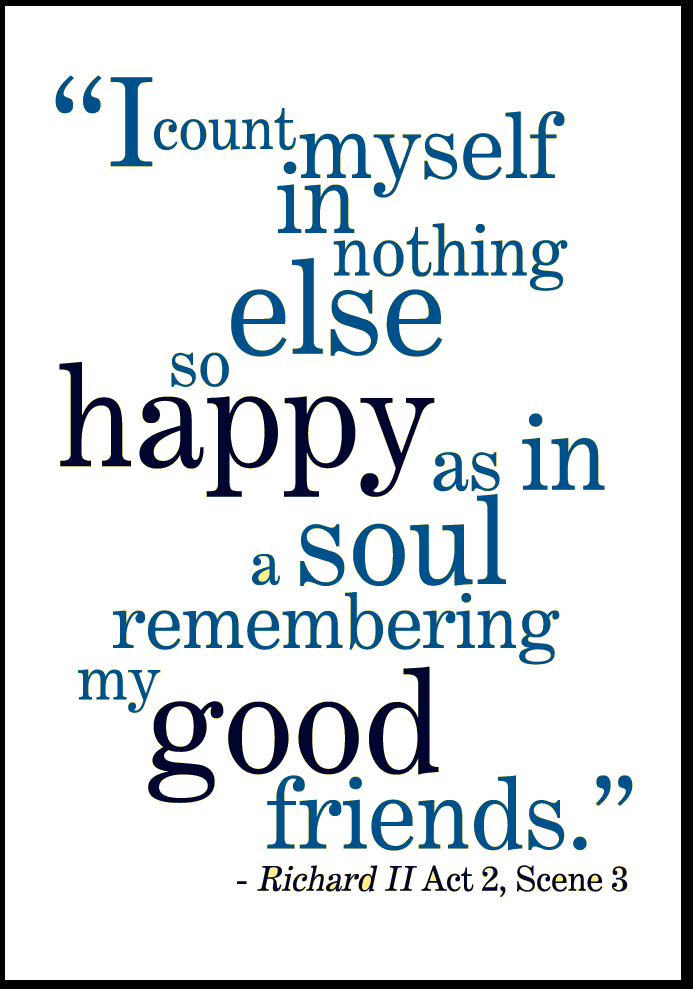 Dialogue gives shape to the story, turning what could be a wall of words into something personal. We meet and get to know our protagonists and the people they will travel with through the conversations they engage in.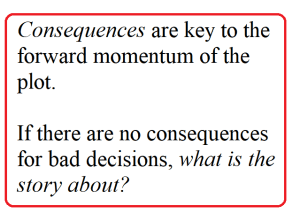



 Life in the Realm of Fantasy