Tag Archives: fantasy

Idea to story part 12 – theme, plot, and the character arc #writing

Two months ago, we began our series, Idea to Story. The previous eleven installments are listed below. We have created a sample story, a romantasy. We have met our protagonists and the ultimate antagonist. We know what their world is like and have given them a worthy quest, and we discovered what genre we are writing by paying attention to the tropes that arose as we were laying down the plot.
Now, we’re going to examine the themes that have emerged. We will strengthen the story arc and make the characters more vivid by ensuring a strong central theme is woven through the story.

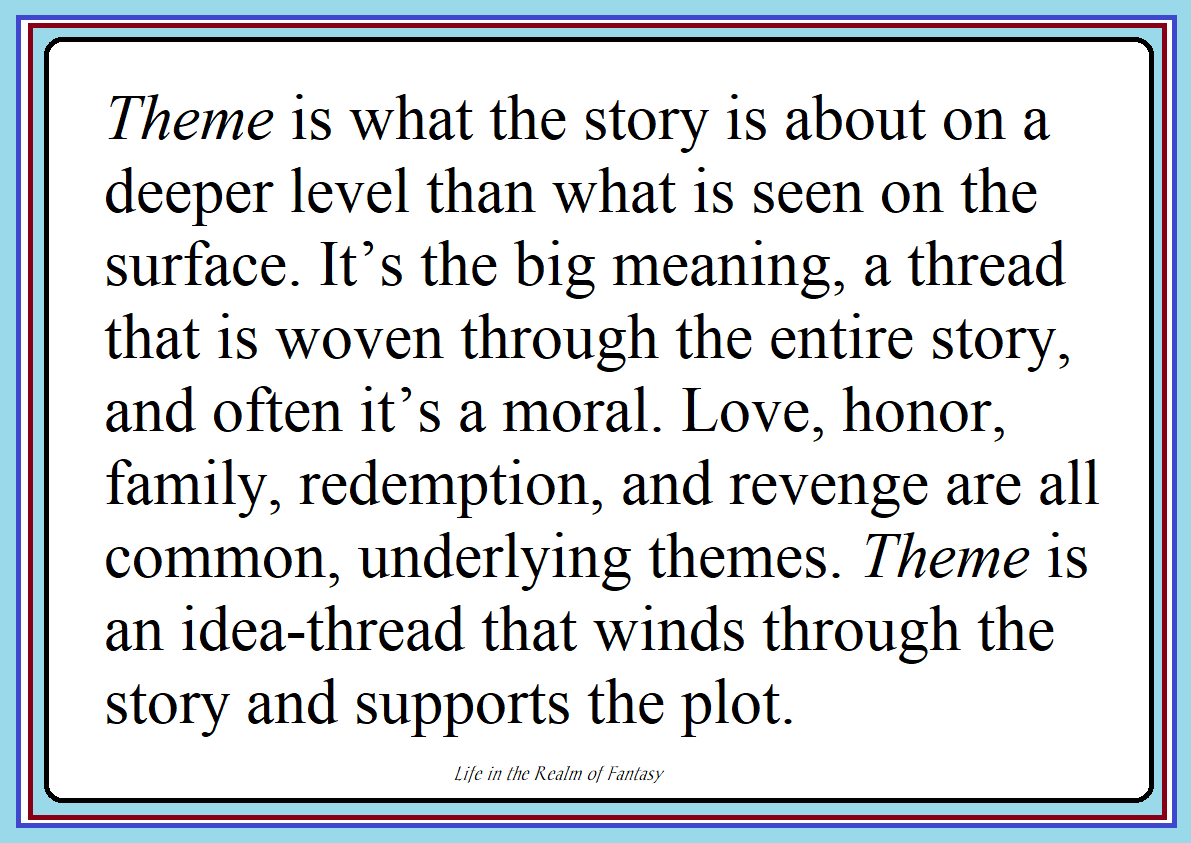
But first, what is a theme? It is an idea, an unspoken message that winds through the arc of the story and generates action. Themes are subtle but move the characters to action and define why the action happens. For an incredible list of themes, go to A Huge List of Common Themes – Literary Devices.

Before we talk about the themes we want to incorporate in our story, let’s look at how the master of themes, Henry James, wove them into his work.
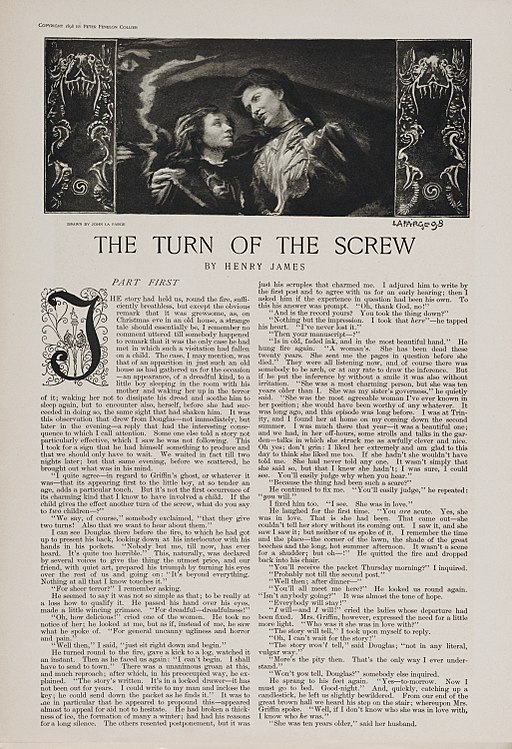
Henry James is a 19th-century writer you might have heard of but never read. However, he can teach us so much about using a story’s themes to create memorable characters. You may be familiar with the titles of some of his works, such as The Turn of the Screw and The Golden Bowl. Filmmakers and playwrights are still turning his work into movies and plays.

Henry James was a master at writing one common theme into a story—lust. Lust for sex. Lust for money. Lust for control.

Lust for power.

Henry James wrote one of the most famous novellas ever published, the Turn of the Screw.

On the surface, the Turn of the Screw is a gothic horror story. The four main themes are the corruption of the innocent, the destructiveness of heroism, the struggle between good and evil, and the difference between reality and fantasy. A fifth theme is the perception of ghosts. Are the ghosts real or the projection of the governess’s madness?

However, there are several subthemes interwoven into the fabric of the narrative:

  • Secrecy.
  • Deception.
  • The lust for control.
  • Obsession.

What I take home from the longevity of Henry James’s work is this: find a strong theme and use it to underscore and support our characters’ motives.

So, now we know that literary themes are a pattern, a “melody” that recurs in varying forms throughout a story. They emphasize mood and shape the plot.
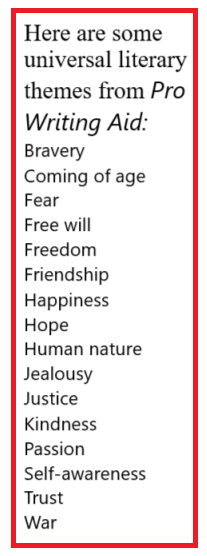
The main theme of our story is the struggle between good and evil. In Donovan’s well-planned manipulation of Kai under the guise of brotherly mentoring, we have the subthemes of deception and the corruption of the innocent. In Val and Kai, we have the dangers of ignorance and the subthemes of arrogance and class prejudice.

Our three main characters are people. In real life, people are a mix of good and bad at the same time. Some lean more toward good, others toward bad. Either way, their intentions are logical, and they desperately want what they think they deserve.

Most importantly, our characters lie to themselves about their own motives and obscure the truth behind other, more palatable truths. These unspoken truths are the themes we must weave into the fabric of our story by subtly showing a pattern.

Two themes we want to emphasize in Donovan are the desire for power and the use of fear as a means of control. However, at first, we want the tug-of-war for control of the child king, Edward, to be focused on the regents, Kai Voss and Valentine.

The story opens from Val’s point of view, so we lean a bit toward her. But not entirely, as Kai’s chapter shows he has good intentions.

By hinting at the pattern of Donvan’s actions in the first quarter of the book, his lust for power becomes clear. We hope to create in the reader a sense of helplessness to stop what we see coming. This is emphasized as clues appear, indicating that Val and Kai are acting on misinformation that is deliberately fed to them.

Once Val and Kai find themselves in the dungeon, new themes will join the story. Both are in their mid-thirties and are established and respected in their respective peer groups. However, both must have a coming-of-age arc. Despite their apparent adulthood, they each have a lot to learn about real life.

But what about young King Edward? For Val and Kai, the theme of parental love is shown in their actions of caring for him from the beginning. While he is not their child, he is in their care and both love him as if he were their son and are secretly jealous of each other. They have differing goals for him, which causes friction, but the reader doesn’t doubt their sincere love for the boy.
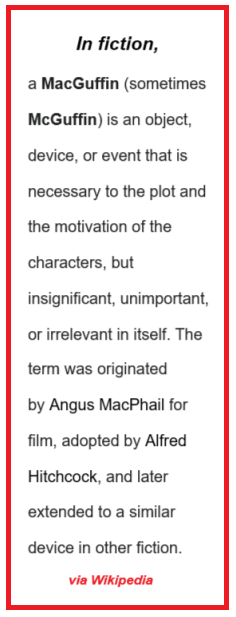
Edward is sickly, cursed with a wasting disease. All through this tale, he has been a McGuffin, the object of the quest and a pawn in Donovan’s game of power. His character arc is limited because he is bedridden and unaware of the war for control centered on him.

When she wakes up in the dungeon, Val realizes who truly set the curse on Edward and who murdered the boy’s parents in the first place. She realizes that if she can’t rescue Edward, Donovan’s curse will kill him, and Donovan will become king. She is miserably aware that she will need a wizard to counter Donovan’s sorcery. Unfortunately, the only sorcerer she has access to is Kai, which means she must rescue him first, something she despises having to do.

Conversely, Kai is glad to be free but not pleased that it is Valentine who has rescued him. He doubts her motives and refuses to believe his brother betrayed him, until they overhear the guards talking.

Val and Kai must learn to work together. As they do, the theme of romantic love will emerge.

What other themes might emerge as we write our story? How will we recognize and underscore the patterns, the melodies that appear in the narrative?

This is where writing becomes a craft, and to excel at any craft, we must work at it.

Thank you for sticking with me as we worked our way through this long and involved process of taking an idea for a story and building the characters, the world, and the plot.

While the story of Val and Kai is just a sample plot for demonstration, I have used these weeks to reexamine the different aspects of my current work in progress. Talking my way through a plot with my friends really helps, so thank you!

Previous in this series:

Idea to story, part 1: novel, poetry, memoir, or short story? #writing | Life in the Realm of Fantasy

Idea to story part 2: thinking out loud #writing | Life in the Realm of Fantasy

Idea to story part 3: plotting out loud #writing | Life in the Realm of Fantasy

Idea to story part 4 – the roles of side characters #writing | Life in the Realm of Fantasy

Idea to story part 5 – plotting treason #writing | Life in the Realm of Fantasy

Idea to story part 6 – Plotting the End #writing | Life in the Realm of Fantasy

Idea to story part 7 – Building the world #writing | Life in the Realm of Fantasy

Idea to story part 8 – world-building and society #writing | Life in the Realm of Fantasy

Idea to story part 9 – technology and world-building #writing | Life in the Realm of Fantasy

Idea to Story part 10 – science and magic as world-building #writing | Life in the Realm of Fantasy

Idea to story part 11: Genre and expected tropes #writing | Life in the Realm of Fantasy
5 Comments

Filed under writing

How the Written Universe Works – Warping Time #amwriting

In cosmology, the concept of space-time combines space and time into a single abstract universe. Apparently, we all move through time. Here on earth, time either passes us, or we pass the time. It’s all relative (Einstein humor) to how fast you are going and a lot of sub-atomic particle stuff I can’t really take the time to explain here, and you aren’t interested in anyway.

How the written universe works - warping time.Time interests me because I mostly write fantasy, although I write contemporary short fiction and poetry. Fantasy, and all speculative fiction, relies heavily on worldbuilding, and managing time is a facet of that skill.
But all genres, including contemporary and literary, require worldbuilding. Every story, true or fiction, is set SOMEWHERE, either in this world we are familiar with or in an alternate fantasy universe.

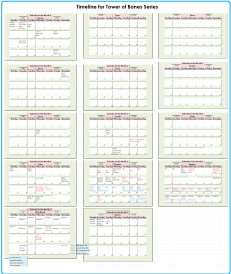
When I begin writing a book, I create a stylesheet in a spreadsheet program like Google Sheets or Excel for the universe, a workbook that has a page devoted to a glossary for that world, and a page for the calendar of events. A calendar is an essential tool that helps you with pacing and consistency.

  • Calendars are good for pacing, as they keep the events moving along the story arc.
  • They ensure you allow enough time to reasonably accomplish large tasks, enabling a reader to suspend their disbelief.
  • They ensure you don’t inadvertently jump from season to season in your visuals surrounding the characters.

So, for me, the calendar is a device that keeps the events happening logically.

Picture2HERE is where I confess my great regret: in 2008, a lunar calendar seemed like a good thing while creating my first world.
  • Thirteen months, twenty-eight days each,
  • one extra day at the end of the year,
  • a Holy Day on the winter solstice. They have two Holy Days and a big party every four years.

That arrangement of thirteen months is actually quite easy to work with. Where it becomes difficult is in the choices we made in naming things. You know how planning meetings are–ideas tossed at the wall like spaghetti and seeing what sticks.

We were just beginning to design the game, and while I had the plot and the synopsis, I didn’t have some details of the universe and the world figured out. So, in a burst of creative predictability, I went astrological in naming the months, to give the player a feeling of familiarity.

  • Caprica, Aquas, Piscus, (winter).
  • Arese, Taura, Geminis (spring)
  • Lunne, Leonid, Virga (summer)
  • Libre, Scorpius, Saggitus (harvest)
  • Holy Month (begins winter). Holy Day falls at the end of this thirteenth month, occurring on the winter solstice. The premise of the game was the War of the Gods, so religion is central.

strange thoughts 2In an even worse bout of predictability, I went with the names we currently use when I named the days, only I twisted them a bit and gave them the actual Norse god’s name. (The gods and goddesses of Neveyah are not Norse.)
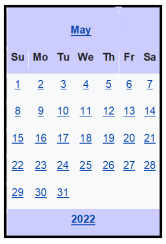
That choice is an example of how what seems like a good idea at the time, may not be.

  1. Lunaday
  2. Tyrsday
  3. Odensday
  4. Torsday
  5. Frosday
  6. Sunnaday – this is the confusing day, as it falls where Saturday is in our normal calendar.
  7. Restday

One thing I did right was sticking to a twenty-four-hour day. I can’t stress enough how important it is to keep things simple when we are worldbuilding. Simple things are less likely to add to the chaos when the plot gets complicated.

That game was never built for several reasons, but I retained the rights to my work. I took my maps and the storyline and wrote Mountains of the Moon, an epic portal fantasy. That story was the genesis of an entire series set at various points along the timeline of that universe.

I couldn’t get that story out of my head and onto paper fast enough—it obsessed me. As I wrote, the calendar I had invented for the RPG was incorporated into the world of Neveyah, and now it is canon.

Time can be an abstract thing when we are writing the first draft of a story where many events must occur. Things are accomplished in too short a period to be logical, or we take too long.

Calendars are maps of time. They turn the abstract concept into an image we can understand.

Even though I regret how I named the days in Mountains of the Moon, my characters progress through their space-time continuum at a rate I can comprehend. I can move events forward or back in time by looking at and updating their calendar. The sequence of events forming the plot arc remains believable.

calendarI LEARNED from my mistakes – the timeline for the Billy’s Revenge 3-book series, Huw the Bard, Billy Ninefingers, and Julian Lackland, uses the familiar calendar we use today.

I heartily suggest you stick to a simple calendar. That is the advice I would give any new writer—stick to something close to the calendar we’re familiar with and don’t get too fancy.

Next up: Time and Distance – how calendars and rudimentary maps work together to keep the plot moving and believable.

2 Comments

Filed under writing

#NaNoPrep: Signing up and getting started #amwriting

Even if you don’t have an idea of what you want to write, it’s time to go out to www.nanowrimo.org and sign in or sign up. That will inspire you!

Navigating the website at www.nanowrimo.org can be confusing. However, if you take the time to explore it and get to know all the many tricks to using it, you’ll be more comfortable with it.

If you haven’t been a participant for several years and are considering joining again, you’ll find the new website is radically different from the old site. Many features we used and loved in the past are no longer available, but it includes numerous features that really are nice. The following screenshots will help you find your way around the website:

First, go to www.nanowrimo.org. This is the landing page:

nanoLandingPageOnce there, create a profile. You don’t have to get fancy unless you are bored and uber-creative.
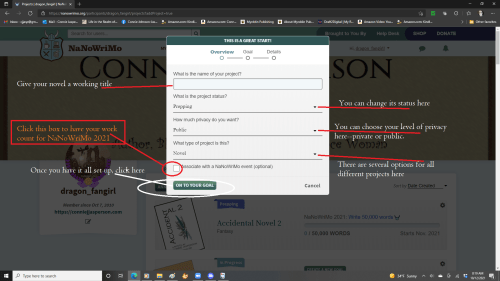
Next, declare your project: Give your project a name if you have one. I don’t have a working title yet, so I’m just going with Accidental Novel 2 since it features the same characters as last year’s accidental novel. Pick the genre you intend to write in. Write a few paragraphs about your intended project if you know what you plan to write.

AnounceYourProject2021You can play around with your personal page a little to get used to it. I use my NaNoWriMo avatar and name as my Discord name and avatar. This is because I only use Discord for NaNoWriMo and one other large organization of writers. (Next week, we’ll talk about Discord and why NaNoWriMo HQ wants us to use it for word sprints and virtual write-ins.)

While you are creating your profile, write a short bio, and with that done, you’re good to go. If you’re feeling really creative, add a header and make a placeholder book cover—have fun and go wild.

right dropdown menu buttonNext, check out the community tabs. If you are in full screen, the tabs will be across the top. If you have the screen minimized, the button for the dropdown menu will be in the upper right corner and will look like the blue/green and black square to the right of this paragraph.
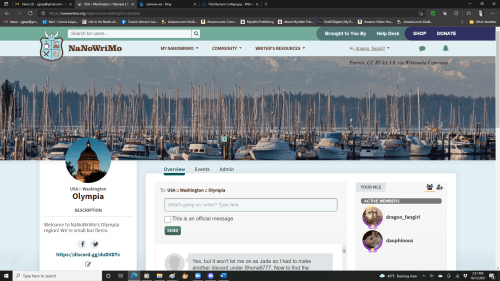
When the button is clicked, the menu will be on the righthand side instead of across the top.

Your regional page will look different from ours because every region has a different idea of how they present themselves, but it will be there in the Community tab. And don’t forget to check out the national forums, also on the Community tab.

Olympia_Region_homepageYou may find the information you need in one of the many forums listed here.

Now, let’s talk about eliminating heartache and attempted suicides among authors.

Losing your files is a traumatic experience. Some authors within my writing group have lost several years of work in a surprise computer crash – an unimaginable tragedy.

I use a cloud-based storage system because entire manuscripts can go missing when a thumb drive or hard drive is corrupted.

fileFolderMake a master file folder that is just for your writing. I write professionally, so my files are in a master file labeled Writing.

Inside that master file are many subfiles, one for each new project or series. My subfile for this project is labeled Ivans_Story.

FileDocumentGive your document a label that is simple and descriptive. My NaNoWriMo manuscript will be labeled: Accidental_Novel_2.
First of all, you need to save regularly. I use a file hosting service called Dropbox. I have a lot of images on file, so I pay for an expanded version, but they do have a free version that offers you as much storage as a thumb drive. I like using a file hosting service because it can’t be lost or misplaced and is always accessible from my desktop, laptop, or Android. I work out of those files, so they are automatically saved and are where I want them when I closeout.

You can use any storage system that is free to you: Google Drive, OneDrive, or a standard portable USB flash drive.

Save regularly. Save consistently. DON’T put off saving to a backup of some sort – do it every day before you close your files.

One final thing for those who have participated in the past: NaNoWriMo HQ has announced that there will be no sanctioned in-person write-ins again this year. While this is disappointing, we care about the health of all our writers.

WordItOut-word-cloud-4074543Still, we can come together and support each other’s writing via the miracle of the internet. My region is finalizing a schedule for “Writer Support” meet-ups via Zoom – little gab sessions that will connect us and keep us fired up.
Our region will use the Discord Channel for nightly write-ins in the general chat and word sprints in our wordwars room. The pandemic has had one positive benefit – our region has remained active for the last year, with several intrepid writers doing nightly sprints.

Check out what you region offers you for year-round support. You might be amazed what they are doing.

The #NaNoPrep series to date:

#NaNoPrep: part 1: What’s the Story?  (the storyboard)

#NaNoPrep, Setting: Creating the Big Picture

#NaNoPrep, Building Characters

#NaNoPrep, More Character Building

#NaNoPrep, Creating Societies

#NaNoPrep, Designing Science, Magic, and the Paranormal

#NaNoPrep, Terrain and Geography

#NaNoPrep, Connections and Interconnections

#NaNoPrep, Construction and Deconstruction

#NaNoPrep, The Story Arc Part 1

#NaNoPrep, The Story Arc Part 2

#NaNoPrep, The Story Arc part 3, the End

14 Comments

Filed under writing

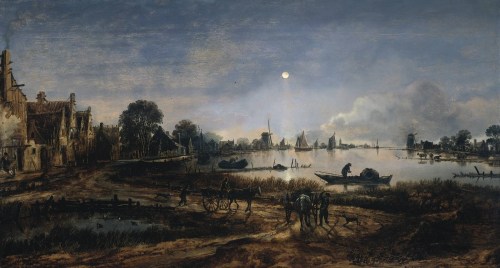
#FineArtFriday: River View by Moonlight, Aert van der Neer


River View by Moonlight, Aert van der Neer [Public domain], via Wikimedia Commons

Aert van der Neer, or Aernout or Artus (c. 1603 – 9 November 1677), was a landscape painter of the Dutch Golden Age, specializing in small night scenes lit only by moonlight and fires, and snowy winter landscapes, both often looking down a canal or river.

Description:
View of a village on a river by moonlight. In the foreground two horse and carriage on a dirt road. To the right a fisherman on a small boat on the water. On the horizon two windmills.
Date: Circa 1640-1650
Medium: oil on panel

What I love about this painting:

This image offers us context to history. It shows how a 17th century harbor looked and the people who worked there. Carters and haulers move cargo, and fishermen go out in the dark to fish for a living. Some freshwater fish, such as eels, are more commonly found after dark.


Credits and Attributions:

River View by Moonlight, Aert van der Neer [Public domain], via Wikimedia Commons / Wikimedia Commons contributors, “File:Rijksmuseum neer.jpeg,” Wikimedia Commons, the free media repository,  https://commons.wikimedia.org/w/index.php?title=File:Rijksmuseum_neer.jpeg&oldid=194438646 (accessed October 27, 2017).

Wikipedia contributors, “Aert van der Neer,” Wikipedia, The Free Encyclopedia, https://en.wikipedia.org/w/index.php?title=Aert_van_der_Neer&oldid=770891498 (accessed October 27, 2017).

Comments Off on #FineArtFriday: River View by Moonlight, Aert van der Neer

Filed under #FineArtFriday

The derailed plot #amwriting

You’re a pantser, not a plotter–you like to wing it when you write, just let the ideas flow freely. This can be liberating, but sometimes in the course of writing the first draft, we realize our manuscript has gone way off track and is no longer fun to write.

At this point, we must go back and find the point where the story stops working. We cut everything back to there and make an outline to build some structure into the manuscript.

Let’s say we are working on a manuscript titled “Dog Days of Summer.” We wrote most of it during November and are sixty thousand words in, but we aren’t even a third of the way to the finish. When we look back, the first twenty thousand words are exactly what we wanted the story to be. But at that point we became a little desperate to get our daily word count, and now we don’t know what to do or how to bring the story to its intended conclusion.

When this happens to me, I stop floundering and (literally) cut my losses. It needs to be cut back to the place where it dissolved into chaos. This is good – it’s called rewriting. Nearly every published novel has entire sections that had to be rewritten at least once before it got to the editing stage.

Much of what you cut out can be recycled, reshaped, and reused, so never just delete weeks of work.

  1. Save everything you cut to a new document, labeled, and dated: “OutTakes_DDoS_rewrite1_09-19-2018.” (Out Takes, Dog Days of Summer, rewrite 1, 09-19-2018)

Now, you must consider what will be the most logical way to get the plot back on track.

Sit down with a notebook (or in my case a spreadsheet) and make a list of what events must happen between the place where the plot was derailed and the end—a list of chapters with each the keywords for each scene noted:

15 Aeddie sick – Mendric can’t repair his heart-take him to Hemsteck 
16 Three days into the journey Elgar and Raj battle Thunder lizard
17 Star stone falls outside Waterston
18 Aeddie sick, nearly dies, Mendric nearly burns out gift keeping him alive
19 South of Kyran, water wraith
20 North of Kyran, mob attack
21 Nola – inn
22 Maldon, highwaymen, and William

You can go even farther and color code your scenes to show who the POV characters are, as was noted in my previous post, Author Simon Wood on Plotting.

What is the core conflict? Make a large note to remind yourself of what the central conflict is so that you won’t go off track again.

Pay close attention to the story arc. Make a “blueprint” of the intended story arc, an outline.

  1. Where does the inciting incident occur?
  2. Where does the first pinch point occur?
  3. What is happening at the midpoint? Are the events of the middle section fraught with uncertainty but still moving the protagonist toward their goal? If not, cut them and insert events that propel the story forward.
  4. Where does the third plot point occur?

What does each character desire? List each character and make a note of what they want at the beginning, what stands in their way at the middle, and what they get at the end.

  1. At the outset, what do the characters want?
  2. What are they willing to sacrifice to get it?
  3. How are their attempts to achieve it frustrated?
  4. Do they get it in the end, or do their desires evolve away from that goal as the story progresses?

Everything you write from the point of the inciting incident to the last page will detail that quest for the unobtainable something. At the outset, your protagonist must desire nothing more than to achieve that objective. Use whatever you can of the material you cut, and write new prose where you must.

By the end of the book, the internal growth of the characters may have caused them to change their personal goals, but something big and important must be achieved in the final chapters.

Where are they going? If they are traveling in a created world, draw a simple map for your own reference. Otherwise, use an atlas or Google Earth to keep your story on track.

Don’t be afraid to rewrite what isn’t working. Save everything you cut, because I guarantee you will want to reuse some of that prose later, at a place where it makes more sense. Not having to reinvent those useful sections will greatly speed things up, which is why I urge you to save them with a file name that clearly labels them.

Finally, don’t feel that, just because you wrote a wonderful section, it has to stay in the manuscript. If the story is stronger without that great scene, cut it. Use it as fodder for a short story or novella set in that world.

5 Comments

Filed under writing

Information and Misinformation #amwriting

This week, I am involved in editing for clients, hosting a writing meetup, and working hard on a first draft.

Over the weekend I made good headway with new material, and now I am putting much of what we have previously discussed into action as I expand on those chapters.

I’m ensuring that within the larger story, I have a structure of smaller arcs,  scenes that will come together to create this all-encompassing two-volume drama. If I do this right, I will keep my readers’ hearts invested in the narrative until the end of the second book.

I’ve talked before about the arc of the scene vs. the overall arc of the novel.

The end of the scene is the platform from which your next scene launches. This means each scene begins at a slightly higher point on the novel’s narrative arc than the previous scene did, driving the narrative. That pulse is critical to creating the necessary tension.

At this point, I’m still fine-tuning the plot, deciding who has the critical knowledge. The fact that some characters are working with limited information is what creates the tension, a concept known as asymmetric information. This a situation in which one party has more or superior information compared to another. In business, this can prevent other companies from effectively entering and competing in an industry or market. The company with the information has a monopoly.

In real life, a monopoly of information creates a crisis. In the novel, it creates tension. A conversation scene should be driven by the fact that one person has knowledge the others need to know at that moment. Whether or not they receive the information in time is up to you in the plotting stage.

So, this is what I am doing now, making sure the information is divided up disproportionately. No one ever has all the knowledge, and what my protagonist doesn’t know at the beginning is central to the plot and the final confrontation at the end of the second half.

The reader must get answers at the same time as the other characters, gradually over the first 3/4 of each novel. Book one has the first half of the story line and a satisfying conclusion, and book two is the protagonists’ ultimate destination and final meeting with the enemy. Dispersing small but necessary bits of info at just the right moment so there are no info dumps is tricky but by the final draft of both books, all will have been smoothed out.

As I said, I am creating small arcs, scenes that pose questions, but also provide answers to previously posed questions. Large and small events occur but are linked by conversations because events don’t happen randomly. Sometimes an incident is self-explanatory, but action alone wouldn’t be enlightening.

My characters are charismatic, as they exist in my head. My task in this first draft is to show them in such a way that the reader sees the magic in them that I see. I have to create a pulse of each character’s desires and objectives, laced with information and misinformation. I am creating a trail of breadcrumbs leading to the first conclusion at the end of book one.

Book one’s final confrontation has to be good and resolve the first conflict. I hate cliff-hanger endings so there will be none of that in my work.

I will finish both books before I publish book one, with book two in the final editing stage when book one goes to press. By planning out my production schedule like this, I hope I can achieve what I envision, an epic fantasy that hooks the reader with small rewards of emotional satisfaction along the way to the big event.

My trusty beta readers will “politely” inform me (with a brick to my head) if I don’t somehow accomplish just that.

Comments Off on Information and Misinformation #amwriting

Filed under writing

#FlashFictionFriday: The Marriage Counselor

I shook my head to get rid of the sudden, loud buzzing sound in my ears. Feeling a little disoriented, I looked at the calendar, which said Thursday, the day I dreaded most. Sometimes I felt like it was always Thursday. It was nearly time for my regular two o’clock appointment… the couple from hell, pardon my cursing. After my heart attack about six months before, they had begun coming to me, and were likely to give me another. They never missed an appointment no matter how I wished they would.

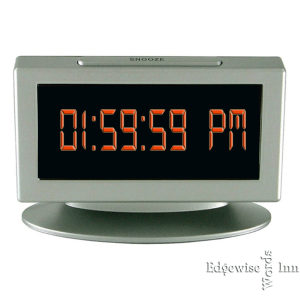
I watched the clock tick from one fifty-nine to two o’clock.

My receptionist opened the door. “Mr. and Mrs. Haydes are here. Shall I show them in?”

>>><<<

I lifted my pen from the notepad and regarded the couple seated across from me. “Would you listen to yourselves? You make marriage sound like hell. It doesn’t have to be that way. You both sabotage it every chance you get.”

“Of course marriage is hell,” said the husband across from me, dressed in a double-breasted, blue suit, giving him an almost nautical appearance. Add a captain’s hat and he’d look like a cast member on The Love Boat. “It’s the absolute worst thing that could possibly have happened to a once studly man like myself. But just like the moth flying into the flame, I had to do it. ‘Don’t go toward the light,’ my friends all said. But did I listen? Hell, no!”

His wife snorted. “Luke always does the exact opposite of what anyone advises him to do. That’s what he gets for being a devil-may-care, I’m-gonna-do-it-my-way sort of a guy. He’s Satan. That makes me Satan’s wife. Of course it’s hell—it comes with the territory. If I can put up with him, he can put up with me.” This week she wore little makeup, and was neatly coiffed with not a hair out of place. In a counterpoint to Luke’s dashing attire, she wore a beige wool suit, cut to just below her modestly crossed knees, with low-heeled pumps. Mrs. Haydes could have been a proper matron from any Protestant congregation, right down to her puritanical sense of morality.

This forty-five minute session of misery began promptly at two o’clock every Thursday. They booked their appointments under the pseudonyms, Lucifer and Persephone Haydes. He preferred to be called Luke, and she preferred to be called Mrs. Haydes. After six months of working with this pair of nut cases, I was beginning to suspect they were playing a game of mess-with-the-counselor.

Last week she’d been dressed like a teenaged skateboarder, and he as an English literature professor. The week before that, she was a hippie, complete with headband and love beads, and he was a cricket player.

Every week it was something different but always opposites. Mrs. Haydes seemed to choose her wardrobe based on what she thought would annoy him most, and he went with the opposite because he really couldn’t do anything else. He had the worst case of oppositional defiant disorder I had ever seen.

“Why are you here?” I had to ask, despite knowing I wouldn’t get an answer. “I no longer understand what you are trying to save here. You never take my advice. And you’ve been aware since the outset that I am a pastor, not a magician. What do you hope to gain from this?” I tapped my foot and looked at the clock. We were only fifteen minutes into this session, and I was already exhausted. “What you really need is a good divorce lawyer, not a counselor. I can tell you every reason why you should stay married, and if you are looking for religious affirmation, I can give you chapter and verse on the apostle Paul’s views regarding marriage. Over the last six months, I have done so repeatedly.  We’ve discussed what you originally saw in each other and what you each want from your relationship, but you’re still at this impasse.  I think that at this stage divorce is the only answer for the two of you.”

Luke snorted. “Don’t bother telling me anything the apostle Paul said—I wrote that book. I was delusional.”

“I think the pastor is right,” said Mrs. Haydes, primly folding her hands. “Divorce is the only option. I’m sure no one would blame me for leaving a devil like you.”

“I’m not giving up half of everything I own,” said Luke, clearly aghast at the notion. “Do you know how many divorce lawyers she has access to? No way am I going to let her off so easily.”

“I come from a broken family,” said Mrs. Haydes, discreetly wiping a tear. “I don’t want our children to grow up in a broken home. But it would be better than Anaheim. It’s a bad environment to raise children in. I want to move back to our palace in Hell. All it needs is a little remodeling.”

I couldn’t stop myself. I had to ask it. “And you think Hell is a good environment to raise kids in?”

“Well, at least there’s no crime in hell. We have the finest law enforcement professionals in the universe.” She glared at me defensively. “Where should I be raising them? Seattle? I’m not exposing my children to a bunch of pot-smoking vegans who ride bicycles and wear socks with sandals.”

Luke brightened up. “I love Seattle—perhaps we should move there. I could get some goats or raise alpacas. They have the best coffee in the world!”

Mrs. Haydes sniffed. “The place is full of vulgar vegetarians. They’re always taking their children to yoga and soccer, where everyone gets a trophy whether they win or lose—it’s just wrong. We will most certainly not be moving to Seattle.”

“Enough,” said Luke. “I’m going vegan and we’re moving to Seattle and that’s final.” He turned to me and missed her small, satisfied smile. “What I really want to talk about is the stint we did on ‘Home Hunters.’ She destroyed me in front of millions of people, and I have to watch it every time they rerun that episode, which they seem to do three times a week.”

“Well dear, it airs on one of your networks, and you make the rules. You’re the one who decides why the television viewing public has 999 channels available to them, and all but three of them at any given time are showing the same reruns of Pawn Shop Heroes, Home Hunters, or Gator Boys.”

From the look on Luke’s face, Mrs. Haydes had the knife and was twisting it for all she was worth.

She continued, “Besides, I said very clearly that I wanted the extremely modern condo, with all the sleek furnishings and the gorgeous terrazzo floors. I said it at least six times. It’s on the videotape of the show.” She smiled at him smugly. “You just had your heart set on that cozy, little pink bungalow with the seventies’ décor and the orange shag carpet. You insisted, and so, of course, I gave in. Once you make up your mind, it’s impossible to change it.”

“See?” Luke exploded. “See how she manipulates me? How could I not go for the house she said she didn’t want? It was like asking the dog not to eat the chocolate you left on the coffee table. I’m Satan! I’m not really an agreeable sort of guy, and she knows exactly how to manipulate me, so now, twice a week, everyone in America gets to watch me buying grandma’s overpriced, decorating nightmare. It’s been voted the most popular episode of all time! She embarrassed me in front of God and the world.” He dropped his head into his hands. “We’re moving to Seattle now, and it’s going to be hell trying to sell that dump in Anaheim. I won’t even be able to rent it out for enough to cover the carrying costs. What a life!”

I knew this session was going nowhere. Their sessions never went anywhere positive because they were masters at circular reasoning. “What is it you want from me? You must have some reason for putting me through this agony every week.”

“I despise him, so I want a divorce, of course,” said Mrs. Haydes, with a smug, little smile. “I’ll be happy with my half of everything, and, of course, alimony. I gave up my career to raise our children, you know, and they will need child support.” She aimed her tight, fundamentalist smile at me. “We won’t waste your time any further.”

“No. No. No!” Luke’s eyes widened and he leaned forward. “No divorce. I adore you, Persey—you’re the love of my life!” He kissed her hand.  “I would be lost without you. Think of the children.”

“I love you too, Luke—I just hate being around you. And now you’re going to be forcing all your hippy, vegetarian food on me.” She turned away from him, primly pursing her lips. “You know how I love steak.”

“No dear, not vegetarian. Vegan. It’s good for you, you’ll love it. Why, I’ve a recipe for smoked tofu that will put a smile on that pretty face in no time.” Luke smiled his most charming. “If there is one thing I understand, it’s how to barbecue. You’ll adore my smoked tofu salad.”

“If you say so, dear. I’ll likely throw up.”

The two rose and left my office. I sighed.

Luke might claim to be Satan, and yes, it was even possible given how contrary he was, but if that was case, Mrs. Haydes ruled in Hell. There was no mistake about that.

I heard my receptionist speaking in the anteroom. Yes, Mrs. Haydes was scheduling another appointment…two o’clock next Thursday.

Satan might move to Seattle, or he might not. Somehow, I knew his new penchant for tofu and coffee wouldn’t get me off the hook.

I shook my head to get rid of the sudden, loud buzzing sound in my ears. Feeling a little disoriented, I looked at the calendar, which said Thursday, the day I dreaded most. Sometimes I felt like it was always Thursday. It was nearly time for my regular two o’clock appointment… the couple from hell, pardon my cursing. After my heart attack about six months before, they had begun coming to me, and were likely to give me another. They never missed an appointment no matter how I wished they would.

I watched the clock tick from one fifty-nine to two o’clock.

My receptionist opened the door. “Mr. and Mrs. Haydes are here. Shall I show them in?”


The Marriage Counselor, by Connie J. Jasperson © 2015-2018, All Rights Reserved, was first published on 06 March 2015, at Edgewise Words Inn. Reprinted by permission.

8 Comments

Filed under #FlashFictionFriday, writing

Day 8, #NaNoWriMo2017: The Detour

When I was planning my manuscript for NaNoWriMo and the month of November, I had intended to write nothing but short stories.

Unfortunately, the inspiration I had lacked for the rough draft of my current novel-in-progress (set in the Tower of Bones world of Neveyah) struck me at 2:30 a.m. on November 1st, taking us to the mid-point crisis in that story.

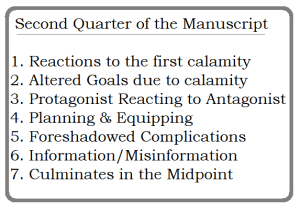
As a result, I have written the entire second quarter of that epic fantasy proto-novel, nearly 22,000 words in total over the last six days. But that is how NaNoWriMo sometimes goes for me. I plan to be a rebel, and end up following the rules.

On December 1st, I will copy those new chapters from my NaNo Manuscript and paste them into my original rough draft. Once that is done, the new words will bring the total up to around 60,000 words.

If all goes as planned, I will spend the rest of this month writing short stories, and won’t get back to that story until December 1st.

But as you may have noticed, things don’t always go as planned. When inspiration strikes, you must write, as some stories simply burn to be written. Write when you feel the passion, and you will have done your best work.

The creative process is different, from person to person. I use daydreaming and visual art to fire up the creative muse. With these prompts, I have little trouble getting submerged in my work.

As every writer knows, sometimes finding inspiration for what I am supposed to be working on can be elusive. But some random image or phrase will trigger my imagination. At that point I switch gears and write whatever that story is.

During most of the year, I usually have three manuscripts in various stages: one unfinished first draft, one in the second draft stage, and one near the finish line.  Every day I write new words on my rough draft first thing in the morning, unless I have an editing contract. By ten a.m. I move on to work on the others. Focusing on my rough draft first allows me to come to the more finished stories with a different, less biased eye.

At the end of the day, when my creative mind is tired, I find myself alternating between playing my game and adding a few words here and there to my rough draft.

But during November, my writing time is wholly devoted to writing new words. By the end of the day, my brain is fried, and my creative genius has died an untidy death.

As a result, some of my NaNoWriMo ramblings are brilliant—just ask me and I will tell you so. However, the majority of them not so much.

But every word I write can and will be recycled into something better, something useable, and something worth reading. In writing this stream-of-consciousness prose, I’m getting the ideas down before I forget them.

In 2015 and 2016, the manuscript I patched together for NaNoWriMo was like a quilt made up of short stories. This year’s manuscript will be a patchwork too. It will be made up of scenes and vignettes, parts of stories mingled with complete stories.

This jumble is like a bank, but instead of a place to keep money, it’s a depository of ideas and concepts for short stories, flash fictions, and essays. I will come back to this convoluted mish-mash of genres and prose again and again, whenever I need the core of a new story.

The first 22,000 words of this year have been different from the previous two years, in that my work has been a continuation of an established work-in-progress. However, I have now come to a stopping place.

Now I am experimenting with point of view through short stories. I thought of the perfect plot in which to use the little flâneur that lurks in all of us. Yes, I am leaving the fantasy genre for a brief stint in literary fiction. Besides the flâneur, I have an idea for the story of a woman, navigating the shoals of social ostracization because of her husband’s conviction for embezzlement.

Once those are done,  I will return to fantasy with an installment of Bleakbourne on Heath, and a short story set in Neveyah, the world where Tower of Bones is set.

As my homage to paranormal fantasy, I have the idea for another Dan Dragonsworthy story, set in the Drunken Sasquatch, the neighborhood tavern favored by Seattle’s ‘alternate’ population.

If I have time, Astorica, my gender-bent alternate universe, may see another flash fiction.

I have so many ideas and this month of madness is the time for me to get them all down. In fact, I’ve been talking to you long enough—I have to get back to writing!

Comments Off on Day 8, #NaNoWriMo2017: The Detour

Filed under writing

#FineArtFriday: River View by Moonlight, Aert van der Neer


River View by Moonlight, Aert van der Neer [Public domain], via Wikimedia Commons

Aert van der Neer, or Aernout or Artus (c. 1603 – 9 November 1677), was a landscape painter of the Dutch Golden Age, specializing in small night scenes lit only by moonlight and fires, and snowy winter landscapes, both often looking down a canal or river.

Description:
View of a village on a river by moonlight. In the foreground two horse and carriage on a dirt road. To the right a fisherman on a small boat on the water. On the horizon two windmills.
Date: Circa 1640-1650
Medium: oil on panel

Credits and Attributions:

River View by Moonlight, Aert van der Neer [Public domain], via Wikimedia Commons / Wikimedia Commons contributors, “File:Rijksmuseum neer.jpeg,” Wikimedia Commons, the free media repository,  https://commons.wikimedia.org/w/index.php?title=File:Rijksmuseum_neer.jpeg&oldid=194438646 (accessed October 27, 2017).

Wikipedia contributors, “Aert van der Neer,” Wikipedia, The Free Encyclopedia, https://en.wikipedia.org/w/index.php?title=Aert_van_der_Neer&oldid=770891498 (accessed October 27, 2017).

Comments Off on #FineArtFriday: River View by Moonlight, Aert van der Neer

Filed under #FineArtFriday

#FineArtFriday: More Things in Heaven

And therefore as a stranger give it welcome.
There are more things in heaven and earth, Horatio,
Than are dreamt of in your philosophy.

Hamlet, Act 1, scene 5, by William Shakespeare


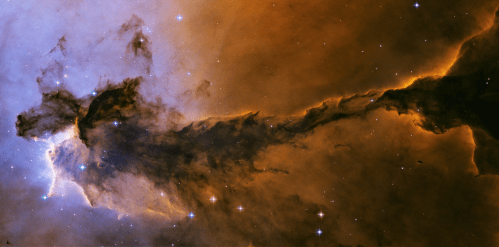
About the Eagle Nebula: Quote from Wikipedia:

The Eagle Nebula is part of a diffuse emission nebula, or H II region, which is catalogued as IC 4703. This region of active current star formation is about 7000 light-years distant. A spire of gas that can be seen coming off the nebula in the northeastern part is approximately 9.5 light-years or about 90 trillion kilometers long.[4]

The cluster associated with the nebula has approximately 8100 stars, which are mostly concentrated in a gap in the molecular cloud to the north-west of the Pillars.[5] The brightest star (HD 168076) has an apparent magnitude of +8.24, easily visible with good binoculars. It is actually a binary star formed of an O3.5V star plus an O7.5V companion.[6] This star has a mass of roughly 80 solar masses, and a luminosity up to 1 million times that of the Sun. The cluster’s age has been estimated to be 1–2 million years.[7]

The descriptive names reflect impressions of the shape of the central pillar rising from the southeast into the central luminous area. The name “Star Queen Nebula” was introduced by Robert Burnham, Jr., reflecting his characterization of the central pillar as the Star Queen shown in silhouette.[8]


Credits and Attributions

Quote from Hamlet, Act 1, scene 5, by William Shakespeare, [Public Domain]

The Fairy of Eagle Nebula  By NASA [Public domain], via Wikimedia Commons

Wikipedia contributors, “Eagle Nebula,” Wikipedia, The Free Encyclopedia, https://en.wikipedia.org/w/index.php?title=Eagle_Nebula&oldid=804691133 (accessed October 12, 2017).

2 Comments

Filed under #FineArtFriday, #FlashFictionFriday, writing