Tag Archives: Fine Art Friday

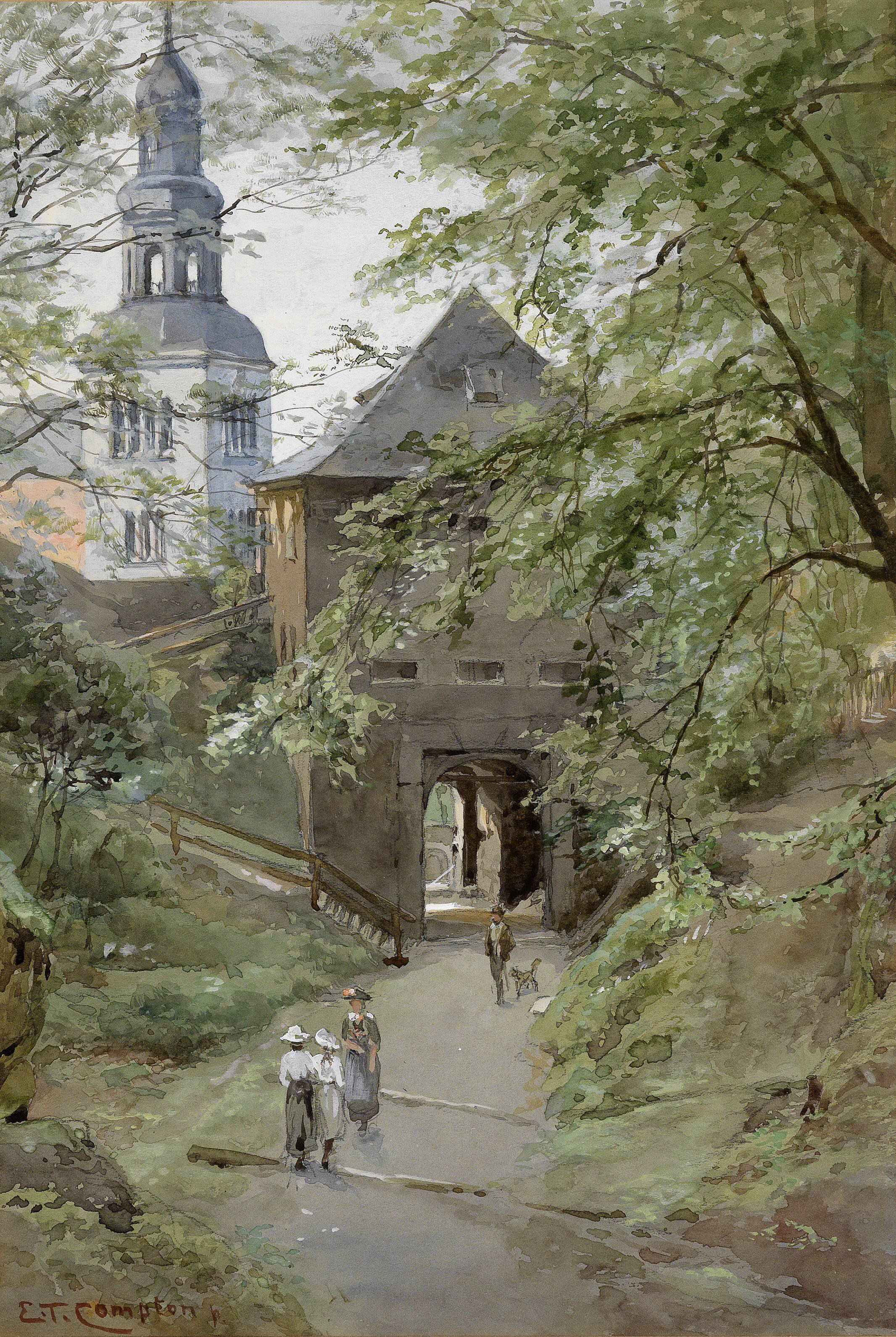
#FineArtFriday: Augustiner Bräu and Mülln Abbey by E. T. Compton

Edward_Theodor_Compton_Augustiner_Bräu_und_Kloster_MüllnPainting: Augustiner Bräu and Mülln Abbey in Salzburg

Artist:  Edward Theodore Compton (1849–1921)

Medium: Watercolor and opaque white on paper, 24,5 x 35,5 cm

Inscription: signed E. T. Compton

Date: by 1921

What I love about this image:

This is a cityscape, a genre which Compton was not famous for painting. The central building is a brewery, and in background rises the steeple of an Augustinian abbey. The day is pleasant, not too bright or warm, but comfortable. People are out without coats, so perhaps it was painted on one of those slightly overcast days in June.

The muted colors and gray skies make this a familiar kind of day to me, as June in the Pacific Northwest is frequently overcast, but pleasant.

Compton is known for his vast mountain-scapes, but this painting shows us that he found the architecture and community of his adopted country interesting too.

Judging by the dress of the walkers, I would say this was painted just after WWI. The skirts are not full and are hemmed well-above the ankle, which was not a pre-WWI style at all. The blouses are simple, with no lace or ruffles; the clothes of women who worked both at home and at jobs. After the war, cloth was expensive, and fashions changed accordingly.

About the Artist, Via Wikipedia:

Edward Theodore Compton, usually referred to as E. T. Compton, (29 July 1849 – 22 March 1921) was an English-born, German artist, illustrator, and mountain climber. He is well known for his paintings and drawings of alpine scenery, and as a mountaineer made 300 major ascents including no fewer than 27 first ascents.

Compton was born in Stoke Newington in London, the son of Theodore Compton, an art-loving insurance agent, and grew up in a deeply religious Quaker household. He attended various art schools, including, for a time, the Royal Academy in London, but otherwise he was mainly self-taught in art.

In 1867, wanting the best education for their artistically-talented son, and due to the high cost of schooling in England, the family decided to emigrate to Germany settling in Darmstadt. The city at that time was the seat of the Grand Duchy of Hesse under Grand Duke Ludwig III, and a community of artists had sprung up there. Entries in Compton’s diary show that both he and his father were art teachers – Alice, the Princess of Hesse numbered amongst Edward’s students.

Initially painting in the English romantic tradition, Compton later developed a more realistic representation of nature, being guided by his true artistic ideas while retaining topographical accuracy. Even his early watercolors show the great importance of brightness and light and his work is also remarkable for its portrayal of the elements such as water and air, including ascending mist and fog. He can be regarded as an impressionist.

Although Compton never had much formal art education and did not found a school, he influenced artists such as Ernst Platz and Karl Arnold as well as his son Edward Harrison Compton and daughter Dora Compton. [1]


Credits and Attributions:

[1] Wikipedia contributors, “Edward Theodore Compton,” Wikipedia, The Free Encyclopedia, https://en.wikipedia.org/w/index.php?title=Edward_Theodore_Compton&oldid=1021678754 (accessed September 30, 2021).

Image courtesy of: Wikimedia Commons contributors, “File:Edward Theodor Compton Augustiner Bräu und Kloster Mülln.jpg,” Wikimedia Commons, the free media repository, https://commons.wikimedia.org/w/index.php?title=File:Edward_Theodor_Compton_Augustiner_Br%C3%A4u_und_Kloster_M%C3%BClln.jpg&oldid=331463362 (accessed September 30, 2021).
Comments Off on #FineArtFriday: Augustiner Bräu and Mülln Abbey by E. T. Compton

Filed under #FineArtFriday, writing

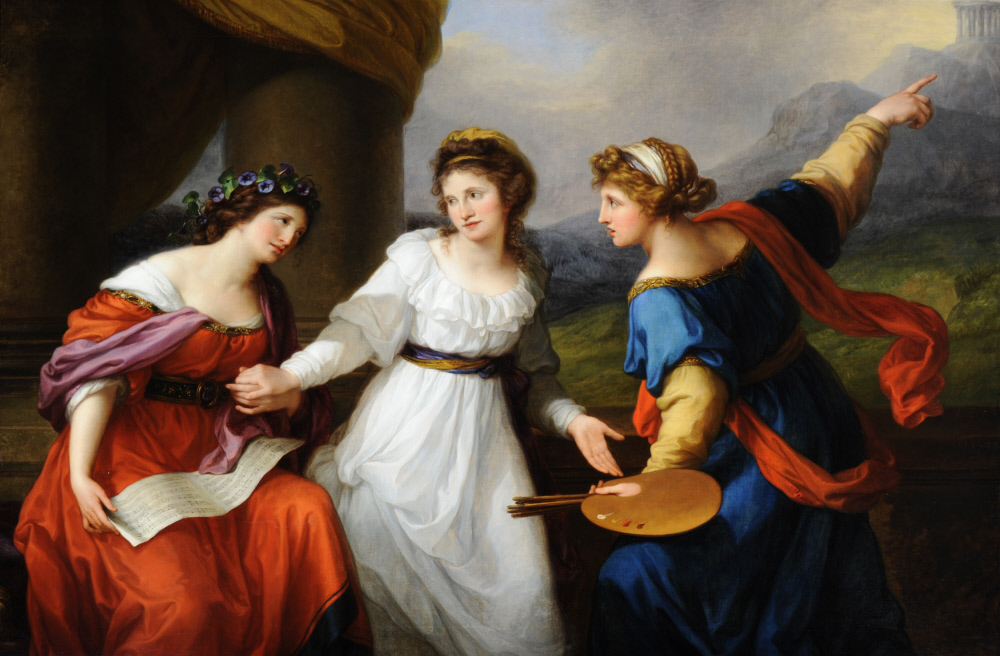
#FineArtFriday: Self-portrait Hesitating between the Arts of Music and Painting by Angelica Kauffmann 1791

Self-portrait of the Artist hesitating between the Arts of Music and Painting by Angelica Kauffman RA (Chur 1741 ¿ Rome 1807)

Artist: Angelica Kauffmann  (1741–1807)

Title: Self-portrait Hesitating between the Arts of Music and Painting

Date: 1791

Medium: oil on canvas

Dimensions: Height: 147 cm (57.8 in); Width: 216 cm (85 in)

Collection: The St Oswald Collection, Nostell Priory. (The National Trust)

What I love about this painting:

Balanced, powerful colors and the soft-brushed, multi-layered style of English portraitists Sir Joshua Reynolds and Thomas Gainsborough characterize all of Angelica Kauffman’s work. We see sharp clarity and attention to the smallest detail in the setting and the scene. Yet, the faces have a mystical, dreamlike quality.

This painting shows the struggle many artists suffer from, trying to decide which muse to follow. Kauffmann loved music and painting in equal measure. She had a natural soprano of operatic quality, yet she had the kind of artistic talent for painting that rarely comes along.

Art won out. I’m glad because, in those days before recordings, music was ephemeral. It was over when the last bow was taken, and the curtain closed. Only the lucky few in the opera house experienced it.

Artists like Kauffmann, who leave us their great works, bring enjoyment to thousands of people over the course of centuries.

Angelica Kauffmann was a beautiful, extraordinarily talented and well-educated woman in an era when talented, educated women were considered an annoyance. Slut-shaming isn’t a new method of trying to keep a woman down, although social media has made it into a handy weapon. The practice has been around for as long as humans have walked the earth.

Kauffmann’s talent and success, along with her friendship with Sir Joshua Reynolds, so annoyed fellow artist Nathaniel Hone that he went to great lengths to publicly humiliate both her and Reynolds in his painting, The Conjurer.

Hone’s attempt to put her in her place backfired, as rather than cowering in shame, Kauffmann held her head up and fought back, forcing him to remove the nude he’d painted (implying she’d posed for it) from his picture. Her reputation remained untarnished by the defamatory assault, but Hone’s crudely expressed jealousy, both professional and personal, did him no favors among his peers.

From Wikipedia:

Her friendship with Reynolds was criticized in 1775 by fellow Academician Nathaniel Hone, who courted controversy in 1775 with his satirical picture The Conjurer. It was seen to attack the fashion for Italian Renaissance art and to ridicule Sir Joshua Reynolds, leading the Royal Academy to reject the painting. It also originally included a nude caricature of Kauffman in the top left corner, which he painted out after she complained to the academy. The combination of a little girl and an old man has also been seen as symbolic of Kauffman and Reynolds’s closeness, age difference, and rumoured affair. [1]


About the Artist (also via Wikipedia):

Maria Anna Angelika Kauffmann RA (30 October 1741 – 5 November 1807), usually known in English as Angelica Kauffman, was a Swiss Neoclassical painter who had a successful career in London and Rome. Remembered primarily as a history painter, Kauffmann was a skilled portraitist, landscape and decoration painter. She was, along with Mary Moser, one of two female painters among the founding members of the Royal Academy in London in 1768.

In 1782, Kauffman’s father died, as did her husband in 1795. In 1794, she painted, Self-Portrait Hesitating Between Painting and Music, in which she emphasizes the difficult choice she had faced in choosing painting as her sole career, in dedication to her mother’s death. She continued at intervals to contribute to the Royal Academy in London, her last exhibit being in 1797. After this she produced little, and in 1807 she died in Rome, being honored by a splendid funeral under the direction of Canova. The entire Academy of St Luke, with numerous ecclesiastics and virtuosi, followed her to her tomb in Sant’Andrea delle Fratte, and, as at the burial of Raphael, two of her best pictures were carried in procession. [1]


Credits and Attributions:

Self-Portrait Hesitating Between the Arts of Music and Painting by Angelica Kauffmann, Public domain, via Wikimedia Commons. Wikimedia Commons contributors, “File:Angelica Kauffman. Self-Portrait Hesitating Between the Arts of Music and Painting.jpg,” Wikimedia Commons, the free media repository, https://commons.wikimedia.org/w/index.php?title=File:Angelica_Kauffman._Self-Portrait_Hesitating_Between_the_Arts_of_Music_and_Painting.jpg&oldid=527350844 (accessed September 23, 2021).

[1] Wikipedia contributors, “Angelica Kauffman,” Wikipedia, The Free Encyclopedia, https://en.wikipedia.org/w/index.php?title=Angelica_Kauffman&oldid=1045596134 (accessed September 23, 2021).

4 Comments

Filed under #FineArtFriday, writing

#FineArtFriday: Nighthawks by Edward Hopper 1942

Nighthawks_by_Edward_Hopper_1942Artist: Edward Hopper (1882–1967)

Title: Nighthawks

Genre: genre art

Date: 21 January 1942

Medium: oil on canvas

Dimensions: Height: 84.1 cm (33.1 in); Width: 152.4 cm (60 in)

Collection: Art Institute of Chicago

What I love about this painting:

Edward Hopper’s years spent working as an illustrator enabled him to convey mood and emotion with startling clarity. In Nighthawks, the mood is dark and brooding. The emotion is solitariness, the sense of being alone even in the company of others. We (the viewer) stand in the shadows outside the diner, with a cinematic view of the brightly lit interior, its neon cheeriness imposed upon the patrons, who seem oblivious to it. Around us, the street is dark and empty.

Some have ascribed the dark atmosphere of this piece to the fact that Pearl Harbor had just been attacked, and that may have played a role in Hopper’s personal mood as he developed the painting. However, Hopper himself later said, “Nighthawks has more to do with the possibility of predators in the night than with loneliness.” [1]

We who observe through the window are voyeurs, observers only, watching the people who pass the lonely night in the café.

About this painting, via Wikipedia:

Nighthawks is a 1942 oil on canvas painting by Edward Hopper that portrays four people in a downtown diner late at night as viewed through the diner’s large glass window. The light coming from the diner illuminates a darkened and deserted urban streetscape.

It has been described as Hopper’s best-known work and is one of the most recognizable paintings in American art. Within months of its completion, it was sold to the Art Institute of Chicago on May 13, 1942, for $3,000, equivalent to $47,520 in 2020.

It has been suggested that Hopper was inspired by a short story of Ernest Hemingway‘s, either “The Killers.” which Hopper greatly admired, or from the more philosophical “A Clean, Well-Lighted Place.” In response to a query on loneliness and emptiness in the painting, Hopper outlined that he “didn’t see it as particularly lonely.” He said, “Unconsciously, probably, I was painting the loneliness of a large city.” [2]

About the Artist, via Wikipedia:

Always reluctant to discuss himself and his art, Hopper simply said, “The whole answer is there on the canvas.” Hopper was stoic and fatalistic—a quiet introverted man with a gentle sense of humor and a frank manner. Hopper was someone drawn to an emblematic, anti-narrative symbolism,  who painted short, isolated moments of configuration, saturated with suggestion. His silent spaces and uneasy encounters touch us where we are most vulnerable and have a suggestion of melancholy, that melancholy being enacted. His sense of color revealed him as a pure painter as he turned the Puritan into the purist, in his quiet canvasses where blemishes and blessings balance. According to critic Lloyd Goodrich, he was “an eminently native painter, who more than any other was getting more of the quality of America into his canvases.”

Conservative in politics and social matters (Hopper asserted for example that “artists’ lives should be written by people very close to them”), he accepted things as they were and displayed a lack of idealism. Cultured and sophisticated, he was well-read, and many of his paintings show figures reading. He was generally good company and unperturbed by silences, though sometimes taciturn, grumpy, or detached. He was always serious about his art and the art of others, and when asked would return frank opinions.

Though Hopper claimed that he didn’t consciously embed psychological meaning in his paintings, he was deeply interested in Freud and the power of the subconscious mind. He wrote in 1939, “So much of every art is an expression of the subconscious that it seems to me most of all the important qualities are put there unconsciously, and little of importance by the conscious intellect.”


Credits and Attributions:

[1] Wikipedia contributors, “Edward Hopper,” Wikipedia, The Free Encyclopedia, https://en.wikipedia.org/w/index.php?title=Edward_Hopper&oldid=1038646946 (accessed September 9, 2021).

[2] Wikipedia contributors, “Nighthawks (painting),” Wikipedia, The Free Encyclopedia, https://en.wikipedia.org/w/index.php?title=Nighthawks_(painting)&oldid=1042829601 (accessed September 9, 2021).

Wikimedia Commons contributors, “File:Nighthawks by Edward Hopper 1942.jpg,” Wikimedia Commons, the free media repository, https://commons.wikimedia.org/w/index.php?title=File:Nighthawks_by_Edward_Hopper_1942.jpg&oldid=469227621 (accessed September 9, 2021).

4 Comments

Filed under #FineArtFriday

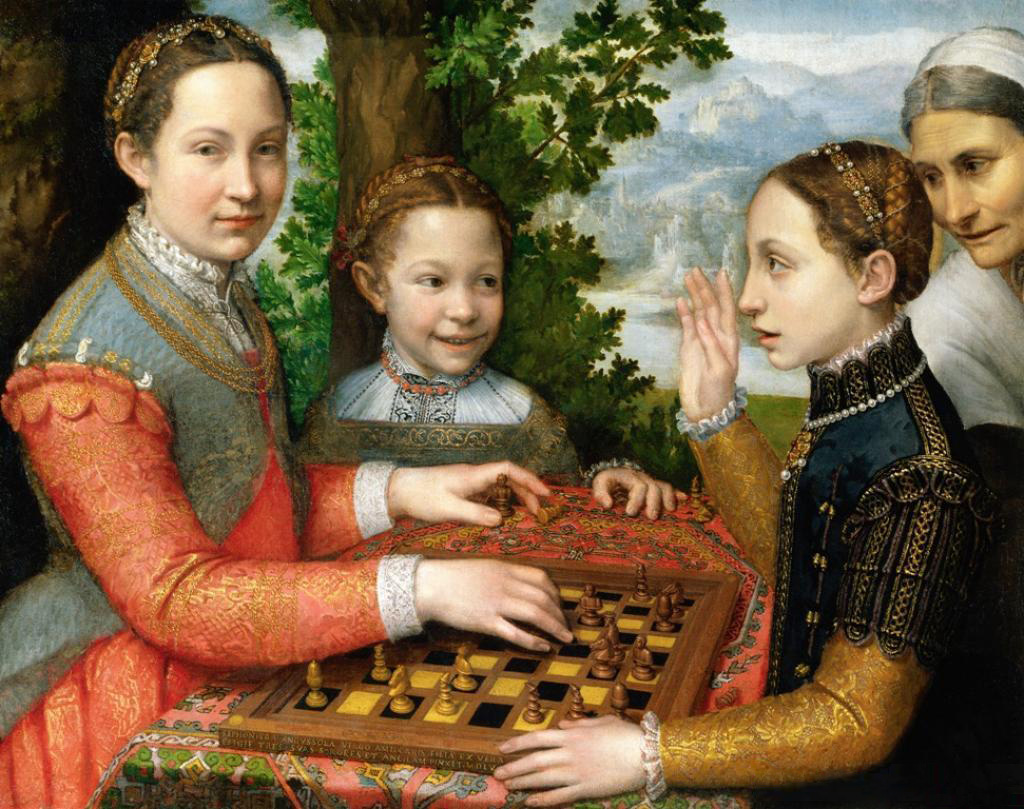
#FineArtFriday: The Chess Game, by Sofonisba Anguissola ca. 1555 (reprise)

Title: The Chess Game (Portrait of the artist’s sisters playing chess)

Artist: Sofonisba Anguissola

Date: 1555

Medium: oil on canvas

Dimensions: Height: 72 cm (28.3 ″) Width: 97 cm (38.1 ″)

Today we’re revisiting The Chess Game, which is a portrait of the artist’s sisters playing chess. This post first appeared here on September 13, 2019 and is a wonderful window into the personalities of three girls in an upper class family in the 16th century. Anguissola had a marvelous ability to capture the moods of her subjects.

What I love about this painting:

The colors are vibrant,

Because it is a game of war and strategies for winning a war, chess has historically been considered a predominantly male game. That Anguissola’s sisters are playing it at so young an age is a testimony to the atmosphere of education surrounding the home.

Their features are modern in the way they are shown with a roundness that is unusual in early renaissance portraits, which were often so highly formal that they were visually flat. These girls could be my granddaughters.

Anguissola has captured the emotions and happiness of a family at play. Her sisters’ personalities are clearly shown. The older sister has taken a pawn, the younger fears she might lose the game to a more experienced player. The youngest is enjoying the game immensely, seeing the sister who sometimes bosses her around being handed her own medicine.

About the Artist, via Wikipedia:

Sofonisba Anguissola (c. 1532 – 16 November 1625), also known as Sophonisba Angussola or Anguisciola, was an Italian Renaissance painter born in Cremona to a relatively poor noble family. She received a well-rounded education, that included the fine arts, and her apprenticeship with local painters set a precedent for women to be accepted as students of art. As a young woman, Anguissola traveled to Rome where she was introduced to Michelangelo, who immediately recognized her talent, and to Milan, where she painted the Duke of Alba. The Spanish queen, Elizabeth of Valois, was a keen amateur painter and in 1559 Anguissola was recruited to go to Madrid as her tutor, with the rank of lady-in-waiting. She later became an official court painter to the king, Philip II, and adapted her style to the more formal requirements of official portraits for the Spanish court. After the queen’s death, Philip helped arrange an aristocratic marriage for her. She moved to Sicily, and later Pisa and Genoa, where she continued to practice as a leading portrait painter.

On 12 July 1624, Anguissola was visited by the young Flemish painter Anthony van Dyck, who recorded sketches from his visit to her in his sketchbook. Van Dyck, who believed her to be 96 years of age (she was actually about 92) noted that although “her eyesight was weakened”, Anguissola was still mentally alert. Excerpts of the advice she gave him about painting survive from this visit, and he was said to have claimed that their conversation taught him more about the “true principles” of painting than anything else in his life. Van Dyck drew her portrait while visiting her.

About this painting, via Wikipedia:

Although Anguissola enjoyed significantly more encouragement and support than the average woman of her day, her social class did not allow her to transcend the constraints of her sex. Without the possibility of studying anatomy or drawing from life (it was considered unacceptable for a lady to view nudes), she could not undertake the complex multi-figure compositions required for large-scale religious or history paintings.

Instead, she experimented with new styles of portraiture, setting subjects informally. Self-portraits and family members were her most frequent subjects, as seen in such paintings as Self-Portrait (1554, Kunsthistoriches Museum, Vienna), Portrait of Amilcare, Minerva and Asdrubale Anguissola (c. 1557–1558, Nivaagaards Malerisambling, Niva, Denmark), and her most famous picture, The Chess Game (1555, Muzeum Narodowe, Poznań), which depicted her sisters Lucia, Minerva and Europa.

Painted when Sofonisba was 23 years old, The Chess Game is an intimate representation of an everyday family scene, combining elaborate formal clothing with very informal facial expressions, which was unusual for Italian art at this time. The Chess Game explored a new kind of genre painting which places her sitters in a domestic setting instead of the formal or allegorical settings that were popular at the time. This painting has been regarded as a conversation piece, which is an informal portrait of a group engaging in lively conversation or some activity .


Credits and Attributions:

Wikimedia Commons contributors, “File:The Chess Game – Sofonisba Anguissola.jpg,” Wikimedia Commons, the free media repository, https://commons.wikimedia.org/w/index.php?title=File:The_Chess_Game_-_Sofonisba_Anguissola.jpg&oldid=359367567 (accessed September 12, 2019).

Wikipedia contributors, “Sofonisba Anguissola,” Wikipedia, The Free Encyclopedia, https://en.wikipedia.org/w/index.php?title=Sofonisba_Anguissola&oldid=908120352 (accessed September 12, 2019).

Comments Off on #FineArtFriday: The Chess Game, by Sofonisba Anguissola ca. 1555 (reprise)

Filed under #FineArtFriday

#FineArtFriday: Accident at the Old Pier, by Andreas Achenbach 1863

OLYMPUS DIGITAL CAMERA

Artist: Andreas Achenbach  (1815–1910)

Title: Accident at the Old Pier, by Andreas Achenbach 1863

Genre: landscape art

Date: 1863

Medium: oil on panel

Dimensions: Height: 92.5 cm (36.4 in) Width: 70.8 cm (27.8 in)

Collection: Kunsthalle Bremen 

Object history: 1865: purchased by Kunsthalle Bremen

Inscriptions: Signature and date bottom left: A. Achenbach 1863

What I love about this painting:

The scene depicted here is both historical, and current. It is a scene that plays out in our modern world in the same way as it did in 1863.

No matter what part of the world you live, anyone who lives near the sea will recognize the style of the rickety, weathered pier. Storms and saltwater wreak their will on both the wooden docks and the hubris of those who think to conquer the waves. Wood is no match for the storm; we fish and travel the waters at the mercy of the weather, and if the wind is wrong, approaching the dock can be dicey.

Along the pier, men work to keep the boat from crashing. A ship of that size would take out at least a section of the dock, if not the whole dock.

To this day, there is only one way to fend a boat away from a bad docking if they are at the mercy of the storm, and that is what we see here. Dockworkers push the vessel with poles to hold it off, hoping to reduce its momentum. A timber floats in the waves, as the boat has struck the pier at least once with the full force of the gale winds.

For the crew, disembarking will be a challenge. Should these sailors remain on board or try to jump onto the pier, risking being crushed between the rolling, lurching ship and the waves?

About the Artist, via Wikipedia:

Andreas Achenbach (29 September 1815, Kassel – 1 April 1910, Düsseldorf) was a German landscape and seascape painter in the Romantic style. He is considered to be one of the founders of the Düsseldorf School. His brother, Oswald, was also a well known landscape painter. Together, based on their initials, they were known as the “Alpha and Omega” of landscape painters. [1]


Credits and Attributions:

Wikimedia Commons contributors, “File:Achenbach Havarie am alten Pier@Albert König Museum20160904.jpg,” Wikimedia Commons, the free media repository, https://commons.wikimedia.org/w/index.php?title=File:Achenbach_Havarie_am_alten_Pier@Albert_K%C3%B6nig_Museum20160904.jpg&oldid=526736266 (accessed August 19, 2021).

[1] Wikipedia contributors, “Andreas Achenbach,” Wikipedia, The Free Encyclopedia, https://en.wikipedia.org/w/index.php?title=Andreas_Achenbach&oldid=1037476363 (accessed August 19, 2021).

1 Comment

Filed under #FineArtFriday, writing

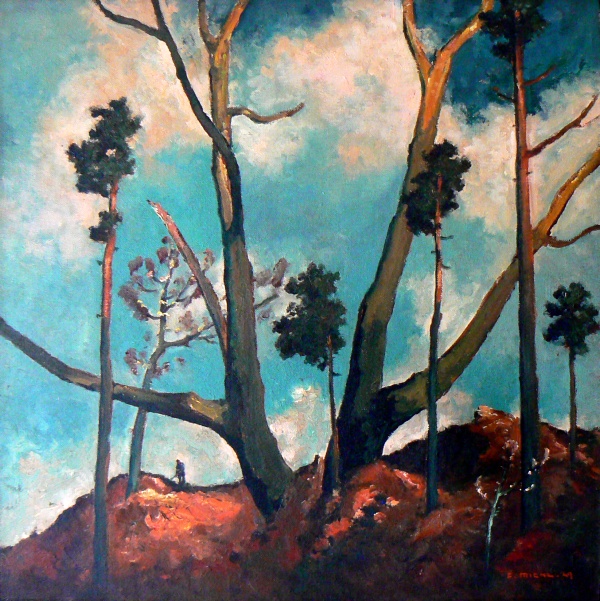
#FineArtFriday: Autumn by František Michl 1949

1949-Autumn

Artist: František Michl

Title:  Autumn, 1949.

Medium: oil on canavas (private collection)


What I love about this painting:

This is a powerful, moody piece. It conveys the chill and dampness of a day in late autumn, contrasted against the brilliant blue of the skies between rain squalls. Some trees cling to their leaves, defying the cold breeze while others are bare, mingled among the tall evergreens. The grass is brown, and a solitary hiker takes advantage of the sunshine, making their way over the ridge in solitary peace.

One feels that soon this hillside will be covered with snow.

About the Artist, via Wikipedia:

[1] František Michl (20 November 1901, – 4 June 1977), Czech academic painter, graphic artist, and original designer of the Škoda Works emblem, the “Winged Arrow”. He was imprisoned in Pankrac Prison, and the concentration camps Terezin and Flossenbürg after his arrest by Nazis for an anti-fascist demonstration at Domažlice. After the war he was arrested in the Czechoslovak Socialist Republic for listening to the anticommunist Radio Liberty.

Michl, being a free-minded and anticommunist spirit, was imprisoned in Plzeň Prison in 1961. The trial was based on the accusation that Michl listened to Radio Liberty, which was considered by the totalitarian regime as treason. His name was blacklisted and his family persecuted.

The diminished political pressure in 1967 opened new prospects for Michl’s art in Czechoslovakia and abroad. In March 1968 his paintings were exhibited in Montreal. The Rullos Gallery in New York bought 165 paintings in November 1968. Unfortunately, preparation of Michl’s exhibition in the London National Gallery was interrupted by the Soviet invasion in August 1968.

The time of normalization brought back the ban on Michl’s name. Michl was not allowed to publicly display his art (though several illegal exhibitions, organized by his friends, took place, camouflaged under fake titles, for example “Successes of building socialism”). After his first brain stroke in 1972, which left half of his body paralyzed, Michl kept painting. It was only after his sixth stroke that Michl remained permanently bedridden until his death on June 4, 1977.

In 1991, František Michl’s name was fully politically rehabilitated, and his contribution to the anti-fascist and anticommunist resistance was recognized. Michl’s work, however, is still awaiting public recognition. [1]


Credits and Attributions:

Wikimedia Commons contributors, “File:1949-stromy.jpg,” Wikimedia Commons, the free media repository, https://commons.wikimedia.org/w/index.php?title=File:1949-stromy.jpg&oldid=423191687 (accessed August 13, 2021).

[1] Wikipedia contributors, “František Michl,” Wikipedia, The Free Encyclopedia, https://en.wikipedia.org/w/index.php?title=Franti%C5%A1ek_Michl&oldid=1002262176 (accessed August 13, 2021).

2 Comments

Filed under #FineArtFriday

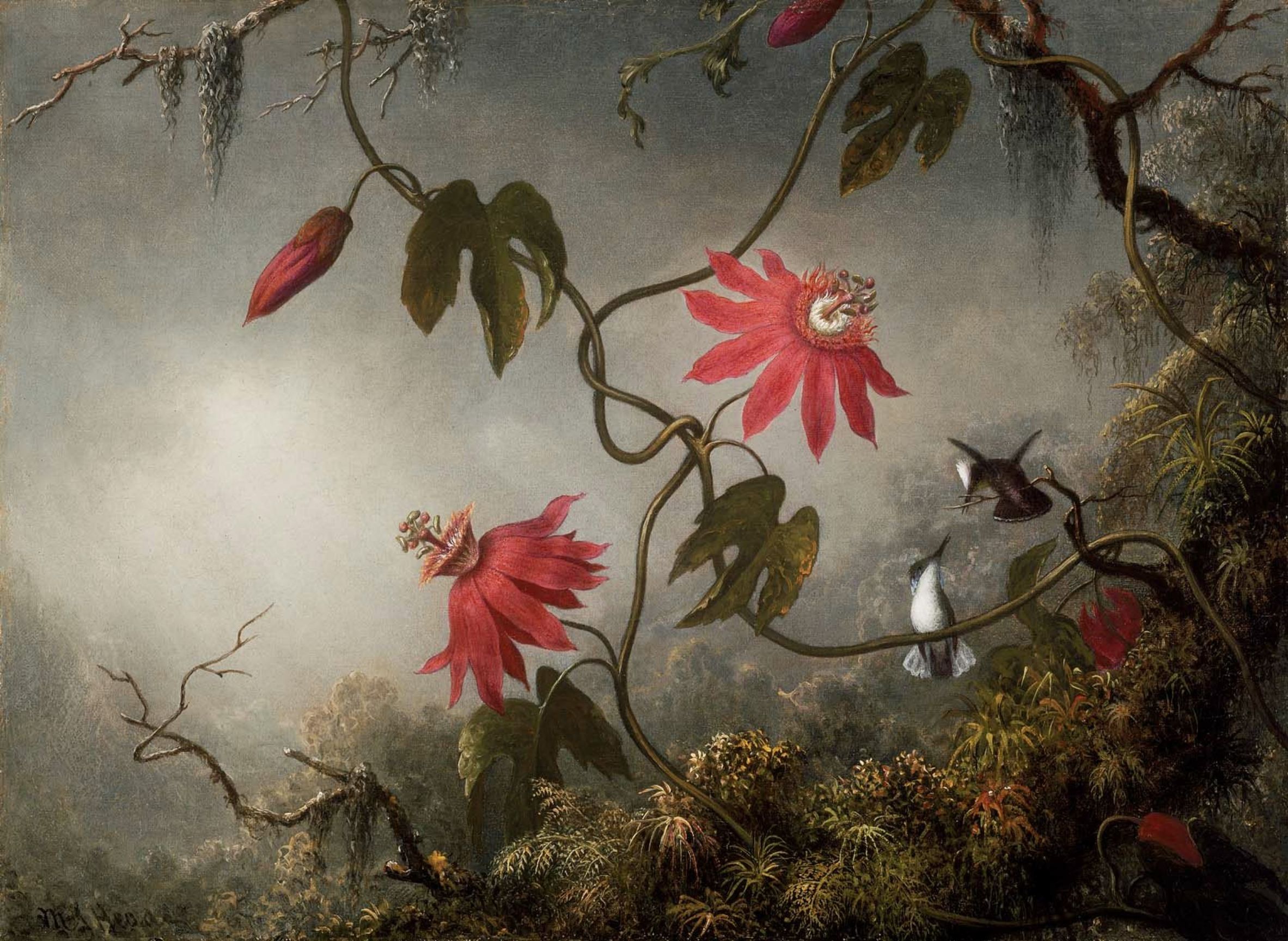
#FineArtFriday: Passion Flowers and Hummingbirds by Martin Johnson Heade

MJ_Heade_Passion_Flowers_and_HummingbirdsArtist: Martin Johnson Heade (1819–1904)
Title: Passion Flowers and Hummingbirds

Genre:  floral painting

Date: circa 1870–83

Medium: oil on canvas

Dimensions: Height: 39.3 cm (15.5 in); Width: 54.9 cm (21.6 in)


About this painting, via Wikimedia Commons:

[1] In Passion Flowers and Hummingbirds, Heade depicted two snowcap hummingbirds, small black-and-white birds found in Panama, and the most brilliantly colored species of passionflower, Passiflora racemosa, in a steamy, lush jungle setting.

The passionflower is so named because missionaries saw correspondences between the parts of the flower and the Passion (or sufferings) of Christ. For example, the ten petals represent the ten apostles present at the crucifixion, the corona filaments resemble the crown of thorns, and the three stigmas relate to the nails.

In this work, Heade successfully combined his scientific interests and his aesthetic sensitivity. He rendered the birds and the passionflowers accurately in a close-up view but also gracefully composed the winding stems across the surface of the picture and contrasted the cool greens and grays with the dazzling red of the flowers.

Although Heade was one of the first to reflect Darwin’s theories in his paintings of flowers in their natural habitats, other artists were subsequently affected by Darwin’s view of the vitality of plants and the interaction of plants with their environment. [1]

About the Artist, via Wikipedia:

[2] Martin Johnson Heade (August 11, 1819 – September 4, 1904) was an American painter known for his salt marsh landscapes, seascapes, and depictions of tropical birds (such as hummingbirds), as well as lotus blossoms and other still lifes. His painting style and subject matter, while derived from the romanticism of the time, are regarded by art historians as a significant departure from those of his peers.

Heade was born in Lumberville, Pennsylvania, the son of a storekeeper. He studied with Edward Hicks, and possibly with Thomas Hicks. His earliest works were produced during the 1840s and were chiefly portraits. He travelled to Europe several times as a young man, became an itinerant artist on American shores, and exhibited in Philadelphia in 1841 and New York in 1843. Friendships with artists of the Hudson River School led to an interest in landscape art. In 1863, he planned to publish a volume of Brazilian hummingbirds and tropical flowers, but the project was eventually abandoned.

He travelled to the tropics several times thereafter, and continued to paint birds and flowers. Heade married in 1883 and moved to St. Augustine, Florida. His chief works from this period were Floridian landscapes and flowers, particularly magnolias laid upon velvet cloth. He died in 1904. His best known works are depictions of light and shadow upon the salt marshes of New England.

Heade was not a widely known artist during his lifetime, but his work attracted the notice of scholars, art historians, and collectors during the 1940s. He quickly became recognized as a major American artist. Although often considered a Hudson River School artist, some critics and scholars take exception to this categorization. Heade’s works are now in major museums and collections. His paintings are occasionally discovered in unlikely places such as garage sales and flea markets. [2]


Credits and Attributions:

[1] Wikimedia Commons contributors, “File:MJ Heade Passion Flowers and Hummingbirds.jpg,” Wikimedia Commons, the free media repository, https://commons.wikimedia.org/w/index.php?title=File:MJ_Heade_Passion_Flowers_and_Hummingbirds.jpg&oldid=577409420 (accessed July 29, 2021).

[2] Wikipedia contributors, “Martin Johnson Heade,” Wikipedia, The Free Encyclopedia, https://en.wikipedia.org/w/index.php?title=Martin_Johnson_Heade&oldid=1013422150 (accessed July 29, 2021).

Comments Off on #FineArtFriday: Passion Flowers and Hummingbirds by Martin Johnson Heade

Filed under #FineArtFriday, writing

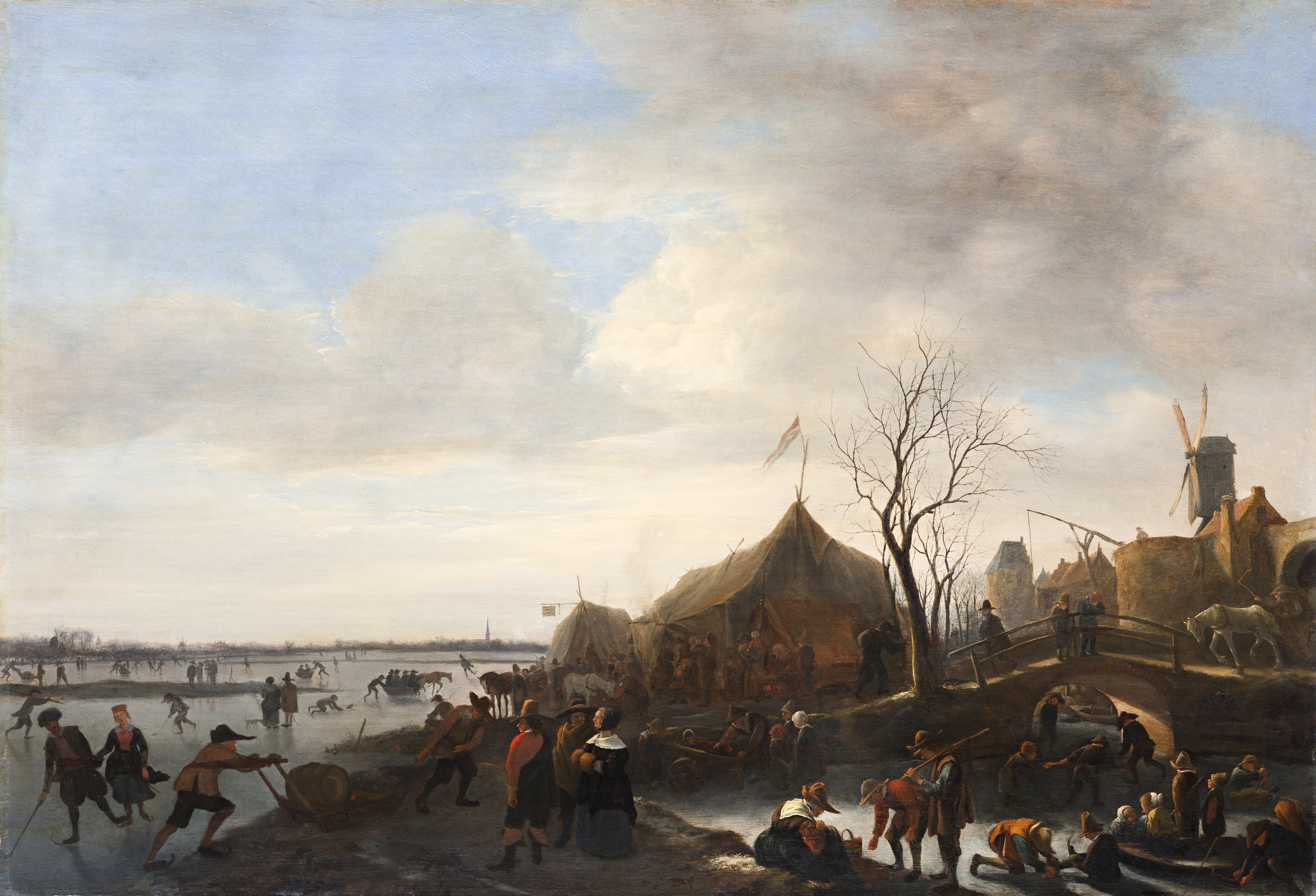
#FineArtFriday: Winter Scene by Jan Steen 1650

Inv.nr: 10032

Artist: Jan Steen (1625/1626–1679)

Title: Winter Scene

Date: circa 1650

Medium: oil on canvas

Dimensions: Height: 660 mm (25.98 in); Width: 960 mm (37.79 in)

About this painting, Via Wikimedia Commons:

[1] Winter Scene is one of the earliest known paintings by Steen. With its diagonal composition and silhouetted figures on the ice one can clearly see his early inspirations from paintings such as Isaac van Ostade’s Winter from 1645. Here, as often seen in other works by Steen and his contemporaries, the activities are being watched by a well-dressed couple who occupies a central position in the composition. [1]

About the Artist, via Wikipedia:

[2] Jan Havickszoon Steen (c. 1626 – buried 3 February 1679) was a Dutch Golden Age painter, one of the leading genre painters of the 17th century. His works are known for their psychological insight, sense of humour and abundance of colour.

Daily life was Jan Steen’s main pictorial theme. Many of the genre scenes he portrayed, as in The Feast of Saint Nicholas, are lively to the point of chaos and lustfulness, even so much that “a Jan Steen household,” meaning a messy scene, became a Dutch proverb (een huishouden van Jan Steen). Subtle hints in his paintings seem to suggest that Steen meant to warn the viewer rather than invite him to copy this behaviour. Many of Steen’s paintings bear references to old Dutch proverbs or literature. He often used members of his family as models, and painted quite a few self-portraits in which he showed no tendency of vanity.

Steen did not shy from other themes: he painted historical, mythological and religious scenes, portraits, still lifes and natural scenes. His portraits of children are famous. He is also well known for his mastery of light and attention to detail, most notably in Persian rugs and other textiles.

Steen was prolific, producing about 800 paintings, of which roughly 350 survive. His work was valued much by contemporaries and as a result he was reasonably well paid for his work. He did not have many students—only Richard Brakenburgh is recorded—but his work proved a source of inspiration for many painters. [2]


Credits and Attributions:

Wikimedia Commons contributors, “File:Måleri, landskapsbild, vinterlandskap. Jan Steen – Skoklosters slott – 88965.tif,” Wikimedia Commons, the free media repository, https://commons.wikimedia.org/w/index.php?title=File:M%C3%A5leri,_landskapsbild,_vinterlandskap._Jan_Steen_-_Skoklosters_slott_-_88965.tif&oldid=428348165 (accessed July 22, 2021). Photographer:  Jens Mohr.

Wikipedia contributors, “Jan Steen,” Wikipedia, The Free Encyclopedia, https://en.wikipedia.org/w/index.php?title=Jan_Steen&oldid=1022958604 (accessed July 22, 2021).

Comments Off on #FineArtFriday: Winter Scene by Jan Steen 1650

Filed under #FineArtFriday

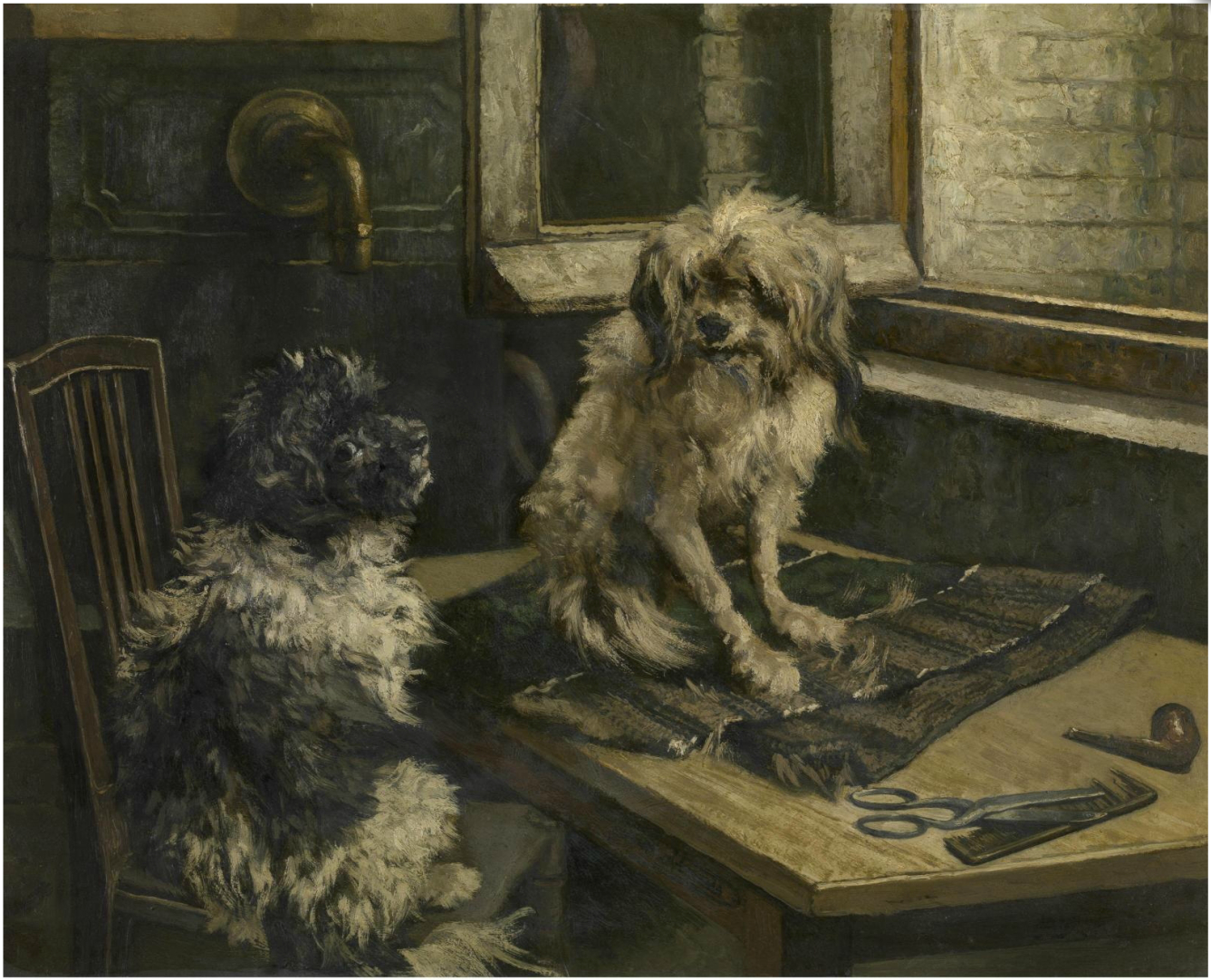
#FineArtFriday: Dogs by Jan Stobbaerts

Jan_Stobbaerts_-_DogsTitle: Dogs

Artist: Jan Stobbaerts  (1839–1914)

Date: between 1858 and 1914

Medium: oil on canvas

Dimensions: Height: 36.5 cm (14.3 in); Width: 45.5 cm (17.9 in)

What I like about this painting:

These dogs have the run of the house. They’re not too well groomed and probably spend a certain amount of time roaming the neighborhood. Both dogs have personality, and both are unrepentant ruffians.

This is a pair of canine hooligans bent on having a good time.

About the Artist, via Wikipedia [1]:

Jan Stobbaerts or Jan-Baptist Stobbaerts (18 March 1838 – 25 November 1914) was a Belgian painter and printmaker. He is known for his scenes with animals, landscapes, genre scenes and portraits or artists. With his dark-brown studio tones and forceful depiction of trivial subjects, Stobbaerts was a pioneer of Realism and ‘autochthonous’ Impressionism in Belgium.

While in his early works he painted scenes with pets in kitchen interiors in which the genre and anecdotal elements prevailed, from 1880 onwards stables and barns became a dominant theme in his work.[5] The compositions in this period were painted with an almost photographic realism.[8] His sober monochrome palette developed to a more balanced color scheme and he gave more attention to the effect of light.

Around 1890, Stobbaerts’ style underwent a considerable change likely under the influence of his discovery of Impressionism and his personal search for resolving the problem of light. Stobbaerts abandoned the detailed realism in favour of a very personal sfumato of light. His style became velvety, his brushwork looser and the paint more fluid. His paintings of the 1890s depicting scenes around the river Woluwe were made with an opaque, somewhat transparent paste. The artist concentrated on the effect of light and the forms, while they remained recognizable, became less clear as if seen through a soft-focus lens. The subject matter itself became less important. [1]


Credits and Attributions:

Wikimedia Commons contributors, “File:Jan Stobbaerts – Dogs.jpg,” Wikimedia Commons, the free media repository, https://commons.wikimedia.org/w/index.php?title=File:Jan_Stobbaerts_-_Dogs.jpg&oldid=354839586 (accessed July 9, 2021).

[1] Wikipedia contributors, “Jan Stobbaerts,” Wikipedia, The Free Encyclopedia, https://en.wikipedia.org/w/index.php?title=Jan_Stobbaerts&oldid=1025124429 (accessed July 9, 2021).

2 Comments

Filed under #FineArtFriday, writing