Tag Archives: Fine Art Friday

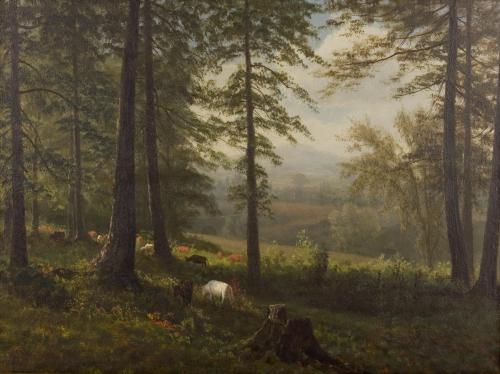
#FineArtFriday: View to a Clearing by Albert Bierstadt

Title: View to a Clearing by Albert Bierstadt

Medium: oil on paper mounted on canvas

Dimensions: Height: 14 in (35.5 cm); Width: 19 in (48.2 cm)

Inscriptions: Signature bottom left: ABierstadt

What I love about this painting:

I love the serenity of this scene, one of Bierstadt’s quieter paintings.  The muted colors, the rising mist, the filtered light, and the cattle grazing show us a hazy afternoon. It was perfect for a picnic, for mind-wandering, and a good day for painting.

Bierstadt is one of my favorite artists because he was often over the top, a little fantastic, and usually epic. He saw drama in nature and painted it, and like every good storyteller, his imagination filled in the blanks with with powerful imagery.

About the artist, via Wikipedia:

Despite his popular success, Bierstadt was criticized by some contemporaries for the romanticism evident in his choices of subject and his use of light was felt to be excessive. Some critics objected to Bierstadt’s paintings of Native Americans on the grounds that Indians “marred” the “impression of solitary grandeur.”

Interest in Bierstadt’s work was renewed in the 1960s with the exhibition of his small oil studies.  Modern opinions of Bierstadt have been divided. Some critics have regarded his work as gaudy, oversized, extravagant champions of Manifest Destiny. Others have noted that his landscapes helped create support for the conservation movement and the establishment of Yellowstone National Park. Subsequent reassessment of his work has placed it in a favorable context, as stated in 1987:

The temptation (to criticize him) should be steadfastly resisted. Bierstadt’s theatrical art, fervent sociability, international outlook, and unquenchable personal energy reflected the epic expansion in every facet of western civilization during the second half of the nineteenth century.

Bierstadt was a prolific artist, having completed over 500 paintings during his lifetime.


Credits and Attributions:

Wikimedia Commons contributors, “File:Albert Bierstadt – View to a Clearing.jpg,” Wikimedia Commons, the free media repository, https://commons.wikimedia.org/w/index.php?title=File:Albert_Bierstadt_-_View_to_a_Clearing.jpg&oldid=343092014 (accessed March 5, 2021).

Wikipedia contributors, “Albert Bierstadt,” Wikipedia, The Free Encyclopedia, https://en.wikipedia.org/w/index.php?title=Albert_Bierstadt&oldid=1009967730 (accessed March 5, 2021).

2 Comments

Filed under writing

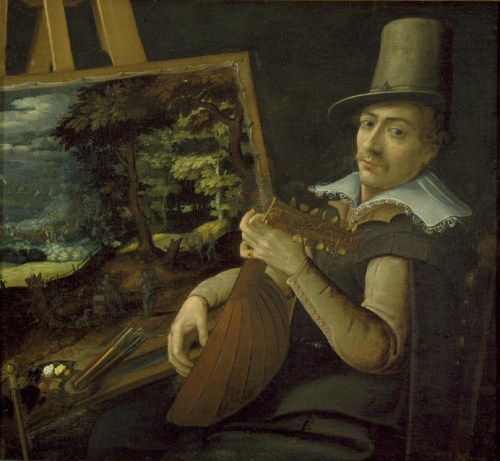
#FineArtFriday: Self-portrait, Paul Bril ca. 1595-1600

Artist: Paul Bril (circa 1553/1554–1626)

Title: Self-portrait

Genre: self-portrait

Date: between 1595 and 1600

Medium: oil on canvas

Dimensions: Height: 71 cm (27.9 in); Width: 78 cm (30.7 in)

About this painting, via Wikipedia:

The painting portrays the artist, elegantly dressed and holding a lute, sitting before his palette and easel, on which a landscape painting sits.

Bril is seen from the back, and is turning towards the viewer. He grasps the lute firmly, with active and jointed fingers. The landscape painting sitting on the easel is typical of Bril’s early work which is characterized by small figures, deep and shaded foregrounds and masses of silvery foliage, attributes that [Bril] shared with other Flemish painters. This has helped with the dating of the work to ca. 1595 – 1600. [1]

What I love about this image:

In this self-portrait Bril shows the viewer who he is and what he cares about, art and music. He is relaxed, at peace and sharing his two passions with us.


Credits and Attributions:

Paul Brill, Public domain, via Wikimedia Commons

[1] Wikipedia contributors, “Self-Portrait (Paul Bril),” Wikipedia, The Free Encyclopedia, https://en.wikipedia.org/w/index.php?title=Self-Portrait_(Paul_Bril)&oldid=1008810469 (accessed February 26, 2021).

Wikimedia Commons contributors, “File:Bril, Paul – Self-Portrait – 1595-1600.jpg,” Wikimedia Commons, the free media repository, https://commons.wikimedia.org/w/index.php?title=File:Bril,_Paul_-_Self-Portrait_-_1595-1600.jpg&oldid=527757876 (accessed February 26, 2021).

Comments Off on #FineArtFriday: Self-portrait, Paul Bril ca. 1595-1600

Filed under #FineArtFriday

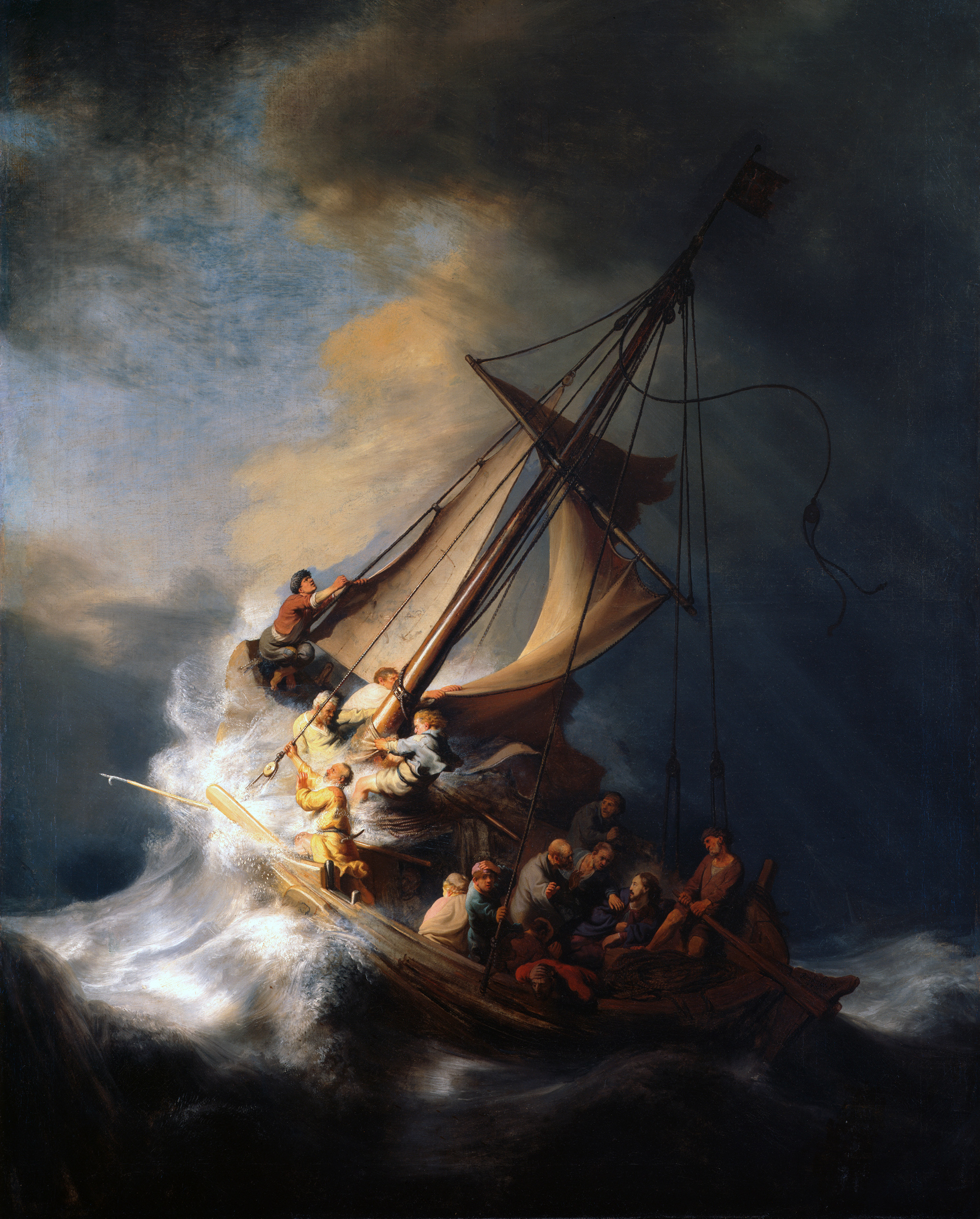
#FineArtFriday: Christ in the Storm on the Sea of Galilee by Rembrandt van Rijn, 1633

Today’s image is of a picture that was stolen in 1990 and has never been recovered. I like to bring this picture to the public eye every year, in the hope that one day it will be found safe and will be recovered. 

Christ in the Storm on the Sea of Galilee was painted during one of the happiest years of Rembrandt van Rijn’s turbulent life and depicts the miracle of Jesus calming the storm on the Sea of Galilee. A devout Christian, Rembrandt painted it from the description of the event as reported by the Apostle Mark, in the fourth chapter of his Gospel. As far as is known, it is the only seascape Rembrandt ever painted.

Constantijn Huygens, the father of Dutch mathematician and physicist Christiaan Huygens, had seen Rembrandt’s talent and helped him gain important commissions from the Court of The Hague. Many of his best religious paintings date from the years during which he had the favor of both Huygens and Prince Frederick Hendrick.

At the end of 1631, Rembrandt had moved to Amsterdam. The city was becoming the new business capital of the Netherlands, so there was great opportunity there for artists. In Amsterdam, Rembrandt had begun to paint portraits for the first time, and by 1633, his work was in high demand. His religious paintings and history paintings were also receiving the highest praise.

At first, he lived with an art dealer, Hendrick van Uylenburgh, which was where he met Hendrick’s cousin, Saskia van Uylenburgh. During 1633, the year in which Christ on the Sea of Galilee was painted, he was courting Saskia, hoping to marry her. He was earning a good income as a portraitist, and a bright future loomed. He must have felt in many ways as if he had the world by the tail.

What I love about this painting:

Rembrandt’s colors are vivid, standing out against the darkness of the storm. An entire story is captured in this image. The sea is terrifying, monstrous waves battering the ship, men panicking, trying to gain control. The terror of the event is clearly shown, and you feel fear for the men too. In the midst of chaos, Jesus awakes, calm despite the panic around him. Each face has a different expression, and one, a man holding a rope in one hand and pressing his cap to his head with the other, looks directly at us—Rembrandt himself.

The Gospel of Mark records the incident:

He woke up and rebuked the wind, and said to the sea, “Peace! Be still!” Then the wind ceased, and there was a dead calm. He said to them, “Why are you afraid? Have you still no faith?” And they were filled with great awe and said to one another, “Who then is this, that even the wind and the sea obey him?

Rembrandt was a man of many frailties but was a devout Christian. He lived the story as he painted it, as do all good storytellers.

About the theft, via Wikipedia:

On March 18, 1990, 13 works of art valued at a combined total of $500 million were stolen from the Isabella Stewart Gardner Museum in Boston. In the early hours, guards admitted two men posing as police officers responding to a disturbance call. Once inside, the thieves tied up the guards and over the next hour committed the largest-value recorded theft of private property in history. Despite efforts by the Federal Bureau of Investigation (FBI) and multiple probes around the world, no arrests have been made, and no works have been recovered.

The stolen works had originally been purchased by art collector Isabella Stewart Gardner (1840–1924) and intended to be left on permanent display at the museum with the rest of her collection. Since the collection and its layout are permanent, empty frames remain hanging both in homage to the missing works and as placeholders for their potential return. Experts are puzzled by the choice of paintings that were stolen, especially since more valuable artwork was left untouched. Among the stolen works was The Concert, one of only 34 known works by Vermeer and thought to be the most valuable unrecovered painting, valued at over $200 million.[when?] Also missing is The Storm on the Sea of GalileeRembrandt‘s only known seascape. Other works by Rembrandt, DegasManet, and Flinck were also stolen.

Christ in the Storm on the Sea of Galilee by Rembrandt van Rijn

  • Artist:   Rembrandt  (1606–1669)
  • Genre: religious art
  • Date: 1633
  • Medium: oil on canvas
  • Dimensions: Height: 160 cm (62.9 ″); Width: 128 cm (50.3 ″)
  • Current Location: Unknown

Sources and Attributions:

Wikimedia Commons contributors, “File:Rembrandt Christ in the Storm on the Lake of Galilee.jpg,” Wikimedia Commons, the free media repository, https://commons.wikimedia.org/w/index.php?title=File:Rembrandt_Christ_in_the_Storm_on_the_Lake_of_Galilee.jpg&oldid=341966464 (accessed April 4, 2019).

Wikipedia contributors, “Calming the storm,” Wikipedia, The Free Encyclopedia, https://en.wikipedia.org/w/index.php?title=Calming_the_storm&oldid=882782126 (accessed April 4, 2019).

The Isobel Stewart Gardner Museum, CHRIST IN THE STORM ON THE SEA OF GALILEE, 1633, https://www.gardnermuseum.org/experience/collection/10953 (accessed April 4, 2019).

This post first appeared in April of 2019. 

2 Comments

Filed under #FineArtFriday

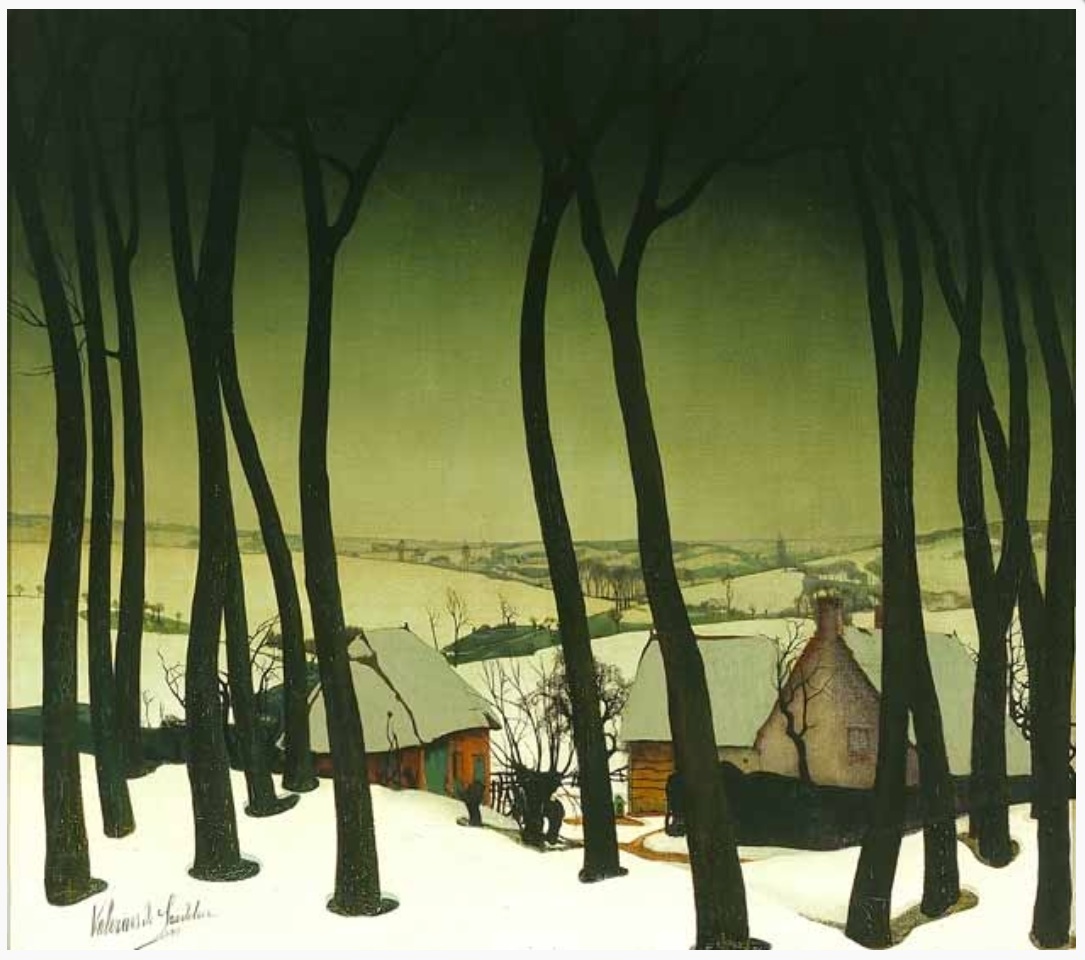
#FineArtFriday: Winter in Flanders by Valerius de Saedeleer 1927

Artist:   Valerius de Saedeleer  (1867–1941)

Title: Winter in Flanders

Date: 1927

Medium: oil and canvas

Dimensions: Height: 84 cm (33 in) Width: 96 cm (37.7 in)

Collection: Royal Museums of Fine Arts of Belgium

Inscriptions: Signature and date bottom left: Valerius de Saedeleer / 1927

What I like about this painting:

I like the bold color of the houses against the snow. Viewing the farmstead through the zen-like simplicity of the dark trees is soothing. I particularly like way he portrays green-golden sky of an afternoon in a dark northern winter.

This is a pleasant, relaxing painting.

About the artist, via Wikipedia:

Valerius de Saedeleer  (4 August 1867 – 16 September 1941) was a Belgian landscape painter, whose works are informed by a symbolist and mystic-religious sensitivity and the traditions of 16th-century Flemish landscape painting. He was one of the main figures in the so-called first School of Latem which in the first decade of the 20th century introduced modernist trends in Belgian painting and sculpture.

From 1914 de Saedeleer and his family lived in Wales as refugees from the First World War. Together with his family and the family of his friend George Minne he lived a number of years in CwmystwythGustave van de Woestijne and George Minne and their families also resided in Wales during the war. The family de Saedeleer and other Belgian artists were brought to Wales by David, Gwendoline and Margaret Davies. The two Davies sisters were best known for putting together one of the great British art collections of the 20th Century. The initiative of the Davies family in inviting Belgian artists to Wales was prompted by their expectation that these artists would be able to inject local cultural life with their expertise. 

De Saedeleer’s daughters studied weaving, binding and tapestry at Aberystwyth. The second daughter Elisabeth became acquainted with William Morris‘ daughter Mary from whom she learned tapestry weaving. The family became so accomplished at weaving that they even started giving courses in the craft themselves. De Saedeleer may have undertaken some conservation work on items from the Aberystwyth University Collection. He also exhibited his paintings of local views in the University’s Alexandra Hall and was able to earn a living from his art. 

De Saedeleer remained in Wales until 1920, when he moved to Etikhove. In 1933 he became an honorary citizen of the city of Aalst. In 1937 he moved to Leupegem.  The work of de Saedeleer became gradually more decorative and he developed a luxuriant and whimsical calligraphy. His compositions often included a row of trees in the foreground, a Japanese-style effect with which he had already experimented before the war. This device is clear in the composition Winter in Flanders. He was also an accomplished colourist.  


Credits and Attributions:

Wikimedia Commons contributors, “File:Valerius De Saedeleer – Winter in Flanders.jpg,” Wikimedia Commons, the free media repository, https://commons.wikimedia.org/w/index.php?title=File:Valerius_De_Saedeleer_-_Winter_in_Flanders.jpg&oldid=402112537 (accessed February 12, 2021).

Wikipedia contributors, “Valerius de Saedeleer,” Wikipedia, The Free Encyclopedia, https://en.wikipedia.org/w/index.php?title=Valerius_de_Saedeleer&oldid=1005028837 (accessed February 12, 2021).

Comments Off on #FineArtFriday: Winter in Flanders by Valerius de Saedeleer 1927

Filed under #FineArtFriday

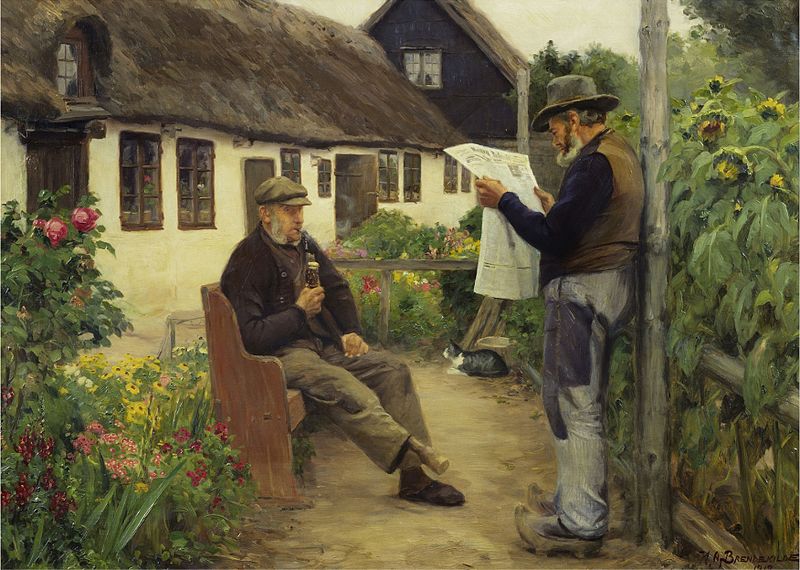
#FineArtFriday: While reading the newspaper by H. A. Brendekilde 1912

Artist: H. A. Brendekilde  (1857–1942)

Title: While reading the newspaper news

Date: 1912

Medium: oil on canvas

Dimensions: Height: 61 cm (24 in); Width: 85 cm (33.4 in)

Inscriptions: Signature and date bottom right: H. A. Brendekilde / 1912

What I love about this painting:

There is a story in this well-executed painting. I particularly like the details: the patched trousers of the gardener, the mud on his clogs, the other man’s wooden leg— I like the way they are juxtaposed against the lush spring garden and prosperous village life of Denmark in 1912.

Their hands and clothes indicate they have stopped work to read the newspaper. Both men seem stunned. Are they perhaps reading of the death of King Frederick VIII, who died on 14 May 1912?

Whatever they are reading, the cat remains undisturbed by the news.

H. A. Brendekilde was a forerunner of the social realist style, embraced by Diego Rivera. His early work often depicted the daily lives of the rural working class.


Credits and Attributions

While reading the newspaper  by H. A. Brendekilde 1912 [Public domain], via Wikimedia Commons

Wikimedia Commons contributors, “File:H. A. Brendekilde – Mens du læser avisen nyheder (1912).jpg,” Wikimedia Commons, the free media repository, https://commons.wikimedia.org/w/index.php?title=File:H._A._Brendekilde_-_Mens_du_l%C3%A6ser_avisen_nyheder_(1912).jpg&oldid=300367623 (accessed February 5, 2021).

Comments Off on #FineArtFriday: While reading the newspaper by H. A. Brendekilde 1912

Filed under writing

#FineArtFriday: Bringing down marble from the quarries to Carrara, Sargent 1911

Artist: John Singer Sargent  (1856–1925)

Title: Bringing down marble from the quarries to Carrara

Date: 1911

Medium: oil on canvas

Dimensions: Height: 71.4 cm (28.1 in); Width: 91.8 cm (36.1 in)

Collection: Metropolitan Museum of Art

Inscriptions: Signature bottom left: John S. Sargent

What I love about this painting:

This picture details the relentless heat of the day, the back-breaking labor of men cutting marble. This is how quarrying was done prior to World War I, with steam-donkeys and great physical peril. The ropes are huge and heavy, and these men secure the dangerous load with practiced ease.

Carrara Italy is an important center for the extraction and processing of marble. The famous stone is white and exceedingly valuable.

One of Sargent’s great skills was the ability to convey the sensory impressions of an environment, depicting his characters outdoors in all the seasons.

About the Artist, via Wikipedia:

John Singer Sargent, January 12, 1856 – April 14, 1925) was an American expatriate artist, considered the “leading portrait painter of his generation” for his evocations of Edwardian-era luxury. He created roughly 900 oil paintings and more than 2,000 watercolors, as well as countless sketches and charcoal drawings. His oeuvre documents worldwide travel, from Venice to the Tyrol, Corfu, the Middle East, Montana, Maine, and Florida.

Born in Florence to American parents, he was trained in Paris before moving to London, living most of his life in Europe. He enjoyed international acclaim as a portrait painter. An early submission to the Paris Salon in the 1880s, his Portrait of Madame X, was intended to consolidate his position as a society painter in Paris, but instead resulted in scandal. During the next year following the scandal, Sargent departed for England where he continued a successful career as a portrait artist.

From the beginning, Sargent’s work is characterized by remarkable technical facility, particularly in his ability to draw with a brush, which in later years inspired admiration as well as criticism for a supposed superficiality. His commissioned works were consistent with the grand manner of portraiture, while his informal studies and landscape paintings displayed a familiarity with Impressionism. In later life Sargent expressed ambivalence about the restrictions of formal portrait work, and devoted much of his energy to mural painting and working en plein air. Art historians generally ignored artists who painted Royalty and “Society” – such as Sargent – until the late 20th century.


Credits and Attributions

John Singer Sargent, Public domain, via Wikimedia Commons

“Carrara.” Wikipedia, The Free Encyclopedia. 16, 2021, 12:36 utc. 29 Jan 2021, 03:23 <//en.wikipedia.org/w/index.php?title=Carrara&oldid=118022943>.

“File:John Singer Sargent – Bringing Down Marble from the Quarries to Carrara (1911).jpg.” Wikimedia Commons, the free media repository. 15 Jun 2019, 13:13 UTC. 29 Jan 2021, 03:24 <https://commons.wikimedia.org/w/index.php?title=File:John_Singer_Sargent_-_Bringing_Down_Marble_from_the_Quarries_to_Carrara_(1911).jpg&oldid=354733943>.

Comments Off on #FineArtFriday: Bringing down marble from the quarries to Carrara, Sargent 1911

Filed under #FineArtFriday

#FineArtFriday: The Art of Joos van Craesbeeck revisited

Joos van Craesbeeck (c. 1605/06 – c. 1660) was an interesting character, one who stood out among the many interesting characters of the seventeenth century Flemish art community. He was a baker and an artist, a friend and contemporary of  Adriaen Brouwer. They most likely met while Brouwer was jailed in the citadel of Antwerp, although why he was imprisoned is unknown. But the bakery in the Antwerp citadel was operated at that time by Joos van Craesbeeck.

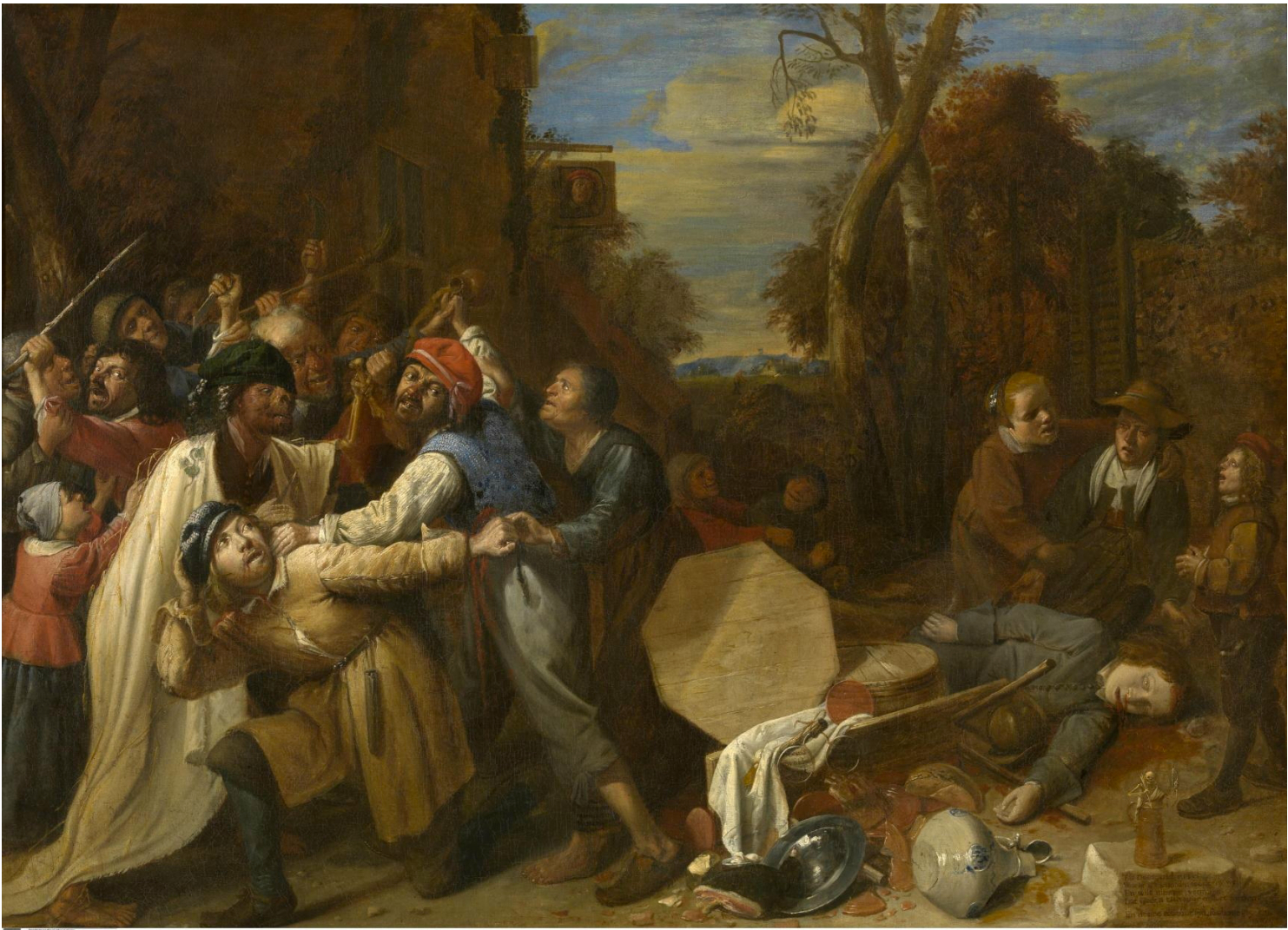
Van Craesbeeck was fascinated with the portrayal of violence and the senses of taste and smell. He painted the dissolute side of life, shocking in its intensity and honesty. Death is Violent and Fast: Quarrel in a Pub, is an excellent example of his almost brutish depiction of peasants brawling. Blood flows, one man lies dead, and in the lower right hand corner, Death smiles, pleased with that night’s work.

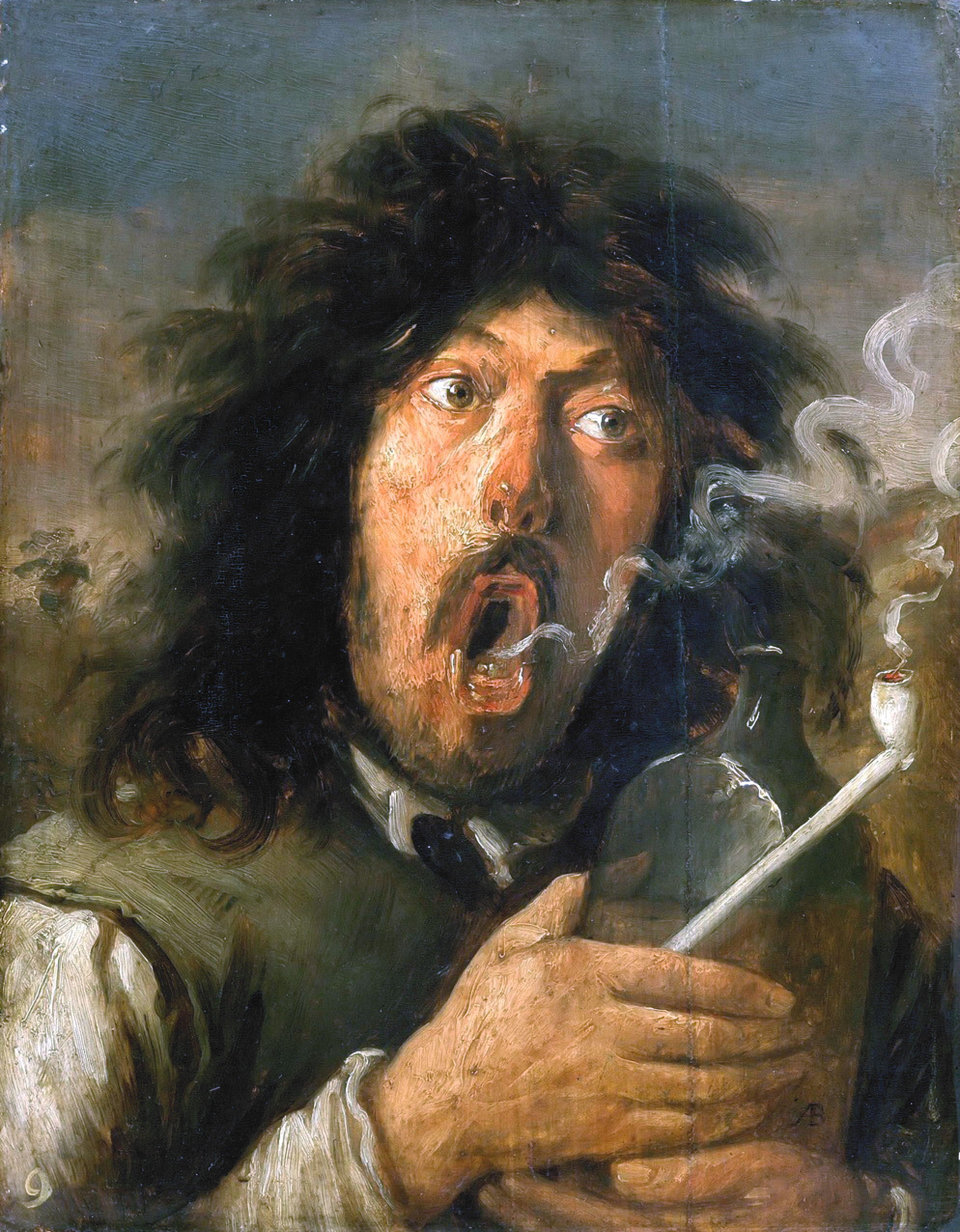
He often painted himself, as is seen in The Smoker, a self-portrait that was at one time attributed to Adriaen Brouwer, depicting the senses of smell and taste. He shows himself clutching both a bottle of hard liquor and a pipe, as if they are the dearest things to him. He exhales a stream of smoke, savoring it.

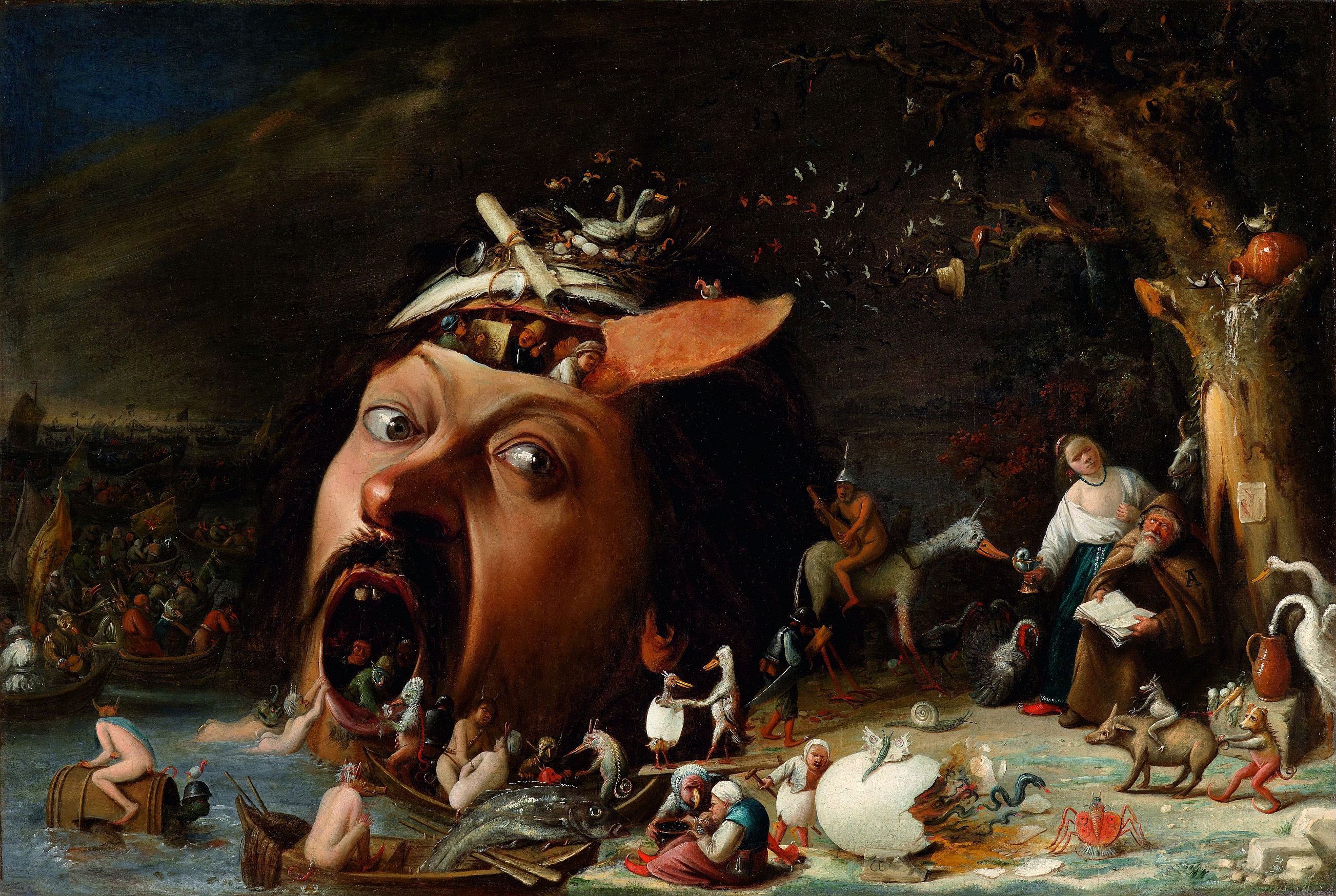
He also painted his own self-portrait as the central nightmare from which other nightmares spawn in the Temptation of St. Anthony. Note the way his mouth is full of little demons entering and leaving, and his head is open to reveal an artist painting beneath wild dark hair in which geese nest. St. Anthony himself is small, placed to the right, almost unnoticed in the onslaught of demons and temptations, both physical and moral. A cacophony of violence and evil rages as Anthony clings to the scriptures. This is a revealing portrait of how the artist viewed himself and the demons he battled, in my opinion.

The work of Joos van Craesbeeck is not comforting or warm. It is always allegorical, showing us something we don’t like about the world we live in. Violence and vice were as much a part of life in his time as they are today, and perhaps will always be.

Quote from Wikipedia: Van Craesbeeck painted at least five portraits which are presumed to be self-portraits and in which he depicts himself in a ‘dissolute’ manner. The dissolute self-portrait was a genre that had taken root in Dutch and Flemish genre painting in the 17th century. It was an inversion of the Renaissance ideal of the ‘pictor doctus’: the artist as an intellectual and gentleman. This ideal was replaced by the new model of the prodigal artist who is characterized by his creative inspiration and talents. These self-portraits emphasized the artists’ dissolute nature by creating associations with traditional moral themes such as the Five Senses and the Prodigal Son in the tavern. Van Craesbeeck painted himself four times in low-life guises depicting the sense of Taste.


Credits and Attributions:

The Art of Joos van Craesbeeck first appeared here on Life in the Realm of Fantasy 20 July 2018.

Wikipedia contributors, “Joos van Craesbeeck,” Wikipedia, The Free Encyclopedia, https://en.wikipedia.org/w/index.php?title=Joos_van_Craesbeeck&oldid=823865809 (accessed July 20, 2018).

Death is Violent and Fast: Quarrel in a Pub, painting by Joos van Craesbeeck, ca. 1630 – 1635 PD|100 via Wikimedia Commons.

The Smoker, Joos van Craesbeeck ca.1635 – 1636 [Public domain], via Wikimedia Commons

The Temptation of St Anthony, Joos van Craesbeeck ca. 1650 [Public domain], via Wikimedia Commons

Comments Off on #FineArtFriday: The Art of Joos van Craesbeeck revisited

Filed under #FineArtFriday

#FineArtFriday: Peasant Wedding, David Teniers II (revisited)

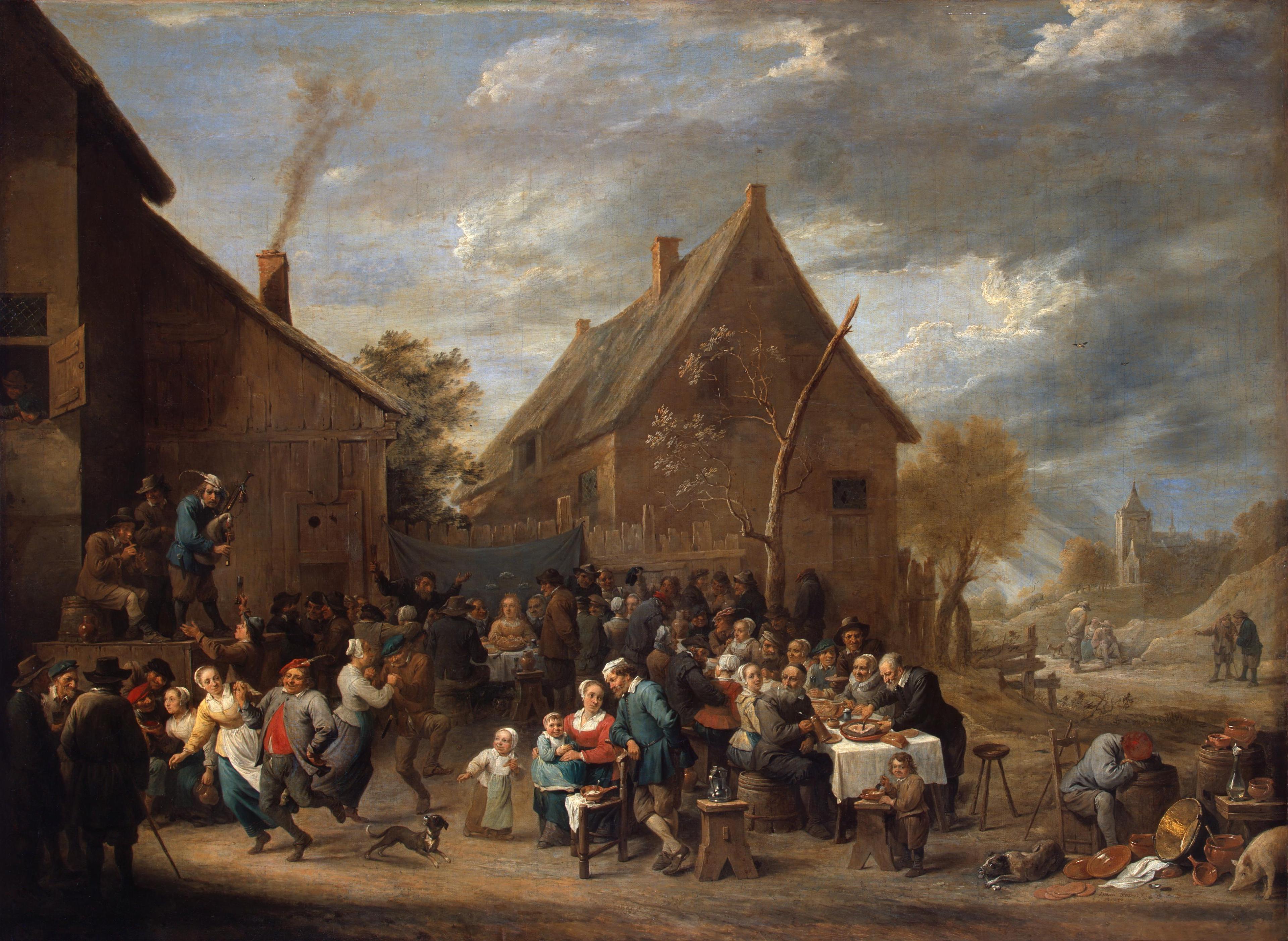
The Peasant Wedding by David Teniers the Younger  first appeared here on Life in the Realm of Fantasy on Nov 2, 2018. It’s one of my favorite Flemish paintings, because it depicts an event that is intrinsic even in today’s society–the wedding. The families of the bride and groom go all out, and weddings tend to be as big a party as the pair can manage no matter how rich or poor they are.

This painting is full of movement and life, and shows real people having a great party. The musicians are playing, some people are singing, some are talking, and some are dancing. Most are eating and just enjoying themselves. A few of the men are becoming a little familiar with the ladies, who are not really having any, and a few people have indulged a little too much.

Even the dog is having a good time.

Teniers was a prolific and skilled artist, a man remembered today as much for his lofty social ambitions as he is for the quantity and excellence of his work. He wanted to be a nobleman; indeed he once falsely laid claim to being descended from a noble line. Several times he nearly succeeded in this ambition, but nobility was one accolade he never achieved.

About David Teniers II, from Wikipedia:

Teniers married into the famous Brueghel artist family when Anna Brueghel, daughter of Jan Brueghel the Elder, became his wife on 22 July 1637. Rubens, who had been the guardian of Anna Brueghel after her father’s death, was a witness at the wedding.

Through his marriage Teniers was able to cement a close relationship with Rubens who had been a good friend and frequent collaborator with his wife’s father. This is borne out by the fact that at the baptism of the first of the couple’s seven children David Teniers III, Rubens’ second wife, Hélène Fourment was the godmother.

Teniers’ wife died on 11 May 1656. On 21 October of the same year the artist remarried. His second wife was Isabella de Fren, the 32-year-old daughter of Andries de Fren, secretary of the Council of Brabant. It has been suggested that Teniers’ main motive for marrying the ‘spinster’ was her rather elevated position in society. His second wife also brought him a large dowry. The couple had four children, two sons and two daughters. His second wife’s attitude to Teniers’ children from his first marriage would later divide the family in legal battles.

At the behest of his Antwerp colleagues of the Guild of Saint Luke, Teniers became the driving force behind the foundation of the Academy in Antwerp, only the second of such type of institution in Europe after the one in Paris. The artist used his connections and sent his son David to Madrid to assist in the negotiation to successfully obtain the required licence from the Spanish King. There were great celebrations in Antwerp when, on 26 January 1663, Teniers came from Brussels with the royal charter creating the Antwerp Royal Academy of Fine Arts, the existence of which was due entirely to his persistence.

Teniers petitioned the king of Spain to be admitted to the aristocracy but gave up when the condition imposed was that he should give up painting for money.

He was an innovator in a wide range of genres such as history,  genrelandscapeportrait and still life. He is now best remembered as the leading Flemish genre painter of his day


Credits and Attributions:

Wikimedia Commons contributors, “File:David Teniers de Jonge – Peasant Wedding (1650).jpg,” Wikimedia Commons, the free media repository, https://commons.wikimedia.org/w/index.php?title=File:David_Teniers_de_Jonge_-_Peasant_Wedding_(1650).jpg&oldid=225700063 (accessed November 2, 2018).

Wikipedia contributors, “David Teniers the Younger,” Wikipedia, The Free Encyclopedia, https://en.wikipedia.org/w/index.php?title=David_Teniers_the_Younger&oldid=858638339 (accessed November 2, 2018).

Comments Off on #FineArtFriday: Peasant Wedding, David Teniers II (revisited)

Filed under #FineArtFriday

#FineArtFriday: The Way you Hear it is the Way you Sing It by Jan Steen ca. 1665

Artist: Jan Steen  (1625/1626–1679)

Jan Steen: ‘As the Old Sing, So Pipe the Young’

Title: ‘The way you hear it, is the way you sing it’

Genre: genre art

Date: circa 1665

Medium: oil on canvas

Dimensions: Height: 134 cm (52.7 in); Width: 163 cm (64.1 in)

About this painting:

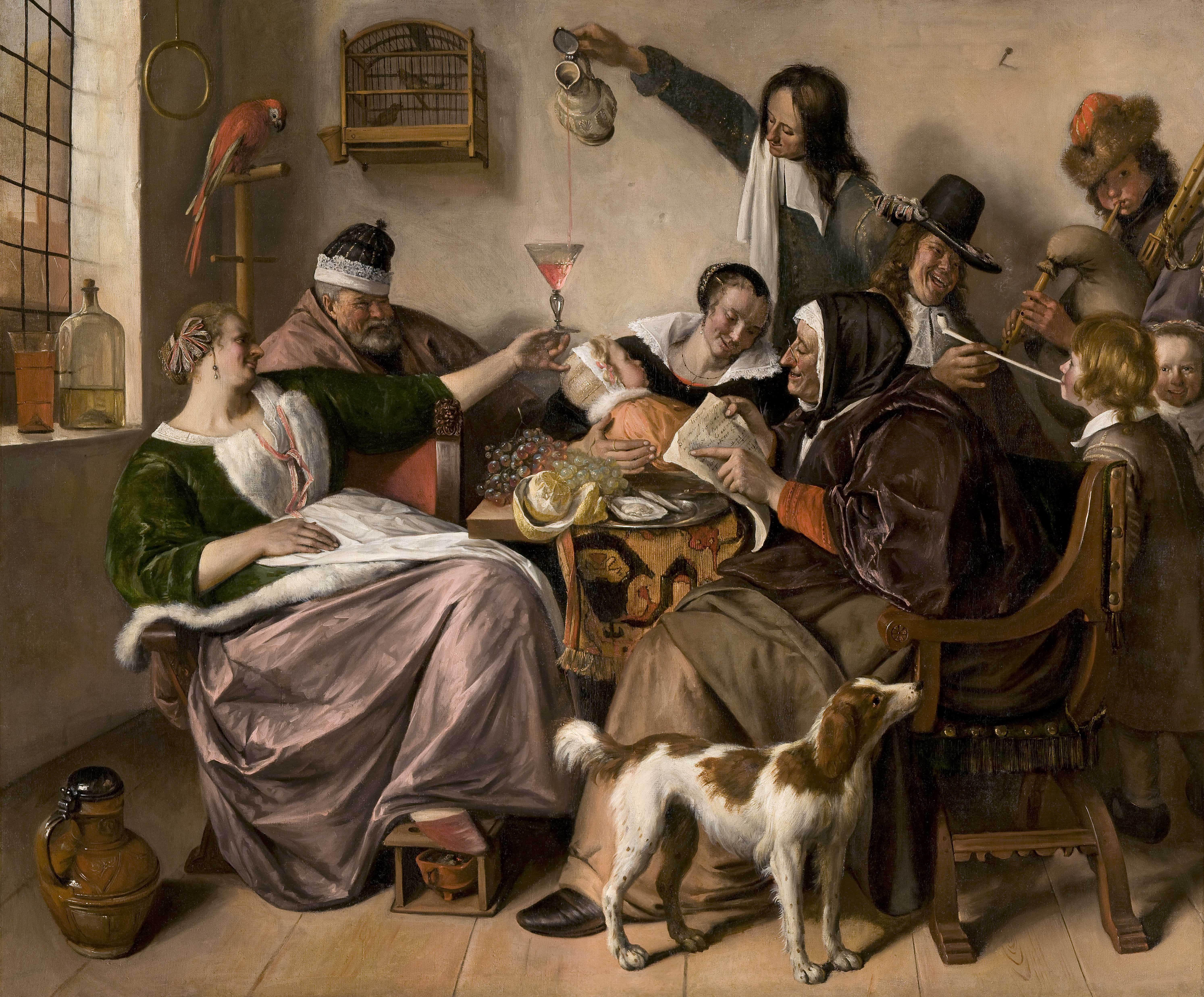
Jan Steen’s work The Way you Hear it is the Way you Sing It depicts a Dutch Proverb, As the Old Sing, So Twitter the Young. It shows us a family carousing and overindulging in rich foods. Luxurious fabrics, a foot warmer, and rare birds show off this family’s wealth, which they are spending lavishly as fast as they can.

A young piper, who closely resembles a young Jan Steen (possibly one of his sons?), entertains them. He looks directly at us as if to ask what he’s gotten himself into.

Mother and Father, dressed as the King and Queen, are sumptuously attired, being served wine in an overlarge crystal goblet by the family’s servant. Both are indifferent to the chaos, too sated and drunk to care.

To the right of Father (his left, our right), a younger woman, perhaps an unmarried sister or eldest daughter, is holding the baby but has nodded off, having indulged too freely.

The wasting of money on so much luxury that one can’t consume it all is clearly represented here. Mother raises her glass high to have it refilled, as if it is the most important thing–indeed, the wine cascading down into the crystal goblet is the focal point of the picture.

A bottle of clear liquor (distilled?) and a beaker of ale are set on the windowsill behind Father, and a covered pitcher stands on the floor beside Mother. The table is laden with grapes and oysters, expensive luxuries.

Grandmother is singing from sheet music, leading the song that the family sings. This is the direct allegory for the proverb, as the old sing, so twitter the young.

A youngish man, either the eldest son or the Drunk Uncle (every family has one), finds it hilarious to teach the children to smoke.

Neither the dog nor the piper is impressed with the carrying on, and the servant has no comment, merely serving the wine as required.

In essence, Steen tells us that children learn what they live, so if you want sober, morally upstanding children, you must be a sober, morally upright parent.

About the Artist, via Wikipedia:

Jan Havickszoon Steen (c. 1626 – buried 3 February 1679) was a Dutch Golden Age painter, one of the leading genre painters of the 17th century. His works are known for their psychological insight, sense of humour and abundance of colour.

In 1648 Jan Steen and Gabriël Metsu founded the painters’ Guild of Saint Luke at Leiden. Soon after he became an assistant to the renowned landscape painter Jan van Goyen (1596–1656), and moved into his house on the Bierkade in The Hague. On Oct 3, 1649 he married van Goyen’s daughter Margriet, with whom he would have eight children. Steen worked with his father-in-law until 1654, when he moved to Delft, where he ran the brewery De Slang (“The Snake”) for three years without much success. After the explosion in Delft in 1654 the art market was depressed, but Steen painted A Burgomaster of Delft and his daughter. It does not seem to be clear if this painting should be called a portrait or a genre work.

Steen lived in Warmond, just north of Leiden, from 1656 till 1660 and in Haarlem from 1660 till 1670 and in both periods he was especially productive. In 1670, after the death of his wife in 1669 and his father in 1670, Steen moved back to Leiden, where he stayed the rest of his life. When the art market collapsed in 1672, called the Year of Disaster, Steen opened a tavern. In April 1673 he married Maria van Egmont, who gave him another child. In 1674 he became president of the Saint Lucas Guild. Frans van Mieris (1635- 1681) became one of his drinking companions. He died in Leiden in 1679 and was interred in a family grave in the Pieterskerk.

Daily life was Jan Steen’s main pictorial theme. Many of the genre scenes he portrayed, as in The Feast of Saint Nicholas, are lively to the point of chaos and lustfulness, even so much that “a Jan Steen household”, meaning a messy scene, became a Dutch proverb (een huishouden van Jan Steen). Subtle hints in his paintings seem to suggest that Steen meant to warn the viewer rather than invite him to copy this behaviour. Many of Steen’s paintings bear references to old Dutch proverbs or literature. He often used members of his family as models, and painted quite a few self-portraits in which he showed no tendency of vanity.

Steen did not shy from other themes: he painted historical, mythological and religious scenes, portraits, still lifes and natural scenes. His portraits of children are famous. He is also well known for his mastery of light and attention to detail, most notably in Persian rugs and other textiles.

Steen was prolific, producing about 800 paintings, of which roughly 350 survive. His work was valued much by contemporaries and as a result he was reasonably well paid for his work. He did not have many students—only Richard Brakenburgh is recorded—but his work proved a source of inspiration for many painters.


Credits and Attributions:

The Way you Hear it is the Way you Sing It, Jan Steen, Public domain, via Wikimedia Commons

Wikimedia Commons contributors, “File:The way you hear it.jpg,” Wikimedia Commons, the free media repository, https://commons.wikimedia.org/w/index.php?title=File:The_way_you_hear_it.jpg&oldid=428340634 (accessed January 8, 2021).

Wikipedia contributors, “Jan Steen,” Wikipedia, The Free Encyclopedia, https://en.wikipedia.org/w/index.php?title=Jan_Steen&oldid=994869815 (accessed January 8, 2021).

Comments Off on #FineArtFriday: The Way you Hear it is the Way you Sing It by Jan Steen ca. 1665

Filed under #FineArtFriday

#FineArtFriday: Beneath the Snow Encumbered Branches by Joseph Farquharson 1903

Title: Beneath the Snow Encumbered Branches

Publisher: Hallmark Cards

Genre: landscape art

Date: Circa 1903

Medium: oil on canvas

Dimensions: 82 x 119.25 cm. (32 5/16 x 46 15/16 in.

What I love about this painting:

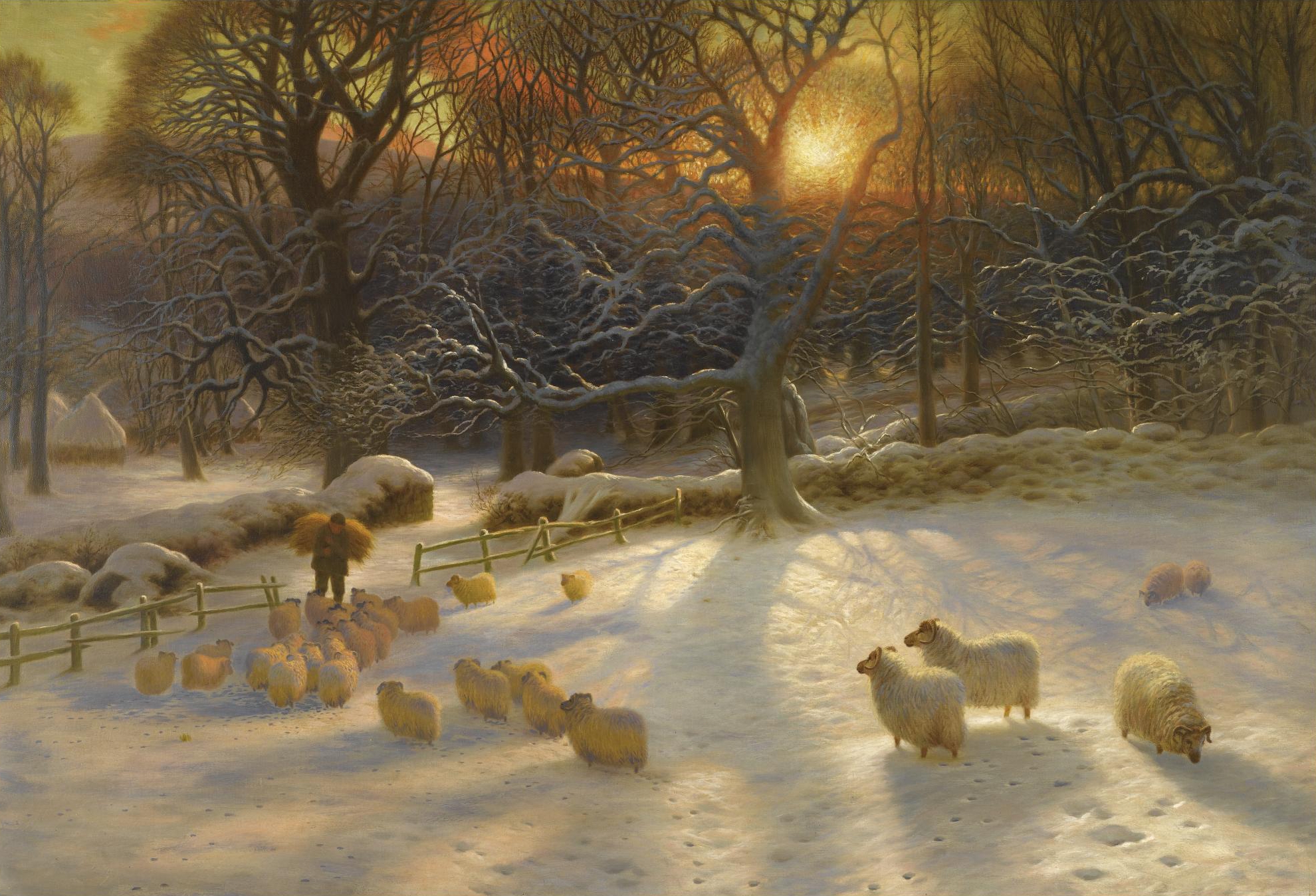
There is something haunting, a nostalgic echo of times long gone in this picture. The snow is thick and heavy, and the sheep are fluffy in their long coats. Winter has come and the shadows are long, but the conical haystacks across the lane contain plenty to last through the harshest season. The afternoon light is reflected on the snowy landscape and in the branches, a perfect golden luminosity, the hue that presages imminent dusk. 

About the Artist, via Wikipedia:

Joseph Farquharson DL RA (4 May 1846 – 15 April 1935) was a Scottish painter, chiefly of landscapes, mostly in Scotland and very often including animals. He is most famous for his snowy winter landscapes, often featuring sheep and often depicting dawn or dusk. The unusual titles of many of Farquharson’s paintings stand out and are sometimes long. Many of them were taken from poems by Burns, Milton, Shakespeare, and Gray. Farquharson was very patriotic and well versed in Scottish literature.

The remarkable realism of Farquharson’s work can be attributed to his desire to work en plein air. This had to be carried out in a unique way which was adapted to the harsh Scottish climate. Farquharson had constructed a painting hut on wheels, complete with a stove and large glass window for observing the landscape. Likewise to achieve as realistic a result as possible when painting the sheep which frequently appear in his snowscapes, he used a flock of “imitation” sheep which could be placed as required in the landscape of his choice. Farquharson painted so many scenes of cattle and sheep in snow he was nicknamed ‘Frozen Mutton Farquharson’.

Farquharson inherited the title of Laird in 1918 after the death of his elder brother Robert, a doctor and MP for West Aberdeenshire.

In 2008 the original of the 1901 painting Beneath the Snow Encumbered Branches came to light, for the first time in 40 years, when the lady owner put her house up for sale. The painting, which she had bought from a Bond Street dealer in the 1960s for £1,450, was expected to fetch up to £70,000 when it was offered for sale by auction at Lyon and Turnbull in Edinburgh. Nick Carnow, a director at the auctioneers, form said that the unnamed seller was moving to a smaller house and would not have room for the painting. In fact it sold for more than twice that estimate to another private collector in Scotland for £147,600.


Credits and Attributions:

Beneath the Snow Encumbered Branches Joseph Farquharson, Public domain, via Wikimedia Commons

Wikipedia contributors, “Joseph Farquharson,” Wikipedia, The Free Encyclopedia, https://en.wikipedia.org/w/index.php?title=Joseph_Farquharson&oldid=982764133 (accessed January 1, 2021).

Wikimedia Commons contributors, “File:The shortening winter’s day is near a close Farquharson.jpg,” Wikimedia Commons, the free media repository, https://commons.wikimedia.org/w/index.php?title=File:The_shortening_winter%27s_day_is_near_a_close_Farquharson.jpg&oldid=354603464 (accessed January 1, 2021).

Comments Off on #FineArtFriday: Beneath the Snow Encumbered Branches by Joseph Farquharson 1903

Filed under #FineArtFriday