Tag Archives: indie publishing

#amwriting: ensuring consistency: the stylesheet

Book- onstruction-sign copyWhen a manuscript comes across their desk, editors and publishers create a list of names, places, created words, and other things that may be repeated and that pertain only to that manuscript. This is called a stylesheet. Some editors refer to this as a “bible.”

The stylesheet can take several forms, but it is only a visual guide to print out or keep minimized until it’s needed. I copy and past every new word or name onto my list,  doing this the first time they appear in the manuscript. If I am conscientious about this, I’ll be less likely to inadvertently contradict myself later on in the tale.

Some people use a program called Scrivener which is not too expensive, but which seems to have a tricky learning curve. I downloaded the free version but couldn’t make heads or tails of it and found it quite frustrating. Nevertheless, I understand that it works well for many people, and to them, I say, “Good for you.”

For myself, I don’t want a fancy word-processing program. I just use MS Office, because I have been using the programs that come with that software since 1993, and I’ve been able to adapt to each upgrade they have made. It’s affordable, so I use Word to write and edit in, and occasionally use Excel to make small charts that are my style guides for each novel or tale I write, and also for every book I edit.

You can do this in Google Docs too, and that is free.

Regardless of how you create your stylesheet, I suggest you include these elements:

  • Word/Name
  • Page it first appears
  • Meaning

Bleakbourne Style Sheet

This is especially crucial for fantasy authors because we invent entire worlds, creating names for people, places, and creatures.

Take my own work-in-progress: it has characters with names that can be spelled several ways, and when I am in the throes of writing the first draft I fling them out any old way.

Thus, a character named Claire on page one can become Clair by page six. Dominick can become Dominic. Place names become mushy, and any word that is important or invented can evolve over the course of a manuscript.

I first learned about creating a stylesheet years ago when Huw the Bard was being edited. As she was editing my manuscript, my editor made a global search for every possible variant of the words I had created. She alerted me to these discrepancies, and I replaced the incorrect instances with the version I like best.

I have kept a Stylesheet for every work in progress since then, for short stories as well as novels.

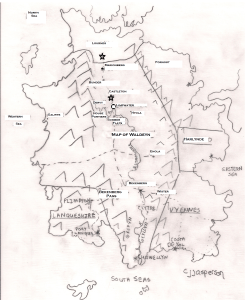
map of Waldeyn 2015 with lettering cooper black copyPlace names evolve too, so maps are essential tools when you are building the world. Places written on a map tend to be ‘engraved in stone’ so to speak. Readers will wonder where the town of Maldon is when the only town on the map at the front of the book that comes close to that name is listed as Malton.

To prevent that from happening, double check what you have written on the map, and then do a global search for every possible variant of that name in your rough draft.

Just because you invented the world doesn’t mean you know it like the back of your hand. That world is constantly evolving in your mind. I have been writing in the world of Neveyah since 2009, and I still frequently contradict myself, which is why the stylesheet is so important.
9 Comments

Filed under writing

#amreading: The Karaoke Novelist

BIF Blog Print ScreenI used to write an indie book review blog, before I got too busy to read as much as the blog required. The blog was called Best in Fantasy, and I still post reviews to it once in awhile, but only when something really rings my bells.

Sometimes I had to attempt to read six novels before I found one worth reviewing. In the process of searching Amazon for those really good fantasy reads, I’ve read a large share of badly written books. There is no  describing the agony of seeing a perfectly good idea for a plot destroyed by an author who was too eager to share their genius and rushed to publish what was clearly an excellent first draft .

You will get no snarky reviews from me—in fact I don’t review books I don’t like. I just move on to the next one in my pile and hope for the best.

Instead, I focus on the really awesome books I have enjoyed, some written by the famous, but most by the NOT so famous. Many of the great books I have enjoyed will never be best sellers because they are just one drop in an ocean of Kindle books.

It’s the wild west of indie publishing right now, and while it’s not necessarily a terrible thing, many untutored authors publish less than stellar works. These books are written and published by people who have no idea how the industry works.

Writing is like any other craft. There is a learning curve. Publishing is a separate craft, but nowadays the two go hand-in-hand.

At some point,  as indies gain the knowledge of what is involved in writing and publishing a good novel, the overall quality will  improve and level out. Those who are in it for the long haul will gain better visibility.

I have some hard-earned advice for new authors, those of you who want to leave the ranks of the Karaoke novelists, screeching their inept renditions of Wind Beneath my Wings. If you’re serious about your work, get your manuscript professionally edited.

Yes, it will cost you money, and you may get feedback you don’t want to hear. But that experience will enable you to put a book out there that you can be proud of, one that will stand up to any put out by the big publishers.

When I was writing a book review blog on a weekly basis, I often spent my week looking through five reasonably priced books only to discover they were

  1. Poorly formatted.
  2. Poorly edited.
  3. Rife with newbie errors such as beginning the book with a big info dump (been there done that).
  4. Thick, lush descriptions of “creamy blue eyes” (pardon, must barf now).
  5. Written by an author with no concept of a story arc.
  6. Boring filler conversations to fluff up the word count.
  7. Threads to nowhere,
  8. A random event that was intended as a cliff-hanger ending, but was obviously stuck there to entice the reader to get the sequel, which hadn’t been written yet and was now on my “No Way in Hell” list.

This also happens regularly with traditionally published books.  TOR can publish a novel that was poorly edited and no one will blink an eye, because they are one of the Big 5 Publishing houses.

Indies have to be better than that. Indies are scrutinized more closely and are held to a much higher standard. Flaws in our work are held up as an example of all that is wrong with the industry.

I used to curse at my Kindle when I read the first pages of books, both indie and traditionally published, that were  travesties. Many had gorgeous covers. I feel strongly the authors would be better served if they spent that money having their manuscript professionally edited.

I cringe when someone blithely tells me their friends edit for them. Most people aren’t best mates with a professional editor, and if you don’t have a degree in creative writing, you probably need a professional eye on your work.

Indies–aren’t you glad I only reviewed the books I liked? I didn’t want to be known for being a bitch, which is what I felt like when I read some of those travesties.

Thus, I say

  1. Go to writing craft seminars and conventions.
  2. Take writing classes at your local community college.
  3. Take online classes in writing.
  4. Buy and read books on the craft of writing.
  5. Write every day, even if it is only a paragraph.
  6. Hire a professional editor and consider following their suggestions.
  7. Have your manuscript proofread professionally before you publish it.

keep clam and proofreadI can’t stress this enough: before you publish that book you wrote during NaNoWriMo, please develop the craft of writing and rewrite that amazing novel.

You can join a writing group in your town and they will help you with these things. With the right group helping you grow, you will develop the skills needed to truly be a published author. And remember, if one group doesn’t really feel like a good fit, keep looking until you find a group you can work with.

2 Comments

Filed under writer, writing

#amwriting: learning from the masters: Kurt Vonnegut

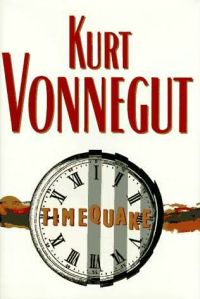
Timequake(Vonnegut)I haven’t written about Kurt Vonnegut in a while, and I believe it’s time to revisit him and his wisdom. I am dusting off a piece I wrote several years ago, as it has merit in my writing life today.

Kurt Vonnegut (November 11, 1922 – April 11, 2007) was one of my literary heroes. He was considered to be one of the most outrageously creative writers of our time, and indeed time figures prominently in much of his work – such as in his semi-autobiographical novel, Timequake. In this novel, he writes about trying to write a story. He understood writers’ block, because he had experienced it. Reading Timequake is like seeing my own struggle to write reflected in another author’s life.

His most famous work, Slaughterhouse-Five came out of his experiences in WWII as a prisoner of war. Vonnegut understood being a prisoner of war because he had experienced it.

In 1982, Vonnegut wrote a short piece for the International Paper Company, titled simply, ‘How to Write with Style.’ He began his essay by first considering the question of “why we should strive to improve our writing style”:

  1. “Do so as a mark of respect for your readers, whatever you’re writing. If you scribble your thoughts any which way, your readers will surely feel that you care nothing about them. They will mark you down as an egomaniac or a chowder-head — or worse, they will stop reading you.”

For me as both an editor and a reader, this is a critical point, because if you, as an author, become irate at hearing honest opinions from your beta readers or editors, you are doing them a disservice. We all experience this feeling of shock and dismay, but do take the medicine and try to understand what your reader saw that wasn’t up to par.

My most painful moments have been at the hands of editors who truly wanted to help me improve my work. I thank God they cared enough to tell me the truth.

If you’re doing this only for your ego, then, by all means, enjoy writing whatever falls out of your head. Do it and have fun, but don’t show it to anyone for if you do, your ego is in for a bruising.

That joy and abandonment is how a first draft should be written. But, if you have a first draft, don’t ask me what I think of it, no matter how proud you are unless you want my perspective because we all know every ms has flaws.

After Vonnegut had explained why authors must work to improve their knowledge of the craft, he went on to present 7 more concepts authors must strive to achieve:

  1. Find a subject you care about.

Let’s be real – if we don’t have a passion for our subject, it’s difficult to wax poetic about it. But when you are passionate, you can’t stop discussing it. It takes all your attention, and you find new things to say about it every day.

  1. Do not ramble, though.

What a sense of humor!  He was right – keep it brief!  Don’t spend 50 words when 10 will do.  The longer a sentence is, the more opportunity an author has to weaken it.  I am terrible at putting this concept into action.

  1. Keep it simple.

(note to self) Simplicity is the key to Not Rambling!

  1. Have the guts to cut.

Sometimes an author is in love with a particular sentence or paragraph – and it may be one which, to an editor, doesn’t really work. You must be prepared to divorce the sentences you are married to. This happens to me all the time – and now I try not to cry when my most beautiful, alliterative prose is given the boot.  Nine times out of ten tossing out the offending gibberish improves the reader’s experience. After all, this isn’t only an ego trip – it’s the reader I’m writing for, right?

  1. Sound like yourself.

You may find this to be a ‘Well, duh!’ moment, but take a moment to think about how you actually speak.  Do you say “I shall meet you anon.” …er…no… probably not.  I usually say, “I’ll meet you as soon as I can.”  Write it the way it feels most comfortable to say it. (Thank you, my many wonderful editors, for helping me to understand this concept!)

  1. Say what you mean to say.

Another ‘Well, duh!’ moment, you might say, but think about how hard it is to express your thoughts when you are trying to tell a stranger how to get from your house to the Walmart in the next town just south of you. Use the words that most clearly express your thoughts. Don’t use vague words to describe simple things – don’t say ‘red marks that started to bleed slightly’ if what you’re describing are ‘bloody scratches.’

  1. Pity the readers.

kurt-vonnegut_quoteDon’t make your readers want to put down your book at the end of the first page. Write the sort of story you want to read – put yourself in the reader’s place.  All we dedicated readers really want is the best tale we’ve ever read!

Is that too much to ask?

No, and maybe.  We’re only human after all so mixed in with our flashes of literary brilliance are the occasional things which do well for lining the bottom of the bird-cage.

As writers, we struggle to grow every day, and yes, there are times when what we put to paper isn’t our best work.  But that is where having the guts to cut is important.

I just hate it when one of my most beautiful turns of phrase during the first draft of a tale becomes not-so-pretty in the second draft and ends up on the verbiage-heap when the editing is done!

Sometimes we find ourselves writing in a desert, a place where the words won’t come. We feel that our work is dry and uninspiring, but I guarantee the most famous and well-loved authors have suffered the same dry-spells, suffered the same feelings of miserable failure we aspiring indies feel.

When I read their beautiful, harsh, and diverse work, I am inspired. I believe I can do this crazy thing. I remind myself that, for me, it’s not about numbers and sales, because it can’t be. For me, it has to be about improving the quality of my work and the telling of the tales I have locked in my brain and getting them out there in book form to the best of my ability.

Reading and understanding how the great authors write is one of the keys to unlocking our own potential. We indies have to use every tool we have available in this rough business, and we have to know what we want to achieve.

I want to achieve great sales, of course. But more than that I want to write compelling tales that move my readers. I may never achieve the first, but I think I can do the second.

6 Comments

Filed under writing

#amreading: Night Watchman Express by Alison DeLuca

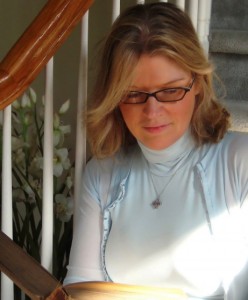
Alison DeLuca HeadshotOne of my dear friends is author Alison DeLuca, who is the main driving force behind Myrddin Publishing.  Alison is the idea woman, and has the follow-though needed to successfully run the equivalent of a small publishing house these days.

Alison is a superwoman. Not only does she guide 25 authors through the wild west of indie publishing, she is the mother of an active pre-teen, a working author and blogger, and is one of the finest editors I know.

My husband and I share 5 children, and so we have “a passel” of grandkids, as my grandma would have said. While I generally write books more geared for adult readers, Alison has written a young adult Steampunk collection of books, the Crown Phoenix series.

She has written several other novels, and numerous short stories more geared for mature readers, and if there is one thing I can say about Alison, everything she writes is classy and well-crafted.

I am always looking for good, challenging books for my grandkids to read, ones that will keep their interest and stretch their minds, so I was thrilled when I met Alison and discovered her young adult work.

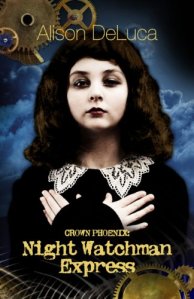
night watchman expressThe first book of hers that I ever read was the Night Watchman’s Express. I loved this book. The story never stops moving until the last page. Miriam, an unhappy young girl is orphaned when her wealthy industrialist father dies. With no other family, her father’s business partners, the Marchpanes, become her guardians. The Marchpanes immediately move into Miriam’s house, and take over her father’s rooms. (Mrs. Marchpane is deliciously evil.) They make their attempt to gain full control of Miriam’s money and her father’s company.

Gradually, Miriam begins to find common ground with the Marchpane’s son and their other young ‘guest’ when a nanny, who is both wise and skilled in certain magics, is hired. Mana is a woman who is of a race of people, who are considered to be second-class citizens, and contrary to the Marchpane’s hopes, she turns out to be exactly what both Miriam and the two boys needed.

There is a reluctant camaraderie that develops between Miriam and the two boys. The three of them do a certain amount of exploring the grounds of the estate, and discover a strange machine that her father has constructed. Another interesting thread is also Miriam’s strange emotional attachment to her father’s typewriter-like machine, which she has claimed for her own since his death, and keeps hidden in her room.

This book was so good for a rainy-weekend read that I read it twice. And guess what? It’s currently a free download for your Kindle, but if you are into paper, it also available in that format for $12.99.

This month, Alison is participating in The #BigBookGiveaway, which starts today, July 1st. For avid book lovers, this is an awesome deal! Sponsored by Girl Who Reads, two boxes of books donated by multiple authors and publishers will be given away through Rafflecopter, and the link to enter that contest is here: #BigBookGiveAway via RafflecopterJust click on that link and it will take you to the contest page, and you too could end up with a large box of books to while away your summer with, and Alison DeLuca’s Night Watchman Express is only one of them.

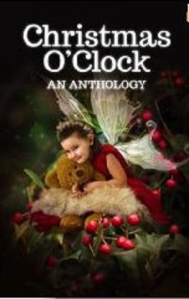
Christmas O'clock 2013Girl Who Reads is a great resource for avid readers like me, as it’s a website where you can find balanced book reviews, many of them indie books. Books are being offered in this giveaway by many wonderful authors, several with larger publishers, such as Penguin Books and Random House. Alison is also including a copy of Myrddin Publishings children’s’ anthology, Christmas O’Clock.

I did pen one of the stories in that collection, a little thing called A Christmas Tail.  I loved writing that tale—I was in a Toad Hall mood apparently, and Ratsy’s adventures with his friends are reminiscent of that wonderful series of tales.

Alison is one of the easiest people to work with I’ve ever known. We began this publishing adventure in the summer of 2012 as refugees from a bad publishing situation, and while it was rocky in the beginning, we have never regretted our decision to go indie. Our publishing cooperative began with a great group of authors who were all as committed to the indie way as we are, and every year we have gained new authors who bring new ideas and new fire to our collective. Alison is the glue that binds us together.

You can find Alison and more of her work here:

Facebook: http://www.facebook.com/alison.deluca.author

OR http://on.fb.me/TNWEfb

Twitter – http://twitter.com/ – !/AlisonDeLuca

Google + http://bit.ly/ADGoogle

Amazon Author Central:  http://amzn.to/ADeLucaAuthorCentral

Pinterest: http://pinterest.com/alisondeluca/

4 Comments

Filed under Books, Fantasy, Literature, Self Publishing, writer, writing

#amwriting: homonyms and honorifics

MSClipArt MP900390083.JPG RF PDAn editor once told me, “If you’re going to use grammar improperly, at least have the decency to misuse it consistently.” Since that day, I have made every effort to do so.

However, as a reader, I like to see that the author and editor both had a good grasp of the basics, and if a book is written with too many inconsistencies it ‘s hard to get involved in it.

We are all guilty of typos, homonym misuse, and the occasional comma splice. We sometimes are inconsistent with the words “sir” and “Son.” We make every effort to have our work read by editors and proofreaders, and still, invariably, some glaring blot of darkness sneaks through because certain aspects of the English language are as difficult to wrangle as a van full of toddlers on coca-cola.

One thing I’ve regularly noticed people have trouble with is the proper use of terms of endearment, such as “Sir,” or “Dad,” and “Mom.” The rules are basically simple to remember:

For people who are related, if you are saying it directly to them in place of their name, capitalize it.

  • “I love you, Son.”

If you are mentioning them in conversation, don’t capitalize it.

  • “My son is wonderful.”

Terms of endearment can also be relatively impersonal, denoting a friendship, or can even be slightly patronizing. If the speaker is not related to the person in question, do not capitalize it.

  • “I wouldn’t do that, son.”

Then there is the issue of the word “sir.” It is an honorific. Quoted from the Chicago Manual of Style section 8.32:

Honorific titles and respectful forms of address are capitalized in any context with several exceptions:

  • sir

  • ma’am

  • my lord

  • my lady

Where king/queen, Lord, or Sir is used as part of someone’s name, it is always capitalized, as are these honorifics:

  • King Olav, and Lucille, the Queen of Darkness
  • Lord John Davies; Lady Mary Shelton
  • Sir William Neville

Where king/queen is employed in the context of a general reference it is lowercased:

  • “Hello,” said the king.

But should one capitalize the word “sir” when it’s used in dialogue? Which of the following would be correct? “Yes sir.” OR “Yes Sir.”

If the reply is to a respected person in general, it is written with no capital, as it’s not a formal name. But you do need a comma just you would with a formal name:

“Yes, sir.”

“Yes, George.”

For a more in-depth exploration of that subject see my post of March 14, 2016: son and sir: to capitalize or not?

When writing dialogue: if your speaking character is in the military and the person he/she is addressing has a military rank above them, and is speaking in their military capacity you must capitalize it. The exception to this is if a younger person of lesser rank is talking to an older person of higher rank in an informal setting. At that point, the younger person is simply speaking respectfully to an older person, and “sir” does not need to be capitalized.

Remember, English is a strange and mysterious language, and is one even which even native-born speakers rarely master. While it has rules, it has many exceptions to those standards, so it is easy to be confused. Your word-processing program’s spell checker won’t notice these things because they aren’t misspelled.

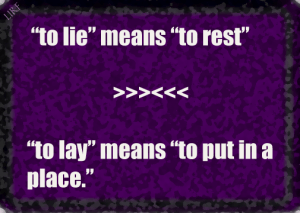
to lie means to restHomophones: Words that share the same pronunciation, regardless of how they are spelled and Homonyms: Words that sound alike, but have different meanings:

  • there, they’re, their
  • to, too, two

It’s also good to recognize homographs (words that share the same spelling) that have different pronunciations and meanings. These words include:

  • desert (to abandon) and desert (arid region)
  • tear (to rip) and tear (a drop of moisture formed in the eye)
  • row (to argue or an argument) and row (as in to row a boat or a row of seats—two words which are also a pair of homophones)
  • bark (the sound of a dog) and bark (the skin of a tree)

Capitonyms are words that share the same spelling but have different meanings when capitalized. They may or may not have different pronunciations. Such words include:

  • polish (make shiny) and Polish (from Poland)
  • march (walk or advance) and March (the third month of the year in the Gregorian calendar)

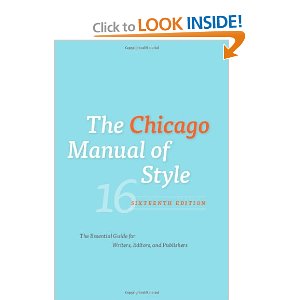
chicago manual of styleNegotiating the shoals of English grammar can be tricky, and it’s easy to get a fortune tied up in reference books. However, if you are on a tight budget, these two good references will help immensely with gaining some mastery of it:

I always recommend these two as they are the most comprehensive examples of their kind, and good, lightly used volumes are sometimes available second hand through Amazon.

Strunk and White’s Elements of Style is an excellent reference book if the Chicago Manual of Style is too daunting for you, as it’s not nearly as detailed and does hit the high points, and old copies are always available in second-hand bookstores.

Comments Off on #amwriting: homonyms and honorifics

Filed under writing

#amwriting: so you want to be a writer

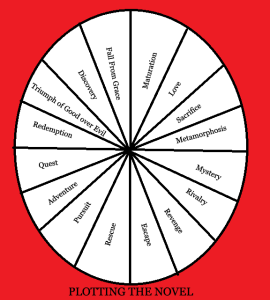
Dial-a-PlotSo, you want to be a writer. You have written several unpublished short works, and they were darned good, if you do say so yourself. Your novel is half finished, and your cousin, Phil, says he’s never read anything like it.

One of the many things I didn’t realize when I first began this crazy journey, is that your family and friends are not editors. Even if they are teachers, it’s likely they won’t notice anything but the most glaring errors in your work, and they will miss a great many of those.

Unless your cousin Phil is an author himself, he won’t mention places where you have repeated yourself ad nauseum, nor will he point out places that are phrased in a convoluted way.

Because these places are both annoying and confusing, Phil has most likely skipped over them, and didn’t mention it because he didn’t want to hurt your feelings. Large plot-holes, inadvertent use of clichés, and intriguing auto-correct mistakes get missed when your eager-to-help friends try to edit your work.

Your friends might know they don’t like what you wrote, but they don’t know why they don’t like it so they plow through it as fast as they can just to get the misery done with. They will spot a few problems, which helps, but isn’t going to make your manuscript readable.

Oh, your friends aren’t going to tell you they don’t like it, but they will think it: “This is awful. What’s up with the dog…is he an arsonist? No…it was apparently the Guinea pig but…no. God, this is the worst drivel I’ve ever read. How do I get out of this? Um…I’ll tell her it was great, I loved it.”

Consider joining an online beginners’ writing group. A lot of useful information can be found through these two free resources:

  • NaNoWriMo (National Novel Writing Month) nanowrimo.org They operate year round and have many resources available to help you get started.
  • Critters Workshop critters.org

Critter is an excellent place to get feedback on your work, in a way that doesn’t feel threatening. New authors should definitely consider joining the critters workshop.

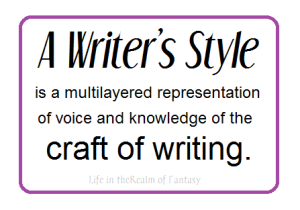
a writer's stylePLEASE don’t publish your work without first having it edited professionally, or at the very least, read by an advanced writers group. You have no idea what your manuscript actually looks like. An advanced writing group will tell you the ugly truth, and they won’t be kind about it, but once they are done with you, you will reconsider your decision to not hire an editor.

If you plan to submit it to a large publisher, do hire an editor so that what you submit will be the best you can offer them.

If you are in the beginning stages of your writing career, invest in books on the craft of writing. Many books are available used through Amazon dot com, and many are available as affordable eBooks, also through Amazon. And you don’t need a Kindle, as you can download the free app for your PC, Mac, Android, or Apple device.

Books on the craft that are on my desk and in use today:

  • The Chicago Manual of Style
  • The Oxford American Writer’s Thesaurus
  • Rhetorical Grammar by Martha Kolln
  • Story: Substance, Structure, Style and the Principles of Screenwriting by Robert McKee
  • The Sense of Style by Stephen Pinker
  • The Sound on the Page by Ben Yagoda
  • Outlining Your Novel by K.M. Weiland

Books that help when I am stuck:

  • The Negative Trait Thesaurus by Angela Ackerman and Becca Puglisi
  • The First Five Pages by Noah Lukeman

Three websites a beginner should go to if they want instant answers in plain English:

Writing is not just a career for me—it is an obsession. Anything involving books is the proverbial shiny thing for me. All of my inspiration has come from the many excellent writers whose works moved me.

Better You Go Home, Scott DriscollI am also inspired by those authors whose workshops I have been fortunate enough to attend. Consider this high quality online option for learning the craft of writing:

Introduction to Fiction Writing at The Writer’s Workshop, instructor, Scott Driscoll.

This is admittedly not  free, but it is an exceptionally in-depth exploration of the craft. I have attended some seminars offered by Scott at several conferences and have never come away disappointed.

Remember, writing is a career path that requires dedication, and commitment to learning and growth. The money you spend going to workshops and conferences is an investment you make in your career. You not only learn about the craft of writing, but you will also learn the business aspect, and make no mistake: regardless of whether you are traditionally published or indie published, this is a business.

via buzzfeed

via buzzfeed

It’s not always easy, and sometimes it is hard to see progress. But with each completed project you gain strength and confidence. Your work evolves, growing in readability and your voice as an author becomes recognizably yours.

Writers finish their work. Many people will begin walking this path, believing they want to be writers. They like the idea of being a writer, and may claim to be a writer, but when you ask them about their work, they will tell you they don’t have time to write, and their work was only halfway begun when they had to stop.

The fact that you once sat in a Ferrari does not make you a Formula One driver.

I always urge writers to write every day, even if it is only for fifteen minutes. If you are not committed to writing regularly, your novel will never see the light of day.

Write regularly, and finish that book.

9 Comments

Filed under Literature, writer, writing

#amwriting: Taking the #NaNoWriMo novel to the next level

NaNo-2015-Winner-Badge-Large-SquareYou took a leap of faith. You’d had this idea for a novel rolling around in your head for years. Someone told you about Nation Novel Writing Month, and on the spur of the moment you joined.

Then you were committed. Every day, no matter what disaster was occurring on the home-front, you sat down and wrote at least 1,667 words.  Some days it was hard, the words just weren’t there. But you persevered and some days you were on fire–everything flowed. Your story took you places that amazed you.

Now it’s November 30th and you have your 50,000 word manuscript, and the all-important winner’s certificate from NaNoWriMo dot org!

But now you don’t know what to do next.  Whatever you do, DON’T SHOW IT TO YOUR ADORING FANS JUST YET. This is not the time to ask for feedback unless you want to be lied to. They’ll look at you with a possum-in-the-headlights smile, and say “Wow…this is really…different.”

What they’re really thinking is, “Holy s**t. This disjointed, hokey mess sucks.” That friend will poke needles in their eyes before they read another piece of your work again.

What you must do is put it in a drawer for a month or two. Write some short stories, or start a new novel. You have to step back from this in order to see what need to be done with it, and you can’t do that right now. SO–in January or February:

First let’s talk about that manuscript.

When you were writing it, you were concerned about increasing your word-count. Someone told you not to use contractions, as the word ‘doesn’t’ counts as one word while ‘does not’ is two. Foolishly, you did just that.

LIRF Global Search all steps

Global Search Print-Screen

Now you must go through and make that awkward, stilted phrasing into contractions. Do a global search:

  1. press control+F
  2. type the word you are looking for in the search box
  3. click on options
  4. click on replace
  5. in the ‘replace with’ box type the word you want to replace the wrong word with
  6. DO NOT replace all. Go to each instance of the words individually and replace them after you have seen the context of the sentence they are in.

Second, let’s look at how we are telling the story. In the rush of the first draft, of getting all our thoughts about the story-line down, we use a kind of mental shorthand and write things like:

Erving was furious.

Martha was discouraged.

Readers don’t want to be told how the characters felt—they want to see.  When you come across this in your first draft, now is the time to follow those road signs and expand on the scene a little. Instead of telling the reader that Martha was furious, you will show this emotion.

Martha stamped her foot.

Erving’s face went white, his body shook with rage.

When you go back through your manuscript, change each ‘telling scene’ to a ‘showing scene.’ When you show the reader the emotions it deepens the story and enables the reader to be involved.

Dialogue

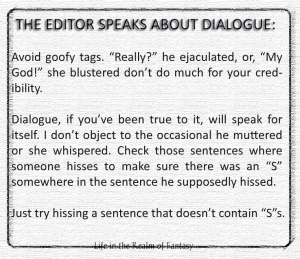
Third: too many dialog tags. When only two characters are in a scene readers should be able to keep track of speaker ID with ease. In those situations, speech tags are rarely, if ever, needed.

Instead of using a speech tag, consider inserting an action beat (a burst of action) before a line of dialogue. This identifies the speaker and offers opportunities for you to deepen character chemistry, conflict, and emotions.

Annie felt something trickling down her cheek. She wiped it, and her hand came away with blood. Her companion was covered with gore, but at least he was in one piece. “John, are you okay?”

 “Of course.”

 She reached toward his shoulder, toward the torn shirt, the ugly gash—but something held her back. “Your arm. I thought maybe ….”

 “You thought it was bad.” 

 The look in his eyes forced her to glance away. “Well, yes. But if you say you’re okay….” Her face burned.

John bent down, digging around in the medical kit, hiding his grin. His thoughts ran wild, but he said only, “Let’s get ourselves doctored up. We’ve a long way to go.”

Replace those empty speech tags with an emotion-infused narrative. However you must remember that the reader needs to have clear direction as to who is speaking to whom, otherwise you will lose them. Don’t make more than a few exchanges without dialogue tags, and make those you do use simple. Said, replied–we really don’t need to get fancy.

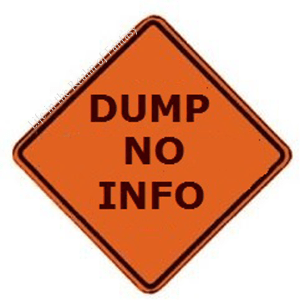
dump no infoFourth: Too Much Information. This is my personal bugaboo. As I am writing I spill my guts and write all the background as I am thinking it. The reader doesn’t need to know everything up front. These passages are really notes telling me as the author what direction this tale is supposed to go.

My beta readers always tell me the reader doesn’t want to read the history of the world–they want to get to the action. THEY ARE RIGHT!

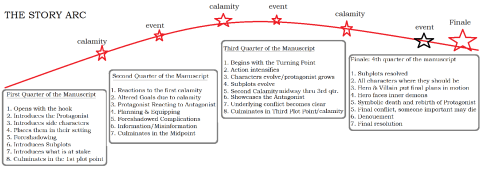
Fifth: Make sure you have a good story arc:

  1. Exposition, where we introduce our characters and their situation.
  2. Rising Action, where we introduce complications for the protagonist
  3. Climax, the high point of the action, the turning point of the narrative
  4. Falling Action, the regrouping and unfolding of events that will lead to the conclusion
  5. Resolution, in which the problems encountered by the protagonist are resolved, providing closure for the reader.

The Story Arc

SO before we show this novel to anyone, we have a lot of work to do.

  1. Check for contractions
  2. Check for scenes that are telling and not showing
  3. Take a look at the dialogue tags and make action speak for you.
  4. Carve back the info dumps–keep what moves the story along and save the rest in a separate file.
  5. Make sure you have a good story arc.

Let this nano novel rest for several months before you do anything with it. Start a different novel, and come back to this one later. When you look at that original first draft with fresh eyes and begin looking for these things, you will be amazed at how well your novel will begin to come together. During this rewrite, your characters will grow and develop, and your plot will really begin to move along. This is when you really write your novel.

4 Comments

Filed under Humor, Publishing, Uncategorized, writing

#amwriting: 3 steps for keeping the story straight

1916 Momus Pinocchio via Wikimedia CommonsEvery liar knows it’s difficult to keep a story straight–the story keeps evolving and soon it’s out of control.  However, writers, those spinners of awesome lies on paper, must devise ways to avoid this little problem.

Some people use a program called Scrivener which is not too expensive, but which seems to have a tricky learning curve. I downloaded the free version but couldn’t make heads or tails of it and found it quite frustrating. Nevertheless, I understand that it works well for many people, and to them I say, “Good for you.”

For myself, I don’t want a fancy word-processing program. I just use MS Office, because I have been using the programs that come with that software since 1993, and I’ve been able to adapt to each upgrade they have made. It’s affordable, so I use Word to write and edit in, and occasionally use Excel  to make small charts that are my style guides for each  novel or tale I write, and also for every book I edit.

Helpful tip #1: Create a style sheet for every work-in-progress. Whether it is a handwritten list or spreadsheet–keep track of what you named people, places, and things.

Bleakbourne Style Sheet

By creating a visual guide that I can print out or  keep minimized until I need it, I will not inadvertently contradict myself later on in the tale. This particular chart is the style-sheet for a serial I am writing for Edgewise Words Inn, a small online blogzine.

Lets consider Lord Tenneriff, the name of a minor character. Because I noted it on the style sheet and gave a small explanation when I first used it, I will always remember that Lord Tenneriff was spelled with two ‘n’s and two ‘f’s, and with no ‘e’ at the end of it.  The heading of the sheet is like this:

Character Name       Word 1st appears      Other names       Meaning?

            Jason Tenneriff              chapter 1                                                      a local lord

                                                         chapter 2                   Bleakbourne             a village

By listing out the names of every character no matter how minor, even the horses, I will not have a continuity problem by the time I hit chapter 14 of this series. For my editing clients, I also list all magic spells, every god, demon or dwarf that comes into the tale. Anything that is named goes onto that style sheet exactly the way it was first mentioned, the chapter it was first mentioned in, and the brief description of what it means.

Every author has a different way of visualizing these things, and this is what works for me.

Helpful tip #2: Map it out:

Map of WaldeynSo how do you visualize your country and the world you are creating? I have discussed this before–I draw maps.

They start out like this, all blotchy and hand-drawn, with whiteout covering the changes. After a while of refining them they end up looking more like real maps.

Its a gradual process, and the actual shapes and where the places are will evolve throughout writing the tale, but it will remain basically that way.

Many authors will use locales they are familiar with for their fantasy maps, just changing the names of major cities.  This is a good way to do it, because your world is already well defined for you, and Northwesterners know that Portland, Oregon is about 170 miles south of Seattle, Washington.  You are safe using currently existing terrain.

map of Waldeyn 2015 with lettering cooper black copyBut safe isn’t exactly my thing, so I had to invent both the world of Waldeyn (Huw the Bard), and the World of Neveyah (Tower of Bones). This is what the hand-drawn map of Waldeyn from above has evolved into————>

Helpful Tip #3: Version control:

When we first begin to write seriously we learn how critical it is to have proper naming of our files to ensure version control.  The most recent file will usually be the best edited unless you have accidentally saved an earlier version over it. ALWAYS use a separate file for each version, and ALWAYS use consistent file labeling practices to avoid this tragedy!

Use good file labeling practices, even if you have a fancy program that handles structuring your manuscript.

As an editor, I am particularly careful how I name the files of my clients.

  1. I use a specific sort of naming system. It will ALWAYS be Book_ AuthorName_script.doc .
    This is the main file folder for this book and this author!
  2.  The file folder will contain everything that pertains to this author and his work. There will be at least two folders in this file, and can have up to six. Version control is critical, so proper naming of the files is absolutely essential. If he should ever lose his files, I will have the most recent version on hand.
  3. The raw manuscript in its entirety is saved in this file, and I will name it:
  •  Book_ AuthorName_rawscript.doc

There will be 2 files for every step of the process this manuscript goes through with me: One file will be from the author’s desk to me, and the other will be from my desk to the author.  I will break the raw ms down into chapters, and label each chapter in that file consecutively:

  • Book title_Ch1_ author initials_cjj_edit_rnd1.doc

This tells me that this is Book A, chapter 1, by Author SoAndSo, and was edit round one of that ms.

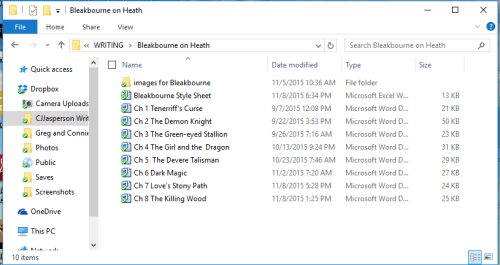
For my own work I label the files uniformly, like this: The main folder will be labeled with the working title, such as Bleakbourne on Heath. Inside the main folder will be the style sheet, and any images that will be used, including maps if needed.

Version Control 1

These three tips, creating a style guide, drawing a map, and labeling your files so you have good version control will help you navigate the shoals of the authoring business. You will always know who you are talking about, where you are, and you will be working in the most recent version of your work.

3 Comments

Filed under Publishing, writer, writing

#amreading: Mad Science Institute, by Sechin Tower

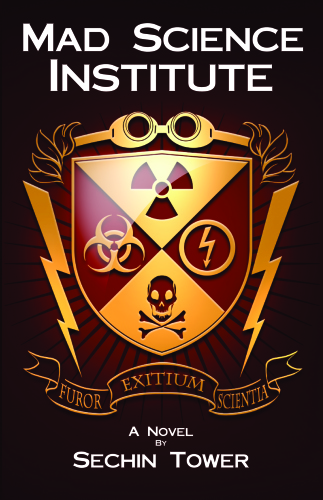
mad science institute front-coverI have been catching up on my long-put off reading, starting with a book by fellow Northwest indie author Sechin TowerMad Science Institute . I had a great time reading this particular YA novel. But first, The Blurb:

Sophia “Soap” Lazarcheck is a girl genius with a knack for making robots—and for making robots explode. After her talents earn her admission into a secretive university institute, she is swiftly drawn into a conspiracy more than a century in the making. Meanwhile and without her knowledge, her cousin Dean wages a two-fisted war of vengeance against a villainous genius and his unwashed minions. Separately, the cousins must pit themselves against murderous thugs, experimental weaponry, lizard monsters, and a nefarious doomsday device. When their paths finally meet up, they will need to risk everything to prevent a mysterious technology from bringing civilization to a sudden and very messy end.

My Opinion: This book totally lives up to it’s promise. Soap is a great character, and so is Dean.  She is a little too adventurous in the laboratory, and things sometimes go awry. The story opens with her, and immediately shifts to Dean’s story, but shifts back again.

Dean is older, is a firefighter who loves his work, and has relationship issues, which launch him into the thick of things.

Soap is a feisty girl, who is launched into a series of immersive adventures. She’s a bit testy and awkward when it comes to interpersonal relationships.

The author, Sechin Tower, is a teacher in his real life, and I think he must be pretty awesome in the classroom, because the story contains a lot of historical information imparted in regard to Nicola Tesla and his scientific legacy, presented in such an entertaining way the reader doesn’t realize they’re learning.

All in all, I have three grandkids who would really enjoy this book–and Santa will be obliging this year!

Comments Off on #amreading: Mad Science Institute, by Sechin Tower

Filed under Books, Humor, Uncategorized

#amwriting: creating religion within the context of the tale

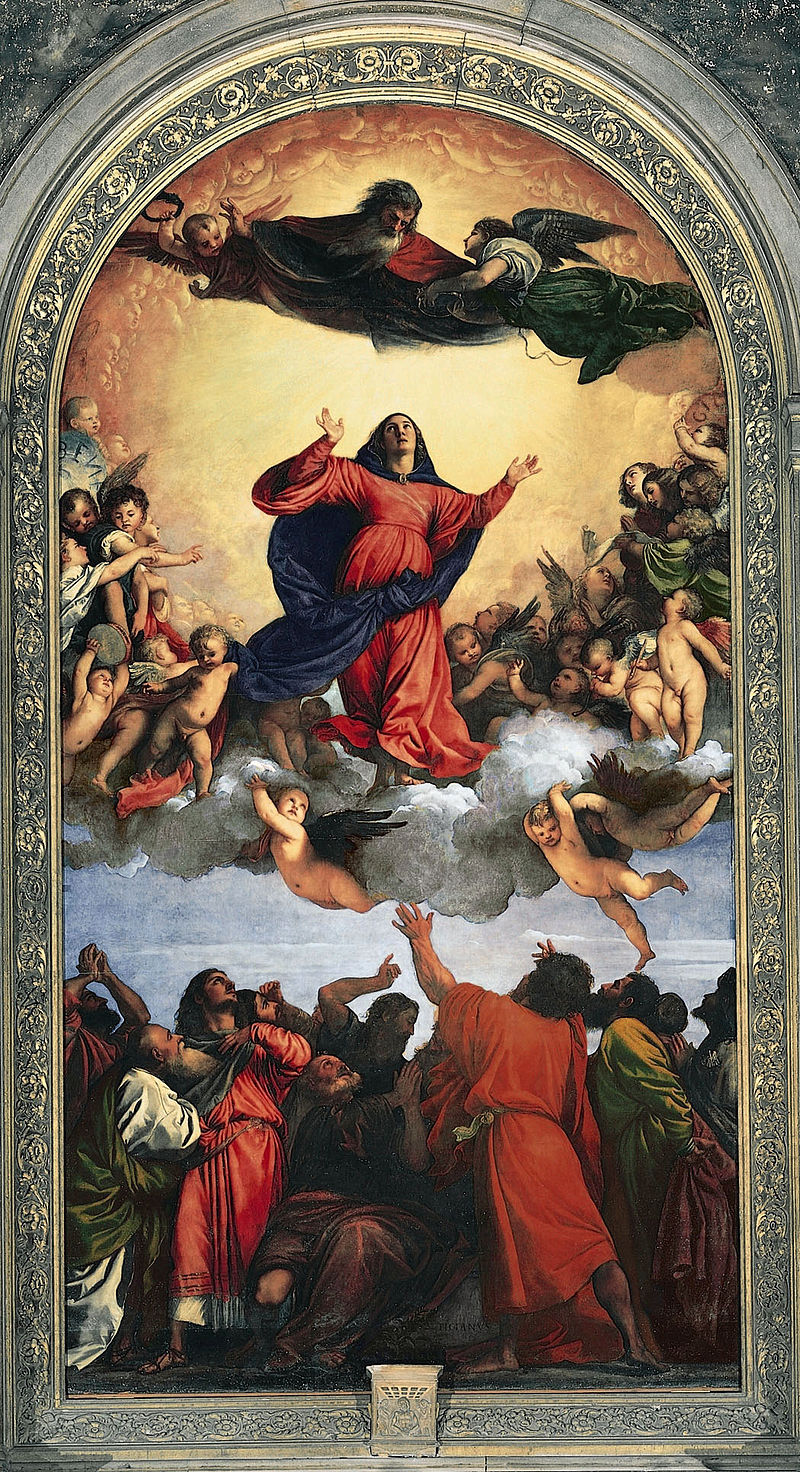
Assunta, by Titian, 1516-1518, via Wikimedia Commons

Assunta, by Titian, 1516-1518, via Wikimedia Commons

One thing we fantasy authors must occasionally deal with is developing religions within the context of the tale.

Most of what we will discuss here won’t actually make it into the written pages of your tale, but if you don’t have a good understanding of what you are writing about, you will inadvertently introduce discrepancies into your tale.

First, ask yourself “why does this religion matter?”  If it doesn’t matter, it doesn’t belong in your tale.

However, when you have a heavenly power-struggle, you have some intriguing opportunities for mayhem.

Are there many gods and goddesses? What is their relationship with each other and how does it play into your story?

If you choose to create a religion as a key plot point, here are some questions to ask:

  1. How central to the life of the protagonist or antagonist is religion? Is the protagonist a member of the priestly class, perhaps a priestess or priest of a particular god or goddess?
  2. What does the protagonist gain from following this deity?
  3. How jealous is this deity?
  4. What is the protagonist/antagonist willing to do for their faith? Will they die for their deity or is it a more abstract religion?
  5. The priesthood—who can join?
  6. Can only the nobility rise in the priesthood, or can anyone with the ability to learn gain power within the organization?
  7. How do the nobility and the priestly class get along? Do they have a good accord or are they jostling for power?
  8. And within that religious organization, who has the most power?
  9. What does that person do with their power?

How important is your religion politically? In Rome, the church was central to their government, in some cases having more power than the ruling nobility. During the Middle Ages, Rome slowly fell under the political control of the Papacy, which had settled in the city since the 1st century AD. In the 8th century, Rome became the capital of the Papal States, which lasted until 1870.

You don’t have to re-invent the wheel here–history is full of great ideas to draw upon.

A_Glass_of_Wine_with_Caesar_Borgia_-_John_Collier

Painting by John Collier, “A glass of wine with Caesar Borgia” via Wikimedia Commons

Consider the Borgias–Wikipedia, the fount of all knowledge says this about them: Especially during the reign of Alexander VI, they were suspected of many crimes, including adultery, incest, simony, theft, bribery, and murder (especially murder by arsenic poisoning). Because of their grasping for power, they made enemies of the Medici, the Sforza, and the Dominican friar Savonarola, among others. They were also patrons of the arts who contributed to the Renaissance.

See? Even George R.R. Martin knows that the renaissance offers great opportunity for good plot twists in your fantasy project.

Now let’s examine the political environments of the medieval city-states of Venice, Milan, Florence, Genoa, Pisa, Siena, Lucca, and CremonaRodney Stark, an American sociologist of religion, proposes that the city-state was a ‘marriage of responsive government, Christianity, and the birth of capitalism’ as we know it. He argues that these states were mostly republics, unlike the great European monarchies of France and Spain, where absolute power was vested in rulers who could and did stifle commerce.

It has been suggested (in Wikipedia, the fount of all knowledge) that by keeping both direct Church control and imperial power at arm’s length, the independent city republics of medieval Italy prospered because their commerce was based on early capitalist principles. The church was still involved in their daily lives, but this slight, deliberate separation of church and state ultimately created the societal conditions that brought about the artistic and intellectual flowering of the renaissance.

And for you, the author, understanding the commerce and economics of your fantasy society is extremely important, so that inconsistencies don’t get introduced. The reader won’t care, and doesn’t want the background info, but you need to know it.

If your protagonists are poor, why are they poor? Is poverty widespread, or is it only the one family? Where is all the money–is it in the hands of the church or is it in the hands of the middle-class? If it’s in the hands of the church–you’ve a good plot-point to work with.

Thus if religion of some sort is an integral part of your work, you as the author must have a good knowledge of what the influence of that institution is, the structure of the priesthood, the power they wield in society at large, how (or if) they control the economy, and how this organization is viewed by the ordinary citizen.

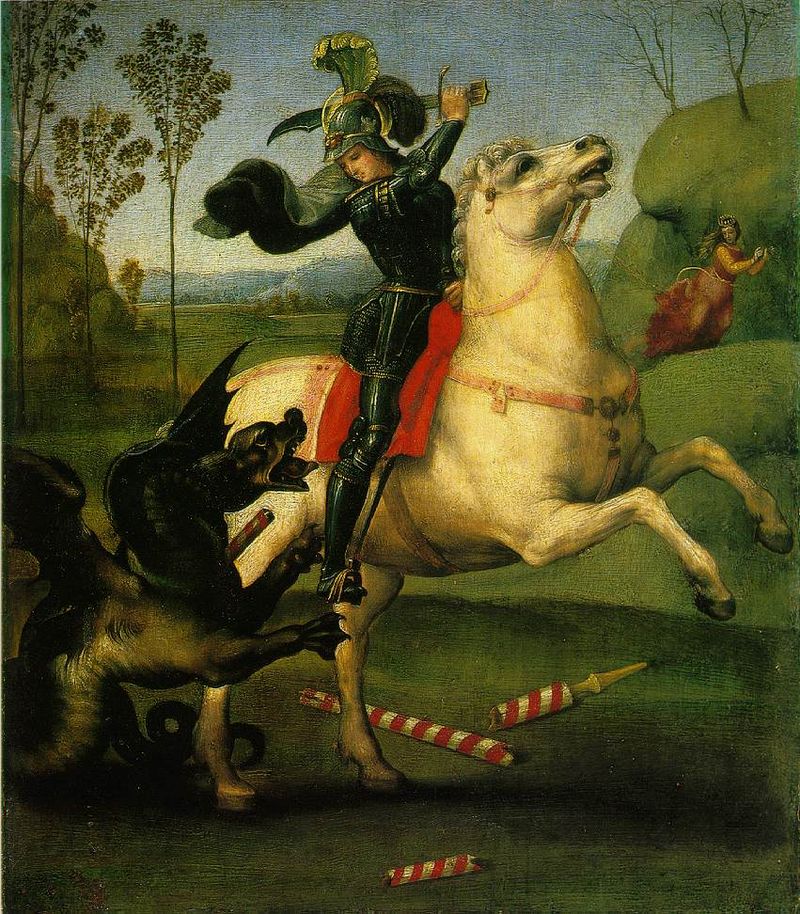
St. George and the Dragon, Raphael via Wikimedia Commons

St. George and the Dragon, Raphael via Wikimedia Commons

Many authors avoid this altogether, by having only a vague mention of religion, simply mentioning a connection with a particular deity as the reason for the ability to use and control magic.

Others make religion and opposing religions the foundation of their works. How you handle religion in your manuscript is up to you, but if you make it a central part of your tale, I suggest you create a document in which you establish the basics of your religion(s) clearly. Update it as the rules evolve, which they certainly will do over the first two drafts of your novel. During your writing process, refer back to this document regularly.

The reader doesn’t care about those details, and will put the book down if they are included. But if you don’t know what you are writing about, can’t remember what you wrote three chapter ago, and contradict yourself too often, your reader will lose the ability to suspend his disbelief.

Keeping the reader immersed in the tale, forgetting that it is only a fiction is the primary goal every author wants to achieve.

2 Comments

Filed under Fantasy, Publishing, Uncategorized, writing