Tag Archives: literature

Elements of a story: Identifying your protagonist

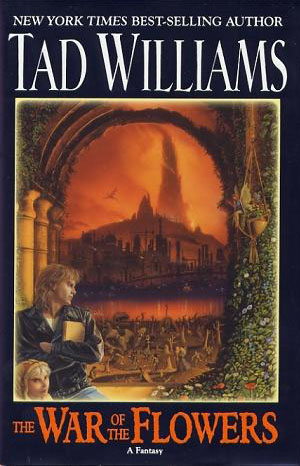
War_of_the_FlowersGreat plots drive great stories, but the best stories start with a character that really moved me. The trouble is, when we first begin to write a story, one character leads to another and soon, each character is vying to tell your their own story. It’s sort of like a family gathering, where they all talk at once, and you love them all.

This makes writing a true stand-alone book difficult. Tad Williams managed to do just that in 2003 with The War of the Flowers.  Theo Vilmos is a thirty-year-old lead singer in a marginally successful rock band. Fearing he is past his prime, he seeks refuge in a remote cabin in the woods. There, he reads a memoir written by a (perhaps) dead relative. This relative claimed he had visited the magical world of Faerie. A series of strange events occurs and before Theo knows it, he too is drawn into a place that is both strange and yet familiar to him, revealing the truth about many things that had always puzzled him.
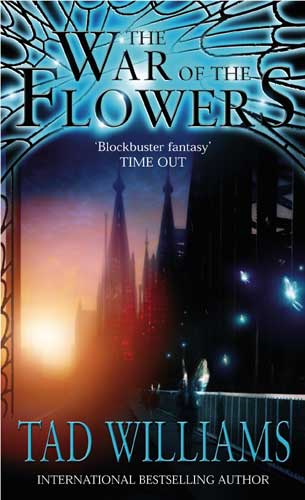
war_flowersWilliams had another great character to draw on in his little fairy, Applecore, but he kept it contained in one wonderful novel detailing Theo Vilmos’ adventures rather than going too far afield and having to serialize it. This is a model we lesser-known fantasy authors might want to take a closer look at and somehow revive: the stand-alone novel.

We might have a great story in our head, and we may have an awesome cast of characters dying to leap onto the page, but until we know who the hero is, we have no story. From the first page to the last, Tad Williams knew who his hero was in The War of the Flowers, and it’s clear that he never doubted it was Theo Vilmos.

Sometimes  identifying just whose emotional and physical journey you will be following is easier said than done. When faced with a pantheon of great characters, ask yourself these questions (listed here in no particular order):

  • Who among these people has the most to lose?
  • Which character do you find the most interesting?
  • Who’s personal story inspired this tale in the first place?
  • Who will be best suited to taking full advantage of all this plot’s possibilities?

Dragonbone_ChairFrom my point of view, one of the best fantasy series of all time is Tad Williams’  epic, three-volume masterpiece, Memory, Sorrow, and Thorn. It opens with volume one, The Dragonbone Chair. This is a very different tale than The War of the Flowers, much larger, and encompassing several entire cultures on the edge of disaster.

In this opening volume, Tad had many great characters to draw on, all of whom had strong stories. Indeed, there is a large cast of characters with incredible possibilities, but as a reader I liked that he managed to tell their stories without losing sight of the original story that sparked the series in the first place.

The fact that Williams was able to weave the many threads of such a large cast of characters into one enthralling story and still leave (Seoman) Simon Snowlock as the main protagonist with a gripping story-line  is amazing.
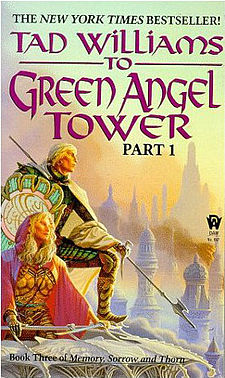
Green_Angel_Tower_P1Yet in this series, Tad Williams does just that. He could have written it as the story of Prince JosuaPrincess Miriamele, Binabik the Troll, or even the Norn prince, Jiriki. They are each compelling characters, with deep, intriguing back-stories, and any of them would have been an awesome protagonist.

Each and every one of the many characters in this series was strong enough to warrant a book of their own, but Simon the kitchen boy remains the central character, and the other story-lines are detailed but remain subordinate to his, fleshing it out and defining his ultimate fate, driving the plot to the final denouement, and the cataclysmic events in Green Angel Tower.
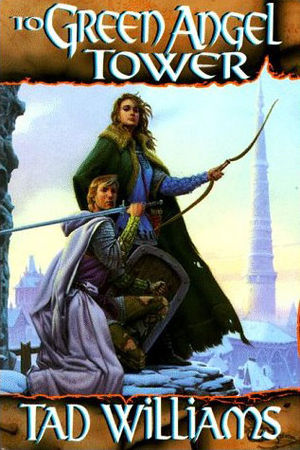
To_Green_Angel_TowerThis juggling act, this ability to not become sidetracked by your wonderful side-characters while telling their story is critical to the progression of your plot. It’s excruciatingly easy to become so enthralled with the story-line of a minor player that you derail your novel in the first draft.

I’m a gamer and I play Final Fantasy type RPGs. I adore side-quests, and I love a little back-story to flesh out whatever tale I’m reading, but just like in a game, the protagonist and the core plot has to stay in motion. Memory, Sorrow, and Thorn has a lot of side-quests, and a lot of back-story, but despite the opportunities for derailment, it is propelled irresistibly toward the final catastrophic event, and does it in three admittedly large books.
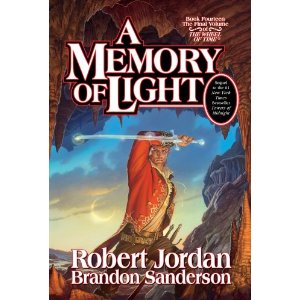
A_Memory_of_Light_cover (1)As much as I adored the Wheel of Time series, Robert Jordan seemed to fall into the trap of loving all his characters too much, and wanting to tell each of their truly epic stories in the one series–and it couldn’t be done without aggravating his fans.

Consider this: although it was originally planned as a six-book series, The Wheel of Time grew to encompass fourteen volumes, a prequel novel, and a companion book.  Jordan began writing the first volume, The Eye of the World, in 1984. It was published in January 1990. With Jordan’s death on 16 September 2007, the conclusion of the series was in question, but Brandon Sanderson stepped in and did a masterful job of taking Jordan’s incredible mass of notes and background, along with the rough draft and finished the series’ final three installments.
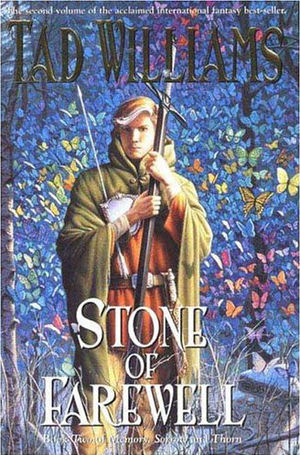
Stone_of_FarewellIt occasionally happens that you have chosen a protagonist, but another character suddenly seems to have a more intriguing way about him. It is up to you to make a decision–who will be the central character? If, after all is said and done, a different character than the one you originally thought was the protagonist comes to the fore, you must go back and rewrite your beginning to to reflect that.

Deciding who that protagonist will be is a matter of knowing which character has the most opportunity to take full advantage of all the possibilities. The other characters serve only to propel him/her to the final conflict.

Sometimes, as in Memory, Sorrow, and Thorn, that character is the 14 year old kitchen boy on the verge of manhood, and not the battle-hardened prince with the tragic history.


Comments Off on Elements of a story: Identifying your protagonist

Filed under Adventure, Books, Fantasy, Humor, Literature, Publishing, Uncategorized, writer, writing

World Building part 4: Questions to consider when creating a society

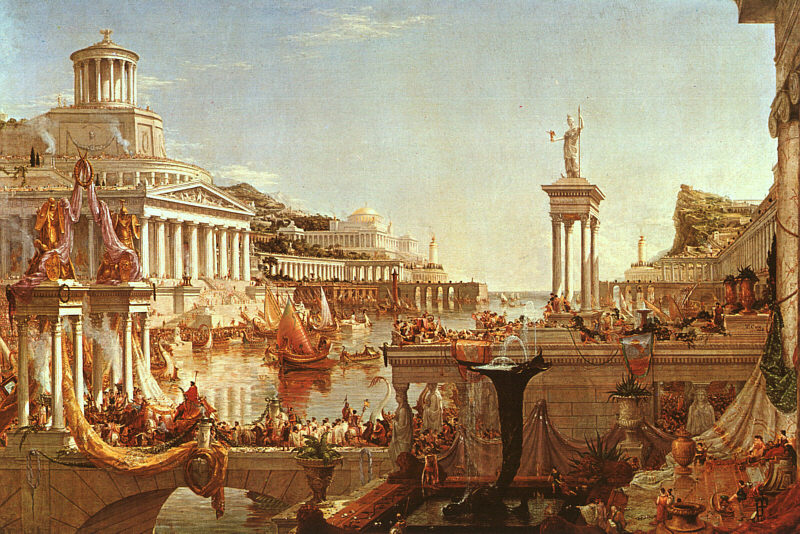
Thomas Cole, 1836: the Course of Empire: the Consummation

Thomas Cole, 1836: the Course of Empire: the Consummation

In speculative fiction, we often have one culture that is more advanced in contrast to the neighboring, somewhat more primitive cultures. Each of these societies have unique cultures, and if you know the culture of your characters’ homeland, you understand your characters and why they think the way they do.

But what is a society formed of? Initially, people come together and form  small communities, or tribes,  for protection. They find it’s a good way to consolidate more consistent sources of food and resources. With adequate food and shelter, people live longer and are generally healthier. Out of a need to get along with each other, they develop certain commonly agreed upon rules-of-the-road for sharing that wealth. Eventually these common rules become a complex social structure. As life becomes easier for the population in general, other amenities of civilization begin to be a part of their culture.

I write in many different worlds with widely varying levels of technology and forms of government. When I first began writing I knew it was important to know what the social structure was in each fantasy world, so I made a list of questions to consider when I begin constructing a new society. I was new at this, so please bear with the randomness of the order in which these things are listed:

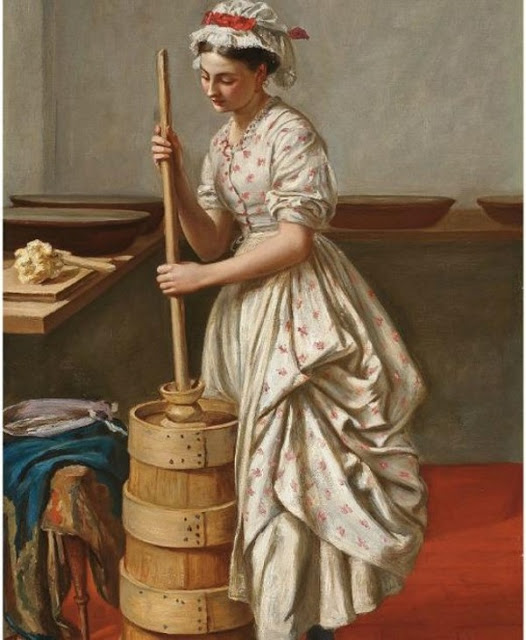
  1. The butter churnSocial Organization: Society is always composed of many layers and classes. How is your society divided? Who has the wealth? are there
  • Nobility?
  • A servant class?
  • A merchant class
  • A large middle class?
  • Who makes up the poorest class?
  • Who has the power, men, women—or is it a society based on mutual respect?
  1. Language, the written word, and accounting: Do they have a written language? This is really important if you are setting your people in a medieval world or in a really low-tech society, because it determines how knowledge is passed on. Low-tech generally equals an oral tradition.
  • How are people educated?
  • Who is allowed to learn to read and write?
  • How are bards, storytellers and other disseminators of knowledge looked upon?
  • How is monetary wealth calculated?
  • Do they use coins? What is their monetary system? If you are inventing it, keep it simple. (I generally use gold,  divided into tens: 10 coppers=a silver/ 10 silvers=a gold)
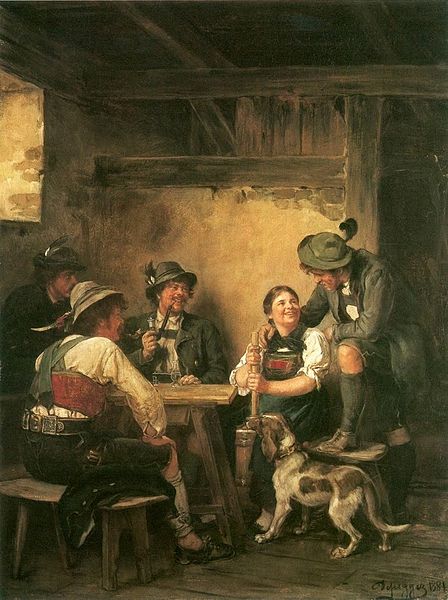
  1. Franz Defregger, 1921: Auf der Alm

    Franz Defregger, 1921: Auf der Alm

    Ethics and Values: What constitutes morality?

  • Is marriage required?
  • How are women treated? How are men treated?
  • How are same-sex relationships viewed?
  • How are unmarried sexual relationships seen in the eyes of society?
  • How important is human life? How is murder punished?
  • How are treachery, hypocrisy, envy, and avarice looked upon?
  • What about drunkenness?
  • How important is truth?
  • What constitutes immorality?
  • How important is it to be seen as honest and trustworthy?
  1. Religion and the Gods: How important is religion in this tale? If it is central, ask yourself: Is there one god/goddess or many? If the worship of a deity is a key part of your tale, you must design the entire theology. You must know the rituals, and know how their deity holds their hearts. You must know how that deity considers his/her worshipers.
  • What sort of political power does the priestly class wield?
  • What is the internal hierarchy of the priesthood?
  • Who has the power?
  • Is this religion a benevolent entity or all-powerful, demanding, harsh?
  • How does the priesthood interact with the community?
  • Who can join the priesthood
  • Do people want to join the priesthood or do they fear it?
  • How is the priesthood trained?
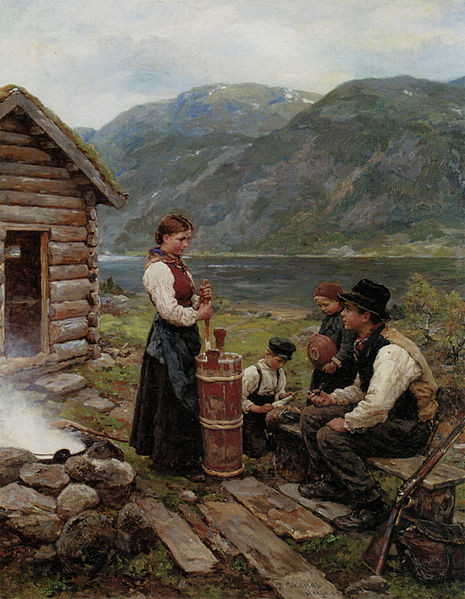
  1. Jahn Ekenæs, 1908: Family in a Norwegian fjord landscape

    Jahn Ekenæs, 1908: Family in a Norwegian fjord landscape

    Level of Technology: What tools and amenities does this society have available to them? What about transport?

  • Hunter/Gatherers?
  • Agrarian/farming
  • Greco-Roman  metallurgy and technology?
  • Medieval metallurgy and technology?
  • Pre-industrial revolution or late Victorian?
  • modern day?
  • Or do they have a magic-based technology?
  • How do we get around and how do we transport goods? On foot, by horse & wagon, by train, or by space shuttle?
  1. Government: There will be a government somewhere, even if it is just the local warlord. Someone is always in charge because it’s easier for the rest of us that way:
  • Is it a monarchy, theocracy, or a democratic form of government?
  • How does the government fund itself?
  • How are taxes levied?
  • Is it a feudal society?
  • Is is a clan-based society?
  • Warlord, President, or King/Queen?
  • How does the government use and share the available wealth?
  • How is the government viewed by the citizens?
  1. Crime and the Legal System: What constitutes criminal behavior and how are criminals treated?
  1. Foreign Relations: Does your country coexist well with its neighbors?
  • If not, why? What causes the tension?
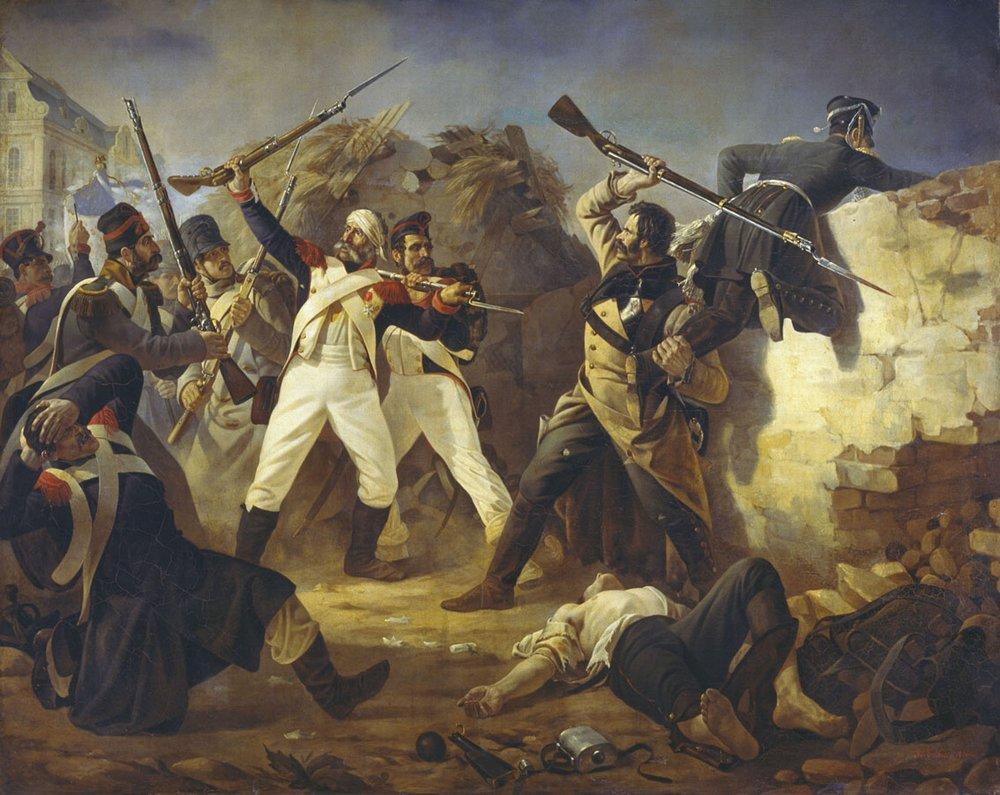
  1. Feat of the grenadier of leib-guards Finnish regiment Leontiy Korennoy in the battle of Leipzig at 1813

    Feat of the grenadier of leib-guards Finnish regiment Leontiy Korennoy in the battle of Leipzig at 1813

    Waging War: This is another area where we have to ask what  their level of technology is. It is critical for you as the author to understand what sort of weapons your characters will bring to the front, and also what the enemy will be packing. Do the research and choose weaponry that fits your established level of technology.

  • What kind of weaponry will they use?
  • How are they trained?
  • Who goes to battle? Men, women, or both?
  • How does social status affect your ability to gain rank in the military?

This is by no means a comprehensive list. It was initially meant to be a jumping off point, just a short list of things for me to ponder, but I thought I would share it with you today. Considering this little list of ideas always leads to my realizing a kajillion other rather large concepts that  combine to make up  a civilization. You are welcome to use this roster to form your own inventory of ideas about society.

What I originally did was to write the whole story of the community my protagonist grew up in, a word-picture of about 5000 words, and then I set it aside, to use as reference material. This is the method I still use today.

When you have cemented the society in your mind,  the world your characters inhabit will flow naturally and your protagonists will fit into it organically. Their society will be visually real to the reader, even if the world it evokes in their minds isn’t exactly your vision of it. You will have done your job, by giving them a solid framework to imagine the story around.

2 Comments

Filed under Books, Fantasy, Humor, Literature, Publishing, Self Publishing, Uncategorized, writer, writing

To swag or not to swag

HTB Bookmark side B copyI’ve several multi-author events coming along in the near future, and I’ve been preparing accordingly. I’m now technologically able to accept any sort of payment for my sales at these events: I actually own a portable store.

Now I have to consider swag–that portable bit of treasure to keep others thinking about you and your books.

It’s always hard to know what sort of swag to invest in, what is going to pay for itself. I can’t really afford to go nuts here, so I’m going to see what my author friends are pushing, and try to determine just what is going to be the right fit for me.  So I ordered the old standby indie swag-item, book marks.  I’ll make sure each book I sell has one in it, and if a passerby asks for one I will hand them out. Some folks like them so I’ll make sure I have some for them, but at various different conferences and conventions, I’ve observed that a lot of things like that just get tossed unless the person actually asked for it. Why invest in something that will just end up littering the mall?

I went to an event and met a lovely man from Alaska who practically forced me to take a cardboard replica of his book cover. As I said, he was friendly and nice, but…it must have been costly and I had no idea what to do with it. By the time I arrived home it was a mangled mess and went out with the recycling. Thus, I don’t even remember his name, or his book.

That incident got me to asking myself: what do I really want out of this? After all, I am selling my brand, and that brand is my author name.  I want people to remember it.

Business card MockupSO: Business Cards–These are an absolute must. They’re cheap and easy to make on my home computer and good to hand out when asked for one. Keep it simple and readable, with just the facts:

  • Your Author Name
  • Your website
  • Your Fan Email Address
  • Any other contact information you feel comfortable giving out
  • Your book title (s)

Remember: Don’t Junk It Up.  Simple and readable is the way to go with business cards.

I have another friend who is investing in postcards that have to do with his book, and each one will have a coupon to redeem a free paper copy of his forthcoming novella–and that’s a good idea, but also costly. I need to keep my costs a low as possible, so that will not be an option for me. Romance authors are encouraged to offer all sorts of little swag items–chap-stick, makeup mirrors, even tote bags–these are costly though. Whatever I do, it has to be effective and low-cost.

HTB Stamp copyI do think custom post it notes might be a good idea.  They seem reasonably priced, and fairly easy to do. Again, I think the key is to do it like business cards and book marks–keep it simple and just the facts: Author Name, website, and book title. If I decide to do those, I’ll let you know how it goes.

I had fun finding clip-art and designing a special Huw the Bard Stamp for an event that will happen in June–each participating author will have a stamp and will stamp the programs of the crowd as they pass through.  This was intriguing, and something I can use later in so many ways. Plus it was only $ 7.95 + shipping.

Anyway, I’m sure my little stamp will be great fun for the grandkids–heh heh…hold still and let grandma stamp this little tattoo on you….

7 Comments

Filed under Books, Fantasy, Humor, Literature, Publishing, Self Publishing, Uncategorized, writer, writing

Dark, Gothic, and hurtling toward disaster

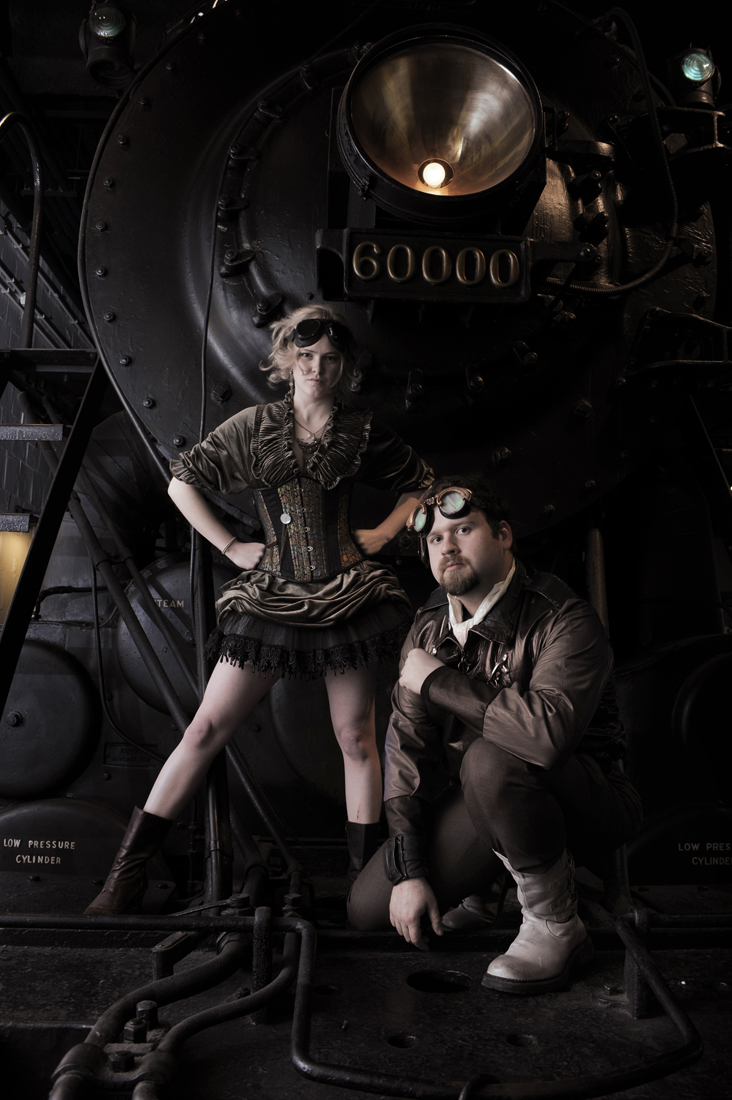
Steampunks  by Kyle Cassidy

Steampunks by Kyle Cassidy

Well…apparently my current scifi work-in-progress, a short story, is steampunk. Who knew? My good friend, author Lee French, figured it out yesterday at our regular Tuesday morning brainstorming session at Panera. After she pointed it out, I could see it clearly, despite my original thought that because I had set it on a mining-colony world, it was a scifi tale.

I was a little surprised I hadn’t seen it earlier, and once it was pointed out, I could see why I was struggling with the tale–I didn’t know what I was writing.

It began as an exercise in writing from the point of view of the flâneur–the man of leisure, the idler, the urban explorer, the connoisseur of the street. Click here for Scott Driscoll‘s great blogpost on the flâneur. In short, he tells us that: “With a flâneur narrating, you can remove the noticing consciousness from your point of view character to accomplish other purposes.”  

The flâneur  is frequently found in literature from the 19th century.  The story is filtered through his eyes and perceptions–it distances the reader from the immediacy of the scene, so be forewarned: genre-nazis and arm-chair editors who want the material delivered in 60 second sound-bytes of action won’t love it. Literary fantasy explores the meaning of life or looks at real issues, and I tend to write from that aspect. Often, the fantastic setting is just a means to posing a series of questions. Sometimes the quest the hero faces is in fact an allegory for something else. I read good literary fantasy–it tends to be written by men and women who can actually write. Not only are the words and sentences pregnant with meaning, but they are often beautifully constructed, and I learn the craft of writing from reading it.

The Rainy Day, Gustave Caillebotte

The Rainy Day, Gustave Caillebotte

My flâneur is Martin Daniels, a young, wealthy, retired crystallographer. He spends his time roaming his city’s streets and sitting in sidewalk cafés observing his fellow citizens, and making social and aesthetic observations. He regularly finds himself crossing paths with one man in particular, Jenner: a self-made man who came up through the mines.

Jenner is battering against the prevailing social barriers which stand in the way of his achieving a political office that he covets, using whatever means at his disposal. He is uncouth, a barely civilized rough-neck with a bad reputation, but something about him draws Martin’s attention, and so he finds himself both observing Jenner, and listening to the whispered gossip that surrounds the man.

One day, as Jenner is passing Martin’s table,  his hat blows off and Martin catches it, returning it to him. Jenner then introduces himself, and admits that he has been watching Martin for some time. He has a task for Martin, one that intrigues him enough to bring him out of retirement. Thus begins an odd relationship.

Thus my flâneur ceases to be merely an observer, and becomes my protagonist, yet he is reporting the events from the distance of his memory, so he is still the observer.

aesthetic definitionSo what is Steampunk?  Mike Perschon, in his dissertation, The Steampunk Aesthetic: Technofantasies in a Neo-Victorian Retrofuture, has described it as “…an aesthetic that mixes three features: technofantasy, neo-Victorianism, and Retrofuturism.” The key word here is aesthetic.

So how does that relate to my short story? When I looked at it with a critical eye, I realized it incorporates all three of those devices:

Technofantasy: Technology that lacks plausibility, or utilizes fantasy elements as the force or motive behind an action or process. No explanations will be given. The technology exists within the story, not the real world.

Neo-Victorianism: A setting that evokes the nineteenth century, whether it is set there or  not. In my tale, the use of the flâneur evokes a 19th century atmosphere, as do the other constraints I had inadvertently written into it.

Retrofuturism: How we think the past viewed the future. It is set in the distant future, but it is a future I think Victor Hugo would have recognized.

I have always perceived steampunk as cogs and diodes, dark atmosphere, rather Gothic, and with a plot that has the protagonists hurtling toward disaster. Now I know it is all that and more. They hurtle toward disaster, with a nineteenth century flair.

Thus my sci-fi flâneur is now the protagonist in a steampunk mystery. This short story, which had sort of stalled, is now back on track and fun to write. Through writing short stories we have the opportunity to write in different genres, and stretch our writing-wings.

I learn more about the craft of writing with each tale, and that fires me up, helping me see my longer works with fresh eyes.

2 Comments

Filed under Adventure, Books, Fantasy, Humor, Literature, Publishing, Self Publishing, Steampunk, Uncategorized, writer, writing

Comfort Books, the main course: The Wheel of Time, by Robert Jordan and Brandon Sanderson

The Eye Of The WorldFor the main course of this three course meal I’ve chosen a hearty 14-book trilogy. I warned you that many of the books I love and turn to when I need a good book are NOT comforting in any way, and for many people the incredibly long, epic series, the Wheel of Time, definitely falls into the UNcomfortable category. This is for a variety of reasons.

The Eye of the World was the opening volley in what would ultimately become one of the most controversial series in epic fantasy. Written by Robert Jordan and first published in 1990, this series of books has polarized the most dedicated fans of true fantasy into two groups: the lovers and the haters.  No reader walks away from this series unscathed.

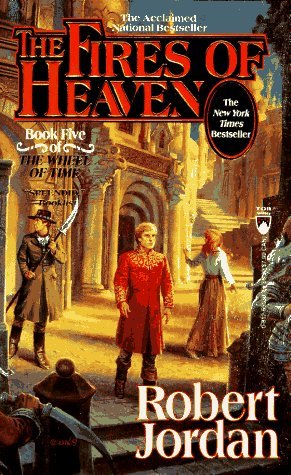
WoT05_TheFiresOfHeavenThe story begins in the exceedingly rural village of  Emond’s Field. They are so rural that they have no concept that they are still considered to be a part of a larger country. The village is suddenly attacked by Trollocs (the antagonist’s soldiers) and a Myrddraal (the undead-like officer commanding the Trollocs).  These creatures are intent on capturing the three protagonists, Rand al’Thor, Matrim (Mat) Cauthon, Perrin Aybara, although why they are being hunted is not revealed at first. To save their village from further attacks, Rand, Mat, Perrin, and Egwene (Rand’s first love interest) flee the village, accompanied by the Aes Sedai Moiraine Damodred, her Warder, Al’Lan Mandragoran, and gleeman, Thom Merrilin.They are later joined by Nynaeve al’Meara, who is their village’s medicine woman.

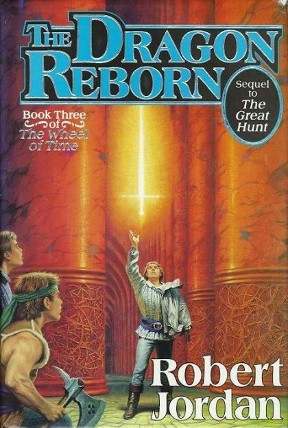
WoT03_TheDragonRebornThis huge range of characters and the many, many threads that weave an incredibly tangled plot are what polarizes the reading community over this series of books. Originally intended to be a trilogy, it eventually expanded to encompass fourteen LARGE, long books.

Robert Jordan passed away in 2007 while working on the final book, leaving the series uncompleted, but he left the rough draft and enough notes behind that Brandon Sanderson was able to finish the series, eventually breaking that final volume into three very large  books, and bringing the story to a satisfying conclusion.

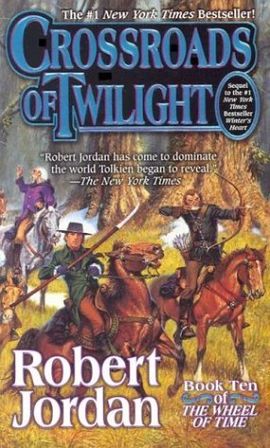
WoT10_CrossroadsOfTwilightSo what is the basis for the plot’s tension, what conflict could possibly draw the reader in and keep them reading for such a long, drawn out process? It’s Robert Jordan, folks–the eternal quest for power, and dominance through violence, religion and politics is the core of this tale. According to Wikipedia, the Fount of All Knowledge: The series draws on numerous elements of both European and Asian mythology, most notably the cyclical nature of time found in Buddhism and Hinduism, the metaphysical concepts of balance and duality, and a respect for nature found in Daoism. Additionally, its creation story has similarities to Christianity’s “Creator” (Light) and Shai’tan, “The Dark One” (Shaytan is an Arabic word which in religious contexts is used as a name for the Devil). It was also partly inspired by Leo Tolstoy’s War and Peace (1869).”

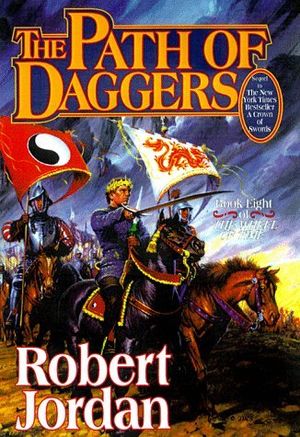
300px-WoT08_ThePathOfDaggersI loved the first three books in this series. I both enjoyed and endured the next three, hoping Robert Jordan would get to the point and finish the damned series. I had become a little irritated with book eight, Path of Daggers, but by the time Winter’s Heart came out, I was resigned to never seeing an end to it, and was back to simply enjoying each strange plot twist and new random thread for what it was–just a great tale.

When Robert Jordan died, I was thrilled that Brandon Sanderson was the author tapped to finally bring that unwieldy mess together. There were so many different stories within the greater story that the task of winding up each thread must have been incredibly daunting, and he did it magnificently.

The reason so many devoted fans abandoned the series somewhere around book six , Lord of Chaos, was that Rand al’Thor’s story ( and Mat’s and Perrin’s) stalled, and Jordan was sent way off track by the stories of Egwene, Nynaeve, and Elaine Trakand. In fantasy, there is a large contingent of readers who want instant gratification are not going to wait around for eight more books. They proved it by jumping ship and trash-talking his work.

TheGatheringStormUSCoverThroughout the series, the quality of the writing never faltered. The depth of story and the intensely alive characters whose stories graced those pages never failed to intrigue me. The fact that it felt like the conflict would never be resolved was, at times, upsetting to me as a reader, and is a lesson authors should take to heart with their own work.

To write a story that is so compelling that readers become so violently polarized over it is quite an accomplishment.  I see this happening with George R.R. Martin‘s fans right now. Although I adore him as a person, I’ve never cared much for his style of writing, as he jumps around too much even for me. Have patience, people! It looks like George has a large story there too, so it may take him a while.

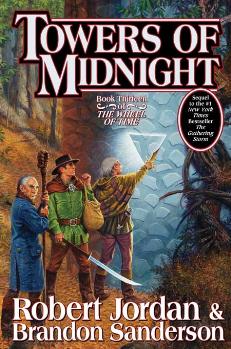
Towers_of_Midnight_hardcoverFor Brandon Sanderson to step into the wasps’ nest of controversy that was the Wheel of Time and complete the series with such grace and finesse is nothing short of amazing, and I am glad I stuck with it to the end. Brandon Sanderson has become one of my favorite authors because of what he did to wind up this epic series.

In the end, the final resolution was satisfying, and was well worth the journey.  I have gotten rid of most of my hard copies, and am down to only one room’s worth of hardbound books at our house. I don’t buy too many hard copies of books, being a fan of the Kindle, and  but I did make an exception for this book.   For me, some books need to be in hard copy form and the Wheel of Time Series is one of them, as are the Harry Potter books. There was a large contingent of people who were upset that the epub edition wasn’t released until 4 months after the paperbook, but this was a choice made by Robert Jordan’s widow and her publisher, TOR. It was a strange one in my opinion, but it was their choice.

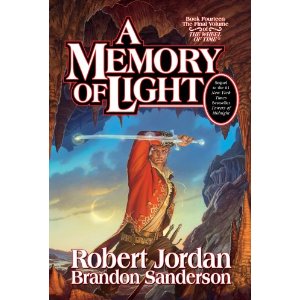
A_Memory_of_Light_coverAmazon’s early reviews of the later books in this series were rife with trolls and naysayers who couldn’t wait to emerge from the woodwork and have their say. Apparently very few of these people purchased the book, much less read it. That is the price of success and these days it’s almost an honor to have so many haters just spoiling to knock you down. But their strident caws and self-important rants should have no effect on the true fans of WoT. In my humble opinion these works are masterpieces and Brandon Sanderson’s three books are a triumphant finish to the series.

I love Brandon Sanderson’s handling of this series finale, and feel I more than got my money’s worth from this series of book, as I will definitely read it again and again–in my opinion it’s that good. If you love this series, you will love the way it ends!

The original cover artist for these amazing books was none other than the late Darrell K. Sweet, who was just as amazing a fantasy artist as is Michael Whelan. The newer covers are nice, but for me they lack the power of Sweet’s brilliant paintings.

And as we all know, I buy most books for their covers, even epubs, and then fall in love with the tale.

Comments Off on Comfort Books, the main course: The Wheel of Time, by Robert Jordan and Brandon Sanderson

Filed under Adventure, Battles, blogging, Books, Dragons, Fantasy, Humor, Literature, Politics, Publishing, Self Publishing, WordPress, writer, writing

Friday Interview: Carlie M.A. Cullen

Photo of CarlieAs I promised a while back, today Carlie M A Cullen, author of The Heart Search trilogy, has consented to answer a few questions for us. She is a lovely, talented woman who has been one of my editors for several years now!

CC: Hi Connie! It’s lovely to be here. Thank you for the tea.

CJJ: Hello, and you’re welcome! Tell us a little of early life and how you began writing:

CC: I grew up as an only child. My parents worked full time and both had second jobs. As a result I was left to create my own entertainment. I loved the tales of Hans Christian Andersen and started to write my own fairy tales. I found myself disappearing into the stories I created and it made me feel less lonely. From there, I progresses to writing longer short stories and poems. It’s something I’ve continued to do into adulthood.

CJJ: As you know, I love this series. Tell us about your most recent book.

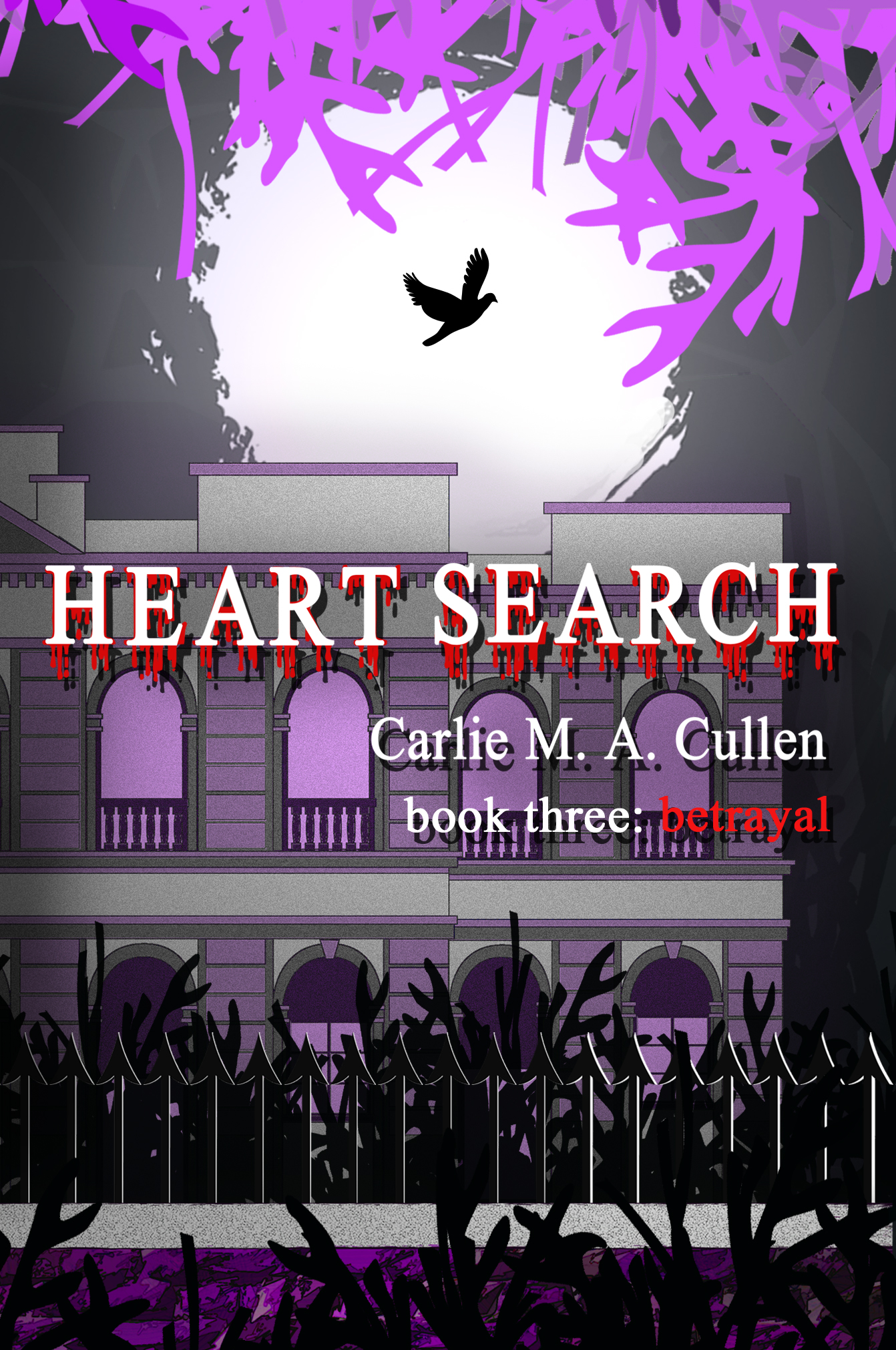
CC: I hope you’re not after any spoilers, Connie! [laughs] Heart Search: Betrayal is the final book in the trilogy and takes Remy and Joshua’s story to its natural conclusion. However, it’s not all hearts and flowers – far from it. There is a traitor who is passing copious amounts of information to someone who has a massive grudge against the coven, and who they are in league with. But there are four possible suspects. Which one is it and can the coven discover their identity before it’s too late? There are many twists and turns along the way, some good and some terrible. Certain characters really shine and there’s the discovery of new talents along the way. Unfortunately there are casualties, some of which may shock my readers.

CJJ: The story line in Betrayal is quite divergent from the previous two books. How did you come to write this novel?

CC: When I reached the halfway point in the first book, Heart Search: Lost, I knew there was too much of a story for just one. It was at that point I realized Heart Search would turn into a trilogy. I couldn’t leave the world I’d created and made the decision to complete the trilogy before moving onto other stories I had in my head.

CJJ: I always have that problem too. I think some stories are just larger than we originally thought. So, do you have a specific ‘Creative Process’ that you follow, such as outlining or do you ‘wing it’?

CC: It depends on what I’m writing really. With Heart Search, I had the first twelve chapters meticulously outlined, but around chapter five my characters decided they were going to take over and make me tell their story their way. I threw away the outline and have ‘winged it’ ever since. As I wrote this based on current day, it was easy to do.

With my next book, I’ve had to do some extensive world building and creating magic systems and the like before I began writing. However, as far as the story goes, again I’m winging it and seeing where my muse and characters takes me.

CJJ: Well your muse is taking you to some wonderful places! In your opinion, how does your work differ from others of its genre?

CC: I can only really talk about the Heart Search trilogy here. In the first book you have two POV’s: Remy in first person and Joshua in third person. Their stories run parallel to each other and every now and then they softly bump before going off again. I believe this is what makes it unique. In book two, I brought in extra character voices and gave them their own POV’s in third person. The final book takes even more POV’s into the mix, always in third person, whereas Remy has maintained a first person POV throughout.  I also believe (going by the reviews I’ve read) the storyline itself is completely different to what others have read before. Put all this together and that’s what I think makes my work so different from others in its genre.

CJJ: So now we get down to the question that I always wonder: Why do you write what you do?

CC: As I said earlier in the interview, I loved the Hans Christian Andersen fairy tales and that was a huge influence in my writing. Growing up I tried reading different genres, but I always came back to fantasy. There’s something so intriguing about the characters you can create, the worlds you can build, and adding to that those mystical creatures we all know so well: fairies, goblins, dragons, vampires, et al. It seemed only natural for me to write in this genre. It’s where I’m in my comfort zone.

CJJ: I know why I chose the indie route for my work, but I’m curious as to why you’ve chosen this path.

CC: Originally, I wanted the dream of getting an agent and a decent publishing deal, but I was new to the industry and quite naïve. After a few rejections, I decided that after all my hard work on the book it would be nice to give people a chance to read it. In addition, I had people I knew asking me for it. It was about that time I joined Myrddin Publishing. Everyone was so supportive from day one so I published it through them and haven’t looked back since.

Now I know more about the industry, I’m really glad I’ve taken this path. I have so much more control over where my books are sold, what sort of cover I want, what price to charge, and how much I want in royalties that I think I’d now be too stifled by a major publisher.

CJJ: I agree! Being a part of the Myrddin Group has been a blessing to me too, considering the assistance we give each other in every aspect of bringing a book to market. And the fact that you really are in control of your own work and profits makes this an adventure!  So what advice would you offer an author trying to decide whether to go indie or take the traditional path?

CC: This is a tricky one to answer because what’s right for one person isn’t necessarily right for another. I think the best thing they could do is talk to other authors, some who are indie and some who have gone the traditional route. Ask them about the pros and cons of both and then they can make an informed decision that’s best for them.

I wish I’d done that in the beginning as I was so green it was ridiculous, but I was one of the lucky ones who met some wonderful indie authors who helped me along the way.

But going back to the question, do your homework and don’t make any snap decisions or judgments that you may later regret.

CJJ: Very good advice! Thank you for taking the time from your busy schedule to visit with me, and for sharing your wisdom!

Alice in Wonderland Tea SetCC: Thanks so much for inviting me, Connie. I’ve really enjoyed chatting with you. Now, is there any more tea brewing?

CJJ: Yes, actually. This is a lovely citrus Lady Grey, I hope you like it! This tea set is my Alice in Wonderland set, which my children gave me last year!

>>>—<<<

Betrayal front coverCarlie M A Cullen was born in London. She grew up in Hertfordshire where she first discovered her love of books and writing.

She has always written in some form or another, but started to write novels in 2011. Her first book was published by Myrddin Publishing in 2012. She writes in the Fantasy/Paranormal Romance genres for New Adult and Adult.

Carlie is also a principal editor for Eagle Eye Editors.

Carlie also holds the reins of a writing group called Writebulb. They have published four anthologies so far, two for adults and two for children, all of which raise money for a local hospice.

Carlie currently lives in Essex, UK with her daughter.

>>>—<<<

Links for Carlie M A Cullen

Website: http://carliemacullen.com

Twitter: @carlie2011c

Facebook: http://www.facebook.com/CarlieMACullen

Linkedin: https://www.linkedin.com/profile/view?id=240655941&trk=nav_responsive_tab_profile

Amazon: http://www.amazon.co.uk/-/e/B009MWVL5A

About.me: http://about.me/CarlieCullen

Wattpad: http://www.wattpad.com/user/CarlieCullen

Goodreads: https://www.goodreads.com/author/show/6550466.Carlie_M_A_Cullen

BOOKS:

Heart Search, book one: Lost: http://smarturl.it/HeartSearch-Lost

Heart Search, book two: Found: http://smarturl.it/HeartSearch-Found

1 Comment

Filed under Blogger, blogging, Books, Fantasy, Humor, Literature, mythology, Publishing, Self Publishing, vampires, writer, writing

Weak Prose vs Passive Voice

Book- onstruction-sign copyI read voraciously, and I read in many genres. I love books written with passion, but I don’t always love passionate writing. By that I mean—be crafty with how you deliver your descriptions, because I don’t want to be told what to think.

In various writing forums I regularly see authors complaining that Beta Readers don’t understand their ‘voice.’

Several things could cause that disconnect:

  1. The person who agreed to Beta Read for you does not read your genre, and genuinely does not like the kind of books you write. This happens all the time, so find a reader who enjoys romantic, urban fantasy, if that is what you write. A woman who reads hard sci-fi likely won’t love a fantasy-romance involving elves and vampires.
  2. Also, perhaps the person reading as a Beta Reader does not understand that Beta Reading is NOT picking a manuscript to shreds, it is giving general opinions on the manuscript as a whole. This is why I am selective as to who I share a manuscript with—the reader must be familiar with and read my genre, and understand the rules for Beta Reading, as set down by Orson Scott Card.
  3. We also must consider the possibility that we are mistaking lazy writing habits for voice. We love our glorious, elegant prose, but our reader was not as impressed. I hate it when that happens!

I had a conversation with an author who said, “My editor wants to change my voice. She won’t let me use ‘there was,’ but I don’t know how to tell my story without using it.”

She was not trying to change his voice, she was trying to encourage him to be creative and to write strong sentences.  Weak prose tells the story, holds the reader away from the immediacy of the experience.

Passive voice also tells a story, but when done well, it can be beautiful and immersive.

What is passive voice? I absolutely adore this paragraph from the American Bar Association website article “Writing Clear and Effective Legal Prose” by George D. Gopen:

“Lawyers cannot write sophisticated, powerful prose without a skillful use of the passive voice. I could offer you a theological proof: God would not have created the passive had it no use. Or perhaps you might prefer the Darwinian argument: The passive could not have survived unless it was fittest for something. But I prefer this circular reasoning: The passive is better than the active in all cases in which the passive does a better job than the active. It only remains to learn what those cases are.”

Notice how he meanders through that thought, but eventually arrives at the point? He never devolves into weak prose. This is also the way many new authors approach writing genre fiction, and is where they run afoul of their readers. Readers of genre fiction expect lean, action-oriented prose driving each scene toward a final conclusion.

So now we come to another point—what is GENRE FICTION? Modern genre fiction avoids passive voice, opting for active, pared-down sentences that have one purpose—resolving a conflict. Literary fiction often uses passive voice, but knows how to apply it correctly. Literary fiction takes the reader on a journey, often where they witness events as seen through other eyes. Both styles of writing have to be carefully crafted, and both must immerse the reader in the experience. Stephen Petite, in his article, “Literary Fiction vs Genre Fiction” says:

“An argument can be made that there are two types of fiction when it comes to novels: Genre Fiction and Literary Fiction. The former includes many subcategories such as Mystery/Thriller, Horror, Romance, Western, Fantasy, Science Fiction, etc. The latter is more difficult to classify or break apart into subcategories. To put it simply, Literary Fiction is anything that does not fit into a genre.”

The fact that literary fiction is anything that does not fit into a genre offers authors the option of writing in a more leisurely style, if that is their desire. However—do not mistake bad craftsmanship for literary style.

I read genre fiction for entertainment, for a riveting story, an escape from reality.

Literary fiction is not about escaping from reality. It seeks to better understand the world and delivers real emotional responses, often though situations that are rooted in fantasy. I often read and enjoy literary fiction.

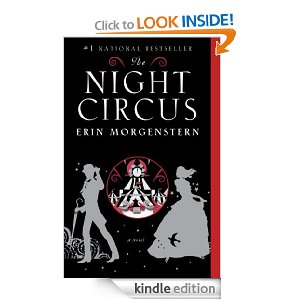
the night circus by erin morgensternDo you see the crossover there? Some fantasy qualifies as literary fiction because of the way in which the story is delivered. Erin Morgenstern’s beautiful fantasy, The Night Circus is a perfect example of this cross-over. Genre fantasy purists decry her lush, beautiful prose, and lack of direct conflict between the two magicians, while readers of literary fiction enjoy her lush, beautiful prose, and the deeper story that underlies the politely waged war between two magicians.

Know who your readers are. Select your beta readers from people who read in the genre you think you are writing for. It’s likely you are writing for yourself, so identify the sort of books you gravitate to, and choose your readers accordingly. If you’ve chosen the right beta readers, you will also know what your chosen market will be.

10 Comments

Filed under Books, Fantasy, Humor, Literature, Publishing, Self Publishing, writer, writing

Don Quixote

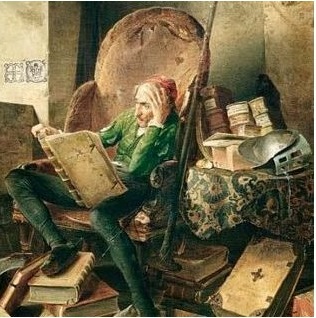
Don Quixote in the library Adolf Schrödter 1834

Don Quixote in the library by Adolf Schrödter 1834

Lately I have been on a Don Quixote binge. Published in two volumes, in 1605 and 1615, volume I, The Ingenious Gentleman Don Quixote of La Mancha, and volume II, The Ingenious Knight,  written by by Miguel de Cervantes Saavedrais considered the most influential work of literature from the Spanish Golden Age and the entire Spanish literary canon (a body of books traditionally accepted by scholars as the most important and influential in shaping culture.)

As a founding work of modern Western literature,and one of the earliest canonical novels, it regularly appears high on lists of the greatest works of fiction ever published, such as the Bokklubben World Library ( a series of classical books, mostly novels, published by the Norwegian Book Club since 2002) collection which cites Don Quixote as authors’ choice for the “best literary work ever written.” It is also said that the two parts of this masterpiece have been  translated into more languages than any book other than the Bible. 

Don Quixote had major influence on the literary community, as shown by direct references in Alexandre DumasThe Three Musketeers (1844) and Mark Twain’s Adventures of Huckleberry Finn (1884).

The Story:

Alonso Quixano, the protagonist of the novel (though he is not named until much later in the book), is a retired country gentleman nearing fifty years of age, living in La Mancha with his niece and housekeeper. Although he is mostly a rational man, his excessive reading of books of chivalry has produced a skewed view of reality and what we might consider dementia. In keeping with the theories of the time, not sleeping adequately–because he was reading–has caused his brain to dry. (I LOVE that!) As a result, he is easily given to anger and believes every word of these fictional books of chivalry to be true.

Don Quixote’s niece commits, what is to me, the most heinous crime–she and the Parrish curate burn his library, and lie to him, telling him it was the work of an evil magician. Criminal!!!

He decides to become a knight-errant in search of adventure. To these ends, he dons an old suit of armor, renames himself “Don Quixote”,  and renames his poor old horse “Rocinante.” Cervantes was a genius when he penned the horse–Rocinante is not only Don Quixote’s horse, but is a reflection of Don Quixote himself, ungraceful, past his prime, and in way over his head.

Don Quixote asks his neighbor, Sancho Panza, to be his squire, promising to make him governor of an island. Sancho agrees, and the pair sneak off in the early dawn. At this point their adventures begin, starting with Don Quixote’s attack on the windmills.

Miguel de Cervantes Saavedra created a wonderful, hilarious masterpiece when he penned Don Quixote. Even in today’s society the plot is relevant and and the characters leap off the pages. The extremes of the human condition are all laid out in glorious prose that has been beautifully translated to English in 2003 by Edith Grossman. The New York Times called Grossman’s translation a “major literary achievement.”

In the original version of Don Quixote there are basically two different types of Castilian Spanish: Old Castilian is spoken only by Don Quixote, while the rest of the roles speak a modern version of Spanish. The Old Castilian of Don Quixote is for comic relief – he copies the language spoken in the chivalric books that made him crazy; and many times, when he talks nobody is able to understand him because his language is too old. This comedic effect translates well to Modern English when the translator has Don Quixote use  Shakespearean English phrases.

I write fantasy, and I read widely. But to those purists who decry the work of genre fiction writers as being “created for the masses,” I would like to say this: it is quite clear that the modern perception of “fantasy” as having no literary merit is complete hogwash when you look at the books that make up the western cannon of great literature. ALL of them are fantasies of one sort or another, beginning with Don Quixote and going forward, and all of them were created for the enjoyment of the masses.

2 Comments

Filed under Adventure, Battles, Blogger, blogging, Books, Fantasy, Humor, knights, Literature, Publishing, Self Publishing, WordPress, writer, writing

Rendering my brain obsolete

Garmin GPSI have quit using the Garmin, except on long trips.  I like to find my own way around, and I think that getting the directions from Google Maps and finding the path keeps you sharp.  I’m one of those lucky people who usually always knows where I am, and which way is west, unlike my hubby who has no sense of direction.

I navigate by landmarks, and I am always updating my mental map of the area, so that new landmarks are duly noted and don’t throw me off track.

However, some of our best adventures have been at the hands of the Garmin lady.

One of the first things we found out was that if you have the Garmin set on “Pedestrian” mode, it will tell you how far and how fast you have walked. This has been really helpful for my hubby who regularly takes long walks on his lunch break. It’s amazing how far he can walk in an hour.

I will say, there is a down side to this:

IF you forget to switch it back to driving mode, and you decide to make a random trip down Interstate 5  from Olympia, Washington to, oh, let’s say McMinnville, Oregon, you may have a random encounter with The Garmin Lady that goes like this:

6a0120a85dcdae970b0120a86d6130970b-piGarmin Lady: “Exit Freeway at next exit.”

Me and Greg: “What? No way, we aren’t even in Chehalis yet!”

Garmin Lady “Recalculating. Take Next Exit, to the right.”

Me and Greg: “There’s something wrong with this thing. We’re passing Longview. We’re nowhere near McMinnville yet. We’re still in Washington, so what she wants us to do, I can’t imagine.”

Garmin Lady “Recalculating. Make U-Turn at next police turnout and then exit freeway, to the right.”

Us: “What?!? That’s just plain crazy, not to mention illegal! Turn that damned thing off!  It’s broken!”

I kid you not–that actually happened. The Garmin was on pedestrian mode, and was trying desperately to get us off the freeway. However smart the Garmin is, it did not connect the fact we were traveling 70 mph, which is a brisk pace for your average walker, with the notion that maybe we were in a vehicle.

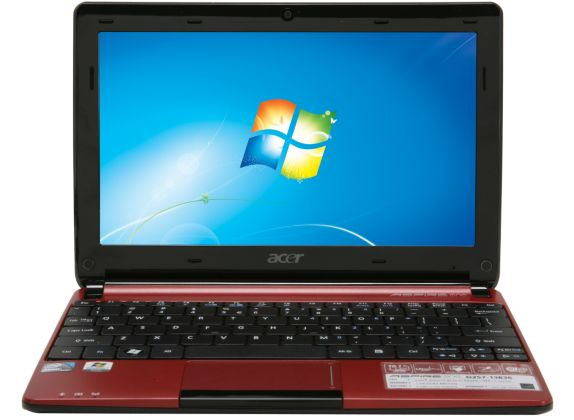
Acer-Aspire-One-AOD257-4I sometimes wonder if all my helpful devices aren’t rendering my brain obsolete. I have my PC, which I am using right now. I have my ancient Acer Aspire laptop, which is a difficult device to enjoy using, and which gets sworn at regularly in coffee shops. It’s slower than a pencil and paper, and is less likely to make a connection to the internet when I really want one. It shall be replaced someday.

I have my Kindle, with more than a thousand books in it. A thousand books! That’s the library of my dreams, and it takes up less space than a regular book! I have my iPod for walking, and I stream music all over my house through the PS3. I have more music in my iPod and on my computer than most radio stations have in their music libraries.

Locutus of BorgSigh.

I’m in possession of more external brain power than a bus full of physicists.

But it’s not enough.

The only way to get the speed and connectivity I really want is to go Borg.  Of course, I will want my headset to coordinate with my clothes–I don’t wear leather, so mine will have to go with tie-dyed cotton. And maybe I can Be Dazzle it, for special occasions.


be dazzle kit


1 Comment

Filed under Adventure, Battles, Books, Fantasy, Humor, Literature, Publishing, Uncategorized, writer, writing

Virtual unreality

midnight-new-years-champagneWhat are your New Years traditions? Normally my hubby and I do something a little fun to celebrate, but this year we were pretty low-key. I’ve been suffering from a flu-like virus, and I was finally fairly mobile, enough to go out to dinner at the local Mexican restaurant we like so much.

Then we spent New Year’s eve at an all-night party with friends from all over the world. I love the virtual reality of the internet universe. You’re never alone unless you log off Facebook.

canapes (1)My publisher, Myrddin Publishing threw a great virtual New Year’s party on Facebook where the authors and readers got to meet and have a rollicking time in the virtual universe. For a short time (until Sunday Jan 4th 2015) kindle downloads of Huw the Bard and Tales From The Dreamtime are on sale for .99 cents.

breakfastThe party is still going on today, with a virtual breakfast being served, and people popping in and out. I’ve had a lot of fun with that, despite being under the weather. And this morning on New Years Day, I actually feel good.

So what are my goals for this new year that looms fresh and untrammeled before us?

My goal is to create and implement a marketing plan for my books.  This is something I have attempted, but have always become side-tracked by life, and never got back to it. From what I’ve read on the internet this involves a combination of things:

1. During January I’m going to create a plan-of-action, and map out my strategy. Once I know the answers to the next two questions I will be able to develop a plan of attack.

2. I will identify my audience.  This is hard–I write for my own amazement, so I’m not sure what my audience is! But I will spend some  time figuring that out, and I will blog about the process.

2. I will figure out what makes my books different from all the other books out there, aside from their obvious, amazing wonderfulness. This is also difficult! I wrote these things while in a trance, apparently, as the minute someone asks me about them, my mind goes blank and I have no idea how they got here, or what they’re about. I will probably blog about that process too.

3. I will budget $$ for Google ads and Goodreads ads, and see how they perform. My Goodreads ad seems to get a lot of clicks, but I’m not sure it translates into sales. I haven’t done a Google ad yet.

Possibilites copyI’m pretty lousy at blatant self-promotion. But I intend to make this a good year for honing my marketing skills in such a way that I can sell a few books without annoying my friends!

It’s a brand new beginning, with endless possibilities. In completing and publishing my books, I’ve already achieved dreams I never thought possible, and now a new year lies before me. How wonderful to know that anything can happen!

Comments Off on Virtual unreality

Filed under Adventure, Battles, Books, Fantasy, Humor, Literature, Publishing, writer, writing