Tag Archives: the story arc

#amwriting: the point of no return

Epic Fails memeIn life we often find ourselves boxed into a corner, frantically dealing with things we could have avoided if only we had paid attention and not ignored the metaphoric “turn back now” signs.

Imagine a road trip where you are sent off on a detour in a city you’re unfamiliar with. Imagine what would happen if some of the signs were missing, detour signs telling you the correct way to go, and also a one-way street warning sign.

At some point before you realized the signs had been removed, there was a place you could have turned back. Unaware of the danger, you passed that stopping point by and turned left when you should have turned right, and found yourself driving into oncoming traffic on a one-way street.

That safe place where you could have turned around before you entered the danger zone was the point of no return for your adventure. Fortunately, in our hypothetical road-trip no one was harmed, although you were honked at and verbally abused by the people who were endangered by your wrong turn. You made it safely out danger, but you’ll never take a detour again without fearing the worst.

In literature what is the point of no return? Scott Driscoll, on his blog, says, “This event or act represents the point of maximum risk and exposure for the main character (and precedes the crisis moment and climax).”

Epic fantasy, which is what the novels in my Tower of Bones series are, generally features a plot driven by a chain of events, small points of no return, each one progressively forcing the protagonist and his/her companions to their meeting with destiny. These scenes of action form arcs that rise to the Third Plot Point: the event that is either an actual death or a symbolic death, but which forces the hero/heroine to be greater than they believed they could be.

For me, in a gripping story, the struggle may have been fraught with hardship, but the actual point of no return is the event that forces the ultimate showdown and face-to-face confrontation with the enemy.

What if you aren’t writing epic fantasy? This series of “arcs of action” driving the plot comes into play in every novel to some degree—the protagonists are in danger  of losing everything because they didn’t recognize the warning signs, and they are pushed to the final confrontation whether they are ready for it or not.

During the build-up to the point of no return, you must develop your characters’ strengths.  Identify the protagonist’s goals early on, and clarify why he/she must struggle to achieve them.

  • How does the hero react to being thwarted in his efforts?
  • How does the villain currently control the situation?
  • How does the hero react to pressure from the villain?
  • How does the struggle deepen the relationships between the hero and his cohorts/romantic interest?
  • What complications (for the hero) arise from a lack of information regarding the conflict, and how will he/she acquire that necessary information?

800px-Singapore_Road_Signs_-_Temporary_Sign_-_Detour.svgCalamity and struggle create opportunities for your character to grow, so it is your task to litter your protagonist’s path with obstacles that stretch his/her abilities and which are believable. Each time he/she overcomes a hair-raising obstruction, the reader is rewarded with a feeling of satisfaction.

It doesn’t matter what genre you are writing in: you could be writing romances, thrillers, paranormal fantasy, or contemporary women’s lit—for all fiction, obstacles in the protagonist’s path make for satisfying conclusions. I say this because the books I love to read the most are crafted in such a way that we get to know the characters, see them in their environment, and …uh ohh…. Calamity happens, thrusting the hero down the road to divorce court, or trying to head off a nuclear melt-down. Sometimes our hero finds himself walking to Naglimund, or to the Misty Mountains with nothing but the clothes on his back.

Calamity is the fertile ground from which adventure springs, and most calamities are preceded by a point of no return. Identify this plot point, and make it subtly clear to the reader, even if only in hindsight.

8 Comments

Filed under writing

#amwriting: advancing the plot

e.m. forster plot memeIn the previous post, I discussed the story arc, and how it relates to what E.M. Forster said about the plot: that plot is the cause-and-effect relationship between events in a story. The story arc is a visual description of where events should occur in a story. For me, knowing where they should happen is good, but it doesn’t tell me what those events are.

Planning what events your protagonist will face is called plotting, and I make an outline for that.

“Pantsing it,” or writing using stream-of consciousness, can produce some amazing work. That works well when we’re inspired, as ideas seem to flow from us. But for me, that sort of creativity is short-lived.

Participating in nanowrimo has really helped me grow in that ability, and one nanowrimo joke-solution often bandied about at write-ins is, “When your’re stuck, it’s time for someone to die.” But we all know that in reality, assassinating beloved characters whenever we run out of ideas is not a feasible option because soon we will run out of characters.

As devotees of Game of Thrones will agree, readers (or TV viewers) get to know characters, and bond with them. When cherished characters are too regularly killed off, the story loses good people, and we have to introduce new characters to fill the void. The reader may decide not to waste his time getting invested in a new character, feeling that you will only break their heart again.

The death of a character should be reserved to create a pivotal event that alters the lives of every member of the cast, and is best reserved for either the inciting incident at the first plot point or as the terrible event of the third quarter of the book. So instead of assassination, we should resort to creativity.

This is where the outline can provide some structure, and keep you moving forward.  I will know what should happen in the first quarter, the middle, and the third quarter of the story. Also, because I know how it should end, I can more easily write to those plot points by filling in the blanks between, and the story will have cohesion.

Think about what launches a great story:

The protagonist has a problem.

You have placed them in a setting, within a given moment, and shown the environment in which they live.

You have unveiled the inciting incident.

Now you need to decide what hinders the protagonist and prevents them from resolving the problem. While you are laying the groundwork for this keep in mind that we want to evoke three things:

  1. Empathy/identification with the protagonist
  2. Believability
  3. Tension

We want the protagonist to be a sympathetic character whom the reader can identify with; one who the reader can immerse themselves in, living the story through his/her adventures.

Also, we want the hindrances and barriers the protagonist faces to feel real to the reader. They must be believable so that the reader says, “Yeah, that could happen.” Within every scene, you must develop setups for the central events of that moment in their lives and show the payoffs (either negative or positive) to advance the story: action and reaction.

Each scene propels the characters further along, each act closing at a higher point on the story arc, which is where the next one launches from.

Some authors resort to “idle conversation writing” when they are temporarily out of ideas.  Resist the temptation—it’s fatal to an otherwise good story. Save all your random think-writing off-stage in a background file, if giving your characters a few haphazard, pointless exchanges helps jar an idea loose.

imagesDon’t introduce random things into a scene unless they are important. What if you had a walk-on character who was looking for her/his cat just before or just after the inciting incident? If the loss of the cat is to demonstrate the dangers in a particular area, make it clear that it is window dressing or remove it.

If the cat has no purpose it needs to be cut from the scene. To show the reader something  is to foreshadow it, and the reader will wonder why the cat and the person looking for it were so important that they had to be foreshadowed.

Every memorable element in a fictional story must be necessary and irreplaceable.  In  creative writing, this concept is referred to as “Chekhov’s Gun,” as it is a principal formally attributed to the great Russian playwright, Anton Chekhov.

Finally, we want to keep the goal just out of reach, to maintain the tension, and keep the reader reading to find out what will happen next. Readers are fickle, and always want what they can’t have. The chase is everything, so don’t give them the final reward until the end of the story.

But do have the story end with most threads and subplots wrapped up, along with the central story-line. Nothing aggravates readers more than going to all the trouble of reading a book to the end, only to be given no reward for their investment of time.

2 Comments

Filed under writer, writing

#amwriting: revisiting the story arc

howards endE.M. Forster was one of the great English novelists. He was also a short story writer, essayist, and wrote librettos. Forster was considered a master of creating ironic, well-plotted novels that examined class difference and hypocrisy in early 20th-century British society. He really understood how to structure a novel or short story.

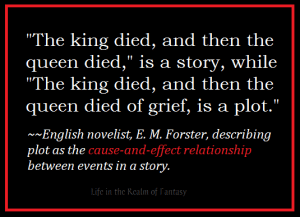
He has been quoted as saying that plot is the cause-and-effect relationship between events in a story. His example was, “‘The king died, and then the queen died,’ is a story, while ‘The king died, and then the queen died of grief,’ is a plot.”

That is the absolute truth. You can tell that story baldly, but without a plot, the above story is only a casual commentary on the death of two monarchs.

I am not good at winging it when it comes to plotting a novel. I find it helps me to spend a day or two thinking about the story as a whole, how it begins, how it ends, and why it went that way. While I am brainstorming, I write an outline to use as a framework to guide the story. I may not keep to the outline exactly, but the plot points occurring at each of the four quarters will be met, to maintain momentum and not inadvertently introduce inconsistencies.

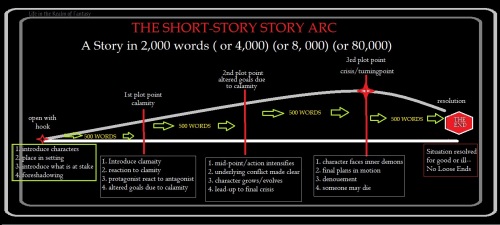
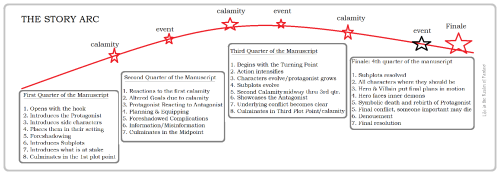
Inside every good story that seizes the reader’s imagination, there is an arc to the action within the plot, and when it is graphed out, it forms an arc: the story arc. My outline will provide me with the framework for this story arc.

51i0K3WVpML._SX312_BO1,204,203,200_The story begins with the opening act, where the characters are introduced, and the scene is set. It then kicks into gear with the occurrence of the “inciting incident,” which is the first plot point. It occurs around the ¼ mark and triggers the rest of the story. It is “the problem,” the core conflict of the story. This is where the protagonist is thrown into the action and is also where they first find themselves blocked from achieving the desired goal.

Even if you open the story by dropping the character into the middle of an event, you will need to have a pivotal event at the 1/4 mark that completely rocks his/her world. The event that changes everything is what really launches the story.

Following the inciting incident is the second act: more action occurs which leads to more trouble, rising to a severe crisis. At the midpoint, the protagonist and friends are in grave difficulty and are struggling. Within the overall story arc, there are scenes, each of which propels the plot forward, moving the protagonist and antagonist further along the story arc to the final showdown. Each scene is a small arc of action that illuminates the motives of the characters, allows the reader to learn things as the protagonist does, and offers clues regarding things the characters do not know that will affect the plot.

Those clues are foreshadowing. Through the first half of the book, foreshadowing is important, as it piques the reader’s interest, and makes them want to know how the book will end.

At the midpoint, another serious incident occurs, launching the third act and setting them back even further. Now they are aware that they may not achieve their objectives after all. Bad things have happened, and the protagonists have to get creative and work hard to acquire or accomplish their desired goals. They must overcome their own doubts and make themselves stronger.

Someone may die.

Midpoint is also where we get to know the antagonist and learn what the enemy knows that the protagonists do not. We discover his/her motives and what they may be capable of.

By the end of the third act, the protagonists are getting their acts together. They are finding ways to resolve the conflict and are ready to commence the final, fourth act, where they will embark on the final battle. They will face their enemy and either win or lose.

By the end of the book, all the threads have been drawn together and resolved for better or worse. The ending is finite and wraps the conflict up.

No matter how many or how few words you intend to write, your story arc should work the same way. I do this all the time with short stories, because if you know what has to happen at what point in a narrative, you can develop the characters and write each section to that point.

short story arc

In genre fantasy and science fiction, we often have story arcs that evolve and take place across multiple volumes. If you are writing the first novel in what you plan to be a series, it must have a finite ending, regardless of how many books you plan to follow. Even a famous author should obey this rule.

Out of respect for the time the reader has spent reading your work, do not leave them hanging. A second volume can have a less conclusive ending, but the first and the third books must end well or at least finitely. Readers will want to buy that second book simply because of the characters you have created and the great experience they had reading the book they just finished.

5 Comments

Filed under writing

#amwriting: the end: separation anxiety

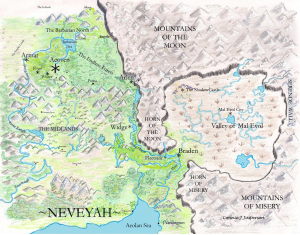
Map of Neveyah, for RizAeroNothing is more difficult (in my opinion) than finishing a novel that has been stalled for three years. My current work in progress has been through three different incarnations.

Two other books have been published during this time because  I couldn’t find a satisfying way to end this chapter in the history of Neveyah.  Perhaps it is a case of separation anxiety, but for one reason or another, it has never gotten to the true finish line.

My current focus is on finishing the final draft of this novel and getting it submitted to my editor. This book must wind up the Tower of Bones series, and it has to finish BIG.

While I am doing this, I confess I feel the same mix of feelings as I did when my youngest child left home–a sense of loss combined with pride and the thought that freedom looms.

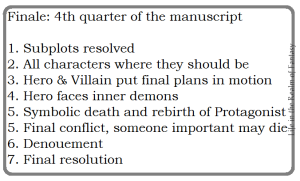
4th qtr of MSSo let’s talk about the all-important fourth quarter of the story arc.

At this point in the story arc, the final plans are in motion. We’ve met the enemy part 1 and survived the encounter. We’ve suffered a terrible setback. Now we’ve regrouped.

In the third quarter, major events have unfolded that point to the conclusion. Based on my structural editor’s suggestions, I  inserted new scenes into the existing narrative that drive the action to the final conflict. Those are all finished and are where they should be.

  1. At the outset of the 4th quarter, all my subplots are resolved and the final focus is on the Dark God’s move.
  2. The Dark God’s final pawn in this game must be exposed to the reader.
  3. The enemy’s plan and their true nature must be shown.
  4. Someone who was previously safe is now in peril. Their fate hangs on a thread and the outcome is unclear.
  5. The heroes must face the fact that their efforts to preserve their homeland has forced the enemy’s hand in a way they never expected
  6. The resolution for these characters is final, no loose threads can be left at the end of this book, as it completes the trilogy.

My work right now revolves around taking the new material and blending it into the existing story. Foreshadowing must be inserted and some otherwise great passages will be cut. This is because anything that does not drive the plot to this end is a side quest, and there can be no more of those.

This means one whole storyline that took six months to write will be cut, but it’s not a waste. There will be more opportunities for writing in this world, and that storyline could become a novella. These are great characters and the villains are as intriguing as the heroes.

As I said at  the beginning of this post, I am seeing this novel coming together at long last, and I am loath to let go of it. But I am excited to see it coming to this conclusion and feel good about it, despite having to shed some of the work that took so long to write.

The events have been detailed. Making sure this story flows seamlessly is time-consuming but it’s my obsession, so poring over the manuscript is what I am doing when I could be playing games. (Hear that Aveyond Stargazer?)

The Story Arc copy

4 Comments

Filed under Publishing, writer, writing

#amwriting: The second draft: effective revisions

My Writing LifeI am in the process of making revisions on Valley of Sorrows, the third book in the Tower of Bones trilogy. I’ve had trouble with this manuscript, not because I fell out of love with it, but because so many great characters have emerged that I lost the thread of the story.

Because I knew I had lost my way, I sent it to a friend, Dave Cantrell, who has done a structural edit and given me the pointers I need to get this back on track.

What happened to derail VOS is this: I lost track of the original story arc.

This is not an uncommon problem–writers tell me all the time how new and intriguing characters pop up and take their tale in a different direction.

Sometime this works out well. Other times, not so much. I have floundered for two years on this novel.

What Dave did at my request was far more intensive than a beta-read. He really went deep, looking at it from the standpoint of a reader and an editor, and asking himself what worked, what didn’t, and analyzing why.

So right now I am taking each chapter on an individual basis and looking at Dave’s comments. Every comment is designed to let me know why a particular plot point did or didn’t work, and where it became confusing. He was able to see where I lost the overall story arc and his comments give me a road-map to guide my efforts in building tension and ending this series with a strong finish.

I’ve said before that making revisions is not editing. Revising the first draft is a necessary part of the process that will get you to the editing stage.

Most authors understand that there is an arc to the overall novel–the Story Arc  which  consists of :

  1. Exposition, where we introduce our characters and their situation.
  2. Rising Action, where we introduce complications for the protagonist
  3. Climax, the high point of the action, the turning point of the narrative
  4. Falling Action, the regrouping and unfolding of events that will lead to the conclusion
  5. Resolution, in which the problems encountered by the protagonist are resolved, providing closure for the reader.

The Story Arc

As I said, most of us understand this arc, but we can easily lose track of it when we are in the throes of writing our first draft.

At the 2014 PNWA Conference, in his seminar on the arc of the scene, author Scott Driscoll explained how the main difference in the arc of the scene vs the overall arc of the novel is this: the end of the scene is the platform from which your next scene launches.

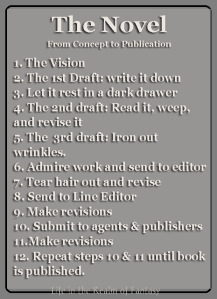
The Novel Meme LIRFSo as I am revising I am keeping in mind:

  1. Each chapter is a scene.
  2. These scenes have an arc to them: action and reaction.
  3. These arcs of action and reaction begin at point A and end at point B.
  4. Each launching point will land on a slightly higher point of the story arc.

I had lost the plot of this novel, so first I had to remind myself just what the series was about:

  1. This series deals with Edwin’s story.
  2. He is separated from his wife and child because of his task on behalf of the Goddess Aeos.
  3. Completion of his task takes us to the 3rd plot point of the novel
  4. Hunting  the acolyte of Tauron and the final battle in Aeoven resolves the story
  5. No conversation can happen unless it advances the plot of this story. EVERYTHING that does not pertain to this story can be cut, saved, and used later.

I have a goal of finishing this by the end of February. When I submit this to my editors, there will be more revisions–that is a given. But because of the work Dave has done, it won’t be the arduous rewrite it would have been.

8 Comments

Filed under Self Publishing, writing

Elements of the story: Conversation, gestures, and actions

My Writing LifeCreating memorable characters is the goal of all authors–after all, who would read a book if the characters are bland or uninteresting? But what is it that makes a character interesting? Is it just witty conversation?

That is surely a part of it, but think about the people you know. Picture the ones you like to spend time with. What is it about them that captured your interest in the first place? I’m not talking lovers here, so set the intangible, irresistible chemistry aside, for the moment.

Was it their gestures, their mannerisms that intrigued you before you got to know them? Something about them caught your interest, and you found a kindred spirit.

That is what we want to do for our characters.

And no, I don’t mean for you to inject an excess of flushing, smirking, eye-rolling, or shrugging into your story.

I want you to think natural: People don’t only use their faces to communicate. People’s bodies and faces are in constant motion, and that is how you want your characters to seem. You can do this in small, unobtrusive ways by visualizing your conversations and the character’s who are having them.

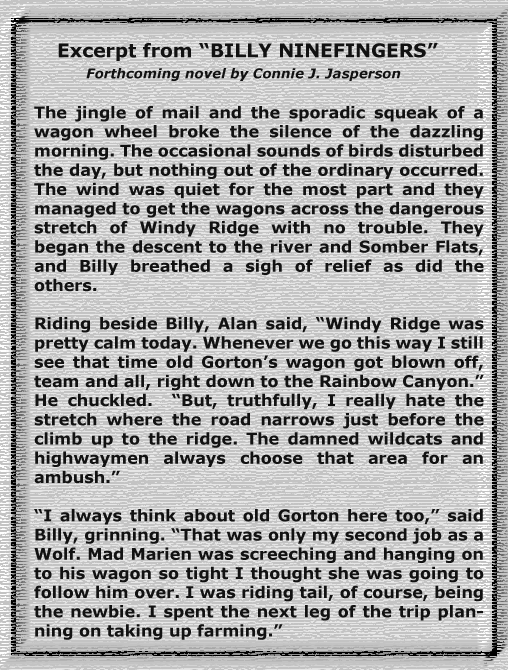
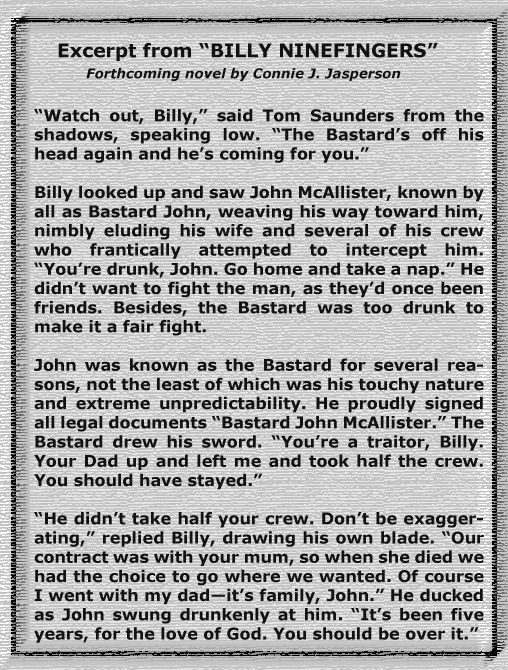
Consider this excerpt from one of my works in progress, Billy Ninefingers. These excerpts are from my rough draft and will be tightened up, but I am using them as the examples today.  This tale takes place in the world of Waldeyn, and Huw the Bard figures prominently in it, although not in the opening chapters. This conversation happens just before the first plot point. It is the calm before the storm and reveals some of Billy’s personality and his sidekick, Alan Le Clerk. It shows them as mercenaries and as people, and also shows their environment.

Conversation 1 Billy and Alan


Billy and Alan are clearly friends. It’s a sunny day and they are obviously wearing armor. Their conversation tells us they’re concerned about the trail they are on. Through that, we learn that world they live in is dangerous and people must hire guards to protect them from more than just highwaymen if they choose to travel. The three paragraphs of that conversation are all the reader needs to know about the work they do and the trail they are riding. That scene ends and the next scene  takes them and the merchant they are guarding to their destination, the dark, dirty town of Somber Flats.

That is where we come to the lead-up to the inciting action. This is where we meet Bastard John, and it is one of the few times he will be in such a place that we can see who he is. The second plot point makes no sense unless the reader knows that the Bastard is an obnoxious bastard, and proud to be so-named.

Conversation 2 Billy and Bastard John


We know the Bastard is a bastard when he is drunk. We know he is capable of acting on any thought that passes through his alcohol-soaked mind. We also see that Billy has a sense of fair-play.

Picture your conversations as if your were there with them. People miss a few beats when they are speaking. They gather their thoughts and  speak in short bursts. They shift in their chair, or stand up, or wave a hand to emphasize a point. They turn, and they sometimes mumble.

And it is important to remember that every character’s mannerisms are individual, uniquely theirs. You, as the author visualize them this way, but it is your task to commit their personalities to paper, and that is where many authors fail.

Through physical actions and conversational interactions we make our characters knowable and likable (or not, as the case may be). Their actions also help to show the environment they exist in. Within the scene of the conversation, you have the opportunity to convey the setting and the mood of your characters.

Claude Monet Painting in his Garden, by Pierre-Auguste Renoir [Public domain or Public domain], via Wikimedia Commons

Claude Monet Painting in his Garden, by Pierre-Auguste Renoir [Public domain], via Wikimedia Commons

We use our words sparingly and with intention, painting the setting as if we were artists in the style of the  impressionists. With color and small hints a good author gives the impression of detail, offering the reader a framework for  to hang his imagination on.

When characters act and speak naturally within a clearly visualized impression of a setting, we as readers,  suspend our disbelief and become immersed in the story.

Comments Off on Elements of the story: Conversation, gestures, and actions

Filed under Fantasy, Literature, Publishing, Uncategorized, writer, writing

Dazed and confused

my sisters grave robert dugoniI am a a bit dazed and confused right now. I have been intensely preparing to give a seminar on writing dialogue at conference next weekend, but now the convention has been cancelled. Apparently not enough people pre registered. And I was all prepped to hear an announcement from Robert Dugoni!  Now I won’t know what it is until he tweets it. And his book, My Sister’s Grave was just named one of the top five thrillers of 2014.  I love it when an Indie goes viral!

But on the positive side, I am now free to focus on editing for clients, prepping for NaNoWriMo 2014 and several other things that demand my attention. Also, I don’t have to hope and pray I can find a vegan-friendly restaurant near the hotel (which I also cancelled.)

I had planned to talk about talking–at least about how your characters might talk, if they were talking to you in real life.

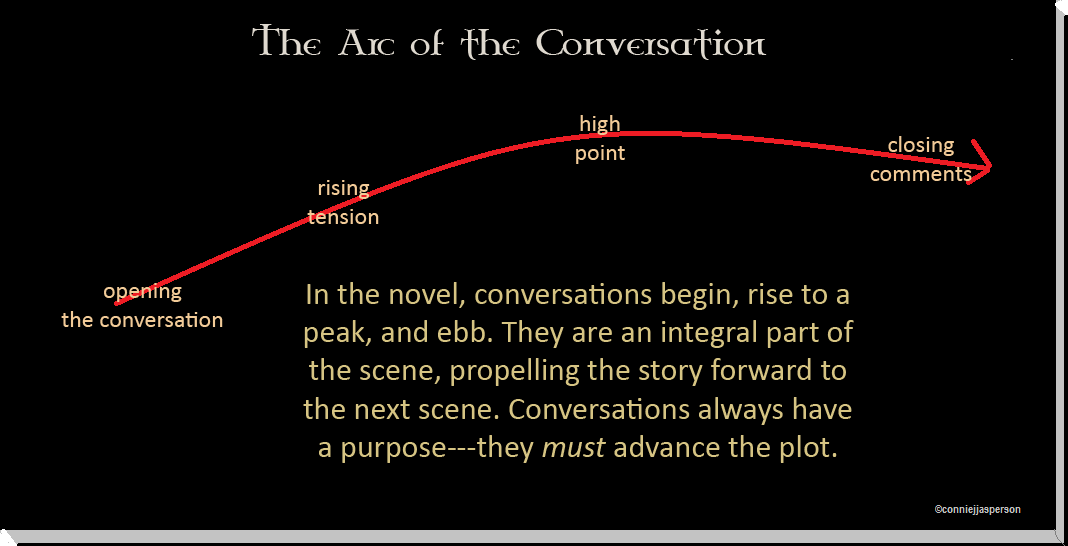
So how do we convey a sense of naturalness and avoid the pitfalls of the dreaded info dump and stilted dialogue? First, we must consider how the conversation fits into the arc of the scene.

It begins, rises to a peak, and ebbs, an integral part of the scene, propelling the story forward to the next scene. A good conversation is about something and builds toward something. J.R.R. Tolkien said dialogue has a premise or premises and moves toward a conclusion of some sort. If nothing comes of it, the dialogue is a waste of the reader’s time.

First we must identify what must be conveyed in our conversation.

  1. Who needs to know what?
  2. Why must they know it?
  3. And how many paragraphs do you intend to devote to it?

My rule of thumb is, keep the conversations short and intersperse them with scenes of actions that advance the plot. Walls of conversation don’t keep the action moving and will lose readers, so make the conversations important—and intriguing.

Author James Scott Bell says dialogue has five functions:

  1. To reveal story information
  2. To reveal character
  3. To set the tone
  4. To set the scene
  5. To reveal theme

So now that we know what must be conveyed and why, we arrive in the minefield of the manuscript. That will be the subject of my next blogpost.

The Arc of the Conversation

2 Comments

Filed under Battles, Blogger, blogging, Books, Fantasy, Humor, Literature, Publishing, Romance, Self Publishing, Uncategorized, WordPress, writer, writing