
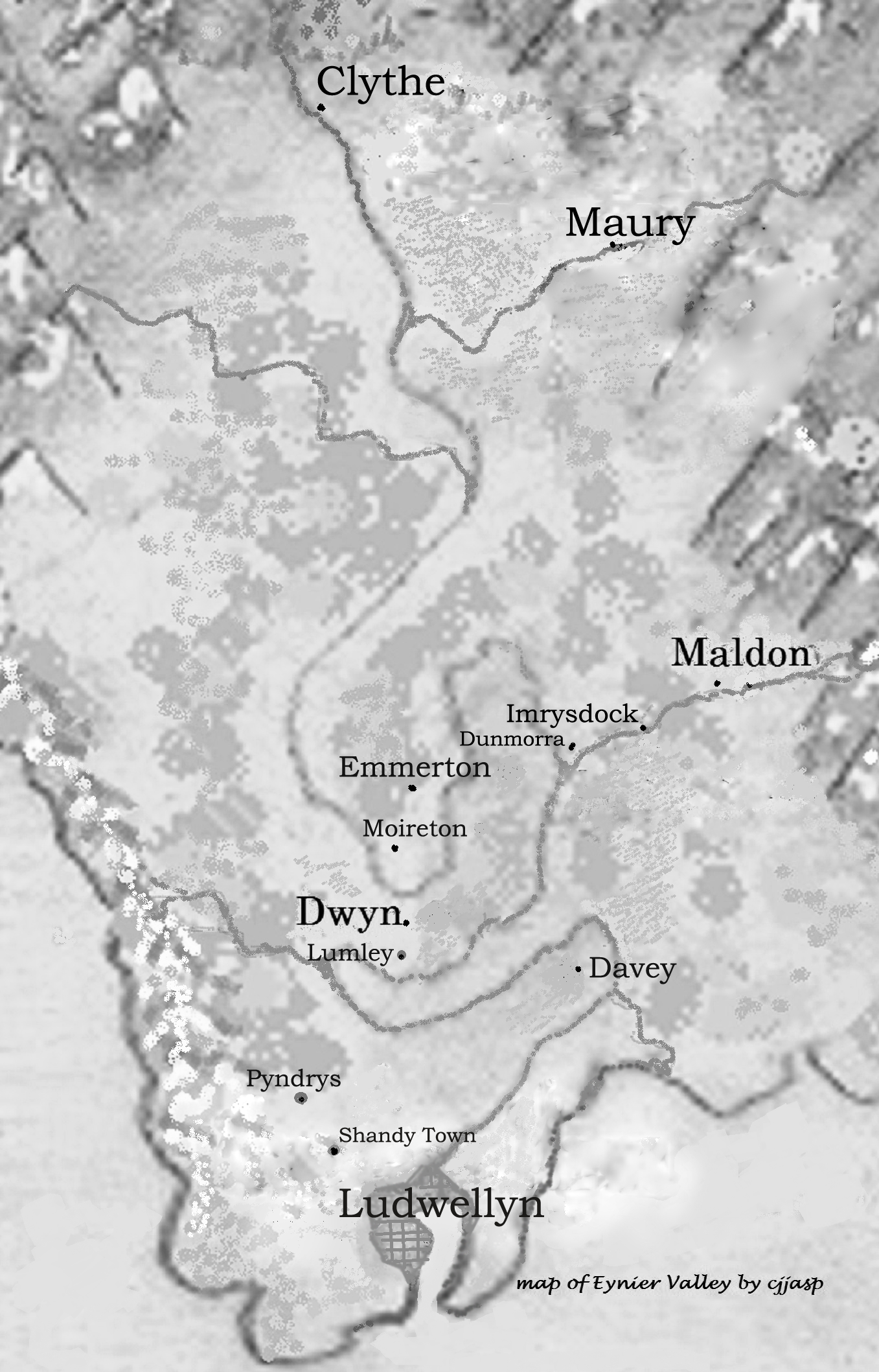
 One of the problems I have in my fantasy world is knowing where I am, how I got there and where I am going next. Somehow it’s less of a mystery to the reader if I have some idea of the what world I am writing about looks like.
Many authors use locales that either currently exist or once existed in the real world. This is a good way to do it, because your world is already well defined for you, and most everyone knows that Portland, Oregon is about 170 miles south of Seattle, Washington. You are safe using currently existing terrain.
When we write a fantasy story, we start out with a great plot, but we are making the physical world up as we go along, and it evolves as the story does. This can be dicey unless you are really good at remembering what you said 3 months ago. Epic fantasy often involves sending the hero off on a quest – and this means he/she will journey far from home.
Knowing where the protagonists are going, and when they’ll be there is crucial because readers notice inconsistencies; at least I do when reading other authors’ works.
I begin by drawing a sketchy map when I first begin the story. It is just a scribble at first, but this way I have an idea of where the towns are in relation to each other. I do it in pencil so at this stage nothing is finite; they are only approximations–artistic guesses.
 As I write, my map evolves with the story, becoming more complex as the topography becomes more clear to me. In the World of Neveyah, I began with a pencil sketch, and that evolved into a relief map that gave me the opportunities for injecting tension into the tale that I needed. It also provided me with a detailed explanation of where the resources were, so that funding my country was not an issue.
If you are writing epic fantasy, it is unlikely the hero will have a GPS to guide them. By scribbling a map while I am setting the original story down, I know I have originally declared Armat is the nearest town to the portal, in Neveyah. This is important because when I am really pounding out the words, I don’t always remember exactly what I wrote 22 chapters ago. Going back to make corrections is a tricky business, as it is hard to know for sure if you have caught all your small errors in regard to places and the distances between them.
- Map your world:
- How big are the continents, and what is their shape?
- Are there inland seas? If so, are they fresh water seas like the Great Lakes?
- Where are the oceans? Where are your port cities located?
- How large is your protagonist’s country?
- If they travel, what type of terrain will they be crossing?
- Does your protagonist’s country have near neighbors?
- What about mountain ranges? Mountains, swamps, rivers and oceans are all important when you are adding local color to your background.
The physical environment affects the hero’s journey. Mountains are difficult to travel in, as are swamps and deserts; and these environments will greatly color the story.
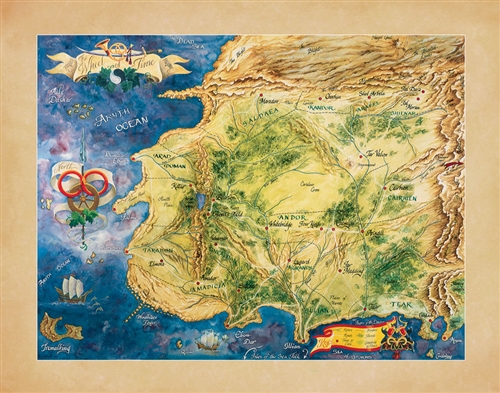 A map doesn’t have to be too detailed; it is only a bare-bones reference for you as the writer, and possibly for the reader later. Of all the books I have read, the books whose maps I have referred back to most while reading them are those in the Wheel of Time series, written by Robert Jordan and Brandon Sanderson. The map is not too detailed, but it does give you an idea of where Tear is in relation to Amadicia – both of which figure prominently in the travels of all the main characters, and it remains accurate through the entire series.
The thing is—maps, unless they are drawn by satellite GPS–are inherently wrong in regard to actual distances and such. All they can do is provide a general idea of where the cartographer thought things were.
But what about sci-fi—how do you build an entire planet that may or may not exist?
This is where I brainstorm the possibilities: I spend hours on the internet researching the physics and the possibilities of each and every technological thing that appears in my work. Morgan Freeman, Michio Kaku and Stephen Hawking are my invisible friends, but the best hard facts are found through scouring the internet.
- Locate your planet:
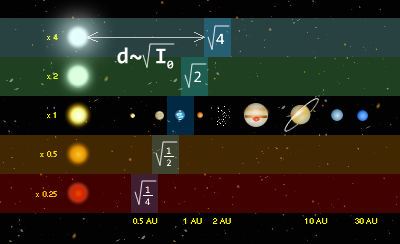
An example of a system based on stellar luminosity for predicting the location of the habitable zone around various types of stars. Planet sizes, star sizes, orbit lengths, and habitable zone sizes are not to scale.
Situate your planet around its sun in what we arm-chair physicists refer to as “The Goldilocks Zone.” Life may exist in the most challenging places, but we humans can only exist in a narrow range of temperatures, in a world with a nitrogen/oxygen atmosphere, and where water exists in abundance. We need a magnetosphere to protect us from lethal radiation. We also need to be situated around a friendly-to-us kind of star, or a G-type main-sequence star. A K-type main-sequence star may also support our kind of life, as may others, but we know the G-type will for sure. A good-sized moon is also optimal to stabilize the planetary wobble, but not having one opens the plot-possibilities of severe climate stresses due to an unstable orbit.
Alpharse is the setting for a future novel that grew out of a short scifi story. I’ve done a certain amount of prep for it: it’s a colony world, still in the terraforming process, and human habitation is still either underground or in the Asteroid Ships that originally brought the colonists to the system.
It’s located across the galactic arm from my protagonist’s home world of Lorann, and to travel the quickest route involves crossing an area of the galaxy inhabited by the Ernsaa, a race of methane-breathing beings who don’t want anyone coming near the worlds they claim. Thus, the closest route is now closed to them and it now takes twenty years real-time to get from Alpharse to Lorann even with the technology available to them. This means the colonists are on their own and can expect no help.
- Consider the Uninhabitable (by humans) Terrain:
- What is the surface of the world like at this time?
- What makes it dangerous?
- Can humans breathe the air yet or must they wear protective suits?
- Are there native organisms, or was it a young world when it was first colonized?
In regard to the maps you are drawing for your story: if you choose to incorporate your map into your book, that is an awesome addition—but for the love of J.R.R. Tolkien—don’t put maps in your books that have nothing to do with your story.
 I have talked about this before: one of my favorite series of books, written by L.E. Modesitt Jr., has a huge failing–the maps suck! In Fall of Angels, The Chaos Balance, Magii of Cyador, and Scion of Cyador, all of which take place before the world of Recluce is dramatically altered, the main characters are traveling all over the continent to places that don’t exist on the maps provided in the front of the books! The series span several thousand years, and the cities and geography changes radically, but the maps are stubbornly stuck in the timeframe of the first book in the series, Magic of Recluce, which actually details the last years of the story.
There is absolutely nothing on the map in the front of the book that pertains to the time frame of Scion of Cyador. Lorn, the main character, travels all over Cyador! I can only assume the crappy maps and the many typos and inconsistencies in several books of Modesitt’s Recluce series are the fault of his publisher, one the Big Boys of Publishing, TOR, who has done a great author a terrible disservice by not addressing these issues before publication. Despite the typos and stupid maps, I love Modesitt’s work and highly recommend it.
In conclusion, situating and building the physical world your characters will live in takes a day or two of your time, but once you have it all together, your work is so much easier. Taking notes and adding to your map and your style sheet as you go will keep your work consistent and make the setting of your story real to your readers. When you, as the author, have only a mushy idea of what sort of world in which your characters live, you will inadvertently write contradictions and inconsistencies into your work, so do your homework from the outset.





 Life in the Realm of Fantasy