Tag Archives: Writers Block

The Zen of #writing

Every writer is different, with a unique approach to getting their work on paper. There is no one-size-fits-all method for taking a story from an idea, a “what if” moment, to a finished piece. Each of us has to find our own way.

As an indie, my deadlines are self-imposed, so my production timelines aren’t as finite as a writer who is under contract. If I find myself at a real stopping point, a place where the plot isn’t moving forward, I stop forcing it.

I choose to stop forcing myself to write when the ideas have dried up. I set aside what isn’t working and relax by writing flash fiction and short stories. I have no deadlines, so I can return to a piece that is stuck when I’ve figured out how to get it back on track.

 My goals are for me, not for anyone else. I choose to embrace a Zen writing life.

I’ll admit there is one drawback to this approach, but it’s not the end of the world. One book I began ten years ago feels as if it will never be finished, because I became stalled at the halfway point. Despite my best intentions in 2022, I never got back to it. I know how it has to end, because it is history and is canon in the Tower of Bones series. At this point, I haven’t decided the best way to arrive at that conclusion.

So, one goal for that novel during the rest of this year (2025) is:
First, I will go back to the outline and begin the next phase. Looking at the original plan will help me get the book back on track again. Once I have the plot firmly in mind, I’ll finish writing the pivotal scenes, then tie them together with good transitions. That will complete the manuscript which should top out at 170,000 words.

After that, I will send it to my beta readers. Once I receive their recommendation, I can embark on my favorite part: revising the manuscript. It could take months, but this really is the stage of the process I enjoy most.

Once all that is done to my satisfaction, I will send the manuscript to Irene and have it professionally edited.

The last stage is a two-step process:

  • I make the corrections Irene wants.
  • Then, I hang on to a manuscript and let it sit unread for a while. A month or so later, I print out each chapter and go back through it with a yellow highlighter. At this point, I am proofreading it, looking for typos and cut/paste errors, and making corrections.

Then, if I am happy with it, I will have it professionally formatted for publication. I will also hire the cover out, as I no longer have the patience to deal with cover design.

The first hard-earned piece of wisdom that I have to share with you today is this: you must develop perseverance. You can write the greatest novel ever, but it won’t satisfy every reader. So write your stories for yourself and don’t stop trying.

The second bit is a little more challenging but is a continuation of the first point: Write something new every day, even if it is only one line. You develop better skills when you practice writing a few new words every day. Even if you only have ten minutes free, use them to write whatever enters your head, stream-of-consciousness. Maybe you should write a journal entry.
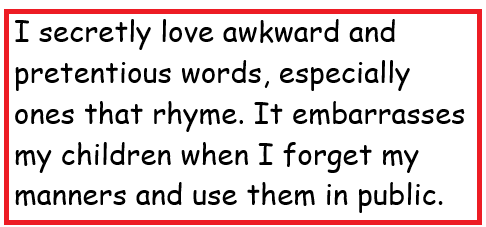
The third suggestion is fun and easy: learn the meaning of a new word every day. You don’t have to use it, but it never hurts to know new things. Authors should have a wide vocabulary.

The fourth thing: don’t sweat the small stuff when you are just laying down a first draft. I know it’s a cliché, but it is true. Lay the words down, passive phrasing and all, because the important thing is to get the story finished. Don’t share that first draft with anyone you can’t unconditionally trust, as it is yours and still in its infant stage.

The fifth thing to remember is this: every author begins as someone who wants to write but feels like an imposter. The authors who succeed in finishing a poem, a short story, or a novel are those who are brave enough to just do it.

Every author I know has struggled in their personal life. During the years I was raising my children, I had three failed marriages, worked three part-time jobs, and struggled to find time to write. Just when life was getting better financially, two of my children developed adult-onset epilepsy. However, that bad year was when I reconnected with the love of my life. That was the year life became better than good despite the hiccups and the dreaded “E” word.
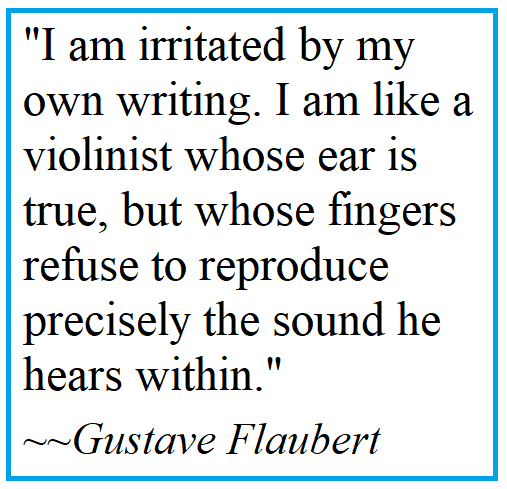
Now, twenty-two years later, my spouse is suffering from late-stage Parkinson’s, and I am no longer physically able to properly care for him. Still, I visit him every morning without fail, the high point of my day. And even though he is unable to reliably communicate his thoughts, he tells me he loves me. Things are different, but we are still who we always were.

The good things in life are still good, and I choose to focus on those. As time has gone on, I have learned not to panic when I get the dreaded phone call letting me know something bad has happened. Our five children are strong and have stepped into the roles Greg and I have had to step back from. We pull through the rough times as a family.

Everyone needs a creative outlet, whether it is painting, music, or gardening. Writing is how I make sense of the twists and turns of life. It helps me process the complications in a non-threatening way. My Zen approach to writing means I have the choice to write what I can and not feel guilty for the goals I don’t achieve.

  • The story is the goal. Everything else is a bonus.

In real life, nothing is certain. Adversity in life forges strength and understanding of other people’s challenges. It enables us to create characters who aren’t perfect, but with secret backstories that make them more human, more relatable.
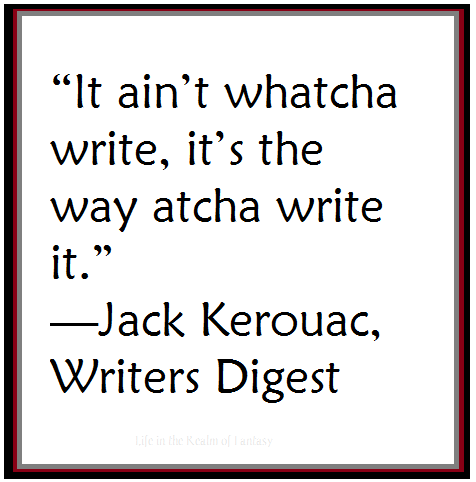
Storytelling is my art form, my creative outlet, the one thing I do for myself. I write the stories I want to read, and that is what every writer should do.

So, take ten minutes, and write as many new words as possible. Write a scene, write a 100-word microfiction, or write a haiku. Write these words just for you, a piece you don’t have to share with anyone unless you choose to.

Let go of the guilt. Enjoy the freedom of writing for the joy of it.


7 Comments

Filed under writing

#Writing in the Blender of Life

Technically, I am a full-time writer. For about ten years after I retired from corporate America, I had regular office hours for writing, and very little interfered with it. Nothing lasts forever, and once again, I am drawing on the habits I developed during my years as a hobbyist.

While I’m rarely in the right headspace to do a long stint of writing new words, I manage to fit short bursts of writing into my day, no matter what is on the calendar.

When I was still working, I sometimes wrote during breaks or at lunch. Other days, I was able to dedicate a block of time for writing by rising two hours before I had to depart for work. But waking up that early was tough, so I frequently wrote after the dishes were done and the house was clean. If I skipped watching TV, I could get a whole scene on paper.

Nowadays,  I arrange my writing time around whatever the calendar says is scheduled. I usually have all afternoon to devote to it, but some days are less productive than I wish. However, I always manage to get something done. Even though the advancement is slow, I’m creeping toward the finish line.

A happy life is all about balance, which is sometimes hard to find.

blended margarita drinkI’ve mentioned before that sometimes life is like a blended margarita. It’s a slurry of everything all at once, and here at Casa del Jasperson, things are usually in a whirl or at a dead halt. Sometimes finding my creative muse among the chaos is difficult, and other times it won’t be silent.

If you are a regular here at Life in the Realm of Fantasy, you know my husband is in the late stages of Parkinson’s. He is now in an Adult Family Home, and every morning I go to visit him. That is the one thing that happens every day without fail. All my appointments are scheduled around that morning visit.

Setting him up in a care facility was a difficult decision, as I felt caring for him was my job, my responsibility. But his decline has been exceedingly rapid. He is unable to stand without two people assisting him as he can’t transfer himself from wheelchair to bed, and is unable to reliably communicate his needs. He can no longer write, use his cellphone, or use the computer.

In May, I had to face the reality I had put off for as long as I could: my husband was no longer safe in our home. He had fallen twice and developed a blood clot in his left leg.

I had help from a Senior Living professional in finding the right place for him. We found a lovely home fifteen minutes away from my apartment, just down the road from the house I grew up in.

The home is owned and operated by two registered nurses, with two licensed CNAs (certified nursing assistants) on duty around the clock. He has his own room, the kind of food he likes, and company. Currently, there are only three residents, but the maximum capacity is six, with each resident having a private room.

They have daily activities, games, and physical therapy. Best of all is the lovely, peaceful deck where residents can take their wheelchairs to sit. He and I often sit out there absorbing the serenity of the back garden. The ongoing squabbles and dramas among the squirrels and many birds keep us both entertained.

So, things have settled into a routine here. I have more free time, which allows me to participate in my writing group and engage in write-ins with the larger writing community. I have time to mentor new authors and can enjoy the occasional lunch with friends.

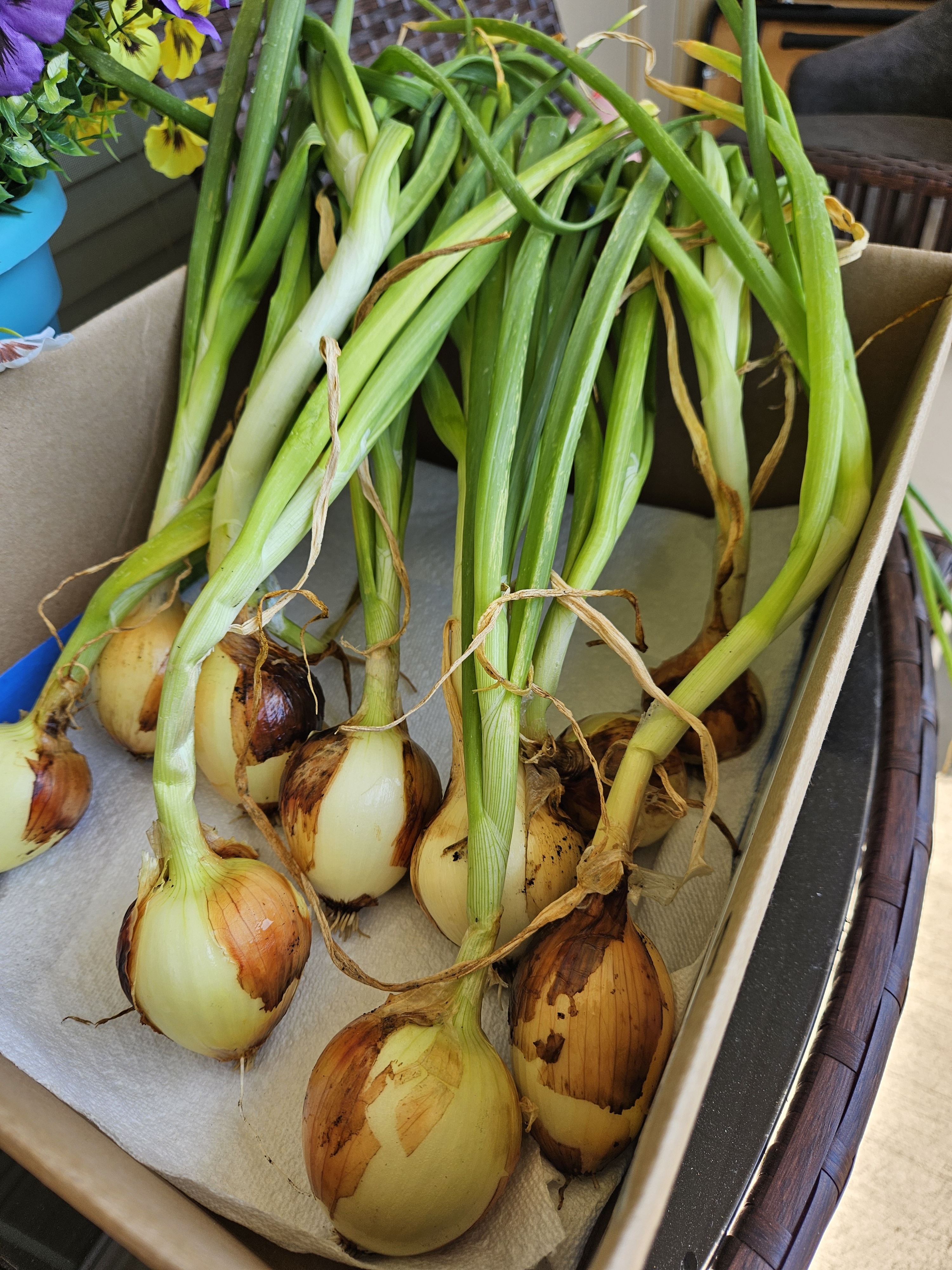
walla walla onionsWriting posts for this blog and the community of friends I have found here has been the one constant during a stretch of time when everything felt out of control. The plot in our community garden has been a surprisingly relaxing hobby. I have harvested strawberries, tomatoes, and onions. In the next few days, celery will be on the menu.

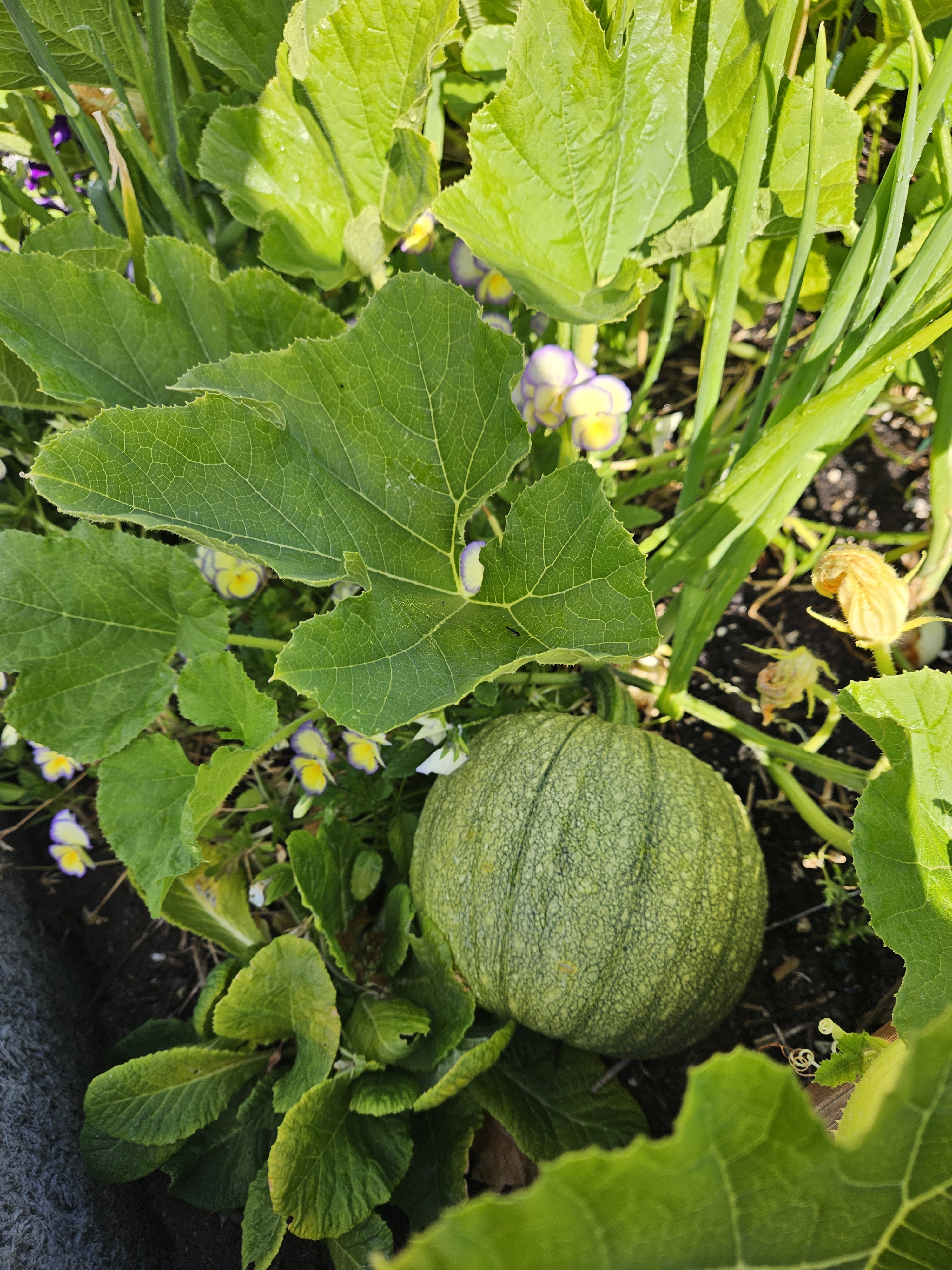
The lone pumpkin plant is taking over the world, and I will get six or seven pumpkins when all is said and done. They should be small, as they are the sugar pie variety, but when I planted it, I had no idea how big a single pumpkin plant would get.

I am so grateful for the blessings, the good things that stand out sharply against the not-so-good in life. I can still be with my husband for part of the day, and I have the freedom to do a few things that I was unable to do before.

Life is different, but it’s still good.

6 Comments

Filed under writing

Writing through the Block #amwriting

We all have moments where our creativity has failed us. Maybe we had an idea, but the words wouldn’t come. Or when they did, they felt stilted, awful. We feel alone and isolated in this because we are writers. The words are supposed to flow from our fingers like water down the Columbia River.

MyWritingLife2021BSome people call this writers’ block. I think of it as a temporary lull in my creativity.

I have learned to write my way through these dry spells. Usually, the work I produce at that moment is awful, and I wouldn’t share it with anyone. But I am a professional writer and the act of writing every day keeps me fit and in the habit of working.

Writing is like participating in sports or playing a musical instrument. We must practice if we want to be good at it. Doing well at writing requires some discipline on our part. I lose my momentum and purpose when I stop writing for any reason.

I lose my passion for my work.

At times, we come to a place where we can’t think of what to write. It happens to everyone, and we each handle it differently. I will share how I deal with lulls in creativity—and I know it’s not a one-size-fits-all solution.

Before we begin, I suggest you save the file you are working on, the one you can’t seem to make headway on. Close it, and delete nothing. You will be able to use this work later, so file it properly.

mindwanderingLIRF02212023Sometimes, the problem is that your mind has seen a shiny thing, a different project that wants to be written, and you can’t focus on the job at hand. If that is the case, work on the project that is on your mind. Let that creative energy flow, and you can reconnect with the first project once the new project is out of the way.
For me, writer’s block manifests not as a block per se. It will appear as an inability to visualize a scene I must write to advance a story. If I can’t picture it, I can’t describe it.

That can be quite frustrating.

Unfortunately, some people have a different experience, one where they have no words whatsoever. They try, they struggle, and nothing comes to them.

This creates a kind of trauma. Once a person has experienced that moment of complete inability, fear of being unable to write can magnify the problem until it paralyzes them.

So what do I do when the words don’t come?

First, I open a new document. At the top of this document, I type: Where I Am Today.

  • I look around myself and see the room I am in, trying to see it with a stranger’s eyes.
  • I briefly describe what the stranger might see on entering that room.
  • Then I describe how I feel sitting in that place at that moment in time.

I write two or three paragraphs just to prove I can do it.

Next, I go somewhere else and take my notebook. I am a stranger there, so I write three more paragraphs detailing how I fit into that new space and how it makes me feel.

You could do this at the mall, a coffee shop, or the parking lot at the supermarket.

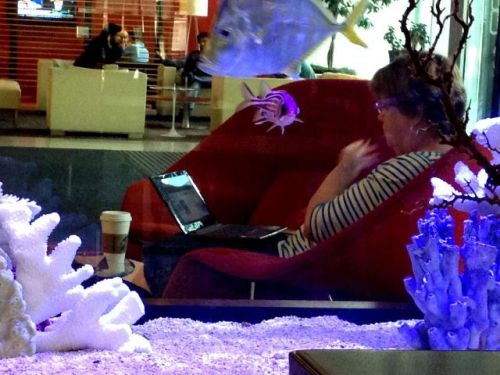
Me working in a starbucks, through the fishbowl, copyright Dan Riffero 2013

Me writing in a Seattle Starbucks, taken through a fish tank. I was the big fish in that tank! Photo by Dan Riffero.

The last exercise is more abstract: Where do I want to be? I visualize it and describe my imaginary scene as if I am looking at it.

I want to walk along the high-tide mark on a foggy beach. I want to hear the gulls and the waves. I want to feel at peace again.

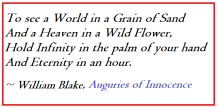
It’s weird but writing about nothing in particular is like doodling. It is a form of mind wandering. It can jar your creative mind loose. With perseverance, you will be writing your other work again.

Everyone has family, jobs, and external demands that limit their writing time. Sometimes the world gets in the way of writing. We might feel unwell or have too many things to accomplish and not enough time to get it all done.

WilliamBlakeInfinityAndEternityLIRF05072022In my real life, getting our house ready to put on the market saps my creativity, but I am muddling along. Boxes here and there, getting rid of this and that—it’s exhausting. Sometimes I don’t have the energy to write.
But I sit down and get at least 100 words on paper just to prove I can. That usually leads to a more productive writing session.

The most important thing is to care for my family first. Sometimes just doing laundry can jar an idea loose, and I feel incredibly productive at the same time.

However, when I am stuck for words to write, the most important thing I do is to sit somewhere quiet and let my mind wander.

Daydreaming is good for you. It boosts the brain, making our thought process more effective. Apparently, letting the mind wander allows a kind of ‘default neural network’ to engage when our brain is at wakeful rest, like in meditation, unlike when it’s actively focused on the outside world.

Book- onstruction-sign copyWhen we daydream, our brain is free to process tasks more effectively.
This is good to know because I spend an astounding amount of time daydreaming, and I would hate to be simply wasting time.

This is how my mind works. I hope that what works for me will work for you. Remember, if you are suffering from a temporary dry spell, you are not alone. We all go through those times.

When you want to talk about it, you will find friends here.

14 Comments

Filed under writing

Writing Contemporary Fiction in a Time of Uncertainty #amwriting

The pandemic, combined with the political uncertainty of our time, has left many authors feeling unable to write. In an online group, an author who writes YA contemporary/near-future sci-fi novels said that looking at his keyboard made him feel like a deer staring into the headlights of an oncoming car.

This subject also came up at our last writing group meeting via Google Chat. A good friend who is an integral part of my writing posse is suffering from this crippling inertia.

The block these authors are experiencing is caused by the extreme uncertainty of our times and the constant barrage of bad and often conflicting news. No one knows what the near future holds, so writing something that will be affected either by the next election or how the pandemic progresses is a difficult proposition.

For some people, writing anything right now is impossible.

To write contemporary or near-future sci-fi, one must be able to predict a multiplicity of futures and decide which is most likely to occur. This is an iffy thing even in less turbulent times.

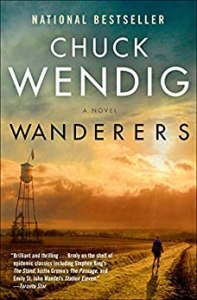
Chuck Wendig managed to nail how our society might react to a true global pandemic with The Wanderers, A Novel. Just as in the novel, we have deniers and blame-casters who categorically refuse to accept scientific evidence. We are blessed with fools aplenty.

Isaac Asimov in The Naked Sun, George Orwell in Nineteen Eighty-Four: A Novel, Ray Bradbury in Fahrenheit 451—these were the forward-thinkers of their time. These authors were able to extrapolate a possible future from reading about current events in the newspapers and watching the evening news on TV or radio.

These novels don’t describe a perfect example of how things are, but they contain glimpses of our modern life. In The Naked Sun, we find people who communicate almost exclusively via an internet of sorts and rarely meet in person.

In Nineteen Eighty-Four: A Novel, we see the effects of mass surveillance and the brutal regimentation of all aspects of behavior within a society. Dangerous thoughts are illegal, and the Thoughtpol (thought police) spy on everyone to detect and eliminate those whose independent thinking questions the powers-that-be.

In Fahrenheit 451, we are asked to consider a society in which books have been ruthlessly condensed to accommodate short attention spans. Minority groups protest the controversial, outdated content they believe exists in literature. However, comic books and pornography remains, as these feed the mainstream population’s desire for mindless entertainment. At the outset of the story, it is illegal to own a book.

These are novels that raise questions and ask us to take a hard look at ourselves.

These authors were conscious of how people react to given events, how the herd mentality takes over, and how mobs function. They also paid attention to the cutting edge science and theories of the day.

We denizens of the 21st century spend a lot of time on the internet, communicating via social media. Our phones and computers are under constant surveillance by our governments as part of the war on terrorism, and Google Earth knows where we are and what we are doing.

And finally, in many homes, reading takes a distant second place to television when it comes to family entertainment.

This raises the question, does our society shape sci-fi, or does sci-fi shape us? We tease about our cell phones and e-book readers being Star Trek devices. But all jokes aside, cell phones and electronic books and notebooks are integral parts of our culture that were described by Gene Roddenberry as part of his 1966 sci-fi televisions series.

So, while the early speculative fiction authors weren’t seers or clairvoyants, they took the information that was available to them and wrote stories that intuited a multitude of possible future timelines fairly accurately, some aspects of which closely resemble our 21st-century society.

This time of uncertainty will pass. We may never go back to standing next to strangers in a line at the grocery store, but we will create a new normal. We will find security in whatever form that new normal takes once we get used to the routine.

In real life, the good guys never win completely, but neither do the bad guys. One may have the upper hand for a while, but the pendulum swings two ways.

Pandemics are horrible, but they do eventually pass, and we will recover as a society.

This sense of powerlessness will pass.

You who write contemporary and near-future fiction and who are momentarily unable to put pen to paper will regain your creative muse, and words will flow. You will once again write insightful stories, delving deeply into what it means to be human. You will show us what a beautiful, interconnected world we live in, and how fragile each link in the web of life is.

The words will come, and you will write them.


Credits and Attributions

Eye on Flat Panel Monitor, Image by © Royalty-Free/Corbis

Dog Using Laptop Computer CC0 1.0 Universal (CC0 1.0)

2 Comments

Filed under writing

#amwriting: when writing becomes work

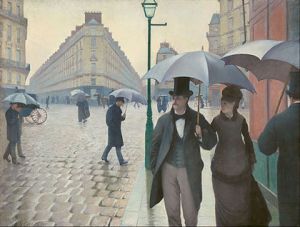
The Rainy Day, Gustave Caillebotte

Winter is approaching, here in the great Northwest.  It’s still warm now, but soon we will enjoy endless days of rainy grey darkness interspersed with brief moments of frozen hysteria. Yes, we who live in the rural parts of the Northwest dread those clear, cold nights when, just before dawn, the temperature hovers at 28 degrees Fahrenheit, and a fine glaze of ice encases the county roads, keeping things interesting.

In my part of the Northwest, the months of November through March are famous for the phenomenon known as Black Ice. The drive to the freeway is a white-knuckle experience: tightly controlled panic interspersed with moments of sheer terror. But I rarely have to drive in it, so it’s mostly my husband who gets the adrenaline rush of having survived yet another commute.

The dark days are sometimes depressing. I force myself to write, because to go a day without writing is to let the demons win. And even though I am not as inspired as I wish I was at this moment, I am getting the nuts and bolts out of the way, doing work that needs to be done, but isn’t that fun.

  • Plotting
  • Developing the theme.
  • Getting to know the characters.
  • Building the world.
  • Designing the magic system.

My boots sit damply near the door, and the umbrella rests near them. Soon the retention-pond in the front yard will be full, and puddles will dot the landscape.  I will walk the neighborhood, swathed in fleece and Gortex, dry and warm in the midst of side-ways rain storms, but not because I want to.  I will do it because its “good for me.”

I will walk and consider my work in progress. Am I remaining faithful to my theme? How can I show the disintegration of a relationship without resorting to the same arguments and spats that are the cliché tropes of badly crafted romance novels? I decide that what I need to do is continue crafting the allegories, and build the layers of tension.

And once I have brainstormed my block into submission, I will stop in at the diner, order a coffee, and pull out my android tablet. I will write for an hour putting those thoughts together. It will be a productive hour, just because I have walked in the fresh air, and changed my writing environment.

Everyone suffers from stalled creativity. For me, the only solution is to force my way through it. Once I have a hole punched through the wall, new ideas crystallize and I am fired with the knowledge of what has to be done next.

3 Comments

Filed under writing

Death Valley

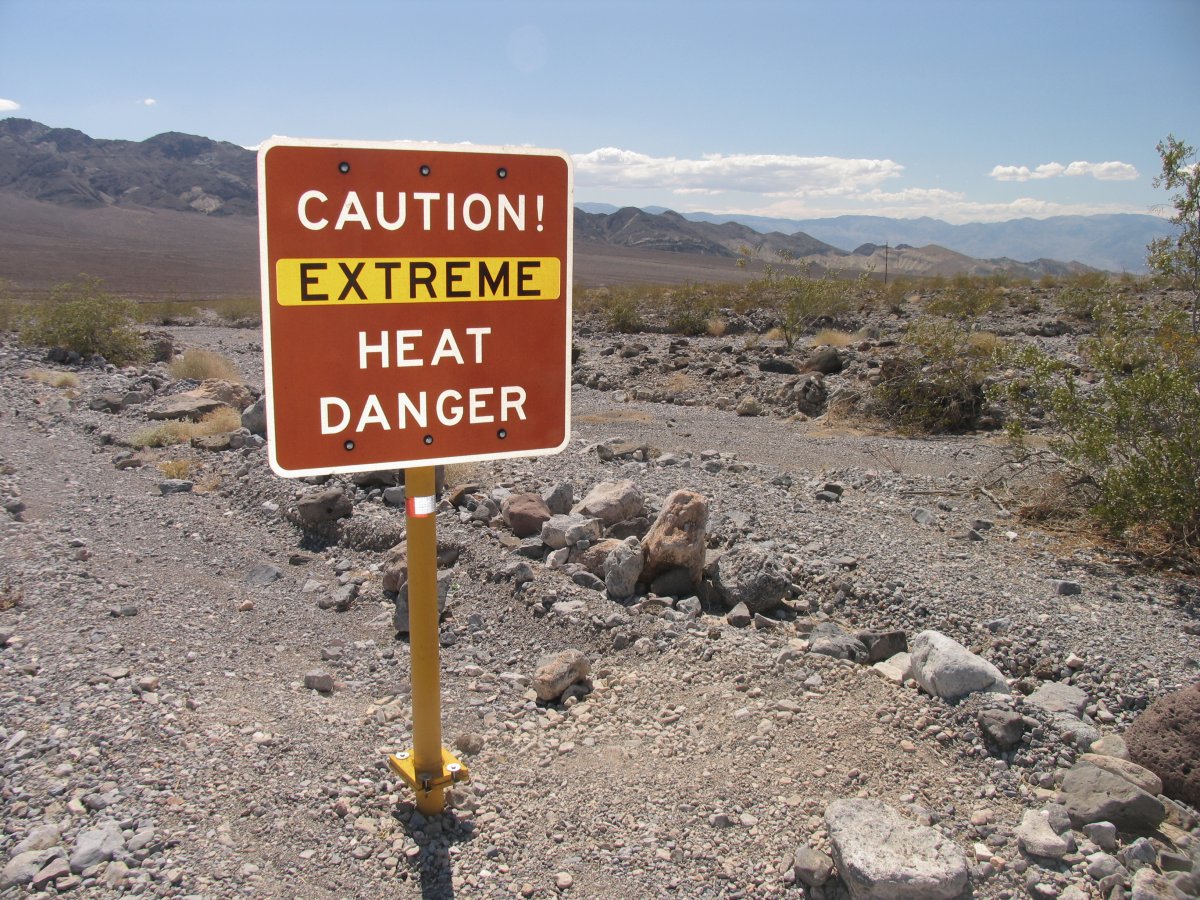
Extreme-Heat-Death-ValleyEvery artist who has successfully created works other people enjoyed is a slave to the creative muse. Each artist endures those horrible moments when they question their choice of career–they have a series of bad days and inspiration is far from their grasp. Every note they play, every word they write, every picture painted is dead and dull. Forcing it doesn’t help, and indeed drives it further away.  These are the moments when we are walking in the Death Valley of creativity.

I have no magic bullet, no super-human powers of creativity to bestow upon you.  For me, the joy of creativity in music, art, and writing is the rebellious feeling of stealing the time to do it. I make music, I do graphics, and I write, doing each whenever the muse strikes me.

In the old days I would come home from work with a small notebook full of ideas and after I had fed the masses, everything else would fall by the way while I put those ideas to paper. Even when you must earn a living, creativity must be allowed to flow when you feel it, because it is a finite commodity.

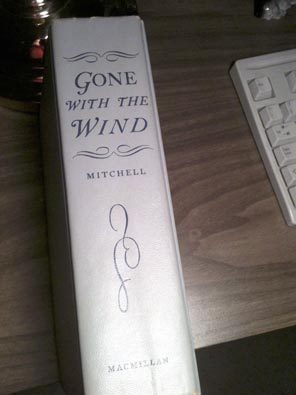
But I will tell you this: You Are Not Alone. Margaret Mitchell only published one book: Gone With The Wind.

gone with the wind 2Quoted from the fount of all knowledge,  WikipediaMargaret Munnerlyn Mitchell (November 8, 1900 – August 16, 1949) was an American author and journalist. One novel by Mitchell was published during her lifetime, the American Civil War-era novel, Gone with the Wind, for which she won the National Book Award for Most Distinguished Novel of 1936[1] and the Pulitzer Prize for Fiction in 1937. In more recent years, a collection of Mitchell’s girlhood writings and a novella she wrote as a teenager, Lost Laysen, have been published. A collection of articles written by Mitchell for The Atlanta Journal was republished in book form.

And did you know that Edgar Allen Poe and Oscar Wilde each only wrote one novel in their careers?  I am assuming this was because they suffered from long periods of having nothing they thought was worthy to show the world.

Poe understood the value of writing the short story. While he is generally considered the inventor of the detective fiction genre, his body of work consisted of–wait–how many short stories did he write? “Almost eighty” it says on page 373 of the official volume of the Big Read. The Edgar Allan Poe Society of Baltimore says the number is sixty-nine – counting “both short fiction and novels.” This appears to be the most widely published number.
So how many short stories did Edgar Allan write? By all reports he was a troubled man, and it’s possible that not even he knew for sure.

Poe is further credited with contributing to the emerging genre of science fiction. He was the first well-known American writer to try to earn a living through writing alone, resulting in a financially difficult life and career. Are we surprised? I don’t think so.

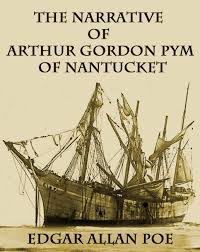
narrative of arthur gordon pym edgar allen poeBut though he is considered by many to be the most famous of our American authors, he only published one novel: The Narrative of Arthur Gordon Pym of Nantucket (1838) is the only complete novel written by our famous man, Edgar Allan Poe. The work relates the tale of the young Arthur Gordon Pym, who stows away aboard a whaling ship called the Grampus. Various adventures and misadventures befall the protagonist, Pym, including shipwreck, mutiny, and cannibalism, before he is rescued by the crew of the Jane Guy.

Indie author Mary W. Walters has written a wonderful blogpost on the subject of turning writers block into building blocks, available here.

So even if you feel the stream of creativity has run dry, it’s frustrating, yes–but nothing to get to worried about. At some point, when it is least convenient, that muse will strike again. You will once again feel that divine energy, that spark of madness that is the breath of life for a poem, a song, a novel or a painting. When you feel it, go with it.


4 Comments

Filed under Adventure, Battles, Blogger, blogging, Books, Fantasy, History, Humor, Literature, Publishing, Self Publishing, Uncategorized, WordPress, writer, writing

Ode to Writer’s Block

Ode to Writers Block 

What beauty is this, that lies sleeping near my heart?

‘Tis word—and word should tumble from my pen,

Not lie locked within the chamber dark and inky.

Where hides the key to free thee from thy prison?

Oh, lovely word, spring forth from the trap that is my mind,

Set thee down upon this paper, word.

Let me hold thee, and from thee let me form the dreams,

The hopes and fantasies that fill my eyes and blind me to all but thee,

Oh word! Fill my paper with thy bounteous delight,

As you fill my head with longing,  and my wastebasket with scrap.

©2014 Connie J. Jasperson, All Rights Reserved

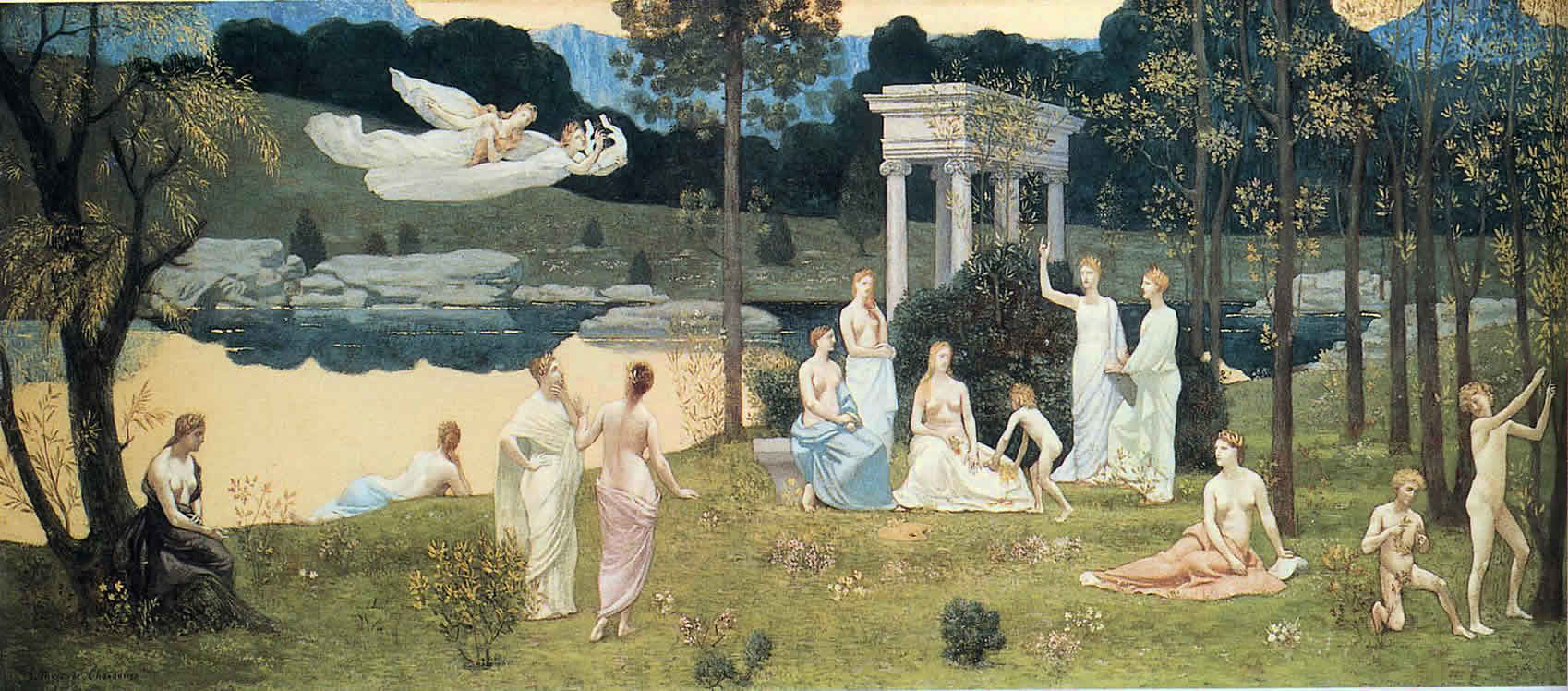
Arts and the Muses by Pierre Puvis de Chavannes, 1884-1889

Arts and the Muses by Pierre Puvis de Chavannes, 1884-1889

3 Comments

Filed under Adventure, Battles, Books, History, Humor, Uncategorized, writer