
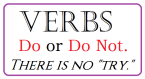
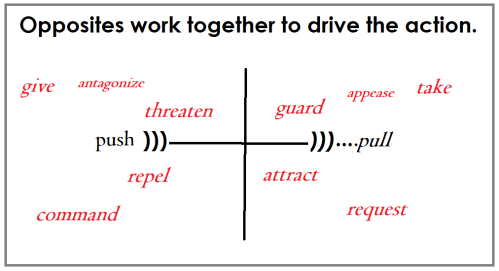
Verbs are the engine words of our prose. They show the action, but like all words, they have shades of mood, nuances that color the tone of my paragraphs. Verbs can either push the action outward from their partner nouns or pull it in.
 When I write poetry, I look for words that contrast vividly against each other. I choose action words that begin with hard consonants, emotion words that begin with softer sounds.
If I can do this for poetry, I should be able to do this for narrative prose – but alas. For some reason, my poetic brain goes on vacation when I am trying to write a first draft. My work is filled with a bald telling of events.
But that’s okay. All I need at that point is to get the story written down.
But during revisions, when writing really becomes work, and I’m trying to turn that boring mess into something worth reading – that is when I need to use my words. Finding strong verbs and employing contrasts in my word choices becomes essential when embarking on the second draft.
I know that power verbs push action outward from a character. Other word choices pull the action inward, and contrasting the two creates a feeling of opposition and friction. This contrast of opposites injects dynamism into a passage, a sense of vitality, vigor, and energy.
Readers are attracted to dynamic prose.
Note to self: write dynamic prose.
Verbs that push the action outward from a character make them appear authoritative, competent, energetic, and decisive.
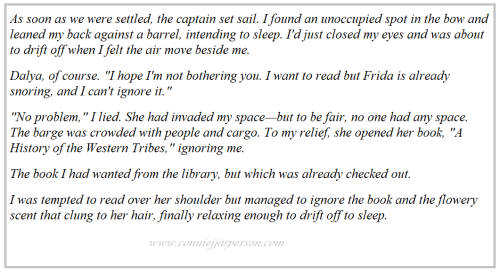
Verbs that pull the action in toward the character make them appear receptive, attentive, private, and flexible.
I want to make my characters well-rounded but not quite perfect. I hope they are relatable and human. The way I show their world and their place in it must convey who they are.
 Concise writing is difficult for me because I love descriptors. So, I have to make my action words set the mood. To do that, I must use contrasts.
- Brood
- Deny
- Embrace
- Escape
- Consent
- Refuse
- Agony
- Ecstasy
A part of my life was burned away. I was destroyed, but now I was reborn in ways I’d never foreseen.
My action words are burn, destroy, and birth. This character’s entire arc is encapsulated in those three words. The contrasting words I choose throughout their story will make or break that novel.
Can I do it? I don’t know, but I’ll have fun trying. In the beginning, this character’s verbs will be darker, their actions more inward and brooding.
At the end of the story, events and interactions will alter them despite their desire to remain safely static. They will experience a renaissance, a flowering of the spirit.
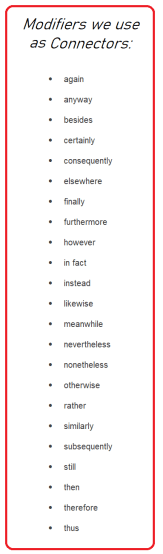
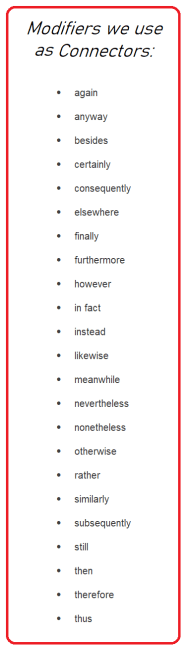
But verbs and nouns by themselves don’t make engaging prose. They need modifiers and connectors.
I will have to select modifiers and connecting verbs to enhance contrasts. Since I can’t go wild with them, the few I choose must be power words.
Many power words begin with hard consonants. The images they convey project a feeling of power:
- Backlash
- Beating
- Beware
- Blinded
- Blood
- Bloodbath
- Bloodcurdling
- Bloody
- Blunder
When things get tricky and the characters are working their way through a problem, verbs like stumble and blunder offer a sense of chaos and don’t require a lot of modifiers to show the atmosphere. When you incorporate any of the above “B” words into your prose, you are posting a road sign for the reader, a notice that ahead lies danger.
Here are some words to create an atmosphere of anxiety – words that push the action outward:
- Agony (noun)
- Apocalypse (noun)
- Armageddon (noun)
- Assault (verb)
- Backlash (noun)
- Pale (modifier)
- Panic (verb or noun)
- Target (verb)
- Teeter (verb)
- Terrorize (verb)
Here are some words that draw us in:
- Delirious (intransitive verb)
- Depraved (modifier)
- Desire (verb)
- Dirty (modifier)
- Divine (modifier)
- Ecstatic (intransitive verb)
- Embrace (verb)
- Enchant (verb)
- Engage (verb)
- Entice (verb)
- Enthrall (verb)
Writing is an adventure, and I learn something new every day. Some days I like what I write; other days, not so much.
 The drive to understand why some books enthrall me and others leave me cold keeps me reading and looking for new stories.
Life can be a bumpy road.
The key is to focus on the good things and laugh at the inconveniences. Make a little time to do something creative, and always make time for the people you love.
 Unfortunately, although we asked for a ground-floor condo, we were assigned a second-floor unit. My husband is managing the stairs – slowly. On the good side, we have the god’s-eye view of a wide stretch of beach, the perfect deck overlooking it all.
 Writing is going as well as ever, a little up and down. I’m building the framework for a new story, which I will begin writing on November 1st. The world is already built; it’s an established world with many things that are canon and can’t be changed. So, I’m working my way through the bag of tricks that help me jar things loose.
 Protagonist HER: Anna Lundquist, an unemployed game developer. She inherited an old farm and has moved there. She embarks on creating her own business designing anime-based computer games. Anna is shy, not good with men unless discussing books or computer games. VOID: Loss of family. VERBS: Create, Build, Seek, Defend, Fight, Nurture. Modifiers: Adaptable, ambitious, focused, independent, industrious, mature, nurturing, private, resourceful, responsible, simple, thrifty.
 Antagonist HIM: Matt Gentry, owner of MGPopularGames and Anna’s former boss, is angry at Anna for leaving his firm. On a skiing trip with an old fraternity brother who owns an art supply store in Starfall Ridge, he sees her entering Nic’s coffeeshop. Matt discovers that Anna is now living in that town. He learns she has started her own company and is building an anime-based RPG. He goes back to Seattle and files an injunction to stop her, claiming that he owns the rights to her intellectual property. VOID: Narcissist. VERBS: Possess, Control, Desire, Covet, Steal, Lie, Torment.
 Today’s post focuses on word choice. What do you want to convey with your prose? This is where the choice and placement of words come into play. Active prose is constructed of nouns followed by verbs or verbs followed by nouns.
 The second draft revisions are where I do the real writing. It involves finetuning the plot arc, character arcs, and most importantly, adjusting phrasing.
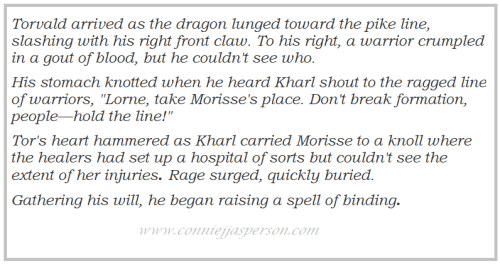
 Some types of narratives should feel highly charged and action-packed. Most of your sentences should be constructed with the verbs forward if you write in genres such as sci-fi, political thrillers, and crime thrillers.
 What clues should you look for when trying to see why someone says you are too wordy?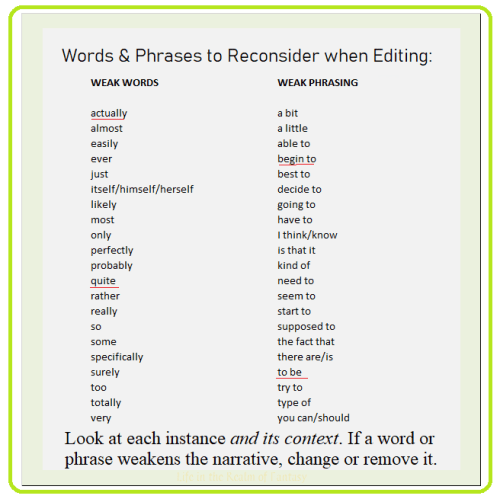
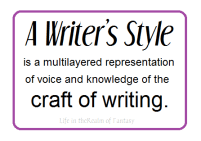 Some authors are forceful in their style and throw you into the action. They have an in-your-face, hard-hitting style that comes on strong and doesn’t let up until the end.
 “I’m going to send you over. The chances are you’ll get off with life. That means you’ll be out again in twenty years. You’re an angel. I’ll wait for you.” He cleared his throat. “If they hang you I’ll always remember you.” [1]
 But I prefer to keep my research in hardcopy form, rather than digital.
  As we become confident in our writing, we learn more about grammar and punctuation in our native languages. We learn to write so others can understand us.
 However, quantifiers have a bad reputation because they can quickly become habitual, such as the word very.
 Our narrative voice comes across in our choice of hard or soft words and where we habitually position verbs in a sentence. Where we automatically place the words in the sentence is a recognizable fingerprint.
 In
In 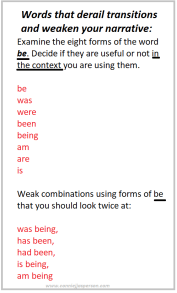 If we write a sentence that says a character is hot and thirsty, we leave nothing to the reader’s imagination. However, when we change the tense, we are often inspired to rephrase a thought.
 Other authors manipulate time. They may start with a chapter of action and commentary set in the past. The experiences shown in the prologue show the reason for present day events and actions that are yet to unfold.
 I’ve read some excellent narratives where the author uses the flashback to ratchet up the suspense in a danger scene. An example could be a character trapped in a small space while a killer searches for her. She remembers being a small child during the war and being hidden in a cupboard by her father when enemy soldiers arrived. Through the keyhole, she witnesses the slaughter of her family.
 Narrative time and calendar time are separate entities. Point of view and narrative time work together.
 Some stories work best with a first-person point of view, while others are too large and require an omniscient narrator.
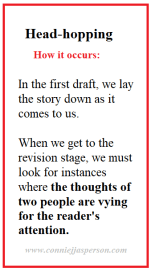 Head-hopping occurs when an author switches point-of-view characters within a single scene. It sometimes happens when using a third-person omniscient narrative because each character’s thoughts are open to the author.
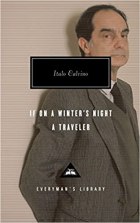 One example of a bestseller written in second person POV is
  Even if you have an MFA degree, you could spend a lifetime learning the craft and never learn all there is to know about the subject. We join writing groups, buy books, and most importantly, read. We analyze what we have read and figure out what we liked or disliked about it. Then, we try to apply what we learned to our work.
 You have just spent the last year or more combing through your novel. This is another example of silly advice that doesn’t consider how complex and involved the process of getting a book written and published is. I love writing, but when you have been working on a story through five drafts, it can be hard to get excited about making one more trip through it, looking for typos.
 When we first embark on learning this craft, we latch onto handy, easy-to-remember mantras because we want to educate ourselves. Unless we’re fortunate enough to have a formal education in the art of writing, we who are just beginning must rely on the internet and handy self-help guides.
 We can easily bludgeon our work to death in our effort to fit our square work into round holes. In the process of trying to obey all the rules, every bit of creativity is shaved off the corners. A great story with immense possibilities becomes boring and difficult to read. As an avid reader and reviewer, I see this all too often.
 However, I can always write a blog post—which is how I keep my writing muscles in “fighting form.”
 I’m always learning. While I love to talk about writing craft, I am a far better editor than a writer. Free-lance editing is like being a hired gardener—with a bit of work, a trim here, pulling a few weeds there, you enable an author’s creative vision to become real.

 In real life, nothing is certain. Adversity in life forges strength and understanding of other people’s challenges. Having the opportunity to make daily notes in a journal, to write poetry, blog posts, short stories, or novels is a luxury—one I am grateful for.
 However, (cue the danger theme music), once I have set it aside for a while, I will have to begin the revision process. That is when writing becomes work. This is the moment I discover the child of my heart isn’t perfect – my action scenes are a little … confusing.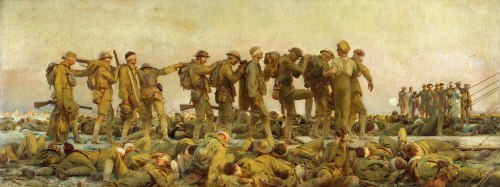
 What motivated the action?
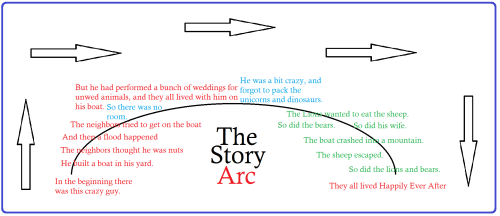
 We add the details when we begin the revision process. One of the elements we look for in our narrative is pacing, or how the story flows from the opening scene to the final pages.
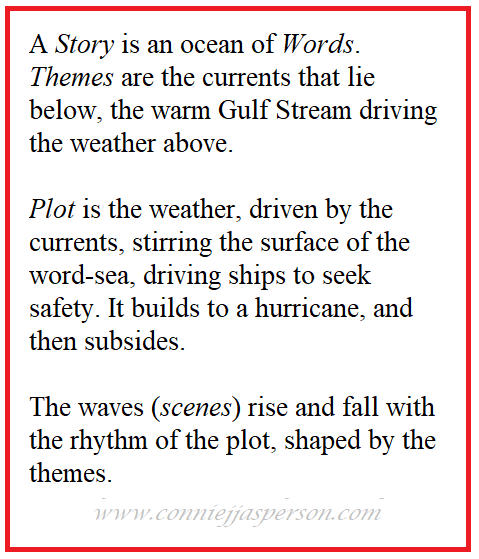 This string of scenes is like the ocean. It has a kind of rhythm, a wave action we call pacing. Pacing is created by the way an author links actions and events, stitching them together with quieter scenes: transitions.
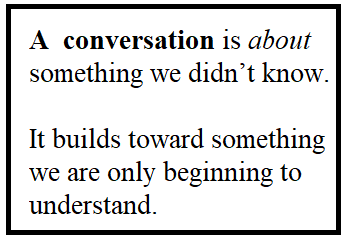 Internal monologues should humanize our characters and show them as clueless about their flaws and strengths. It should even show they are ignorant of their deepest fears and don’t know how to achieve their goals. With that said, we must avoid “head-hopping.” The best way to avoid confusion is to give a new chapter to each point-of-view character. Head-hopping occurs when an author describes the thoughts of two point-of-view characters within a single scene.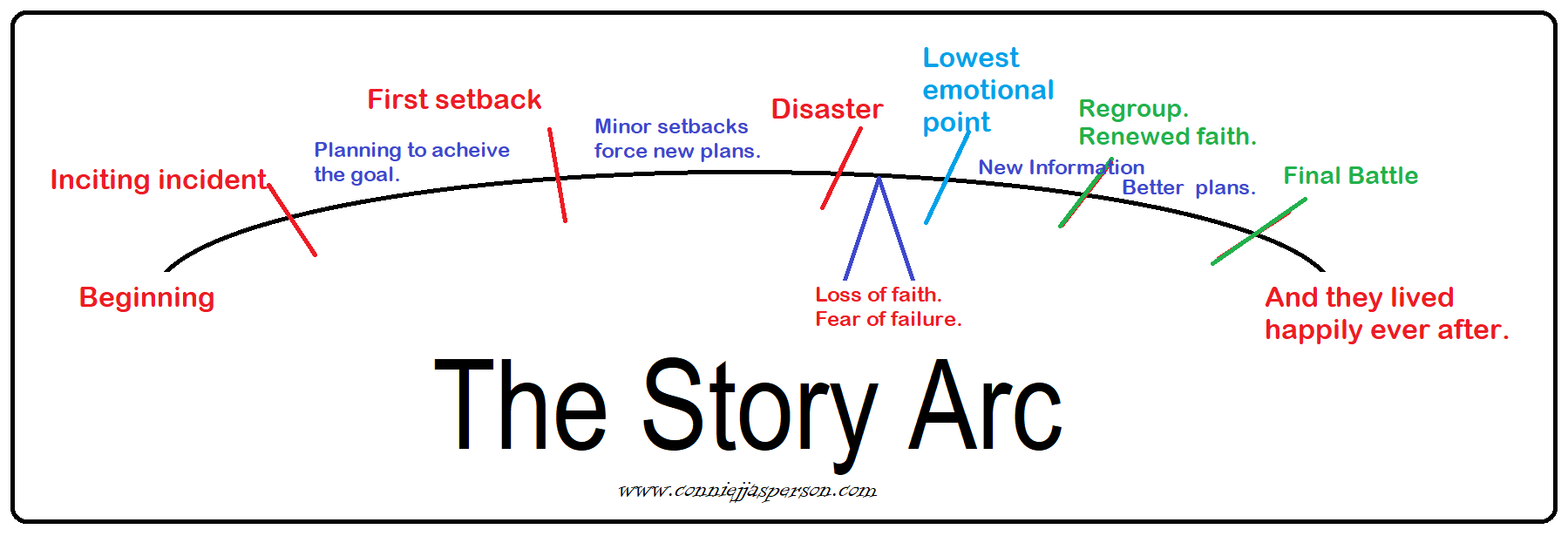


 Life in the Realm of Fantasy