Tag Archives: writing craft

Learning from the masters: @TadWilliams: contrast and texture #amwriting

tadwilliams-the-heart-of-what-was-lostOne of my favorite authors is Tad Williams, who wrote the watershed series, Memory, Sorrow, and Thorn. To my eternal joy, he has set another series of books in the world of Osten Ard. The first installment, The Heart of What Was Lost, is set to launch on January 3, 2017.

I have it on pre-order, as you might imagine—a Happy New Year present to me.

I became a confirmed fan of epic fantasy in 1988 when I first entered this world of Osten Ard and the books of Tad Williams. Each character was deserving of a novel, and the diverse races whose cultures were so clearly shown fascinated me. The arrogance some members of each race have with regard to their innate superiority struck me as illustrating a truth about the real world, something the Buddha once said: “We are what we think. All that we are arises with our thoughts. With our thoughts, we make the world.”  

Why did I become so captivated by Tad Williams’ work in the original series?

Contrast.

It is well-written, with harsh, beautiful prose, but more importantly an entire world is encapsulated in those pages. It is built from both good and evil, with all the many grey places between those two absolutes clearly defined. For each misery, some small glimmer of hope is introduced, offering a reason for the characters to keep struggling.

Tad Williams created the world of Osten Ard masterfully, exploring it through the diverse people’s thoughts and conversations. He used their impressions to show the setting, the history, and the core of the conflict. He started out slow, introducing Simon Mooncalf (Seoman) and the other players, showing a certain amount of background by Simon’s wandering path through the various places in his familiar environment.

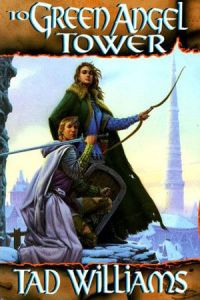
Simon Mooncalf is an orphaned kitchen boy, serving in the immense castle, the Hayholt. He is in service to King John Presbyter, but he is a dreamer, unable to concentrate on the mundane tasks he’s been given. With the reputation of being an idiot, his fortunes change when he is apprenticed to the good Doctor Morgenes, the castle’s healer and wizard.
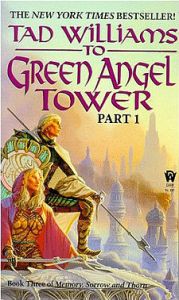
Green_Angel_Tower_P1Unfortunately, the king dies. Many dark, terrible events transpire, and ultimately Simon finds himself alone and on the run, carrying Dr. Morgenes’ true biography of the good King John.

The action then intensifies, as do Simon’s struggles. He finds friends who help him along the way, but they are also in danger. Love, friendship, and loyalty are tested when thrown against a lust for power, a desire for complete domination, and the endless desire of the ultimate mastermind behind the war, Ineluki, the immortal Storm King.

Tad Williams uses contrast. He opens in a place that feels comfortable and familiar, a place where food is plentiful and cats are lazy. He then slingshots the reader into a world of violence and darkness, hunger and fear. Simon is lost, alone, helpless, and terrified. Despite his being an orphan, he has only known comfort and now his life of deprivation is more than he can bear.

When I first began reading the series, it was clear to me that Tad Williams understood a fundamental truth of life: if you have never felt hunger, you can never understand what it is to have plenty. In the same context, if you have never known sorrow, how can you know joy? The contrasts of life are the flavors, the textures that give it meaning.

Since we are waxing philosophical, the Buddha also offered this morsel of wisdom for authors to consider, “There has to be evil so that good can prove its purity above it.”  

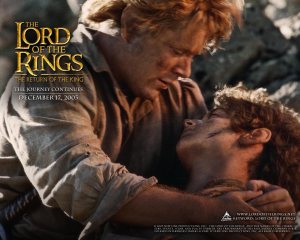
That contrast of good and evil is a fundamental truth for all writers of traditional fantasy fiction to consider when devising plots. It is one that J.R.R. Tolkien understood quite clearly. After all, what would have been the point of Frodo and Sam going to the depths of Mordor, suffering the hardships they endured if not to destroy the One Ring and negate the power of Sauron? And why would they do this, if Sauron was not the embodiment of evil?

In both the Lord of the Rings trilogy, and Memory, Sorrow, and Thorn, we have two of the most enduring works of modern fiction. Both feature an epic quest where through it all, we have joy and contentment sharply contrasted with deprivation and loss, drawing us in and inspiring the deepest emotions.

This use of contrast is why Tolkien’s work is the foundation upon which modern epic fantasy is built. It’s also why Tad William’s work changed the way people saw the genre of epic fantasy, turning it into hard fantasy. The works of these authors inspired a generation of authors: George R.R. Martin and  Patrick Rothfuss, to name just two of the more famous.
To_Green_Angel_Tower

In my own current work (as in all my work), good people have found themselves in bad situations. It’s my task to demonstrate the beauty of life through the drama, heartache, and violence.

Employing contrast gives texture to the fabric of a narrative. My intention is to use the emotions that are experienced when joys are contrasted against sorrows to draw the reader in. If I do this right, my readers will think about this story and these characters long after it has ended.

As a writer, if I can create a tale in which the reader experiences the full gamut of human emotion, I will have done my job.  The longer I am at this craft, the more I see that the rest of my life will be a training ground, teaching me new things, widening my writing horizons everyday. Reading and analyzing the works of the masters is a joy and a privilege, and is a necessary component of my education in the craft of writing.
1 Comment

Filed under writing

#amwriting: the #nanonovel: starting with the basics

a writer's styleI receive a lot of unsolicited manuscripts, by new authors looking for an editor. Most of them are from authors who just completed NaNoWriMo. They’re just learning the ropes and don’t realize their work is still in the unreadable stage. I always explain to them why these manuscripts are not submission ready, much less ready for an editor to have a look at.

What many first-time authors lack is knowledge, so I direct them to workshops, seminars, and writing groups.

This is where the work comes into it. We must learn and use the basic writing conventions that underpin how all English literature is written. These conventions consist of:

  • Spelling
  • Punctuation
  • Capitalization
  • Grammar

These are the fundamental rules authors follow so their work is understandable by any person who can read English, no matter if they are from Sacramento, London, Sydney, or Mumbai.

Kathleen Cali, in an article at Learn NC, says: “Conventions are the surface features of writing — mechanics, usage, and sentence formation. Conventions are a courtesy to the reader, making writing easier to read by putting it in a form that the reader expects and is comfortable with.”

When we write, whether we are writing a book, an essay, or an email, we are writing something we want the intended reader to comprehend. Therefore, we write using universally accepted rules for sentence construction.

So what makes an understandable sentence? It will consist of

  • a subject (My dog)
  • a verb (barked)
  • some words to help explain those two things (all night long.)
  • My dog barked all night long.

Sentences consist of clauses. Commas are the universally acknowledged pausing and joining symbol. Periods (or full stops) are how we signify the end of a sentence. Without these pausing and stopping symbols, our words become a jumble and make no sense. You might think this is a “Well, Duh!” moment, but when a person is in the throes of laying down the first draft they begin to write in a kind of mental shorthand, and sometimes these fundamentals fall by the way. This is why we do a second draft before we have anyone look at it.

Readers expect to find a pause between two clauses and commas are sometimes the signifiers of those pauses. Words that are conjunctions (such as and, or, but) also serve to join clauses to form compound sentences.

According to About EducationA clause may be either a sentence (an independent clause) or a sentence-like construction within another sentence (a dependent or subordinate clause).

Subordinate Clause definition: A group of words that has both a subject and a verb but (unlike an independent clause) cannot stand alone as a sentence. Also known as a dependent clause. Contrast with coordinate clause.

Example:

If a free society cannot help the many who are poor, it cannot save the few who are rich.
(John F. Kennedy)

Mostly I find subordinate clauses cropping up in conversation–dialogue–when I look at my own writing. These “grammatical juniors” are like any other form of seasoning in our writing and must be used consciously and sparingly. When we write with too many subordinate clauses, we separate the reader from the narrative.

We provide balance in how we phrase our sentences, using a variety of sentence structures. We use complex sentences, consisting of:

  1. a simple clause 

I went to the grocery store.  (the meat of the matter)

  1. a dependent clause

because I needed skewers. (technically not necessary but adds to it)

  1. I went to the grocery store because I needed skewers.  

Who was I going to skewer? I don’t know, but I at least I had the right tool for the job.

We can set the clause off with commas:

The lake, its surface calm and black, called to me.

The lake called to me is the meat of this sentence, the clause describing it is technically not necessary, but without that clause the sentence is flat.

Sometimes, we want to use sentence fragments in our narrative. When they are written well and interspersed correctly, using sentence fragments emphasizes certain passages, creates a desired atmosphere, and can make conversations sound more natural.

A sentence expresses a complete thought.  Also, every sentence, no matter how short, contains a subjector an implied subject—and a verb.  Linda Neuman of Sophia.org says:

So a sentence fragment would be a piece of a sentence.  It’s not a sentence because it’s incomplete, and does not contain both a subject and a verb.  Sometimes sentence fragments are referred to as incomplete sentences.  There is something missing, and you know it when you read it.  The thought is not complete, like a sentence would be.

Example of a sentence:  Her car was old, but very stylish.

Example of a sentence fragment:  Her car was old.  But very stylish.

The internet is full of good information about sentence construction and how to write a narrative that any reader of English, no matter what their nationality, will be able to understand. You can access a great deal of information on how to construct a readable narrative and it will cost you nothing.

commaThe Chicago Manual of Style is a volume that defines the rules of the road for US English Grammar.  I consider it an indispensable guide for serious authors. This particular book is the reference manual used by the US publishing industry and is the foundation book for my personal reference library. It is one of the oldest and most comprehensive style guides available, and for me in my role as an editor, it’s an indispensable tool because it contains information that I can’t find anywhere else. While I could easily access it all via the online version, I do like having my large book at my fingertips.


Quoted and Researched Sources:

AboutEducation.com: Clause (Grammar) by Richard Nordquist, accessed Dec. 11, 2016

GrammarRevolution.com:  What are Clauses by Elizabeth O’Brien, accessed Dec. 11, 2016

LearnNC.com: The five features of effective writing, by Kathleen Cali and Kim Bowen, accessed Dec. 11, 2016

Sophia.org: Using Sentence Fragments Wisely, by Linda Neuman, accessed Dec. 11, 2016

11 Comments

Filed under writing

#amwriting: Thoughts on #NaNoWriMo2016

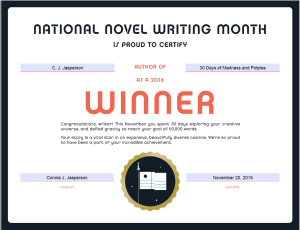
winners-certificateIt is the final day of NaNoWriMo for 2016. I wrote 96,603 words: ten short stories and fifteen chapters on my next novel set in the world of Neveyah. I had my winners certificate by the 23rd, but I write everyday and update my wordcount. More than sixty of the 265 participants in my region will also get their winner’s certificates, which is a very good year. Some years only thirty participants in our region make it to the finish line. On average, 7 out of ten entrants will fall by the way in any given year, because 50,000 words is a difficult goal to achieve in only 30 days, if you are not completely fired up by your novel.

Those who fall by the way are authors who discover that having an idea that would be a good book and writing that book are two radically different things. They are daunted by the amount of work that is involved.

NaNoWriMo (National Novel Writing Month) is a contest in the sense that if you write 50,000 words and have them validated through the national website you ‘win.’ But it is not a contest in any other way as there are no huge prizes or great amounts of acclaim for those winners, only a PDF winners certificate that you can fill out and print to hang on your wall.

It is simply a month that is solely dedicated to the act of writing a novel.

Now lets face it–a novel that is only 50,000 words long is not a very long novel. That falls more into the line of a long novella and is only half a novel, in my opinion. But a dedicated author can get the basic structure and story-line of a novel down in those thirty days simply by sitting down for an hour or two each day and writing a minimum of 1667 words per day.

That is not too hard. In this age of word processors, most authors can double or triple that.

As always, there is a downside to this free-for-all style of writing. Just because you can sit in front of a computer and spew words does not mean you have the ability to write a novel that others want to read.

Over the next few months many cheap or free eBooks will emerge testifying to this fundamental truth.

The good thing is, over the next few months many people will realize they enjoy the act of writing. They will find that for them this month of madness was not about getting a certain number of words written by a certain date, although that goal was important. For a very few, participating in NaNoWriMo has fired them with the knowledge that they are authors. For them it was about writing and completing a novel they had wanted to write for years, something that had been in the back of their minds for all their lives.

These are the people who will join writing groups and begin the long journey of learning the craft of writing. They may go back to school and get their MFA.

These authors will take the time and make the effort to learn writing conventions (practices). They will attend seminars, they will develop the skills needed to take a story and make it a novel with a proper beginning, a great middle and an incredible end.

They will properly polish and edit their work and run it past critique groups before they publish it.

These are books I will want to read.

It’s not easy. Sometimes what we hear back from our readers and editors is not what we wanted to hear. The smart authors haul themselves to a corner, lick their wounds, and rewrite it so it’s more readable. They will be successful, for a variety of reasons, all of them revolving around dedication and perseverance.

But when we write something that a reader loves–that is a feeling that can’t be described.

Authors must keep their day jobs, because success as an author these days can’t be measured in cash. It can only be measured in what satisfaction you as an author get out of your work. Traditionally published authors see a smaller percentage of their royalties than indies, but if they are among the lucky few, they can sell more books.

2016-placeholder-book-cover-smallThe fact your book has been picked up by a traditional publisher does not guarantee they will put a lot of effort into pushing a first novel by an unknown author. You will have to do all the social media footwork yourself. You may even have to arrange your own book signing events, just as if you were an indie.

Going indie or aiming for a traditional contract—it’s a conundrum many new authors will be considering in the new year.

However, if you don’t write that book, you aren’t an author, and you won’t have to worry about it. The concept of NaNoWriMo will jump-start many discussions about this very issue.

Today marks the end of NaNoWriMo 2016.  For many, it will be a mad scramble between now and midnight to get their 50,000 words and earn that certificate.

Some of us have completed our first draft, and some of us still have a ways to go. But we are all walking a path that is more rewarding than any high-paying job I’ve ever had.

nanowrimo_2016_webbanner_winner_congrats

7 Comments

Filed under writing

#amwriting: magic and creating the rules of engagement

magicEvery now and then, new authors look at me with an awestruck expression, and say something like. “I was just  writing along, and all of a sudden my characters gained the ability to use magic. I wasn’t writing a fantasy, but now I am.” (It could be any ability or thing, but we are discussing magic today.)

It is a fact that sometimes books that were outlined to a certain storyline sometimes go off in their own directions, and the story is better for it. I haven’t experienced the sudden influx of magic into story, but I have had other random events throw a curve ball at me.

The fact is, when I sit down to write a fantasy story, there will be magic, and I will have planned carefully for it. I have three worlds with three radically different systems of magic.

In my serial, Bleakbourne on Heath, sorcerers use incantations sung to certain melodies.

In Huw the Bard people can purchase magic (majik) amulets and potions.

In the Tower of Bones Series, magic and religion are intertwined. Aeos, the goddess, has decreed that all children who begin to show healing-empathy, or the ability to use the magic of the elements must be brought to the Temple and trained, for the protection of society in general. There are rules, certain things which can and can’t be done. As in real life, there are certain exceptions, but they too have limitations. No one is all-powerful.

Once magic enters your story, you must do some foot work, or your premise won’t be believable. It’s critical that you have finite rules for limiting how magic works. If your magic rules are too elastic, or you imbue too many amazing abilities into your main character, you will make them too good to be true. Readers won’t be able to relate to their story.

Each time you make parameters and frameworks for your magic you make opportunities for conflict within your fantasy world. Remember, in fantasy, conflict drives the plot.

Without rules, there would be no conflict, no reason for the hero to struggle, and no story to tell.

First you must consider who has magic? What kind of magic–healing or offensive or both? What are the rules for using that magic and why do those rules exist? Magic is an intriguing tool in fantasy, but it should only be used if certain conditions have been met:

  1. if the number of people who can use it is limited
  2. if the ways in which it can be used are limited
  3. if not every mage can use every kind of magic
  4. if there are strict, inviolable rules regarding what each kind magic can do and the conditions under which it will work.
  5. if there are some conditions under which the magic will not work
  6. if the learning curve is steep and sometimes lethal

What challenge does your character have to overcome in regard to his magic?

  • Is he unable to fully use his own abilities?
  • If that is so, why is he hampered in that way?
  • How does that inability affect his companions and how do they feel about it?
  • Are they hampered in anyway themselves?
  • What has to happen before your hero can fully realize his abilities?

Even if this aspect does not come into the story, for your own information you should decide who is in charge of teaching the magic, how that wisdom is dispensed, and who will be allowed to gain that knowledge.

  1. is the prospective mage born with the ability to use magic or
  2. is it spell-based, and any reasonably intelligent person can learn it if they can find a teacher?

Magic and the ability to wield it usually denotes power. That means the enemy must be their equal or perhaps their better. So if they are not from the same school, you now have two systems to design. You must create the ‘rules of magic.’  Take the time to write them out.

In creating both social and magic systems, you are creating a hidden framework that will support and advance your plot. Within your magic system, there can be an occasional exception to a rule, but there has to be a good reason for it, and it must be clear to the reader why that exception is acceptable.

Another important point to take note of is this: the only time the reader needs to know these systems exist is when they affect the characters and their actions. Dole this information out in conversations or in other subtle ways and it will become a natural part of the environment rather than an info dump.

1 Comment

Filed under writing

#amwriting: The strong novella vs. a weak novel

via buzzfeed

Sometimes we find that our work-in-progress is not really a novel after all. We get to the finish point, and that place might be only at the 40,000-word mark (or less).

In some circles, 40,000 words is a novel, but in fantasy, it is less than half a book. A short novel that has been read to shreds is far better than a long, boring book ending its days as a doorstop.

I recommend not trying to stretch the length if you have nothing of value to add to the tale. It’s better to be known for having written a strong novella than a weak novel. So, now at the end of the rough draft, your book must become a novella.

In the second draft, you will weed out many words and cut the unnecessary repetitions. The manuscript is going to both expand and contract, but when the final ms is complete, it may be only 35,000 words. But why do I think this?

I have experienced this very thing. Sometimes, when I was just finishing the rough draft, I discovered that besides the four chapters that had to go since they don’t belong there anymore, 3 more chapters were mostly background, rambling to get my personal mindset into the story. That sort of background doesn’t need to be in the finished product, other than a brief mention in conversation. Often, when I go in and remove large chunks of exposition, I’m able to condense those chapters into one passage or scene that actually moves the story forward.

Another thing to watch for when you are in the second draft, are areas where you may have repeated yourself, with a slightly different phrasing. These are hard for the author to pick out, but they can be found. Decide which phrasing you like the best, and go with that.

Also in the rough draft, we use a lot of words we can cut or find alternatives for, words and phrases that weaken our narrative:

  • There was
  • To be

We change these words to more active phrasing, and sometimes we gain a few words in the process.

In conversations especially, it’s good to use contractions. ‘Was not’ becomes ‘wasn’t,’ ‘has not becomes hasn’t,’ etc.

It’s amazing how many times we can simply cut some words out, and find the prose is stronger without them. Many times they need no replacement.

Sometimes we use what I think of as “crutch” words. You can really lower your word-count when you look at each instance and see if you can get rid of these words. These are overused words that fall out of our heads along with the good stuff as we are sailing along:

  • so,
  • very,
  • that,
  • just,
  • literally
  • very

The fact is, you must be willing to be ruthless. Yes, you may well have spent three days or even weeks writing a chapter you are about to cut. But now that you see it in the context of the overall story arc, you realize it is bogging things down, and NO–Sometimes there is no fixing it. Just because we wrote something does not mean we have to keep it in the story.

But do save it in a separate file, as you may be able to use it later. I always have a file folder labeled “Outtakes.” Many times those cut pieces become the core of a new story.

I strongly feel that no matter how much you like the prose you have just written for a given chapter, if the chapter or passage does not advance the story, it must go.

Pay close attention to the story arc. Large chunks of exposition flatten it, pushing the plot point back, and the reader may give up. Once you have your rough draft complete, measure the tale against the blueprint of the story arc.

  • Where does the inciting incident occur?
  • Where does the first pinch point occur?
  • What is happening at midpoint? Are the events of the middle section moving the protagonist toward their goal?
  • Where does the third plot point occur?

short story arc

It’s not important to have written a novel. Whether you write short stories or 700-page doorstops, you are an author.  It is, however, extremely important to have written well. A powerful, well-written novella can be a reading experience that shakes the literary world:

  1. A Christmas Carol, by Charles Dickens
  2. Breakfast at Tiffany’s, by Truman Capote
  3. Candide, by Voltaire
  4. Three Blind Mice, by Agatha Christie
  5. The Strange Case of Dr. Jekyll and Mr. Hyde, by Robert Louis Stevenson
  6. The Time Machine, by H.G, Wells
  7. Of Mice and Men, by John Steinbeck
  8. The Old Man and the Sea, by Ernest Hemingway
  9. Animal Farm, by George Orwell
  10. The Turn of the Screw, by Henry James

8 Comments

Filed under writing

#amwriting: Midpoint in the Character Driven Novel

LOTR advance poster 2Some novels are character-driven, others are event-driven.

ALL novels follow an arc.  For my personal reading pleasure, I prefer literary fantasy, which has a character-driven plot. Events happen, often in a fantasy setting, but the growth of the characters is the central theme, and the events are just the means to enable that growth.

You may have built a great world, created a plausible magic system or, conversely, you may have created an alien world with plausible technologies based on advanced scientific concepts. You may have all sorts of adventures and hiccups for your protagonist to deal with. All that detail may be perfect, but without great, compelling characters, setting and action is not reason enough for a reader to stick with your story.

Despite your amazing setting and the originality of your plot, if you skimp on character development, readers won’t care about your protagonist. You must give them a reason to stick with it.

In a character driven novel, the midpoint is the place where the already-high emotions really intensify, and the action does too. From this point on, the forces driving the plot are a train on a downhill run, picking up speed. There is no  turning back now. The characters continue to be put to the test, and the subplots kick into gear.

Of course, plotting and pacing of your entire story arc is critical, but it is especially so from midpoint to the third plot point.

As you approach midpoint of the story arc, the personal growth for the protagonist and his/her friends begins to drive the plot. These are the events that tear the hero down, break him emotionally and physically so that in the final fourth of the book he can be rebuilt, stronger, and ready to face the villain on equal terms.

How does the protagonist react to the events? What emotions drive him/her to continue toward the goal?

In a character -driven novel, this is the place where the protagonists suffer a loss of faith or have a crisis of conscience. It may be a time when the main character believes they have done something unfair or morally wrong, and they have to learn to live with it.

What personal revelations come out about the protagonist, or conversely what does he discover about himself?

This part of the novel is often difficult to write because the protagonist has been put through a personal death of sorts–his world has been destroyed or shaken to the foundations. You as the author are emotionally invested in the tale and are being put through the wringer as you lay it down on the paper.

What has happened? Remember, the protagonist has suffered a terrible personal loss or setback. Perhaps she no longer has faith in herself or the people she once looked up to.

  • How is she emotionally destroyed by the events?
  • How was her own personal weakness responsible for this turn of events?
  • How does this cause the protagonist to question everything she ever believed in?
  • What makes her pull herself together and just keep on going?
  • How is she different after this personal death and rebirth event

LOTR advance posterThe truth underlying the conflict now emerges. Also, the villain’s weaknesses become apparent. The hero must somehow overcome her own personal crisis and exploit her opponent’s flaws. It’s your task to convey the hard decisions she must make, and show that she truly does have the courage to do the job. The villain has had his/her day in the sun, and they could possibly win.

This low point is a crucial part of the hero’s journey, the place during which she is taken down to her component parts emotionally, and rebuilds herself to be more than she ever believed she could be.

At this point in the novel, if you have done it right, your reader will be sweating bullets, praying that Frodo and Sam can just hold it together long enough to make it to Mt. Doom.

2 Comments

Filed under writing

#amwriting: choosing an effective writing group

MSClipArt MP900390083.JPG RF PD

As it is November, and I am attending a lot of write-ins with people just beginning their writing careers, I am frequently asked if I am a member of a writing group. I am, but it is not a traditonal group, by any means. We are all published authors and are more of an author-support beta-reading group. But what the new author is asking, is how to find a group that will be a good fit for them. To answer that question, I am revisiting a post from March of 2015, originally titled “Critique groups vs beta reading groups.”


Every writer needs honest, constructive feedback in order to grow in their craft. Many will join critique or beta reading groups. These groups come in all sorts and sizes, some specializing in general fiction and some in genres like mystery, science fiction, fantasy, or romance.

Most communities have clusters of authors—after all, nowadays everyone either is an author or has a couple in the family . In your community you will find groups for beginners, or some that cater to more advanced crowds. I guarantee there will be one to fit your needs.

We’ve all heard the horror stories regarding critique groups, and perhaps even experienced one. Making a poor choice in writing groups can be devastating—it can undermine a budding author’s confidence and destroy a person’s joy in the craft. The seas are rough out there but many writing groups are really good, supportive gatherings of authors who stay for years and welcome new authors into their group with open arms.

Other groups can be cliquish, unwelcoming, and daunting to new arrivals. Authors just beginning to explore this necessary part of the craft will not come back to one of these groups if they were given the cold-shoulder the first time.

I suggest that you sit in on a group in your area. Do not offer your work on the first time, but do take notes, paying special attention to these points:

  1. Do they treat the submitted work with respect, or do they nitpick it to shreds?
  2. Do they allow discussion of a critiqued work or is the author supposed to sit there and silently take the punishment?

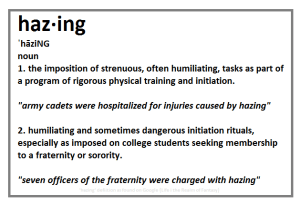
hazing-definitionIf the latter is the case, that group is engaged in a subtle form of hazing, more than in critiquing. Thank them for allowing you to sit in, and walk away from them.

There is a difference in types of writing groups, too. Some are traditional critique groups, people who usually read a few pages aloud at their sessions and discuss it in detail in a round-table fashion. This sort of focus can be just right for some authors, especially those in the final stages of making their manuscript submission-ready.

Because traditional critique groups focus only on 3 or 4 pages at a time, they lack the context to be able to discern if your protagonist has developed sufficiently along his character arc by the first 1/4 of the tale. However, they can tell you if you have made editing errors, and discuss small points of technique within those few pages, which you can then apply to the overall manuscript.

This is an important aspect of the process, but is not always the kind of input an author is seeking.

The one flaw these sorts of groups have is they don’t have the ability to properly critique the larger picture—pacing, overall story arc, worldbuilding, character development, and on, and on–because these things can only be judged in larger context. So if, like me, that is the sort of input you are looking for, my advice is to find a beta reading group.

Critique groups cannot do what beta readers can.

But how do you select a group? Before you join a writing group, you have the right to know what that group focuses on.

A beta reading group will focus on these questions:

  1. Where did my chapter bog down?
  2. What did they think about my characters?
  3. Where did they get confused and what did they have to read twice?
  4. Did it become unbelievable or too convenient at any point?
  5. What do they think will happen to the characters now?

Then after you have sat in on one of their sessions and observed how they treat each others’ work, ask yourself, “What kind of vibes did I get from this group of people? Will I benefit from sharing my work with this group? Did the comments they made to each other sound helpful?” Hopefully, the answer to those questions will be a resounding “yes.”

If the answer is anything other than a resounding “yes,” run now. Run far, far away.

Red Flags to Watch For:

There are common negatives to watch out for in all writing groups: If you have stumbled into a group where the most visible member is a self-important, read-all-the-books-on-writing-so-I-know-it-all kind of a person, don’t bother joining or you’ll be subjected to many accounts of how their writing group in Minnesota was so much better than this pathetic group.

Another author you might watch out for is the ubiquitous Famous-Author-Name-Dropper, a person who must be important because she has been to a great many seminars and conventions with these famous people, and hung out in the bar with one of them once. If it turns out she is in your prospective group, it may not be the group you are looking for. Sometimes they are the same person, sometime not, but either one of these wannabe-famous authors are poison—in their eyes the group only exists to admire them, and they will casually cut your work to shreds, dismissing it as merely amateur in the face of their “professional” experience.

When you are considering joining a group, ask the leader/chairperson these questions:

  1. If the group is a beta reading group focused on first drafts, what do they consider a first draft? Do you have to hire an editor and have it thoroughly edited before you submit it to this group? I say this because a fully edited manuscript is not a first draft, and that group would be a waste of your time.
  2. Will you receive insights into your manuscript on points you hadn’t considered, or will the focus of the discussion centered on minor editing issues that you are already aware of?
  3. Ask the leader to define for you the specific areas that readers will be looking at:
  1. Character development,
  2. pacing the arc of the scene,
  3. pacing the arc of the conversation,
  4. worldbuilding,

So let’s say you have found a group who seems to a good bunch of people, and yes, they read and write in your genre. You trust them enough to submit your first piece to the group. After the session is over, ask yourself:

  1. Do I still feel positive about my work or do I feel like my work was treated as being less than important?
  2. Did I gain anything from the experience that would advance the plot or did I just hear a rehash of arm-chair editing from a wannabe guru?

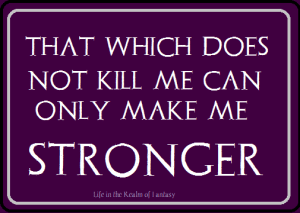
that which does not kill meThe answers to these questions have to be that you feel good about your work, that you saw through their eyes the weaknesses, and that they can be fixed.

New authors join writing groups feeling a great deal of trepidation, filled with uncertainty and fear. They fear being belittled and told their work is crap, and sometimes that happens. At the end of the day, you have to feel as if you have gained something from the experience.

Hopefully you will be as fortunate as I have been, and find a group of beta readers you can mesh with, people who will support and nurture you in the same way that you will them.


This post was first published March 2, 2015, under the title “Critique groups vs beta reading groups” by Connie J. Jasperson

7 Comments

Filed under writing

#amwriting: using allegory to underscore theme

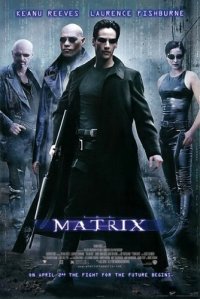
the Matrix PosterGreat novels, like great movies, are built of many layers. Theme is what the story is about on a deeper level than what is seen on the surface. It’s the big meaning, and often it’s a moral. Love, honor, family, redemption, and revenge are all common, underlying themes.

Allegory is an essential tool of the author who wants to convey important ideas with the least amount of words. One of my works-in-progress is a contemporary novel. I need to convey a Gothic atmosphere in this piece and yet maintain the setting and time-frame of a novel set squarely in the  21st century. The way I am doing this is through the use of allegory. With symbolism in mind, I try to approach writing a scene as it would be portrayed in a movie. Each conversation is an event and must advance the story.

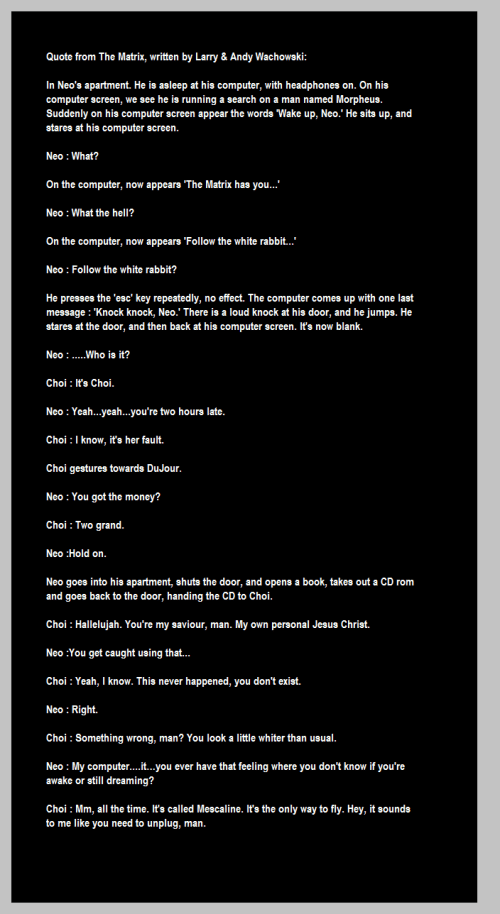
Consider this scene from one of my favorite movies of all time, The Matrix. The films of The Matrix trilogy pit man against machine in a clearly drawn battle, but they also reveal that the humans are more machine-like than they think, and that the machines possess human qualities as well. These are the obvious themes, but there are several underlying concepts going at the same time.

The movies in this series are famous for the action, and rightfully so.  But great choreographed martial arts sequences can’t convey the concepts the authors needed to express. The advancement of the plot hinges on dialogue. Dialogue drives the action and connects the fundamental ideas of the story through the intentional use of allegory. The authors never lost the way, because every aspect of that script is steeped in symbolism that directly points to the overall theme(s).

Quotes from the matrix


The conversation concerns a drug deal, but the overarching idea of the blurred line between humans and machines is never lost.

The key words are in the first line, written on Neo’s computer:

  1. The Matrix has you,
  2. the third line,follow the white rabbit,
  3. and in that very last line, telling Neo to unplug.

The obvious plot of The Matrix series of films details a questioning of what reality is and portrays Neo as the potential savior of the world, which has been enslaved by a virtual reality program. Dig slightly deeper, and you see that it is about escaping that program, at which point the audience sees that a larger theme is in play: fate vs. free will.

Even before that larger concept is made clear, the conversations that happen in the course of the film all advance that theme, even the minor interactions, from the first conversation to the last.

The storytelling in The Matrix movies is a brilliant example of employing heavy allegory in both the setting and conversations to drive home the motifs of man, machine, fate, and free will.

The themes are represented with heavy symbolism in the names of the characters, the words used in conversations, and even the androgynous clothes they wear. Everything on the set or mentioned in conversation underscores those themes, including the lighting. Inside The Matrix the world is bathed in a green light, as if through a green-tinted lens. In the real world, the lighting is harsher, unfiltered.

In the movie, everything that appears or is said onscreen is symbolic and supports one of the underlying concepts. When Morpheus later asks Neo to choose between a red pill and a blue pill, he essentially offers the choice between fate and free will.

Neo chooses the red pill—real life—and learns that free will can be unpleasant. Cypher regrets choosing the red pill and ultimately chooses to return to the Matrix.

The creators of the movie even used the lighting as an allegory showing that Neo’s world is filtered through something else: The Matrix.

The arc of the story is driven by

  1. who has the information,
  2. when they learned it, (and when the audience learns it)
  3. what they did on learning that information.

In our own work, if we don’t keep the arc of the story moving toward the final conclusion with each scene, we will lose our reader. To that end, we disseminate information in small increments, with the reader learning what she must know at the same time our protagonist does. Using symbolism and allegory is a way to get the most information out there in the least amount of words, but it requires intention on the part of the author. Words, phrases, and setting must be chosen and the narrative’s prose must be crafted.

Crafted prose does not mean flowery prose. If you reexamine the above excerpt from The Matrix, you see lean dialogue, spare and to the point. It is in the symbolism of the setting, their names, their attire, and the authors’ choice of words that we get the most information. When Neo answers the door and is invited to the party, he at first declines. But then he notices that Du Jour, the woman with Choi, bears a tattoo of a white rabbit. He remembers seeing the words: follow the white rabbit, on his computer. Curious and slightly fearful of what it all means, he changes his mind and goes to the party, setting a sequence of events in motion.

We build the overall arc of the story from scenes, each of which is a small arc, in the same way a gothic cathedral is constructed of many arches that all build toward the top.  The underlying arches strengthen the overall construction. Without arches, the cathedral wouldn’t remain standing for very long.

Theme is a thread that winds through the story and supports the plot. Using allegory and symbolism in the environment to subtly underscore your themes allows you to show more without resorting to info dumps.

Picture conversations, clothing, settings, and wider environments as if they were scenes in a movie, and consider how you can use allegory to support your story arc. When we are immersed in reading it, we don’t notice the heavy symbolism on a conscious level, but on closer examination it is all there, making the imaginary real, solid and concrete.

By using allegory and conversations to create many layers, we can build memorable stories that will stand out in the reader’s mind.

1 Comment

Filed under writing

#amwriting: trust your readers

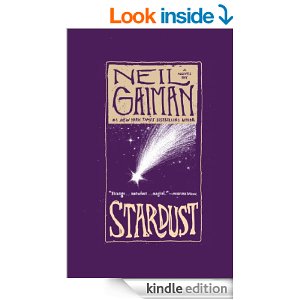
Stardust, Neil GaimanSome hard-core fantasy qualifies as literary fiction because of the way in which the story is delivered. Because of the style in which they’re written, these books appeal to a broader fan base than work pigeonholed into either the “genre fantasy category” or the “literary fiction category.”

Neil Gaiman’s Stardust qualifies as a novel that is a “literary fantasy.” This is because it is a fairy tale told with beautiful prose in an unhurried fashion.

Among the burgeoning population of authors who are just learning the craft, opinions regarding style and voice run high and loud.

According to those critique groups armed with a little dangerous knowledge, in the very first sentence of chapter one, Gaiman commits the most heinous crime an author can: he tells the story with leisurely, poetic prose.

Quote: There once was a young man who wished to gain his heart’s desire. 

OMG!  He did he really write “There once was” in a genre fantasy novel?  Passive Voice! Passive Voice!

Well, guess what? Neil Gaiman knows what he is doing when he sits down to tell a story, and his rabid fans and best-selling novels are a testament to that.

Those megalomaniacal gurus armed with tattered copies of Strunk and White, limited talent of their own, and who believe themselves the fount of writerly knowledge really lose their minds over what he does after that first sentence:

  1. He sets the scene: In a style reminiscent of traditional fairy-tales, he explains how our hero, Tristam, lives in the village of Wall. It’s a tiny town about a night’s drive from London. A giant wall stands next to the town, giving the place its name.
  2. He goes on to explain that there’s only one spot to pass through this huge grey rock wall, and it’s always guarded by two villagers at a time, and they are vigilant at their task.
  3. Gaiman comments that this guarding of the gap is peculiar because all one can see through the break in the wall is meadows and trees. It looks as if nothing frightening or strange could be happening there, and yet no one is allowed to go through the break in the wall.
  4. Only then does he bring us to the point: Once every nine years, always on May Day, a unique, traveling fair comes to the meadow. That is the only day the guards ever take a break from their posts on the gap in the wall.

I can hear the group’s de facto emperor pontificating now. What was Gaiman thinking, starting a fantasy novel with a TELLING, PASSIVE sentence followed by an info dump? Why, everyone knows real authors only use active prose and never, ever, offer information up front.

To that breathless expert, I say “not true, my less-than-widely-read friend.” Lean prose can be leisurely and poetic, and still pack a punch. That is what true writing is all about, conveying a story in a style that is crafted and has a voice that is uniquely that of the author.

In Stardust, each character is given a certain amount of importance, and even minor players are clearly drawn. The circumstances and events gradually pick up speed, and in the end, the reader is left pondering what might have happened after the final words on the last page.

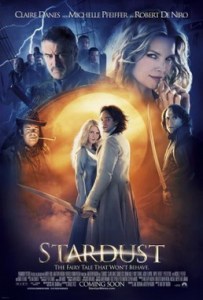
stardust_promo_posterIf you saw the movie that is loosely based on the book, you might be surprised at how different the book is from the movie. There are no cross-dressing sky pirates in the book, although Robert De Niro was awesome in that role in the movie. The movie is excellent but bears little resemblance to the book, and, like The Hobbit movie, should be looked at as a different entity entirely.

Neil Gaiman trusts his readers. That is something we all need to do. Sometimes a story needs to emerge slowly and be told with beautiful, immersive prose, and we need to trust that our readers will enjoy it if we craft it well.

There is room in the bookstore for books with a less urgent story to tell as well as those that ambush the reader and beat them bloody with non-stop action.

When we write, we are writing because we have a story to tell. (Yes, I said tell.) To that end, every word must count, every idea must be conveyed with meaningful words, and sometimes you can just have a little fun with it.

In the opening lines of Gaiman’s Stardust, nothing unimportant is mentioned although the prose meanders in a literary way. Yes, he takes the long way, but the attitudes, mores, and personalities of Tristam’s village are conveyed with humor, and the journey is the best part of this fairy tale. He never devolves into florid, overblown purple prose, yet it has a poetic feel.

True authors are driven to learn the craft of writing, and it is a quest that can take a lifetime. It is a journey that involves more than just reading “How to Write This or That Aspect of a Novel” manuals. Those are important, but they only offer up a part of the picture.

You must read widely, and outside your favorite genre. When you come across authors whose work shocks, rocks, and shakes you, study how they crafted the sentences that moved you.

Let their works show you how to use words to form the moods and emotions that drive the plot.

Learn from the masters how to show the true character of a protagonist, or the smell of an alley by the wharves, painting pictures with words.

Read widely, and then apply what you’ve learned to your own work.

6 Comments

Filed under Fantasy, Literature, writing

#amwriting: consider the short story

via buzzfeed

For the author struggling to get their name out there, one of the best ways is writing and submitting short stories to magazines, contests, and anthologies. You might earn a little cash, and you have the added thrill that someone liked your work enough to publish it.

But how does one go about writing a short story? First, you need a theme, an idea or message that flows through a story from beginning to end. The theme is what readers think the work is about, but it is also what the work itself says about the central subject.

In a given work the theme might never be mentioned outright, but the characters’ actions are motivated by it, and the plot revolves around it. (In case you need it, here is a list of 101 common themes in books.)

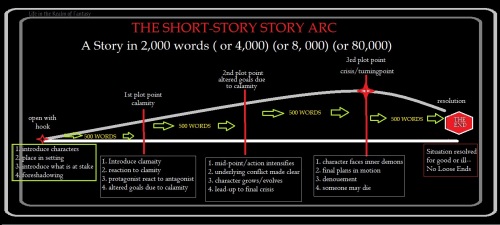
The structure of the short story is the same as for a novel: it consists of the Story Arc, which is the term that describes plot structure, or the sequence of events that occur within a story.

Plot Structure is the way the story is arranged:

*the setup

*the obstacle

*the turning point

*the resolution/outcome

THE SETUP: You must have a good hook. In some cases, the first line is the clincher, but especially in a short story, by the end of the first page you must have your reader hooked and ready to be enthralled.

One of the best first lines ever: George Eliott’s Middlemarch starts, “Miss Brooke had that kind of beauty which seems to be thrown into relief by poor dress.” That line makes you want to know Miss Brooke. And the reader wonders who the observer is who chronicles this. It is a novel, but if it had been a short story, it would still have hooked the reader.

Good first lines make the reader beg to know what will happen next.  We have to think about that first line, those first paragraphs, and how to land our reader.

After the hook, you must immediately get down to business, as you have no words to waste. Consider these things when writing the opening paragraphs:

  1. The opening lines set the tone for the story.
  2. The opening lines introduce the dramatic question that is the core of the story.
  3. The opening lines introduce the sense of place, the setting of the story.

Sometimes you have a short story you can’t seem to get off the ground. Something stalls it. It could be that you are trying to place too much background in at the beginning. Ask yourself where the story truly begins and start there.

Consider the length of the story you intend to write. Most literary magazines want stories of 1000 to 4000 words in length, but many will say no more than 2000 words. That places a real constraint on you as the storyteller because, to sell your work to that magazine, you must fit your story into a very small box. Every word in a 2000-word story is critical and has a specific task — that of advancing the plot. To that end, in a story of only 2,000 words:

  • No subplots are introduced
  • Minimal background is introduced
  • The number of characters must be limited to 2 or 3 at most

How do you fit a story into 2000 words? Make the Story Arc your friend.

Divide your story into four acts and assign a word limit to each of those acts: in a 2000 word story, each act would be 500 words long.

short story arc

Writing short fiction forces the author to become more economical and yet poetic in how they lay down their prose.

  • Each word must set the scene and convey the atmosphere, and every conversation must impart both information and give the reader a sense of who these characters are.
  • Every sentence must propel the story to the conclusion.
  • By the end of the first ¼ of the manuscript, the reader should have an idea of who the character is, what their moral compass is, what the character wants, and what they are willing to do to acquire it.

Be economical with your words: If you are writing a less formal story, make liberal use of contractions in the narrative as well as in the dialogue: hasn’t, he’d, wasn’t, didn’t, couldn’t, etc. A contraction is a “Two-fer” word – you get two words for the price of one.

Ditch the “crutch” words. You will lower your word-count when you look at each instance and see if you can get rid of these words. Removing them tightens your prose and makes room for important words that will convey the story more effectively.

“Crutch” words are overused words that fall out of our heads along with the good stuff as we are sailing along:

  • so
  • very
  • that
  • just
  • literally
  • there was
  • to be

We all use them too liberally in the rough draft. When we are doing revisions, we look at each instance of those words and decide if the sentence is stronger without it. Nine out of ten times, it is.

As I have said before, writing short stories gets you writing more:

  • more often,
  • more widely on a broad range of topics, and
  • more creatively using a variety of styles.

Using and building on the skills gained in writing short stories can only grow you as an author. Your prose will become stronger and tighter, and you will have a better grip on story construction.

9 Comments

Filed under Publishing, writing