Tag Archives: writing craft

How to format your manuscript for submission

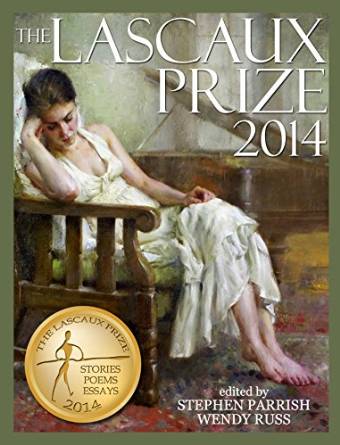
lasceax prizeThis post is a follow-up to the previous post on why indies need to write short stories. That article sparked some questions that I will answer to the best of my ability. All of this information was gleaned by searching the internet when I first wanted to know why my manuscripts were so regularly rejected.

First of all, a properly formatted manuscript shows that the author did her research and knows what the editor wants. That will help your ms make it past the first hurdle.

You will find that each publisher, magazine, or contest website will have a page or section called “Submission Guidelines.” That page is your friend, because within the words on that page will be the rules specific to that particular publication or contest:

  1. length of submissions in word count (Do not exceed or fudge this. Stay within their parameters.)
  2. how they want you to format your work for their best use.
  3. where to submit the work
  4. what dates submission will be open
  5. if it is a contest, fees will be listed there

If you are building a back-log of of short-fiction there are some short-cuts you can take to enable you to have submission-ready work that requires minimal adjustment to fit  various requirements. This is because most publishers use what is considered the industry standard, Shunn Manuscript Format. William Shunn didn’t invent this, but he made this knowledge available to all would-be authors via the internet.

First, if you are submitting this to a publisher that publishes hard-copy your manuscript should look typed, not typeset. If you are composing your manuscript on a computer, don’t succumb to the temptation to use fancy fonts. For hard-copy publishers use a Courier font. Every word processor and printer comes with Courier, so you have no excuse for not using it.

Use a 12-point Courier. This means it prints out at a pitch of ten characters per inch. Don’t use a 10- point Courier, which prints out at a pitch of twelve characters per inch. That is far too small and editors who have to read a lot of manuscripts won’t want to struggle to read yours and it will be summarily rejected.

On a side note, something I have learned through this publishing life is that in printing, point size refers to the height of the characters in a font; pitch refers to the width. This is critical knowledge, because the font that the publisher wants the ms submitted in is the only one that will make it past the first editor’s inbox.

If you are submitting this to a publisher that is publishing in an electronic format, they may require 12-point Times New Roman font. Times New Roman is easier on the eyes, when viewed on a monitor. As an editor I prefer submissions in Times New Roman, as I rarely work from hard copy.

The preferred font will be clearly stated in their submission guidelines.

IF YOU INTEND TO FORMAT YOUR MS FOR HARD-COPY SUBMISSION TO AN OLD-SCHOOL PUBLISHER:

  1. Set the margins for your document at 3cm (1 inch) on all four sides.
  2. Align to the left hand side only; the right hand side should remain jagged. (THIS IS CRITICAL)
  3. Use twelve point Courier in black type only. Times New Roman or Arial fonts may also be acceptable—check the submission guidelines of the magazine or anthology.
  4. Lines should be double spaced with no extra spaces between paragraphs. (THIS IS CRITICAL)
  5. Single space between sentences after periods. (this is also critical)
  6. Indent new paragraphs and each new section of dialogue, with the exception of a scene break paragraph.
  7. Indicate scene breaks by inserting a blank line and centering the hash sign (#) in the center of that line.
  8. Center a hash sign # one double-spaced blank line down at the end of the manuscript. Or simply write The End. This assures the reader that no pages are accidentally missing.
  9. Use underline for italicized words if you are using Courier font. If you are using Times New Roman you can use proper italics. (Again, check the submission guidelines)
  10. William Shunn says, “You should place a header in the upper-right corner of every page of your manuscript except the first. This header will consist of: the surname used in your byline, one important word from the title of your story, and the current page number. Do not place the header in the upper-left corner, because the typesetter will often have your manuscript clipped in that corner as he or she transcribes it and will not be able to see what the current page number is.” (end quoted text)

Your first page should include:

  1. The name of the work.
  2. The approximate word count, some will want it only to the nearest hundred.
  3. In the upper left, your contact details formatted in the same font and size as the manuscript font.
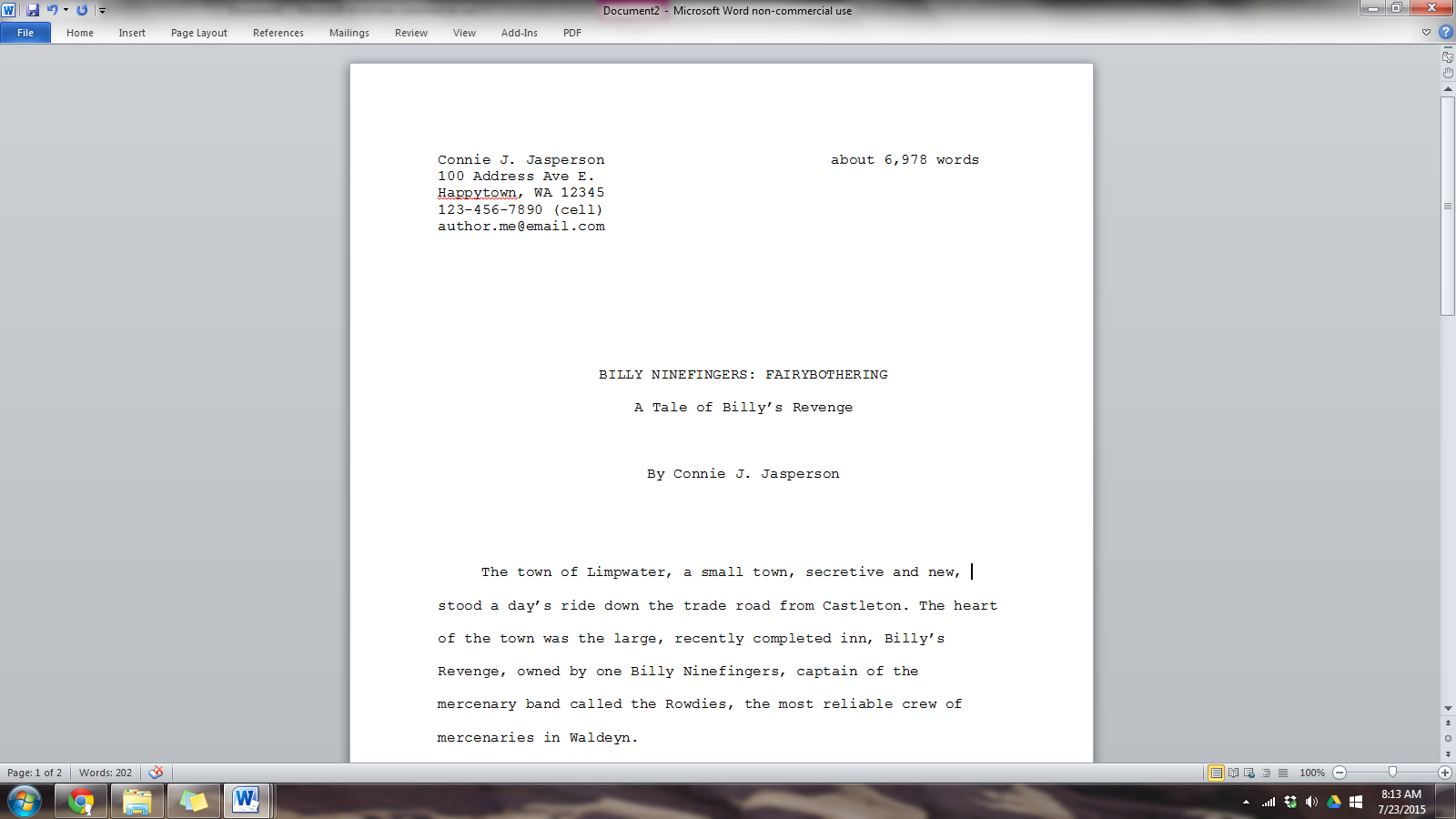
prnt scrn Fairybothering 1

MANY contests and e-magazines want your manuscript formatted in a similar fashion, but may require a different font. Some will want the header on all pages, and some will want your full author name in the header:
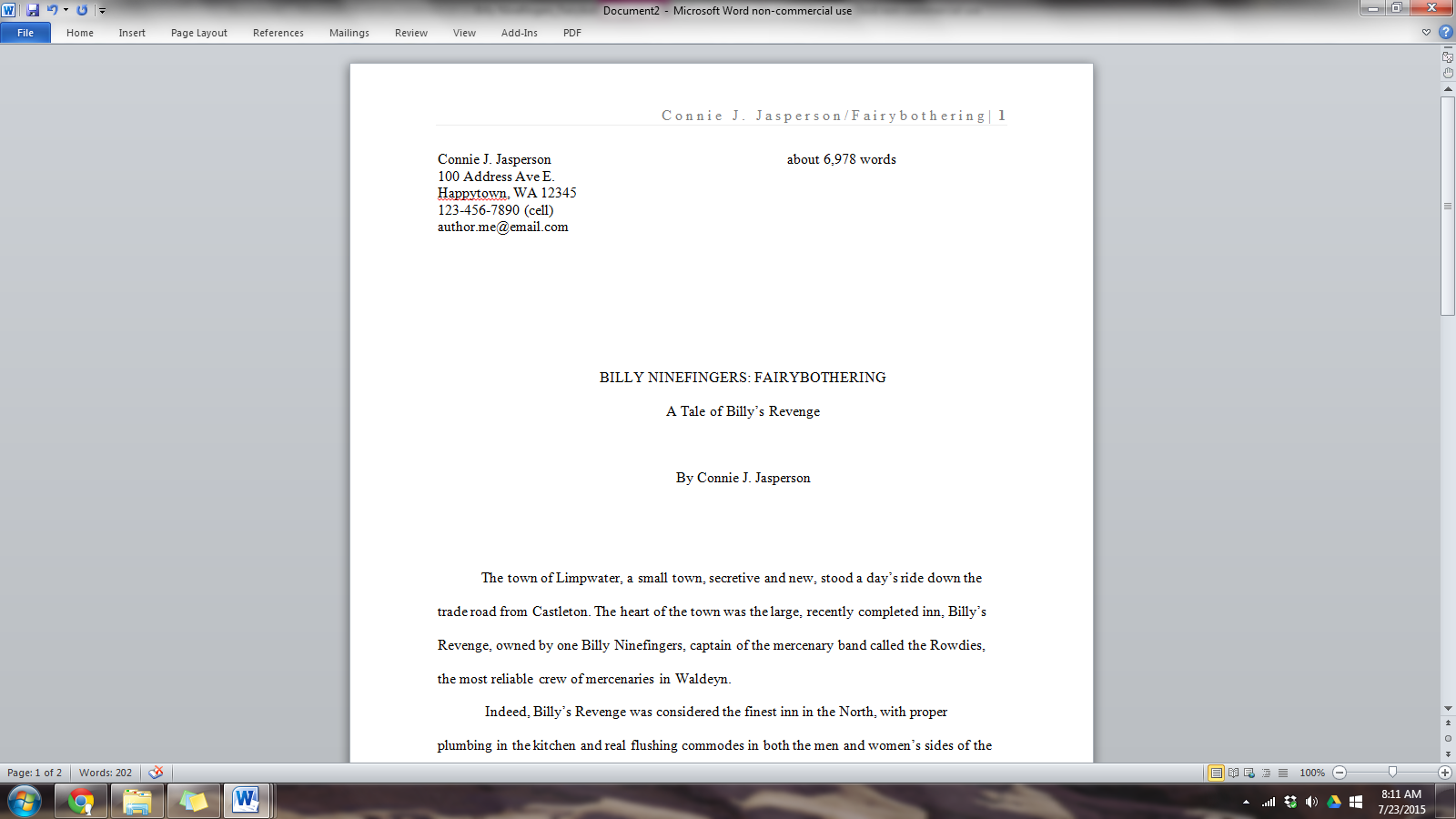
prnt scrn Fairybothering 2

TO Format your header in MS WORD:

  1. Go to the Insert Tab and click on: page numbers>top of page
  2. From the drop down menu select plain number three (the upper right hand corner)
  3. Type your name and title just before the number
  4. Click on the body of your document and the header/page number is set, and will appear to gray out.

TO Format your ms so the page numbers start on page two: click on this link to go to this page at MS Office Help if you are using WORD 2007 or 2010. Later versions also have help pages there. The process is a little more involved, and I don’t want to fill this post up with that, so use the resource offered by Microsoft–that is how I learned. Most hard-copy manuscripts must be formatted this way, so learning how to do this is critical.
anthology sci fiWhen you submit your work to an anthology or contest, if your work is accepted you will receive a contract. That contract will have the terms of payment, conditions of use, and all the pertinent information you, as the author, will need to know. Most are simple, and don’t require a law degree to understand. If you receive a complicated contract, seek a literary agent or attorney for advice.

Also be aware that ALL contests  and magazines will want original work that has never been published before. Many anthologies, will too, unless they are promotional anthologies put out by publications showcasing the most popular stories they printed during the previous year. Often these collections are the editors’ favorites.

Most contracts will state that you can reuse or republish the work 3 months or 90 days after the date of their publication. When you do so, you must include on the copyright page a caveat stating that it was originally published in their anthology or magazine, and what issue/year.

1 Comment

Filed under Publishing, Self Publishing, writer, writing

Elements of the story: the structure of the scene

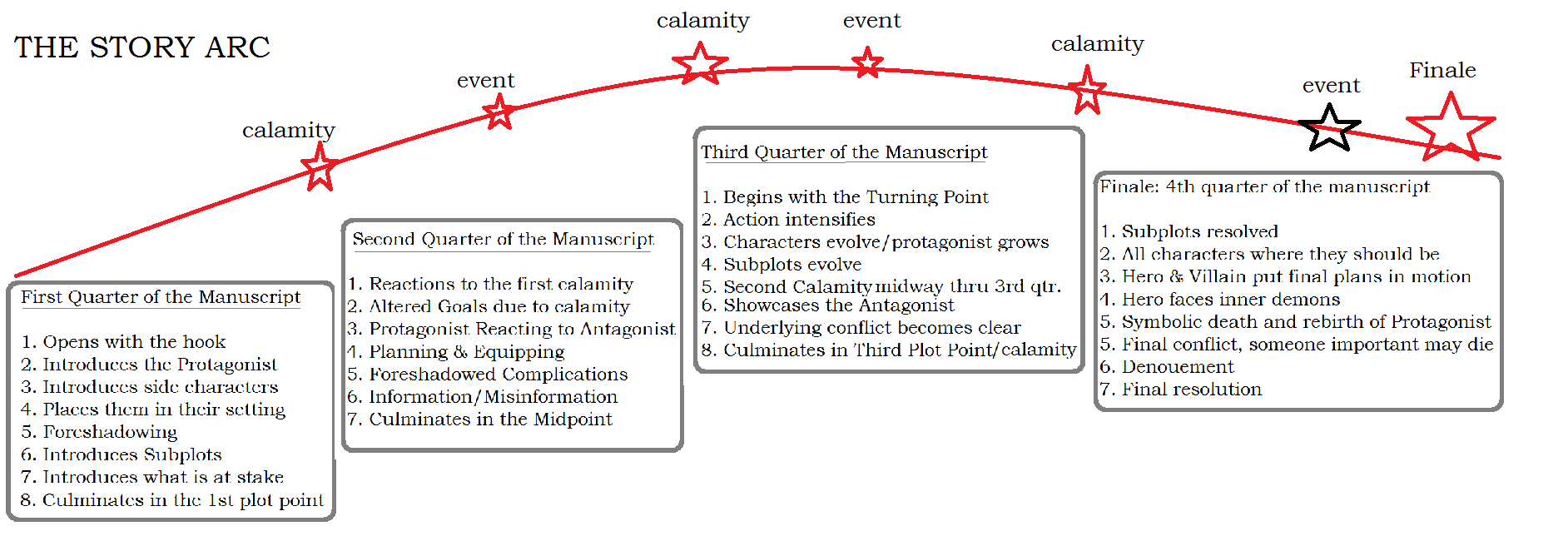
Most authors understand that there is an arc to the overall novel–the Story Arc  which  consists of :

  1. Exposition, where we introduce our characters and their situation.
  2. Rising Action, where we introduce complications for the protagonist
  3. Climax, the high point of the action, the turning point of the narrative
  4. Falling Action, the regrouping and unfolding of events that will lead to the conclusion
  5. Resolution, in which the problems encountered by the protagonist are resolved, providing closure for the reader.

The Arc of the Story

Wikipedia, the fount of all knowledge says, “In a story arc, a character undergoes substantial growth or change, and it ends with the denouement in the last third or quarter of a story: The end of a narrative arc is the denouement. It shows what happens as a result of all the conflict that the characters have gone through.”

However, as we’ve discussed before, within the larger story there are many smaller stories, “scenes” created with this same arc, that come together to create this all-encompassing drama. The way these scenes unfold is what keeps our readers interested and invested in the narrative until the end of the book.

Last July, at the 2014 PNWA Conference, in his seminar on the arc of the scene, author Scott Driscoll explained how the main difference in the arc of the scene vs the overall arc of the novel is this: the end of the scene is the platform from which your next scene launches.

Once he explained it in that fashion, I understood it. This means each scene begins at a slightly higher point on the novel’s Narrative Arc than the previous scene did, pushing the narrative toward the climax.

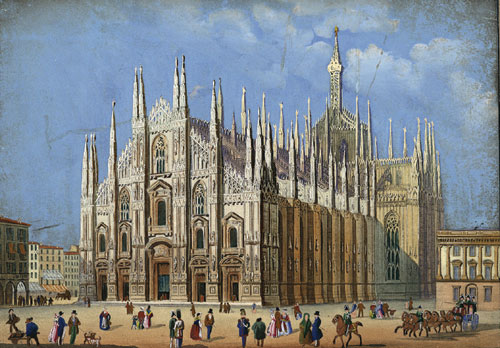
Milano_Duomo_1856

Milano Duomo 1856 via Wikipedia

In my mind, this means that novels are like Gothic Cathedrals–smaller arcs of stone support the larger arcs until you have a structure that can withstand the centuries. Each small arc of the scene builds and strengthens the overall arc of the greater novel.

These small arcs of action and reaction ensure the plot doesn’t stall and create tension that drives the story to the four cardinal points of the story arc.

Conversations are scenes that form a fundamental part of the overall arc: they begin, rise to a peak, and ebb. They inform us of something we must know to understand the forthcoming action. Conversations propel the story forward to the next scene. A good conversation is about something and builds toward something. J.R.R. Tolkien said “Dialogue has a premise or premises and moves toward a conclusion of some sort. If nothing comes of it, the dialogue is a waste of the reader’s time.”

That is true of every aspect of a scene: action, conversation, reaction. A scene that is is all action can be confusing if it has no context. A properly placed conversation can give the reader the context needed to understand the reason for the action.

A certain amount of context can arrive through internal monologue, but it must be done in such a way that the reader is not faced with a wall of italics. There are two problems with long mental conversations:

  1. italics are daunting in large chunks.
  2. it can become a thinly veiled cover for an info dump.

Remember, in novels, not everyone in the scene knows everything, so their thoughts won’t be that critical, and are therefore not needed. Plot points are driven by the the characters who do have the critical knowledge. The fact that some characters are working with limited information is what creates the tension.

Consider the concept of  asymmetric information–a situation in which one party in a business transaction has more or superior information compared to another. In business, one individual’s pursuit of pure self-interest can prevent other companies from effectively entering and competing in an industry or market–he has critical knowledge they don’t have, and effectively eliminates his competition. He has a monopoly.

That monopoly of information creates a crisis. In the novel, a conversation scene should be driven by the fact that one person has knowledge the others need. Idle conversation will bore your reader to tears.

We deploy info, but we don’t dump it in one large chunk though–the reader must find it out at the same time as the other characters, over the first 3/4 of the novel.

We do this in small arcs that combine to form the overall story arc. Events occur, linked by conversations, forming small arcs (scenes) that support the structure of the novel.

The Story Arc


By creating small arcs in the form of scenes, we offer the reader the chance to experience the rise and fall of tension, a pulse which never completely falls but is always increasing toward the high point of the book, giving the reader small rewards of emotional satisfaction along the way to the big event, the grand climax.

Comments Off on Elements of the story: the structure of the scene

Filed under Literature, Publishing, Uncategorized, writer, writing

Gearing up for #PNWA2015

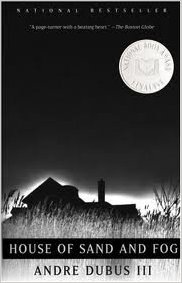
House of Sand and Fog Andre Dubus III

I love conventions. Especially writer’s conventions, where the craft of writing is the central theme, so that is why I look forward to the PNWA convention every year. Two weeks from now, that is where I will be, along with fellow Myrddin Publishing Group editor and bff, Irene Roth Luvaul.

It is horribly expensive, but for me, it is so worth it.

This year, Andre Dubus III will be the keynote speaker. While I frequently read literary fiction, I have to say I didn’t really enjoy his book, House of Sand and Fog, although it was excellently crafted. I found it exceedingly depressing, as I did most books touted by Oprah’s Book Club, which I generally don’t find to be much of a recommendation any more. Oprah is a wonderful lady, but her tastes in literature are far different than mine.

Let’s face it–I’m an escape-reader. I read to get away from the misery of the world, so while the story is thought-provoking, and worthy of every honor it has received, I didn’t enjoy it. I prefer happy endings.

But that doesn’t really matter–I want to hear what he has to say. I don’t care for George R.R. Martin‘s work either. But I love to hear George speak, and so I am looking forward to hearing what Andre Dubus III has to say.

SUPPORT YOUR LOCAL AUTHORSMy hubby took a vacation-day yesterday, giving himself a 4 day weekend to help me take my books 75 miles north to Bellevue. 3 hours each direction, inching along I-5 and I-405 in 90 degree heat–what fun!

This was so they can  be included in the PNWA July 16-19 convention’s Friday Autograph Party event. I’m pretty excited about that. My good friend, Lindsay Schopfer will also be signing books, as will 58 other authors.

I’ll be showcasing the World of Neveyah series, and Huw the Bard, so 4 books for the signing event. But all my books will be there.

Every attendee will receive an Ebook copy of Tales from the Dreamtime courtesy of Smashwords. I so wish I could give them each a copy of the audio book–Craig Allen’s narration is simply amazing.

I really enjoy the PNWA conference. A lot of people who are going the traditional route use it to pitch to agents and editors, but that doesn’t interest me. I am happy as an indie and have no plans to court a large publisher.

What I am interested in are the seminars on the craft of writing. Every year I come away from this event feeling completely inspired, and ready to write.

Friday morning Irene and I will attend the annual meeting. I do have some concerns which I have made a list of, and wish I lived closer to Seattle to be more of a volunteer. Living 75 miles away limits what I can do to help out, but I could do some virtual assisting, if there is an option for that.

Also, I will be attending seminars given by Scott Driscoll, Robert Dugoni, and Lindsay Schopfer.

creamy_wild_rice_and_mushroom_soup_recipe

creamy wild rice and mushroom soup w/coconut milk

All in all, I think it will be a fun event, and am planning my food ahead for it, as the vegan can never count on the kindness of strangers when it comes to food. The wise vegan author travels well-prepared to stay in a room with no microwave, in a hotel that is less than understanding about what constitutes a vegan meal.

I can honestly say I am NOT looking forward to the dinners, but will be well-able to provide for myself, and who needs food anyway–were gonna be talking books!

Comments Off on Gearing up for #PNWA2015

Filed under Literature, Publishing, writer

Jonesing for affirmation

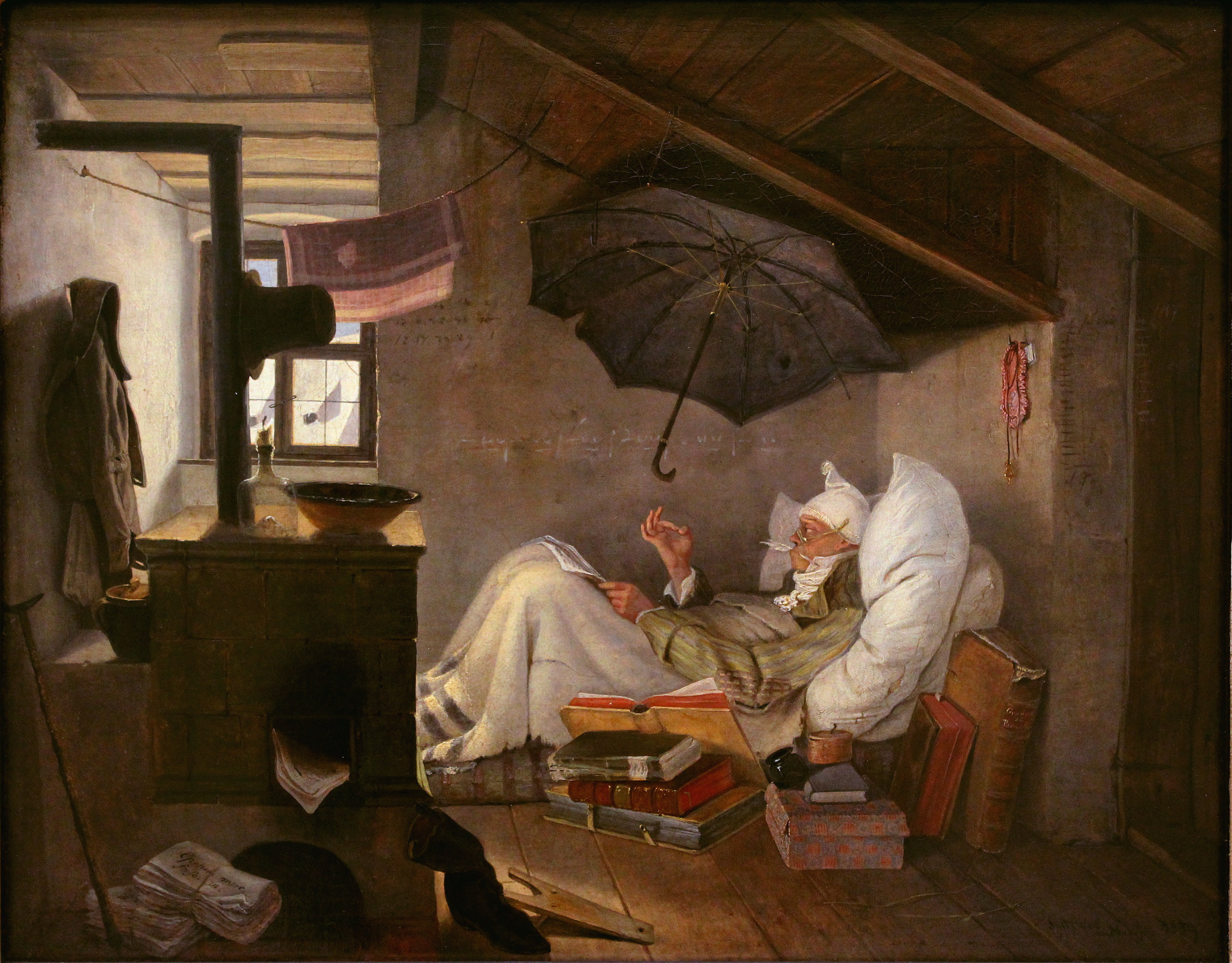
Der Arme Poet

Carl Spitzweg, The poor poet,1839 PD|100 yrs via Wikimedia Commons

Writing is an addiction. Oh, we don’t start out as garret-dwelling addicts. No, we start out as young people with bright futures, occasionally toying with that gateway drug–short-fiction.

At first it’s just thrill-seeking–writing a few short-stories and flash-fiction, just to see if we can. However, once we’ve felt the rush of  hearing the incredulous words, “You wrote this? This is good!” we are hooked.

The next step is often NaNoWriMo. Once you’ve done that first NaNoWriMo, you’ll never be the same.

Some fortunate people manage to walk away from it–they just do one NaNoWriMo, and quit, forever.

But for the rest of us, we are now on an eternal cycle of getting our word count and stream-of-consciousness-writing, and it will take us to the gates of perdition. Or to a local writing group–same thing, I am told.

No sane person thinks we can actually write for a living, but we can’t fight the urge.  We know we can do it, if we just keep at it. We crave that affirmation again, that incredible rush of “Oh yeah–I knew that story was all that, and I wrote it!”

At first, we still have some basic common sense. We know it isn’t cool to just quit our jobs and expect our family to live in a garret, starving, so we hang on to our day jobs and begin sneaking around, writing in secret, hiding it from our closest loved ones until we accidentally blow it–we are so high on the adrenaline rush from the incredible scene we just finished writing that we just have to tell someone.

After all, that scene is the turning point for the entire novel, and it’s golden!

So, not wanting to see the glazed look in your spouse’s eyes again, you tell the dog. Of course, the dog just has to tattle on you. Dogs can’t keep secrets, you should know that.

tumblr_ndi15fZRpu1syd000o1_500That is when it finally comes out that your every waking moment is spent on some aspect of the writing craft. Our family knew something was going on,and they were worried about our behavior.

But we’re so far gone by now that we don’t care.

If we’re lucky, the family is comprised of consummate enablers. Desperate to have some normalcy in their lives, they will try to keep us from becoming unkempt, shabby, pajama-clad writing-seminar junkies, bankrupting them with our endless, rather costly, efforts to “improve our work.”

They tell themselves that we’ll out grow the habit if they help us control our addiction. They encourage us to join free online writing and critique groups. They toss us a bone by giving us the occasional second-hand book on the craft of writing, usually by a famous author.

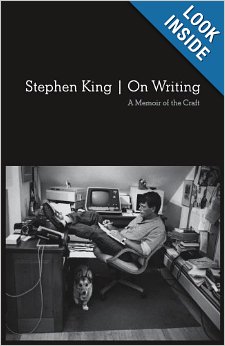
on writingThey have no idea just how potent an injection of inspiration that garage-sale edition of “On Writing” by Stephen King is to a hopeful author, and unknowingly they just make our condition worse.

At parties we have a sixth sense, always knowing who the other writers are just by the way they can’t focus on the conversation, and can’t wait to get  back to their work in progress, surreptitiously keying notes into their cell-phone and pretending they are texting.

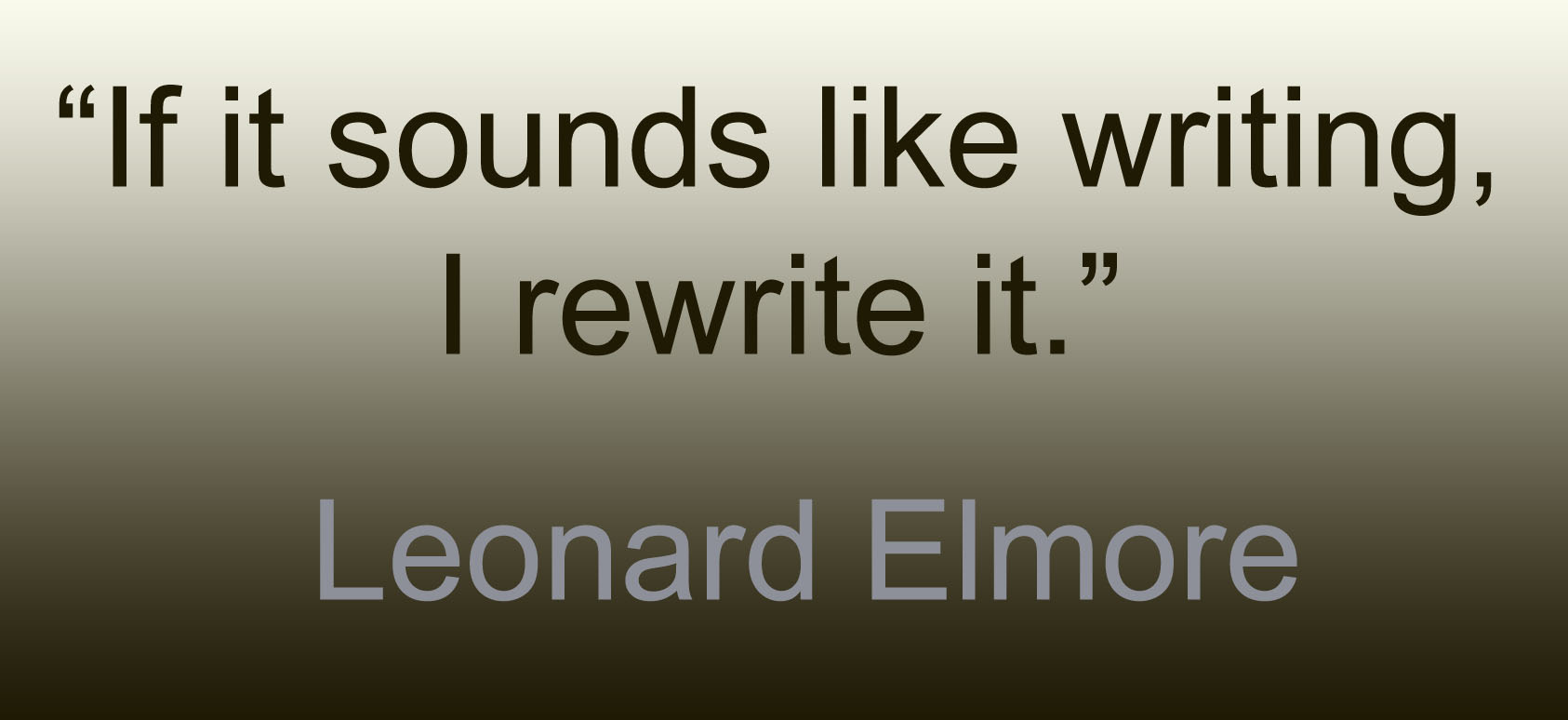
We’ve never met them before, but we find ourselves exchanging knowing glances and sneaking out to the patio with our new best friend, bingeing on Leonard Elmore quotes about writing, and sharing a few morsels of Orson Scott Card’s writerly wisdom.

leonard elmore quoteA new brother-in-arms and Leonard Elmore–we’re high as a kite and having fun now. What a great party!

Shocked faces stare out the window–it’s apparent we’re having too much fun, and our families suspect we’re “ranting about our novel again.” They drag us back into the light, despairing of ever having a “normal” life again.

An intervention and rehab looms in our future.

It won’t work. It’s not an addiction you can just walk away from. When they’ve taken your laptop away and hidden the pencils, and still they catch you forming little sentences out of the ‘o’s in your cereal bowl, they will know there is no such thing as recovery for the writing addict.

Don’t worry. Soon, they will be begging you to just go to that bloody writers’ convention and get it out of your system.

Heh heh. Like that’s ever going to happen. Soon, you will be hanging out at the local coffee-shops, looking for people with their laptops open, trying to make unsuspecting new converts to your dirty little habit.

“Are you a writer too? Ever do any NaNoWriMo?”

“Wanna share a little “Writer’s Digest? C’mon, what’s the worst that can happen? It’s not like it’s illegal, or anything.”

4 Comments

Filed under Books, Humor, Literature, Publishing, writer, writing

Why I #amblogging

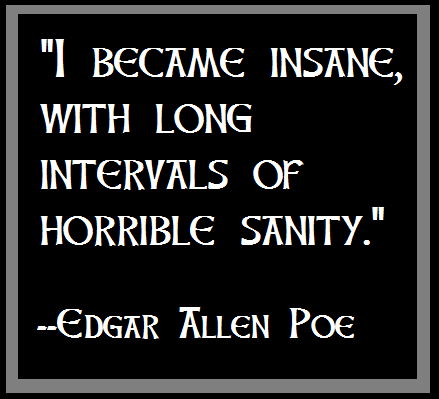
edgar allen poe quoteWriters need to write every day–that is a given. Writing every day takes discipline and dedication. We writers are often told we are undisciplined and lack drive, but nothing could be further from the truth. We simply lack the desire to do what we are told, and have this story that needs to be told.

Sometimes we have nothing to write that will advance our current work in progress. Inspiration has failed us. We have a kajillion ideas about things we could be writing, and things we plan to write…but nothing that sings in regard to the  task at hand.

When that happens, I sit down and look back through what has already been written, and inspiration fires me up again.

Other times, nothing. That is when I blog on the craft of writing. The act of blogging loosens my imagination when it is stuck.

One of the first chores I was given by my first publisher, was to blog regularly, at least once a week. This, he said, would help get my name out there, and give me a regular platform for my opinions.

I had no idea what I would ever blog about, and the idea of just sitting down and rambling on about nothing and then publishing it made me feel a bit faint. I have no issue with rambling on–I am grandma, it’s what I do. But publishing it weekly?

It began, as all love affairs do, somewhat awkwardly. I wrote short, stilted posts that were obviously forced and took days to write. I felt like blogging had taken up a large chunk of real estate in my writing time, and I resented it.

Then one day I didn’t know what to write about. The only thing I was interested in talking about was either books I had read or books I was writing. I found the words flowed easily when I talked about either of those. Thus was born this blog, Life in the Realm of Fantasy. This is where I talk about everything from Don Quixote to serial commas.

Blogging regularly has helped me to write more freely when I am using a stream-of-consciousness style of writing, such as during NaNoWriMo.

I have also made many friends through blogging, people all over the world who I may never meet in person, but who I am fond of, nevertheless.

And blogging is where I develop my seminars on the craft of writing. I find that talking to you about the craft helps me organize my thoughts. And, although I hate to say it, my first publisher was right about blogging. Blogging regularly does get your author name out there and does showcase what you are able to do.

I recommend blogging to anyone who has a craft they are passionate about. You want to talk about that craft, but your spouse’s eyes glaze over when you launch into one of your discussions.

Well, let me tell you, the internet is full of folks who want to talk about that same craft. Take welding–there are hundreds of blogs about welding, some popular, and some just getting started. Who knew welding was such a hot topic? Obsessed people make poor conversationalists, but writing a weekly blog about what you are passionate about gives you that platform to wax poetic about what you love.

If you want to know more about getting your own blog up and running, see my post of April 20, 2014: The Girl with the Tolstoy Tattoo:

  • Keep it down to about 1000 words more or less.
  • Use the spellchecker tool to look for obvious errors.
  • Write in in draft form and don’t publish it right away–come back and read it over again, and make corrections.
  • If you use information found elsewhere, quote it and credit the author
  • Use images that are either public domain, or that you have the right to use
  • Put links to other informative sites in the text

Blogging is fun. It’s where I blow off steam and grow as a writer. Every author should blog regularly–some of my most inspired moments have happened here in this crazy blog.

2 Comments

Filed under Humor, Literature, Publishing, Uncategorized, writer, writing

Writers’ Resources

tumblr_ng6esx01YT1syd000o1_1280The internet is a wonderful place. You can find just about anything here, and you can get a complete education for FREE!

Of course, it’s not credited, but there is an incredible amount of information on just about anything for free, up to and including college level courses in various aspects of writing through Coursera.

Coursera is a wonderful organization. They are a for-profit organization but you can take online courses from major universities FOR FREE, and while you don’t receive a diploma, you do get a good education. Wikipedia tells us that: All courses offered by Coursera are accessible for free and some give the option to pay a fee to join the “Signature Track.” Students on the Signature Track receive verified certificates, appropriate for employment purposes. These students authenticate their course submissions by sending webcam photos and having their typing pattern analyzed. 

I’m not sure how that works, but I am all for it. What I really like is that Coursera offers specializations, set courses that help increase understanding of a certain topic. I’ve take a couple of medieval history courses from them and while I didn’t have the money to get the certificate, I really enjoyed them. Knowledge is such a useful thing!

But  for the financially strapped author wanting to increase their knowledge of the craft of writing, an amazing resource is the website Writers’ Digest. They are also for profit, but they offer an incredible amount of information and assistance FOR FREE.

So here, in no particular order, are my favorite sources of Online Information About Writing your novel:

www.writersdigest.com

PBS.org/GuiltyPleasures/HowToWriteRomanceNovel

The Creative Penn

Harlequin.com

Creative Writing Now

Harlequin has one of the best websites, for teaching authors how to develop professional work habits, which is critical to being productive. I highly recommend you go to websites that specialize in writing romance novels regardless of what genre you write in, because the romance publishers have it right: they want to sell books, and they want you to succeed and so they get down to the technical aspects of novel construction and offer many excellent tools for getting your work out the door in timely fashion–something I need to work on. They also offer tips on marketing your work.

They also give you all kinds of tips on how to create a writing space and organize your day so you can get good writing time in and still manage your family. I used to do my writing on an old IBM Selectric that was next to the gerbil cage–not a good environment for writing.

In regard to research, reading one Wikipedia article does not qualify you as an expert in your chosen subject, so go beyond the surface. Find the websites that really explain your subject and go to the local library to research. Once you know what you are writing about, you can mash it up any way you want to.

But even though we are educating ourselves about our novel’s setting and have gained an understanding of how the science that forms the core plot-point actually works, sometimes we hit a bit of sticking point in the creative process.

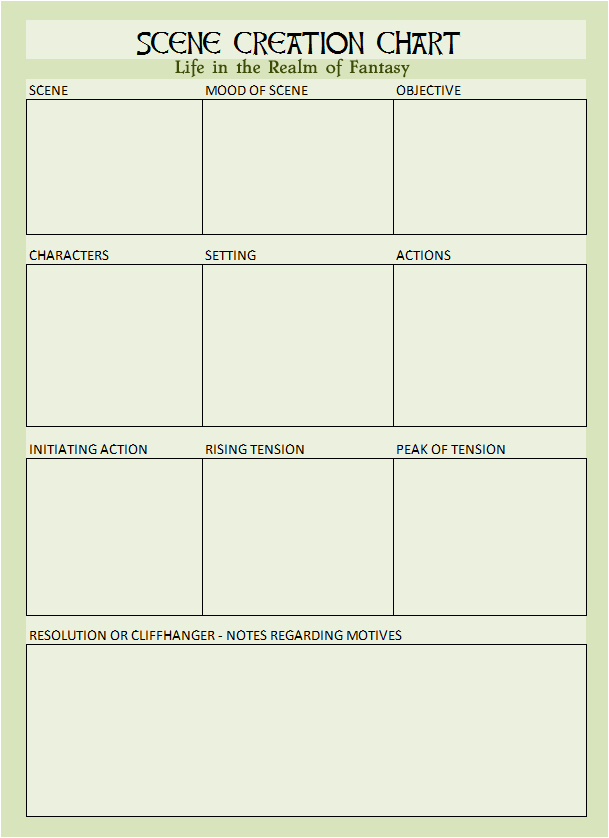
When that happens we can either drop out of writing mode (not an option for me) or we can find a way to yank that thought out of our head and identify what must happen to get that scene moving. I am a linear thinker, so after a little trial and error, and after seeing how other authors work, this is what I came up with, that works for me in regard to organizing a scene that I am having difficulty with. If it works for you, feel free to:

right click>save image as jpeg or png and save it to your hard drive to print out

Scene creation chartOnce I know how these seemingly disparate things fit together, the scene becomes unstuck, and I begin making progress again. Also, something about the process of spreadsheeting the scene gives me a little insight as to why a particular character might NOT need to be in that scene.

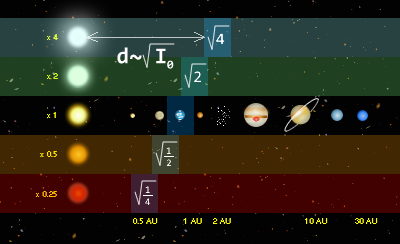
Sometimes just knowing who does and who doesn’t need to be in a scene is just as important as knowing where the nearest inhabitable (for humans) planet  might lie in a given star system.

Habitable_zone_-_HZ

1 Comment

Filed under Books, Humor, Literature, Publishing, Uncategorized, writer, writing

The Great Dialogue Debate

My Coffee Cup © cjjasp 2013We meet our friends on the street, or in a bar or a coffee shop and we talk talk talk.  And so do our characters.  Sometimes those wild and wacky imaginary friends of ours just won’t be quiet, and it drives us nuts. Other times they behave like a thirteen-year-old forced to go on the old family vacation,  sitting in stony silence staring at her signal-less phone, refusing to participate with those people who claim to be her parents and who dragged her off to the wilderness for something called ‘family time.’

Eww.

But when they DO choose to participate in the conversation, how do we make them sound natural? There is a lot of argument in writers forums on this subject, but I go from the point of view of the reader. What is easiest for the reader to follow?

Take a good long look at the works of established writers whose dialogue is crafted in such a way that you, as the the reader, didn’t feel like you were reading it: you felt like you were living it. Did they get too fancy, and uber creative?

No, they kept it simple, and showed you the conversation.

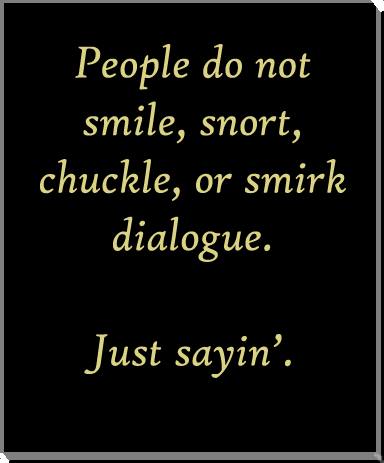
First off–my pet peeve: people do not smile, snort, chuckle, or smirk dialogue. They don’t giggle it either, but they DO say it, they reply it, and many times they ask it. As long as you mainly stick to said, replied, answered, and asked, your reader won’t even notice the attributions are there. If you are writing genre-fiction, there is no need to get creative with your attributions, or ‘dialogue tags’ as we call them: stick to ‘John said’ (not said John, which sounds too old-fashioned these days.) Unless you absolutely need a John screamed or a Sarah uttered or a Paula retorted (which you pretty much never do) just say it and let the reader do the rest. Fancy synonyms for ‘said’ are usually unnecessary and distracting.

You can skip using dialog tags altogether for a back-and-forth or two, but not if there are more than two speakers in the scene, and not for more than a few exchanges. Readers want to be able to track who is saying what.

Sometimes it’s okay to miss a few beats. Beats are what screen-writers call the little bits of physical action that is inserted into dialogue:

People do not snort dialogueBack in the office with the door shut tight, Junior and Pap plotted the special hunting trip for the nice tabloid man. Junior unbraided his hair and pulled it back into his customary long ponytail. Off came the blanket, which he told Pap smelled musty, and the headband. “Tell Johnny thanks for the loan of his buckskins,” he said as he stripped them off, stuffed them into a gym bag, and then pulled on a pair of slacks. “I’ll need them tomorrow for this picnic. That idiot wanted to leave at dawn! I told him after breakfast, so what do you think—about ten o’clock? I usually don’t go to bed until dawn.”

Beats or actions serve to punctuate the dialogue, to give the scene movement, and to maintain a strong mental picture in the absence of description.

Small actions showing the mood of a character are often best placed where there is a natural break in the dialogue, as they allow the reader to experience the same pause as the characters. They’re an effective tool and are essential to good dialogue, but don’t overdo it. If your characters are fluttering their eyelashes, gazing into the distance or opening their laptops between every second line of conversation, the scene becomes about the action and not the dialogue, and the impact is diluted or lost entirely.

This means that when we add gestures and actions to the conversation we want it to be meaningful,.  Otherwise, just use a simple dialogue tag, like said, or replied. This is why we don’t want to make the mistake of getting rid of attributions entirely—because the verbal exchanges become confusing and the action takes over, making the dialogue fade into the background noise of foot shuffling and paper rattling.

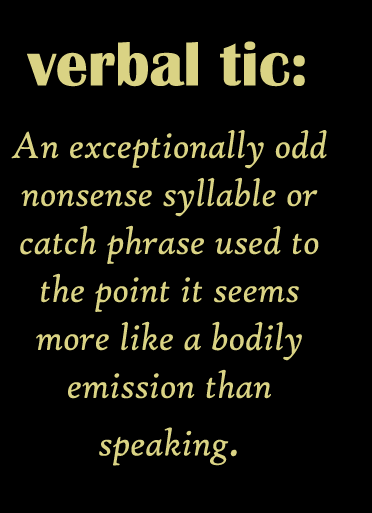
verbal tic memeBut what about exclamations and verbal tics?

We frequently speak this way  in real life, but we don’t want it in our work so I recommend you avoid using them. When a character overuses exclamations, it is exhausting for the reader to wade through paragraphs peppered with instance after instance of “Ahhhh…” “Ugh!” “Yuck!”  “Blech!”

For example, have you ever met a person who drones on with a long “A-a-and a-a-ahhhhhhhhh….” holding conversations hostage with meaningless syllables? These are ‘thinking syllables.’ This is what is known as a ‘verbal tic’ and can be such an ingrained habit the guilty party is unaware they are doing it. They’re often quite hurt if you try to hurry them along.

It’s a habit that we don’t enjoy in a conversation, and don’t want to read in novel, so I recommend you don’t begin more than a few sentences with thinking syllables like  “Ahh…” or “Hmmm….”

These are difficult speech behaviors to convey, because they are supremely annoying in real life and are excruciating to read in a book. As a reader, I’ve come to feel your best bet when dealing with verbal tics is to give a brief instance of their speech pattern and after that, if it is important, mention occasionally the way their habits annoy other characters.

What about accents? Grammar Girl, Mignon Fogarty, says “When writing for a character with an accent, it is tempting to render the character’s speech phonetically using nonstandard spellings. However, this practice is risky and should be avoided, unless you specifically want to emphasize how a character speaks. First, there’s the question of how accurate to be. The more accurate the phonetic spelling, the more frustrating it will be to read.”  

Don’t overdo spelling them out.  You have no idea how hard it is to wade through that:

490px-Henry_Singleton_The_Ale-House_Door_c._1790“Me lempsor’ ‘urt an’ oi’m feelin’ dead knackered. Oi nade ter kip for a while.”

Translation: “My feet hurt and I’m feeling dead tired. I need to sit and rest a while.”  I think you could get away with just using knackered and kip to convey the general idea, and not lose the reader’s interest. If you choose to replace ‘to’ with ‘ter’ for a specific character, be sure to do it consistently and consider leaving it at that.

I have walk-on characters who are minotaurs, and the physical transformation from man to minotaur affects their ability to speak, some more than others. They also come from a different world. This posed a dilemma for me. Because the lower ranked minotaur soldiers make only brief appearances, I can get away with a bit more of a dialect or a speech impediment. The higher ranking ones made it through the remaking with more of their wit and abilities intact, and therefore speak more clearly. I mention they have an accent and leave it at that.

More and more, I am leaning away from writing heavy accents into my dialogue. I recommend going light and limiting the use of misspellings, bad grammar, and vulgar accents especially if you are trying to point out that the character is uneducated or from a rural background.  Use only a few well-chosen words to convey the idea of the accent and use them in a consistent manner for that character in such a way that it isn’t incomprehensible. It’s very easy to go over the top with it, and then the character becomes a parody, a cartoon of a person, instead of someone who feels real.

This winds up my rant on annoying habits we don’t want to inject into our dialogue. Accents, dialects, verbal tics–these are things we need to convey, but we must be mindful of our readers’ supply of patience. Show a little, and let the reader’s imagination do the rest.

5 Comments

Filed under blogging, Books, Fantasy, Humor, Literature, Publishing, Self Publishing, Uncategorized, writer, writing

Infinite power equals infinite boredom

I attended a seminar on World Building this week offered by Lindsey Schopfer, local author and writing coach. One of my strengths is in that area, and I realized, as I listened to his talk, that it is because I use the same steps he does to make my world as real as is possible. I always know WHERE I am writing, WHO, and WHAT I am writing about.

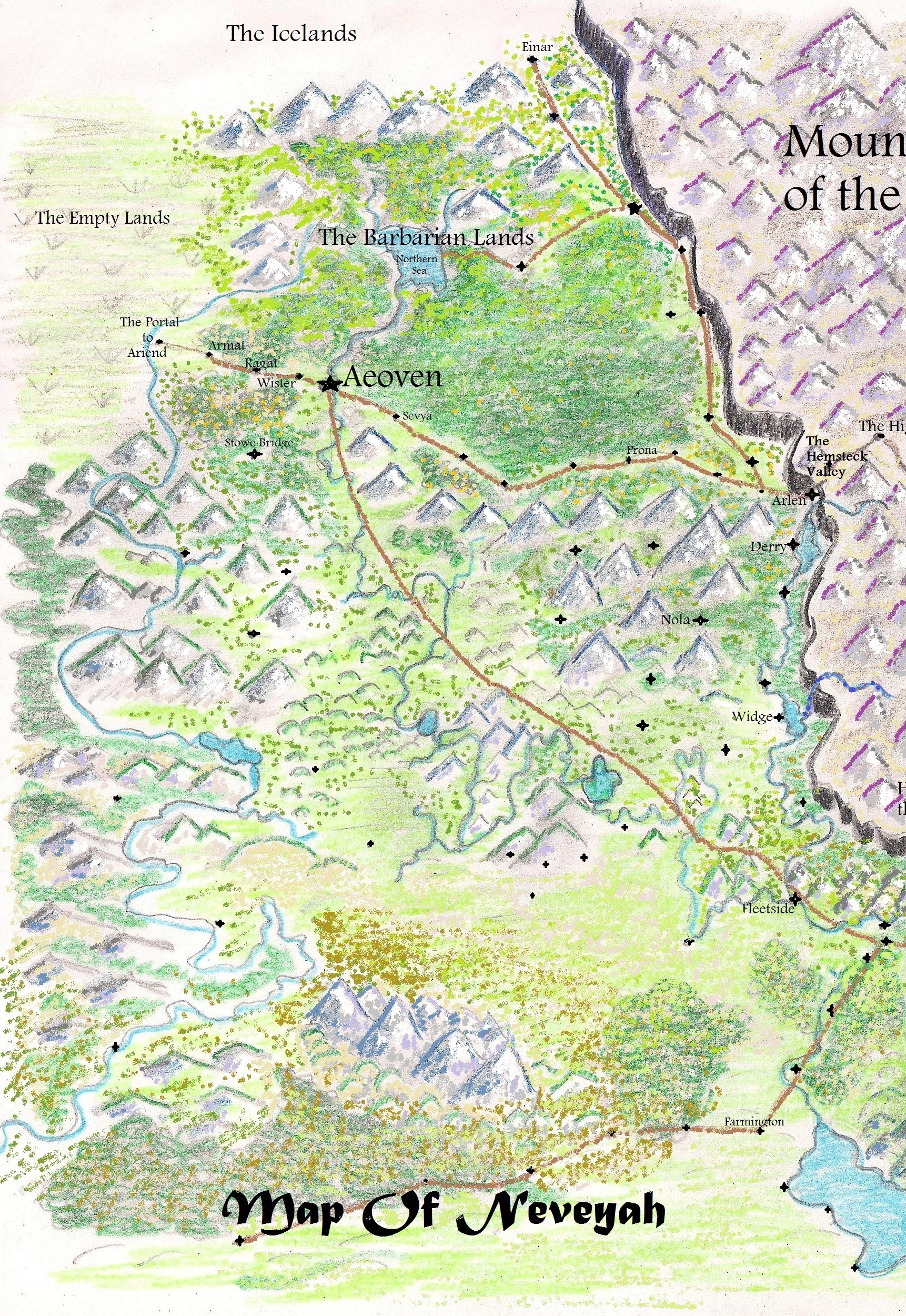
I begin by drawing a sketchy map.This way I have an idea of where the towns are in relation to each other. Nothing on a map is ever finite, they are only approximations–artistic guesses.

Heart of Neveyah relief 3-4-2013 001As I write, my map evolves, becoming more complex as the topography becomes more clear to me. In Neveyah, I began with a pencil sketch, and that evolved into a relief map that gave me the opportunities for injecting tension into the tale that I needed. It also provided me with a detailed explanation of where the resources are, so that funding my country is not an issue.

I build their political and monetary structure, and the prevailing religion. I decide who has the power and privilege in that society, and who is the underclass.

As I create the power-structure and the maps, the opportunities for creating tension within the story also grow. I keep a list of those ideas so that when I run short on creativity I have a bit in the bank, so to speak.

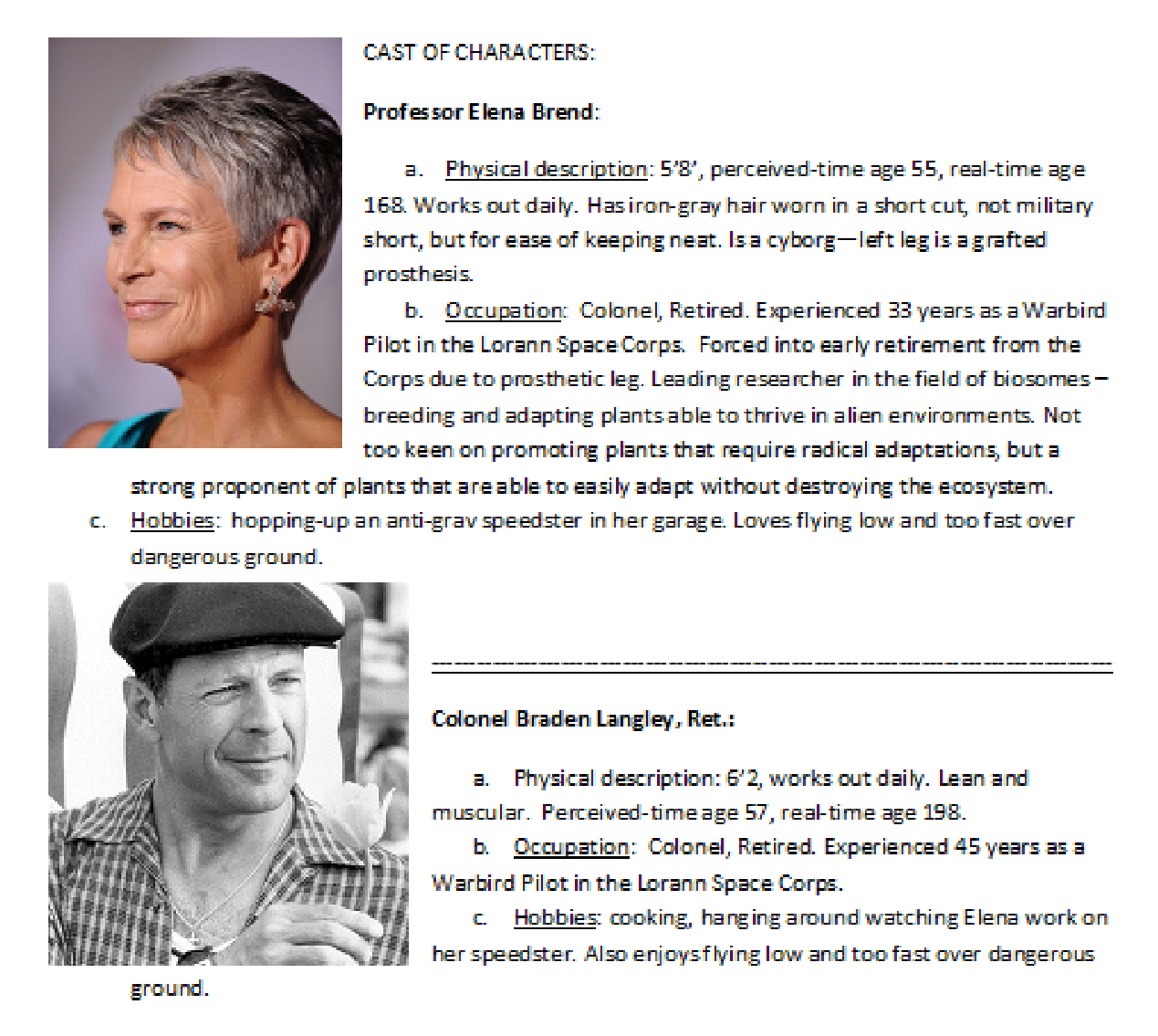
Another thing Lindsey mentioned that I also do is to create a sort of personnel file. (I was an office-manager for years, so I think in those terms.) Is everyone human? If not, what are their species and how do they differ from humans? What are their origins and why are they all together on this world. This information will most likely not make it into the tale, but it is important for me to know.

personel file for Elena and LangleySome people draw their characters, but my artistic talents run to less realistic things. In some cases, I select an actor who best represents my character or who could play him/her well. I am a whiz at cartoons and maps, but not at drawing people or animals, so that’s why I resort to simpler methods to cement them in my head. Once I know who they are, that is where I stop. The reader will decide from the bare-bones descriptions I will give as to what they look like and that will be more intriguing than if I belabor their violet eyes and stunning cheekbones.

When I design a religion, I do it from the ground up.  I know who the gods are, what they require of their worshipers and the rituals that worship involves.  The same goes for the political system. Who is in charge of the country, and what is their power-base? What is their currency and how do they get it? Alternatively, how do they spend it? Are they despots or benevolent?

Then, there is the magic. Who has magic? What kind of magic–healing or offensive or both? What are the rules for using that magic and why do those rules exist? I despise books where there are no clearly defined rules for the magic, because infinite power instills infinite boredom in me as a reader.

http://www.hdwallpapers.in/

Ask yourself what sort of wild creatures will live in your world. What do they look like and how big are they? How do they survive, what do they eat? Are they hunted, or are they simply benign creatures that harm no one? What is their place in the ecosystem?

How are you going to name your people and beasts? Do your readers a favor and use spellings that look fairly simple and look good on paper. DO NOT USE THE CONVENIENT NAME GENERATOR websites that the internet is rife with. They provide you with hokey, ridiculous  names no barbarian worth his salt would claim.

How do they dress? Do they wear armor? How difficult is that armor to get on and off?

How do they travel? Horses or spaceships each have certain basic requirements–both require fuel of some sort and both frequently need maintenance, whether it is currying or cleaning the exhaust vents. Who does this?

In conclusion, assembling this background information is time-consuming, but once I have it all together, my work is so much easier. The hard work is mostly done at that point, so there is less stopping and starting. All I have to do is get my heroes off the sofa and out of the house to the final battle on time, so they can save the world.


6 Comments

Filed under Adventure, blogging, Books, Dragons, Fantasy, Literature, Publishing, Self Publishing, WordPress, writer, writing

Journaling or Noveling

As summer ends and fall approaches, those of us who are regular NaNoWriMo writers begin to plan for our month of committed writing. We are jotting down ideas as they come to us, and making notes to help springboard ourselves into November with all our guns a blazing.

Generic-180x180People who have never heard of NaNoWriMo are always surprised that it is not only people who want to be published authors who use this month to create 50,000 word manuscripts. Family historians, dedicated diarists, people working on their PhD–anyone who wants or needs a month dedicated to getting a particular thing written will do so in November. More people do this during November than you would think–about half of our WriMos in my regional area are journaling or writing their theses. The support of the group really helps the graduate students stay focused, and it also bolsters those who are diarists and encourages them to write more about their thoughts and philosophies.

330px-Title_page_William_Shakespeare's_First_Folio_1623I’ve been asked many times what I see as the differences between journaling and noveling. (Sorry, word-nazis–I know,  I know! I just invented that word but hey, why not loosen up a bit and have a little fun with language? Willie Shakespeare did it all time!)

Anyway, journaling is keeping a diary. You do this on a daily basis, or at least frequently. According to Tiny Buddha “Journaling can help with personal growth and development. By regularly recording your thoughts you will gain insight into your behaviors and moods.” You start where you are in life at that moment, and for ten or fifteen minutes a day, you write stream of consciousness. This is an awesome way to jump-start your brain.

Noveling is telling lies, keeping them straight, and making the world believe it until the last page.  Again, William Shakespeare was awesome at this, and he put his work into the form of plays and sonnets, which were the most accessible media of the time for the common people.

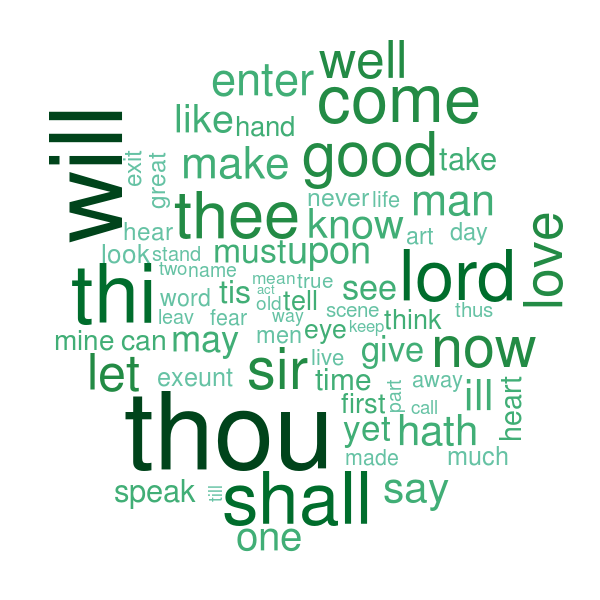
shakespeare-word-cloudHow many words did William Shakespeare invent? According to Shakespeare Online Dot Com: “The English language owes a great debt to Shakespeare. He invented over 1700 of our common words by changing nouns into verbs, changing verbs into adjectives, connecting words never before used together, adding prefixes and suffixes, and devising words wholly original. …  For a more in-depth look at Shakespeare’s coined words, please click here.”

Whether you are journaling or noveling, the important thing is to do it every day. Write for as long as you can when you can, and that will build your ‘writing’ muscles. If I dedicated 3 hours a day to just writing stream of conscious, I will chunk out 2500 to 3000 words–about half of which are mis-keyed and misspelled, but hey, no one is perfect. Some words I invent–and some words invent me, but either way, I love words.

Comments Off on Journaling or Noveling

Filed under Blogger, blogging, Books, Fantasy, History, Humor, Literature, Publishing, Self Publishing, Uncategorized, WordPress, writer, writing

Yes, but how do you really feel?

x - y chromosomesI love writing and I love my characters, but they are so stubborn about some things. Of course, many of them have ‘Y’ chromosomes, but still…. It’s frustrating because they don’t want to to talk about how they’re feeling.

Oh, for the love of Tolstoy–don’t they get it? I’m  a woman. I need you people to talk to me. Tell me what’s going on in your imaginary head.

It’s difficult to show the characters’ emotions and thought processes when it’s so much easier to just say he felt, or she was some emotion.  These thoughts and feelings are central to making our characters feel real. But describing them from a distance, as an author must do, may disconnect the reader from that character.

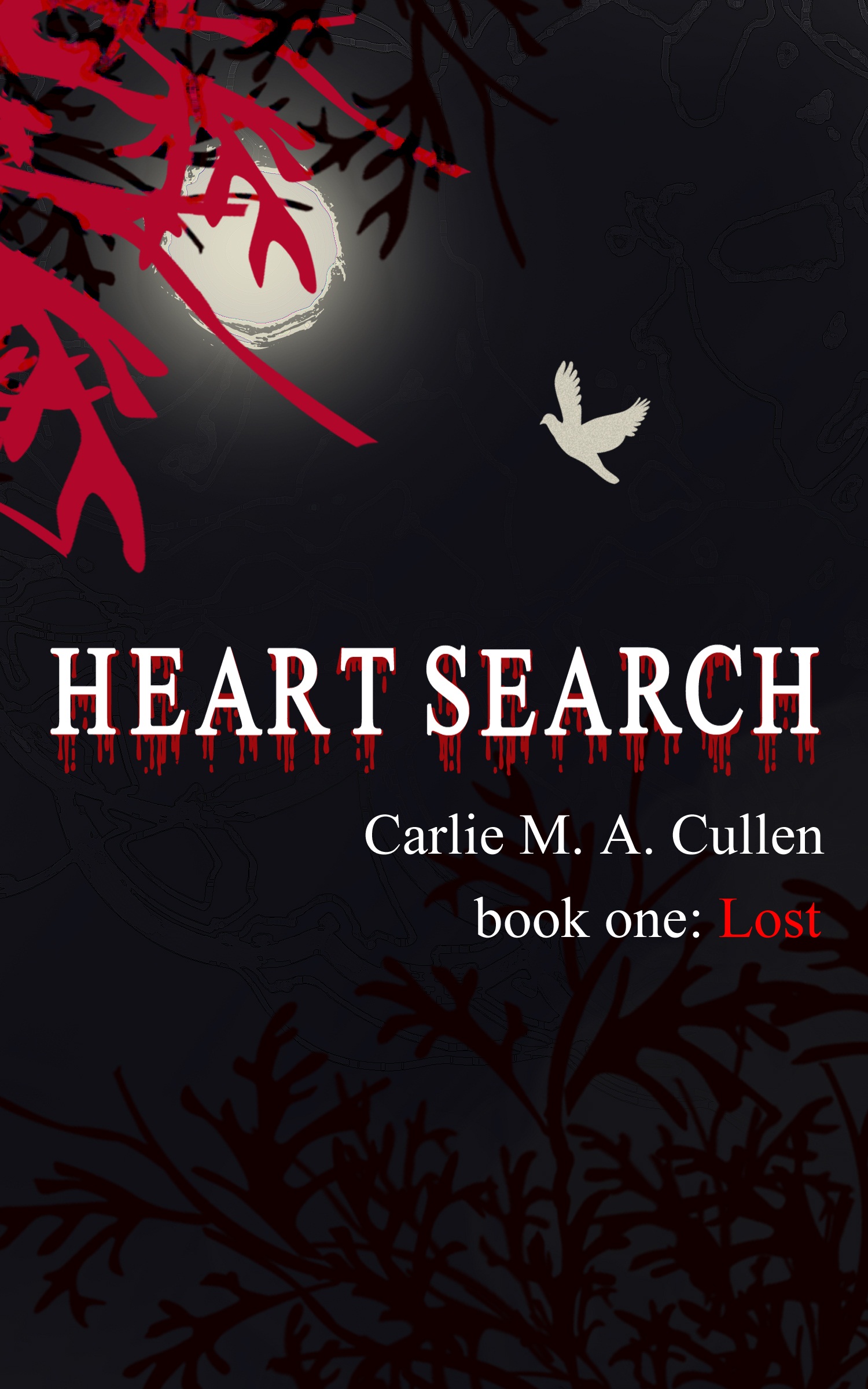
Sometimes, descriptions don’t allow the reader to experience the moment with the character. Instead, the author is telling them how the character feels.What we must ensure is that our readers remain immersed in the narrative, that no ‘speed-bumps’ come along to knock them out of it. Heart Search cover

One of the best at this is Carlie M.A. Cullen, whose urban fantasy series Heart Search  featuring a coven of vampires is gaining in popularity. I think her books are so compelling because of her ability to draw a reader into the character without going over the top. So, how does she do it?

The opening line of chapter one of Heart Search Book 1, Lost reads like this: The sun, a ferocious golden orb, burnt into his skin as Joshua wandered aimlessly through the country park.

She could have just written The sun was hot and Joshua was killing time in a park.

But she didn’t, and the story is better for it–AND she showed you both the scene and Joshua’s mood in that one sentence.

So what can we learn from reading our favorite authors? We can see how they craft their tales, and we can learn those skills. Painters do this all the time, and we paint with words. 480px-Schmalz_galahad

Let’s pretend we’re writing a fantasy novel. We can go over the top, like a painting by Herbert Gustave Schmalz, or we can find a happy medium between too much and too little. There is no need to sink into overly sentimental and exaggerated pathos in order to inject feeling into our work.

Here we have a character who is on the run from a creature of some sort. 1. He was afraid. He was terrified to look back.

Example one tells the reader how the character feels. We might write this in our first draft when we are just trying to get the story out of our heads. An unskilled writer would consider it just fine the way it is, as it expresses his thoughts perfectly.

However, it tells the reader how to feel, and readers really don’t like being told what to do.

2. He wiped the sweat from his brow with a trembling hand, fear from his narrow escape coursing through his veins. Heart pounding, he leaned against the wall, listening for any sounds that shouldn’t be there before chancing a glance around the corner.

Personally, I would read book number two over book number one, because it’s more interesting and makes me want to know more about this character and his problems. We need to use physical symptoms a character might experience combined with their actions, but  we need to describe them in such a way that it is a natural part of the scene.

John slid down the wall, sitting in the mud, his breaths coming in hard, ragged gasps. Something trickled down his cheek, and wiping it, his hand came away with blood.

Another example: Theodor_Hosemann_Weinstube_1858

Lord Deccan’s fist hit the table. “Wine now, you miserable worm–or I’ll cut off your other ear!”

The one-eared innkeeper scuttled to the cellar. He quickly searched the shelves filled with dusty jars of cheap wine, settling at last on a vintage he thought might suffice.

Baldric’s guests normally drank from wooden tankards, but he knew that wouldn’t suit. There was a goblet, one he’d come by in a peculiar way, but it was a fine cup and would do well enough to stave off a tantrum of the lordly variety.

His shoulders hunched in anticipation of trouble, he approached the angry lord’s table. Setting the only goblet before the nobleman, he left the bottle and stepped away, bowing with feigned obeisance. Baldric had  survived  the  war with all but his left ear intact, and intended to remain that way.

Sir Paul McCartney, image from Rolling Stone MagazineWhat we are doing here is exactly like interpreting what our loved one is telling us, when he/she refuses to use their words. Seeing them sitting slouched in the chair, clicker in hand and numbly flipping through channels is a good indication of their mood. So we must picture the scene and describe it .

We must show the emotions as they are reflected by the physical cues our characters give us, but don’t tell them–a difficult trick to master but one we must all do if we want our work to engage the reader.

7 Comments

Filed under blogging, Fantasy, Humor, Publishing, Self Publishing, Uncategorized, WordPress, writer, writing