Tag Archives: writing

Creating your author blog part 3 #amwriting

Today marks the end of my three-part series on author blogs. (Edited to add: Parts 1 & 2 can be found at these links:)

Creating Your Author Blog, Part 1

Creating your Author Blog, Part 2

One of the comments authors make most often when explaining why they don’t keep their blogs updated, is that they don’t know what to write about. One well-known author told me she sees it as a job that is as exciting as doing laundry.

I think it’s because it hasn’t occurred to her to write about her passions. She is a woman who has many different hobbies—climbing, cooking, and kick-boxing, as well as writing. It just hasn’t occurred to her to write a 500-word article about what she did over the weekend and post it for her fans to read. As a fan, I’d love to hear about her trip to the Sasquatch! Music Festival at the Gorge and get her opinion on the various bands that played there.

However, my friend regularly tweets about her hobbies. The fact is, many authors who use twitter to connect with fans don’t think that their lives are worthy of more than the 280 characters you must work with in a tweet. But a blogpost doesn’t have to be long. Think of it as a long tweet or Facebook post, and you will have 300 – 500 words written in no time.

That is an acceptable blogpost. My first posts averaged 400 words.

A great many of us are quite adept with Facebook as a medium for connecting with readers. The work you put into a Facebook post for your author page or a tweet could easily be turned into a short blog post.

If you fall into that category, even a bi-monthly update on your works in progress and where you will be signing books is a good option. We just need something to  keep our fans engaged.
Needing a blogpost is also an opportunity to quickly dash off a flash-fiction, a drabble, or a haiku. Authors need to write and keeping our blogs updated is a good way to keep those juices flowing when we are having a creative lull in other areas.

Life, my family, and the nuts-and-bolts of writing craft are my inspiration. I am always educating myself in this craft, and since writing is my obsession, that is usually what I riff on for 500 – 1000 words at a time.

However, I sometimes write about the challenges life hands us. I will talk about the worry of having two adult children who live with epilepsy. I have discussed how being vegan adds culinary adventure to attending conventions. I also have many creative grandchildren, some of whom who give me career advice, some of the more hilarious of which have made fun posts.

Sometimes, during the week, interesting things will come up in conversations in the writing groups I visit on Facebook. Often these little questions and how they relate to my own works-in-progress are subjects that I think might make a good topic for a blogpost. So, I keep a sticky note up on my desktop and note my ideas for topics as I come across them.

Usually, the only day I write blog posts is Sunday, but I write the entire week’s posts that day. Sometimes, I write them the day before I intend to schedule them, but I like to do them well in advance, so I can proofread them with fresh eyes before their posting.

Sometimes there is research involved, and I need to quote other websites. When that is the case, I make footnotes at the bottom of my composition document as I go. Pretend I need to quote from an article on Gallows humor. Footnotes or attributions are written like this:

Wikipedia contributors, “Gallows humor,” Wikipedia, The Free Encyclopedia, https://en.wikipedia.org/w/index.php?title=Gallows_humor&oldid=759474185 (accessed January 30, 2017).

If you are using images or quotes found on the web, only publish those you have the legal right to use. Do the right thing, and source your images and quotes responsibly. To find out more on that subject, see my article of September 4, 2017, Citing Sources and Image Attribution.

Some people wonder why I make footnotes at the end of most of my posts. I didn’t always do this, because I didn’t understand that even public domain and royalty free images found on Wikipedia should be attributed correctly. It’s our legal obligation, but there is a moral one here too: photographers and artists are as proud of their work as we are of ours—if you wrote something good and someone quoted you verbatim, wouldn’t you want to be credited? When you see your book offered for free on a pirate’s website, don’t you feel anger?

After my post is written in a document, I open WordPress or Blogger and select new blog post. Then, before I do anything else, I insert the title and schedule the date for publishing, so the post is prescheduled for the right publishing date. Prescheduling allows my blog to post a new article three times a week at 06:00 am my time (on a Monday, Wednesday, or Friday) which is 09:00 US Eastern time. It updates without my having to babysit it.

I do have to be observant when I am scheduling my posts. Occasionally, I accidentally hit the “publish immediately” button, which means I end up with an extra post that week whether I meant to or not. When that happens, I sometimes use naughty words. When I get done cursing, I either skip the Monday post or write an extra one.
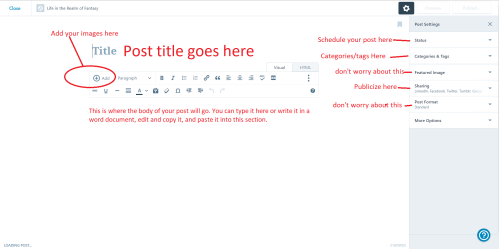
Once I have the post scheduled, I select the categories and tags.

For an author who is posting once a week or twice a month, it won’t take an hour to put together a post if you write in a word document, spell-check it, and paste it into the body of the post. I spell-check and self-edit my posts as well as possible. Blogposts don’t require an editor, but you should, at a minimum, check for these things:

  • We need to look for incorrectly spelled words and doublecheck the spelling of proper names. We also need to look for words that sound the same but are spelled differently.
  • We need to use good grammar—when we are blogging, it doesn’t have to be perfect but do your best. It will sound like you, and that is important.
  • Also look at sentence structure. Did you use complete sentences? What about run-on sentences? Lo-o-o-o-o-ng sentences can make reading a post confusing.
  • Numbers. This is especially an issue when using digits, as the difference between 10 and 100 is substantial.
  • Look carefully for dropped words or repeated words—my big bugaboo is the extra and or to in a sentence: and and.

Once I have my post edited as well as I can, I paste the document into the body of the post. It is a good idea to use the preview function and read your post. It looks different there than it does in a word doc, so you will find many things you want to change and can make any adjustments needed before the blog is actually posted. Even so, I always miss a lot of typos and other bloopers, so don’t freak if you have to go back and take the apostrophe of a plural word that is not a possessive: sharks vs shark’s (as I regularly have to do.)

Blogs look nice with an image, so insert pictures. I love looking for images on Wikimedia Commons and other free public domain sites, or sometimes I use my own photographs/graphics.

Blogging is where I come to talk about things that are on my mind, which are usually ideas about writing craft. Having the ability to write each post ahead of time, edit them, and select the date for publishing allows me to work the rest of the week at my true job, which is writing novels.


(07 June 2018) Edited to add the links to the previous posts:
Creating Your Author Blog, Part 1

Creating your Author Blog, Part 2

10 Comments

Filed under writing

Creating your Author Blog part 1 #amwriting

Much of this is taken from earlier posts on this subject, so if you have seen it before, thank you for stopping by, and the next post will be on creating blog posts.


‘Life in the Realm of Fantasy’ is a WordPress blog. I use WordPress because it is a free, open-source blogging tool and content management system.  I also have several other blogs on Blogger (Blogspot), which is also a free, open-source blogging tool and content management system. I prefer Blogger for ease of use, but it is limited. I love the way WordPress looks when you get to the finished product stage.

There is a small learning curve for each. But with very few skills, I have a decent-looking blog at no cost to me, using the fine tools and templates provided by the wonderful people at WordPress or Blogspot–and you can too.

The thing that is so awesome about both these products is you have the option to use them in what my husband-the-programmer calls ‘wysiwyg’ (pronounced wizzy-wig) or ‘what-you-see-is-what-you-get.’ The user does not have to know any programming or coding–all that is done for you already, and you just organize it the way you want it, within certain limitations.

If you want to use WordPress visit the WordPress home pageand select the ‘Sign Up’ button to register for a WordPress account. You’ll need a valid email address (that has not been used to create another WordPress account) to sign up for a new WordPress account. Follow the steps and bam! You have a blog.

But you can also do this via Blogger (blogspot), Google’s free blogging tool and content management system, also an extremely simple process.

Whichever platform you choose, I suggest you use your author name. I used Connie J. Jasperson. This links your author name to your blog, which is why you are doing this in the first place. Pick a title for your blog–this one is Life in the Realm of Fantasy.

I now pay something like $25.00 a year for the domain name, so https://conniejjasperson.com is mine. But for five years I used the free domain, which gives you a .wordpress.com ending after your blog name, such as http://myblogname1.wordpress.com.

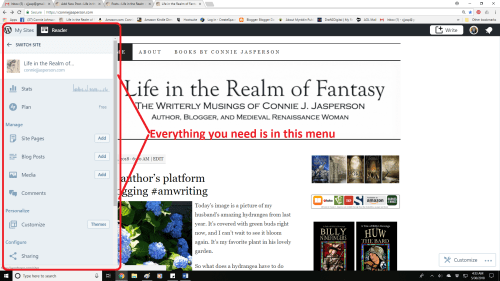
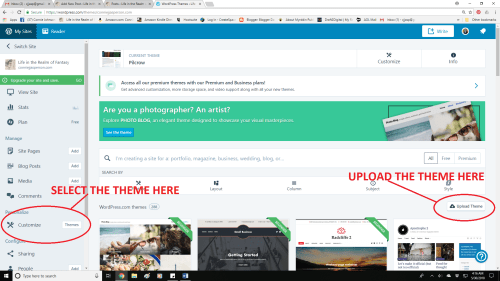
In WordPress, begin with finding a template. Open the left-hand menu and go to Customize and click on Themes. Select one of the many free templates. Once you find a theme that you like, you are ready to go. I use Pilcrow theme for this site because I like the versatility.

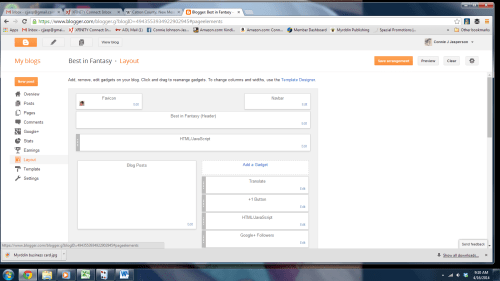
In Blogger, you will also come to a screen with many options. I suggest you just start at the top of the menu where it says template and begin playing around with it until you find the look and style you like best. You will be able to see most of your changes in the area below the Template Designer.

In both WordPress and Blogger, I keep the template simple because it is easier for people to read.

Once you have decided on that catchy title for your blog and have figured out the color of your fonts and background are all organized, decide the layout. You can make it one column with no sidebar, or with one or two sidebars. Sidebars are good places for advertising your books and book trailers, along with many other things you want to share with the world, such as blogs that you follow, and offers those who wish to follow your blog a place to sign up. The trick with sidebars is to keep them from junking up the blog, which I have a tendency to do.

In WordPress, you will click “Upload.” This will take you to the part where you REALLY customize the look of your blog. Open the menu on the left and begin customizing from there. Click on Customize and go to Widgets. You can add your book images there, and links to amazon or other sellers, along with all sorts of other wonderful things that will make your site uniquely yours.

In Blogger, click “Apply to Blog” in the upper right-hand corner. This should take you back to the Blogger page, where you will look in the menu on the left and click on the “Layout” button, just above the orange Template button. On the right hand side (yours may be different, depending on how you chose to display sidebars) click on add a gadget.

In both WordPress and Blogger, you will find many options to make your site look great, from inserting images to ways to add html code for embedding videos. You can get fancy with the header or use the header they offer you. The appearance of your site will evolve over time, as mine certainly has.

Both sites have awesome and informative help in their FAQs and I suggest you make good use of them. Everything I know was learned by my asking questions.

Do take some time to play around with arrangements. You can preview it, but if you accidentally hit publish, don’t freak because until you add content and tell folks it’s out there, no one will see your mistakes. Take as much time as you need to get comfortable with the system and remember that anything you don’t like can be undone.

On Monday, we will begin with the actual blogging part of your author website. This is as crucial as anything else because it is where you will connect with your readers.

13 Comments

Filed under blogging, writing

The author’s platform #blogging #amwriting

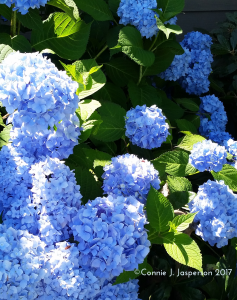
Today’s image is a picture of my husband’s amazing hydrangea from last year. It’s covered with green buds right now, and I can’t wait to see it bloom again. It’s my favorite plant in his lovely garden.

So what does a hydrangea have to do with blogging? Nothing, although a photo from a garden would be a good image for an author’s blog post. Blogging is a good way to connect with readers. It’s a platform where you can advertise your books and discuss your interests, and most importantly, talk about what you are writing.

I have made a personal commitment to post three times a week on this blog, plus I contribute posts to three other blogs. I do this because each time I write an essay on the craft of writing, I clarify my own thoughts on those points. Also, posting the occasional flash fiction on Friday keeps me sharp and keeps me writing little bits of prose I might otherwise not have the chance to write.

Many of you know that I first began blogging because my former publisher insisted I do so. This, he said, would help get my name out there, and give me a regular platform for my opinions. That original blog is long gone, and those posts were pathetic attempts to write about current affairs as a journalist. That blog failed because writing about current affairs is something that has never interested me.

What I learned from that otherwise-negative blogging experience is important: it wasn’t until I stopped trying to fit into a mold someone else had designed for me and began writing about my interests that I learned to love the craft of blogging. When I made that connection and commitment to writing about what I enjoy, I began to grow as a writer.

When I’ve had a small success and am in danger of becoming too full of myself, blogging never fails to provide me with a sharp dose of reality. I must work hard to proofread my own work and then publish it. Nothing bursts your bubble of self-importance like discovering gross errors and bloopers several days after you published the post.

Oops.

Regularly writing blogposts has made me a “thinking” author, as well as a “pantser.” I can write using the “stream-of-consciousness” method or write from an outline of whatever interests me at the time. I do the research, and the post begins to write itself.

I have found that a good length for a blogpost ranges from about 500 words to not more than 1,000. Having that limit means I must keep my area of discussion narrow, and not get sidetracked.

This helps me when writing flash fiction, as most flash fiction can only be up to 1000 words. When I first began writing flash fiction, telling the entire story in so few words was often an issue. Writing blog posts really helped me learn that skill.

I have found that writing blogposts isn’t that difficult per se. I can knock one out in less than an hour if I’m fired up about the subject.

What I find most challenging now is sourcing ideas for new and interesting content. I have written posts on nearly every aspect of the craft, and don’t want to bore people. I also write on the craft for two other professional organizations and don’t like to repeat myself there either. These commitments have me scrambling though my notes to see what questions people might want to have answered, and then doing the research—my favorite thing.

During the week I make a note of any interesting topic that might make a good blog post. The only day I write blog posts is Sunday, but I write the entire week’s posts that day. If there is a lot of research involved, I make footnotes with citations and sources as I come across the information. When that is the case, getting the week’s articles ready could take the whole day. Usually writing the posts for the week only involves the morning.

If you are a blogger who only posts once a week, writing your blog post should take less than an hour.

I spell-check and self-edit my posts as well as possible. Then I go to each website where they will be posted and pre-schedule them. By using the tools each platform offers (be it WordPress or Blogger) to schedule in advance, they will post without my having to babysit them. Having that ability allows me the rest of the week to work on my true job, which is writing novels.

If you are an author, you really should be blogging too—but you don’t have to blog as frequently as I do. Think about this: your website is your store, your voice, and your public presence. Readers will find you and your books there. So, offer them a reason to come and look at your books.

Many of you are saying that it’s hard to gain readers when your website is new, and you first begin to blog. This is true, but that will change if you just keep at it. The reason we write is for people to be able to read our work. When we have a limited audience, we feel a little defeated in our efforts to gain readers. In the world of blogging, as in everything else, we start out small and gain readers as we go along—but we gain them more quickly if we keep the content updated at least bi-monthly.

Because authors want to gain readers, it’s necessary for them to use every platform available to get the word out. Updating our website blogs twice a month offers us many opportunities to do just that and keeps us in touch with the people who count—our readers.

My next few posts will discuss the little things I’ve learned about blogging, beginning with how to get your own author blog up and running at little or no cost to you. I am fluent with WordPress and Blogger, two free-to-the-author platforms, and I will explain how to get started with both platforms. After that, we will talk about finding new content.


Credits and Attributions

Hydrangea, image by Connie J. Jasperson ©2017, All Rights Reserved

Comments Off on The author’s platform #blogging #amwriting

Filed under blogging, writing

Works In Progress update #amwriting

This week has been busy. I have finished my work as a reader for a short-story contest, which was an awesome gig, I am nearing the end of an editing project, and I am continuing to discover who my characters are in my current first draft. I am 70,000 words into this project, which is slated to be a duology. This means I am about a third of the way through it.

When I published the Tower of Bones series, I learned a difficult lesson. As slowly as I write, I need to have the entire series fleshed out and in the form of the final draft before I begin editing the first novel or it will take three years for the next novel to be published. That isn’t acceptable—people want the follow-up books in a timely fashion.

The entire two-book story arc is now laid out, and some sections are complete, but some of the characters are still raw and unfinished. I don’t really know them the way I need to for this story to come to life. After all, I can say they are charismatic all I want, but if the readers don’t find them that compelling, the story will fall flat.

At this point, I am still fleshing out my main character as a human being. He and I have come far, but I still don’t know him as well as I know his father and his brother. I am beginning to get a grip on him but some aspects of his character still elude me—he is still at what I think of as the “he-went-he-saw” stage of development.

When writing the other characters, I asked them to “talk” to me, asked them to tell me who they are and what is most important to them. So that is what my protagonist is doing this week. I have him as an old man, sitting on his porch and telling me what really happened. This is a short story, but it will never see the light of day.

This 2,000 – 5,000-word exercise is all backstory and will go into a file labeled as such. When I go back to writing the actual novel, this information won’t even be a part of the story. But because I have talked to my protagonist, Alf, and gotten to know why he thinks the way he does, his actions and reactions will be organic and natural. His motivations will become clear, and the reader will feel that Alf wouldn’t think any other way.

My antagonist, Daryk, will also have the chance to talk to me this week in the form of a letter written to me. He will tell me who he is and why he should really be the protagonist rather than the bad guy, as he is really the good guy and I have it all wrong.

I discovered this method during the rewrite of the Tower of Bones series. I knew who my main character and his companions were, as I had designed the original game story line around them. But I couldn’t get a grip on why my evil guy was so wicked and why he was convinced he was the good guy when his actions were so reprehensible.

What I finally did for Stefyn in Tower of Bones, was this—I had him write a long letter to me, explaining his reasons and trying to convince me that he was the real protagonist. Having read his reasons, Stefyn’s motivations were easy for me to understand. His commitment to his god’s path was fundamental to who he was.

My new antagonist must also be that committed, but he comes from a completely different culture than Stefyn, who was raised to be who he is. Daryk was once my protagonist, Alf’s, dearest friend and companion. Caught in a mage-trap during a battle, he has been turned against his will to the path of the dark god. Now he has abandoned the path of Aeos and has become Tauron’s highest priest.

In my current work,  Neveyah has recovered from a global disaster. The war of the gods brought three civilizations to their knees five hundred years prior. Additions have been made to the maps, and some places that are there in Edwin’s time are not there in Alf’s.

Humanity has emerged from the ruins, but the world is a different place. The tribes were sundered from each other, and the southern tribes no longer remember their roots—a source of tension between the two different cultures.

Now Neveyah is poised on the edge of another cultural change no matter which deity wins this skirmish in their ongoing battle. To survive, the disparate societies will have to work together under a strong leader. Who will that leader be, Alf or Daryk?

I have written the overarching story and the plot. The side characters are clear in my mind and on paper. The two most important characters, Alf and Daryk, are equally matched in abilities, but only one can succeed. The path before each character is difficult and the differences between them is clear. Alf’s companions are his greatest strength, and they serve Aeos beside him as equals and follow him out of respect. Daryk has only one close companion, his wife, and she is under a magic geas (spell) to serve him and his god.

Alf leads by reason and example—many times he has difficulty swaying people to what he believes is their only salvation. Daryk leads by force of will, and when that fails, he compels his wife to use her mind-magic to “make them understand.”

Historical figures of the stature of Alf and Daryk must embody personal charisma and great leadership ability. People must wholeheartedly believe in them and desire to dedicate their lives to following them. My current mission is to understand what makes these two people charismatic enough to be great leaders and figure out why each one could win. That final battle will decide the future of a world, and if I don’t make it epic, there is no point in writing the tale.

Epic battles require epic characters. Hopefully, over the next few weeks of getting to know these characters, I will know why each one deserves to succeed. My hope is that finishing the first draft of these two books will only take half a year—although it could take longer.

As I mentioned above, I do write slowly. This is because much of what I write ends up being rewritten based on beta readers’ comments–and new ideas that pop into my head at 03:00 in the morning.

4 Comments

Filed under Publishing, writing

Thoughts on the craft #amwriting

We who write all begin this journey with a story we think would make a great book, and a certain amount of natural talent for storytelling. However, unless we have an exceptional memory for the obscure and boring lectures we endured in grade-school grammar, authors who are serious about the craft must learn how to write.

This means they must learn how to construct a sentence using accepted rules of grammar. They must also learn how to construct a story, so it has a beginning, a middle, and an end. The core features of a great story are:

  • Originality
  • Plausibility
  • Plot arc
  • Character arc
  • A satisfying end

Within those pages, we want to see:

  • Unique characters
  • Well visualized settings
  • Compelling dialogue
  • Tension and pacing
  • Hooks and transitions that make a reader want to turn the page

Knowledge of grammar and writing craft is crucial if you want a reader to stay with your story. As I’ve mentioned before, commas are to clauses what traffic signals are to streets—they govern the flow of traffic, although, in the case of sentences, the traffic is comprised of words, not cars.

The opportunity to learn writing craft is out there on the internet, and it costs nothing.

Education in America is under fire at all levels. The determined learner can still get that education simply by going to the library and asking questions. Start there and use the information you glean there to lead you to other places to learn writing craft via the internet.

This is why it is crucial for us to support the libraries in our towns, both financially if possible, and with our patronage. In places where the education system is broken, libraries are the last bastion of opportunity for both children and adults with limited funds and unlimited curiosity.

If you are fortunate enough to have a secondhand bookstore in your town, purchase secondhand books on writing craft, and invest in technical manuals detailing different aspects of writing.

For the financially strapped author wanting to increase their knowledge, an amazing resource is the website Writers’ Digest. They are also for profit, but they offer an incredible amount of information and assistance for free.

So here are several sources of online information about the craft of writing (and I’ve listed them before):

I’ve also mentioned before that Harlequin has one of the best websites for teaching authors how to develop professional work habits, which is critical to being productive. I highly recommend you go to websites that specialize in writing romance novels regardless of what genre you write in.

I say this because the romance publishers have it right: they want to sell books, and they want you to succeed:

  • They get down to the technical aspects of novel construction and offer many excellent tools for getting your work out the door in a timely fashion–something I need to work on.
  • They also offer tips on marketing your work.

Many authors are able to get a degree in creative writing. But many talented authors don’t have the money or education to get into a program like that. They are working day jobs to support their families and money is tight.

However, an education can be obtained at little or no cost–but it takes effort and determination. Though we may not have the money or time to get an official degree, many of us will become knowledgeable the craft of writing by obtaining information in bits and pieces over time. This is the method I have used–a combination of some college classes, writers’ workshops, and many hours of reading books on the craft of writing.

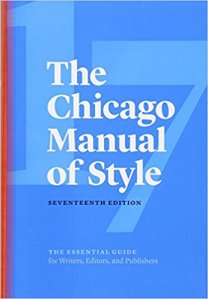
If you only have two books on your desk, one should be the Chicago Manual of Style, and the other should be the Oxford American Writers’ Thesaurus. Besides those two books, these are a few of the books I keep in hard-copy and refer to regularly:

Story, by Robert McKee

Dialogue, by Robert McKee

The Writer’s Journey, by Christopher Vogler

The Sound on the Page, by Ben Yagoda

Rhetorical Grammar, by Martha Kolin and Loretta Gray

You may not be able to afford to take writing classes or have the time to go to college and get that degree. But you may be able to afford to buy a few books on the craft, and it’s to your advantage to try to build your reference library with books that speak to you and your style. You will gravitate to books that may be different than mine, and that is good. But some aspects of our craft are absolute, nearly engraved in stone, and these are the basic concepts you will find explained in these manuals.

Reading is the key. Read widely, and you will begin to understand many different forms of literature. We all know that reading widens your horizons and opens your mind to possibilities in your own work that you otherwise wouldn’t consider.

Most importantly, you must lose the fear of being stuck reading works you don’t enjoy.

An essential skill for you to gain as a writer is the ability to clearly identify what you don’t like about a given work.

By reading widely, you will become less inclined to make broad statements, such as “I don’t like sci-fi.” You will be able to identify what it is that you don’t like about a given novel rather than dismissing an entire genre.

So much can be done at no cost financially, but it does require a desire to learn and the willingness to try.

If you have some funds to dedicate to learning the craft of writing, you can take online classes or attend seminars in your local area.

Look at the calendar of your local library and see if they are offering any FREE seminars on writing craft. If you check in your local area, you will be surprised just how many opportunities there are to learn about the craft of creative writing.


Credits/Attributions

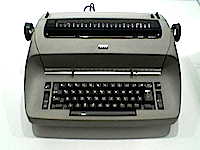
IBM Selectric, By Oliver Kurmis (Self-photographed) [CC BY 2.5 (http://creativecommons.org/licenses/by/2.5)%5D, via Wikimedia Commons, accessed Feb 26, 2017

The Chicago Manual of Style, University of Chicago Press; Seventeenth edition (September 5, 2017) Fair Use

12 Comments

Filed under writing

Five Thoughts On Writing #amwriting

Today, I have five thoughts for your consideration:

One: Some people don’t know what to do with commas and attempt to do without them altogether. This is not a good idea. Commas are to clauses what traffic signals are to streets—they govern the flow of traffic, although, in the case of sentences, the traffic is comprised of words, not cars.

  • Commas follow introductory words and clauses. Instead, they took a left turn.
  • Commas set off “asides.” Her sister, Sara, brought coffee.
  • Commas separate words in lists: We bought apples, oranges, and papayas for the salad.
  • Commas join two complete sentences, and once joined, they form one longer sentence. When used too freely, linked clauses can create run-on sentences.
  • Commas frequently precede conjunctions but only when linking complete clauses. When linking a dependent clause to a complete clause, don’t insert a comma. “I intended to come back to the Swords but found myself here instead.”

Consider how many sentences you link together with the word and. Could brevity strengthen your prose? Conjunctions are the gateway to run-on sentence hell. If you are deliberate in your use of conjunctions you will also use fewer commas. Craft your prose, but use grammatical common sense.

Two: Don’t write self-indulgent drivel. Go lightly with the praise, adoration, and general lauding of your characters’ accomplishments.

Three: Use active phrasing. There were Small colorful flowers growing grew in each raised bed. and some slightly Larger flowering plants growing grew around the fountain at the center. With a mixture of mild pastels and vivid colors, it was beautiful.

Four: Don’t waste words describing each change of expression and mood. Consider this hot mess of fifty-one words that make no sense: Eleanor looked at Gerard with concern. His voice changed so much in the telling of the story as his emotions came to the surface that it still seemed so raw, as if Timmy’s death had happened only days ago. In addition, his expressions also changed and his current one was akin to despair.

It could be cut down to fourteen words that convey the important parts of the sentence: Gerard’s raw despair concerned Eleanor, seeming as if Timmy’s death had happened only days before.

Five: Simplicity is sometimes best. “Delicious sounds captivated their eardrums. Please, just say it sounded amazing. If music touches the protagonist’s soul, it’s good to say so. We want to convey the fact the music was wonderful, and we don’t want to be boring. But when we try to get too artful, the prose can become awkward. Odors and sounds are part of the background, the atmosphere of the piece and while they need to be there, we don’t want them to be obtrusive, in-your-face. This is an instance of prose working better when it isn’t fancy.

Five thoughts to get your writing week started–now, go! Write like the wind!

15 Comments

Filed under writing

Beta Reading VS. Editing #amwriting

Once again, the question of the difference between beta reading and editing has arisen in one the many forums I frequent on Facebook. So, I feel the need to revisit a post from 2015, Beta Reading VS. Editing. If you’ve already seen this post, nothing has changed in the world of editing and beta reading since this first appeared. But thank you for stopping by!


Indies rely heavily on what we refer to as beta readers to help shape their work and make it ready for editing. But in many online forums, authors use the term used interchangeably with editing, and the two are completely different.

And unfortunately, some indie published works are clear examples of work by authors who don’t realize the importance of working with an editor, although it is apparent that they have had assistance from beta-readers.

What is quite disappointing to me, is the many traditionally published works that seem to fall into the same lack-of-good-editing category, and I am at a loss as to why this is so.

So, what is the difference between a beta reader and an editor?

Well, there is a HUGE difference.

Editing is a process, one where the editor goes over the manuscript line-by-line, pointing out areas that need attention: awkward phrasings, grammatical errors, missing quote-marks, or a myriad of things that make the manuscript unreadable. Sometimes, major structural issues will need to be addressed. It may take more than one trip through to straighten out all the kinks.

  1. In scholastic writing, editing involves looking at each sentence carefully and making sure that it’s well designed and serves its purpose. In scholastic editing, every instance of grammatical dysfunction mustbe resolved.
  2. In novel writing, editing is a stage of the writing process in which a writer and editor work together to improve a draft by correcting errors and by making words and sentences clearer, more precise, and more effective. Weak sentences are made stronger, nonessential information is weeded out, and important points are clarified, while strict attention is paid to the overall story arc.
  3. The editor is not the author She can only suggest changes, but ultimately all changes must be approved and implemented by the author.

Beta Reading is done by a reader. One hopes the reader is a person who reads and enjoys the genre that the book represents. Beta reading is meant to give the author a general view of the overall strengths and weaknesses of his story.

The beta reader must ask himself:

  1. Were the characters likable?
  2. Where did the plot bog down and get boring?
  3. Were there any places that were confusing?
  4. What did the reader like? What did they dislike?
  5. What do they think will happen next?

Beta Reading is not editing, and the reader should not make comments that are editorial in nature. Those kinds of nit-picky comments are not helpful at this early stage because the larger issues must be addressed before the fine-tuning can begin, and if you are beta reading for someone, the larger issues are what the author has asked you to look at.

This phase of the process should be done before you submit the manuscript to an editor, ensuring those areas of concern will be straightened out first.

Editors and other authors make terrible beta readers because it is their nature to dismantle the manuscript and tell you how to fix it. That is not what you want at that early point–what you want is an idea of whether you are on the right track or not with your plot and your characters, and if your story resonates with the reader.

Do yourself a favor and try to find a reader who is not an author to be a first reader for you. Then hire a local, well-recommended editor that you can work with to guide you in making your manuscript readable, and enjoyable.

If you notice a few flaws in your manuscript but think no one else will notice, you’re wrong. Readers always notice the things that stop their eye.

In my own work, I have discovered that if a passage seems flawed, but I can’t identify what is wrong with it, my eye wants to skip it. But another person will see the flaw, and they will show me what is wrong there.

That tendency to see our writing ‘as it should be and not how it is’ is why we need other eyes on our work.


Credits and Attributions:

Beta Reading VS. Editing, by Connie J. Jasperson, © 2015 first published on Life in the Realm of Fantasy.

31 Comments

Filed under writing

Character description: too much or not enough? #amwriting

I love eBooks for the simple reason I have over 800 books, and I don’t have to dust them. I do buy paper books, but only those on writing craft or research for my work.

I have managed to get nearly every book I ever loved as an eBook. Every week I add at least two more books to my library. I have become a fan of hundreds of new authors, most of them indies.

Every now and then I read a book that is traditionally published, sometimes taking a dip into general fiction. I did that this week, reading a book I saw advertised on twitter. I picked it up, knowing I might hate it because the critics loved it.

I can live without a happy ending, and even with no ending at all. Not every story ends happily. But please, make the pages that come before that lack of ending something more than self-indulgent hero worship of your protagonist. I get that you’re in love with your characters. I’m in love with mine too.

Just don’t wax poetic about their magnetic beauty on every third page, please.

Unfortunate phrasings that yank me out of a book:

“She lay there staring with her creamy blue eyes, water pooling in the corners.”

“Her eyes were the same color as the deep purple velvet drapes.”

Meh. Enough about their eyes already. Some authors go to incredible (and at times, awkward) lengths to force their personal creative vision of what a character looks like on the reader.

I don’t know about you, but I don’t want to be told what to think when I am reading a book. What I consider beautiful is not necessarily attractive to someone else.

But this brings us to a dilemma that many authors seem to face. How do you describe a character in such a way that the reader will find them as attractive as you want them to be?

You must give the reader enough of a general description that they can fill in the blanks with their imagination.

Generally, you want to show a character’s coloring, hair style/color, eye color, general physical description. Especially, you must somehow mention anything that is unique about their appearance. If they are not too fastidious, mention it, and the same goes for if they are obsessively fastidious.

Actions can reveal physical characteristics and mannerisms. Consider how they fix their hair, what style of clothes they gravitate to, even how they move and interact with both the environment and other characters. What are their habitual facial expressions?

Offer this information up in bits over a period of time rather than dumping it in a police-blotter style of delivery. Just don’t go on and on giving minute, unimportant details.

In my Tower of Bones series, the men in Edwin’s family have this sort of cachet that makes them irresistible to all women. It is the Goddess Aeos’s way of ensuring that the girl she has selected for them falls in love with them, and their bloodline is continued.

But what do Edwin and his father (and grandfather) look like? Edwin and his family are a lot like my uncles were as young men, tall, blondish, blue-eyed, and physically strong from working on their farm. They’re rather average, nothing spectacular. They’re good-looking, but aren’t overly handsome. However, there is something about them that causes trouble in a certain strata of female society that has a rather free approach to life.

So what is this charisma these men have? (And that my uncles did not have.)

Here is where I romanticize them. To most men, they seem no more intriguing than any other person, but to women, they are an irresistible banquet of masculine pheromones. Since they do a lot of traveling, this creates opportunities for mayhem. While writing the Tower of Bones series, I’ve had a lot of fun with that plot-line, especially when it came to Wynn Farmer in Mountains of the Moon.

For my other characters in various books, again we write what we know. In my mind, all my characters are exceedingly good-looking in their own different ways. I am of British Isles stock as is most of my family, but I live in a town filled with people of all races and origins. Throughout my life, my neighbors have been from such diverse places as Japan, Mexico, Alabama, Norway, Cambodia, Nigeria, India, and Minneapolis.

Thus, in my head, my characters are of all races, and all are attractive to me.

Huw the Bard is darkly handsome, blue-eyed with black curling hair, and has a roguish charm that women find irresistible. An incurable romantic and on the run, he loves many, but gives his heart only to a few.

Billy Ninefingers is exceptionally tall and strong, sandy-haired, with a boyish face. He’s competent and a strong leader with a firm sense of justice. He is in love with only one woman, but there are complications.

Reina Jacobs is a middle-aged woman, a retired pilot who has been conscripted back into active duty. She has short iron-grey hair and is a cyborg. She is attracted to Ladeaux, a pilot of her age, but while they are working together, she won’t fall into a romance.

Personally, I don’t find Prosperine as painted by Dante Gabriel Rossetti to my taste, although as a painting it is flawlessly executed. But millions of people find her beautiful, and he certainly did. His model, Jane Morris, was considered a great beauty in her day.

Yet the images of her, both painted and photographed, portray her as sulky-looking, which is not attractive to me at all.

I choose not to beat the reader over the head with my personal vision, other than the general description for the reader to hang their imagination on. I want the reader to see beauty and magnetism in the way that is most appealing to them. I hope that mannerisms, conversations, and other characters’ opinions convey the image the reader wants to see in a protagonist.

And this is the way it is for every author. We are painters who use words to show an image. We want to the reader to see what they believe is beauty.

Your vision of beauty is not what your readers see, and to force too many details on them ruins the flow of the tale.

A good general description, with hints or comments about their beauty or lack thereof, is all that is needed. If you provide the framework, the reader’s mind will supply the rest.

15 Comments

Filed under writing

First-person Point of View #amwriting

A month ago, I mentioned the problems I was having with a short story I had been working on. I couldn’t seem to get into my main character’s head. So, I rewrote it in the first-person present tense narrative mode, but because I was unused to that mode, it felt like I had written a walk-through for an RPG (geek-talk for role-playing game).

Apparently, it read that way too.

But after a lot of help from my writer friends, and a lot of rewriting, I got into the swing of things. Finally, the story drew me into my character’s mind, which was what I had wanted all along.

In traditional first-person POV, the protagonist is the narrator. One thing I had to keep in mind is that no one ever has complete knowledge of anything so the narrator cannot be omnipotent. At first, this was difficult for me. When I chose to have the reader experience the story as the protagonist does, I had made a fundamental change in my style of writing, and my finished product has required several rewrites.

After all, in real life, we aren’t all-seeing and all-knowing. Any lawyer will tell you, even eye-witnesses are notoriously unreliable.

We each see and interpret things from our own perspective. The human mind is hardwired to fill in the blanks—this is why eye-witness accounts of a single event will often vary so widely.

That lack of information is why I now love writing in this point of view for short stories.

What I had to figure out:

Who is the best person to tell the story? I could easily have told it in third omniscient POV, but I had a compelling main character with a real, gut-wrenching story. It didn’t feel as close, as intimate as I wanted it to be when written in my usual narrative mode of Third Person. She had to tell her own story.

What was the inciting incident? That was also difficult – deciding where the story actually began was the first step to getting it on track. Because this story is intended for submission to an anthology, I have a specific word count to fit the story into, and the anthology’s theme must be strongly present throughout. After reading the first draft, a writer friend pointed out that the narrative had to begin at the point of no return, as there is no room for backstory.

They were right. Thus, I had to scratch the first half of the story and begin at what I had thought was the middle. That was when things began to fall together.

What does she actually know? She isn’t omniscient, so she can only know what she has witnessed. That was also a problem for me, as I know everything. Just ask me. But I had to figure out what she really could have witnessed, and then work only with that information.

What does my protagonist want? At first glance, it seemed obvious, but the truth is that her quest is to find herself as a human being, as much as it is to honor a promise made and quickly regretted.

What was she willing to do to achieve it? I didn’t know. She didn’t know either, and until I wrote the last line in this tale, I didn’t know what she was capable of or if she had the backbone to accomplish it.

I am once again approaching the finish line on rewriting this tale. The submission deadline is still several months out, so I’m not rushing. I still have to rework and condense a few things at the front end of it, but now I know what changes I want to make. Writing this story has been an awesome adventure for me, and once this is ready for an editor’s eyes, I might attempt writing another in the first-person point of view.

Sometimes writing a story with a finite word-count limit and a specific theme to adhere to is as time consuming as writing a novel. But finding ways to work within these constraints is making me a stronger writer, so even if this isn’t picked up by the publication I hope it will be, I will have a good marketable story.

I’m grateful to have the company of talented authors to help me brainstorm sticky problems.

8 Comments

Filed under writing

Creating Romance #amwriting

Normally people don’t look too romantic. On weekends they hang around the house in comfy clothes and only get cleaned up to go somewhere. Come Monday, they dress a certain way to go to work–dressing in whatever is suitable for their business.

However, no matter how they dress for work, people always dress in their fanciest clothes if they’re going out nightclubbing, or to dinner in a fancy restaurant, or going to a party. People want to look their best, especially if they are single and hoping to find love.

The point is, no one looks good all the time in real life. In many novels, the events and action leaves them dirty and disheveled for a large portion of the story, which in real life isn’t that pretty. But what if you want to give these unkempt, stinking heroes a romance? When it comes to injecting romance into an action adventure story, the author’s task is to make the protagonists ignore the dirt and seem attractive no matter what the circumstances. There is a bit of escapism in all readers. A grand adventure with a good romance is the sort of story I will gravitate to in a heartbeat.

I love an author who manages to take her heroes and heroines through rough adventures and still make the romance between them special. Sure, let them get dirty and sweaty, and make their lives hard. That makes them feel like real people.

Just please, make any romance between them a part of the story that advances the plot.

Writing romance into a scene and not going off the rails requires skill.  Do we keep it restrained or get graphic? Would my characters really get graphic? And how much graphic is too much graphic? When do we cross the line of writing fantasy and venture into erotica?

I don’t really see myself going into that area of writing, although I understand there is a large market for it.

As for what is too much, it depends on what story I am trying to tell. In my current work in progress, innuendo and allusion are the means to convey the deeper story. In my novel, Huw the Bard, a certain amount of graphic detail was required to advance the plot, although not as much as in many other authors’ books. Because these scenes were such a small part of the story but were defining moments in his life, the romance scenes of Huw’s book required many revisions to get right. They had to be important, but couldn’t overshadow the larger story.

For me as a reader, there is a fine line between enjoying an erotic scene and feeling like a voyeur. It’s easy to write graphic details, but are they romantic? Quite often they read like the assembly instructions for a set of bookshelves from IKEA—insert tab A into slot B.

Certain words repel me, especially if they are applied with no finesse, emerging from the prose with force of a jackhammer.

The lead up to romance is critical. Are you going to have them together forever? If so, make the road to happiness difficult. We must show longing, wondering, hoping, and there must be roadblocks to instant happiness. A trail of hints and innuendo creates a sense of growing connection between two characters. Each tiny connection between two characters raises the emotional stakes, and emotions are the key to a real romance. The chase is the story—‘happily ever after’ is the epilogue.

If the romance is a brief moment of respite in a sea of chaos, a long chase is not needed. With that said, the romance between two characters who are not destined for each other must be central to advancing the plot. Whether you choose the ‘fade to black’ method (which I usually do) or get graphic (which I have done on occasion) is up to you. You must consider your intended reader and what they will expect.

When I contemplate how to portray a love scene, I want the reader to feel like it was worth the time they took to read it. I want them to care about what happens next in that couple’s relationship—if anything does. Just as in real life, sometimes true love is not meant to be.

I want to be able to stretch myself as a writer and learn more skills at telling a good tale. I try to do that by finding the works of other writers that moved me and discovering what it was about a scene (regardless of whether it involved romance or not) that made me glad I had read it.

When I write, I’m like every other author—words fall out of my head, some good and some not so elegant. And if I have written something awkward, my beta readers will graciously (or bluntly) tell me so.

Being an author isn’t always roses and wine. Sometimes it’s weeds and pickle-juice.

Writing something worth reading is hard work. It’s striving to meet the expectations of people you’ve never met, which is not easy. By working closely with a circle of trusted author friends, I have gained a better ability to step back and see my work with a less prejudiced eye.

If they don’t see the charm that I do in a certain passage, I ask myself why. Sometimes, the answer lies in the fact they don’t enjoy the sort of work I do, but very often the answer is that what I wrote was not ready for someone else to read it.

That ‘proud child’ urge to display your work in its raw stage is one we all combat. Nevertheless, for me, having the opportunity to do this full time is living the dream.


Credits and Attributions:

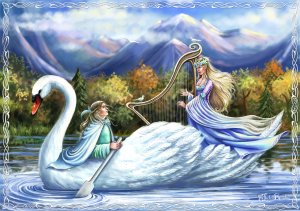
Galadriel and Celeborn, by Araniart [CC BY 3.0 (http://creativecommons.org/licenses/by/3.0)%5D, via Wikimedia Commons|Wikimedia Commons contributors, “File:Araniart – Galadriel and Celeborn.jpg,” Wikimedia Commons, the free media repository, https://commons.wikimedia.org/w/index.php?title=File:Araniart_-_Galadriel_and_Celeborn.jpg&oldid=262862472 (accessed April 1, 2018).

5 Comments

Filed under writing