Tag Archives: writing

The Eye of the Beholder

finalfantasy12_ps2box_usa_org_000boxart_160wSigh. I read a lot of indie books. I’ve said this before, but I read or at least crack open around 6 books a week. It never fails–just when I am really enjoying reading a book, something comes along to yank me out of it. Like an asteroid landing in the backyard or squirrels taunting the dog–it’s always some darned thing.

Unfortunate phrasings that yank me out of a book:

“She lay there staring with her creamy blue eyes, water pooling in the corners.”

“Her eyes were the same color as the deep purple velvet drapes.”

VAYNE final-fantasy-xii_305674Meh.  Enough about their eyes already. I don’t know about you, but I don’t want to be told what to think when I am reading a book. The fact is, what I consider beauty is not necessarily beautiful to someone else.   So how do you describe a character in such a way that the reader will find them as attractive as you want them to be?

I think a loose, general description will solve the problem, and give the reader the framework to build their mental image around.  In my TOWER OF BONES series, the men in Edwin’s family have this sort of cachet that makes them irresistible to all women. It is the Goddess Aeos’s way of ensuring that the girl she has selected for them  falls in love with them, and their bloodline is continued.

final-fantasy-guys-xii-basch_255851But what do they look like?  Well, they are blond, blue-eyed, and  well-built, muscular from working on their farm. To men they seem rather average, nothing spectacular. They aren’t the best looking man in town, so what is this charisma they seem to have?

To women, they are an irresistible banquet of masculine  pheromones.  This creates many opportunities for mayhem, and I have had a lot of fun with that  particular plot-line, especially in my current work in progress,  Mountains of the Moon.

For my other characters in various books–Christoph Berryman is dark, with short black hair and elfin features. Julian Lackland is blond, handsome, the image of the knight in shining armor. Huw the Bard is dark, blue-eyed with black curling hair. Friedr Freysson is tall, with long curling red hair and a beard. Aeolyn is small, with dark hair worn in plaits that she coils around her head like a crown.

Final-Fantasy-XII-Balthier-final-fantasy-12-3118596-540-1200This is as descriptive as I get, because I want the reader to imagine the characters’ beauty and magnetism in the way that is most appealing to them.

Because I am a romantic at heart, ALL my characters are exceedingly good-looking in their own different ways. I just don’t want to beat the reader over the head with my personal vision, other than the general description to cement them in place.

In many ways, my mental images of my characters are drawn from the many wonderful characters in the epic Final Fantasy series of games, which these images are also from. I love the fabulous art work that Square-Enix, the makers of these games put into their characters, making them a blend of the best of all we are as humans.  Since a great deal of my time has been spent playing these games, It stands to reason a certain amount of that kind of storytelling will creep into my work.

And this is the way it is for every author–your vision is definitely not what your readers see, and to force them to see what you do ruins the flow of the tale. A good general description, with hints or comments about their beauty or lack thereof is all that is needed. The reader’s mind will supply the rest.

Comments Off on The Eye of the Beholder

Filed under Books, Fantasy, Final Fantasy, Humor, Literature, Publishing, Romance, Uncategorized, writer, writing

10 Things to Do—Part 1, The First 5 Speedbumps

shakespeare-word-cloud

There are things that happen in the natural course of writing the first draft that make it painful for people to read. DO NOT SHOW IT TO YOUR ADORING FANS JUST YET. This really is NOT the time to ask for feedback unless you want to be lied to. They will look at you with a possum-in-the-headlights smile, and say “Wow…this is really…nice.”

What they really are thinking is, “Holy s**t. This disjointed, hokey mess sucks.” That friend will poke needles in their eyes before they read another piece of your work again.

Just sayin’.

But even though the first draft is always stinkaroo, don’t try to edit as you write because it interferes with your creative processes and blocks the flow of ideas. While you’re writing the first draft these bloopers should be allowed to just fall where they may, because you just need to get the ideas down.  You will reshape them in the 2nd draft. So, today I’m posting the first half of a two-part series on 10 Things to Do in the second draft of your manuscript.

Before you do anything, just put it to one side. Forget about it for a while.

A month or so later, after you have gained a different perspective is when you begin to look for these problems.  Fine tuning and rephrasing will settle most of them, and a good flamethrower will take care of the rest!

First we will look at:

800px-Singapore_Road_Signs_-_Temporary_Sign_-_Detour.svg1. The Info Dump (my personal failing)

Often new authors feel they need to dump a lot of back story at a novel’s beginning before readers will understand the main story. I did this in my first novel, and I have regretted it ever since! It seems like logical thinking: “Before you get this, you need to know this.” But the problem was, I gave the info dump in the first five pages.  Those are the pages that acquisition editors look at and decide whether or not to continue reading the submission. For those of us planning to go the indie route, those pages are also the pages the prospective buyer sees in the “look inside” option on Amazon dot com.

While back story is important for character and plot building, too much outright “telling” freezes the real-time story in its tracks. And for modern genre fiction, beginnings must be active—they need to move.

Here is the opening paragraph of my next novel in the Tower of Bones series, Mountains of the Moon. It is a prequel to the first two novels, and this is the way it currently reads in its second draft stage. It may be changed once the editor gets her hands on it, but right now this is how it stands with the info dump removed:

Wynn Farmer discovered his old boots had holes worn in the soles when he heard the soft, squishing sound, perfectly in sync with every step he took. If he’d known he would be dropped into some strange world when he left the house, he might have planned ahead a little better and slipped some new cardboard into his boots, just until he could get them resoled. Now he trudged along a faint path through a dark, eerie prairie with wet feet, shivering in the cold, misty rain and completely lost.

In the second draft we alter the original words we wrote, subtly slipping little details into the narrative while showing the real-time story, and doing it in such a way that it is part of the action and the dialogue, fading into the background.  The reader will understand what you are showing them without feeling bludgeoned by it.
 

nausea42. Telling Instead of Showing in Prose (heh, heh–my own personal failing)

In the rush of the first draft, of getting all our thoughts about the storyline down, sometime our minds go faster than we can write. We use a kind of ‘mental shorthand’ and write things such as:

Erving was furious.

Martha was discouraged.

These are really just notes telling us what direction this tale is supposed to go. Modern readers don’t want to be told how the characters felt—they want to see. When you come across this in a novel, it is clear the author has published a first draft.

Thus, when you come across this in your first draft, now is the time to follow those road signs and expand on the scene a little. Instead of telling the reader that Martha was furious, you will show this emotion.

Martha stamped her foot, and clenched her fists.

Erving’s body shook with rage, and his face went white.

Show the reader the emotions. It adds word count, but you will also be taking word count away in other places in the manuscript as you go along.
 

cover_art_Billy_39_s_Revenge3. Using Dialogue to Tell, Not Show (oh yeah–my personal failing)

“I’m simply not going to do it,” Vivian hissed. (Reader: “What, is she a snake?”)

“Why, oh why, did I ever trust her?” Greg said dejectedly. (Reader: “Aw, that’s sad. Boring!”) (Closes book.)

Please, OH please, avoid attaching adverbs ending in “ly” to speech tags. They are the devil!

If you want to convey an attitude in dialogue, the words themselves should communicate it.  Greg’s words already communicate dejection. If you need more, add a line of action:

In low tones, Vivian said, “You couldn’t pay me enough to do that.” She turned and walked away.

Greg threw up his hands. “Why did I trust her?”

This gives readers the opportunity to see for themselves the scene you painted with words.


4. A Lack of Contractions in Dialogue (Wait–this is my personal failing too!  What’s going on here?)

“Arrabelle, I do not want you to leave me!”

This is one of the worst NaNoWriMo manuscript flaws BECAUSE when we are in the midst of November, we are desperate for word count. “Don’t use contractions” is one of the prime directives of Chris Baty’s  “No Plot? No Problem” and if word-count is all you are in the game for, then fine.  However, IF you ever intend to publish your work you should use contractions in dialogue. Depending on the type of story you are writing, you may want to use them elsewhere, if that is the style of your work.

This problem may also be a throwback to those days in your high school English class, when teachers deducted points for the use of contractions in term papers. But contractions are effective at conveying realistic speech.

You want dialogue to sound natural? Use contractions.
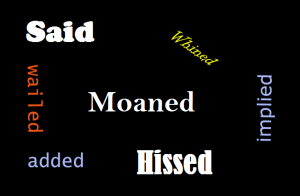
 

Dialogue Tags © cjjasp 20145. Too Many Speech Tags in Dialogue (Hey–I have that problem too! What the heck…?)

“Jake, are you okay?”  Vaia wailed.

 “Of course I’m all right,” Jake groaned. “What a silly question.”

 “But your arm,” Vaia said. “I thought maybe you…well, the way you’re holding it…I guess I thought—”

 “You thought I’d injured it,” Jake said.

 “Well…yes,” Vaia said.

Especially when only two characters are talking, readers should be able to keep track of speaker ID with ease. In those situations, speech tags are rarely, if ever, needed. In fact, doing away with tags entirely, unless they are absolutely necessary, is frequently suggested to be a great strategy, although I don’t go that far. Instead of using a speech tag, insert a burst of action before or after a line of dialogue that identifies the speaker and lends opportunities to deepen character chemistry, conflict, and emotions.

Vaia felt something trickling down her cheek. She wiped it, and her hand came away with blood. Jake was pale, and held his arm at a strange angle. “Jake, are you okay?”

 “Of course I’m all right. I’m always all right.”

 She reached toward his shoulder, toward the torn shirt—but something held her back. “But your arm. I thought maybe ….”

 “I’m hurt, but I think it’s fine. You thought maybe I had broken it.” He willed her to admit that she cared.

 The intensity of his gaze forced her to look away. “Well…. I did think that. Can you still fight?” 

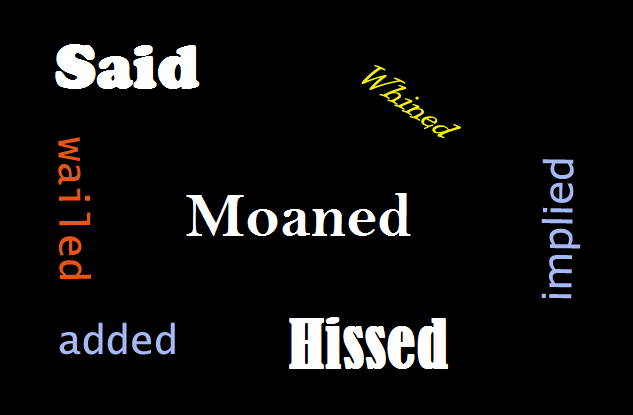
Trade in empty speech tags for emotion-infused writing that can do so much more. HOWEVER—Remember that the reader needs to have clear direction as to who is speaking to whom, otherwise you will lose the reader. And I do recommend you don’t get too creative with them.  Said, replied–those are usually all that is required. If you throw in hissed, or moaned, once in a great while for specific circumstances, fine, but not too much please. It’s too distracting for me as a reader.  I close that book and move on to the next when the  characters do too much hissing and moaning. Just sayin’.

This covers the first 5 things to look for in your second draft. Items 6 through 10 will be covered on Wednesday!



1 Comment

Filed under Adventure, Battles, Books, Fantasy, Humor, Literature, Publishing, Uncategorized, writer, writing

Strapping the Monkey to the Typewriter and Selling His Work

0000-9780857863782At times, creativity seems to fail. We’ve become bored with the work we’re doing and need some new thing to spark that creative genius lurking deep within our coffee-addled brains (or wine-soaked, as the case may be.) An infinite number of monkeys strapped to IBM Selectrics, industriously typing out Shakespeare could do better.

For myself, the way to beat this is to write something, anything–even if it doesn’t pertain to my major work in progress. The best part of being an indie is that you can write in whatever direction the mood takes you.

And that is how Huw the Bard  came about. I was supposed to be working on Forbidden Road, but I had become bogged down. NaNoWriMo came along and Huw grabbed me by the imagination and away we went.  This jump-started my mind on the other book too, so I wrote on both books for the next year. Forbidden Road was finished, edited and published in 2013

Now Huw the Bard has been published and I am working on Valley of Sorrows. In the meantime I have to find ways to publicize my work, and since we just acquired a hefty car payment, it must be affordable. (As in CHEAP.)

google plus iconIn other posts I have discussed the importance of getting Twitter, LinkedIn, Goodreads, Pinterest, Facebook and Google+ profiles created. You must also have your Author Central profile put together on Amazon and one for Smashwords, Barnes and Noble and any other major online place you sell your works.

Today, I want to say that Facebook is fun, and a great place for a free launch party. We had a great time with that, and I do think it helped sell books.  But you need a sustainable place to put your work, and Facebook is no longer that great a venue for selling books.  I’ve had better luck through blogging, if the truth be told.  My good friends helped get Huw the Bard off the ground with their blogs and tweets.

Also, Facebook won’t allow your posts to be seen by many people unless you pay them. They call it ‘Boosting’ the post. I have done that on occasion, and  for 30.00 I sold 3 books.  That is a terrible return on investment.

tsra-button-01I was directed by Aura Burrows, who writes the hit series, “The Cold” on www.BigWorldNework.com, to an interesting and free website run by a friend of hers. It is called The Story Reading Ape Blog and I have gone to the “contact me” page and followed the instructions. It is free, and Chris is awesome as a person–he is very sincere about helping indies get their work seen. I will keep you posted as to how that goes for me, and if you want to try it yourself, please feel free to click the link and go for it.

There are many venues–blog hops,  paid ads on Goodreads and Google–all of which I will be doing over the next year. Paid ads are tricky–the ones I can afford are not that big or prominent so perhaps they aren’t a good investment. However, there are many affordable indie book websites who will sell you ad space for $30.00 to $50.00 a whack–a sum that is doable for me if I give up Starbucks for my craft.

So now begins my real push to get my work out there–to make it visible so readers will see it and want to know what it’s about.  I have to push Tales From the Dreamtime as well as Huw the Bard, because I have that wonderful narrator, Craig Allen, depending on me to sell our audio-book! I’m selling a few books here and there, but I’ll be posting about which venues were most successful as the year progresses.

The real trick will be to get the work out in the public eye without spamming and alienating my friends.


5 Comments

Filed under Books, Epilepsy, Fantasy, Literature, Publishing, Uncategorized, writer, writing

HUW the BARD Launch

HTB New Front Cover with gold frameToday is the official launch of HUW THE BARD, a novel set in the alternate medieval world of Waldeyn.

I am doing something quite unique, for me–I am hosting a Virtual Launch Party via Facebook, complete with virtual canapes, champagne, and caviar. The link for this event is here: Huw The Bard Launch Party. Any and all are welcome to stop by and share in the revelry.

This is the hard part of going the indie route–I wrote, had it edited, got it published, and now I have to sell it. There is an art to this, I ‘m sure! Some people with moderately good books are quite successful, and others with truly great books, not so much.  Even Charles Dickens had trouble selling his work, back in the early days of publishing. In fact, most of the early authors of books we now consider classics were unheard of in their own time, except by a few intrepid readers.

So now, in this modern era of social media, I am trying to let the world know I wrote a book. I want folks who might be interested in it to be able to find it.

But I want to do this in such a way that I am not spamming my Facebook friends — because they get enough of that already without me adding to it. Hence, my launch party, open to the public and of course, my friends. How this will go, I don’t know, but I have been looking at other avenues of exposure, and now begins the (tasteful) twitter campaign. Also, many of my friends are supporting me by posting reviews, excerpts and cover reveals on their blogs, which is a huge help.

Carlie M.A. Cullen posted a lovely review.

Maria V.A. Johnson also posted a great review.

Fresh Pot of Tea, Alison DeLuca hosted the cover reveal, and posted an excerpt of the book.

So if you are available, feel free to stop on by  the Launch Party, have a virtual canape and swap a joke or two with me and my friends. I will be posting medieval music that I have come across on YouTube, and of course, we will talk about the book.

HUW THE BARD on Amazon.com

YouTube video book trailer featuring the music of Tom Cusack


Lute onBlack Background


4 Comments

Filed under Adventure, Battles, Books, Dragons, Fantasy, History, Humor, Literature, Publishing, Romance, Uncategorized, writing

HUW the BARD cover reveal


HTB New Front Cover with gold frame


HTB back cover for create space

Excerpt from ‘HUW THE BARD’ 

Copyright 2014 by Connie J. Jasperson, All Rights Reserved

Desperately Huw continued fighting despite the intense pain in his now useless left hand. Somewhere along the way, Huw noticed it was just he, Derik and Bil still fighting.

After what felt like hours, Bil got in a lucky swing and had the creature hamstrung. It lay thrashing on its side, but still the men could rarely get close enough to the beast to do any more damage. Huw stumbled across a sword, and without thinking he picked it up and threw it, hoping to hit an eye. He heaved it just as the creature opened its mouth to snap at Bil.

The sword entered the gaping maw and sank to the hilt, impaling the soft tissue in the creature’s throat. The firedrake writhed in the dirt, gagging, struggling vainly to dislodge it with his little arms. The high-pitched keening shredded the hearing of everyone in its range. At last they were able to swarm the creature, the three of them hacking at it until they succeeded in finally cutting the great head off, ending the battle.

The silence was deafening, and Huw reeled. “I don’t know about you lads, but someone else is going to have to bury this thing. I’m knackered.” The pain of his injuries rushed in, causing him to drop his sword. Huw fell to his knees, puking his guts up. The last thing he saw was the clearing slowly spinning, as he fell forward into a soft pool of darkness.

 >>><<<

Off and on all day other excerpts from ‘Huw the Bard’  will be appearing on these lovely blogs:

www.carliemacullen.com

www.deborahjayauthor.com

http://alisondeluca.blogspot.com/

www.mariavajohnson.com.

>>><<<

HUW the BARD trailer on YouTube

>>><<<

But this is not the only wonderful thing happening this week!  My novella of short stories, Tales From the Dreamtime has been made into an audiobook, and is now available at Amazon and also through iTunes. The wonderful narration was done by Craig Allen, a voice-actor of extraordinary ability. His reading brings the words to life, and working with Craig was a joy.

I have discovered audiobooks, and find them to be wonderful companions on road trips, or even to listen to as I work around my house.

This has definitely been a busy week, and Monday will be even more so, with the launch of Huw the Bard, and the ensuing madness of promoting my work.  Promotion is my weak spot–but I must get better at it. Promotion is part of the indie author’s daily routine, and I must not be lazy!

Comments Off on HUW the BARD cover reveal

Filed under Adventure, Battles, Books, Dragons, Fantasy, History, Literature, Romance, Uncategorized, writing

HUW the BARD launch date set

Map of Eynier Valley © Connie J. Jasperson 2014

Map of Eynier Valley © Connie J. Jasperson 2014

I am pretty excited about things right now!  HUW THE BARD will be officially launched on March 31, 2014. I’m having a virtual launch party and everything–with virtual canapes and margaritas.

On Friday, March 28, 2014 we will be revealing the cover, on both Carlie M.A. Cullen’s blog and on this place, right here.  I can hardly wait!

It has been a long journey, to get Huw to this point. I began writing him in November 2011, and had the first draft complete by November of 2012.

I have the good fortune to have a friend, Irene Roth Luvaul, who is a professional author and a fine dedicated editor, go over it, helping me to make the manuscript submission ready. (That process is an entire blogpost in and of itself!)

Inset Bekenberg Trail to Castleton

Bekenberg Trail to Castleton © Connie J. Jasperson 2014

At that point, Huw was sent to the fine ladies at Eagle Eye Editors, where he was thoroughly scrutinized and we went through the editing process. Because of the sometimes difficult things Huw must deal with, that was frequently an emotional ordeal, but Carlie, Maria, and Irene nursed me through it.

In the end, the final product is a book we can all be proud of.

In the meantime–here is the blurb that is on the back of the book:

*

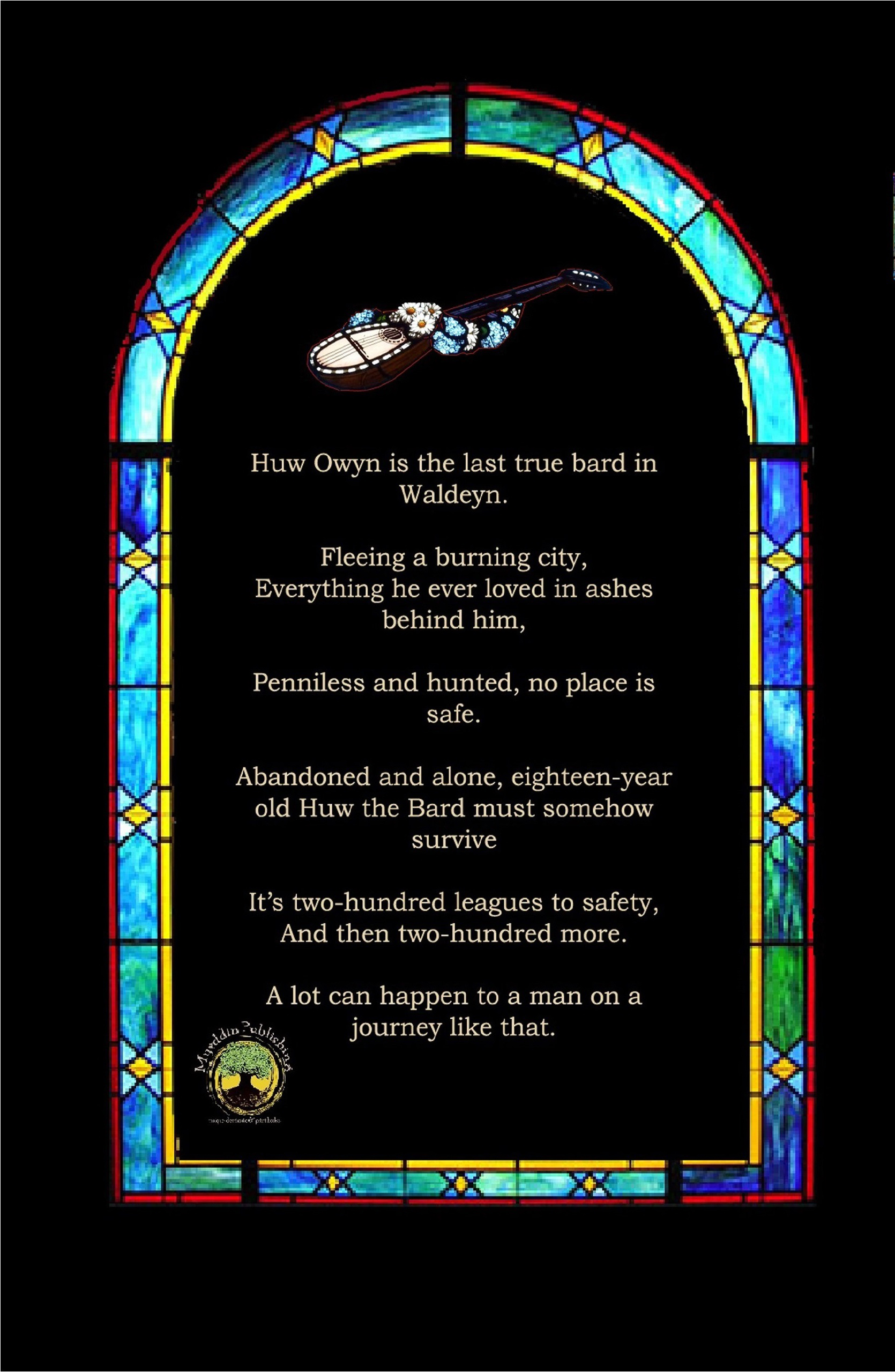
Huw Owyn is the last true bard in Waldeyn.

Fleeing a burning city,

Everything he ever loved in ashes behind him,

Penniless and hunted, no place is safe.

Abandoned and alone, eighteen-year old Huw the Bard must somehow survive.

 It’s two-hundred leagues to safety,

And then two-hundred more.

A lot can happen to a man on a journey like that.

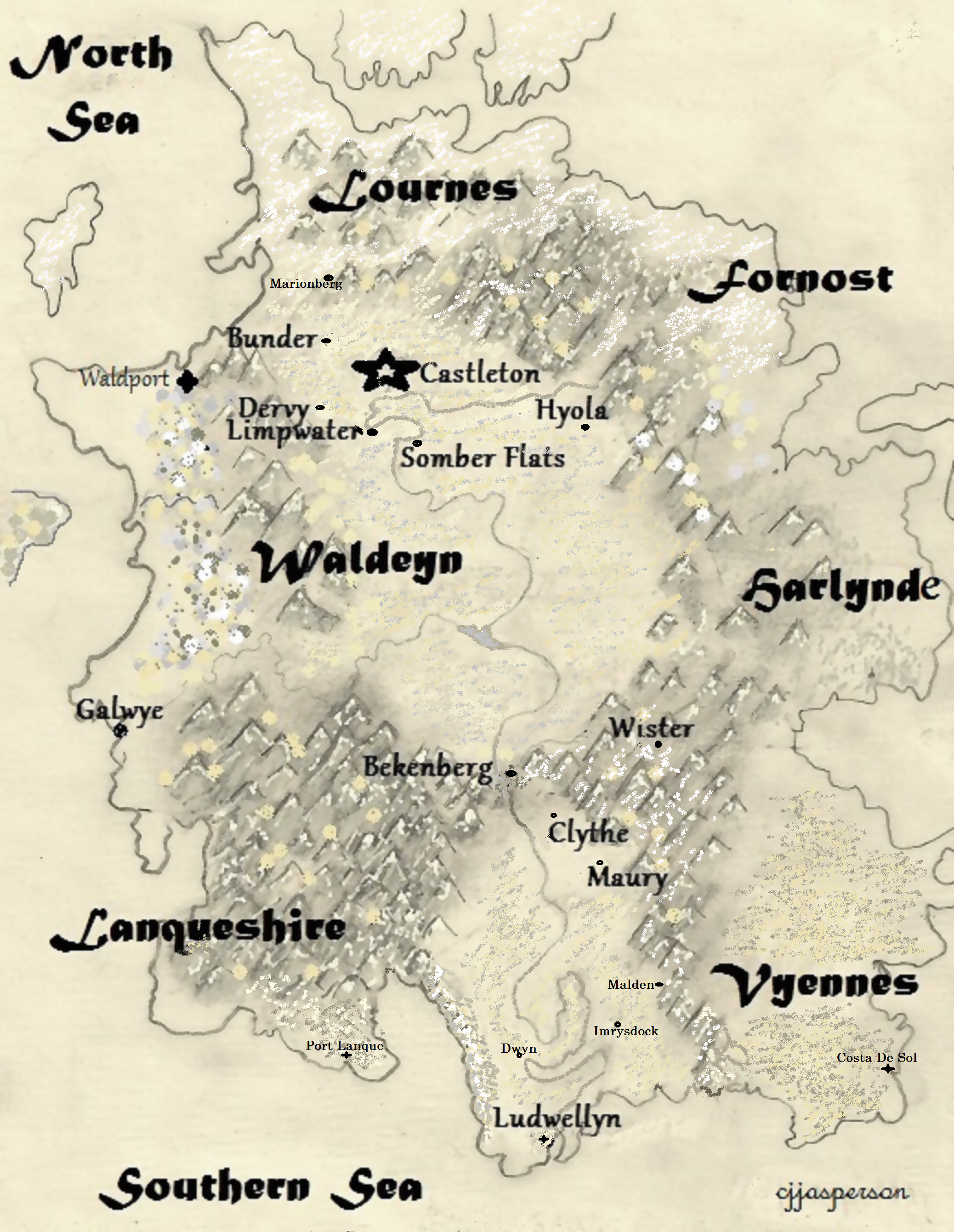
Map of Waldeyn © Connie J. Jasperson 2014

Map of Waldeyn © Connie J. Jasperson 2014

9 Comments

Filed under Adventure, Books, Fantasy, Humor, Literature, Publishing, Uncategorized, writing

Karaoke Noveling

science of relationships dot comGoodness knows I have read my share of badly written books over the last three years. There is no way to describe the agony of seeing a perfectly good novel devoured by excessive descriptions and overblown characters whose moves and emotions are described to the last detail.

So I don’t.

children of the elementi ceri clarkInstead I focus on the really awesome books I have enjoyed, many of twhich will never be best sellers because they are just one drop in an ocean of books.  But that too will change, I think.

Right now, there is this sort of Karaoke Culture going in regard to writing genre-novels. It’s an “anything you can do, I can do better” sort of philosophy, and while it’s not necessarily terrible, it’s flooding the market with less than stellar works by people who really only have one book in them, and not a great one at that.  At some point, this flood of indies will peak and then level out and those who are in it for the long haul will gain better visibility.

George R.R.Martin formatting issue 1 via book blog page views, margaret ebyIn actuality, every indie author is a Karaoke Star–at first we begin as amateurs who dream big, standing up in front of a crowd and putting our talents (or lack thereof) on the line.  We find out that the more you drink, the better we sound, and when you applaud our efforts, it only encourages us.

Young Woman Sitting Looking at Laptop ScreenSome of us become so encouraged, we quit our day jobs and go pro–to our families’ shock and horror.

Regardless of how badly written a book is, the author had passion for it, and just like the guy who mutilated “Billie Jean” with all his drunken heart in the Karaoke Bar the other night, the author did their best against huge odds.

I have some hard-earned advice for new authors, those of you who want to leave the ranks of the Karaoke novelists. If you are really serious about your work,  get your work professionally edited. Yes, it will cost you, but that experience will enable you to put a book out there that you can be proud of, one that will stand up to any put out by the big publishers.

George R.R.Martin formatting issue 2 via book blog page views, margaret ebyYou might wonder what prompted this little rant–I have just spent the week looking through five reasonably priced, beautifully covered indie books–only to discover they were poorly formatted, rife with newbie errors–beginning the book with a big info dump (been there done that)–thick, lush descriptions of “creamy blue eyes” (pardon, must barf now)–and threads to nowhere, obviously intended to entice the reader to get the sequel, which is now on my “No way in hell” list.  My response? “If you went to the trouble to find expensive art for the cover, you could have had the freaking mess professionally edited. Don’t tell me your friends edited it for you, because the way it looks now, your best chums aren’t doing you any favors.”

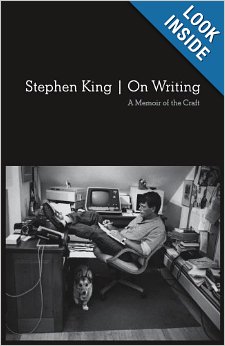
on writing

Indies–aren’t you glad I only review the books I like? I don’t want to be known for being a bitch, which is what I feel like when I read some of these travesties.  You see–I have been there.  I started out that way and I didn’t get it either. But experience is a real teacher, and more than anything, I love this craft, and want to be the best I can be at it, whether I sell a book or not.

Thus, after grousing and yelling for two days this week, I decided to reread an old favorite, and will be blogging on my review blog about a book that was published in 1997. I have read it twice, and each time I am swept away by it. Tomorrow, I will be talking about it on Best in Fantasy. My posts go up by 8:00 in the morning US west coast Pacific time. If you are curious as to what book I am talking about, stop by tomorrow!

EDIT:

Review of “Fall of Angels” by L.E. Modesitt Jr.

8 Comments

Filed under Adventure, Books, Fantasy, Humor, Literature, Publishing, Romance, Uncategorized, writer, writing

Wringing inspiration from a stone

Wrong-Way-Traffic-Sign-K-101-1Writing is sometimes a bit of a struggle. Some days you just have to force it, and if you get a thousand words, you’ve scored! It isn’t that I have lost my fire for this tale–on the contrary–I love these characters and their story incredibly.  I’m just at a spot where I am not sure how to proceed.

I’m building up to an important moment in the tale. I know what has to happen. I know who must be there and what they will do–I just can’t set the scene in my head. Gradually, one conversation at a time, it is taking shape.

When I see it in my head it is one thing.  When I see it on the screen, it’s another. Pulling this out of my head is worse than cleaning the refrigerator.

It’s amazing, the stuff that you find.

800px-Singapore_Road_Signs_-_Temporary_Sign_-_Detour.svgSo–I’ve come up with a plan.  I made the plan so that I would have something to do when I was not writing what I was trying to write. Making plans is really a good diversionary tactic for when you are avoiding doing something that you should be doing.

Like writing.

traffic-sign-reflective-10683So I work on business until my head hurts. Then I write a little. Then I do some things around the house but not too much–I don’t want my husband to think I’ve turned into a domestic diva or something. And then I write a little more.

Then I blog.

Then I write a little.  Then I read, which is a lot more fun than any of the above.

Then I get my behind back in the chair and force myself to write, even though I know whatever falls out of my head won’t remain in the book in this incarnation. It will be filtered through me, the betas and then the editors, so the point is to just get that idea out there onto the paper.

6a0120a85dcdae970b0120a86d6130970b-piWhy is it so stinking hard?.

It’s like having to work on Saturday, and hoping that when you get home your spouse or the kids will have done the dishes.

You know the house will be trashed, and the darlings will be starving despite the mountain of cereal bowls in the sink–and you know it will be your job to rush around like a freak solving the problem.

But when it’s done, and the first draft of your manuscript is finished, it’s so worth the effort.

3 Comments

Filed under Adventure, Battles, Books, Fantasy, Humor, Literature, Uncategorized, writer, writing

Spanking L. E. Modesitt Jr.

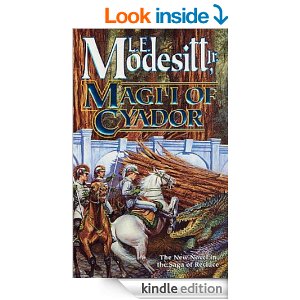
magii of cyadorI’m just going to say at the outset, I love L. E. Modesitt Jr. and his work.  But my very FAVORITE series of books has a huge failing–the MAPS SUCK!  In Fall of Angels,  The Chaos Balance, Magii of Cyador and Scion of Cyador, and all of which take place BEFORE the world of Recluce is dramatically altered, the main characters are traveling all over the continent to places that DON’T EXIST on the maps provided in the front of the books! (I’d add another exclamation point or two, but it would look like I’m hyperventilating.) (Gasp.)

798px-Diego-homem-black-sea-ancient-map-1559However, I do understand how such a thing happens.  Being an indie, I am responsible for providing some sort of mappy-thing in the front of my own books and that is where it actually gets a bit dicey.

The thing is–maps, unless they are drawn by satellite GPS, are inherently WRONG in regard to actual distances and such. All they can do is provide a general idea of where the cartographer thought things were.

map of Waldeyn 2014As a tool, I draw my own maps, when I am writing the tale so I will have some idea of where the heck they are going, but I am not a cartographer. All maps drawn by me are only a picture of where one town might lay in relationship to another, a general idea of things.

Being an avid map checker, it frustrates me when there is no way to see what the author is talking about when he takes his characters from one place to another. I’m not asking for accuracy here, just a general scribble on the back of a napkin would be awesome–some indication of the direction and the lay of the land, such as mountains, forests and harbors.

BUT FOR THE LOVE OF TOLSTOY DON’T PUT MAPS IN THE FRONT OF THE BOOK THAT HAVE NO RELATIONSHIP TO THE TALE.

Cyador's HeirsL.E. Modesitt Jr. has a new Cyador book coming out in May, Cyador’s Heirs,  and I have already preordered it. I can hardly wait–it’s almost like waiting for Harry Potter!  Oh, mighty publishing giant who prints these wondrous creations PLEASE — make the bloody maps pertain to the actual book! Don’t make me stop this car!

2 Comments

Filed under Adventure, Battles, Fantasy, Humor, Literature, Publishing, writer, writing

Hyphen help us–

hyphenated wordsYou thought hell was getting that manuscript written and ready for submission. You thought the rest was going to be easy.

Oh, no, my friend.

True hell is discovered in the editing process of your manuscript. This is when you realize that (among other failings) your knowledge of  how hyphenated words really work is somewhat lacking.

Oh sure, everyone agrees that a compound word is a combination of two or more words that function as a single unit of meaning. Most of us even know that there are two types of compounds: those written as single words, with no hyphenation and which are called “closed compounds”– such as the word “bedspread,”  AND  the “hyphenated compounds,” such as “jack-in-the-box” and “self-worth.”

But there is a third group, and they are the bane of my life–those mysterious, ephemeral denizens of the deepest corner of writer’s hell, called open compounds. These seemingly innocent instruments of torture are written as separate words–the nouns “school bus” and “decision making,” for example.

But how do I tell if  it’s one word, two words or a hyphenated word?  

1. Do not use a hyphen unless it serves a purpose. If a compound adjective cannot be misread or, as with many psychological terms, its meaning is established, a hyphen is not necessary.

For example:

covert learning techniques, health care reform, day treatment program, sex role differences, grade point average

2. Do use one in a temporary compound that is used as an adjective before a nounuse a hyphen if the term can be misread or if the term expresses a single thought:

For example:

“the children resided in two parent homes” means that two homes served as residences, whereas if the children resided in “two-parent homes,” they each would live in a household headed by two parents.  In that case, a properly placed hyphen helps the reader understand the intended meaning.

IMG7663. We also use hyphens for compound words that fall into these catagories:

a. the base word is capitalized: pro-African

b. numbers: post-1910, twenty-two

c. an abbreviation: pre-ABNA manuscript

d. more than one word: non-achievement-oriented students

d. All “self-” compounds whether they are adjectives or nouns such as self-report, self-esteem,  self-paced.

4. We hyphenate words that could be misunderstood when there are diverse meanings if they’re unhyphenated:

re-pair (to pair again) as opposed to repair (to mend)

re-form  (to form again) as opposed to reform (to improve)

5. We hyphenate words in which the prefix ends and the base word begins with the same vowel:

metaanalysis, antiintellectual

But really, unless you are a technical writer, how often are we going to use these terms? Hence, the confusion when we DO use them.

Getting it write online dot com says, “One way to decide if a hyphen is necessary is to see if the phrase might be ambiguous without it. For example, “large-print paper” might be unclear written as “large print paper” because the reader might combine “print” and “paper” as a single idea rather than combining “large” and “print.” Another such example is “English-language learners.” Without the hyphen, a reader might think we are talking about English people who are learning any language rather than people who are learners of the English language.”

Write most words formed with prefixes and suffixes as one word with NO hyphen.

Prefixes: Afterglow, extracurricular, multiphase, socioeconomic

Sufixes: Arachnophobia, wavelike, angiogram

dictionaryxHooray for Merriam-Webster! One can also look the word up in an online dictionary, to see the various different ways it can be combined. Just go to:

http://www.merriam-webster.com

Now the real point of all this is that no matter how much I know when I am editing for another author, I always manage to screw up my own work amazingly well–it’s like my finger has a twitch that absolutely MUST add a hyphen! (Or a semi-colon, but that’s another post.)

Curses on the hyphen!

6 Comments

Filed under Books, Fantasy, Humor, Literature, Publishing, Uncategorized, writer, writing