Monthly Archives: January 2021

Do the research before you do the murder #amwriting

I recently began reading a murder mystery where the author used a mushroom to kill the first victim. That’s where this book fell apart—the idea was good, but the facts and execution weren’t.
Using a mushroom stroganoff to poison him was a poor choice because fungi is an undependable weapon unless you are an expert. Also, individually, one mushroom may be more or less poisonous than another of the same kind, rather like people are. Judging how many one would need to kill a three-hundred-pound man takes more thought than I am capable of plotting out.

Also, it was stroganoff, which is basically beef and mushrooms in a sour cream sauce. This author danced over the fact that serving the food at this dinner party would have been a tactical nightmare. It would have been nearly impossible to ensure the intended victim got the poison mushrooms and no one else did, which is how this murder was written.

Agatha Christie knew that and regularly poisoned entire dinner parties, literarily speaking. Her murderers made everyone at the table sick but only the intended victim actually died.

This particular mystery was set in Scotland, and I don’t know how poisonous their mushrooms are, but I think that logic would hold true there as well as it does here in the Pacific Northwest.

If I hadn’t been on several nature walks with Ellen King Rice, a wildlife biologist and amateur mycologist who writes well-plotted mushroom thrillers, I would have accepted the slightly contrived fatal dinner as written and focused on the other failings of this novel.

This experience reinforced my belief that readers are often more knowledgeable than we authors are. E-readers can do the research just by highlighting the word and hitting search.

For this reason, having a solid base of information to back up what we are writing is critical.

My disappointment as a reader could have been avoided if the author had gone out to several mushroom hunter websites or even if she had found a local person to talk with. With only a small amount of effort, she could have made her plot a little less flimsy.

Targeted research is essential if you want your fiction to convey a feeling of truth. Identify what you want to know, use the internet, ask an expert, and create a searchable file or database of information that backs up your assertions.

Once you establish the technological era you are writing in, you know what you need to research and how theoretical you may have to get.

Here are some of my go-to sources of information:

If you seek information about low-tech societies (the past) :

My best source of information on low-tech agrarian (farm) life and culture comes from a book I found at a second-hand book store in Olympia in the mid-to-late-1980s. Lost Country Life by Dorothy Hartley is still available as a second-hand book and can be found on Amazon. This textbook was meticulously researched and illustrated by a historian who personally knew the people she wrote about.
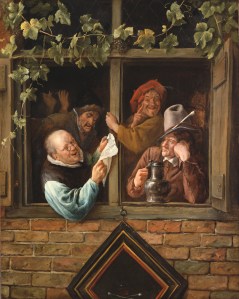
I also find a lot of information on how people lived from Wikimedia Commons.  Under the heading  Category: Painters from the Northern Netherlands (before 1830), you will find the brilliant works of the Dutch Masters, artists living in what is now The Netherlands.

These painters created accurate records of ordinary people going about everyday life. Their genre art depicts how they dressed, and what was important to them.

Talk to police, talk to doctors, talk to lawyers–many are willing to help you with your quest for accuracy about their professions. Also, you can Google just about anything. Fads, fashion, phone tech, current robotics tech, automobile tech—it’s all out there.

Looking things up on the internet can suck up an enormous amount of your writing time. Do yourself a favor and bookmark your resources so all you have to do is click on a link to get the information you want. Then you can quickly get back to writing.

Resources to bookmark in general:

www.Thesaurus.Com (What’s another word that means the same as this but isn’t repetitive?)

Oxford Dictionary (What does this word mean? Am I using it correctly?)

Wikipedia (The font of all knowledge. I did not know that.)

TED Talks are a fantastic resource for information on current and cutting edge technology.

ZDNet Innovation is an excellent source of current tech and future tech that may become current in 25 years.

Tech Times is also a great source of ideas.

Nerds on Earth has useful information about swords and how they were used historically.

If you want to know what interests the people in the many different layers of our society, go to the magazine rack at your grocery store or the local Big Name Bookstore, and look at the many publications available to the reading public. You can find everything from mushroom hunting, to culinary, to survivalist, to organic gardening. If people are interested in it, there is a magazine for it.

We can only extrapolate how societies will look in the future by taking what we know is possible today and mixing it with a heavy dose of what we wish were possible.

SpaceX

NASA

Digital Trends

If you write sci-fi, you must read sci-fi as that is where the ideas are. Much of what was considered highly futuristic in the era of classic science fiction is today’s current tech.

Ion drive, space stations—these are our reality but were only a dream when science fiction was in its infancy.

Think about it: your Star Trek communicator is never far from your side, and your teenagers won’t put theirs down long enough to eat dinner.

MAPS: If you are writing a story set in our real world and your characters will be traveling, walking a particular city, or visiting landmarks, bookmark google maps for that area and refer back to it regularly to make sure you are writing it correctly.

USE GOOGLE EARTH!

If you are writing about a fantasy world and your characters will be traveling, quickly sketch a rough map. Refer back to it to ensure the town names and places remain the same from the first page to the last. Update it as new locations are added.

Do the right research, target it to your needs, and don’t allow yourself to be sidetracked by the many bunny trails that lead you away from actually writing. And for the love of Agatha Christie, make sure your literary murders are done in a way that doesn’t fly in the face of logic.


Credits and Attributions:

Wikimedia Commons contributors, “File:Jan Steen, Dutch (active Leiden, Haarlem, and The Hague) – Rhetoricians at a Window – Google Art Project.jpg,” Wikimedia Commons, the free media repository, https://commons.wikimedia.org/w/index.php?title=File:Jan_Steen,_Dutch_(active_Leiden,_Haarlem,_and_The_Hague)_-_Rhetoricians_at_a_Window_-_Google_Art_Project.jpg&oldid=355150081 (accessed September 10, 2020).
13 Comments

Filed under writing

Chapter Length #amwriting

I was recently asked in an online group what length a chapter should be. I’ve discussed this before here, but I’m always happy to repeat myself. In my opinion, there is no hard and fast rule.

When we commit to writing daily, our writing style grows and changes. Fifteen years ago, I wrote long chapters, some over 4,000 words.

However, as time has passed, my writing style has evolved. Chapters have become shorter, averaging between 1,500 to 2,250. Some will be much shorter, for reasons I will go into further on down this article. Some might be longer if the story demands it.

However, it’s a good idea to consider comfort of your reader. Many readers want to finish a chapter in one sitting. I’ve attended seminars given by authors who say they have a specific word-count limit for their chapter length, a personal choice.

I’ve read and enjoyed many books where the authors made each scene a chapter, even if it was only two or three hundred words long. They ended up with over 100 chapters in their books, but the chapter-length went unnoticed by me when I read it.

L.E. Modesitt Jr. sometimes has chapters of only five or six-hundred words, which keeps each point-of-view character’s storyline separate and flows well.

For me as a reader, books work best when each chapter details the events of one large scene or several related events.

Chapters are like paragraphs. Packing too many unrelated ideas into one place makes them feel erratic and disconnected. In the end, you must decide what your style is going to be.

The key to a smooth, seamless narrative is how an author handles transitions.

This could be a conversation that moves the story forward to the next scene within a chapter.

Conversely, the transition conversation could end a chapter by offering a tidbit of information that compels the reader to turn the page—the hook.

Information is crucial but should be given only as the reader requires it.

A good conversation is about something one or more characters don’t know. It builds toward something they’re only beginning to understand. A conversation is an opportunity to close a scene or chapter with a hook.

That is true of every aspect of a scene or chapter. Each should reveal something new and push the story forward toward the final showdown. If a scene is there to fluff the word count, I suggest removing it.

Fade-to-black: I don’t like fade-to-black transitions except as a finish to a chapter. Fading-to-black in the middle of a chapter makes the story feel mushy.

Hard scene breaks: When a length of time has passed between the end of one scene and the beginning of the next, it makes sense to use the old 1-2-3:

  1. Wind it up with a firm finish
  2. Leave the reader with a hook that makes them want to turn the page
  3. Start a new chapter.

Short stories are different. If you are writing a short story, dividing it into chapters isn’t an option. At the end of a scene, you may find that a hard break is required. Editors with open calls for short stories will often ask that you insert an asterisk or hashtag to indicate a hard scene break.

Pacing is deeply intertwined with chapter length. Most readers find it easier to follow the story when they are only in one character’s mind for the majority of the narrative.

Some editors suggest you change chapters, no matter how short, when you switch to a different character’s point of view. That is my choice also, as a hard transition between characters is the best way to avoid head-hopping.

Head-hopping: first you’re in his head, then you’re in hers, then you’re back in his—it gives the reader “tennis neck” and makes following the storyline difficult.

Sometimes an event occurs where more than one character has a point of view that needs to be shown. How you navigate this will significantly affect the readability of the narrative.

If you switch POV characters, I strongly suggest that you either change scenes with a hard, visual break such as two blank spaces between paragraphs, or consider ending the chapter.

I’ve mentioned before that one of the complaints some readers have with Robert Jordan’s brilliant Wheel of Time Series is how he wandered around between storylines as if he couldn’t decide who the main character was.

Rand Al Thor begins as the protagonist, but Matrim, Perrin, Nynaeve, and Egwene are also given prime storylines.

I’m a dedicated Wheel of Time fan, but I was halfway through reading the series when I realized there was a good chance that we were never going to see Rand do what he was reborn to do. At that point, I kept reading because the world, the characters, and the events were so intriguing.

As very few of us are writers at Robert Jordan’s level, I suggest you concentrate on developing a single compelling, well-rounded main character, with the side characters well-developed but not upstaging the star.

Now we come to a commonly asked question: Should I use numbers or give each chapter a name? The authors I am acquainted with seem divided by this question.

What is your gut feeling for how you want to construct this book or series? If good titles pop up in your mind for each chapter, by all means, go for it. Otherwise, numbered chapters are perfectly fine and don’t throw the reader out of the book.

Whether you choose numbered or titled chapter headings, be consistent and stay with that choice for the entire book.

Limit point of view characters to one per scene.

Each chapter should detail scenes and events that are related, rather than a jumble of unrelated happenings.

In regard to chapter length, you as the author must decide what the right word count is.

End your chapters at a logical place, but do end each chapter with a hook that begs the reader to continue on to the next chapter.

9 Comments

Filed under writing

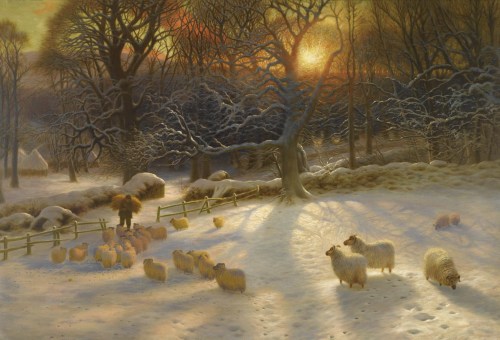
#FineArtFriday: Beneath the Snow Encumbered Branches by Joseph Farquharson 1903

Title: Beneath the Snow Encumbered Branches

Publisher: Hallmark Cards

Genre: landscape art

Date: Circa 1903

Medium: oil on canvas

Dimensions: 82 x 119.25 cm. (32 5/16 x 46 15/16 in.

What I love about this painting:

There is something haunting, a nostalgic echo of times long gone in this picture. The snow is thick and heavy, and the sheep are fluffy in their long coats. Winter has come and the shadows are long, but the conical haystacks across the lane contain plenty to last through the harshest season. The afternoon light is reflected on the snowy landscape and in the branches, a perfect golden luminosity, the hue that presages imminent dusk. 

About the Artist, via Wikipedia:

Joseph Farquharson DL RA (4 May 1846 – 15 April 1935) was a Scottish painter, chiefly of landscapes, mostly in Scotland and very often including animals. He is most famous for his snowy winter landscapes, often featuring sheep and often depicting dawn or dusk. The unusual titles of many of Farquharson’s paintings stand out and are sometimes long. Many of them were taken from poems by Burns, Milton, Shakespeare, and Gray. Farquharson was very patriotic and well versed in Scottish literature.

The remarkable realism of Farquharson’s work can be attributed to his desire to work en plein air. This had to be carried out in a unique way which was adapted to the harsh Scottish climate. Farquharson had constructed a painting hut on wheels, complete with a stove and large glass window for observing the landscape. Likewise to achieve as realistic a result as possible when painting the sheep which frequently appear in his snowscapes, he used a flock of “imitation” sheep which could be placed as required in the landscape of his choice. Farquharson painted so many scenes of cattle and sheep in snow he was nicknamed ‘Frozen Mutton Farquharson’.

Farquharson inherited the title of Laird in 1918 after the death of his elder brother Robert, a doctor and MP for West Aberdeenshire.

In 2008 the original of the 1901 painting Beneath the Snow Encumbered Branches came to light, for the first time in 40 years, when the lady owner put her house up for sale. The painting, which she had bought from a Bond Street dealer in the 1960s for £1,450, was expected to fetch up to £70,000 when it was offered for sale by auction at Lyon and Turnbull in Edinburgh. Nick Carnow, a director at the auctioneers, form said that the unnamed seller was moving to a smaller house and would not have room for the painting. In fact it sold for more than twice that estimate to another private collector in Scotland for £147,600.


Credits and Attributions:

Beneath the Snow Encumbered Branches Joseph Farquharson, Public domain, via Wikimedia Commons

Wikipedia contributors, “Joseph Farquharson,” Wikipedia, The Free Encyclopedia, https://en.wikipedia.org/w/index.php?title=Joseph_Farquharson&oldid=982764133 (accessed January 1, 2021).

Wikimedia Commons contributors, “File:The shortening winter’s day is near a close Farquharson.jpg,” Wikimedia Commons, the free media repository, https://commons.wikimedia.org/w/index.php?title=File:The_shortening_winter%27s_day_is_near_a_close_Farquharson.jpg&oldid=354603464 (accessed January 1, 2021).

Comments Off on #FineArtFriday: Beneath the Snow Encumbered Branches by Joseph Farquharson 1903

Filed under #FineArtFriday