Category Archives: Books

Mountains of the Moon Launches

Map of Neveyah, for MOTM 6-14-2015Mountains of the Moon is the newest release in the World of Neveyah. It is set in the same world as the Tower of Bones series but it is the original story that was written as the storyline for an old-school RPG game, along the lines of the early Final Fantasy games.

A prequel to Tower of Bones, the book follows the adventures of Wynn Farmer as he and his companions travel high into the mountains to stop the Tauron, Bull God, and his minotaurs from overrunning Neveyah. Nothing goes as it’s supposed to, and Wynn’s general naiveté often causes his companions serious trouble.

MOTM Front Cover Final 6-18-2015Wynn is seriously ignorant of the world in general, and at the outset, he’s in over his head, and he knows it. This book also introduces several characters as young men,  two of whom play a large role in the Tower of Bones series, Rall Ivarsson, and Jules Brendsson. Both these men figure strongly in later books, and at the time of Tower of Bones, Rall occupies the office of the Holy Seat, guiding the Temple of Aeos, and is the most powerful man in Neveyah.

Wynn’s story is sometimes hilarious and was fun to write–a contrast against the frequently dark situations they find themselves in. The world of Neveyah is a harsh place at times. Magic is a fundamental facet of life there, and many of the magical creatures that inhabit the world are just as deadly as the minotaur hordes of the Bull God.

THE BLURB:

Charged by the goddess Aeos, Wynn and his companions bicker and bumble their way through the Mountains of the Moon. Danger, mystery, and dark prophecies chase them through a gauntlet of jagged peaks and deadly traps.

Can they survive the dark secret hidden in Tauron’s crumbling castle before his minotaurs overrun Neveyah?

The Gods are at war, and Neveyah is the battlefield.

>>><<<

Mountains of the Moon is on sale at these fine online stores for $2.99 ebook and $17.99 for paperbook:

Barnes and Noble for Nook or paperback

Amazon.com for Kindle or paperback

Also available at SmashWords in a variety of ebook formats for your phone or tablet!

>>><<<

FOR CARLIE M.A. CULLEN’S REVIEW OF MOUNTAINS OF THE MOON, CLICK HERE Wow! She liked it!

>>><<<

And also, a reminder that I will be signing books at AFK Elixers and Eatery all afternoon and evening tomorrow, Saturday the 27th of June, 2015. Please–feel free to stop in and chat! I will be there with local authors AJ Downey, Sechin Tower, Lee French,  Lindsay Schopfer, Stephen Matlock, David Moore and Jeffrey Cook.

Comments Off on Mountains of the Moon Launches

Filed under Books, Publishing, Uncategorized, writer, writing

Heading to Renton at AFK Elixers and Eatery #Booksigning

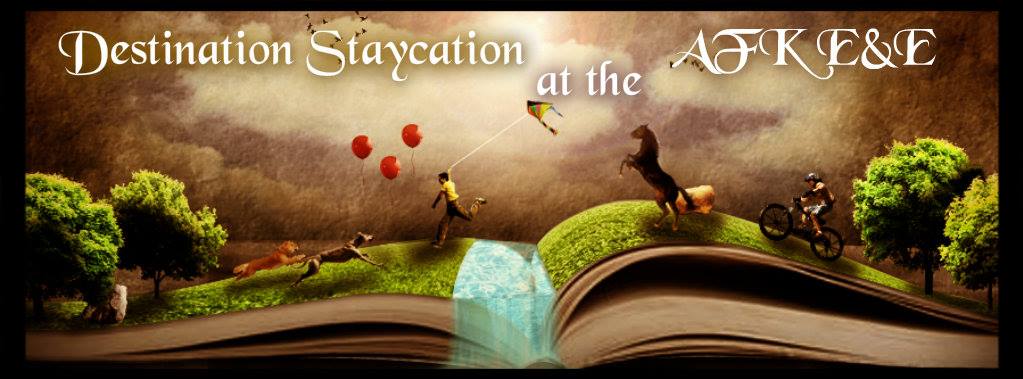
Destination StaycationOh, my gosh–I am getting so excited! The next event, Destination Staycation is happening in just 3 days, on Saturday the 27th of June.  Eight local, independent authors will be coming together for one event. We will be selling and signing books all afternoon and evening at AFK Elixirs & Eatery  in Renton, Washington, and I can hardly wait!

HTB Stamp copyWe will be offering reading-passports and stamping them with our book-related stamps.

Along with myself, AJ Downey, Sechin Tower, Lee French, Lindsay Schopfer, Stephen Matlock, David Moore, and Jeffrey Cook are the featured authors this time around.

And wow–what a fabulous venue–a gamer’s paradise!  AFK simply means Away From Keyboard. It’s commonly used in chatrooms and online games and it basically means that you won’t be available (Not at the keyboard = Not in front of your computer). But at AFK Elixers & Eatery you may be away from your computer, but you’re never far from gaming.

My friends and fellow gamers & book addicts in the western Washington/Seattle area are more than welcome to come on up (or down) and join us Saturday, between 2 and 9 pm.

Here are some samples of books being offered by the intrepid indie authors who will be joining me:

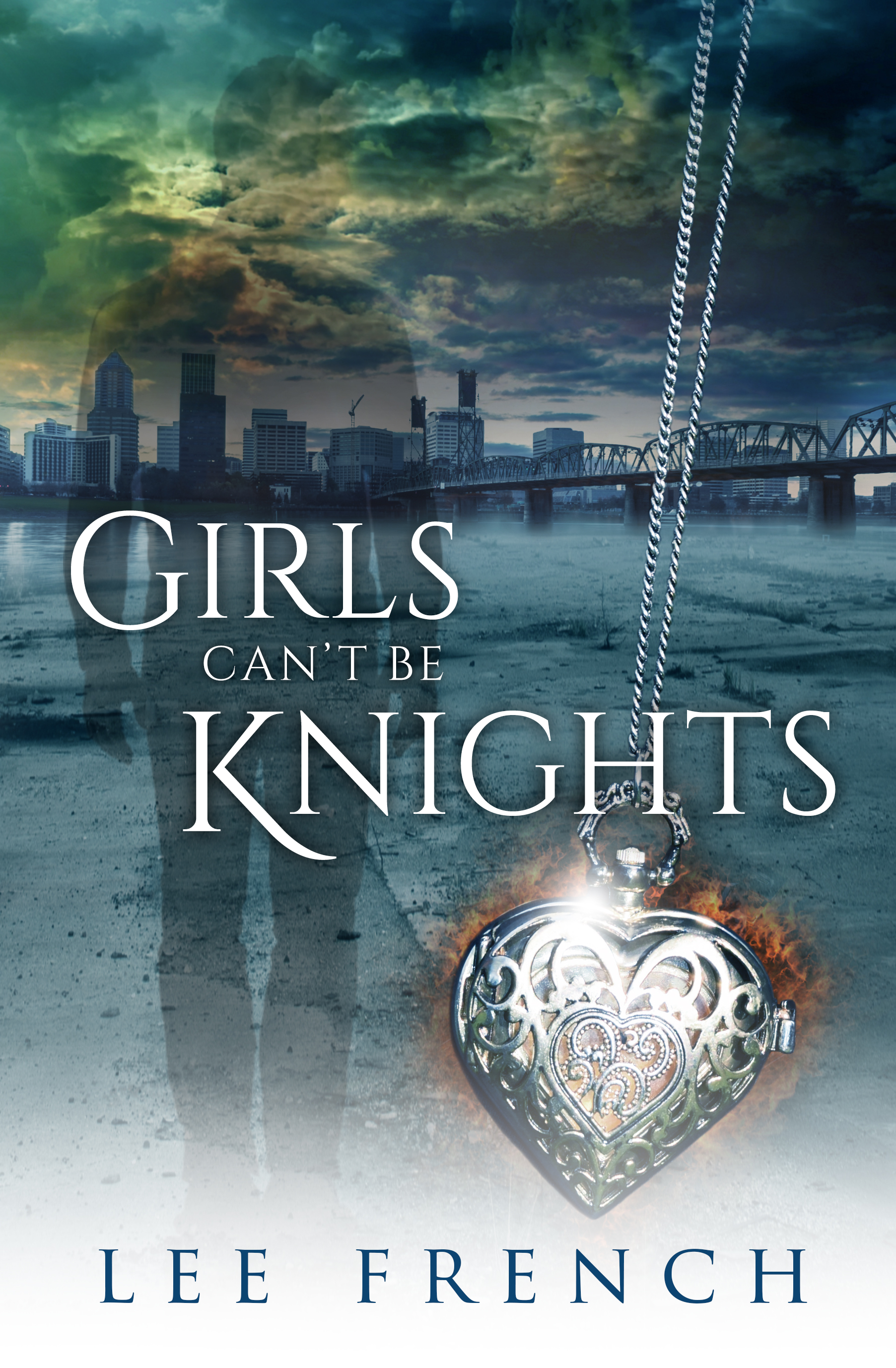
Girls Can't Be Knights KINDLEGirls Can’t be Knights, by Lee French

Portland has a ghost problem.

Sixteen-year-old Claire wants her father back. His death left her only memories and an empty locket. After six difficult years in foster care, her vocabulary no longer includes “hope” and “trust”.

Everything changes when Justin rides his magical horse into her path and takes her under his wing. Like the rest of the elite men who serve as Spirit Knights, he hunts restless ghosts that devour the living.

When an evil spirit threatens Claire’s life, she’ll need Justin’s help to survive. And how could she bear the Knights’ mark on her soul? Everybody knows Girls Can’t Be Knights.

Lost Under Two moons, Lindsay SchopferLost Under Two Moons, Lindsay Schopfer

Alone. Stranded. Richard finds himself on Other World, a place of fantasy and horror. With no companion but a makeshift journal, Richard must quickly learn the unfamiliar dangers around him as he struggles daily to survive. From the approach of winter to eerily intelligent packs of nightmarish creatures, each entry details another trial of life or death. But when Richard finds the remnants of an ancient civilization, he begins to wonder if he is truly alone, and whether or not the lost people of Other World still hold the secrets that could return him home to Earth.

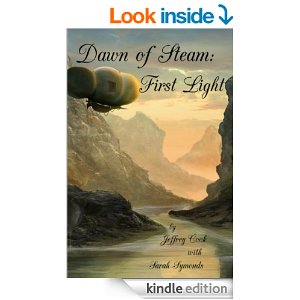
Dawn of Steam First Light Jeffrey CookDawn of Steam, Jeffrey Cook

In 1815, in the aftermath of the Napoleonic Wars, two of England’s wealthiest lords place a high-stakes wager on whether a popular set of books, which claim that the author has traveled to many unknown corners of the globe, are truth or, more likely, wild fiction. First Light is an epistolary novel, told primarily through the eyes of former aide-de-camp Gregory Conan Watts, describing the journeys of the airship Dame Fortuna and its crew through journals and letters to his beloved fiancee.
The first recruit is, necessarily, the airship’s owner: war hero, famed genius, and literal knight in steam-powered armor Sir James Coltrane. Persuading him to lend his talents and refitted airship to the venture requires bringing along his sister, his cousin, and the crew that flew with him during the Napoleonic Wars. Only with their aid can they track down a Scottish rifleman, a pair of shady carnies, and a guide with a strong personal investment in the stories.
When they set out, the wild places of the world, including the far American West, the Australian interior, darkest Africa, and other destinations are thought to be hostile enough. No one expects the trip to involve a legendary storm – or the Year Without a Summer of 1815-1816. The voyage is further complicated by the human element. Some parties are not at all happy with the post-war political map. Most problematic of all, the crew hired by the other side of the wager seem willing to win by any means necessary.

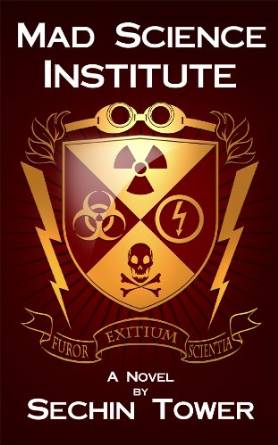
mad science institute Sechin TowerMad Science Institute, Sechin Tower

Sophia “Soap” Lazarcheck is a girl genius with a knack for making robots—and for making robots explode. After her talents earn her admission into a secretive university institute, she is swiftly drawn into a conspiracy more than a century in the making. Meanwhile and without her knowledge, her cousin Dean wages a two-fisted war of vengeance against a villainous genius and his unwashed minions. Separately, the cousins must pit themselves against murderous thugs, experimental weaponry, lizard monsters, and a nefarious doomsday device. When their paths finally meet up, they will need to risk everything to prevent a mysterious technology from bringing civilization to a sudden and very messy end.

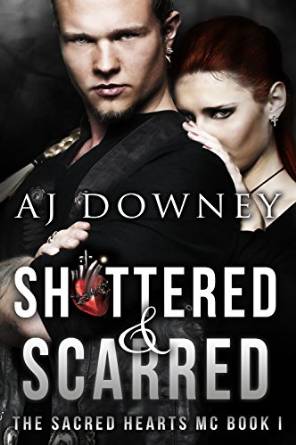
AJ Downey Shattered and ScarredShattered & Scarred: The Sacred Hearts MC, AJ Downey

She’s Shattered…

Ashton Granger is a perfect wife to her husband. She has to be, if she’s not, he will find a way to correct any perceived imperfections. Such is life, and so it has been for a very long time, eroding Ashton’s sense of self, cracking her sense of worth until she lays in a million pieces on the side of a stretch of lonely highway.

He’s Scarred…
Ethan “Trigger man” Howard is the Sergeant of Arms for The Sacred Hearts Motorcycle club. After several tours as a Marine Corps sniper overseas, he’s seen and done enough damage for a man three times his age. He’s out. Done. So over it, and home to nurse his wounds, physical, emotional and psychological with the help of his MC brothers. Now he simply deals with the scars that life handed him.

Was it more than just luck for he and Ashton both that he was the only other soul traveling that isolated stretch of highway that night?

**Mature Audiences Only (18+)**


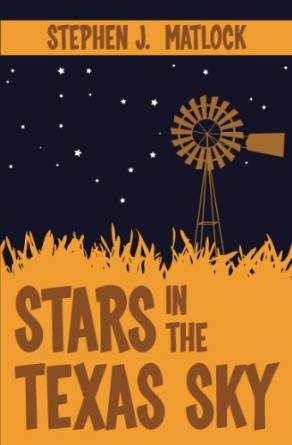
Stars in the Texas Sky Stephen J. MatlockStars in the Texas Sky, Stephen J. Matlock

STARS IN THE TEXAS SKY is a story about 13-year-old Henry Valentine. He’s the school’s star pitcher, intoxicated by first love of a young girl, and all seems right with his world of 1952 racially separated East Texas. Then he is confronted by an unlikely antagonist, a colored boy who challenges him in his town, bests him in a pitching duel, and fights him in the vacant lot outside of town. A wary distance becomes an unexpected friendship when they discover a common love for Texas beauty. He is devastated when a corrupt congressman sacrifices Henry’s friend to win re-election, and receives no sympathy or help from his disapproving family, church, and town. His finds support in the feisty, independent-minded widow with a taste for liquor in her lemonade who helps him fight against the powerful using only the tools of an innocent and powerless boy. In the end he learns the value of standing for what he believes in face of opposition, and discovers that there is nothing more powerful than a boy – or a man – who knows who he is.

This book is a 2012 Amazon Breakout Novel Award (ABNA) quarter-finalist.


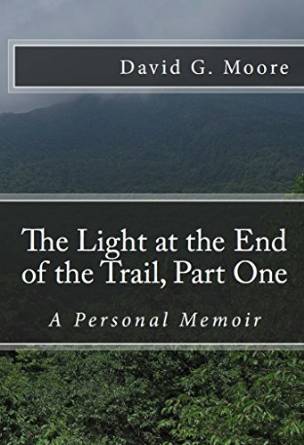
David Moore Light at end of trailThe Light at the End of the Trail, David G. Moore

This is a memoir of Moore’s early life–a life filled with equal parts light and darkness. Battling the neighborhood bullies, embracing the world of nature, surviving his mother’s depression, he finally descended into his own world of sadness. But the sadness was nothing compared to what awaited him at college. With the help of drugs and alcohol, a mysterious illness overtook him that baffled both him and the best of doctors. Meanwhile, the Moore family exploded. His parents separated, one sister joined a religious cult, the other buried herself in therapy, and his mother finally moved to the West Coast to escape it all. There were moments of bright light. At times, his illness vanished and during those reprieves he tried to live life to the fullest. But the quest for a life full of passion and joy pushed his mysterious psyche to the edge–then over the edge. It was time to enter the gates of hell.

>>><<<

And these are just the tip of the iceberg–the number of books my fellow authors and I will be offering is somewhat mind-boggling to me!

Check out the Destination Staycation Facebook Page!

I hope to see you at AFK E&E in Renton Wa on Saturday June 27th!


1 Comment

Filed under Books, Fantasy, Publishing, Uncategorized, writer, writing

Cover Reveal: Mountains of the Moon

Mountains of the Moon will go live on June 26, 2015.

I know! What took me so long!?

Well, it’s still the wild west here in the indie publishing world. Ya gotta get your book written, then rewritten, then beta-read and revised accordingly, then edited and revised accordingly, and the cover designed and the blurb made–it all takes time!

Four years, to be exact.

A great many things conspired to hold up publication of this novel, which was actually supposed to be published before Forbidden Road, but the day is finally here.

Mountains of the Moon is a prequel to Tower of Bones. The book follows the adventures of Wynn Farmer as he discovers who he is and what he is meant to do.

Wynn is a bundle of contradictions. He is in over his head, and he knows it. Naive beyond words, and ignorant of the world in general, he says the first thing that pops into his head, does not understand the difference between sarcasm and a direct order, and tends to follow instructions to the letter. His habit of answering rhetorical questions seriously is quite aggravating to his companions.

Wynn gets his act together, though, and that is when the fun really begins.

The book also follows the paths of Jules Brendsson and Rall Ivarsson, seeing them as young men. It also introduces Devyn D’Mal, an earth-mage and (unbeknownst to him in this book) uncle of most hated villain in Neveyah.

In the meantime, here is an excerpt:

The horn blew again, and the four tired mages trooped out. “Please, Aeos, just make this misery end,” muttered Jules. “Heaven only knows what that evil woman has planned for us next.”

“That was a real thunder-lizard,” said Devyn, horror tingeing his voice. “I can’t believe they had a real thunder-lizard. What is wrong with that woman? What if it had gotten loose?”

“It was only a baby,” said Rall, sagely. “Even the holy mother’s not mad enough to bring an adult inside the city.” Internally, he was shaken. “I hate fighting those things because you can’t use magic against them.”

“I thought it was fun,” said Wynn with a tired grin. The others stopped and stared at him then resumed walking. “She’ll run out of creatures pretty soon.” He tried to conceal his disappointment.

“I hope so,” said Jules, brightening up. “I can’t think of anything she hasn’t trotted out yet.”

As the four mages reached the slope opposite the amethyst tent, a thunderous roar shook the field and the night was suddenly lit as if by the sun. An enormous dragon emerged from the dark mists, landing directly in front of the group. Flames leapt and danced along the length of its immense back. Waves of heat like that of a large house fire rolled off it, making the questers unable to get close enough to use a sword, had they been so inclined.

They were not.

“Holy…where the hell did she get a firedrake?” Rall, Jules, and Devyn scattered, giving the beast too many targets concentrate on. Fiery breath roared toward them. Blazing claws reached and slashed, first at Jules and then Devyn. The horrific head swung, looking for a victim.

Overwhelmed by the horror that now stared down at him, Wynn reacted instinctively. Without even thinking, he cast his steel-cutting bolt to crack the creature’s shields and followed up immediately with a large ice spell.

>>><<<

And now, the cover:

MOTM Front Cover Final 6-18-2015

>>><<<

MOTM Back Cover Final 06-18-2015

>>><<<

And here is the YouTube link to my World of Neveyah, epic fantasy trailer, featuring Sway, written and performed by Margaret.

4 Comments

Filed under Adventure, Books, Fantasy, Humor, Publishing, writing

Great Cover Ups

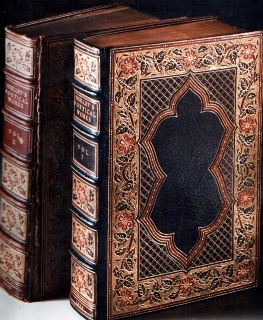
Old Restored booksBook covers. Remember when they were tooled, engraved leather, hand-made by monks? Yeah, me neither, but I do love good, well designed book covers.

We indies stress over them, and I suppose the Big 5 publishers do too, to a certain extent. But what, besides money and great designers who will make them for us, are elements that make a great book cover?

First up, in my opinion, a catchy cover has mystique. It expresses the central theme of the book, but it’s like a blurb–it can only capture one moment in time, so you have to choose what you will go for: mood, mystery, or great art.

Occam’s Razor (also known as Ockham’s Razor) comes into play here. According to iUniverse’s article on Cover Design Essentials, “…the essential theory is that unnecessary elements will decrease the overall efficiency and aesthetic appeal of a design. It can be a good indicator of why one design may succeed and another one will not. A good writer will spend hour after hour editing and re-editing their book, cutting words, paragraphs and so forth until it is “clean.” The cover designer’s method is not much different, other than it is a visual process rather than a written one.” 

In my own limited experience this is so true.  

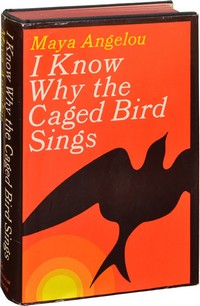
Caged_bird2Book covers have really evolved since my childhood. They used to be quite simple, with the art kept to a minimum. In the 1950’s and 60’s, book covers were stark, modern–and in my opinion, boring, such as Maya Angelou’s I Know Why the Caged Bird Sings.

My great problem is, I have always known what catches my eye, but not how to achieve it. So what are the simple, affordable elements of a good, catchy cover?

Again, iUniverse says (and I quote) good covers:

  1. Fall within the norms for your genre but visually stand out among other books.
  2. Appeal to readers and convince them to take a closer look at your book with a strong visual presence.
  3. Reflect the content of your book and expose readers to your writing style.
  4. Convince a potential reader to invest in a literary journey with your story.

Well, that is a hell of a lot to pack into a cover. And it’s hard to do! I am struggling with this aspect of being an indie. I am an artist, but until 2010 my work has been mostly in pastels and pencil. But I love Photoshop, and have been spending a lot of time designing covers and and learning how to make the graphics and the title a part of the art that captures the eye, but does not detract from the cover art.

I have been examining a lot of wonderful book covers, trying to define what it was about them that I liked so that my next book cover will be more true to what I want it to be. Being an old dog learning a new trick, I must learn from the masters.

So, here are only a few of my all-time favorite book covers, in no particular order:

Simple and to the point: The Martian, by Andy Weir tells us everything we need to know–this is going to be a hell of an adventure.

The MArtian Andy Weir

♦♦♦♦

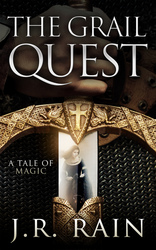
Grail Quest, by J.R. Rain, cover artist not credited–intriguing, and made me want to look inside.

Grail, JR Rain 2

♦♦♦♦

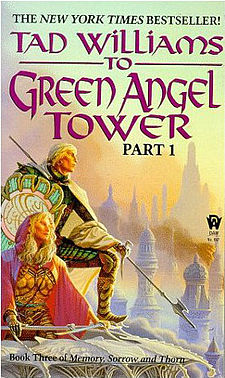
To Green Angel Tower, Tad Williams, as painted by the brilliant Michael Whelan–representing the mood, characters, and setting of the book, and visually stunning. I can’t replicate this sort of beauty, but I can admire it, nonetheless.

Green_Angel_Tower_P1

♦♦♦♦

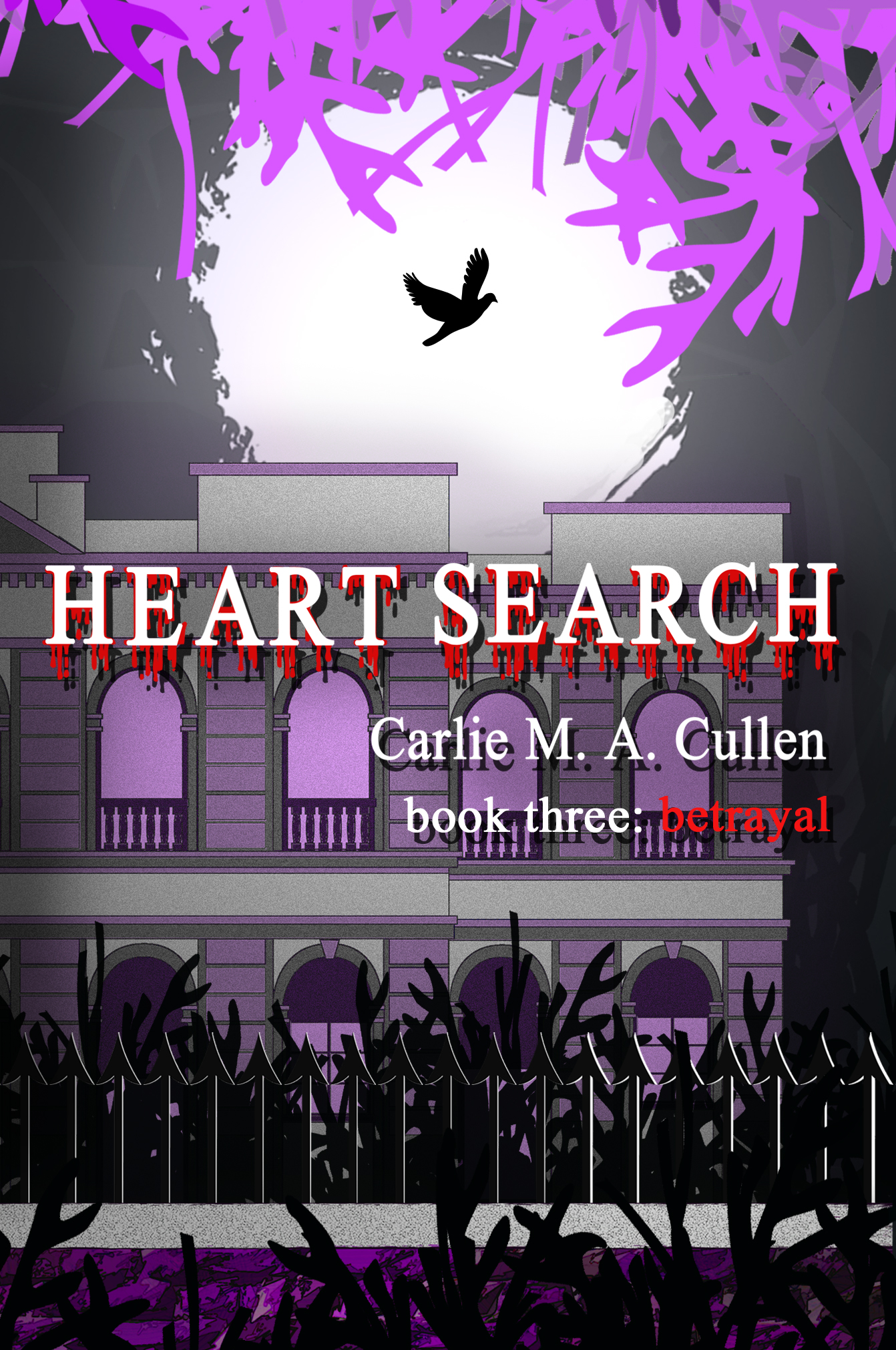
Heart Search book three: Betrayed, Carlie M.A. Cullen, cover by Nicole Antonia Carro. Completely speaks to what is inside the book–dark, mysterious, and a bit vampiric.

Betrayal front cover

♦♦♦♦

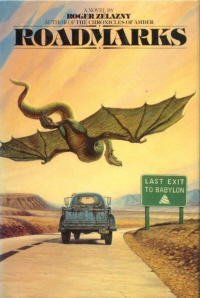
Roadmarks, Roger Zelazny, cover by the late Darrell K. Sweet. Simple, well-placed elements, promising a real roller-coaster ride inside.

Roadmarks_first

♦♦♦♦

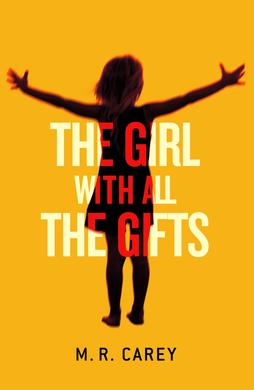
The Girl With All the Gifts, M.R. Carey–almost retro 1970s, yet intriguing. 

The_Girl_with_All_the_Gifts m.r. carey

♦♦♦♦

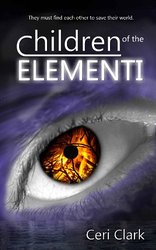
Children of the Elementi, Ceri Clark–this cover is a real winner, as much for the graphics as for the stunning yet simple art.

children of the  elementi

♦♦♦♦

Antithesis, Kacey Vanderkarr — cover art by Najla Qamber.

Antithesis by Kacey Vanderkar

♦♦♦♦

For me, books that portray the features of the characters on the cover are a bit dicey. They never look the way I, as the reader, think they should. So, usually I find myself gravitating to the symbolic aspects of the cover and ignoring the artist’s conception of the characters. I want mystique, intrigue…the hint of danger and adventure. A book cover must flip the switch on my curiosity, make me wonder what is inside…and that particular trigger is subjective.

Each reader is lured by something different, which is what makes this aspect of indie publishing so difficult. However, I am beginning to understand what it is that I am looking for when I am drawn to a cover, so…I’ve been busy learning graphic design. I will be doing a cover reveal for my forthcoming book, Mountains of the Moon, a book based in the World of Neveyah, the same world as the as Tower of Bones series, and which is set to be released July 15, 2015.

My son, Dan, who is a graphic designer has really given me some pointers on this particular cover. I have been to “YouTube University,” and learned how to make vectors for this cover (I made two!) and I have learned several other unique little tricks of Photoshop. I have the layout finalized, and the graphics, and will be revealing it at the end of June.

6 Comments

Filed under Books, Humor, Literature, Publishing, writing

#Proofreading is not #editing

Epic Fails signWhile some people will dispute this, proofreading is not editing.

Proofreading is done after the final revisions have been made, and hopefully it is done by someone who has not seen the manuscript before. That way, they will see it through new eyes, and the small things in your otherwise perfect manuscripts will stand out.

Anita Campbell, in her May 28, 2015 guest post for the SBA’s Blog-Industry Word says: “The first step of effective proofreading is understanding that not every typo or issue is alike.  Each needs to be attacked in a different way.” While she is speaking of editing blogposts, and short works, that profoundly true of longer manuscripts.

Even though an editor has combed your manuscript and you have made thousands of corrections, both large and small, there may be places where the reader’s eye will stop. Words have been left out, punctuation is missing–any number of small, hard-to-detect things can occur even after the most thorough of edits.

After the final edit we go over our work with a fine-toothed comb, trying to proof it ourselves. We read it aloud, and we read it from the bottom up, but our eye sees what it expects to see. We catch many things, but we don’t catch it all.

This is where the third person in the process comes in–the proofreader.

First of all, proofreading is not editing. Editing is a process that I have discussed at length elsewhere, and is completed long before we get to the proofreading stage.

SO, at the outset, the proofreader must understand that no matter how tempting it may be, they have not been invited to edit the manuscript for content. That has already been done and done again. If they cannot refrain from asking for large revisions regarding your style and content, find another proofreader.

What The Proofreader Should Look For:

Spelling—misspelled words, and homophones (words that sound the same but are spelled differently). These are words that spell-checker may or may not catch, so a human eye is critical for this.

  • Wrong:  Bobby wint out the door, slamming the screen.
  • Right:  Bobby went out the door, slamming the screen.
  • Wrong: There cat escaped and he had to chase it
  • Right: Their cat escaped and he had to chase it.

Repeated words and cut-and-paste errors. These are insidious and damned difficult to spot, and spell-checker won’t find always them. Sometimes they seem like unusually garbled sentences.

  • Wrong: First of all, First of all, it is accepted practice to italicize thoughts.
  • WrongFirst of all, it is accepted practice to practice thoughts.
  • Wrong: First of all, it is accepted to ot  thoughts.
  • Right: First of all, it is accepted practice to italicize thoughts.

Missing closed quotes:

  • Wrong: “Doctor Mendel, you’re new to the area. What do you know about the dead man? asked Officer Shultz.
  • Right: “Doctor Mendel, you’re new to the area. What do you know about the dead man? asked Officer Shultz.

Numbers that are digits:

  • Wrong: There will be 3000 guests at the reception.
  • Right: There will be 300 guests at the reception.

Dropped and missing words:

  • Wrong: Within minutes the place was crawling with cops, and Officer Shultz was sitting at my kitchen table me gently while I made hot water for tea.
  • Right: Within minutes the place was crawling with cops, and Officer Shultz was sitting at my kitchen table grilling me gently, while I made hot water for tea.

keep clam and proofread

Each time you create a new passage in your already edited manuscript, you run the risk of creating another undetected error.

At some point your manuscript is done. You have been through the editing process, and the content and structure is as good as you can get it, but you need one last eye looking for small flaws. Before you upload that masterpiece to Kindle or wherever, do yourself a favor and have it proofread by an intelligent reader, who understands what you are asking them to do and who is willing to do only that.

11 Comments

Filed under Books, Humor, Literature, Publishing, Uncategorized, writer, writing

#Inspiration: Oppression, rebellion and art

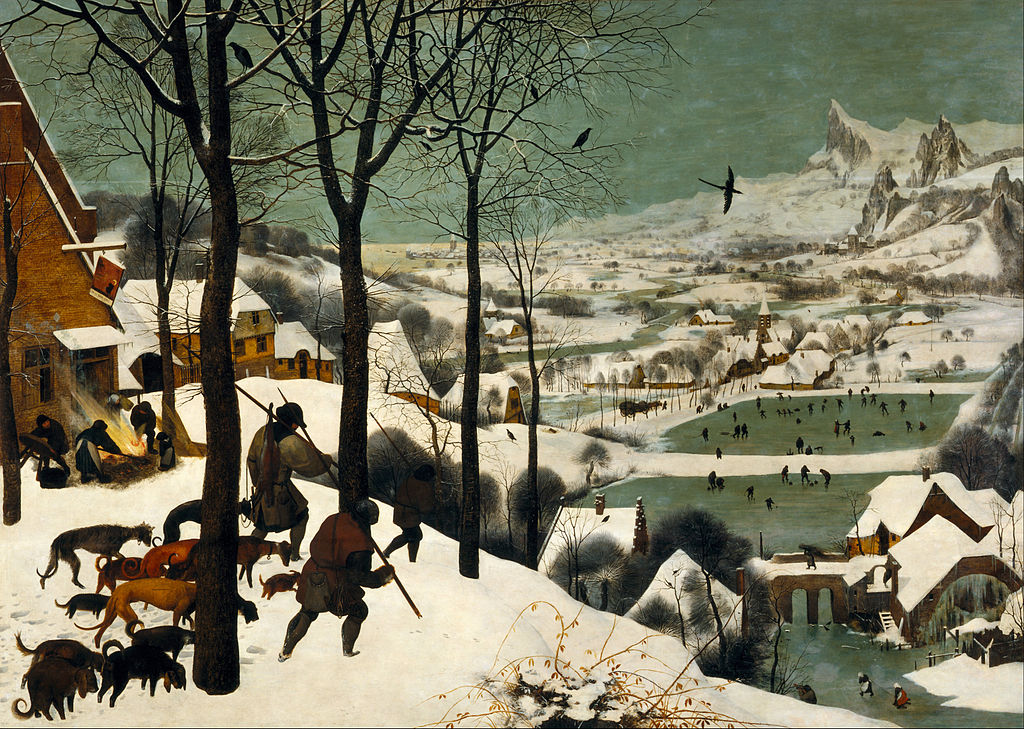
Hunters in the Snow, Pieter Bruegel the Elder, via Wikimedia Commons

Hunters in the Snow, Pieter Bruegel the Elder, via Wikimedia Commons

Writing, even writing fantasy, involves a certain amount of reality checking. You need to know how things actually worked.

Say you need to know what clothing the common European people wore during the renaissance looked like and how they dressed, both for celebrations, and for working.

I go to the 16th and 17th century painters and artists for that information. They always painted their subject with a heavy dose of religious allegory, but that was a part of village life–both the inquisition and the reformation was under way and the politics of religion was in the very air they breathed.

Any time you want an idea of average European village life in the Late Middle Ages through the 17th century, you need look no further than Wikimedia Commons.  There, under the heading  Category:Painters from the Northern Netherlands (before 1830) you will find the brilliant works of the Dutch Masters. These were artists living in what is now The Netherlands, and who were creating accurate records of the everyday life of the common people, along with stylized religious images.

During the 16th century, the Netherlands fought an 80 year war, trying to gain their independence from Spain, during the heart of the Spanish Inquisition. This was a period of extreme oppression and religious rebellion, and the art of times portrayed that very clearly.

I have learned, by rooting around the internet (so it must be true), that everything in the paintings of the time, no matter how commonplace, was allegorical, symbolic of some higher message. In art history (which I have always wanted to study), iconography is a visual language. This means that the way a subject is depicted and the way the image is organized, such as the number of figures used, their placing and gestures, all have specific meanings. The allegories they painted made heavy use of this visual language.

One particular family of of early Dutch painters from the county of Flanders pique my interest, the Brueghel Family. Five generations of their family were well-known painters, and print-makers.

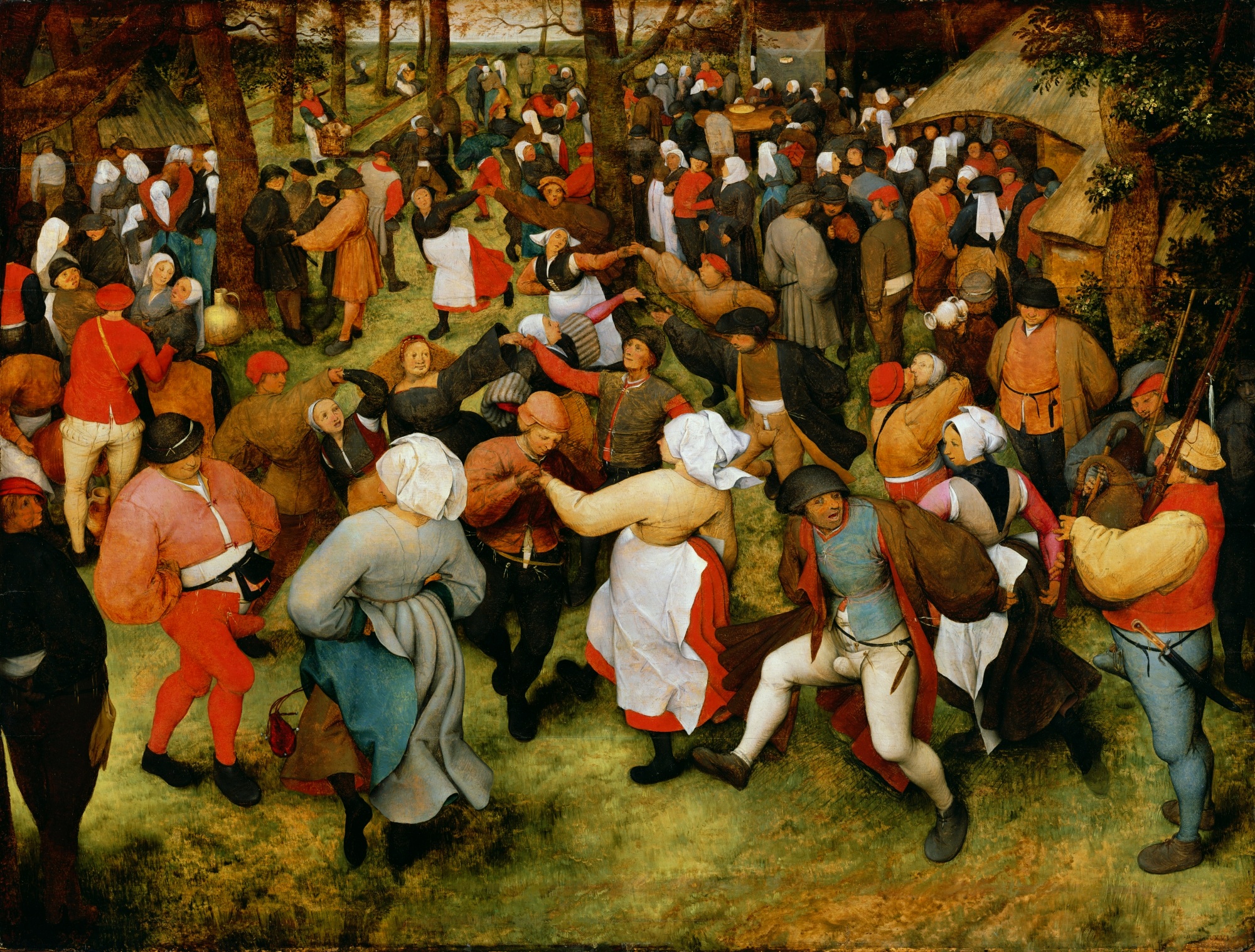
One of my favorite early Dutch paintings is the Wedding Dance, by Pieter Brueghel the Elder:

The Wedding Dance, c.1566 (oil on panel) by Bruegel, Pieter the Elder (c.1525-69)

The Wedding Dance, c.1566 (oil on panel) by Bruegel, Pieter the Elder (c.1525-69)

What makes this painting so spectacular to me is the amazing detail of the clothing. They loved color. From Wikipedia: The painting depicts 125 wedding guests. As was customary in the Renaissance period, the brides wore black and men wore codpieces. Voyeurism is depicted throughout the entire art work; dancing was tabooed at the time by the authorities and the church, and the painting can be seen as both a critique and comic depiction of a stereotypical oversexed, overindulgent, peasant class of the times.

All of these people are depicted as plump, which was a desirable trait–they were prosperous and not starving. All the things that (to this day) make a great party are there: music, food, and dancing. The men wear codpieces, emphasizing their male anatomy in the same way that in today’s society, women’s breasts are hyper-sexualized.  Perhaps codpieces should make a comeback in the men’s fashion world. I’ll show off my babyfeeders, if you parade your babymaker–that way we’ll both be sure we are getting something worth having. (or not.)

Anyway, back to the renaissance. They paid taxes, and this his how their IRS office looked to Brueghel’s eldest son, Pieter Jr. As you can see, not a lot has changed between then and now–we still pay in chickens and eggs. (heh heh.)

Pieter_Brueghel_the_Younger_(or_workshop)_The_Payment_of_the_Tithes_

The Payment of the Tithes (The tax-collector), also known as Village Lawyer, Pieter Bruegel, the Younger, signed P Brueghel

Brueghel’s eldest son, Pieter the Younger,  was never considered as fine a painter as his father or his brother, Jan Brueghel. He was considered a fine print-maker and his work shop was highly regarded. But he was not respected as an artist. Critics of the day felt he copied his father’s style, rather than developing his own. While he did paint in a folk-art style reminiscent of his father’s, his is sharper, more refined, taking it to the next level.

Notice how the people in the above picture are looking lean and ragged though, as opposed to the wedding picture painted by Pieter the Elder. The Little Ice Age had really gripped Europe, and times were hard.

So here is a painting by the second son of Pieter Brueghel the Elder, and a man who fathered his own dynasty of artists, Jan Bruegel the Elder. This is called People Dancing on a Riverbank and by their dress, with the neck-ruffs, you can see it depicts a wealthier class than his brother’s images, perhaps the merchant class rather than the peasants.

People_dancing_on_a_river_bank_by_Jan_Brueghel_the_elder

People Dancing on a riverbank, Jan Bruegel the elder, via Wikimedia Commons

One hundred years later, the Dutch were famous for their painters–and everyone wanted to own a Dutch masterpiece. Times had become quite hard, as the climate had cooled and crops regularly failed. Once-prosperous families often lived in the ruins of their family manors.

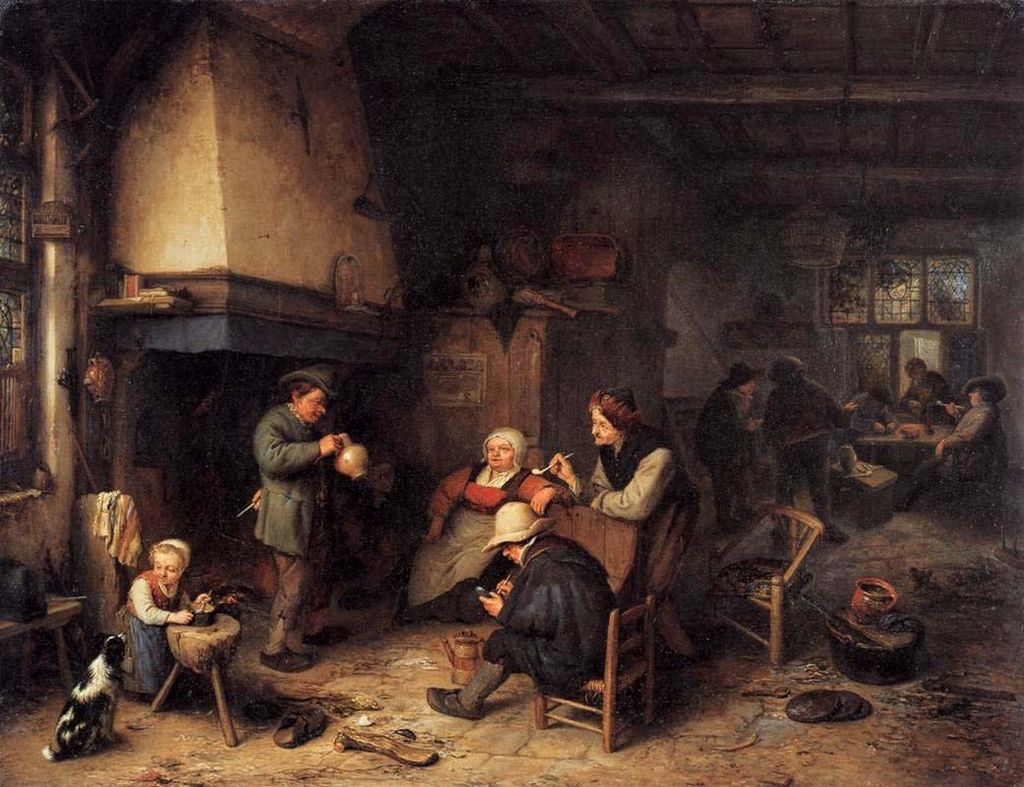
Peasants_in_an_Interior_(1661)_Adriaen_van_Ostade

Peasants in an Interior, Adriaen Van Ostade (1661) via Wikimedia Commons

In the above picture by Adriaen Van Ostade, these peasants are living in an enormous, decrepit farmhouse, almost like squatters. They are no longer plump, and are living in filthy conditions. The fire in the fireplace is very low, as if fuel was scarce.

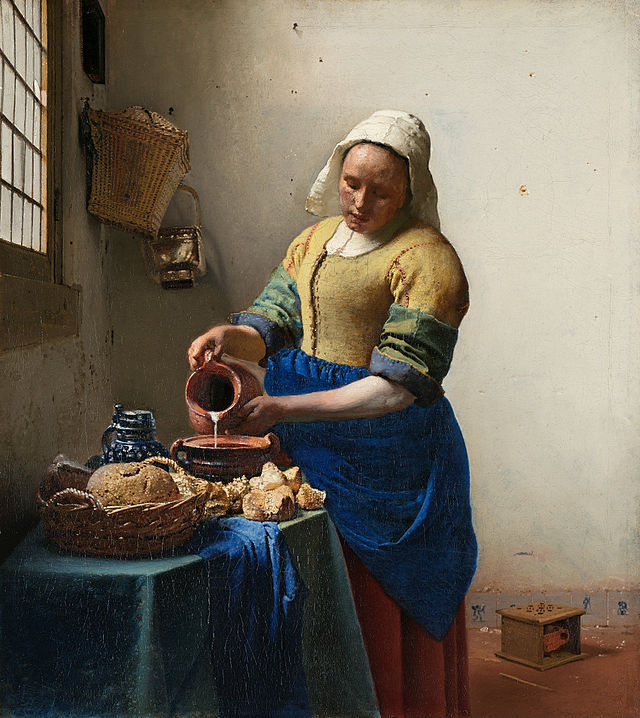
Another famous Dutch painting, from the same time period but showing a different segment of society is The Milkmaid, by Johannes Vermeer. In this painting, Vermeer shows an everyday task, a small glimpse of something that occurred daily in every household, a woman cooking.

The Milkmaid, Johannes Vermeer, via Wikimedia Commons

The Milkmaid, Johannes Vermeer, via Wikimedia Commons

In the background on the floor is a foot-warmer which was filled with coals and was an essential luxury, showing this was one of the wealthier households.

According to Wikipedia, the fount of all knowledge: By depicting the working maid in the act of careful cooking, the artist presents not just a picture of an everyday scene, but one with ethical and social value. The humble woman is using common ingredients and otherwise useless stale bread to create a pleasurable product for the household.

I love art depicting the lives of ordinary people. I find the small details intriguing. It shows us that in many ways we are not that different than they were. We want food, decent shelter, and of course, stylish clothes to attract a mate.

And back then as it does now, a hint of anything taboo would most certainly find its way into even a religious painting.

The best part of all this is, a woman with an average education and on a tight budget (like me) can enjoy these wonderful works of art at will. I can examine them  in as much detail as I want, and take all the time I want, and no one will stop me or throw me out of their museum for loitering, because the internet is open all hours and is free.

Wikimedia Commons is a great resource to just roam around in, even when you are not looking for something specific.

8 Comments

Filed under Books, Humor, Literature, writer, writing

Beta Reading, or Editing–what’s the difference?

Book- onstruction-sign copyIndies rely heavily on what we refer to as beta readers to help shape their work and make it ready for editing. But in many forums, I’ve seen authors  use the term used interchangeably with editing, and the two are completely different.

And unfortunately, some indie published works are clear examples of work by authors who don’t realize the importance of working with an editor, although it is apparent that they have had assistance from beta-readers.

What is quite disappointing to me, is the many traditionally published works that seem to fall into the same lack-of-good-editing category, and I am at a loss as to why this is so.

So what is the difference between a beta reader and an editor?

Well, there is a HUGE difference.

Editing is a process, one where the editor goes over the manuscript line-by line, pointing out areas that need attention: awkward phrasings, grammatical errors, missing quote-marks or a myriad of things that make the manuscript unreadable. Sometimes, major structural issues will need to be addressed. It may take more than one trip through to straighten out all the kinks.

  1. In scholastic writing, editing involves looking at each sentence carefully, and making sure that it’s well designed and serves its purpose. In scholastic editing, every instance of grammatical dysfunction must be resolved.
  2. In novel writing, editing is a stage of the writing process in which a writer and editor work together to improve a draft by correcting errors and by making words and sentences clearer, more precise, and more effective. Weak sentences are made stronger, nonessential information is weeded out, and important points are clarified, while strict attention is paid to the overall story arc.
  3. The editor is not the author She can only suggest changes, but  ultimately all changes must be approved and implemented by the author.

Beta Reading is done by a reader. One hopes the reader is a person who reads and enjoys the genre that the book represents. Beta reading is meant to give the author a general view of  the overall strengths and weaknesses of his story.

The beta reader must ask himself:

  1. Were the characters likable?
  2. Where did the plot bog down and get boring?
  3. Were there any places that were confusing?
  4. What did the reader like? What did they dislike?
  5. What do they think will happen next?

beta read memeBeta Reading is not editing, and  the reader should not make comments that are editorial in nature. Those kinds of nit-picky comments are not helpful at this early stage, because the larger issues must be addressed before the fine-tuning can begin, and if you are beta reading for someone, the larger issues are what the author has asked you to look at.

This phase of the process should be done before you submit the manuscript to an editor, so that those areas of concern will be straightened out first.

Editors and other authors make terrible beta readers, because it is their nature to dismantle the manuscript and tell you how to fix it. That is not what you want at that early point–what you want is an idea of whether you are on the right track or not with your plot and your characters, and whether or not your story resonates with the reader.

Do your self a favor and try to find a reader who is not an author to be a first reader for you. Then hire a local, well-recommended editor that you can work with to guide you in making your manuscript readable, and enjoyable.

If you notice a few flaws in your ms but think no one else will notice, you’re wrong. Readers always notice the things that stop their eye.

In my own work I have discovered that if a passage seems flawed but I can’t identify what is wrong with it, my eye wants to skip it. But another person will see the flaw, and they will show me what is wrong there.

That tendency to see our own work as it should be and not how it is, is why we need editors.

1 Comment

Filed under Books, Literature, Publishing, writer, writing

Writers’ Resources

tumblr_ng6esx01YT1syd000o1_1280The internet is a wonderful place. You can find just about anything here, and you can get a complete education for FREE!

Of course, it’s not credited, but there is an incredible amount of information on just about anything for free, up to and including college level courses in various aspects of writing through Coursera.

Coursera is a wonderful organization. They are a for-profit organization but you can take online courses from major universities FOR FREE, and while you don’t receive a diploma, you do get a good education. Wikipedia tells us that: All courses offered by Coursera are accessible for free and some give the option to pay a fee to join the “Signature Track.” Students on the Signature Track receive verified certificates, appropriate for employment purposes. These students authenticate their course submissions by sending webcam photos and having their typing pattern analyzed. 

I’m not sure how that works, but I am all for it. What I really like is that Coursera offers specializations, set courses that help increase understanding of a certain topic. I’ve take a couple of medieval history courses from them and while I didn’t have the money to get the certificate, I really enjoyed them. Knowledge is such a useful thing!

But  for the financially strapped author wanting to increase their knowledge of the craft of writing, an amazing resource is the website Writers’ Digest. They are also for profit, but they offer an incredible amount of information and assistance FOR FREE.

So here, in no particular order, are my favorite sources of Online Information About Writing your novel:

www.writersdigest.com

PBS.org/GuiltyPleasures/HowToWriteRomanceNovel

The Creative Penn

Harlequin.com

Creative Writing Now

Harlequin has one of the best websites, for teaching authors how to develop professional work habits, which is critical to being productive. I highly recommend you go to websites that specialize in writing romance novels regardless of what genre you write in, because the romance publishers have it right: they want to sell books, and they want you to succeed and so they get down to the technical aspects of novel construction and offer many excellent tools for getting your work out the door in timely fashion–something I need to work on. They also offer tips on marketing your work.

They also give you all kinds of tips on how to create a writing space and organize your day so you can get good writing time in and still manage your family. I used to do my writing on an old IBM Selectric that was next to the gerbil cage–not a good environment for writing.

In regard to research, reading one Wikipedia article does not qualify you as an expert in your chosen subject, so go beyond the surface. Find the websites that really explain your subject and go to the local library to research. Once you know what you are writing about, you can mash it up any way you want to.

But even though we are educating ourselves about our novel’s setting and have gained an understanding of how the science that forms the core plot-point actually works, sometimes we hit a bit of sticking point in the creative process.

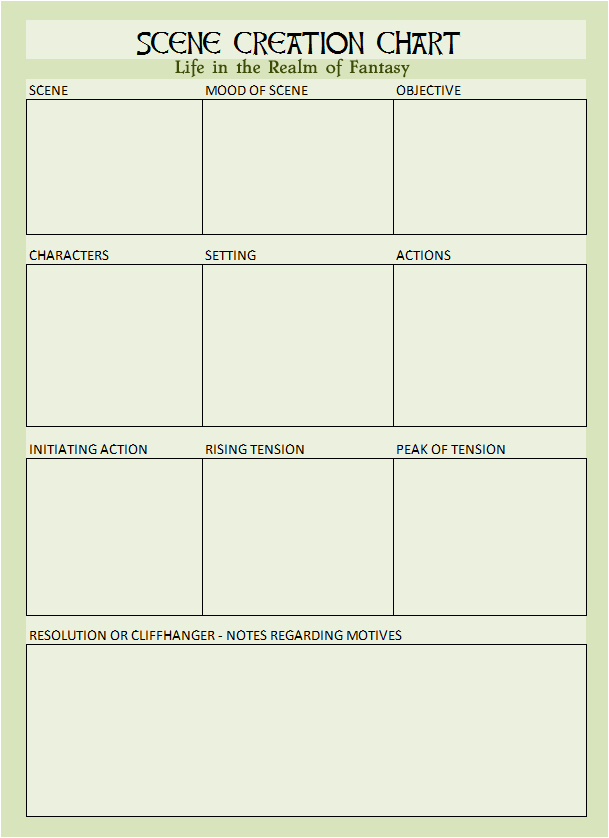
When that happens we can either drop out of writing mode (not an option for me) or we can find a way to yank that thought out of our head and identify what must happen to get that scene moving. I am a linear thinker, so after a little trial and error, and after seeing how other authors work, this is what I came up with, that works for me in regard to organizing a scene that I am having difficulty with. If it works for you, feel free to:

right click>save image as jpeg or png and save it to your hard drive to print out

Scene creation chartOnce I know how these seemingly disparate things fit together, the scene becomes unstuck, and I begin making progress again. Also, something about the process of spreadsheeting the scene gives me a little insight as to why a particular character might NOT need to be in that scene.

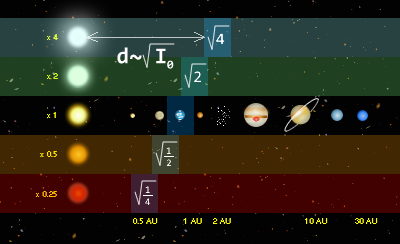
Sometimes just knowing who does and who doesn’t need to be in a scene is just as important as knowing where the nearest inhabitable (for humans) planet  might lie in a given star system.

Habitable_zone_-_HZ

1 Comment

Filed under Books, Humor, Literature, Publishing, Uncategorized, writer, writing

Baiting the hook

450px-Flyfishing wikipedia dot com

Flyfishing on river Sava Bohinjka, Slovenia photo by Ziga (PD)

You wrote the book. Your friends read it–you hope. At least they said they did, and they still like you. They tell you it’s a good book. They think it’s publishable, so you decide to go indie and self pub it. You spend the next year getting it edited and having a flashy cover designed. You even have a launch date picked out and feel reasonably sure you can get the book through the pipeline at CreateSpace by that date.

Now you are at the point where you must come up with some sort of a blurb.

This is where it gets fun.

Not.

There are many wonderful blurb-writing gurus out there on the internet, offering advice to those intrepid indies who would write that catchy morsel of blurbiness:

www.blurb.com

Marilyn Byerly 

Digital Book World

The Creative Penn

Yes, there are many websites offering us insight, and they all have great advice for us.  But putting that plethora of knowledge to practice is a bit daunting. 

They each approach it differently but when you distill it into a simple, linear form, it all boils down to variations on these concepts (in no particular order) for you to have in your head before you begin:

  • Use words that clearly evoke the genre
  • Keep it short– 100 to 300 words
  • Get the protagonist’s name out there early
  • Introduce the core conflict
  • Make it intriguing, mysterious–can this conflict be resolved?
  • Use a little hyperbole–stunning, denouement, and so on

The Internet Gurus also offer us this advice:

  • Don’t say what a great book it is
  • Don’t give spoilers
  • Don’t summarize the book (or even the first chapter)
  • Don’t be long-winded or wordy
  • Don’t say what a great writer you are
Back Cover of Mage-Guard of Hamor

Example of what NOT to put on back of book in lieu of proper blurb.

I would also offer this advice: keep it to less than 150 words and don’t skip writing the blurb. It has become popular for the Big 5 publishers to skip writing a blurb and just go with praises for the author’s other works, expecting that their name and fame will sell the book. This tells me that blurb writing is hard and even the the big guys don’t like it. Most big publishers, like Penguin, will have a marketing department.  Penguin puts blurbs on their books, so why the others can’t come up with a proper blurb is a mystery to me.

That might work for Stephen King or L.E. Modesitt Jr., but it won’t work for an unknown indie who is trying to build a reputation and a fan base.

Readers want to know what they are buying, and if they have no idea who you are, they don’t care what your friends think about your work. They aren’t going to touch it.

The blurb is a teaser.  It’s one part of a three-part lure, the only purpose of which is to entice a customer to buy your book.

Remember, you are fishing for readers and that blurb is part of the triangular bait:

  1. Part one is the flashy cover–even for ebooks that cover gets them to stop and look a bit closer, and
  2. the blurb is part two–the part that hooks them and gets them to crack it open.
  3. Part three of this lure is the words they read once they open the bookthat is when you land your fish, whether by ebook or by paperbook.

But until they have read your blurb, they won’t open the book, so they won’t know what wonder awaits them.

I am currently working on a blurb for a stand-alone book based in the world of Neveyah, the world the Tower of Bones Series is set in.  Where the Tower of Bones series can be rather dark, Mountains of the Moon has many comic elements.

Right now, this is my blurb. My head is numb, so I’m letting it sit for another week or so then I will revisit it and have my homies at Myrddin Publishing go over it one more time:

MOTM MAPHidden away in the Mountains of the Moon, the ruins of an immense castle harbor a dark secret: entire families have vanished from the valleys in the shadow of the mountains, leaving no trace. The elderly Baron Hemsteck hasn’t been seen for two seasons.

Four mages are sent to investigate. Wynn Farmer and his companions embark on a trek to learn the truth. Along their route, they must battle against the strange beasts controlled by a rogue mage and ultimately face an evil they never thought possible.

Danger, dark magic, and mystery await those who seek the truth in the Mountains of the Moon. The Gods are at war, and Neveyah is the battlefield.

We kept it down to 114 words, and managed to get the World of Neveyah series tag-line in on the end of it.

Sigh. I admit I am not good at writing blurbs for my own books, but I do have a large posse of author-friends who are more than willing to help me hone that blurb. When the back cover is finished, I will have a concise blurb that will hopefully entice readers to read my book.

Finally, at the end of June,  I will reveal the cover.  I am pretty excited about this new book. I can hardly wait!

6 Comments

Filed under Adventure, Battles, Books, Fantasy, Humor, Literature, Publishing, Uncategorized, writer, writing

Girls Can’t be Knights, Lee French cover reveal and interview

My good friend and fellow member of Myrddin Publishing Group, Lee French, has a new book coming out soon. The cover is gorgeous, in my opinion. I also love the title, Girls Can’t Be Knights.  This book is a young adult fantasy novel, championing Girl Power while exploring the world of a secret organization, the Spirit Knights. I can totally get behind that!

Set in Portland Oregon, Girls Can’t Be Knights is another in the long line of French’s impressive career, which includes nine books, one trilogy, one epic fantasy series and a short story. Her works are popular among fantasy and paranormal readers, with many re-reading books several times after purchase.

Lee has consented to answer a few questions for us:

CJJ: Tell us a little of early life and how you began writing:
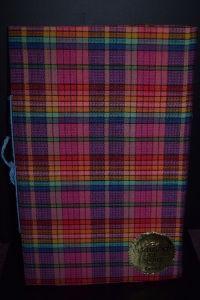
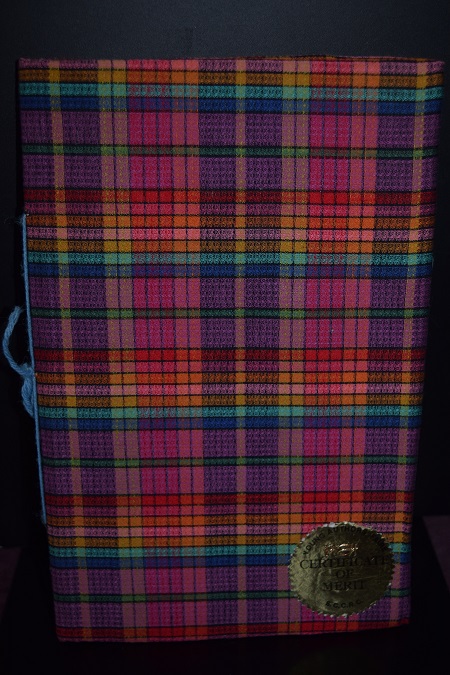
Lee French's First Book

Lee French’s First Book

LF: I was a late reader, not really grasping the whole thing until 2nd grade. Once I did, I clung to books with both hands and a glare for anyone who dared to attempt prying one away. At that time, my school district ran an annual book fair, for which they encouraged students of all ages to submit “books” for “judging.” With my mom’s help, I self-published an epic six page volume about The Mean Old Man’s Backyard, which is to say that I cut all the paper, wrote all the words, drew all the pictures, and let her glue the fabric to the cardboard for the cover.

From that point on, I considered myself a “writer,” though I considered it a hobby for a long time.

CJJ: That is a cute book! Tell us about your most recent book. How did you come to write this novel?

LF:  Girls Can’t be Knights started as all my books do—with an idea that sounds brilliant but is ultimately kinda dumb. I wrote it for NaNoWriMo last year, which means it had curious ideas and plot points that had to be rewritten quite a bit. The primary idea comes from Les Miserables, specifically the idea of two men, eash the hero of his own story, striving against each other. The two main characters were Valjean and Javert, and elements of that remain. What happened is that Claire stepped in and demanded agency. The core ideas had to mutate to accommodate her.

CJJ: How does Girls Can’t be Knights differ from your other two series of books?

LF: This is my first foray into YA. The Maze Beset trilogy is similar to urban fantasy, though being about people with superpowers who got them through a genetic thingy, it’s technically science fiction. Like that trilogy, The Greatest Sin is generally suitable for teen readers, but wasn’t written with them in mind.

CJJ: Do you have a specific ‘Creative Process’ that you follow, such as outlining or do you ‘wing it’?

LF:  When I first took the plunge into writing novel length work, I winged it. A lot. October 29, 2008, I decided to do NaNoWriMo for the first time and had just a basic idea of where I’d go. I finished, but it was awful. The next year, I took outlining a little too far. Since then, I’ve found a happy medium that works for me, where I go back and forth between winging it and outlining. The first chapter of a book is usually off the cuff, then I outline a few chapters, then I work up to the outline and wing a bit, then go back to the outlining. It works for me, which is the most important part of any Process.

CJJ: What genre would you consider this book, and how does it differ from others of its genre?

LF: Girls Can’t Be Knights is Young Adult Urban Paranormal/Fantasy Adventure. This book is all about family issues. Justin has a happy traditional family, but he’s the only one, and he came to it by way of domestic abuse between his own parents. This story shows a number of characters in various stages of dealing with broken homes and lost family members, and for various reasons. I’m really looking forward to pursuing the theme further in the second book, which is untitled as yet and will probably be out in 2016.

CJJ: What sort of books do you read for pleasure?

LF: As a book blogger, I don’t really read for pleasure in the strictest sense anymore. My reading material is almost exclusively indies, because that’s who needs book reviews. I’ve had the good fortune to meet a number of excellent indie authors, though, and their writing is mostly what I read, ensuring that steampunk, traditional fantasy, the occasional bit of space sci-fi, and some guilty pleasure smut fills my reading time slots.

CJJ: When you are not writing, what do you do for fun?

LF: Though writing is, admittedly, the most fun thing I do, I also enjoy baking, gardening, and cycling. Every year, I participate in Ragbrai, which is a lunatic pedal-powered festival across Iowa that attracts about 20,000 other cyclists for long days of torturous riding in abysmal heat punctuated by camping every night. It’s awesome.

CJJ: I know why I chose the indie route for my work, but I’m curious as to why you’ve chosen this path.

LF: At first, I chose it because the process of querying an agent or publisher made me freeze in panic. It also made my hideously impatient side cringe at the expectation of waiting months to get rejected. After pursuing it for almost two years now, I’ve come to the conclusion that I’d probably be unhappy with a traditional publisher. I’m too impatient, I have too much need for control over the aspects, and I actually *gasp* enjoy formatting my own books. If someone took one of my books and gave me a cover that I didn’t like without letting me at least make suggestions, I’d probably punch them in the face.

CJJ: What advice would you offer an author trying to decide whether to go indie or take the traditional path?

LF: Read everything you can about how it works and don’t discount one or the other because you’ve “heard” x or y thing. Independent publishing is now a major force in the market, but traditional publishing isn’t going to roll over and die. There are benefits and detriments to both paths, and every author has to decide what’s right for them. Investigate the market to discover who your audience is and where and how they shop. Get out and meet other authors in your area. Pay attention to the books you come across and how you came across them. All the information you need to make the best choice for you is out there.

CJJ: I always enjoy your POV, especially on the way the publishing industry works, and what indies need to take note of. And now, the blurb, and the the cover reveal for Lee’s new book:

>>><<<

GIRLS CAN’T BE KNIGHTS

by Lee French

release date June 12, 2015
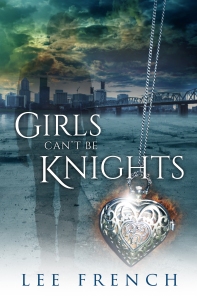
Girls Can't Be Knights KINDLEPortland has a ghost problem.

Sixteen-year-old Claire wants her father back. His death left her only memories and an empty locket. After six difficult years in foster care, her vocabulary no longer includes “hope” and “trust”.

Everything changes when Justin rides his magical horse into her path and takes her under his wing. Like the rest of the elite men who serve as Spirit Knights, he hunts restless ghosts that devour the living.

When an evil spirit threatens Claire’s life, she’ll need Justin’s help to survive. And how could she bear the Knights’ mark on her soul? Everybody knows Girls Can’t Be Knights.

>>><<<
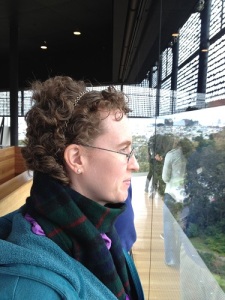
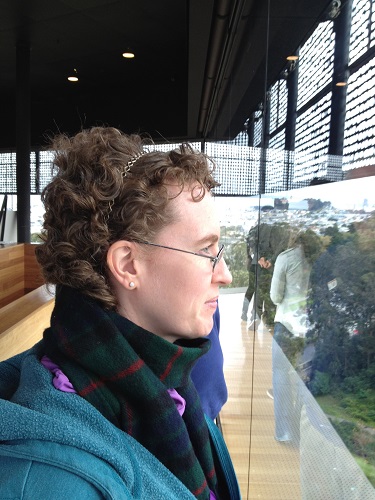
Lee French PhotoLee French lives in Olympia, WA, and is the author of several books, most notably the Maze Beset Trilogy, The Greatest Sin series (co-authored with Erik Kort), and assorted tales in her fantasy setting, Ilauris. She is an avid gamer and active member of the Myth-Weavers online RPG community, where she is known for her fondness for Angry Ninja Squirrels of Doom. In addition to spending much time there, she also trains year-round for the one-week of glorious madness that is RAGBRAI, has a nice flower garden with one dragon and absolutely no lawn gnomes, and tries in vain every year to grow vegetables that don’t get devoured by neighborhood wildlife.


She is an active member of the Northwest Independent Writer’s Association and the Olympia Writer’s Coop, as well as serving as the co-Municipal Liaison for the NaNoWriMo Olympia Region.


Comments Off on Girls Can’t be Knights, Lee French cover reveal and interview

Filed under Books, Humor, Publishing, Uncategorized, writer, writing