Category Archives: #FineArtFriday

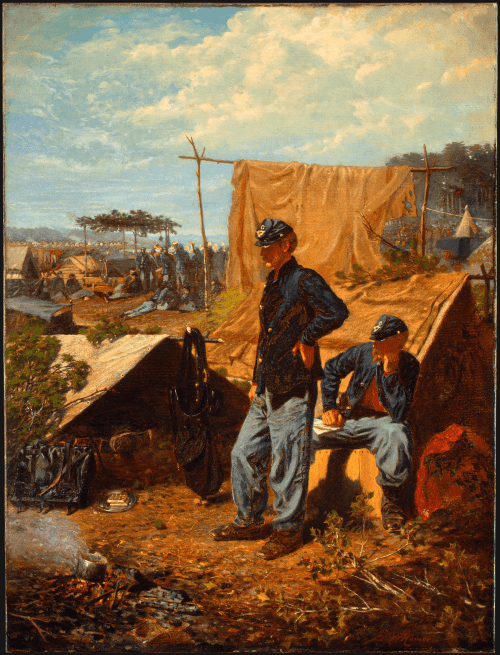
#FineArtFriday: Home, Sweet Home by Winslow Homer (reprise)

We now live in challenging times with the pandemic and social upheavals occupying our conscious minds and social media. I’ve chosen to revisit one of Winslow Homer‘s most poignant images as a reminder of our humanity, that we can come together and be better than we were.

Homer traveled with the Union Army, but the story of the moving event that he depicted in this painting is told by a Confederate soldier who was present. That story follows, toward the bottom of this article.

Home, Sweet Home is one of the most famous paintings of the American Civil War, depicting a moment in time, painted by Winslow Homer. On opposite shores of the Rappahannock River, opposing armies are caught up in an awareness of brotherhood, as music becomes the medium that lays bare the humanity of the soldiers on both sides.

Winslow Homer was best known for his landscapes featuring the many moods of the ocean, but he also painted many iconic images of that turbulent time before, during, and after the American Civil War. His art captures a sense of familiarity, a feeling that the viewer knows these people and their stories intimately.

Wikipedia says, “Harper’s (magazine) sent Homer to the front lines of the American Civil War (1861–1865), where he sketched battle scenes and camp life, the quiet moments as well as the chaotic ones. His initial sketches were of the camp, commanders, and army of the famous Union officer, Major General George B. McClellan, at the banks of the Potomac River in October 1861.

“Although the drawings did not get much attention at the time, they mark Homer’s expanding skills from illustrator to painter. Like with his urban scenes, Homer also illustrated women during wartime, and showed the effects of the war on the home front. The war work was dangerous and exhausting. Back at his studio, Homer would regain his strength and re-focus his artistic vision. He set to work on a series of war-related paintings based on his sketches, among them Sharpshooter on Picket Duty (1862), Home, Sweet Home (1863), and Prisoners from the Front (1866). He exhibited paintings of these subjects every year at the National Academy of Design from 1863 to 1866. Home, Sweet Home was shown at the National Academy to particular critical acclaim; it was quickly sold and the artist was consequently elected an Associate Academician, then a full Academician in 1865.[10]”

The story behind the painting, Home, Sweet Home, is told poignantly in the autobiography, Reminiscences of a Private, by Frank Mixson, who served in the Confederate Army.

“The Yankee band would play the popular airs of theirs amid much yelling and cheering; our bands would do the same with the same result. Towards the wind-up the Yankee band struck up “Yankee Doodle.” Cheers were immense. When they stopped our band struck up “Dixie,” and everything went wild. When they finished this, both bands, with one accord and simultaneously, struck up “Home, Sweet Home.” There was not a sound from anywhere until the tune was finished and it then seemed as if everybody had gone crazy. I never saw anything to compare with it. Both sides were cheering, jumping up and throwing up hats and doing everything which tended to show enthusiasm. This lasted for at least a half hour. I do believe that had we not had the river between us that the two armies would have gone together and settled the war right there and then.”

Quote from: Reminiscences of a Private, by Frank Mixson (1910)


Sources and Attributions:

Wikipedia contributors, “Winslow Homer,” Wikipedia, The Free Encyclopedia, https://en.wikipedia.org/w/index.php?title=Winslow_Homer&oldid=817253575 (accessed January 4, 2018).

Home, Sweet Home: “Had we not had the river between us,” posted by Marek,  https://civilwarfolkmusic.com/2013/12/15/1862-home-sweet-home/ accessed 04 January 2018.

Reminiscences of a Private, by Frank Mixson (published 1910 by Columbia, S.C., The State Company)

Home, Sweet Home (oil on canvas) by Winslow Homer – circa 1863 | Winslow Homer [Public domain], via Wikimedia Commons, accessed 04 January 2018.

Comments Off on #FineArtFriday: Home, Sweet Home by Winslow Homer (reprise)

Filed under #FineArtFriday, writing

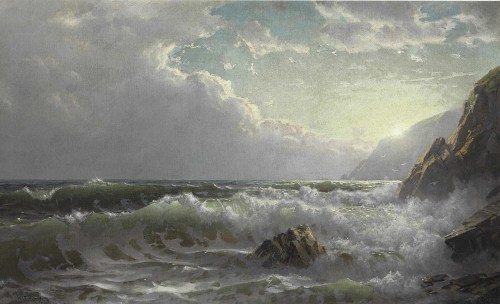
#FineArtFriday: Off the Coast of Cornwall by William Trost Richards 1904

Artist: William Trost Richards  (1833–1905)

Title: Off the Coast of Cornwall

  • Genre: landscape art
  • Date: 1904
  • Medium: oil on canvas
  • Dimensions : Height: 55.9 cm (22 in); Width: 91.4 cm (35.9 in)
  • Collection   Private collection
  • Inscriptions: Signature and date bottom left: W.T. Richards.04.

What I love about this painting:

It is a blustery day, along a rugged seacoast. Intermittent rain squalls blow through, and when one passes the sun peeps out, the bright lull between storms. The sea is that dark greenish color reflecting the sky, a quality stormy waters here in the North Pacific coast often have. It is of a shore in Cornwall, England, but it feels as familiar as if it were the coast of my home, Washington State.

What I love most about how Richards depicted the water is the milk-glass opaqueness of the green water and the way the light seems to shine through the waves.

About the Artist via Wikipedia:

William Trost Richards  rejected the romanticized and stylized approach of other Hudson River painters and instead insisted on meticulous factual renderings. His views of the White Mountains are almost photographic in their realism. In later years, Richards painted almost exclusively marine watercolors.

In the summer of 1874 Richards visited Newport, Rhode Island, and became enthralled with the area’s sublime coastline. He purchased his first of several Newport area homes in 1875 and continued to paint there for the rest of his life, dividing time between Newport and Chester County, Pennsylvania, where he purchased a farm near the Brandywine in 1884. Richards made many excursions to Europe, especially Britain and Ireland, where he produced an important body of work.

He was married to the the poet and playwright Anna Matlack, with whom he had eight children, only five of whom lived past infancy. Matlack educated the children at home to a pre-college level in the arts and sciences. One of their sons, Theodore William Richards, would later win the 1914 Nobel Prize in Chemistry. Anna Richards Brewster, their sixth child, went on to become an important painter in her own right, having received an early arts education from her father as well.

Richards was one of the few 19th century American landscape artists who was equally skilled as a watercolorist and a painter in oils. His drawings are considered among the finest of his generation. Many of his drawing still survive.

Today, Richards is highly regarded for the luminist seascapes, images imbued with light and atmosphere, that he created along the Rhode Island, New Jersey and British coasts. Luminist landscapes emphasize tranquility, and often depict calm, reflective water and a soft, hazy sky.


Credits and Attributions:

Off the Coast of Cornwall, by William Trost Richards / Public domain

Wikimedia Commons contributors, “File:William Trost Richards – Off the Coast of Cornwall.jpg,” Wikimedia Commons, the free media repository, https://commons.wikimedia.org/w/index.php?title=File:William_Trost_Richards_-_Off_the_Coast_of_Cornwall.jpg&oldid=288660467 (accessed June 4, 2020).

Wikipedia contributors, “William Trost Richards,” Wikipedia, The Free Encyclopedia, https://en.wikipedia.org/w/index.php?title=William_Trost_Richards&oldid=939570835 (accessed June 4, 2020).

Wikipedia contributors, “Anna Matlack Richards,” Wikipedia, The Free Encyclopedia, https://en.wikipedia.org/w/index.php?title=Anna_Matlack_Richards&oldid=933481876 (accessed June 4, 2020).

1 Comment

Filed under #FineArtFriday

#FineArtFriday: Silver Lake at Dusk, by Diego Delso

Silver Lake during dusk, Wrangell–St. Elias National Park and Preserve, Alaska, United States, Photographed by Diego Delso on 23 August 2017. This image was selected as picture of the day on Wikimedia Commons for .

About the Photographer:

Diego Delso roams the world photographing nature and contributes his work to Wikimedia Commons. He is a free content and knowledge supporter, whose photographs are regularly featured as the Image of the Day, and several of his images have been selected as finalists for Image of the Year.

I love the mood and serenity of today’s image. The clarity and depth of both the water and the sky makes one feel as if we know this place.


Credits and Attributions

Silver Lake at Dusk, Diego Delso / CC BY-SA (https://creativecommons.org/licenses/by-sa/4.0)

Wikimedia Commons contributors, “File:Lago Plateado, Parque nacional y reserva Wrangell-San Elías, Alaska, Estados Unidos, 2017-08-22, DD 135.jpg,” Wikimedia Commons, the free media repository, https://commons.wikimedia.org/w/index.php?title=File:Lago_Plateado,_Parque_nacional_y_reserva_Wrangell-San_El%C3%ADas,_Alaska,_Estados_Unidos,_2017-08-22,_DD_135.jpg&oldid=419215168 (accessed May 29, 2020)


Comments Off on #FineArtFriday: Silver Lake at Dusk, by Diego Delso

Filed under #FineArtFriday

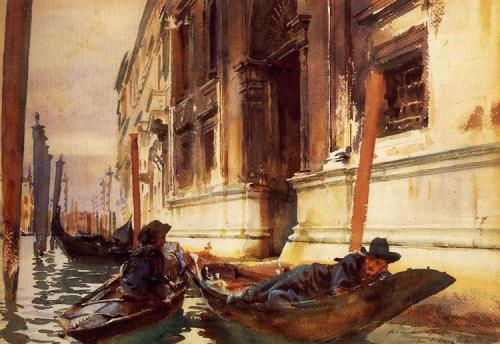
#FineArtFriday: The Gondoliers’ Siesta, John Singer Sargent 1904 

The Gondoliers’ Siesta, John Singer Sargent 1904  

Artist: John Singer Sargent  (1856–1925)

Title: English: Gondoliers’ Siesta

Date: circa 1904

Medium: watercolor

Dimensions: 35.6 x 50.8 cm

Collection: Private collection, courtesy of Adelson Galleries

Current location: New York

Source/Photographer   Beyeler Foundation

What I Love About this Painting:

John Singer Sargent shows us a moment in time, set in Venice of 1904. It is an image capturing the heat of midday and the well-deserved rest of two men whose lives are spent on the water. They are well-employed, earning a good living by ferrying passengers from one end of town to another. During their heyday as a means of public transports, teams of four men would share ownership of a gondola — three oarsmen (gondoliers) and a fourth person, primarily shore based and responsible for the booking and administration of the gondola (Il Rosso Riserva).

About Singer’s Watercolors, via Wikipedia:

During Sargent’s long career, he painted more than 2,000 watercolors, roving from the English countryside to Venice to the Tyrol, Corfu, the Middle East, Montana, Maine, and Florida. Each destination offered pictorial stimulation and treasure. Even at his leisure, in escaping the pressures of the portrait studio, he painted with restless intensity, often painting from morning until night.

His hundreds of watercolors of Venice are especially notable, many done from the perspective of a gondola. His colors were sometimes extremely vivid and as one reviewer noted, “Everything is given with the intensity of a dream.” In the Middle East and North Africa Sargent painted Bedouins, goatherds, and fisherman. In the last decade of his life, he produced many watercolors in Maine, Florida, and in the American West, of fauna, flora, and native peoples.

With his watercolors, Sargent was able to indulge his earliest artistic inclinations for nature, architecture, exotic peoples, and noble mountain landscapes. And it is in some of his late works where one senses Sargent painting most purely for himself. His watercolors were executed with a joyful fluidness. He also painted extensively family, friends, gardens, and fountains. In watercolors, he playfully portrayed his friends and family dressed in Orientalist costume, relaxing in brightly lit landscapes that allowed for a more vivid palette and experimental handling than did his commissions (The Chess Game, 1906). His first major solo exhibit of watercolor works was at the Carfax Gallery in London in 1905. In 1909, he exhibited eighty-six watercolors in New York City, eighty-three of which were bought by the Brooklyn Museum. Evan Charteris wrote in 1927:

To live with Sargent’s water-colours is to live with sunshine captured and held, with the luster of a bright and legible world, ‘the refluent shade’ and ‘the Ambient ardours of the noon.’

Although not generally accorded the critical respect given Winslow Homer, perhaps America’s greatest watercolorist, scholarship has revealed that Sargent was fluent in the entire range of opaque and transparent watercolor technique, including the methods used by Homer.

About the Artist, via Wikipedia:

John Singer Sargent born January 12, 1856 – died April 14, 1925, was an American expatriate artist, considered the “leading portrait painter of his generation” for his evocations of Edwardian-era luxury. He created roughly 900 oil paintings and more than 2,000 watercolors, as well as countless sketches and charcoal drawings. His oeuvre documents worldwide travel, from Venice to the Tyrol, Corfu, the Middle East, Montana, Maine, and Florida.

He was born in Florence to American parents, and trained in Paris before moving to London, living most of his life in Europe. He enjoyed international acclaim as a portrait painter. An early submission to the Paris Salon in the 1880s, his Portrait of Madame X, was intended to consolidate his position as a society painter in Paris, but instead resulted in scandal. During the next year following the scandal, Sargent departed for England where he continued a successful career as a portrait artist.

From the beginning, Sargent’s work is characterized by remarkable technical facility, particularly in his ability to draw with a brush, which in later years inspired admiration as well as criticism for a supposed superficiality. His commissioned works were consistent with the grand manner of portraiture, while his informal studies and landscape paintings displayed a familiarity with Impressionism. In later life Sargent expressed ambivalence about the restrictions of formal portrait work, and devoted much of his energy to mural painting and working en plein air. Art historians generally ignored “society” artists such as Sargent until the late 20th century.

Sargent’s early enthusiasm was for landscapes, not portraiture, as evidenced by his voluminous sketches full of mountains, seascapes, and buildings. Carolus-Duran’s expertise in portraiture finally influenced Sargent in that direction. Commissions for history paintings were still considered more prestigious, but were much harder to get. Portrait painting, on the other hand, was the best way of promoting an art career, getting exhibited in the Salon, and gaining commissions to earn a livelihood.


Credits and Attributions:

Wikimedia Commons contributors, “File:John Singer Sargent, Gondoliers’ Siesta.jpg,” Wikimedia Commons, the free media repository, https://commons.wikimedia.org/w/index.php?title=File:John_Singer_Sargent,_Gondoliers%E2%80%99_Siesta.jpg&oldid=149791025 (accessed May 22, 2020).

Wikipedia contributors, “John Singer Sargent,” Wikipedia, The Free Encyclopedia, https://en.wikipedia.org/w/index.php?title=John_Singer_Sargent&oldid=956888160 (accessed May 22, 2020).

Wikipedia contributors, “Gondola,” Wikipedia, The Free Encyclopedia, https://en.wikipedia.org/w/index.php?title=Gondola&oldid=950230627 (accessed May 22, 2020).

Comments Off on #FineArtFriday: The Gondoliers’ Siesta, John Singer Sargent 1904 

Filed under #FineArtFriday

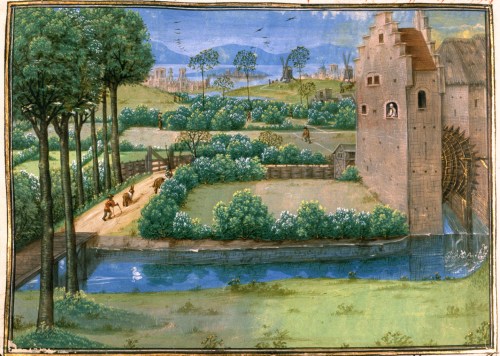
#FineArtFriday: Landscape with a Watermill – Le Tresor des Histoires (15th C) The Cotton Library

Description: Landscape with a Watermill

Date: 15th century

Collection: British Library

Accession number: Cotton Augustus V, f.345v

Source/Photographer: Image taken from Le Tresor des Histoires: a universal history from the Creation to the time of Pope Clement VI.

Originally published/produced in 15th century.

Held and digitised by the British Library

About the Cotton Library, via Wikipedia:

The Cottonian Library was the richest private collection of manuscripts ever amassed. Of secular libraries it outranked the Royal Library, the collections of the Inns of Court and the College of Arms. Cotton’s collection even included the original codex bound manuscript of Beowulf, written around the year 1000. Cotton’s house near the Palace of Westminster became the meeting-place of the Society of Antiquaries of London and of all the eminent scholars of England. the Library was eventually donated to the nation by Cotton’s grandson and is now housed in the British Library.

Robert Bruce Cotton organized his library in a room 26 feet (7.9 m) long by six feet wide filled with bookpresses, each with the bust of a figure from classical antiquity on top. Counterclockwise, these were:

This is an incomplete list of some of the manuscripts from the Cotton library that today form the Cotton collection of the British Library. Some manuscripts were destroyed or damaged in a fire at Ashburnham House in 1731, and a few are kept in other libraries and collections.

In each press, each shelf was assigned a letter; manuscripts were identified by the bust over the press, the shelf letter, and the position of the manuscript (in Roman numerals) counting from the left side of the shelf. Thus, the Lindisfarne Gospels, Nero B.iv, was the fourth manuscript from the left on the second shelf (shelf B) of the press under the bust of Nero. For Domitian and Augustus, which had only one shelf each, the shelf letter was left out of the press-mark.

The British Museum retained Cotton’s press-marks when the Cotton collection became one of the foundational collections of its library, so manuscripts are still designated by library, bookpress, shelf, and number (even though they are no longer stored in that fashion). For example, the manuscript of Beowulf is designated Cotton MS Vitellius A.xv, and the manuscript of Pearl is Cotton MS Nero A.x.

Today’s image is a gorgeous, highly detailed illustration from the 15th century book,  Le Tresor des Histoires. Universal history, from the Creation to Pope Clement VI (died 1342). 15th century copy. Lavishly illuminated, the beautiful art was most likely done by an unknown artist in either a monastery or nunnery, as both priests and nuns were known to work at copying and illustrating books. In fact, nuns were as likely to be found working as scribes as monks, friars, and priests were.

About Sir Robert Cotton, 1st Baronet – via Wikipedia:

Sir Robert Cotton began developing the works and manuscripts into a collection for his Library shortly after the birth of his son in 1594. From the period 1609 to 1614 the deaths of various people (including Lord Lumley, Earl of Salisbury, Prince Henry, William Dethick and Northampton) all contributed to Sir Robert Cotton’s purchase of works for his library. Sir Robert Cotton resided in London, while his wife and son remained in the country. During his father’s absence Thomas Cotton studied to eventually receive his BA on 24 October 1616 from Broadgates Hall—the very same year that Sir Robert Cotton returned to his wife Elizabeth and family (a result of a hiccup with the law involving the death of earl of Somerset). At that point, Sir Thomas Cotton had taken the responsibilities of the home and the library into his own hands.

(c) Trinity College, University of Cambridge; Supplied by The Public Catalogue Foundation

In 1620, Thomas Cotton married Margaret Howard with whom he had his first son, Sir John Cotton, just one year later in 1621. Sir Thomas Cotton’s marriage with Margaret Howard ended in 1622, which had been the year that Thomas Cotton’s father, Sir Robert Cotton, permanently moved residence to The Cotton House, along with the library which remained in the Cotton House until Sir Robert Cotton’s death nine years later in 1631. The relocation of the library and residence to the Cotton House gave members of Parliament and government workers better access to the matter within the library to be used as resources for their work.

The Cotton Library offered important and valuable sources of reference and knowledge to many people, such as John Selden, “a frequent borrower from the library, and probably its protector during the civil wars” as stated in the Oxford Dictionary of National Biography. Selden, in 1623 said of Cotton: “his kindness and willingness to make them [his collection of books and manuscripts] available to students of good literature and affairs of state”. In keeping with the notion that John Selden was a common presence in the Cotton library, The British Library holds a list of thirteen works, and the locations of those volumes today, that had been lent to Seldon by Sir Robert Cotton.

After another hiccup with the government, Sir Robert Cotton was forced to close the library by Charles I because the content within the library was believed to be harmful to the interests of the Royalists in 1629. In September 1630 Sir Robert Cotton and Sir Thomas Cotton, together, petitioned for renewed access to their library. One year later, in 1631, Sir Robert Cotton died without knowing what the future held for his library, but wrote in his will that the library be left to his son Thomas Cotton and that it be passed down accordingly. After the death of his father, Sir Thomas Cotton married his second wife, Alice Constable, in 1640 with whom they had their son Robert Cotton in 1644. Sir Thomas Cotton’s “ownership access to the Cotton library was more limited than under his father” according to the Oxford Dictionary of National Biography, and Thomas Cotton maintained his ability to “protect,” “improve” and “maximize the profits” received during the civil war, as he had earlier on in his life as a result of his father’s absence. Upon the death of Sir Robert Cotton on 13 May 1662, Sir Thomas Cotton obeyed the will of his father and passed down the library to his eldest son from his first marriage, Sir John Cotton.

On 12 September 1702, Sir John Cotton died. Prior to his death, Sir John Cotton had arranged for the Cotton Library to be bought for the nation of England through acts of Parliament. If the library had not been sold to the nation, despite the wish of his grandfather Sir Robert Cotton, the library would have been taken over and inherited by John Cotton’s two grandsons, who, unlike the rest of the college-educated Cotton family, had been illiterate and put the Cotton Library at risk of potentially getting broken up and sold to different divisions within the family.


Credits and Attributions:

Wikimedia Commons contributors, “File:Landscape with a watermill – Le Tresor des Histoires (15th C), f.345v – BL Cotton MS Augustus V.jpg,” Wikimedia Commons, the free media repository, https://commons.wikimedia.org/w/index.php?title=File:Landscape_with_a_watermill_-_Le_Tresor_des_Histoires_(15th_C),_f.345v_-_BL_Cotton_MS_Augustus_V.jpg&oldid=295714857 (accessed May 14, 2020).

Wikipedia contributors, “List of manuscripts in the Cotton library,” Wikipedia, The Free Encyclopedia, https://en.wikipedia.org/w/index.php?title=List_of_manuscripts_in_the_Cotton_library&oldid=919448324 (accessed May 14, 2020).

Wikipedia contributors, “Sir Robert Cotton, 1st Baronet, of Connington,” Wikipedia, The Free Encyclopedia, https://en.wikipedia.org/w/index.php?title=Sir_Robert_Cotton,_1st_Baronet,_of_Connington&oldid=948522337 (accessed May 14, 2020).

Portrait of Sir Robert Bruce Cotton, 1st Baronet, by Cornelis Janson van Ceulen Wikimedia Commons contributors, “File:Robert Cotton.jpg,” Wikimedia Commons, the free media repository, https://commons.wikimedia.org/w/index.php?title=File:Robert_Cotton.jpg&oldid=369753711 (accessed May 14, 2020).

3 Comments

Filed under #FineArtFriday

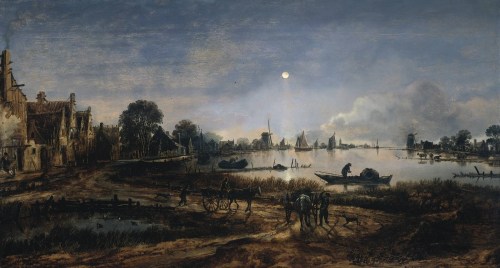
#FineArtFriday: River View by Moonlight, Aert van der Neer


River View by Moonlight, Aert van der Neer [Public domain], via Wikimedia Commons

Aert van der Neer, or Aernout or Artus (c. 1603 – 9 November 1677), was a landscape painter of the Dutch Golden Age, specializing in small night scenes lit only by moonlight and fires, and snowy winter landscapes, both often looking down a canal or river.

Description:
View of a village on a river by moonlight. In the foreground two horse and carriage on a dirt road. To the right a fisherman on a small boat on the water. On the horizon two windmills.
Date: Circa 1640-1650
Medium: oil on panel

What I love about this painting:

This image offers us context to history. It shows how a 17th century harbor looked and the people who worked there. Carters and haulers move cargo, and fishermen go out in the dark to fish for a living. Some freshwater fish, such as eels, are more commonly found after dark.


Credits and Attributions:

River View by Moonlight, Aert van der Neer [Public domain], via Wikimedia Commons / Wikimedia Commons contributors, “File:Rijksmuseum neer.jpeg,” Wikimedia Commons, the free media repository,  https://commons.wikimedia.org/w/index.php?title=File:Rijksmuseum_neer.jpeg&oldid=194438646 (accessed October 27, 2017).

Wikipedia contributors, “Aert van der Neer,” Wikipedia, The Free Encyclopedia, https://en.wikipedia.org/w/index.php?title=Aert_van_der_Neer&oldid=770891498 (accessed October 27, 2017).

Comments Off on #FineArtFriday: River View by Moonlight, Aert van der Neer

Filed under #FineArtFriday

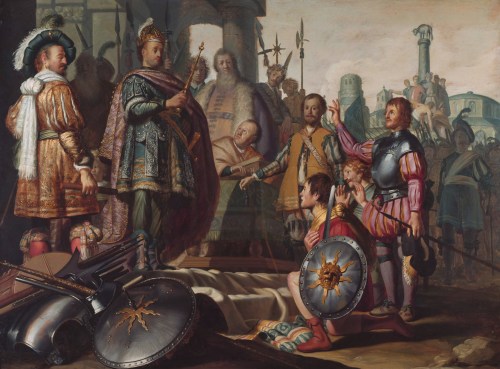
#FineArtFriday: History Painting, Titus (with self portrait of Rembrandt) by Rembrandt Harmenszoon van Rijn 1626

History Painting, Titus (with self portrait of Rembrandt) by Rembrandt Harmenszoon van Rijn 1626

  • Artist: Rembrandt  (1606–1669) Rembrandt Harmenszoon van Rijn
  • Title: Historical Scene.
  • Inscriptions: Monogram and date bottom right: RH 16[2]6
  • Object type: painting
  • Genre: history painting
  • Depicted people: Titus
  • Date: 1626
  • Medium: oil on oak panel
  • Dimensions: Height: 89.8 cm (35.3 in); Width: 121 cm (47.6 in)
  • Collection:   Museum De Lakenhal

What I love about this Painting:

This is one of Rembrandt’s earliest history paintings. The young artist went all out to compose and execute this painting. He scoured the city for props, and found old armor and weapons. Then he dressed the players richly in the finest garments of his own day, so as to befit a beloved and respected emperor.

Wikipedia says: Rembrandt’s portraits of his contemporaries, self-portraits, and illustrations of scenes from the Bible are regarded as his greatest creative triumphs. His self-portraits form a unique and intimate biography, in which the artist surveyed himself without vanity and with the utmost sincerity.

The level of detail in the weaponry and richly worked garments is remarkable, as are the faces and features of each of the players. Emperor Titus is portrayed as slightly larger than life, noble, wise, and kind.

In the background, hidden by the scepter, we find Rembrandt himself, the witness who happened to come upon the scene and is looking on with wonder. Of the witnesses, he alone is shown dressed in the unadorned muted gray woolen clothing of a common man.

We know Rembrandt was well educated in history, and admired the Emperor Titus greatly, as he named his only surviving son after him.

About the Roman Emperor Titus, the Subject of this Painting (via Wikipedia):

Vespasian died of an infection on 23 June 79 AD, and was immediately succeeded by his son Titus. As Pharaoh of Egypt, Titus adopted the titulary Autokrator Titos Kaisaros Hununefer Benermerut (“Emperor Titus Caesar, the perfect and popular youth”). Because of his many (alleged) vices, many Romans feared that he would be another Nero. Against these expectations, however, Titus proved to be an effective Emperor and was well loved by the population, who praised him highly when they found that he possessed the greatest virtues instead of vices.

One of his first acts as Emperor was to order a halt to trials based on treason charges, which had long plagued the principate. The law of treason, or law of majestas, was originally intended to prosecute those who had corruptly “impaired the people and majesty of Rome” by any revolutionary action. Under Augustus, however, this custom had been revived and applied to cover slander and libel as well. This led to numerous trials and executions under Tiberius, Caligula, and Nero, and the formation of networks of informers (Delators), which terrorized Rome’s political system for decades.

Titus put an end to this practice, against himself or anyone else, declaring:

“It is impossible for me to be insulted or abused in any way. For I do naught that deserves censure, and I care not for what is reported falsely. As for the emperors who are dead and gone, they will avenge themselves in case anyone does them a wrong, if in very truth they are demigods and possess any power.”

Consequently, no senators were put to death during his reign; he thus kept to his promise that he would assume the office of Pontifex Maximus “for the purpose of keeping his hands unstained.” The informants were publicly punished and banished from the city. Titus further prevented abuses by making it unlawful for a person to be tried under different laws for the same offense.  Finally, when Berenice returned to Rome, he sent her away.

As Emperor he became known for his generosity, and Suetonius states that upon realizing he had brought no benefit to anyone during a whole day, Titus remarked, “Friends, I have lost a day.”


Credits and Attributions:

History Painting, Titus (with self portrait of Rembrandt) by Rembrandt Harmenszoon van Rijn 1626

Wikipedia contributors, “Titus,” Wikipedia, The Free Encyclopedia,  https://en.wikipedia.org/w/index.php?title=Titus&oldid=950453618 (accessed April 24, 2020).

Wikimedia Commons contributors, “File:Rembrandt Historical Painting 1626 (Detail, with self-portrait).jpg,” Wikimedia Commons, the free media repository, https://commons.wikimedia.org/w/index.php?title=File:Rembrandt_Historical_Painting_1626_(Detail,_with_self-portrait).jpg&oldid=369318658 (accessed April 24, 2020).

2 Comments

Filed under #FineArtFriday

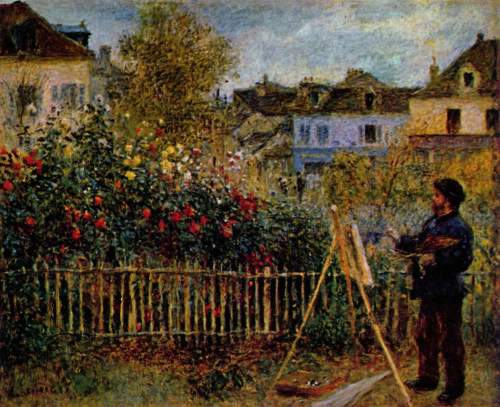
#FineArtFriday: Monet Painting in His Garden by Pierre-Auguste Renoir 1873

Monet Painting in His Garden by Pierre-Auguste Renoir

Date: 1873

Medium: oil on canvas

Dimensions : Height: 46 cm (18.1 in); Width: 60 cm (23.6 in)

Collection: Wadsworth Atheneum Museum of Art

What I love about this painting:

Renoir shows us that Claude Monet’s garden is lush and a little wild, like the man who owns it. Yet, although he is the subject of this painting, Monet is completely focused on his work. The colors are vivid, which inspires me since my own garden is only now shaking off the depredations of winter. I would love to spend time in this riotous garden.

Renoir visited his good friend many times during the years Monet lived at Argenteuil, a village on the right bank of the Seine river near Paris. In 1873, Monet purchased a small boat equipped to be used as a floating studio, which must have been a draw for Renoir and his friends.

About the artist (via Wikipedia):

In 1862, Auguste Renoir began studying art under Charles Gleyre in Paris. There he met Alfred Sisley, Frédéric Bazille, and Claude Monet.  At times, during the 1860s, he did not have enough money to buy paint. Renoir had his first success at the Salon of 1868 with his painting Lise with a Parasol (1867), which depicted Lise Tréhot, his lover at the time. Although Renoir first started exhibiting paintings at the Paris Salon in 1864, recognition was slow in coming, partly as a result of the turmoil of the Franco-Prussian War.

Renoir was inspired by the style and subject matter of previous modern painters Camille Pissarro and Edouard Manet. After a series of rejections by the Salon juries, he joined forces with Monet, Sisley, Pissarro, and several other artists to mount the first Impressionist exhibition in April 1874, in which Renoir displayed six paintings. Although the critical response to the exhibition was largely unfavorable, Renoir’s work was comparatively well received.  That same year, two of his works were shown with Durand-Ruel in London. 


Credits and Attributions:

Monet Painting in His Garden by Pierre-Auguste Renoir / Public domain

Wikipedia contributors, “Pierre-Auguste Renoir,” Wikipedia, The Free Encyclopedia, https://en.wikipedia.org/w/index.php?title=Pierre-Auguste_Renoir&oldid=949963500 (accessed April 17, 2020).

Wikimedia Commons contributors, “File:Renoir-Monet painting.png,” Wikimedia Commons, the free media repository, https://commons.wikimedia.org/w/index.php?title=File:Renoir-Monet_painting.png&oldid=338421916 (accessed April 17, 2020).

Comments Off on #FineArtFriday: Monet Painting in His Garden by Pierre-Auguste Renoir 1873

Filed under #FineArtFriday

#FineArtFriday: Painting Easter Eggs, by Mykhaylo Chornyi

Today’s image is one that I posted in 2019 on Good Friday – the Friday before Easter. For me, this painting is like an Easter-card from friends far away.

This image is painted in  the Ukrainian Neo-Folk style. The artist, Mykhaylo Chornyi, lives and paints in the Ukraine. Many European ethnic groups have traditions for using the wax-resist method (psyanky) for inscribing designs on eggs.

From Wikipedia:

A pysanka (Ukrainian: писанка, plural: писанки) is a Slavic egg , decorated with traditional folk designs using a wax-resist method. The word pysanka comes from the verb pysaty, “to write” or “to inscribe”, as the designs are not painted on, but written (inscribed) with beeswax.

I’m captivated by the colors, the life in this amazing depiction of that most popular of Easter activities. It was painted in 2000, and to me, while it is highly stylized, it is passionate. Every time I look at this photograph of the painting, I see something new, some small detail that enchants me and draws me deeper into it. I feel like it’s an Easter gift from the artist to me.

Coloring eggs is a common activity this time of year, but these artists don’t simply dye their eggs in pastel shades the way most children here in the US do. These painters are intent, creating brilliant works of art on the most delicate of canvasses—the eggshell.

There is something reverent about the painters as they go about their work. The religious themes in the background are so much a part of the overall scene they are nearly subliminal, yet they are not hidden in any way. Who are the eggs intended as gifts for?

About the Artist, Via Wikipedia:

Mykhaylo Nikiforovich Chornyi (Ukrainian: Михайло Никифорович Чорний; Russian: Михаил Никифорович Чёрный; November 26, 1933) is a Ukrainian Realist, Neo-Primitivist) painter and graphic artist. Chornyi is described as “the founder of Ukrainian Neo-Folk Style”. A member of Ukrainian National Artists’ Union since 1968. People’s Artist of Ukraine (2003).


Credits and Attributions:

Painting Easter Eggs by Mykhaylo Chornyi first posted here on 19 APR 2019. https://conniejjasperson.com/2019/04/19/fineartfriday-painting-easter-eggs-by-mykhaylo-chornyi/

Painting Easter Egg, by Mykhaylo Chornyi (Black milly [CC BY-SA 3.0 (https://creativecommons.org/licenses/by-sa/3.0)] )

Wikimedia Commons contributors, “File:Painting Easter Eggs.jpg,” Wikimedia Commons, the free media repository, https://commons.wikimedia.org/w/index.php?title=File:Painting_Easter_Eggs.jpg&oldid=185923430 (accessed April 19, 2019).

Wikipedia contributors, “Mykhaylo Chornyi,” Wikipedia, The Free Encyclopedia, https://en.wikipedia.org/w/index.php?title=Mykhaylo_Chornyi&oldid=838782944 (accessed April 19, 2019).

Lubap Creator:Luba Petrusha [CC BY-SA 3.0 (https://creativecommons.org/licenses/by-sa/3.0)%5D

Wikipedia contributors, “Pysanka,” Wikipedia, The Free Encyclopedia, https://en.wikipedia.org/w/index.php?title=Pysanka&oldid=893148353 (accessed April 19, 2019).

2 Comments

Filed under #FineArtFriday, writing