Category Archives: #FineArtFriday

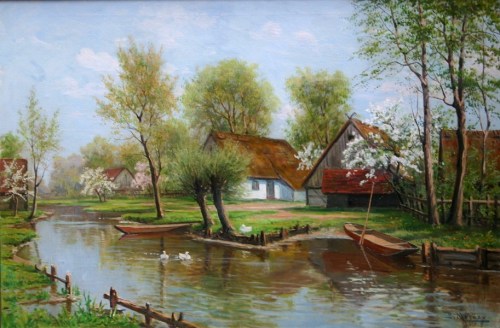
#FineArtFriday: Canal in the Spreewald in Spring by Bruno Moras

Artist: Bruno Moras, (1833 – 1939)

Title: Kanal im Spreewald im Frühling (Canal in the Spreewald in Spring)

Medium: oil on canvas

Dimensions Height: 79 cm (31.1″); Width: 119 cm (46.8″)

What I love about this picture:

Moras captured the trees as they are when the leaves first burst forth, with a bright, yellow-green. The apple and plum trees, the first signs of spring around here, are blossoming. The water reflects the  colors of the world, yet a slight breeze moves it. The small boats drawn up to the shore can carry one or two fisher folk comfortably.

About the artist:

I have been unable to find much about Bruno Moras, other than he was the son of Walter Moras, was born, lived, and died in Berlin, and never achieved the fame his father had. This is too bad, as his works are just now becoming more in demand at auctions.

Still, his work survives. In a time when modern art was moving away from traditional landscape painting, Moras painted beautiful images of what he loved most: the countryside of his Germany.

Credits and Attributions:

Wikimedia Commons contributors, “File:Bruno Moras – Kanal im Spreewald im Frühling.jpg,” Wikimedia Commons, the free media repository, https://commons.wikimedia.org/w/index.php?title=File:Bruno_Moras_-_Kanal_im_Spreewald_im_Fr%C3%BChling.jpg&oldid=273477004 (accessed March 13, 2020).

Comments Off on #FineArtFriday: Canal in the Spreewald in Spring by Bruno Moras

Filed under #FineArtFriday, writing

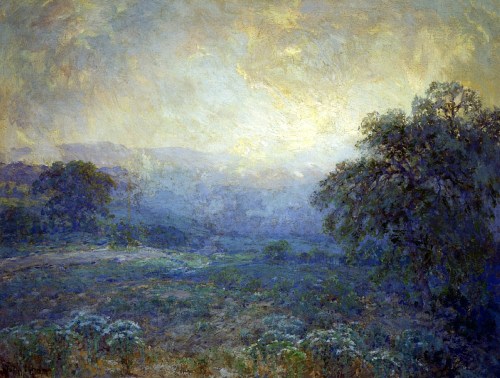
#FineArtFriday: Dawn in the Hills by Julian Onderdonk, 1922

  • Artist: Julian Onderdonk  (1882–1922)
  • Title: Dawn In The Hills
  • Date    1922
  • Medium: oil on canvas
  • Dimensions: Height: 76.2 cm (30″); Width: 101.6 cm (40″)
  • Collection: Private collection

What I love about this painting:

Onderdonk captured the surreal essence of early morning near San Antonio, Texas. The mists are rising in the hills, slowly revealing the riotous splendor of deep blue wildflowers. It is a rolling sea of bluebonnets, with the occasional white of the blackfoot or fleabane daisy mingled in.

The artist perfectly conveyed the mystical quality of that singular moment of the morning when the air is still and golden, and the day ahead is full of possibilities.

I could spend hours in this place.

About this painting:

Art historian Jeffrey Morseburg writes, “In the fall of 1922, as he was just entering his prime, Onderdonk was rushed to the hospital with an intestinal blockage. He failed to recover from the emergency surgery and died on October 27, 1922. His sudden death created an outpouring of emotion for the man who had become “The Dean of Texas Painters.” Just before he died, Onderdonk had finished a beautiful early morning view of a Texas hillside carpeted with Bluebonnets titled ‘Dawn in the Hills’ and another work, a bold fall scene titled ‘Autumn Tapestry.’” [1]

About the Artist, Via Wikipedia:

Julian Onderdonk was born in San Antonio, Texas, to Robert Jenkins Onderdonk, a painter, and Emily Gould Onderdonk. He was raised in South Texas and was an enthusiastic sketcher and painter. As a teenager Onderdonk was influenced and received some training from the prominent Texas artist Verner Moore White who also lived in San Antonio at the time. He attended the West Texas Military Academy, now the Episcopal School of Texas, graduating in 1900. His grandfather Henry Onderdonk was the Headmaster of Saint James School in Maryland, from which Julian’s father Robert graduated.

At 19, with the help of a generous neighbor, Julian left Texas in order to study with the renowned American Impressionist William Merritt Chase. Julian’s father, Robert, had also once studied with Chase. Julian spent the summer of 1901 on Long Island at Chase’s Shinnecock Hills Summer School of Art. He studied with Chase for a couple of years and then moved to New York City to attempt to make a living as an en plein air artist. While in New York he met and married Gertrude Shipman and they soon had a son.

Onderdonk returned to San Antonio in 1909, where he produced his best work. His most popular subjects were bluebonnet landscapes. Onderdonk died on October 27, 1922 in San Antonio.

President George W. Bush decorated the Oval Office with three of Onderdonk’s paintings. The Dallas Museum of Art has several rooms dedicated exclusively to Onderdonk’s work.

His art studio currently resides on the grounds of the Witte Museum.


Credits and Attributions:

[1] Julian Onderdonk, An Illustrated Biography by Jeffrey Morseburg, © 2011 https://julianonderdonk.wordpress.com/tag/julian-onderdonk-biography/  (accessed March 4, 2020).

Wikimedia Commons contributors, “File:Julian Onderdonk (1882-1922) – Dawn In The Hills (1922).jpg,” Wikimedia Commons, the free media repository, https://commons.wikimedia.org/w/index.php?title=File:Julian_Onderdonk_(1882-1922)_-_Dawn_In_The_Hills_(1922).jpg&oldid=278966540 (accessed March 4, 2020).

Wikipedia contributors, “Julian Onderdonk,” Wikipedia, The Free Encyclopedia, https://en.wikipedia.org/w/index.php?title=Julian_Onderdonk&oldid=882101452 (accessed March 4, 2020).

Comments Off on #FineArtFriday: Dawn in the Hills by Julian Onderdonk, 1922

Filed under #FineArtFriday

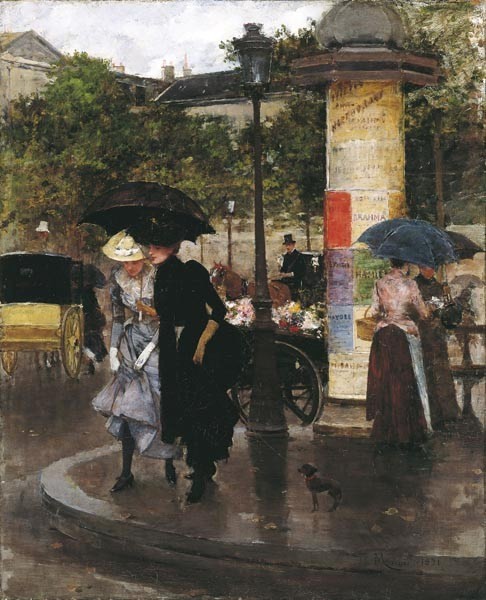
#FineArtFriday: Street Scene on a Rainy Day by Francesco Miralles Galup (ca. 1891)

What I love about this painting:

We see a perfect rainy spring afternoon in a busy cosmopolitan city. It could have been any large city at the end of the 19th century. The street is busy, full of carriages, and pedestrians must be careful where they step.

A cart full of flowers passes in the background, headed for the market. Two well-dressed ladies dodge puddles in their effort to cross the street. Around them, shoppers gossip and umbrellas abound.

Like every chihuahua I’ve ever known, the little dog is miserable, unhappy with the damp.


About the Artist, via Wikipedia:

Francisco Miralles Galup was born Francesc Miralles i Galaup (6 April 1848, Valencia – 30 October 1901, Barcelona). He was a Catalan painter, best known for his realistic scenes of bourgeois life and high society.

When he turned eighteen, he received parental permission (and financial support) to study in Paris, where he would remain until 1893, with occasional visits home. During his first years there, he copied masterworks at the Louvre and may have worked briefly with Alexandre Cabanel. He eventually had several small studios in Montmartre and on the Rue Laffitte.

He exhibited regularly at the Salon and the Sala Parés, back home in Barcelona. He also became a client of the well-known art dealership Goupil & Cie, attracting wealthy buyers throughout Europe and America. This was a relief to his family, who had initially been concerned that they might have to support him indefinitely. Their ability to do so had been compromised as they had lost much of their fortune in the Panic of 1866 and were losing more of it as they paid off their debts. In fact, they eventually moved to Paris so he could help support them.


Credits and Attributions:

Escena de carrer c1891, Francisco Miralles Galup / Public domain

Wikipedia contributors, “Francesc Miralles i Galaup,” Wikipedia, The Free Encyclopedia, https://en.wikipedia.org/w/index.php?title=Francesc_Miralles_i_Galaup&oldid=894995022 (accessed February 28, 2020).

Comments Off on #FineArtFriday: Street Scene on a Rainy Day by Francesco Miralles Galup (ca. 1891)

Filed under #FineArtFriday

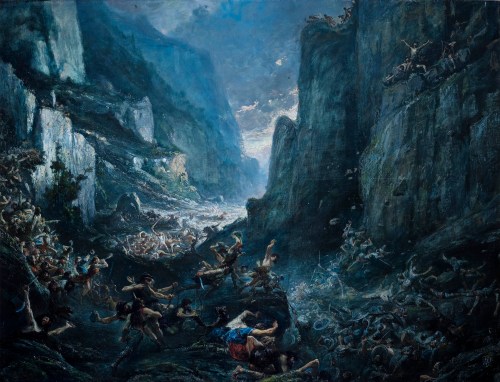
#FineArtFriday: Roland à Roncevaux, by Gustave Doré

Roland at Roncevaux, by Gustave Doré (b 1832 – d 1883)

Date: 19th century

Medium: oil on canvas

Dimensions: Height: 149 cm (58.6″); Width: 114 cm (44.8″)

Collection: Private collection

What I love about this image:

First of all, this shows the battle as being dark, ugly, and doomed, which history tells us, it was.

Doré chose to illustrate a historic battle that took place in the year 778. However, he painted a heroic image of Roland, surrounded and his unbreakable sword held high. This is as the battle was portrayed three centuries later by medieval authors whose embellishments were romanticized fantasies rather than accurate historical descriptions.

About the Artist:

Paul Gustave Louis Christophe Doré, born 6 January 1832 –  died 23 January 1883, was a French artist, print-maker, illustrator, comics artistcaricaturist, and sculptor who worked primarily with wood-engraving.

Doré was famous for his highly detailed, romantic engravings of heroic classical literature and also the Bible. His illustrations are still considered to be among the finest ever produced.

What he is not as well-known for are his paintings, which are both detailed and vivid, and portray a wide variety of subjects.

About the Story of Roland

The story of Roland’s death at Roncevaux Pass was embellished in later medieval and Renaissance literature. The first and most famous of these epic treatments was the Old French Chanson de Roland of the 11th century.

Two masterpieces of Italian Renaissance poetry, the Orlando Innamorato and Orlando Furioso (by Matteo Maria Boiardo and Ludovico Ariosto), are further detached from history than the earlier Chansons, similarly to the later Morgante by Luigi Pulci. Roland is poetically associated with his sword Durendal, his horse Veillantif, and his oliphant horn.

Roland also appears as a sometimes tragic hero in some Arthurian legends, and many Norse and Germanic tales.

The true history of Roland’s Demise at Roncevaux (via Wikipedia):

The Battle of Roncevaux Pass (French and English spelling, Roncesvalles in Spanish, Orreaga in Basque) in 778 saw a large force of Basques ambush a part of Charlemagnes army in Roncevaux Pass, a high mountain pass in the Pyrenees on the present border between France and Spain, after his invasion of the Iberian Peninsula.

The Basque attack was a retaliation for Charlemagne’s destruction of the city walls of their capital, Pamplona. As the Franks retreated across the Pyrenees back to Francia, the rearguard of Frankish lords was cut off, stood its ground, and was wiped out.

Among those killed in the battle was a relatively obscure Frankish commander, Roland, whose death elevated him and the paladins, the foremost warriors of Charlemagne’s court, into legend, becoming the quintessential role model for knights and also greatly influencing the code of chivalry in the Middle Ages.

There are numerous written works about the battle, some of which change and exaggerate events. The battle is recounted in the 11th century The Song of Roland, the oldest surviving major work of French literature, and in Orlando Furioso, one of the most celebrated works of Italian literature. Modern adaptations of the battle include books, plays, and works of fiction, and monuments in the Pyrenees.


Credits and Attributions:

Wikimedia Commons contributors, “File:Gustave Doré – Roland à Roncevaux.jpg,” Wikimedia Commons, the free media repository, https://commons.wikimedia.org/w/index.php?title=File:Gustave_Dor%C3%A9_-_Roland_%C3%A0_Roncevaux.jpg&oldid=369725623 (accessed February 20, 2020).

Wikipedia contributors, “Gustave Doré,” Wikipedia, The Free Encyclopedia, https://en.wikipedia.org/w/index.php?title=Gustave_Dor%C3%A9&oldid=939834558 (accessed February 20, 2020).

Comments Off on #FineArtFriday: Roland à Roncevaux, by Gustave Doré

Filed under #FineArtFriday

#FineArtFriday: View of Delft by Johannes Vermeer ca.1661

View of Delft by Johannes Vermeer

Genre: cityscape

Date: between circa 1660 and circa 1661

Medium: oil on canvas

Dimensions: Height: 96.5 cm (37.9″); Width: 117.5 cm (46.2″)

What I love about this painting:

The scene is as clear and sharp as if it were viewed through an open window. The colors are both bright and muted–true to life. The red of roof tiles contrast with the blue of both the sky and a blue painted shingle roof. The reflections on the water, the people on the shore show us a lovely morning in the Netherlands.

Vermeer is considered the master of light, and indeed, the quality of light in all his works is remarkable. The shadowy reflections on the dark, still waters look as real as a photograph.

About this Painting, via Wikipedia:

View of Delft  is an oil painting by Johannes Vermeer, painted ca. 1660–1661. The painting of the Dutch artist’s hometown is among his most popular, painted at a time when cityscapes were uncommon. It is one of three known paintings of Delft by Vermeer, along with The Little Street and the lost painting House Standing in Delft. The use of pointillism in the work suggests that it postdates The Little Street, and the absence of bells in the tower of the New Church dates it to 1660–1661. Vermeer’s View of Delft has been held in the Dutch Royal Cabinet of Paintings at the Mauritshuis in The Hague since its establishment in 1822.

The technical analysis shows that Vermeer used a limited choice of pigments for this painting: calcitelead whiteyellow ochre, natural ultramarine and madder lake are the main painting materials. His painting technique, on the other hand, is very elaborate and meticulous.


Credits and Attributions:

Wikipedia contributors, “View of Delft,” Wikipedia, The Free Encyclopedia, https://en.wikipedia.org/w/index.php?title=View_of_Delft&oldid=933182285 (accessed February 14, 2020).

Wikimedia Commons contributors, “File:Jan Vermeer van Delft 001.jpg,” Wikimedia Commons, the free media repository, https://commons.wikimedia.org/w/index.php?title=File:Jan_Vermeer_van_Delft_001.jpg&oldid=338278968 (accessed February 14, 2020).

Comments Off on #FineArtFriday: View of Delft by Johannes Vermeer ca.1661

Filed under #FineArtFriday

#FineArtFriday: Frost Fair on the River Thames near the Temple Stairs, by Thomas Wyke

Today I’m revisiting a painting, Frost Fair on the River Thames near the Temple Stairs. by Thomas Wijck (also Thomas Wijk, or Thomas Wyck; 1616–1677). He  was a Dutch painter of port views and genre paintings. This painting details a moment in history, the winter of 1686-1684, as seen though the eyes of one who lived it. I first published this post in January of 2018.

About the Artist, via Wikipedia:

Wijck was born into an artist family and received his training from his father. He journeyed to Italy, presumably by 1640, the year in which a ‘Tommaso fiammingo, pittore’ (Thomas the Fleming, painter) is documented as residing in Rome in the Via della Fontanella. Although this evidence of his residence in Rome around this time has been questioned,[1] a number of his pictures depict scenes in and around Rome which would indicate a visit to the city at some point.[2] He also resided in the environs of Naples, where he executed many sketches which he subsequently worked up into drawings of coast views.[3]

In 1642 Wijck returned to the northern Netherlands, where he became a member of the Haarlem Guild of St. Luke.[1] In 1660 he was appointed Dean of the Haarlem Guild.

He went to England about the time of the Restoration and was much employed. He was followed there by his son and pupil Jan Wyck, who remained in Britain for the rest of his career and played an important role in the development of English sporting painting. Thomas Wyck was also the teacher of the Haarlem painter Jan van der Vaart, who later also immigrated to England.

He died in Haarlem in August 1677. Pieter Mulier II was a follower of his style.

What I love about this painting:

Everywhere you look you see color. Red wheels on a cart, red tents, blue tents, and yellow–color is everywhere. We sometimes think of the 17th century as a dark colorless time, but clearly it was not. People were much the same then as they are today. We love to have fun and will find a way to enjoy ourselves even in the harshest conditions.

And winters during that time were harsh. Fuel for heating and cooking was expensive, food was expensive, and many people died from the cold and starvation.

Quoted from Wikipedia: During the Great Frost of 1683–84, the worst frost recorded in England, the Thames was completely frozen for two months, with the ice reaching a thickness of 11 inches (28 cm) in London. Solid ice was reported extending for miles off the coasts of the southern North Sea (England, France and the Low Countries), causing severe problems for shipping and preventing the use of many harbours. Near Manchester, the ground was frozen to 27 inches (69 cm), in Somerset, to more than 4 feet (1.2 m).

In the pedestrian tunnel under the south bank of Southwark Bridge, there is an engraving by Southwark sculptor Richard Kindersley, made of five slabs of grey slate, depicting the frost fair.[19]

The frieze contains an inscription that reads (two lines per slab):

Behold the Liquid Thames frozen o’re,
That lately Ships of mighty Burthen bore
The Watermen for want of Rowing Boats
Make use of Booths to get their Pence & Groats
Here you may see beef roasted on the spit
And for your money you may taste a bit
There you may print your name, tho cannot write
Cause num’d with cold: tis done with great delight
And lay it by that ages yet to come
May see what things upon the ice were done

The inscription is based on handbills,[20] printed on the Thames during the frost fairs.


Credits and Attributions:

Wikipedia contributors, “Thomas Wijck,” Wikipedia, The Free Encyclopedia, https://en.wikipedia.org/w/index.php?title=Thomas_Wijck&oldid=913753600 (accessed February 7, 2020).

#FineArtFriday: Frost Fair on the River Thames near the Temple Stairs, by Thomas Wyke was first published here on Life in the Realm of Fantasy on January 20, 2018.

Wikipedia contributors, “River Thames frost fairs,” Wikipedia, The Free Encyclopedia, https://en.wikipedia.org/w/index.php?title=River_Thames_frost_fairs&oldid=820904368 (accessed January 19, 2018).

Frost Fair on the River Thames near the Temple Stairs, by Thomas Wyke ca.1683-1684 via Wikimedia Commons (scan from FT magazine, 2007-09-30) [Public domain]

Comments Off on #FineArtFriday: Frost Fair on the River Thames near the Temple Stairs, by Thomas Wyke

Filed under #FineArtFriday

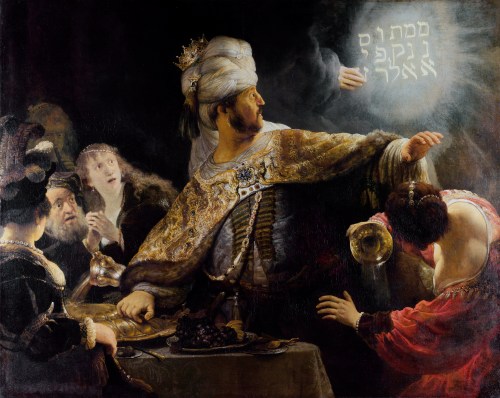
#FineArtFriday: Belshazzar’s Feast by Rembrandt ca. 1635-1638

Artist:  Rembrandt  (1606–1669):Rembrandt Harmenszoon van Rijn

Title:   Belshazzar’s Feast

Genre: religious art (history painting)

Description: According to Daniel 5:1-31, King Belshazzar of Babylon takes sacred golden and silver vessels from the Jewish Temple in Jerusalem by his predecessor Nebuchadnezzar. Using these holy items, the King and his court praise ‘the gods of gold and silver, bronze, iron, wood, and stone’. Immediately, the disembodied fingers of a human hand appear and write on the wall of the royal palace the words “MENE”, “MENE”, “TEKEL”, “UPHARSIN”

Depicted people: Belshazzar

Date: circa 1635-1638

Medium: oil on canvas

Dimensions: Height: 167.6 cm (65.9″); Width: 209.2 cm (82.3″)

Collection: National Gallery


What I love about this painting:

Rembrandt went to a great deal of expense and trouble to paint what he hoped would be seen as a masterpiece. He wanted to be a history painter, as that is where the fame was in his time. While the money was in portraits, Rembrandt also wanted fame. We know this painting was painted before his wife Saskia’s illnesses  and death in 1642, because she was the model for woman behind Belshazzar. She is depicted as being terrified by what is being written on the wall.

Every detail is there, from the finely worked golden ornaments and crown in Belshazzar’s headdress to the king’s golden earring in the shape of a crescent moon. His garments are covered in delicate embroideries in gold thread and sewn with pearls and beads of jet. The garments and jewelry of all the diners are rich and sumptuous; they too wear golden jewelry, with pearls and beads of jet. The shock of the diners, the combination of fear and indignation of the king at the appearance of the hand—these emotions are depicted as perfectly as are the extravagant garments.

About this painting, Via Wikpedia:

Rembrandt’s handling of painting materials and his painting technique in Belshazzar’s Feast are both exceptional and do not compare to any of his other works. The palette of this painting is unusually rich encompassing such pigments as vermilionsmaltlead-tin-yellowyellow and red lakesochres and azurite.


About the story, via Wikipedia:

Belshazzar’s feast, or the story of the writing on the wall (chapter 5 in the Book of Daniel) The story of Belshazzar and the writing on the wall originates in the Old Testament Book of Daniel. The Babylonian king Nebuchadnezzar looted the Temple in Jerusalem and has stolen the sacred artefacts such as golden cups. His son Belshazzar used these cups for a great feast where the hand of God appeared and wrote the inscription on the wall prophesying the downfall of Belshazzar’s reign. The text on the wall says “mene, mene, tekel, upharsin“. Biblical scholars interpret this to mean “God has numbered the days of your kingdom and brought it to an end; you have been weighed in the balances and found wanting; your kingdom is given to the Medes and Persians”.

The inscription on the wall is an interesting element in this painting. Rembrandt lived in the Jewish Quarter of Amsterdam and “derived the form of Hebrew inscription from a book by his friend, the learned Rabbi and printer, Menasseh ben Israel, yet mis-transcribed one of the characters and arranged them in columns, rather than right to left, as Hebrew is written.” This last detail is essential as it relates to the question of why Belshazzar and his advisers were not able to decipher the inscription and had to send for Daniel to help them with it.

The biblical story does not identify the language of the cryptic message, but it is generally assumed to be Aramaic, which, like Hebrew, is written in right-to-left rows, and not in right-to-left columns as in the painting. Although there is no accepted explanation why the Babylonian priests were unable to decipher the writing, the point of this unconventional arrangement – reading the text in the painting in the conventional row-wise left-to-right order results in a garbled message – may be to suggest why the text proved incomprehensible to the Babylonian wise men; indeed, this explanation is in accordance with the opinion of the amora Shmuel, which is mentioned in the Babylonian TalmudTractate Sanhedrin, 22a, among various dissenting views.


Sources and Attributions:

Belshazzar’s Feast by Rembrandt PD|100 via Wikimedia Commons. Wikimedia Commons contributors, “File:Rembrandt-Belsazar.jpg,” Wikimedia Commons, the free media repository, https://commons.wikimedia.org/w/index.php?title=File:Rembrandt-Belsazar.jpg&oldid=363468240 (accessed January 31, 2020).

Wikipedia contributors, ‘Belshazzar’s Feast (Rembrandt)’, Wikipedia, The Free Encyclopedia, 17 January 2020, 09:24 UTC, <https://en.wikipedia.org/w/index.php?title=Belshazzar%27s_Feast_(Rembrandt)&oldid=936202396> [accessed 31 January 2020]

2 Comments

Filed under #FineArtFriday

#FineArtFriday: Home, Sweet Home by Winslow Homer 1863 (reprise)

I’m out of town this week, listening to the radio in car, and to audio books. War and peace seem to be hot topics… That brings to mind this iconic painting by Winslow Homer, an image that evokes profound emotion in me, even though I am viewing it 157 years later. I first posted this article in January 2018. Every time I view this painting, I find something new in the details.

The mud on their ragged uniforms, the can heating food in the cookfire, the plate in front of the tent–they are living and fighting in hellish conditions, doing the best they can despite the struggle.


Home, Sweet Home is one of the most famous paintings of the American Civil War, depicting a moment in time, painted by Winslow Homer. On opposite shores of the Rappahannock River, opposing armies are caught up in an awareness of brotherhood, as music becomes the medium that lays bare the humanity of the soldiers on both sides.

Winslow Homer was best known for his landscapes featuring the many moods of the ocean, but he also painted many iconic images of that turbulent time before, during, and after the American Civil War. His art captures a sense of familiarity, a feeling that the viewer knows these people and their stories intimately.

Wikipedia says, “Harper’s (magazine) sent Homer to the front lines of the American Civil War (1861–1865), where he sketched battle scenes and camp life, the quiet moments as well as the chaotic ones. His initial sketches were of the camp, commanders, and army of the famous Union officer, Major General George B. McClellan, at the banks of the Potomac River in October 1861.

“Although the drawings did not get much attention at the time, they mark Homer’s expanding skills from illustrator to painter. Like with his urban scenes, Homer also illustrated women during wartime, and showed the effects of the war on the home front. The war work was dangerous and exhausting. Back at his studio, Homer would regain his strength and re-focus his artistic vision. He set to work on a series of war-related paintings based on his sketches, among them Sharpshooter on Picket Duty (1862), Home, Sweet Home (1863), and Prisoners from the Front (1866). He exhibited paintings of these subjects every year at the National Academy of Design from 1863 to 1866. Home, Sweet Home was shown at the National Academy to particular critical acclaim; it was quickly sold and the artist was consequently elected an Associate Academician, then a full Academician in 1865.[10]”

The story behind the painting, Home, Sweet Home, is told poignantly in the autobiography, Reminiscences of a Private, by Frank Mixson, who served in the Confederate Army.

“The Yankee band would play the popular airs of theirs amid much yelling and cheering; our bands would do the same with the same result. Towards the wind-up the Yankee band struck up “Yankee Doodle.” Cheers were immense. When they stopped our band struck up “Dixie,” and everything went wild. When they finished this, both bands, with one accord and simultaneously, struck up “Home, Sweet Home.” There was not a sound from anywhere until the tune was finished and it then seemed as if everybody had gone crazy. I never saw anything to compare with it. Both sides were cheering, jumping up and throwing up hats and doing everything which tended to show enthusiasm. This lasted for at least a half hour. I do believe that had we not had the river between us that the two armies would have gone together and settled the war right there and then.”

Quote from: Reminiscences of a Private, by Frank Mixson (1910)


Sources and Attributions:

Home Sweet Home by Winslow Homer, © Connie J. Jasperson,  first appeared here on Life in the Realm of Fantasy on January 5th 2018. It has been dusted off and reposted for your viewing pleasure.

Wikipedia contributors, “Winslow Homer,” Wikipedia, The Free Encyclopedia, https://en.wikipedia.org/w/index.php?title=Winslow_Homer&oldid=817253575 (accessed January 4, 2018).

Home, Sweet Home: “Had we not had the river between us,” posted by Marek,  https://civilwarfolkmusic.com/2013/12/15/1862-home-sweet-home/ accessed 04 January 2018.

Reminiscences of a Private, by Frank Mixson (published 1910 by Columbia, S.C., The State Company)

Home, Sweet Home (oil on canvas) by Winslow Homer – circa 1863 | Winslow Homer [Public domain], via Wikimedia Commons, accessed 04 January 2018.

2 Comments

Filed under #FineArtFriday, writing

#FineArtFriday: Irene (poem)and The Coffee House, by Rita Greer 2008

The Coffee House


Portions of this post first appeared on Life in the Realm of Fantasy in 2015, as Flash Fiction Friday offering. The poem that follows, Irene, was written for a writer friend, a woman who moved to my Northwest town from Texas.

She participated in NaNoWriMo 2012, and we discovered we lived only a mile apart. Over the years she  became like a sister to me. Now, in 2020, one of her grandchildren has been hit with cancer, and she is temporarily relocating back to Texas to help care for him.

Believe me, she will be missed, as a neighbor, a dear friend, and as the heart and soul of my writing posse. My forthcoming novel, Julian Lackland, would still be languishing in limbo without her determined efforts over the last six years.

She and her husband quickly became members of our family, and no holiday will be the same with out them.


About this painting (quoted from Wikimedia Commons)

The original is an oil painting on board by Rita Greer, history painter, 2008. This was digitized by Rita and sent via email to the Department of Engineering Science, Oxford University, where it was subsequently uploaded to Wikimedia.

Coffee Houses played an important part in the social life of Robert Hooke. Only coffee and chocolate were served (no alcohol). Here news could be had, conversation, arguments, meetings, card games, wagers made, workmen could be paid, etc. (Hooke would sometimes carry out a scientific experiment in front of a coffee house audience as witnesses.) Hooke is shown writing (bottom left) at a table with people waiting to talk to him.

About the artist:

Rita Greer is a history artist, goldsmith, graphic designer, food scientist and author/writer. On retirement in 2003 Rita began the Robert Hooke project, “to put him back into history.”

According to Wikipedia: Much has been written about the unpleasant side of Hooke’s personality, starting with comments by his first biographer, Richard Waller, that Hooke was “in person, but despicable” and “melancholy, mistrustful, and jealous.” Waller’s comments influenced other writers for well over two centuries, so that a picture of Hooke as a disgruntled, selfish, anti-social curmudgeon dominates many older books and articles. For example, Arthur Berry said that Hooke “claimed credit for most of the scientific discoveries of the time.” Sullivan wrote that Hooke was “positively unscrupulous” and possessing an “uneasy apprehensive vanity” in dealings with Newton. Manuel used the phrase “cantankerous, envious, vengeful” in his description. More described Hooke having both a “cynical temperament” and a “caustic tongue.” Andrade was more sympathetic, but still used the adjectives “difficult”, “suspicious”, and “irritable” in describing Hooke.

Back-biting and jostling for position was a hobby among the divas of 17th century science, apparently. Little has changed in the world of academics, it seems.

I spend a large portion of my life in coffee houses too, writing and meeting with other writers, and artists. The friend who inspired the poem today was introduced to me in a coffee house in Olympia, on a dark November night in 2012. It was the kick-off meeting for NaNoWriMo that year.


Irene

I met you in a coffee shop.

Knitters and authors vied for tables

In a dark, polished, coffee-scented room.

Texas wit met Northwest irreverence

And the world was never the same.

A sisterhood built on words

And books

And commonalities.

We met as old ladies, too wise to raise much hell.

We’d have been dangerous

Had Austin met Olympia in the young, wild days.

It must have been divine intent

That our lives converged in the quiet years.

Sisterhood binds and unites us

Because family is more

Than marriage or blood.


Irene © Connie J. Jasperson 2015, All Rights Reserved

Portions of this post first appeared here on Life in the Realm of Fantasy on December 12, 2015.

The Coffee House by Rita Greer, history painter, 2008. Wikimedia Commons contributors, “File:10 The Coffee House.JPG,” Wikimedia Commons, the free media repository, https://commons.wikimedia.org/w/index.php?title=File:10_The_Coffee_House.JPG&oldid=304207824 (accessed January 16, 2020).

3 Comments

Filed under #FineArtFriday, writing

#FineArtFriday: Bridge at Ipswich by Theodore Wendel ca. 1905

  • Artist:  Theodore Wendel  (1859–1932)
  • Title:    Bridge at Ipswich        Date:   circa 1905
  • Medium: oil on canvas
  • Dimensions: Height: 61.5 cm (24.2 ″); Width: 76.2 cm (30 ″)
  • Collection: Museum of Fine Arts

One of the artists whose work I viewed at the Tacoma Art Museum last Friday is a little known Impressionist painter,  Theodore Wendel. I had never heard of him and have had a difficult time finding information on him. By digging around, I was able to cobble together some of this very intriguing artist’s story.

Most of the photos  that I shot with my cell phone while at the museum are not useful other than to identify the artists whose work I viewed. For that reason, I have returned to Wikimedia Commons to find a good example of his sterling work. Today’s image, Bridge at Ipswich, is a perfect example of his best work.

What I find interesting about this painting is how small the sky is and how large the bridge. Most plein air painters make the sky a prominent feature of their work. I like the way the land beyond the bridge dominates the painting, despite the size and solid feeling of the bridge.

About the Artist:

Theodore Wendel was born on July 19, 1857, in Midway, Ohio. He studied at the McMicken School of Design. In 1876 he traveled to Munich, where he enrolled in the Royal Academy. He associated with a group of artists, including Frank Duveneck. He studied at Duveneck’s school of art until returning to the US in 1882. In 1886 he went to Giverny, France, where he met and became close friends with Claude Monet.

Monet and the art of his circle impressed Wendel. He was one of the first artists to change their style from the heavier palette of classical realism to the lighter palette of Impressionism.

He returned to America in 1889 and adapted this new influence to the landscape of New England. He taught at Cowles Art School and at Wellesley College until his marriage in 1897. He married one of his students, Philena Stone.

He and his wife purchased a farm in Ipswich. Both painting and the craft of managing his farm consumed him—he loved both occupations equally.

Unfortunately, after an infection in the jaw in 1917, Wendel was mostly unable to paint until his death in 1932.


Credits and Attributions:

Wikimedia Commons contributors, “File:Theodore M. Wendel – Bridge at Ipswich – 1978.179 – Museum of Fine Arts.jpg,” Wikimedia Commons, the free media repository, https://commons.wikimedia.org/w/index.php?title=File:Theodore_M._Wendel_-_Bridge_at_Ipswich_-_1978.179_-_Museum_of_Fine_Arts.jpg&oldid=358706162 (accessed January 10, 2020).

Most of the information for this article was gleaned from Theodore Wendel, an American impressionist, 1859-1932, by John I.H, Baur.

I also found information on Wendel at the Vose Galleries website, Theodore Wendel, 1859 – 1932.

Comments Off on #FineArtFriday: Bridge at Ipswich by Theodore Wendel ca. 1905

Filed under #FineArtFriday