Category Archives: #FineArtFriday

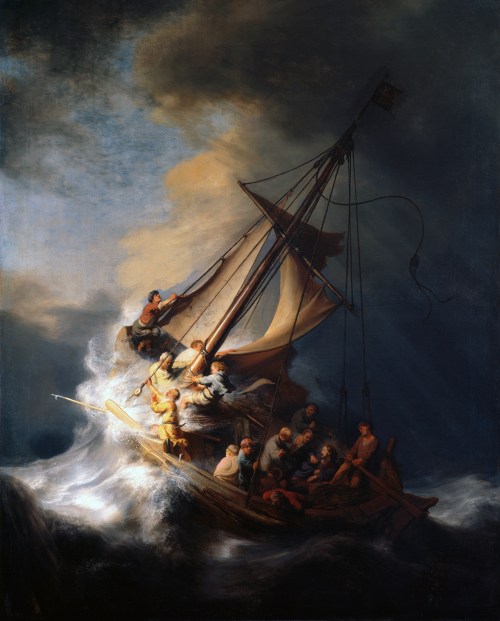
#FineArtFriday: Summer Landscape with Harvesting Farmers, by Fredrik Marinus Kruseman 1850


Author: Fredrik Marinus Kruseman  (1816–1882)

Title: Summer Landscape with Harvesting Farmers

Date:1850

Medium: oil on panel

Dimensions: Height: 28.5 cm (11.2 ″); Width: 38.1 cm (15 ″)

Collection: Art Renewal Center

About the Artist, via Wikipedia

Fredrik Marinus Kruseman was born as the fourth son of Philip Benjamin Kruseman (1781-1842) and Jacoba Magero. He received his first drawing lessons from Jan Reekers (1790-1858) and visited the City Tekenschool in Haarlem in 1832-1833. In 1833, Kruseman received painting lessons from Nicolaas Johannes Roosen Boom (1805-1880) and in 1835 he moved to the Gooi where He further qualified with Jan van Ravenswaay (1789-1869). He also followed education at the romantic landscape painter Barend Cornelis Kaf.

Fredrik Marinus Kruseman is best known for his romantic landscapes. In his entire oeuvre, which is estimated on 300-350 paintings, only 3 still lifes are known. The rest consists of landscapes.


Credits and Attributions:

Summer Landscape with Harvesting Farmers, by Fredrik Marinus Kruseman 1850 [Public domain] via Wikimedia Commons

Wikimedia Commons contributors, “File:Kruseman Fredrik Marinus Summer Landscape with Harvesting Farmers 1850 Oil On Panel.jpg,” Wikimedia Commons, the free media repository, https://commons.wikimedia.org/w/index.php?title=File:Kruseman_Fredrik_Marinus_Summer_Landscape_with_Harvesting_Farmers_1850_Oil_On_Panel.jpg&oldid=266178001 (accessed June 21, 2019).

Fredrik Marinus Kruseman, via Wikipedia The Free Encyclopedia, https://www.translatetheweb.com/?from=&to=en&ref=SERP&dl=en&rr=UC&a=https%3a%2f%2fnl.wikipedia.org%2fwiki%2fFredrik_Marinus_Kruseman accessed 20 June 2019.

Comments Off on #FineArtFriday: Summer Landscape with Harvesting Farmers, by Fredrik Marinus Kruseman 1850

Filed under #FineArtFriday

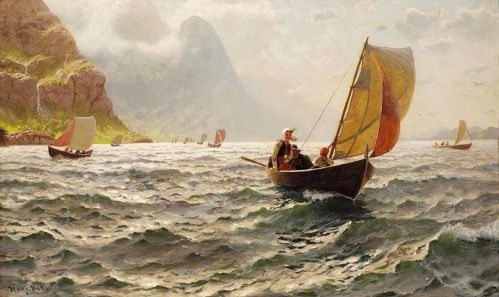
#FineArtFriday: Upon Sunny Waves, by Hans Dahl

Hans Dahl (19 February 1849 – 27 July 1937) was a Norwegian painter.

Trained in Germany, Hans Dahl is associated with the Düsseldorf school of painting, which was characterized by finely detailed imaginary landscapes. Despite later mean-spirited criticisms by other artists and art critics, Dahl remained true to his idealized fantasy art, resisting the movement from Romanticism to Modernism.

What I love about this painting:

Dahl captures the bold freedom of sailing on a sunny summer day. He captures the sense of flying on the water that makes sailing a small boat so much fun.

We aren’t on a leisurely fishing expedition here—this is boating for the sake of adventure. We’re running with wind and enjoying every minute of it.

About the Artist, via Wikipedia:

In the 1890s a new school of art arose, and artists like Dahl were not very popular in the leading circles in the capital. He was particularly criticized by the art historian Jens Thiis. He was severely criticized by fellow artists especially by Christian Krohg, who was one of the leading figures in the transition from romanticism to naturalism which characterized Norwegian art in this period. Throughout his life, he increasingly narrowed his range of topics. Dahl often described the scenery of the western part of Norway in brilliant sunshine with smiling people in national costumes. His vibrant colors and charming portrayals of young Norwegian girls in their national costume have always been very popular.


Credits and Attributions:

Wikipedia contributors, “Hans Dahl,” Wikipedia, The Free Encyclopedia, https://en.wikipedia.org/w/index.php?title=Hans_Dahl&oldid=827399492 (accessed June 13, 2019).

Upon Sunny Waves, by Hans Dahl PD|70 [Public domain]

Wikimedia Commons contributors, “File:Hans Dahl – Upon sunny waves.jpg,” Wikimedia Commons, the free media repository, https://commons.wikimedia.org/w/index.php?title=File:Hans_Dahl_-_Upon_sunny_waves.jpg&oldid=140877929 (accessed June 13, 2019).

2 Comments

Filed under #FineArtFriday

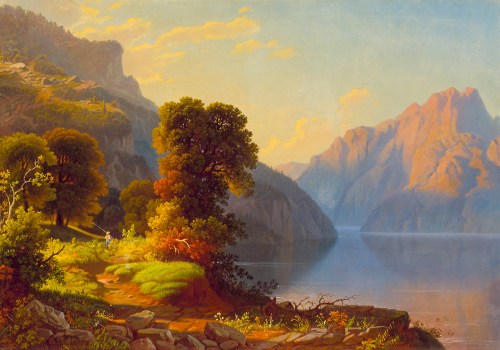
#FineArtFriday: A View of a Lake in the Mountains by George Caleb Bingham


  • Title: A View of a Lake in the Mountains
  • Artist: George Caleb Bingham
  • Medium: Oil on canvas
  • Date: between circa 1856 and circa 1859
  • Dimensions: Height: 53.9 cm (21.2 ″); Width: 76.5 cm (30.1 ″)
  • Current Location: Los Angeles County Museum of Art

What I love about this picture:

This scene depicts an hour of utter serenity in the turbulent life of the artist. The late afternoon sunlight falls gently on the rocky path above the calm waters. Shadows fall in all the right places but don’t darken the moment.  There is a dreamlike quality to the day, as if the artist painted his deepest wish. This is a pleasant, restful painting.

About the Artist, via Wikipedia:

George Caleb Bingham (March 20, 1811 – July 7, 1879) was an American artist, soldier and politician known in his lifetime as “the Missouri Artist”. Initially a Whig, he was elected as a delegate to the Missouri legislature before the American Civil War where he fought the extension of slavery westward. During that war, although born in Virginia, Bingham was dedicated to the Union cause and became captain of a volunteer company which helped keep the state from joining the Confederacy, and then served four years as Missouri’s Treasurer. During his final years, Bingham held several offices in Kansas City, as well as became Missouri’s as Adjutant General. His paintings of American frontier life along the Missouri River exemplify the Luminist style.

Bingham ran for election as a Whig to the Missouri House of Representatives the following year. He appeared to have won in 1846 by 3 votes but lost in a recount. In a reprise of the election in 1848, Bingham won the seat by a decisive margin, becoming one of the few artists to serve in elected political office. He actively opposed the pro-slavery “Jackson resolutions” in 1849, although their proponent was also a resident of Saline County. He would also represent Missouri’s eighth district at the Whig National Convention in June 1852. Bingham’s political interests would be reflected in his vivid paintings of frontier political life.

About the Luminist style, via Wikipedia:

Luminism is an American landscape painting style of the 1850s to 1870s, characterized by effects of light in landscape, through the use of aerial perspective and the concealment of visible brushstrokes. Luminist landscapes emphasize tranquility, and often depict calm, reflective water and a soft, hazy sky.

As defined by art historian Barbara Novak, luminist artworks tend to stress the horizontal, and demonstrate the artist’s close control of structure, tone, and light. The light is generally cool, hard, and non-diffuse; “soft, atmospheric, painterly light is not luminist light”. Brushstrokes are concealed in such a way that the painter’s personality is minimized. Luminist paintings tend not to be large so as to maintain a sense of timeless intimacy. The picture surface or plane is emphasized in a manner sometimes seen in primitivism. These qualities are present in different amounts depending on the artist, and within a work.

Luminism has also been considered to represent a contemplative perception of nature.

Novak states that luminism, of all American art, is most closely associated with transcendentalism. The definitional difficulties have contributed to over-use of the term.[5]

The artists who painted in this style did not refer to their own work as “luminism”, nor did they articulate any common aesthetic philosophy outside of the guiding principles of the Hudson River School.


Credits and Attributions:

A View of a Lake in the Mountains by George Caleb Bingham, via Wikimedia Commons.  Los Angeles County Museum of Art [Public domain].

Wikipedia contributors, “George Caleb Bingham,” Wikipedia, The Free Encyclopedia, https://en.wikipedia.org/w/index.php?title=George_Caleb_Bingham&oldid=900386053 (accessed June 6, 2019).

Wikipedia contributors, “Luminism (American art style),” Wikipedia, The Free Encyclopedia, https://en.wikipedia.org/w/index.php?title=Luminism_(American_art_style)&oldid=886912140 (accessed June 6, 2019).


2 Comments

Filed under #FineArtFriday

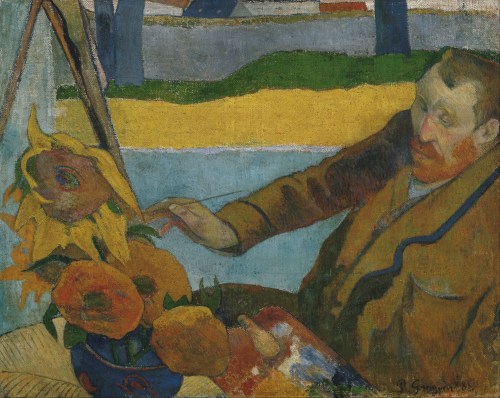
#FineArtFriday: Vincent van Gogh Painting Sunflowers by Paul Gauguin 1888

Title: Van Gogh Painting Sunflowers

Artist: Paul Gauguin

Genre: portrait

Date: 1888

Medium: oil on jute

Dimensions: Height: 73 cm (28.7 ″); Width: 91 cm (35.8 ″)

About this Painting, via Wikipedia:

The portrait was painted when Gauguin visited Van Gogh in Arles, France. Vincent had pleaded with Gauguin to come to Arles to start an art-colony. Gauguin eventually agreed after funding for the transportation and expenses was provided by Vincent’s brother Theo Van Gogh; however Gauguin only stayed for two months as the two often quarreled and the famous incident where Van Gogh severed his left ear with a razor occurred after an argument with Gauguin.

Van Gogh’s first impression on seeing the painting was that Gauguin had depicted him as a madman. He later softened his view. “My face has lit up after all a lot since, but it was indeed me, extremely tired and charged with electricity as I was then.”

About the Artist, via Wikipedia:

Eugène Henri Paul Gauguin (UK: /ˈɡoʊɡæ̃/, US: /ɡoʊˈɡæ̃/; French: [øʒɛn ɑ̃ʁi pɔl ɡoɡɛ̃]; 7 June 1848 – 8 May 1903) was a French post-Impressionist artist. Unappreciated until after his death, Gauguin is now recognized for his experimental use of color and Synthetist style that were distinctly different from Impressionism. Toward the end of his life, he spent ten years in French Polynesia, and most of his paintings from this time depict people or landscapes from that region.

Gauguin’s relationship with Vincent proved fraught. In 1888, at (van Gogh’s brother)Theo’s instigation, Gauguin and Vincent spent nine weeks painting together at Vincent’s Yellow House in Arles. Their relationship deteriorated and eventually Gauguin decided to leave. On the evening of 23 December 1888 according to a much later account of Gauguin’s, van Gogh confronted Gauguin with a razor blade. Later the same evening, van Gogh cut off his own left ear. He wrapped the severed tissue in newspaper and handed it to a woman who worked at a brothel both Gauguin and van Gogh had visited, and asked her to “keep this object carefully, in remembrance of me”. Van Gogh was hospitalized the following day and Gauguin left Arles.


Credits and Attributions:

Vincent van Gogh Painting Sunflowers by Paul Gauguin 1888 [Public domain]

Wikipedia contributors, “Paul Gauguin,” Wikipedia, The Free Encyclopedia, https://en.wikipedia.org/w/index.php?title=Paul_Gauguin&oldid=899278654 (accessed May 31, 201 Wikipedia contributors, “The Painter of Sunflowers,” Wikipedia, The Free Encyclopedia, https://en.wikipedia.org/w/index.php?title=The_Painter_of_Sunflowers&oldid=853391418 (accessed May 31, 2019). 9).

Wikimedia Commons contributors, “File:Paul Gauguin – Vincent van Gogh painting sunflowers – Google Art Project.jpg,” Wikimedia Commons, the free media repository, https://commons.wikimedia.org/w/index.php?title=File:Paul_Gauguin_-_Vincent_van_Gogh_painting_sunflowers_-_Google_Art_Project.jpg&oldid=321446852 (accessed May 31, 2019).

Comments Off on #FineArtFriday: Vincent van Gogh Painting Sunflowers by Paul Gauguin 1888

Filed under #FineArtFriday

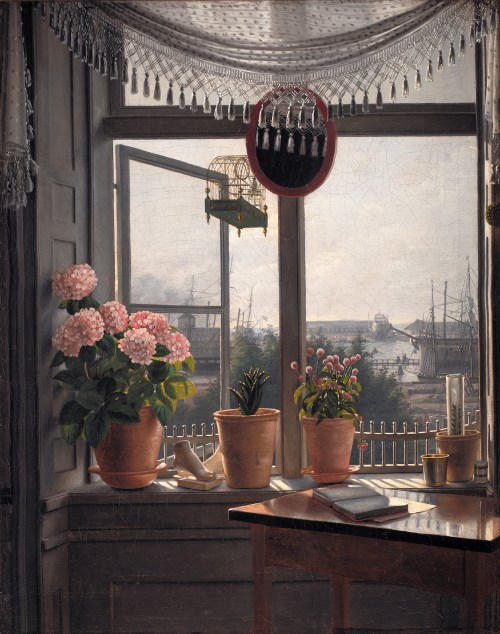
#FineArtFriday: View from the Artist’s Window, Martinus Rørbye

What I like about this painting:

View from the Artist’s Window was painted just at the time when the young Rørbye was gaining recognition as an artist, around the year 1825. The room is pleasant, homey, and the pink hydrangeas are beautiful. The transparency of the curtain is masterfully done.

The shipyard is represented as looming below and in the distance, a dominant view in the artist’s life.

The visual allegory of the caged bird floating out of the open window is wonderful, representing the young artist poised on the edge of leaving home, daring to imagine the wide, unknown world that waits for him.

The possibility of adventure is represented by the view of the working shipyard and the ship berthed in the harbor below.

About the artist, via Wikipedia:

Martinus Christian Wesseltoft Rørbye (17 May 1803 – 29 August 1848) was a Danish painter, known both for genre works and landscapes. He was a central figure of the Golden Age of Danish painting during the first half of the 19th century.

The most traveled of the Danish Golden Age painters, he traveled to Norway and Sweden and south to Italy, Greece and Constantinople.

He is remembered for his genre paintings, his landscapes and his architectural paintings, as well as for the many sketches he made during his numerous travels. He painted numerous scenes of life in Copenhagen, as well as large compositions showing Italian and Turkish landscapes and scenes of folk life. He painted few portraits.

He was one of the most traveled of the Golden Age painters and distinguished his artistic production by his interpretations of lands rarely explored at that time for their artistic motifs, as well as for his anecdotal genre paintings depicting the Copenhagen of his day.

Title: View from the Artist’s Window, Martinus Rørbye [Public domain]

  • Genre: landscape art
  • Date: About 1825
  • Medium: oil on canvas
  • Dimensions: Height: 380 mm (14.96 ″); Width: 298 mm (11.73 ″)

Credits and Attributions:

Wikimedia Commons contributors, “File:Martinus Rørbye – View from the Artist’s Window – Google Art Project.jpg,” Wikimedia Commons, the free media repository, https://commons.wikimedia.org/w/index.php?title=File:Martinus_R%C3%B8rbye_-_View_from_the_Artist%27s_Window_-_Google_Art_Project.jpg&oldid=326761582 (accessed May 17, 2019).

Wikipedia contributors, “Martinus Rørbye,” Wikipedia, The Free Encyclopedia, https://en.wikipedia.org/w/index.php?title=Martinus_R%C3%B8rbye&oldid=895614706

Comments Off on #FineArtFriday: View from the Artist’s Window, Martinus Rørbye

Filed under #FineArtFriday

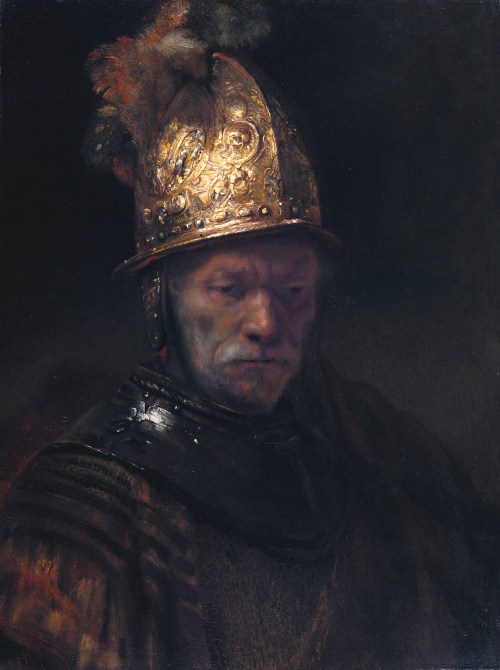
FineArtFriday: The Man With the Golden Helmet, Circle of Rembrandt

About this image, via Wikipedia:

The Man with the Golden Helmet (c. 1650) is an oil on canvas painting formerly attributed to the Dutch painter Rembrandt and today considered to be a work by someone in his circle.

Categorized as a work by Rembrandt for many years, doubts were expressed as to its provenance in 1984 by a Dutch curators’ commission specifically created to investigate Rembrandt works of questionable authenticity. They made their remarks whilst viewing the painting in West Berlin.

In November 1985, Berlin-based art expert Jan Kelch announced that important details in the painting’s style did not match the style of Rembrandt’s known works, and that the painting was probably painted in 1650 by one of Rembrandt’s students.

What I like about this painting:

This is a  wonderful portrait with a great mystery attached. It’s a classic example of a work by a student being good enough to be mistaken for the mentor’s work. Whichever of Rembrandt’s student did paint this man’s portrait, they were clearly on their way to great things in the art world. So far, the artist has not been identified, and most of Rembrandt’s students left large catalogs of work, all of which could be compared to it.

However, Rembrandt had many students, including his son, Titus.

Titus died very young but was known to be painting at the time this portrait is attributed to. He was nine, old enough to be apprenticed. Could this have been one of his lessons? Could the confusion have arisen because a father was teaching his young son the art of portrait painting? No works with his signature survive that I know of, although I admit I am not an art historian. Regardless, much is like Rembrandt, enough to confuse the issue.

Just a Rembrandt fangirl, fantasizing.

A partial list of Rembrandt’s students can be found here Rembrandt’s Students.


Credits and Attributions:

Wikimedia Commons contributors, “File:Mann mit dem Goldhelm.jpg,” Wikimedia Commons, the free media repository, https://commons.wikimedia.org/w/index.php?title=File:Mann_mit_dem_Goldhelm.jpg&oldid=318048571(accessed May 10, 2019).

Wikipedia contributors, “The Man with the Golden Helmet,” Wikipedia, The Free Encyclopedia, https://en.wikipedia.org/w/index.php?title=The_Man_with_the_Golden_Helmet&oldid=880858243 (accessed May 10, 2019).

2 Comments

Filed under #FineArtFriday

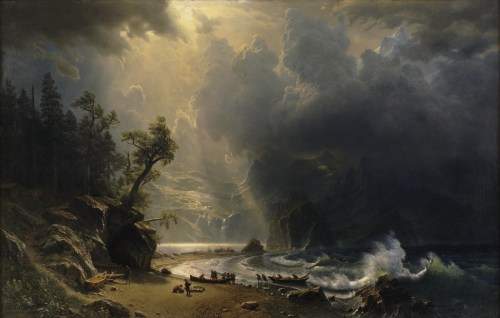
#FineArtFriday: Puget Sound on the Pacific Coast by Albert Bierstadt 1870

What I love about this painting:

I live on Puget sound, and while the exact beach this image depicts likely does not exist, the cliffs are pretty accurate. I have seen many, many places here like it. The waters of the sound can get quite rough during storms, as this video shot by a storm chaser in December shows: Wild Ferry Ride Across Puget Sound Dec. 16 2018.

Anyone who lives here will tell you, the view of the Olympic Mountains from over the sound is unparalleled.

At certain times of the year, rain sweeps in like a dark beast. I have often seen the sky as black and heavy as it is depicted in this painting. Shafts of sun between heavy rain squalls are frequent companions here. When the sun shines through the heavy clouds, the light looks very much the way he shows it.

A sky that looks like the one in this painting heralds a serious storm. If you are driving anywhere during this kind of weather, you are in for a slow, miserable trip.

Quote from http://www.SeattleArtMuseum.org, regarding Puget Sound on the Pacific Coast, 1870, which is now in their possession.

 “Bierstadt had likely not yet traveled to the Washington Territory in 1870. The painting was possibly a commission from a New York shipping magnate who had made his enormous fortune on the Pacific coast. Enterprising artist that he was, Bierstadt did not shy away from the challenge of painting a place he had not yet seen.”

I love that Bierstadt was a story teller as much as an entrepreneur in regard to his art. All the great artists were.

It has been suggested he put this picture together by piecing together places he had visited on the Lower Columbia River. Indeed, the trees and landscape there is much like that of Puget Sound, so it is possible. However, it would have been easy for him to have traveled north to the sound if he was on the  Lower Columbia—a matter of only eighty miles, so a week of travel for him by horse.

He was a man who traveled all over the west and painted what he felt as much as what he saw.

Wikipedia has this to say about Albert Bierstadt:

In 1867, Bierstadt traveled to London, where he exhibited two landscape paintings in a private reception with Queen Victoria. He traveled through Europe for two years, cultivating social and business contacts to sustain the market for his work overseas. His exhibition pieces were brilliant images, which glorified the American West as a land of promise and “fueled European emigration.” He painted Among the Sierra Nevada, California in his Rome studio, for example, showed it in Berlin and London before shipping it to the U.S. As a result of the publicity generated by his Yosemite Valley paintings in 1868, Bierstadt’s presence was requested by every explorer considering a westward expedition, and he was commissioned by the Atchison, Topeka, and Santa Fe Railroad to visit the Grand Canyon for further subject matter.

Bierstadt’s choice of grandiose subjects was matched by his entrepreneurial flair. His exhibitions of individual works were accompanied by promotion, ticket sales, and, in the words of one critic, a “vast machinery of advertisement and puffery.”

Bierstadt was highly successful in his day, which the more refined critics despised. Everything the critics mocked about his work are the aspects I love. The high contrasts of light and shadow, sweeping epic themes, and overblown romanticism—those are what I love about all his work.

In all his works, Bierstadt created an emotional landscape as much as a physical one.

Puget Sound on the Pacific Coast by Albert Bierstadt

  • Genre: landscape art
  • Date: 1870
  • Medium: oil on canvas
  • Dimensions: Height: 52.5 ″ (133.3 cm); Width: 82 ″ (208.2 cm)
  • Collection: Seattle Art Museum
  • Current location: Seattle Art Museum Downtown, Gallery Level 3, American Art

Credits and Attributions:

Puget Sound on the Pacific Coast, by Albert Bierstadt, signed and dated 1870 [Public domain]

Wikimedia Commons contributors, “File:Albert Bierstadt – Puget Sound on the Pacific Coast (1870).jpg,” Wikimedia Commons, the free media repository, https://commons.wikimedia.org/w/index.php?title=File:Albert_Bierstadt_-_Puget_Sound_on_the_Pacific_Coast_(1870).jpg&oldid=344396079 (accessed April 26, 2019).

Quote from the article: Puget Sound on the Pacific Coast, Seattle Art Museum website contributors, (accessed April 25, 2019).

Comments Off on #FineArtFriday: Puget Sound on the Pacific Coast by Albert Bierstadt 1870

Filed under #FineArtFriday

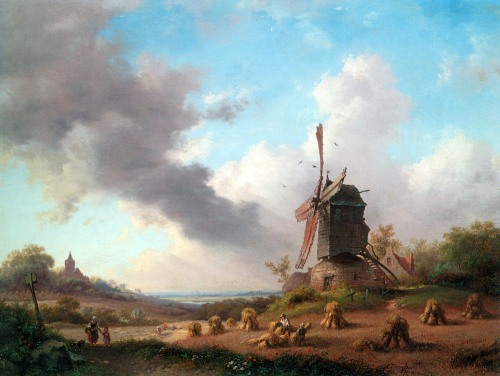
#FineArtFriday: Christ in the Storm on the Sea of Galilee by Rembrandt van Rijn, 1633

Today’s image is of a picture that was stolen in 1990 and has never been recovered.

Christ in the Storm on the Sea of Galilee was painted during one of the happiest years of Rembrandt van Rijn’s turbulent life and depicts the miracle of Jesus calming the storm on the Sea of Galilee. A devout Christian, Rembrandt painted it from the description of the event as reported by the Apostle Mark, in the fourth chapter of his Gospel. As far as is known, it is the only seascape Rembrandt ever painted.

Constantijn Huygens, the father of Dutch mathematician and physicist Christiaan Huygens, had seen Rembrandt’s talent and helped him gain important commissions from the Court of The Hague. Many of his best religious paintings date from the years during which he had the favor of both Huygens and Prince Frederick Hendrick.

At the end of 1631, Rembrandt had moved to Amsterdam. The city was becoming the new business capital of the Netherlands, so there was great opportunity there for artists. In Amsterdam, Rembrandt had begun to paint portraits for the first time, and by 1633, his work was in high demand. His religious paintings and history paintings were also receiving the highest praise.

At first, he lived with an art dealer, Hendrick van Uylenburgh, which was where he met Hendrick’s cousin, Saskia van Uylenburgh. During 1633, the year in which Christ on the Sea of Galilee was painted, he was courting Saskia, hoping to marry her. He was earning a good income as a portraitist, and a bright future loomed. He must have felt in many ways as if he had the world by the tail.

What I love about this painting:

Rembrandt’s colors are vivid, standing out against the darkness of the storm. An entire story is captured in this image. The sea is terrifying, monstrous waves battering the ship, men panicking, trying to gain control. The terror of the event is clearly shown, and you feel fear for the men too. In the midst of chaos, Jesus awakes, calm despite the panic around him. Each face has a different expression, and one, a man holding a rope in one hand and pressing his cap to his head with the other, looks directly at us—Rembrandt himself.

The Gospel of Mark records the incident:

He woke up and rebuked the wind, and said to the sea, “Peace! Be still!” Then the wind ceased, and there was a dead calm. He said to them, “Why are you afraid? Have you still no faith?” And they were filled with great awe and said to one another, “Who then is this, that even the wind and the sea obey him?

Rembrandt, a frail man but a devout believer, lived the story as he painted it, as do all good storytellers.

About the theft, via Wikipedia:

On March 18, 1990, 13 works of art valued at a combined total of $500 million were stolen from the Isabella Stewart Gardner Museum in Boston. In the early hours, guards admitted two men posing as police officers responding to a disturbance call. Once inside, the thieves tied up the guards and over the next hour committed the largest-value recorded theft of private property in history. Despite efforts by the Federal Bureau of Investigation (FBI) and multiple probes around the world, no arrests have been made, and no works have been recovered.

The stolen works had originally been purchased by art collector Isabella Stewart Gardner (1840–1924) and intended to be left on permanent display at the museum with the rest of her collection. Since the collection and its layout are permanent, empty frames remain hanging both in homage to the missing works and as placeholders for their potential return. Experts are puzzled by the choice of paintings that were stolen, especially since more valuable artwork was left untouched. Among the stolen works was The Concert, one of only 34 known works by Vermeer and thought to be the most valuable unrecovered painting, valued at over $200 million.[when?] Also missing is The Storm on the Sea of GalileeRembrandt‘s only known seascape. Other works by Rembrandt, DegasManet, and Flinck were also stolen.

Christ in the Storm on the Sea of Galilee by Rembrandt van Rijn

  • Artist:   Rembrandt  (1606–1669)
  • Genre: religious art
  • Date: 1633
  • Medium: oil on canvas
  • Dimensions: Height: 160 cm (62.9 ″); Width: 128 cm (50.3 ″)
  • Current Location: Unknown

Sources and Attributions:

Wikimedia Commons contributors, “File:Rembrandt Christ in the Storm on the Lake of Galilee.jpg,” Wikimedia Commons, the free media repository, https://commons.wikimedia.org/w/index.php?title=File:Rembrandt_Christ_in_the_Storm_on_the_Lake_of_Galilee.jpg&oldid=341966464 (accessed April 4, 2019).

Wikipedia contributors, “Calming the storm,” Wikipedia, The Free Encyclopedia, https://en.wikipedia.org/w/index.php?title=Calming_the_storm&oldid=882782126 (accessed April 4, 2019).

The Isobel Stewart Gardner Museum, CHRIST IN THE STORM ON THE SEA OF GALILEE, 1633, https://www.gardnermuseum.org/experience/collection/10953 (accessed April 4, 2019).

2 Comments

Filed under #FineArtFriday

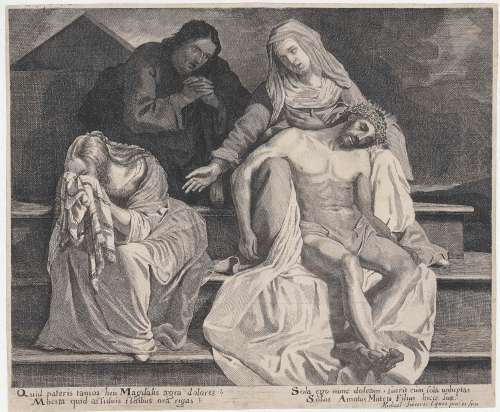
#FineArtFriday: The Lamentation by Michiel Sweerts  

Michiel Sweerts:  The Lamentation

Date:   between 1643 and 1661

Medium:          Etching and engraving on paper

Dimensions:    Height: 28.7 cm (11.2 ″); Width: 34.6 cm (13.6 ″)

About the technique of Etching (From Wikipedia):

Etching is traditionally the process of using strong acid or mordant to cut into the unprotected parts of a metal surface to create a design in intaglio (incised) in the metal. As a method of printmaking, it is, along with engraving, the most important technique for old master prints, and remains in wide use today.

In traditional pure etching, a metal (usually copper, zinc or steel) plate is covered with a waxy ground which is resistant to acid. The artist then scratches off the ground with a pointed etching needle where he or she wants a line to appear in the finished piece, so exposing the bare metal. The échoppe, a tool with a slanted oval section, is also used for “swelling” lines. The plate is then dipped in a bath of acid, technically called the mordant (French for “biting”) or etchant, or has acid washed over it. The acid “bites” into the metal (it dissolves part of the metal) where it is exposed, leaving behind lines sunk into the plate. The remaining ground is then cleaned off the plate. The plate is inked all over, and then the ink wiped off the surface, leaving only the ink in the etched lines.

Etchings were, in the 17th century, the way an artist could ensure his work was seen by the growing middle-class who would otherwise be unable to afford art for their homes. Once an artist mastered the technique, it was the most reliable way to earn money from his work.

About the artist, via Wikipedia:

Michiel Sweerts was born in Brussels where he was baptized on 29 September 1618 in the St. Nicholas Church as the son of David Sweerts, a linen merchant, and Martina Ballu.  Little is known about the artist’s early life and nothing about his training.

The surviving works by Sweerts mostly date to the period of his residence in Rome. Due to the difficulty of attributing works to the artist who rarely signed his works the number of canvases given to the artist vary from 40 to 100. Some of Sweerts’ works were so popular in his time that contemporary copies were made, some by Sweerts himself, others by pupils or followers. It is not always easy to determine the level of Sweerts’ involvement (if any) in the making of these copies. For instance, there exist at least four early copies, of varying quality, of his Artist’s studio with a woman sewing (one copy at the Collection RAU – Fondation Unicef, Cologne). None of his paintings produced after he left Europe is known to survive.

The majority of his output falls into two categories: ‘genre scenes” of low-life subjects of country and street life and portraits or tronies. A third category are allegorical works, which are regarded as enigmatic and are the subject of ongoing interpretation by art historians. Sweerts reportedly painted compositions of Biblical subjects, several of which are mentioned in contemporary inventories. However, none of these are known to have survived. One of his religious paintings, a Lamentation is known from the print, which Sweerts himself made after his own painting. The composition is unusual for the Virgin’s comforting gesture towards the inconsolable Mary Magdalene.

Sweerts is an enigmatic and difficult artist to categorise, since he absorbed a variety of influences to create an eclectic style that adapted Netherlandish genre painting to early tenebrist styles as well as blended Baroque and classicist tendencies.

By December 1661 Sweerts had arrived in Marseilles from where his ship left for Palestine in January 1662.  Sweerts sailed for Alexandretta with bishop François Pallu, 7 priests and another lay brother. In Syria he is said to have produced some paintings. On the overland portion of the trip in Syria he became mentally unstable and was dismissed from the company somewhere between Isfahan and Tabriz in Persia. He then traveled on to the Portuguese Jesuits in Goa where he is reported to have died at the age of 46.


Credits and Attributions:

Wikipedia contributors, “Etching,” Wikipedia, The Free Encyclopedia, https://en.wikipedia.org/w/index.php?title=Etching&oldid=887368691 (accessed March 29, 2019).

Wikipedia contributors, “Michiel Sweerts,” Wikipedia, The Free Encyclopedia, https://en.wikipedia.org/w/index.php?title=Michiel_Sweerts&oldid=850063690  (accessed March 29, 2019).

Wikimedia contributors, “Michiel Sweerts,”  https://en.wikipedia.org/wiki/File:Michiel_Sweerts_-_The_lamentation.jpg (accessed March 29, 2019)


Comments Off on #FineArtFriday: The Lamentation by Michiel Sweerts  

Filed under #FineArtFriday

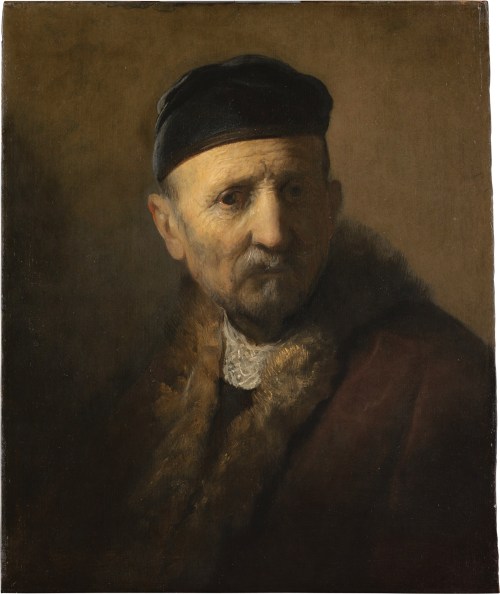
#FineArtFriday: Tronie of an Old Man by Rembrandt van Rijn

Tronie of an Old Man by Rembrandt van Rijn is a portrait of Rembrandt’s father, Harmen Gerritszoon van Rijn.  Harmen was a miller in Leiden.

About the word “tronie” from Wikipedia: A tronie (16/17th-century Dutch for “face”) is a common type, or group of types, of works common in Dutch Golden Age painting and Flemish Baroque painting that shows an exaggerated facial expression or a stock character in costume. It is related to the French word “tronche” which is slang for “mug” or head.

Rembrandt’s family was quite well-to-do and as such, young Rembrandt was educated in the best schools, which his father paid for.  Rembrandt’s father encouraged his son’s talent.

To my opinionated eyes, this painting shows Rembrandt’s affection for his father.

Rembrandt resembled  his father, if this portrait was accurate, and I think we can assume it was. As an artist, Rembrandt was unflinchingly honest in the portrayal of his subjects, while always managing to show their humanity.


Credits and Attributions

Tronie of and Old Man by Rembrandt van Rijn

Wikipedia contributors, “Tronie,” Wikipedia, The Free Encyclopedia,https://en.wikipedia.org/w/index.php?title=Tronie&oldid=872242306 (accessed March 15, 2019).

Rembrandt and workshop [Public domain]

Comments Off on #FineArtFriday: Tronie of an Old Man by Rembrandt van Rijn

Filed under #FineArtFriday, writing