Category Archives: #FineArtFriday

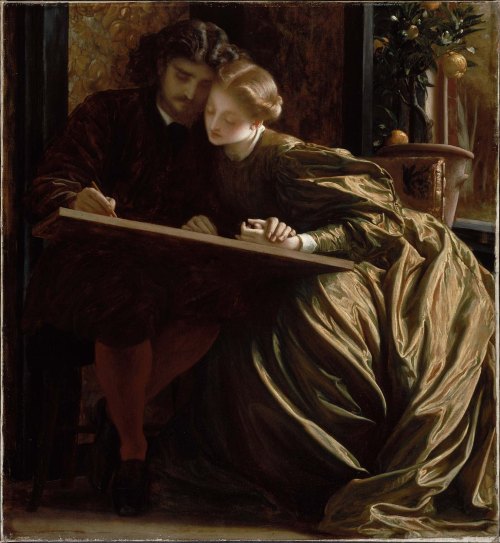
#FineArtFriday: The Painter’s Honeymoon by Frederic Leighton, 1st Baron Leighton ca. 1864

Artist: Frederic Leighton, 1st Baron Leighton: The Painter’s Honeymoon

Title: The Painter’s Honeymoon

Date: 1864

Medium: painting

Dimensions: 83.8 × 76.8 cm (32.9 × 30.2 ″)

What I like about this painting:

This is a real departure from Leighton’s usual precise nudes. There is a great deal of emotion and closeness depicted here. The folds of the wife’s skirt are shown with his usual vivid sharpness, as are the hands of both the painter and his wife. Their hands are portrayed as gentle and tender—and yet they are clearly defined, as they are the medium through which the painter expresses himself.

Their faces are not as distinct, as if they are still in the romantic haze of their new life together.

According to Wikipedia:

The Painter’s Honeymoon was first exhibited at the Royal Academy in 1866 – it appears that Leighton deliberately prevented it from being shown publicly in the years following its completion. As Leighton was renowned for his lack of confidence and shyness, many of his contemporaries believed he felt he had betrayed too much of his own emotion to feel comfortable exhibiting the picture.


Credits and Attributions:

The Painter’s Honeymoon by Frederic Leighton, 1st Baron Leighton [Public domain]

Wikipedia contributors, “The Painter’s Honeymoon,” Wikipedia, The Free Encyclopedia, https://en.wikipedia.org/w/index.php?title=The_Painter%27s_Honeymoon&oldid=902492011 (accessed October 18, 2019).

2 Comments

Filed under #FineArtFriday

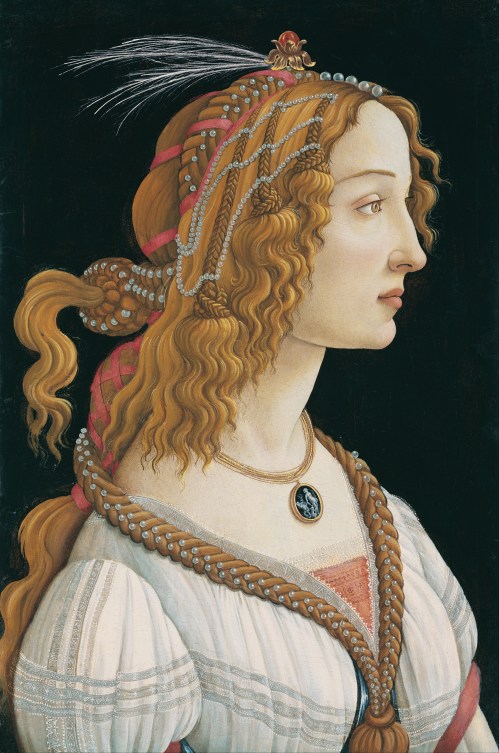
#FineArtFriday: Portrait of a Lady by the workshop of Sandro Botticelli ca. 1480

  • Artist: Workshop of Sandro Botticelli  (1445–1510)
  • Title: Idealized Portrait of a Lady (Portrait of Simonetta Vespucci as Nymph)
  • Genre: portrait
  • Date: circa 1480
  • Medium: tempera on wood
  • Dimensions: Height: 82 cm (32.2 ″); Width: 54 cm (21.2 ″)

About Portrait of a young woman, possibly Simonetta Vespucci, 1484:

The Roman engraved gem on her necklace was owned by Lorenzo de’ Medici. It is suggested that in Quatrocento paintings, hair and water are related. Certainly, the waves of her hair seem to suggest water.

Ronald Lightbown, author of Botticelli: Life and Works claims it is  a creation of Botticelli’s workshop and was likely neither drawn nor painted exclusively by Botticelli himself. He also reminds us that the model’s identity can’t be confirmed; that Botticell’s workshop most likely executed fancy portraits of idealized beauties, rather than real ladies.

About the Artist, via Wikipedia:

Alessandro di Mariano di Vanni Filipepi (c. 1445[1] – May 17, 1510), known as Sandro Botticelli (/ˌbɒtɪˈtʃɛli/, Italian: [ˈsandro bottiˈtʃɛlli]), was an Italian painter of the Early Renaissance. He belonged to the Florentine School under the patronage of Lorenzo de’ Medici, a movement that Giorgio Vasari would characterize less than a hundred years later in his Vita of Botticelli as a “golden age“. Botticelli’s posthumous reputation suffered until the late 19th century; since then, his work has been seen to represent the linear grace of Early Renaissance painting


Credits and Attributions:

Wikipedia contributors, “Sandro Botticelli,” Wikipedia, The Free Encyclopedia, https://en.wikipedia.org/w/index.php?title=Sandro_Botticelli&oldid=916319613 (accessed October 4, 2019).

1 Comment

Filed under #FineArtFriday

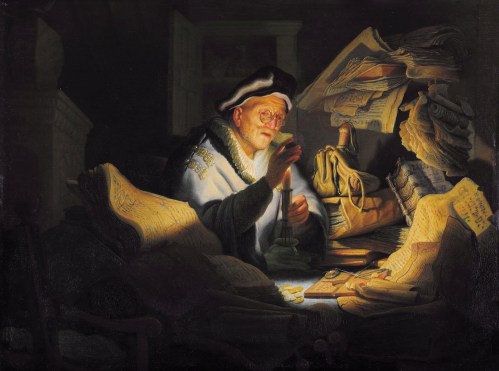
#FineArtFriday: The Parable of the Rich Fool by Rembrandt ca. 1627

  • By Rembrandt  (1606–1669)
  • Title: The Parable of the Rich Fool
  • Genre: religious art
  • Date: 1627  Monogram and date bottom left: RH. 1627.
  • Medium: oil on oak panel
  • Dimensions: Height: 31.9 cm (12.5 ″); Width: 42.5 cm (16.7 ″)


Rembrandt’s early career focused on religious paintings, which were well received by influential patrons. Today’s featured painting, The Parable of the Rich Fool, is one of his early works, from the time when he shared a studio with Jan Lievens.


About this parable, via Wikipedia:

The rich farmer in this parable is portrayed negatively, as an example of greed.  By replacing his existing barn, he avoids using agricultural land for storage purposes, thus maximizing his income, as well as allowing him to wait for a price increase before selling. St. Augustine comments that the farmer was “planning to fill his soul with excessive and unnecessary feasting and was proudly disregarding all those empty bellies of the poor. He did not realize that the bellies of the poor were much safer storerooms than his barns.”


Credits and Attributions:

Wikipedia contributors, “Parable of the Rich Fool,” Wikipedia, The Free Encyclopedia, https://en.wikipedia.org/w/index.php?title=Parable_of_the_Rich_Fool&oldid=912095443

(accessed September 27, 2019).

Wikimedia Commons contributors, “File:Rembrandt – The Parable of the Rich Fool.jpg,” Wikimedia Commons, the free media repository, https://commons.wikimedia.org/w/index.php?title=File:Rembrandt_-_The_Parable_of_the_Rich_Fool.jpg&oldid=354111849

(accessed September 27, 2019).

Comments Off on #FineArtFriday: The Parable of the Rich Fool by Rembrandt ca. 1627

Filed under #FineArtFriday

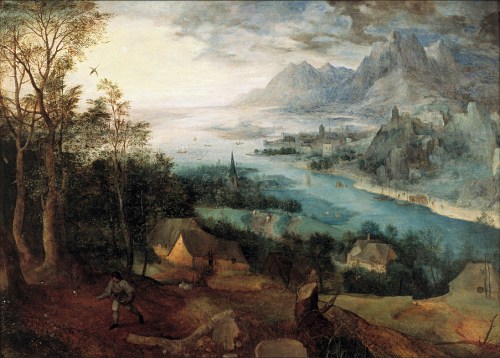
#FineArtFriday: Landscape with the Parable of the Sower by Pieter Bruegel the Elder 1552

Artist: Pieter Bruegel the Elder  (1526/1530–1569)

Title: Landscape with the Parable of the Sower

Genre: religious art

Date: 1552

Medium: oil on panel

Dimensions: Height: 74 cm (29.1 ″); Width: 102 cm (40.1 ″)

What I love about this painting:

Pieter Brugel the Elder was one of my first influences in the world of art appreciation. What always strikes me about his work is the innocent joy he infused in his art. This particular painting has a delicate, almost watercolor feel to it.

In this piece, the color of the river is the unique shade of blue that appears in his other works.

The parable he illustrates (via Wikipedia):

In the (Biblical) story, a sower sows seed and does so indiscriminately. Some seed falls on the path (wayside) with no soil, some on rocky ground with little soil, and some on soil which contained thorns. In these cases the seed is taken away or fails to produce a crop, but when it falls on good soil it grows, yielding thirty, sixty, or a hundredfold.

Jesus then (only in the presence of his disciples) explains that the seed represents the Gospel (the sower being anyone who proclaims it), and the various soils represent people’s responses to it (the first three representing rejection while the last represents acceptance).

About the Artist, via Wikipedia:

Pieter Bruegel (also Brueghel or Breughelthe Elder (/ˈbrɔɪɡəl/, also US: /ˈbruːɡəl, ˈbrɜːɡəl/, Dutch: [ˈpitər ˈbrøːɣəl] c. 1525–1530 – 9 September 1569) was the most significant artist of Dutch and Flemish Renaissance painting, a painter and printmaker from Brabant, known for his landscapes and peasant scenes (so-called genre painting); he was a pioneer in making both types of subject the focus in large paintings.

He was a formative influence on Dutch Golden Age painting and later painting in general in his innovative choices of subject matter, as one of the first generation of artists to grow up when religious subjects had ceased to be the natural subject matter of painting. He also painted no portraits, the other mainstay of Netherlandish art. After his training and travels to Italy, he returned in 1555 to settle in Antwerp, where he worked mainly as a prolific designer of prints for the leading publisher of the day. Only towards the end of the decade did he switch to make painting his main medium, and all his famous paintings come from the following period of little more than a decade before his early death, when he was probably in his early forties, and at the height of his powers.


Credits and Attributions:

Wikimedia Commons contributors, “File:Pieter Bruegel d. Ä. 030.jpg,” Wikimedia Commons, the free media repository, https://commons.wikimedia.org/w/index.php?title=File:Pieter_Bruegel_d._%C3%84._030.jpg&oldid=356083009 (accessed September 20, 2019).

Wikipedia contributors, “Pieter Bruegel the Elder,” Wikipedia, The Free Encyclopedia, https://en.wikipedia.org/w/index.php?title=Pieter_Bruegel_the_Elder&oldid=915292603 (accessed September 20, 2019).

Wikipedia contributors, “Parable of the Sower,” Wikipedia, The Free Encyclopedia, https://en.wikipedia.org/w/index.php?title=Parable_of_the_Sower&oldid=907267798 (accessed September 20, 2019).

Comments Off on #FineArtFriday: Landscape with the Parable of the Sower by Pieter Bruegel the Elder 1552

Filed under #FineArtFriday

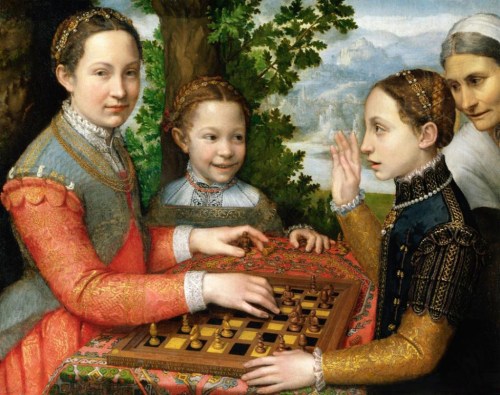
#FineArtFriday: The Chess Game, by Sofonisba Anguissola ca. 1555

Title: The Chess Game (Portrait of the artist’s sisters playing chess)

Artist: Sofonisba Anguissola

Date: 1555

Medium: oil on canvas

Dimensions: Height: 72 cm (28.3 ″) Width: 97 cm (38.1 ″)


What I love about this painting:

The colors are vibrant,

Because it is a game of war and strategies for winning a war, chess has historically been considered a predominantly male game. That Anguissola’s sisters are playing it at so young an age is a testimony to the atmosphere of education surrounding the home.

Their features are modern in the way they are shown with a roundness that is unusual in early renaissance portraits, which were often so highly formal that they were visually flat. These girls could be my granddaughters.

Anguissola has captured the emotions and happiness of a family at play. Her sisters’ personalities are clearly shown. The older sister has taken a pawn, the younger fears she might lose the game to a more experienced player. The youngest is enjoying the game immensely, seeing the sister who sometimes bosses her around being handed her own medicine.

About the Artist, via Wikipedia:

Sofonisba Anguissola (c. 1532 – 16 November 1625), also known as Sophonisba Angussola or Anguisciola, was an Italian Renaissance painter born in Cremona to a relatively poor noble family. She received a well-rounded education, that included the fine arts, and her apprenticeship with local painters set a precedent for women to be accepted as students of art. As a young woman, Anguissola traveled to Rome where she was introduced to Michelangelo, who immediately recognized her talent, and to Milan, where she painted the Duke of Alba. The Spanish queen, Elizabeth of Valois, was a keen amateur painter and in 1559 Anguissola was recruited to go to Madrid as her tutor, with the rank of lady-in-waiting. She later became an official court painter to the king, Philip II, and adapted her style to the more formal requirements of official portraits for the Spanish court. After the queen’s death, Philip helped arrange an aristocratic marriage for her. She moved to Sicily, and later Pisa and Genoa, where she continued to practice as a leading portrait painter.

On 12 July 1624, Anguissola was visited by the young Flemish painter Anthony van Dyck, who recorded sketches from his visit to her in his sketchbook.[25] Van Dyck, who believed her to be 96 years of age (she was actually about 92) noted that although “her eyesight was weakened”, Anguissola was still mentally alert.[24] Excerpts of the advice she gave him about painting survive from this visit,[26] and he was said to have claimed that their conversation taught him more about the “true principles” of painting than anything else in his life.[1][2] Van Dyck drew her portrait while visiting her.

About this painting, via Wikipedia:

Although Anguissola enjoyed significantly more encouragement and support than the average woman of her day, her social class did not allow her to transcend the constraints of her sex. Without the possibility of studying anatomy or drawing from life (it was considered unacceptable for a lady to view nudes), she could not undertake the complex multi-figure compositions required for large-scale religious or history paintings.

Instead, she experimented with new styles of portraiture, setting subjects informally. Self-portraits and family members were her most frequent subjects, as seen in such paintings as Self-Portrait (1554, Kunsthistoriches Museum, Vienna), Portrait of Amilcare, Minerva and Asdrubale Anguissola (c. 1557–1558, Nivaagaards Malerisambling, Niva, Denmark), and her most famous picture, The Chess Game (1555, Muzeum Narodowe, Poznań), which depicted her sisters Lucia, Minerva and Europa.

Painted when Sofonisba was 23 years old, The Chess Game is an intimate representation of an everyday family scene, combining elaborate formal clothing with very informal facial expressions, which was unusual for Italian art at this time. The Chess Game explored a new kind of genre painting which places her sitters in a domestic setting instead of the formal or allegorical settings that were popular at the time.[17] This painting has been regarded as a conversation piece, which is an informal portrait of a group engaging in lively conversation or some activity .


Credits and Attributions:

Wikimedia Commons contributors, “File:The Chess Game – Sofonisba Anguissola.jpg,” Wikimedia Commons, the free media repository, https://commons.wikimedia.org/w/index.php?title=File:The_Chess_Game_-_Sofonisba_Anguissola.jpg&oldid=359367567 (accessed September 12, 2019).

Wikipedia contributors, “Sofonisba Anguissola,” Wikipedia, The Free Encyclopedia, https://en.wikipedia.org/w/index.php?title=Sofonisba_Anguissola&oldid=908120352 (accessed September 12, 2019).

Comments Off on #FineArtFriday: The Chess Game, by Sofonisba Anguissola ca. 1555

Filed under #FineArtFriday

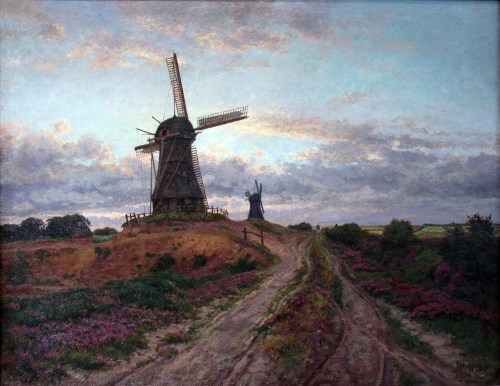
#FineArtFriday: Margaret Mill at Husum by Richard von Hagn

Margaret Mill at Husum by Richard von Hagn

What I like about this Painting:
The artist has captured the blustery feel of a fall or spring day—the sort of day where cold rain falls, interspersed with bright sunshine. His sky is perfect.

Artist: Richard von Hagn (1850–1933)
Title :English: Margaret mill Husum
Deutsch: Margaretenmühle vor Husum
Object type painting
Date: 1930
Medium: oil on canvas
Collection: NordseeMuseum Husum

About the Artist via de.Wikipedia (translated page):
“In his old age the following confession was not always easy for him, but he also showed his affection for a new topic in the spirit of the new German nationalism and the passing away of romanticism : “Yes, in my youth it always had to be Venice. Only much later did we realize that our homeland is just as beautiful, and actually much nicer for us. ” [6]


Credits and Attributions:

Wikimedia Commons contributors, “File:1930 Hagn Margaretenmühle vor Husum anagoria.JPG,” Wikimedia Commons, the free media repository, https://commons.wikimedia.org/w/index.php?title=File:1930_Hagn_Margaretenm%C3%BChle_vor_Husum_anagoria.JPG&oldid=351391992 (accessed September 6, 2019).
Page “Richard von Hagn”. In: Wikipedia, The Free Encyclopedia. Processing status: May 10, 2019, 04:04 UTC. URL: https://en.wikipedia.org/w/index.php?title=Richard_von_Hagn&oldid=188410554 (accessed: September 6, 2019, 12:46 UTC)

Comments Off on #FineArtFriday: Margaret Mill at Husum by Richard von Hagn

Filed under #FineArtFriday

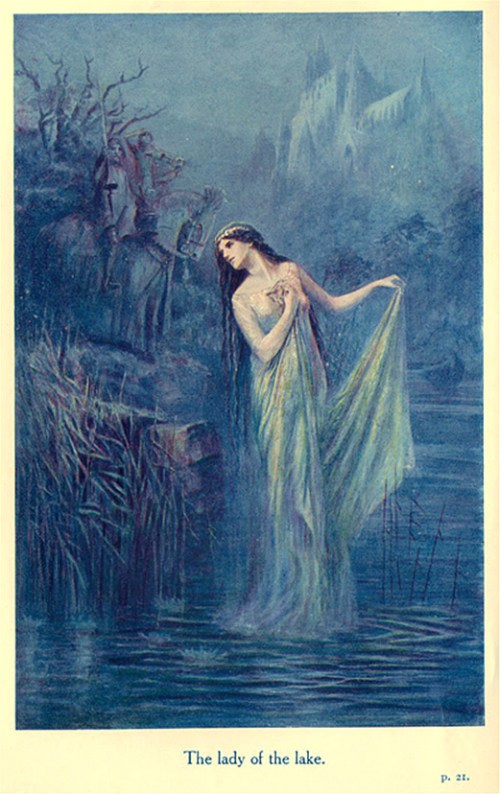
#FineArtFriday: The Lady of the Lake by Lancelot Speed 1912

Today’s image is that of The Lady of the Lake, Lancelot Speed‘s illustration for James Thomas Knowles’ The Legends of King Arthur and His Knights (1912), 9th edition. Ed. Sir James Knowles, K. C. V. O. London; New York: Frederick Warne and Co., Publication Date: 1912.

An area of art I intend to explore more thoroughly is that primary reason why I buy books: the illustrations.

The artwork that went into many books in the 19th and early 20th centuries was exquisite, created by masters. Yet, these illustrators remained unknown for the most part and unsung. Books are fragile things that don’t always stand the test of time. They become worn, and their contents become outdated. Younger readers see nothing of value in them and they go to rummage sales, or worse: recycling.

They are rarely passed on from one generation to the next.

Thanks to Wikimedia Commons and all the intrepid contributors who find and upload scanned images into that media repository, the works of many brilliant artists have not been lost. They will be there for us to admire, for as long as we are able to access the internet.

About the artist:

Lancelot Speed (13 June 1860 – 31 December 1931) was a British illustrator of books in the Victorian era, usually showing fantasy or romantic subjects. He is best-known for his illustrations for Andrew Lang‘s fairy story books. Speed is credited as the designer on the 1916 silent movie version of the novel She by H. Rider Haggard, which he had illustrated.

In 1912, he provided twenty illustrations, both color and black-and-white, for a new edition of Sir James Thomas Knowles’s The Story of King Arthur and His Knights of the Round Table.

Lancelot Speed was also the director of a number of early British silent films. Born into an exceedingly wealthy family, Speed died in 1931, leaving less than £300.

About the Image:

Artist: Lancelot Speed (1860-1931)

Title: The Lady of the Lake

Description: scan of illustration at title page in a book, The Legends of King Arthur and His Knights, 1912., 9th edition. Ed. Sir James Knowles, K. C. V. O. London; New York: Frederick Warne and Co., Publication Date: 1912.


Credits and Attributions:

Wikimedia Commons contributors, “File:The Lady of the Lake by Speed Lancelot.jpg,” Wikimedia Commons, the free media repository,  https://commons.wikimedia.org/w/index.php?title=File:The_Lady_of_the_Lake_by_Speed_Lancelot.jpg&oldid=328850056  (accessed August 29, 2019).

Wikipedia contributors, “Lancelot Speed,” Wikipedia, The Free Encyclopedia https://en.wikipedia.org/w/index.php?title=Lancelot_Speed&oldid=883335674  (accessed August 29, 2019).

2 Comments

Filed under #FineArtFriday

#FineArtFriday: Spanish Blacksmiths by Ernst Josephson 1882

Spanish Blacksmiths, by Ernst Josephson

  • Date: 1882
  • Medium: oil on canvas
  • Dimensions : width: 107 x height: 128.5 cm

What I love about this image:

This is a powerful painting. Josephson captures the boundless self-confidence and personalities of these young men. He has managed to portray their cock-of-the-walk swagger, and he has shown us the truth of their craft: that sparks fly and ruin their clothes; that the work is hard and their muscles strong. These men are full of life.

The influence of Josephson’s having studied Rembrandt’s works closely can be seen here in the style with which he has painted their features. He has painted the men with truth—they are not classically handsome, but they are in the prime of life and have immense charisma. They wear their burned and ragged hats with pride. These men are good at what they do, and they know it. Their eyes dance and flirt outrageously with you across the years—they are full to bursting with machismo, daring you to just try to walk past and not notice them.

About the Artist, Via Wikipedia

(Ernst Josephson) was born to a middle-class family of merchants of Jewish ancestry. His uncle, Ludvig O. Josephson (1832-1899) was a dramatist and his uncle Jacob Axel Josephson (1818-1880) was a composer. When he was ten, his father Ferdinand Semy Ferdinand Josephson (1814-1861) left home and he was raised by his mother, Gustafva Jacobsson (1819-1881) and three older sisters.

At the age of sixteen, he decided to became an artist and, with his family’s support, enrolled at the Royal Swedish Academy of Fine Arts. His primary instructors there were Johan Christoffer Boklund and August Malmström. He was there until 1876, when he received a Royal Medal for painting.

After leaving the Academy, he and his friend and fellow artist Severin Nilsson (1846-1918) visited Italy, Germany and the Netherlands, where they copied the Old Masters. His breakthrough came in Paris, where he was able to study with Jean-Léon Gérôme at the École des Beaux-Arts. He soon began concentrating on portraits, including many of his friends and fellow Swedes in France. For a time, he shared a studio with Hugo Birger (1854–1887). His personal style developed further during a trip to Seville with his friend, Anders Zorn, from 1881 to 1882.

His private life did not go well, however. By his late twenties, he was afflicted with syphilis. His romantic life suffered as a consequence, as he was forced to break off a promising relationship with a young model named Ketty Rindskopf.


Credits and Attributions:

Wikimedia Commons contributors, “File:Ernst Josephson – Spanish Blacksmiths – Google Art Project.jpg,” Wikimedia Commons, the free media repository, https://commons.wikimedia.org/w/index.php?title=File:Ernst_Josephson_-_Spanish_Blacksmiths_-_Google_Art_Project.jpg&oldid=354761584 (accessed August 16, 2019).

Wikipedia contributors, “Ernst Josephson,” Wikipedia, The Free Encyclopedia, https://en.wikipedia.org/w/index.php?title=Ernst_Josephson&oldid=888815743 (accessed August 16, 2019).

2 Comments

Filed under #FineArtFriday

#FineArtFriday: Shoshone Falls on the Snake River by Thomas Moran 1900

About the Artist, Via Wikipedia:

Thomas Moran (February 12, 1837 – August 25, 1926) was an American painter and printmaker of the Hudson River School in New York whose work often featured the Rocky Mountains. Moran and his family, wife Mary Nimmo Moran and daughter Ruth, took residence in New York where he obtained work as an artist. He was a younger brother of the noted marine artist Edward Moran, with whom he shared a studio. A talented illustrator and exquisite colorist, Thomas Moran was hired as an illustrator at Scribner’s Monthly. During the late 1860s, he was appointed the chief illustrator for the magazine, a position that helped him launch his career as one of the premier painters of the American landscape, in particular, the American West. [1]

Moran, along with Albert Bierstadt, Thomas Hill, and William Keith are sometimes referred to as belonging to the Rocky Mountain School of landscape painters because of all of the Western landscapes made by this group. [1]

Shoshone Falls is a waterfall on the Snake River in southern Idaho, United States, approximately 3 miles (4.8 km) northeast of the city of Twin Falls. Once called the “Niagara of the West,” Shoshone Falls is 212 feet (65 m) high—45 feet (14 m) higher than Niagara Falls—and originally flowed over a rim nearly 1,000 feet (300 m) wide. However, in 1900, Ira Burton Perrine led the drive to divert the Snake River at Caldron Linn, a point approximately 24 miles (39 km) upstream of Shoshone Falls. Now a fraction of its original width and volume, the falls remain a tourist destination.

Senator William A. Clark and others who owned land at Shoshone Falls filed a lawsuit against the Twin Falls Land and Water Company but were defeated in the Idaho Supreme Court in 1904. Despite his efforts, the Milner Dam and the major canals required to deliver water were completed by 1905. [2]

“On March 1, 1905, Frank Buhl gave a ceremonial pull on the wheel on a winch, and the gates of Milner Dam were closed, and the gates to a thousand miles of canal and laterals were opened, and the Snake River was diverted, and that night Shoshone Falls went dry as the water rushed across the desert far above, and Perrine’s vision was realized, and 262,000 acres of desert were shortly transformed.” [3]

Shoshone Falls, Idaho viewed from the northwest 2013 Famartin [CC BY-SA 3.0]


Credits and Attributions:

Images:

Shoshone Falls on the Snake River by Thomas Moran 1900 [Public domain]

Shoshone Falls, Idaho viewed from the northwest 2013 Famartin [CC BY-SA 3.0 (https://creativecommons.org/licenses/by-sa/3.0)]

Wikimedia Commons contributors, “File:Gilcrease – Shenandoah River.jpg,” Wikimedia Commons, the free media repository, https://commons.wikimedia.org/w/index.php?title=File:Gilcrease_-_Shenandoah_River.jpg&oldid=354856726 (accessed August 1, 2019). (Shoshone Falls, Snake River, Idaho – original file uploaded by Gilcrease, river mislabeled)

Quotes:

[1]  Wikipedia contributors, “Thomas Moran,” Wikipedia, The Free Encyclopedia, https://en.wikipedia.org/w/index.php?title=Thomas_Moran&oldid=887900185 (accessed August 1, 2019).

[2] Wikipedia contributors, “Shoshone Falls,” Wikipedia, The Free Encyclopedia, https://en.wikipedia.org/w/index.php?title=Shoshone_Falls&oldid=904109934 (accessed August 1, 2019).

[3] Yost, Joe. “History of Milner Dam”; Twin Falls Canal Company. Retrieved 2016-06-27.

1 Comment

Filed under #FineArtFriday

#FineArtFriday: Portrait of Madame X by John Singer Sargent 1884


What I love about this Painting:

I love everything–the moody colors and textures–she needs no necklace, no jewels to prove she is someone unforgettable.

Madame X is mysterious; she is a promise unspoken.

She is dangerous the way uncharted seas are.

Her pose, the elegance of the black dress, the turn of her head—this portrait shouts “Here is a woman to be reckoned with.” Everyone who knew Virginie Amélie Avegno Gautreau said that in this Portrait of Madame X, American expatriate artist  John Singer Sargent captured something real, something true about the woman, something well beyond the unashamed sexuality of the portrait.

About this painting, via Wikipedia:

(John Singer Sargent’s) most controversial work, Portrait of Madame X (Madame Pierre Gautreau) (1884) is now considered one of his best works, and was the artist’s personal favorite; he stated in 1915, “I suppose it is the best thing I have done.” When unveiled in Paris at the 1884 Salon, it aroused such a negative reaction that it likely prompted Sargent’s move to London. Sargent’s self-confidence had led him to attempt a risqué experiment in portraiture—but this time it unexpectedly backfired. The painting was not commissioned by her and he pursued her for the opportunity, quite unlike most of his portrait work where clients sought him out. Sargent wrote to a common acquaintance:

I have a great desire to paint her portrait and have reason to think she would allow it and is waiting for someone to propose this homage to her beauty. …you might tell her that I am a man of prodigious talent.

It took well over a year to complete the painting. The first version of the portrait of Madame Gautreau, with the famously plunging neckline, white-powdered skin, and arrogantly cocked head, featured an intentionally suggestive off-the-shoulder dress strap, on her right side only, which made the overall effect more daring and sensual. Sargent repainted the strap to its expected over-the-shoulder position to try to dampen the furor, but the damage had been done. French commissions dried up and he told his friend Edmund Gosse in 1885 that he contemplated giving up painting for music or business.

Writing of the reaction of visitors, Judith Gautier observed:

“Is it a woman? a chimera, the figure of a unicorn rearing as on a heraldic coat of arms or perhaps the work of some oriental decorative artist to whom the human form is forbidden and who, wishing to be reminded of woman, has drawn the delicious arabesque? No, it is none of these things, but rather the precise image of a modern woman scrupulously drawn by a painter who is a master of his art.”


Credits and Attributions:

Wikipedia contributors, “John Singer Sargent,” Wikipedia, The Free Encyclopedia, https://en.wikipedia.org/w/index.php?title=John_Singer_Sargent&oldid=904608954 (accessed July 25, 2019).

Madame X (Madame Pierre Gautreau), by John Singer Sargent, 1884 PD|100

Wikimedia Commons contributors, “File:Madame X (Madame Pierre Gautreau), John Singer Sargent, 1884 (unfree frame crop).jpg,” Wikimedia Commons, the free media repository, https://commons.wikimedia.org/w/index.php?title=File:Madame_X_(Madame_Pierre_Gautreau),_John_Singer_Sargent,_1884_(unfree_frame_crop).jpg&oldid=358225955 (accessed July 25, 2019).

1 Comment

Filed under #FineArtFriday