Category Archives: Self Publishing

#amwriting: the truth about blogging

Who are youNothing improves your writing chops more than writing every day. Deadlines can be daunting but say what you will about not being able to write under pressure—I think that is when I do my best work.

Blogging regularly offers me that mix of self-imposed deadlines combined with the opportunity to riff on my favorite subject—the craft of writing. Much of what I have learned over the past four years has been through researching topics for this blog.

When I first began, I was only blogging under duress—my former publisher was forcing me to. This, he said, would help get my name out there, and give me a regular platform for my opinions. That blog is long gone, and those posts were pathetic attempts to write about current affairs as a journalist, something that has never interested me.

It wasn’t until I stopped trying fit into a mold someone else had designed for me and began writing about my interests that I learned to love the craft of blogging. That is also when I began to grow as a writer, because I have to work hard to proofread my own work and then publish it. If I am not vigilant, it posts with “warts and all.”

I don’t like warts in my work.

RALPH WALDO EMERSON QUOTE meme copyBlogging has made me a “thinking” author, as well as a “pantser.” I can write using the “stream of consciousness” method as I am now, or I can write it several days in advance by putting together a quick outline about whatever is interesting me at the time. I just do the research, and the post begins to write itself.

I use WordPress for this blog—and many of you know how aggravating I have found some of the changes recently implemented by WP. I am a contributor to two other blogs hosted by WordPress, and the other authors I am working with tend to find WordPress technical “support” just as exasperating as I do.

Giving me a list of canned questions and redirecting me to threads filled with complaints by other users is not “tech support.” It is, instead, clearly an effort to maintain separation from the user and any real-life problems he/she may have with using their product. (See my post of March 2, 2016: wanted: flatiron for curly quotes and other blogging twists.)

And just today they have introduced a new “less invasive” way of inserting links into the post, by which I mean with fewer options (unless you know the magic trick) and less useful. However, although it is evident the fine people at WordPress are not done messing with our heads, I am still not going to change this blog to a different platform—yet.

Instead, I will continue to work around things until they force me to switch to a platform run by people who are genuinely involved with their users and who care enough to respond to technical questions with more than circular, canned responses that go nowhere, like a snake eating its own tail.

I am a contributor to several blogs hosted on Blogger (Best In Fantasy is one), and I do like the way Blogger does NOT keep changing and fixing what isn’t broke. But I’ve been here at this little corner for several years now, and I hate moving so this will remain a WordPress blog.

I have made many friends through blogging, people all over the world who I may never meet in person, but who I am fond of, nevertheless.

This place is where I develop seminars on the craft of writing. I find that talking to you about my obsession helps me organize my thoughts. And, although I hate to say it, my first publisher (Lord Voldemort) was right about blogging. Blogging regularly does get your author name out there and showcases your work and your voice.

But only if you are passionate about what you are discussing.

I recommend blogging to anyone who has a craft they are fired up about. For novelists, I also recommend publishing short pieces—flash fiction. Little off-the-cuff pieces of less than a thousand words are fun to write and often find their way into your larger work, as they are a great way to brainstorm ideas.

If you want to know more about getting your own blog up and running, see my post of December 14, 2015, Blogging is Writing TooThis post talks about how to use the new default system here at WordPress so that you can insert pictures and make a nice looking post.

  • Keep it down to about 1000 words more or less.
  • Use the spellchecker tool to look for obvious errors.
  • Write in draft form and don’t publish it right away–come back and read it over again, and make corrections.
  • If you use information found elsewhere, quote it and credit the author
  • Use images that are either public domain, or that you have the right to use
  • Put links to other informative sites in the text

Rule number one: be consistent. I began by blogging once a week on a now defunct site—but my actual posts were more often made only once or twice a month. I dreaded it and didn’t want to do it. My blog stats were in the tank because I wasn’t applying myself to it.

One day it occurred to me that because I am a hermit and spend all day writing, my only way of communicating with my potential readers was through blogging. And it also occurred to me that communicating with other writers in the process could only benefit me.

I hated the thought of it but sucked it up. Once I realized that I could talk about whatever I wanted, Life in the Realm of Fantasy was born. My first posts stunk like last week’s garbage, but they were a beginning. With every post I wrote, I felt a sense of accomplishment, and the next post was better.
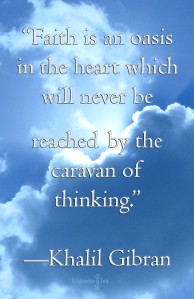
Kahlil Gibran MemeNow I am writing three posts a week on this blog, and at least one post a week for each of several other venues. I spend Sundays putting my blog posts together and look forward to the time I spend here, exploring the craft of writing.

Life in the Realm of Fantasy has evolved over the years because I have changed and matured as an author. Four years ago I would never have felt comfortable publishing my poetry. Now, I regularly post short works and poems on Fridays, some bad and some worse—but all them exercises in creative writing.

At first it took courage to lay my work out there because letting people see my work unedited by my editors made me feel like I was a teenager all over again, getting ready for the prom and hating my hair. I feared the flaws I saw in it.

Now I feel more like I am sharing it with my friends and I feel good about it.

To repeat myself ad nauseum: If you really want to grow as an author, you must write. Try to write daily, even if it is only a paragraph or two. Consider writing that paragraph as a short blog and dressing it up with a picture or two. Someone will read and enjoy it–and you may have made a fan.
2 Comments

Filed under blogging, Self Publishing, WordPress, writing

#amwriting: Wattpad, serializing your novel, and Shaun Allan

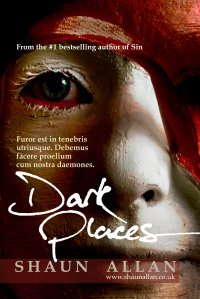
Dark Places Front Large (1)One area of writing that I have lately discovered is the serialized novel.

In the 19th century, many of the most popular novels ever written began their lives as serials in magazines or newspapers. Such diverse authors as  Charles DickensGeorge Eliot, Thomas Hardy, Anthony Trollope, and William Makepeace Thackeray all published novels in serial form.

At times, these intrepid writers missed deadlines, and I can see why: life intrudes, and writing halts, for whatever reason. It’s been said that Thackeray was highly critical of authors who didn’t have the endings worked out before the opening chapters were published–which just about covered all of his contemporaries.

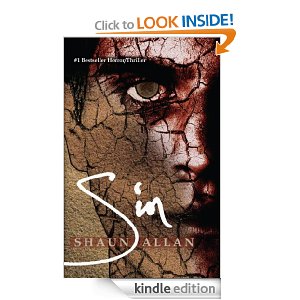
Today we’re talking with my good friend and fellow co-founder of Myrddin Publishing Group, UK author, Shaun Allan. He is the author of several award-winning children’s stories, copious amounts of poetry, and the adult horror novel, Sin, which has garnered a great deal of critical acclaim and is one of the most popular books on Wattpad.

According to Wikipedia, as of April 2014:

  • 85% of Wattpad’s traffic and usage comes from mobile devices,
  • the site has 35 million unique visitors per month,
  • there are over 100,000 story uploads per day,
  • there have been over two million writers.

Along with writing novels and poetry, Shaun was approached by the people at Wattpad, asking if he would be willing to write an original story based on the premise of the movie The Purge. Of course, he was, and out of that came the five-part serial, Mr. Composure.

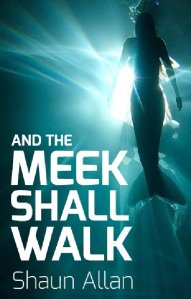
Mr. Composure was wildly successful, and since then, Shaun has had great success with his most recent serial, And the Meek Shall Walk, a thirty-three-part story which he also published on Wattpad as he wrote it.  Already it has garnered close to 10,000 reads.

On Sunday, Shaun and I were able to chat a bit about the experience of serializing your work as you are writing it.

CJJ: From my perspective, serializing a novel has many pros and cons—in some ways it’s a double-edged blade. For me, I have to have an outline and a story arc to write to, so that I don’t get sidetracked. How do you approach this?

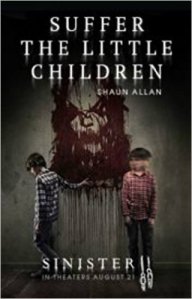
Suffer the childrenSA: Sometimes I wish I could, or think I should, create an outline.  I’m not sure if it’s because of my time issue.  I have so little, I want to get into the story and, if I’m outlining, I’m not writing.  On the other hand, I quite enjoy finding out the story as I go.  I like to be surprised when I meet new characters and wonder how I (or my characters) might get out of sticky situations.

As such, I’ve almost always written off the cuff.  I’ve followed the story where it would take me, following its meandering course to what is, hopefully, a brilliant ending.

With the writing I’ve done for Wattpad and their partners, such as Universal, that’s changed somewhat.  For Suffer the Little Children, written for the movie Sinister 2, I was asked to write an overview first to present to them.  Luckily I’d seen, and enjoyed, the first film, but I had to, in the space of a weekend, produce the path the story was going to take.  That wasn’t an easy task for someone unused to doing so.  I found, when I’d started, the idea came quite easily.

With the serialization of And the Meek Shall Walk, it was a little easier.  Knowing both the Disney version and the classic Hans Christian Anderson original meant the story arc, or the basis of one, was already written.  I felt I was writing just the current chapter rather than the story in its entirety.  I only needed to work on the existing part.  I did get to the point, however, where I thought it best to put down my own version of events.  I was about two-thirds of the way through the book at this point.  I knew, more or less, what was going to happen (teasing parts from both previous versions), but I was giving the story my own twist. The overview I wrote was very brief, but it gave me some focus.

CJJ: You have to be able to write quickly and concisely, and edit your work well, because what goes out will be an immediate reflection of your entire body of work. I always worry that if it’s crap, I will have turned off all my potential readers! Has that idea affected how you work in any way?

sin - Shaun AllanSA: Not at all.  Well, not really!  I write, essentially, for me.  My dream was to become a writer.  The fact people really seem to be enjoying what I produce is both wonderful and humbling.  I write to the best of my ability and feel I can do little more than that.  If I like my work, I’m happy with that.  If others do too, I’m ecstatic.  I usually find, too, if I reread my stories, I generally don’t change things.  That’s not to say I shouldn’t, but I try not to second guess myself.  The frame of mind and ‘alternative world’ I’m in when I write isn’t the one I’m in when editing so changes don’t… taste right.  Another pair of eyes could find things which should be changed, and I’m fine with that.  Maybe I’m blind to my errors lol!

CJJ: You have a high-profile job in the corporate world, and you are also the owner of a barber salon. On top of that, you are a dedicated, hands-on father of two daughters. Yet you turn out new installments on time, and also find the inspiration and time to write new, separate literary work. How do you make the time to be as prolific as you are? Do you have that Harry Potter Time Turner thingy?

SA: I wish I did have the Harry Potter Time Turner doodad.  I don’t.  I have a half hour lunch break.  I have an understanding wife.  And I have a burning need where ideas bug the hell out of me until I get them down.  I wake up thinking of what’s going to happen next.  I even deliberately think of the story arc at night.  It relaxes me, and I drift off to sleep.  I’ve yet to dream it through, though.  Smartphones help – I can scribble sentences or paragraphs down and save it to the Cloud ready for joining it up with the main story when I can.

Oh, the Tardis parked out back comes in useful now and again.

CJJ: Let’s talk about And the Meek Shall Walk. It is dark, as all your mainstream fiction is, definitely fantasy with a horror twist. I found it really scary.  Yet it was your daughter who gave you the idea?

SA: It certainly was!  I’m so proud!  I’d just finished Suffer the Little Children whilst on holiday in the Lake District.  Wattpad does a regular #JustWriteIt promotion inviting you to write 10,000 words in a month.  I fancied having a go (I sometimes have a break between stories but was buzzing in this case) but, after having just written about pagan deities and child possession, my mind was a little fried.  My daughter (12) threw the idea in the air:  The Little Mermaid where, instead of magically being given legs, she cuts her own tail off and sews a pair of human legs in their place.  That was the start.  How could I resist?

She’s also got me working on the Rapunzel story too, but I won’t give away what she came up with.  I’m currently, now that And the Meek Shall Walk is done, writing a new take on the Queen of Hearts from Alice in Wonderland.  This is a story close to my heart.  I dressed as the Mad Hatter for a themed birthday party for my daughters, and also have the Cheshire Cat tattooed on my shoulder!

As for the darkness, you can’t have the darkness without the light.

CJJ: Kurt Vonnegut famously said (and I find it true) that every character should want something. Who is your main character and what does she want? And who is the villain, and what do they want?

SA: My main character is Aren.  She is a mermaid and a princess.  Her father believes her to be meek, but she regularly flouts the rules governing their lives beneath the sea.  She has a secret cave where human body parts float, tied to vines.  The parts are from the people she has killed.

Aren believes humans were responsible for her mother’s death.  As such, she seeks revenge on those responsible and goes to excessive lengths to carry this out – including, as I have said, cutting off her own tail and having her forked tongue sealed together, rendering her mute.

I’d rather not say who the villain is as you don’t know immediately, and I don’t want to give it away.  You might, indeed, say it’s Aren herself!

CJJ: What setbacks have you overcome in this endeavor with Wattpad and what advice would you give authors new to publishing their work on Wattpad?

SA: Apart from my time limitations, I’ve generally found Wattpad to be an amazing experience.  I’m one of the Wattpad Stars, a program of their most popular writers.  This has led to exposure and opportunities I would otherwise, potentially, never have been offered.  One of the things I love about the site is it’s a real community.  I have had some of the most amazing comments you could imagine.  Mr. Composure was called the ‘best story ever’ and And the Meek Shall Walk has already been described as ‘one of the best stories on Wattpad.’

Sin was my first serialized novel on the site.  I’d originally posted the Prologue, and they asked if I’d be willing to put the whole story up.  I agreed, and it’s now had almost 765,000 reads!

On Wattpad, you can connect with so many other writers and readers.  Those readers can connect with you, vote and leave comments.  It’s wonderful.

CJJ: And finally, do you have any writing-craft advice for authors who want to serialize their work?

SA: Trust in yourself.  Trust in your story.  Whether you create overviews or write as you go, it’s your story.  As you post each chapter, engage with your readers.  Let them know you appreciate their feedback.  As much as you enjoy their contact with you, they enjoy yours with them.

Writing should be about enjoyment, after all.

>><<<

To Read: And the Meek Shall Walk on Wattpad click HERE

And the Meek Shall Walk coverPrincess Aren is determined to make the human who killed her mother and exiled her people to the bottom of the ocean pay. To do so, she must go to extremes of pain and heartache in her search for justice. Aren, however, is no sweet, happy mermaid. To kill is to ignite a fire of passion in her heart which only the savage letting of blood can satiate. She will go to any lengths to find the man responsible, including cutting off her own tail and sewing, in its place, a pair of human legs – legs she tore from one of the many humans she had murdered. With the unwilling help of the sea witch, Princess Aren must go ashore and hunt for her mother’s killer. But, in doing so, the worlds above and below the ocean will clash in ways neither thought possible!


Profile

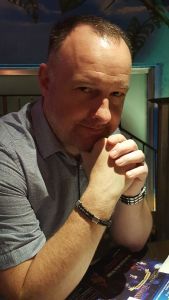
A creator of many prize winning short stories and poems, Shaun Allan has written for more years than he would perhaps care to remember. Having once run an online poetry and prose magazine, he has appeared on Sky television to debate, against a major literary agent, the pros and cons of internet publishing as opposed to the more traditional method. Many of his personal experiences and memories are woven into the point of view and sense of humour of Sin, the main character in his best-selling novel of the same name, although he can’t, at this point, teleport.

A writer of multiple genres, including horror, humour and children’s fiction, Shaun goes where the Muse takes him – even if that is kicking and screaming. He has written for Universal, DC Vertigo Comics and Goosebumps and regularly holds writing workshops at local schools.

Shaun lives with his wife, two daughters and two cats. Oh and a manic dog. Though his life might, at times, seem crazy, he is not.

Honest.

Links:

5 Comments

Filed under Fantasy, Literature, Self Publishing, writer, writing

#amwriting: genitives and possessives: when good apostrophes go bad

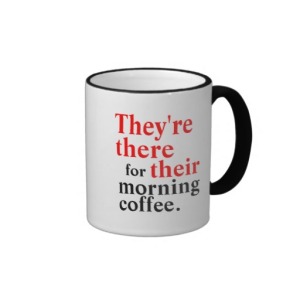
they're their there cupEvery now and then I’m reading along and I’m jarred out of the book by the improper use of an apostrophe. Yeah I know, that seems pretty minor, but think about it: apostrophes denote possession (and I’m not talking demonic here).

Things to remember:

  1. Who’s is the contraction of “who is” or, less commonly, “who has.”
  2. Whose is the possessive of “who” or, somewhat controversially, “which.”
  3. Their(s) is the possessive of “they.” (They’re proud to own it, it’s theirs, and it’s not there.)
  4. Its is the possessive of “it,” and “it’s” is a contraction of it is.

Quote from grammar-quizzes.com:

“Whose replaces a genitive personal or inanimate noun in a relative clause. While some people may object to the usage of whose with an inanimate noun, grammarians approve of it and cite its usage by highly esteemed writers.” (end quoted text)

What does that slightly complicated explanation really mean?

Let’s look at some definitions:

Genitive: The genitive case is the grammatically correct term predominantly used for showing possession. Nowadays words falling into that category are more frequently referred to as possessive, which is simpler. With nouns, it is usually created by adding an apostrophe followed by an “s”: ’s to the word or by preceding it with the word: of.

  • John’s blue eyes.
  • The rim of the cup.
  • It is the cat’s possession, a possession of the cat, or a possession owned by the cat. (Universal fact: cats own everything.)

However, the genitive case is not always about possession and, for this reason, the word genitive won’t completely fall out of favor in the English language. Grammar-Monster.com says:

  • Dan’s bike (No one would argue this is the genitive case and the possessive case. It is the bike of Dan. It is about possession.)
  • Children’s songs (This is not about possession. It’s about songs for children. For this reason, some argue this is the genitive case and not the possessive case.)
  • Constable’s paintings (This is not about possession. It’s about paintings by Constable. Some would argue this is the genitive case and not the possessive case.) (end quoted text)

Grammar-Monster also says:

“Possessive adjectives and possessive personal pronouns are also forms of the genitive case.” Examples:

  • our carpet (our – a genitive form of we)
  • Can I use yours? (yours – a genitive form of you) (end quoted text)

Remember:

When referring to living beings, whose denotes possession and who’s is a contraction that refers to existence: who is.

So now we have some idea of “whose” versus “who’s.” But what about “It?”

Dealing with possession by the inanimate—we don’t need an exorcist, although a good maid service could probably help. But in this case, we are referencing something owned by  the inanimate:

  • The texture of the wall —it’s rough. (It is rough.)
  • I scratched myself on its surface. (The wall’s surface.)

Its…it’s…which is what and when to use it?

The trouble here can be found in the apostrophe. In probably 99% of English words an apostrophe indicates possession, but once in a while, it indicates a contraction.

  1. It’s is the contraction of “it is” and sometimes “it has.”
  2. Its denotes possession: It owns it.

it's and whose

Contractions (e.g., let’s, don’t, couldn’t, it’s, she’s) have a bad reputation in educational and formal writing. Many argue that they have no place at all in formal writing. If you are writing a thesis, you should observe your publisher’s or instructor’s requirements.


However, in writing fiction, avoiding contractions makes your writing appear stilted and hyper-formal. If you are serious about the craft, you will learn the exceptions to the rules when it comes to apostrophes, and not accidentally mingle possessives in with your contractions.


5 Comments

Filed under Self Publishing, writing

#amwriting: squinting modifiers

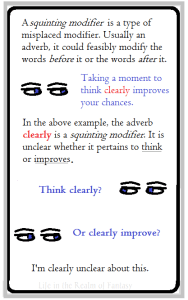
Squinting ModifiersThis week we are going to look at two structural errors that introduce ambiguity into our narrative.

First up is the hilariously named squinting modifier.  Who thinks up these things? The first time I came across that expression, I thought it was a joke. However, in the world of writing, a “squinting modifier” is simply a type of misplaced modifier. According to Neal at Literal Minded, the term can be traced back to George Campbell’s The Philosophy of Rhetoric, published in 1776.

It is a common error that can be difficult for the author to spot in their work because the author’s mind sees what was intended, not how it appears to an unbiased eye.

This structural error introduces ambiguity:  it seems to qualify the words both before and after it.

  • Students who skip classes rarely are reprimanded.

Does this mean students who rarely skip classes are reprimanded? Or, perhaps those students are rarely reprimanded.

Mignon Fogarty, the Grammar Girl, offers this example:

  • Children who laugh rarely are shy.

Is the author talking about children laughing rarely, or rarely being shy?

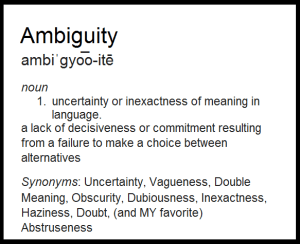
ambiguityMisplaced modifiers (frequently adverbs) make our work unclear, or “ambiguous.” The best way to avoid that ambiguity is to move the modifier so that your meaning is clear, or completely reword the sentence.

  • Children who laugh are rarely shy.
  • Students who skip class are rarely reprimanded.

When you introduce a large number of modifiers into your work you run the risk of

  • Introducing passivity to your narrative
  • Unintentionally introducing ambiguity

If you haven’t figured it out by now, there is an easy way to identify adverbs. Most, but not all, end in the letters “ly.” Knowing this makes it fairly easy to identify adverbs in sentences.

As I said, not all adverbs end in “ly.” Some frequency adverbs, do not follow this rule.

  • always
  • never
  • often
  • sometimes
  • seldom

Still, knowing that ‘ly’ at the end of a word indicates an adverb will help you avoid overusing them.

You may wonder why we want to limit the modifiers in our prose—and it’s a good question. How we use modifiers is part of the voice of our work.

If we are writing genre fiction (i.e. romance, mystery, sci-fi, fantasy) your prospective readers will not endure fluffed up prose written for the beauty of the words. They want lean prose, with an active voice, and to achieve that active phrasing, we cut back on the “ly” modifiers. Instead of telling you how the scene looks, an active voice shows you what the protagonist sees.

Telling: The night was hot and damp. Darren entered the alley, which was awfully dark and smelly. “Rafe?” he asked quietly.

“Over here,” said Rafe. He was all raggedy and dirty.

Showing: Darren entered the alley, his eyes adjusting to the darkness. The odors of overripe privies and decomposing garbage lingered in the humid air, along with the reek of despair. “Rafe?” he whispered.

A pile of rags stirred and a familiar voice said, “Over here.”

When we use active phrasing, we are better able to convey atmosphere.

Adverbs ending in “ly” are often called “adverbs of manner.” Despite the rants of some self-proclaimed gurus in certain writing forums, these words have a place in active prose, and anyone who says they don’t is not fully informed.

This is where it becomes a matter of style and the author’s voice. We choose our words deliberately to convey the story the way we see it, precisely placing modifiers to achieve a certain effect.

Perhaps you are trying to convey a character’s lack of conviction regarding his plan of action: Rafe is a down-on-his-luck confidence man, a reformed scam-artist drawn in to do a job only he has the skills for.

“I’m fairly sure this will be safe.” Rafe crossed his fingers for luck. “It’s not that much dynamite.”

Several authors I know well would never use the word “fairly” because its an indecisive word. That indecisiveness is what I want to convey. This is the difference in our “voices.”

The way I see it: Rafe could say “I’m almost sure” but to me, that phrasing feels clunky and obvious–it does show his doubt. But, in  my opinion, what it doesn’t convey is Rafe’s desire to sell his reluctant partner the plan he has little confidence in. He has to convince Darren to go along with it because they have no other option. Rafe is a conman, trying to reform. He has an important reason to not just lie about it, so he wants to be as truthful as he can be and still sell Darren on the plan.

Writing involves words of all kinds and using them properly.

Adverbs are a powerful seasoning to add to your prose–be sparing and make the best use of them. Those you do use should go unnoticed in the narrative.

Your readers will thank you.

List of common adverbs

5 Comments

Filed under Publishing, Self Publishing, writer, writing

#amwriting: rejection is not the end of the world: keeping track of submissions

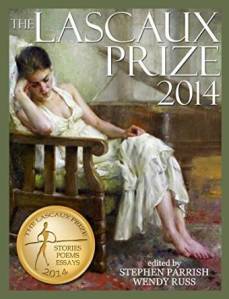
lasceax prize

Recently I realized I had submitted a short story to two places. One place was a magazine that pays per word, the other was an anthology that offered no remuneration, but was being published by a well-respected professional group.

Quite often publishers prefer that you not make simultaneous submissions, although some don’t care. Most will want a story to be new and previously unpublished, but again, some don’t care.

Fortunately, this particular tale was not what the anthology was looking for–no money was involved there and I try to concentrate on submitting my work to paying gigs as often as possible.

Thus, I have begun to keep a list of what short story was submitted to what magazine or anthology. If it is rejected with comments, I consider the remarks, address them if they are valid and immediately submit it elsewhere. The fact is, rejection can be a positive thing.

Of course, I have enough rejections to wallpaper an outhouse. Not everyone will love your work. You have to keep trying, but eventually you will sell a story.

When I first began this journey I didn’t understand how specifically you have to tailor your submissions when it comes to literary magazines, contests, and anthologies.

When you have a great story that you believe in, you must find the venue that might be interested in your sort of work. This means you must buy magazines, read them, and write to those standards.

Go to the publisher’s website and find out what their submission guidelines are and FOLLOW THEM. (Yes, they apply to EVERYONE, no matter how famous, even  you.) If you skip this step, you can wait up to a year to hear that your ms has been rejected, and they most likely won’t tell you why.

Formatting your manuscript is crucial. If you are unsure how that works, see my blogpost of July 24, 2015,  How to Format Your Manuscript for Submission.

It’s not worth a publisher’s time to teach you how to be a writer–you have to learn that on your own.

A sci-fi magazine like Analog Science Fiction and Fact will not be interested in fantasy from an unknown author. If you read Analog, you can see they mostly publish hard, technology driven sci-fi. If they publish a fantasy piece at all, it will be by one of their regular contributors, and will likely have been solicited by them for a particular feature.

Analog’s Submission page clearly says: “Basically, we publish science fiction stories. That is, stories in which some aspect of future science or technology is so integral to the plot that, if that aspect were removed, the story would collapse. Try to picture Mary Shelley’s Frankenstein without the science and you’ll see what I mean. No story!

The science can be physical, sociological, psychological. The technology can be anything from electronic engineering to biogenetic engineering. But the stories must be strong and realistic, with believable people (who needn’t be human) doing believable things–no matter how fantastic the background might be.”

You have been warned. They want science, not magic.

Therefore, I never submit to this magazine as I don’t write hard science fiction. I don’t enjoy the kind of work they publish, and that is an important clue: If you don’t read what they publish, you likely can’t write it to their standards.

An excellent article that addresses that well is  “What Editors Want; A Must-Read for Writers Submitting to Literary Magazines.”

Because I have so many short pieces floating around in the ether, I now keep a list, organized like this:

Submissions log

Remember, only submit your best work. If you have a well-written piece that reads smoothly when read aloud and is rejected for whatever reason, find a different magazine, contest, or anthology to submit it to. Chances are it simply didn’t resonate with the editor at that place, and who knows–it may be exactly what the next place is looking for.

If you are stumped for places to send your work, there are several sites that offer classified ads calling for submissions:

NewPages Calls for Submission

Every Writer’s Resource

Let’s Write a Short Story

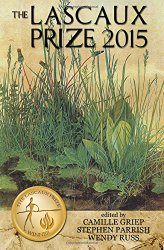
Lascaux 2015If you are new to this, a good place to start is the Lascaux Review. This is a literary magazine, but they have great contests, and their rules are fairly relaxed:

The Lascaux Prize in Flash Fiction http://lascauxreview.com/contests

The Lascaux Prize in Flash Fiction is presently open for submissions. Stories may be previously published or unpublished, and simultaneous submissions are accepted. Winner receives $1,000, a bronze medallion, and publication in The Lascaux Review. The winner and all finalists will be published in The 2017 Lascaux Prize Anthology.

12 Comments

Filed under Literature, Self Publishing, writing

#amwriting: wrangling that, which, and semicolons

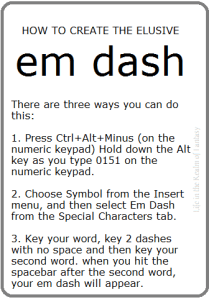
em dash memeSemicolons are misused morsels of punctuation. Some authors believe they are extra-long pauses: half-way between a comma and a (full stop)period. These bits of typographical madness litter their work.

Semicolons  are NOT extra-firm pauses. Em dashes or (if you are British) hyphens serve that function. Semicolons have a different place in the universe. For this post, we are going to look at semicolons as joiners.

The proper use of a semicolon is to join two short sentences that are directly related to each other, turning them into a compound sentence.

No one enjoys reading a choppy narrative. Too many short sentences can be distracting and hard to get into. The way we smooth the narrative is to join short sentences into longer, compound sentences. But frequently, that creates run-on sentences. (I am the queen of those.)

  1. Short and choppy: I’d love some ice-cream. We should go to the Dairy Queen.
  2. Compound sentence: I’d love some ice-cream; we should go to the Dairy Queen.

Comma Splice MemeYou do not join independent clauses with commas as that creates a rift in the space/time continuum: the Dreaded Comma Splice.

  1. WRONG: It’s nearly half past five, we can’t reach town before dark.
  2. BETTER: It’s nearly half past five; we can’t reach town before dark.

The two clauses that are joined together with a semicolon should relate to each other. The above sentences work because the lateness of the day means they might have to travel after dark.

  1. WRONG: We should go to the Dairy Queen; it’s nearly half past five.
  2. BETTER: We should go to the Dairy Queen. It’s nearly half past five.

If time is actually the issue in the above sentence, and you absolutely MUST use a semicolon or you will explode, say, “The Dairy Queen is about to close; it’s nearly half past five.”

I generally try to find alternatives to semicolons, but I don’t dislike them, as some editors do. I think they are too easily abused and misused, so I encourage myself and my authors to think outside the semicolon.

Another sticky area for the some authors are the words ‘that’ and ‘which.’ They are often difficult for new authors to get the hang of. They are not interchangeable, and overuse of the word ‘that’ cannot be cured by using ‘which’ instead.

‘That’ is a pronoun:

  1. Used to identify a specific person or thing observed by the speaker.

“That’s his dog on the curb.”

  1. Referring to a specific thing previously mentioned, known, or understood.

“That’s a good idea.”

‘That’ is also a determiner:

  1. Used to identify a specific person or thing observed or heard by the speaker.

“Look at that house fire.”

  1. Referring to a specific thing previously mentioned, known, or understood.

“He lived in Tacoma at that time.”

‘That’ is also an adverb

  1. Indicating to such a degree; so.

“I wouldn’t go that far.”

And ‘that’ is a conjunction:

  1. Introducing a subordinate clause expressing a statement or hypothesis.

“She claimed that she was married.”

‘That’ can also be a literary conjunction expressing a wish or regret:

“Oh, that I had known this before.”

<><>

‘Which’ is a pronoun:

  1. asking for information specifying one or more people or things from a definite set.

“Which are the best diapers for newborns?”

Which’ is a determiner:

  1. used referring to something previously mentioned when introducing a clause giving further information.

“A house on Black Lake, which is for sale.”

Some people will rather forcefully say you must never use the word ‘that,’ but those people are clearly unaware of the larger grammatical picture—do not listen to them.

Sigh.

So, when do we use the word ‘that’ in an appropriate and defensible fashion?  After all, too many ‘that’s’ make the prose boring and forgettable.

So does Grammar Girl, (Mignon Fogarty) on her awesome website for writers with questions. This website is an invaluable resource for folks like me, with some education, but no memory of what we were actually taught.

that which does not kill meThere are instances where only ‘that’ will suffice. When do we use the word that?

We use it when we have something called a ‘Restrictive Clause’:

Quote from Grammar Girl, “A restrictive clause is just part of a sentence that you can’t get rid of because it specifically restricts some other part of the sentence.”  She goes on to give a specific example of a restrictive clause: “Gems that sparkle often elicit forgiveness.”  See?  Not just any gems elicit forgiveness in this sentence. Only gems that sparkle bring about clemency. In this sentences, forgiveness is restricted to one kind of gem.

So, now we know about restrictive clauses, but what about nonrestrictive clauses? Again we turn to the Grammar Girl and she says, “A nonrestrictive clause is something that can be left off without changing the meaning of the sentence. You can think of a nonrestrictive clause as simply additional information.”

Again the Grammar Girl gives the example, “Diamonds, which are expensive, often elicit forgiveness.”  The word ‘which’ isn’t really necessary, as the meaning of the sentence would not be changed if you left it out. “Diamonds are expensive, but often elicit forgiveness.”

stop don't click replace allOften the sentence is better without the words ‘that’ or ‘which,’ but each instance must be examined individually, to ensure you are making the best choice.

This is yet another time when making a global search for these words is a good idea. (And never choose ‘replace all’.) On an individual basis, decide which word is the correct word, ‘that’ or ‘which’ and then decide whether to delete it or keep it. If the sentence makes good sense without it, lose it.

4 Comments

Filed under Self Publishing, writing

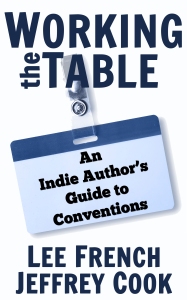
#CoverReveal: Working the Table, by Lee French and Jeffrey Cook

IndieGuideCoverAs you know, I am a strong proponent of the indie movement in publishing. Indies have a hard road when it comes to getting their work noticed.

A useful new book for indie authors is due out on March 19, 2016: Working the Table–An Indie Author’s Guide to Conventions. Well-travelled authors Lee French and Jeffrey Cook have put together this comprehensive how-to manual based on their own experiences.

The Blurb:

Because books won’t sell themselves.

In these times when it’s easy to self-publish but hard to get noticed, conventions offer a solid, feasible option for the independent author to start on a path to financial sustainability. But becoming a professional denizen of the dealer’s room has its challenges. In Working the Table, two veteran indie authors spill their secrets to help you not only survive, but thrive in the book-event environment.

I have shared a table with both Jeff and Lee, and they really do know what they are doing. They really love the convention atmosphere and they are building a solid fanbase with their personal appearances. I look forward to seeing what their secrets are.

Lee1Lee French lives in Olympia, WA, and is the author of several fantasy and science fiction books, most notably the Maze Beset Trilogy, The Greatest Sin series (co-authored with Erik Kort), and assorted tales in her fantasy setting, Ilauris. She’s an avid gamer and active member of the Myth-Weavers online RPG community, where she’s known for creative squirrel deployment. In addition to spending time there, she also trains year-round for the one-week of glorious madness that is RAGBRAI, has a nice flower garden with one dragon and absolutely no lawn gnomes, and tries in vain every year to grow vegetables that don’t get devoured by neighborhood wildlife.

She is an active member of the Northwest Independent Writer’s Association and serves as the Municipal Liaison for the Olympia region of NaNoWriMo. Her appearances to date include GenCon, WorldCon, Norwescon, and several other Pacific Northwest sci-fi and fantasy conventions. You can find Lee’s books here: Lee French’s author page on amazon.com.

Jeff1Jeffrey Cook lives in Maple Valley, Washington, with his wife and three large dogs. He was born in Boulder, Colorado, but has lived all over the United States. He’s the author of the Dawn of Steam trilogy of alternate-history/emergent Steampunk epistolary novels, the YA urban fantasy series The Fair Folk Chronicles, and the YA Sci-fi thriller Mina Cortez: From Bouquets to Bullets. He’s a founding contributing author of Writerpunk Press and has also contributed to a number of role-playing game books for Deep7 Press out of Seattle. When not reading, researching, or writing, Jeffrey enjoys role-playing games and watching football.
 –
You can find Jeff’s books here at: Jeffrey Cook’s author page on amazon.com.
 
Lee and Jeff will have a lot of good advice and information to offer in this book–they spent the entire summer on the road last year, and do at least 2 conventions a month during the off-season! I don’t have that kind of enthusiasm for living out of a suitcase, but they are making it work.

2 Comments

Filed under Self Publishing, writer

#amwriting and #amrevising: weeding the garden of words

Free-range pansies by cjjaspersonWhen I write a novel, I always end up with a lot of back story. These are details that are important for me to know, but not meant for the actual novel. It’s more a way for me to mentally talk my way through the first draft.

I think of my manuscript as a garden of words, and by the time the novel is complete, it will have been weeded, dug up, and replanted many times.

Every author has their own style, their own way of getting the story down on paper. My style is not the usual way, but it works for me.

The way I do a first draft is this: First, I put together an outline listing all the characters and plot points.  Second, I write the ending and then write the scenes for the large events and turning points. Once those are in place, I start at the beginning and write the story in a linear form, connecting the large events and finally meeting up with the end.

Along the way, my story evolves. A lot of fluff gets added in because I need to sort the story out in my head and writing it down is the way I do that. This fluff is all written in a passive, telling voice, and is part of my road map for creating the first draft–it was put down in that fashion so I would remember it later when I came back to rewrite the scene and turn it into an action sequence or cut it entirely.

I’ll give you an example of a telling sequence from Julian Lackland’s story, which is set in Waldeyn, Huw the Bard’s world. It was written down in this way so I would have a mental picture:

“In Port Lanque, the harbor itself was accessible only by one broad cobbled street, Quay Street, snaking down the steep cliffs to the piers. This wide boulevard ran through the center of town, twisting and turning in a sharp descent down to the piers, and had been kept in good repair by the pirates as it was the only way to move carts and drays down to the ships for off-loading loot. At the very top of Quay Street, in the worst part of town, an immense, rundown palace loomed. Now less than a filthy slum, it was once the home of generations of kings.”

Little or none of that passage will make it into the final manuscript because it doesn’t advance the plot. It was originally written to set the scene in MY mind. But I didn’t throw it away–I kept it in my file of outtakes along with some useful conversations further down the page that may come in handy in a different story:

“You’re wearing a dress, madam, not a crown. How can I be sure you’re the real king?” King Harry eyed the pirate. “You could be any old thief claiming to know how to sail a ship. I happen to like this ship, and I’m not disposed to give her away to some random old man in a dress.”  

That above passage is why I say you shouldn’t be married to your prose. I love the scene and the conversation, and the action that follows, but the plot thread it is part of does not advance Julian Lackland’s story. However, I intend to turn it into a short story set in Waldeyn.

By the time I finish a manuscript, I will have written the beginning three different ways, some names will have changed, and relationships will have evolved. But the major plot points and the ending will usually be the same as I had originally envisioned.  I say ‘usually’ because that was not the case for Valley of Sorrows. I ended up completely rewriting the end of that manuscript.

prnt screen 1 never delete cut passagesI can’t say it often enough: never delete any passage that you have cut from your manuscript. Save it in a separate file labeled ‘outtakes,’ because you may need that information later, or you may be able to turn that work into a short story.

A lot of authors use Scrivener for this, and it seems to work for them. I find it simpler to just copy and paste the work into a new file and save it in my outtakes for that particular novel. That way it’s out there in my dropbox or google drive and available no matter where I go or what happens to my computer.

Short stories are the bread-and-butter of many authors. You get paid a small sum for them, and your author name is published in one more place. The small story you toss out there could attract new fans to your other work.

Our work starts out full of passion and promise. Like a garden, it can grow wildly out of control. When you can’t see the flowers for the weeds, the garden must be cut back and pruned. The wild weed-words must be pulled in order for the reader to enjoy the real story.

Sometimes those weeds produce beautiful flowers when you get them into a different garden.

2 Comments

Filed under Self Publishing, writer, writing

#amwriting: Evoking Atmosphere and Place

Several indie books I’ve read lately impressed me with the sense of atmosphere the author managed to pack into their work, and the sense of place.

a girl called wolfThe book I am currently reading  is a contemporary novel,  “A Girl Called Wolf” by Stephen Swartz. In the opening chapters, Swartz’s Greenland has a harsh, ethereal quality. The environment is shown as unearthly, beautiful, and deadly, as are the people. The story of his protagonist Anuka (later called Anna) and her early life stands out sharply against the nearly cinematic backdrop, yet Swartz shows it with an economy of words.

Later, when Anuka is forcibly taken to civilization, that village and its poverty, as compared to her prior life, is clear in the reader’s head. It is seen through her eyes, although the villagers themselves don’t see themselves as poor in comparison–just the opposite. Swartz manages to get that across without overstating it: it simply is.

Conveying the mood of a piece and evoking a real sense of place is where artistry and skill on the part of the author comes into play. A book can be a simple recounting of events, or it can be an immersive experience. When a reader can see the world, feel the wind or sun, that author has created ‘place.’

In literature, ‘atmosphere’ has a broad meaning, covering both the overall emotional mood of a piece and the setting as described by the mention of objects and furnishings of a room, or the visual cues that fill the larger environment.

Think about the Harry Potter books: we know Hogwarts as well as we know our own home because J.K. Rowling not only showed us the furnishings and the building itself, she showed us the emotional mood of the residents. She did this through her protagonist’s eyes.

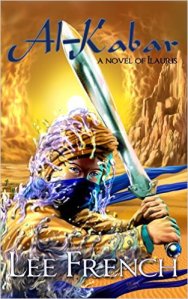
al-kabarA completely different kind of book from “A Girl Called Wolf,” is  “Al-Kabar” by Lee French. The tale is set in a mythical Persian-type of world, Ilauris.

“Al-Kabar” is unabashedly a fantasy, clearly a world of its own. As Stephen Swartz does with his work, Lee French conveys the world through her protagonists eyes. Fakhira’s world of Ilauris is harsh, and in this book, it is the characters that make it so. Fakhira experiences the world, and the reader does also, right alongside her.

What I like about Lee French’s approach in this tale is the way she conveys the environment: you the reader know this world because the protagonist knows it.

When it is done right, the emotional mood of the characters combines with the setting to create an atmosphere that pulls the reader in, making them forget they are reading. The trick is to dole out the scenery and the emotion as  needed. Treat them as you would the historical background information. If the character doesn’t need to know it at that moment, it probably does not belong in the scene.

the vision dean koontzDean Koontz is a master at this. Take this quote from “The Vision”published in 1986:

The woman raised her hands and stared at them; stared through them. Her voice was soft but tense. “Blood on his hands.” Her own hands were clean and pale.

Show us what the character sees, and feels. Show us only what needs to be there to advance the story. If the character doesn’t need to know it at that moment, it probably does not belong in the scene.

This aspect of the craft is what I am working on in my own writing.

10 Comments

Filed under Self Publishing, writing

#amwriting: headers and page numbers

Book- onstruction-sign copyI’ve blogged before on this subject, but it is time to talk about it again: making your manuscript ready for submission to an editor, agent, or a publisher. All agents, editors and publishing companies have specific, standardized formatting they want you to use, and these guidelines are posted on their websites.

The submissions page for TOR Forge, one of the Big Boys in the publishing world, clearly says: “Standard manuscript format means margins of at least 1 inch all the way around; indented paragraphs; double-spaced text; and Times New Roman in 12 pitch. Please use one side of the page only. Do not justify the text. Do not bind the manuscript in any way. Make sure the header of the ms. includes your name and/or the title of the book as well as the page number (on every page).”

For the most part this formatting is basically the same from company to company, so once you know what the industry standard is, it’s easy to make your manuscript submission-ready, at least in the area of formatting.

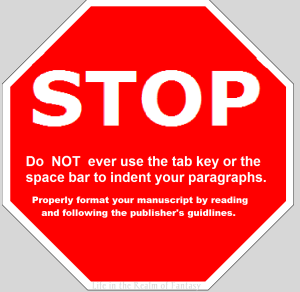
stopI’ve said this before, and I will say it again: Do NOT ever use the tab key or the space bar to indent your paragraphs. Many times publishers want electronic submissions and you have no idea what a crapped up mess (sorry for the editor-speak) using the tab key makes out of an electronic manuscript.  You most likely will have to go in and remove these tabs by hand and it’s a tedious job, but do it now, if you have been using the tab key.

You might say, “Well I only submit to traditional publishers who all want hard-copy.” That, my friends, it not true. The entire publishing industry is undergoing modernization, and while they do still accept hard-copy, electronic submissions are rapidly becoming the preferred method, even with the larger publishers. Don’t limit your options by refusing to learn a simple trick.

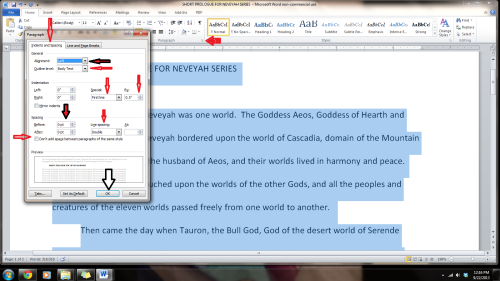
To format your paragraphs indents, first highlight the entire manuscript: on the far right side of the home-tab at the top of your page, click select all. Next,  still on the home tab,  click on the little box at the lower right of the box that says ‘Paragraph.’  This will open a whole new menu:

  1. On the indents and spacing tab of the menu: Use standard alignment, align LEFT. The reason we use this format is we are not looking at a finished product here. We are looking at a rough draft that will be sliced, diced and otherwise mutilated many times before we get to the final product. The following pictures are for WORD 2010, as I have not yet upgraded my MS Office program, but the basic ideas are the same.

paragraphs post 2 pof word series

  1. Indentation: leave that alone or reset both numbers to ‘0’ if you have inadvertently altered it.
  2. Where it says ‘Special’: on drop-down menu select ‘first line’. On the ‘By’ menu, select ‘0.5’
  3. ‘Spacing’: set both before and after to ‘0’.
  4. ‘Line Spacing’: set to ‘double’

Do not forget to click OK at the bottom of the menu.

But today we are going to talk about headers and page numbers:

The “Header” is the writing in the margin at the top of each page of a word-processed or faxed document, usually automatically inserted and, in this case, consisting of the title of the book and your name.

Publishers and editors want this because when they receive a print copy, they want them UNBOUND. Each page should be clearly marked with your name and/or the title of the book as well as the page number. Also, publishers and editors who ask for electronic submissions may need to print sections of your work for closer examination. Accidents happen: if the ms falls off a desk, it can easily be reassembled and the editor will always know that brilliant work was written by you.

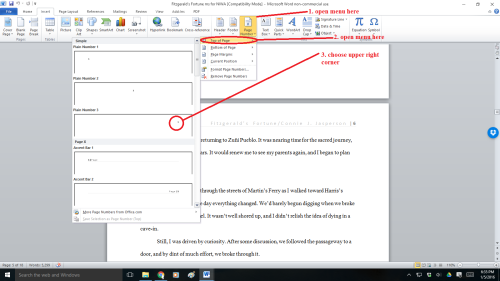
We begin by opening the “insert” tab, and clicking on “page number.”  This opens up a new menu. We add the page numbers using this menu.

Headers and Page numbers prnt sc 2

You will insert the Title of the Book and Your Author Name  just before the page number, so it will look neat and be aligned to the right. You can do this on the page number tab.

Sometimes, a publisher will specify that the first (title) page have no header or page number, but they want the header and page numbers to begin on page two.

Headers and Page numbers prnt sc 1

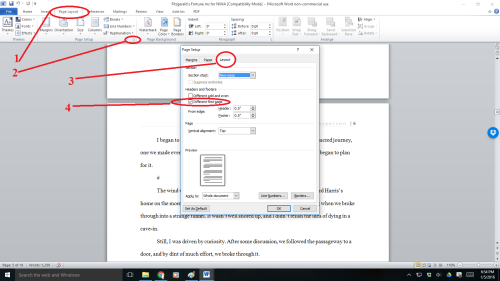
To make the page numbers begin on page two:

  1. Click anywhere in the document.
  2. On the Page Layout tab, click the Page Setup Dialog Box Launcher, and
  3. then click the Layout tab.
  4. Under Headers and footers, select the Different first page check box, and then click OK.

Headers and Page numbers prnt sc 3

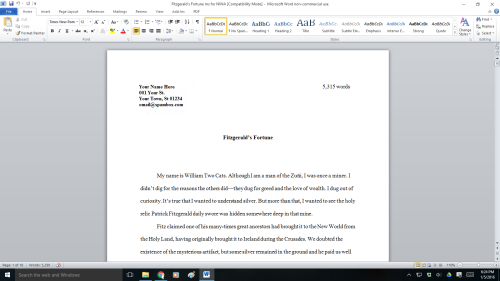
Now your manuscript:

  1. is aligned left
  2. has 1 in. margins
  3. is double-spaced
  4. has formatted indented paragraphs
  5. The header contains title and author name and page numbers aligned right
  6. The first page contains your mailing address and contact information in upper left hand corner

For more on the subject of getting a manuscript ready for submission, check out my post of July 24, 2015, How to format your manuscript for submission.

43 Comments

Filed under Publishing, Self Publishing, writing