Category Archives: writing

#amwriting: holding indies to a higher standard

Hamlet Poster Benedict CumberbatchI haven’t been able to read as much lately as I normally do and I miss it. However, time spent editing for clients and then trying to write has seriously cut into my ability to read. When I am editing for a client, I can’t disengage my mind from that mindset, which means I have a terrible time reading for pleasure. In fact, I haven’t written a book review in months. Lately, I am lucky to read two or three pages before falling out of the book. Thus I have been reading poetry and resorting to audio books.

When I am in an editing mindset, I notice things a casual reader might not, and I can’t just enjoy the book. And I am not talking indies here—I mean books published by the Big 5 traditional publishers. I keep finding things they could have phrased more actively, or should possibly have cut. These are things an average reader will never notice, and are examples of why authors must have a thick skin.

Typos and editing mistakes are pretty much taken for granted when left in mass-market paperbacks by the Big 5 Publishers, but woe to the indie who neglects to notice a repeated ‘and’ or any other editing error. Also, the Big 5 publishers are allowed to take questionable chances with “style,” such as Alexander Chee did when writing The Queen of the Night, allowing lazy habits we indies could never get away with.

I was unable to actually read the book, as it must have been too tiring for him to use closed quotations to indicate dialogue. The reader has no idea someone is speaking until they’re halfway through a conversation, and have to re-read it. I loved what I could read of it, so I had to resort to the audio book, which was the only way I could get through it.

As an editor, it’s incomprehensible to me why an editor for a large publisher would accept a manuscript that is as annoying as that one flaw makes this otherwise remarkable book.

It is also proof that large publishers (Houghton Mifflin Harcourt in this case) are just as guilty as indies when it comes to making strange decisions that can negatively affect sales. They may have done this to elevate it to a “status” read, a must-buy literary name-dropper for those who wish to appear fashionably cultured. If so, it’s a disservice to work that is brilliant despite a flaw that would be fatal if it were to appear in an Indie author’s work.

However, though we can’t take avant garde chances with style, indies DO get to take chances with content, writing and publishing stories that traditionally published authors most likely wouldn’t be allowed to do. If a book might not sell, it won’t be published by a large publisher, because that is what they are in the business to do. However, once an indie has a best seller with a plot the Big 5 would deem sure to fail, traditional publishers will leap on it and the market will soon be glutted. (Can you say Fifty Shades of Grey?)

George R.R.Martin bormatting issue 1 via book blog page views, margaret ebySometimes the errors and flaws in the work sold by the traditional publishing houses are hilarious, as we saw in the first Kindle edition of George R.R.Martin’s A Feast For Crows. That was a formatting error, not an error on Martin’s part, so some poor intern probably got raked over the coals for it, as the book had to be pulled, reformatted, and republished as quickly as possible.

The thing is, errors do creep into even the most carefully examined texts and manuscripts. Usually, no one dies from it, but sometimes there are consequences, as in the case of the infamous Wicked Bible. The publishers paid a hefty price: Robert Barker and Martin Lucas, the royal printers in London, were fined £300 (£43,586 as of 2015) and deprived of their printing license.

Indies are held to a far more rigid code by most readers than the traditional publishers are because the internet is rife with disparaging rhetoric pointing the finger at us. And while the Big 5 traditional publishers are just as guilty of rushing-to-publish unreadable crap, the truth is, many new self-published authors haven’t yet gotten the hang of the publishing business, and often their books are rife with things they will later wish they hadn’t been so eager to publish.

Having learned my own lessons the hard way, I have made changes in how I review my own work. Besides working closely with a professional editor, I now have a solid group of friends who comb my completed manuscripts for errors and gross cut-and-paste errors. We can only hope we have caught them all. When you are an indie, it takes a village to help you get your book fit for the public to read.

Anyway—my editor’s hat is firmly on my head these days, and that means I can’t enjoy casual reading for a while more. This mindset slows my own writing output to nearly nothing because I am stupidly self-editing instead of just letting the words flow.

When I am editing I am looking for all varieties of mistakes–not just structural, grammatical, and glaring punctuation errors. I am also looking for things that will interfere with formatting the final manuscript for upload to Kindle or Smashwords, and I hope I find them all for my client, but it makes writing my own work challenging.

joyce corrections on his msAs an editor, I do my best. But, nothing is ever sure, and I won’t see the manuscript after I send my client the final suggested corrections. Mistakes can be made right up to the last minute while the client is making those adjustments, so someone else will have to proof-read her work.

Remember, you, as the author, have the responsibility for the final eye on your manuscript. So when my client has finished making revisions, she will have her posse check the manuscript over for the slings and arrows of publishing fate.

I will be done with my current editing project soon, and I plan to take a break from editing for a short while when that happens. Then I will let my mindset slide back into the joy-of-reading mode. I look forward to resting my editorial mind and over-indulging in the work of my many favorite authors.

5 Comments

Filed under Self Publishing, Uncategorized, writing

#independenceday: celebrating diversity

800px-John_C._Dollman_-_The_immigrants'_ship_-_Google_Art_ProjectToday, July 4, 2016, is celebrated as Independence Day, here in the US. Yet, though my family left their homes in dear old Mother England, we still feel that bond, that familial connection.

My father’s side of the family came to America from Herne Hill, Canterbury, England in 1630, sailing on the Winthrop Fleet, and ended up in Massachusetts.

My mother’s side came from Laugharne, Carmarthenshire, Wales right around the same time, and ended up in Virginia. Somehow, fortunes were made and lost, generations passed, and my grandparents ended up in Olympia, Washington.

Hó-ra-tó-a,_a_BraveWhen you look back far enough, every person in this country is an immigrant. The Native American tribes and First Nations peoples came first, across the waters and across the land bridges. This was their land for thousands of years. But we who claim European, African, and Asian ancestry are all recent immigrants. We are only here because our parents and grandparents found a place where they could raise their family in relative safety, and forced their way in. Some were brought here against their will, but stayed, hoping to find a better life. It wasn’t easy, and those times were difficult.

We are decent people, trying to live good lives. Individually, we don’t see ourselves as exclusionary or cruel. We believe in the greater good, and because we do, change will come. The face of America will evolve.

800px-4th_of_July_(2008)_fireworks_over_Seattle_(3)Immigrants have always come to America and always will, and they will be a part of what makes this nation a good place to live. We will find common ground because this is a small planet in a large universe, and right now, we have nowhere else to go. Change and growth are never easy, and there are always some who would hold back, fearing the unknown.

Today America celebrates its independence from Great Britain. Today we celebrate our diversity.

6 Comments

Filed under writing

#amreading: Night Watchman Express by Alison DeLuca

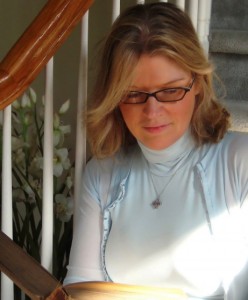
Alison DeLuca HeadshotOne of my dear friends is author Alison DeLuca, who is the main driving force behind Myrddin Publishing.  Alison is the idea woman, and has the follow-though needed to successfully run the equivalent of a small publishing house these days.

Alison is a superwoman. Not only does she guide 25 authors through the wild west of indie publishing, she is the mother of an active pre-teen, a working author and blogger, and is one of the finest editors I know.

My husband and I share 5 children, and so we have “a passel” of grandkids, as my grandma would have said. While I generally write books more geared for adult readers, Alison has written a young adult Steampunk collection of books, the Crown Phoenix series.

She has written several other novels, and numerous short stories more geared for mature readers, and if there is one thing I can say about Alison, everything she writes is classy and well-crafted.

I am always looking for good, challenging books for my grandkids to read, ones that will keep their interest and stretch their minds, so I was thrilled when I met Alison and discovered her young adult work.

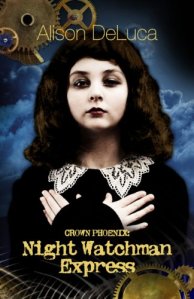
night watchman expressThe first book of hers that I ever read was the Night Watchman’s Express. I loved this book. The story never stops moving until the last page. Miriam, an unhappy young girl is orphaned when her wealthy industrialist father dies. With no other family, her father’s business partners, the Marchpanes, become her guardians. The Marchpanes immediately move into Miriam’s house, and take over her father’s rooms. (Mrs. Marchpane is deliciously evil.) They make their attempt to gain full control of Miriam’s money and her father’s company.

Gradually, Miriam begins to find common ground with the Marchpane’s son and their other young ‘guest’ when a nanny, who is both wise and skilled in certain magics, is hired. Mana is a woman who is of a race of people, who are considered to be second-class citizens, and contrary to the Marchpane’s hopes, she turns out to be exactly what both Miriam and the two boys needed.

There is a reluctant camaraderie that develops between Miriam and the two boys. The three of them do a certain amount of exploring the grounds of the estate, and discover a strange machine that her father has constructed. Another interesting thread is also Miriam’s strange emotional attachment to her father’s typewriter-like machine, which she has claimed for her own since his death, and keeps hidden in her room.

This book was so good for a rainy-weekend read that I read it twice. And guess what? It’s currently a free download for your Kindle, but if you are into paper, it also available in that format for $12.99.

This month, Alison is participating in The #BigBookGiveaway, which starts today, July 1st. For avid book lovers, this is an awesome deal! Sponsored by Girl Who Reads, two boxes of books donated by multiple authors and publishers will be given away through Rafflecopter, and the link to enter that contest is here: #BigBookGiveAway via RafflecopterJust click on that link and it will take you to the contest page, and you too could end up with a large box of books to while away your summer with, and Alison DeLuca’s Night Watchman Express is only one of them.

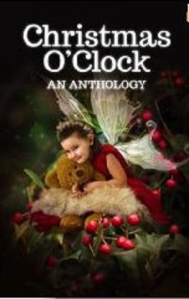
Christmas O'clock 2013Girl Who Reads is a great resource for avid readers like me, as it’s a website where you can find balanced book reviews, many of them indie books. Books are being offered in this giveaway by many wonderful authors, several with larger publishers, such as Penguin Books and Random House. Alison is also including a copy of Myrddin Publishings children’s’ anthology, Christmas O’Clock.

I did pen one of the stories in that collection, a little thing called A Christmas Tail.  I loved writing that tale—I was in a Toad Hall mood apparently, and Ratsy’s adventures with his friends are reminiscent of that wonderful series of tales.

Alison is one of the easiest people to work with I’ve ever known. We began this publishing adventure in the summer of 2012 as refugees from a bad publishing situation, and while it was rocky in the beginning, we have never regretted our decision to go indie. Our publishing cooperative began with a great group of authors who were all as committed to the indie way as we are, and every year we have gained new authors who bring new ideas and new fire to our collective. Alison is the glue that binds us together.

You can find Alison and more of her work here:

Facebook: http://www.facebook.com/alison.deluca.author

OR http://on.fb.me/TNWEfb

Twitter – http://twitter.com/ – !/AlisonDeLuca

Google + http://bit.ly/ADGoogle

Amazon Author Central:  http://amzn.to/ADeLucaAuthorCentral

Pinterest: http://pinterest.com/alisondeluca/

4 Comments

Filed under Books, Fantasy, Literature, Self Publishing, writer, writing

#amblogging: why authors should blog, take 3: the vegan

avacado dinner salad

my favorite avocado dinner salad

One of the things I love most about writing is this blog. I have made so many friends though this little place on the internet. Blogging offers me the opportunity to riff for several hundred words on any subject I’m interested in, without interruption. Of course, I’m usually only interested in writing-craft, but this is where I come to discuss it.

Nothing improves your writing chops more than writing every day. Deadlines can be daunting but say what you will about not being able to write under pressure—I think that is when I do my best work.

And, today I don’t feel like talking about writing. I want to discuss food! As many know, I am vegan, but my descent into veganism was (sadly) not motivated by any high moral prohibition against animal cruelty. There is a certain amount of that, but it was always there in the the way I purchased food for my family. During the 1980s, much of our meat we raised ourselves, cage free, free range chickens, and sheep raised in traditional farming methods.

However, I have developed an auto-immune variety of arthritis that is triggered by meat and dairy–all forms of it. Whenever I go off my diet (and cheese is the big draw) I pay the price. So, I stay on my vegan diet and I feel good.

I have discovered a wonderful resource for amazing, healthy, vegan food: the internet.

I know! It’s not just for Facebook and online gaming.

There is information out there, and it’s all in blogs. One of the best sites for me is called The Minimalist Baker. Today the main picture on their site is a gorgeous image of peppers stuffed with cauliflower rice. That image is eye candy. I will definitely be making some form of this recipe.

Oh my gosh! That website, and the recipes Dana and John have put together are just amazing. I use more of their recipes as the basis of my own cooking than from any other website or book.

Changing your diet is difficult, because you have to change your habits. Sometimes you have to change the flavors you love, and learn to like new ones.

And if you are just starting out and can’t afford to buy cookbooks, the internet offers an incredible wealth of free information, and much of it in the form of blogs by people like me.

I love to eat as much as I love to read, and I could easily talk for hours on either subject. If you are passionate about a particular subject, a blog is a great place to talk about it. It brings together people with similar interests, and for a writer, blogging is crucial, as it gets your name out there. Blogging shows people you can write well, and blogging regularly forces you to be creative.

If you want to know more about getting your own blog up and running, see my post of December 14, 2015, Blogging is Writing TooThis post talks about how to use the new default system here at WordPress so that you can insert pictures and make a nice looking post.

  • Keep it down to about 1000 words more or less.
  • Use the spellchecker tool to look for obvious errors.
  • Write in draft form and don’t publish it right away–come back and read it over again, and make corrections.
  • If you use information found elsewhere, quote it and credit the author
  • Use images that are either public domain, or that you have the right to use
  • Put links to other informative sites in the text
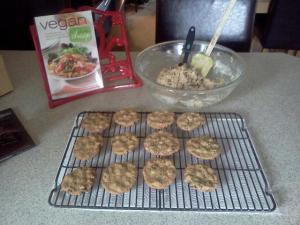
chocolate chip cookies, vegan

chocolate chip cookies, vegan and yummy

Rule number one: be consistent. I began by blogging once a week on a now defunct site—but my actual posts were more often made only once or twice a month. I dreaded it and didn’t want to do it. My blog stats were in the tank because I wasn’t applying myself to it.

It’s a commitment, and authors are procrastinators, but we can write to deadlines when we have to, and it’s good for us.  Now I am writing three posts a week on this blog, and at least one post a week for each of several other venues. I spend Sundays putting my blog posts together, which I couldn’t do if I was still raising children, but you only need to blog once a week to keep your content fresh. Writing this post took me about 45 minutes, so that is a small time commitment.

But just like a healthy diet and a walk in the fresh air, a change of writing scenery is good for you.

6 Comments

Filed under blogging, writing

#amwriting: evoking a sense of place

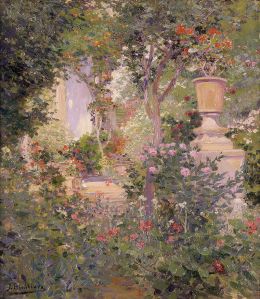
800px-El_jardí_de_l'autor,_Josep_Benlliure_Gil,_Museu_de_Belles_Arts_de_València

The Garden of the Author, by José Benlliure Gil via Wikimedia Commons

Summer has officially arrived here in the Pacific Northwest. This is a time when I can take my notepad out on the back porch, enjoying the garden and, to a certain extent, people watching. I love my back yard and my porch, feeling as if the heart of my home is there.

My work involves creating worlds and making them real to the reader. All the worlds I write about are a composite woven of my personal experiences and places that I love.

My town is a tiny place, slightly more than a village, and less than a city. Historically it is a mining town. Three things kept my town alive during hard times: the sandstone quarry, the coal mines, and timber. Now it’s a bedroom community for Olympia, the capital city of the State of Washington.

I’ve been here since 2005, and although I love my small house and garden, I don’t really fit into this community, which is probably my fault. Most of my writing groups are in Olympia, and my favorite places are in that city too. But I have a “soul-home,” which is comprised of the places that had the most profound meaning to me in my life. My soul-home is made up of three places that I have lived, which have all had a profound effect on me.

One part of that soul-home is Seattle. I lived there until I was 10, and went to West Woodland Elementary School.Our house was in Ballard, an urban community of fishermen who spent most of their time fishing in Alaska, and who were first-generation Norwegians. Everyone, including my family, was Lutheran, which was a cultural thing as well as religious. In the late 1950s to the early 1960s, Ballard was a small town within the big city, and the kids in my neighborhood were close-knit.

Seattle and the greater Puget Sound area is one component of my soul home, mainly because of the many immigrants whose cultures made it what it is today. The Pacific Northwest and Seattle, in particular, is a fusion of Asian, Norwegian, Native American, and hardy sons and daughters of the pioneers who came from all over the world seeking a better life. We are a unique mix and happy to be so.

In Seattle, music takes on a life of its own, and the world listens. Wikipedia has a page that lists all the famous musicians who came out of Seattle, and it’s pretty impressive. You can check it out here.

Music, art, and literature are celebrated in Seattle, and the influence the city has on Pacific Northwest culture is felt all up and down the Puget Sound region. I was fired to write my own books by reading the works of local area authors like Frank Herbert, Greg Bear, J.A. Jance, Terry Brooks and so many, many more Northwest authors. The Puget Sound region is a breeding ground for creativity, and Seattle is where it comes together.

Amaranthus and Savvy at the needles by haystack rock cannon beach 2012

But I am also a product of many summers spent in Cannon Beach, Oregon. I love that place so much that it is another piece of my soul-home. Terry Brooks and Ursula K. LeGuin are also fans of the North Oregon Coast, as are many famous musicians and actors. Something about it calls to the wilder side of me, and it seeps into my work.

But the primary portion of my soul-home came into my life when I was ten, and my family moved to Olympia, to a home on Black Lake. We moved from a nice, large, two-story home in a middle-class neighborhood to a tiny, rundown, ranch-style vacation house miles from civilization. It was cold and damp in the winter, and cool and pleasant in the summer. The house was barely livable, but the property was what my parents moved there for: the 350 feet of waterfront and the sandy beach, with forested land going back 5 acres to the county road. Dad was a WWII vet, and fishing was his greatest hobby.

The first thing I saw the day we moved there wasn’t the lake, although it was impressive. It was the Black Hills that dominated my view—black and forested with cedars, firs and hemlock, and rising high over the other side of the lake, they dominated the front windows. The many moods of the lake were out there for us all to see every minute of every day. You knew what going to happen by the direction the wind was coming from.

I hated it. I was torn from everything I knew, thrust into a world where I had no friends, and didn’t know my way around. Nevertheless, after the first, terribly difficult months of adjustment, I grew to love my Black Lake home, relishing the rural privacy and the deep connection to nature we formed, without our knowing it. When I left home, I carried a piece of it in my heart, and it will always be with me. My contemporary literary fiction is usually set there, with the bits and pieces I loved so much about that home forming a memory that shines, and I am able to give that place to my readers.

Just as my world, and the place I think of as my home was created by many generations of immigrants and pioneers filled with hope and the dream of a better life, so are most other cities and cultural centers.

The sense of place you instill into your work is the sure knowledge of where it is and what it represents to the protagonist. If you are crafting a world that doesn’t exist, as I have done with most of my work, you must make it real. Take some of what you love about your home, your town, and your culture, and write it into your work.

The knowledge of place is created in the reader’s mind by subtle cues, small descriptions, minor mentions over multiple scenes. A few words, little references to the background setting give the reader a framework upon which his imagination will build the rest.

Terry Brooks’ world of Shannara is real in his mind, because he lives there, just as Neveyah is real to me for the same reason. Both worlds have evolved from the reality and landscape we live in and love so much, yet they are radically different, both from each other and from the Pacific Northwest. They are composites of our imaginations, made real by our experiences.

Haystack_rock_monochromeWhen you write a novel or an essay, whether it’s fiction or non-fiction, the setting is how you create the sense of place, and must be a creation of many layers:

  • Place: where the protagonist lives, whether in the city, a village, a wandering life with no fixed address, or a farm in the countryside
  • Landscape/Terrain: mountainous, forested, high desert, seaside
  • Culture: in many stories, broad hints of what passes for political systems, the influence of religion, and the amount of respect accorded by society to music and art.

None of these layers will be overtly discussed or described at length in your work unless it is part of what creates the tension and drives the plot. But you, as the author, must know and understand these components as if they were your soul-home. That knowledge will come across in your work via small cues, and your readers will have a firm picture of the world in which your work is set.

4 Comments

Filed under writing

#amwriting: the point of no return

Epic Fails memeIn life we often find ourselves boxed into a corner, frantically dealing with things we could have avoided if only we had paid attention and not ignored the metaphoric “turn back now” signs.

Imagine a road trip where you are sent off on a detour in a city you’re unfamiliar with. Imagine what would happen if some of the signs were missing, detour signs telling you the correct way to go, and also a one-way street warning sign.

At some point before you realized the signs had been removed, there was a place you could have turned back. Unaware of the danger, you passed that stopping point by and turned left when you should have turned right, and found yourself driving into oncoming traffic on a one-way street.

That safe place where you could have turned around before you entered the danger zone was the point of no return for your adventure. Fortunately, in our hypothetical road-trip no one was harmed, although you were honked at and verbally abused by the people who were endangered by your wrong turn. You made it safely out danger, but you’ll never take a detour again without fearing the worst.

In literature what is the point of no return? Scott Driscoll, on his blog, says, “This event or act represents the point of maximum risk and exposure for the main character (and precedes the crisis moment and climax).”

Epic fantasy, which is what the novels in my Tower of Bones series are, generally features a plot driven by a chain of events, small points of no return, each one progressively forcing the protagonist and his/her companions to their meeting with destiny. These scenes of action form arcs that rise to the Third Plot Point: the event that is either an actual death or a symbolic death, but which forces the hero/heroine to be greater than they believed they could be.

For me, in a gripping story, the struggle may have been fraught with hardship, but the actual point of no return is the event that forces the ultimate showdown and face-to-face confrontation with the enemy.

What if you aren’t writing epic fantasy? This series of “arcs of action” driving the plot comes into play in every novel to some degree—the protagonists are in danger  of losing everything because they didn’t recognize the warning signs, and they are pushed to the final confrontation whether they are ready for it or not.

During the build-up to the point of no return, you must develop your characters’ strengths.  Identify the protagonist’s goals early on, and clarify why he/she must struggle to achieve them.

  • How does the hero react to being thwarted in his efforts?
  • How does the villain currently control the situation?
  • How does the hero react to pressure from the villain?
  • How does the struggle deepen the relationships between the hero and his cohorts/romantic interest?
  • What complications (for the hero) arise from a lack of information regarding the conflict, and how will he/she acquire that necessary information?

800px-Singapore_Road_Signs_-_Temporary_Sign_-_Detour.svgCalamity and struggle create opportunities for your character to grow, so it is your task to litter your protagonist’s path with obstacles that stretch his/her abilities and which are believable. Each time he/she overcomes a hair-raising obstruction, the reader is rewarded with a feeling of satisfaction.

It doesn’t matter what genre you are writing in: you could be writing romances, thrillers, paranormal fantasy, or contemporary women’s lit—for all fiction, obstacles in the protagonist’s path make for satisfying conclusions. I say this because the books I love to read the most are crafted in such a way that we get to know the characters, see them in their environment, and …uh ohh…. Calamity happens, thrusting the hero down the road to divorce court, or trying to head off a nuclear melt-down. Sometimes our hero finds himself walking to Naglimund, or to the Misty Mountains with nothing but the clothes on his back.

Calamity is the fertile ground from which adventure springs, and most calamities are preceded by a point of no return. Identify this plot point, and make it subtly clear to the reader, even if only in hindsight.

8 Comments

Filed under writing

#amwriting: point of view

Xpogo_RioA young author recently asked me, “What is head-hopping and why has my writing group accused me of doing it?” Headhopping occurs when an author switches point-of-view characters within a single scene, and happens most frequently when using a Third-Person Omniscient narrative, in which the thoughts of every character are open to the reader.

It’s difficult to know whose opinions are most important when all your characters are speaking in your head as you are writing. They clamor and speak over the top of each other, making a din like my family at any holiday dinner. But you must force them to take turns speaking, and make a real break between the scenes where the speaker changes, or each rapid shift of perspective will throw the reader out of the story. But what is Point of View other than the thoughts of one or two characters?

Point of view is a common literary term which some authors are a little unclear on. Remember, books, stories and literature in general, are a window through which readers look at the world. The way they see through that window, is though the eyes of the narrator: the point of view.

Writers direct their readers’ attention to the details, opinions, or emotions they want to emphasize by manipulating the point of view of the story, writing the narrative in one of three different ways: first-person, second-person, or third-person.

First-person point of view is fairly common, and is told from one protagonist’s personal point of view. It employs “I-me-my-mine” in the protagonist’s speech, allowing the reader or audience to see the primary character’s opinions, thoughts, and feelings. Remember, it is told from the view and knowledge of the narrator, and not of other characters. You ,as the author, must remember that no one has complete knowledge of anything. Thus, your protagonist cannot be all-seeing and all-knowing. The reader will find out the information as the protagonist does, which can be engrossing.

So I know I am right not to settle, but it doesn’t make me feel better as my friends pair off and I stay home on Friday night with a bottle of wine and make myself an extravagant meal and tell myself, This is perfect, as if I’m the one dating me. ~~ Gone Girl, by Gillian Flynn

Second-person point of view, in which the author uses “you” and “your,” is rarely found in a novel or short story. It is, however, commonly used in guide books, self-help books, do-it-yourself manuals, interactive fiction, role-playing games, gamebooks such as the Choose Your Own Adventure series, musical lyrics, advertisements.

For an author attempting to use it in fiction, it’s tricky to get right, so it doesn’t come off like a walkthrough for an RPG and for this reason, authors rarely speak directly to the reader in this way. However, it can work well, if the author is smart and really understands what they are writing. Successful use of Second Person POV can be found in: Jay McInerney’s Bright Lights, Big City (1984)

“You are not the kind of guy who would be at a place like this at this time of the morning. But here you are, and you cannot say that the terrain is entirely unfamiliar, although the details are fuzzy.”

Third-person point of view provides the greatest flexibility to the author and thus is the most commonly used narrative mode in literature. In the third-person narrative mode, each and every character is referred to by the narrator as “he,” “she,” “it,” or “they.” Third-person point of view is that of an outsider looking at the action, an invisible third person describing the events.

  1. The writer may choose third-person omniscient, in which the thoughts of every character are open to the reader, or third-person limited, in which the reader enters only one character’s mind, either throughout the entire work or in a specific section.
  2. Third-person limited differs from first-person because while we see the thoughts and opinions of a single character, the author’s voice, not the character’s voice, is what you hear in the descriptive passages.
  3. The Flâneur (idler, lounger, loiterer.) This is traditionally a form of third person POV, but I like to think of it almost as a fourth POV. Many of you have heard of it as third-person objective or third-person dramatic.

James Wood, author and literary critic, discusses this in the New Yorker (Books section Feb 28, 2011) in his review of Teju Cole’s Open City. Wood writes: …we also need a flâneur to see interesting things in the city, and to notice them well, and (Teju) Cole’s narrator has an acute, and sympathetic, eye. Sometimes he is witty and paradoxical, in a way that recalls Roland Barthes. Watching a park full of children: “The creak-creak of the swings was a signal, I thought, there to remind the children that they were having fun; if there were no creak, they would be confused.”

The flâneur is a voice that observes and comments but without actually becoming a character, a witness to the events. There is a downside to using the flâneur as your vehicle to convey your narrative:

  • He is not reliable—he has his own personality, offering subtle judgments and unconscious opinions on the behavior of the characters. Therefore, just as in a first-person narrative, the reader cannot be sure he is telling the unbiased truth.
  • The narrator  tells the story without describing any of the character’s thoughts, opinions, or feelings; so the reader can only guess at character motivations, and must assume the objective observer truly is objective and has told the truth in that regard.
  • It separates the reader from the intimacy of the action and slows the pace down.

Authors know what every character they are writing is thinking, and sometimes feel compelled to write from every character’s viewpoint. First we’re in Joe’s head, and then we are in Mary’s–rather like watching a tennis match. It’s critical that we don’t jump from head to head within a scene, as that will knock the reader out of the narrative and we don’t want that.

Joe’s experience can be explored and Mary’s can too, but make a solid break, or begin new chapter before you switch to Mary’s viewpoint. If a different character has something to say that is important to the narrative, I give them a separate chapter, even if it is a short one. That way my readers are not too confused about who is making the observations.

Remember, we avoid head-hopping and mental whiplash by not changing characters and point of view mid-scene.

10 Comments

Filed under writing

#flashfictionfriday: October Sky

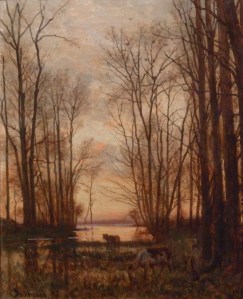
Louis_Français-CrépusculeIt had been the coldest October I could remember. Rafts of ice floated up and down the lake, blown by the winds, breaking up and re-forming as if dancing a ballet. The leaves had been off the trees since the end of September, almost as if they couldn’t fall fast enough.

It was in the last, quiet hour before sunset when the real beauty of my rustic lake home was revealed to me. The sun drifted its way behind the hills as the wind died off to nothing. The lake became a mirror reflecting the pink-blue-purple-gold of the sky and the deep green of the evergreen forested hills. It was a green so deep that it appeared to be black.

I would sit at my frozen picnic table with a steaming mug of coffee warming my hands, watching the snow geese and the western grebes. Only the voices of the loons and the geese pierced the blanket of peace I had wrapped about myself.

When the colors had faded, and I could no longer feel my fingers, I would go back into the house and stoke up the fire, still in the thrall of the lake’s spell. Then, only when I had absorbed the tranquility of my lake, would I pick up a brush and enter my world of canvas and color.

On the first morning I saw the naked trees stark against the incredible sky, I knew I had to somehow capture the power. Attempt followed attempt and soon my house was littered with the “almosts.” The bones of the trees were right, but the essence of the sky was missing. Each night I worked longer and more feverishly until one day I realized that I had to back off and gain some perspective.

And so it was that in the small hours before dawn one morning I put away the brushes and paints, and covered the canvasses, frustrated by my inability to capture the essence of the lake and the sky that was mirrored in it. Exhausted, I fell into my bed drained and unable to concentrate, yet sleep escaped me. My mind was filled with the loons and the trees and their sky.

At last, knowing it was futile to try to sleep I rose and made myself tea. Wrapping a blanket about myself I walked out to my small sitting room to watch the trees greeting the pale dawn. The warmth and fragrance of the steaming cup of tea made me feel rested as my bed never had, and the familiarity of the ritual soothed away my frustrations.

The serenity of the moment deepened, a sense of sacredness pervaded the garden. Willingly, I gave myself to the experience, allowing the essence of the moment to seep into my soul.

The air felt strange, alive and crystalline, and the trees beckoned to me. I could feel them calling me to come out and greet the sun with them, and bemused, I answered their call. Stepping outside, still wrapped in my blanket, I walked through the frozen grass, until I was in the orchard among the trees on the shore of the lake.

Looking west to the black-forested hills, I held my breath, overcome by the feeling of anticipation that infused me. Something told me I stood on the verge of an event, vast and unfathomable, though what it could be I couldn’t imagine.

Gradually I realized that the ground was vibrating, and had been for a while, shaking as if a giant walked nearby. As I became aware of the vibrations beneath my feet, a deep rumbling began to penetrate my reverie, shattering the peace. The unfamiliar thunders grew louder with every moment, and the birds fell silent as if waiting to see what approached.

Huddling nervously in my blanket, my eyes were drawn to the north and there, emerging from the mist I saw machines—great, huge, monstrous machines I had no words to describe. They came slowly and relentlessly down the middle of my lake. The waters rolled and boiled around them as they passed me by, paying me less attention than they did the trees. The ice floes broke and tipped crazily, riding the waves that danced about the giant treads.

The line of machines continued south, grinding through the swamp, going I knew not where and coming from where I could not imagine. As they came, the waters grew, and waves began splashing at my feet and then my knees. At last, realizing that I was in trouble, I turned and raced for the higher ground and the safety of my house.

Still the waters rose, following me, and still the machines came rolling down from the north.

I closed the door and stood to gaze out the window at the rising waters and the monstrous machines that continued their unrelenting journey south. The waters rose, and my house began swaying, creaking and groaning under the water’s assault.

I fell to my knees praying to the God I didn’t believe in, but he wasn’t listening.  My house shook and rocked, and lifted with the rising water, turning slowly as if to say goodbye to the lake and the hills to the west. Dishes and furniture careened off paintings and walls—my life in small objects passing before my eyes. I looked, disbelieving, through the shattered windows and saw the inconceivable sky spinning around like a child’s top spins.

I covered my head, and screamed my prayer, but the only answer I received was the sure and profound sound of breaking glass and furniture shattering.  At last, when I believed it would never stop, the floor I clung to gave a great lurch and the noise of destruction stuttered into silence, a silence every bit as loud as the din had been.

Throwing back my blanket, determined to get out of the wreckage while I could, I saw the last of the machines going south into the broken swamp. The trail they blazed through the marshland was a great scar that would never heal, and I wept at the sight of it.

I surveyed the damage to my home with stunned eyes. My house was now perched all askew upon a slight rise that had been perhaps fifty feet behind it before. Everything I had ever owned was now in full view of anyone who might choose to make a leisurely visit to my remote home. Every item of clothing, every bit of dish, smashed or whole, everything dangled from the branches of the broken trees, displayed everywhere.

Despite the carnage, the sky hung pink-blue-purple-golden and unchanged while the naked trees made lewd gestures with my most personal of possessions. The ridiculousness of the situation penetrated my shock, and I began laughing, and falling to my knees I laughed until I couldn’t breathe. Eventually, my laughter became sobs, and I howled until I was spent.

The silence was too much, making me intensely aware of my frail mortality. Stepping through the rubble, I gathered my canvasses, paints, and brushes. Miraculously my easel was untouched, and so I did the only thing I could think of.

I painted the pathetic wreck of my house reflected in the perfection of the lake and the hills.

I painted the obscene trees against the incredible sky as they proudly displayed the debris of my life.

And then I painted those awesome machines as they paraded past me, not realizing that I was there and not caring.

When I was done, three paintings leaned against my ruined fireplace. Exhausted, I found my bed and righted it. Crawling into it I finally fell asleep, resting dreamlessly.

When my eyes opened, I was disoriented. I awoke in my bedroom and looking around, I could see no signs of the previous day’s events. In disbelief, I went to the kitchen and found all my kitsch and accumulated knick-knacks still to be there, whole and in their tasteless entirety. There were no broken dishes, no broken furniture.

Awed and amazed at the power of the dream I had just experienced I set about preparing my breakfast. “Idiot,” I muttered, still feeling rather giddy. I wondered what my sister would say when I called to tell her about it.

Making a cup of coffee, I went to sit by the window in the sitting room.

As I passed the fireplace I froze. Three pictures leaned against the uninjured hearth.

One was of obscene trees decorated with my personal possessions, silhouetted against an incredible sky. In the second picture, my sad house perched askew on the hill, broken and sad, framed by the astounding sunset.

And the third picture was a terrifying image of gigantic, grotesque machines tearing up my lake, plowing through the swamp with the waters roiling wildly about the monstrous treads, beneath the sky that had eluded my skills until that night.

Even I had to admit that the power of the paintings was overwhelming.


October Sky © Connie J. Jasperson 2016 All Rights Reserved

Written circa 1992 and originally published On Wattpad, December 2012

Republished on Edgewise Words Inn, April 2015

8 Comments

Filed under #FlashFictionFriday, writing

#amwriting: the struggle is the story

A point that was raised on another blog I follow is something many authors struggle with: devising the complicating events that raise levels of risk for the protagonist, and also for the antagonist. A compelling story evolves when the antagonist is strong, but not omnipotent. The protagonist must also be stronger than she thought she was, but still not omnipotent.

Small hindrances must occur between the larger events, frustrating the journey. These things delay the protagonist, and sometimes send them down the wrong path, but as each is overcome the reader feels a small sense of satisfaction. Following the protagonist as he/she is negotiating these detours is what makes the story captivating, in my opinion.

If you have a story of any length, short or long, you can’t have people sitting around idly chit-chatting. Conversations must have a purpose, and be designed to advance the plot. Information emerges that the protagonist (or antagonist) must know. The reader discovers this at the same time as the characters.

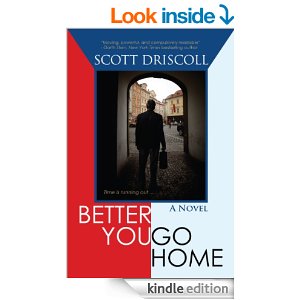
Better You Go Home Scott DriscollIn the literary novel Better You Go Home by Scott Driscoll, Chico Lenoch, a Seattle attorney, is desperately ill and needs a family member to donate a kidney. None of his family members here locally are suitable donors. He has always wondered about his family in the Czech Republic, which his father won’t discuss, and has recently discovered he has a half-sister still living there. He journeys there to find his sister, and in the process, he unearths the secrets his father and mother left behind. As each terrible secret is revealed, hindrances arise. Danger, political fallout, personal vendettas, and a growing concern for his sister conspire with Chico’s failing health to keep him from achieving his goal.

If the path had been easy, Chico’s story would have been an exploration of a man with a problem, but not real exciting. Because of the roadblocks, it’s a taut thriller, and his journey comes to an unexpected and electrifying conclusion.

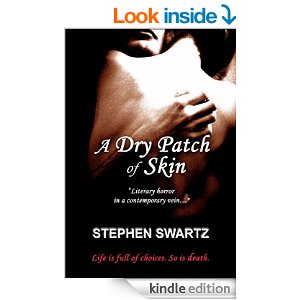
TA patch of Dry Skin, Stephen Swartzhis notion of making the path difficult is explored well in  Stephen Swartz’s literary fantasy, A Dry Patch of Skin. The story opens in Croatia but moves to Oklahoma. This tale is a fantasy in the sense it’s an exploration of vampirism, but is literary and gripping in its plausibility. Two of my favorite lines of all time are in the opening chapters of this novel:

Mirrors are such odd devices, and whoever invented them should have been killed. They purport to show us the true state of affairs and yet everything is distorted.

The protagonist, a man of Hungarian descent, named Stefan Székely, has a disturbing genetic skin condition and embarks on a quest to find a cure, desperate to somehow salvage his relationship with Penny. He has a job as a phlebotomist, which allows him to conceal his ailment, but eventually he is unable to hide it. Many roadblocks arise, interfering with Stefan’s success, forcing him to seek a cure in Budapest, but even that trip is fraught with frustrations. Because of those hindrances, the tension builds toward the end, making for a gripping read. The novel ends in an unexpected fashion and is one that stayed with me for a long time after.

Both these novels detail a seemingly ordinary thing—a person dealing with a life-threatening illness, both seeking a cure that seems like it should be easy but which becomes virtually impossible. In both novels, the roadblocks and detours along the journey create compelling narratives I found impossible to put down.

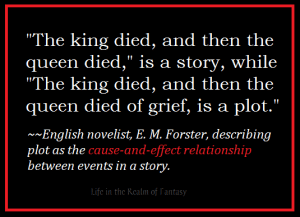
e.m. forster plot memeBoth are set in a contemporary setting, and both have surprising endings that could only have been arrived at because of the roadblocks and hindrances placed in the paths of the protagonists.

This is why we can’t make it easy for our characters. The struggle is the story.

2 Comments

Filed under writer, writing

#amwriting: Desires and Objectives

LOTR advance poster 2When we sit down to write a story of any length, whether a novel or flash fiction, we often begin with an idea for a plot, the possibilities of great characters, and little more. To make those two things into a compelling story, we must discover what the protagonist desires most, and find out what she/he is willing to risk to achieve it.

Objectives+Risk=Story

In The Lord of the Rings, by J.R.R. Tolkien, Frodo is just an ordinary young hobbit, with no particular ambitions. On the same day as his older cousin Bilbo’s “eleventy-eleventh” (111th) birthday, Frodo (Bilbo’s heir) celebrates his thirty-third birthday.

At the lavish double-birthday party, Bilbo departs from the Shire for what he calls “a permanent holiday.” He does so by using the magic ring (that he had found on the journey detailed in The Hobbit) to disappear. He is aided in that by Gandalf with a flash and puff of smoke, leading many in the Shire to believe Bilbo has gone mad.

He leaves Frodo his remaining belongings, including his home, Bag End, and after some heavy-handed persuasion by the wizard Gandalf, he also leaves the Ring. Gandalf departs on his own business, warning Frodo to keep the Ring secret. Seventeen years or so pass, and then Gandalf returns to inform Frodo of the truth about Bilbo’s ring. It is the One Ring of Sauron the Dark Lord, and is evil. It forges a connection between the wearer and Sauron, and whoever bears it will be slowly corrupted, eventually becoming a Ringwraith.

LOTR advance posterFrom the moment of learning the truth about the Ring, Frodo’s goal is clear to the reader: he must get rid of the ring. In Rivendell, he learns the only way to do so is to carry it into the depths of Mordor and cast the ring into the fires of Mt. Doom.

Frodo wants to achieve this goal badly enough to walk into an active volcano and certain death to accomplish this.

At no point in the narrative is the objective unclear. The path is blocked many times, and each of the characters is tested by the evil ring, some beyond their ability to resist it.

The objective creates the tension, which drives the plot forward.

But what about a book where the goal is not so clear? Let’s talk about Ulysses, by James Joyce.

Ulysses chronicles the wandering appointments and encounters of Leopold Bloom in Dublin, taking place over the course of an ordinary day, 16 June 1904. Ulysses is the Latinized name of Odysseus, the hero of Homer’s Odyssey. Joyce established a series of parallels between the epic poem and his novel. This book has one of the best opening lines of all time:

Stately, plump Buck Mulligan came from the stairhead, bearing a bowl of lather on which a mirror and a razor lay crossed.

Ulysses cover 3Structurally, there are strong correlations between the characters and experiences of Leopold Bloom with Odysseus, Molly Bloom with Odysseus’ long-suffering wife, Penelope, and Stephen Dedalus with Odysseus’s son, Telemachus. It is set in early twentieth century Dublin with the events and political tempests of of the time. Themes of antisemitism and the impact of Ireland’s rocky relationship with Britain as a it was felt in those days are the underlying pins of this novel. It is highly allusive and filled with allegories.

There is no obvious quest, although many minor quests are completed in the course of living through the day. The book opens with Stephen Dedalus, the first protagonist, having breakfast with Buck Mulligan, who is perhaps a friend, or maybe a rival. It’s James Joyce, so it’s complicated. Stephen shares his opinions about religion, especially as they relate to the recent death of his mother, with Buck Mulligan, who manages to offend him. They make plans to go drinking later that evening.  Stephen is not Leopold’s biological son as Telemachus is Odysseus’, but he fulfils that role.

What does Leopold desire? In Episode 4, the narrative shifts abruptly. The time is again 8 am, but the action has moved across the city and to the second protagonist of the book, Leopold Bloom, a part-Jewish advertising canvasser. He and his wife have a daughter, Milly Bloom, who, at the age of 15, has left home to study photography.  As the day unfolds, Bloom’s thoughts turn to the affair between his wife, Molly, and her manager.

He also thinks about the death of their infant son, Rudy Bloom, who died at the age of 11 days. The absence of a son is what leads him to form an attachment to Stephen, for whom he goes out of his way in the book’s latter episodes. He rescues him from a brothel, walks him back to his own home, and even offers him a place there to study and work.

Finally, we come to Molly. The significant difference between Molly and Odysseus’ wife, Penelope, is that while Penelope is eternally faithful, Molly is not. Molly is having an affair with Hugh ‘Blazes’ Boylan after ten years of her celibacy within the marriage.  In Dublin, Molly is an opera singer of some renown. Molly wants to be loved.

Ulysses_(1967_film_dvd_cover)The final chapter of Ulysses, often called “Molly Bloom’s Soliloquy,” is a long, un-punctuated stream-of-consciousness passage, which is arguably the most difficult passage to read and/or follow in the Western canon. (The body of books, music and art that scholars generally accept as the most important and influential in shaping Western culture.)

At the end of the day Molly allows Leopold into her bed, and worries about his health. She reminisces about their first meeting, and about when she knew she was in love with him. This long-winded monologue is comprised of some 20,000 words of her thoughts as she lies in bed next to Bloom, who is unaware of her internal rambling.

In The Lord of the Rings, we have a clear and obvious quest, straightforward and seemingly impossible. In Ulysses, we have a group of people who all want something, but just as in real life, what that may be is not as clear as we would like it. But there is an objective: they just want to get through the day and in the end, they each want to love and be loved, and perhaps be part of a family.

Once we know what our protagonist wants and what he/she is willing to risk to achieve it, we have our plot. Personally, I like a certain amount of literary prose, but I prefer reading books that are a little more straight-forward than Ulysses. That’s why Tolkien’s work spoke to me when I was still in grade school.

How we dress it up is up to us—and, while I admit James Joyce’s rambling is too daunting for me to read for pleasure, I am a confirmed fan of his magnificent one-liners.

History is a nightmare from which I am trying to awake.

Ulysses, Episode 2

4 Comments

Filed under Books, writing