Category Archives: writing

Micro Fiction: Goals and Rewards #amwriting

The habit of creative writing usually begins small. It’s an idea, something we wish someone would write. At first, it’s a hobby we must fit around our work schedule and family obligations. Somehow, that hobby grows and grows. For some of us, it becomes a second job that pays little and demands a great deal of attention.

WritingCraft_short-story-drabbleWhen a new writer decides to begin their career by embarking on writing a novel, the magnitude of the undertaking soon becomes apparent.

At first, they are fired up about the project. For several pages, the words flow. Unfortunately, the fire of enthusiasm burns low as creativity fails.

They have the idea. They have the characters. But they don’t have the skills to write something as long and involved as a novel.

Many people see that as a sign that they are untalented. They put it away and never write again.

But the truth is, the project was too ambitious for their skill level. They haven’t learned the tools of the trade and received no reward for their efforts.

I suggest people begin by writing micro fiction. Drabbles are a form of micro fiction, an entire story in exactly 100 words.

Some forms of poetry, such as haiku, are not micro fiction, as they don’t tell a fully developed story.

My Coffee Cup © cjjasp 2013 iconWriting a drabble takes less time than writing a 3,000-word story or a 70,000-word novel, but all writing is a time commitment. When writing a drabble, you can expect to spend an hour or more getting it to fit within the 100-word constraint.

First, we need a prompt, a jumping-off point. We have 100 words to write a scene that tells the entire story of a moment in a character’s life.

Some contests give whole sentences for prompts. Others offer one word, and still others have no prompt at all.

prompt is a word or visual image that kick-starts the story in your head. If you need an idea, go to Reedsy’s Weekly Writing Prompts.

But prompts are only the beginning. To write a story of any length, we need these essential components:

  • A setting
  • One or more characters
  • A conflict
  • A resolution.

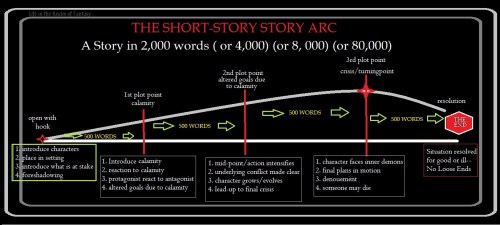
writer_at_work_nanowrimo_signI use a loose outline to break the arc of every story I write into acts, each with a specific word count. (I’ve included a graphic at the bottom of this post.)

A drabble may have only 100 words, but my process works the same as for a novel.

For a novel, I divide my outline this way: 10,000 or so words to open the story, set the scene, introduce the characters and get to the inciting incident. 50,000 or so words for the heart of the story. 10,000 or so words for the conclusion.

A micro fiction is outlined the same way:

  • I have about 25 words to open the story and set the scene.
  • I have about 50 – 60 for the heart of the story.
  • I give myself 10 – 25 words to conclude it.
  • The story must be told in precisely 100 words. (Not more, and not less—exactly 100 words.)

Writing micro fiction teaches you to tell a story without exposition.

However, you should save the clumps of exposition and backstory in a separate file because they do come in usefully as part of your world-building and character development exercises.

  • Every word you write and discard might be useful in a later story.
  • Label the file with a title that says what it is.
  • Save it in a master file that contains ideas for longer stories.

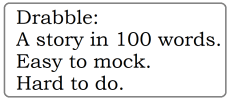
Drabble_LIRF_1_jan_2018_cjjapI mentioned rewards in the title of this post. The completed story is a small gift you give yourself, and the surge of endorphins you experience in that moment of “Yes! I can write after all!” are the reward.

When you write to a strict word count limit, every word is precious and must be used to the greatest effect. By shaving away the unneeded info in the short story, the author has more room to expand on the story’s theme and how it supports the plot.

I suggest you save your drabbles and short scenes in a clearly labeled file for later use. Each one has the potential to be a springboard for writing a longer work. Or you might want to submit it to a drabble contest.

Contests for micro fiction abound on the internet. Whether you choose to submit a drabble to a contest or hang on to it doesn’t matter. Either way, the act of writing micro fiction hones your skills, and you will have captured the heart of your brilliant idea.

Micro fictions are the distilled essence of novels. They contain everything the reader needs to know about that one moment in time. The reader wants to know what happens next.

You will have succeeded in writing your story, and that success is a reward in itself.

short-story-arc

25 Comments

Filed under writing

#FineArtFriday: View to a Clearing by Albert Bierstadt (revisited)

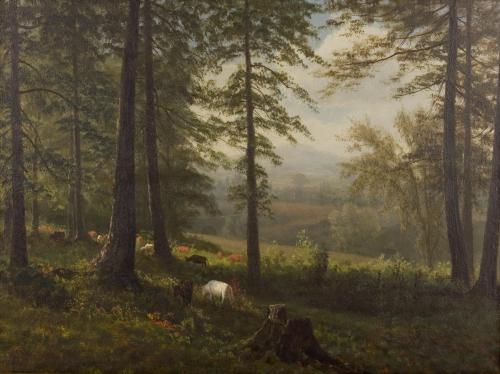
Title: View to a Clearing by Albert Bierstadt

Medium: oil on paper mounted on canvas

Dimensions: Height: 14 in (35.5 cm); Width: 19 in (48.2 cm)

Inscriptions: Signature bottom left: ABierstadt

What I love about this painting:

I first posted this painting a year ago. Sometimes life gets ahead of us, and we just need moment of serenity, a chance to relax and let go of stress. Life is a little hectic right now, with sorting through the possessions we’ve acquired over the years of living in this house. A box filled with corkscrews … how many does one family need?  A shopping bag packed with coaxial cables and no hint of what they were once connected to. What were we saving these for? And then there are the things people give you that you wouldn’t have bought for yourself, but which you now own and feel guilty for not appreciating.

We are moving those things on, donating them to Value Village, a store where someone else will want them and love them as they deserve. Today’s picture is a moment in time, a day long ago, but which is exactly what I needed on this dark and rainy March day.

I love the peace of this scene, one of Bierstadt’s quieter paintings.  The muted colors, the rising mist, the filtered light, and the cattle grazing show us a hazy afternoon. It was perfect for a picnic, for mind-wandering, and a good day for painting.

Bierstadt is one of my favorite artists because he was often over the top, a little fantastic, and usually epic. He saw drama in nature and painted it, and like every good storyteller, his imagination filled in the blanks, employing powerful imagery to show his stories.

About the artist, via Wikipedia:

Despite his popular success, Bierstadt was criticized by some contemporaries for the romanticism evident in his choices of subject and his use of light was felt to be excessive. Some critics objected to Bierstadt’s paintings of Native Americans on the grounds that Indians “marred” the “impression of solitary grandeur.”

Interest in Bierstadt’s work was renewed in the 1960s with the exhibition of his small oil studies.  Modern opinions of Bierstadt have been divided. Some critics have regarded his work as gaudy, oversized, extravagant champions of Manifest Destiny. Others have noted that his landscapes helped create support for the conservation movement and the establishment of Yellowstone National Park. Subsequent reassessment of his work has placed it in a favorable context, as stated in 1987:

The temptation (to criticize him) should be steadfastly resisted. Bierstadt’s theatrical art, fervent sociability, international outlook, and unquenchable personal energy reflected the epic expansion in every facet of western civilization during the second half of the nineteenth century.

Bierstadt was a prolific artist, having completed over 500 paintings during his lifetime.


Credits and Attributions:

Wikimedia Commons contributors, “File:Albert Bierstadt – View to a Clearing.jpg,” Wikimedia Commons, the free media repository, https://commons.wikimedia.org/w/index.php?title=File:Albert_Bierstadt_-_View_to_a_Clearing.jpg&oldid=343092014 (accessed March 5, 2021).

Wikipedia contributors, “Albert Bierstadt,” Wikipedia, The Free Encyclopedia, https://en.wikipedia.org/w/index.php?title=Albert_Bierstadt&oldid=1009967730 (accessed March 5, 2021).

12 Comments

Filed under writing

Worldbuilding part 3 – Visualizing flora and fauna #amwriting

Every now and then, I come across a book where the protagonist finds themselves dealing with the dangerous creatures inhabiting that place. I especially loved the way man and tiger developed a wary cohabitation in Life of Pi.

WritingCraftWorldbuildingStrange beasts are a common trope in speculative fiction.

We all approach this aspect of our work differently. Lindsay Schopfer‘s Beast Hunter series is one series of books where this is done well. When planning this post series, I asked Lindsay how he approached designing his beasts.

Connie: “Is Kelton’s world a colonized planet? If not, what natural mechanism spawns the creatures in your Beast Hunter world?”

Lindsay: Of all the questions I get asked by fans, yours is probably the most common. Folks want to know where the beasts come from in the Adventures of Keltin Moore. The truth is, I’ve intentionally not answered that question for a long time. I consider it the single biggest conceit of Keltin’s stories, which is why I work so hard to make other elements in the story feel as authentic as possible.

the beast hunterSo, why do I feel the need to be so vague on a subject that fans are obviously interested in? The original idea for Keltin Moore’s world came from a RPG video game, which is one of the main reasons why the series shares many conventions with role-playing games, including the presence of a variety of dangerous creatures in an otherwise ‘normal’ world. While some games may give token explanations for their wandering monsters, the majority of enemy units in these games are just accepted as a part of the RPG world, no more unusual than ability cool-downs or health regenerating potions.

Of course, there’s a second, more deeper level to this question. Whether or not I choose to tell the fans where my beasts come from, do I, as the author, know what their origins are? Honestly, I have an idea, but it isn’t set in stone. This felt like a dirty secret of mine until very recently as I was rereading my collection of Hellboy library editions by Mike Mignola.

Within the collection, there are several interviews and insights provided by the author, and I was shocked to learn how little Mignola actually knew about his own world. His methodology for building the mythos of Hellboy seems to have revolved around whatever interested him at the time that he was creating each individual element.

If some deeper meaning was necessary for fans, then it would be their responsibility to puzzle out these conclusions on their own.  While this kind of shoot-from-the-hip world building may be abhorrent to highly organized speculative fiction writers, it was very validating to an impulsive creative like me.

So, will I ever give a definitive answer of where the beasts in Keltin’s world come from? I don’t know. While it could be rewarding for both me and my fans, I’m also mindful of the fact that leaving some questions unanswered gives my readers more opportunities to share in the creative process with me.

After all, as soon as my books are published, they are no longer mine alone. They are also my readers’, and I owe it to them to give them the freedom to imagine their own explanations for questions left unanswered. If I ignore that, I run the risk of repeating the mistakes of other creatives that decided that they needed to answer all the questions on their own, resulting in a dissatisfying, authorial dictatorship. Metachlorians, anyone?

As he says, Lindsay doesn’t over-engineer anything, and that is his style. In his books, the plots revolve around the discovery of predatory creatures in a populated area and how the protagonists devise ways to hunt and kill them. Schopfer’s creatures feel as if they’re formed out of nightmares.

You can find his books on Amazon at this link: Amazon.com: Lindsay Schopfer: books, biography, latest update. I highly recommend his work.

Author-thoughtsI am more of a planner. Like Lindsay, some of my fantasy work is RPG game-based. My mind works in a linear, logical manner. In real life, if something anomalous to the native plants and animals exists, it arrived there via external means.

But I am curious monkey – I want to know how it got there. So, in Mountains of the Moon, (RPG game-based fantasy), the war of the gods resulted in a few creatures born from other worlds being cut off from returning to their home world.

These creatures are rare but have elemental magic to defend themselves and are often predatory. In the case of water-sprites, they are annoying but cute. As large predators do in real life, each beast has a preferred place to nest and a favored range where they will hunt. As in real life, this knowledge affects how people travel.

We don’t walk into a place where lions are known to hunt.

My beasts aren’t inherently evil but will hunt and kill humans for food and must be removed from inhabited areas. A culture of mercenaries exists to protect travelers and traders.

In my books, the origins of the rare beasts are not really discussed, but I know how they got there. I like knowing that, so I don’t contradict myself.

I don’t only write fantasy. Many of my short stories are contemporary fiction set here in the Pacific Northwest. I use the plants and animals native to the Puget Sound area, and that familiarity makes dressing each scene easy.

When I am writing fantasy, I take what I know and reshape it to fit my fantasy world. By using what I know, I can visualize as I am writing, and it emerges as an organic part of the background. I don’t have to explain it. It just is.

Our subconscious minds recognize the trees in our neighborhoods and the animals that call our areas home. We know how our part of the world looks and smells with each change of the seasons, just the same as we know that racoons or the neighbor’s dog will get into the trash can if you don’t bungee cord the lid down.

magicSuburban coyotes, racoons, possums, deer – they all make their living in our backyards. In real life, our local fauna is there, part of the environment. Some are predators, so we keep our cats inside and work around the wildlife as a matter of course.

When your characters walk out their front door, what do they see? I only notice our yard when the grass is too long or a favorite plant is in bloom. But I feel the chill a cold March wind brings from the west. I see the way the heat rises from the pavement in August. The local bird species might come and go with the seasons, but they are noisy, calling to each other off and on all day.

You may be a pantser like Lindsay, or you might be a planner like me. There is no one perfect way to do this.

No matter how you approach creating the plants and animals of your world, write them as if they’re just part of the scenery. The environment must be the background, set dressing that frames the narrative without taking over.

9 Comments

Filed under writing

World-building part 2 – Building Worlds from the Ground Up #amwriting

Geography rules our lives. In my area, an inlet of the Pacific Ocean, Puget Sound, dominates the landscape. Numerous rivers, two decently large mountain ranges, a bunch of volcanoes, and innumerable lakes and ponds impede travel in this part of the world. We are forced to build roads that follow these obstacles, go around them, or climb the lowest passes.
WritingCraftWorldbuildingHere, the shoreline of Puget Sound determines the path of the interstate highway. The major cities and towns are located where there are good deepwater ports.

The roads wind around these obstacles and add to the distance we must travel, increasing the time it takes to go from one place to another. In this part of the world, we cross bridges every day.

Building even rudimentary log bridges requires engineering, but humans have been making them since before we discovered fire. If you want your log to stay put, you must drop it where

  • It won’t roll away.
  • It won’t be washed away.
  • It will bear your weight.
  • It will reach the other side with enough clearance that you can safely travel across it without its falling into the chasm or water.
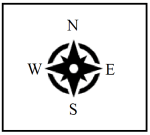
compass roseIf you are designing a fantasy world, you might want to make a pencil-drawn map. Place north at the top, east to the right, south to the bottom, and west to the left. Those are called cardinal points. Placing the north at the top and the directions east, south, and west following at 90-degree intervals in the clockwise direction is standard in modern maps.

Even if your story is set in a town, a map will help you avoid contradictions. Knowing which direction they are going at the outset is critical if your characters travel from one spot to another. The lines and scribbles you add to your map are the information you can use to check for consistency in your narrative.

I use a pencil so I can easily make changes to my map as the story evolves during revisions. My first maps for any given novel aren’t fancy. But I do suggest you lay your map out like a standard real-world map.

Forests and meadows like water. The climate of an area will be affected by the placement of mountains. Mountain ranges running north and south create what is known as a rain shadow.

This is demonstrated by the radical difference in climate and fauna within my state of Washington. Wikipedia says:

The high mountains of the Cascade Range run north-south, bisecting the state. In addition to Western Washington and Eastern Washington, residents call the two parts of the state the “Westside” and the “Eastside,” “Wet side” and “Dry side,” or “Timberland” and “Wheatland,” the latter pair more commonly in the names of region-specific businesses and institutions. These terms reflect the geography, climate, and industry of the land on both sides of the Cascades. [1]

A river may emerge from a mountain spring or a glacier, but it will flow downhill to a valley where it will either continue on to the ocean or will pool and form lakes and ponds. Farms are usually situated on flood plains or near sources of water.
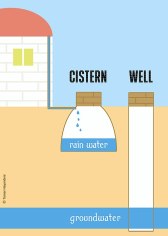
512px-Well-cisternAccess to water is crucial to life and prosperity. Humans have long understood the value of clean water for drinking, and you can’t count on getting that from streams or pools. Wells and the technology to make them have been around for a very long time. Cisterns have too, collecting rainwater for drinking and irrigation.

The oldest reliably dated well is from a neolithic site on the island of Cyprus. It has been dated to around 8400 BC and consists of a round shaft driven through limestone. The well tapped into an aquifer at a depth of 8 meters or 26 feet.

On your fantasy map, rivers, mountains, lakes, and ponds will impede travel, forcing a road to go around them.

Those detours will add to the distance and increase the time it takes to travel using whatever the common mode of transportation is for your chosen level of technology.

Having a realistic grip on the length of time it takes to go places is critical to keeping the narrative believable. I keep a calendar of events for each novel, which has saved me several times.

Maybe you aren’t artistic, but you want a nice map for your book. The little scribbled map you make to keep your narrative logical will enable a map artist to provide you with a beautiful and accurate product. An artist can give you a map containing the information readers need to enjoy your book.

Are changing seasons a part of your story?

In a first draft, it’s challenging to fit the visual world into a narrative without dumping it on the page because you are in the process of inventing it. Don’t worry about fine details when you are laying down the story. Go ahead and write “It was autumn” when you have an action scene that must be shown.

A blunt statement like that is a code embedded there for you to expand on in the second draft. It is there to enable you to get the story out of your head and move on.

However, in the revision process, I take those three words, it was autumn, and change them up, using them to lead into the action.

Ivan drew his cloak around himself, listening to the soft rattling of branches moving with the breeze. The occasional calls of night birds went on around him, as if he weren’t full of doubt and indistinct fears, as if he didn’t exist to them. Leaves fell, brown and harvest-dry, drifting, spiraling down to the forest floor.

When it comes to geography, the “three S’s” of worldbuilding are critical: sights, sounds, and smells. Those sensory elements create what we know of the world. What does your character see, hear, and smell? Taste rarely comes into it, except when showing an odor.

Moira slipped the egg into the bag. It was the smallest but was far heavier than she’d thought. It took all her strength to carry it back to the entrance. She moved from boulder to boulder until she disappeared into the shrubbery. At last, hidden in the thick undergrowth, she breathed deeply. The metallic aftertaste of terror and bitter air lingered in her imagination, overriding the musty scents of earth and leaves and the rank odor of dragon scat.

Now she had to wait until the beast returned and went back inside its lair. Moira wrapped herself and the egg inside her cloak, blending into the underbrush. “Don’t worry, little one. I’ll keep you safe and warm.” She felt justified in her theft; the little dragon would never have survived the hatching frenzy. The others would have devoured it.

In my part of the world, the native forest trees are mostly Douglas firs, western red cedars, hemlocks, big-leaf maples, alders, cottonwood, and ash. Because I am familiar with them, these are the trees I visualize when I set a story in a forest.

My husband and I once drove from Olympia Washington to Grand Marais, Minnesota. After leaving the rolling prairies of North Dakota, we went through many miles of birch forests—something I had never seen. I was surprised at how short the vast woodlands we passed through were as compared to the dizzying heights of the forests near my home.
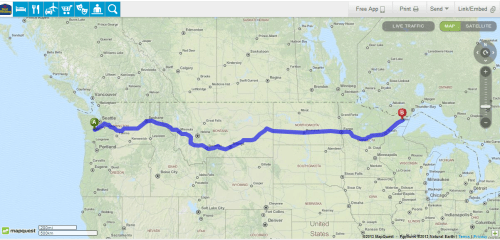
map quest to Grand Marais MinnesotaThose birch trees were nowhere near as tall as the giant cedars and Douglas firs I was familiar with. But once you were away from the road, the birch forests became dark jungles, tangled and mysterious.

Cities have complex geography and an environment that is theirs alone. It is created by the city’s original terrain and the materials its founders used to develop the architecture. Tall buildings loom, creating canyons through which we must pass on our way to wherever.

The odors and sounds of modern 21st-century life are essential components of worldbuilding in a contemporary novel. Cell phones, the bells and alerts of appliances, traffic sounds—we live in a noisy world. The way the streets sound to pedestrians is a crucial element of modern city life.

But villages have always had sounds and smells that are unique to human habitations. We have always created communities where resources are plentiful, but over time, climate changes. When it does, we adapt.

History and geology tell us that what was once a good place may become a desert over time. Your narrative will mention all the terrain your characters must deal with, and a little map scribbled on notepaper will help you keep things on track.

Next up: Visualizing the flora and fauna of the world. No matter where your story is set or the era it is set in, there will be life of some sort–even on a moon where you are that life.

Previous in this series: Worldbuilding part 1 – Checklist for Creating Societies


Credits and Attributions:

[1] Wikipedia contributors, “Washington (state),” Wikipedia, The Free Encyclopedia, https://en.wikipedia.org/w/index.php?title=Washington_(state)&oldid=1142551716 (accessed March 5, 2023).

Image: Wikimedia Commons contributors, “File:Well-cistern.jpg,” Wikimedia Commons, the free media repository, https://commons.wikimedia.org/w/index.php?title=File:Well-cistern.jpg&oldid=730998786 (accessed March 5, 2023).

13 Comments

Filed under writing

Worldbuilding part 1 – checklist for creating societies #amwriting

Worlds are comprised of plants, animals, and geology. But if intelligent life forms live in that world, societies will also exist.

WritingCraftWorldbuildingWe humans are tribal. We prefer an overarching power structure leading us because someone has to be the leader. We call that power structure a government.
As a society, the habits we develop, the gods we worship, the things we create and find beautiful, and the foods we eat are evidence of our culture.

If your society is set in modern suburbia, that culture and those values will affect your characters’ view of their world. You will still have to build that world on paper. But the information and maps are all readily available, perhaps in your own backyard.

But what if you are writing a sci-fi or fantasy novel? You must create the background material to show your world logically and without contradictions.

  • Authors must know how society works in their created cities and towns.
  • They must know the technology whether it is set in a medieval world or on a space station.

Merchants, scientists, priests, soldiers, teachers, healers, thieves – no matter the setting, each occupation has specific technology. They may also have a place in the social hierarchy, people they can and cannot associate with.

Society is always composed of many layers and classes. Below is a list of what I think of as “porch questions.”

This is the stage where I sit on the back porch and consider the world my characters will inhabit. Going somewhere quiet and pondering these questions brings clarity to my vague ideas.

The following is a list of points to consider when creating a society. Feel free to copy and paste it to a page you can print out. Jot the answers next to the questions and refer back to it if the plot raises one of these questions.

How is your society divided? Who has the wealth?

  • Is there a noble class?
  • Is there a servant class?
  • Is there a merchant class
  • Is there a large middle class?
  • Who makes up the most impoverished class?
  • Who has the power, men or women—or is it a society based on mutual respect?

Ethics and Values: What constitutes morality, and how do we treat each other?

  • Is marriage required?
  • How are women treated?
  • How are men treated?
  • How are the different races viewed?
  • Is there a cisgenderbias, or an acceptance of different gender identities?
  • How are same-sex relationships viewed?
  • How are unmarried sexual relationships seen in the eyes of society?
  • How important is human life?
  • How is murder punished?
  • How are betrayal, hypocrisy, envy, and avarice looked upon?
  • What about drunkenness?
  • How important is the truth?
  • What constitutes immorality?
  • How important is it to be seen as honest and trustworthy?
  • What is taboo? What is “simply not done” among that group?

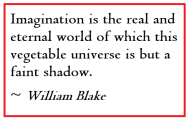
WilliamBlakeImaginationLIRF05072022Power structures are the hierarchies encompassing the leaders and the people with the power. Government is an overall system of restraint and control among selected members of a group. Think of it as a pyramid, a few at the top governing a wide base of citizens.
Religion is rarely a sci-fi trope but often figures prominently in fantasy work. In sci-fi, science and technology often take the place of religion or are at odds with it. They both have similar hierarchies and fanatics, but with different job titles.

Archbishop might be replaced with Head of Research and Development.

Cardinal or Pope might be replaced with GeneralAdmiral, or CEO (Chief Executive Officer).

Level of Technology: What tools and amenities are available to them? What about transport?

  1. Hunter/Gatherers?
  2. Agricultural/farming?
  3. Greco-Roman metallurgy and technology?
  4. Medieval metallurgy and technology?
  5. Pre-industrial revolution or late Victorian?
  6. Modern-day?
  7. Or do they have a magic-based technology?
  8. How do we get around, and how do we transport goods? On foot, by horse & wagon, train, or space shuttle?

Government: There will be a government somewhere, even if it is just the local warlord. Someone is always in charge because it’s easier for the rest of us that way:

  1. Is it a monarchy, theocracy, or a democratic form of government?
  2. How does the government fund itself?
  3. How are taxes levied?
  4. Is it a feudal society?
  5. Is it a clan-based society?
  6. How does the government use and share the available wealth?
  7. How do the citizens view the government?

Crime and the Legal System: What constitutes criminal behavior, and how are criminals treated?

Foreign Relations: Does your country coexist well with its neighbors?

  • If not, why? What causes the tension?
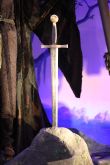
Excalibur London_Film_Museum_ via Wikipedia

Excalibur, London Film Museum via Wikipedia

Waging War: This is another area where we have to ask what their level of technology is. It is critical for you, as the author, to understand what weapons your characters will bring to the front. You must also know what the enemy will be packing. Do the research and choose weaponry that fits your established level of technology.

  • What kind of weaponry will they use?
  • How are they trained?
  • Who goes to battle? Men, women, or both?
  • How does social status affect your ability to gain rank in the military?

A common trope in fantasy is magic, which brings up the need to train magic-gifted people. Do your sorcerers/mages rely on

  • dumb luck and experimentation?
  • apprenticing to sorcerers?
  • training by religious orders?
  • or as in the case of Harry Potter, a school of some sort? What are the rules of your magic?

The Church/Temple is the governing power in many real-world historical societies. The head of the religion is the ruler, and the higher one rises within the religious organization, the more power one has. The same is true of both universities and research facilities.

Power in the hands of only a few people offers many opportunities for mayhem. Zealous followers may inadvertently create a situation where the leader believes they are anointed by the Supreme Deity. Even better, they may become the God-Emperor/Empress.

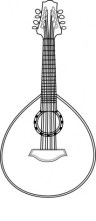
lute-clip-artThe same sort of God complex occurs among academicians and scientists. Some people are prone to excess when presented with the opportunity to become all-powerful.

If you were unsure what your plot was before you got to this stage, now you might have a real villain, one presented to you by your society.

What sort of society do you envision in your world? How does that culture shape your characters?

Being the leader means bearing responsibility when things go wrong. Scrambling to keep things afloat occurs far more often than basking in the glory.

When things are going well, it’s good to be the queen.

However, the Tiara of Shame weighs heavily when things go awry—and that is when we have a story.

19 Comments

Filed under writing

Characterization – The Art of Naming Characters #amwriting

When laying down the first draft of a work in progress, I always give every walk-on a name, right down to the dog. I generally write with an outline, but during NaNoWriMo, my stream of consciousness takes over, and the story veers away from the outline.

namesOnce NaNoWriMo is over, I try to shave my cast of thousands down to a reasonable level.
What is the optimal number of characters for a book? Some say only four, others fifteen. I say introduce however many characters it takes to tell the story but use common sense.

I now have 3 hard and fast rules for deciding who should be named and who should not. Sometimes I am good at following them. Other times—not.

  1. Is this character someone the reader should remember?Even if they offer information the protagonist and reader must know, it doesn’t necessarily mean they must be named. Throw-away characters provide clues to help our protagonist complete their quest. Also, they can show us something about the protagonist and give hints about their personality or past.
  2. Does the person return later in the story, or are they just set dressing? Are they part of the scenery of, say, a coffee shop or a store? They don’t need a name if they are only a component of world-building.
  3. Only give names to characters who advance the plot.

In my experience as a reader, the pacing an author is trying to establish comes to a halt when a character who is only included for the ambiance has too much time devoted to them. If they are set dressing, they should be nameless.

When we are writing a scene, ask yourself these questions:

  • Do these people advance the plot?
  • Do they help or hinder the protagonist in some crucial way?
  • Do they provide essential background information we won’t get any other way?
  • Is their presence a necessary part of world-building?

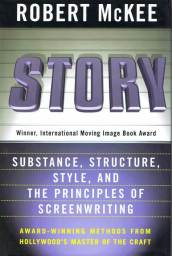
storybyrobertmckeeTake a second look at the characters in each scene and remove those with no real purpose. (Save everything you cut in a separate file—you might want to reuse these characters someday.)
This is true of a novel, a screenplay, or a short story. Names alert us, telling us a character will have an important role in the story.

  • Ask yourself if the character is an example of “Chekhov’s Gun.”
  • Does this character serve a purpose the reader must know? If not, don’t give them a name.

Novelists can learn a lot about writing a good, concise scene from screenwriters.

  • An excellent book on craft, and one I highly recommend, is Story by Robert McKee.

We want the reader to stay focused on the protagonist(s) and their story. In the second draft, we hunt for the distractions we may have inadvertently introduced in our first draft. Having too many named characters in a scene is easy to fix.

  • We remove side characters from the scene if they have nothing to contribute.
  • Walk-on characters can be identified in general terms. The reader will move on and forget about them.

When Joley entered the café, all the seats were taken but one at the counter between a man in paint-stained coveralls and a woman with a briefcase at her feet. She caught Nathan’s eye, and he brought her a coffee. “We need to talk,” she whispered.

“I get off at four,” he replied. He refilled several coffees at the counter, then carried the pot to the tables.

The tendency to make every character a memorable person is one we can’t indulge. The reader will become confused if too many characters are named.

When I first began writing full-time, I learned a lesson the hard way about naming characters. I have a main character named Marya in one of my early novels, and she’s central to the series. Also, in the first book, a side character was important enough to have a name, but my mind must have been in a rut when I thought that one up. For some stupid reason, I named her Marta.

You can probably see where this is going—the two names are nearly identical.

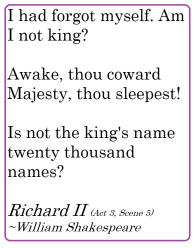
name quote, richard II shakespeareWhat is even worse, halfway through the first draft of the second book in the series, Marta suddenly was a protagonist with a significant storyline. She actually becomes Marya’s mother-in-law in the third book. Fortunately, I was in the final stage of editing book one for publication. I immediately realized I had to make a major correction: Marta was renamed Halee.
But how do names play out in real life? In my family, “Robert” is a recurring name.

My father was named Robert, and my two brothers are both named Robert (with different middle names). My mother’s younger brother is also a Robert. My younger brother’s son is named Robert, as is his son. We have a Bob, a Little Bob, a Rob, a Bobby, a Robby, and a Quatro. Two Bobs are no longer with us, but the confusion continues with each new generation of Roberts in our family.

I took this absurdity to an extreme in Billy Ninefingers. In Waldeyn, the most common boy’s name is William, which is why Billy MacNess embraces the name his mercenaries give him after the injury – Billy Ninefingers. In that novel, anyone named William generally goes by their last name or their trade. Think Mason, Sawyer, etc., etc.

Other than Billy Ninefingers, where the overuse of one name was intentional and integral to the story, my personal rule is to NEVER name two characters so that the first and last letters of their names are the same.

I try never to have two names that begin with the same letter, but that becomes difficult.

But in a scene, who should go and who should stay? And what is the optimal number of characters for a book? Some say only four, others fifteen.

I feel an author should introduce however many characters it takes to tell the story but should also use common sense.

One last thing to consider: how will that name be pronounced when read aloud? You may not want to get too fancy with the spelling, so a reader can easily read that name aloud. You may not think that matters, but it does.

I read Tad Williams’ Memory Sorrow and Thorn series aloud to my youngest daughter when she was old enough to appreciate and understand it. (I was too cheap to pay for cable television, and it kept my teenager from being bored.) I will just say that while his narrative is brilliant and engrossing, many of those names took some practice to say without stumbling.

Epic Fails meme2Names are also a component of world-building. While recording Tales from the Dreamtime, a novella consisting of three fairy tales, my narrator had trouble pronouncing the names of two characters. This happened because I had written the names so they would feel foreign and look good on paper.
Despite my experience of reading fantasy books aloud to my children, it didn’t occur to me that the names were unpronounceable as they were written. We ironed that out, but that hiccup taught me to spell names the way they’re pronounced whenever possible.

In conclusion, don’t confuse your readers by giving unimportant walk-on characters names.

Never give two characters names that are nearly identical.

Do consider making your spellings of names and places pronounceable just in case you decide to have your novel made into an audiobook.

18 Comments

Filed under writing

#FineArtFriday: The Milkmaid by Johannes Vermeer (revisited)

What I love about this painting:

It seems like a good time to revisit Vermeer’s famous painting, known as “the Milkmaid.” This is lovely look into the past, a window into daily life of 1657 – 1658. I love the realism, the way the maid carefully pours the milk into the bread.

All of Vermeer’s known works illustrate how the quiet moments in life can be the most profound.

Wikipedia has many things to say about this painting.


About Johannes Vermeer, the Master of Light (from Wikipedia)

Johannes Vermeer (October 1632 – December 1675) was a Dutch painter who specialized in domestic interior scenes of middle-class life. He was a moderately successful provincial genre painter in his lifetime but evidently was not wealthy, leaving his wife and children in debt at his death, perhaps because he produced relatively few paintings.

Vermeer worked slowly and with great care, and frequently used very expensive pigments. He is particularly renowned for his masterly treatment and use of light in his work.

Vermeer painted mostly domestic interior scenes. “Almost all his paintings are apparently set in two smallish rooms in his house in Delft; they show the same furniture and decorations in various arrangements and they often portray the same people, mostly women.”

He was recognized during his lifetime in Delft and The Hague, but his modest celebrity gave way to obscurity after his death. He was barely mentioned in Arnold Houbraken‘s major source book on 17th-century Dutch painting (Grand Theatre of Dutch Painters and Women Artists), and was thus omitted from subsequent surveys of Dutch art for nearly two centuries. In the 19th century, Vermeer was rediscovered by Gustav Friedrich Waagen and Théophile Thoré-Bürger, who published an essay attributing 66 pictures to him, although only 34 paintings are universally attributed to him today. Since that time, Vermeer’s reputation has grown, and he is now acknowledged as one of the greatest painters of the Dutch Golden Age. [2]

About the featured painting, The Milkmaid, also from Wikipedia:

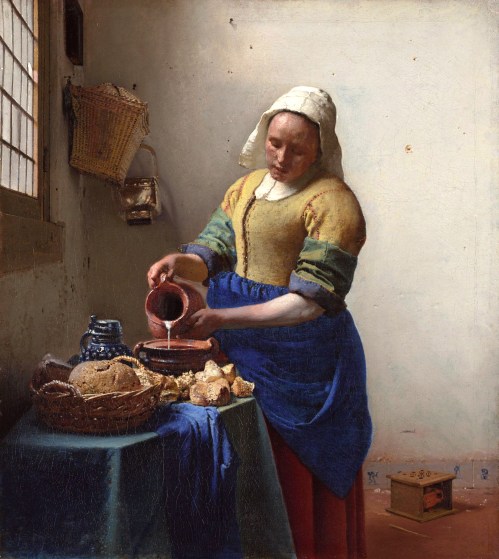
Despite its traditional title, the picture clearly shows a kitchen or housemaid, a low-ranking indoor servant, rather than a milkmaid who actually milks the cow, in a plain room carefully pouring milk into a squat earthenware container (now commonly known as a “Dutch oven”) on a table. Also on the table are various types of bread. She is a young, sturdily built woman wearing a crisp linen cap, a blue apron and work sleeves pushed up from thick forearms. A foot warmer is on the floor behind her, near Delft wall tiles depicting Cupid (to the viewer’s left) and a figure with a pole (to the right). Intense light streams from the window on the left side of the canvas.

The painting is strikingly illusionistic, conveying not just details but a sense of the weight of the woman and the table. “The light, though bright, doesn’t wash out the rough texture of the bread crusts or flatten the volumes of the maid’s thick waist and rounded shoulders”, wrote Karen Rosenberg, an art critic for The New York Times. Yet with half of the woman’s face in shadow, it is “impossible to tell whether her downcast eyes and pursed lips express wistfulness or concentration,” she wrote.

“It’s a little bit of a Mona Lisa effect” in modern viewers’ reactions to the painting, according to Walter Liedtke, curator of the department of European paintings at The Metropolitan Museum of Art, and organizer of two Vermeer exhibits. “There’s a bit of mystery about her for modern audiences. She is going about her daily task, faintly smiling. And our reaction is ‘What is she thinking?'” [1]


Credits and Attributions:

The Milkmaid, by Johannes (Jan) Vermeer ca. 1658 [Public domain or Public domain], via Wikimedia Commons.

[1] Wikipedia contributors, “The Milkmaid (Vermeer),” Wikipedia, The Free Encyclopedia, https://en.wikipedia.org/w/index.php?title=The_Milkmaid_(Vermeer)&oldid=853243011 (accessed August 31, 2018).

[2] Wikipedia contributors, “Johannes Vermeer,” Wikipedia, The Free Encyclopedia, https://en.wikipedia.org/w/index.php?title=Johannes_Vermeer&oldid=854172655 (accessed August 31, 2018).

7 Comments

Filed under #FineArtFriday, writing

Writing through the Block #amwriting

We all have moments where our creativity has failed us. Maybe we had an idea, but the words wouldn’t come. Or when they did, they felt stilted, awful. We feel alone and isolated in this because we are writers. The words are supposed to flow from our fingers like water down the Columbia River.

MyWritingLife2021BSome people call this writers’ block. I think of it as a temporary lull in my creativity.

I have learned to write my way through these dry spells. Usually, the work I produce at that moment is awful, and I wouldn’t share it with anyone. But I am a professional writer and the act of writing every day keeps me fit and in the habit of working.

Writing is like participating in sports or playing a musical instrument. We must practice if we want to be good at it. Doing well at writing requires some discipline on our part. I lose my momentum and purpose when I stop writing for any reason.

I lose my passion for my work.

At times, we come to a place where we can’t think of what to write. It happens to everyone, and we each handle it differently. I will share how I deal with lulls in creativity—and I know it’s not a one-size-fits-all solution.

Before we begin, I suggest you save the file you are working on, the one you can’t seem to make headway on. Close it, and delete nothing. You will be able to use this work later, so file it properly.

mindwanderingLIRF02212023Sometimes, the problem is that your mind has seen a shiny thing, a different project that wants to be written, and you can’t focus on the job at hand. If that is the case, work on the project that is on your mind. Let that creative energy flow, and you can reconnect with the first project once the new project is out of the way.
For me, writer’s block manifests not as a block per se. It will appear as an inability to visualize a scene I must write to advance a story. If I can’t picture it, I can’t describe it.

That can be quite frustrating.

Unfortunately, some people have a different experience, one where they have no words whatsoever. They try, they struggle, and nothing comes to them.

This creates a kind of trauma. Once a person has experienced that moment of complete inability, fear of being unable to write can magnify the problem until it paralyzes them.

So what do I do when the words don’t come?

First, I open a new document. At the top of this document, I type: Where I Am Today.

  • I look around myself and see the room I am in, trying to see it with a stranger’s eyes.
  • I briefly describe what the stranger might see on entering that room.
  • Then I describe how I feel sitting in that place at that moment in time.

I write two or three paragraphs just to prove I can do it.

Next, I go somewhere else and take my notebook. I am a stranger there, so I write three more paragraphs detailing how I fit into that new space and how it makes me feel.

You could do this at the mall, a coffee shop, or the parking lot at the supermarket.

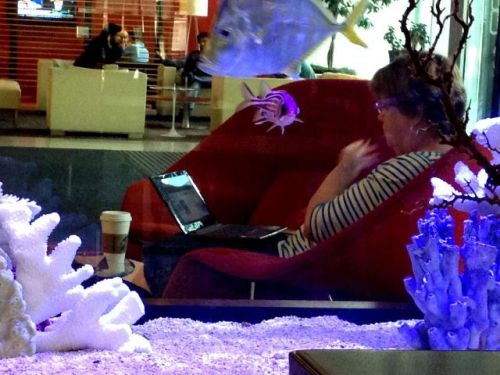
Me working in a starbucks, through the fishbowl, copyright Dan Riffero 2013

Me writing in a Seattle Starbucks, taken through a fish tank. I was the big fish in that tank! Photo by Dan Riffero.

The last exercise is more abstract: Where do I want to be? I visualize it and describe my imaginary scene as if I am looking at it.

I want to walk along the high-tide mark on a foggy beach. I want to hear the gulls and the waves. I want to feel at peace again.

It’s weird but writing about nothing in particular is like doodling. It is a form of mind wandering. It can jar your creative mind loose. With perseverance, you will be writing your other work again.

Everyone has family, jobs, and external demands that limit their writing time. Sometimes the world gets in the way of writing. We might feel unwell or have too many things to accomplish and not enough time to get it all done.

WilliamBlakeInfinityAndEternityLIRF05072022In my real life, getting our house ready to put on the market saps my creativity, but I am muddling along. Boxes here and there, getting rid of this and that—it’s exhausting. Sometimes I don’t have the energy to write.

But I sit down and get at least 100 words on paper just to prove I can. That usually leads to a more productive writing session.

The most important thing is to care for my family first. Sometimes just doing laundry can jar an idea loose, and I feel incredibly productive at the same time.

However, when I am stuck for words to write, the most important thing I do is to sit somewhere quiet and let my mind wander.

Daydreaming is good for you. It boosts the brain, making our thought process more effective. Apparently, letting the mind wander allows a kind of ‘default neural network’ to engage when our brain is at wakeful rest, like in meditation, unlike when it’s actively focused on the outside world.

Book- onstruction-sign copyWhen we daydream, our brain is free to process tasks more effectively.
This is good to know because I spend an astounding amount of time daydreaming, and I would hate to be simply wasting time.

This is how my mind works. I hope that what works for me will work for you. Remember, if you are suffering from a temporary dry spell, you are not alone. We all go through those times.

When you want to talk about it, you will find friends here.

14 Comments

Filed under writing

Characterization: Layers of a Scene #amwriting

Our characters feel real to us, their creators, but the trick is making them seem natural to our readers.

WritingCraftSeries_character-arcWhen I begin writing a first draft, I try to approach writing each scene as if I were shooting a movie. We know that each conversation is an event that must advance the story, but it must also give us glimpses of who each person is.
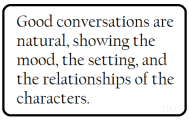
To that end, dialogue must do at least one (if not all) of these things:

  • Offer information the characters are only now learning.
  • Show the state of mind the characters are experiencing.
  • Show the relationship of the characters to each other.
  • Show the relationship of the characters to their world.

However, dialogue is only one layer of the scene. We try to establish the world environment in the opening pages but world-building is an ongoing task and is a foundational layer of each scene.

  • We continue world-building by showing our characters as they interact with the immediate environment.

In the first stage of the rough draft, I sit down and picture the characters and their relationships, with those goals in mind.

  • Then, I write just the dialogue for several back-and-forth exchanges. I use minimal speech tags for this because I want to get the discussion written down the way I hear it.

I do this in short bursts, getting the basic words down. It’s a two-stage process—the scenery and background get filled in after the dialogue has been written. Here is an example of four lines of dialogue:

Ann: “What are you doing?”

Jon: “Oh, just drawing.”

Ann: “Drawing what?”

Jon: “You’ll laugh or find a reason to mock me for it.”

good_conversations_LIRFmemeHaving the fundamentals of the conversation to work with sharpens the scene in my mind, enabling me to frame it properly. Once I know what they are talking about and have the rudimentary dialogue straight, I add the scenery. Then, I insert the props and add the speech tags. The interaction grows, shedding more light on their relationship.
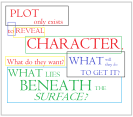
So let’s take those four lines of dialogue and set them in a kitchen. We have two characters who are wary of each other and have radically different views of their relationship.

The following day, when Ann came down for coffee, she found her stepson was once again working on something in his sketchbook. He stood when she entered, gathering his pens. “The coffee should be ready.”

“What are you doing?” Ann’s clipped tones cut the silence.

“Oh, just drawing.”

“Drawing what?”

Jon’s expression was closed, indecipherable. “You’ll laugh or find a reason to mock me for it.” He shut his sketchbook and stood, intending to leave her to her breakfast.

“Show me. Please.” When Ann repeated her demand, he reluctantly opened the book. Page after page was covered in stylized dragons, leafy vines, and runes. “Why do you waste your time with this crap? You could be brilliant, but no. People want real art, not fairies and dragons.”

“Art is not reserved just for some elite aficionado. Everyone has a different idea of it, and what appeals to you doesn’t appeal to everyone. This is how I earn my living, even though it’s not up to your standards.”

Ann poured herself a cup of coffee. “You could do so much better. I’ve tried to steer you toward success, but—”

“Stop it. I’m happy with my life.” Jon reclaimed the sketchbook. “Tim was right. Coming back was a mistake. We did it because Dad asked us to and because it’s Christmas.” He opened the door to the dining room. “Enjoy your breakfast, and don’t start in on Tim when he gets up.” The door closed behind him.

Ann gripped her cup. Where had she gone wrong? Why couldn’t the boys see how much she cared? All she had ever wanted was for them to be successful and happy.

Plot-exists-to-reveal-characterMy above sample is not perfect, as it is from the first draft of a short story I never actually finished, but you get the idea. We learn more about the characters’ relationship with each other and see their place in this environment. The layers that form this scene are:
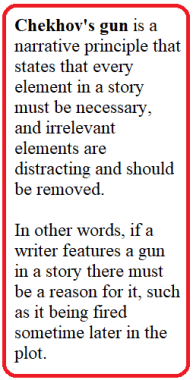
Action: Jon, one of our protagonists, has risen first and made coffee. He sits in the kitchen drawing in his sketchbook. An adversarial conversation ensues. Later he gathers his pens, stands, and leaves the room.

Dialogue: The conversation illuminates long-simmering differences between the two players and gives us a time reference—it’s Christmas. It also hints that the father wants the family to be reunited.

Internal Dialogue: Ann’s thoughts offer us the first glimpse of her reasoning. Tim and Jon are stepbrothers, but they were raised together and consider themselves brothers. Ann loves them fiercely, Jon as much as Tim, and we see the first indication of her inner battle in the story. We learn more about the family dynamics that must be overcome if their Christmas is to be saved.

Environment: a kitchen, closed off from the rest of the house. In this story, the woman’s closed-off kitchen symbolizes her closed-off personality. The place that is the heart of a home is closed off.

As the story progresses, we find Ann is at odds with her own son as well as her stepson and is gradually losing her husband to dementia. She’s afraid and needs emotional support from Tim and Jon but is her own worst enemy.

No matter the plot or setting, each scene we write should be formed of layers:

  • environment
  • props
  • characters

chekhovs gun layers of a sceneSet dressing (the props you place in the scene) shows the immediate environment. Having characters interact with props provides opportunities to insert hints that a deeper backstory exists. However, only have them interact with props that are organic or crucial to the story. This eliminates the problem of Chekhov’s Gun.
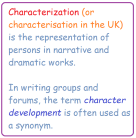
Because they are layered into the work, the scenery and props become unobtrusive. This allows the conversation to show the reader everything they need to know about our characters at a singular moment in time. It also gives us logical places for introspection and foreshadowing, integral aspects of pacing.

I can get the words down before I forget them by starting with the dialogue that will form the basis for each scene. Then I can concentrate on visualizing the conversation’s setting and decide what props to insert. The items I place in that scene must show something about the characters who interact with them.

As the story progresses along the plot arc, readers are gradually shown the world these characters live in. They will see that world without our having to dump a floor plan or itinerary on the reader. Remember our basic conversation?

“What are you doing?”

“Oh, just drawing.”

“Drawing what?”

“You’ll laugh or find a reason to mock me for it.”

We could put that exact dialogue and the notebook into a fantasy setting, sci-fi, or any other genre. The book’s plot would change what the conversation reveals about the two characters.

Each scene has a purpose, which is to reveal information and move the plot forward. All it takes is a few lines of dialogue and a moment of introspection on the part of the point-of-view character.

Characterization definitionBy beginning with the conversation and envisioning each scene as if I were filming a movie, I can flesh it out and show everything the reader needs to hang their imagination on. The reader’s mind will supply the details of the immediate setting depending on the clues I give.
We try to layer conversations and world-building to bring depth to our characters. When we do it right, the possibilities are endless.

18 Comments

Filed under writing

Characterization part 4 – Doling out the Backstory #amwriting

Every story has a past, a present, and hopefully, a future. The past shapes what we know as the here and now. The past also gives history to our characters, so when they first step onto the page, they are formed in the author’s mind and ready to begin their journey.

MyWritingLife2021Every writer knows the backstory is what tells us who the characters are as people and why they’re the way they are. At the beginning of our career, it seems logical to inform the reader of that history upfront. “Before you can understand that, you need to know this.”
As we progress, we learn not to drop the history of the intended conflict in the first five pages of a novel or to waste the first three paragraphs of a short story on it.

We understand that those are the pages and paragraphs editors look at first. From those pages, acquisitions editors will decide whether or not to continue reading the submission.

For those of us planning to go the indie route, those first five pages are what the prospective buyer sees in the “look inside” option when buying an eBook. For us, the prospective reader is the acquisition editor. They will buy the book if they like what they see on those pages.

Walls of fictional history muck up the transitions and negate our hooks. We know that infodumps block the doors from one scene to the next.

strange thoughts 2But knowing this and putting it into action are two different things.
So, how do our favorite authors deliver the backstory and still sell books?

First, they consider what must be accomplished in each scene and allow the backstory to inform the reader only when (and if) it’s needed to advance the plot.

Look at the first scene of your manuscript. Ask yourself three questions.

  1. Who needs to know what?
  2. Why must they know it?
  3. How many words do you intend to devote to it?

Dialogue, both spoken and internal, is the easiest way to dole out information but can be the gateway to an infodump.

  • Don’t give your characters long paragraphs with lines and lines and lines of uninterrupted dialogue. (Trust the voice of experience, please.)

Doling out the information is a double-edged sword, one all authors must learn to wield with skill. Beginnings must be active, yet those precious first lines must step onto the stage in such a way that they are original, informative, and engaging.

After we open with our best work, the passages and chapters that follow must reflect and build upon the tone and cadence of the opening pages. If not, the reader may be disappointed and choose to not buy any more books by us.

We’re all familiar with the term ‘flatlined,’ a medical expression indicating the patient has died. When the story arc is imbalanced, it can flatline in two ways:

  • Not enough backstory: The action becomes random, an onslaught of meaningless events that make no sense.
  • Too much backstory: The pauses become halts, long passages of random info dumps that have little to do with the action.

A good way to avoid this is to have your characters briefly discuss what is on their minds. Then they will bravely muck on to the next event, keeping the story moving at a good pace.

  • Don’t allow conversations to deteriorate into bloated exposition.
  • Do set forth the necessary information.

This can be accomplished in several ways. For my novels and short stories, I tend to write in either a close third-person or first-person point of view, so my comments in this post are geared toward that style of writing.

Short moments of introspection (thinking, reminiscing, etc.) offer opportunities for doling out new information essential to the story. Their thoughts shed light on how they really feel, illuminating their secret fears or voicing knowledge, giving it to the reader at the moment it is needed.

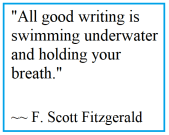
F Scott Fitzgerald on Good Writing LIRF07252022Be aware: if you are writing from an omniscient POV, this can be tricky and lead to “head-hopping,” which can lead to confusion on the reader’s part. When I change point-of-view characters, I do a hard scene or chapter break.
Letters and messages received or written can give needed information.

Conversations between witnesses and adversarial dialogues (quarrels) can shine a light on a festering past. But remember, if you go on for too long, your reader will either skip forward and miss what was really important or close the book and walk away.

Those are only a few ways to briefly open a window for the reader to see who the characters think they are and how the other characters see them. They offer a hint of how the characters became the way they are portrayed.

In the most gripping narratives I have read, character introspection is brief but delivers crucial information. Their internal monologues illuminate a character’s motives at a particular moment in the story arc, cluing the reader in on what is happening and why.

As the plot progresses, conversation and introspection are good opportunities to deliver information not previously discussed.

Consider the most popular genre: Romance novels. These things fly off the shelves. Why?

  • Because the path to love is never straightforward, and a reward awaits the reader who sticks with it.
  • Some characters will have an air of mystery about their past that isn’t fully revealed until the end.

The pacing in a Romance novel is crucial and is something all writers can learn from:

  • It speeds up (a small reward), and
  • Then it is slowed (dangling the carrot),
  • Then, it goes a little ahead (slightly larger reward),
  • But is slowed (enticement),
  • Finally, the two overcome the circumstances and things that have barred the way to their true happiness. (Gratification and endorphins abound.)

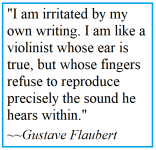
Flaubert on writing LORF07252022Romance novels average 50,000 to 70,000 words. In shorter novels, there is no room for sweeping, epic backstories. Instead, information and backstory are meted out only as needed through conversations and internal dialogue/introspection.
All obstacles to the budding romance are followed by small rewards that keep the reader involved and make them more determined to see the happy ending.

As a reader, I can say that a long-winded rant is not a reward.

This holds true in every book and story, regardless of genre: enticement, reward, enticement, reward. In all stories, complications create tension, and information is a reward.

The combination of those elements keeps the reader reading.

It’s difficult to see bloated exposition in my own work, but one trick I have found is this: word count.

I look at each conversation and assess how many words are devoted to each character’s statement and response. Then, when I come to a passage that is inching toward a monologue, I ask myself, “What can be cut that won’t affect the flow or gut the logic of this exchange? Can some of this be moved to a later conversation?”

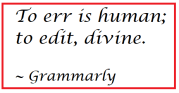
to err is human to edit divineEven with all the effort I apply to it, my editor will find things that don’t matter. She will gently take a metaphorical axe to it, highlighting that which doesn’t advance the story or add to the intrigue.

Sometimes we write brilliantly; other times, not so much. Sorting the diamonds from the gravel is hard when it comes to doling out the backstory, but your readers will be glad you made an effort.

16 Comments

Filed under writing